Operational Programme 2014 – 2020 – Version 1.1
Cornelia Krajasits Jiri Skoda Karl Reiner Manfred Kojan 25th March 2014strategy for smart, sustainable and inclusive growth and the achievement of economic, social and territorial cohesion
(Reference: Article 27(1) of Regulation (EU) No 1303/2013 of the European Parliament and of the Council1 and point (a) of Article 8(2) of Regulation (EU) No 1299/2013 of the European Parliament and of the Council2)
1.1 Strategy for the cooperation programme's contribution to the Union strategy for smart, sustainable and inclusive growth and to the achievement of economic, social and territorial cohesion
Description of the cooperation programme’s strategy to contribute to the delivery of the Union strategy for smart, sustainable and inclusive growth and to the achievement of economic, social and territorial cohesion.
1.1.1 The contribution of the programme to the EU 2020 strategy
The European Territorial Cooperation programmes contributed to the overall – economic, social and territorial – cohesion of the EU. They are intended to
complement the European mainstream programmes such as “rural development” or “investment for growth and jobs” programmes. They aim to strengthening cooperation structures in defined areas linked to activity fields of EU priorities, they want to create a common identity, an integrated physical space, a balanced
development and improved and harmonized policies and governance. The strategy of the AT-CZ programme is based on the following European documents:
Europe 2020
Territorial Agenda of the European Union 2020
Commission’s legislative package for the new Cohesion policy
1 Regulation (EU) No 1303/2013 of the European Parliament and of the Council of 17 December 2013 laying down common provisions on the European Regional Development Fund, the European Social Fund, the Cohesion Fund, the European Agricultural Fund for Rural Development and the European Maritime and Fisheries Fund and laying down general provisions on the European Regional Development Fund, the European Social Fund, the Cohesion Fund and the European Maritime and Fisheries Fund and repealing Council Regulation (EC) No 1083/2006 (OJ L 347, 20.12.2013, p. 320).
2 Regulation (EU) No 1299/2013 of the European Parliament and of the Council of 17 December 2013 on specific provisions for the support from the European Regional Development Fund to the European territorial cooperation goal (OJ L 347, 20.12.2013, p. 259).
Regional challenges in the perspectives of 2020 – Regions 2020 and on national and regional strategies, first of all the National Reform Programmes (NRP).
Following the orientation of the Europe 2020 strategy and the Territorial Agenda 2020 and taking into account the specific characteristics and challenges analyzed for the Austrian-Czech border region the main elements of the programme´s strategy are:
Extending the intraregional integration and the urban – rural exchange (labour, products and services, innovation…)
Strengthening the existing co-operation and communication structures and the institutional capacities
Developing an innovative and skill oriented economic and social system Securing the regional, social and cross border accessibility in regard to jobs,
housing, public and private services, innovation and know-how, natural and cultural assets
Strengthening the regional economies' resilience to climate risks Improving the quality of the natural and cultural resources Harmonising the (regional) legal and institutional framework
The cooperation programme AT-CZ will contribute to Europe 2020 through investing in the following thematic objectives (TOs):
Priority Axis 1: Strengthening research, technological development and innovation (TO1)
Priority Axis 2: Preserving and protecting the environment and promoting resource efficiency (TO6)
Priority Axis 3: Promoting sustainable transport and removing bottlenecks in key network infrastructures (TO7)
Priority Axis 4: Investing in education, training and vocational training for skills and lifelong learning by developing education and training infrastructure (TO 10)
Priority Axis 5: Enhancing institutional capacity and efficient public administration (TO11)
The following NUTS III regions form the Austrian-Czech border region: in Austria Mostviertel-Eisenwurzen, Sankt Pölten, Waldviertel, Weinviertel, Wiener Umland-Nordteil, Wien, Innviertel, Linz-Wels, Mühlviertel, Steyr-Kirchdorf; in the Czech Republic Jihočeský kraj, Kraj Vysočina, Jihomoravský kraj.
The cross border region is characterized by villages and small and medium sized towns on the one hand and agglomeration of Vienna as the largest city in the region, Brno and Linz on the other hand. Around 80% of the settlements are villages with a population below 2.000 inhabitants.
Vienna (1,7 Mio.) and Brno (379.000) are the most important centers in the region, the numerous medium-sized and small cities in the region function as regional administrative and local economic centres (Linz 191.000, St. Pölten 52.000, České Budějovice (94.000) and Jihlava (51.000). Rural regions close to the urban centres are – measured in demographic or economic terms – mostly the dynamic ones while the peripheral parts – poorly connected to economic urban centres – are declining in terms of population and jobs.
Demographic development
In the Austrian-Czech Border region live about 6.3 Mio. inhabitants, 28% of the region´s population live in Vienna, 19% in Brno and Brno region. In a long-term perspective the border region shows a negative population development, but some years ago a demographic change becomes observable. In comparison to the year 2007 the number of inhabitants increased due to migration by around 2.5% in the Austrian border region and by 1.8% in the Czech border region. While the
development in the cities and urban agglomeration areas is very dynamic,
peripheral regions and small villages which are not well connected to the centres are facing declining tendencies.
Economic development
The Austria-Czech border region is characterized by a very diversified regional economic structure manifesting in different types of regions: underdeveloped regions with weak and less competitive branches and enterprises, regions with structural problems were traditional industries are dominating and very dynamic regions with an innovative and creative economic environment with a high level of establishing business and competitive enterprises. The disparities become also manifest between cities and the rural regions and between the Austrian and the Czech border region. The BRP per capita (PPP, 2010) reaches in the Austria border region an economic level of 135% compared to the EU-27 average- the determining factor here is Vienna, as strongest region. The strongest Czech region is
Jihomoravský kraj with a GDP/capita corresponding to 75 % of EU 27 average followed by 68 % in Jihočeský and Vysočina 65 % in Vysočina (2010). (Source: Eurostat)
The secondary sector is characterised by traditional sectors especially in rural areas and a dynamic industrial development in technology and innovation oriented branches in the urbanised areas and traditional industrialized regions. The
Austrian part.
The tertiary sector is expanding from a high level in the urban areas and low level in the rural parts and contributes to a high extend to the economic growth. The urban economies are more oriented on a knowledge-based development. The rural areas - with a higher orientation towards agriculture than on the respective national average - are developing new structures to overcome the decreasing tendencies in the leading branches. In this context tourism is one of the most famous
development and innovative factors and is becoming the new economic core branch with the biggest growth of regional business activities for some rural less developed regions.
The dynamics of the economic development are based on the large and growing number of SMEs. In principle the size of enterprises in the Czech regions is higher than in Austria. Enterprises with more than 500 employees are dominating in branches like steel industry, chemicals/oil/gas, partly in the vehicle and automotive sector, the textile and leather and food and beverage production. With exception of some social and public services (e.g. health system, administration…) the tertiary sector is dominated by small enterprises. On the Czech side these enterprises as well as establishments set up mostly by foreign investors. These enterprises contribute in a large extent to the economic growth in many regions. This new structure causes also changes in working conditions and income and thus to a trend towards a segmentation of the regional labour markets. In most of the cases the average size of an enterprise does not exceed more than 5-10 employees.
About 3 million people are employed in the border region, about two times more on the Austrian part than in the Czech region. The employment structure reflects the distinction and the disparities of the regional economic structures and
potentials. The labour market centres are the urban agglomerations. For the people living in the rural areas these centres are the favourable commuting destinations. The economic structure (branches), the level of regional income and the size of regional enterprises are determining not only the quantity and quality of employment and the economic growth potential generate the basis for the competitiveness of the innovation system. Together with the
the public and private R&I institutions imbedded into the national and regional innovation system (support structures, subsidies, research programmes,
traditions..) the economic system and the labour market are the most important players to contribute to an increase in innovation and R&I activities.
1.1.3 Needs related to economic growth by research & innovation EU policy context
The strategy of the programme directly contributes to the achievement of the Union commitment formulated as a headline target of EU 2020 Strategy:
Strategic assignment of EU Initiative Innovation Union and its commitments will target in particular on: strengthen cross border matching of innovative firms with investors, ensure stronger involvement of SME in EU R&I programmes, facilitate collaborative research and knowledge transfer, improve the use of Structural Funds for research and innovation and others.
Two of the three priorities of Horizon 2020 as EU Framework programme for research and Innovation are especially relevant for the Austrian-Czech Programme region:
Industrial leadership (making Europe a more attractive location to invest in research and innovation ) and
Societal challenges (a challenge-based approach will bring together resources and knowledge across different fields, technologies and disciplines, including social sciences and the humanities)
The National Reform Programmes (NRP) of both member states put a strong emphasis on R&D. While the Austrian NRP emphases the importance of investment in research, development and innovation and sets the target of 3,76 % in 2020 compared to 2,76% in 2010, the Czech NRP sets as a target 1% of GDP invested in R&D (public sector only).
Not only the NRPs but also other key strategic documents and regional strategies emphases importance of R&I for national and regional economies.
Characteristics
The structure and the development of the research and innovation sector in the Austrian-Czech border region is very heterogenous. Following the Innovation Union Scoreboard 2013 the Czech Republic is characterised as a moderate innovator with a below average performance while Austria is characterised as a innovative follower with an above average performance.
Concerning R&I the cross-border region is highly developed in the urban areas in Vienna and Brno followed by the Upper Austrian central region Linz-Wels. In these regions the 3% target declared by the EU is or can easily be reached. The other regions not urbanised regions are lacking behind.
The employment structure in the R&I sector is rather unbalanced in terms of gender, only about 1/5 to 1/3 of all R&I employees in the region are women. The regional innovation system determined by the economic structure is based on the broad range of universities, specialized colleges/Fachhochschulen and public and private research institutions as well as on innovative and/or research based enterprises – mainly in the secondary sector - and specialized regional technology centers and centers of excellence.
there are efforts for the diffusion of these activities. Technology transfer activities and the establishment of R&I institutions in the peripheral areas should bring these locations and the regional enterprises closer to the national/international
innovation system.
All regions have worked out their regional innovation strategies based on their economic potentials and enterprises, the innovation system and the labour supply. Public or semi-public institutions supporting R&I play an important role in the field of applied research, innovation, transfer of technologies helping entrepreneurs and companies to introduce innovations, to start spin-off activities etc.
The most innovative enterprises are those of the secondary sector. Small and micro enterprises dominating in the service sector often do not have the capacities for systematic innovation strategies and whether the national nor regional innovation scheme is sufficient to support them in an adequate way. In general the innovative and development capacities are implemented by larger enterprises rather than by smaller ones. The attitude of small and medium enterprises to the R&I results (or even implementation of their own innovative activities) is rather weak.
The existing cluster initiatives in the region can be seen as an excellent starting point for co-ordination of institutional support for the formation of cross border enterprise networks. The regional clusters are specialized in
Construction,
Renewable energy and Environmental technologies (e.g. Water treatment..) Wood processing
Food processing
Mechanical Engineering
Biotechnology and Bioinformatics Microelectronics
Plastic processing
Automobile and Transport Mobility
Information technology
Most of them are working on national level the potential of cooperation is not yet exploited.
Cross-border basic research networks by universities and basic research institutions are much more developed than cross-border networks of applied research. Czech and Austrian actors are rather involved in international innovation and patent networks, than in regional and cross border cooperation structures.
1.1.4. Needs related to education and qualification EU-policy context
The programme´s strategy directly contributes to the achievement of Europe 2020 Headline target: “Improving education levels”
skills and jobs” targets (e.g. stepping up reforms to improve flexibility and security in the labour market, equipping people with the right skills for the jobs of today and tomorrow) as well as Initiative “Youth on the move” by realisation of education and training measures leading to increase of young people’s education and
employability,
The main national EU2020 targets are set in NRPs in the field of education. The target for Austriaisto lower, the rate of drop-outs of pupils to 9.5% by 2020 and to raise the proportion of the 30 to 34 year-old tertiary graduated to 38%.
In the Czech Republic measures described in NRP and its targets (a maximum drop-out rate of 5.5% and 32% of persons aged 30–34 years with tertiary education) are part of a broader strategy in which structural reforms of the education system and, especially, its quality and interaction with labour market and business sectors´ needs to play an important role. Beside other measures described in the NRP
increasing the quality of vocational training in cooperation with employers seems to be most important in a regional/cross-border context.
Characteristics
In general the level of education is high in the Austrian-Czech border region, whereas there are distinct disparities: The highest shares of inhabitants with tertiary education are counted for the urban agglomerations and the lowest for areas with high concentration of the agricultural sector. Especially the more industrialised regions have above national average shares - of persons with secondary education (skilled workers).
In the last decades the educational level of women is rising as consequence of an increasing attendance rates and graduates in high schools and university. In spite of this development the concentration on specific fields of education and qualification or branches of studies follows a traditional male/female orientation (more technical courses and jobs/ social and communication issues).
The workforce of the border region is well trained. The share of employed persons with secondary education accounts about 80% in the Czech Republic and 67% in Austria. Concerning the tertiary education the Austrian border region reaches 16,1% and the Czech border region 18,0%. Major differences can be identified across the various age groups, between male and female and in a regional context. The Austrian-Czech border region is well equipped with educational infrastructure. There are universities in Wien, Linz, Krems, in Brno and Česke Budejovice; a Faculty of Management was set up in Jindřichuv Hradec. Higher vocational education is mostly concentrated in the large cities, the Fachhochschulen in Austria are located also in medium and smaller towns. On secondary level the school systems offer a general and specialized education, there are technical schools, schools for
management and business and also for health and social affairs. Challenges and needs for cooperation
researchers and concrete projects. The cooperation of schools is at the beginning and depends on the initiative of single schools and teachers and seems to be much more institutionalised. There are some schools cooperating very intensively in the border region. Most of them started with projects and school to school contacts and exchange of pupils and concrete partnership agreements.
Apart from the technical and economic capabilities language learning and thus an insight into other cultures is one of the most important issues for the further development of the region and the development of the cross border co-operation process. The number of secondary and higher schools and colleges where Czech or German became part of the official curriculum is growing on both sides of the border.
Demographic changes with a perspective of an ageing population and a decrease of the population share in pre-productive age in some parts of the border region have implications for optimising the infrastructure, especially for pre-school, primary and secondary education.
Existing partnerships and links between municipalities (and towns), which are providers of pre-school and primary education, offers a good basis for an extension of cooperation also to the field of education.
Early childhood education and primary education can effectively address the growing interest of inhabitants to better explore the Austrian-Czech region and to improve the understanding of official languages.
To improve the links between the education system and labour market demand fostering cross-border mobility of the workforce in general will be an issue for cooperation.
The low participation of the adult population in life-long learning asks for
cooperation focused on introducing and delivery of joint programme and education products.
1.1.5 Needs related to accessibility and mobility EU-policy context
At EU level the Integrated Guidelines make a reference to the need for Member States to: “... ensure progress towards decarbonising transport … while maximizing European synergies in this respect …. develop smart, upgraded and fully
interconnected transport infrastructures… and … ensure coordinated implementation of infrastructure projects.“
The programme contributes to fulfil the objectives and intentions of EU Initiative A resource-efficient Europe which deals with the need to modernize the transport sector in order to improve the accessibility and reduce the travel time.
It also contributes to the achievement of EU 2020 Headline target: „Reduce
consumption to 20%, and achieve a 20% increase in energy efficiency“ and refers to the White Paper on Transport which sets out a vision for a competitive and
resource-efficient transport system.
National Reform Programmes (NRP) of both member states deal with transport as an important topic either as a mean of increase competitiveness or in an
environmental context. Measures defined in the programme directly contribute to reaching both – targets for environment as well as competitiveness identified in the NRPs.
Beside the mentioned EU and national references the strategy reflects national as well as regional transport strategies implemented in the border regions and also contributes to achieve objectives of bi-/multilateral strategies and development documentsfocusing the cross-border region. (list of regional documents…see annex)
Characteristic
The cross border region can be characterised by an unbalanced situation in regard to transport infrastructure and to accessibility. Sufficient and good accessibility only exists around the economic and urban centres which are connected to international high level transport systems. Especially the eastern and southern parts of the region are well connected to three EU-corridors the Baltic-Adriatic corridor, the Danube corridor and the Hamburg corridor.
Most of the peripheral regions are weakly connected to the main centres and to each other. The development of the transport system is oriented predominantly to national needs and strategic approaches, not having in focus cross border
development.
Especially on the Czech side and in the northern border regions of Austria
accessibility is weak, the road and the rail network is considerably less developed and sets limits for the social and economic development of these areas.
The common region is provided with quite a sufficient number of border crossings. There are 15 border crossings passable for cars along the common border which represents 1 border crossing per every 31 kilometres. This shows that the border is no limiting factor anymore.
The relatively good accessibility to international airports of European or even global importance such as Prague, Vienna or possibly Munich in Bavaria does not limit the development of the programme area.
The Danube as one of the most important European inland waterways plays especially for the southern parts of the region an important role in a multimodal context. There are 4 inland ports (Linz, Ennshafen, Krems and Vienna) with high capacities and multimodal equipment in the region.
For the urban agglomerations the public transport system plays an important role in order to organise the daily inner urban and intraregional commuting activities.
transport means.
Challenges and needs for cooperation
In the last years a cross border orientation leads to new border crossings and new and/or more transport-supply between the regions (new bus lines, new schedules, new destinations…) Although the construction of infrastructure is ongoing on both sides the cross-border interregional infrastructure and the accessibility from peripheral areas is still insufficient.
Another unfavourable characterization of some Czech regions is the fact that the technical condition of the roads is getting constantly worse which negatively influences the traffic accident frequency and travel time. Lower quality and the need for reconstruction are especially noticeable in the areas close to the border in comparison with central parts of the Jihočeský Region.
The region is making a long-term increase in individual passengers and goods transportation. The general increase in the standard of living, the higher number of cars and other vehicles and building of satellite settlements and development of suburban areas resulting in longer commuting distances are the main causes for this developments.
Insufficient public transport systems and disperse settlement structures are the main reasons why the use of cars especially in the rural regions is getting much more intensive than in the urban agglomeration.
The development of sustainable energy saving transport and communication system is lagging behind. Further mobility management and awareness raising for sustainable transport as “soft measures” will be challenges both in Austria and in the Czech Republic.
In some region with increasing touristic activities the issue of better accessibility and of shifting to environmental friendly means of transport is getting part of the regional transportation and mobility strategy. Innovative activities and pilot project can support a resource efficient regional development.
1.1.6 Needs related to environment and natural and cultural resources EU-policy context
The programme´s strategy reacts to the need of sustainable growth, generally meaning such economic growth that does not collide with the need of sustainable utilization of resources and energy. The strategy will also contribute to an increase of stability and adaptive capacities of ecosystems and partially even to overall mitigation of climate changes impact.
The Integrated Guidelines make a reference to the need for Member States to “... decouple economic growth from resource use, turning environmental challenges into growth opportunities and making efficient use of their natural resources“
objectives and intentions of EU Initiative A resource-efficient Europe as one of two EU initiatives targeting directly at sustainable growth.
The strategy alsorefers to EU 2020 headline target: Reduce greenhouse gas emissions by at least 20% compared to 1990 levels or by 30% if the conditions are right, increase the share of renewable energy in our final energy consumption to 20%, and achieve a 20% increase in energy efficiency“
Reference national and regional documents are: the National Reform Programmes setting out the national targets in the field of shift towards a resource efficient and low-carbon economy as described in part Climate protection and energy and
primarily in its part Efficient use of natural resources – efficiency of resources of the Austrians NRP and also directly reflects reform objective no. 6 “Support of low-carbon competitive and environment friendly economy”, namely in the field of
“Environment quality improvement and decreasing of greenhouse gas emissions” in the Czech NRP.
The EU’s Biodiversity Strategy (2011) sets the goal of halting the loss of biodiversity and the degradation of ecosystem functions by 2020, and of restoring them to the extent feasible. In this respect, the Natura 2000 network, which consists of Special Protection Areas (SPAs) and Special Areas of Conservation (SACs), provides a common EU framework to safeguard natural assets and serves as the main European instrument to achieve the biodiversity objectives.
Another relevant policy instrument is the EU Water Framework Directive (2000), which establishes a common basis for actions in the field of water policy and integrated river basin management. Following the guidelines of this framework until now some bilateral projects in the border region were started and realized for the Thaya/Dyje and the March/Morava river system.
Characteristic
Landscape and protection of nature
The Austrian – Czech border region covers an area of 49,738 km² and offers a variety of very different landscapes: in the western part the low mountain range, one of the oldest geological formations in Europe, the Danube valley forms the southern boundary. Towards the Eastern part the landscape changes into hills and the granite and gneiss highlands, valleys and lowlands. The Carpathian region forms the border in the southeast. Moravský kras as one of the most significant karst areas in Central Europe. The northern Vienna Basin is a depression between the Alps. The river systems Danube, the Thaya/Dyje and the March/Morava do not only form the character of the landscape, they are also the living environment of specific fauna and flora and part of the National park system in the region. In the region a number of reserves (National parks, nature parks, natural landscape reserves, Natura 2000 areas) were founded to protect natural and cultivated landscapes and preserve them for future generations. In the programme area are located
8 large protected landscape areas, almost 800 small-size protected areas and nearly 400 “Natura 2000” sites in Bohemia.
9 nature parks and 148 Natura 2000 sites in Austria and
the Wienerwald Biosphere Reserve, designated in 2005
Besides these clearly defined sites, the whole so-called “Green Belt” stretching along the state border is becoming more and more important. Due to the
restrictions that once accompanied the former “Iron Curtain”, the Green Belt has kept its original character and remained a very valuable landscape.
Most of these preserved areas are also important areas of recreation and touristic and education activities. All the national parks offer a wide range of spiritual, scientific, educational, recreational, and visitor opportunities, all of which must be environmentally and culturally compatible, Guided tours and special excursions especially for schools and children learning making experience with the nature and their habitats.
In most cases especially the national, nature parks and Biosphere Reverse are well connected to the touristic structure and are important elements of the regional touristic attractions. As example the information center of the Thayatal-Podyjí national park counts more than 25.000 visitors per opening season, for a less developed region a very high potential.
Climate change
The region takes part of two climate zones – the continental and the pannonian climate. The forecasts assume an increase of the temperature, more and heavier precipitation and more strong winds and storms. The expected climate change impacts for the region are growing risks from water scarcity, heat waves and natural hazards (floods, droughts, landslides, storms, rockfalls, forest fires).
Water
In the programme area the main continental (European) divide between the Elbe and Danube river systems is located. While the Czech regions are drained to a large extent to the North Sea, the Austrian regions are drained to the south, to the Black Sea. This geographic situation has immediate influence upon the watercourses or water regimes and is important for analysing the risks regarding flood protection and water pollution. In the last 15 years the border region was – nearly annually - confronted with large and some smaller catastrophic floods.
Land use
Intensity of land use is steadily growing – natural character of landscape is
changing, esp. by intensive agricultural use and construction activities in the area - road constructions, growing of municipalities etc. Especially in the eastern part of the Czech programme area the landscape has considerably changed if compared to the original natural landscape as consequence of natural risks. Among other
nearly 50 of total area.
Renewable sources of energy
The cross-border region has good conditions for power generation from renewable sources to contribute the obligation of the EU countries in this particular field. The renewable sources of energy in the region include: wind (Niederösterreich,
Vysočina), solar energy (South Moravia), water and bioenergy.
The tradition, the conditions and the technical level of producing energy by renewable sources is extremely different in Austria and the Czech Republic. In Austria more than 2/3 of the energy production is made by renewable sources, about 30% of that by using the water resources. In the Czech Republic the share of renewable energy production accounts by about 10 %.
However the regions along the southern border rank among those regions in the Czech Republic that utilize renewable resources most. If compared with their own consumption, the overall energy production in the programme area regions was 9.9% in Vysočina and 8.4% Jihočeský Region, which are ones of the highest values within the Czech Republic.
Air Pollution
The abundance of protected areas, the high proportion of forested lands in the western part of the territory, the settlement structure and the limited number of big polluters within the programme area result in relatively low degree of air pollution and emission production.
Industrial districts and urban agglomerations centres (Linz, Wien, České Budějovice, Brno or Tábor) overreaching average levels of the CBC region twice or more are in a big contrast to rural areas with minimum presence of large polluters like traffic and industrial sites (e.g. districts of Vyškov, Třebíč or Prachatice).
Cultural Heritage
The variety of cultural heritage and activities in the Austrian-Czech border region is unique. There are sights of global importance (UNESCO sights) like the historic centre of Vienna, the palace and gardens of Schönbrunn, Wachau Cultural Landscape, Historic Centre of Český Krumlov, Historic Centre of Telč, Holašovice Historical Village Reservation, Jewish Quarter and St Procopius' Basilica in Třebíč, Lednice-Valtice Cultural Landscape, Tugendhat Villa in Brno. The intangible heritage represented by folk traditions, handicrafts, folklore with typical folk dances (one of them danced in South Moravia has been entered in the UNESCO List of Intangible Heritage) and other persisting activities is no less important common sign of the cross-border region. These mentioned sites of cultural heritage are well developed. Besides those mentioned sites there is a great number of historical value and protected buildings in the programme area. Hundreds of them are open to the public and host thousands of cultural events every year (exhibitions, concerts, theatrical performances, etc.).Especially for the rural parts of the programme area where these sites are located a further development and an integration into
economic development.
Challenges and needs for cooperation
The aim of the European biodiversity strategy running until 2020 is to conserve and enhance natural assets and manage them sustainably, ensuring nature delivers what we need. This should protect species and their habitats , help to combat climate change and adapt to its impacts and contribute to meeting the goals of the EU's resource-efficient Europe initiative. The strategy focus on 6 targets. This programme is oriented on
• enhancing efforts to protect species and habitats
• maintain and restore ecosystems and their services and •step up the EU contribution to averting global biodiversity loss
The development of functional ecological networks and green infrastructures (including the Natura 2000 conservation areas) for the preservation of biodiversity constitutes a particular challenge for the different policy strands since management and restoration of natural assets has to be based on integrated concepts of land and water use management.
The forecasted climate change will lead to risks for infrastructure, settlements structures, economic activities and problems with water supply, consequences for energy production and agriculture and heat waves esp. in cities and urban
agglomeration.
Although all kinds of the flood-protection measures have been enhanced since the last extensive floods in 1997 (South Moravia) and in 2002 (South Bohemia, Lower and Upper Austria), the risk of floods still exists. Based on treaties a specialized “Natural Disaster Protection Group” has been established, this group is a very appropriate starting point for common projects, for removing the existing barriers due to different legislation, incompatible equipment, different organization and different languages.
A specific need concerns the improved connection between environment and leisure and tourism activities. The cultural and natural heritage sites are very popular recreation and touristic destinations as well for the regional (urban) population as for foreign visitors. The utilisation of this cultural/natural heritage with tangible and/or intangible character needs to be developed in a sustainable and integrated cross border way. Touristic development in the sense of eco-touristic approaches is especially for less developed regions the most important asset for starting a dynamic regional development process and increasing employment esp. in the service sector where women are dominating.
This approach follows the orientation of GD Enterprise and Industry: The quality of tourist destinations is strongly influenced by their natural and cultural environment and their integration into the local community. Long term sustainability requires a balance between sustainability in economic, socio-cultural and environmental terms. The need to reconcile economic growth and sustainable development also
preserving natural and cultural resources
limiting negative impacts at tourist destinations, including use of natural resources and waste production
promoting the wellbeing of the local community reducing the seasonality of demand
limiting the environmental impact of tourism related transport making tourism accessible to all
improving the quality of tourism jobs.
Partly existing initiatives have to be extended in order to better interlink natural habitats and wildlife corridors, reduce barriers and improve use management and nature protection. Restoration and conservation measures of natural assets should be accompanied by investments in sustainable tourism, awareness-raising, training and education as well as communication and information activities.
In Austria only 8% of the surface water bodies have a poor and 2% a bad ecological status. Concerning the ecological status of surface water there are some problems identified in the eastern part of the Austrian border region. On the Czech side, the Bohemian part still does not meet the Aquis water treatment requirements. 1.1.7 Needs related to cooperation and regional governance
EU-policy context
Strengthening institutional and administrative capacity at all levels and in all fields and promoting good governance principles is important in order to underpin structural adjustments. Reducing regulatory and administrative burdens and promoting high standards of transparency, integrity and accountability in public administration also helps to increase productivity and strengthen competitiveness of the cross-border region. In this respect, the priority should be on reducing the administrative burden on citizens and business and increasing the transparency, integrity and quality of public administration as well as its efficiency in delivering public services in all sectors (including though up-skilling in the fields of policy development, organisational innovations, e-governance and public procurement of innovative solutions)
Characteristic
In the on-going period projects have been implemented promoting the integration of the civil society in institutions, committees, administrations and also at the political level. Civil society in most of the sub-regions shows high willingness and commitment in regards of civic involvement and solidarity. Associations,
federations and administration unions are widely spread, which shows a
border cooperation structures. Many of these are carried out individually and pragmatically orientated by associations, institutions and private persons covering all kinds of different fields.
The mentality present on both sides of the border is felt as similar, which also contributes to the integration process and general cooperation. This represents a common pillar in order to build a cohesive identity by means of cross border cooperation projects.
Cross border cooperation structures enhance the competitiveness and innovative potential of regions. The Austrian-Czech border region has different active
institutional networks operating in order to improve its exchange rates at the personal, economic and political level. The cooperation can be described along the following structure:
Cooperation on the institutional level (EUREGIO in cooperation with the communities, the regions and the regional management structures) Cooperation on a political and administrative level and
Project based cooperation initiatives
Most of the networking in the sub-regions is oriented towards bilateral structures. Urban centres have gained the most importance in this process and are already becoming supra-regional network nodes. Nevertheless, small-scale networking also takes place. Especially in the border areas where participants and key players at the municipal level play up to now the relevant role, even though their influence and results rarely exceed the proximate areas.
Concerning the themes which are being dealt with we find that most of the cross border multi-thematic cooperation structures. Regional development networks and networks with a focus on tourism and business have a greater visibility in the sub-regions. Also relevant is the primary “bottom-up” nature of most of the networking cross border cooperation structures present in the area and the limited role of political and administrative levels, at least at the coordination level.
Challenges and needs for cooperation
Important challenges for the regional cross border governance system are: The enabling environment, the attitudes, the policy framework, regulations, organisational settings and practices that stimulate and support effective and efficient implementation of cross-border cooperation reveal serious bottlenecks. Especially the imbalance in governance capacity at regional level requires a prudent approach to partnership-building
1.1.2 Justification for the choice of thematic objectives and corresponding investment priorities, having regard to the Common Strategic Framework, based on
the strategy chosen in response, addressing, where appropriate, the missing links in cross-border infrastructure, taking into account the ex-ante evaluation
Selected thematic objective
Selected investment priority Justification for selection
TO 1: Strengthening research, technological development and innovation IP 1a:
Enhancing R&I infrastructure and capacities to develop R&I excellence and promoting centres of competence, in particular those of European interest
The region provides on one hand valuable assets for such an innovation and research based economic development (existing R&I infrastructure, university centres, innovative branches with innovative enterprises), but at the same time it is also facing severe challenges in this respect: mainly rural areas with R&I quotas below national average, lack of cooperation among R&I institutions across the border, insufficient technology transfer and low integration of SMEs in the innovation systems. Considering the cross border dimension of R&I by establising and developing common infrastructure the the cross border programm should contribute to the regional and national innovation strategie and complement the other ESI fonds
IP 1b :
Promoting business
investment in R&I, developing links and synergies between enterprises, research and development centres and the higher education sector, in particular promoting investment in product and service development, technology transfer, social innovation, eco-innovation, public service applications, demand stimulation,
networking, clusters and open innovation through smart
In the programme region the share of SMEs is very high, their contribution to R&I acitivities and their involvment within the innovation system is low. Establishing networks and support through technology transfer activities can help to open the access and the integration to the regional innovation sytem. The national and regional innovation
strategies offer the basis for the activation of the SME´s potenial. (e.g. specific branches,
Clusterinitiatives..). Following this approach the programme will focus on areas of investment
technological and applied research, pilot lines, early product validation actions, advanced manufacturing capabilities and first
production, in particular in key enabling technologies and diffusion of general purpose technologies
firms operate like infrastructure, business services and support for business, technolgogy transfer and and research. In addtition to the regional and national
actitivities the cross border cooperation will extend the activitiy level of enterprises and contribute to strenghten their position in the competitive surroundings TO 6: Preserving and protecting the environment and promoting resource efficiency IP 6 c: Conserving, protecting, promoting and developing cultural and natural heritage
The natural and cultural heritage is an important factor for regional integration, basis for a high level of living quality and not at least for local and regional economic development. In this context sustainability requires a balance between sustainability in
economic, socio-cultural and environmental terms. The IP 6c was selected to increase the level of region´s attractivity by
protecting the environment and to promote an ecologic and economic sustainable
development limiting negative impacts at tourist destinations and extending jobs especially in the service and tourism sector.
IP 6 d:
Protecting and restoring biodiversity and soil and promoting ecosystem services including through Natura2000, and green infrastructure
The large extent of (protected) natural resources is an unique wealth of the region, on the other hand, it sets certain limits on infrastructure development as well as on some economic
activities. The main
environmental challenges in the region are the protection of the sensible landscape taking under account the demographic and economic development (e.g. water, land, energy) and the consequences of climate change. In order to ensure an effective contribution of this programme
2020 strategy concerning the environmental and ressource efficiency goals the IP 6d was selected to face the main environmental challenges in the region like
- increasing land use as consequence of demographic and economic development with negative effects on the biodiversity
- the negative impacts of climate change affecting the regional ecosystem, the local population and the economic system - The existing (protected)
natural resources which are not only an unique wealth but also set certain limits on infrastructure development as well as on economic activities
Selecting this IP the programme will contribute substantially to environmental enhancement, and to climate change objectives and the biodiversity-strategy
IP 6 f:
Promoting innovative technologies to improve environmental protection and resource efficiency in the waste sector, water sector and with regard to soil, or to reduce air pollution
The combination of good natural conditions, a strong tradition in environmenal protection, a broad know how in environmental technologiies e.g. renewable energy, existing (specialicedI research insitutions are the basic conditions for developing and implementing new approaches, new products and procedures.
TO 7: Promoting
sustainable transport and removing bottleneck in key network
infrastructures IP 7b:
Enhancing regional mobility by connecting secondary and tertiary nodes to TEN-T
infrastructure, including multimodal nodes
The programme region is characterised by an unbalanced situation regarding the quality and functionality of the transport infrastructure and accessibility. Sufficient international and
interregional accessibility only exists around the economic and urban centres. The peripheral regions are weakly connected to the national and regional centres and to regions on the other side of the border. Neither the road network nor the public transport system allows an appropriate
economic development.
TO 10 :
Investing in education, training and vocational training for skills and lifelong learning by developing education and training infrastructure; IP 10b: Investing in education, training and vocational training for skills and lifelong learning by developing and implementing joint education, vocational training and training schemes
For a smart and inclusive
development and growth policy skills and qualification are the main assets, especially to improve and foster the cross border activities. In a cross border context the development of social innovation and civilization techniques (e.g. languages, cultural activities, common skills, joint basis of experiences..) are very important for the joint development process. TO 11:
Enhancing institutional capacity of public authorities and
stakeholders and efficient public administration through actions to strengthen the
institutional capacity and the efficiency of public administrations and public services related to the implementation of the ERDF, and in support of actions under the ESF to strengthen the
institutional capacity and the efficiency of public administration.
IP 11:
Enhancing institutional capacity of public authorities and
stakeholders and efficient public administration by promoting legal and administrative cooperation and cooperation between citizens and institutions;
Cross border activities are based on intensive co-operation and
communication processes. In the last years joint governance structures and networks between several
institutions, regional actors and the civil society have been established. Network analysis show that there are specific needs to implement and to strengthen existing networks and cooperation platforms as well as creating new possibilities promoting cooperation between organisation, the administrative sector and the citizens.
The justification of the financial allocation (i.e. the Union support) to each thematic objective and, where appropriate, investment priority, in accordance with the thematic concentration requirements, taking into account the ex-ante evaluation.
<1.2.1 type=‘S’ maxlength=‘7000’ input=‘M’ >
The implementation of the cooperation programme should support an innovative sustainable development of an innovative smart and inclusive economic development in a cross border dimension. The thematic objectives and investment priorities were selected to follow a
common strategy based on the analysis of the region taking into account the results of several regional and thematic workshops were representatives of the administration, of NGOs,
municipalities and so on discussed their experience and the needs for the next generation of cross border programmes.
As main elements of the common strategy were formulated:
Strengthening the existing co-operation and communication structures and the institutional capacities
Developing an innovative and skill oriented economic and social system
Securing the regional, social and cross border accessibility in regard to jobs, housing, public and private services, innovation and know-how, natural and cultural assets Strengthening the regional economies' resilience to climate risks
Improving the quality of the natural and cultural resources Harmonising the (regional) legal and institutional framework
Taking into account the disparities and the diversity in this border region this strategic
approach leads to a concentration of the programme on five thematic objectives to support a regional development process based on
knowledge, research and innovation, integration SMEs into the innovation system and the establishment of systems for cross-border information exchange
a greener, more resource-efficient and competitive economy, including cross-border mobility and taking into account the impacts of climate change.
the preservation and the development of the natural and cultural heritage as main elements to strengthen sustainable tourism, as part of a territorial strategy aimed at achieving employment-friendly growth;
ecological stability and an improved ecosystem
the development of the administrative capacity and strengthen the cross-border cooperation structures
Within the next years the programme should contribute to the Europe 2020 strategy by supporting projects and activities in the field of research and innovation involving private and public R& I institutions as well as enterprises. The cross border programme is to be
growth and jobs and the ESF programm and focus on common and cross border specific activities. This approach is expressed in the allocation of the financial mean for thematic objective 1 and 10 where 13 % of the total ERDF budget is for seen for TO 1 with focus on IPa and about 14% for TO 10 with focus on the development and implementation of joint
education and training schemes.
The high importance of environmental and resource efficiency issues is demonstrated by the budgetary allocation: 28 % of the total ERDF budget are reserved for projects to be realized under IP c, d and f. Within this thematic objective the IP 6c protecting, promoting and developing cultural and natural heritage is the most important one with an share of 15,3 % referring to the total budget followed by protecting and promoting biodiversity and ecosystem services.
20,8 % of the budget will be available for projects under thematic objective 11, a thematic objective very important for a cooperation programme. In contrast to the other thematic objectives the expected project size will be smaller, much more projects will be realized within this thematic objective.
For project under thematic objective about 18% of the budget are reserved especially for the reconstruction and upgrading of roads to increase the accessibility of the region and reducing travel time.
The budget line for the technical assistance counts 6%.
The allocation is based on the experiences in the former periods, the information on planned projects and activity gathered in the regional workshops and the planned projects prepared by the administrative bodies.
Being in line with Article 6 of the ETC regulation 80% of the ERDF allocation has been concentrated on four of the thematic objectives.
The allocation follows the requirement to use the available European, national and regional financial means in an efficient and effective way aiming to support the cross border development, to achieve a value added and a visibility and effectivity of supported action as high as possible.
Table: Financial allocation by IPs (20.3.2014) – will be finialized after decision IP Euro Share in % 1a 8 % 1b 5 % 6c 15 % 6d 8 % 6f 5 % 7b 18 % 10 14 % 11 21 % Technical Assistance 6% Total 100%
Priority axis ERDF support (in EUR)
Proportion (%) of the total Union support for the cooperation programme (by Fund)
Thematic objective Investment priorities Specific objectives corresponding to the investment priorities
Result indicators corresponding to the specific objective ERDF ENI (where
applicable) IPA (where applicable) <1.2.1 type=‘S’ input=‘G’> <1.2.2 type=‘S’ input=‘G’> <1.2.3type=‘N’ ‘ input=‘G’> <1.2.4 type=‘S’ input=‘G’><1.2.9 type=‘P’ input=‘G’> <1.2.5 type=‘S’ input=‘G’><1.2.1 0type=‘P’ input=‘G’> <1.2.6 type=‘S’ input=‘G’> <1.2.7 type=‘S’ input=‘G’> <1.2.8 type=‘S’ input=‘G’> <1.2.9 type=‘S’ input=‘G’>
SECTION 2. PRIORITY AXES
(Reference: points (b) and (c) of Article 8(2) of Regulation (EU) No 1299/2013)
Section 2.A. A description of the priority axes other than technical assistance
(Reference: point (b) of Article 8(2) of Regulation (EU) No 1299/2013)
2.A.1a Priority axis
2.A.2 Justification for the establishment of a priority axis covering more than one thematic objective (where applicable)
(Reference: Article 8(1) of Regulation (EU) No 1299/2013) N/A
2.A.1a
ID
Title Strengthening research, technological development
and innovation
The entire priority axis will be implemented solely through financial instruments
The entire priority axis will be implemented solely though financial instruments set up at Union level
The entire priority axis will be implemented through community-led local development
2.A.3a Fund and calculation basis for Union support
Fund ERDF
Calculation basis (public or total)
<2A.8 type=‘S’ input=‘S’> Need to be discussed
2.A.4aa Investment priority
(Reference: point (b)(i) of Article 8(2) of Regulation (EU) No 1299/2013)
Investment Priority Enhancing R&I infrastructure and capacities to
develop R&I excellence and promoting centres of competence in particular those of European interest
2.A.5aa Specific objectives corresponding to the investment priority and expected results
(Reference: points (b)(i) and (ii) of Article 8(2) of Regulation (EU) No 1299/2013) ID
Specific objective Improved and extended research and innovation
capacities The results that the Member
States seek to achieve with Union support
The region is provided with a considerable number of highly recognized research institutions and advanced infrastructure in innovative branches with high value added such as: biotechnology, material engineering, nanotechnology, ICT and automotive industries and others.
The ranking of the InnovationScore Board identifies the programme region partly as a innovation leader (eastern part of Austria), as a innovation follower (eastern part of the Czech regions and western part of Austria´s region) and the western part of the CZ region as a moderate innovator.
Through investments in adequate infrastructure and capacities on the one hand and the possibility of sharing new or existing modernized/adapted/extended
capacities on the other hand should lead to realize synergy effects and to diffuse the regional potential. The envisaged results of these investments are:
o Extension and improvement of the innovation system by jointly used R&I capacity
o New and intensified cooperation between existing institutions in the strategic fields of R&I
o Realisation of economies of scale by cross-border sharing of existing capacities.
The chosen indicator represents the level of R&I activities and with the planned interventions a contribution to an increase of the R&I expenditure is expected
Table 3: Programme specific result indicators
(Reference: point (b)(ii) of Article 8(2) of Regulation (EU) No 1299/2013)
ID Indicator Measurement Unit Baseline Value Baseline Year Target Value (2023) Source of Data Frequency of reporting Research quota - share of R&I on the GDP % 2011 Eurostat, Innovati on score board Every 3 years
2.A.6aa Actions to be supported under the investment priority
2.A.6.1aa A description of the type and examples of actions to be supported and their expected contribution to the specific objectives, including, where appropriate, identification of the main target groups, specific territories targeted and types of beneficiaries
(Reference: point (b)(iii) of Article 8(2) of Regulation (EU) No 1299/2013)
Investment Priority Enhancing R&I infrastructure and capacities to develop R&I excellence and promoting centres of competence in particular those of European interest
Within this investment priority and with the aim to reach the specific objective, following types of activities as examples will be realized:
a) Preparatory studies and planning activities for investments in R&I infrastructure which will be jointly used/shared by cooperating R&I institutions from both sides of the border
b) Investments in new jointly used/shared R&I facilities or extension and modernisation of technology facilities, research capacities, laboratories which are of regional/cross border interest
c) Supporting concrete joint cross-border R&I activities and fostering the preparation of the implementation of results
Intention is to use existing R&I capacities on one or another side of the border with the aim to realize economies of scale and by joint use increase utilisation of existing capacities, instead of purchasing similar capacities on both sides of the border.
Main target groups
public and private R&I institutions universities and university institutes enterprises
non-profit sector public sector Types of beneficiaries
public and private R&I institutions universities and university institutes
non-profit actors EGTC
Specific territories targeted Programme area
2.A.6.2aa Guiding principles for the selection of operations (Reference: point (b)(iii) of Article 8(2) of Regulation (EU) No 1299/2013)
Investment Priority Enhancing R&I infrastructure and capacities to develop R&I excellence and promoting centres of competence in particular those of European interest
I. The following general principles will guide the selection of interventions under the various Investment Priorities:
Strategic relevance:
- the project contributes to the specific objective(-s) of relevant Investment Priority - coherence with relevant strategies/concepts at regional/national level
Partnership:
- the project partners are eligible according to the program rules and have capacity for sound management of the project
Regional relevance:
- interventions reflect socio-economic situation of the region (needs and/or
potentials) and have a noticeable positive effect on socio-economic development - the project contributes to a better cohesion and integration of the joint region
and / or contribute to the strengthening of a common identity
CBC character of the intervention:
- the project fulfils cross-border cooperation criteria (Art. 12(4) ETC Reg.)
- the project is implemented on both sides of the border or in a single country, provided that cross-border impacts and benefits are identified and clear (Art. 12(2) ETC Reg.)
Specific quality of the project:
- the project has a clear intervention logic and expenditures are effective - the project outcomes have a sustainable character (where applicable)
Horizontal principles:
- the interventions consider equality between men and women and non-discrimination principles
- the interventions will be implemented considering sustainable development
II. Additional specific principles that apply for this Investment Priority are:
- at any supported project an R&I institution must be actively included as a partner - only R&I activities of regional interest/impact will be supported (i.e. research projects etc. using the internal research and innovation potential of cross-border region)
- only those studies, strategies, plans and similar cross-border mechanisms and solutions will be supported which are able to demonstrate evidence or realistic assumption on their real/practical application in sustainable development of common area.
The Monitoring Committee will develop and approve detailed criteria for the selection of projects and interventions within this Programme.
2.A.6.3aa Planned use of financial instruments (where appropriate) (Reference: point (b)(iii) of Article 8(2) of Regulation (EU) No 1299/2013)
Investment priority Enhancing R&I infrastructure and capacities to develop R&I excellence and promoting centres of competence in particular those of European interest
Planned use of
financial instruments
N/A
2.A.6.4aa Planned use of major projects (where appropriate) (Reference: point (b)(iii) of Article 8(2) of Regulation (EU) No 1299/2013)
Investment priority Enhancing R&I infrastructure and capacities to develop R&I excellence and promoting centres of competence in particular those of European interest
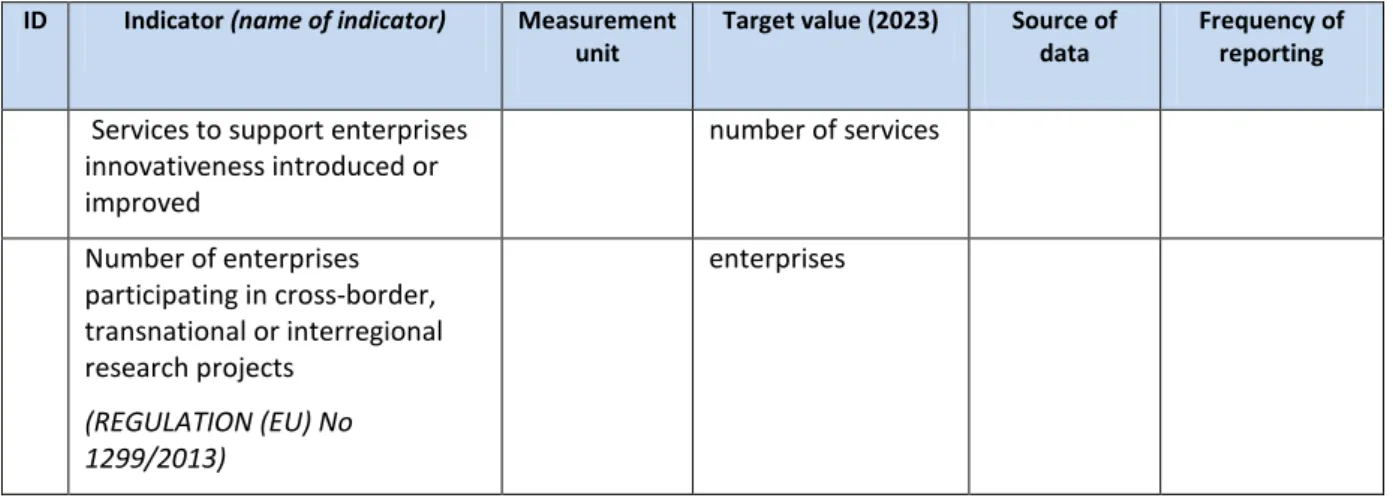
2.A.6.5aa Output indicators
(Reference: point (b)(iv) of Article 8(2) of Regulation (EU) No 1299/2013) Table 5: Common and programme specific output indicators ID Indicator (name of
indicator)
Measurement unit Target value (2023)
Source of data Frequency of reporting
Cross-border mechanisms in the field of R&I (studies, strategies etc.) Number of mechanisms Monitoring Number of research institutions participating in cross-border, transnational or interregional research projects (REGULATION (EU) No 1299/2013) Organisations Monitoring
2.A.4ab Investment priority
(Reference: point (b)(i) of Article 8(2) of Regulation (EU) No 1299/2013) Investment
Priority
Promoting business investment in R&I, developing links and synergies between enterprises, research and development centres and the higher education sector, in particular promoting investment in product and service development, technology transfer, social innovation,
eco-innovation, public service applications, demand stimulation, networking, clusters and open innovation through smart specialisation, and
supporting technological and applied research, pilot lines, early product validation actions, advanced manufacturing capabilities and first
production, in particular in key enabling technologies and diffusion of general purpose technologies
2.A.5ab Specific objectives corresponding to the investment priority and expected results
(Reference: points (b)(i) and (ii) of Article 8(2) of Regulation (EU) No 1299/2013)
ID
Promoting business investment in R&I, developing links and synergies between enterprises, research and development centres and the higher education sector…
Specific objective Fostering of involvement of enterprises (primarily SMEs) in
the innovation system
The results, which the Member States seek to achieve with Union support
The innovation system of the cross border region is based on a considerable number of recognized public and private research institutions, universities located in the cities as well as on scientific parks and the numerous large scale enterprises running their own R&I departments or the specialised regional clusters.
In the programme area SMEs are dominating as the main group of enterprises but their involvement in the innovation system and their R&I activities are in comparison with the large enterprises with special budgets and special R&I departments very low. Networking, technology transfer activities and other R&I support activities have a strong potential to intensify and ensure the integration of SMEs into the innovation system. Important in boosting innovation potential of the region and in process of introducing SMEs into innovation system is the role if “innovative leaders”, being usually large
enterprises.
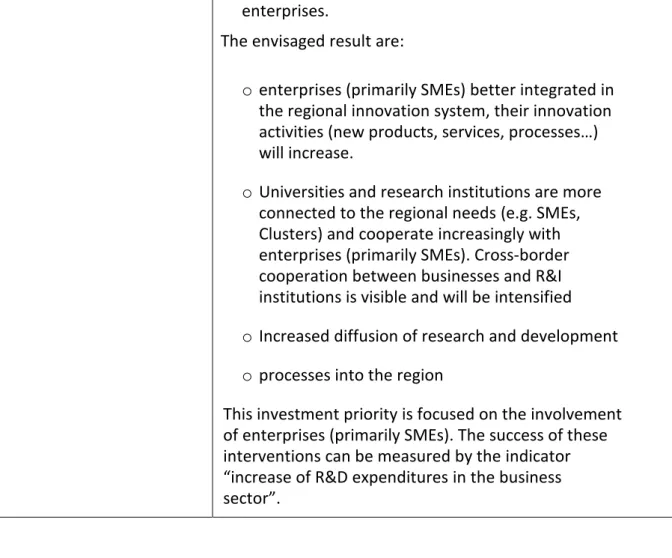
The envisaged result are:
o enterprises (primarily SMEs) better integrated in the regional innovation system, their innovation activities (new products, services, processes…) will increase.
o Universities and research institutions are more connected to the regional needs (e.g. SMEs, Clusters) and cooperate increasingly with enterprises (primarily SMEs). Cross-border cooperation between businesses and R&I institutions is visible and will be intensified
o Increased diffusion of research and development
o processes into the region
This investment priority is focused on the involvement of enterprises (primarily SMEs). The success of these interventions can be measured by the indicator “increase of R&D expenditures in the business sector”.
Table 3: Programme specific result indicators (by specific objective)
(Reference: point (b)(ii) of Article 8(2) of Regulation (EU) No 1299/2013)
ID Indicator Measurement Unit Baseline value Baseline year Target value (2023)
Source of data Frequency of reporting R&I expenditure in the business sector R&I expenditure (% of GDP) 2011 ...% EUROSTAT, national statistics Every 3 years
2.A.6ab Actions to be supported under the investment priority
2.A.6.1ab A description of the type and examples of actions to be supported and their expected contribution to the specific objectives, including, where appropriate, identification of the main target groups, specific territories targeted and types of beneficiaries