doi: 10.1016/j.procs.2016.05.300
High Performance LDA through Collective Model
Communication Optimization
Bingjing Zhang
1, Bo Peng
1,2, and Judy Qiu
1 1 Indiana University, Bloomington, Indiana, U.S.A.{zhangbj,pengb,xqiu}@indiana.edu
2 Peking University, Beijing, China
Abstract
LDA is a widely used machine learning technique for big data analysis. The application includes an inference algorithm that iteratively updates a model until it converges. A major challenge is the scaling issue in parallelization owing to the fact that the model size is huge and paral-lel workers need to communicate the model continually. We identify three important features of the model in parallel LDA computation: 1. The volume of model parameters required for local computation is high; 2. The time complexity of local computation is proportional to the required model size; 3. The model size shrinks as it converges. By investigating collective and asynchronous methods for model communication in different tools, we discover that optimized collective communication can improve the model update speed, thus allowing the model to converge faster. The performance improvement derives not only from accelerated communi-cation but also from reduced iteration computation time as the model size shrinks during the model convergence. To foster faster model convergence, we design new collective communica-tion abstraccommunica-tions and implement two Harp-LDA applicacommunica-tions, “lgs” and “rtt”. We compare our new approach with Yahoo! LDA and Petuum LDA, two leading implementations favoring asynchronous communication methods in the field, on a 100-node, 4000-thread Intel Haswell cluster. The experiments show that “lgs” can reach higher model likelihood with shorter or similar execution time compared with Yahoo! LDA, while “rtt” can run up to 3.9 times faster compared with Petuum LDA when achieving similar model likelihood.
Keywords: Latent Dirichlet Allocation, Parallel Algorithm, Big Model, Communication Model, Com-munication Optimization
1
Introduction
Latent Dirichlet Allocation (LDA) [1] is an important machine learning technique that has been widely used in areas such as text mining, advertising, recommender systems, network analysis, and genetics. Though extensive research on this topic exists, the data analysis community is
Procedia Computer Science
Volume 80, 2016, Pages 86–97
ICCS 2016. The International Conference on Computational Science
86 Selection and peer-review under responsibility of the Scientific Programme Committee of ICCS 2016 c
zzzz1,1
zzzzi,j
zzzzzi,1
Document Collection Topic assignment
xxxxxx1,1 xxxxi,j xxxxi,1 K*D j V*D w word-doc matrix V*K w Nwk word-topic matrix
≈
×
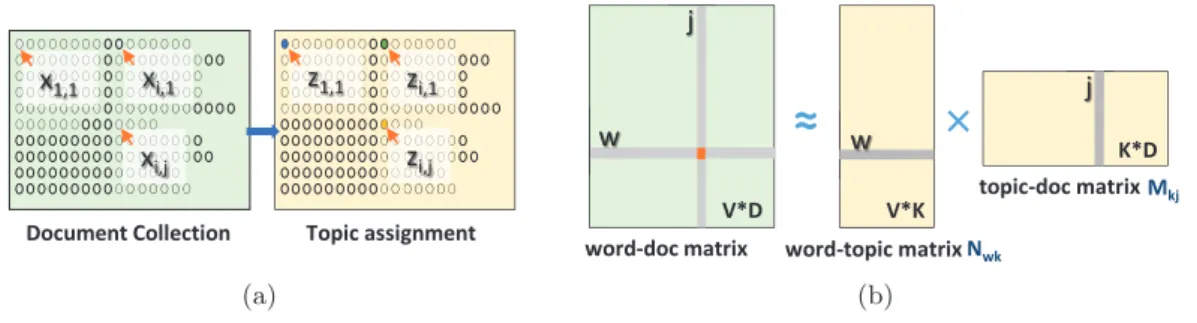
j Mkj topic-doc matrix (a) (b)Figure 1: (a) Topics Discovery (b) View of Matrix Decomposition
still endeavoring to scale it to web-scale corpora to explore more subtle semantics with a big
model which may contain billions of model parameters [5].
We identify that the size of the model required for local computation is so large that sending such data to every worker results in communication bottlenecks. The required computation time is great due to the large model size. In addition, the model size shrinks as the model converges. As a result, a faster communication method can speed up the model convergence, in which the model size shrinks and reduces the iteration execution time.
By guaranteeing the algorithm correctness, various model communication strategies are developed in parallel LDA. Existing solutions favor asynchronous communication methods, since it not only avoids global waiting but also quickly makes the model update visible to other workers and thereby boosts model convergence. We propose a more efficient approach in which the model communication speed is improved upon with optimized collective communication methods. We abstract three new communication operations and implement them on top of
Harp [15]. We develop two Harp-LDA applications and compare them with Yahoo! LDA1 and
Petuum LDA2, two well-known implementations in the domain. This is done on three datasets
each with a total of 10 billion model parameters. The results on a 100-node, 4000-thread Intel Haswell cluster show that collective communication optimizations can significantly reduce communication overhead and improve model convergence speed.
The following sections describe: the background of LDA application (Section 2), the big
model problem in parallel LDA (Section 3), the model communication challenges in parallel
LDA and related work (Section 4), Harp-LDA implementations (Section5), experiments and
performance comparisons (Section6), and the conclusion (Section 7).
2
Background
LDA modeling techniques can find latent structures inside the training data which are ab-stracted as a collection of documents, each with a bag of words. It models each document as a mixture of latent topics and each topic as a multinomial distribution over words. Then an inference algorithm works iteratively until it outputs the converged topic assignments for the
training data (see Figure 1(a)). Similar to Singular Value Decomposition (see Figure 1(b)),
LDA can be viewed as a sparse matrix decomposition technique on a word-document matrix, but it roots on a probabilistic foundation and has different computation characteristics.
1https://github.com/sudar/Yahoo_LDA
2https://github.com/petuum/bosen/wiki/Latent-Dirichlet-Allocation
LDA through Collective Model Communication Optimization Zhang, Peng and Qiu
Among the inference algorithms for LDA, Collapsed Gibbs Sampling (CGS) [12] shows high scalability in parallelization [3,11], especially compared with another commonly used algorithm, Collapsed Variational Bayes (CVB3) [1]. CGS is a Markov chain Monte Carlo type algorithm. In the “initialize” phase, each training data point, or token, is assigned to a random topic denoted as zij. Then it begins to reassign topics to each token xij = w by sampling from a multinomial distribution of a conditional probability ofzij:
pzij =k|z¬ij, x, α, β∝ N ¬ij wk +β wNwk¬ij+V β M¬ij kj +α (1) Here superscript ¬ij means that the corresponding token is excluded. V is the vocabulary size. Nwk is the token count of wordwassigned to topic k inK topics, and Mkj is the token count of topic k assigned in document j. The matrices Zij, Nwk and Mkj, are the model. Hyperparameters α and β control the topic density in the final model output. The model gradually converges during the process of iterative sampling. This is the phase where the “burn-in” stage occurs and finally reaches the “stationary” stage.
The sampling performance is more memory-bound than CPU-bound. The computation itself is simple, but it relies on accessing two large sparse model matrices in the memory. In Algorithm 1, sampling occurs by the column order of the word-document matrix, called
Algorithm 1: LDA Collapsed Gibbs Sampling Algorithm
input : training dataX, the number of topicsK, hyperparamters α, β
output: topic assignment matrixZij, topic-document matrixMkj, word-topic matrixNwk 1 InitializeMkj, Nwk to zeros// Initialize phase
2 foreachdocumentj ∈[1, D]do
3 foreachtoken positioni in documentj do
4 zi,j=k∼Mult(K1)// sample topics by multinomial distribution
5 mk,j += 1;nw,k+= 1// token xi,j is word w, update the model matrices // Burn-in and Stationary phase
6 repeat
7 foreachdocumentj ∈[1, D]do
8 foreachtoken positioni in documentj do
9 mk,j −= 1;nw,k−= 1// decrease counts
10 zi,j =k∼p(zi,j=k|rest)// sample a new topic by Equation (1)
11 mk,j += 1;nw,k += 1// increase counts for the new topic
12 untilconvergence;
“sample by document”. AlthoughMkj is cached when sampling all the tokens in a document j, the memory access toNwk is random since tokens are from different words. Symmetrically, sampling can occur by the row order, called “sample by word”. In both cases, the computation time complexity is highly related to the size of model matrices. SparseLDA [14] is an optimized CGS sampling implementation mostly used in state-of-the-art LDA trainers. In Line 10 of Algorithm1, the conditional probability is usually computed for eachkwith a total ofKtimes, but SparseLDA decreases the time complexity to the number of non-zero items in one row of Nwk and in one column ofMkj, both of which are much smaller thanK on average.
3CVB algorithm is used in Spark LDA (http://spark.apache.org/docs/latest/mllib-clustering.html)
and Mahout LDA (https://mahout.apache.org/users/clustering/latent-dirichlet-allocation.html) LDA through Collective Model Communication Optimization Zhang, Peng and Qiu
3
Big Model Problem in Parallel LDA
Sampling onZij in CGS is a strict sequential procedure, although it can be parallelized without much loss in accuracy [3]. Parallel LDA can be performed in a distributed environment or a shared-memory environment. Due to the huge volume of training documents, we focus on the distributed environment which is formed by a number of compute nodes deployed with a single worker process apiece. Every worker takes a partition of the training document set and performs the sampling procedure with multiple threads. The workers either communicate through point-to-point communication or collective communication.
The LDA model contains four parts: I.Zij - topic assignments on tokens, II. Nwk - token counts of words on topics (word-topic matrix), III.Mkj- token counts of documents on topics (topic-document matrix), and IV.wNwk - token counts of topics. HereZij is always stored along with the training tokens. For the other three, because the training tokens are partitioned by document,Mkj is stored locally whileNwk and wNwk are shared. For the shared model parts, a parallel LDA implementation may use the latest model or the stale model in the sampling procedure. The latest model means the current model parameters used in computation are up-to-date and not modified simultaneously by other workers, while the stale model means the model parameters are old. We show that model consistency is important to convergence speed in Section6.
Now we calculate the size ofNwk, a huge but sparseV ∗K matrix. We note that the word distribution in the training data generally follows a power law. If we sort the words based on their frequencies from high to low, for a word with rank i, its frequency is freq(i) =C∗i−λ. Then forW, the total number of training tokens, we have
W = V i=1 freq(i) = V i=1 (C∗i−λ)≈C∗(lnV +γ+ 1 2V) (2)
Hereλis a constant near 1, constantC=freq(1). To simplify the analysis, we considerλ= 1. Then W is the partial sum of the harmonic series which have logarithmic growth, where γ is the Euler-Mascheroni constant ≈0.57721. The real model size (denoted asS) depends on the count of non-zero cells. In the “initialize” phase of CGS, with random topic assignment, a word igetsmax(K, freq(i)) non-zero cells. If freq(J) =K, thenJ =C/K, and we get:
Sinit= J i=1 K+ V i=J+1 freq(i) =W− J i=1 freq(i) + J i=1 K=C∗(lnV +lnK−lnC+ 1) (3) The actual initial model sizeSinitis logarithmic to matrix sizeV∗K, which meansS << V∗K. However this does not meanSinit is small. SinceC can be very large, evenC∗ln(V ∗K) can result in a large number. In the progress of iterations, the model size shrinks as the model converges. When a stationary state is reached, the average number of topics per word drops to a certain small constant ratio ofK, which is determined by the concentration parametersα,β and the nature of the training data itself.
The local vocabulary size V of each worker determines the model volume required for computation. When documents are randomly partitioned to N processes, every word with a frequency larger thanNhas a high probability of occurring on all the processes. Iffreq(L) =N at rank L, we get: L= (lnVW+γ)∗N. For a large training dataset, the ratio between L and V is often very high, indicating that local computation requires most of the model parameters. Figure2shows the difficulty of controlling local vocabulary size in random document partition-ing. When 10 times more partitions are introduced, there is only a sub-linear decrease in the LDA through Collective Model Communication Optimization Zhang, Peng and Qiu
Model
Worker Worker Worker
•The stale model •A1. Allreduce collective
-PLDA
A2. Unoptimized collective
-PowerGraph LDA
A3. Point-to-point (asynchronous)
-Yahoo! LDA
Communication Model Type B Communication Model Type A
Worker Worker Worker
Model 1 Model 2 Model 3 ••The latest modelB1. Point-to-point
(asynchronous) -Petuum LDA Training Data 1 Load Worker Worker Worker Sync 4 Global Model 2 Compute 2 Global Model 3 Compute 2 Global Model 1 Compute 2 3 3 Sync Sync 3 Iteration Local Model Local Model Local Model Worker Worker Worker Rotate Global Model 2 Compute 2 Global Model 3 Compute 2 Global Model 1 Compute 2 3 3 Rotate Rotate 3 lgs (use syncLocalWithGlobal & syncGlobalWithLocal) rtt (use rotateGlobal) (a) (b)
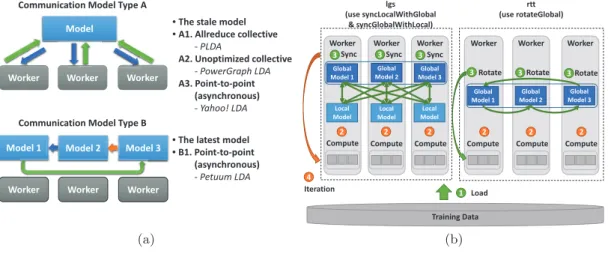
Figure 3: (a) Communication Models (b) Harp-LDA Implementations
is A3, which uses asynchronous point-to-point communication. Yahoo! LDA [13, 2] and
Pa-rameter Server [7] follow this communication model. In A3, each worker independently fetches
and updates the related model parameters without waiting for other workers. A3 can ease the communication overhead, however, its model update rate is not guaranteed. A word’s model parameters may be updated either by changes from all the training tokens, a part of them, or even no change. A solution to this problem is to combine A3 and A2. This is implemented in
Petuum (version 0.93) LDA [8].
In Communication Model Type B, each worker first takes a partition of the model param-eters, after which the model partitions are “shifted” between workers. When all the partitions are accessed by all the workers, an iteration is completed. There is only one communication model B1 which uses asynchronous point-to-point communication. Petuum (version 1.1) LDA
[9] follows this model.
A better solution for Communication Model Type A can be a conjunction of A1 and A2 with new collective communication abstractions. There are three advantages to such a strategy. First, considering the model requirement in local computation, it reduces the model parameters communicated. Second, it optimizes routing through searching “one-to-all” communication patterns. Finally, it maintains the model update rate compared with asynchronous methods. For Communication Model Type B, using collective communication is also helpful because it maximizes bandwidth usage between compute nodes and avoids flooding the network with small messages, which is what B1 does.
5
Harp-LDA Implementations
Based on the analysis above, we parallelize LDA with optimized collective communication
abstractions on top of Harp [15], a collective communication library plugged into Hadoop5. We
use “table” abstractions defined in Harp to organize the shared model parameters. Each table may contain one or more model partitions, and the tables defined on different processes are associated to manage a distributed model. We partition the model parameters based on the
5http://hadoop.apache.org
LDA through Collective Model Communication Optimization Zhang, Peng and Qiu
range of word frequencies in the training dataset. The lower the frequency of the word, the higher the partition ID given. Then we map partition IDs to process IDs based on the modulo operation. In this way, each process contains model partitions with words whose frequencies are ranked from high to low.
We add three collective communication operations. The first two operations, “syncGlob-alWithLocal” and “syncLocalWithGlobal”, are paired. Here another type of table is defined to describe the local models. Each partition in these tables is considered a local version of a global partition according to the corresponding ID. “syncGlobalWithLocal” merges parti-tions from different local model tables to one in the global tables while “syncLocalWithGlobal” redistributes the model partitions in the global tables to local tables. Routing optimized broad-casting [4] is used if “one-to-all” communication patterns are detected. Lastly, “rotateGlobal” considers processes in a ring topology and shifts the model partitions from one process to the next neighbor.
We present two parallel LDA implementations. One is “lgs”, which uses “syncGlobalWith-Local” paired with “syncLocalWithGlobal”. Another is “rtt”, which uses “rotateGlobal” (see Figure 3(b)). In both implementations, the computation and communication are pipelined, i.e., the model parameters are sliced in two and communicated in turns. Model Part IV is synchronized through A1 at the end of every iteration. The SparseLDA algorithm is used for the sampling procedure. “lgs” samples by document while “rtt” samples by word. This is done to keep the consistency between implementations for unbiased communication performance comparisons in future experiments.
6
Experiments
Experiments are done on a cluster6 with Intel Haswell architecture. This cluster contains 32 nodes each with two 18-core 36-thread Xeon E5-2699 processors and 96 nodes each with two 12-core 24-thread Xeon E5-2670 processors. All the nodes have 128GB memory and are connected with 1Gbps Ethernet (eth) and Infiniband (ib). For testing, 31 nodes with Xeon E5-2699 and 69 nodes with Xeon E5-2670 are used to form a cluster of 100 nodes, each with 40 threads. All the tests are done with Infiniband through IPoIB support.
“clueweb”7, “enwiki”, and “bi-gram”8 are three datasets used (see Table 1). The model parameter settings are comparable to other research work [5], each with a total of 10 billion parameters. αandβare both fixed to a commonly used value 0.01 to exclude dynamic tuning. We test several implementations: “lgs”, “lgs-4s” (“lgs” with 4 rounds of model synchronization per iteration, each round with 1/4 of the training tokens), and “rtt”. To evaluate the quality of the model outputs, we use the model likelihood on the training dataset to monitor model convergence. We compare our implementations with two leading implementations, Yahoo! LDA and Petuum LDA, and thereby learn how communication methods affect LDA performance by studying the model convergence speed.
6.1
Model Convergence Speed Measured by Iteration
We compare the model convergence speed by analyzing model outputs on Iteration 1, 10, 20... 200. In an iteration, every training token is sampled once. Thus the number of model updates
6https://portal.futuresystems.org
710% of ClueWeb09 (a collection of English web pages,http://lemurproject.org/clueweb09.php/) 8Both “enwiki” and “bi-gram” are English articles from Wikipedia (https://www.wikipedia.org)
LDA through Collective Model Communication Optimization Zhang, Peng and Qiu
overhead than Petuum LDA, and the total execution time of “rtt” is 3.9 times faster. On “clueweb”, although the computation speed of the first iteration is 2- to 3-fold slower, the total execution time remains similar.
Despite the implementation differences between “rtt”, “lgs”, Yahoo! LDA, and Petuum LDA, the advantages of collective communication methods are evident. Compared with asyn-chronous communication methods, collective communication methods can optimize routing be-tween parallel workers and maximize bandwidth utilization. Though collective communication will result in global waiting, the resulting overhead is not as high as speculated. The chain reac-tion set off by improving the LDA model update speed amplifies the benefits of using collective communication methods. In future work, we will focus on improving intra-node LDA perfor-mance in many-core systems and apply our model communication strategies to other machine learning algorithms facing big model problems.
Acknowledgments
We gratefully acknowledge support from Intel Parallel Computing Center Grant, NSF 1443054 CIF21 DIBBs 1443054 Grant, and NSF OCI 1149432 CAREER Grant. We appreciate the system support offered by FutureSystems.
References
[1] D. Blei, A. Ng, and M. Jordan. Latent Dirichlet Allocation. The Journal of Machine Learning Research, 3:993–1022, 2003.
[2] A. Ahmed et al. Scalable Inference in Latent Variable Models. InWSDM, 2012.
[3] D. Newman et al. Distributed Algorithms for Topic Models. The Journal of Machine Learning Research, 10:1801–1828, 2009.
[4] E. Chan et al. Collective Communication: Theory, Practice, and Experience. Concurrency and Computation: Practice and Experience, 19(13):1749–1783, 2007.
[5] E. Xing et al. Petuum: A New Platform for Distributed Machine Learning on Big Data. InKDD, 2015.
[6] J. Gonzalez et al. PowerGraph: Distributed Graph-Parallel Computation on Natural Graphs. In OSDI, 2012.
[7] M. Li et al. Scaling Distributed Machine Learning with the Parameter Server. InOSDI, 2014. [8] Q. Ho et al. More Effective Distributed ML via a Stale Synchronous Parallel Parameter Server.
InNIPS, 2013.
[9] S. Lee et al. On Model Parallelization and Scheduling Strategies for Distributed Machine Learning. InNIPS, 2014.
[10] Y. Wang et al. PLDA: Parallel Latent Dirichlet Allocation for Large-scale Applications. In Algorithmic Aspects in Information and Management, pages 301–314. Springer, 2009.
[11] Y. Wang et al. Peacock: Learning Long-Tail Topic Features for Industrial Applications. ACM Transactions on Intelligent Systems and Technology, 6(4), 2015.
[12] P. Resnik and E. Hardist. Gibbs Sampling for the Uninitiated. Technical report, University of Maryland, 2010.
[13] A. Smola and S. Narayanamurthy. An Architecture for Parallel Topic Models. Proceedings of the VLDB Endowment, 3(1-2):703–710, 2010.
[14] L. Yao, D. Mimno, and A. McCallum. Efficient Methods for Topic Model Inference on Streaming Document Collections. InKDD, 2009.
[15] B. Zhang, Y. Ruan, and J. Qiu. Harp: Collective Communication on Hadoop. InIC2E, 2014. LDA through Collective Model Communication Optimization Zhang, Peng and Qiu