Au d i t N u m b e r : 1 0 1 2 4 1 3
Implementing a state debt-off set program and participating in the U.S. Treasury’s State Reciprocal Program can help Washington collect delinquent business debt. Debt-off set programs help states recover delinquent debt by intercepting payments the state makes to businesses that owe taxes and other debts. Washington does not have a comprehensive state debt-off set program, but at least 29 states and the District of Columbia do.
We talked to nine of these states and reviewed literature on debt collection. We learned that eff ective off set programs are automated with wide participation across agencies providing states with benefi ts such as: fast collections, increased voluntary compliance, recovery of diffi cult debts, and effi cient use of agency staff resources. We also learned about leading practices that could help guide the development and implementation of eff ective debt-off set programs in Washington.
Performance Audit
Debt-Off set Programs: A tool to help
Washington collect delinquent debt
December 4, 2014
I n d e p e n d e n c e • R e s p e c t • I n t e g r i t y
AU DIT OR OF STA T E W A S H I N G TNOV 11, 1889 ONWashington State Auditor’s Office
Table of Contents
Executive Summary 3 Glossary 7 Introduction 8 Audit Scope and Methodology 9 Audit Results 11 Recommendations 20 Agency Response 21 Appendix A: Initiative 900 29 Appendix B: Methodology 30 Appendix C: State Profi les 33 Appendix D: Description of Process and
System Changes Needed 43 Appendix E: U.S Treasury’s State Reciprocal
Program Legislative/Regulation Checklist 45
The mission of the Washington State Auditor’s Offi ce
The State Auditor’s Offi ce holds state and local governments accountable for the use of public resources.
The results of our work are widely distributed through a variety of reports, which are available on our website and through our free, electronic subscription service.
We take our role as partners in accountability seriously. We provide training and technical assistance to governments and have an extensive quality assurance program.
For more information about the State Auditor’s Offi ce, visit
www.sao.wa.gov.
State Auditor’s Offi ce contacts
State Auditor Troy Kelley
360-902-0360, [email protected]
Chuck Pfeil, CPA :: Director of State & Performance Audit
360-902-0366, [email protected]
Lou Adams, CPA :: Deputy Director of Performance Audit
360-725-5577, [email protected]
Sohara Monaghan :: Senior Performance Auditor
360-725-5616, [email protected]
Thomas Shapley :: Deputy Director of Communications
Debt-Off set Programs :: Executive Summary | 3
Executive Summary
State debt-off set program: A national best practice
Debt-off set programs help states recover delinquent debt by intercepting payments the state makes to businesses. Th ese programs use unique identifi ers, such as federal taxpayer identifi cation numbers (TINs), to compare businesses who owe debt to the state with those claiming payments. Th e program then helps a state recover the debt by reducing the amount paid by the amount owed.
In a survey of states conducted by the National Association of State Auditors, Comptrollers and Treasurers (NASACT) and the consulting fi rm CGI, other states reported that a debt-off set program is their most eff ective strategy for collecting debt. At least 29 states and the District of Columbia use debt-off set programs to recover debt owed by businesses, and 40 states use the program to collect debt owed by individuals. We talked to nine of these states and reviewed literature on debt collection. We learned that eff ective off set programs are automated with wide participation across agencies providing states with benefi ts such as: fast collections, increased voluntary compliance, recovery of diffi cult debts, and effi cient use of agency’s staff resources.
Washington does not have a comprehensive
debt-off set program
As of June 2014, businesses owed fi ve state agencies about $738 million in outstanding delinquent debt that is more than 90 days past due. Individually, agencies actively pursue debt owed by businesses. Th ey use a variety of collection tools to recover debt including notices to withhold and deliver, garnishments and levies. Several agencies included in our audit have the authority to off set payments internally as well as externally, by cooperating with other agencies. However, Washington lacks the single comprehensive legal authority needed to off set payments at a statewide level; it also lacks a systematic method to identify when delinquent businesses are receiving payments from the state. Currently, agencies can only detect payments the state makes to delinquent businesses by searching manually through each other’s data systems – a process some agencies stated is time consuming.
Although some agencies use limited off set processes to collect debt internally before making payments to businesses, they do not off set debt businesses owe to all their divisions. Agencies included in the audit told us they believe a debt-off set program would be a benefi cial additional tool in their debt-collection toolkit.
CT DE IA KS MA MO MT NV NJ RI VT TN TX VA WV WI DC
Source: State Auditor’s Office research.
29 states use a debt-offset program to collect business debt
We interviewed nine of them, highlighted in yellow on the map.
MD MN MI NE SC NC KY IL AZ CO NM NY UT
Audit objectives
Th is performance audit examined whether implementing a state debt-off set program and participating in the U.S. Treasury’s State Reciprocal Program can help Washington collect delinquent business debt. Th e audit also identifi ed leading practices other states recommend for developing and implementing eff ective debt-off set programs, and the changes Washington needs to make to put the programs into action.
Two debt-off set programs: two eff ective ways to help
Washington collect delinquent debt
States typically have two options when they set out to recover delinquent business debt with a debt-off set program: a state-only program or a state program working in partnership with the U.S. Treasury’s State Reciprocal Program. While a state off set program is not required to participate in the federal State Reciprocal Program, we learned that having the state program in place aids implementation of the federal program. Th e U.S. Treasury also prefers that a state’s participation in its State Reciprocal Program be a consolidated eff ort to recover debt.
A state debt-off set program could have helped Washington
more quickly recover about $4 million in delinquent business
debt in one month
We compared the outstanding delinquent debt that businesses incurred and still owed to fi ve state agencies in fi scal year 2013 to the payments eight state agencies made to those businesses in June 2013. We found agencies paid $261 million to businesses that, at the end of fi scal year 2013, still owed the state about $40 million in delinquent state and unemployment taxes, workers compensation premiums, and medical and social services debt. We estimate that, if the program had been in place, it could have potentially recovered about $4 million (10 percent) of this debt in one month.
It is likely agencies recovered some of the $4 million aft er June 2013 (the month of our estimate) with existing collection eff orts. However, based on our test and benefi ts reported by other states, we concluded that a debt-off set program could have recovered these funds sooner, freeing up agency staff time to collect other types of debt that cannot be off set.
Several factors can aff ect an estimate of potential collections with a debt-off set program. Th us, future collections will vary: the amounts of debt owed and collected, as well as the amount the state pays businesses, can change daily or monthly. In addition, agency managers told us that some of the debt is being paid in installments under a payment plan while other debts may be under appeal.
Accurate and complete taxpayer data is key to maximizing collections with a debt-off set program
Other states fi nd the success of an off set program depends greatly on the accuracy and completeness of taxpayer information. We learned that because of a lack of statutory authority to require federal taxpayer identifi cation numbers (TINs), not all agencies track them. About $29 million (14 percent) of the total outstanding delinquent debt we reviewed lacked or had inaccurate TINs. As a result, we
$4
Washington’s estimated debt recovery in June 2013, using a state debt off set program based on leading practices
million
Quicker debt collections for the state with a state off set programDebt-Off set Programs :: Executive Summary | 5
Washington could also benefi t from participation in the
U.S. Treasury’s State Reciprocal Program
Four of the nine states we talked with participate in the federal program and said it was benefi cial. Debt off set collections in those states ranged from $1 million to $8.7 million in 2013. Th ese states also said the federal program helps with recovery of diffi cult debts, such as debt owed by out-of-state businesses and debt that is up to 10 years old.
To maximize collections through the federal program, Washington would have to remove a statutory barrier to data sharing as well as improve the accuracy of taxpayer data. According to staff at the Department of Revenue, state law (RCW 82.32.330) does not provide clear authority to share data with the U.S. Treasury.
Leading practices could help guide the development and
implementation of eff ective debt-off set programs
Our interviews with nine states that operate off set programs helped us identify several leading practices that could guide policy-makers and agencies to develop and implement eff ective debt-off set programs for Washington. Th e box to the right lists these practices.
Washington would need to make some changes to
implement eff ective debt-off set programs
States we spoke with recommend establishing the program through legislation that includes key components such as identifying a lead agency, setting up a priority payment system and establishing a sustainable funding model. Implementing the program will also require process changes and system upgrades. Th e lead agency would have to modify its computer system to receive debt from other agencies, send notifi cations and conduct other off set activities. Additionally, some agencies would need to revise processes and systems to send their debt to and process payments through the lead agency. We learned that these functions could likely be integrated into the state’s existing fi nancial management system with modifi cations.
Other states report investments in system upgrades as the major expense when launching a debt-off set program. Although we did not conduct a cost estimate for Washington, states report that the investment is worthwhile because the benefi ts the program provides outweigh its costs.
Debt off set collections for four states ranged
from $1 million
to $8.7 million
in 2013 Other states found benefi ts in participating in the federal reciprocal debt off set programLeading practices for developing and implementing eff ective debt-off set programs
• Select a lead agency to implement and administer the programs
• Maximize agency participation to increase collections
• Develop a sustainable funding model to fi nance the program’s ongoing administrative costs
• Specify types of debt and payments the program can and cannot off set
• Establish a priority system to determine which types of debts are recovered fi rst • Provide due process to debtors to
ensure they are treated fairly
• Authorize agencies to share confi dential data needed for debt recovery
• Develop processes that are clear and standardized and automate them as much as possible
• Provide initial and ongoing training to staff at both the lead and the participating agencies
Recommendations
To implement eff ective debt-off set programs, we recommend:
1. Th e Legislature authorize state agencies to require federal TINs and share payment and debt data for the purposes of conducting state and federal debt off sets, allowing individual agencies to immediately enhance existing collection eff orts.
2. Th e legislature authorize state agencies to participate in the U.S. Treasury’s State Reciprocal Program.
3. Th e Legislature establish a workgroup with a directive to develop a proposal for the design and implementation of a state and the federal reciprocal debt-off set programs. To effi ciently and eff ectively implement and administer the programs, the workgroup should:
• Design the programs using the leading practices recommended by other states and the U.S. Treasury’s State Reciprocal Program requirements • Identify ways for agencies to obtain accurate federal TINs
• Identify necessary process changes and system upgrades • Estimate necessary resources
• Identify statutory changes
• Report its progress to the Legislature and the Governor’s Offi ce by June 30, 2016
4. Taking into account the workgroup’s June 2016 report, the Legislature authorize a single comprehensive statute to off set debts owed by businesses with payments to those businesses.
Debt-Off set Programs :: Glossary | 7
Glossary
Agency Financial Reporting System (AFRS) Th e state-owned accounting system used by Washington agencies and higher education institutions. It performs all aspects of the accounting process: general ledger, accounts receivable, accounts payable, balance sheets, etc. Accounting information is updated daily by most users of the system.
Business An employer, provider, vendor, contractor, or tradesperson who does business with or has an obligation with the state or federal government.
Claimant agency A state agency that is owed debt and submits delinquent debt for collection through a debt-off set program.
Debtor An individual or business that owes debt to the state or federal government. Th is audit focused only on business debtors.
Delinquent debt A debt is delinquent when a debtor has failed to pay it aft er the due date established by an entity.
Involuntary collection actions Legal collection actions agencies use to recover money owed by businesses or individuals who failed to pay their debt voluntarily. Examples of these include notice to withhold and deliver, levies, garnishments and liens.
Lead agency Th e state agency that implements and administers debt-off set programs. Th e lead agency is in charge of, among other things, gathering the debt the state wishes to collect and matching debt against payments the state has authorized to recover debt.
Off set match When the debt-off set program identifi es debts owed by and payments made to the same business using unique identifi ers such as a federal taxpayer identifi cation number. Th ese off set matches are potential collections.
Payee An individual or business receiving payment from the state or federal government. Th is audit focused only on business payees.
State debt-off set program A state government debt collection program that compares pending payments to outstanding delinquent debts. When the program identifi es a match between the recipient of a payment and the holder of a debt, the program recovers the debt by reducing the amount paid by the amount owed.
State Reciprocal Program (SRP) An off set program administered by the U.S. Department of the Treasury, Bureau of the Fiscal Services that helps states recover delinquent debt by off setting federal vendor payments. In return, states off set payments to businesses who owe the federal government money.
Taxpayer Identifi cation Number (TIN) A unique 9-digit number assigned by the federal government to businesses and individuals for the administration of tax laws. Th e Internal Revenue Service uses this number to verify that amounts businesses and individuals report on tax returns match those reported by the entities that paid them money. Depending on the business’s structure and whether the business has employees, a TIN for a business could be either of the following:
• Federal Employer Identifi cation Number (FEIN), assigned by the Internal Revenue Service.
• Social Security Number (SSN), assigned by the Social Security Administration.
Introduction
As of June 2014, businesses owed fi ve state agencies about $738 million in outstanding delinquent debt that is over 90 days past due. Like many states, Washington state agencies pay businesses that owe debt to the state. A debt-off set program could help Washington recover delinquent debt by intercepting payments the state makes to businesses.
Debt-off set programs could off er signifi cant benefi ts
Our research and interviews suggest that eff ective debt-off set programs can bring signifi cant benefi ts to the states that operate them, such as:
• Expanded collection capabilities A comprehensive and automated off set process can routinely compare debts to payments within and across all participating agencies.
• Effi cient use of staff resources An automated off set process can be less time consuming than manual collection procedures, leaving agency staff more time to concentrate on collecting other types of debt.
• Fast collections Agencies should have fair but aggressive programs to recover delinquent debt. Routine, automated matching of debts and payments can collect debt faster than manual processes. Faster debt collections generally yield more revenue since the ability of an agency to collect its delinquent debts diminishes over time.
• Increased voluntary compliance Some states report that debtors
voluntarily pay their debts more frequently as a result of the off set program because debtors realize the state is serious about collecting debt and want to avoid disruption in services and additional collection fees.
• Recovery of diffi cult debts Debt-off set programs can help states recover debt that agencies may have had to write-off or declare uncollectable due to challenges in identifying when the government makes payments to delinquent businesses.
• Better management of debt data Other states report that debt-off set programs encourage state agencies to improve the completeness and accuracy of taxpayer data, which in turn improves other collection processes.
Washington does not have a comprehensive state debt-off set program, nor does it participate in the U.S. Treasury’s State Reciprocal Program
Individually, state agencies actively pursue delinquent debt owed by businesses, employing a variety of collection tools to recover debt. Th e Department of Revenue, for example, uses a tool called “e-withhold,” to recover tax debt directly from a taxpayer’s fi nancial institution. Th e Department of Labor and Industries and the Health Care Authority off set medical provider debt internally from future payments to those providers. However, Washington lacks the single comprehensive legal authority needed to off set payments at a statewide level; it also lacks a systematic method to identify when delinquent businesses are receiving payments from the state.
In addition, Washington does not participate in the U.S. Treasury’s State Reciprocal Program. Th is program helps states recover delinquent business debt by off setting
Kentucky said that after the fi rst year of off setting payments from Medicaid providers, many came into compliance and voluntarily paid their debt.
Wisconsin said it collected debt owed by out-of-state businesses through the U.S. Treasury’s State Reciprocal
Debt-Off set Programs :: Scope & Methodology | 9
Audit Scope and Methodology
We designed this audit to answer three questions:
1. Can a state debt-off set program help Washington collect delinquent business debt?
2. Can participation in the U.S Treasury’s State Reciprocal Program help Washington collect delinquent business debt?
3. What actions would Washington need to take to develop and implement eff ective debt-off set programs?
Estimating potential debt collections with a state
debt-off set program
Although a state debt-off set program can also be used to collect debt owed by individuals, this audit focused on debt owed by businesses. To estimate the amount of delinquent debt a state debt-off set program might have been able to recover for Washington in one month we performed these procedures:
• We calculated the amount of outstanding delinquent debt that businesses incurred with fi ve agencies in fi scal year 2013 and which they still owed at the end of the same fi scal year. We then used federal TINs to compare this amount to payments eight agencies made to businesses in June 2013. Although additional agencies are owed business debt and make payments to businesses, we selected fi ve agencies with the largest business debt balances and eight agencies making
substantial payments to businesses. See Appendix B for more information about the agencies that provided debt and payment data for analysis. • When we identifi ed matches between businesses that owed debt and those
receiving payments, we calculated the amount a state debt-off set program could have collected in June 2013. An off set program can only off set a
payment up to the full amount of the debt owed. Th erefore, if payments were greater than the debt, the off set amount was equal to the debt. If payments were less than the debt, the off set amount was equal to the payment.
Estimating potential debt collections with participation in
the U.S. Treasury’s State Reciprocal Program
To estimate the amount of potential collections if Washington participated in the federal State Reciprocal program, we asked the U.S. Treasury to match a portion of the outstanding delinquent debt businesses owed to four state agencies against one month of federal vendor payments. Th e U.S. Treasury’s current testing environment can only compare one month of federal vendor payments against outstanding state debt. Although initial results were available, Treasury offi cials indicated in November 2014 that they needed to make revisions to their estimates. Th e revised results are expected early in 2015.
State agencies in audit scope
Included in state off set program estimate
Included in federal off set program estimate
Employment Security
Enterprise Services
Health Care Authority
Labor & Industries
Lottery
Revenue
Social & Health Services
Transportation
Identifying leading practices and lessons
learned in other states
We fi rst reviewed debt off set laws nationwide to fi nd states that have authority to operate an off set program to collect business debt. To gain an understanding of leading practices and lessons learned, and how states designed and manage their off set programs, we selected nine states for review. We based our selection on factors such as tax structures, agency participation requirements, level of centralization in debt collection, and funding models.
Our conversations with off set program staff and management in these states helped us understand the legislative, system and process changes needed to implement and administer eff ective debt-off set programs. Appendix C provides more details of off set programs in the nine states we interviewed.
Identifying changes Washington would need to consider
To identify additional changes Washington needs to make to implement eff ective debt-off set programs, we reviewed relevant Washington laws and interviewed state agencies to gain an understanding of the capabilities and limitations of existing collection tools, processes and systems.
Appendix D provides more details on system and process changes needed to implement eff ective debt-off set programs. Appendix E provides a checklist of the minimum legal requirements Washington would need to meet to participate in the U.S. Treasury’s State Reciprocal Program.
Audit performed to standards
We conducted this performance audit under the authority of state law (RCW 43.09.470), approved as Initiative 900 by Washington voters in 2005, and in accordance with Generally Accepted Government Auditing standards (December 2011 revision) issued by the U.S. Government Accountability Offi ce. Th ose standards require that we plan and perform the audit to obtain suffi cient, appropriate evidence to provide a reasonable basis for our fi ndings and conclusions based on our audit objectives. We believe that the evidence obtained provides a reasonable basis for our fi ndings and conclusions based on our audit objectives. See Appendix A, which addresses the I-900 areas covered in the audit. Appendix B
contains more information about our methodology.
Next steps
Our performance audits of state programs and services are reviewed by the Joint Legislative Audit and Review Committee (JLARC) and/or by other legislative committees whose members wish to consider fi ndings and recommendations on specifi c topics. Representatives of the State Auditor’s Offi ce will review this audit with JLARC’s Initiative 900 Subcommittee in Olympia. Th e public will have the opportunity to comment at this hearing. Please check the JLARC website for the
States interviewed
Has a state business debt off set program
Participates in U.S. Treasury’s State Reciprocal Off set Program
Kansas
Kentucky
Maryland
Minnesota
Nevada
North Carolina
Texas
Virginia
Wisconsin
Debt-Off set Programs :: Audit Resutls | 11
Audit Results
$4
Washington’s estimated debt recovery in June 2013, using a state debt off set program based on leading practices
million
Quicker debt collections for the state with a state off set programQuestion 1: Can a state debt-off set program help Washington
collect delinquent business debt?
A state debt-off set program could have helped Washington more quickly recover about $4 million in delinquent business debt in one month.
Our analysis found that in June 2013 state agencies paid $261 million to businesses that, at end of fi scal year 2013, still owed the state about $40 million in delinquent taxes, workers compensation premiums, and medical and social services debt. We estimate that, if a state debt-off set program had been in place, it could have potentially recovered about $4 million (10 percent) of this debt in one month. Th e program could have used state and unemployment tax refunds, payments for products and services, unclaimed property and lottery winnings to recover the debt.
It is likely agencies recovered some of the $4 million aft er June 2013 (the month of our estimate) with existing collection eff orts. However, based on our test and benefi ts reported by other states, we concluded that a debt-off set program could have collected these funds sooner, freeing up agency staff time to recover other types of debt that cannot be off set.
Not all $40 million in outstanding delinquent debt could have been recovered in one month because some of the businesses that owed a signifi cant portion of this debt did not receive suffi cient payments in June 2013 to off set all their debt this month.
Several factors can aff ect an estimate of potential collections with a debt-off set program. Th us, future collections will vary: the amounts of debt owed and collected, as well as the amount the state pays businesses, can change daily and monthly. In addition, agency managers told us that some of the debt is being paid in installments under a payment plan while other debts may be under appeal. Th e amount the state can recover once the program is implemented will also be aff ected by policy decisions such as how many agencies participate in the program and the types of debts and payments the state authorizes for off set. In Question 3 in this report, we off er leading practices that can help guide policy-makers and agencies as they consider implementing eff ective debt-off set programs for Washington. Additional considerations are the legal restrictions on how some debt recovered through a debt-off set program can be used. For example, some debt recoveries, such as unemployment taxes and worker’s compensation premiums, are earmarked to go into federal and state trust funds. And a portion of the money collected on medical and social services debt that has a federal component must be returned to the federal government.
Accurate and complete taxpayer data is key to maximizing
collections with a debt-off set program.
Other states fi nd the success of an off set program depends greatly on the accuracy and completeness of taxpayer data. States we spoke with use federal taxpayer identifi cation numbers (TINs) to match debt businesses owe with payments the state makes to businesses. We also used federal TINs in our analysis to identify potential debt recoveries. We learned that because of a lack of statutory authority to require federal TINs from businesses, not all agencies track them.
Debt off set collections for four states ranged
from $1 million
to $8.7 million
in 2013 Other states found benefi ts in participating in the federal reciprocal debt off set programAbout $29 million (14 percent) of the total outstanding delinquent debt businesses incurred and still owed to fi ve state agencies at the end of fi scal 2013 lacked or had inaccurate TINs. As a result, we could not estimate all debt a state debt-off set program might have recovered for Washington in June 2013.
To improve taxpayer data and maximize collections with a debt-off set program, some states recommend that agencies ask for and verify the accuracy of taxpayer information during the business registration or enrollment process. Doing so increases the likelihood of debt recovery later on because businesses are more likely to provide complete and correct data when they do not owe money.
Question 2: Can participation in the U.S. Treasury’s State
Reciprocal Program help Washington collect delinquent
business debt?
We found Washington could benefi t from participating in the federal program
Four states we talked with participate in the U.S. Treasury’s State Reciprocal Program and found it benefi cial. Debt off set collections in those states ranged from $1 million to $8.7 million in 2013.
States we interviewed report implementation costs to participate in the federal State Reciprocal Program are relatively low and can be recovered quickly. For example, Maryland said it spent about $600,000 to implement the program. Th e state has recovered more than $67 million since joining the program in 2008. Currently, Treasury charges states a fl at fee of $15 for every off set done for states to fi nance the program’s ongoing administrative costs. Some states we talked with pass this fee onto the delinquent business.
Th e federal program can help states recover diffi cult debts. Some states we spoke to said this program has helped them recover more debt owed by out-of-state businesses than they could have recovered with other collection tools. Many delinquent out-of-state businesses do not have property or receive payments in the state where the debt was established. Th is program provides a means for states to recover this debt through federal payments. Moreover, when a state joins this program, the U.S. Treasury allows the use of federal vendor payments, in addition to federal tax payments, to recover a state’s unemployment benefi t debt. States can also collect some debt considered uncollectable and not usually targeted by agencies because the program recovers debt that is up to 10 years old.
Washington could maximize collections with the federal program
by collecting complete and accurate taxpayer information
and removing a statutory barrier to data sharing
Th e federal program only off sets debt when the state’s delinquent business’s federal TIN and name match the federal TIN and name of a business paid by the federal government. In an initial review of taxpayer debt data from Washington, Treasury indicated that, although the TINs of a signifi cant number of businesses matched the TINs of businesses that receive federal payments, their names did not match. Treasury told us that common causes for name discrepancies include spelling errors and inconsistent data entry.
Debt-Off set Programs :: Audit Results | 13
To help states solve these cases and improve collections through this program, Treasury provides states a report with debts that matched federal payments by TIN, but not by business name. If Washington implements this program, agencies could use this list to research the discrepancies and determine if the names belong to the same business.
Moreover, according to staff at Washington’s Department of Revenue, state law (RCW 82.32.330) does not provide clear authority to share tax data with the U.S. Treasury. Given that this agency accounts for a signifi cant portion of the delinquent debt owed to the state, including its debt in the program most likely would result in the collection of more debt.
Question 3: What actions would Washington need to take to
develop and implement eff ective debt-off set programs?
We interviewed nine states that use their off set programs to collect delinquent business debt. Most of these states have had their off set programs for many years. As in Washington, some of these states do not collect income taxes, and some do not have centralized debt collections. Although the amounts these states collect with their off set program vary widely, they fi nd the program benefi cial and use it as an additional tool to enhance their state’s debt collection processes and capabilities. Th e successes and challenges of these states helped us identify leading practices that could guide policy-makers and agencies as they consider a debt-off set program for Washington.
To develop and implement eff ective debt-off set programs, these states recommend: • Pass legislation that includes key components.
• Develop processes that are clear and standardized and automate them as much as possible.
• Provide initial and ongoing training to staff at both, the lead and the participating agencies.
Specifi c aspects of each group of leading practices are discussed below. Appendix C
provides more information about debt-off set programs in the nine states we interviewed. Page 18 provides information about enabling the U.S. Treasury’s State Reciprocal Program.
Pass legislation that includes key components
All the states we spoke with passed legislation to create their off set programs. Th ey emphasized the importance of incorporating all necessary program components, listed below, in the statute to maximize the program’s benefi ts and facilitate administration.
1. Select a lead agency to implement and administer the programs. 2. Maximize agency participation to increase collections.
3. Develop a sustainable funding model to fi nance the programs’ ongoing administrative costs.
4. Specify types of debts and payments the program can and cannot off set. 5. Establish a priority system to determine which types of debts are
recovered fi rst.
6. Provide due process to debtors to ensure they are treated fairly.
7. Authorize agencies to share confi dential data needed for debt recovery. In the pages that follow, we examine these program components in more detail.
Source: State Auditor’s Office analysis of payment data. Paid outside AFRS 13% Paid through AFRS 87% Exhibit 1 - Proportion of business payments paid through AFRS
Represents results for payments eight state agencies made to delinquent businesses in June 2013
1. Select a lead agency to implement and administer the program
To eff ectively recover debt, Washington will need to select a lead agency to implement and administer the off set programs. Th e lead agency will be responsible for, among other things, gathering the debt the state wants to collect and matching it against payments the state has authorized for use in debt collection. Off set program offi cials in some states said that fewer system upgrades and process changes are needed if a state selects either its central debt collection agency and/or its central payment agency to lead the off set program.
As is the case in some of the states we interviewed, Washington does not have a central debt collection agency, but it does have a central payment agency in the Department of Enterprise Services, making it a good candidate to lead the program. As shown in Exhibit 1, in June 2013 Enterprise Services processed 87 percent of the payments eight agencies made to delinquent businesses through the Agency Financial Reporting System (AFRS). And some state agencies’ debt collection systems can already send data to this payment system.
2. Maximize agency participation to increase collections
Two types of state agencies are particularly important to the success of a debt off set program: those with large delinquent debt balances and those making substantial payments to businesses. Six of the nine states we spoke with mandate agency participation in the debt-off set program and believe this is an eff ective way to maximize participation. Some states with voluntary participation said a voluntary program helps agencies “buy in.” However, they also said they had to devote considerable resources to initial outreach in an eff ort to persuade agencies to participate; their early collections results were lower than in the later years.
3. Develop a sustainable funding model to fi nance the program’s
ongoing administrative costs
Administering a debt-off set program involves ongoing costs, including staffi ng, training, correspondence, telephone services, and computer system maintenance and enhancements. But off set program offi cials fi nd the benefi ts the program provides outweigh its costs. Five of the nine states we spoke with pay for the program’s entire ongoing costs through fees charged to debtors. Th ese fees are typically set as a percentage of the amount collected and range from 15 percent to 25 percent. Kansas charges state agencies fees but is considering switching to a business-based fee. Two states, Virginia and Texas, are able to fi nance program operations through existing resources that are part of other debt collection eff orts.
Debt-Off set Programs :: Audit Results | 15
North Carolina’s off set program consulted with participating agencies and researched state and federal statutes to determine which debts and payments should be used in its off set program.
Virginia said a fi come, fi rst-served approach encourages state agencies to submit accurate information the fi rst time, in the correct format and in a timely manner.
North Carolina said that in an off set program with voluntary participation, basing priority on date of registration can encourage agencies to participate in the program early on.
4. Specify types of debts and payments the program can
and cannot off set
Clarifying which debts and payments are included and excluded from off set can help protect the state from litigation brought by businesses that disagree with the use of their payments to recover money they owe to the state. Off set program offi cials explained that the decision to exclude certain debts and payments is usually based on existing federal or state restrictions or a state’s policy decisions. Exhibit 2 lists some examples of business debts and payments a few states include and exclude from off set.
5. Establish a priority system to determine which types of
debts are recovered fi rst
Establishing a priority system in legislation helps prevent strained relationships between the off set program and participating agencies. Program offi cials said this is of particular importance when a business owes debts to multiple agencies and the payments the business will receive are not suffi cient to off set all debts. Many of the states we interviewed give fi rst priority for collections to delinquent state taxes. Priorities for collecting other types of business debts include:
• First-come, fi rst-served. Th is method recovers debt based on the date agencies submit the debt to the off set program. Agencies that send their debt to the program fi rst get priority over others for collections. Th is practice encourages agencies to submit accurate debt data to the lead agency promptly.
• Debt size. Th is method collects debt based on the amount of the debt. Agencies that send large debts get fi rst priority over collections.
• Date agency registered with the program. In off set programs with voluntary participation, this method encourages agencies to participate early on.
Exhibit 2 - Examples of business debts and payments some states include and exclude from off set
Business debts included:
• Tax debt
• Most other debt businesses owe to state agencies
Business debts excluded:
• Debt that has been dismissed in bankruptcy
• Debt being managed through an active payment plan
Business payments included:
• State tax refunds
• Payments a business receives for goods and services supplied to state or on behalf of the state
Business payments excluded:
• A few states exclude some payments funded with federal dollars
6. Provide due process to debtors to ensure they
are treated fairly
While states we interviewed strive to collect the maximum amount of money possible, they also recognized the need for debtors to be treated fairly. Th eir off set program legislation required that agencies give delinquent businesses minimum due process before and during off set procedures. Exhibit 3 sets out examples of due process in other states.
7. Authorize agencies to share confi dential data needed
for debt recovery
Off set program offi cials said it is critical to eliminate restrictions that prevent the lead agency and participating agencies from sharing confi dential data. Maryland’s statutes restrict the sharing of tax data, so the daily management of its off set program had to be split between two entities, creating ineffi ciencies. Virginia’s off set program does have statutory authority to share debt data with key agencies, facilitating operations while maximizing collections.
Washington state agencies included in our review are currently allowed to share confi dential payment data with Enterprise Services, but they would need authorization to share their delinquent debt with Enterprise Services if it is selected to lead the program.
Exhibit 3 - Other states’ debt-off set programs off er basic due process to debtors
Opportunities to pay debt prior to referring it to off set program
• Some states require that agencies attempt to collect debt before referring it to the off set program. • Some states require that debt be anywhere from 60
to 90 days delinquent or that agencies make three unsuccessful attempts to collect the debt before referring it to the off set program.
Notice • Some states require that the off set program and/or agencies notify debtors when the program has identifi ed a payment that will be used to off set the debt.
• Some states encourage agencies to inform businesses in advance that if they fail to pay their debt, it will be referred to the off set program for collection and they will have to pay the money owed plus an additional recovery fee.
Appeal rights • Some states require agencies to provide debtors an opportunity to contest the off set, typically 30 days from the date of the notice.
Debt-Off set Programs :: Audit Results | 17
Develop processes that are clear and standardized, and
automate them as much as possible
In addition to the statutory elements described above, other states said automated, clear and standardized processes are key to operating a successful debt-off set program. Th e lead agency needs to develop three main areas in collaboration with participating agencies: the management of delinquent debt data, a process for identifying off sets, and protocols for communicating with claimant agencies and businesses. We learned these functions could likely be integrated into the state’s existing fi nancial management system with modifi cations.
• Transmit, receive and store debt fi les. Th e debt-off set program should establish a process for agencies to send debts to the lead agency and update those accounts as payments, adjustments, penalties and interests occur. Th e lead agency will need to develop processes and rules for sending debt fi les to and receiving debt fi les from agencies that will address the diff erent debt collection systems currently in place.
• Identify potential off sets. Th e debt-off set program needs a method to match outstanding debts against pending payments to determine whether an off set can take place. To ensure the accuracy of matches, some states we spoke with use federal TINs in combination with a second identifi er, such as the debtors’ name, to match debts with payments.
• Communicate with claimant agencies and businesses. Th e debt-off set program needs to establish communication protocols so both, the business and the claimant agency are notifi ed promptly of the potential off set. Program offi cials recommend that agencies verify the debt amount is still accurate and legally due. Businesses must also be notifi ed to provide them with an opportunity to contest the off set. Off set programs in other states have established expectations for eff ective communication to ensure all parties are kept informed and responsive.
Th ese types of repetitive tasks and processes lend themselves to automation within computerized systems and applications. Off set program offi cials told us that automating off set processes can greatly improve the effi ciency and eff ectiveness of the program. Automation can help reduce errors, ensure the program aligns with laws and rules, and reduce the amount of staff time and resources required for program administration. Because it would be expensive to replace all the related technology, Washington should consider incorporating the new automated off set processes into existing computer systems and debt collection procedures as much as possible. Appendix D provides more details on system and process changes needed.
Provide initial and ongoing training to
participating agencies
Training is essential for the eff ective administration of a debt-off set program, especially in the earliest phases so relevant employees at the lead and participating agencies understand how the process works. Even with an automated off set program, people still have a key role in keeping the program operating smoothly. For example, agencies will need staff to format debt fi les properly, to keep debt balances current to ensure that off sets are accurate, and for customer service calls. Off set program offi cials said that ongoing training is also important because of staff turnover.
Employees in participating agencies will need training so they can communicate eff ectively with the lead agency and debtors. Off set program offi cials said they rely on agencies’ employees to solve issues that arise during the daily administration of the program and to give businesses information about the debt that is being off set. If agencies fail to respond to questions, businesses approach the off set program for answers.
However, program offi cials do not recommend that the lead agency be responsible for answering customer service questions about the debt because they are not experts in the debt and the overall volume of calls for the program can be burdensome. Th e burden is lessened and operational effi ciency improves when each participating agency fi elds its own calls about debts.
Actions needed to implement the U.S. Treasury’s
State Reciprocal Program
Th rough interviews with the U.S. Treasury and four states (Kentucky, Maryland, Minnesota and Wisconsin) that currently participate in the U.S. Treasury’s State Reciprocal Program, we learned that Washington would need to address two key issues in order to participate in this program:
1. Pass legislation authorizing participation in the U.S. Treasury’s State Reciprocal Program
2. Consider implementing the state debt-off set program fi rst
1. Pass legislation authorizing participation in the U.S. Treasury’s
Reciprocal Program
Legislation would authorize the state to enter into a reciprocal debt collection agreement with the U.S. Treasury. Treasury reports that such an agreement must provide the state, at a minimum, with:
1. Authority to off set state tax refunds and other business payments to help recover federal debt.
2. Authority to submit the state’s delinquent debt to the U.S. Treasury. Th e U.S. Treasury prefers that a state’s participation in its federal reciprocal program be a consolidated eff ort.
3. Authority for the U.S. Treasury to charge a fee to the state to cover its cost of running the program. Th e current fee charged to states is $15 for every off set. States are free to add that fee to the debt balance, if state law authorizes it. Some states also incorporate into their legislation permission for the state to charge the payee for the off set of their payment to recover federal debt.
4. Due process for debtors in accordance with the agreement and federal code 31 CFR 285.6.
5. No authority for the state to charge fees to U.S. Treasury for collecting federal debt.
Appendix E provides more details on minimum legislative requirements to participate in the U.S. Treasury’s State Reciprocal Program.
Debt-Off set Programs :: Audit Results | 19
2. Consider implementing the state debt-off set program fi rst
Some states we spoke with found that having their state debt-off set program in place aided implementation of the U.S. Treasury’s State Reciprocal Program for the following reasons:
• Th e lead agency of their state’s off set program already had a system that was collecting delinquent debt through off sets for state agencies. Th is created one point of contact between the state and the U.S. Treasury to share delinquent state debt for off set with federal payments; also to off set state payments to recover federal debt.
• Th e investments in system upgrades are less because the state only had to change the lead agency’s system to communicate with the U.S. Treasury instead of upgrading all state agencies’ debt and payment systems to perform this function.
Putting eff ective debt-off set programs in place requires signifi cant changes, but other states said the rewards outweigh the eff ort
Our analysis and the experiences of other states indicate that state and federal debt-off set programs can help Washington recover delinquent debt. But developing and implementing the programs would require legislation and dedicated staff to develop off set processes and rules and update existing systems and processes to incorporate the new program. Th is eff ort will require some initial investment. Although we did not conduct a cost estimate for Washington, other states fi nd the investment in off set programs is worthwhile because the benefi ts the programs provide outweighed their costs. Some states have fi nanced the program’s startup costs one of two ways, through a legislative allocation or prepayment and amortization. Under prepayment, the lead agency could prepay for the costs of systems upgrades and recover those costs over time through fees.
Washington is currently in the planning phase of developing a modern fi nancial management system. Th e state plans to include debt off set functionality in this new system. If a debt off set function is incorporated, the state could consider this system as another option to aid in the implementation and administration of eff ective state and federal reciprocal off set programs.
However, a new fi nancial management system is not necessary to implement the programs. Based on interviews with staff at Enterprise Services, the state’s existing fi nancial management system could likely be modifi ed to implement the programs. We also spoke with some states that, like Washington, do not currently have centralized debt collection systems and some that did not have them when they implemented their off set programs. We learned these states adapted their debt-off set programs to suit their capabilities and needs by incorporating the programs into existing systems and processes and making improvements over time.
Recommendations
To implement eff ective debt-off set programs, we recommend:
1. Th e Legislature authorize state agencies to require federal TINs and share payment and debt data for the purposes of conducting state and federal debt off sets, allowing individual agencies to immediately enhance existing collection eff orts.
2. Th e Legislature authorize state agencies to participate in the U.S. Treasury’s State Reciprocal Program.
3. Th e Legislature establish a workgroup with a directive to develop a proposal for the design and implementation of a state and the federal reciprocal debt-off set programs. To effi ciently and eff ectively implement and administer the programs, the workgroup should:
• Design the programs using the leading practices recommended by other states and the U.S. Treasury’s State Reciprocal Program requirements
• Identify ways for agencies to obtain accurate federal TINs • Identify necessary process changes and system upgrades • Estimate necessary resources
• Identify statutory changes
• Report its progress to the Legislature and the Governor’s Office by June 30, 2016
4. Taking into account the workgroup’s June 2016 report, the Legislature authorize a single comprehensive statute to off set debts owed by businesses with payments to those businesses
Debt-Off set Programs :: Agency Response | 21
Agency Response
Debt-Off set Programs :: Appendix A | 29
Appendix A: Initiative 900
Initiative 900, approved by Washington voters in 2005 and enacted into state law in 2006, authorized the State Auditor’s Offi ce to conduct independent, comprehensive performance audits of state and local governments. Specifi cally, the law directs the Auditor’s Offi ce to “review and analyze the economy, effi ciency, and eff ectiveness of the policies, management, fi scal aff airs, and operations of state and local governments, agencies, programs, and accounts.” Performance audits are to be conducted according to U.S. General Accountability Offi ce government auditing standards.
In addition, the law identifi es nine elements that are to be considered within the scope of each performance audit. Th e State Auditor’s Offi ce evaluates the relevance of all nine elements to each audit. Th e table below indicates which elements are addressed in the audit. Specifi c issues are discussed in the Audit Results and Recommendations section of this report.
I-900 element Addressed in the audit
1. Identifi cation of cost savings No. However, the audit found debt-off set programs can help Washington recover delinquent business debt faster.
2. Identifi cation of services that can be reduced or eliminated
No. Th e audit objectives did not include identifi cation of services that can be reduced or eliminated
3. Identifi cation of programs or services that can be transferred to the private sector
No. Th e audit objectives did not include identifi cation of programs or services that can be transferred to the private sector.
4. Analysis of gaps or overlaps in programs or services and recommendations to correct gaps or overlaps
Yes. Th e audit found the state does not have a systematic method to identify when delinquent businesses are receiving payments from the state. Th e audit discusses how an off set program can help agencies intercept those payments to recover delinquent debt.
5. Feasibility of pooling information technology systems within the department
No. Th e audit objective did not include analyzing the feasibility of pooling information technology systems.
6. Analysis of the roles and functions of the department, and recommendations to change or eliminate departmental roles or functions
Yes. Th e audit identifi ed selecting a lead agency as a necessary component to administer an eff ective off set program and maximize its benefi ts
7. Recommendations for statutory or regulatory changes that may be necessary for the
department to properly carry out its functions
Yes. Th e audit recommends the legislature authorizes a single comprehensive statute to allow state agencies to off set state debt with state payments and to participate in the U.S. Treasury’s State Reciprocal Program.
8. Analysis of departmental performance, data performance measures, and self-assessment systems
No. Th e audit objective did not include an analysis of performance data or measures.
9. Identifi cation of best practices Yes. Th e audit identifi ed leading practices other states
recommend to implement and administer eff ective debt-off set programs.
Appendix B: Methodology
Th is audit was designed to answer three questions:1. Can a state debt-off set program help Washington collect delinquent business debt?
2. Can participation in the U.S Treasury’s State Reciprocal Program help Washington collect delinquent business debt?
3. What actions would Washington need to take to develop and implement eff ective debt-off set programs?
To answer our audit questions, we:
• Estimated the amount of delinquent business debt Washington could have recovered in one month with a state debt-off set program.
• Researched literature and interviewed nine states that use off set programs to collect business debt to identify leading practices, lessons learned and benefi ts achieved. Also, to gain an understanding of how states designed, manage and fund their off set programs.
• Reviewed relevant laws in Washington and interviewed states agencies to identify additional changes the state would need to make to implement and administer eff ective debt-off set programs.
Estimate of potential debt collections with a state debt-off set program
Although a state debt-off set program can also be used to collect debt owed by individuals, this audit focused on debt owed by businesses. To estimate how much outstanding delinquent debt a state debt-off set program could have potentially recovered for Washington in one month, we did the following:
• We calculated the amount of outstanding delinquent debt that businesses incurred with fi ve agencies in fi scal year 2013 and which they still owed at the end of the same fi scal year. • We then used federal TINs to compare this amount to payments eight agencies made to
businesses in June 2013. Th e federal TIN was either a Social Security Number (SSN) or federal employer identifi cation number (FEIN).
In general, our estimate assumes:
1. Th e state debt-off set program existed in the month of comparison (June 2013).
2. Th e state had authorized the debts and payments we included in the analysis for off set. 3. No prioritization: We assumed all debts a business owed to any or all the fi ve agencies was
debt owed to the state of Washington, in order to eliminate the need to determine which agency should get priority over potential collections in the analysis. As a result, the estimate of potential recoveries with a state debt-off set program cannot be specifi cally allocated to the fi ve state agencies.
Interests and penalties: Although a debt-off set program can collect interest and penalties in addition to the debt principal, we excluded them from this analysis (whenever possible) because we could not predict how much would have been assessed if an off set program had been in place during the month of our estimate.
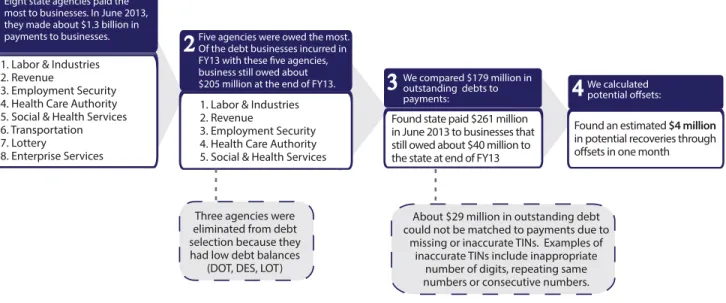
Figure 1 on the following page shows the steps we performed in the analysis to estimate potential debt collections for Washington with a state debt-off set program. Th ese steps are described in more detail in
Debt-Off set Programs :: Appendix B | 31
the text that follows the graphic.
We fi rst identifi ed a sample of state agencies to review. Box 1 lists the agencies that we asked to supply fi scal year 2013 payment and delinquent business debt data for analysis. Although other agencies are also owed business debt and make payments to businesses, we selected eight agencies making substantial payments to businesses.
Th e eight agencies selected for payments paid about $1.3 billion to businesses in June 2013 (the month of the estimate). Business payments included in the analysis consist of state and unemployment tax refunds, retrospective rating refunds, payments for products and services (that is, provider and vendor payments), unclaimed property, and lottery winnings to business owners.
We next eliminated three agencies from debt analysis because they had low debt balances. For the remaining fi ve agencies, we calculated the amount of outstanding delinquent debt that businesses incurred with them and which was still owed at the end of the same fi scal year.
As shown in box 2, businesses incurred and still owed about $205 million in outstanding delinquent debt to the fi ve agencies selected for debt review, including state and unemployment taxes, worker’s compensation premiums, and medical and social service debts. Th e agencies considered these debts delinquent during the review period; they told us they had attempted to collect through collection actions such as warrants, liens, levies, notice to withhold and deliver, and others. Each agency sets its own timeline of when they consider a debt delinquent and when they start collection actions to recover debts.
We then used federal TINs to compare the amount of outstanding delinquent debt businesses incurred and still owed to fi ve agencies in fi scal year 2013 to the payments businesses received from eight agencies in June 2013. As shown in box 3, we found that in June 2013, agencies paid $261 million to businesses that still owed about $40 million in outstanding delinquent debt at the end of the fi scal year.
We could not match all debt to payments because about $29 million (14 percent) of the total outstanding delinquent debt lacked or had inaccurate TINs. As a result, we could not estimate all debt a state debt-off set program might have recovered for Washington in June 2013.
Finally, when we identifi ed matches between businesses that owed debt and those who received payments in June 2013, we calculated the amount of debt a state debt-off set program could have collected in that month. An off set program can only off set a payment up to the full amount of debt owed. Th us, if payments businesses received were greater than their debt, the off set amount was equal to the debt. If payments were less than the debt, the off set amount was equal to the payment.
In box 4, we see that an off set program could have potentially recovered about $4 million (10 percent) of this debt in one month. Note that not all $40 million in outstanding delinquent debt could have been recovered in one month because some of the businesses that owed a signifi cant portion of this debt did not receive suffi cient payments in
Eight state agencies paid the most to businesses. In June 2013, they made about $1.3 billion in payments to businesses. 1. Labor & Industries 2. Revenue
3. Employment Security 4. Health Care Authority 5. Social & Health Services 6. Transportation 7. Lottery
8. Enterprise Services
Found an estimated $4 million
in potential recoveries through offsets in one month 1. Labor & Industries
2. Revenue
3. Employment Security 4. Health Care Authority 5. Social & Health Services
Figure 1 - Steps used in the analysis to determine potential collections for Washington with a state debt-offset program
1
Five agencies were owed the most. Of the debt businesses incurred in FY13 with these five agencies, business still owed about $205 million at the end of FY13.
2
We compared $179 million in outstanding debts to payments:
3
Found state paid $261 million in June 2013 to businesses that still owed about $40 million to the state at end of FY13
Three agencies were eliminated from debt selection because they had low debt balances
(DOT, DES, LOT)
About $29 million in outstanding debt could not be matched to payments due to
missing or inaccurate TINs. Examples of inaccurate TINs include inappropriate
number of digits, repeating same numbers or consecutive numbers.
We calculated potential offsets:
the month of our estimate.
Estimate of potential debt collections with participation in the
U.S. Treasury’s State Reciprocal Program
We coordinated with four Washington agencies (Social and Health Services, Health Care Authority, Employment Security, and Labor and Industries) to send a portion of their outstanding delinquent business debt to the U.S. Treasury for analysis.
To estimate the amount of potential collections if Washington participated in the federal program, we asked the U.S. Treasury to match a portion of the outstanding delinquent debt businesses owed to four state agencies against one month of federal vendor payments. Th e U.S. Treasury’s current testing environment can only compare one month of federal vendor payments against outstanding state debt. Although initial results were available, Treasury offi cials indicated in November 2014 that they needed to make revisions to their estimates. Th e revised results are expected early in 2015.
Treasury’s initial results found a signifi cant number of accounts that could not be matched to federal payments because they matched payments on a business’ TIN but not business name.
Leading practices and lessons learned in other states
We conducted nationwide research to fi nd states that have authority to operate an off set program to collect business debt and to identify the characteristics of off set program design in other states. Of the 29 states that apply off set programs, we selected nine for review based on factors such as tax structure, level of centralization in debt collection, funding model, state agency participation requirements, and participation in the U.S. Treasury’s State Reciprocal Program.
We sought to gain an understanding of how these states designed, manage and fund their off set programs, challenges experienced in implementing the program, benefi ts achieved and practices and lessons for developing eff ective debt-off set programs. Brief summaries of our research are in Appendix D.
Changes Washington would need to make
We reviewed relevant sections of the Revised Code of Washington (RCW) and Washington Administrative Code (WAC) to identify legal barriers to implementing debt-off set programs in Washington. We also interviewed each agency included in the audit to learn about existing statutory, system, process or other limitations that those agencies regard as a barrier to off set program implementation.
With this understanding of Washington’s current condition, plus the information we learned from other states, we determined the legislative, system and process changes Washington would need make to implement and administer eff ective state and federal debt-off set programs.
Kansas North Carolina Kentucky Texas
Maryland Virginia Minnesota Wisconsin Nevada
Debt-Off set Programs :: Appendix C | 33
Appendix C: State Profi les
Th e following state profi les provide information gathered through interviews with off set program administrators in nine states, the U.S. Treasury, and our review of the statutes that authorize the use of an off set program in these states.
Many of the states we interviewed use several diff erent types of off set programs that collect money owed by businesses and individuals; or they may use an off set program as part of a larger centralized debt collection program. As a result, it was not always possible to separate the specifi cs of the business debt-off set program from other types of off set or debt collection programs. Th e following table’s profi les are specifi c to business debt-off set programs unless otherwise noted.
Of the nine states we interviewed, four participate in the U.S. Treasury’s State Reciprocal Program (Kentucky, Maryland, Minnesota, and Wisconsin). Th e U.S. Treasury provided recent collection amounts for states that participate in its State Reciprocal Program.