Semi-Supervised Neural Networks for Nested Named Entity Recognition
∗ Jinseok NamKnowledge Engineering Group
Department of Computer Science, TU Darmstadt, Germany Knowledge Discovery in Scientific Literature
German Institute for Educational Research, Germany
Abstract
In this paper, we investigate a semi-supervised learning approach based on neu-ral networks for nested named entity recog-nition on the GermEval 2014 dataset. The dataset consists of triples of a word, a named entity associated with that word in the first-level and one in the second-level. Additionally, the tag distribution is highly skewed, that is, the number of occurrences of certain types of tags is too small. Hence, we present a unified neural network archi-tecture to deal with named entities in both levels simultaneously and to improve gen-eralization performance on the classes that have a small number of labelled examples.
1 Introduction
Named Entity Recognition (NER) is an important natural language processing (NLP) task that aims at assigning a class label to a word such as person, location, organization and so on. In contrast to the traditional NER where a classifier assigns only a single named entity (NE) for elements in text, the GermEval 2014 dataset (Benikova et al., 2014b) allows for elements to have two NEs at most. For example, “TU Darmstadt” is not only considered as an organization, but “Darmstadt” can be also tagged as alocation. The dataset consists of sen-tences sampled from Leipzig Corpora Collection (LCC) (Quasthoff et al., 2006) publicly available for download.1
∗
This work is licensed under a Creative Commons Attri-bution 4.0 International License (CC BY 4.0). Page numbers and proceedings footer are added by the organizers. License details: http://creativecommons.org/licenses/by/4.0/
1
http://corpora.uni-leipzig.de/ download.html
Recently, neural networks (NNs) have suc-ceeded in various NLP tasks including NER (Col-lobert et al., 2011). Thus, we build a neural net-work architecture solving the nested NER prob-lem in a semi-superivsed way by making use of a large number of unlabelled sentences from LCC. 2 Background
2.1 NER using Neural Networks
Collobert et al. (2011) proposed a unified neural network architecture, namely SENNA, on which we build an architecture for nested NER.
Consider a sentence t = {w1, w2,· · ·, wNt}
of lengthNtin which each wordwi is associated
with its target yi, which has one of C possible
tags. The inputs to SENNA are the concatenated vector representations for the words in the sen-tence. The vector representations can be drawn from a matrixL ∈Rd×|V|wheredis the dimen-sion of the vectors and|V|is the number of words in our vocabulary. While it is possible to define another feature matrix that we want to learn such as capitalization features L(caps) as well as the word featuresL(w), for simplicity, we only con-sider the word features asLin this Section.
Assuming that we wish to tag a wordwiand let
kw be the width of a window. The vector
repre-sentations of word wi and of words surrounding
wi in a window are drawn fromL, then
concate-nated to formxi ={L·wn}
bkw/2c+i
n=−bkw/2c+i ∈R
d·kw
wherebxcdenotes the largest integer not greater than x. If nis less than1 or greater than Nt, a
specialpaddingword is used instead. In turn, the inputxi is passed to a non-linear function to
ob-tain a hidden representation hi=f
W(1)xi+b(1)
(1) where the functionf :R→Ris an element-wise
W(1) ∈
RF×(d·kw)is a matrix of weights that link
input units to hidden units, and b(1) ∈ RF is a
vector of biases for the hidden layer. The hidden representationhi is, then, fed forward to the
out-put layer to yield the prediction scoresyˆi ∈ RC
of the tags for the given local context
ˆ
yi=W(2)hi+b(2) (2)
where W(2) ∈ RC×F are the weights between
hidden and output units, each of which corre-sponds to a tag, and b(2) ∈ RC are the biases
for the output layer.
If we assume that the tag of each word depends only on that word and its context, i.e., xi, then
the probability distribution over {wi, yi} can be
formulated as follows p(y1,· · · , yNt, w1,· · · , wNt) = Nt Y i=1 p(yi|xi; Θ). (3) In order to convert the prediction scoresyˆji of
the tagjfor the wordwiinto probability, we can
use thesoftmaxfunction p(yji= 1|xi; Θ) = exp ˆyji P kexp ˆyki (4) whereΘ ={L,W(1),b(1)W(2),b(2)}is a set of parameters. By taking thelog, our objective, Eq. 4, becomes max Θ Nt X i=1 C X j=1 I[yji = 1] yˆji−log C X k=1 exp ˆyki ! (5) where I[·] denotes the indicator function which
takes 1 when the argument is true, otherwise 0. This is referred to asword-levellog-likelihood.
Learning Tag Dependencies In word-level
log-likelihood, tag dependencies are ignored by the assumption that a tag is determined by only its local context. To exploit dependencies between tags, we take tag transition scores T ∈ RC×C
into account. A prediction score for the whole sentence is given by ˆ y[c]= Nt X i=1 W(2)hi+b(2)+Tci,ci−1 (6) where [c] denotes a sequence of the tags in the sentence,ciindicates the tag of the wordwi, and
Tci,ci−1 is a transition score fromci−1 toci. For the case i = 1, we also need initial tag scores Tc,0 ∈RC. The prediction score for the sentence
is also transformed to a probability divided by the
scores over all possible tag sequences[k]
p{yi}Ni=1t |{xi}Ni=1t ; Θ,T = Pexp ˆy[c] [k]exp ˆy[k] . (7) Similarly, the objective taking transitions be-tween tags into consideration is given by
max
Θ,T yˆ[c]−log
X
[k]
exp ˆy[k] (8) which is referred to as sentence-level log-likelihood and this can be addressed efficiently usingrecursion.
2.2 Semi-Supervised Learning
The simplest algorithm for semi-supervised learn-ing is self-trainlearn-ing (Rosenberg et al., 2005). In self-training, once a model is trained on labelled data, it is used to predict labels of unlabelled data, then such unlabelled data are provided as if addi-tional labelled examples.
Pseudo-Label (PL) (Lee, 2013) is a semi-supervised learning technique especially for NNs. Unlike self-training, it estimates pseudo-labels, most probable labels of unlabelled data, during training and uses them to update parameters as well as labelled examples. Its purpose is similar to Entropy Regularization (Grandvalet and Ben-gio, 2005) that minimizes conditional entropy of unlabelled data as a measure of class overlap on the feature space.
3 Semi-Supervised Neural Networks for Nested NER
In contrast to the traditional NER, a word in nested NER can be tagged by multiple NEs. For simplicity, the number of levels is limited to two.
3.1 Jointly Learning Top-level and Nested NEs
In nested NER, a sentencetcan be characterized by a sequence of triples{wi, yi1, yi2}wherey1i is
the tag of the wordwiin the first level, andyi2for
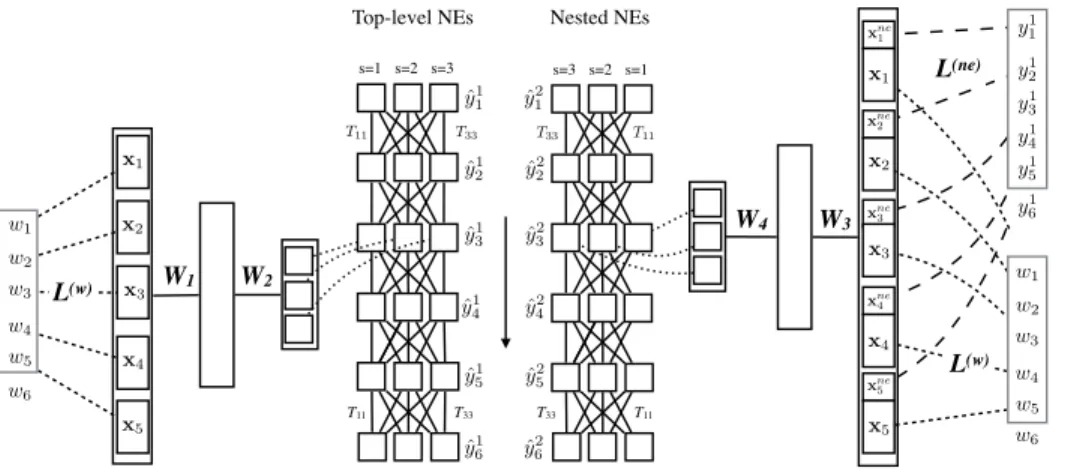
the second level. Note that the tags in both levels are defined over the same set. Figure 1 describes our proposed architecture to tackle nested NER.
The proposed model deals with all NEs in both levels jointly during the learning phase by us-ing an additional feature matrixL(ne) ∈Rdne×C
for NEs, which is also a set of learnable param-eters like L(w). Each column of L(ne)
corre-W3 W4 L(ne) y1 1 y1 2 y1 3 y1 4 y1 5 ˆ y2 5 ˆ y2 4 ˆ y2 3 ˆ y2 2 ˆ y2 1 W1 W2 L(w) s=1 s=2 s=3 T11 T33 ˆ y1 1 ˆ y1 2 ˆ y1 3 ˆ y1 4 ˆ y1 5 ˆ y1 6 T11 T33 T11 T11 ˆ y2 6 xne 3 xne 4 xne 5 xne 1 xne 2 L(w) T33 T33 s=3 s=2 s=1
Top-level NEs Nested NEs
w6 y1 6 w1 w2 w3 w4 w5 w1 w2 w3 w4 w5 w6 x1 x2 x3 x4 x5 x1 x2 x3 x4 x5
Figure 1: An illustrative example of the proposed architecture for jointly learning top-level and nested NEs. Consider a sentencet={wi, y1i, y
2 i}
6
i=1of length 6, a window of sizekw= 5, and that we want to predict tags
y13, y23 for a wordw3. Assuming that the number of NEs in the problem is 3,sindicates an index of a named entity. A matrix of word embeddingsL(w) and the tag transition matrixTare shared between two networks. Each network is trained to make predictions NEs of given a word sequence{wi}6i=1for each level.
sponds to a vector representation of a named en-tity. Given the concatenated feature vectors of a word xi in the window as described in
Sec-tion 2.1, we construct a vector representaSec-tion for NEs in the top-level corresponding to that word, denoted by xnei ∈ Rdne·kw, then concatenate it
to xi, which yields combinedvector
representa-tions of words and NEs xcombi = {xi,xnei } ∈
R(dne+dK)×kw. Similar to Eq.7 for the first
level NEs, the sentence-level log-likelihood is also computed for the second level NEs like
ˆ
yi2 =W(4)f W(3)xcombi +b(3)
+b(4).Then, the training objective considering the first- and second-level NEs simultaneously is given by
p {yi1, yi2, wi}Ni=1t ; ¯Θ = (1−α) p{yi1}Nt i=1|{xi}Ni=1t ; Θ,T +α p {y2i}Nt i=1|{x comb i }Ni=1t ;θ,T (9) where θ = {W(3),b(3),W(4),b(4),L(·)}, Θ =¯
{Θ, θ,T}, andα∈[0,1]is a control parameter.
3.2 Learning from Pseudo Labels of Unlabelled Data
Semi-supervised learning methods are well-suited to the problems where the number of train-ing instances is insufficient. Tag distribution of the GermEval dataset is highly skewed. In other words, the proportion of the three tag types, i.e., LOC, PER, and ORG, amounts to approximately 70% (See (Benikova et al., 2014b) for statistics).
In this work, we apply PL to only the first level in order to improve the generalization per-formance on such small classes. The first term of the right hand side in Eq. 9 can be re-written as
(1−α) p {y1i}Nt i=1|{xi} Nt i=1; Θ,T + (1−α)βtp {yˆ1ui}uNt ui=1|{xui}uNui=1t ; Θ,T (10) where ui is an index of an unlabelled sentence randomly selected from LCC,yˆ1uiis a pseudo tag for the wordwuiin an un-annotated sentence, and
β controls the importance of learning from unla-belled data. Scheduling the control parameter at timettakes the following form:
βt= 0 t < T1 t−T1 T2−T1βmax T1 ≤t≤T2 βmax t > T2 (11)
withβmax= 2, T1 = 100, andT2 = 500. 2 The
pseudo labelyˆ1
ui is determined by simply
choos-ing the most confident one given prediction scores for an un-annotated sentence during training. 4 Experiments
Our experiments were performed on the Ger-mEval 2014 dataset, where the tags constitutes four major types, i.e., LOC, PER, ORG and OTH, and their sub-types which end with deriv” or “-part” using a BIO tagging scheme. The results in
2
The hyperparameters for scheduling PL were chosen via cross validation.
Table 1: Effect of word embeddings
Initialization P R F1
Random 69.67 54.19 60.96
Pretrain 68.39 69.27 68.82
Table 2: Effect of Pseudo Label as a regularizer
Learning scheme P R F1
Sup. learning(βt= 0) 68.39 69.27 68.82 Semi-sup.(βmax= 2) 77.08 68.40 72.48
Table 1 and 2 are reported in terms of the official metric, namely M1 (See (Benikova et al., 2014a)), in the GermEval 2014 Shared Task.
4.1 Details of Training
We evaluated the proposed method with the fol-lowing hyperparameter settings over the number of hidden units F = 300, the dimension of cap-italization features dcap = 3, the dimension of
named entity features dne = 10, window size
kw = 5, α = 0.5, a fixed learning rate 0.01 for
SGD with AdaGrad (Duchi et al., 2011). In addi-tion, we used length normalization over all em-beddings such that kxk = 10 to prevent over-fitting. For the transfer function in Eq.1, ReLU, f(x) = max(0, x), is used. The feature matrices L(caps)andL(ne)were initialized randomly.
4.2 Importance of Word Embeddings
We used word2vec (Mikolov et al., 2013) for learning word embeddings because of its effi-ciency.3 We set the dimension of word embed-dingsdwto 128 and the size of vocabulary|V|is
about 4M which yields the feature matrixL(w) ∈ R128×4M. We run the word2vec for 10 epochs
with a fixed learning rate 0.01 on approximately 87M sentences from a German Wikipedia dump, LCC, and SDeWac (Faaß and Eckart, 2013).
The results of using pretrained word embed-dings on unlabelled data in comparison to random initialization are shown in Table 1. We observed that NNs using pretrained word embeddings per-form much better in terms ofrecall.
4.3 Effect of Semi-Supervised Learning
We evaluated our proposed approach for nested NER. The results of this experiment are shown in
3https://code.google.com/p/word2vec/
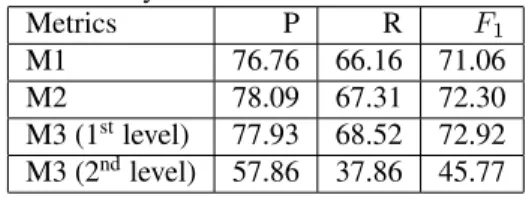
Table 3: The System Performance on Unseen Data
Metrics P R F1
M1 76.76 66.16 71.06
M2 78.09 67.31 72.30
M3 (1stlevel) 77.93 68.52 72.92 M3 (2ndlevel) 57.86 37.86 45.77
Table 2. The semi-supervised approach outper-forms the purely supervised one. We observe that learning with pseudo labels reduces the number of false positives which results in higher precision. In particular, the number of predictions in the top-level resulting from the supervised approach is 2738 while the semi-supervised approach yields 2378 predictions. Interestingly, we also observe performance improvement on LOC and ORG as well as the smaller classes including OTH and “deriv”- and “part”-classes, but not all of them.
4.4 Results of GermEval 2014 Shared Task
The proposed method was submitted to the Ger-mEval 2014 Named Entity Recognition Shared Task. Our system calledPLsNERwas ranked at 5th and the scores are shown in Table 3. More re-sults and comparisons with other systems can be found in (Benikova et al., 2014a).
5 Conclusions
We proposed a neural network architecture, which is capable of learning from top-level NEs and nested NEs jointly in nested NER. By making use of unlabelled data in a semi-supervised fash-ion, we also demonstrated its effectiveness when a small number of training examples are provided. Our experiments show that the use of word embeddings improvesrecallcompared to random initialization. Pseudo labels make it possible to get more precise predictions. Additionally, our system performs pretty well on unseen data with-out use of language-dependent feature engineer-ing steps.
Acknowledgments
This work has been supported by the German Institute for Educational Research (DIPF) under the Knowledge Discovery in Scientific Literature (KDSL) program.
References
Darina Benikova, Chris Biemann, Max Kisselew, and Sebastian Pado. 2014a. GermEval 2014 Named Entity Recognition: Companion Paper. In Proceed-ings of the KONVENS GermEval Shared Task on Named Entity Recognition, Hildesheim, Germany. Darina Benikova, Chris Biemann, and Marc Reznicek.
2014b. NoSta-D Named Entity Annotation for Ger-man: Guidelines and Dataset. InProceedings of the Ninth International Conference on Language Re-sources and Evaluation.
Ronan Collobert, Jason Weston, L´eon Bottou, Michael Karlen, Koray Kavukcuoglu, and Pavel P. Kuksa. 2011. Natural Language Processing (almost) from Scratch. Journal of Machine Learning Research, 12:2493–2537.
John Duchi, Elad Hazan, and Yoram Singer. 2011. Adaptive Subgradient Methods for Online Learning and Stochastic Optimization. Journal of Machine Learning Research, 12:2121–2159.
Gertrud Faaß and Kerstin Eckart. 2013. SdeWaC– a Corpus of Parsable Sentences from the Web. In Language processing and knowledge in the Web, pages 61–68. Springer.
Yves Grandvalet and Yoshua Bengio. 2005. Semi-supervised Learning by Entropy Minimization. In Advances in Neural Information Processing Sys-tems 17, pages 529–536.
Dong-Hyun Lee. 2013. Pseudo-Label: The Simple and Efficient Semi-Supervised Learning Method for Deep Neural Networks. InWorkshop on Chal-lenges in Representation Learning, ICML.
Tomas Mikolov, Ilya Sutskever, Kai Chen, Greg S Cor-rado, and Jeff Dean. 2013. Distributed representa-tions of words and phrases and their compositional-ity. InAdvances in Neural Information Processing Systems, pages 3111–3119.
Uwe Quasthoff, Matthias Richter, and Chris Biemann. 2006. Corpus Portal for Search in Monolingual Corpora. InProceedings of the Fifth International Conference on Language Resources and Evalua-tion, pages 1799–1802, Genoa.
Chuck Rosenberg, Martial Hebert, and Henry Schnei-derman. 2005. Semi-Supervised Self-Training of Object Detection Models. In Proceedings of the Seventh IEEE Workshops on Application of Com-puter Vision, WACV-MOTION ’05, pages 29–36.