Technical Aid Packet
Resource Mapping and Management to
Address Barriers to Learning:
An Intervention for Systemic Change
(Revised 2015)
The Center is co-directed by Howard Adelman and Linda Taylor and operates under the auspiceof the School Mental Health Project, Dept. of Psychology, UCLA. (310) 825-3634 E-mail: [email protected]
Website: http://smhp.psych.ucla.edu
Permission to reproduce this document is granted.
1
Resource Mapping and Management to Address Barriers to Learning:
An Intervention for Systemic Change
Page
I. Purpose of Mapping Resources 2
• Overview 3
• About Resource Mapping and Management 5
• The Movement Toward Assets Mapping 6
• Mapping, Analyzing, Enhancing Resources 7
II. Processes for Mapping Resources 8
A. Mapping in Stages 9
B. Resource Aids for Mapping People & Programs 10
1. Who Does the Mapping?? 12
2. Mapping of Resource Staff 14
3. Mapping of Activities Using an Enabling Component Framework 17
4. Mapping Community Resources 31
C. Mapping Funding Sources 32
D. Other Relevant Resources 37
III. Products of Mapping 39
A. Examples of Products 40
1. Initial Mapping of Enabling Activity at an Elementary School 41
2. Initial Mapping of Enabling Activity at a Secondary School 48
3. A Spread Sheet Version of Initial Mapping at an Elementary School 53
4. Combined Summary of Resource Professionals 55
56
B. Making Products Visible
C. Examples of Community Mapping 60
IV. Beyond Mapping 69
A. Social Marketing as a Spiraling Facet of Program and Systemic Change 70
B. Establishing Priorities 71
C. Some Next Steps 74
V. Resources 76 A. Online 77 B. References 78 C. Centers 79 D. Links 80 Appendix: 81
• Examples of Surveys that Aid Mapping
>Learning Supports Staff at the School 85
>General Overview of Student/Learning Supports Activitties, Processes, Mechanisms 95
>Classroom-based Approaches to Enable and Re-engage Students 89
95
>Support for Transitions
100
>Home Involvement, Engagement, and Re-engagement
107
>Community Outreach and Collaborative Engagement
118
>Student and Family Assistance 123
>Analyzing Gaps; Reviewing Resources; Planning Action 130
2
I. Purpose of Mapping Resources
• Overview• About Resource Mapping and Management
3
I. Purpose of Mapping Resources
Resource Mapping and Management
to Address Barriers to Learning:
An Intervention for Systemic Change
Overview
In their effort to raise test scores, school leaders usually have pursued intensive instruction as the primary route. While improved instruction is necessary, for too many youngsters it is not sufficient. Students who arrive at school on any given day lacking motivational readiness and/or certain abilities need something more. That something more involves developing comprehensive, multifaceted, and integrated approaches to address barriers to student learning and promote healthy development.
Schools already have a variety of programs and services to address barriers and promote development. These range from Title I programs, through extra help for low performing students, to accommodations for special education students. In some places, the personnel and programs to support learning account for about 30% of the resources at a school. However, because school leaders have been so focused on instruction, essential efforts to support learning are marginalized, and resources are deployed in a fragmented and often wasteful and ineffective manner. The result of the marginalization is that school improvement efforts continue to pay little attention to the need for and potential impact of rethinking how these resources can be used to enable student learning by doing more to address barriers.
How can a school improve its impact in addressing barriers to student learning?
It can begin by (a) taking stock of the resources already being expended and (b) considering how these valuable resources can be used to the greatest effect. These matters involve a variety of functions and tasks we encompass here under the rubric of mapping and managing resources.
Carrying out the functions and tasks related to mapping and managing resources is, in effect, an intervention for systemic change. For example:
• A focus on these matters highlights the reality that the school’s current infrastructure probably requires some revamping to ensure the necessary functions are carried out (e.g., a resource-oriented mechanism focusing on resources is needed).
4
• By identifying and analyzing existing resources (e.g., personnel, programs, services, facilities, budgeted dollars, social capital), awareness is heightened of their value and potential for playing a major role in helping students engage and re-engage in learning at school.
• Analyses also lead to sophisticated recommendations for
deploying and redeploying resources to improve programs, enhance cost-effectiveness, and fill programmatic gaps in keeping with well-conceived priorities.
• The products of mapping activities can be invaluable for “social marketing” efforts designed to show teachers, parents, and other community stakeholders all that the school is doing to address barriers to learning and promote healthy development.
Enhanced appreciation of the importance of resource mapping and management may lead to a desire to accomplish the work quickly. Generally speaking, it is not feasible to do so because mapping usually is best done in stages and requires constant updating. Thus, most schools will find it convenient to do the easiest forms of mapping first and, then, build the capacity to do in-depth mapping over a period of months. Similarly, initial analyses and management of resources will focus mostly on enhancing understanding of what exists and coordination of resource use. Over time, the focus is on spread-sheet type analyses, priority recommendations, and braiding resources to enhance cost-effectiveness, and fill programmatic gaps.
5
About Resource Mapping and Management
A. Why mapping resources is so important.
• To function well, every system has to fully understand and manage its
resources. Mapping is a first step toward enhancing essential understanding, and done properly, it is a major intervention in the process of moving forward with enhancing systemic effectiveness.
B. Why mapping both school and community resources is so important.
• Schools and communities share
> goals and problems with respect to children, youth, and families
> the need to develop cost-effective systems, programs, and services to meet the goals and address the problems.
> accountability pressures related to improving outcomes
> the opportunity to improve effectiveness by coordinating and eventually integrating resources to develop a full continuum of systemic interventions
C. What are resources?
• Programs, services, real estate, equipment, money, social capital, leadership, infrastructure mechanisms, and more
D. What do we mean by mapping and who does it?
• A representative group of informed stakeholder is asked to undertake the process of identifying
> what currently is available to achieve goals and address problems > what else is needed to achieve goals and address problems
E. What does this process lead to?
• Analyses to clarify gaps and recommend priorities for filling gaps related to programs and services and deploying, redeploying, and enhancing resources • Identifying needs for making infrastructure and systemic improvements and
changes
• Clarifying opportunities for achieving important functions by forming and enhancing collaborative arrangements
• Social Marketing
F. How to do resource mapping
• Do it in stages (start simple and build over time)
> a first step is to clarify people/agencies who carry out relevant roles/functions > next clarify specific programs, activities, services (including info on how many
students/families can be accommodated)
> identify the dollars and other related resources (e.g., facilities, equipment) that are being expended from various sources
> collate the various policies that are relevant to the endeavor
• At each stage, establish a computer file and in the later stages create spreadsheet formats
• Use available tools (see examples in this packet)
6
The Movement Toward Assets Mapping
Asset Based Community Development
In the past, community development has followed a guideline that focused attention on the deficits of a community. The traditional “needs assessments” were always the first steps to address the problems of a community. After thirty years of prioritizing the negative aspects of a community, a new movement is underway. This movement, known as Asset Based Community Development (ABCD), concentrates on the resources in each community.
http://www.northwestern.edu/ipr/abcd.htm
Community Building Resources
Community Capacity Building & Asset Mapping
©Asset-based Community Building or Asset-based Community Development is an effective way to animate, connect, and inform citizens, and to create an environment in which relationships can build. The asset focus can be a catalyst and a spark for the people to discover, access, and mobilize their unrecognized resources, and engages people who have not participated in the life of the community. Community Capacity Building & Asset Mapping© includes everyone; it encourages conversation and creates an environment where people can become acquainted, relationships can grow and people are interested and motivated to support each other.
7
Mapping, Analyzing, and Enhancing Resources
A comprehensive form of "needs assessment" is generated as resource mapping is paired with surveys of the unmet needs of students, their families, and school staff.
In schools and community agencies, there is redundancy stemming from ill-conceived policies and lack of coordination. These facts do not translate into evidence that there are pools of unneeded personnel and programs; they simply suggest there are resources that can be used in different ways to address unmet needs. Given that additional funding is hard to come by with respect to developing comprehensive, multifaceted approaches for addressing barriers to student leanring, such redeployment of resources is the primary answer to the ubiquitous question: Where will we find the funds?
Thus, a primary and essential task in improving the current state of affairs is that of enumerating school and community programs and services that are in place to support students, families, and staff. Analyses of what is available, effective, and needed, provides a sound basis for formulating strategies to link with additional resources at other schools, district sites, and in the community and to enhance use of existing resources. Such analyses can also guide efforts to improve cost-effectiveness. In a similar fashion, mapping and analyses of a complex, or family, of schools (e.g., a high school and its feeders) provides a mechanism for analyses that can lead to strategies for cooperation and integration to enhance intervention effectiveness and to garner economies of scale.
8
II. Processes for Mapping Resources
A. Mapping in Stages
B. Resource Aids for Mapping People & Programs
C. Mapping Funding Sources
9 II. Processes for Mapping Resources
A. Mapping in Stages
Mapping is an essential step in coordinating and enhancing the use of resources.
It is important to complete the process as quickly as feasible. However, because mapping often is time consuming and some forms are complex, it probably will be done in stages over time.
First, map “Who’s Who” and what they do
(including any representatives from community agencies who come to the school).
Second, make a list of programs, activities, services, etc. You may start with a “laundry list,” but as soon as feasible, organize what is going on into areas (see appendix for examples of survey aids and area summary sheets).
Move on to map the dollars and related resources (e.g., facilities, equipment) currently allocated for addressing barriers to learning and promoting healthy development.
Then, collate the various policies that are relevant to the endeavor.
At each stage:
• Establish a computer file and in the later stages create spread sheetformats
10
II.Processes for Mapping Resources
B. Resource Aids for Mapping People & Programs
On the following pages are some tools that can be
used as aids in the first stages of mapping resources.
(1)
Who Does the Mapping?
(2)
Mapping of Resource Staff
(3)
Mapping of Activities Using
an Enabling Component Framework
(4)
Mapping Community Resources
Do you know what resources are in use for addressing
barriers to learning and teaching and re-engaging
disconnected students?
Who is responsible for mapping and analyzing these
resources with a view to improving the way schools
address the barriers?
(1) Who Does the Mapping?
A LEARNING SUPPORTS LEADERSHIP TEAM
E
very school that wants to improve student and learning supports needs a mechanism specificallyworking on system development to enhance how schools address barriers to learning and teaching and re-engage disconnected students. The goal is to rework existing resources by establishing a unified and comprehensive approach. A Learning Supports Leadership Team is a vital mechanism for transforming current marginalized and fragmented interventions into a comprehensive, multifaceted, and cohesive system that enhances equity of opportunity for all students to succeed at school.
Most schools have teams that focus on individual student/family problems (e.g., a student support team, an IEP team). These teams pursue such functions as referral, triage, and care monitoring or management. In contrast to this case-by-case focus, a school’s
Learning Supports Leadership Team, along with an administrative leader, can take responsibility for developing a unified and comprehensive enabling or learning supports component at a school. In doing so, it ensures that the component is (1) fully integrated as a primary and essential facet of school improvement and (2) outreaches to the community to fill critical system gaps by weaving in human and financial resources from public and private sectors.
What Are the Functions of this Leadership Team?
A Learning Supports Leadership Team performs essential functions and tasks related to the implementation and ongoing development of a comprehensive, multifaceted, and cohesive system for addressing barriers to student learning and teaching. Examples are:
Aggregating data across students and from teachers to analyze school needs
Mapping resources at school and in the community
Analyzing resources & formulating priorities for system development (in keeping with the most pressing needs of the school)
Recommending how resources should be deployed and redeployed
Coordinating and integrating school resources & connecting with community resources Planning and facilitating ways to strengthen
and develop new programs and systems Developing strategies for enhancing resources Establishing work groups as needed
“Social marketing”
Related to the concept of an enabling/learning supports component, these functions and tasks are pursued within frameworks that outline six curriculum content arenas and the full continuum of interventions needed to develop a comprehensive, multifaceted approach to student and learning supports that is integrated fully into the fabric of school improvement policy and practice. (See http://smhp.psych.ucla.edu/pdfdocs/systemic/frame worksforsystemictransformation.pdf )
Who’s on Such a Team?
A Learning Supports Leadership Team might begin with only a few people. Where feasible, it should expand into an inclusive group of informed, willing, and able stakeholders. This might include the following:
• Administrative Lead for the component • School Psychologist
• Counselor • School Nurse
• School Social Worker • Behavioral Specialist • Special education teacher
• Representatives of community agencies involved regularly with the school
• Student representation (when appropriate and feasible)
• Others who have a particular interest and ability to help with the functions
It is important to integrate this team with the infrastructure mechanisms at the school focused on instruction and management/governance. For example, the school administrator on the team needs to represent the team at administrative and governance meetings. A member also will need to represent the team when a Learning Supports Leadership Council is established for a family of schools (e.g., the feeder pattern).
For Related Center Resources, see the System Change Toolkit forTransforming Student and Learning Supports into a Unified, Comprehensive, and Equitable System for
Addressing Barriers to Learning and Teaching – especially Section B on Reworking Infrastructure –
http://smhp.psych.ucla.edu/summit2002/resourceaids.htm
12
13
Learning Supports Leadership Teams: Mapping & Analysis
One of the first tasks of a Learning Supports Leadership Team is to map the resources used at the school to address barriers to learning. Then, the team analyzes how well the resourcesare being used.
• How well are the various activities coordinated/integrated? • Which activities need to be improved (or eliminated)?
• What is missing – especially any activity that seems as important or even more important than those in operation.
Concerns arise about redundancy, effectiveness, and priorities. The immediate challenge is to move from piecemeal approaches by coordinating and integrating existing activity (including curricula designed to foster positive social. emotional, and physical development). Resources must be redeployed from poorly conceived activities to enhance the potency of well-conceived programs and to fill gaps in the continuum of interventions. Concerns also arise about how students receive special assistance. Renewed efforts are made to ensure there are effective referral, student review ("triage"), and care monitoring/ management procedures. Greater emphasis is placed on ensuring there are programs in place that students can enter easily and quickly after referral (such as support groups, peer counseling, social skills training, recreation, and enrichment), thereby reducing the waiting list for limited intensive services (such as assessment and counseling).
Subsequent challenges are to evolve existing programs so they are more effective and then to enhance resources as needed (e.g., by working with neighboring schools, community resources, volunteers, professionals-in-training, and family engagement). As resources are enhanced, these challenges encompass solving problems related to sharing space and information, building working relationships, adjusting job descriptions, allocating time, and modifying policies. Maintaining the involvement of key administrators is essential in all this. Adding new partners to the team also is essential if the newcomers are to understand the schools comprehensive, multifaceted approach and how to connect their pieces in a cohesive way.
14
(2) Mapping of Resource Staff
The following templates can be used as aids in generating a
list of the special resource personnel at a site and throughout
a feeder pattern (or “family”) of schools.
Note the following:
In listing “itinerant” resources (e.g., staff who go to different
schools on different days), information should be included
that indicates the days and hours the individual is at the
school.
The individuals listed for a school are a logical group to build
a resource-oriented
team
around. Then, when a multi-site
council is formed, 1-2 representatives of each school's team
can be the core around which to build a resource-oriented
council
(for a family of schools).
II.Processes for Mapping Resources -- B. Resource Aids15
Learning Supports Staff at the School
In a sense, each staff member is a special resource for each other. A few individuals are highlighted here to underscore some special functions.
Administrative Leader for Learning Supports ____________________________________ School Psychologist ____________________
times at the school _______________
• Provides assessment and testing of students for special services. Counseling for students and parents. Support services for teachers.
Prevention, crisis, conflict resolution, program modification for special learning and/or behavioral needs.
School Nurse ____________________________ times at the school________________
• Provides immunizations, follow-up, communicable disease control, vision and hearing screening and follow-up, health assessments and referrals, health counseling and information for students and families. Pupil Services & Attendance Counselor _________________________________ times at the school ________________
• Provides a liaison between school and home to maximize school attendance, transition
counseling for returnees, enhancing attendance improvement activities.
Social Worker ___________________________ times at the school _______________
• Assists in identifying at-risk students and provides follow-up counseling for students and parents. Refers families for additional services if needed.
Counselors times at the school __________________ ____________ __________________ ____________
• General and special counseling/guidance services. Consultation with parents and school staff.
Dropout Prevention Program Coordination
__________________________________ times at the school _____________
• Coordinates activity designed to promote dropout prevention.
Title I and Bilingual Coordinators
__________________________________ __________________________________
• Coordinates categorical programs, provides services to identified Title I students,
implements Bilingual Master Plan (supervising the curriculum, testing, and so forth)
Resource and Special Education Teachers ____________________________________ ____________________________________ ____________________________________
times at the school __________________
• Provides information on program modifications for students in regular classrooms as well as providing services for special education. Other important resources:
School-based Crisis Team (list by name/title) ________________/___________________ ________________/___________________ ________________/___________________ ________________/___________________ ________________/___________________
School Improvement Program Planners
________________/___________________ ________________/___________________ ________________/___________________
Community Resources
• Providing school-linked or school-based interventions and resources
Who What they do When __________/__________________/________ __________/__________________/________ __________/__________________/________ __________/__________________/________ __________/__________________/________ __________/__________________/________
16
Mapping the Resource Staff in a Family of Schools
(e.g., the feeder pattern)
Enter the Name of Each School Type of Resource Staff (under school name, enter each person by name) School Psychologist School Counselor(s) School Nurse Attendance Counselor Social Worker Dropout Prevention Coordinator Title I Coordinator Bilingual Coordinator Resource Teacher Speech & Language Specialist
Enter all other school resource staff Administrators for Learning Supports Enter all resource staff who come to the school from the community
17
(3) Mapping of Activities Using a Enabling Component Framework
Because the range of barriers to student learning is multifaceted and complex and the number of students affected is quite large, it is reasonable to stress that a comprehensive and systemic approach to intervention is necessary. The question is: How should such an approach be depicted?One trend has been to formulate a continuum of interventions. For example, a graphic many folks use is a pyramid-like triangle that, starting at its peak, stresses “intensive interventions” (for a few), “supplemental interventions” (for some), and “universal interventions” (for all). Other outlines highlight prevention, early intervention, and treatment approaches. Other descriptions amount to little more than itemizations of specific interventions and listings of various disciplines providing support.
If the marginalization of student supports is to end, a framework that presents a coherent picture of a comprehensive, multifaceted, and cohesive set of interventions must be formulated and operationalized. Minimally, such a framework must delineate the essential scope and content focus of the enterprise. Our approach conceives the scope of activity as a school-community continuum of interconnected intervention systems consisting of
• systems for promotion of healthy development and prevention of problems
• systems for intervening early to address problems as soon after onset as is feasible
• systems for assisting those with chronic and severe problems.
This continuum is intended to encompass efforts to enable academic, social, emotional, and physical development and address learning, behavior, and emotional problems at every school.
For any school and community, the continuum encompasses many activities, programs, and services. These are not presented as a lengthy list of specifics. Rather, they are clustered into a delimited, set of overlapping arenas, each of which reflects the intervention’s general “content” focus.
Pioneering school initiatives have operationalized six arenas of intervention content. In doing so, these trailblazers have moved from a “laundry-list” of interventions to a defined set of general categoriesthat captures the multifaceted work schools need to pursue in comprehensively addressing barriers to learning. The categories are:
• Classroom-focused enabling – enhancing regular classroom strategies to enable learning (e.g., improving instruction for students with mild-moderate learning and behavior problems and re-engaging those who have become disengaged from learning at school)
• Support for transitions (e.g., assisting students and families as they negotiate school and grade changes, daily transitions)
• Home involvement with school – strengthening families and home and school connections
• Crisis response and prevention – responding to, and where feasible, preventing school and personal crises
• Community involvement and support (e.g., outreach to develop greater community involvement and support, including enhanced use of volunteers)
• Student and family assistance – facilitating student and family access to effective services and special assistance as needed.
18
Combining scope and content generates a matrix framework (see below). Such a framework helps convey a big picture of a comprehensive, systemic approach. It currently is being used as a unifying intervention framework and as an analytic tool for mapping and analyzing what schools are and are not doing and then setting priorities for school improvement. (For more on this, see http://smhp.psych.ucla.edu/summit2002/ standardsforenabling.pdf .)
A Unifying Umbrella Framework to Guide Mapping of Learning Supports*
Scope of Intervention
Systems for Promoting Systems for Systems of Care Healthy Development & Early Intervention
Preventing Problems (Early after problem onset)
Classroom-Focused Enabling
Crisis/ Organizing Emergency around the Assistance &
Prevention Content/
“curriculum”
Support for (for addressing transitions barriers to learning & promoting Home healthyInvolvement development) in Schooling Community Outreach/ Volunteers Student and Family Assistance
Accommodations for differences & disabilities Specialized assistance & other intensified interventions (e.g., Special Education & School-Based
Behavioral Health)
* Note that specific school-wide and classroom-based activities related to positive behavior support, “prereferral” interventions, and the eight components of Center for Prevention and Disease Control’s Coordinated School Health Program are embedded into the six content (“curriculum”) areas.
19
Rather than mapping that creates a long list of seemingly disconnected activity, the matrix provides a logical framework for mapping the various activities, programs, and services at a school.
Below is a bit fuller description of the six areas that have been conceived as the "curriculum" of an enabling component. (See the surveys in the appendix for more detail.)
Examples of one school's mapping in each of these areas are provided on the following pages.
(1) Classroom-Focused Enabling -- enhancing teacher capacity for addressing problems and for fostering social, emotional, intellectual and behavioral development. When a classroom teacher encounters difficulty in working with a youngster, the first step is to see whether there are ways to address the problem within the classroom and perhaps with added home involvement. It is essential to equip teachers to respond to garden variety learning, behavior, and emotional problems using more than social control strategies for classroom management. They must learn ways to engage students who are not highly motivated and reengage those who have become turned off to school. Teachers must be helped to learn many ways to enable the learning of such students, and schools must develop school-wide approaches to assist teachers in doing this fundamental work. The literature offers many relevant practices. A few prominent examples are: prereferral intervention efforts, tutoring (e.g., one-to-one or small group instruction), enhancing protective factors, and assets building (including use of curriculum-based approaches to promoting social emotional development).
(2) Support for Transitions -- enhancing school capacity to handle the variety of transition concerns confronting students and their families. It has taken a long time for schools to face up to the importance of establishing transition programs. In recent years a beginning has been made. Transition programs are an essential facet of reducing levels of alienation and increasing levels of positive attitudes toward and involvement at school and learning activity. Thus, schools must plan, develop, and maintain a focus on transition concerns confronting students and their families. Examples of relevant practices are readiness to learn programs, before, during, and after school programs to enrich learning and provide safe recreation, articulation programs (for each new step in formal education, vocational and college counseling, support in moving to and from special education, support in moving to post school living and work), welcoming and social support programs, to and from special education programs, and school-to-career programs. Enabling successful transitions has made a significant difference in how motivationally ready and able students are to benefit from schooling.
(3) Crisis/Emergency Assistance and Prevention -- responding to minimize the impact of, and prevent crises. The need for crisis response and prevention is constant in many schools. Such efforts ensure assistance is provided when emergencies arise and follow-up care is provided when necessary and appropriate so that students are able to resume learning without undue delays. Prevention activity stresses creation of a safe and productive environment and the development of student and family attitudes about and capacities for dealing with violence and other threats to safety. Examples of school efforts include (1) systems and programs for emergency/crisis response at a site, throughout a complex/family of schools, and community-wide (including a program to ensure follow-up care) and (2) prevention programs for school and community to address safety and violence reduction, child abuse and suicide prevention, and so forth. Examples of relevant practices are establishment of a crisis team to ensure crisis response and aftermath interventions are planned and implemented, school environment changes and safety strategies, and curriculum approaches to preventing crisis events (violence, suicide, and physical/ sexual abuse prevention). Current trends stress school- and community-wide prevention programs.
20
(4) Enhancing home involvement. In recent years, the trend has been to expand the nature and scope of the school’s focus on enhancing home involvement. Intervention practices encompass efforts to (1) address specific learning and support needs of adults in the home (e.g., classes to enhance literacy, job skills, ESL, mutual support groups), (2) help those in the home meet their basic obligations to the children, (3) improve systems to communicate about matters essential to student and family, (4) enhance the home-school connection and sense of community, (5) enhance participation in making decisions that are essential to the student, (6) enhance home support related to the student’s basic learning and development, (7) mobilize those at home to problem solve related to student needs, and (8) elicit help (support, collaborations, and partnerships) from those at home with respect to meeting classroom, school, and community needs. The context for some of this activity may be a parent center (which may be part of the Family and Community Service Center Facility if one has been established at the site).
(5) Outreaching to the community to build linkages and collaborations. The aim of outreach to the community is to develop greater involvement in schooling and enhance support for efforts to enable learning. Outreach may be made to (a) public and private community agencies, colleges, organizations, and facilities, (b) businesses and professional organizations and groups, and (c) volunteer service programs, organizations and clubs. Efforts in this area might include 1) programs to recruit and enhance community involvement and support (e.g., linkages and integration with community health and social services; cadres of volunteers, mentors, and others with special expertise and resources; local businesses to adopt-a-school and provide resources, awards, incentives, and jobs; formal partnership arrangements), 2) systems and programs specifically designed to train, screen, and maintain volunteers (e.g., parents, college students, senior citizens, peer and cross-age tutors/counselors, and professionals-in-training to provide direct help for staff and students--especially targeted students), 3) outreach programs to hard-to-involve students and families (those who don’t come to school regularly--including truants and dropouts), and 4) programs to enhance community-school connections and sense of community (e.g., orientations, open houses, performances and cultural and sports events, festivals and celebrations, workshops and fairs). A Family and Community Service Center Facility might be a context for some of this activity. (Note: When there is an emphasis on bringing community services to school sites, care must be taken to avoid creating a new form of fragmentation where community and school professionals engage in a form of parallel play at school sites.)
(6) Providing special assistance for students and families. Some problems cannot be handled without a few special interventions; thus the need for student and family assistance. The emphasis is on providing special services in a personalized way to assist with a broad range of needs. School-owned,- based, and -linked interventions clearly provide better access for many youngsters and their families. Moreover, as a result of initiatives that enhance school-owned support programs and those fostering school-linked services and school-community partnerships (e.g., full service schools, family resource centers, etc.), more schools have more to offer in the way of student and family assistance. In current practice, available social, physical and mental health programs in the school and community are used. Special attention is paid to enhancing systems for prereferral intervention, triage, case and resource management, direct services to meet immediate needs, and referral for special services and special education resources and placements as appropriate. A growing body of data indicates the current contribution and future promise of work in this area.
As noted, our Center has developed a set of self-study instruments (see appendix) that delineate many activities related to each of the above areas. These provide templates to aid school personnel in identifying the status of current school site activities. All these tools are available for downloading from the Center's website or in hardcopy from the Center (for the cost of copying and handling).
Enabling Component*
Figure. An enabling component to address barriers to learning and enhance healthy development at a school site.
Range of Learners
(categorized in terms of their response to academic instruction at any given point in time)I = Motivationally ready & able
No Barriers Instructional Component
(a) Classroom Desired
Not very Teaching Outcomes
motivated/ +
lacking Barriers (b) Enrichment prerequisite to Activity II = knowledge Learning & skills/ different learning rates & styles/ minor vulnerabilities Avoidant/
very deficient Unified, Component to Enable Learning:Comprehensive, & Equitable Approach A
in current for Addressing Barriers to Learning
III = capabilities/
has a disability/ Such an approach weaves six clusters of enabling
major health activity (i.e., an enabling component curriculum) into problems the fabric of the school to address barriers to learning and promote healthy development for all
students.
Classroom-Based Approaches to Enable Learning
Crisis/ Student
Emergency & Family
Adapted from: Assistance &
Infrastructure Assistance
H.S. Adelman & L. Taylor Prevention
>leadership (1994).
Support for Community
Transitions Outreach
Home Involvement in Schooling
Emergent impact = Enhanced school climate/culture/sense of community
22
Forms for Mapping Using the Six “Curriculum” Areas
of an Enabling
/Learning Supports
Component
On the following pages are work sheets for each of the six areas and for
describing the resource-oriented mechanism that is in place (e.g., a
Resource Coordinating Team)
As you can see, the work sheet for each area is divided into four sections:
• a brief description of the area,
• a designated space to list names of current program team for the area,
• programs currently offered in the area,
• desired programs for the area (see attached copies).
A separate sheet is used to indicate the resource-oriented mechanism
(e.g., team functions, membership).
Following this is an example of a spreadsheet format that can be used
in the later stages of mapping.
23
Current Team
Current Programs
Desired New Programs
Classroom-Focused Enabling
Programs to enhance
classroom-based efforts to address barriers and
thus enable learning.
24
Current Team
Current Programs
Desired New Programs
Student & Family
Assistance
Use of direct services, referral, and
case management for students and
families in need of special assistance
25
Current Team
Current Programs
Desired New Programs
Crisis Assistance
& Prevention
Immediate emergency response and
follow-up care, as well as programs
to prevent crisis.
26
Current Team
Current Programs
Desired New Programs
Support for
Transitions
Programs to welcome & support new
students and families, before & after
school activity, support for grade to
grade moves.
27
Current Team
Current Programs
Desired New Programs
Home Involvement
in Schooling
Programs to provide those in the
home with opportunities to learn and
to help.
28
Current Team
Current Programs
Desired New Programs
Community
Outreach
Programs to develop greater
community involvement in schooling
and support for efforts to enable
learning.
29
Current Functions:
Team Membership:
Meeting Schedule:
Learning
Supports
Leadership
Team
30
Samples of Mapping
Spreadsheet
Summary of Activities (programs and services) relevant to the Area of ________________________
Name of Activity
Contact Person
Schedule Grade Level Eligibility How to Access Capacity (number) Budget and Funding Source Capacity re. volunteers Additional Information
(4)
Mapping Community Resources
The following are examples of resources that may be in a community and may be invaluable to any school concerned with improving its outcomes. Partnerships may be established to connect and enhance programs by increasing availability and access and filling gaps. They may involve use of school or neighborhood facilities and equipment; sharing other resources; collaborative fund raising and grant applications; shared underwriting of some activity; donations; volunteer assistance; pro bono services, mentoring, and training from professionals and others with special expertise; information sharing and dissemination; networking; recognition and public relations; mutual support; shared responsibility for planning, implementation, and evaluation of programs and services; building and maintaining infrastructure; expanding opportunities for assistance, community service, internships, jobs, recreation, enrichment; enhancing safety; shared celebrations; building a sense of community.
One of the set of self-study instruments developed by our Center focuses on school-community partnerships and provides a template to aid school personnel in identifying the status of current efforts (see appendix).
County Agencies and Bodies
(e.g., Depts. of Health, Mental Health, Children & Family Services, Public Social Services, Probation, Sheriff, Office of Education, Fire, Service Planning Area Councils, Recreation & Parks, Library, courts, housing)
Municipal Agencies and Bodies
(e.g., parks & recreation, library, police, fire, courts, civic event units)
Physical and Mental Health & Psychosocial Concerns Facilities and Groups
(e.g., hospitals, clinics, guidance centers, Planned Parenthood, Aid to Victims, MADD, “Friends of” groups; family crisis and support centers, helplines, hotlines, shelters, mediation and dispute resolution centers)
Mutual Support/Self-Help Groups
(e.g., for almost every problem and many other activities)
Child Care/Preschool Centers
Post Secondary Education Institutions/Students
(e.g., community colleges, state universities, public and private colleges and universities, vocational colleges; specific schools within these such as Schools of Law, Education, Nursing, Dentistry)
Service Agencies
(e.g., PTA/PTSA, United Way, clothing and food pantry, Visiting Nurses Association, Cancer Society, Catholic Charities, Red Cross, Salvation Army, volunteer agencies, legal aid society)
Service Clubs and Philanthropic Organizations
(e.g., Lions Club, Rotary Club, Optimists, Assistance League, men’s and women’s clubs, League of Women Voters, veteran’s groups, foundations)
Youth Agencies and Groups
(e.g., Boys and Girls Clubs, Y’s, scouts, 4-H, KYDS, Woodcraft Rangers)
Sports/Health/Fitness/Outdoor Groups
(e.g., sports teams, athletic leagues, local gyms, conservation associations, Audubon Society)
Community Based Organizations
(e.g., neighborhood and homeowners’ associations, Neighborhood Watch, block clubs, housing project associations, economic development groups, civic associations)
Faith Community Institutions
(e.g., congregations and subgroups, clergy associations, Interfaith Hunger Coalition)
Legal Assistance Groups
(e.g., Public Counsel, schools of law)
Ethnic Associations
(e.g., Committee for Armenian Students in Public Schools, Korean Youth Center, United Cambodian Community, African-American, Latino, Asian-Pacific, Native American Organizations)
Special Interest Associations and Clubs
(e.g., Future Scientists and Engineers of America, pet owner and other animal-oriented groups)
Artists and Cultural Institutions
(e.g., museums, art galleries, zoo, theater groups, motion picture studios, TV and radio stations, writers’
organizations, instrumental/choral, drawing/painting, technology-based arts, literary clubs, collector’s groups)
Businesses/Corporations/Unions
(e.g., neighborhood business associations, chambers of commerce, local shops, restaurants, banks, AAA, Teamsters, school unions)
Media
(e.g., newspapers, TV & radio, local access cable)
Family Members, Local Residents, Senior Citizens Groups
32
II.Processes for Mapping Resources
C. Mapping Funding Sources
As schools and communities work to develop partnerships, their interest is in existing resources and what new support is needed. Mapping existing funding is a key facet of asset mapping and is fundamental to comprehensive analyses and (re)deployment of resources.
The following tool can be used as a guide for identifying the various sources that may be providing funds for programs and services at a school.
As existing funding is identified, it can be mapped in a standard budgeting spreadsheet format.
This is also a good stage at which to map other relevant resources such as facilities and equipment that are relevant to the endeavors of addressing barriers to learning and promoting healthy development.
Funding Stream Integration to Promote Development and Sustainability of a Comprehensive System of Learning Supports
T
he Louisiana Department of Education is one of the states pioneering development of acomprehensive system of learning supports that transforms its approach to providing student and learning supports. As Paul Pastorek, the state superintendent of Education, has stressed:If we really want to eliminate the achievement gap, we must also ask schools to develop comprehensive plans to address the [many] needs of our students. ... Most of our schools have resources in place, but we need to reorganize those resources to proactively meet the needs of the entire student body....
Louisiana’s reorganization of its student and learning supports began with the development of a design for a comprehensive, multifaceted, and cohesive approach to addressing barriers to teaching and learning and re-engaging disconnected students. The design (1) unifies the various interventions fragments and (2) ends the marginalization of student and learning supports by (a) moving school improvement policy and practice from a two- to a three component approach and (b) designating implications for reworking the operational infrastructure at schools, districts, regional units, and the state department. See the design at http://www.louisianaschools.net/lde/uploads/15044.pdf. Moving student and learning supports out of a maginalized and fragmented status in school improvement policy and practice always has required integrating and redeploying existing resources. Education funding cutbacks are making such efforts even more pressing. With this in mind, the Louisiana Department of Education has gone on to develop a manual and tools to assist local education agencies in understanding how to integrate multiple funding sources to accomplish efforts such as the development of the state’s design for a Comprehensive Learning Supports System (see http://www.louisianaschools.net/lde/comm/fiscal_model_training.html )
An introduction to the work states:
With each year's budget projections getting smaller and smaller, we are forced to think of more efficient ways to do business. We know the tremendous responsibility we have to do the right thing for our children. ... and we have to make tough choices - and make them now. ... Leadership is the key in integrating educational funds to achieve the sustainability of "system change" for improved student outcomes. We must put aside our "turfs" and our "purse-strings," in order to overcome the challenges that dwindling resources present for school improvement planning. It is critical for all leaders at the district level to support this effort, in order to empower all personnel to collaborate in new and effective ways. Leaders must remain engaged in this new way of planning and allow personnel the flexibility to think outside of the box to transform the way we do business. ... Managing change is difficult and to be successful, we have to meet the needs of all children, regardless of the ways we choose to fund programs. Far too often, in our silos we have said, "No, we can't do that because..," rather than working together to eliminate the silos. We are [too] comfortable with the inflexibility we have created.
In the documents to guide local education agencies, the department presents templates related to various promising initiatives for meeting the state priority goals for education. The emphasis is in clarifying ways that federal, state, and local funding sources can work together to implement and sustain the initiatives effectively. The templates offer a framework for district/school review of current and future planning for improving integration of resources.
The template related to a Comprehensive Learning Supports System is on the next two pages.
LOUISIANA DEPARTMENT OF EDUCATION
Comprehensive Learning Supports System (CLSS)
LDOE Critical Goals:
.1,.2,.3,.4,.5,.6Purpose
To.ensure.all.students.have.opportunity.to.succeed.at.school.by.aligning.and.redeploying.resources.to.develop.a comprehensive.system.of.learning.that.addresses.students’.academic,.emotional,.physical,.and.social.needs.Possible Funding Sources
Title.I,.II,.III,.IV,.VI,.X,.School.Improvement,.MFP,.IDEA.Targeted Population
Students.with.physical,.social,.or.emotional.barriers.to.learning.Detail how this LDOE initiative supports academic achievement
Students.learn.best.when.their.academic, emotional,.physical,.and.social.needs.are.met...By.addressing.all.of.these.needs,.we.are.educating.the.whole.child.and.ensuring. that.he/she.is.healthy,.safe,.engaged,.supported,.and.challenged...Anticipated.outcomes.are.(1).increased.graduation.rates.and. reduced.student.dropout.rates;.(2).re-engaged.students;.(3).reduced.number.of.low-performing.schools;.(4).narrowing.of.the. achievement.gap;.and.(5).countering.of.student.achievement.plateau.effect.PROGRAM/ACTIVITY: Implement a fully developed Comprehensive Learning Supports System
PROGRAM/ACTIVITY DESCRIPTION: The Comprehensive Learning Supports System is a comprehensive and systemic approach to ensuring all students have equal opportunity to succeed at school. Learning Supports are the resources strategies and practices that provide physical, social, and emotional support to directly address barriers to learning and teaching and to re-engage disconnected students.
ACTIVITIES NEEDED FOR PROGRAM DEVELOPMENT/IMPLEMENTATION/EVALUATION:
Personnel
» District CLSS Facilitator - directs, guides, and facilitates the development of a cohesive and coherent district-wide support with the intent of addressing barriers to learning and teaching and reengaging disconnected students.
Professional Development
» Job Embedded professional development to model appropriate learning supports strategies to improve student academic achievement. » Stipend and Substitute allowances for teacher and support staff participation in professional development.
Travel
» In-state - travel to schools by facilitators to improve student achievement by providing technical assistance and job-embedded professional development. Travel to other districts to view model schools and to attend state-level training.
» Out of state - Travel to conferences that focus on strategies to implement a comprehensive system of learning supports designed to improve student achievement by eliminating barriers to learning and teaching and providing equal opportunity for all students.
Materials/Supplies
» Supplies to facilitate professional development activities. Other
» None.
RESEARCH: The work of Drs. Howard Adelman and Linda Taylor through the UCLA School Mental Health Project, (http://smhp.psych.ucla.edu/ ) indicates the need for developing a comprehensive, multifaceted, and cohesive system of learning supports. There are many barriers that interfere with ensuring all students have an equal opportunity to succeed at school. A comprehensive learning supports system is essential to ensuring higher academic achievement, closing the achievement gap, and preparing students to be effective citizens in a global market. The research-base for initiatives to pursue a comprehensive focus on addressing barriers indicates the value of a range of activity that can enable students to learn and teachers to teach. The findings also underscore that addressing major psychosocial problems one at a time is unwise because the problems are interrelated and require multifaceted and cohesive solutions. In all, the literature supports the need for new directions, offers content for learning supports, and stresses the importance of integrating such activity into a comprehensive, multifaceted approach.
St at e I ni tia tiv es N o C hi ld L ef t Be hi nd Pe rk in s In di vi du al s W ith Di sa bi lit ie s E du ca tio n Ac t Ti tle I Ti tle I I Ti tle I II Ti tle I V Ti tle V I Ti tle X Bu dg et Co de Ac tiv ity Pa rt A Pa rt C A: Te ac he r Qu al ity D: Tech LE P B B: RE AP -RL IS M cK in ne y- Ve nt o Pa rt B Ea rly In te rv en in g Pr es ch oo l 10 03 A 10 03 G M ig ra nt 10 0 Sa la ri es CL SS L ea de r: t o s up po rt e xi st in g o r n ew em pl oy ee X X X X X St ip en ds - T ea ch er P D X X X X X X X X Su b P ay T ea ch er C LS S P D X X X X X X X X 20 0 Em pl oy ee B en efi ts X X X X X X X X 30 0 Pu rc ha se d P ro fe ss io na l / Te ch S VC Ca pa ci ty B ui ld in g P D: A dm in /t ea ch X X X X X X X X Ca pa ci ty B ui ld in g: P A a nd S up po rt * X X X X X X X 40 0 Pu rc ha se d P ro pe rt y S er vi ce s 50 0 O th er P ur ch as ed S er vi ce s Tr av el -In S ta te X X X X X X X X Tr av el -O ut o f S ta te X X X X X X X X 60 0 Su pp lie s ( Le ss T ha n $ 5, 00 0) PD M at er ia ls /S up pl ie s X X X X X X X X Ou tre ac h M at er ia ls /S up pl ie s X X X X X X X 70 0 Pr op er ty ( G re at er T ha n $ 5, 00 0) 80 0 O th er O bj ec ts *S ch oo l P sy ch /S W /S C ou ns el or s C O M P R E H E N S IV E L E A R N IN G S U P P O R T S S Y S T E M ( C L S S ) 35
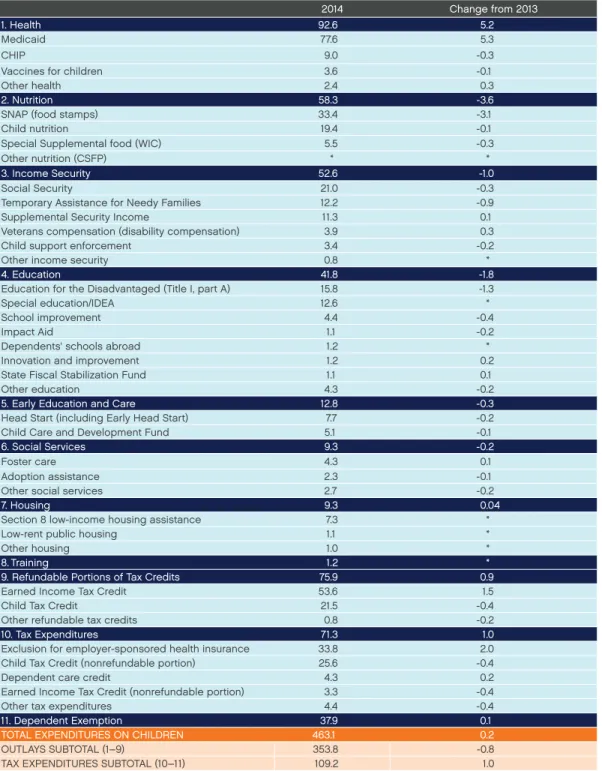
2014 Change from 2013
1. Health 92.6 5.2
Medicaid 77.6 5.3
CHIP 9.0 -0.3
Vaccines for children 3.6 -0.1
Other health 2.4 0.3
2. Nutrition 58.3 -3.6
SNAP (food stamps) 33.4 -3.1
Child nutrition 19.4 -0.1
Special Supplemental food (WIC) 5.5 -0.3
Other nutrition (CSFP) * *
3. Income Security 52.6 -1.0
Social Security 21.0 -0.3
Temporary Assistance for Needy Families 12.2 -0.9
Supplemental Security Income 11.3 0.1
Veterans compensation (disability compensation) 3.9 0.3
Child support enforcement 3.4 -0.2
Other income security 0.8 *
4. Education 41.8 -1.8
Education for the Disadvantaged (Title I, part A) 15.8 -1.3
Special education/IDEA 12.6 *
School improvement 4.4 -0.4
Impact Aid 1.1 -0.2
Dependents' schools abroad 1.2 *
Innovation and improvement 1.2 0.2
State Fiscal Stabilization Fund 1.1 0.1
Other education 4.3 -0.2
5. Early Education and Care 12.8 -0.3 Head Start (including Early Head Start) 7.7 -0.2
Child Care and Development Fund 5.1 -0.1
6. Social Services 9.3 -0.2
Foster care 4.3 0.1
Adoption assistance 2.3 -0.1
Other social services 2.7 -0.2
7. Housing 9.3 0.04
Section 8 low-income housing assistance 7.3 *
Low-rent public housing 1.1 *
Other housing 1.0 *
8.Training 1.2 *
9. Refundable Portions of Tax Credits 75.9 0.9
Earned Income Tax Credit 53.6 1.5
Child Tax Credit 21.5 -0.4
Other refundable tax credits 0.8 -0.2
10. Tax Expenditures 71.3 1.0
Exclusion for employer-sponsored health insurance 33.8 2.0 Child Tax Credit (nonrefundable portion) 25.6 -0.4
Dependent care credit 4.3 0.2
Earned Income Tax Credit (nonrefundable portion) 3.3 -0.4
Other tax expenditures 4.4 -0.4
11. Dependent Exemption 37.9 0.1
TOTAL EXPENDITURES ON CHILDREN 463.1 0.2
OUTLAYS SUBTOTAL (1–9) 353.8 -0.8
TAX EXPENDITURES SUBTOTAL (10–11) 109.2 1.0
Source: Urban Institute, 2015. Authors’ estimates based on the Budget of the U.S. Government Fiscal Year 2016 and past year.
Notes: Because this analysis shows outlays, rather than appropriated or authorized levels, and because the dollars are adjusted for inflation, these estimates may differ from other published estimates. Numbers may not sum to totals because of rounding. Other health covers immunizations, Maternal and Child Health (block grant), children’s graduate medical education, lead hazard reduction, children’s mental health services, birth defects and developmental disabilities, Healthy Start, emergency medical services for children, universal newborn hearing, home visiting, school-based health care, and health insurance exchanges. Child nutrition includes the National School Lunch Program (NSLP), the School Breakfast Program (SBP), the Child and Adult Care Food Program (CACFP), the Summer Food Service Program (SFSP), and Special Milk. Other nutrition is the Commodity Supplemental Food program. Other income security includes Railroad Retirement, survivors’ compensation, veterans’ compensation, survivors’ pensions, and veterans’ pensions. Other education includes Indian education, English language acquisition, domestic schools, the Institute of Education Sciences, safe schools and citizenship education, hurricane education recovery, Junior ROTC, the Education Jobs Fund, Safe Routes to Schools, and vocational (and adult) education. Other social services include the Social Services Block Grant, the Community Services Block Grant, child welfare services and training, Safe and Stable Families, juvenile justice, guardianship, independent living, missing children, children’s research and technical assistance, PREP and abstinence education, and certain children and family services programs. Other housing includes rental housing assistance and low-income home energy assistance. Training includes WIA Youth Formula Grants, Job Corps, Youth Offender Grants, and YouthBuild Grants. Other refundable tax credits include outlays from Qualified Zone Academy Bonds and Qualified School Construction Bonds. Other tax expenditures include exclusion of employer-provided child care, employer-provided child care credit, exclusion of certain foster care payments, adoption credit and exclusion, assistance for adopted foster children, exclusion for Social Security retirement and dependents’ and survivors’ benefits, exclusion for Social Security disability benefits, exclusion for public assistance benefits, exclusion for veterans’ death benefits and disability compensation, Qualified Zone Academy Bonds, and Qualified School Construction Bonds.
* Less than $50 million.
Table 1 Federal Expenditures on Children by Program, 2014 (billions of 2014 dollars)
From: Kids' Share 2015: Report on Federal Expenditures on CHildrn Through 2014
http://firstfocus.org/wp-content/uploads/2015/09/Kids-Share-2015.pdf
II. Processes for Mapping Resources
D. Other Relevant Resources for Mapping
You will find a good range of references to mapping (info, tools) by viewing our Quickfind on Mapping Existing School and Community Resources (http://smhp.psych.ucla.edu/qf/p2312_06.htm) or searching our website (http://smhp.psych.ucla.edu). You will find materials our Center has pulled together and also references to resources developed by others around the country.
Mapping School Resources
Center for Mental Health in Schools (1995). Addressing Barriers to Learning: A Set of Surveys to Map What a School Has and What It Needs . Los Angeles: Author at UCLA. Available from website
http://smhp.psych.ucla.edu or by order from the Center at cost of copying and handling. Center for Mental Health in Schools (1999). New Directions in Enhancing Educational Results:
Policymakers' Guide to Restructuring Student Support Resources to Address Barriers to Learning. Los Angeles: Author at UCLA. Available from website http://smhp.psych.ucla.edu or by order from the Center at cost of copying and handling.
H. Adelman & L. Taylor (2006). Mapping a School’s Resource to Improve Their Use in Preventing and Ameliorating Problems. The School Services Sourcebook, A Guide for Social Workers, Counselors, and Mental Health Professionals. Available from website http://smhp.psych.ucla.edu or by order from the Center at cost of copying and handling.
Mapping Community Resources
Putting the Pieces Together – Chapter 2: Conducting a Community Assessment (1996) by the U.S. Department of Education and the Regional Educational Laboratory Network.
http://www.ncrel.org/sdrs/areas/issues/envrnmnt/css/ppt/putting.htm
Essential tools: Community resource mapping (2005) by K. Crane & M. Mooney. University of Minnesota, Institute on Community Integration, National Center on Secondary Education and Transition. Online at
http://www.ncset.org/publications/essentialtools/mapping/default.asp
School-Community Partnerships: A Guide by theCenter for Mental Health in Schools (rev. 2004). http://smhp.psych.ucla.edu or by order from the Center at cost of copying and handling.
And from J.L. McKnight, J.P. Kretzmann, and their colleagues at Northwestern University:
>A Guide to Capacity Inventories: Mobilizing the Community Skills of Local Residents
(1997) by J.P. Kretzmann, J.L. McKnight, and G. Sheehan, with M. Green and D. Puntenney. http://www.northwestern.edu/ipr/publications/community/capinv.html >Building Communities from the Inside Out: A Path Toward Finding and Mobilizing a
Community’s Assets. (1993) by J.P. Kretzmann & J.L. McKnight, Chicago: ACTA Pubs. http://www.northwestern.edu/ipr/publications/community/buildingblurb.html
>Mapping Community Capacity (1996) by J.L. McKnight & J.P. Kretzmann http://www.northwestern.edu/ipr/publications/community/mcc.html
Mapping Your Community: Using Geographic Information to Strengthen Community Initiatives
(1997), by G.T. Kingsley, C.J. Coulton, M. Barndt, D.S. Sawicki, & P. Tatian. Free copy available through the Mapping Your Community website at
http://www.comcon.org/pubs/publist.htm (#CH1041). Free copy also provided with HUD's Community 2020 mapping software.
38
Community Tool Box – http://ctb.ku.edu/
This site, created in 1995, by the University of Kansas Work Group on Health Promotion and Community Development in Lawrence, KS. and AHEC/Community Partners in Amherst, Massachusetts continues to grow weekly. Currently, the core is "how-to tools" (including tools for mapping). For instance, there are sections on leadership, strategic planning, community assessment, advocacy, grant writing, and evaluation.
ERIC Resources
Selected material from the ERIC database that deal with mapping school/community resources. These are all downloadable in pdf format. Just go to the ERIC site (http://www.eric.ed.gov/) and search the database by ERIC #.
Beaulieu, L.J. (2002). Mapping the Assets of Your Community: A Key Component for Building Local Capacity. Lincoln, NE: Heartland Center for Leadership Development. ERIC
#:ED467309
Connor, S. (2001). Using Community Mapping to Enhance Child Development. Research in Focus. ERIC #:EJ618724
Crane, K. & Skinner, B. (2003). Community Resource Mapping: A Strategy for Promoting Successful Transition for Youth with Disabilities. Information Brief. Minneapolis, MN: National Center on Secondary Education and Transition. ERIC #:ED478263
Dorfman, D. (1998). Mapping Community Assets Workbook. Strengthening Community Education: The Basis for Sustainable Renewal. Northwest Regional Educational Lab., Portland, OR, Rural Education Program. ERIC #:ED426499
Kerka, S. (2003). Community Asset Mapping. Trends and Issues Alert. Columbus, OH: ERIC Clearinghouse on Adult, Career, and Vocational Education. ERIC #:481324
Samuels, B., Ahsan, N. & Garcia, J. (1995). Know Your Community: A Step-By-Step Guide to Community Needs and Resources. Chicago, IL: Family Resources Coalition; Iowa City, IA: National Resource Center for Family Centered Practice. ERIC #:ED423057
Thinking about Community Capacity Building & Asset Mapping. (1997). Spruce Grove, Alberta: Community Building Resources. ERIC #:ED414504
39
III. Products of Mapping
A. Examples of Products
B. Making Products Visible
40 III. Products of Mapping
A. Examples of Products
As indicated in section II, mapping and summarizing resources are essential to improving understanding, management, and appreciation of what exists and for taking steps to enhance resources and their effectiveness.
The product examples on the following pages emerged from the efforts of individual schools and families of schools to summarize the programs and services at their sites. (The material offered also provides a perspective on what might be available to a school.)
Product examples included are:
(2) an initial mapping of enabling activity at an secondary school (3) a spreadsheet version of initial mapping at an elementary school
(4) combined summary of resource professionals from five schools working together to coordinate resources
(1)
an initial mapping of enabling/learning supports activity at an
elementary school
41
(1) Initial Mapping of Enabling/Learning Supports
Activity at an Elementary School
III.Products of Mapping