Teaching Pre-Service Teachers Co-Teaching: An Interactive Co-Teaching Training Protocol
by
Pik Wah Lam, M.Ed., M.A. A Dissertation
In
Special Education
Submitted to the Graduate Faculty of Texas Tech University in
Partial Fulfillment of the Requirements for
the Degree of DOCTOR OF PHILOSOPHY Approved Dr. Robin Lock Chair of Committee Dr. Donna Brown
Dr. Monica Kathleen Strickland-Cohen
Mark Sheridan Dean of the Graduate School
Acknowledgements
Thank you, my committee, Dr. Robin Lock, Dr. Donna Brown, and Dr. Strickland-Cohen, for the support, guidance, and encouragements you provided me throughout the research and write up process. Without you, I would not have been able to complete this dissertation. Dr. Lock, thank you for always being positive and
supportive on my ideas and suggestions. Instead of telling me “no”, you provided me guidance and positive feedback to solve the problems. I was very lucky and honored to have you as my committee chair. I would like to thank Dr. Brown for all your time and effort being my co-training partner. All the research sessions would not have been possible without your help. Thank you for always being there to monitor and support me during the research process. Dr. Strickland-Cohen, your comments helped a lot in writing up the dissertation. I learned a lot from you on how to write up the results and discussions.
My deepest thanks go to my husband, Steven Chesnut. Thank you for your love and understanding. Thank you for being so patient with me and most importantly, putting up with me when I was stressed. Your support in all aspects means everything to me. Thank you for motivating me when I was procrastinating. I truly could not have finished this dissertation without you. I am very blessed to have you in my life.
My very special thanks to a little person I recently have in my life, Lorraine Chesnut, my baby girl. Even though you are only six months old, you are a bundle of joy. Thank you for trying to be a “co-author” of this dissertation. Although it lengthened
my writing process, you provided me the sweetest and most enjoyable memories during my dissertation writing.
To my mother, Kwok Yam Lee, thank you for your love. I really appreciated that you traveled across the globe to visit and help me out. You freed me up from a lot of daily duties and allowed me to focus on writing up this dissertation. I hope I made you proud.
Table of Contents
ACKNOWLEDGEMENTS ....... ii
ABSTRACT ......... vi
LIST OF TABLES ....... vii
LIST OF FIGURES ...... ix
CHAPTER ONE INTRODUCTION ... 1
OVERVIEW ... 1
BACKGROUND OF STUDY ... 2
STATEMENT OF THE PROBLEM ... 3
PURPOSE OF STUDY ... 3
THEORETICAL FRAMEWORK ... 5
RESEARCH HYPOTHESES ... 6
RESEARCH QUESTIONS ... 7
IMPORTANCE AND SCOPE OF THE STUDY ... 7
DEFINITION OF TERMS ... 8
LIMITATIONS AND FUTURE RESEARCH ... 9
SUMMARY ... 10
CHAPTER TWO LITERATURE REVIEW ... 11
OVERVIEW OF THE TEACHER PREPARATION PROGRAM AND LEARNING IN COLLEGE LEVEL ... 12
EXPECTATIONS OF NEW TEACHERS ... 15
INCREASED USE OF CO-TEACHING ... 18
HISTORY OF CO-TEACHING ... 21
EFFECTIVENESS OF CO-TEACHING ... 27
CURRENT CO-TEACHING TRAINING AND CHALLENGES OF CO-TEACHING ... 28
THE INCONSISTENCY BETWEEN NEW TEACHER EXPECTATIONS AND THE PREPARATION ... 37
NEED AND THE DEVELOPMENT OF THE TRAINING PROTOCOL ... 39
CONCLUSION ... 41
CHAPTER THREE METHODS ... 43
QUANTITATIVE PHASE ... 43
QUALITATIVE PHASE ... 55
SUMMARY ... 60
CHAPTER FOUR RESULTS ... 61
RESEARCH QUESTION 1:EFFECTIVENESS OF TRAINING IN TEACHING CO-TEACHING ... 62
RESEARCH QUESTION 2:PARTICIPANTS’EXPERIENCES AND DESCRIPTIONS ON EFFECTIVENESS OF TRAINING ... 86
RESEARCH QUESTION 3:OVERALL EFFECTIVENESS OF THE CO-TEACHING TRAINING PROTOCOL ... 94
CHAPTER FIVE DISCUSSION ... 98
BRIEF SUMMARY OF METHODS AND PROCEDURES ... 99
DISCUSSION OF RESULTS ... 100
WHAT IS EFFECTIVE IN TEACHING PRE-SERVICE TEACHERS CO-TEACHING? ... 103
WHO NEEDS THE CO-TEACHING TRAINING? ... 107
HOW COULD THIS STUDY IMPACT TEACHER PREPARATION PROGRAMS? ... 112
LIMITATIONS ... 114
FUTURE STUDIES ... 117
SUMMARY ... 120
REFERENCES ... 121
APPENDICES ... 130
APPENDIX A:VISUAL DIAGRAM ... 130
APPENDIX B:TREATMENT INTEGRITY DATA COLLECT SHEETS ... 131
APPENDIX C:INTERVIEW PROTOCOL ... 133
APPENDIX D:TRAINING PLAN ... 136
APPENDIX E:PRE-SURVEY ... 140
APPENDIX F:POST-SURVEY ... 145
Abstract
In recent years, under the influence and encouragement of the Individuals with
Disabilities Education Act (IDEA) and No Child Left Behind (NCLB), there has been an increase in inclusive practices in general education contexts. Due to the resulting higher numbers of students with disabilities being educated in general education settings, there has also been a rise in the use of co-teaching in kindergarten through twelfth grade classrooms. The effectiveness of co-teaching has been studied, yet the results remain inconclusive. Although various factors may contribute to the mixed results on the effectiveness of co-teaching, many attribute these incongruencies to a lack of training in pre-service teacher education programs. Co-teaching is not a topic required in all teacher education programs and is often only briefly discussed in courses designed to teach collaborative teaching. Research has suggested that increased training in co-teaching practices enhances proper implementation which can lead to positive outcomes. A need to develop an effective, research-based co-teaching training for pre-service teachers has been clearly shown in the field. The purpose of this study was to develop a research-based co-teaching training protocol for pre-service teachers in a southwest university and to evaluate the effectiveness of the training protocol. Over 150 pre-service teachers were trained in this study. The results suggested that the training protocol was effective in enhancing pre-service teachers’ knowledge, confidence, and positive perception of co-teaching. Potential limitations and implications of the study findings for further research and applied practice in the field were discussed.
List of Tables
TABLE 2.1RESEARCH QUESTIONS,DATA SOURCES, AND DATA ANALYSIS FOR THE
QUANTITATIVE PHASE ... 54
TABLE 2.2 RESEARCH QUESTIONS,DATA SOURCES, AND DATA ANALYSIS FOR
QUALITATIVE DATA AND MIXED METHODS DATA ... 59
TABLE 4.1 MEAN DIFFERENCES ON CHANGE IN CO-TEACHING KNOWLEDGE BETWEEN
LECTURE AND TRAINING ... 64
TABLE 4.2 MEAN DIFFERENCES ON CO-TEACHING KNOWLEDGE CHANGE BETWEEN
LECTURE AND TRAINING AMONG CLASSES ... 65
TABLE 4.3 MEAN DIFFERENCES COMPARING CO-TEACHING KNOWLEDGE CHANGE
BETWEEN LECTURE AND TRAINING AMONG SPECIAL AND GENERAL EDUCATION
MAJORS AS WELL AS ELEMENTARY AND MIDDLE LEVELS ... 66
TABLE 4.4 MEAN DIFFERENCES ON CO-TEACHING KNOWLEDGE BETWEEN LECTURE AND
TRAINING FOR STUDENTS WITH DIFFERENT PREVIOUS CO-TEACHING EXPERIENCES 67
TABLE 4.5 MEAN DIFFERENCES COMPARING CO-TEACHING KNOWLEDGE CHANGE
BETWEEN LECTURE AND TRAINING FOR PARTICIPANTS WITH DIFFERENT
OPPORTUNITIES TO OBSERVE CO-TEACHING. ... 67
TABLE 4.6 MEAN DIFFERENCES ON CO-TEACHING KNOWLEDGE CHANGE OVER TIME .... 68
TABLE 4.7MEAN DIFFERENCES ON CO-TEACHING CONFIDENCE CHANGE BETWEEN
LECTURE AND TRAINING ... 71
TABLE 4.8 MEAN DIFFERENCES ON CO-TEACHING CONFIDENCE CHANGE BETWEEN
LECTURE AND TRAINING AMONG CLASSES ... 72
TABLE 4.9 MEAN DIFFERENCES ON CO-TEACHING CONFIDENCE BETWEEN LECTURE AND
TRAINING AMONG PARTICIPANTS WITH DIFFERENT MAJORS ... 73
TABLE 4.10 MEAN DIFFERENCES ON CO-TEACHING CONFIDENCE BETWEEN LECTURE AND
TRAINING FOR PARTICIPANTS WITH DIFFERENT PREVIOUS CO-TEACHING
EXPERIENCES ... 73
TABLE 4.11 MEAN DIFFERENCES ON CO-TEACHING CONFIDENCE BETWEEN LECTURE AND
TRAINING FOR PARTICIPANTS WITH DIFFERENT OPPORTUNITIES TO OBSERVE CO
-TEACHING. ... 74
TABLE 4.12 MEAN DIFFERENCES ON CO-TEACHING CONFIDENCE OVER TIME ... 75
TABLE 4.13 DEPENDENT T-TESTS RESULTS ON CO-TEACHING PERCEPTION CHANGE
BETWEEN LECTURE AND TRAINING ... 77
TABLE 4.14MEAN DIFFERENCES ON CO-TEACHING PERCEPTION CHANGE BETWEEN
LECTURE AND TRAINING AMONG CLASSES ... 78
TABLE 4.15 MEAN DIFFERENCES ON CO-TEACHING PERCEPTION BETWEEN LECTURE AND
TRAINING AMONG PARTICIPANT WITH DIFFERENT MAJORS ... 79
TABLE 4.16 MEAN DIFFERENCES ON CO-TEACHING PERCEPTION BETWEEN LECTURE AND
TRAINING FOR PARTICIPANTS WITH DIFFERENT PREVIOUS CO-TEACHING
EXPERIENCES ... 80
TABLE 4.17 MEAN DIFFERENCES ON CO-TEACHING PERCEPTION BETWEEN LECTURE AND
-TABLE 4.18 MEAN DIFFERENCES ON CO-TEACHING PERCEPTION OVER TIME ... 82
TABLE 4.19 DEPENDENT T-TESTS FOR PARTICIPANTS’RATING ON EFFECTIVENESS ... 83
TABLE 4.20 PARTICIPANT’S REFERENCES OF FIVE TEACHING PEDAGOGIES IN COLLEGE
CLASSROOMS ... 89
TABLE 4.21 OVERALL RANKING OF THE FIVE TEACHING PEDAGOGIES IN DESCENDING
ORDER ... 90
TABLE 4.22 PERCENTAGES OF THE CO-TEACHING APPROACHES BEING USED ... 93
List Of Figures
FIGURE 1.1.THEORETICAL FRAMEWORK ... 6
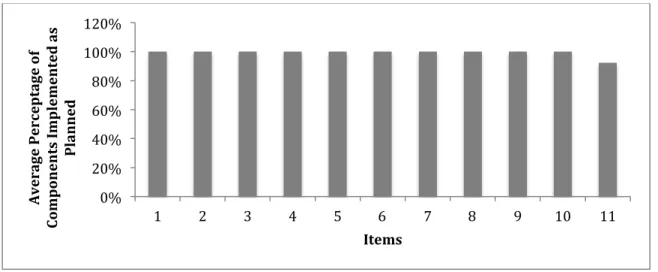
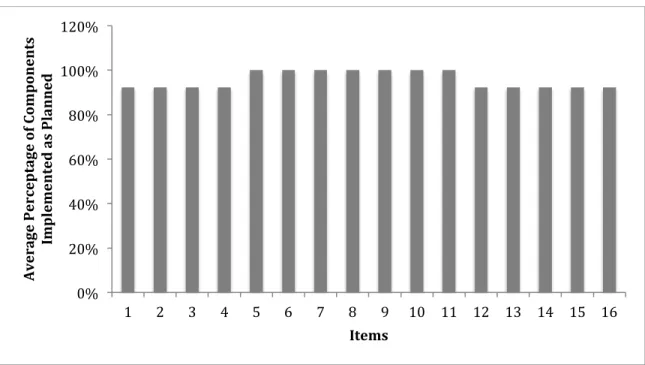
FIGURE 4.1.IMPLEMENTATION FIDELITY RESULTS PER ITEM OF THE LECTURE ... 84
Chapter One Introduction Overview
I was a general education teacher in Hong Kong. I taught for slightly over four years before I came to the United States of America to pursue further education about how to teach students with disabilities. As a general educator, I was privileged to experience co-teaching. However, I was not aware of the fact that it was co-teaching until I learned about it in one of my courses during my Master’s in Special Education. Based on this experience, I was passionate about co-teaching because I have seen its benefits first-hand. Furthermore, I learned from my Master’s program peers that in-service teachers in the field have mixed feelings towards the implementation of co-teaching. Some of them loved it, but some of them were very resistant and had bad experiences and comments about co-teaching. I was confused by this fact and started to learn more about co-teaching.
In addition to my personal experiences with co-teaching, I also taught
undergraduate classes to pre-service teachers in which co-teaching was covered in the curriculum. I learned from these future teachers that they are more acceptant of new instructional strategies than experienced in-service teachers. As the nature of my teaching, I used hands-on activities to introduce the topic of co-teaching. From the course feedback I received from these students, I learned that they really appreciated the opportunities to learn about and discuss co-teaching using activities. They thought it was very helpful in their professional development. Since then, I started to get interests in the
literature to support what I did and discovered a lack of discussion in the literature. That shaped the beginning of this study.
Background of Study
The Individuals with Disabilities Education Act (IDEA, 2004) and No Child Left Behind (NCLB, 2001) mandated students with disabilities to be educated in the general education classroom. Having students with special needs in the inclusive setting creates a need to bring together the content specialties from the general education teacher and the unique skills from the special education teacher to educate students with disabilities. To address this unique need of the school setting, educators have turned to co-teaching for answers.
Co-teaching is pairing two or more teachers with different areas of specialties, teaching in a single classroom to the same group of students (Friend & Cook, 2013). As more school districts are implementing co- teaching, the effectiveness of co-teaching and readiness of teachers to co-teach needs to be studied and evaluated.
However, literature indicated that the effectiveness of co-teaching was inconsistent (e.g., Pugach & Wesson, 1995; Rice & Zigmond, 2000; Weiss & Lloyd, 2002). Research studies suggested that these inconsistencies were related to the lack of training on co-teaching for both in-service and pre-service teachers (e.g., Hazlett, 2001; Scruggs, Mastropieri & McDuffie, 2007). Thus, it is important to learn about teacher preparation programs and to provide an effective training on co-teaching for pre-service teachers.
Statement of the Problem
Beginning teachers are expected to collaboratively work with other professionals in the K-12 school setting, including implementing co-teaching, in which they will be working closely with another certified teacher to meet the diverse needs of students in the general education classroom. However, these beginning teachers are often unprepared to fulfill this role in collaboration, especially in the area of co-teaching. Consequently, the lack of training leads to improper implementation of co-teaching, which leads to negative experiences of co-teaching, as well as possible negative effects on students learning.
To better prepare future teachers to be effective co-teachers, effective training must be provided to them during their teacher preparation programs. Unfortunately, there are no existing co-teaching training models available, and the evaluation of the methods currently used in the institutes of higher education (IHEs) are very limited. Therefore, there is a strong need to develop a co-teaching training model for pre-service teachers and to evaluate the effectiveness of the training model.
Purpose of Study
The purpose of this study was to evaluate the effectiveness of an interactive co-teaching protocol, which incorporates modeling, hands-on activities in a simulated inclusive environment. It is important to provide a research-based training, and to study its effectiveness. Evaluation in this study refers to testing the treatment effects, thus, it fits with one of the typology of research purposes described by Newman and colleagues (Newman, Ridenour, Newman, & Demarco, 2003). This present co-teaching training model combines researched effective components, modeling, with hands-on activities,
which were proposed by researchers in the field (e.g., Graziano & Navarrete, 2012), as well as from past participants. It is well documented in the literature that the need for an empirically researched effective co-teaching training model is urgent. This present study provides a well-structured co-teaching model, conducts evaluation on the model and its components, and adds knowledge to the field about the effective components of co-teaching training and expectations of pre-service teachers on co-co-teaching.
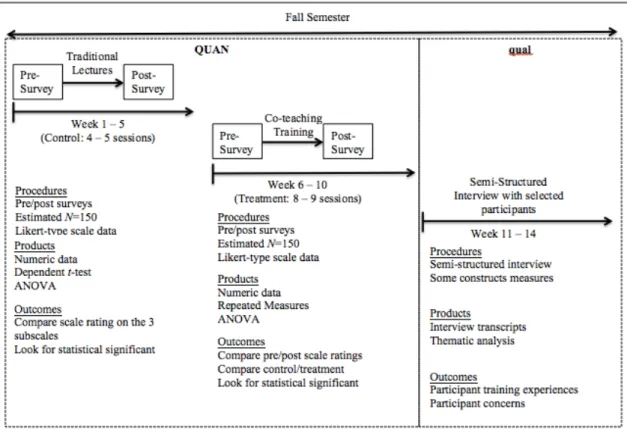
To achieve the above-mentioned purpose, a sequential embedded mixed methods design was conducted at a southwestern university in the United States with
undergraduate pre-service teachers. A qualitative strand was embedded within a quantitative design using pre- and post-surveys. The quantitative pre- and post-survey data was used to measure the increase in self-reported ratings of pre-service teachers in a southwestern university before and after the intervention on co-teaching knowledge, confidence in teaching implementation, as well as attitude and acceptance of co-teaching. The qualitative semi-structured interview data was embedded in the quantitative pre- and post-survey design to provide insightful information about the participants’ experiences, effectiveness of the training, as well as concerns about learning co-teaching. The qualitative data helped to explain the differences of the scoring on the scales before and after the training in order to fully evaluate the effectiveness of the co-teaching training protocol. The information obtained from the embedded qualitative procedures will provide a more complete evaluation of the effectiveness of the training model.
Theoretical Framework
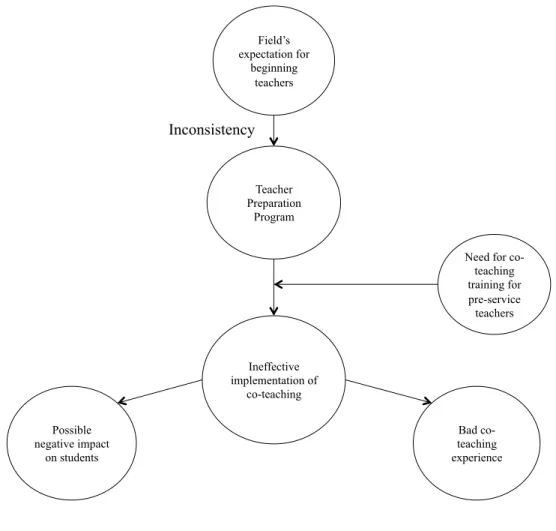
There is an inconsistency between the expectations about co-teaching for
beginning teachers and the training they receive during the teacher preparation program. This inconsistency was clearly demonstrated in the literature. The lack of training in teaching led to the ineffective implementation of teaching, which led to bad co-teaching experiences and possible negative impact on students’ learning. The key to enhance the effectiveness of co-teaching lies in the quality of co-teaching
implementation. Providing effective trainings of co-teaching is one of the strategies to improve co-teaching implementation. Figure 1.1 is a diagram displaying the theoretical framework.
Figure 1.1. Theoretical Framework
Research Hypotheses
It was hypothesized that the training protocol is effective in enhancing pre-service teachers’ knowledge in co-teaching, confidence in implementation the six co-teaching approaches, and promoting a positive attitude towards the use of co-teaching. In other words, the scores in co-teaching knowledge are expected to be higher in the post-surveys. Participants are expected to have higher self-reported ratings regarding their co-teaching confidence and perception on the post-surveys compared to the pre-surveys in both the
Field’s expectation for beginning teachers Teacher Preparation Program Inconsistency Ineffective implementation of co-teaching Bad co-teaching experience Possible negative impact on students
Need for co-teaching training for pre-service teachers
lecture and training conditions. In addition, the increase in self-reported ratings is expected to be higher in the training condition compared to the control condition.
Research Questions
The study was developed to answer three research questions. These questions are listed below:
Quantitative Research Questions:
To what extent does the co-teaching training help prepare pre-service teachers to learn to implement co-teaching?
a. Are there any differences on the co-teaching knowledge scores before and after attending the training?
b. Are there any differences on the self-reported scales on co-teaching confidence and co-teaching perceptions before and after the training? c. Are these differences statistically significant?
Qualitative Research Question:
How do the participants describe their experiences and effectiveness of the training?
Mixed Method Research Question:
What is the overall effectiveness of the co-teaching training on helping pre-service teachers learn implementing co-teaching?
Importance and Scope of the Study
As documented in the literature, the need for an empirically researched effective co-teaching training model is urgent. This present study is important because it addresses
to the documented need for teaching preparation by providing a well-structured co-teaching model. By using both quantitative and qualitative methodologies, the evaluation of the model and its components provided a complete picture of its effectiveness and thus, add knowledge to the field on the effective components of co-teaching training for pre-service teachers.
The scope of the study included developing an effective co-teaching training protocol and evaluating its effectiveness via a set of pre- and post-surveys developed by the researcher. The researcher has developed the evaluation instrument because there are no existing measures that match with the needs and group of participants of this study. The only existing survey on co-teaching targeting in-service teachers and their attitudes towards co-teaching and their co-teaching partners (Bixler, 1998). However, the target participants in this study are pre-service teachers who have limited experiences in co-teaching. Thus, Bixler’s (1998) survey is not applicable for this study.
Definition of Terms
Co-teaching – Co-teaching was defined as 2 or more professionals with different primary areas of expertise providing joint delivery of instruction to a diverse group of students in a shared classroom space (Friend & Cook, 2013).
Inclusion – There is not a commonly agreed definition of inclusion (Odom & Diamond, 1998). It is commonly viewed as a spectrum reflecting the placement of a student’s time spent in the general education classroom within a school day. Therefore, it is appropriate to look at the definition of the inclusion classroom instead.
Inclusion classroom – “Inclusion classroom placement involves the maintenance of the child in a general education classroom assisted by the presence of a second teacher who is certified in special education” (IDEA, 2004 in Pierangelo & Giuliani, 2012).
Limitations and Future Research
There are limitations of the study. First, although the number of participants has enough power based on the power analysis, the diversity of the participants is limited to one southwest university, which hinders the generalization of this study. To solve this problem, replication of this study in other universities in different geographic locations is highly encouraged and needed.
In addition, a single-group interrupted time-series design was used in which the same group of participants experience both the control and training conditions in the same order. All the participants received lecture as the control condition and then the training as the treatment condition. Learning effects were not controlled because participants would learn about teaching in the lecture. Then they experience co-teaching again through modeling and hands-on experiences. Another limitation of this research design is that it is hard to control for the natural growth of participants, which affects the reliabilities of the results. Although the researcher utilizes the test/retest reliability measure to try to address the limit, the confounding variable of natural growth still cannot be totally eliminated. Future research could retest the participants just before they graduate the teacher education program to examine how the participants’
time. More robust research design could also be used to overcome the challenge of maturation.
Furthermore, the ideal training grouping for students would be having one special education pre-service teacher paired with one general education pre-service teacher. However, due to the arrangements and schedules of the different participating classes, the researcher was unable to apply such grouping. Future research should aim to pair
participants in special education and general education together in order to provide the most realistic simulation of the co-teaching teacher environment.
Summary
In this chapter, the researcher discussed her combined experiences in co-teaching that she gained from Hong Kong being a general education teacher and being a teacher educator in the United States teaching pre-service teachers about co-teaching. These experiences led to further investigation on the topic of co-teaching. In addition, the background of study and the nature of the problem were also discussed. The need for developing an effective co-teaching training protocol was addressed. Research questions were set based on a theoretical framework. Limitations of the study were discussed.
Chapter Two Literature Review
As the practice of co-teaching became more commonly and widely used in the K through 12 settings, more and more teachers were engaged in the co-teaching duties, including beginning teachers. However, beginning teachers were not prepared to fulfill this particular duty because trainings on co-teaching were not offered in the teacher education programs. Thus, the teacher preparation programs should prepare pre-service teachers on teaching by providing structured, research-based, and effective
co-teaching trainings. In addition to the training, pre-service teachers should learn about the challenges they would face when implementing co-teaching in traditional classroom settings. Potential solutions should be discussed with pre-service teachers so that they are better prepared to handle the challenging situations and more adequately work with the diverse students in the classrooms.
This chapter discusses the literature related and relevant to the topic of teaching co-teaching to pre-service teachers. The discussion started from broad big picture then narrowed to the specifics. Topics that are covered in this chapter include a brief
discussion of the teacher preparation program and learning in college level, expectations for new teachers entering kindergarten through twelfth grade (K-12) education, the increased use of teaching in K-12 education setting, history of teaching, current co-teaching training for pre-services teachers, the gap between what is expected from new teachers and the training they are provided to prepare for this challenging role of being a
co-teacher, the need to provide an effective co-teaching training to pre-services teachers, and the development of the effective training model of this study.
Overview of the Teacher Preparation Program and Learning in College Level
Each year, over 200,000 new members join the teaching force by graduating from teacher preparation programs and obtaining teaching credentials (Greenberg, McKee, Walsh, & National Council on Teacher Quality, 2013). According to the report
Preparing and Credentialing the Nation’s Teachers: The Secretary’s Eight Report on
Teacher Quality Based on Data Provided for 2008, 2009 and 2010 (Duncan, & Ochoa,
2011), there were 2,054 teacher preparation programs in the United States in 2010. These programs were classified as traditional, alternative programs based at institutes of higher education (IHEs), or alternative teacher preparation programs not based at IHEs. In the academic year of 2008-2009, there were over 720,000 students enrolled in teacher preparation programs. In the same year, 234,138 students graduated from these
programs. There was an 18% increase in number of students graduating teacher
preparation program since the academic year of 2000-2001 (Duncan, & Ochoa, 2011). The report showed a large and increasing number of pre-service teachers
graduating each year and joining the teaching workforce. A good question to ask would be, how prepared are these teachers in implementing different instructional strategies that fit today’s diverse classroom? Greenberg and colleagues (2013) reported that teacher preparation programs were still producing traditionally prepared teachers, and this preparation approach was one of the many reasons that caused the educational decline in America. They claimed that universities and colleges have become “an industry of
mediocrity” (p. 1). Classroom management skills and content knowledge provide by teacher preparation programs were inadequate for the increasingly diverse classrooms. Our K-12 classrooms have been changing, but the teacher preparation programs have not.
One of the effective ways to address the diverse student in the classroom is
through co-teaching (Friend & Cook, 2013). The use of co-teaching was also encouraged by Individuals with Disabilities Education Act (IDEA, 2004) and No Child Left Behind (NCLB, 2001). However, pre-service teachers have not been well prepared to implement co-teaching effectively (McKenzie, 2009). The national survey conducted by McKenzie (2009) examined the collaboration training for special education major students with 53 undergraduate pre-service special education training programs representing 25 states. The results suggested that pre-service teachers were not at all trained in collaboration. McKenzie’s report supported Greenberg and colleagues’ review (2013) that pre-service teachers were not sufficiently prepared for to address the diverse needs of students.
Lammers and Murphy (2002) developed a profile of the teaching techniques used in the university classroom. Fifty-eight undergraduate classrooms representing 19
different academic departments were observed for three weeks. Their study revealed that nearly half of the class time was spent in lecturing in which the instructor was the only one actively involved in the learning. They also reported that there was no one involved in any learning activities for about 15% of the class time due to starting class late or dismissing class early, canceling class, and doing administrative tasks such as roll taking. The most common cause for non-learning was due to ending class early. Their report revealed that at least 15% of the time, students were not involved in any learning. On top
of lecture being the most frequently used instructional method, they also found that male instructors lecture more often than female instructors. This finding supported the
literature that lecture was frequently used in college settings (Blackburn, 1980).
Although Lammers and Murphy’s profile (2002) was conducted in one university and the 19 academic departments were not revealed, this study still has helped to provide insights for the inadequate preparation of pre-service teachers in colleges and universities.
Lecture has been shown to be a frequently used instructional method in colleges and universities. Thus, the effectiveness of this instructional method was critical to students’ learning. The literature effectiveness of lecture was inconclusive. Some study suggested that lecture was ineffective (Omelicheva & Avdeyeva, 2008), but some studies argued that lecture was as effective as other instructional methods (Bligh, 1998; Malone & Langone, 2005; McKethan & Everhart, 2001), or even more effective (McKethan, Everhart, & Stubblefield, 2000; Riley, 1979).
Literature has shown that pre-service teachers were not well prepared to address the needs of a diverse student body in the classroom. Therefore, how they learned in the college classroom was reviewed and results suggested that lecture was the main
instructional method in the higher education setting and the effectiveness of lecture was non-conclusive. Switching lenses and taking a look at what is expected from pre-service teachers during their first year teaching helps to provide insight to what co-teaching training should address.
Expectations of New Teachers
In the past, teachers taught in their isolated classroom and there were rarely opportunities for the teachers to collaborate with other professionals. This scenario has changed since the Education for All Handicapped Children Act (EHA) was enacted in 1975. The act opened the door for students with disabilities to be educated with their peers without disabilities in public schools. The same act was reauthorized in 2004 and is now known as the IDEA (2004), which ensures students with disabilities a free and appropriate public education (FAPE) in the least restricted environment (LRE). The implementation of these principles under the Act has been referred by the field as inclusion. Under the influences of these legislations, an increased number of students with disabilities were placed in the inclusion setting. The results of students with disabilities accessing the general education was the increase in expectations for these students (Danielson, 2002). In order to help these students to succeed, many different types of support were provided to students with disabilities in order to help them access to the general education curriculum. General education teachers felt not only
incompetent to attend to the unique needs of the diverse students in the classroom (Jung et al., 2010), but they were also untrained to meet the needs. Consequently, there were increased opportunities for the general education teachers to consult and collaborate with other professional in order to provide these services (Youngs, Jones, & Low, 2011). These collaborations included school psychologists, counselors, social workers,
occupational therapists, physical therapists, special educators, and families etc. However, as the number of students with disabilities enrolled in the general education classrooms
increased, this consultation model started to fail. General education teachers started to find themselves incapable of meeting the diverse needs of students with special
educational needs in the classroom. One beginning teacher was quoted saying that she “went home crying hysterically” and “suddenly started screaming [in lessons]” (Jung et al., 2010, pp. 22-23). Due to the ineffective model of consultation, the need for general educators and special educators to work together within the same classroom started to be emphasized (Deno, 1973). The concept of team teaching was introduced in special education to form a unique teaching team with one general educator and one special educator within a single classroom (e.g., Bauwens, Hourcade, & Friend, 1989; Bauwens et al., 1989; J. L. Trump, 1965). Caused by the need for collaboration mentioned above, beginning teachers were expected to be good at personal skills and be ready to work with a wide variety of professionals in an attempt to meet the educational needs of students with disabilities, including accepting a co-teaching assignment when requested by the principal.
Researchers detailing what is expected of beginning teachers is actually very limited (Youngs et al., 2011). This may be due to the fact that the expectations were fairly unstudied in the field. Existing studies on expectations for beginning teachers employed qualitative research methods focusing on understanding individual beginning teachers’ experiences during their first year teaching (e.g., Jung et al., 2010; Whitaker, 2000; Youngs et al., 2011). The number of beginning teachers interviewed in many of these studies was limited to 10 participants on average. In addition, many of the studies
focused on expectations on academic and teaching performance instead of collaborative needs and skills. Little emphasis was placed on co-teaching.
Beginning teachers were involved in a lot of collaborations including maintaining professional relationships with their mentor teachers, working with other professionals, and with the community (West & Hudson, 2010). Research demonstrated that a good relationship with the mentor teacher was an important factor for successful first year teaching and a higher rate of new teacher retention (Ambrosetti, 2010; Feiman-Nemser, 2003; Grossman & Davis, 2012). Youngs and his colleagues (2011), in their work on studying role expectations of beginning teachers, interviewed and compared the
responses from two special education teachers and two general education teachers. The results suggested that special education beginning teachers spent a significant amount of their time in the general education classroom. The term “significant amount of time” these beginning special education teachers spent in the general education classroom was not quantified and the actual time spent was not known. Youngs et al. (2011) did not discuss how much time the beginning general education teachers spent collaborating with their special education colleagues. One special education teacher could be co-teaching and collaborating with more than one general education teachers in one day. The amount of time special education teachers spent in the general education classrooms might not equal to the amount of time a general education teacher spent collaborating with the special education teachers. Youngs and his colleagues' (2011) research revealed that beginning teachers, including both special education teachers and general education teachers, were expected to collaborate and co-teach in the general education classrooms.
It was very surprising that even though the majority of research in co-teaching (e.g., Austin, 2001; Cook & Friend, 2010) in their articles at some point claimed that there was an increased use of co-teaching, there was no existing research on the actual number of schools, districts, or states implementing co-teaching. In addition, the number of beginning teachers being recruited for co-teaching was also not reported. Expectations for beginning teachers in the area of co-teaching also had very limited discussion in the literature. It was pretty obvious that although the pace of implementing co-teaching in the K through 12 school settings was speeding up, but the research on co-teaching was not keeping up.
Increased Use of Co-Teaching
The increased use of co-teaching was due to the enactment of two pieces of legislation. The Individuals with Disabilities Education Act (IDEA) (PL 101-476) and No Child Left Behind (NCLB) (PL 107-110). These legislations mandated students with disabilities to be educated in a general education classroom, which indirectly promoted the use of co-teaching in the K through 12 school system. Having students with special needs in the inclusive setting creates a need to bring together the content specialties from the general education teacher and the unique skills to educate students with disabilities from the special education teacher. To address this unique need of inclusive setting, educators have turned to co-teaching for answers. On the one hand, because co-teaching is a research based instructional strategy that utilizes the expertise of both the general and special educators to enhance learning of students with disabilities in the general education setting, it made sense to utilize co-teaching to address the unique need of the inclusive
classrooms. On the other hand, because the two pieces of legislations indirectly
influenced the use of co-teaching, it is very common for researchers to draw connections between the enactments of legislations in attempt to explain the phenomenon of
increasing use of co-teaching in the field. Nonetheless, as more and more school districts are implementing co-teaching, the effectiveness of co-teaching and readiness of teachers to co-teach needs to be studied.
The battle of ensuring students with disabilities to be educated equally with their peers without disabilities started in the 1970s when the Education for All Handicapped Children Act (EHA) was enacted in 1975. People started to value the education rights of students with disabilities and the Individuals with Disabilities Education Act (IDEA) was authorized in 1990, then reauthorized in 1997 and 2004. Under IDEA, students with disabilities were promised free and appropriate public education (FAPE) in the least restricted environment (LRE). FAPE guarantees that students with disabilities are entitled to appropriate education through the public school system. LRE ensures that the student’s education should have the least restriction for the student to access to the general education system and to be a successful learner in school. In other words, IDEA allows students with disabilities to be educated in the public schools with their peers without disabilities in the general education classroom taught by general education teachers. The problem is, general education teachers are not prepared and trained to address the needs of these students in their classroom (Jung et al., 2010).
Furthermore, because of the poor performance of the school-age population revealed by the A Nation at Risk published in 1983, a high concentration of focus and
resources were put towards ensuring teachers were highly qualified in order to ensure student performance. The No Child Left Behind was enacted in 2001, which required teachers to obtain full certification, a degree in education, and pass a state-administered test on core academic subject knowledge.
The two pieces of legislation created a conflict that educators had to solve. Students with disabilities were now placed in the general education classroom being taught by general education teachers who were not certified to serve them. Under these circumstances, it would make sense to ask general educators to work with special
educators in order to fulfill the requirements of both legislations and serve the population of students with disabilities properly. But, one may be interested in how big an impact this is on the education system? Are we talking about limited isolated cases?
According to The Condition of Education Report published in 2012 (Aud, Hussar, Johnson, Kena, Roth, Manning, Wang, & Zhang, 2012), over four million school-age children received special education in 1980 – 1981. Nearly thirty years later, the number has increased to 6.5 million in 2009 – 2010 (Aud, et al., 2012), approximately 13 percent of school-age children and youth received special education services. In other words, statistically, there were two to three students with disabilities on average in every general education classroom.
Other than students with disabilities, students from minority backgrounds were also struggling and needed special support from their teachers. The number of minority population had increased from 35.1% in 1995 – 1996 to 45.7% in 2011-12. General education teachers, without the proper training in such areas, often felt helpless in helping
these children (Jung et al., 2010). The rapid increase of students in need of individual support from teachers promoted the need for special educations to work closely with general education teachers.
History of Co-teaching
The roots of co-teaching can be traced back to the 1930s and was simply referred to a group of teachers working together. Different variations of team teaching began to emerge in the 1950s (Brownell & Taylor, 1962; Polos, 1965). At that time, this basic concept of co-teaching was referred to as team teaching and was viewed as an
administrative tool for organization. The concept of team teaching then expanded to more than just an organizational idea, even though the functions and natures of the teams varied greatly to fit the needs of individual schools. These practices evolved to the instructional strategy that we now refer to as co-teaching.
In the 1950s and 1960s, team teaching is a widely varied concept (e.g., Fraenkel, 1967). The origin of team teaching was untraceable. Research articles (e.g., Bench, 1967; Brownell & Taylor, 1962; Fea, 1968; Polos, 1965) and books (e.g., Warwick, 1971) related to team teaching started to emerge and all of them mentioned that team teaching was not a new idea but did not describe where this idea came from. In addition, due to the limited citations in these early resources, the origin of the team teaching concept was not found.
The only work mentioned in the 1950s was the Claremont Teaching Team Program described briefly by Brownell and Taylor (1962). In the year of 1957-58, a conceptual model for a teaching team was developed by a group of school representatives
including superintendents, curriculum directors, principals, teachers, guidance workers, and the Claremont Graduate School faulty. The model was to form a teaching team with four to six teachers representing the major subjects. Each teaching team unit was
designed to work with 125 to 175 students and the team would work with the same group of students for a period of two years with the support from non-certificated
paraprofessionals. A team leader was either elected by the team members or assigned by the school principal and all the members within the same team were given the same conference period to allow collaboration. The result of implementing the teaching team model in one high school noted positive outcomes. First, teachers had high morale throughout the year and there was a decrease in discipline cases and an increase in learning. This could be the beginning of the team teaching concept. This project was only cited and described in two articles (Brownell & Taylor, 1962; Taylor, 1960), thus, it seemed to be a completely novel practice. The authors in both articles were members of the committee of the project of the Claremont Graduate School Program and the articles were not cited in any other articles or books discussing team teaching. Therefore, although it was the only and the earliest documented work on team teaching, it was hard to draw the conclusion that it was the origin of team teaching due to the lack of
relationship between the Claremont project and other articles on team teaching. Following the Claremont project, Brownell and Taylor (1962) discussed the theoretical perspectives of the teaching teams. The authors discussed a wide range of assumptions from providing extra pay for instructional leadership, to effective curriculum development, to providing special assistance to students who had difficulties learning.
The authors defined team as “an instructional unit within a school” (Brownell & Taylor, 1962, p. 151). The three components of the unit were students, teachers, and supports for teachers and students. Brownell and Taylor (1962) described three models and three sub-models to be implemented in elementary schools, and three sub-models for secondary
schools. The three models for elementary school were developed around grade levels. The first model involved forming a team with all the classes of the same grade and the sub-model involved forming the team with one content area from one grade. The second team model consisted of one class from all the grade levels and the sub-model involved forming the class around one content area with students from two to three grade levels. The last model for elementary school involved forming classes with students from two grade levels and the sub-model included having students from all grade levels for each content area. The first team model was organized by grades, in which teachers from different academic disciplines teaching the same students in the same grade worked as a team. The second team model was organized by content areas. Teachers teaching the same subject formed a team working with students from more than two grade levels. The last team model for the secondary school was a smaller version of the first model, in which the team was formed by two to three teachers from different content areas, who taught the same group of students.
In addition, Fea (1968) viewed team teaching as a continuum. On the left side of the continuum, the collaboration behaviors between the team teachers were considered to be the minimal, indicating minimum interactions and communication between the team teachers. On the right side of the continuum, collaboration behaviors were fully
complimentary, indicating unified presentation of knowledge and student evaluation by both team teachers. Fea (1968) also claimed that “completely complimentary” was the ideal team teaching situation because team teachers shared responsibility, which reduced teacher anxiety. Fea (1968) mentioned that students might also benefit from the
flexibility, independency, and creativity that followed this type of team teaching.
However, his theories were not validated by research and thus, called for more extensive research to be done in this area.
Viewing various types of teaching teams as a continuum was not the only school of thought. Another view was to organize different teaching teams as different concepts (Bench, 1967). The first concept involved co-planning with the teaching team only. Teachers in the team still taught in the class individually. Teacher compatibility was relatively minimal; and under this concept, students were still assigned to a specific teacher and they were considered members of their own classes. Thus, team teachers were responsible for their own grading and classroom and teachers visiting each other’s classrooms were rare. The second concept represented the type of team teaching in which teachers co-planned together and then taught the major concepts together with a large group of students. Then the big group broke into small groups to work on the subject matter. Teachers working under this concept were required to have higher
compatibility and higher confidence with each other. Students still viewed themselves as being assigned to one specific teacher with brief exposure to other team teachers.
Grading was done independently and the responsibility was not shared. In addition, the classes only joined together for the major concepts and then individual teachers took their
own students back to their own classrooms. The last concept represented the type of team teaching in which teachers planned curriculum, taught the major concept together, and continued to instruct and assist students together as a big group. Different types of grouping might be employed to achieve individualized instruction. Teachers using this model were highly compatible and there was no sense of “your class” and “my class” as well as “your students” and “my students.” Grading became a team responsibility. All the different groups of students used the same classroom in a way that best fit the team’s needs. The descriptions of the concepts described above provided the seminal work of the co-teaching approaches that are used today (Cook & Friend, 1995; Friend & Cook, 2013).
The concept of team teaching continued to be a debate. Warwick (1971) summarized that there were two very different theoretical concepts for team teaching. One of them was “an economic and fairly democratic way of organizing a school” (Warwick, 1971, p. 9). An example of this theoretical basis of team teaching could be illustrated by Garvar and Papania (1982), who described how their high school started team teaching and one of the main reasons was to combine two classrooms into a larger class in order to conserve space. The other theoretical basis of team teaching went far beyond the convenience of administrative framework and involved re-orientation of the curriculum. For example, Crespin (1971) described a scenario in which general educator and special educator started working together to serve the educational needs of a little boy who struggled greatly due to his limited English language skills.
Team teaching got a lot more attention when Brownell and Taylor (1962) called for the need to evaluate and conduct research on team teaching and when Trump (1966) discussed his view of educational reform and mentioned the practice of team teaching. Team teaching was widely spread throughout the world in the 1970s (Friend et al., 1993); and at the same time, the importance of collaboration between general and special
educators was being emphasized (Deno, 1973). The idea of team teaching was borrowed and applied to special education as a strategy for educating students with special needs in the general education settings in the 1980s, when Friend, Reising, and Cook (1993) discussed the variations of team teaching. The needs to accommodate students with special needs in the general education classrooms increase and the incapability of the traditional consultation model was revealed. This triggered the improvement of the borrowed idea of team teaching and terms like collaboration (Friend & Cook, 1992a; Friend & Cook, 2013), cooperative teaching (Bauwens et al., 1989) and co-teaching (Friend & Cook, 1992b).
Recently, when a general educator and a special educator share teaching
responsibilities including delivering instructions, grading, etc., it is generally referred to as co-teaching. This concept includes six co-teaching approaches: one teaching one assisting, station teaching, parallel teaching, alternative teaching, and team teaching (Cook & Friend, 1995), and one teaching one observing (Friend & Cook, 2013).
Effectiveness of Co-teaching
The effectiveness of teaching has been researched since the introduction of co-teaching as a strategic approach to enhance the education of students with special needs in the inclusion setting. Most of these studies examined effectiveness from the co-teachers’ perspectives using qualitative research methodologies (e.g., Devlin-Scherer & Sardone, 2013). These studies mainly used self-report and interview data from teachers and/or students. Results from these studies were positive, supporting co-teaching as an effective co-teaching approach (Austin, 2001; Boudah, Schumacker, & Deshler, 1997). There is a limited amount of empirical research studies measuring the effectiveness of co-teaching in relation to students’ achievements (Embury & Kroeger, 2012).
Although research results support the effectiveness of co-teaching and leaning towards showing positive relationships with students’ outcomes, some research showed non-significant (Fontana, 2005) or even negative results when co-teaching was
implemented (e.g., Boudah et al., 1997; Hang & Rabren, 2009). These mixed results are worrisome because it demonstrates that some co-teaching practices in the field may negatively impact students’ academic performance. These results of ineffective co-teaching could be explained by McKenzie's (2009) report, in which the author revealed that co-teachers were not well prepared before implementing co-teaching. In addition, Austin (2001) indicated that current co-teachers did not have access to many of the recommended practices, preparations, and school-based support. If adequate training is not provided to prepare co-teachers to implement co-teaching correctly, it sets up a
situation that wastes valuable resources. Putting an additional certified teacher in a classroom is a valuable resource. However, when the two teachers in the classroom failed to collaborate with each other, no positive impact could be made on students’ learning. This defeats the benefits of co-teaching. In addition, inadequate and ineffective implementation of co-teaching could also put students’ performance at risk. Research has shown us that improper implementation of co-teaching could impact students’ performance negatively. Therefore, a well-structured training that effectively enhances pre-service teachers’ skills in co-teaching practices is needed to maximize the benefits that co-teaching can bring to students’ learning outcomes.
Current Co-Teaching Training and Challenges of Co-Teaching
As discussed briefly in the previous section of the overview of the teacher preparation program, a brief picture was presented. The picture revealed that currently the institutes of higher education (IHEs) focus on content area and professional
development including lesson planning, classroom management, and assessment
according to the Standards for the National Council on Teacher Quality (Greenberg et al., 2013). In this set of standards, collaboration was not included. In fact, even though collaboration was not included in the Standards for the National Council on Teacher Quality (NCTQ), some IHEs understood the importance of the knowledge and practice of collaboration for pre-service teachers. However, research projects studying co-teaching in pre-service courses have remained uncommon (Larson & Goebel, 2008).
McKenzie (2009) conducted a national survey with 53 undergraduate pre-service programs in special education in 25 states. The survey included 35 items with yes or no
responses, estimating percentages, and a 4-point Likert-type scale. One hundred IHEs were recruited and 53 responded. Thirty-seven of the 53 IHEs indicated that a course specified on collaboration was provided to their students in the special education teacher preparation program. Among these IHEs, only 6 of them also listed the collaboration course to students in the pre-service training program for general education majors as a required course. In addition, 75% of the responses from faculty of IHEs, which did not require collaboration course for general education majors, reported a negative perception on doing so. The results of McKenzie's (2009) report indicated collaboration courses were not required for general education pre-service teachers. Faculty members also had a negative perception on the need to providing collaboration courses to general education pre-service teachers. General education pre-service teachers did not view collaboration courses as beneficial as only 1% of the general education pre-service teacher enrolled in collaboration courses when provided as an elective.
Outside of the teacher preparation programs, there were trainings on co-teaching in conferences and webinars provided by different professional organizations. One of them was the Council of Exceptional Children (CEC). However, these conferences or webinars were typically not cheap and not likely to be affordable to students. The target audiences were generally professionals including professors and in-services teachers, who could afford the registration fee, or were reimbursed for their continue education units (CEU). Pre-services teachers were rarely required to attend these professional development events and were typically not used to do so based on financial reasons or busy class schedules. Therefore, pre-service teachers could not benefit from these events
and could only rely on what was available in the teacher preparation program.
Nonetheless, the motivation of college students investing time learning something not required in the regular program curriculum of the teacher preparation program was found to be low. McKenzie (2009) revealed in his national survey that the enrollment rate in collaboration courses, which students were not required to take, was only 1%. This understanding further supported that trainings on co-teaching should be provided to pre-service teachers in the teacher preparation programs as a required course.
There were some college instructors who observed and agreed upon the importance of helping pre-service teachers to develop collaboration and co-teaching skills, experimented to introduce co-teaching within their teaching paradigms. These scholars shared their experiences through qualitative research approaches (Arthaud, Aram, Breck, Doelling, & Bushrow, 2007; Bashan & Holsblat, 2012; Devlin-Scherer & Sardone, 2013; Graziano & Navarrete, 2012; Larson & Goebel, 2008).
Wu (2012) conducted a qualitative studied on the effects of a 10-week collaborative joint course project for both general education and special education students. The purposes of the project were to practice collaboration, enhance pre-service teachers’ ability to teach diverse students, and enhance math instructional skills and the ability to apply universal design for learning (UDL) principles. The project was designed for special education and general education pre-service teachers to collaborate and write a lesson plan together. The lesson plan required evidence of application of UDL to
accommodate needs of diverse learners. Since the different cohorts of pre-service
Special and general education pre-service teachers were instructed to communicate with their partners through discussion boards online using Wikispaces. Wu’s (2012) results suggested that both special and general education pre-service teachers reported the experience to be positive. Both special and general education pre-service teachers’ understanding of incorporation of UDL, technology, and visuals to teach math concepts were positive. Wu (2012) called for greater and more opportunities for pre-service teachers to be engaged in collaborative practices in teacher education programs.
Graziano and Navarrete (2012) co-taught a course in a Southwest college in 2007 to 18 students. As co-instructors, they found out that it was not necessary for co-teachers to share the same teaching philosophy. The disequilibrium was viewed as a great
professional development for the co-teachers. They also found out that co-planning was time consuming and it took four to five hours to co-plan for a three-hour lesson.
However, they learned that the time was well spent because the more they share and expand their knowledge and idea, the more they gained. Graziano and Navarrete (2012) used the course evaluation as their evaluation method. Their students commented that the modeling of co-teaching was helpful and they valued co-teaching practices. The overall experiences from both the researchers themselves and students were found to be positive in the study.
Arthaud and her colleagues (2007) described a collaborative seminar in which students from general education majors and special education majors were joined together for role-playing and simulation activities to facilitate their understanding on IDEA. Students attending the seminar were also placed in classrooms for two full days
each week for eight weeks. Feedback was gathered from the participants at the end of the project. Participating students reported positive results and the opportunities for
addressing a real problem was mostly appreciated. In addition, faculty members involved also enjoyed the collaboration among themselves.
Other than seminars, other researchers tried to model co-teaching throughout the semester by delivering joint instructions by two instructors. Bashan and Holsblat (2012) worked with a total number of 48 third-year college students in Israel for three years. Each year, sixteen student teachers were selected to attend the program including eight general education and eight special education majors. During the year, these sixteen student teachers were placed in a school to gain real-life experiences while co-teaching was modeled to them by the two instructors, one specialized in special education and the other specialized in general education. All the student teachers were paired with one special education major and one general education major and were asked to work with their partners during their field experiences. Results revealed that students found it difficult to work with another person and students’ personality differences, teaching styles, and beliefs of the training, all brought great influences into their partnership.
Other instructors view their collaborative teaching relationship as consultant and consultee or mediators. Larson and Goebel (2008) co-taught a course on applied
behavior analysis to eight student teachers. The course met once per week for slightly less than three hours. The course was divided into two segments and taught by one instructor who specialized in the content covered during that segment. The Teachers’ Sense of Efficacy Scale (TSES) was used as the measurement tool, which the authors
administered before and after the course. The results suggested that students had a higher confidence on classroom management after the course. No matter how much the
researcher welcome positive results, one must note that the results from this study had limitations. The biggest issue was that the authors of this study did not account for natural growth from simply attending the course. The course was designed for teaching students classroom management and thus, it was expected to see students being more confident on managing behaviors in the classroom. Although the TSES scales showed increase in student confidence on classroom management, the design of the study failed to build a relationship between this growth to the use of co-teaching training.
Promoting collaboration and modeling co-teaching to college teacher students did not only benefit students, instructors also found the process beneficial. Devlin-Scherer & Sardone (2013) engaged in a multiyear collaboration experience, which included
instructional training, research partnership, team teaching, and co-writing. The partners changed roles and responsibilities and had very positive reflection on seven aspects: coexisting, communicating, cooperating, coordinating, partnering, collaborating, and co-adjuncting.
Although there started to be teacher educators sharing their own experiences on teaching co-teaching to pre-service teachers, there were very limited research studies on co-teaching teaching by faculty members in teacher preparation program. For example, how many faculty members were engaged in teaching co-teaching, how long had the training been implemented, what were the common structures of the training, what were
the effective components of these training, etc. All of the above questions still need to be answered.
In terms of effects of pre-service co-teaching training, all the available articles seemed to have some degree of evaluation on the effectiveness of their training. However, almost all of these studies employed qualitative research methodologies and were limited on generalization. Thus, a more robust research on the effectiveness of these co-teaching training was needed.
Preparing for challenges. Other than providing structured training using research-based components, it is also necessary to prepare pre-service teachers on the challenges they would face in the real classroom on co-teaching implementation. The most common challenges included insufficient co-planning time, subordinate role of special education co-teachers and the rare alteration of roles between co-teachers, and the territorial characteristics of general education teachers.
Insufficient co-planning time was the most commonly found challenges among teachers. Some teachers reported that they only had 40 minutes per week to co-plan all the lessons for the week (Hazlett, 2001). School administrators often assigned teaching assignments to teachers without considering providing time for the co-teachers to co-plan. Typically, each teacher only had one conference period per day for him or her to prepare for the lessons. Thus, it takes a lot of effort from the co-teachers’ part to find extra time for co-planning if their conference period did not happen to be the same period.
In addition to co-planning time, being treated equally was another big frustration faced by co-teachers, especially special education co-teachers. Research revealed that special education teachers always ended up taking the subordinate role in a co-teaching relationship (Antia, 1999; Hazlett, 2001; Magiera, Smith, Zigmond, & Gebauer, 2005; Zigmond & Matta, 2004; Pugach & Wesson, 1995; Rice & Zigmond, 2000). The subordinate role presented the special education teachers as assistants in the classroom, which led to the uncomfortable feelings of a lot of special education teachers. They did not feel they were treated equally in a suppose-to-be equal relationship. The cause of this situation was because of the use of one teaching one assisting co-teaching approach, in which one teacher would be the assisting teacher. Unfortunately, the assisting teacher was always the special education teacher. Another cause of this situation was that special education teachers were not as knowledgeable as the general education teacher in the content area they co-teach (Mastropieri et al., 2005; Pugach & Wesson, 1995; Rice & Zigmond, 2000; Weiss & Lloyd, 2002). When this happened, it was inevitably for the special education teacher to fall in the role of the subordinate role.
General education teachers typically did not co-teach for all the classes they teach. Typically, a co-teaching classroom was the general education teacher’s classroom. The special education teacher came into the general education teacher’s classroom when co-teaching. Thus, it was very common for general education teachers to claim
ownership of the class and be territorial (Gately & Gately, 2001). When general education teachers were being territorial, they would like to take charge of the class, make the final decision of the lesson, as well as address students’ behavior, etc. These
types of behaviors were not beneficial toward developing a healthy relationship with their co-teachers.
Potential solutions for the challenges. There were several possible solutions for the challenges discussed above. Some of the solutions could be carried out by the co-teachers themselves, while some needed external support. Teacher educators in the teacher preparation programs should encourage pre-service teachers to improve the challenging situations by doing both.
Research suggested that administrative support was very important in successful co-teaching practices (Austin, 2001; Schuggs, Mastropieri, & McDuffie, 2007). These supports vary from providing in-service training and encouraging professional
development conferences or seminars, to providing regular co-planning time and moving the classrooms of the co-teachers closer together. It was very important for the
administrators, including principals, to understand thoroughly about the co-teaching practice in order to provide the necessary supports co-teachers need. Furthermore, teachers should be communicating with the administrations frequently about their needs and challenges they were facing, as well as sharing successful stories and strategies.
To increase co-planning time (Gately & Gately, 2001; Scruggs et al., 2007), the administration could try its best to schedule the same conference period for co-teachers so that they could have regular time to co-plan. Co-teachers could also try to find creative ways to co-plan. For example, via emails, leaving notes for each other, and video conferencing, etc. It is also important to remind co-teachers that the more they
share their thoughts and co-plan together at the beginning of the school year, the less time they will need at the year goes by once they have gotten to know each other better.
Research suggested that the higher the compatibility of the co-teachers, the more successful the co-teaching practice (Rice & Zigmond, 2000). To increase compatibility, it was very important for the co-teachers to volunteer for engaging in co-teaching. Thus, principals should ask for teacher’s willingness on teaching instead of assigning co-teaching for them. In addition, co-teachers seemed to have a better relationship when they were allowed to choose their co-teaching partners. Thus, principals should consider letting the co-teachers choose their own partners. Additionally, if teachers feel
comfortable about co-teaching and have a good working buddy, it is highly
recommended that these teachers should consider volunteering with a partner instead of waiting for the principals to assign it for you.
The Inconsistency Between New Teacher expectations and The Preparation
In order to talk about the inconsistency between new teacher expectations and the preparation they received through the teacher preparation program, one must look at the issues from the angles. The previous sections discussed the expectations for beginning teachers and what the current teacher preparation programs provides. A basic
understanding of the big picture was developed.
As a review of the big picture, the majority of causes covered in the teacher preparation programs were content based, with some courses in professional skills including classroom management, lesson planning, and assessment. Collaboration was clearly not on the list of courses covered by teacher preparation programs. It is