Zurich Open Repository and Archive University of Zurich Main Library Strickhofstrasse 39 CH-8057 Zurich www.zora.uzh.ch Year: 2017
Place recognition in semi-dense maps: Geometric and learning-based
approaches
Ye, Yawei ; Cieslewski, Titus ; Loquercio, Antonio ; Scaramuzza, Davide
Abstract: For robotics and augmented reality systems operating in large and dynamic environments, place recognition and tracking using vision represent very challenging tasks. Additionally, when these systems need to reliably operate for very long time periods, such as months or years, further challenges are introduced by severe environmental changes, that can significantly alter the visual appearance of a scene. Thus, to unlock long term, large scale visual place recognition, it is necessary to develop new methodologies for improving localization under difficult conditions. As shown in previous work, gains in robustness can be achieved by exploiting the 3D structural information of a scene. The latter, extracted from image sequences, carries in fact more discriminative clues than individual images only. In this paper, we propose to represent a scene’s structure with semi-dense point clouds, due to their highly informative power, and the simplicity of their generation through mature visual odometry and SLAM systems. Then we cast place recognition as an instance of pose retrieval and evaluate several techniques, including recent learning based approaches, to produce discriminative descriptors of semi-dense point clouds. Our proposed methodology, evaluated on the recently published and challenging Oxford Robotcar Dataset, shows to outperform image-based place recognition, with improvements up to 30% in precision across strong appearance changes. To the best of our knowledge, we are the first to propose place recognition in semi-dense maps.
Posted at the Zurich Open Repository and Archive, University of Zurich ZORA URL: https://doi.org/10.5167/uzh-138926
Conference or Workshop Item Published Version
Originally published at:
Ye, Yawei; Cieslewski, Titus; Loquercio, Antonio; Scaramuzza, Davide (2017). Place recognition in semi-dense maps: Geometric and learning-based approaches. In: British Machine Vision Conference, London, 4 September 2017 - 7 September 2017, 1-8.
YE, CIESLEWSKI, LOQUERCIO et al.: PLACE RECOGNITION IN SEMI-DENSE MAPS
Place Recognition in Semi-Dense Maps:
Geometric and Learning-Based Approaches
Yawei Ye [email protected] Titus Cieslewski [email protected] Antonio Loquercio [email protected] Davide Scaramuzza [email protected]Robotics and Perception Group University of Zurich
http://rpg.ifi.uzh.ch Zurich, Switzerland
Abstract
For robotics and augmented reality systems operating in large and dynamic environ-ments, place recognition and tracking using vision represent very challenging tasks. Ad-ditionally, when these systems need to reliably operate for very long time periods, such as months or years, further challenges are introduced by severe environmental changes, that can significantly alter the visual appearance of a scene. Thus, to unlock long term, large scale visual place recognition, it is necessary to develop new methodologies for improving localization under difficult conditions. As shown in previous work, gains in robustness can be achieved by exploiting the 3D structural information of a scene. The latter, extracted from image sequences, carries in fact more discriminative clues than individual images only. In this paper, we propose to represent a scene’s structure with semi-dense point clouds, due to their highly informative power, and the simplicity of their generation through mature visual odometry and SLAM systems. Then we cast place recognition as an instance of pose retrieval and evaluate several techniques, including recent learning based approaches, to produce discriminative descriptors of semi-dense point clouds. Our proposed methodology, evaluated on the recently published and chal-lenging Oxford Robotcar Dataset, shows to outperform image-based place recognition, with improvements up to 30% in precision across strong appearance changes. To the best of our knowledge, we are the first to propose place recognition in semi-dense maps.
1
Introduction
Visual place recognition has become a highly active area of research both in computer vision and robotics communities over past years and has many practical applications, such as au-tonomous navigation and augmented reality. A major challenge in visual place recognition is to achieve robustness to the appearance changes of scenes encountered in the real world due to lighting, weather and seasonal changes.
Visual place recognition is typically cast as an image retrieval problem, where the ap-proach is to recognize places by matching individual images of these places. One of the
c
2017. The copyright of this document resides with its authors. It may be distributed unchanged freely in print or electronic forms.
YE, CIESLEWSKI, LOQUERCIO et al.: PLACE RECOGNITION IN SEMI-DENSE MAPS
Figure 1: Images of the same intersection in the Oxford Robotcar Dataset [19] captured on February and October 2015, and a point cloud of the same place obtained from a sequence in May. The appearance of the scene strongly changes due to vegetation, lighting, camera exposure and traffic. The geometrical structure of the scene as captured by DSO however remains mostly consistent. Using the structure furthermore allows us to capture data on a larger scope than from just one image.
most widely used approaches for matching these images is to utilize sparse local features selected at salient regions of the image. Locally salient regions of the image are detected and descriptors are calculated that allow direct matching of these points. Classically, hand-crafted descriptors were used [1,3,15,17,27]. In contrast, recent methods allow learning of more discriminative descriptors in a data-driven manner [6,16,30].
For computational efficiency, a query image is not directly matched to all images in the database. Instead, images are typically reduced to compact representations [13,22,34] that are inherently less expensive to match and can further exploit efficient matching methods such as inverted indices or kd-trees. Moreover, image-based place recognition based on these techniques has been recently shown to be trainable in an end-to-end manner [2].
A drawback of the image matching approach is that it is inherently sensitive to changes in appearance that can be due to lighting, weather and seasonal changes. Exploiting the ge-ometry of scenes can help to remedy this problem, but to date only very few image-based approaches for visual place recognition exist that do this [14,23,35,36]. It is common prac-tice to use geometrical verification [38] as a post-matching step, yet this can only be used to reject false positive matches, but not to obtain more true positives. An interesting alter-native approach to image-to-image matching is to match 2D features directly to the points of a 3D point cloud [29], which results in a tighter integration of matching and geometric verification.
In a robotic context, regular cameras provide more information that can be used for place recognition than just individual images. It has been previously proposed to exploit information contained in the sequence in which images occur [18,21] and in sparse point clouds extracted by feature-based structure from motion (SfM) algorithms [7]. We propose to go one step further and to exploit the information contained in semi-dense point clouds. In particular, we mean point clouds that are created by methods that track and triangulate all image points with a gradient, not just corners. Examples for such methods are LSD-SLAM [8], DSO [9] and more recently methods using event-based cameras [25,26]. Based on examples like that in Fig.1, our intuition is that the overall shape of these point clouds is more invariant to environmental changes than the appearance of the scenes or the sparse point clouds obtained from triangulating tracked features. To the best of our knowledge, we are the first to consider semi-dense point clouds for place recognition.
To allow for a similar efficiency as in image-based place recognition, we base our method on local descriptor matching. We evaluate the ability to discriminatively describe semi-dense point clouds of several methods from the literature. In particular, we also propose to use a
YE, CIESLEWSKI, LOQUERCIO et al.: PLACE RECOGNITION IN SEMI-DENSE MAPS
Figure 2: The used place recognition pipeline. From an initial semi-dense point cloud we extract and normalize local patches. The patches are described using either hand-crafted de-scriptors or a 3D convolutional neural network. Finally, the resulting dede-scriptors are matched to descriptors in the database and the descriptor matches are aggregated to keyframe matches.
trainable neural network, which, in accordance with recent trends, outperforms methods us-ing hand-crafted descriptors. The methods are trained and evaluated on the Oxford Robotcar Dataset [19], which contains several sequences collected by a car over a period of more than a year. As a consequence, the recorded sequences contain strong and realistic variations in lighting, weather and seasonal conditions, as well as occlusions by other traffic participants.
2
Related Work
2.1
Hand-crafted 3D Structural Descriptors
Many structural descriptors have been introduced fordense3D point clouds. As an exam-ple, Point Feature Histograms(PFH) [28] and theSigature of Histograms of Orientations
(SHOT) [37] characterize the local geometry by computing surface normals within a neigh-bourhood and using a histogram to describe the extracted features. However, semi-dense point clouds do not have the required point density to estimate surface normals. Thus, we are restricted to using descriptors which do not rely on surface normals. From those, the neighbour-binary landmark density descriptor (NBLD) [7,10] and the multiview 2D pro-jeciton descriptor (M2DP) [11] have been shown to perform best in recent literature. We thus consider NBLD and M2DP in our evaluation and detail their working principles in Sec-tion3.3.1.
2.2
Learned 3D Structural Descriptors
A recent development in the design of descriptors is to move away from hand-crafted features towards features learned from massive amounts of data, in particular using neural networks. Both VoxNet [20] and 3D ShapeNets[39] introduced the use of deep learning to encode shapes of different objects. They focus on learning features from complete dense 3D point clouds at object level and are designed for object classification. Work that is more aimed at place recognition within point clouds was recently done by3DMatch[40], which learns a local structural descriptor using a Siamese network [5] for establishing correspondences between partial 3D RGB-D data. The use of Siamese networks for traning discriminative descriptors has recently proven to be successful also in the context of image-based place recognition [2,16].
3
Place Recognition
An outline of the place recognition pipeline we adopt is provided in Fig. 2. In this section, we briefly describe the components of this pipeline.
YE, CIESLEWSKI, LOQUERCIO et al.: PLACE RECOGNITION IN SEMI-DENSE MAPS
3.1
Semi-dense point cloud acquisition
As mentioned in the introduction, the semi-dense point clouds that we use for place recogni-tion can be acquired using any system that tracks and triangulates points with nonzero image gradient. Throughout our experiments, we use DSO [9] to acquire the semi-dense point clouds, since it proves to track the longest on the Oxford Robotcar Dataset.
3.2
3D patch selection and rotational normalization
A random five percent of the resulting points are selected as keypoints~pand local cylindri-cal patchesΓare extracted around them. The patchesΓare centered around the keypoints and their size is chosen to be as small as possible while fitting the domainΩof the used descriptor.Ωis defined as the subspace ofR3which contains all points contributing to the
descriptor, and no points that do not contribute to it. Since we evaluate descriptors with different shapes ofΩ,Γvaries depending on the descriptor used.
Since none of the evaluated descriptors are invariant to orientation, but the point clouds may originate from differently oriented frames of reference, we normalize the patches in orientation. We assume that the gravity vector is known and aligned with thez-axis, so that the patches only need to be normalized in yaw. The shape of the patchesΓis cylidrical to allow for a normalization that is independent of the initial orientation of the point cloud. We use the normalization proposed in [4]: first, the sample covarianceCof the points within the patch is computed. Let~e0be the unitary eigenvector corresponding to the smallest eigenvalue
λ0of C. Then, the projection of~e0onto the horizontal plane is chosen as the x-axis of the
normalized patch. Since~e0is ambiguous (−~e0is also an eigenvector ofλ0), we choose the
~e0which points towards the first observer of the keypoint~p.
3.3
Calculation of 3D patch descriptors
3.3.1 Hand-crafted DescriptorsWe evaluate two hand-crafted descriptors that were originally designed for dense and sparse point clouds: NBLD [7] and M2DP [11]. These are recently proposed hand-crafted descrip-tors that unlike many other structural descripdescrip-tors do not rely on surface normals. They report superior performance to previous descriptors that also do not use surface normals.
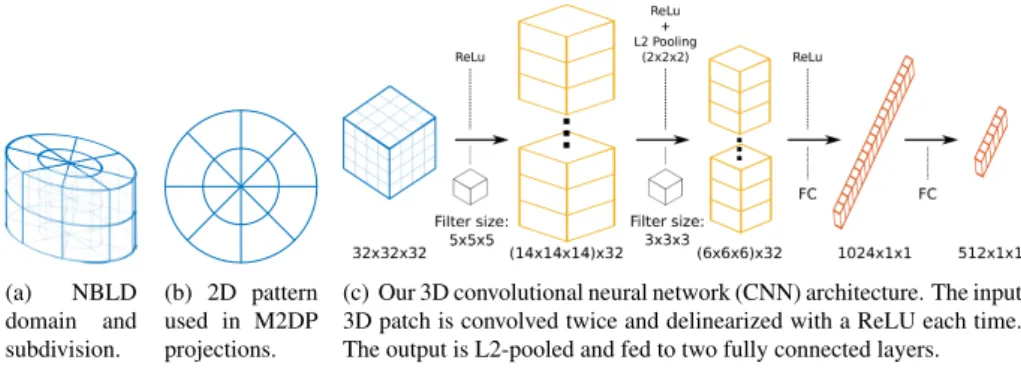
The NBLD descriptor has a cylidrical domainΩ, with respectively na, nr andnz
sub-divisions in azimuthal, radial andz-direction, see Fig. 3(a). It considers the point density in each cell, that is, the point count divided by the cell volume. Inspired by the success of binary photometric descriptors [1,15,27], NBLD does not use absolute densities but rather comparsions between densities of neighboring cells. Its 3·nr·na·nz binary coefficients
in-dicate for each cell how its point density compares to its neighbors in radial, azimuthal and
zdirections.
M2DP projects the points within its domainΩ intonE·nA2D planes. We setΩto be
cylidrical with a radiusrand to have an infininte extent in z. Each of thenE·nA planes
crosses the keypoint~pand is defined by its normal vector, which is expressed as(1,θ,φ)T
in spherical coordinates. θ andφ respectively assumenE andnAlinearly spaced values in
[0,π2](elevation angles) and[−π2,π2](azimuth angles). Into each plane, a polar grid withna
azimuthal andnr radial subdivisions (up to radiusr) is inscribed (Fig.3(b)). For each bin
of this grid, the amount of points that project into it are counted. All these values are stored in a(nA·nE)×(na·nr) matrix A. Finally, the singular value decompositionA=UΣVT
is applied toA, and the first columns ofU andV respectively are concatenated into the
YE, CIESLEWSKI, LOQUERCIO et al.: PLACE RECOGNITION IN SEMI-DENSE MAPS (a) NBLD domain and subdivision. (b) 2D pattern used in M2DP projections. Filter size: 5x5x5 ReLu Filter size: 3x3x3 ReLu + L2 Pooling (2x2x2) ReLu FC FC 32x32x32 (14x14x14)x32 (6x6x6)x32 1024x1x1 512x1x1
(c) Our 3D convolutional neural network (CNN) architecture. The input 3D patch is convolved twice and delinearized with a ReLU each time. The output is L2-pooled and fed to two fully connected layers.
Figure 3: Visualizations for the used descriptors.
3.3.2 Convolutional Neural Network (CNN) descriptor
Inspired by the recent success of CNNs in place recognition, we adapt a 3D CNN similar to the ones proposed in [20] and [40]. We have explored several network architectures and present here the one with top performance. First, the points inside a cubic domainΩ are transformed into a 32x32x32 regular voxel gridXin either of two ways:1) binary occupancy grid: each voxel has a binay value, which is 1 if it has any points inside, and 0 otherwise.
2) Binary density comparison grid: similarly to NBLD, the point density of each voxel is compared to each adjacent voxel in each axis, and the comparison results are converted into binary values. The three axes in which the comparison can be made are represented as three channels ofX. Our CNN has two 3D convolutional layers, each followed by a rectified linear unit (ReLU), a pooling layer and two fully connected layers to map from the voxel gridX
to a 512 dimensional descriptor, as depicted in Fig.3(c). In particular, we useL2 pooling
for the pooling layer, which has been shown to perform better than max pooling [32]. We describe the way in which we train the neural network in Section4.
3.4
Descriptor matching and place voting
Similarly to image-based place recognition we equate a "place" to an image frame. Thus, we ultimately use our descriptors to match poses from which images were taken, using a simple voting-based method [12]: first, we build an inverted index of the image frames that can be retrieved as matching places. We call these the database frames{d}. A kd-tree is populated with all descriptors extracted from the database sequence, and to each entry we add a reference to all image frames that have observed the corresponding keypoint~p. As is common practice [2,7], we use principal component analysis (PCA) to reduce the dimensionality, which results in more efficient matching. The image frame references are obtained from DSO.
A place query is then executed by identifying an image frame from the query sequence which is considered thequery frame q. Again, we can extract what keypoints{~p}are ob-served byqfrom DSO. Of these keypoints, the patches are extracted and described. For each resulting descriptor we match the closest descriptor with respect to theℓ2distance from the
database kd-tree. No threshold needs to be applied to the matching.
The matched descriptor now votes for the database frame to be matched to the query frame: each matched descriptor casts a vote for each frame from which its keypoint~phas been observed. Finally the vote count that each database framedreceives is defined asv(d), and the database frame with the highestv(d)is matched to the query frameq, providedv(d)
YE, CIESLEWSKI, LOQUERCIO et al.: PLACE RECOGNITION IN SEMI-DENSE MAPS
exceeds a vote count thresholdλv.
4
Training the CNN
Given the place matching method, how should we train the CNN for outputting meaningful descriptors? Patches obtained at the same place should result in descriptors with a lowℓ2
distance, while patches obtained at different places should have a higher distance between them. This can be achieved with a triplet loss functionL as presented in [31] and used in [2,16,40]. A triplet is defined as a collection of 3 voxel grids(X1,X2,X3)whereX1and
X2are the voxel grids of matching patches from the training data, andX3is the voxel grid of
a non-matching patch. The triplet loss function is defined as:
L(X1,X2,X3) =max(kD(X1)−D(X2)k2+m− kD(X1)−D(X3)k2,0)2, (1)
whereD(X)is the descriptor ofX and the marginmis a tunable hyperparameter. The triplet loss is 0 if the distance between the matching descriptors is lower than the distance between the non-matching ones by at least a marginm.
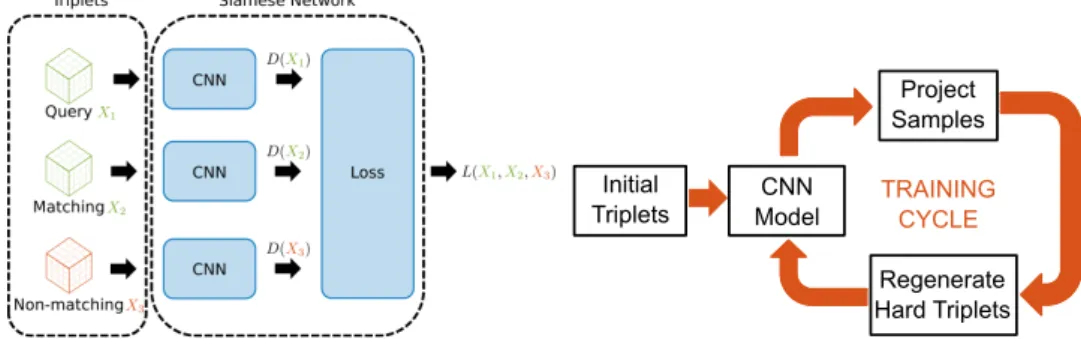
In order to back-propagate from this loss, we set up a so-calledSiamese architecture, since several forward passes from the network are required to compute a single cost value. As illustrated in Fig4(a), this architecture is constituted by three instances of the descriptor CNN shown in Fig.3(c)with shared weights. These instances convert each of(X1,X2,X3)
into their descriptors, and feed the descriptors into the differentiable loss functionL.
4.1
Generating Training Data
In order to obtain the triplets(X1,X2,X3)from the training data, we need a method to reliably
generate corresponding and non-corresponding matches. Naively, corresponding patches would be obtained from centering them around exactly the same location across the different datasets. The problem with this is that while ground truth camera poses are provided, there is no guarantee that DSO will triangulate the same points in consistent locations across se-quences. In fact, the trajectory estimate of DSO is not perfectly aligned with the ground truth in the first place, and it sometimes loses track. Thus, we first align the trajectory estimated by DSO to the GPS data. At this point, we extract from each sequence local point clouds around the same geo-referenced point that is given by a random keypoint in one of the se-quences. Before extracting the patchesΓthat are considered to be corresponding, the local point clouds are aligned using iterative closest point (ICP). If the root-mean-square error af-ter ICP exceeds a thresholdλICP, we reject the patches. ICP alignment is done to counteract
any inconsistencies present between the DSO maps obtained for different sequences. Next, the patchesΓare extracted from the aligned local point clouds, and normalized in orienta-tion using the method presented in Secorienta-tion3.2. Finally, the voxel grid representationX is extracted from the alignedΓ. This allows us to extractNcorresponding voxel grids, where
Nis the amount of sequences in which the patch is observed. With this, we have enough corresponding voxel grids for N2
triplets, which provides us with plenty of training sam-ples for each randomly chosen point. To generate a non-corresponding patch to append to a corresponding pair, we extractΓat a randomly selected position, which is far away from the location of the corresponding patches.
4.2
Batch Sampling Strategy
To train the network, we perform stochastic gradient descent with a batchBof 25 triplets. Concretely, a batchBis built of random samples from a triplet setT of cardinality 20′000,
YE, CIESLEWSKI, LOQUERCIO et al.: PLACE RECOGNITION IN SEMI-DENSE MAPS
Triplets
(a) In order to back-propagate the triplet lossL(1), we apply a Siamese network in which our CNN is applied 3 times with shared weights for two matching patches and one non-matching patch.
Project Samples Initial Triplets CNN Model Regenerate Hard Triplets TRAINING CYCLE
(b) We use a batch sampling strategy which prefer-entially samples triplets that exhibit large loss, thus accelerating the learning process.
Figure 4: Illustrations of the concepts used in the training of our CNN.
generated through the method described in the previous section.
Inspired by boosting, multiple works have recently reported the benefits of a hard nega-tive mining policy, where the optimization is focused on samples with high loss [16,24,33]. However, as proposed by [16], we do not generate difficult samples in a pre-processing step, but we compute them on the fly. The advantage of this approach is that the optimizer points its attention oncurrentlymis-classified samples,i.e., onhardtriplets. Those are defined as
(X1,X2,X3)triplets in whichX3is one the nearest neighbours ofX1in descriptor space, even
though they should not be matched.
To prevent the optimizer from spending too much effort on correctly classifying noisy examples, henceforth over-fitting, we substitute everyK=2 epochs only 5% of the training samples withhardtriplets, produced from the same training dataset. This cycling strategy, depicted in Fig.4(b), experimentally proved to reduce training times while drastically in-creasing performance, confirming results reported in previous work.
5
Experiments
5.1
Dataset
For all of our experiments, we employ the challengingOxford RobotCar Dataset[19]. This contains a large set of image sequences recorded by a car traversing the same path several times over the course of more than a year. Several sequences were recorded for each sea-son, allowing to test the localization performance on a large scale. The dataset was chosen because of its high variance in places’ visual appearance, as shown in Fig1. Strong visual changes result in fact from the presence of occluders, from difference in illumination and viewpoint conditions, and eventually from environment variations across seasons.
To account for all seasons while restricting ourselves to a manageable amount of data, we select 11 image sequences, with at least 2 of them for each season. Each sequence has a spatial extent of around 10km, and is divided into geographically non-overlapping training and testing sets, as shown in Fig. 5(a). The training splits from all chosen sequences are joined together to create a single large training set. This training set is used for training the proposed CNNs and for fine-tuning a visual place recognition baseline, see below.
YE, CIESLEWSKI, LOQUERCIO et al.: PLACE RECOGNITION IN SEMI-DENSE MAPS 0 500 1000 1500 0 200 400 600 800 1000 Frame positions [m] Training Testing
(a) The spatial extent and geographical training-testing split, illus-trated on the 15-05-19-14-06 sequence.
0 10 20 30 40 Descriptor dimensions 0 0.2 0.4 0.6 0.8 1 Max MCC score Dimensionality analysis
(b) MCC for different descriptor dimen-sions, evaluated on the summer-winter match (Fig.6(d)) of the CNN.
Figure 5: Training-testing split and dimensionality analysis with the Matthews Correlation Coefficient (MCC). tp fp fn Database placedis matched to queryq. If|~pq−~pd| ≤re 1 0 0 Else, if∃d′∈D,|~pq−~pd′|<re 0 1 1 Otherwise 0 1 0 No database place is matched to queryq. If∃d′∈D,|~pq−~pd′|<re 0 0 1 Otherwise 0 0 0
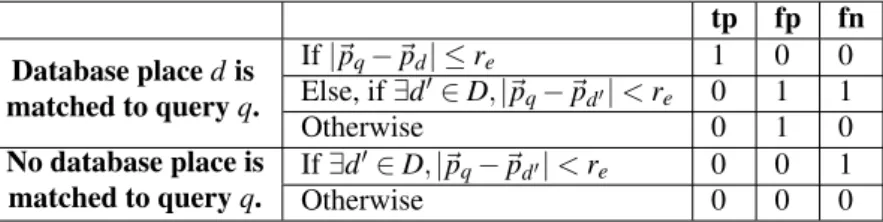
Table 1: True positives, false positives and false negatives evaluated for each query placeq. Here,~piare ground truth positions.
5.2
Evaluating Place Recognition Performance
To evaluate the performance of our methods, we match pairs of testing sequences against each other. From all the possible pairs, we selected 10 of them, in such a way that one sequence for each season would be matched not only against another one from the same season, but also against one from each other season. For each evaluated pair, precision and recall are computed using the (true positive, false positive, false negative) case distinction presented in Table1, where the GPS distance thresholdreis set to 25m.
In the following, we report results when using NBLD, M2DP and our CNN in the pipeline described in Section3. Before evaluation, all of the above descriptors are pro-jected down to a 25-dimensional space via PCA. Fig5(b)reports an evaluation of the CNN descriptor at different target dimensions. Heuristically, we have observed the dimensionality of 25 to be the best trade off between performance and computational complexity. Fur-thermore, we compare to NetVLAD [2] as a state-of-the-art image matching based method. The NetVLAD descriptor, however, is projected with PCA to a 128 dimensional space, as it was reported by the authors to be one of the most performing projection dimensions. We evaluate NetVLAD for two sets of weights: the provided off-the-shelf weights (VGG-16 + NetVLAD + whitening, Pittsburgh) and a set of weights obtained by fine-tuning the off-the shelf weights on our training data for 8 epochs. Given the large size of our training dataset, this corresponded to 80 hours. For the fine-tuning, the VGG-16 part of the network was fixed.
YE, CIESLEWSKI, LOQUERCIO et al.: PLACE RECOGNITION IN SEMI-DENSE MAPS 0 0.2 0.4 0.6 0.8 1 Recall 0 0.2 0.4 0.6 0.8 1 Precision 2015/08/13 to 2015/10/30 (a) Summer-fall 0 0.2 0.4 0.6 0.8 1 Recall 0 0.2 0.4 0.6 0.8 1 Precision 2015/05/19 to 2015/05/22 CNN(og) CNN(dcg) NBLD M2DP NetVLAD(ots) NetVLAD(ft) (b) Spring-spring 0 0.2 0.4 0.6 0.8 1 Recall 0 0.2 0.4 0.6 0.8 1 Precision 2015/05/19 to 2015/10/30 (c) Spring-fall 0 0.2 0.4 0.6 0.8 1 Recall 0 0.2 0.4 0.6 0.8 1 Precision 2015/08/13 to 2015/02/10 (d) Summer-winter
Figure 6: Precision-recall curves for the evaluated methods (our CNN withog: occupancy grid,dcg: density comparison grid, the hand-crafted descriptors NBLD and M2DP as well as the baseline image matching method NetVLAD withots: off-the-shelf andft: fine-tuned weights). Learning-based descriptors use input patches of size 20x20x20m3, NBLD uses a radius of 10mand a height of 20m. We randomly select 5% of the point cloud points as keypoints.
6
Results
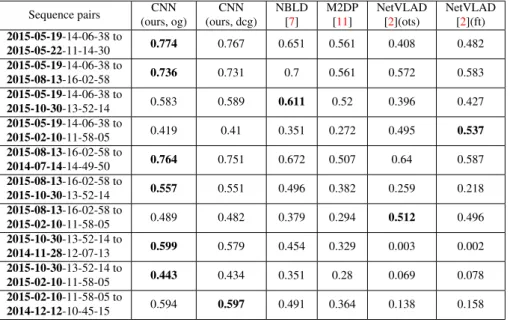
In the 10 considered place recognition cases, we observe a wide range of behaviours for the evaluated methods. Precision-recall curves for the four most representative cases are reported in Fig. 6while the area-under-curve (AUC) measure for all of them are reported in Table2. In six out of ten cases, all structural descriptors outperform NetVLAD, that is, structural descriptors have consistently better precision and recall like in Figs.6(a),6(c). In two out of ten cases, NetVLAD outperforms the structural descriptors in recall, although it exhibits lower precision at lower recall values, like in Fig.6(d). Finally, there remain two cases like in Fig.6(b), where NetVLAD partially beats the hand-crafted descriptors but not the learned ones. Overall, the learned structural descriptors, which are barely distinguishable in performance, outperform the hand-crafted ones by margin between 5−20%, with the one notable exception shown in Fig.6(c). Here, NBLD outperforms the learned descriptors by a small margin in recall. We speculate that this is due to the inherent robustness of the cylin-drical descriptor domain of NBLD to noise in the orientation normalization: in a cylincylin-drical descriptor, all bins in radial direction are equally affected by noise in rotation, while in a cubic domain, such as the voxel grid used as CNN input, the outer bins are disproportionally highly affected by rotational normalization noise.
For the structural descriptors, there is a good correlation between the performance and whether the sequences stem from the same season. Interestingly, this correlation is not as strong for NetVLAD. However, we have found that out of the six pairs in which NetVLAD performs poorly, four involve the sequence 2015-10-30-13-52-14. When inspecting this
YE, CIESLEWSKI, LOQUERCIO et al.: PLACE RECOGNITION IN SEMI-DENSE MAPS Sequence pairs CNN (ours, og) CNN (ours, dcg) NBLD [7] M2DP [11] NetVLAD [2](ots) NetVLAD [2](ft) 2015-05-19-14-06-38 to 2015-05-22-11-14-30 0.774 0.767 0.651 0.561 0.408 0.482 2015-05-19-14-06-38 to 2015-08-13-16-02-58 0.736 0.731 0.7 0.561 0.572 0.583 2015-05-19-14-06-38 to 2015-10-30-13-52-14 0.583 0.589 0.611 0.52 0.396 0.427 2015-05-19-14-06-38 to 2015-02-10-11-58-05 0.419 0.41 0.351 0.272 0.495 0.537 2015-08-13-16-02-58 to 2014-07-14-14-49-50 0.764 0.751 0.672 0.507 0.64 0.587 2015-08-13-16-02-58 to 2015-10-30-13-52-14 0.557 0.551 0.496 0.382 0.259 0.218 2015-08-13-16-02-58 to 2015-02-10-11-58-05 0.489 0.482 0.379 0.294 0.512 0.496 2015-10-30-13-52-14 to 2014-11-28-12-07-13 0.599 0.579 0.454 0.329 0.003 0.002 2015-10-30-13-52-14 to 2015-02-10-11-58-05 0.443 0.434 0.351 0.28 0.069 0.078 2015-02-10-11-58-05 to 2014-12-12-10-45-15 0.594 0.597 0.491 0.364 0.138 0.158
Table 2: The area under the precision-recall curve (AUC) for the evaluated sequence pairs
(querytodatabase) and methods (og: occupancy grid representation,dcg: density
compari-son grid representation,ots: off-the-shelf,ft: fine-tuned).
sequence, we found that it was captured with exceptionally low exposure when compared to the other sequences. Low exposure seems to disproportionally affect NetVLAD more than the structural descriptors. Fine-tuning NetVLAD on our training data gives it a performance boost in six out of ten cases, but does not affect much its performance relative to the structural descriptors. In four instances, the fine-tuning even has a negative effect on NetVLAD’s performance, indicating that the off-the-shelf weights generalize very well to the Robotcars dataset.
7
Conclusion
In this paper, we have presented a novel approach for vision-based place recognition using semi-dense point clouds. Moreover, we have presented a novel approach to learn powerful descriptors in a data-driven manner, showing large improvements over hand-crafted feature based models. Throughout several experiments, we have shown that the information carried by semi-dense 3D point clouds can provide an improvement in robustness over image based approaches, in particular when tested on challenging conditions. Future work could explore the possibility of combining our methodology with appearance-based methods in order to achieve further robustness in long-life, large-scale localization.
8
Acknowledgments
This research was funded by the DARPA FLA Program, the National Center of Compe-tence in Research (NCCR) Robotics through the Swiss National Science Foundation and the SNSF-ERC Starting Grant.
YE, CIESLEWSKI, LOQUERCIO et al.: PLACE RECOGNITION IN SEMI-DENSE MAPS
References
[1] Alexandre Alahi, Raphael Ortiz, and Pierre Vandergheynst. Freak: Fast retina keypoint. InIEEE Conf. on Computer Vision and Pattern Recognition (CVPR), 2012.
[2] Relja Arandjelovic, Petr Gronat, Akihiko Torii, Tomas Pajdla, and Josef Sivic. Netvlad: Cnn architecture for weakly supervised place recognition. InIEEE Conf. on Computer Vision and Pattern Recognition (CVPR), 2016.
[3] Herbert Bay, Tinne Tuytelaars, and Luc Van Gool. Surf: Speeded up robust features. InEuropean Conf. on Computer Vision (ECCV), 2006.
[4] Michael Bosse and Robert Zlot. Place recognition using keypoint voting in large 3d lidar datasets. InIEEE Int. Conf. on Robotics and Automation (ICRA), 2013.
[5] Jane Bromley, James W. Bentz, Léon Bottou, Isabelle Guyon, Yann LeCun, Cliff Moore, Eduard Säckinger, and Roopak Shah. Signature verification using a "siamese" time delay neural network.IJPRAI, 1993.
[6] Zetao Chen, Obadiah Lam, Adam Jacobson, and Michael Milford. Convolutional neu-ral network-based place recognition.arXiv preprint arXiv:1411.1509, 2014.
[7] Titus Cieslewski, Elena Stumm, Abel Gawel, Mike Bosse, Simon Lynen, and Roland Siegwart. Point cloud descriptors for place recognition using sparse visual information. InIEEE Int. Conf. on Robotics and Automation (ICRA), 2016.
[8] Jakob Engel, Thomas Schöps, and Daniel Cremers. Lsd-slam: Large-scale direct monocular slam. InEuropean Conf. on Computer Vision (ECCV), 2014.
[9] Jakob Engel, Vladlen Koltun, and Daniel Cremers. Direct sparse odometry. IEEE Transactions on Pattern Analysis and Machine Intelligence (PAMI), 2017.
[10] Abel Gawel, Titus Cieslewski, Renaud Dubé, Mike Bosse, Roland Siegwart, and Juan Nieto. Structure-based vision-laser matching. InIEEE/RSJ Int. Conf. on Intelligent Robots and Systems (IROS), 2016.
[11] Li He, Xiaolong Wang, and Hong Zhang. M2dp: A novel 3d point cloud descriptor and its application in loop closure detection. InIEEE/RSJ Int. Conf. on Intelligent Robots and Systems (IROS), 2016.
[12] Herve Jegou, Matthijs Douze, and Cordelia Schmid. Hamming embedding and weak geometric consistency for large scale image search. European Conf. on Computer Vision (ECCV), 2008.
[13] Hervé Jégou, Matthijs Douze, Cordelia Schmid, and Patrick Pérez. Aggregating local descriptors into a compact image representation. InIEEE Conf. on Computer Vision and Pattern Recognition (CVPR), 2010.
[14] Edward Johns and Guang-Zhong Yang. Generative methods for long-term place recog-nition in dynamic scenes.International Journal of Computer Vision, 2014.
[15] Stefan Leutenegger, Margarita Chli, and Roland Y Siegwart. Brisk: Binary robust invariant scalable keypoints. InInt. Conf. on Computer Vision (ICCV), 2011.
YE, CIESLEWSKI, LOQUERCIO et al.: PLACE RECOGNITION IN SEMI-DENSE MAPS
[16] Antonio Loquercio, Marcin Dymczyk, Bernhard Zeisl, Simon Lynen, Igor Gilitschen-ski, and Roland Siegwart. Efficient descriptor learning for large scale localization. In
IEEE Int. Conf. on Robotics and Automation (ICRA), 2017.
[17] David G Lowe. Distinctive image features from scale-invariant keypoints.Int. Journal of Computer Vision, 2004.
[18] Simon Lynen, Michael Bosse, Paul Furgale, and Roland Siegwart. Placeless place-recognition. In3D Vision (3DV), 2014 2nd International Conference on, 2014. [19] Will Maddern, Geoffrey Pascoe, Chris Linegar, and Paul Newman. 1 year, 1000km:
The oxford robotcar dataset. The Int. Journal of Robotics Research, 2016.
[20] Daniel Maturana and Sebastian Scherer. Voxnet: A 3d convolutional neural network for real-time object recognition. InIEEE/RSJ Int. Conf. on Intelligent Robots and Systems (IROS), 2015.
[21] Michael J Milford and Gordon F Wyeth. Seqslam: Visual route-based navigation for sunny summer days and stormy winter nights. InIEEE Int. Conf. on Robotics and Automation (ICRA), 2012.
[22] David Nister and Henrik Stewenius. Scalable recognition with a vocabulary tree. In
IEEE Conf. on Computer Vision and Pattern Recognition (CVPR), 2006.
[23] Rohan Paul and Paul Newman. Fab-map 3d: Topological mapping with spatial and visual appearance. InIEEE Int. Conf. on Robotics and Automation (ICRA), 2010. [24] James Philbin, Michael Isard, Josef Sivic, and Andrew Zisserman. Descriptor learning
for efficient retrieval. InEuropean Conf. on Computer Vision (ECCV), 2010.
[25] Henri Rebecq, Guillermo Gallego, and Davide Scaramuzza. EMVS: Event-based multi-view stereo. InBritish Machine Vision Conf. (BMVC), September 2016. [26] Henri Rebecq, Timo Horstschaefer, Guillermo Gallego, and Davide Scaramuzza. Evo:
A geometric approach to event-based 6-dof parallel tracking and mapping in real-time.
IEEE Robotics and Automation Letters, 2016.
[27] Ethan Rublee, Vincent Rabaud, Kurt Konolige, and Gary Bradski. Orb: An efficient alternative to sift or surf. InInt. Conf. on Computer Vision (ICCV), 2011.
[28] Radu Bogdan Rusu, Nico Blodow, Zoltan Csaba Marton, and Micheal Beetz. Align-ing point cloud views usAlign-ing persistent feature histograms. InIEEE/RSJ Int. Conf. on Intelligent Robots and Systems (IROS), 2008.
[29] Torsten Sattler, Bastian Leibe, and Leif Kobbelt. Fast image-based localization using direct 2d-to-3d matching. InInt. Conf. on Computer Vision (ICCV), 2011.
[30] Johannes Lutz Schönberger, Hans Hardmeier, Torsten Sattler, and Marc Pollefeys. Comparative evaluation of hand-crafted and learned local features. InIEEE Conf. on Computer Vision and Pattern Recognition (CVPR), 2017.
[31] Matthew Schultz and Thorsten Joachims. Learning a distance metric from relative comparisons. InConf. on Neural Information Processing Systems (NIPS), 2003.
YE, CIESLEWSKI, LOQUERCIO et al.: PLACE RECOGNITION IN SEMI-DENSE MAPS
[32] Pierre Sermanet, Soumith Chintala, and Yann LeCun. Convolutional neural networks applied to house numbers digit classification. In Int. Conf. on Pattern Recognition (ICPR), 2012.
[33] Edgar Simo-Serra, Eduard Trulls, Luis Ferraz, Iasonas Kokkinos, Pascal Fua, and Francesc Moreno-Noguer. Discriminative learning of deep convolutional feature point descriptors. InInt. Conf. on Computer Vision (ICCV), 2015.
[34] Josef Sivic and Andrew Zisserman. Video google: A text retrieval approach to object matching in videos. InInt. Conf. on Computer Vision (ICCV), 2003.
[35] Henrik Stewénius, Steinar Gunderson, and Julien Pilet. Size matters: exhaustive geo-metric verification for image retrieval. European Conf. on Computer Vision (ECCV), 2012.
[36] Elena Stumm, Christopher Mei, Simon Lacroix, and Margarita Chli. Location graphs for visual place recognition. InIEEE Int. Conf. on Robotics and Automation (ICRA), 2015.
[37] Federico Tombari, Samuele Salti, and Luigi Di Stefano. Unique signatures of his-tograms for local surface description. InEuropean Conf. on Computer Vision (ECCV), 2010.
[38] Junqiu Wang, Hongbin Zha, and Roberto Cipolla. Coarse-to-fine vision-based local-ization by indexing scale-invariant features.IEEE Transactions on Systems, Man, and Cybernetics, Part B (Cybernetics), 2006.
[39] Zhirong Wu, Shuran Song, Aditya Khosla, Fisher Yu, Linguang Zhang, Xiaoou Tang, and Jianxiong Xiao. 3d shapenets: A deep representation for volumetric shapes. In
IEEE Conf. on Computer Vision and Pattern Recognition (CVPR), 2015.
[40] Andy Zeng, Shuran Song, Matthias Nießner, Matthew Fisher, Jianxiong Xiao, and Thomas Funkhouser. 3dmatch: Learning local geometric descriptors from rgb-d re-constructions. InIEEE Conf. on Computer Vision and Pattern Recognition (CVPR), 2017.
![Figure 1: Images of the same intersection in the Oxford Robotcar Dataset [19] captured on February and October 2015, and a point cloud of the same place obtained from a sequence in May](https://thumb-us.123doks.com/thumbv2/123dok_us/10204604.2923435/3.612.53.556.44.152/intersection-robotcar-dataset-captured-february-october-obtained-sequence.webp)