Probabilistic Lane Association
Msc Thesis
ISRN LUTFD2/TFRT--5937--SE ISSN 0280-5316
Department of Automatic Control Lund University
Box 118
SE-221 00 LUND Sweden
© 2014 by Elin Dahlin. All rights reserved. Printed in Sweden by Media-Tryck Lund 2014
Abstract
Lane association is the problem of determining in which lane a vehicle is currently driving, which is of interest for automated driving where the vehicle must understand its surroundings. Limited to highway scenarios, a method combining data from different sensors to extract information about the currently associated lane is presented.
The suggested method splits the problem in two main parts, lane change identification and road edge detection. The lane change identification mainly uses information from the camera to model the lateral movement on the road and identifies the lane changes as a relative position on the road. This part is implemented with a particle filter. The road edge detection enters radar detections to an iterated Kalman filter and estimates the distances to the road edges.
Finally, a combination of the filter outputs makes it possible to compute an absolute position on the road. Comparing the relative and absolute positioning then leads to the desired lane association estimate.
The results produced are reliable and encourages to continue approaching this problem in a similar manner, but the current implementation is computationally heavy.
Populärvetenskaplig
Sammanfattning
Som ett steg mot framtidens förarlösa fordon behövs metoder för att öka förståelsen av omvärlden. En bit i det stora pusslet är att kunna identifiera i vilken fil ett fordon kör, till en början begränsat till motorvägskörning. Det är vad detta projekt handlar om, där uppgiften är att undersöka möjligheterna att få ut information om filtillhörighet på ett robust sätt med tillgänglig data.
En modern lastbil innehåller stora mängder elektronik för att styra och kontrollera funktionen. Lagkrav om exempelvis nödbroms har infört radar och kamera som standardutrustning, och data som dessa sensorer kontinuerligt samlar in kan användas till att ta fram en mängd olika information.
Från en kamera kan man få information om vägmarkeringar och deras sträckning. Genom att kombinera kameradata med lastbilens acceleration i lateral riktning, kan den laterala rörelsen över vägen modelleras. Med fokus på korsning av väglinjer kan filbyten identifieras.
Radardetektioner kommer från alla objekt framför ett fordon; andra fordon, vägräcken, vegetation längs vägen, osv. Genom att sortera ut detektioner från vägräcken kan avståndet till vägens ytterkanter skattas.
Den information som fås från kamera och radar kan sedan kombineras till en skattad filtillhörighet. De resultat som presenteras i den fullständiga rapporten kan med bra resultat verifiera att detta är ett möjligt angreppssätt för att lösa det presenterade problemet.
Acknowledgements
First of all, I would like to thank the people who helped and guided me during my time at Scania, especially my supervisor Pär Degerman with his never-failing patience and expertise. Christoffer Norén also deserves recognition for all the practical help with understanding and retrieving data. I will also never forget the other employees and thesis students, who would always be up for a refreshing coffee and conversation.
I would also like to thank my supervisor and examiner at LTH, Bo Bernhardsson, who has been of great importance with his guidance and perspective.
Finally, I would like to thank my family and friends, without whom nothing would be possible.
Contents
1. Introduction ... 10
1.1 Background ... 10
1.2 Purpose and Goals ... 12
1.3 Methodology ... 12
1.4 Report Outline ... 13
2. Related Work ... 14
3. Truck and Sensor Setup ... 16
3.1 Internal Communication ... 16
3.2 Camera Data ... 19 3.3 Radar Data ... 20 3.4 Map Data ... 21 4. Theory ... 22 4.1 Sensor Fusion ... 22 4.2 Filters ... 24 4.3 Kalman Filter ... 24 4.4 Particle Filter ... 284.5 Change Detection – The CUSUM Algorithm ... 34
5. Implementation ... 36
5.1 System Overview ... 38
5.3 Lane Change Identification ... 41
5.4 Road Edge Detection ... 47
5.5 Lane Association ... 52
6. Results ... 55
6.1 Lane Change Identification ... 55
6.2 Road Edge Detection ... 69
6.3 Lane Association ... 74
6.4 Final Performance ... 79 7. Discussion ... 81 7.1 Model Critique ... 81 7.2 Filter Critique ... 82 7.3 Data Selection ... 83 7.4 Structure of Computations ... 84 7.5 Computational Complexity ... 84 7.6 Conclusion ... 84 7.7 Future Research ... 85 8. References ... 861. Introduction
This master thesis presents a way of determining in which lane a vehicle is driving in a highway scenario. The project was performed at Scania, using information from currently available sensors on Scania trucks, especially radar and camera data is essential for this application.
The project was an overall success, the implemented system can produce stable and robust lane estimates for data recorded on highways.
1.1 Background
Increasingly higher requirements on fuel economy and safety motivate the development of more advanced vehicles. The automotive industry puts great effort in research to adapt to the new demands on the market.
Heavy-duty vehicles contribute greatly to the carbon dioxide emissions to the atmosphere, an approximation by the European Commission is a quarter of the total emissions from road transport and 6 % of total carbon dioxide emissions in the European Union [1]. This has negative impact on the environment and oil is a limited resource. Fuel costs stand for about 35 % of the total cost for a modern haulage contractor [2], a decrease in fuel consumption is strongly economically motivated from their perspective. Modern systems can teach truck drivers how to drive more environmentally friendly, but full or partial automation has potential to further decrease fuel consumption. One example of this is platooning [3], where communicating vehicles autonomously drive closely together to decrease air drag and thereby fuel consumption.
Safety is potentially an even more important issue to consider in this case. In Sweden, Trafiksäkerhetsverket has a vision of zero deaths and serious injuries in traffic [4], an idea that has also gotten attention internationally. Traffic related deaths have been decreasing steadily over the last decades as the safety in vehicles has increased [5].
An older report concludes that human factors alone were the definite or probable cause in 57 % of all accidents and a contributing factor in over 90 % of the cases [6]. Essentially, this is caused by the limited information processing capabilities, which is based on the perception, attention and memory of the driver. These abilities can also be impaired by alcohol, fatigue or other distractions.
The only way to completely remove this risk factor is to rely on an automated system that cannot be affected by this kind of external factors and ideally performs perfectly in any situation.
In order to make it possible to automate vehicles, they must be able to perceive their environment, understand the current situation and take deliberated action.
In the automotive industry, the development of a large number of systems assisting the driver is an important area and software in general is of increasing importance. For some applications, software can reduce costs by replacing expensive sensors [7]. These new, somewhat intelligent functions, are grouped under the name Advanced Driver Assistance Systems, ADAS [8]. Some examples of currently available systems are adaptive cruise control, emergency brake systems and in-vehicle navigation systems. The main purpose of these systems is to increase safety by assisting the driver in some situations.
Scania is a major manufacturer of heavy trucks and buses as well as industrial and marine engines. The main business is heavy trucks with 61,000 sold units in 2012 around the world, Figure 1 shows one of these heavy trucks. Scania is a global company with almost 40,000 employees in over 100 countries. Headquarters and research and development are located in Södertälje [2].
Several projects at Scania develop different kinds of ADAS and with them related software. The FFI project iQMatic is a collaboration between Scania, KTH, Autoliv and LiU and has as a goal to deliver fully autonomous trucks to a mining environment where the trucks can transport overburden to a dumping site.
1.2 Purpose and Goals
As a part of the iQMatic project, this project explores further possibilities of using existing sensors to extract more information about the current situation. Specifically, the purpose of this project is to examine the possibilities of extracting information about in which lane a vehicle is currently driving from data available from radar sensors and camera, available in trucks on the market today. This is one of the steps for increasing the vehicles awareness of the surroundings and this information is of importance for future systems involved with automated driving.
The goal of this project is to formulate a stable lane association method with possibilities to use in real-time for future needs in automated driving. The lane association estimate should be reliable in a highway situation independent of situational variations.
1.3 Methodology
An initial review of literature, scientific papers and dissertations was conducted to give an overview of similar work on the area. Theory, especially for different filtering algorithms, was also revised.
Based on the review results, models and filters were developed in a modular manner, where different functionality were put in individual parts to keep complexity down and allow for change of strategy. Simulations were made, for each module, with real logged data and evaluated by performance and comparison with desired output. The evaluation results lead to improvements in models and filter tuning, and new simulations in an iterative manner. The final results are the collaborative results from all modules working together.
1.4 Report Outline
The report is divided in 6 chapters. After this first introductory chapter, the content can be briefly summarized per chapter as follows.
Related Work – Summary of similar work done on the area with focus on related approaches and methods.
Truck and Sensor Setup – An overview of the communication in the truck, the sensors used as data sources and the format of the data the sensors produce.
Theory – Background about sensor fusion in vehicles, theory about different filters and implementation specific design alternatives with focus on what is implemented.
Implementation – Detailed description on implementation and the design choices presented per function.
Results – Results from simulations focusing on relating back to design choices and step by step getting to the final associated lane estimate.
Discussion – The method and results are critically discussed and improvements and future possibilities are suggested.
2. Related Work
This chapter gives a brief overview of the research topics related to the area. There has been little research with the single ambition to identify the current lane, as this information itself is not very useful. Some areas facing similar problems are also presented, as well as some similar approaches to problems of different character.
Some of the concepts mentioned here will be explained further in the theory section as they are relevant for the project. It might be useful to read this section after the rest of the report, both for increased understanding of the work done and better perspective on the comparison to the similar projects.
Lane detection is a topic which has received quite a lot of attention, the camera and image processing is central for this purpose. Normally, included in this term is localization of the road, the determination of the relative position on the road and some kind of analysis of the vehicles heading on the road. One suggestion for real-time lane detection is given by [11], where all focus is on the image processing as the camera is the only source of information.
Lane departure warning systems use lane detection to determine when vehicle is about to leave the lane without a turn signal being active in that direction. If this is about to happen, the system can either indicate this to the driver as a warning or actively take control of the vehicle and prevent the lane change [12].
Typically, lane departure warning systems rely heavily on visual information, and are thus sensitive to roadway conditions. A multi-sensor fusion approach presented in [13], where GPS, inertial sensors and high-accuracy maps are used to assist the vision-based system with a backup lateral offset to the lane markings.
One of the more similar approaches to this project found in theory is [14], here the road estimation is of as much interest as the lane association. Both rely only on radar, and no camera signals are used at all. Guard rails and the tracking of other vehicles on the road are the important sources for information. The lane
association is done looking at the position relative to the road and the other vehicles, it is also closely connected to the estimated course of the road.
Guard rails are also in focus in [15], where guard rails and other vehicles are identified with camera and radar sensor fusion. The focus is on visually tracking vehicles, detecting the guard rails is mostly done to increase the performance of the tracking.
Another challenging problem is to estimate the course of a road in rural environments, one example of how unmarked and winding rural roads can be detected is given by [16]. Here, guard rails and lane markings heavily relied on in highway scenarios cannot be assumed to exist. The idea is to extend the more frequently used image-based lane recognition with evaluation of 3D information from stereo vision cameras or imaging radar. Several different filtering approaches were evaluated, and a combined Kalman particle filter is proposed as best choice. A slightly different approach for the same problem is presented in [17], where each road feature is tracked individually.
Finally, an approach combining relative and absolute positioning estimates is given by [18], where the application is a simultaneous localization and mapping problem.
These are some examples of the wide-ranging work used as reference and inspiration for different parts of the project.
3. Truck and Sensor Setup
A modern truck is equipped with a large numbers of sensors, mainly for being able to control the basic functionality, such as engine, brakes and gearbox. The extended legal demands and safety goals have forced the introduction of long distance radars and a forward-looking camera. These existing sensors are what this project mainly uses as input, relevant information about the sensors and the produced data is presented in the following sections.
All data produced by sensors, as well as any other information being communicated within the vehicle, is sent on the vehicle internal CAN-network. Within all original equipment manufacturers, OEMs, large amounts of data transmitted on the network on different trucks on the road is logged for development purposes and diagnostics. Throughout this project, this logged CAN-data has been used as input for the models and filters. An overview of the internal communication follows.
3.1 Internal Communication
In a truck there can be as many as 20 different electrical control units, ECUs, communicating internally to make the truck function in a normal way. An ECU can have a number of sensors and actuators connected to it and it is normally responsible for some functionality, where engine control is one of the more complicated examples.
The internal communication standard in the automotive industry is using
controller area networks, CAN, which was created by Bosch in 1983 and has been used widely in vehicles since [19]. A CAN frame has the format seen in Figure 2.
The basic CAN frame depicted above consists of several parts [20];
• Start Of Frame, SOF, indicates the beginning of the frame
• The identifier is also the arbitration field, see below, and contains information about the frame content
• Remote Transmission Request, RTR, is used to distinguish between the data frame and the data request frame
• IDentifier Extension, IDE, is used to distinguish between the CAN base frame and the CAN extended frame
• Data Length Code, DLC, indicates the number of bytes in the following data field
• Data is the actual message transmitted and can be up to 8 bytes long
• Cyclic Redundancy Check, CRC, is a calculated checksum that guarantees the integrity of the frame
• ACKnowledge, ACK, is transmitted as a recessive bit and should be overwritten by receivers with a dominant bit to indicate that the message has been received
• End Of Frame, EOF, indicates the end of the frame
• Intermission Frame Space, IFS, is the smallest number of bits separating two consecutive messages
The CAN message identifier is indicating the content of the message as well as the priority on the bus. In case of bus access conflicts, the arbitration mechanism handles these, allowing the message with the lowest binary identifier and highest priority to be transmitted [21]. Other units will be listening until the priority of their message allows transmission, and any unit interested in the specified content can read a message when it is on the bus [20].
Errors are detected in five different ways in the standardized protocol [21].
• Bit monitoring – Each transmitter monitors the bus level and signals an error if the bus level does not match the transmitted signal
• Bit stuffing – After transmitting five identical bits, a node will always transmit an opposite bit, that will be neglected by the receiver but can be used for error detection
• Frame check – Checks that the fixed bits on the frame have the expected values
• ACK check – All receivers should send an ACK during this part of the message frame, if this is not detected by the transmitter an error has occurred
• CRC – Each receiver calculates the checksum for the message received and compares to the CRC in the message
In case an error is detected, the incorrect message will immediately and automatically be retransmitted. This leads to high data integrity and short error recovery times compared to many other network protocols [21]. The mentioned error detection is only for the two lower OSI layers [22], which are covered by the standard, additional error detection could be implemented in higher layers in applications.
Regarding timing, it is hard to generally guarantee that messages arrive at a certain time. Scheduling and response-time analysis can be done for specific cases, see [23], but a general approach when designing the communication structure is to make the bus fast enough and the number of connected nodes small enough, the delays are then expected to be sufficiently small.
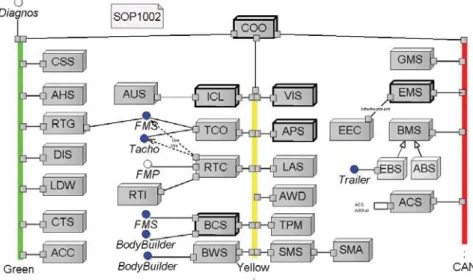
The ECU’s are in Scania trucks connected to three different buses, ordered by priority, see Figure 3 for an overview. Essential systems communicate on the red bus, such as the previously mentioned engine management system, EMS, or the brake management system, BMS. Less critical systems communicate on the yellow bus, examples here are the instrument cluster system, ICL, and the all-wheel drive system, AWD. The least crucial information is put on the green bus, such as the climate control, ACC. These buses are connected at a gateway unit, called the coordinator, COO, which is distributing messages required on several buses and also does some processing itself [21]. With the addition of more sensors and ECU’s for the development of more advanced functionality in the vehicles, another CAN-bus is added. An overview of a typical truck setup can be found in the image below.
Figure 3 Overview of CAN structure in typical Scania truck. ECUs are connected to one of three buses, sorted by importance. The coordinator unit distributes information between buses. Scania internal image.
For more details the two lower OSI layers, which the CAN protocol standardizes, refer to [24], or more details on applications of CAN in different types of vehicles, refer to [21].
3.2 Camera Data
The forward-looking camera is a normal mono-camera bought by Scania from a supplier as a black-box component. It is unfortunately delivered without any formal documentation and the performance is agreed on by a constant undocumented dialogue, what is mentioned in this section is based on experience and general practice.
The supplier is responsible for some camera internal image processing and feature extraction, before publishing data on the CAN-bus. Typically, this kind of lane detection systems is based on Hough-transform of which there are plenty of examples in literature, see for example [25]. The extracted features from the image processing are published on the CAN-bus at a frequency of about 12 Hz.
The camera detects, among other things, the closest lane marking to the left and right, and presents this information on the bus as coefficients for a third degree polynomial. Each time new data is available from the camera, a triplet containing value, time and quality of the value is posted. The quality is an index
from 0 to 3, where 3 indicates excellent quality and 2 good quality. Data marked with 0 or 1 is not deemed to be of good enough use for this application.
The general quality and reliability of the camera signals is determined from frequent use at Scania to be quite high. There are a few situations known to be problematic; for example snow covering lane markings or wet road in combination with the low standing sun causing reflections. In other words, situations which cause the contrast between lane marking and road to become too low are problematic since the image processing relies on the contrast to extract the information. Fortunately this does not apply to a very large number of situations. Problems could also occur if the windshield is very dirty, with dirt directly blocking the view of the camera.
A summary of the camera properties can be seen in Table 1, which focuses on object detection but is included for the general overview it provides.
As a complement to the logged CAN-data, a compressed movie file showing the view through the windscreen is stored for development purposes. Here it is easy to determine the actual position of the car in terms of lane number for use as a reference signal.
Table 1 Properties of Radar and Camera for Object Detection [26]
Camera Radar
Detects Other vehicles, lane markings, pedestrians
Other vehicles, stationary objects
Classifies objects Yes No
Azimuth angle High accuracy Medium accuracy
Range Low accuracy Very high accuracy
Range rate Not Very high accuracy
Field of view Wide Narrow
Weather conditions Sensitive to bad visibility Less sensitive
In the table, the azimuth angle is the angle from the direction in which the sensor is facing, typically straight ahead in the cases involved here, to the detection.
3.3 Radar Data
In Scania trucks today, generic long and short distance radars are mounted in the front of the vehicles to detect objects in front of it. Radars are commonly used in
automotive applications because of the high reliability and accuracy, and low sensitivity to weather and dirt, see Table 1.
The long-distance radar can detect several objects at each measurement instant, the update frequency is 20 Hz with the current setup in the truck. The detections each have information about distance, velocity and acceleration in the direction of detection and an angle from the longitudinal direction of the truck (and radar) that relates the previously mentioned parameters to the truck coordinate system. These signals are considered to be the raw radar signals.
Each of the detections are also classified as true or false for the following categories; movable fast, movable slow and moving. The movable categories indicate if an object is movable, where other vehicles are examples of fast movable objects. The moving category, on the other hand, indicates if an object is currently moving. These categories are evaluated separately; an object identified as a fast movable object, could thus be known to have stopped, and moving would be false.
The raw signals are processed and grouped into targets that different applications can use for a variety of purposes. One important use is tracking objects, where the classification of these objects as moving or static is important.
When determining distances to road boundaries the static detections along a road, such as from guard rails, are of interest. This implies that it is suitable to use the raw radar signals for this application. There are methods suggested for detecting extended objects, instead of working with the individual measurements, refer to for example [27] in the static case and [28] in the dynamic case, but these will not be elaborated further here. The basic idea, however, is to associate the individual detections with any number of objects with certain dynamic behavior and track them over time.
3.4 Map Data
It can be assumed that some other information is available to a vehicle on the road which is associated to the location, this is called map data. This map data includes information regarding topology, speed limits and total number of lanes in the current road segment to mention a few examples.
4. Theory
This chapter introduces the necessary theory on which this project is based. Initially the concept and benefits of sensor fusion is presented, this is followed by a brief introduction to general filter theory and then a presentation, in more detail, of the filter variants used. Finally a practical approach for change detection is presented.
4.1 Sensor Fusion
Sensor fusion is a term used for the combination of data from different sensors in a way that the final data in a sense contains more information than the data from the original sources individually [26] [29]. Common ways of handling this kind of fusion are different statistical approaches, such as least squares methods, maximum likelihood methods and a variety of Bayesian approaches [30].
As previously mentioned, the automotive industry finds the sensor fusion approach very desirable as a way of replacing expensive sensors with more intelligent ways of using cheaper alternatives [7]. Many ADAS use or could use the same state estimates, Figure 4 shows how a central fusion could be structured in the future.
Figure 4 Sensor Fusion Vision [7]. Sensors on the left side provide information about, for example, acceleration, position and speed to the sensor fusion. From the data provided by the sensors, information can, using sensor fusion, be extracted to be used to navigate, track objects or acquire situational awareness for a few examples. This is a vision of how these systems can be structured in the future, centralizing the sensor fusion and sharing the extracted information.
The figure also shows common sensors providing input and typical output data.
Sensor fusion can be implemented in a centralized or decentralized fashion. Centralized fusion means that one filter is developed with all available measurements as input. Decentralized fusion, on the other hand, implies that different filters handle different measurement inputs, and the fusion uses only the filter output [30].
One example of a way of combining information from different sources, as mentioned in [30], is to use weighted least squares, WLS. This would give a combined result of value, x, and variance, P, according to the following.
The result is simply a linear combination of the two estimates, weighted by their quality given by the inverse variances. This assumes the estimates are independent.
4.2 Filters
Recursive Bayesian estimation is a common approach for solving estimation problems in a probabilistic manner. It is a general method, and some of the fundamentals will be presented in this section [31].
Initially, assume there is a model of the following form,
Equation 2 General Bayesian Model
This means that there is a probability distribution that can predict the state x
and measurement z with some degree of certainty. The k index indicates the current time step, and k+1 the closest following. Given the model above, the filtering density and the prediction density one step ahead can be expressed according to the following recursive relations, known as the measurement update
andstate update.
Equation 3 General Bayesian Prediction
The presented equations in this section summarizes the basics in Bayesian filtering, they will be referred to as the filtering theorem [32]. The special case of the theorem when the model is linear and the noise is white and Gaussian, is the well-known Kalman filter, presented in the following section.
4.3 Kalman Filter
The Kalman filter, KF, is an efficient recursive filter for linear dynamic systems based on a Bayesian model. It has numerous applications in a large variety of fields and is of great importance in sensor fusion because of its flexibility [30].
For linear Gaussian systems, the KF computes the posterior distribution exactly by updating finite-dimensional statistics recursively [33]. The KF is optimal in the sense that it gives the exact posterior density, given that the system is linear and completely known and the noise is white [31].
Theory
The KF is well known and commonly used, the filter derivation below follows [30]. The filter estimates the states x and measurements z in a linear state space model given by
Equation 4 Kalman Filter Model
Here u is the control signal, v is the process noise and ethe measurement noise. The F matrix represents the process model and how the states evolve over time, the G matrices indicates how the control signal and the noise affects the different states, the H matrix is the measurement model and shows which states can be measured and how, and the D matrix shows the direct component of the control signal on the expected measurements. Q and R are the covariance of the process and measurement noise respectively.
Initial state and covariance can, as implied by above, be expressed as
Equation 5 Kalman Filter Initializations
In its standard form, the filter based on the given state space model can be divided in two steps and expressed in the following recursive algorithm.
Measurement update: Time update:
Algorithm 1 General Kalman Filter Algorithm
A suggested way to structure the computations is to define the innovation
Equation 6 Innovation
the innovation covariance
Equation 7 Innovation Covariance
and the Kalman gain
Equation 8 Kalman Gain
The measurement update can with these definitions be written
Equation 9 Alternative Measurement Update
Again, this assumes a linear model with white Gaussian noise.
Kalman Filter Variants
There are several variants of the KF, all considered classical approaches to Bayesian filtering, which makes it possible to solve many different types of problems. Essentially, the basic version requires a linear model and can only produce a unimodal posterior distributions, but the variants are more flexible [33].
TheExtended Kalman filter, EKF, is an approach that takes a nonlinear, non-Gaussian model and applies the KF to the linearized model with non-Gaussian noise. The linearization is done around the previous estimate, typically with the first, sometimes also including second, order terms of the Taylor expansion. There are no guarantees that the linearization and noise assumptions will give good results, however, in some applications where nonlinearities are small and the true posterior is unimodal, this works well [33].
The Unscented Kalman filter, UKF, uses a few carefully selected so called sigma points to represent the unimodal Gaussian distributions. The UKF handles nonlinearities better than the EKF, but there are still limitations [33].
The Gaussian sum Kalman filters, GS-KFs, is a group of approximative filters that describes the posterior distribution as a sum of Gaussians, thereby allowing multimodal posteriors. These filters recursively form the Gaussian posteriors, essentially resulting in the parallel operation of several Kalman filters [34].
The Iterated Kalman Filter
With a large number of independent measurements per time step, it is possible to apply an iterated Kalman filter, IKF. This is a variant of the KF which uses the basic theory but allows for any number of measurement updates between two time updates, instead of continuously alternating the two as the basic KF suggests. Intuitively it is reasonable to accept that two measurements with zero time difference can update the filter without a time update in between, a formal proof can be derived from the information filter, refer to [30].
Specifically, this means that the standard KF measurement update equations, after initializing
Equation 10 Iterated Kalman Filter Initializations
for each of total M measurements i = 1, 2, …, M will appear as follows
Equation 11 Iterated Kalman Filter Measurement Update
The final measurement update step is then
The order in which the measurements are added to the filter does not impact the final result.
Outlier Detection and Rejection Algorithm
In order to avoid having unwanted measurements disturbing the filter performance outliers should be filtered out before adding measurements to the filter. This can be done in many ways, basically any hypothesis where a measurement can be tested as an inlier/outlier, and possibly rejected depending on the result, would be sufficient to increase performance if the measurement signal has outliers [30].
Stability
The Kalman filter is sensitive to model imperfections and deviations in the noise covariance from the true values. For numerical stability, the covariance matrix P
must be positive-definite [30].
4.4 Particle Filter
The particle filter, PF, is a stochastic method based on Monte Carlo integration and is also known as sequential Monte Carlo, SMC [26]. It is an alternative to the commonly used KF in cases when the model is very nonlinear, beyond where the “linearized” extended Kalman filter or other variants apply. The earliest mentions of the PF are from the 1950s, but only since the publication of [35] in the 1990s when computational power started becoming more available, did this computationally complex filter gain recognition. The positioning problems of vehicles in real-time has been one of the big areas of application for the PF. Extensions of the positioning problem are algorithms for simultaneous localization and mapping, SLAM, an important development and application based on the PF [33].
The PF is approximating a posterior distribution of the state
given the measurements , based on a set of N samples. These samples are
called particles and each has an associated weight w. For each time step, all particles are sent through the process model, read by the measurement model and assigned weights with a likelihood function on how good approximation of the true measurements that they make. Resampling, choosing a new set of particles from the old set, can optionally be used to keep up the quality of the particles. The steps that the filter iterates through are thus, again according to [30]
1. The measurement update: Modify the weights according to the likelihood function of the difference between observed and predicted measurements.
2. Resampling: Take N new samples of the state from the existing set of particles.
3. The time update: Simulate a trajectory from one measurement time to the next using the dynamic model.
The approximated resulting posterior distribution is for each time step the discrete set of particles representing the estimated state
Equation 13 Particle Filter Approximated Posterior
where(u) is Dirac’s delta function [30].
Theory
The filter theory in this section is based on [30]. The PF can be applied to any nonlinear non-Gaussian model, in general form given by
Equation 14 General Model for Particle Filter Application
There are no restrictions on the probability density functions (PDF) of the process and measurement noise, but they are assumed to be known. The general form of the PF algorithm follows.
First of all a proposal distribution must be chosen, as well
as a resampling strategy and the number of particles N.
Initialization: Generate ,i = 1, …, N and let .
Iteration: For k= 1, 2, …
1. Measurement update: For i = 1, 2, …, N,
2. Estimation: The filtering density is approximated by
and the mean, considered to be the filter estimate, is approximated by
3. Resampling: Optionally at each time, take N samples with replacement from the existing set of particles where the probability to take sample i is
and then set the new particle weight .
4. Time update: Generate predictions according to the proposal distribution
and compensate for the importance weight
Algorithm 2 General Particle Filter Algorithm
It is possible, and common, to combine the two weighting steps.
This section presents the general form of the particle filter, there are several variants and extensions, some of which are presented in detail in [31].
Selection of Proposal Density
To be able to implement a filter according to the principle outlined above, the proposal density q must be selected. Principally, it can be freely selected as any kind of distribution, typically Gaussian, naturally affecting the approximation and therefore the performance negatively with a “bad” selection.
Following the practice in [32], a more straightforward way of looking at the proposal density is presented in this section, valid in the case of a SIR filter, see section Resampling on page 32. This version of the PF represents making a set of design choices and is commonly known as the bootstrap filter. The important aspects are that in order to resample, a proposal density and a corresponding importance weight are required.
which would suggest
Equation 15 Relationship between Target Density, Importance Weight and Proposal Density
These terms can be interpreted as the target (filtering) density, the importance weight and the proposal density respectively. Following again the basic theorem in section 4.2 and the interpretation of the equation above,
Equation 16 Interpretation of Proposal Density
This implies that the proposal density can be chosen as
Equation 17 Suggestion for Proposal Density
This means that the particle predictions can be made by simply updating the particles from the previous time step using the process model. Formally, for each particle
Equation 18 Formal Notation of Particle Update
Equation 19 Particle Update with Model Notations
As mentioned, this simplification makes the implementation more straightforward and is less computationally expensive than sampling from a given distribution. This is the most common version of the PF, and it performs well when the signal-to-noise ratio, SNR, is small [33].
Number of Particles
The most important design choice is the number of particles used. The tradeoff is between getting a good representation of the full spectrum of the posterior PDF and the computational complexity a large number of particles causes [33].
Effective Number of Samples
Looking at a PF, it is important to avoid something called sample depletion. This means, that without any countermeasures, over time all particles except for a very few will have negligible weights. To indicate the degree of depletion the effective number of samples is introduced as
Equation 20 Effective Number of Samples
where a computable approximation is
Equation 21 Approximation of Effective Number of Samples
This means that the effective number of samples can be interpreted to be at its largest equal to the total number of samples when the weights are equal, and at its smallest equal to 1 when all particles except one has zero weight [30].
Resampling
Resampling avoids the sample depletion problem by, as previously mentioned, selecting a new set of particles from the highest weighted particles of the old set. It is here important to make sure that the new set still represents the distribution in a good way, not selecting too few particles to represent the entire range since
throwing away particles essentially means throwing away information. This problem is called sample impoverishment, and in the extreme case this means that all particles collapse into one particle [36].
There are two alternatives for when to resample. Sampling importance resampling, SIR, means that resampling takes place every iteration, as mentioned in the Theory section. The alternative, sampling importance sampling, SIS, is to resample only when needed. This could be, for instance, when the effective number of samples is below a certain threshold [30]. A simple comparison is made in [36], where the resampling schemes produce comparable estimates but the SIR shows a smaller variance in the particle values than the SIS.
There are different ways of selecting the particles to be resampled, the most commonly mentioned schemes are multinomial resampling,residual resampling,
stratified resampling and systematic resampling. Theoretically, the first three schemes have advantages, but all four show comparable results in practical applications. Based on this, systematic resampling is often chosen, since it is the simplest method to implement [37].
The resampling step can be a computational bottleneck if not the implementation is carefully considered and unreasonably high complexity is avoided. The systematic resampling can be implemented in different ways; Gustafsson suggests in [33] a MATLAB implementation including sort, which is of complexity , and Svensson mentions in [38] a method of complexity .
Jittering/Roughening/Dithering
This trick with many names is a practical way of avoiding sample depletion problems. The idea is to use the relationship between process noise and measurement noise; the noise models are modified so the process noise and/or the measurement noise appear larger in the filter than they really are in the process. If the noise level of the process noise is increased, this allows a wider range of particles in the resampling and partly mitigates the sample depletion problem. If instead the noise level of the measurement noise is increased, this also increases the chances of a particle being resampled since the tolerance will be larger for particles not matching an observation [33].
Stability
Divergence is normally an important theoretical issue with particle filters, as over time the noise will eventually cause the particles to diverge as the accumulated
error increases with an infinite time horizon. However, in most practical applications this is not something that needs urgent attention, and convergence can be proven with finite time horizons [30]. An extended discussion on the theoretical stability of particle filters is not assumed to be of further interest here, there is plenty of information available on the topic elsewhere.
4.5 Change Detection – The CUSUM Algorithm
The CUSUM algorithm is a way of detecting changes over time. It is commonly used to detect when a controlled process loses control. In [39] the idea is described as follows. Assume that msamples of size n are collected, and the mean of each sample is calculated. The cumulative sum, CUSUM, can then be formed by plotting one of the following quantities to the sample number m.
Equation 22 CUSUM Basic Sums
Here is the estimate of the mean when the process remains in control and is the known or estimated standard deviation. The summation of the deviation
from the estimated mean will indicate when the samples start drift off from the expected values as this sum is compared to a limit value. A principal example of the plot can be seen below.
Figure 5 CUSUM Visualization [39]. Looking back in time from the current time step, previous values are expected to be inside the cone formed by the arms in the illustration. Values outside the arms indicate a process out of control, or that a change has occurred.
This is called the V-Mask, a way of visualizing the procedure. The process is deemed out of control when one of the points lies outside the upper or lower arm. This image also show the handk parameters, normally used as design parameters. Using these design parameters, a tabular approach, more common than the visual variant, can be implemented according to the following.
Algorithm 3 CUSUM Algorithm
At time 0 both are initialized to 0. These sums will increase if the deviation from the mean is larger than k in the positive or negative direction respectively. At each time step the sums are compared to the limit h to determine whether or not the process is still in control.
5. Implementation
The problem of associating the current position with a certain lane is split in three parts; lane change identification, LCI, road edge detection, RED, and lane association, LA. The lane change identification determines when lane changes take place and the direction of change. It is mainly using camera data as input. The road edge detection on the other hand, uses the stationary radar detections to determine distance to the road edges. Representative models and suitable filters for these applications give estimates as output for the LCI and RED blocks at each time step. This information can in the final lane association step be combined for a resulting lane estimate. Details follow in the succeeding subsections.
The modelling and filter development has been carried out in MATLAB in a data-driven exploratory manner, focusing on presenting stable results with a varying range of input data. Input data for development was chosen to be highway scenarios with lane changes, where there were two or three lanes available.
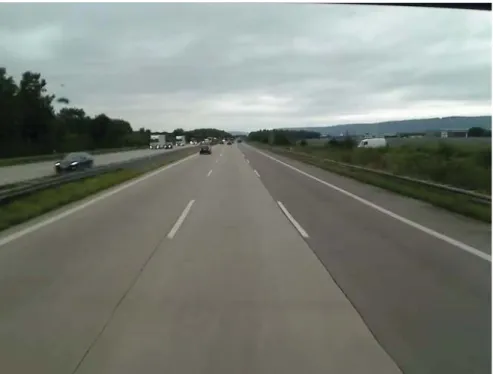
Figure 6 Screenshot from Front View Camera Recording. In this situation with three lanes, the lanes are identified with indexes from 0, the leftmost lane, to 2, the rightmost lane.
Figure 6 shows the view from the front looking camera, this is a screenshot from the stored video file. The lanes are numbered with indexes from 0 to the total number of lanes minus one. In the figure above, the current situation shows a road with three lanes. The leftmost lane is indexed 0, the middle lane in which the vehicle is currently driving is indexed 1, and the rightmost lane is indexed 2. In the general case of n lanes, they would be indexed from 0 to n-1. Minus one would indicate the area between the leftmost lane marking and the guard rail and n the corresponding area on the right side of the road.
This chapter describes the methods and models used, how the filters have been implemented and how the final lane estimate is calculated. The first section gives a brief overview of the complete implemented system to increase the understanding of the individual blocks.
5.1 System Overview
The final implementation of the system showing input data and which states that are communicated as outputs can be seen in Figure 7 below.
Figure 7 System Overview. Lane change identification, road edge detection and lane association are illustrated as blocks where input and output is clearly indicated, as well as the relationship between the blocks and direction of information.
The three main blocks, as earlier mentioned, are the lane change identification, the road edge detection and the lane association.
The LCI uses camera signals, specifically the distance to the closest lane markings left and right, and the measured lateral acceleration to identify the lane changes. Also, the total number of available lanes from the map data is used. The n_LCI estimate corresponds to a relative position on the road, a change on this signal indicates that a lane change, left or right respectively, has occurred. The total number of lanes is also propagated to the LA block, as well as the estimate for the lane width, w_l. The subscript l here indicates a value related to the lane.
The RDI block uses radar signals, distance and angle to measurements as well as the classification whether the detected object is moving or not, to estimate distances to the road edges, l_r and r_r. Here the subscripts indicate that these values are relative to the road.
Finally, the LA block uses the estimates produced by the first two blocks to compute the lane estimate.
5.2 Logged Data
Since the development is tightly connected to the logged data it is of importance to mention the nature of the selected data and some details about this selection process.
Scania has large amounts of logged data stored in databases. Each data segment contains most of what a truck can record during six minutes, mainly all traffic on the CAN-network, but also a compressed video showing what the camera mounted in the windscreen shows. The video file can be directly played in a media player, but the signals must be decompressed, decoded and interpreted either by the CANalyzer software [40] or a re-simulation script in MATLAB. When the decoding step has been finished the signals can be stored in .mat-files and easily accessed.
During this development a large number of data sets have been used, of which eight are of more importance for the tuning of the filters and algorithms. They are chosen to represent different situations and difficulties for the implemented filters that are frequently encountered driving on a highway. These data sets are listed below with their most pronounced characteristic, which is why they are chosen.
1. Lane change, two small exits/entrances
2. Two lane changes, one small exit/entrance, one medium exit/entrance and one large exit/entrance
3. Lane change, three small exits/entrances
4. No lane changes, initial large exit/entrance, later another large one, two lanes, small disturbance on camera signal, two lanes
5. No lane change, small exit/entrance, large “disturbance” on camera signal from section without lane markings
6. Two lane changes, small exit/entrance, change from three to two lanes, small disturbances on camera signal
7. Five lane changes, two small exits/entrances 8. Five lane changes, two small exits/entrances
The two last data sets are similar in many ways, but the focus on the lane changes in this project makes them both interesting to use.
These data sets are all from the same truck, Tina, and are all recorded in the southern parts of Germany, where this truck is located. The road segments have
three lanes, unless mentioned otherwise above, the road is both straight and curved, there are some hills, and there are several other vehicles on the road.
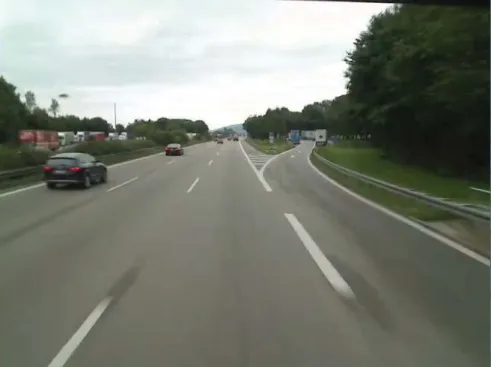
The focus of these data sets are lane changes, which test the performance of the LCI, and exits and entrances on the highway, which test the performance of the RED especially since the guard rails trail off with the exits, see Figure 8. This gives a step change in the road width which could be challenging. The exit below is categorized as small, as only one lane leaves the road.
Figure 8 Screenshot from Front View Camera Recording Showing Highway Exit. The problematic part of this situation is the guard rail on the right side of the road trailing off with the exit. The new position of the guard rail, closer to the road, must be identified when the vehicle has passed the exit.
Worth mentioning, related to the situation above, is that the exiting lane is not counted as a real lane, the number of lanes is thus three also here.
The data selection process was simply to browse through the logs, determining from the video file whether or not the situation was completely recorded on a highway. From this collection of data the eight above were selected showing both simple and more complicated situations with respect to filter capabilities, this will be discussed further in the results in chapter 6.
5.3 Lane Change Identification
The lane change identification uses information from the camera about the lane markings on the road and the lateral acceleration to model the vehicles lateral movement relative to the markings. It models both lane changes, the lane width and the position within the lane, where the lane changes as a relative estimate of the associated lane is the main focus.
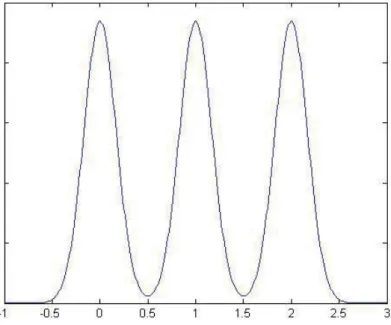
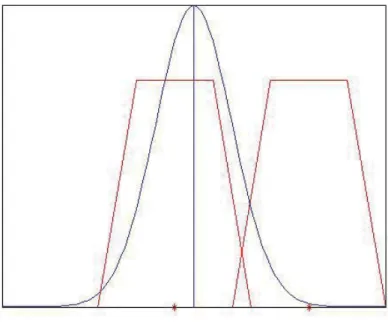
In a highway scenario with multiple lanes, the initial probability, assuming no prior knowledge, would indicate equal probability for each of the lanes. Assuming Gaussian distributed variation within each lane the initial PDF would have the principal look shown in Figure 9 below, where the lane indices are on the x-axis and probability on the y-axis. Here the scaling on the y-axis irrelevant as the interest is in the relative levels.
Figure 9 Initial Probability Density Function with No Prior Information. The lane indices on the x-axis indicate equal probability on the y-axis for each lane without prior knowledge.
Behind this, there is an assumption that disregards traffic rules and driving style, which would indicate higher relative probability for the rightmost lane and lower for the leftmost in a country with right-hand traffic. It is also assumed that
when a vehicle drives in a certain lane, the vehicle is preferred to be driven in the middle of the lane, even though sometimes it is preferable to keep the vehicle in the left or right part of the lane because of surrounding traffic environment. This can thus be regarded as the naïve extreme case based on no information whatsoever.
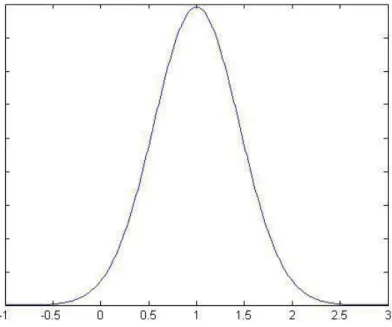
In the case where there is an initial guess, either from knowledge about the data used in simulation or accumulated in the filter over time, the initial probability distribution can be set to a Gaussian distribution as in Figure 10. Also here the shape of the distribution is of interest, rather than the absolute level of probability, hence, no scaling on the y-axis is displayed.
Figure 10 Initial Probability Distribution with Initial Guess. The x-axis shows lane index and y-axis the probability. A guess or prior knowledge could motivate the initialization of particles centered on a specific value, in this case lane 1. The variance allows for some uncertainty in the initial case.
The assumed multi-modal probability distribution in Figure 9 with peaks on each of the lane indexes motivates the use of a particle filter, since it can handle any kind of probability distributions and input and output. The PF does not put any restrictions on the model either.
Process Model
The basic idea is modelling the relative sideways movement on the road with no regards of the longitudinal movement or speed. This is achieved with a simple model of the lateral offset to the closest lane marking to the left, , the change in
this offset (lateral velocity), , and the change rate of the same offset (the lateral acceleration). Again, the index lindicates that the values are relative to the lane.
They change over time according to the following equation, where is the
sampling time. Equation 23 Relative Lane Movement Model
This simple model is then extended with a state for the associated lane, ,
and the lane width in the current road section, . The latter is measured as the
sum of the left offset and the right offset, and is in the model considered to be constant over time. This gives the complete set of states,, according to the following. Equation 24 Complete LCI States
The update method of the associated lane state was developed in parallel with the filter with the ambition to find a reliable indicator for lane change, see the next section for details.
Updating the Lane State
The final way of updating the lane state is described here, different variants were tested during development. This update is essentially what discovers the lane changes, and the basic idea is to find step changes in the offset state.
The lane state is updated in a nonlinear manner. Each particle lane estimate can be increased or decreased by 1, corresponding to the proposition that a lane change has occurred. This happens when the difference of the old offset estimate
and the new particle offset estimate is larger than a selected absolute threshold value, positive or negative difference indicating the direction of lane change. This change is, however, limited in some cases,
• if the particle estimate would exceed the ranges of the lane state (), or
• if the particle is already pulling the total estimate in the direction of the proposed change.
What the second limitation means can be exemplified as follows. If the filter estimate indicates being in lane 1 (the mean particle value is 1), and an individual particle currently suggests lane 2, but identifies a lane and want to change its value to 3. This change will not be allowed, and keeping the particle value at 2 will still pull the estimate in the direction of the suggested change. This limitation keeps the particles clustered and allows for easier change detection.
The first limitation was used only during the early development phase of this filter as an attempt to estimate the absolute lane number solely with this filter. This is referred to when looking at different initial distributions for the lane state later on and therefore mentioned here. When, as in most cases, only the lane change is of interest, the initialization of the associated lane state was set to 0 instead of the actual value as in in early simulations. This limitation would in this case be unwise, as it assumes absolute knowledge of the position.
After these updates the lane estimate is compared with the actual position within the lane, as calculated from the offset and the lane width. The lane estimate is then given a small push towards the actual position within the lane it currently is positioned in. This push is proportional to the deviation of the position and smaller than the noise that the filter will add when the particle is being updated.
Measurement Model
Three of these states mentioned in the previous section can be measured, the offset to the closest left road marking is the constant term from the third degree polynomial that the camera calculates, and the lane width is the sum of the left and right constant terms. The lateral acceleration is also measured in the truck.
The measurement model simply shows that the physically measurable states can be directly read from the model, this is the road width, the offset and the lateral acceleration, all with some amount of noise e distributed over the states according to D.
Equation 25 Particle Filter Measurement Model
Filter Design and Implementation
The filter is implemented in a straight-forward manner according to section 4.4 . The number of particles is selected to be 10,000, which has been empirically proven to be a good tradeoff between performance and quality for this specific case. A smaller number of particles would not properly represent all states in an adequate manner, causing larger variations between simulations as the random behavior of the noise gives a pronounced effect on the results. A larger number of particles would not further increase the performance in a noticeable way, only increase the complexity.
Resampling is selected to be done every iteration, SIR, and the resampling method is chosen as systematic resampling, for details see the Resampling section on page 32. The proposal distribution is chosen/implemented as described on page 30, thus the implemented filter is a type of bootstrap filter.
According to the theory, the particle weight can be calculated using the deviation of the measurement from each particle state to indicate the likeliness of a certain measurement given the state, .
Noise Levels
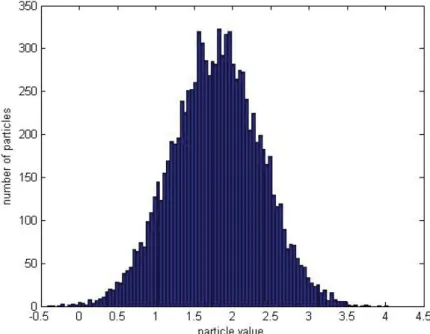
The noise variance levels are selected in an ad-hoc manner, selected to achieve jittering and to avoid sample depletion and impoverishment, see the results in section 6.1 and especially Figure 23. The noise parameters were adjusted so that the effective sample size was at a level somewhere between two thirds and three quarters of the total sample size. Adjusting the noise parameters also effects the resampling as it affects the weights, to make sure that one single particle was not used an extensive number of times in the resampling this maximum number of particle occurrences was also monitored and made sure not to exceed a few hundred. These approximate levels proved to give desired behavior of the filter in general.
The above reasoning applies both for the absolute decision of the noise level, but especially important is the relative difference between process and measurement noise. Worth pointing out again is that these levels are not the actual levels of noise, only what the filter expects of the data. The consequence is how
the filter treats individual measurements; a measurement with poor resemblance to the current estimate will naturally affect the estimate more in a filter expecting a larger noise on the measurement than one expecting smaller noise.
Also, the noise levels are not the same on the different states since they have quite different character. The noise is lower on the associated lane state in the process model than on the other states, since this is an entirely estimated state with no direct input from the measurements, thus, all other noise will be propagated here through calculations. In a similar manner, the measurement noise is different on the states as well; the width noise variance factor is twice the offset variance factor because they come from two and one measurements respectively. The measurement noise variance on the acceleration is set to a higher level because of the fluctuating nature of this data.
Initial Particle Distribution
Particles are initially generated around a given value, an initial guess, with Gaussian noise of a certain variance for each of the states. Any of the states getting input, such as offset and acceleration, can be initialized with any reasonable guess and it will quickly converge to the actual value.
The exception is the lane estimate, where the given initial value has corresponded to the true value during the development phase, since the aim here is to get the relative position. Using the true value here makes it easier to follow the changes over time and compare them to the actual changes in the logged data.
There are variations in the simulations, using different initial particle distributions on the lane state than the above mentioned, such as the principal look shown in Figure 9.
Missing Camera Data
There is a naïve restriction on the filter update; if the camera signal quality is poor, the filter will not be updated and only noise will be added to the states in the update stage, and it will then move on to the next time step. This is because of the nature of the input data, where it is quite common that there are occasionally some invalid measurements, but normally not too many consecutively.
The quality of the camera signals is only determined by the quality stamp that is attached to it. Any data that is of the two highest of four quality levels is passed into the filter.
Resetting of Particles
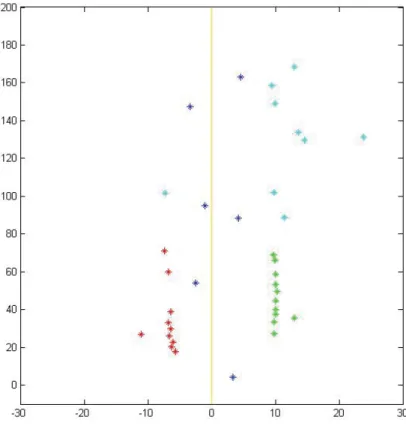
When no new information reaches the associated lane state, such as an indication about a lane change, the particles have a tendency to spread out and form break-out groups. This spreading break-out occurs in both directions from the estimate because of the noise added each step, and because of the random character of the noise the estimate sometimes drifts off in one direction. An example of the filter lane estimate for data set 4 where no lane change occur can be seen in Figure 11 below. Over the course of the six minute in the data set, as seconds on the x-axis in the figure, the estimate changes from 0 to 1, this variation is only from the added noise.
Figure 11 Drift on Lane State without Reset. The x-axis shows time in seconds. The particles are initializes on 0, and since no lane change occurs, they are expected to keep indicating 0. However, over time the estimate changes to -1 because of the noise in the particle filter.
It is decided to reset the particle distribution regularly on the lane state, every 30 seconds or so, to prevent this kind of natural but unwanted behavior. The reset places the particles around the current estimate, the mean, as a Gaussian with the same variance as the initiation.
The same kind of particle reset as mentioned above takes place when a lane change is detected. This makes the estimate more stable, partly because of the same reason of particles spreading out as above, partly because the wide range of particles will never all agree on anything (which really is the point), but since these changes are expected and desired they are propagated throughout the population when identified.
5.4 Road Edge Detection
To be able to estimate which lane a vehicle is currently in, the road edge detection, RED, looks at radar data that can position the vehicle on the road with respect to the road edges. Road edges are in highway scenarios often indicated with guard rails which can be detected by the radar, but the radar also detects other
![Figure 1 Scania Truck on the Road [9]](https://thumb-us.123doks.com/thumbv2/123dok_us/10192101.2921982/11.658.83.581.459.790/figure-scania-truck-road.webp)
![Figure 4 Sensor Fusion Vision [7]. Sensors on the left side provide information about, for example, acceleration, position and speed to the sensor fusion](https://thumb-us.123doks.com/thumbv2/123dok_us/10192101.2921982/23.658.84.575.71.369/figure-sensor-fusion-vision-sensors-information-acceleration-position.webp)