Procedia - Social and Behavioral Sciences 115 ( 2014 ) 54 – 67
1877-0428 © 2013 The Authors. Published by Elsevier Ltd.
Selection and peer-review under responsibility of The 5th Indonesia International Conference on Innovation, Entrepreneurship, and Small Business.
doi: 10.1016/j.sbspro.2014.02.415
ScienceDirect
The 5
thIndonesia International Conference on Innovation, Entrepreneurship,
and Small Business (IICIES 2013)
The Role of Accounting Services and Impact on Small Medium
Enterprises (SMEs) Performance in Manufacturing Sector from East
Coast Region of Malaysia : A Conceptual Paper
Mohd Azian Husin ͣ
, Mohamed Dahlan Ibrahim
ᵇ
*
ͣ Universiti Malaysia Kelantan, Pengkalan Chepa, 16100 Kota Bharu, Kelantan, Malaysia ᵇ Universiti Malaysia Kelantan, Pengkalan Chepa, 16100 Kota Bharu, Kelantan, MalaysiaAbstract
The purpose of this paper is to examine the role of accounting services and impact on SMEs performance in manufacturing sector from East Coast Region of Malaysia. This paper aims the extend of differences in service quality factors among accountant firm and SMEs. A conceptual framework was developed to highlight the relationship between SMEs in accounting services. This paper presents a gap model of services, Resource-based Theory (RBT) and Principal Agent Theory as an approach to be examined. The AMOS (SEM) and NVivo Software will be used to tabulate the data gather form the research question. There appears a relationship on service quality and performance of SMEs and also accountant firms. This paper is limited among selected manufacturing sectors and accountant firms from East Coast Region of Malaysia. This paper has implication for accountant firms, SMEs, academic and also to the company involve and handle in service quality. This paper should be contributed the gap model and the entrepreneurial development policy for SMEs and accounting firms to sustain the national economy.
© 2013 The Authors. Published by Elsevier Ltd.
Selection and peer-review under responsibility of The 5th Indonesia International Conference on Innovation, Entrepreneurship,
and Small Business.
Keywords : Small Medium Enterprises (SMEs), Accountant firm, service quality, performance, manufacturing sector
* Corresponding author. Tel.: +609-771 7251; fax: +609-771 7252. E-mail address: [email protected] ; [email protected] © 2013 The Authors. Published by Elsevier Ltd.
Selection and peer-review under responsibility of The 5th Indonesia International Conference on Innovation, Entrepreneurship, and Small Business.
1.Introduction
The small and medium enterprises (SMEs) are backbone for Malaysia’s economy. According to Finance Minister II Datuk Seri Ahmad Husni Mohamad Hanadzlah, SMEs comprises 99.2 percent of the total registered business establishments in the country and contribute 56.4 percent to employment, they only contribute about 32 percent to gross domestic product (GDP) and 19 percent to total export for the year 2005 (SMIDEC, 2008). The Government has formulated many policies and development plans to assist the SMEs by Ninth Malaysia Plan (9MP) 2006 – 2010 and the Third Industrial Master Plan (IMP3) 2006 – 2016 (SME Annual Report, 2006) and the latest
SME Masterplan 2012 – 2020, will be the 'game changer' to accelerate the growth of SMEs to achieve high income
nation status by 2020. The Masterplan will be for all SMEs in Malaysia, irrespective of sector, gender, geographical region and ethnic background (SMIDEC, 2012).
By the year 2010, the real gross domestic product (GDP) as mention about the manufacturing increase from -9.3% to 11.4% recover with the electrical and electronic (E&E) sub-sector and domestic-oriented industries rebounding to register double-digit growth. This situation was largely attributed to the revival of global corporate IT investment and higher consumer spending on electronics that promoted greater demand for semiconductors and audio-visual product. (SME Annual Report, 2011).
Despite this success of SMEs, we also know that SMEs are subject to increasing pressures which have intensified with the challenges in current economic crisis. There is an increased need for value creation among SMEs to ensure the business become more sustainability which coexists within an environment of good corporate governance.
SMEs need to improve the performance in providing relevant expertise and consultation, particularly those in the Small and Medium Accounting Practices (SMPs) as well as Professional Accountants in Business. SMPs are involved in assisting the SMEs in their compliance to accounting, taxation and other regulatory requirements.
According to the world situations, the accountant from United Kingdom, Norway, Australia and New Zealand, the accountant are a reliable provider of advisory services and support SMEs about business advice, emergency
advice, financial management support and statutory advice to improve performance (growth) Berry et al (2006),
Gooderham et al (2004) and Lewis et al (2005).
1.1 Problem Statements
The lack of managerial capabilities, shortage in financing and human resources in SMEs pushes them to outsource to improve their organisation. This problems facing accounting functions in SMEs are a lack of expertise
or resources (Dorasamy et al. 2010 ; Ismail, 2002 : Hasnah et. al, 2011).
The majority of SMEs tend to fail because of the lack of planning, marketing knowledge, absence of managerial skills and competency of capabilities (Dyer and Ross, 2008 ; Kamyabi & Devi, 2011). SMEs are lack of
accounting knowledge to perform the accounting function internally under Resource Based Theory (Evaraert et al ,
2006,2007,2010).
The other issues that the SMEs use the external accountants as a source of professional advisory services to prepare the financial reporting but at the sometimes the owner or manager do not keep proper and understand the data and figure from the report and also not aware or convinced of the usefulness of accounting and financial reporting requirements for control and decision making purposes. That why the SMEs are unable to carry out the accounting functions internally because of in adequate knowledge (Marriott and Marriot, 2000 ; Ismail, 2002 ;
United Nations Conference on Trade and Development, 2000 ; Dorasamy et al, 2010 ; Ismail, 2002 and Deakins et
al, 2001).
The lack of expertise becomes advantageous to SMPs to extend their services into advisory and consulting
services to business needs of the SMEs especially under the manufacturing services (Hasnah et. al, 2011).
The most significance barriers, from the SMPs’ were short staff and this affected their ability to cope with the workload and to spend time with SME clients. (Susela & Helen, 2010).
The objective of this research is to assess the significance of the service quality factors of the accountant and SMEs in business advisory services of manufacturing firms in east coast region Malaysia.
Specifically, this research aims to answer the following objectives:
1. To determine the service quality factors affecting to accountant and SMEs in business advisory services.
2. To examine the moderating variables (owner, technical competence and firm size) are positively related the
accountant and SMEs.
1.3 Research Questions
The research questions are: -
1. To what extent does the expectation factor affect the accountant and SMEs in business advisory services?
2. To what extent does the management factor affect the accountant and SMEs in business advisory services?
3. To what extent does the experience specification factor affect the accountant and SMEs in business advisory
services?
4. To what extent does the delivery system factor affect the accountant and SMEs in business advisory services?
5. To what extent does the perception factor affect the accountant and SMEs in business advisory services?
6. To what elements under moderating variable (the owner, technical competence and firm size) affect the
relationship between accountant and SMEs?
1.4 Hypothesis Statement
Ho1 : The factors of expectation, management, experiences specification, delivery system and perception have significance relationship of the accountant and SMEs in business advisory services.
Ho2:The moderating variable (the owner, technical competence and firm size) have significance relationship between accountant and SMEs.
1.5 Significance of the research
The proposal will be suggest the ideas and insights to professional business services provider, particularly in the development of manufacturing sector. The agencies such as SME Corporation Malaysia and SME Bank will also to better understand the financial assistance or financial services needed to enhance the resilience of SMEs especially under manufacturing services in east coast region in Malaysia.
The research should be suggests the documentation, models and rules of the service quality factors to accountant and SMEs under manufacturing sector. Also, this research will be develops the standard of the communication and relationship between accountant and SMEs to be more improve the service and performance.
1.6 Summary
In summary, the research proposal will be examine the role of accounting services among SMEs in manufacturing sector. It will determine and identify the service quality factor between accountant and SMEs in business advisory from manufacturing sector.
2. Literature Review
This chapter cover about the SMPs provide the business advisory services, service quality, challenges and service
need by SMEs.
2.1 Small Medium Accounting Practices (SMPs)
to audit practices ; i) most of its clients are SMEs, ii) it ordinarily does not audit the accounts of listed entities, iii) majority of client work may be non-assurance services, iv) limited number of professional staff and v) has direct, hands-on quality control procedures.
Although providing a precise global definition of an SMP is fraught will difficulties International of Federation Accountants (IFAC) has chosen to define SMPs as “accounting practices whose clients are mostly SMEs, external sources are used to supplement limited in-house technical resources, and contain a limited number of professional staff. What constitutes an SME differs depending on the country.” (IFAC 2010) referred from Robert and Robin (2010).
As mention in order to improve the services provided to be client, the accountant should be aware of the issues and obstacles to success for the SMEs or family business. As a facilitator to the regulatory process, the accountants will not be surprised that regulation is rated as the most important issues and obstacles to success (Doran, 2006).
Kamyabi & Devi (2011), use the external accountants' advisory services is positively associated with the knowledge of owner or manager, technical competence, competitive intensity and complexity of market decision. And also when use the advisory services has a positive effect on SME performance.
Refer from Table 1, Malaysia Institute Accountant (MIA) list the accounting firm location at Kelantan, Terengganu and Pahang.
Table 1. Number of firms at East Coast Region in Malaysia
Source: Firms and locations from MIA (2011)
2.2 Business Advisory Services
Many empirical studies show that small enterprises used professional accountant as source of advisory and
support service (Berry et al, 2006, Scott & Irwin,2009). Refer from Nancy & John (2010), International Financial
Reporting System (IFRS) for SMEs requires a statement of financial position, a statement of performance, a statement of changes in equity, a statement of cash flows and disclosure notes containing significant accounting policies and other explanations.
Accounting services is one of the Business Advisory Services sometimes referred to as non-audit services. Non-audit services generally refer to the services above and beyond the related audit services (Gill & Cosserat, 1996).
In manufacturing firms, the product costing in SMEs is simpler than in large enterprise because a significantly larger number of SMEs do not allocate and assign overhead costs to product costs and calculate the product cost based on the variable cost (John, 2011).
Ismail & Mat Zin (2009), explained the SMEs should be indicate the frequency of six basic accounting report and analysis generate by their firm, which is :-
Income statement
Balance sheet
Cash flow statement
Bank reconciliation
Aging schedule
Financial ratios
Accounting services and functions is very important role to SMEs because it can provide them better management control and assist in decision-making, helping them to access new market and maximise profits in the
corporate world (Dorasamy et.al, 2010) and nowadays the accounting software is easy to use and its usage has
facilitated their financial management and companies’ accounts because that software have had positive impact on their businesses (Ismail and Mat Zin, 2009) and this statement also agree from Kamyabi and Devi (2011), explained
Number of firms at 30 June 2011
State Audit Non-audit Total
Kelantan 11 5 16
Terengganu 10 3 13
Pahang 24 6 30
that the outsourcing of accounting function has a significant impact on performance of the SMEs.
2.3 Service Quality
Service has been defined as a performance that one party can offer to another that is essentially intangible and does not result in the ownership of anything (Kotler and Keller, 2010). Che Din (2008) mentioned that service quality on services given either on taxation or consultation indicates that client is satisfied with the service quality given. This is supported by current research conducted by Ganesan (2010) that SMEs are satisfied with service given by SMPs or accounting firm.
2.4 Small Medium Enterprises (SMEs)
Are those that publish general purpose financial statement but do not have public accountability. However their contribution to the national economy is still relatively small and the government has made the development of SMEs a high priority area with a string of development agendas. The definition proposed by SMIDEC (2008) as this is the most comprehensive and can be categorized into three categories : (i) microenterprise, (ii) small enterprises and (iii) medium enterprises. The categories are based on the number of employees and sales turnover. Figure 1 details the definition of SMEs in Malaysia.
Category Microenterprises Small enterprises Medium Enterprises
1. Manufacturing, Manufacturing related services and Agro-based Industries
Sales turnover of less than RM250,000 OR Full-time employees less than 5.
Sales turnover Between RM250,000 and RM10 million OR full-time employees between 5 to 50
Sales turnover between RM10 million and RM25 million OR full-time employees between 51 and 150.
2. Services, Primary Agriculture and Information and Communication Technology (ICT)
Sales turnover of less than RM200,000 OR Full-time employees less than 5.
Sales turnover Between RM200,000 and RM1 million OR full-time Employees between 5 and 19.
Sales turnover between RM1 million and RM5 million OR full-time employees between 20 and 50.
Fig. 1. Definition of SMEs in Malaysia
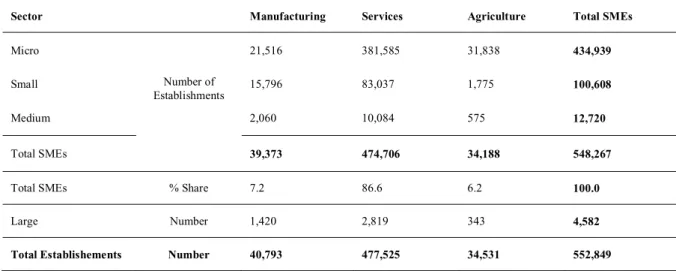
Refer from SME Annual Report 2011, as mentioned about the number of establishments by sector. Totally the manufacturing sector in Malaysia are 39,373 SMEs under micro, small and medium manufacturing. Refer Table 2. Table 2 . The number of establishments by sector
Source : Census of Establishment and Enterprise, 2005 by Department of Statistic, Malaysia
Sector Manufacturing Services Agriculture Total SMEs
Micro Number of Establishments 21,516 381,585 31,838 434,939 Small 15,796 83,037 1,775 100,608 Medium 2,060 10,084 575 12,720 Total SMEs 39,373 474,706 34,188 548,267
Total SMEs % Share 7.2 86.6 6.2 100.0
Large Number 1,420 2,819 343 4,582
Bruce & Amy (2008) mentioned SMEs are still facing heaps of challenge and obstacles that deter them from further expanding their businesses. Factors involved included low access in borrowing and small capital investment, low access of needed infrastructure, low level of expert abilities and raw material, low expertise in management and technical knowledge.
Cynthia (2006) stated that entrepreneur and SMEs could be defined as someone that own, manage and take risk in order to succeed in entrepreneurship. Besides, the entrepreneurs have to involve in understanding entrepreneurship philosophy process systematically and constantly. While refer to Thomas (2006), ones’ ability in entrepreneurship is definitely depends on their efforts in discovering knowledge and skills in the field.
According from Harun et al. (2010), the critical financial information that is mostly needed by the SMEs to
increase their competitiveness or success can be categorized into four groups: (i) taxation, (ii) financial accounting, (iii) management accounting and (iv) strategic planning and these services differ between “fast growth stage” and “global enterprise companies”.
Nancy & John (2010) as mention about the management from SMEs must be recognizes the effect of the possibilities outcomes of a review by the tax authorities. It should be measured using the profitability-weight average amount of all the possible outcomes.
However, the SMEs need assistance in accounting services to help them more into their financial strength in order to provide a better understanding of their financial position. In addition, SMEs need assistance SMPs in helping them to use the financial tools such as breakeven point, budgeting, financial ratios, costing analysis as most
of them come from of non-financial background and lack accounting knowledge (Harun et al. 2010).
2.5 Challenges faced by SMEs
The challenges are faced by SMEs with various challenges globally and domestically. Based on SMIDP, 2001 – 2005 study report (SMIDEC, 2002), these challenges are competition from other producers, intensified global competition, limited capability to meet the challenges of market globalization and liberalization, low productivity and quality output, limited capacity for knowledge acquisition and technology management, limited access to capital and finance and the infancy of venture funds in initial or mezzanine financing, lack of skills for the new environment, general shortage of information and knowledge and high cost of infrastructure.
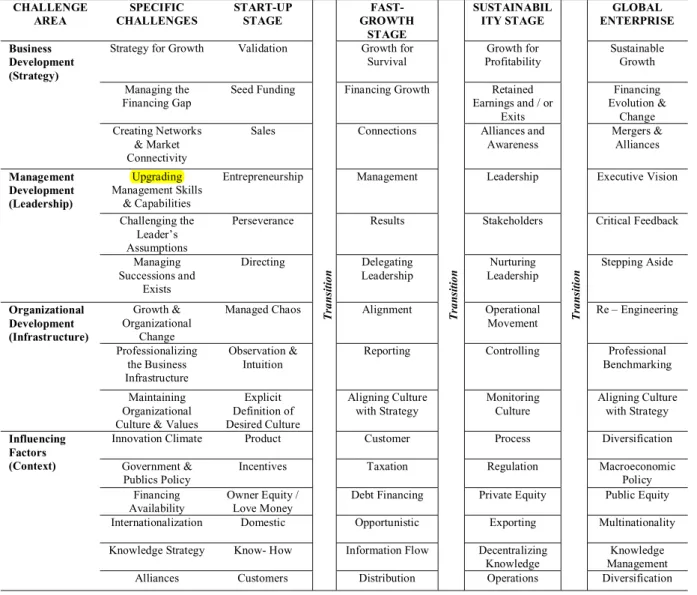
SMEs growth stage and four general challenges faced by SMEs are (i) business development – strategy, (ii) management development – leadership, (iii) organisational development – infrastructure and (iv) influencing factors – context (Refer Figure 2). Refer from Harun et al (2010) in Nik 2010, was noted that SMEs would need to go four stages of growth before reaching the stage when they could compete globally. The stages are:
1. Start-up stage where the business model applied is validated ;
2. Fast-growth stage where the business is growing for survival; revenue starts to grow as products or services
receive market acceptance;
3. Sustainable stage where profitability can be sustained and the entity reaches a maturity level with proven
business model and leadership ;
Fig. 2 . SME Growth Framework
(Source : Adopted from Nik (2006), Supporting The Development of SMEs : Bridging The Services Gap. IFAC Small and Medium Practices Forum)
2.6 Services Needed by SMEs
For reaching the stage and compete the globally, SMEs need accountant are a reliable provider of advisory services and support them about business advice, emergency advice, financial management support and statutory advice to improve the performance. Refer MIA SME Survey, 2008, the indicated that services needed by SMEs such as taxation, accounting, secretarial services and business consulting are the key services sought after by the SMEs with taxation service in the top list.
However, the challenges and services need by SMEs depend on the development stage and size of the company. The funding needs of entities at the different growth stages differ as well. Entities at the start-up stage hunger for seed financial as what drives most of the entrepreneurs at the stage is purely their vision of being successful. CHALLENGE AREA SPECIFIC CHALLENGES START-UP STAGE Tr an sitio n FAST-GROWTH STAGE Tr an sitio n SUSTAINABIL ITY STAGE Tr an sitio n GLOBAL ENTERPRISE Business Development (Strategy)
Strategy for Growth Validation Growth for Survival Growth for Profitability Sustainable Growth Managing the Financing Gap
Seed Funding Financing Growth Retained Earnings and / or Exits Financing Evolution & Change Creating Networks & Market Connectivity
Sales Connections Alliances and
Awareness Mergers & Alliances Management Development (Leadership) Upgrading Management Skills & Capabilities
Entrepreneurship Management Leadership Executive Vision
Challenging the Leader’s Assumptions
Perseverance Results Stakeholders Critical Feedback
Managing Successions and Exists Directing Delegating Leadership Nurturing Leadership Stepping Aside Organizational Development (Infrastructure) Growth & Organizational Change
Managed Chaos Alignment Operational Movement Re – Engineering Professionalizing the Business Infrastructure Observation & Intuition
Reporting Controlling Professional Benchmarking Maintaining
Organizational Culture & Values
Explicit Definition of Desired Culture Aligning Culture with Strategy Monitoring Culture Aligning Culture with Strategy Influencing Factors (Context)
Innovation Climate Product Customer Process Diversification Government &
Publics Policy
Incentives Taxation Regulation Macroeconomic
Policy Financing
Availability
Owner Equity / Love Money
Debt Financing Private Equity Public Equity Internationalization Domestic Opportunistic Exporting Multinationality Knowledge Strategy Know- How Information Flow Decentralizing
Knowledge
Knowledge Management
2.7 Relevance Theory of the research
The Gap Model of Service Quality, Resource Based View (RBT) and Theory of Agency as relevance theory are arranged on the framework as suggest in Figure 1.
2.7.1 Gap Model of Service Quality
Under this research the Gap Model of Service Quality will be choose because this model define the service quality in five major that face organisations seeking to meet customer’s expectation of the customer experience (Parasuraman, Valarie and Leonard, 1985) and service has been defined as a performance that ownership of anything (Kotler and Keller 2006).
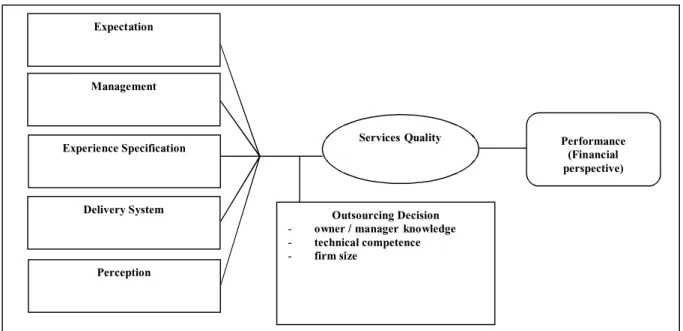
This model illustrate that service quality factors such as expectation, management perception, experience specification, delivery system and perception will be affect the accountant and SMEs
2.7.2 Resource-based Theory (RBT)
The RBT also the one of relevance theory for this research because the three aspect will be examine as a
moderating affect are positively related the accountant and SMEs under manufacturing sector. Marriott et al (2008),
in SMEs environment, RBT is useful in number of studies on outsourcing of accounting functions and provide constructive basis upon which to consider the factors that determine the tendency of a firm to outsource accounting task. The factors are:
i. Owner / Manager knowledge
Owner and manager knowledge partially mediated the impact on firm performance and also technical competence of an accountant on SMEs performance (Kamyabi and Devi, 2011).
ii. Technical competence
One of the objective of the RBT is to help owner / manager to realize why competences can be perceived as a firms’ most valuable asset and understand how those assets can be used to improve firm performance (Caldeira and Ward, 2003).
iii. Firm size
RBT suggest that smaller firms seek accounting services to enhance their competitiveness as the firm extends
its market (Marriott et al, 2008).
2.7.3 Theory of Agency
Rationale choose the theory of agency because the function and rule of the principal (manager) and agency (client) very important to achieve the highly performance in the company (SMEs). This theory will be helps to develop the construct of the item in questionnaires. Refer from Jensen (2002), the theory of agency, the information is a commodity that, like any commodity has a cost can be traded, can be forged, especially if the contract between the principal and the agent is a result-based contract. Over-stock of the company, characterized by the inability to achieve the performance evaluation to justify equity ratio determined by supply / demand financial market is a consequence of information asymmetry, asymmetry reduced by effective mechanism of corporate governance. Agency theory assumes that both parties making decision based on their own best interest. Manager prefer to get higher reward, on the other hand owner prefer higher return from their investment. Therefore, agency conflict happens between owner and managers, also raise agency cost (Bandi, 2012).
2.8 Theorized Relationship among variables in the Research
The Gap Model of Service Quality, Resource Based View (RBT) and Theory of Agency as relevance theory are arranged on the framework as suggest in Figure 3. This figure illustrate that service quality factors such as
expectation, management perception, experience specification, delivery system and perception will be direct affect the accountant and SMEs. The outsourcing decision (owner or manager knowledge, technical competence and firm size) as a moderating affect are positively related the accountant and SMEs under manufacturing sector.
Fig. 3. Theoretical framework
2.9 Summary
From the above literature review, it was found the SMEs face various challenges in sustaining their business and also service quality need by SMEs from accounting firm. This chapter has also discussed the definition of SMPs and SMEs, service quality and relevance theory at the research.
3.Research Methodology
3.0 Introduction
The research methodology of this study is using the mixed method approach as a research design to collect the data from SMPs and SMEs under manufacturing sector on the East Coast Region in Malaysia consists of Kelantan, Terengganu and Pahang
3.1 Research Design Mixed-Method Approach
Refer from Johnson & Christensen (2008), the data from quantitative research based on precise measurement using structured and validated data-collection instruments. This research will be proposed the mixed-method approach research because the relationship will be identify between the SMEs and SMPs using the gap analysis. And also to tests the specific hypotheses and theory with the data.
Mixed-method of data collection will be increase the confidence in the finding by providing validation of data and results, introducing the opportunity for creativity by offering fresh perspectives on the phenomena and including contextual aspects of the SMEs and SMPs perspective.
3.2 Procedure for Data Collection
Outsourcing Decision
- owner / managerknowledge
- technical competence - firm size ServicesQuality Perception Delivery System Experience Specification Management Expectation Performance (Financial perspective)
3.2.1 Population and Sampling
Quantitative Research SMEs
The population of the SMEs under manufacturing sector at east coast region in Malaysia are 4,969 companies. The samples of companies will be base on stratified sampling to be better results as a representative the population. The final result in the range of less than 250 companies will be selected to be collect data from a sample of SMEs. Refer from Table 3, the number of establishments SMEs under manufacturing industries at Kelantan, Terengganu and Pahang.
Table 3 . Number of establishments SMEs manufacturing industries at East Coast Region in Malaysia
Source: Department of Statistic Malaysia, 2010 SMPs / Accounting Firms
The population of this research are 59 accounting firms. The questionnaires will be conduct with the 100% accounting firms or SMPs around the east coast region in Malaysia as a sample of this research. Refer from Table 4, Malaysia Institute Accountant (MIA) list the accounting firm location at Kelantan, Terengganu and Pahang.
Table 4. Number of firms at East Coast Region in Malaysia
Source: Firms and locations from MIA (2011) Qualitative Research
SMEs
This study will be selected on 10 successful SMEs would be interviewed using cluster sampling. Interviews would be conducted with owner / chief executive officer in order to gain insights of the issues as stipulated in the research objectives. Interview is expected to be around 1 to 1.5 hours.
Number of establishments SMEs manufacturing industries
State Total
Kelantan 1,822
Terengganu 1,803
Pahang 1,344
Sub Total 4,969
Number of firms at 30 June 2011
State Audit Non-audit Total
Kelantan 11 5 16
Terengganu 10 3 13
Pahang 24 6 30
SMPs
Five focus group interviews will be used to select the SMPs among the east coast region in Malaysia (Refer Table 5). The characteristic of focus group will be chose to represent different business sectors and ethnic concentrations based on the advice from MIA.
Table 5. Number of firms at East Coast Region in Malaysia Source: Firms and locations from MIA (2011)
3.3 Research Instruments
The research question based on the combination and developed by previous researchers under the same issues and topic discussed about SMEs and SMPs. The research will be used the questionnaires and interview to answer the research question. Refer the Table 6, about the items questionnaires and interview question.
Table 6. Items questionnaires and interview question
3.4 Reliability Test
The construct instrument from questionnaire will be determines the validity and reliability test using Cronbach’s Alpha coefficient. While the Alpha value above 0.80 to a maximum value of 1.00 is considered good (Field 2005). A total of 30 participants will be selected from SMEs and 30 participants will be selected from SMPs. According to Wiersma (2000), the number of samples for a pilot study is sufficient by 5 to 20 samples. In this research, the reliability of each item measured separately based on the dimensions studied value is more than 0.70 is acceptable.
3.5 Procedure for Data Analysis
The procedure for data analysis using the Statistical Package for Social Science (SPSS), AMOS and NVivo Software will be used to tabulate the data gather form the research questionnaire. This program helps to facilitate data clearing and checking for logical inconsistencies. It is also will use to test all the hypotheses formed to prove it significance. Descriptive analysis will be used to summarize the profile and business background of the SMEs and SMPs. Then, moved on by testing all hypothesizes by using a couple of methods depending on the structure of the hypotheses develop. This research will be used a structural equation modeling technique (SEM) to predict the relation of the dependent variable (response variables) to specified independent variables. The SEM will be tested a
Number of firms at 30 June 2011
State Audit Non-audit Total No. of focus group
Kelantan 11 5 16 1
Terengganu 10 3 13 1
Pahang 24 6 30 3
Total 45 14 59 5
Instruments Numbers of section Developer
Questionnaires 3 Doran (2006), Harun et al (2010) and S. Susela & R. Helen (2010)
Interview 4 Harun et al (2010), S. Susela & R. Helen (2010) and
structural model linking our service quality construct and its indicators with our outsourcing decision.
3.6 The Scope and Limitation of the Research
First of all the limitation of this study was carried out in the manufacturing sectors consist of Kelantan, Terengganu and Pahang. Thus the result might only be generalizes to the above population. In other word, the findings might be different if the scope is increased to include more sectors in SMEs and SMPs.
3.7 Summary
This chapter explained specifically the nature of this research, research design and research instruments will be used. The procedure for data analysis was also discussed.
Acknowledgements
The authors would like to thank the Universiti Malaysia Kelantan for support this research especially my supervisor Prof. Dr. Mohamed Dahlan Ibrahim, also my family and friends.
References
A Simple Guide in Completing Form C For Year of Assessment 2011. (2011). Accountants Today. Malaysia Institute of Accountants. Bandi (2012). Finance perspective versus accounting perspective : the case of earning persistence in Indonesia. International Journal of
Economics and Finance, Vol. 4 No. 9, 191-199.
Berry, A.J., Sweeting, R., & Goto, J. (2006). The effect of business adviser on the performance of SMEs. Journal of Small Business and Enterprise Development, 13(1), 33-47.
Bunting, R. (2008). IFAC’s Role in Strengthening SMPs. 2008 IFAC Small and Medium Practices Forum.
Bruce, B.B & Amy, R.G (2008). Formalizing the front-end of the entrepreneurial process using the stage-gate model as a guide ; an opportunity to improve entrepreneurship education and practice. Journal of Small Business and Enterprise Development, Vol. 15 No.2, 289-303. Caldeira, M.M., & Ward, J.M., (2003). Using resource-based theory to interpret the successful adoption and use of information systems and
technology in manufacturing small and medium-sized enterprises. European Journal of Information System, Vol 12(2). 127-141. Che Din, D. (2008), Quality control of service provider on non audit service, and the level of non audit fees: The perception of SMEs in
Malaysia. MBA thesis, School of Management, University Sains Malaysia, Penang.
Cynthia, L.G. (2006). Entrepeneurship – ideas in action (3rd Ed.). Thomsom South Western. Department of Stattictics, Malaysia (2010). www.statistics.gov.my. 04.11.2012.
Doran, M. (2006). Bean counter or business adviser? An exploratory study of changing times for the accounting practitioner in ireland. The Irish Accounting Review. Vol. 13 No.1, 23-46
Dorasamy, M., Marimuthu, M., Jayabalan, J., Raman, M., & Kaliannan, M. (2010). Critical factors in outsourcing of accounting functions in Malaysia small medium-sized enterprises (SMEs). Kajian Malaysia, Vol. 28 No.2.
Dyer, L.M. & Ross, C.A. (2008). Seeking advice in dynamic and complex business environment: Impact on the success of small firms. Journal of Development Entrepreneurship, Vol.13(2), 133-149.
Evaraert, P., Sarens, G., & Rommel, J. (2006). Outsourcing of accounting tasks in SMEs : an extended TCE Model (Working Paper No. 2004/403). Gent : Univeersiteit Gento.
Evaraert, P., Sarens, G., & Rommel, J. (2007). Sourcing strategy of Belgian SMEs : empirical evidence for the accounting services. Production Planning & Control, 18(8), 716-725.
93-112.
Field, A. (2005). Discovering statistics using SPSS : Ed. Ke-2. London : SAGE Publication
Ganesan, Y. (2010). Service quality, satisfaction and level of non audit fees paid by SMEs. MBA thesis, Graduate School of Malaysia, University Sains Malaysia, Penang.
Gill, G.S. & Cosserat, G.W. (1996). Modern Auditing in Australis (4th Ed.). Australia : Jacaranda Wiley Ltd.
Gooderham, P.N., Tobiassen, A., Doving, E., & Nordhaug, O. (2004). Accountants as sources of business advice for small firms. International Small Business Journal, 22(1), 5-22.
Harun, H., Ishak, I., Sofri, Y., Siti Nabiha, A.K., & Yuvaraj, G. (2010).Cases of successful malaysia small and medium enterprises (SMEs) : does business advisory services help? Malaysia Accountancy Research and Education (MAREF).
Ismail, N.A., & Zin, R.M. (2009). Usage of accounting information among Malaysian bumiputra small and medium non-manufacturing firms. Journal of Enterprise Resouces Planning Studies. Vol. 2009.
Ismail, N.A., (2002). A framework for the study of accounting information systems in small businesses. Akauntan Nasional 15(5):32-33. Jensen, M., (2002). The agency cost of equity and the current overevaluated state of corporate finance. Europeon Financial Management
Association, London.
John, A. B. (2011). A comparison of the product costing practices of large and small-to medium-sized enterprise: a survey of british manufacturing firms. International Journal of Management. Vol.28 No.4, 184-194.
Johnson, B. & Christensen, L. (2008). Educational research : Quantitative, qualitative and mixed approaches. Thousand Oaks, CA: Sage Publications.
Kamyabi, Y. & Devi, S. (2011). Accounting outsourcing and firm performance in Iranian SMEs. International Journal of Economics and Finance. Vol. 3. No.4. 181-192.
Kamyabi, Y. & Devi, S. (2011). Use of profesional accountants’ advisory services and its impact on SME performance in an emerging economy : a resource-based view. Journal of Management and Suistainability. Vol.13. No.1. 43-55.
Kotler, P. & Keller, K.L.(2006). Marketing Management (12th Ed.) Pearson Prentice Hall, USA.
Lewis, K., Massey, C., Ashby, M.,Coetzer, A., & Harris, C.(2005). Who? When? Why? – New Zealand SME owner-manager assess their business assistance interactions, Paper presented at the 8th Annual SEAANZ Conference 2005 UNE, Armidale, 25-28 September.
Marriott, N & P. Marriott (2000). Professional accountants and the development of a management accounting service for the small firm: Barriers and possibilities. Management Accounting Research. Vol.11.No.4. 475-492.
Marriott, N., Marriott, P., Collis, J., & Son, D.D. (2008). The accountant and the provision of financial advice to UK smaller companies paper presented at the British Accounting Association Annual Conference 1st – 3rd April 2008.
MIA (Malaysian Institute of Accountants) (2011), Annual Report of the Council Kuala Lumpur: Malaysian Institute of Accountants. MIA SME Survey, (2008), A Report on Current Usage Patterns of Business and Professional Services among SMEs in the Manufacturing and
Distributive Trade Sectors. Malaysia Institute of Accountants.
Nancy, L.C., & John, B. (2010). New standards available for private companies : at last a little GAAP? Academy of Entrepreneurship Journal, Vol. 16 No.1, 55-69.
Nik, M.H (2006). Supporting the Development of SMEs : Bridging the Services Gap. IFAC Small and Medium Practices Forum in Hong Kong on July 3, 2006.
Panduan Kewangan Untuk PKS. (1st ed.) (2011). SME Corporation and CPA Australia.
Parasuraman, A., Valarie, A.Z., & Leopard, L.B. (1985). A conceptual model of service quality and its implications for future research. Journal of Marketing, Vol.49, 41-50.
Scott, J.M, & Irwin, D. (2009). Discourage advise? The influence of gender, ethnicity, and education in the use of advice and finance by UK SMEs. Environment and Planning C : Government and Policy, Vol. 27, 230-245.
SME Annual Report (2011). National SME Development Council. Kuala Lumpur.
SMIDEC (2008). Promoting Innovation – led and Technology – Driven SMEs. Paper Presented in Asia Pacific Conference of Technology and Technology Entrepreneurship.
SMIDEC (2012). SME Masterplan 2012 – 2020. National SME Development Council. Kuala Lumpur
S.Susela, D & R. Helen, S. (2010). Accoutants as provider of support and advice to SMEs in Malaysia. Certified Accountants Education Trust, Association of Chartered Certified Accountants. London.
Thomas, W.Y.M. (2006). Exploring the behavioral patterns of entreprenerial learning : a competency approach. Journal Education and Training, Vol. 40 No. 5, 309-321.
United Nations Conference on Trade and Development, (2000). Promoting transparency and financial disclosure: accounting by small and medium-sized enterprises. http://www.unctad.org/en/docs/c2isarl3.en.pdf(accessed 30 December 2012).