Pavel Avgustinov
1, Oege de Moor
2, Michael Peyton Jones
3, and
Max Schäfer
4 1 Semmle Ltd [email protected] 2 Semmle Ltd [email protected] 3 Semmle Ltd [email protected] 4 Semmle Ltd [email protected] AbstractThis paper describes QL, a language for querying complex, potentially recursive data struc-tures. QL compiles to Datalog and runs on a standard relational database, yet it provides familiar-looking object-oriented features such as classes and methods, reinterpreted in logical terms: classes are logical properties describing sets of values, subclassing is implication, and virtual calls are dispatched dynamically by considering the most specific classes containing the receiver. Furthermore, types in QL are prescriptive and actively influence program evaluation rather than just describing it. In combination, these features enable the development of concise queries based on reusable libraries, which are written in a purely declarative style, yet can be efficiently executed even on very large data sets. In particular, we have used QL to implement static analyses for various programming languages, which scale to millions of lines of code. 1998 ACM Subject Classification D.1.5 Object-oriented Programming, D.1.6 Logic Program-ming, F.3.3 Studies of Program Constructs
Keywords and phrases Object orientation, Datalog, query languages, prescriptive typing Digital Object Identifier 10.4230/LIPIcs.ECOOP.2016.2
1
Introduction
QL is a declarative, object-oriented logic programming language for querying complex, potentially recursive data structures encoded in a relational data model. It is a general-purpose query language, but its strong support for recursion and aggregates makes it particularly well suited for implementing static analyses, code queries and software metrics. Although this paper is not about static analysis per se, it is in this area that QL, being the technical basis of Semmle’s engineering analytics platform, has seen most use so far, so we will use it as our main source of motivating examples.
A static analysis implemented in QL is simply a query run on a special database: the database contains a representation of the program to analyse (encoding, say, its abstract syntax tree or control flow graph), from which the query computes a set of result tuples. A bug finding analysis, for instance, could return pairs of source locations and error messages. Since the database describes the program as it was at one particular point in time, we refer to it as asnapshot database. A snapshot database is created by a language-specific extractor. We have built extractors for various different languages based on existing compiler frontends. As our first example of a QL query, let us consider an analysis for finding useless expressions in JavaScript programs, i.e., pure (that is, side effect-free) expressions appearing in a void context where their value is immediately discarded. Typically, this indicates a typo, for instance mistyping an assignment “x = 42;” as an equality check “x == 42;”.
Listing 1QL query for finding useless expressions in JavaScript. import javascript
predicate inVoidContext(Expr e) {
exists (ExprStmt s | e = s.getExpr()) or
exists (SeqExpr seq, int i | e = seq.getOperand(i) and
(i < count(Expr op | op = seq.getOperand(_))-1 or inVoidContext(seq))) }
from Expr e
where e.isPure() and inVoidContext(e) and not (e instanceof VoidExpr) select e, "This expression has no effect."
To identify such expressions we need to implement a purity analysis and a check to determine whether an expression appears in a void context. Fortunately, the former is already implemented in our standard QL library for JavaScript, so we can concentrate on the latter. A simple query for finding useless expressions is shown in Listing 1. At a very high level, it breaks down into three sections:
Animportstatement pulls in the existing QL libraryjavascript, which, as its name suggests, provides general support for working with JavaScript snapshot databases. A predicateinVoidContextis defined to identify expressions in void context. The mainfrom-where-selectclause defines the analysis itself:
thefrompart declares a variableeranging over all expressions in the analysed program; thewherepart imposes three conditions one: it must be pure, appear in a void context, and not be a voidexpression, which explicitly discards the value of its operand; theselectpart specifies the results to return for values of thefromvariables that pass thewhereconditions; in this case,eitself is returned with an explanatory message. Taking a closer look at the definition ofinVoidContext, it is declared as a unary predicate with a single parametereof typeExpr. Expr and its subtypes model JavaScript expression ASTs: for instance,BinaryExpr is a subclass of Expr representing all binary expressions, which in turn has a subclassAddExpr representing additions; another subclass of Expr is SeqExpr, representing sequence (or “comma”) expressions with two or more operands.
The body of the predicate is a first-order formula with two disjuncts. Its first disjunct says thateis in void context if it is the toplevel expression in an expression statement (as in our example above). The second disjunct handles the case whereeis an operand of a sequence expression: eis in void context if it is not the last operand, or if the entire sequence is in void context, as determined by a recursive call toinVoidContext.
Judging from this example, QL looks like a domain-specific language for querying Java-Script ASTs, but this not the case: the classes used in this example and the navigation operations available on them are defined entirely in QL, not built into the language. In fact, there is nothing about QL that is specific to dealing with ASTs, or even for writing static analyses, but its object-oriented features allow the development of reusable domain-specific libraries (such as thejavascript library and its cousins for other languages), providing a rich and convenient API for query writers.
Perhaps more surprisingly, there are not even any objects in the traditional sense of structured records with fields and methods. QL programs only work with atomic values; structured data is encoded as relational tables. For example, it is natural at first to think of the formulae = seq.getOperand(i)as an operation on an objectseq, perhaps involving
reading thei-th element of one of its fields holding an array of references to other objects, and then storing the result in variablee. In fact, though, all three variablese,seqandirange over atomic values: the latter is an integer, and the former two areentity values, that is, opaque identifiers representing entities modelled in the database (in this case, expressions). In JavaScript snapshot databases, the expression AST structure of the program is encoded in a relationexprscontaining 4-tuples (c, k, p, i), for entity valuescandpand integerskand i, stating that expressionc is the thei-th child of pin the AST, and has kindk. ClassExpr and its subclasses define an object-oriented view of this relation; for example,getOperand is defined such thate = seq.getOperand(i)is compiled to∃k.exprs(e, k,seq,i): no field reads, no assignments, just logic.
In particular, eis not an output computed from inputs seqandi: all three variables are on an equal footing, and there is not even any requirement thateis functionally determined byseqandi(though in this particular case it is). This becomes obvious in our use of the countaggregate to determine the number of operands toseq: op = seq.getOperand(_) holds for any value of op that is an operand of seq (where “_” is the special don’t-care variable familiar from other logic languages), soseq.getOperand(_) behaves like a multi-valued expression. We use the aggregate to count how many of those values there are to obtain the number of operands of seq.
In spite of their unusual semantic underpinnings, QL classes offer very similar features to their more traditional counterparts. In particular, classes can have member predicates, such as theisPurepredicate onExpr, which is defined in the standard QL library for JavaScript and overridden with different implementations for various subclasses of Expr. Calls such as e.isPure()are dispatched virtually, looking up the most specific applicable definitions of isPurebased on the (runtime) value of e.
Like in Java and many other languages, all variables in QL have statically declared types, offering the usual benefits of enabling smart IDEs.1 However, type declarations in QL are not just assertions to be checked by the compiler, but do, in fact, affect program semantics at runtime: the values that a variable can take during execution are restricted to those that conform to the declared type. In particular, the declared types of predicate parameters and quantified variables restrict the set of values they may range over.
As mentioned above, our example query makes use of (a small part of) the standard QL libraries for JavaScript. Just like the query, the libraries are implemented in an entirely declarative style, specifyingwhat should be computed rather thanhow. In fact, QL exposes no details at all of the underlying database system on which the queries are run, and it is up to the optimiser to translate the high-level QL code into an efficiently executable query plan.
In this paper, we present the core features of QL:
We explain the semantics of classes, member predicates and virtual dispatch, first informally (Section 2) and then more formally via a translation from a subset of the language, Core QL, to plain Datalog (Section 3).
We discuss practical usage of QL in Section 4, and report on a case study in using QL to implement static checks for Java in Section 5.
We put QL into context in Section 6, exploring in detail how far it matches the principles of object orientation laid down in the literature, and briefly survey related work.
1 In fact, this is the main motivation for choosing the
from-where-selectquery syntax instead of SQL’s
2
Overview of QL
The fundamental semantic model of QL is that of Datalog: programs define a set ofintensional predicates, one of which is a distinguishedquery predicate. They are evaluated on top of an
extensional database (EDB), which defines a set ofextensional predicates. While intensional predicates are defined by formulas of first-order logic (possibly involving recursion between predicates), extensional predicates are defined as explicit sets of tuples stored in the database. Unlike Prolog, Datalog does not allow the use of complex terms, so intensional predicates can only refer to values already contained in the database and cannot build up new data structures, such as lists. Like many Datalog dialects, QL somewhat relaxes this restriction by providing support for arithmetic and string operations.
The semantics of a program is the least fixpoint of its intensional predicates, that is, intensional predicates are assigned the smallest sets of tuples that satisfy their recursive definitions. Since such a fixpoint need not exist in general, QL imposes the restriction that (mutual) recursion is only allowed under an even number of negations, which is a variant of thestratified negation restriction used in many Datalog systems [32]. Once a fixpoint solution has been found, the set of tuples assigned to the query predicate is returned as the overall result of the program.
The grounding of QL’s semantics in Datalog is not just an expository device: as explained in Section 4, our implementation compiles QL to plain Datalog, and we shall provide a precise semantics for a core calculus of QL in the next section by formalising the essential parts of that translation.
2.1
Classes
A type in QL represents a set of values, which we will call theextentof the type. Classes are types whose extent is defined by a unary intensional predicate called thecharacteristic predicate(orcharacter for short) of the class.
There are also two kinds ofbase types, that is, types which are not themselves defined in QL:primitive types such asintorstringare built into the language;entity types are defined by unary extensional predicates, whose names by convention start with an “@” character. Primitive types always have the same extent, regardless of the content of the EDB, while the extent of entity types and classes may depend on the EDB. For example, snapshot databases representing JavaScript programs defines entity types@exprand@seqexprwhose extent is, respectively, the set of all expressions and the set of sequence expressions in the represented program.
Subtyping can be thought of as set inclusion of extents: ifAis a subtype ofB, then the extent ofA is a (not necessarily proper) subset of the extent ofB.2 For entity types the subtyping relation is given by the database schema: for instance, the schema for JavaScript snapshot databases declares@seqexprto be a subtype of @expr, and it is up to the database system to ensure that this constraint is met at runtime. For classes, direct supertypes are specified as part of their declaration using a Java-likeextendsclause.
While entity types can only be subtypes of other entity types, classes can also extend base types. For instance, we can define a classDigit with the extent{0,1,2, . . . ,9}:
class Digit extends int { Digit() { (int)this in [0..9] } }
2 The reverse direction cannot, in general, hold: since characters are arbitrary predicates, inclusion of
Theextendsclause makesDigita subtype of the built-ininttype, and the character (which syntactically looks like a constructor in Java) further restricts the extent of Digit. Thex in [a..b]notation is a convenience for defining ranges (note that an explicit cast is necessary when using variables with a class type in numeric operations).
Characteristic predicates can contain arbitrary QL code. For instance, we can define the class of even digits and the class of prime digits by subclassing Digitand performing arithmetic checks onthis.
class Even extends Digit { Even() { (int)this % 2 = 0 } } class PrimeDigit extends Digit {
PrimeDigit() { count(Digit divisor | (int)this % (int)divisor = 0) = 2 } }
Observe that the extents of the two classes overlap, yet neither is a subset of the other. This is a natural consequence of defining types by arbitrary characteristic predicates, but it means that not every value has a unique tightest type.
Like Java, QL has aninstanceof operator, which in QL is really just syntactic sugar for calling the character of a class. For instance, the class of odd digits can be defined like this:
class Odd extends Digit { Odd() { not this instanceof Even } }
Being intensional predicates, characters can be recursive. For instance, we could define: class Even extends Digit { Even() { this = 0 or (int)this-1 instanceof Odd } }
class Odd extends Digit { Odd() { (int)this-1 instanceof Even } }
However, recursion has to be stratified: simply defining EvenandOddas mutual comple-ments is not acceptable, since this definition has no least fixpoint.
A class may extend multiple supertypes, which simply means that it is a subtype of the their intersection. The (potentially trivial) intersection of all supertypes of a class is called thedomain of the class. For instance, the class of even prime digits ({2}) is defined as
class EvenPrime extends Even, PrimeDigit {}
In fact, sinceEvenPrimeimposes no additional constraints onthis in its character, its extent is exactly equal to its domain. In general, the extent of a class consists of all those values in its domain that satisfy the body of the character; hence, the implicitthisvariable in the character ranges over the domain of the class.
It should be emphasised that the constructor-like syntax for characters is purely superficial: QL has nonewexpression. Like plain Datalog, QL programs can never construct new values or objects, they can only work with primitive values and the values present in the EDB.
2.2
Prescriptive typing
Every variable in QL has a declared type. In most statically typed imperative and functional languages, such declarations are purely compile-time artefacts that describe the set of values the variable is allowed to take on at runtime; they are checked for consistency by the compiler but play no role at runtime. In contrast to thisdescriptivetyping discipline, QL follows aprescriptivemodel, where the syntactic type declaration corresponds to a semantic containment check at runtime.
For instance, consider the predicate isSmallthat holds for allDigits smaller than five: predicate isSmall(Digit d) { (int)d < 5 }
We can use it in a query like the following (which will return the numbers 0, . . . ,4): from int i where isSmall(i) select i
Note that iis declared to be of type int, but is passed as an argument to isSmall, whose parameter is declared to be aDigit. Under a descriptive typing discipline, this would be a compile-time type error, but not so in QL: declaringdto be aDigitsimply means that in order for a value to satisfy the predicateisSmall, it has toboth be aDigitand satisfy the logical conditions imposed by the body of the predicate (namely, being smaller than five).
Another way of looking at it is that type declarations entail an implicitinstanceoftest (which is, in fact, made explicit when translating to plain Datalog), and our definition of
isSmallis equivalent to
predicate isSmall(int d) { d instanceof Digit and d < 5 }
The callisSmall(i)thus has a perfectly well-defined semantics, regardless of the declared type of i, and regardless of what set of valuesi ranges over at runtime. If none of these values happen to be in Digit, thenisSmall(i) will evaluate to an empty set of tuples, as in the following query:
from int i where isSmall(i) and i < 0 select i
In practice, a query or formula that never returns any values usually indicates a mistake. The problem of finding such empty formulas can be reduced to the problem of inferring types for the generated Datalog [33]; (Datalog) formulas for which we infer the empty type are mapped back to the (QL) formulas they arise from, and reported. In general, emptiness of Datalog formulas is undecidable (even without arithmetic or string operations), so we can never find all empty formulas, but in practice this approach has proved to be quite effective.
Besides type declarations,instanceoftests and casts also restrict the possible values of variables and expressions: x instanceof Arestrictsxto only take on values fromA, and similarly(A)xis an expression picking out those values of xthat are inA.
2.3
Member predicates
The predicateisSmallreally describes a property of Digits, so it thus makes sense to add it to classDigitas amember predicate:
class Digit extends int { Digit() { (int)this in [0..9] }
predicate isSmall() { (int)this < 5 } }
Like characteristic predicates, member predicates have an implicit parameterthis, and they are invoked using a method call-like syntax:
from Digit d where d.isSmall() select d
Of course, member predicates can have other parameters besidesthis. For instance, we could add a predicatedividesto check whether one digit is a divisor of another:
class Digit extends int { ...
predicate divides(Digit that) { (int)that % (int)this = 0 } }
There is one important difference between characters and member predicates: in the former,thisranges over the domain of the class (that is, the intersection of the extents of its supertypes), while in the latterthisranges over the extent of the class itself. This is because the character is what defines the extent of the class in the first place, so by restrictingthis to range over the extent of the class in the character, we would introduce a direct recursive call from the character to itself, which under least fixpoint semantics would mean that the character (and hence the extent of the class) is always empty.
2.4
Multi-valued expressions
Taking the analogy between member predicates and methods further, QL allows treating predicates as multi-valued “functions” with a dedicatedresultparameter. For instance, the member predicatedividescould instead be written as a multi-valued function returning any of the divisors of a digit:
Digit getADivisor() { (int)this % (int)result = 0 }
Note that member predicates using the function syntax have an implicitly declared result variable whose type is the declared result type. The results of the predicate are precisely those values that theresultvariable is bound to. Syntactically, calls to predicates in function syntax are treated like function calls; in particular, they can be chained as in d.getADivisor().getADivisor(), which evaluates to all divisors of divisors ofd.
Semantically, however, such predicates are still relations: there is no requirement that resulthas precisely one value for each value of this, or thatresultis “computed from” thisin some operational sense. In fact, it is quite possible to usegetADivisor()in reverse to compute all values of thisyielding a givenresultvalue, as shown in the following query:
from Digit d where d.getADivisor() = 2 select d // selects 0, 2, 4, 6, 8
When translating to Datalog, predicates using the function syntax are desugared into normal predicates by making the result parameter explicit and introducing temporary variables as necessary. For instance,d.getADivisor()=2is translated into code of this form:
exists (Digit tmp | d.getADivisor(tmp) and tmp = 2)
Thus, multi-valued expressions are a purely syntactic, if practically very useful, feature.
2.5
Overriding and virtual dispatch
Given that we have classes that contain member predicates and that may extend each other, it is natural to ask whether there is a notion of overriding and virtual dispatch, and indeed there is: intuitively, at runtime a callx.p(...) is dispatched to the definition of pbelonging to the tightest class containingx, i.e., the most specific applicable definition of p.
There are two sources of ambiguity: first,xmay, in general, have multiple values; this is solved by dispatching the call separately for each individual value. Second, classes may overlap, so even for a single value of xthere can be multiple most specific definitions of p; this is solved by dispatching to each definition separately and unioning the results.
More formally, let us represent member predicates byrelation specifiersof the formC.p/n, whereC is the name of the class in which the predicate is declared,pis the name of the predicate itself, andnis the predicate’s arity, not including the result parameter.3 We say that a predicateC.p/noverridesa predicateC0.p/nifCis a transitive subtype ofC0; in this case, we also say thatC.p/nismore specific thanC0.p/n.
A member predicate is a root definition(orrootdef for short) if it does not override any other predicate. The set of rootdefs of a predicate is the set of all rootdefs that it overrides, or the predicate itself if it is already a rootdef. Note that due to multiple inheritance a predicate can have more than one rootdef, but every predicate has at least one.
3 QL allows overloading, so there may in fact be multiple member predicates with the same arity as long
as they have different parameter types. Like in Java, overloading is resolved entirely statically based on declared types, and hence plays no role in virtual dispatch, and we shall ignore it for simplicity.
Thestatic target of a member predicate call x.p(...), where the declared type of xis a classC, is the most specific predicateD.p/nsuch thatC is a reflexive, transitive subtype of Dandnis the number of arguments in the call. In a valid QL program, every predicate call must have a unique static target. Thedispatch candidates of x.p(...) are all the rootdefs of the static target, as well as any predicates that override at least one of the rootdefs.
At runtime, for every value vof x, theapplicable targets of the call are those dispatch candidates D.p/n for whichv is in the extent of D, and the actual targets are the most specific applicable targets. The call is dispatched to all actual targets for each value ofx.
In summary, dispatch for a callx.p(...) occurs in two stages, one static and one dynamic. At compile-time we compute the set of dispatch candidates, which contains all rootdefs of p above the declared type of x(that is, member predicates with the same signature that do not themselves override another definition) and all methods that override them. At runtime, each of these candidates applies only if the value of xis contained in the corresponding class, and there is no more specific class that also containsx.
For example, assume we add a member predicatekindto classDigit like this: class Digit extends int { ... string kind() { result = "digit" } }
We overridekind in the subclasses of Digitto result in "even"forEven,"odd"forOdd and"even prime"forEvenPrime. Now consider this query:
from Even e select e, e.kind()
The static target of the call e.kind()is Even.kind/0, whose (unique) root definition isDigit.kind/0. The dispatch candidates areDigit.kind/0,Even.kind/0,Odd.kind/0 and EvenPrime.kind/0. Sincee is declared to be anEven, it ranges over the set {0,2,4,6,8}. For the runtime values 0, 4, 6 and 8, the applicable targets of e.kind()areDigit.kind/0 and Even.kind/0, and the (unique) actual target is Even.kind/0. For the value 2, the applicable targets areDigit.kind/0, Even.kind/0 andEvenPrime.kind/0, and the actual target isEvenPrime.kind/0. Hence, the query evaluates to {(0,"even"),(2,"even prime"), (4,"even"),(6,"even"),(8,"even")}.
Now consider what happens if we add a new class
class Two extends Digit { Two() { this = 2 } string kind() { result = "two" } }
Two.kind/0 hasDigit.kind/0 as its root definition, so it is now also a dispatch candidate fore.kind(), and it is an applicable target fore= 2. We now havetwoapplicable targets in this case, neither of which is more specific than the other. Hence they willboth be called, so the query additionally returns the tuple(2, "two").
If, on the other hand, we define Twoto extendintinstead of Digit, its extent does not change, butDigit.kind/0 is no longer a root definition of Two.kind/0, which hence is no longer a dispatch candidate fore.kind().
Discussion
Support for multiple actual targets is perhaps the most unusual feature of virtual dispatch in QL and can be confusing to novice QL programmers. Its main motivations are:
Naturality Virtual dispatch selects the most specific implementation; with overlapping classes there may be more than one, so in a logic language it is natural to take their disjunction. Simplicity Outlawing multiple actual targets is difficult, since it is undecidable whether two
characteristic predicates to be decidable would rule out many practically interesting cases, while checking ambiguity at runtime and aborting with an error seems undesirable. Usefulness Some common idioms use this feature. For example, a flow analysis could be
implemented as a member predicate on data flow nodes; different overriding definitions handle different kinds of flow, and hence naturally overlap. For instance, one definition could model intra-procedural def-use chains, while another models inter-procedural argument passing; both definitions overlap for parameters that are reassigned.
In particular, the last example above rules out a simpler approach where each predicate is considered its own rootdef, which would make dispatch depend very strongly on static types. As another extreme, one could consider all predicates of the right name and arity as dispatch candidates, ignoring static types altogether. This seems undesirable in practice, since it can cause dispatch to completely unrelated predicates that just happen to have the same name. Instead, QL views a rootdef and all its overriding methods as alternative implementations of the same operation. For a given call, all operations implemented by the static target are determined at compile time, and at runtime the most specific implementations are selected.
There is no intrinsic connection between multiple call targets and multiple inheritance: the former arises without the latter, for example if a class defines a predicate that is overridden by two overlapping subclasses. Ambiguous inheritance is, in fact, illegal in QL (as we shall discuss below), and hence does not give rise to multiple call targets.
2.6
Abstract classes
QL classes as we have described them so far lend themselves quite well to top-down modelling: starting from a general superclass representing a large set of values, we carve out individual subclasses representing more restricted sets of values. In particular, the extent of a class is always defined by filtering its domain through the body of its character.
A classic example where this approach is useful is when modelling ASTs: the node types of an AST form a natural inheritance hierarchy, where, for example, there is a classExpr representing all expression nodes, with many different subclasses for different categories of expressions; there might, for instance, be a classArithmeticExprrepresenting arithmetic expressions, which in turn could have classesAddExprandSubExpr.
In other cases, however, we might prefer to instead think of a class as being the union of its subclasses. Here, the superclass exists purely as an interface that provides certain member predicates, with subclasses filling in concrete implementations.
QL supports a notion of abstract classes that allow us to do exactly this: like a concrete class, an abstract class has one or more superclasses and a characteristic predicate. However, the extent of an abstract class is not the set of values that satisfies its character, but rather the union of the extents of all its subclasses. In particular, an abstract class without subclasses has an empty extent. We will present a practical example of an abstract class in Section 4.
2.7
Miscellanea
QL has various other language features that are important in practice but are either not semantically fundamental, or have direct counterparts in other Datalog dialects.
As we mentioned at the beginning of this section, QL predicates may be recursive, and our program analysis queries make heavy use of this feature. A particularly common kind of recursion is transitive closure, for which QL offers a syntactic shorthand: for a binary predicatep,p+denotes its transitive closure, andp*its reflexive transitive closure. Obviously, this is purely syntactic sugar that is easily translated into plain recursion.
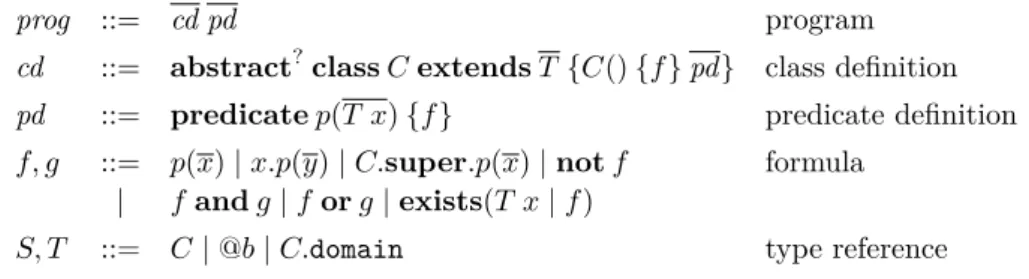
prog ::= cd pd program
cd ::= abstract?classCextendsT{C(){f}pd} class definition
pd ::= predicatep(T x){f} predicate definition
f, g ::= p(x)|x.p(y)|C.super.p(x)|notf formula
| fandg|forg|exists(T x|f)
S, T ::= C|@b|C.domain type reference
Figure 1Syntax of Core QL;·denotes (possibly empty) sequences,·?
optional elements.
In addition to virtual calls, QL also provides statically dispatchedsupercalls of the form C.super.p(...). Their static target is looked up inC(which must be a superclass of the enclosing class), and serves as the single actual target.
The import statement makes definitions from one module available in another. For instance, the QL standard library for JavaScript is split into 40 modules, which are all imported into a single modulejavascript.qll. Since imports are transitive, queries can simply import that module to gain access to the entire library (cf. Listing 1). As in Java, implementation hiding is facilitated by access modifiers: member predicates may be marked private, meaning that they cannot be called from outside the enclosing class.
QL supports aggregates to perform arithmetic operations such as sum or average on (multi-)sets of values. While very useful in practice, aggregates are really a feature of the Datalog dialect into which QL is compiled, and they do not interact with the language’s object-oriented features, hence we will not further discuss them.
As a syntactic convenience, casts may be written in a postfix form asx.(A), which is semantically equivalent to(A)x, but saves parentheses in chained calls.
Finally, member predicates of abstract classes may themselves be abstract, meaning that they do not have a body, and the QL compiler checks that each subclass provides an overriding definition of the predicate. Observe that our definition of virtual dispatch guarantees that an abstract member predicate is never the actual target of a call: since the extent of the abstract class is the union of the extents of its subclasses and since each of those subclasses overrides the abstract predicate, there must always be at least one more specific applicable target. Thus, abstract predicates are not semantically fundamental, and in particular have no deep semantic connection with abstract classes.
3
Semantics of Core QL
To formally describe the semantics of QL, we concentrate on a subset dubbedCore QLthat captures the object-oriented features of QL, while omitting other features that are either purely syntactic or are semantically orthogonal. The semantics of Core QL will be described by a translation to plain Datalog.
3.1
Core QL
Figure 1 presents the syntax of Core QL. Like full QL, Core QL programs consist of toplevel predicates and (concrete and abstract) classes with a characteristic predicate and member predicates. We do not model QL’sfrom-where-selectquery syntax, but simply consider queries as special toplevel predicates.
Predicates can declare parameters, and their bodies are first-order formulas with predicate calls as atomic formulas. As in full QL, there are calls to toplevel predicates and to member predicates, and the latter may be either virtual calls orsupercalls. Unlike full QL,super calls always have to be explicitly annotated with the class they refer to.
Type references appearing in extends clauses, parameter declarations or existential quantifiers are either class namesC or base type names @b. We assume the latter to be defined by an underlying database schema. Core QL also has a syntax fordomain typesof the formC.domainfor a class nameC; these cannot appear at the source level but play a crucial role in the semantics of classes.
Among the QL features omitted from Core QL are overloading, the function syntax for predicates, expressions, the forall quantifier, casts andinstanceof: these can all be desugared into Core QL features. Other QL features such as primitive types and aggregates have no counterpart in Core QL, but their semantics is largely orthogonal to the object-oriented features of the language, which are the focus of our presentation.
3.2
Datalog
The target language for our translation is an untyped variant of Datalog. A Datalog program consists of a series of intensional predicate definitions of the formp(x)←ϕ., where pis a predicate name, xis a possibly empty sequence of variable names, and ϕ is a formula of first-order logic with the usual logical connectives. The free variables ofϕmust be exactly x. The atoms ofϕare calls of the formr(y), where ris either the name of an intensional predicate defined in the same program, or the name of an extensional predicate.
We say that an intensional predicate pcalls a predicateq, writtenp→q, if the body ofp contains a call toq. As usual,→∗ denotes the reflexive transitive closure of this relation. p→− qmeans that one of the calls toqinpoccurs under an odd number of negations.
We require all Datalog programs to be stratified, that is, recursive call chains of the form p→∗ q →− r →∗ pare not allowed. Any stratified Datalog program has a least fixpoint semantics, that is, given an interpretation of the extensional predicates, each intensional predicate has a unique minimal interpretation that satisfies the predicate’s definition.
3.3
Valid Core QL
In order to be meaningfully translatable to Datalog, a Core QL program has to fulfil a set of syntactic requirements and pass some static semantic checks. There is one additional check that is easiest to perform on the generated Datalog and will be discussed later.
The syntactic requirements are entirely standard and mostly naming related:
IDefinition 1(Syntactic validity). In order for a Core QL program to besyntactically valid, the following conditions have to be satisfied:
No two classes and no two toplevel predicates with the same arity may have the same name; no two member predicates of the same class with the same arity, and no two parameters of the same predicate may have the same name.
Every extendsclause must list at least one type.
Every characteristic predicate must have the same name as its enclosing class. No predicate parameter may have the name this.
For every variable name appearing in a formula, there must either be an enclosingexists declaring a variable of that name, or the enclosing predicate must have a parameter of that name, or the variable name isthisand it appears in a member predicate or character. In particular, every variable name can be associated with a declared type.
Similarly, for every class name appearing in a type reference there must be a class of the same name, and for every predicate name appearing in a call to a toplevel predicate, there must be a toplevel predicate of that name with the appropriate arity.
supercalls may only appear in member predicates.
To formulate the static semantic checks, we first introduce some terminology.
IDefinition 2(Relation specifiers). A relation specifier C.p/nconsists of a class name C and a pairp/n, wherepis a predicate name andna natural number.
Unless otherwise specified, we require relation specifiers to bevalid, that is,C must be the name of a class defined in the program, andCmust declare a member predicatepwithn parameters. We abbreviateC.p/nasC.pwherenis not important or obvious from context. IDefinition 3(Subtyping). Thesubtyping relationS <:T is the smallest relation such that for every classC we haveC <:C.domain, and ifC extendsT, thenC.domain<:T.
As usual,S <:+T denotes the transitive closure of this relation.
IDefinition 4 (Overriding). C.p/n overridesD.p/n, written C.p/n≺D.p/n, ifC <:+ D. We writeC.p/nD.p/nto mean that eitherC=D orC.p/n≺D.p/n. IfD.p/noverrides no other member relation, it is arootdef. We writeρ(C.p/n) for the set of all rootdefsD.p/n such thatC.p/nD.p/n.
IDefinition 5(Member predicate lookup). We define a lookup function λ(S, p, n) that looks up a member predicate in a type given a name and its arity and returns a set of candidates:
λ(S, p, n) =
{C.p/n} ifS=CandC.p/nis valid S
S<:Tλ(T, p, n) otherwise
The static semantic checks guarantee that a program can be translated to Datalog: IDefinition 6(Translatability). A syntactically valid Core QL program istranslatableif the following conditions are met:
It is not the case thatT <:+T for some typeT; that is, the subtyping relation is acyclic. For every (not necessarily valid) relation specifier C.p/n, we have |λ(C, p, n)| ≤1; in other words, classes must override ambiguously inherited predicates.
For every member predicate callx.p(y) wherexhas typeT we haveλ(T, p,|y|)6=∅, i.e., all calls can be resolved to a static target.
Similarly, for every callD.super.p(x) in a member predicate of a classC, we must have C <:+D andλ(D, p,|x|)6=∅.
3.4
Translation to Datalog
The translation from (translatable) Core QL to Datalog is presented in Figure 2 as a family of structurally recursive translation functions:
Tc translates Core QL class definitions into sequences of Datalog predicates, using an auxiliary functionKto generate the extent predicate as explained below;
Tmtranslates Core QL member predicates into Datalog predicates; it takes the declaring class of the member predicate as an additional argument;
Tp translates toplevel Core QL predicates into Datalog predicates;
Tb translates Core QL predicate and character bodies into Datalog formulas; it takes a type environment as an additional argument;
Translation of a class definitioncd≡abstract?classCextendsT {C(){f}pd}: Tc(cd) := C.domain(this) ← ^ C<:B B.B(this)∧ ^ C<:@b @b(this). C.C(this) ← Tb(f,hthis:=C.domaini). C(this) ← K(cd).
Tm(pdi, C)
K(cd) := W
D<:CD(this) ifcd is abstract
K(cd) := C.C(this) ifcd is concrete
Translation of a toplevel predicate definitionpd≡predicatep(T x){f}:
Tp(pd) := p(x)← Tb(f,hxi :=Tii).
Translation of a member predicate definitionpd≡predicatep(T x){f}:
Tm(pd, C) := C.p(this, x) ← Tb(f,hthis:=C, xi:=Tii). C.pdisp(this, x) ← V D.p≺C.p¬D(this) ∧C.p(this, x).
Translation of a predicate or character bodyf:
Tb(f,Γ) := V (x,S)∈ΓS(x) ∧ Tf(f,Γ)
Translation of a predicate call:
Tf(p(x),Γ) := p(x) Tf(x.p(y),Γ) := _ R.p∈ρ(D.p) _ B.p∗R.p B.pdisp(x, y) whereD.p:=λ(Γ(x), p,|y|)
Tf(C.super.p(x),Γ) := D.p(this, x) whereD.p:=λ(C, p,|x|)
Translation of other formulas:
Tf(notf,Γ) := ¬Tf(f,Γ)
Tf(fandg,Γ) := Tf(f,Γ)∧ Tf(g,Γ)
Tf(forg,Γ) := Tf(f,Γ)∨ Tf(g,Γ)
Tf(exists(C x|f),Γ) := ∃x.(C(x)∧ Tf(f,Γ[x:=C]))
Figure 2 Translation from Core QL to Datalog (for readability, we writeC <: T to mean C.domain<:T).
Tf translates Core QL formulas into Datalog formulas; it takes a type environment as an additional argument.
The type environments Γ used byTb andTf are partial functions from variable names to type references. We writehx:=Tito denote the type environment that maps xto T, and contains no other mappings. As usual, Γ[x:=T] is a type environment that is identical to Γ except that it mapsxtoT. W
i∈Iϕi andVi∈Iϕi denote disjunctions and conjunctions of families of formulas indexed by a setI. For empty index sets we defineW
i∈∅ϕi:=⊥and
V
i∈∅ϕi :=>, i.e., empty disjunctions are false and empty conjunctions are true. We now discuss the individual translation functions in greater detail.
Classes
For every Core QL class C, we generate a definition for its domain predicate C.domain, its characteristic predicate C.C, and its extent predicate C. Additionally, each member predicatepdi is translated recursively usingTm.
The domain predicate is the intersection of the characteristic predicates of all supertypes of C. The characteristic predicate is generated from its Core QL definition, additionally enforcing prescriptive typing, which is not a feature of plain Datalog. The extent predicate, finally, is the Datalog predicate that actually defines the extent of the class. For concrete classes, this is the same as the characteristic predicate. For abstract classes, however, their extent is instead defined as the union of the extents of their subclasses.
The distinction between these three predicates is subtle, but crucial. C.domainis mainly needed to circumscribe the type ofthisinside the characteristic predicate ofC. To see why it cannot have typeC, consider what the definitions of the characteristic predicate and the extent predicate would look like if it did:
C.C(this) ← C(this)∧. . . . C(this) ← C.C(this).
Note the recursion between C.C and C, which is resolved by computing least fixpoints. Clearly, both rules are satisfied ifC.C and Care empty, and this is also the least fixpoint. In other words, typingthisasC in the character would render every concrete class empty. Using typeC.domaininstead breaks the recursion, and both predicates are now interpreted as the subset of the extent ofC.domainthat satisfies the body of the character, as expected. The distinction between the characteristic predicateC.Cand the extent predicateC is only relevant for abstract classes (and the two are indeed equal for concrete classes): the extent of an abstract class is not the extent of its characteristic predicate, but rather the union of the extents of its subclasses, and this is precisely howC is defined.
Predicates
Toplevel Core QL predicates are translated directly into Datalog predicates of the same name, usingTb to translate the body and enforce prescriptive typing for all parameters.
Member predicatesC.pare translated into two Datalog predicates: an implementation predicate of the same name, and a dispatch predicateC.pdisp. The latter is used during dispatch translation as explained below.
Formulas
Most Core QL formulas are straightforward to translate into their Datalog counterparts, except that for quantifiers we again enforce prescriptive typing. The two most interesting
cases aresupercalls and virtual calls. For the former, we simply use theλfunction to look up the member predicate to invoke, explicitly passing inthisas the first argument.
For virtual calls, we need to implement dispatch. Recall that for a call with static target D.p, the dispatch candidates are all member predicates that override a rootdef forD.p. Hence the call is translated into two nested disjunctions: the outer disjunction is over all rootdefs R.pof the static targetD.p, while the inner is over all methods overriding the rootdef. For each dispatch candidateB.pidentified in this way, we emit a call toB.pdisp, which in turn
invokesB.p, but only if it is a most specific implementation ofpfor the given parameter. The syntactic and static semantic checks ensure that the result of the translation is a valid Datalog program, except that they do not yet ensure stratification. While it would be possible to devise a QL-level check for this, it is conceptually simpler to check stratification of the generated Datalog, and map any violations of this condition back to the QL code it originated from. This is also how we implement the stratification check in our QL compiler.
3.5
Example
As a concrete example of the translation, we show the Datalog definitions generated for classes Digit and Even from Section 2, including definitions for the method kind and a query predicate that computes all even digitseand their kindsk.4
Digit.domain(this)←int(this).
Digit.Digit(this)←Digit.domain(this)∧range(this,0,9).
Digit(this)←Digit.Digit(this).
Digit.kind(this,result)←Digit(this)∧string(result)∧result="digit".
Digit.kinddisp(this,result)← ¬Even(this)∧Digit.kind(this,result).
Even.domain(this)←Digit.Digit(this).
Even.Even(this)←Even.domain(this)∧mod(this,2,0).
Even(this)←Even.Even(this).
Even.kind(this,result)←Even(this)∧string(result)∧result="even".
Even.kinddisp(this,result)←Even.kind(this,result).
query(e,k)←Even(e)∧string(k)∧(Digit.kinddisp(e,k)∨Even.kinddisp(e,k)).
4
QL in Practice
The previous two sections have presented the semantics of QL in some detail, using toy examples for simplicity. We now show how these concepts apply in a more realistic setting.
4.1
Databases and schemata
Recall that QL programs (or rather, the Datalog programs into which they are translated) are run on a relational database. In practice, we use our own custom database system, but in principle QL programs could just as well be run on an off-the-shelf system.5
As in any relational database, data is represented in terms of tuples (rows), grouped into relations (tables) such that all tuples in a relation have the same arity (number of columns).
4 Core QL does not include primitive types or arithmetic operations, so for the purposes of this example we
have treatedintandstringlike entity types, and assumed EDB relationsrange(a,b,c)andmod(x,y,z)
corresponding to QL’s range operatora in [b..c]and the modulo operatorx%y=z, respectively.
5 In fact, early versions of our compiler translated QL to SQL, using a third-party database system as our
backend. Performance was disappointing, since typical QL compiles to very complex SQL with deeply nested joins and lots of recursion. Most SQL systems are not designed with such queries in mind, and hence handle them badly. On the other hand, our queries do not make use of complex extra-logical features such as database updates or transactions, which made it relatively easy to implement our own engine and saves us some performance overhead.
A table may have a distinguishedprimary key column, meaning that no two rows in the table have the same value in this column; in other words, each value in the primary key column uniquely identifies a row. A tablet1may also have foreign key columns referring to the primary key column of a tablet2 (t1=t2 is allowed), meaning that any value occurring in the foreign key column must also be present in the corresponding primary key column; in other words, each row oft1 references a unique row oft2.
Keys can be used to model hierarchical data structures using flat tables. Suppose, for instance, that we want to build a snapshot database representing a JavaScript program. Among other data, we may want to represent the abstract syntax tree of source files, including, in particular, all expressions. Simplifying somewhat, we could introduce a tableexprswith four columns: a primary key column idwith a unique ID for each expression; a column kindindicating what kind of expression we are dealing with, encoded as an integer; a foreign key columnparentreferencing the ID of the parent expression in the AST; and an integer columnidxrecording the ordering among children of the same parent.6 Since
idis a primary key, every expression is guaranteed to have a unique ID, and sinceparentis a foreign key, it is a well-defined reference to another expression in the same table.
For example, assume we want to represent a comparison expression x === 1; its two children are the variable referencexand the integer literal1. Assume further that we assign them the IDs 0, 1 and 2, and encode “equality expression” as kind 2, “variable reference” as kind 1, and “integer literal” as kind 0. The variable referencexthus hasid1,kind 1, parent0, andidx0, corresponding to the tupleexprs(1, 1, 0, 0), while “1” gives rise toexprs(2, 0, 0, 1). In practice, we would additionally store the name of the referenced variable and the value of the integer literal in separate tables, which we elide for simplicity. At the storage level, all four columns of theexprs table look the same: they are just integers. QL, on the other hand, espouses a strongly typed view where keys are treated as opaque values and annotated with an entity type. Primary key columns define an entity type whose extent is the set of values occurring in that column. For instance, theidcolumn of exprscould be annotated with the entity type@expr, meaning that it defines the extent of entity type@expr. Foreign key columns are also annotated with entity types, and the database system ensures that they only contain values drawn from the extent of their type.
This information about tables, the types of their columns, and the entity types they define is described by aschema, which thus defines the interface between a QL program and the database on which it is run.
4.2
Data abstraction
Given a snapshot database with a schema, we could write our analyses in plain Datalog, directly accessing the information stored in the tables. However, this can become quite cumbersome since we need to remember which column contains which piece of information, and is not robust against schema changes.
QL classes hide the specifics of how data is stored in tables behind a higher-level interface, thereby acting like abstract datatypes. For instance, we could implement a QL classExprto provide an abstract view of theexprstable discussed above:
class Expr extends @expr {
Expr getParent() { exprs(this, _, result, _) }
6 Alternatively, each expression could keep references to their child expressions, but as different kinds of
expressions have different numbers of children, this would require tuples with different arities, which would have to be stored in different tables.
Expr getChildExpr(int i) { exprs(result, _, this, i) } string toString() { result = "expr" } }
Since Exprshould contain all expressions represented in the database, it has a trivial character, and hence the same extent as@expr. The member predicategetParentprovides access to theparentcolumn of theexprstable, whilegetChildExprenables navigation in the other direction. Note that we do not need to check that the indexiis in range: if there is no i-th child, the predicate will simply fail to hold. QL also requires each class to define (or inherit) atoStringmember predicate, for which we provide a dummy implementation. This interface allows us to navigate the program AST as a graph without being exposed to the details of its relational representation. For instance,e.getParent+() = f expresses the property that expression e is nested within expressionf (using QL’s “+” syntax for transitive closure).
If all client analyses useExprinstead of directly accessing the EDB, we can easily change our data representation later on. For instance, it may not be desirable to record the parent expression directly in the exprs table, since toplevel expressions do not have a parent expression. Instead, the parent-child relation could be stored in a separate three-column tableexpr_nesting(child,parent,idx). The first two columns are foreign keys, so they must refer to properly defined @exprvalues, but there is no requirement that every@expr value appears in the first column (or, for that matter, the second column), so expressions without parents can now be modelled.
If we want to switch to this representation, we can simply update the definitions of getParentandgetChildExprwithout affecting any client analyses:
class Expr extends @expr {
Expr getParent() { expr_nesting(this, result, _) }
Expr getChildExpr(int i) { expr_nesting(result, this, i) } ...
4.3
Inheritance
ClassExprabstracts away from the details of the relational encoding of the AST and is useful for implementing generic syntax tree traversal, but if we want a richer semantic interface we have to implement subclasses of Expr. For instance, we could implement a classEqExprto exclusively represent equality checks (and no other expressions):
class EqExpr extends Expr { EqExpr() { exprs(this, 2, _, _) }
Expr getLeftOperand() { result = this.getChildExpr(0) } Expr getRightOperand() { result = this.getChildExpr(1) } string toString() { result = "===" } }
The characteristic predicate filters out those expressions that do not have kind 2 (which, in our example encoding, represents equality). We provide getter predicates for the two operands of the equality, further abstracting away from the details of our AST representation, and we override thetoStringpredicate to provide a more specialised string representation. Similar classes can be implemented for variable references, literals, and other expressions.
QL classes thus allow us to impose an abstract data type representation on relational data. Since classes can freely overlap, we can even implement multiple representations for the same data. For instance, we could overlay a control flow graph structure on top of the AST by defining a classCFGNodethat also extends@expr, but presents it under a different interface, offering, say, a methodgetASuccessor()to compute call graph successors.
4.4
Overriding
As a practical example of overriding, consider implementing Expr.isPure, the member predicate used in Listing 1. Its default implementation in class Expr isnone(), which is a built-in predicate that always fails. In other words, we conservatively assume that all expressions are impure, and override it in subclasses:
class Expr extends @expr { predicate isPure() { none() } ...
In classLiteral, we overrideisPureasany(), a built-in predicate that always succeeds: class Literal extends Expr { predicate isPure() { any() } ...
As another example, equality checks are pure if all of their children are: class EqExpr extends Expr {
predicate isPure() { forall (Expr c | c = this.getChildExpr(_) | c.isPure()) } ...
4.5
Interface vs Implementation
Abstract classes support decoupling interface and implementation even further: whileExpr implements an interface in terms of one particular set of EDB relations, abstract classes specify only an interface, which may be implemented in multiple different ways.
As an example, assume we want to implement an analysis for JavaScript to find com-parisons between expressions with incompatible (dynamic) types, which will always eval-uate tofalse at runtime. Assume further that we have implemented a binary predicate incompatTypes(e, f)that infers possible types of eandfand checks whether they are compatible. Using classEqExprdefined above, we could implement our analysis as follows:
from EqExpr eq, Expr l, Expr r
where l = eq.getLeftOperand() and r = eq.getRightOperand() and incompatTypes(l, r) select eq, "Operands have incompatible types."
Other JavaScript language constructs that compare values in the same way include, e.g., the switch statement. If we want to consider them in our query, we could add another disjunct to thewhere part, but this would make it less readable, and we would need to keep extending it for any other equality tests we want to support. Instead, we introduce an abstract class capturing the common interface for all equality tests:
abstract class EqualityTest extends ASTNode {
abstract Expr getALeftOperand(); abstract Expr getARightOperand(); }
Like all classes,EqualityTestneeds a superclass: we chooseASTNode, which is a common superclass of ExprandStmtdefined in the JavaScript QL libraries. The interface defined byEqualityTestconsists of member predicates to access the left and right operands of the comparison. We allow a single equality test to have multiple left or right operands; e.g., in a switch, everycase is viewed as a right operand of the comparison.
We can implement this interface onEqExprandSwitchStmtby introducing new classes that have the same extent asEqExprandSwitchStmt, respectively, but extendEqualityTest:
class EqExprEqualityTest extends EqExpr, EqualityTest { Expr getALeftOperand() { result = this.getLeftOperand() } Expr getARightOperand() { result = this.getRightOperand() } } class SwitchEqualityTest extends SwitchStmt, EqualityTest {
Expr getALeftOperand() { result = this.getExpr() }
The extent of EqualityTestnow contains all equality expressions and all switch state-ments, under a convenient interface for our query:
from EqualityTest eq, Expr l, Expr r
where l = eq.getALeftOperand() and r = eq.getARightOperand() and incompatTypes(l, r) select eq, "Operands have incompatible types."
To add support for other kinds of equality tests, all we need to do is to define new subclasses of EqualityTest; the query need no longer be changed.
4.6
Optimisation
In practice, the translation shown in Figure 2 can produce very inefficient Datalog, particularly when translating virtual calls: the disjunction over all candidates can be quite large, and in many cases the context restricts the receiver variable in such a way that some disjuncts end up always being false, which would lead to a lot of wasted computation if evaluated naively. For example, in the translation shown in Section 3.5, thequerypredicate restrictsetoEven, so the dispatch disjunctDigit.kinddisp(e,k) can never apply. Another source of inefficiency are superfluous type guards for variables that are already restricted sufficiently by their uses. For instance, the conjunct string(result) in Even.kind is implied byresult="even"and hence unnecessary.
One could devise a more sophisticated compilation scheme that avoids this, but we choose to instead perform these optimisations at the Datalog level, keeping the translation as simple as possible: infeasible dispatch disjuncts are simply a special case of formulas that logically contradict other formulas in their context and hence are equivalent to false, while unnecessary type tests are logically implied by other formulas in their context and hence equivalent to true. Both cases can be detected by a form of type inference [15, 33]. We also apply various standard optimisations such as inlining, join ordering and the magic sets transformation [7]; the latter two rely on (compile-time) estimation of (run-time) relation sizes [34].
Ultimately, the example from Section 3.5 is simplified by our optimiser to Even(this) ← range(this, 0, 9) ∧ mod(this, 2, 0).
query(e, k) ← Even(e) ∧ k = "even".
5
Case Study
To demonstrate the benefits of QL in implementing static checks, we reimplemented Error Prone (http://errorprone.info) in QL. Error Prone is a bug finding tool for Java that integrates with the compiler and checks for common mistakes, reports them and suggests possible fixes. As of version 2.0.4, there are 101 checks. We reimplemented the checks (but not the fix suggestions), ensuring that they pass all the unit tests of the original. This required about one man-month of effort by an experienced QL programmer.
Error Prone is originally implemented in Java, comprising about 10,500 lines of code, not including supporting libraries such as thejavacCompiler Tree API.7Our reimplementation, by contrast, is slightly less than 2,000 lines of code, not including the QL standard library for Java. However, our implementation only covers the checks themselves, not the suggested fixes. Manual inspection suggests that the latter account for about 1,100 lines of code in the Java implementation, leaving 9,400 lines of analysis code.
7 That is, counting only files in the
Listing 2QL code for detecting nested null checks in Java.
// a "==" test where one operand is a null literal
class NullCheck extends EQExpr { NullCheck() { getAnOperand() instanceof NullLiteral } }
// "inner" is nested inside the then−branch of "outer", and both check nullness of "v"
predicate nestedNullCheck(IfStmt outer, IfStmt inner, Variable v) { inner.getParent+() = outer.getThen() and
outer.getCondition().(NullCheck).getAnOperand() = v.getAnAccess() and inner.getCondition().(NullCheck).getAnOperand() = v.getAnAccess() }
Java is famously verbose, which explains part of the size difference, although QL is overall syntactically quite similar to Java. If we exclude Javapackagedeclarations and@Override annotations (which have no QL counterparts) andimportstatements (the number of which is largely determined by the organisation of the supporting libraries), we can subtract a further 2,800 lines from Error Prone and 100 lines from our implementation. In other words, the Java implementation is 3.5x the size of the QL implementation.
This is mostly because AST traversal and filtering, which require lots of boilerplate code in Java, can be expressed very concisely using recursion and prescriptive typing in QL. For example, Listing 2 shows part of a query for finding incorrect uses of double-checked locking: NullCheckpicks out comparisons tonull, andnestedNullCheckidentifies nested ifstatements that check the same variable for nullness. Recursion is used to check the nesting condition. The casts toNullCheckwould fail in a descriptive interpretation, since s.getCondition()is not aNullCheckfor mostifstatements s. In QL, they act as filters, restrictingouter andinnerto thoseifstatements that do, in fact, check nullness.
To assess scalability, we ran both the original Error Prone analyses and our reimplement-ations on a recent snapshot of Apache Hadoop,8which is about 1.5 MLoC. Four of the Error Prone checks failed with null pointer exceptions, the remaining 97 finished in 46 seconds. Our reimplementation is about 4x slower, at 201 seconds for the same 97 analyses.9
The performance difference is not so much due to the use of Java instead of QL, but to a fundamentally different execution model: while Error Prone checks are performed on a per-file basis, our queries run on a database representing the entire program, and hence are implicitly global. This reflects different usage scenarios: Error Prone is normally run during compilation or as an IDE service, hence instantaneous feedback is important. Our analysis usually runs offline, often even on a dedicated machine, hence a runtime of several minutes on a large code base (and memory requirement of a few gigabytes) is entirely acceptable. Ultimately, these differences are orthogonal to the choice of language, and there is no fundamental obstacle to running local QL analyses on small databases representing one file each.
In summary, this case study shows that QL allows us to quickly implement static analysis checks as concise and scalable queries, though the whole-program approach of our implementation imposes a performance overhead.
As of March 2016, Semmle’s static analysis platform offers about 2500 individual analyses for eight languages (C/C++/Objective-C, C#, Cobol, Java, JavaScript, PL/SQL, Python, Scala), all implemented in QL. While some analyses are shallow local checks similar to Error Prone, many crucially depend on whole-program analysis. This is especially true for the dynamically typed languages, where global invariants that a statically typed language would
8 Commit SHA 855d529 from
https://git-wip-us.apache.org/repos/asf/hadoop.git.
9 As measured on an Intel Core i7-4900MQ laptop, with 1GB of heap allocated to the analysis. Timings
express in the type system instead have to be derived by flow analysis. For instance, our Python analysis suite includes checks for common mistakes such as using undefined attributes or hashing unhashable objects, which sit on top of a whole-program points-to analysis also implemented in QL. As another example, our Java and C++ suites include security analyses based on inter-procedural taint tracking that identifies vulnerabilities to common attacks such as cross-site scripting or SQL injection. All these analyses are in daily use by our customers on multi-million line code bases. A thorough discussion of technical details is out of scope for this paper, but the advantages of using Datalog for static analysis are well-known [35], to which QL adds the benefits of object-oriented modularity and reusability.
Besides implementing static checks, we also use QL for structural analysis to determine dependencies between different parts of a code base that are then visualised in an architectural design tool. Finally, we use QL as a meta-query language to write queries over static analysis results, comparing and correlating results across multiple revisions of the same code base in order to track introductions and fixes of defects over the history of a code base [6].
6
Discussion and Related Work
In this section, we will discuss QL’s object-oriented features in the light of popular definitions of object orientation in the literature, and then proceed to survey related work.
6.1
Discussion
The deliberately minimalist examples of Section 2 perhaps make the gap between QL classes and methods and their more traditional counterparts appear wider than it is. Recall that in practice QL programs rely on an extensional database, and here the parallels become quite striking: tuples in a table are records with columns as fields; primary keys uniquely identify tuples, and hence play the role of addresses; foreign keys uniquely reference other tuples, thus acting like references to other records. Hence, a database can be viewed as a strongly typed heap containing a collection of objects with fields that may contain primitive values or references to other objects, where objects with the same layout are collected into tables.
A QL class likeExpr whose extent is (a subset of) the primary key column of a table thus describes a set of records; its member predicates can access record elements, using the primary key for lookup. Subclasses inherit member definitions and can override them, allowing different implementations of the same operation for different objects, the appropriate implementation being chosen at runtime based on the dynamic type of the object.
Of course, QL classes are not restricted to this particular setting, since classes can be sets of arbitrary values, not just primary keys, and EDB tables can be arbitrary relations, for which there is no parallel in other object-oriented languages.
QL fits the folklore definition of object orientation as “data abstraction plus inheritance”: Section 4 shows how QL classes achieve the former by abstracting from the concrete layout of database tables; inheritance in QL is entirely conventional, and, as usual, can be used both for implementing an interface and for code reuse.
A more refined characterisation is given by Cook [11] (building on the classic definition by Wegner [39]), whereby object orientation is support for the dynamic creation and use of objects. An object, in turn, is a first-class, dynamically dispatched behaviour, where a behaviour is a collection of named operations, and dynamic dispatch means that different objects can implement the same operations in different ways.
QL satisfies the second half of this definition: classes associate named operations with arbitrary values, and subtyping and virtual dispatch allow different implementations of the