SPBT2632C2A
Bluetooth
®
technology class-2 module
Datasheet
-
production dataFeatures
Bluetooth® radio
– Fully embedded Bluetooth v3.0 with profiles
– Class 2 module
– Complete RF ready module – 128-bit encryption security – Integrated antenna – Multipoint capability
ST micro Cortex-M3 microprocessor up to 72 MHz (256 kb Flash, 48 kb RAM)
Modem transmitter speed
– Supported transmission speed with SPP service active: 560 kbps
General I/O
– 7 general purpose I/Os – 1 LPO input
User interface
– AT2 command set (abSerial) – Firmware upgrade over UART
FCC and Bluetooth qualified
Single voltage supply: 2.5 V typical
Micro-sized form factor: 11.6 x 13.5 x 2.9 mm
Operating temperature range: -40 °C to 85 °C.
Contents SPBT2632C2A
Contents
1
Description . . . 6
2
RoHS compliance . . . 7
3
Applications . . . 7
4
Software architecture . . . 8
4.1
Lower layer stack . . . 8
4.2
Upper layer stack: Amp'ed UP . . . 8
4.3
AT command set: abSerial . . . 8
4.4
Bluetooth firmware implementation . . . 9
5
Hardware specifications . . . 10
5.1
Recommended operating conditions . . . 10
5.2
Absolute maximum ratings . . . 10
5.3
High speed CPU mode current consumption . . . .11
5.4
Standard CPU mode current consumption . . . .11
5.5
I/O operating characteristics . . . 12
5.6
Selected RF characteristics . . . 12
5.7
Pin assignment . . . 13
5.8
Mechanical dimensions . . . 15
6
Hardware block diagram . . . 17
7
Hardware design . . . 18
7.1
Module reflow installation . . . 18
7.2
GPIO interface . . . 19
7.3
GPIOs configuration . . . 19
7.4
UART interface . . . 20
7.5
PCB layout guidelines . . . 21
SPBT2632C2A Contents
7.7
External LPO input circuit . . . 22
7.8
Apple iOS CP reference design . . . 23
8
Regulatory compliance . . . 25
8.1
FCC and IC certification . . . 25
8.2
TELEC certification . . . 25
8.3
Bluetooth certification . . . 26
8.4
CE certification . . . 26
9
Traceability . . . 27
10
Ordering information . . . 28
11
Revision history . . . 29
List of tables SPBT2632C2A
List of tables
Table 1. Recommended operating conditions . . . 10
Table 2. Absolute maximum ratings . . . 10
Table 3. High speed CPU mode current consumption . . . 11
Table 4. Standard CPU mode current consumption . . . 11
Table 5. I/O operating characteristics . . . 12
Table 6. Selected RF characteristics . . . 12
Table 7. Pin assignment . . . 13
Table 8. Soldering. . . 18
Table 9. System configuration variables . . . 22
Table 10. Ordering information . . . 28
SPBT2632C2A List of figures
List of figures
Figure 1. FW architecture . . . 9
Figure 2. Pin connection . . . 13
Figure 3. Mechanical dimensions . . . 15
Figure 4. Recommend land pattern top view . . . 16
Figure 5. SPBT2632C2A.AT2 module block diagram . . . 17
Figure 6. Soldering profile . . . 19
Figure 7. Connection to host device . . . 20
Figure 8. Typical RS232 circuit . . . 20
Figure 9. PCB layout guidelines. . . 21
Figure 10. External reset circuit . . . 21
Figure 11. Internal reset circuit . . . 22
Figure 12. External LPO circuit . . . 23
Figure 13. BT module . . . 23
Figure 14. Co-processor . . . 24
Description SPBT2632C2A
1 Description
The SPBT2632C2A.AT2 is an easy to use Bluetooth module, compliant with Bluetooth v3.0. The module is the smallest form factor available which provides a complete RF platform. The SPBT2632C2A.AT2 enables electronic devices with wireless connectivity, not requiring any RF experience or expertise for integration into the final product. The
SPBT2632C2A.AT2 module, being a certified solution, optimizes the time to market of the final applications.
The module is designed for maximum performance in a minimal space including fast speed UART and 7 general purpose I/O lines, several serial interface options, and up to 560 kbps transmission speed with SPP service active, 250 kbps with iAP1 service active.
Optimized design allows the integration of a complete working Bluetooth modem, including antenna, in the minimum possible size; only an additional external LPO (low power
oscillator) is required to enable low power mode capability.
The SPBT2632C2A.AT2 is a surface mount PCB module that provides fully embedded, ready to use Bluetooth wireless technology. The reprogrammable Flash memory contains embedded firmware for serial cable replacement using the Bluetooth SPP profile.
Embedded Bluetooth AT2 command firmware is a friendly interface, which realizes a simple control for cable replacement, enabling communication with most Bluetooth enabled devices, provided that the devices support the SPP profile. The SPBT2632C2A.AT2, supporting iAP1 profile, provides communication with Android, smartphone, and Apple® iOS Bluetooth enabled devices.
An Apple authentication IC is required to exchange data with an Apple device or access an Apple device application. The AT2 FW includes the Bluetooth SPP profile capable of recognizing the Apple authentication chip.
SPBT2632C2A RoHS compliance
2 RoHS
compliance
ST Bluetooth modules comply with the ECOPACK2 level of RoHS compliance grade. The material declaration file is available from www.st.com at the following URL: http://www.st.com/web/catalog/sense_power/FM1968/CL1976/SC1324/PF253470#
3 Applications
Serial cable replacement
M2M industrial control
Service diagnostic
Data acquisition equipment
Machine control
Sensor monitoring
Security system
Software architecture SPBT2632C2A
4 Software
architecture
4.1 Lower
layer
stack
Bluetooth v3.0
Device power modes: active, sleep and deep sleep
Wake on Bluetooth feature optimized power consumption of host CPU
Authentication and encryption
Encryption key length from 8 bits to 128 bits
Persistent Flash memory for BD address and user parameter storage
All ACL (asynchronous connection less) packet types
Multipoint capability
Sniff mode: fully supported to maximum allowed intervals
Master slave switch supported during connection and post connection
Dedicated inquiry access code for improved inquiry scan performance
Dynamic packet selection channel quality driven data rate to optimize link performance
Dynamic power control
Bluetooth radio natively supports 802.11b co-existence AFH
4.2
Upper layer stack: Amp'ed UP
SPP, iAP1, SDAP and GAP protocols
RFComm, SDP, and L2CAP supported
Multipoint with simultaneous slaves.
4.3 AT
command
set: abSerial
The complete command list including the iAP1 commands is reported in the user manual UM1547.
SPBT2632C2A Software architecture
4.4
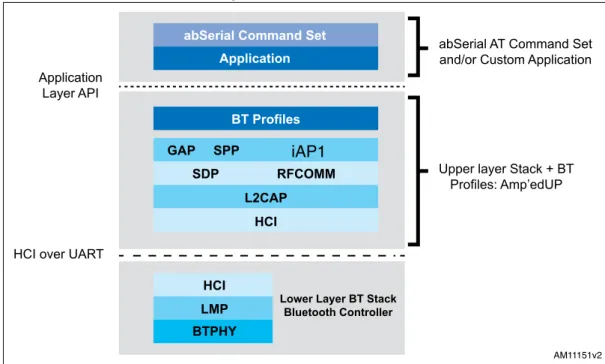
Bluetooth firmware implementation
Figure 1. FW architecture
$0Y
L$3
Hardware specifications SPBT2632C2A
5 Hardware
specifications
General conditions (VIN = 2.5 V and 25 °C).
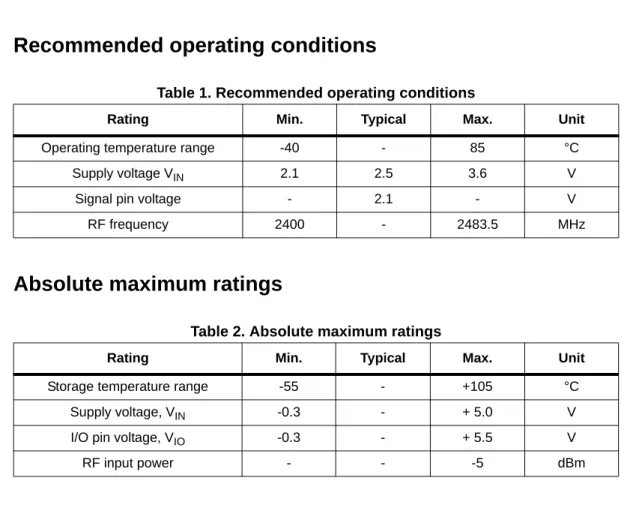
5.1
Recommended operating conditions
5.2
Absolute maximum ratings
Table 1. Recommended operating conditions
Rating Min. Typical Max. Unit
Operating temperature range -40 - 85 °C
Supply voltage VIN 2.1 2.5 3.6 V
Signal pin voltage - 2.1 - V
RF frequency 2400 - 2483.5 MHz
Table 2. Absolute maximum ratings
Rating Min. Typical Max. Unit
Storage temperature range -55 - +105 °C
Supply voltage, VIN -0.3 - + 5.0 V
I/O pin voltage, VIO -0.3 - + 5.5 V
SPBT2632C2A Hardware specifications
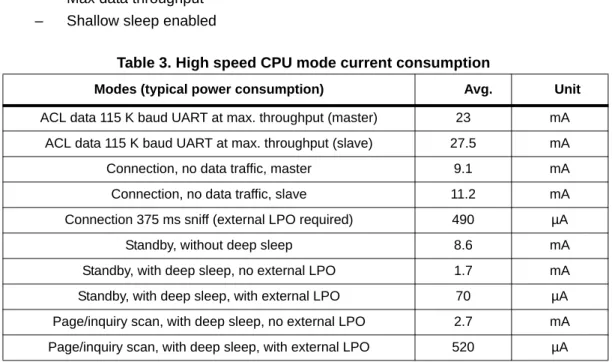
5.3
High speed CPU mode current consumption
High speed CPU mode – CPU 32 MHz
– UART supports up to 921 Kbps – Max data throughput
– Shallow sleep enabled
5.4
Standard CPU mode current consumption
Standard CPU mode – CPU 8 MHz
– UART supports up to 115 Kbps – Data throughput up to 200 Kbps – Shallow sleep enabled
Table 3. High speed CPU mode current consumption
Modes(typical power consumption) Avg. Unit
ACL data 115 K baud UART at max. throughput (master) 23 mA ACL data 115 K baud UART at max. throughput (slave) 27.5 mA
Connection, no data traffic, master 9.1 mA
Connection, no data traffic, slave 11.2 mA
Connection 375 ms sniff (external LPO required) 490 µA
Standby, without deep sleep 8.6 mA
Standby, with deep sleep, no external LPO 1.7 mA
Standby, with deep sleep, with external LPO 70 µA Page/inquiry scan, with deep sleep, no external LPO 2.7 mA Page/inquiry scan, with deep sleep, with external LPO 520 µA
Table 4. Standard CPU mode current consumption
Modes(typical power consumption) Avg. Unit
ACL data 115 K baud UART at max. throughput (master) 16.7 mA ACL data 115 K baud UART at max. throughput (slave) 18 mA
Connection, no data traffic, master 4.9 mA
Connection, no data traffic, slave 7.0 mA
Connection 375 ms sniff (external LPO required) 490 µA
Standby, without deep sleep 4.2 mA
Hardware specifications SPBT2632C2A
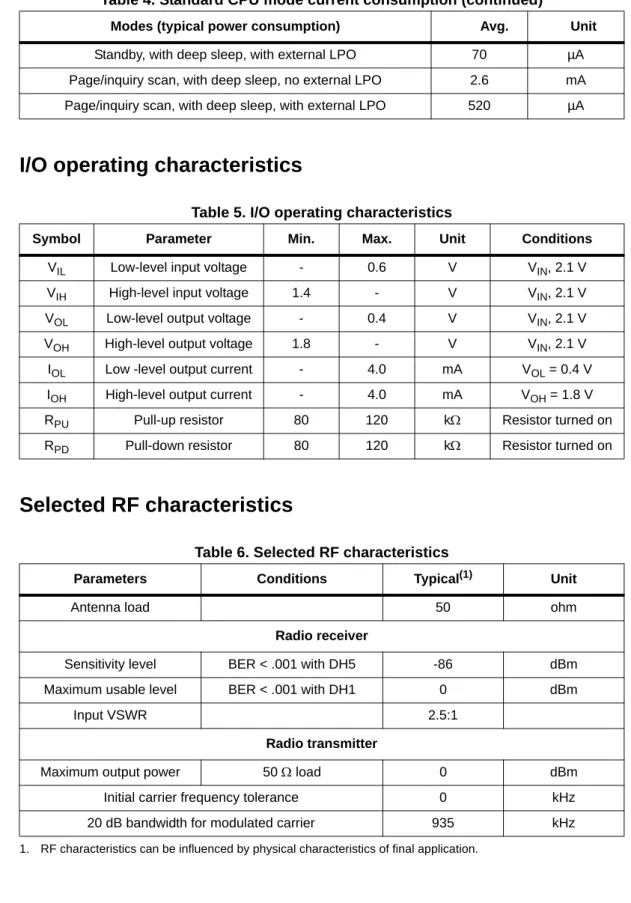
5.5
I/O operating characteristics
5.6
Selected RF characteristics
Standby, with deep sleep, with external LPO 70 µA Page/inquiry scan, with deep sleep, no external LPO 2.6 mA Page/inquiry scan, with deep sleep, with external LPO 520 µA
Table 4. Standard CPU mode current consumption (continued)
Modes(typical power consumption) Avg. Unit
Table 5. I/O operating characteristics
Symbol Parameter Min. Max. Unit Conditions
VIL Low-level input voltage - 0.6 V VIN, 2.1 V
VIH High-level input voltage 1.4 - V VIN, 2.1 V
VOL Low-level output voltage - 0.4 V VIN, 2.1 V
VOH High-level output voltage 1.8 - V VIN, 2.1 V
IOL Low -level output current - 4.0 mA VOL = 0.4 V
IOH High-level output current - 4.0 mA VOH = 1.8 V
RPU Pull-up resistor 80 120 k Resistor turned on
RPD Pull-down resistor 80 120 k Resistor turned on
Table 6. Selected RF characteristics
Parameters Conditions Typical(1)
1. RF characteristics can be influenced by physical characteristics of final application.
Unit
Antenna load 50 ohm
Radio receiver
Sensitivity level BER < .001 with DH5 -86 dBm
Maximum usable level BER < .001 with DH1 0 dBm
Input VSWR 2.5:1
Radio transmitter
Maximum output power 50 load 0 dBm
Initial carrier frequency tolerance 0 kHz
SPBT2632C2A Hardware specifications
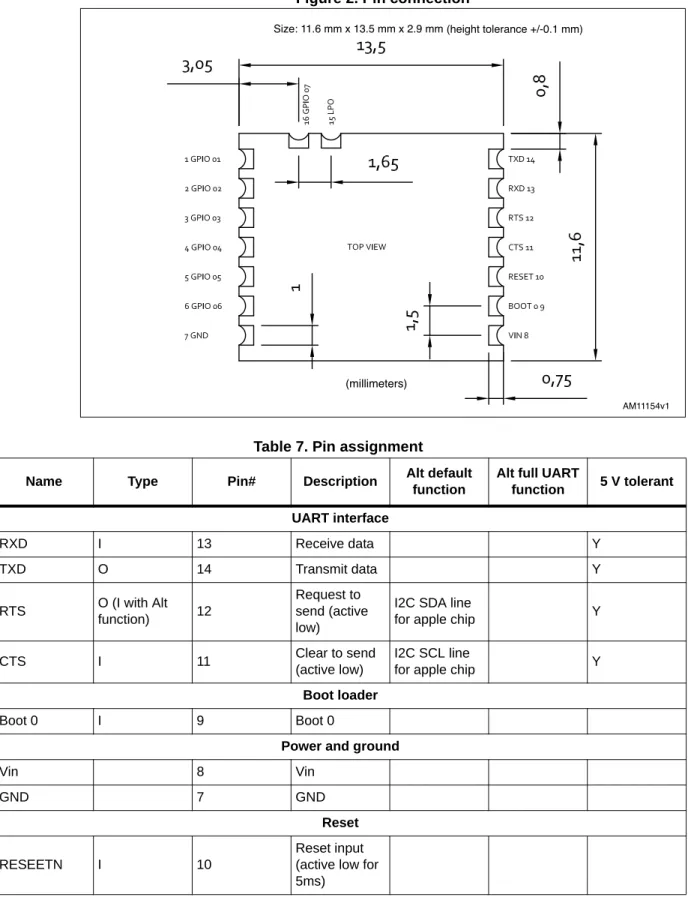
5.7 Pin
assignment
Figure 2. Pin connection
PLOOLPHWHUV
6L]HĆĆPPĆ[ĆĆPPĆ[ĆĆPPĆKHLJKWĆWROHUDQFHĆĆPP
$0Y
Table 7. Pin assignment
Name Type Pin# Description Alt default
function
Alt full UART
function 5 V tolerant UART interface RXD I 13 Receive data Y TXD O 14 Transmit data Y RTS O (I with Alt function) 12 Request to send (active low)
I2C SDA line
for apple chip Y
CTS I 11 Clear to send
(active low)
I2C SCL line
for apple chip Y
Boot loader
Boot 0 I 9 Boot 0
Power and ground
Vin 8 Vin
GND 7 GND
Reset
Hardware specifications SPBT2632C2A
1. Please note that the usage of ALT function is dependent upon the firmware that is loaded into the module, and is beyond the scope of this document. The AT command interface uses the main UART by default. 2. Alt default function is selected setting var 56 =false while setting var56=true the Alt full UART function is
selected. For details about variable pls refer to the UM1547.
LPO
LPO I 15 LPO input 2.5 V max
GPIO – general purpose input/output
GPIO1 I/O 1 general purpose input/output Y GPIO2 I/O 2 general purpose input/output I2S_SD I2S_SD Y GPIO3 I/O 3 general purpose input/output I2S_CK I2S_CK Y GPIO4 I/O 4 general purpose input/output I2S_WS I2S_WS Y GPIO5 I/O 5 general purpose input/output
I2C SDA line for apple chip Y
GPIO6
I/O
(only O with Alt function) 6 general purpose input/output I2C SCL line for apple chip Y
GPIO7 I/O 16
general purpose input/output
Y Table 7. Pin assignment (continued)
Name Type Pin# Description Alt default
function
Alt full UART
SPBT2632C2A Hardware specifications
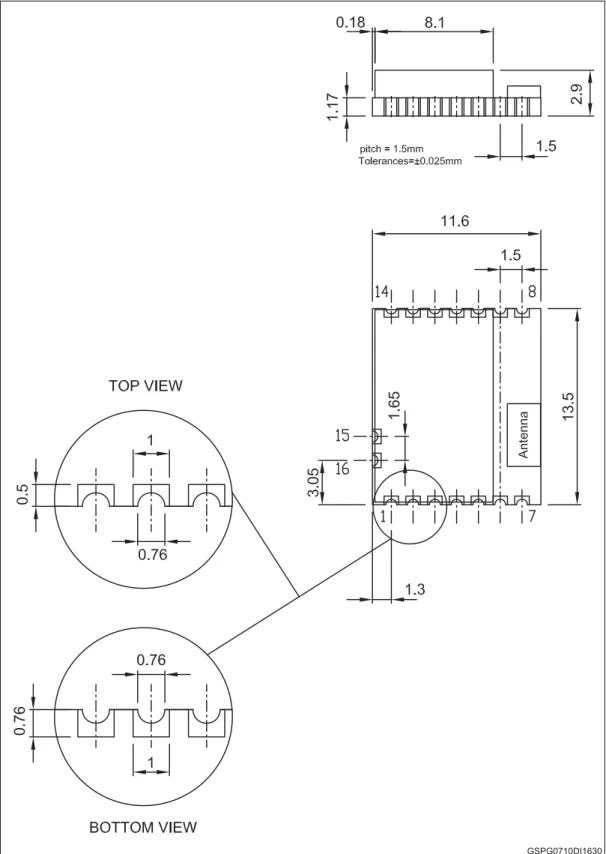
5.8 Mechanical
dimensions
Figure 3. Mechanical dimensions
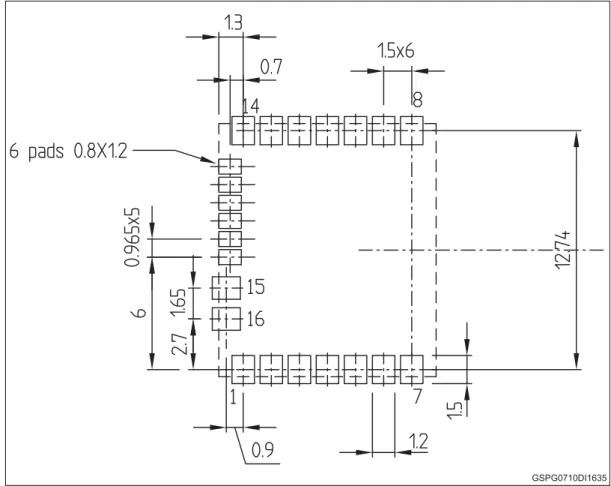
Hardware specifications SPBT2632C2A
Figure 4. Recommend land pattern top view
SPBT2632C2A Hardware block diagram
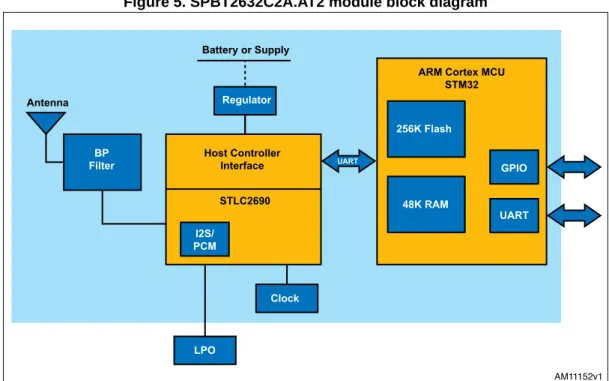
6
Hardware block diagram
Figure 5. SPBT2632C2A.AT2 module block diagram
%DWWHU\RU6XSSO\ 5HJXODWRU $QWHQQD +RVW&RQWUROOHU ,QWHUIDFH 67/& %3 )LOWHU /32 &ORFN ,6 3&0 .)ODVK .5$0 8$57 $50&RUWH[0&8 670 *3,2 8$57 $0Y
Hardware design SPBT2632C2A
7 Hardware
design
The SPBT2632C2A module without AT2 command embedded FW supports UART, I2C and GPIO hardware interfaces. Note that the usage of these interfaces is dependent upon the firmware that is loaded into the module, and is beyond the scope of this document. The AT2 command interface uses the main UART by default.
Note: 1 All unused pins should be left floating; do not ground. 2 All GND pins must be well grounded.
3 The area around the module should be free of any ground planes, power planes, trace routings, or metal for 6 mm from the antenna in all directions.
4 Traces should not be routed underneath the module.
7.1 Module
reflow
installation
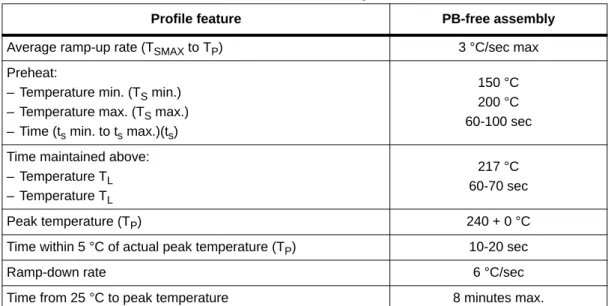
The SPB2632C2A is a high temperature strength surface mount Bluetooth module supplied on a 16-pin, 6-layer PCB. The final assembly recommended reflow profiles are indicated here below.
The soldering phase must be executed with care: In order to avoid undesired melting phenomenon, particular attention must be paid to the setup of the peak temperature. The following are some suggestions for the temperature profile based on IPC/JEDEC J-STD-020C, July 2004 recommendations.
Table 8. Soldering
Profile feature PB-free assembly
Average ramp-up rate (TSMAX to TP) 3 °C/sec max
Preheat:
– Temperature min. (TS min.) – Temperature max. (TS max.) – Time (ts min. to ts max.)(ts)
150 °C 200 °C 60-100 sec Time maintained above:
– Temperature TL – Temperature TL
217 °C 60-70 sec
Peak temperature (TP) 240 + 0 °C
Time within 5 °C of actual peak temperature (TP) 10-20 sec
Ramp-down rate 6 °C/sec
SPBT2632C2A Hardware design
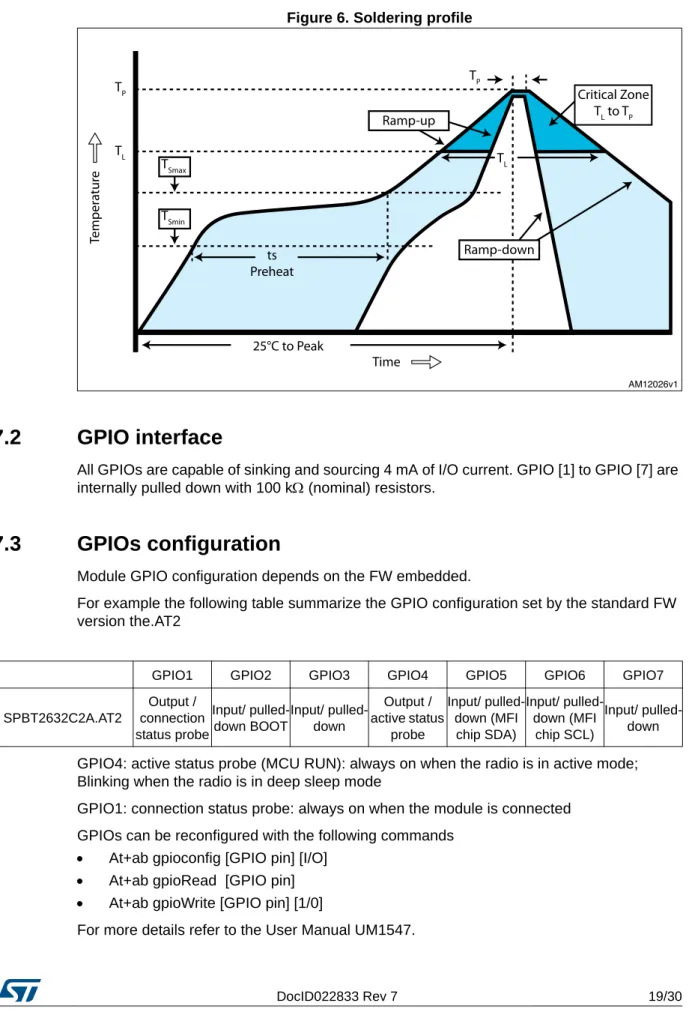
Figure 6. Soldering profile
7.2 GPIO
interface
All GPIOs are capable of sinking and sourcing 4 mA of I/O current. GPIO [1] to GPIO [7] are internally pulled down with 100 k (nominal) resistors.
7.3 GPIOs
configuration
Module GPIO configuration depends on the FW embedded.
For example the following table summarize the GPIO configuration set by the standard FW version the.AT2
GPIO4: active status probe (MCU RUN): always on when the radio is in active mode; Blinking when the radio is in deep sleep mode
GPIO1: connection status probe: always on when the module is connected GPIOs can be reconfigured with the following commands
At+ab gpioconfig [GPIO pin] [I/O]
At+ab gpioRead [GPIO pin]
At+ab gpioWrite [GPIO pin] [1/0]
$0Y
GPIO1 GPIO2 GPIO3 GPIO4 GPIO5 GPIO6 GPIO7
SPBT2632C2A.AT2 Output / connection status probe Input/ pulled-down BOOT Input/ pulled-down Output / active status probe Input/ pulled-down (MFI chip SDA) Input/ pulled-down (MFI chip SCL) Input/ pulled-down
Hardware design SPBT2632C2A
7.4 UART
interface
The UART is compatible with the 16550 industry standard. Four signals are provided with the UART interface. The TXD and RXD pins are used for data while the CTS and RTS pins are used for flow control.
Figure 7. Connection to host device
Figure 8. Typical RS232 circuit
%OXHWRRWK
0RGXOH
+RVW
$0Y
SPBT2632C2A Hardware design
7.5
PCB layout guidelines
Figure 9. PCB layout guidelines
7.6 Reset
circuit
Two types of system reset circuits are detailed below.The maximum voltage that can be supplied to the RESET pin is 2.5 V. As shown in Figure 10 and Figure 11 the RESET is active low, in absence of a reset circuit the pin is internally pulled up and therefore inactive.
7.6.1
External reset circuit
Figure 10. External reset circuit
VXUURXQGLQJ
$0Y
5(6(7
Hardware design SPBT2632C2A
7.6.2 Internal
reset
circuit
Figure 11. Internal reset circuit
Note: 1 RPU ranges from 30 k to 50 k internally. 2 RRST should be from 1 k to 10 k
7.7
External LPO input circuit
An optional low power oscillator input may be added to allow Deep sleep and Sniff modes.
LPO parameters:
– Frequency: 32.768 kHz
– Tolerance: +/- 150 ppm typical, +/- 250 maximum – Absolute maximum supplied voltage at LPO pin: +1.8 V – VIL min/max = 0 V/+0.5 V
– VIH min/max = +1.47 V/+1.8
– Input capacitance: 2.5 pF maximum
Configurations:
– Use two configuration variables: UseExtLPO and AllowSniff.
5(6(7
$0Y
Table 9. System configuration variables
Variable Name Default Description
Var37 UseExtLPO True True when a 32.768 kHz low power oscillator is present, and false if not present
SPBT2632C2A Hardware design
Figure 12. External LPO circuit
7.8
Apple iOS CP reference design
The figures below give an indicative overview of what the hardware concept looks like. A specific MFI co-processor layout is available for licensed MFI developers from the MFI program.
The MFI co-processor can be connected to the module through the pins 11 and 12 if the UART flow control is not required, or through the pins 5 and 6 if the full UART is needed. As indicated at Table 7: Pin assignment on page 13 the choice between the supported connection is made setting a FW variable. for more details on FW setting please refer to the UM1547. Figure 13. BT module .+] RVFLOODWRU 8 8 * 3,2 * 3,2 * 3,2 * 3,2 * 3,2 * 3,2 * 1' 9 ,1 %227 5 ( 6 ( 7 & 76 576 5 ; ' 7 ; ' /32 * 3,2
63%7&$$7
$0YI2C data full UART I2C clock full UART
Hardware design SPBT2632C2A
Figure 14. Co-processor
Figure 15. Power switch
C? 100n R? 10k R? 10k C? 100n R? 10k U? NC 5 NC 3 RST 7 VCC 8 VSS 1 I2C_SCL 6 I2C_SDA 2 NC 4 SDA SCL 1.8V 1.8V 1.8V Apple MFI CO-Processor 2.0c $0Y
SPBT2632C2A Regulatory compliance
8 Regulatory
compliance
8.1
FCC and IC certification
This module has been tested and found to comply with the FCC part 15 and IC RSS-210 rules. These limits are designed to provide reasonable protection against harmful interference in approved installations. This equipment generates, uses, and can radiate radio frequency energy and, if not installed and used in accordance with the instructions, may cause harmful interference to radio communications.
However, there is no guarantee that interference may not occur in a particular installation. This device complies with part 15 of the FCC rules. Operation is subject to the following two conditions: (1) This device may not cause harmful interference, and (2) this device must accept any interference received, including interference that may cause undesired operation.
Modifications or changes to this equipment not expressly approved by the part responsible for compliance may render void the user's authority to operate this equipment.
– Modular approval, FCC and IC FCC ID: X3ZBTMOD5
IC: 8828A-MOD4
In accordance with FCC part 15, the SPBT2632C2A.AT2 is listed above as a modular transmitter device.
– Label instructions
When integrating the SPBT2632C2A.AT2 into the final product, it must be ensured that the FCC labelling requirements, as specified below, are satisfied. Based on the Public Notice from FCC, the product into which the ST transmitter module is
installed must display a label referring to the enclosed module. The label should use wording such as the following:
Contains Transmitter Module FCC ID: X3ZBTMOD5 IC: 8828A-MOD4
Any similar wording that expresses the same meaning may be used.
8.2 TELEC
certification
Module has been tested according to following TELEC certification rules: Type of specified radio equipment
– Radio equipment according to Certification Ordinance Article 2-1-19 / Sophisticated low power radio data communication system in 2.4GHz band. Class of emissions, Assigned frequency, and Antenna power
Regulatory compliance SPBT2632C2A
8.3 Bluetooth
certification
Module with embedded stack and profile has been qualified according to SIG qualification rules:
– Bluetooth SIG Qualified Design, QD ID: B019224 – Product type: End Product
– TGP version: Core 3.0 – Core spec version: 3.0
– Product descriptions: Bluetooth module, spec V3.0
8.4 CE
certification
Module has been certified according to following certification rules: – CE Expert opinion: 0448-ARSO00049
– Measurements have been performed in accordance with (report available on request): – EN 300 328 V 1.8.1 (2012 06) (a) – EN 301 489-17 V 2.2.1 (2012 09) (b) – EN 301 489 -1 V 1.9.2 (2011 09) (c) – EN60950-1:2006 +A11:2009+A1:2010 (d) CE certified:
a. EN 300 328 V 1.8.1 (2012 06): “electromagnetic compatibility and radio spectrum Matters (ERM); Wideband transmission systems; data transmission equipment operating in the 2.4 GHZ ISM band and using wideband modulation techniques; harmonized EN covering essential requirements under article 3.2 of the R&TTE directive”.
b. EN 301 489-17 V 2.2.1 (2012 09): “electromagnetic compatibility and radio spectrum Matters (ERM); electromagnetic compatibility (EMC) standard for radio equipment and services; part 17: specific condition for 2.4 GHz wideband transmission systems and 5 GHz high performance RLAN equipment”.
c. EN301 489-1 V 1.9.2 (2011 09): “electromagnetic compatibility and radio spectrum Matters (ERM); electromagnetic compatibility (EMC) standard for radio equipment and services; part 1: Common technical
SPBT2632C2A Traceability
9 Traceability
Each module is univocally identified by serial number stored in a 2D data matrix laser marked on the bottom side of the module itself.
The serial number has the following format: WW YY D FF NNN
where WW = week YY = year
D = product ID family
FF = production panel coordinate identification NNN = progressive serial number.
Each module bulk is identified by a bulk ID.
Bulk ID and module 2D data matrix are linked by a reciprocal traceability link. The module 2D data matrix traces the lot number of any raw material used.
Ordering information SPBT2632C2A
10 Ordering
information
Table 10. Ordering information
Order code Description Packing MOQ
SPBT2632C2A Revision history
11 Revision
history
Table 11. Document revision history
Date Revision Changes
03-Apr-2012 1 First release. 16-Apr-2012 2 Modified: Section 8
12-Jun-2012 3
– Document status promoted from preliminary data to production data
– Modified: Figure 1
07-Aug-2012 4 – Added: notes in Table 6 and 7 – Modified: Section 7
21-Oct-2013 5 Added new section: Section 5.8, Section 7.3 and Section 9 Modified: Figure 13
06-Jun-2014 6 Modified: Section 8.4
08-Jun-2016 7
– Replaced “iAP” with “iAP1” throughout the document. – Removed last three paragraphs from Section 1: Description. – Minor text edits.
SPBT2632C2A
IMPORTANT NOTICE – PLEASE READ CAREFULLY
STMicroelectronics NV and its subsidiaries (“ST”) reserve the right to make changes, corrections, enhancements, modifications, and improvements to ST products and/or to this document at any time without notice. Purchasers should obtain the latest relevant information on ST products before placing orders. ST products are sold pursuant to ST’s terms and conditions of sale in place at the time of order acknowledgement.
Purchasers are solely responsible for the choice, selection, and use of ST products and ST assumes no liability for application assistance or the design of Purchasers’ products.
No license, express or implied, to any intellectual property right is granted by ST herein.
Resale of ST products with provisions different from the information set forth herein shall void any warranty granted by ST for such product.
ST and the ST logo are trademarks of ST. All other product or service names are the property of their respective owners.