ANGLIA RUSKIN UNIVERSITY
FACULTY OF BUSINESS AND LAW
HAVE THE NEW PROCUREMENT RULES SIMPLIFIED AND IMPROVED THE PUBLIC PROCUREMENT PROCESS?
R.J. WREN
A thesis in partial fulfilment of the requirements of Anglia Ruskin University for the degree of Professional Doctorate in Law
ACKNOWLEDGEMENTS
I must give special thanks to my supervisors, Dr. Aldo Zammit-Borda from Anglia Ruskin University and Dr. Ama Eyo of Bangor University for their understanding, guidance and encouragement and for providing calm support at every stage along the way.
This thesis would not have been possible without the help, assistance and support of my wife Sandra who has suffered with me and inspired me throughout the six-year journey whilst maintaining our professional practice.
ANGLIA RUSKIN UNIVERSITY ABSTRACT
FACULTY OF BUSINESS AND LAW PROFESSIONAL DOCTORATE IN LAW
HAVE THE NEW PROCUREMENT RULES SIMPLIFIED AND IMPROVED THE PUBLIC PROCUREMENT PROCESS?
R.J. WREN November 2019
Public services which must be procured are currently provided in partnership with the private and third sector, with an estimated £284 billion a year in 2018 spent in the United Kingdom on buying goods and services from external suppliers – amounting to around a third of public expenditure. The need for the reform and modernisation of public procurement law and practice to increase the efficiency, effectiveness and understanding of public procurement in the EU has long been recognised resulting in the new Procurement Directive 2014/24/EU. This Professional Doctorate in Law research examines whether and to what extent the new EU rules which have been transposed into the Public Contracts Regulations 2015 (as amended) have modernised, simplified and made more flexible the public procurement process in the United Kingdom.
This research undertakes a black letter / doctrinal approach of the relevant laws in order to analyse and compare the past and present legal frameworks. A black letter law methodology was followed as I needed to undertake a legal/textural analysis of the new rules to better understand how they compare and contrast with the old rules.
In undertaking an analysis of all the changes, modifications and reforms to the law from Directive 2014/24/EU and from my experience in practice when applied to the procurement process I selected a number of specific topics for my research. The topics selected were Selection Criteria, Contract Award Criteria, Framework Agreements and Abnormally Low Tenders. These topic areas were selected as they represent topics which regularly occur in public procurement and therefore provide an important and reasonable indication of the kinds of challenges the new rules give rise to in practice.
As black letter law methodologies do not capture the application of the law in practice, I have followed an empirical interview methodology to record the perceptions of experienced practitioners of public procurement. The voices and perspectives of these practitioners are currently largely absent from the available academic literature. The investigation was
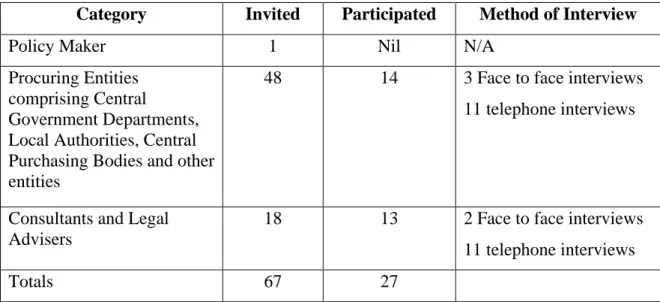
undertaken using 27 participants and whilst this is not a large number and the findings are not generalisable to the larger community, these participants have a cumulative experience of over 1700 procurements and therefore have provided rare and invaluable insights into the procurement process.
This research finds that several participants considered that the new rules had made some areas in the procurement process more complex and made the procurement procedure difficult to operate in practice. The new rules were not perceived by most participants to have simplified or improved the public procurement process. This may be as a result of either a lack of understanding of the rules in certain areas or a resistance to change existing procedures and processes followed by the participants. From these findings further research on the rules is required together with the need for practical training and guidance on the rules, obligations and how they are understood and applied in practice.
Key words: EU law, UK law, Public procurement in practice, Selection Criteria, Contract Award Criteria, Framework Agreements, Abnormally Low Tenders.
CONTENTS
Page
PART 1 - INTRODUCTORY ISSUES AND LEGAL ANALYSIS 1
Chapter 1 – Introduction to the thesis 1
1.1 The Research 1
1.2 Importance of the research 4
1.3 Research Aims and Research Questions 8
1.3.1 Aims of the research 8
1.3.2 Objectives of the research 8
1.3.3 Research Question 9
1.4 Literature Review 9
1.4.1 Literature on Public Procurement Law 10
1.4.2 Public Procurement 15
1.4.3 Distinguishing Public Procurement from Private Procurement 18 1.4.4 The objectives of public procurement systems, rules
and regulations. 25
1.4.5 Public Procurement as a policy tool 35
1.5 Methodology 38
1.6 The structure of the thesis 39
1.7 The Researcher 40
Page
Chapter 2 Context for the research, background to and historical review of public procurement and an overview for background purposes of Directive 2004/18/EC and the Public Contracts
Regulations 2006 43
2.1 Section 1 : Introduction 43
2.2 Section 2 : Context and foundation for the research 44
2.2.1 The researcher’s experience of public procurement in practice 44 2.2.2 Understanding public procurement in practice in the UK 46 2.2.3 Overview of challenges made by suppliers for failures and
breaches on the part of contracting authorities 52
2.3 Section 3 : Background and introduction to public procurement with
an historical overview 53
2.3.1 Procurement in the United Kingdom (UK) prior to the Public
Contracts Regulations 2006 (PCR 2006). 53
2.3.2 The EC and the EU Procurement rules 60
2.3.3 The Treaty Framework 61
2.3.4 The Procurement Directives 62
2.3.5 UK Implementation of European Procurement Directives 67
2.4 Section 4 : Overview of Directive 2004/18/EC and the Public Contracts Regulations 2006 (both of which have been repealed) 70
2.4.1 General Introduction 70
2.4.2 Changes and reforms to the 2004 Public Sector Directive 71 2.4.2.1 Changes, simplification and clarifications 71
2.4.2.2 Changes for increased flexibility 73
Page
2.4.3 Overview of the Public Contracts Regulations 2006 76
Chapter 3 Analysis of the Public Procurement Directive 2014/24/EU and the
Public Contracts Regulations 2015 81
3.1 Section 1 : Introduction 81
3.2 Section 2 : The four topics selected from the changes, modifications and reforms to Directive 2014/24/EU for the empirical research
included in Chapters 4 and 5 of the thesis 81
3.2.1 General Introduction 81
3.2.2 Specific consideration of the four selected topics 82
3.3 Section 3 : Background to Directive 2014/24/EU 92
3.4 Section 4 : Changes, modifications and reforms introduced by
Directive 2014/24/EU 96
3.4.1 Reforms relating to the four topic areas examined in my research concerning Selection Criteria, Contract Award Criteria,
Framework Agreements and Abnormally Low Tenders 97
3.4.2 Other changes and reforms introduced 100
3.5 Section 5 : Literature on the simplification and flexibilisation of the
rules in Directive 2014/24/EU 104
3.6 Section 6 : Further provisions and specific reforms under the PCR 2015 107
3.6.1 General introduction 107
Page
PART 2 : EMPIRICAL RESEARCH 113
Chapter 4 - Empirical research : methodology and approach 113
4.1 Introduction 113
4.2 Design of the research 114
4.2.1 Design 114
4.2.2 Adopted research approach 115
4.3 Participants in the research 117
4.3.1 Introduction 117
4.3.2 Sampling construction and procedures 118
4.3.3 Description of and information on categories and the recruitment
of the participants 122
4.3.3.1 Introduction 122
4.3.3.2 Policy maker and central direct buying entity 122 4.3.3.3 Recruitment of participants under this classification 123
4.3.3.4 Procuring entities 124
4.3.3.5 Procurement Consultants and Legal Advisers 129
4.4 Methods of Data Collection 130
4.5 The Interview Guide 134
(1) Section A – General Questions 135
(2) Section B – Selection Criteria 136
Page
(4) Section D – Framework Agreements 138
(5) Section E – Abnormally Low Tenders 139
(6) Section F – Concluding Question 139
4.6 Ethical Issues 140
Chapter 5 : Analysis of Data and Empirical Findings 141
5.1 Introduction 141
5.2 Responses of the participants and analysis of their comments 144 5.2.1 Section A - General questions on related issues to the research 144
5.2.2 Section B - Selection Criteria 156
5.2.3 Section C - Contract Award Criteria 176
5.2.4 Section D - Framework Agreements 193
5.2.5 Section E - Abnormally Low Tenders 216
5.2.6 Section F - Concluding Question 229
Chapter 6 Conclusion 233
Page
6.2 Research questions and supplementary questions to show how the
new rules are operated by practitioners. 234
6.2.1 Supplementary question 1 : Has the modernisation of the new rules simplified and made more flexible the procurement process in
practice in the selected topic area. 234
6.2.2 Supplementary question 2 : Have the procuring entities and consultants / legal advisers understood and applied the new rules
in relation to the four subject topics areas. 236 6.2.3 Supplementary question 3 : Have the new rules in the four topic
areas resulted in an improvement in the approach of procuring
entities and consultants / legal advisers? 237
6.2.4 Main Research Question : Have the new procurement rules in Directive 2014/24/EU simplified and improved the public
procurement process? 241
6.3. Originality and contribution to knowledge 242
6.4 Conclusion and further study 243
Page
List of Figures
Figure 1.1 The Environment of the Public Procurement System 24
List of Tables
Table 1.1 Seven Stages of Public Procurement 34
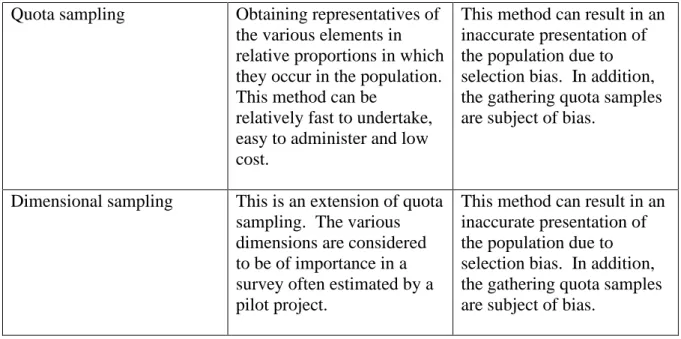
Table 4.1 Five sampling methods 120
Table 4.2 indicating summary of participants invited and subsequently
included in my research 130
List of Appendices
Appendix 1 Invitation to participate in a Public Procurement
research study 263
PART 1 - INTRODUCTORY ISSUES AND LEGAL ANALYSIS
Chapter 1 – Introduction to the thesis
1.1 The Research
The study relates to Public Sector Procurement laws and regulations in the UK which are based on EU laws and regulations. For many years it has been recognised that public procurement rules were complex, and this had resulted in waste, inefficiencies and a lack of understanding on how the rules should be operated which was often added to by the lack of qualified practitioners in public procurement.1 Many attempts have been made to draft and implement rules which are less complex and more simple to operate.
The background to the EU Procurement Directives since their adoption in 1964 and 1971 and prior to 2004 are covered in Chapter 2 to this thesis. After consultation in 2004 the Public Sector Directive2 was introduced by the European Union. The reforms for this Directive originated from a Green Paper of 1996, Public Procurement in the European Union : Exploring the Way Forward.3 There were two main aims, the first to simplify the rules (involving clarification through guidance) and the second intention being to increase the flexibility available to procuring entities in order to take into consideration new practices or market reality.4 The 2004 Directive was transposed into the Public Contracts Regulations 20065 in England, Wales and Northern Ireland. In Chapter 3 I confirm that both the 2004 Directive and the Public Contracts Regulations 2006 have subsequently been repealed. Following the adoption of the 2004 legislation the European Commission commenced a general review of the Directive together with the neglected subjects of remedies and defence procurement.6 The development of these subjects occurred separately but the finalisation of
1 House of Commons, Public Administration Select Committee (PASC) – Government Procurement:
Government Response to the Committee’s Sixth Report of Session 2013-14 (Stationery Office Ltd 2014) 51
2 Parliament and Council Directive 2004/18 (OJ 2004 L134/114) on the co-ordination of procedures for the
award of public works contracts, public supply contracts and public services contracts
3 European Commission, Green Paper, Public Procurement in the European Union, Exploring the Way Forward
(1996) COM 583 final
4 Sue Arrowsmith, ‘The Past and Future Evolution of EC Procurement Law: From Framework to Common
Code?’ (2006) 35(3) Public Contracts Law Journal 345
5 Statutory Instrument (SI 2006 No 5) Public Procurement England and Wales, Public Procurement Northern
Ireland
6 Sue Arrowsmith, The Law of Public and Utilities Procurement: Regulation in the EU and UK (3rd edn,
the remedies regime and the Defence Procurement Directive7 was subsequently evaluated.
The Commission concluded that there was neither major nor urgent need to amend the Remedies Directives and it was decided to maintain them in their current form without any further modification at this stage.8
Following consultation and publication of proposals which occurred in 2011, in 2014 a new Directive9 on public procurement was introduced together with a Utilities Directive10 and a Concessions Directive.11 My research specifically covers the 2014 Public Procurement Directive (Directive 2014/24/EU). The primary objectives of the revision to the EU procurement regime is the modernisation, simplification and so called flexibilisation of the regime.12 The introduction of the Directive was to overhaul and to make significant changes to existing obligations and further to introduce new requirements.13 Directive 2014/24/EU was transposed into the Public Contracts Regulations 201514 (PCR 2015) in England, Wales and Northern Ireland.
The main project is to ascertain whether the new rules in Directive 2014/24/EU which are said to have been modernised, simplified and made more flexible have in practice improved the public procurement process. Consequently, the research will focus on a significant review of Directive 2014/24/EU and the PCR 2015 (as amended). This will also cover whether there has been an improvement in the understanding and approach of users of the new rules in the operation and delivery of public sector procurements.
7 Directive 2009/81/EC of the European Parliament and of the Council of July 13, 2009 on the co-ordination of
procedures for the award of certain works, supply or service contracts by contracting authorities in the fields of defence and security [2009] O.J. L216.76.
8 https://eur-lex.europa.eu/legal-content/EN/TXT/?uri=COM:2017:28:FIN p8
9 Directive 2014/24/EU of the European Parliament and of the Council of 26 February 2014 on public
procurement and repealing Directive 2004/18/EC
10 Directive 2014/25/EU of the European Parliament and of the Council of the 26 February 2014 on procurement
by entities operation in the water, energy, transport and postal services sectors and repealing Directive 2004/17/EC [2014] O.J. L94/243.
11 Directive 2014/23/EU of the European Parliament and of the Council of the 26 February 2014 on the award of
concession contracts [2014] OJ L94/1.
12 COM (2011) 896 final, 2011/0438 (COD) Proposed procurement directive. Explanatory Memorandum
section 1
13 Steen Treumer, ‘Evolution of the EU Public Procurement Regime: The New Public Procurement Directive’ in
Francois Lichere, Roberto Caranta and Steen Treumer (eds) Modernising Public Procurement – The New Directive (DYØF Publishing 2014) 9
In relation to the impact of Brexit on my research, as my research also relies heavily on the PCR 2015 (as amended) I consider that my research will be relevant for the operation of public procurement in the UK whether or not there is a deal for Brexit.
To support this statement, I refer to the following points. In December 2018, the Public Procurement (Amendments etc.) (EU Exit) Regulations 201915 (Public Procurement Regulations 2019) was laid amending several statutes, most notably the Public Contracts Regulations 2015, Utilities Contracts Regulations 2016 and the Concessions Contracts Regulations 2016. The Public Procurement Regulations 2019 are in draft form and despite affecting a number of statutes giving effect to certain EU regulations in domestic UK law, the Public Procurement Regulations 2019 leave the UK public procurement regime largely unchanged. The Public Contracts Regulations 2019 were subsequently amended by the Public Procurement (Amendment etc) (EU Exit) (No. 2) Regulations 2019.16 The proposed changes are aimed at allowing the current procurement regime to work largely unchanged in a ‘no deal’ scenario and so my research is not affected.
Should the UK access the WTO Agreement on Government Procurement (GPA) in its own right as a result of Brexit, as the UK’s current procurement regulations which are the
implementation of EU procurement directives are arguably GPA compliant as the Directives are intended to provide for procedures that comply with the GPA.17 There is no obligation on
the part of the UK to change their current rules.
One commentator has said with reasonable certainty that the future of the UK public procurement regulations will remain as they are until at least after Brexit.18
15 Draft Statutory Instrument 2019 – Exiting the European Union Public Procurement.
16 Draft Statutory Instrument 2019 – Exiting the European Union on Public Procurement (No. 2).
17 Ping Wang, ‘Brexit and the WTO Agreement on Government Procurement (“GPA”)’ (2017) 26 PPLR Issue 1
Sweet & Maxwell 46.
18 Sue Arrowsmith, ‘The Implementations of Brexit for Public Procurement Law and Policy in the United
1.2 Importance of the research
Public procurement refers to the procedure by governments and state-owned entities to procure goods, services and works.19 Public procurement accounts for a substantial proportion of taxpayer’s money. Accordingly, governments are expected to undertake the public procurement efficiently and meet a high level of conduct in order to ensure high quality services, provide value for money and further to safeguard public interest.
Public procurement is a central pillar of services delivery for governments. With the sheer volume of spending that public procurement represents well governed public procurement plays a major role in fostering the efficiency of the public sector and establishing the trust of citizens. It has been said that a well-designed public procurement system also contributes to achieving other goals such as environmental protection, innovation, job creation and
development of small and medium sized enterprises.20
Sound public procurement policy brings immediate tangible macroeconomic benefits and the operation of more cost effective procurement allows for a relaxation of budgetary pressure and creative fiscal space.21 Public procurement is being increasingly identified as a means of achieving policy objectives from the reduction of carbon and as a basis of achieving
innovation resulting in a more resilient and inclusive economy.22
Public procurement is important as every year over 250,000 public authorities in the EU spend around 14% of Gross National Product (GDP) which is around €2 trillion per week on the purchase of services, works and supplies.23
19 Sylvia de Mars, The limits of general principles : a procurement case study [2013] 38(3) ELR 316 20 OECD, Recommendations of the Council on Public Procurement, Directorate of Public Procurement and
Territorial Development 2015
21 Lucas Vogul, Macroeconomic Effects of Cost Savings in Public Procurement, European Countries (Economic
Papers 2009)
22 Abby Semple, Practical Guide to Public Procurement (OUP 2015)
23 European Commission, Public Procurement
High quality public services depend on modern, well managed and efficient procurement. The improvement of public procurement can yield substantial savings and even a 1% efficiency gain could save €20 billion per year.24
In 2018 in the United Kingdom (UK) the public sector spent a total of £284 billion a year on the procurement of goods, works and services (including capital assets) which accounted for 33 percent of public sector spending (total managed expenditure).25
The need for the reform and modernisation of public procurement law and practice to
increase the efficiency, effectiveness and understanding of public procurement in the EU has long been recognised. In addition, the requirement for public procurement law and practices to be made less complex has been raised over several years by practitioners and many organisations involved in public procurement. The complexity of the rules were referred to by the Local Government Group26 as part of a Survey of their Members in 2011 in the UK in response to the European Commission Green Paper27 in 2011 and in a UK Government Procurement Special Report in 2014.28 These papers relate to the 2004 Public Sector Directive following which Directive 2014/24/EU was introduced to make the procurement rules less complex. I cover in Chapter 3 the areas in Directive 2014/24/EU which were intended to modernise the rules and make the new rules less complex by simplification and flexibilisation.
The complexity of the procurement rules led to both a lack of understanding on the part of public bodies as to their obligations and a failure to properly implement the rules and
practices resulting in poor and inadequate processes and litigation. This in fact was the case in all parts of the UK as supported by challenges and cases brought by aggrieved bidders
24 European Commission, Public Procurement
<https://ec.europa.eu/growth/singlemarket/public-procurement-en>2018
25 Institute for Government: Government procurement – The scale and nature of contracting in the UK (Gowling
WLG 2018) 2
26 Local Government Group, Response to Consultations of Office of Government Commerce (OCG) (Review of
Public Procurement Directives 2011) 2
27 United Kingdom response to the European Commission Green Paper on the modernisation of EU
procurement policy, COM (2011) 15 final - Unclassified
28 House of Commons, Public Administration Select Committee (PASC) – Government Procurement:
against procuring entities. There is a growing body of case law in the UK and the EU, particularly in relation to the three areas listed by one commentator.29
• Disclosure and application of selection and award criteria. • Clarification of expressions of interest and tenders.
• The establishment and operation of Framework Agreements.
In relation to the matter of selection and award criteria which is one of the main topics
covered later in the research, there are a number of cases in the UK courts although the courts accept that contracting authorities have a greater discretion over award criteria. These cases are Healthcare at Home,30 Clyde Solway Consortium v Scottish Ministers,31 Mears Ltd. V Leeds County Council,32 McLaughlin and Harvey v Department of Finance and Personnel33 and J. Varney & Sons v Hertfordshire County Council.34
Although there is no general obligation to seek clarification of information submitted by candidates or tenderers, the principles of equal treatment and proportionality may operate in respect of the obligation in specific cases. Cases on the substantive matter of clarification are seen in several judgements such as in Manova35 and All About Rights,36 a series of cases resulting from the award of legal aid contracts by the Legal Services Commission. The matter of a general obligation to clarify an incomplete tender was raised in Slovensko.37
In relation to greater transparency in the way that Framework Agreements are used there have been judgements in two cases involving the Commission v France38 on this matter. With regard to another question concerning whether contracting authorities which are not a direct party or signatory to a Framework Agreement was the subject of a recent judgement in Autorità Garante della Concorrenza e del Mercato v Azienda Socio-Sanitaria Territoriale
29 Abby Semple, A Practical Guide to Public Procurement (OUP 2015) 222. 30 Healthcare at Home Ltd v Common Services Agency [2013] CSIH 22. 31 Clyde Solway Consortium v Scottish Ministers and others [2001] CS 15. 32 Mears Ltd. v Leeds County Council [2011] EWHC 1031 (TCC).
33 McLaughlin & Harvey Ltd v Department of Finance and Personnel [2008] NIQB 91; [2009] BLR 104. 34 J. Varney & Sons Waste Management Ltd v Hertfordshire County Council [2010] EWHC 1404 (QB). 35 Case C-336/12 Ministeriet for Forskning, Innovation og Videregående Uddannelser v Manova A/S (ECJ, 10
October 2013).
36 All About Rights Law Practice v Legal Services Commission [2011] EWHC 964 (Admin)
37 Case C-599/10 SAG ELV Slovensko a.s. and Others v Úrad pre verejné obstarávanie (ECJ, 29 March 2010). 38 Case C-340/02 Commission v France [2004] ECR I-9845 and Case C-299/08 Commission v France [2009]
della Vallecamonica.39 On the matter of disgruntled bidders challenging the award of a Framework Agreement, there is the case of McLaughlin and Harvey v Department of Finance and Personnel40 which covered disclosure of award criteria in respect of a Framework
Agreement and setting aside a Framework Agreement.
The matters contained within my research are important both to public procurement practitioners and also procuring entities especially with their obligations to offer value for money and to meet public auditing constraints which have in the past highlighted poor and unnecessary expenditure of public funds by the UK Government. There have been problems in implementing reforms including ineffective governance strategies, incomplete data and weakness in contract management and a Reform Strategy was recommended by the National Audit Office.41 In 2019 following failures and collapses of a number of high profile suppliers such as Carillion, the Cabinet Office and the UK Government Commercial Function
published an Outsourcing Playbook.42 This document provided supplementary guidance to improve outsourcing practices in central government. Following the publication of The Outsourcing Playbook a Report was prepared to build on areas of the Playbook seeking to identify gaps in those areas. The Report43 further considered how the gaps identified could
be bridged and then focused on key areas for improvement.
The research is becoming more important as I have seen in my role as a public procurement practitioner. I have found in practice when advising on lack of understanding of contract award criteria and the operation of Framework Agreements especially Call-offs from Framework Agreements that knowledge and assistance is required to fill a gap in understanding and the practical aspect of delivery in a professional manner of public procurement. There has been some recognition of the need to define a policy for the professionalisation of public procurement, albeit only in 2017 by the publication of a
39 Autorità Garante della Concorrenza e del Mercato - Antitrust and Coopservice Soc. coop. arl v Azienda
Socio-Sanitaria Territoriale della Vallecamonica - Sebino (ASST) and Others (ECJ, 19 December 2018).
40 McLaughlin & Harvey Ltd v Department of Finance and Personnel [2008] NIQB 91; [2009] BLR 104. 41 National Audit Office, Improving government procurement. Report by the Comptroller and Auditor General,
Cabinet Office 26 February 2013 p9 and 10
42 Government Commercial Function, The Outsourcing Playbook Central Government Guidance on
Outsourcing Decisions and Contracting 2019
43 Joshua Pritchard & Rose Lasko-Skinner, Please Procure Responsibly, The state of public service
European Commission Recommendation.44 This recommendation is accompanied by a
European Staff Works Document which contains a Toolbox of good practice. The European Commission Recommendation contains nine recommendations aimed at increasing the overall professionalism of staff of contracting authorities and other entities.
The knowledge from my research which is based on the use and operation in practice of the new rules will also be applied to develop a training programme and toolkit for use in my practice but to publish as a guide to foster knowledge in practice and to provide a better understanding with technical support to practitioners covering the complete public procurement process.
1.3 Research Aims, Objectives and Research Questions
1.3.1 Aims of the research
To identify whether the EU Procurement rules contained within Directive 2014/24/EU transposed into Public Contracts Regulations 2015 which were modernised and drafted to be simpler and more flexible in use are understood by practitioners, namely Procuring Entities and Procurement Consultants / Legal Advisers. To understand this aim I intend to undertake an analysis in Chapter 5 of the thesis with the four selected topics referred to in Chapters 3 and 4.
1.3.2 Objectives of the research
There is literature covering public procurement law which provides detailed analysis of black letter law. This does not however examine the impact of the laws in practice by users of the procurement process. There is therefore a significant gap and the objective of this thesis is to address this oversight by making available in scholarship the unique perspectives of
procuring entities and consultants and legal advisers.
44 European Commission, Commission Recommendation on the professionalisation of public procurement –
1.3.3 Research Question
Have the procurement rules in Directive 2014/24/EU simplified and improved the public procurement process?
To investigate the research, several supplementary questions were defined to structure the information and data gathering process to show how the new rules are operated by
practitioners. These supplementary questions were designed to gain valuable information in key highlighted and focused areas. The structure of the three supplementary questions not only capture valuable data for the main research question and specifically cover the four questions selected for my research but form a base for the Questions in the Interview Guide. These Supplementary Questions are:
1. Review of the rules and to consider how they have been modernised to simplify and make more flexible the procurement process in practice in respect of the four selected topics for my research.
2. To understand how Contracting Entities and Procurement Consultants / Legal Advisers apply the rules in relation to the four topic areas based on a series of questions set out in an Interview Guide.
3. Have the new rules on the four areas which are the focus of the research resulted in an improvement in the approach of Contracting Entities and Procurement Consultants / Legal Advisers when undertaking public sector procurement?
1.4 Literature Review
1.4.1 Literature on Public Procurement Law
I have reviewed in this section some of the main contributors on the subject areas which have afforded particular attention for my research.
Within Volume 1 of the Third Edition of the book The Law of Public and Utilities
Procurement – Regulation in the EU and UK45 Arrowsmith provides a comprehensive and structured analysis of the law of public and utilities procurement. Arrowsmith primarily refers to EU Directives and EU jurisprudence but does cite UK procurement regulations and law. This Volume covers 2004 Public Sector Directive46 and the 2014 Public Sector
Procurement Directive47 with the 2006 Public Contracts Regulations48 as the book was published in 2014 before the transposition of the Public Contracts Regulations 2015.49 In relation to policies Arrowsmith comments that public procurement is often used as a tool to promote social, environmental or other non-commercial policies which Arrowsmith refers to as horizontal policies. This book also includes commentary on the four topic areas I have selected, namely selection criteria, contract award criteria, framework agreements and
abnormally low tenders although they only relate to the 2014 Directive. Arrowsmith does not however cover the procurement rules in practice and the practical impact on users of either the Directives or the 2006 Public Contracts Regulations. The research that I am undertaking through engagement with practitioners will address this gap by assessing the practical impact of the procurement rules on users.
In Volume 2 of the Third Edition of The Law of Public and Utilities’ Procurement – Regulation in the EU and UK50 Arrowsmith follows on from Volume 1 with a structured analysis in respect of the EU Directives and UK Regulations and also covers the 2014/23/EU
45 Sue Arrowsmith, The Law of Public and Utilities Procurement – Regulation in the EU and UK (3rd edn,
Vol 1, Sweet & Maxwell, 2014).
46 Parliament and Council Directive 2004/18 (OJ 2004 L134/114) on the co-ordination of procedures for the
award of public works contracts, public supply contracts and public services contracts.
47 Directive 2014/24/EU of the European Parliament and the Council on public procurement and repealing
Directive 2004/18 [2004] OJ L94/65.
48 Statutory Instrument (SI 2006 No. 5) Public Procurement England and Wales, Public Procurement Northern
Ireland.
49 Statutory Instrument (SI 2015 No. 102) – Public Procurement.
50 Sue Arrowsmith, The Law of Public and Utilities Procurement – Regulation in the EU and UK (3rd edn,
Concessions Directive51, the Concessions Contracts Regulations 2016.52 and the 2014
Utilities Directive53 and the 2016 Utilities Contracts Regulations.54 These areas do not
however fall within the framework of my research. Although there were references to the 2014 Public Sector Procurement Directive55 and the Public Contracts Regulations 201556 there is also reference to my topic areas, often in relation to other Directives and Regulations but again the practical application of the rules is not covered. Within this volume
Arrowsmith sets out mechanisms for implementing horizontal policies and refers to these policies, with specific reference to the implementation through award criteria which I have included in my research.
Within a book entitled Reformation or Deformation of EU Public Rules,57 Ølykke and Sanchez Graells set out a critical assessment of the reforms to the EU public procurement rules. These authors also act as editors of a number of sections within the book which discuss how the case law influenced the creation of the new rules in Directive 2014/24/EU. Specific case studies are provided within the book to identify many of the reforms of Directive 2014/24/EU with an assessment of how EU public law was deformed. There are in relation to changes by the EU mention of the policies of social, labour and environmental law but there is no specific reference to horizontal policies or any simplification of the use of horizontal policies in public procurement. Although Ølykke and Sanchez Graells cover several areas of uncertainty in the rules and highlight some covering their operation in practice, the book does not relate to practitioner’s interpretation of the rules on a practical platform. In relation to the four topic areas of my research, these areas are referred to in the book but not in use by practitioners. I have drawn information from this book when
researching my four topics. The research I am undertaking is a step further and examines the actual operation of practitioners in these four topic areas using empirical methods
51 Directive 2014/23/EU of the European Parliament and of the Council on the award of Concessions Contracts
[2014] OJ L94/1.
52 Statutory Instrument 2016 No. 273 – Public Procurement, England, Wales and Northern Ireland – Public
Procurement.
53 Directive 2014/25 on procurement by entities operating in the water, energy, transport and postal sectors and
repealing Directive 2004/17/EU Utilities Directive [2014] OJ L94/243.
54 Utilities Contracts Regulations (SI 2016/274).
55 Directive 2014/24/EU of the European Parliament and of the Council on public procurement and repealing
Directive 2004/18/EC [2014] OJ L94/65.
56 Statutory Instrument 2015 No. 102 – Public Procurement.
57 Grith Skovaard Ølykke and Albert Sanchez Graells, Reformation or Deformation of EU Public Rules (Edward
(interviews). The book is based on Directive 2014/24/EU but does not cover or refer to the procurement rules in the UK.
In Modernising Public Procurement : The New Directive58 Lichère et al focus on the essence of the changes and reforms to Directive 2014/24/EU and provides an in-depth analysis of most of the provisions in Directive 2014/24/EU. It is stated that the new Directive opens the door to use public procurement decisions as a lever to promote the enforcement of or
sanctions the lack of social, labour and environmental law which strengthens the pursuit of horizontal policies. The book covers only three of my selected topic areas, these being selection criteria, award criteria and framework agreements. I have drawn information from this book when researching these topics. The book purely relates to Directive 2014/24/EU and does not cover the PCR 2015 in the UK and further does not examine the actual operation by practitioners of rules which have been changed or reformed.
An accessible introduction with a critical assessment of the impact of Directive 2014/24/EU is made by Semple in A Practical Guide to Public Procurement. 59 The book includes information on the reform process and recent case law and although it provides some information on what the rules mean in practice, there is however, no reference to the operational use by practitioners of the rules in connection with the procurement process. Semple does cover an analysis of the changes and reforms to Directive 2014/24/EU which includes my four topic areas. The book concentrates in the main on Directive 2014/24/EU with no reference to the PCR 2015 in the UK. Semple covers horizontal policies which are said to be economic, social and environmental and mentions that rules have been included in the 2014 Directive to address compliance and enhance the scope of these policies. Semple states that the extent of areas such as social consideration need to be taken into account in procurement within a wider debate.
De Koninck et al in a book entitled European Procurement Law : The Public Sector
Directive 2014/24/EU60 provides a commentary on the impact of Directive 2014/24/EU and
58Modernising Public Procurement: The New Directive, Francis Lichère, Roberto Caranta and Steen Treumer
(eds) (DJØF 2014)
59 Abby Semple, A Practical Guide to Public Procurement (OUP 2015)
60 Constant De Koninck, Thierry Ronse and William Timmermanns, European Procurement Law: The Public
Sector Directive 2014/24/EU explained through 30 years of case law by the Court of Justice of the European Union (2nd edn, Kluwer Law International 2015)
an analysis of case law with an insightful overview of the key changes introduced by Directive 2014/24/EU. The book also contains a full text of Directive 2014/24/EU together with an expert analysis of 30 years of relevant jurisprudence. Within the text of the book there is reference to the four topic areas of my research but only with reference to Directive 2014/24/EU. There is no reference to the rules being used by practitioners. In relation to environmental and social aspects, where reference is made to its use as criteria, they must be linked to the subject matter of a public contract with a connection especially in relation to Award Criteria which is one of my topic areas. Under the review of social and environmental policies, there is no reference to these being referred to as horizontal policies or to
non-commercial policies. The book does not relate to domestic cases in the UK or the 2015 Public Contracts Regulations.
The European Commission in 2018 published a Guidance document entitled Public Procurement Guidance for Practitioners on avoiding the most common errors in projects funded by the European Structural and Investment Funds.61 The Guide was prepared with the intention of supporting public practitioners who are responsible with contracting
authorities for placing and delivering projects which are funded from European Funds. The document has a status of Guidance but is not an instruction manual on how to comply with the requirements set out in Directive 2014/24/EU. The document from its construction, is said to provide support and is not a substitute for internal rules and regulations. The guide covers and provides advise on all four of my topic areas, these being selection criteria, contract award criteria, framework agreements and abnormally low tenders. Advice is provided in accordance with Directive 2014/24/EU but does refer to the Public Contracts Regulations 2015 (as amended), however there is reference for the practitioner to comply with national legislation and their own rules and processes as well as the EU rules. The guidance aims to offer practical assistance to procurement practitioners to assist them in avoiding common errors in public procurement. These cover a breach of public procurement rules regardless of the stage in the procurement and have an impact on the final results of a public contract with resultant financial costs. Part of the guidance provides proposals for matters to be considered at various stages of a procurement and information on the choice of procedures to be used together with a range of factors to be considered by practitioners.
61 European Commission, Procurement Guidance for Practitioners on avoiding the most common errors in
Advice is also provided on the main areas within the procurement process but there is no reference to the collectors of data in respect of the various sections included in the Guidance. There is no clear link between the procedures and the most common errors in public
procurement, however there is reference to a schedule of the most common errors in the procurement process relating to the EU funded procurements. These common errors it is stated can usually be detected within internal financial controls and audits, reviews of appeals by economic operators against decisions of contracting authorities or audits and checks performed by external bodies. There is reference to an OECD/SIGMA published Brief 29 entitled Detecting and Correcting Common Errors in Public Procurement62 but there is no clear link to all the areas in the OECD/SIGMA document. The Guidance is dated February 2018, however it does not reflect the latest edition of Brief 2963 which was published in September 2016. Within the Guidance there is said to be a Toolkit, however some of these sections clearly link to the body of the Guidance but the remaining sections are checklists with alternatives to be used for self assessment rather then practical use.
Although the Public Procurement Guidance for Practitioners aims to offer practical assistance to procurement practitioners in connection with projects funded by the European Structural and Investment Funds, it does not extend to the full range of procurement practitioners. There is clearly a gap in knowledge on the application of the rules by practitioners when carrying out the public procurement process. My research aims to fill this gap in knowledge. From my reading, while there are a few scholarly books covering the EU law, there is a scarcity of literature dealing with the implementation of UK procurement law. In relation to this literature the most noteworthy is perhaps the two books by Arrowsmith. While these books provide a detailed analysis of black letter law, they do not however examine the impact of the laws in practice. There is therefore a clear gap in the knowledge which this thesis seeks to address.
62 OECD/SIGMA, Public Procurement Brief 29, Detecting and Correcting Common Errors in Public
Procurement, July 2013. Available at
http://www.sigmaweb.org/bytopic/publicprocurement/Common_Errors_Public_Procurement_2013.pdf
63 OECD/SIGMA Public Procurement Brief 29, Detecting and Correcting Common Errors in Public
1.4.2 Public Procurement
This section contributes to the research question by providing a definition of public procurement and some general background especially in relation to several basic requirements of public procurement.
Public procurement has a long history with the earliest procurement order dating from between 2400 and 2800 B.C., the order being for 50 jars of fragrant smooth oil for 600 small weight in grain.64 Evidence of cross border international trade at public level is evidenced by the silk trade between China and a Greek colony in 800 B.C.65 In the late 1800s in the United States of America state legislators formed boards for purchasing for their own state. In 1810 Oklahoma was the first state to procure centrally for state departments and agencies66 and by 1919 many local governments followed this example.67
In the UK although there was no specific legislation on public procurement until 1970.68 There were however statutes on the prevention of corrupt practices applying to Public Bodies in the public procurement undertaken by such Bodies. Reference to procurement in the UK is made in Chapters 2 and 3 of this thesis.
In the context of the research being undertaken, public procurement refers to an activity of a government or a body governed by public law as defined in EU legislation for the purchasing of goods, works or services which is needed to carry out its functions69. Another definition of public procurement refers to the government’s activity of purchasing goods, services and works which it needs to carry out all of its functions.70 Other systems use a different terminology such as the World Trade Organisation71 and within the Agreement on
64 Charles K. Coe, Public Financial Management (Prentice Hall 1989) 65 Khi V Thai, Public Procurement Re-examined (PrAcadamies Press. 2001)
66 Harry R Page, Public Purchasing and Materials Management (Heath & Company. 1980) 67 Arthur G Thomas, Principles of Government Purchasing (Appleton & Company. 1919) 68 Local Authorities (Goods and Services) Act 1970.
69 Sue Arrowsmith, ‘Public Procurement: Basic Concepts and the Coverage of Procurement Rules’ in
Sue Arrowsmith (ed), Public Procurement Regulation: An Introduction (University of Nottingham 2010) 1.
70 Sue Arrowsmith, ‘National and International Perspectives on the Regulation of Public Procurement: Harmony
or Conflict?’ in S Arrowsmith and A Davis (eds) Public Procurement Global Revolution (Kluwer 1998) 3
71 The World Trade Organisation (WTO) is a global organisation dealing with the rules of trade between
nations. The EU is a member of the WTO and all twenty-eight current Member States of the EU are also members in their own right. The European Commission speaks for all EU Member States at the WTO.
Government Procurement, known as the GPA72, the system is referred to as ‘government
procurement’. The definition ‘Government Procurement’ is also made by the Institute for Government in the UK when reviewing the scale and nature of procurement by the UK Government.73
Within the Public Procurement process there are three phases, these being decision on the goods, services or works to be procured and when, the process of placing a contract and the terms of the contract and then the process of administering the contract to ensure its
performance is effective. All three stages need to be closely integrated within the public procurement process.
Trepte has stated that in relation to public procurement it has to be noted that there is a distinction between common law and international systems and civil law systems where contractual terms are more heavily regulated.74
It is common practice including for the purpose of laws on public procurement75 to divide the categories of procurement as Goods (supplies or products), Works (such as construction) and Services (maintenance, professional, legal or consultancy). These categories have been divided for the purposes of control and regulation.76
It is said that public procurement if carried out correctly can play a substantial role in achieving the balance between front line services for citizens whilst making an economy fit for purpose.77 Sound public procurement policy brings immediate tangible macroeconomic benefits and the operation of more cost effective procurement allows for a relaxation of budgetary pressure and creative fiscal space.78 Public procurement is being increasingly
72 The Agreement on Government Procurement is a WTO plurilateral agreement.
73 Institute of Government, ‘Government Procurement – The scale and nature of contracting in the UK’
(Gowling WLG 2019)
74 Peter Trepte, Regulating Procurement: Understanding the Ends and Means of Public Procurement
Regulation (OUP 2004) 18.
75 UNICITRAL Model Law on the Procurement of Goods, Construction Services.
76 Sue Arrowsmith, The Law of Public and Utilities Procurement: Regulation in the EU and UK (3rd edn,
vol 1, Sweet & Maxwell 2014) 1
77 R West, ‘Collaboration can Create Cost Cutting’ (2012) 19 Supply Chain Europe 2
78 Lucas Vogul, Macroeconomic Effects of Cost Savings in Public Procurement, European Countries (Economic
identified as a means of achieving policy objectives from the reduction of carbon and as a basis of achieving innovation resulting in a more resilient and inclusive economy.79
The activity of public procurement is of concern to a wide range of groups and interests. In particular, public procurement affects the taxpayer who funds the government and the citizen or consumer who benefit from the works, services or supplies being procured. In addition, public procurement affects those businesses that supply the works, services or goods and the economy as a whole.80
Public procurement in the United Kingdom is governed by EU law which has a great practical relevance and an immediate social impact because it has a clear influence on the design of public services.
Public procurement is important as every year over 250,000 public authorities in the EU spend around 14% of Gross National Product (GDP) which is around €2 trillion per week on the purchase of services, works and supplies.81
In 2018 the public sector spent a total of £284 billion on the procurement of goods, works and services (including capital assets) which accounted for 33 percent of public sector spending (total managed expenditure).82
The contracting entities in public procurement covered by this study are referred to as
‘Contracting Authorities’ and cover state, regional or local, bodies governed by public law or associates formed by one or more such authorities or more such bodies governed by public law including central government authorities.83
79 Abby Semple, Practical Guide to Public Procurement (OUP 2015) xxxiii
80 Sue Arrowsmith, The Law of Public and Utilities Procurement: Regulation in the EU and UK (3rd edn, vol 1,
Sweet & Maxwell 2014) 2
81 European Commission, Public Procurement
<https://ec.europa.eu/growth/singlemarket/public-procurement-en> 2018
82 Institute of Government, Government Procurement – The scale and nature of contracting in the UK (Gowling
WLG 2019)
83 Article 2(1) in Directive 2014/24/EU on public procurement and in Part 1 Definitions 2(1) in the Public
1.4.3 Distinguishing Public Procurement from Private Procurement
This section contributes to my research questions as it indicates many of the requirements of public procurement which should be understood and complied with when undertaking public procurement and further shows the complexity of legislation and the delivery of the public procurement process. The comparison between public and private sectors is made to
highlight the demands and external forces which are applied to public procurement which are different in private sector procurement from which a number of the procurement officers of contracting authorities in the public sector were originally trained and had operated.
Procurement has the function in either the public or private sector to manage the sourcing and delivery of goods, services and works through a supply chain in the most cost effective manner.84 There are a number of unique aspects of procurement in the public sector which is characterised by the high level of public disclosure which is required to meet the
requirements of transparency, openness and availability of information. Public procurement has been described as procurement completed within the context of for-profit organisations and happens with privately owned companies.85 This is also known as the private sector.
Walker and Brammer stated that public procurement is a significant and under realised phenomenon86, the private sector having more analysis being undertaken especially in
relation to purchasing, strategies and tactics.87 Although there is a similarity in terms of principles in relation to the acquisition of goods, works and services, they are in fact very different.88 It has been suggested that one of the core differences between procurement in the public sector and that in the private sector is the relationship between the parties89 with the purchasing power of public sector bodies having an impact on the parties. In both sectors, although there are the requirements of cost reduction or management and achieving value,
84 P. Fraser Johnson, Michael R. Leenders and Clifford McCue, A Comparison of Purchasing, Organisational
Roles and Responsibilities in the Public and Private Sector (2002) 2(1) Journal of Public Procurement 57
85 S. Surbhi, ‘Difference between Public Sector and Private Sector’ (26 July 2018)
<https://keydifferences.com/difference-between-public-sector-and-private-sector.html> 2018.
86 Helen Walker and Stephen Brammer, Sustainable Procurement Practice in the Public Sector: An
International Comparative Study (University of Bath 2007)
87 Kenneth Lysons and Brian Farrington, Purchasing and Supply Chain Management (Pearson Education Ltd.
2006) 76
88 Louise Knight, Christine Harland, Jan Telgren, Khi V Thai, Guy Callender and Katy McKen, Public
Procurement: International Cases and Commentary (Routledge 2007) 16
Walker and Brammer argue that there are differences in practice in the public sector resulting from the additional requirements of achieving social, environmental and other benefits in the procurement structure to meet and fulfil the responsibilities of government to society.90 A comparison of public and private procurement has shown that the demands on public procurement are more varied than those in the private sector. The Dutch procurement organisation PIA estimates that 80% of procurement in the public sector is more or less similar to procurement in the private sector, the remaining 20% being very different because of the various demands made upon it.91
The demands which government and other public sector bodies must meet to become more efficient, practitioners of public sector procurement must focus more on the strategic aspects of public procurement and less on routine transactions.92
There are the different demands that exist in public procurement and which are absent in private sector procurement.
An analysis of the demands which differentiate the public sector from the private sector are as follows:93
1. External demands or forces:
In public sector procurement transparency is a major factor and the
procurement procedures and actions of the public sector bodies are governed by the European Union (EU) and in the United Kingdom (UK) by the
European Treaty94 now known as the Treaty for the functioning of the
90 Helen Walker and Stephen Brammer, ‘Sustainable procurement in the United Kingdom public sector’ (2009)
14(2) Supply Chain Management 128
91 Louise Knight, Christine Harland, Jan Telgren, Khi V Thai, Guy Callender and Katy McKen, Public
Procurement: International Cases and Commentary (Routledge 2007) 17
92 Darin Matthews, ‘Strategic Procurement in the Public Sector: A Mask for Financial and Administrative
Policy’ (2005) 5(3) Journal of Public Procurement 388
93 Louise Knight, Christine Harland, Jan Telgren, Guy Callender and Katy McKen, Public Procurement:
International Cases and Commentary (Routledge 2007) 17
94 The Treaty of Rome 1957 as amended by the Single European Act 1986, the Treaty of Maastricht 1996 –
officially known as the Treaty of the European Union (TEU), the Treaty of Amsterdam 1997 and the Treaty of Nice 2001. This Treaty has been amended by the Accession Treaties.
European Union (TFEU), the EU Directives on Procurement and the Public Contracts Regulations in England, Wales and Northern Ireland together with judgements from the European Court of Justice (ECJ)95 and domestic courts in the UK.
Other demands put on public procurement relate to integrity, this being where public bodies must carry out that which they promised to do and further not act in a wasteful, corrupt or fraudulent way.
The demands of accountability on the part of public sector bodies and their officers must be paramount in the way that public procurements are
constructed with an operating structure which can be explained when queries or questions are raised.
Public sector bodes are expected to set an example in terms of ethical standards and in the way public procurement is operated.
2. Internal demands or forces:
Public bodies and organisations have a duty to service and meet many goals at the same time.96 These cover internal goals such as meeting requirements and constraints and serving the public. Many of these goals may well conflict with each other.97
Political goals have also to be taken into consideration, however some of these may be of a broad nature and others may well not be clearly defined. In public procurement political goals influenced by elected officials can have many
95 Case C-285/99 Impresa Lombarda SpA v ANAS ECR 2001 I-9233 para 38, Case C-470/99 Universale-Bau
AG v Entsorgungsbetriebe Simmering GmbH ECR 2002 para 91 I-11617.
96 J. Gordon Murray, ‘Local Government demands more from purchasing’ (1999) 5(1) European Journal of
Purchasing and Supply Management 33.
97 Paul R Schapper, Joäo N Veiga Malta and Diane L Gilbert, ‘An analytical framework for the management
explanations and often it is not clear in procurement terms what exactly is the use and how to measure against such influences.98
The existence of many stakeholders and stakeholder groups, all of which have different objectives to be considered. 99
3. Demands originating from context
Public sector procurement is budget driven and there are strict expenditure controls which generally cannot be transferred from one fiscal year to another with loss of the budget. Budget details for main sectors of public procurement are open to the general public which can have a resultant relationship change between the procuring entity and suppliers.100
It has been said that the public sector often has cultural structures with public employees being concerned with public interests resulting in risk aversions and the operation of tedious decision-making processes.101
4. Demands on processes and procedures
Public sector procurement in the UK is currently bound by and has to be undertaken within strict limits imposed by legal rules and regulations, whether it is the EU rules, transposed regulations from the EU rules such as the Public Contracts Regulations or other political choices.102 These rules and
regulations have an accumulative effect and can often be contradictory.103
98 A. Premehard, Public Expenditure Management (International Monetary Fund 1993).
99 J. Gordon Murray, ‘Local Government demands more from purchasing’ (1999) 5(1) European Journal of
Purchasing and Supply Management 33.
100 C. Covington, Return on investment v return for human resources (The Source 2006) vol 2(3).
101 P. Fraser Johnson, Michael R. Leenders and Clifford McCue, ‘A comparison of purchasing’s organisational
roles and responsibilities in the public and private sectors’ (2003) 3(1) Journal of Public Procurement 57.
102 J. Gordon Murray, ‘Local Government demands more from purchasing’ (1999) 5(1) European Journal of
Purchasing and Supply Management 33.
103 Louise Knight, Christine Harland, Jan Telgren, Guy Callender and Katy McKen, Public Procurement:
Under the public procurement rules and regulations there are difficulties in establishing and engaging in long term relationships with Suppliers.104 The
rules and regulations provide for competition at all stages which would not be met by long term contracts where other Suppliers are not given an opportunity to tender for the goods, services or works. In public sector procurement the competition requirement allows for co-operation of one public sector body with another. The procurement rules and regulations allow for this co-operative procurement although legal and commercial factors must be
considered in respect of each individual procurement being undertaken. It has been said that there are good reasons to enter into a co-operative arrangement, these being both from a commercial point of view and to minimise process and transaction costs.105
There are public sector controls and audits within the processes resulting from the application of the public procurement rules and regulations. It has been said however that the public sector is both a player and a decision maker in the rules of the game and also a referee.106
Organisations in the private sector have more flexibility to adopt whatever criteria and controls they consider should be applied to govern the outflow of money to Suppliers. It has been argued that procurement in the private sector has more of a strategic character than that in the public sector.107
Private and public sector procurement share many of the same objectives such as value for money and following an efficient set of procurement processes. Matters such as the inclusion of social and environmental objectives has been thought to be only in the province of those who procure in the public sector, however this is not the case with Corporate Social Responsibility as the
104 C. Covington, Return on investment v return for human resources (The Source 2006) vol 2(3). 105 Fredo Schotanus and Jan Telgen, Implications of a classification of forms of co-operative purchasing
(Proceedings of the 21st IMP Conference, Rotterdam, 2005)
106 Louise Knight, Christine Harland, Jan Telgren, Guy Callender and Katy McKen, Public Procurement:
International Cases and Commentary (Routledge, 2007) 20.
107 Keith F. Snider, ‘Procurement Leadership: From Means to Ends’ (2006) 6(3) Journal of Public Procurement
private sector has become more focused in promoting both social and environmental objectives.108
In summary, due to all the demands which are faced by the operation of public procurement by the practitioners of public procurement, public sector
procurement is therefore more complex than procurement in the private sector. This complexity, often driven by strict rules and regulations which are
inflexible, has resulted in failures in operation and understanding by users. 5. The environment of the public procurement system
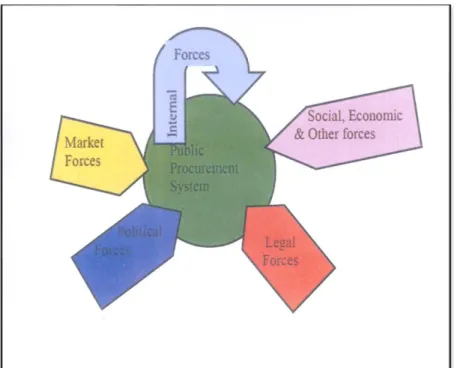
The environment of the public procurement system must be considered. Khi V. Thai has said that a further factor in relation to public procurement is the ability of a public procurement system to meet and accomplish policies and goals and therefore is influenced by an environment.109 The factors cited in support of this proposition are:
• Market factors including the maximisation of competition • The internal environment
• The legal environment and framework • The political environment
• Social, socio-economic and environmental factors
108 Sue Arrowsmith, ‘Public Procurement: Basic Concepts and the Coverage of Procurement Rules’ in
Sue Arrowsmith (ed), Public Procurement Regulation: An Introduction (University of Nottingham 2010).
Figure 1.1 The Environment of the Public Procurement System110
The model covering the environment of public procurement systems was initially founded upon the Public Procurement Framework operated in the USA, however the factors stated can apply to most public procurement systems although some countries such as the USA have a greater legal environment with hard law with statutes and regulations that govern all aspects of business and public procurement activities as compared with other countries that have less hard law with soft law applications, examples being the UK and EU systems although the regulation operated by the UK and EU are still complex and inflexible.
A further difference between public sector and private sector procurement relates to the nature of the systems to be operated and the existence of different objectives which then must be considered against the system or systems to be selected to meet the requirements of public sector procurement.
It is clear that public sector procurement is more challenging to work with and it should be developed further to deal adequately with the complexities of public procurement.111
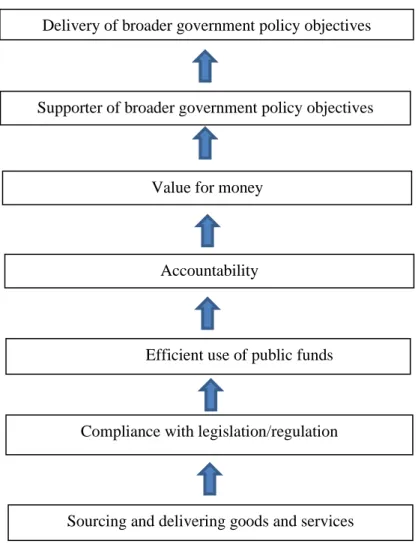
1.4.4 The objectives of public procurement systems, rules and regulations.
The contents of this section play an important role in the contribution to the research questions as the objectives of public procurement and public procurement systems which should be fully considered in the delivery of public procurement. It is therefore critical that each of the stated objectives and their relationship with each other are understood by all those involved in public procurement and compliance with procurement rules. A failure therefore to understand and apply such objectives can result in poor procurement and a range of factors I have found in practice and which I have cited in Chapter 2.
In practice there are several the objectives of public procurement which have been identified and shared by most of the systems of public procurement. Objectives are implemented through legal and regulatory rules which cover the procedures for conducting public procurement, however the design in drafting such objectives, their interpretation and the method of application have an impact on each other. Practitioners of public procurement often do not understand the rules and regulations and how they relate to each other and their relevance in the construction of particular procurements and systems. Although the public procurement rules and regulations do permit some discretion to be exercised, often problems occur when this discretion is exceeded with an impact on the procurement system being operated.
Several objectives have been identified that are usually shared by public procurement systems and eight of these objectives have been identified by practitioners.112 Although individual objectives may differ according to the actual procurement system adopted, the main eight objectives are:
111 Kishor Vadiya, A.S.M. Sajeev and Guy Callender, E-procurement initiatives in the public sector: An
investigation into the critical success factor (Proceedings of the 13th Annual IPSERA Conference, Catonia. p
C325-340, 2004).
112 Sue Arrowsmith, ‘Public Procurement: Basic Concepts and the Coverage of Procurement Rules’ in