ARM
®Cortex
™-A Series
Version: 4.0
ARM Cortex-A Series
Programmer’s Guide
Copyright © 2011 – 2013 ARM. All rights reserved.
Release Information
The following changes have been made to this book.
Proprietary Notice
This Cortex-A Series Programmer’s Guide is protected by copyright and the practice or implementation of the information herein may be protected by one or more patents or pending applications. No part of this Cortex-A Series Programmer’s Guide may be reproduced in any form by any means without the express prior written permission of ARM. No license, express or implied, by estoppel or otherwise to any intellectual property rights is granted by this Cortex-A Series Programmer’s Guide.
Your access to the information in this Cortex-A Series Programmer’s Guide is conditional upon your acceptance that you will not use or permit others to use the information for the purposes of determining whether implementations of the information herein infringe any third party patents.
This Cortex-A Series Programmer’s Guide is provided “as is”. ARM makes no representations or warranties, either express or implied, included but not limited to, warranties of merchantability, fitness for a particular purpose, or non-infringement, that the content of this Cortex-A Series Programmer’s Guide is suitable for any particular purpose or that any practice or implementation of the contents of the Cortex-A Series Programmer’s Guide will not infringe any third party patents, copyrights, trade secrets, or other rights.
This Cortex-A Series Programmer’s Guide may include technical inaccuracies or typographical errors.
To the extent not prohibited by law, in no event will ARM be liable for any damages, including without limitation any direct loss, lost revenue, lost profits or data, special, indirect, consequential, incidental or punitive damages, however caused and regardless of the theory of liability, arising out of or related to any furnishing, practicing, modifying or any use of this Programmer’s Guide, even if ARM has been advised of the possibility of such damages. The information provided herein is subject to U.S. export control laws, including the U.S. Export Administration Act and its associated regulations, and may be subject to export or import regulations in other countries. You agree to comply fully with all laws and regulations of the United States and other countries (“Export Laws”) to assure that neither the information herein, nor any direct products thereof are; (i) exported, directly or indirectly, in violation of Export Laws, either to any countries that are subject to U.S. export restrictions or to any end user who has been prohibited from participating in the U.S. export transactions by any federal agency of the U.S. government; or (ii) intended to be used for any purpose prohibited by Export Laws, including, without limitation, nuclear, chemical, or biological weapons proliferation. Words and logos marked with ® or ™ are registered trademarks or trademarks of ARM Limited, except as otherwise stated below in this proprietary notice. Other brands and names mentioned herein may be the trademarks of their respective owners.
Copyright © 2011 – 2013 ARM Limited, 110 Fulbourn Road Cambridge, CB1 9NJ, England
Figure 1-1 on page 1-2 is supplied courtesy of The Centre for Computing History , www.computinghistory.org.uk
This document is Non-Confidential but any disclosure by you is subject to you providing notice to and the acceptance by the recipient of, the conditions set out above.
In this document, where the term ARM is used to refer to the company it means “ARM or any of its subsidiaries as appropriate”.
Web Address
http://www.arm.com
Change history Date Issue Confidentiality Change
25 March 2011 A Non-Confidential First release
10 August 2011 B Non-Confidential Second release. Updated to include Virtualization, Cortex-A15 processor, and LPAE. Corrected and revised throughout
25 June 2012 C Non-Confidential Updated to include Cortex-A7 processor, and big.LITTLE. Index added. Corrected and revised throughout.
22 January 2014 D Non-Confidential Updated to include Cortex-A12 processor, Cache Coherent Interconnect, expanded GIC coverage, Multi-core processors, Corrected and revised throughout.
Contents
ARM Cortex-A Series Programmer’s Guide
Preface
Preface to the 4th Edition ... ix
Glossary ... x
Typographical conventions ... xiv
Feedback on this book ... xv
References ... xvi
Chapter 1
Introduction
1.1 History ... 1-2 1.2 System-on-Chip (SoC) ... 1-4 1.3 Embedded systems ... 1-5
Chapter 2
ARM Architecture and Processors
2.1 Architectural profiles ... 2-2 2.2 Architecture history and extensions ... 2-3 2.3 Processor properties ... 2-8 2.4 Cortex-A series processors ... 2-10 2.5 Key architectural points of ARM Cortex-A series processors ... 2-16
Chapter 3
ARM Processor Modes and Registers
3.1 Registers ... 3-6
Chapter 4
Introduction to Assembly Language
4.1 Comparison with other assembly languages ... 4-2 4.2 The ARM instruction sets ... 4-3
Contents
4.6 Identifying assembly code ... 4-12 4.7 Compatibility with ARMv8-A ... 4-13
Chapter 5
ARM/Thumb Unified Assembly Language Instructions
5.1 Instruction set basics ... 5-2 5.2 Data processing operations ... 5-6 5.3 Memory instructions ... 5-13 5.4 Branches ... 5-15 5.5 Saturating arithmetic ... 5-16 5.6 Miscellaneous instructions ... 5-17
Chapter 6
Floating-Point
6.1 Floating-point basics and the IEEE-754 standard ... 6-2 6.2 VFP support in GCC ... 6-8 6.3 VFP support in the ARM Compiler ... 6-9 6.4 VFP support in Linux ... 6-10 6.5 Floating-point optimization ... 6-11
Chapter 7
Introducing NEON
7.1 SIMD ... 7-2 7.2 NEON architecture overview ... 7-5 7.3 NEON C Compiler and assembler ... 7-11
Chapter 8
Caches
8.1 Why do caches help? ... 8-3 8.2 Cache drawbacks ... 8-4 8.3 Memory hierarchy ... 8-5 8.4 Cache architecture ... 8-6 8.5 Cache policies ... 8-13 8.6 Write and Fetch buffers ... 8-15 8.7 Cache performance and hit rate ... 8-16 8.8 Invalidating and cleaning cache memory ... 8-17 8.9 Point of coherency and unification ... 8-19 8.10 Level 2 cache controller ... 8-22 8.11 Parity and ECC in caches ... 8-23
Chapter 9
The Memory Management Unit
9.1 Virtual memory ... 9-3 9.2 The Translation Lookaside Buffer ... 9-4 9.3 Choice of page sizes ... 9-6 9.4 First level address translation ... 9-7 9.5 Level 2 translation tables ... 9-11 9.6 Memory attributes ... 9-14 9.7 Multi-tasking and OS usage of translation tables ... 9-17
Chapter 10
Memory Ordering
10.1 ARM memory ordering model ... 10-3 10.2 Memory barriers ... 10-6 10.3 Cache coherency implications ... 10-11
Chapter 11
Exception Handling
11.1 Types of exception ... 11-3 11.1.1 Exception priorities ... 11-6 11.2 Exception handling ... 11-10 11.3 Other exception handlers ... 11-12 11.4 Linux exception program flow ... 11-14
Contents
Chapter 12
Interrupt Handling
12.1 External interrupt requests ... 12-2 12.2 The Generic Interrupt Controller ... 12-7
Chapter 13
Boot Code
13.1 Booting a bare-metal system ... 13-2 13.2 Configuration ... 13-6 13.3 Booting Linux ... 13-7
Chapter 14
Porting
14.1 Endianness ... 14-2 14.2 Alignment ... 14-5 14.3 Miscellaneous C porting issues ... 14-7 14.4 Porting ARM assembly code to ARMv7-A ... 14-10 14.5 Porting ARM code to Thumb ... 14-11
Chapter 15
Application Binary Interfaces
15.1 Procedure Call Standard ... 15-2 15.2 Mixing C and assembly code ... 15-8
Chapter 16
Profiling
16.1 Profiler output ... 16-3
Chapter 17
Optimizing Code to Run on ARM Processors
17.1 Compiler optimizations ... 17-2 17.2 ARM memory system optimization ... 17-7 17.3 Source code modifications ... 17-12
Chapter 18
Multi-core processors
18.1 Multi-processing ARM systems ... 18-3 18.2 Symmetric multi-processing ... 18-5 18.3 Asymmetric multi-processing ... 18-7 18.4 Heterogeneous multi-processing ... 18-8 18.5 Cache coherency ... 18-9 18.6 TLB and cache maintenance broadcast ... 18-13 18.7 Handling interrupts in an SMP system ... 18-14 18.8 Exclusive accesses ... 18-15 18.9 Booting SMP systems ... 18-17 18.10 Private memory region ... 18-19
Chapter 19
Parallelizing Software
19.1 Amdahl’s law ... 19-2 19.2 Decomposition methods ... 19-3 19.3 Threading models ... 19-5 19.4 Threading libraries ... 19-6 19.5 Performance issues ... 19-9 19.6 Synchronization mechanisms in the Linux kernel ... 19-11 19.7 Profiling in SMP systems ... 19-13
Chapter 20
Power Management
20.1 Idle management ... 20-3 20.2 Hotplug ... 20-6 20.3 Dynamic Voltage and Frequency Scaling ... 20-7 20.4 Assembly language power instructions ... 20-8
Contents
Chapter 22
Virtualization
22.1 ARMv7-A Virtualization Extensions ... 22-3 22.2 Hypervisor software ... 22-6 22.3 Relationship between virtualization and ARM Security Extensions ... 22-9 22.4 Large Physical Address Extensions ... 22-10
Chapter 23
big.LITTLE
23.1 Structure of a big.LITTLE system ... 23-2 23.2 Software execution models in big.LITTLE ... 23-4 23.3 big.LITTLE MP ... 23-7 23.4 Using big.LITTLE ... 23-10
Chapter 24
Debug
24.1 ARM debug hardware ... 24-2 24.2 ARM trace hardware ... 24-4 24.3 Debug monitor ... 24-7 24.4 Debugging Linux applications ... 24-8 24.5 DS-5 debug and trace ... 24-10
Appendix A
Instruction Summary
A.1 Instruction Summary ... A-2
Appendix B
Tools, Operating Systems and Boards
B.1 Linux distributions ... B-2 B.2 Useful tools ... B-5 B.3 Software toolchains for ARM processors ... B-7 B.4 ARM DS-5 ... B-10 B.5 Example platforms ... B-12
Appendix C
Building Linux for ARM Systems
C.1 Building the Linux kernel ... C-2 C.2 Creating the Linux filesystem ... C-6 C.3 Putting it together ... C-8
Preface
It is estimated that the number of mobile phones in the world will exceed the human population sometime in 2014. It is also estimated that over 90% of all these mobile devices have an ARM processor inside them.
This book provides an introduction to ARM technology for programmers using ARM Cortex-A series processors conforming to the ARMv7–A architecture. The book is meant to complement rather than replace other ARM documentation available for Cortex-A series processors, such as the ARM Technical Reference Manuals (TRMs) for the processors themselves, documentation for individual devices or boards or, most importantly, the ARM® Architecture Reference Manual (the
ARM ARM).
The purpose of this book is to provide a single guide for programmers who want to develop applications for the Cortex-A series of processors, bringing together information from a wide variety of sources that will be useful to both assembly language and C programmers. Hardware concepts such as caches and Memory Management Units are covered, but only where this is valuable to the application writer. We will also look at the way operating systems such as Linux make use of ARM features, and how to take full advantage of the capabilities of the ARM processor, in particular writing software for multi-core processors.
Although much of the content of this book is also applicable to older ARM processors, it does not explicitly cover processors that implement older versions of the Architecture. The Cortex-R series and M-series processors are mentioned but not described. Our intention is to provide an
approachable introduction to the ARM architecture, covering the feature set in detail and providing practical advice on writing both C and assembly language programs to run efficiently on a Cortex-A series processor.
Preface
book we focus on the ARM-specific detail. We do not assume the use of any particular tool chain. We will mention both GNU and ARM tools in the course of the book. We hope that the book is suitable for programmers who have a desktop PC or x86 background and are taking their first steps into the ARM processor based world.
The first chapters of the book cover the basic features of the ARM Cortex-A series processors. An introduction to the fundamentals of the ARM architecture, covering the various registers, and modes and some background on individual processors is provided in Chapter 2 and 3. Chapters 4 and 5 provide a brisk introduction to ARM assembly language programming, and assembly language instructions. We look at floating-point and the ARM Advanced SIMD extensions (NEON™) in Chapters 6 and 7. These chapters are only an introduction to the relevant topics. We then switch our focus to the memory system and look at Caches, Memory
Management and Memory Ordering in Chapters 8, 9 and 10. Dealing with exceptions and interrupts are covered in Chapters 11 and 12.
The remaining chapters of the book provide more advanced programming information. Chapter 13 provides an overview of boot code. Chapter 14 looks at issues with porting C and assembly code to the ARMv7 architecture, from other architectures and from older versions of the ARM architecture. Chapter 15 covers the Application Binary Interface, knowledge of which is useful to both C and assembly language programmers. Profiling and optimizing of code is covered in Chapters 16 and 17. Many of the techniques presented are not specific to the ARM architecture, but we also provide some processor-specific hints.
Chapters 18 and 19 cover the area of multi-core processors. We take a detailed look at how these are implemented by ARM and how you can write code to take advantage of them. Power management is an important part of ARM programming and is covered in Chapter 20. The final chapters of the book provide a brief coverage of the ARM Security Extensions (TrustZone®) in Chapter 21, the ARM Virtualization extensions in Chapter 22, big.LITTLE™ technology in Chapter 23, and the hardware debug features available to programmers in Chapter 24. Appendix A gives a summary of the available ARM instructions. Appendix B gives a brief introduction to some of the tools and platforms available to those getting started with ARM programming, and Appendix C gives step-by-step instructions for configuring and building Linux for ARM systems.
Preface
Preface to the 4th Edition
The ARM architecture continues to evolve. ARM recently announced the ARMv8 architecture, which, although not covered by this book, has influenced its content. Small changes have been made to the ARMv7 instruction set architecture for compatibility reasons. Those changes are included in this version. We have also taken advantage of the opportunity to carry out a general revision of the contents of the Guide.
You will find some sections moved, some extensively rewritten, and some with minor changes. Chapters that covered the same areas have been combined. The chapter on Registers has been largely rewritten, to include the effects of the Security and Virtualization Extensions and the introduction of Privilege levels. The chapters on Exception Handling have been consolidated, so that they now tell a coherent story. A similar approach has been applied to multiprocessing, and parallelization. In all cases, what was two chapters is now one, with the contents updated. LPAE is now covered in the chapter on Virtualization. The chapter on Tools, Operating Systems and Boards has been moved to the Appendices, while the chapter on big.LITTLE technology has been extensively revised to keep pace with rapidly changing technology.
ARM has added another processor to the ARMv7 Cortex-A series, and the new Cortex-A12 processor is covered in this new edition. You will also notice that what we call the devices has changed. Processor now refers to the marketed device, such as the Cortex-A15 processor, elsewhere you will find references to cores, and clusters (of cores).
Some content that existed in the previous editions of the Cortex™-A Series Programmer’s Guide
has been removed. You will notice that the NEON/VFP Appendix and the chapter on Writing NEON Code have been removed. We originally said that the information on NEON would need a book of its own. It now has one, in the form of the ARM® NEON™ Programmer’s Guide.
Additional information has also been provided in the form of programming hints and tips, for developers using the Cortex-A series processors. While these cannot cover every eventuality that the developer might encounter we hope that the examples included will prove useful. The ARM® Cortex™-A Series Programmer’s Guide has proved to be a very popular addition to
the ARM documentation set, and now also forms the reference textbook for the ARM Accredited Engineer (AAE) examinations.
Preface
Glossary
Abbreviations and terms used in this document are defined here. AAPCS ARM Architecture Procedure Call Standard.
ABI Application Binary Interface.
ACP Accelerator Coherency Port.
AEABI ARM Embedded ABI.
AHB Advanced High-Performance Bus.
AMBA® Advanced Microcontroller Bus Architecture.
AMP Asymmetric Multi-Processing.
APB Advanced Peripheral Bus.
ARM ARM The ARM Architecture Reference Manual. ASIC Application Specific Integrated Circuit. APSR Application Program Status Register.
ASID Address Space ID.
ATPCS ARM Thumb® Procedure Call Standard.
AXI Advanced eXtensible Interface.
BE8 Byte Invariant Big-Endian Mode.
BIU Bus Interface Unit.
BSP Board Support Package.
BTAC Branch Target Address Cache.
BTB Branch Target Buffer.
CISC Complex Instruction Set Computer.
CP15 Coprocessor 15. System control coprocessor. CPSR Current Program Status Register.
DAP Debug Access Port.
DBX Direct Bytecode Execution.
DDR Double Data Rate (SDRAM).
DMA Direct Memory Access.
DMB Data Memory Barrier.
DPU Data Processing Unit.
DS-5™ The ARM Development Studio.
DSB Data Synchronization Barrier.
Preface
DSTREAM® An ARM debug and trace unit. DVFS Dynamic Voltage/Frequency Scaling.
EABI Embedded ABI.
ECC Error Correcting Code.
ECT Embedded Cross Trigger.
EOF End Of File.
ETB Embedded Trace Buffer™.
ETM Embedded Trace Macrocell™.
FDT Flattened Device Tree.
FIQ An interrupt type (formerly fast interrupt).
FPSCR Floating-Point Status and Control Register.
GCC GNU Compiler Collection.
GIC Generic Interrupt Controller.
GIF Graphics Interchange Format.
GPIO General Purpose Input/Output.
Gprof GNU profiler.
Harvard architecture
Architecture with physically separate storage and signal pathways for instructions and data.
HCR Hyp Configuration Register.
HMP Heterogenous Multi-Processing.
ICU Instruction Cache Unit.
IDE Integrated development environment.
I/F Interface (abbreviation used in some diagrams).
IPA Intermediate Physical Address.
IRQ Interrupt Request (normally external interrupts).
ISA Instruction Set Architecture.
ISB Instruction Synchronization Barrier.
ISR Interrupt Service Routine.
Jazelle™ The ARM bytecode acceleration technology.
JIT Just In Time.
Preface
MESI A cache coherency protocol with four states; Modified, Exclusive, Shared and Invalid.
MMU Memory Management Unit.
MOESI A cache coherency protocol with five states; Modified, Owned, Exclusive, Shared and Invalid.
MPU Memory Protection Unit.
MSB Most Significant Bit.
NEON™ The ARM Advanced SIMD Extensions.
NMI Non-Maskable Interrupt.
Normal world The execution environment when the core is in the Non-secure state. Oprofile A Linux system profiler.
QEMU A processor emulator.
PCI Peripheral Component Interconnect. A computer bus standard.
PCS Procedure Call Standard.
PFU Prefetch Unit.
PIPT Physically Indexed, Physically Tagged.
PLE Preload Engine.
PLI Preload Instruction.
PMU Performance Monitor Unit.
PoC Point of Coherency.
PoU Point of Unification.
PPI Private Peripheral Input.
Privilege The ability to perform certain tasks that cannot be done from User (Unprivileged) mode.
PSCI Power State Coordination Interface.
PSR Program Status Register.
RCT Runtime Compiler Target.
RISC Reduced Instruction Set Computer.
RVCT RealView® Compilation Tools (the “ARM Compiler”). SBZP Should Be Preserved.
SCU Snoop Control Unit.
Secure world The execution environment when the core is in the Secure State.
SGI Software Generated Interrupt.
SIMD Single Instruction, Multiple Data.
Preface
SMP Symmetric Multi-Processing.
SoC System on Chip.
SP Stack Pointer.
SPI Shared Peripheral Interrupt.
SPSR Saved Program Status Register. Streamline A graphical performance analysis tool.
SVC Supervisor Call instruction. (Previously SWI)
SWI Software Interrupt instruction. (Replaced with SVC)
SYS System Mode.
TAP Test Access Port (JTAG Interface).
TDMI® Thumb, Debug, Multiplier, ICE.
TEX Type Extension.
Thumb® An instruction set extension to ARM.
Thumb-2 A technology extending the Thumb instruction set to support both 16-bit and 32-bit instructions.
TLB Translation Lookaside Buffer.
TLS Thread Local Storage.
TrustZone The ARM security extension.
TTB Translation Table Base.
TTBR Translation Table Base Register.
UAL Unified Assembly Language.
UART Universal Asynchronous Receiver/Transmitter. UEFI Unified Extensible Firmware Interface. U-Boot A Linux Bootloader.
UNK Unknown.
USR User mode, a non-privileged processor mode.
VFP The ARM floating-point instruction set. Before ARMv7, the VFP
extension was called the Vector Floating-Point architecture, and was used for vector operations.
VIC Vectored Interrupt Controller.
VIPT Virtually Indexed, Physically Tagged. VMID Virtual Machine ID.
Preface
Typographical conventions
This book uses the following typographical conventions:
italic Highlights important notes, introduces special terminology, denotes internal cross-references, and citations.
bold Used for terms in descriptive lists, where appropriate.
monospace Denotes text that you can enter at the keyboard, such as commands, file
and program names, instruction names, parameters and source code. monospaceitalic Denotes arguments to monospace text where the argument is to be
replaced by a specific value.
< and > Enclose replaceable terms for assembler syntax where they appear in code or code fragments. For example:
Preface
Feedback on this book
We have tried to ensure that the Cortex-A Series Programmer’s Guide is both easy to read and still covers the material in enough depth to provide the comprehensive introduction to using the processors that we originally intended.
If you have any comments on this book, don’t understand our explanations, think something is missing, or think that it is incorrect, send an e-mail to [email protected]. Give:
• The title, The Cortex-A Series Programmer’s Guide.
• The number, ARM DEN0013D.
• The page number(s) to which your comments apply. • What you think needs to be changed.
Preface
References
Cohen, D. “On Holy Wars and a Plea for Peace”, USC/ISI IEN April, 1980 http://www.ietf.org/rfc/ien/ien137.txt.
Furber, Steve. “ARM System-on-chip Architecture”, 2nd edition, Addison-Wesley, 2000, ISBN: 9780201675191.
Hohl, William. “ARM Assembly Language: Fundamentals and Techniques” CRC Press, 2009. ISBN: 9781439806104.
Sloss, Andrew N.; Symes, Dominic.; Wright, Chris. “ARM System Developer's Guide: Designing and Optimizing System Software”, Morgan Kaufmann, 2004, ISBN: 9781558608740.
ANSI/IEEE Std 754-1985, “IEEE Standard for Binary Floating-Point Arithmetic”. ANSI/IEEE Std 754-2008, “IEEE Standard for Binary Floating-Point Arithmetic”. ANSI/IEEE Std 1003.1-1990, “Standard for Information Technology - Portable Operating System Interface (POSIX) Base Specifications, Issue 7”.
ANSI/IEEE Std 1149.1-2001, “IEEE Standard Test Access Port and Boundary-Scan Architecture”.
ANSI/IEEE Std 1275-1994, “IEEE Standard for Boot Firmware (Initialization Configuration) Firmware: Core Requirements and Practices”.
The ARM® Architecture Reference Manual (known as the ARM ARM) is a must-read for any
serious ARM programmer. It is available (after registration) from the ARM web site. It fully describes the ARMv7 instruction set architecture, programmer’s model, system registers, debug features and memory model. It forms a detailed specification to which all implementations of ARM processors must adhere.
References to the ARM® Architecture Reference Manual in this document are to:
ARM® Architecture Reference Manual - ARMv7-A and ARMv7-R edition(ARM DDI 0406).
Note
In the event of a contradiction between this book and the ARM ARM, the ARM ARM is definitive and must take precedence. In most instances, however, the ARM ARM and the Cortex-A Programmer’s Guide cover two separate world views. The ARM ARM is for processor implementers, while this book is for processor users. The most likely scenario is that this book will describe something in a way that does not cover all architecturally permitted behaviors, or rewords an abstract concept in more practical terms.
ARM® Generic Interrupt Controller Architecture Specification version 2.0 (ARM IHI 0048).
ARM® Compiler Toolchain Assembler Reference (DUI 0489).
ARM® C Language Extensions (IHI 0053).
ARM® NEON™ Programmer’s Guide (DEN 0018).
Procedure Call Standard for the ARM® Architecture (ARM IHI 0042).
Preface
The individual processor Technical Reference Manuals provide a detailed description of the processor behavior. They can be obtained from the ARM web site documentation area http://infocenter.arm.com.
Chapter 1
Introduction
You can find ARM processors everywhere. More than 10 billion ARM processor based devices had been manufactured by the end of 2008. At the end of 2013, over 52 billion ARM processors had been shipped. It is likely that readers of this book own at least one product containing ARM processor based devices – a mobile phone, tablet device, personal computer, television or even a car. It might come as a surprise to programmers more used to the personal computer to learn that the highly successful x86 architecture occupies a much smaller position in terms of total microprocessor shipments, with over three billion devices.
The ARM architecture has advanced significantly since the first ARM1 silicon in 1985. ARM produces a whole family of processors that share common instruction sets and programmer’s models and have some degree of backward compatibility.
Introduction
1.1
History
The first ARM processor, the ARM1, was designed at Acorn Computers Limited by a team led by Sophie Wilson and Steve Furber, with the first silicon (which worked first time!) produced in April 1985. The ARM1 was quickly replaced by the ARM2, which added multiplier hardware, and was used in real systems, including the Acorn Archimedes personal computer.
Photograph courtesy of The Centre for Computing History, www.computinghistory.org.uk Figure 1-1 Acorn Archimedes
ARM as a separate company was formed in Cambridge, England in November 1990, as Advanced RISC Machines Ltd. It was a joint venture between Apple Computers, Acorn Computers and VLSI Technology and has outlived two of its parents. The original 12 employees came mainly from the team within Acorn Computers. One reason for spinning ARM off as a separate company was that the processor had been selected by Apple Computers for use in its Newton product.
Introduction
Figure 1-2 The Apple Newton
The new company quickly decided that the best way forward for their technology was to license their Intellectual Property (IP). Instead of designing, manufacturing and selling the chips themselves, they would sell rights to their designs to semiconductor companies. These companies would design the ARM processor into their own products, in a partnership model. This IP licensing business is how ARM continues to operate today. ARM was able to sign up licensees, with Sharp, Texas Instruments and Samsung prominent names among the first customers. In 1998, ARM floated on the London Stock Exchange and Nasdaq. At the time of writing, ARM has over 2000 employees and has expanded somewhat from its original remit of processor design. ARM also licenses Physical IP – libraries of cells (NAND gates, RAM and so forth), graphics and video accelerators and software development products such as compilers, debuggers and development boards.
Introduction
1.2
System-on-Chip (SoC)
Designers today can assemble computer chips containing a billion or more transistors. Designing and verifying such complex circuits has become an extremely difficult task. It is increasingly rare for all of the parts of such systems to be designed by a single company. In response to this, ARM and other semiconductor IP companies design and verify components (so-called IP blocks or processors). These are licensed by semiconductor companies who use these blocks in their own designs and include microprocessors, DSPs, 3D graphics and video controllers, along with many other functions.
The semiconductor companies take these blocks and include many other parts to create a complete system on the chip, forming a System-on-Chip (SoC). The architects must select the appropriate core(s), memory controllers, on-chip memory, peripherals, bus interconnect and other logic (perhaps including analog or radio frequency components), in order to produce a system.
Application Specific Integrated Circuit (ASIC) is another term that we will use in the book. This is an Integrated Circuit design that is specific to a particular application. An ASIC might well contain an ARM core, memory and other components. Clearly there is a large overlap between ASICs and SoCs. The term SoC usually refers to a device with a higher degree of integration, including many of the parts of the system in a single device, possibly including analog, mixed-signal or radio frequency circuits.
Semiconductor companies investing tens of millions of dollars to create these devices will normally invest a great deal in software to run on their platform. It would be uncommon to produce a complex system with a powerful processor without at least having ported one or more operating systems to it and written device drivers for peripherals.
Of course, operating systems like Linux require significant amounts of memory to run, more than is usually possible on a single silicon device. The term System-on-Chip is therefore not always entirely accurate, because the SoC does not always contain the whole system. Apart from the issue of silicon area, it is also often the case that many useful parts of a system require specialist silicon manufacturing processes that preclude them from being placed on the same die.
Introduction
1.3
Embedded systems
An embedded system is conventionally defined as a piece of computer hardware running software designed to perform a specific task. Examples of such systems might be TV set-top boxes, smartcards, routers, disk drives, printers, automobile engine management systems, MP3 players or photocopiers. These contrast with what is generally considered a computer system, that is, one that runs a wide range of general purpose software and possesses input and output devices such as a keyboard, and a graphical display of some kind.
This distinction is becoming increasingly blurred. Consider the cellular or mobile phone. A basic model might only perform the task of making phone calls, but modern smartphones can run a complex operating system to which many thousands of applications are available for download.
Embedded systems can contain very simple 8-bit microprocessors, such as an Intel 8051 or PIC micro-controllers, or some of the more complex 32 or 64-bit processors, such as the ARM family described in this book. They require RAM and some form of non-volatile storage to hold the program(s) to be executed by the system. Systems will almost always have additional peripherals, relating to the actual function of the device – typically including UARTs, interrupt controllers, timers, GPIO controllers, but also potentially quite complex blocks such as GPUs, or DMA controllers.
Software running on such systems is typically grouped into two separate parts: the Operating System (OS) and applications that run on top of the OS. In this book, we will concentrate mainly on examples from Linux. The source code for Linux is readily available for inspection by the reader and is likely to be familiar to many programmers. Nevertheless, lessons learned from Linux are equally applicable to other operating systems.
Memory Footprint
In many systems, to minimize cost (and power), memory size can be limited. You might be forced to consider the size of the program and how to reduce memory usage while it runs.
Real-time behavior
A feature of certain systems is that there are deadlines to respond to external events. This might be a “hard” requirement (a car braking system must respond within a certain time) or “soft” requirement (audio processing must complete within a certain time-frame to avoid a poor user experience – but failure to do so under rare circumstances might not render the system worthless).
Power In many embedded systems the power source is a battery, and programmers and hardware designers must take great care to minimize the total energy usage of the system. This can be done, for example, by slowing the clock, reducing supply voltage or switching off the core when there is no work to be done.
Cost Reducing the bill of materials can be a significant constraint on system design. Time to market
In competitive markets, the time to develop a working product can significantly impact the success of that product.
Chapter 2
ARM Architecture and Processors
ARM does not manufacture silicon devices. Instead, ARM creates microprocessor designs, that are licensed to semiconductor companies and OEMs, who then integrate them into System-on-Chip devices.
To ensure compatibility between implementations, ARM defines architecture specifications that define how compliant products must behave. Processors implementing the ARM architecture conform to a particular version of the architecture.
The ARM architecture supports implementations across a very wide range of performance points. Its simplicity leads to very small implementations, and this enables very low power consumption. The Cortex-A series processors covered in this book conform to the ARMv7-A architecture. There might also be multiple processors with different internal implementations and micro-architectures, different cycle timings and clock speeds that conform to the same version of the architecture, in that they execute the ARM instruction set defined for the architecture and pass the ARM Validation System tests.
ARM Architecture and Processors
2.1
Architectural profiles
Periodically, new versions of the architecture are announced by ARM. These add new features or make changes to existing behaviors. Such changes are almost always backwards compatible, meaning that user code that ran on older versions of the architecture will continue to run correctly on new versions. Of course, code written to take advantage of new features will not run on older processors that lack these features.
In all versions of the architecture, some system features and behaviors are left as
implementation-defined. For example, the architecture does not define cache sizes or cycle timings for individual instructions. These are determined by the individual core and SoC. Each architecture version can also define optional extensions. These might be implemented in a particular implementation of a processor. For example, in the ARMv7 architecture, the Advanced SIMD (NEON) technology is available as an optional extension, and is described in Chapter 7 Introducing NEON.
The ARMv7 architecture also has the concept of profiles. These are variants of the architecture describing processors targeting different markets and usages.
The profiles are as follows:
A The Application profile defines an architecture aimed at high performance processors, supporting a virtual memory system using a Memory Management Unit (MMU) and therefore capable of running fully featured operating systems. Support for the ARM and Thumb instruction sets is provided.
ARMv7-A, the Application profile, is implemented by all Cortex-A series processors, and by processors developed by companies who have licensed the ARM architecture. At the beginning of 2014, just under three billion Cortex-A Series chips had been shipped.
The ARMv8-A architecture, which is not described in this book, supports the AArch32 state, a 32-bit implementation of the architecture that is backwards compatible with ARMv7-A.
R The Real-time profile defines an architecture aimed at systems that require deterministic timing and low interrupt latency. There is no support for a virtual memory system, but memory regions can be protected using a simple Memory Protection Unit (MPU).
M The Microcontroller profile defines an architecture aimed at low cost systems, where low-latency interrupt processing is vital. It uses a different exception handling model to the other profiles and supports only a variant of the Thumb instruction set.
ARM Architecture and Processors
2.2
Architecture history and extensions
The ARM architecture changed relatively little between the first test silicon in the mid-1980s through to the first ARM6 and ARM7 devices of the early 1990s. In the first version of the architecture, the majority of the load, store and arithmetic operations along with the exception model and register set was implemented by the ARM1. Version 2 added multiply and
multiply-accumulate instructions and support for coprocessors, plus other innovations. These early processors only supported 26-bits of address space. Version 3 of the architecture separated the program counter and program status registers and added several new modes, enabling support for 32-bits of address space. Version 4 adds support for halfword load and store operations and an additional kernel-level privilege mode. Readers unfamiliar with the ARM architecture should not worry if parts of this description use terms they have not met, because all of these topics are covered in the following chapters.
The ARMv4T architecture, which introduced the Thumb (16-bit) instruction set, was
implemented by the ARM7TDMI® and ARM9TDMI® processors, products that have shipped in their billions.
The ARMv5TE architecture added improvements for DSP-type operations and saturated arithmetic and to ARM/Thumb interworking.
ARMv6 made a number of enhancements, including support for unaligned memory accesses, significant changes to the memory architecture and for multi-core support, plus some support for SIMD operations operating on bytes or halfwords within the 32-bit registers. It also provided a number of optional extensions, notably Thumb-2 and Security Extensions (TrustZone). Thumb-2 extends Thumb to be a mixed length (16-bit and 32-bit) instruction set.
The ARMv7-A architecture makes the Thumb-2 extensions mandatory and adds the Advanced SIMD extensions (NEON), described in Chapter 7.
For a number of years, ARM adopted a sequential numbering system for processors with ARM9 following ARM8, that came after ARM7. Various numbers and letters were appended to the base family to denote different variants. For example, the ARM7TDMI processor has T for Thumb, D for Debug, M for a fast multiplier and I for EmbeddedICE.
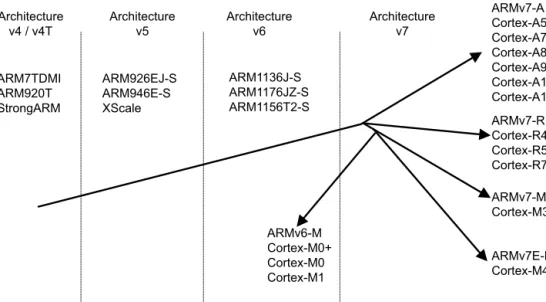
For the ARMv7 architecture, ARM Limited adopted the brand name Cortex for its processors, with a supplementary letter indicating which of the three profiles (A, R, or M) the processor supports. Figure 2-1 on page 2-4 shows how different versions of the architecture correspond to different processor implementations. The figure is not comprehensive and does not include all architecture versions or processor implementations.
ARM Architecture and Processors
Figure 2-1 Architecture and processors
In Figure 2-2, we show the development of the architecture over time, illustrating additions to the architecture at each new version. Almost all architecture changes are backwards-compatible, meaning software written for the ARMv4T architecture can still be used on ARMv7 processors.
Figure 2-2 Architecture history
Individual chapters of this book will cover these topics in greater detail, but here we will briefly introduce a number of architecture elements.
Architecture
v4 / v4T Architecturev5 Architecturev6 Architecturev7 ARM7TDMI ARM920T StrongARM ARM926EJ-S ARM946E-S XScale ARM1136J-S ARM1176JZ-S ARM1156T2-S ARMv7-A Cortex-A5 Cortex-A7 Cortex-A8 Cortex-A9 Cortex-A12 Cortex-A15 ARMv7-R Cortex-R4 Cortex-R5 Cortex-R7 ARMv7-M Cortex-M3 ARMv6-M Cortex-M0+ Cortex-M0 Cortex-M1 ARMv7E-M Cortex-M4 4T 5 6 7
Halfword and signed halfword/byte support System mode Thumb instruction set Improved ARM/Thumb Interworking CLZ Saturated arithmetic DSP multiply-accumulate Instructions Extensions: Jazelle (v5TEJ) SIMD instructions Multi-processing TrustZone v6 memory architecture Unaligned data support Extensions: Thumb-2 (v6T2) TrustZone (v6Z) Multiprocessor (v6K) Thumb only (v6-M) Thumb-2 technology NEON Profiles: v7-A (Applications) NEON LPAE Virtualization v7-R (Real-time) Hardware divide NEON v7-M (Microcontroller) Hardware divide Thumb only Floating-point
ARM Architecture and Processors
2.2.1 DSP multiply-accumulate and saturated arithmetic instructions
These instructions, added in the ARMv5TE architecture, improve the capability for digital signal processing and multimedia software and are denoted by the letter E. The new instructions provide many variations of signed multiply-accumulate, saturated add and subtract, and count leading zeros and are present in all later versions of the architecture. In many cases, this made it possible to remove a simple separate DSP from the system.
2.2.2 Jazelle
Jazelle-DBX (Direct Bytecode eXecution) was introduced in ARMv5TEJ to accelerate Java performance while conserving power. A combination of increased memory availability and improvements in Just-In-Time (JIT) compilers have subsequently reduced its value in application processors. For this reason, many ARMv7-A processors do not implement this hardware acceleration.
Jazelle-DBX is best suited to providing high performance Java in systems with very limited memory (for example, feature phone or low-cost embedded use). In today’s systems, it is mainly used for backwards compatibility.
2.2.3 Thumb Execution Environment (ThumbEE)
Introduced in ARMv7-A, ThumbEE is sometimes referred to as Jazelle-RCT (Runtime Compilation Target). It involves small changes to the Thumb instruction set that make it a better target for code generated at runtime in controlled environments, for example, by managed languages like Java, Dalvik, C#, Python or Perl.
ThumbEE is designed to be used by Just-In-Time (JIT) or Ahead-Of-Time (AOT) compilers, where it can reduce the code size of recompiled code. The use of ThumbEE is now deprecated by ARM.
2.2.4 Thumb
The ARMv7 architecture contains two main instruction sets, the ARM and Thumb instruction sets. Much of the functionality available is identical in the two instruction sets. The Thumb instruction set is a subset of the most commonly used 32-bit ARM instructions. Thumb instructions are each 16 bits long, and have a corresponding 32-bit ARM instruction that has the same effect. The main reason for using Thumb code is to reduce code density. Because of its improved density, Thumb code tends to cache better than the equivalent ARM code and can reduce the amount of memory required.. You can still use the ARM instruction set and you may want to, for particular code sections which require the highest performance. See The ARM instruction sets on page 4-3.
2.2.5 Thumb-2
Despite continued rumours to the contrary, there is no such thing as a Thumb-2 instruction set. Thumb-2 technology was introduced in ARMv6T2, and is required in ARMv7. This technology extends the original 16-bit Thumb instruction set to include 32-bit instructions. The range of 32-bit Thumb instructions included in ARMv6T2 permits Thumb code to achieve performance similar to ARM code, with code density better than that of the purely 16-bit Thumb code.
ARM Architecture and Processors
2.2.6 Security Extensions (TrustZone)
The optional Security Extensions referred to as TrustZone introduced with ARMv6K have been implemented in all ARM Cortex-A processors. TrustZone provides a separate Secure world to isolate sensitive code and data from the normal world that contains the operating system and applications. The software in the Secure world is therefore intended to provide security services to the Normal (non-secure) world applications. TrustZone is described in Chapter 21.
2.2.7 VFP
Before ARMv7, the VFP extension was called the Vector Floating-Point Architecture, and supported vector operations. VFP is an extension that implements single-precision and optionally, double-precision floating-point arithmetic, compliant with the ANSI/IEEE Standard for Floating-Point Arithmetic.
2.2.8 Advanced SIMD (NEON)
The ARM NEON technology provides an implementation of the Advanced SIMD instruction set, with separate register files (shared with VFP). Some implementations have a separate NEON pipeline back-end. It supports 8, 16, 32 and 64-bit integer, and single-precision (32-bit) floating-point data, that can be operated on as vectors in 64-bit and 128-bit registers. NEON is described in Chapter 7, and in the ARM® NEON™ Programmer’s Guide.
2.2.9 Coprocessors
The ARM architecture supports a way of extending the instruction set by using Coprocessors, to extend the functionality of an ARM processor. There are 16 coprocessors with numbers from 0 to 15, On earlier ARM cores, a dedicated hardware interface was provided to permit external coprocessors to be connected. On the Cortex-A series processors, only internal coprocessors are supported. These are CP15 (system control for such things as cache and MMU, CP14 for debug, and CP10 and 11 for NEON and VFP operations. Coprocessors are described in Registers on page 3-6. Coprocessor operations are described in Miscellaneous instructions on page 5-17.
2.2.10 Large Physical Address Extension (LPAE)
LPAE is optional in the v7-A architecture and is presently supported by the Cortex-A7, Cortex-A12, and Cortex-A15 processors. It enables 32-bit processors that are normally limited to addressing a maximum of 4GB of address space to access up to 1TB of address space by translating 32-bit virtual memory addresses into 40-bit physical memory addresses. See Large Physical Address Extensions on page 22-10.
2.2.11 Virtualization
The ARM Virtualization Extensions are optional extensions to the ARMv7-A architecture profile. The extensions support the use of a virtual machine monitor, known as the hypervisor, to switch from one operating system to another. When implemented in a single core or in a multi-core system, the Virtualization Extensions support running multiple virtual machines on a single cluster. See Chapter 22.
2.2.12 big.LITTLE
big.LITTLE processing was introduced in ARMv7 to enable devices to balance the
requirements for processing power and power efficiency. big.LITTLE uses a high performance cluster, such as the Cortex-A15 processor, coupled with an energy efficient cluster, such as the
ARM Architecture and Processors
Cortex-A7 processor. The “big” cluster can be utilized for heavy workloads, while the “LITTLE” cluster can take over for the majority of mobile device workloads. big.LITTLE is described in Chapter 23.
ARM Architecture and Processors
2.3
Processor properties
In this section, we consider some ARM processors and identify which processor implements which architecture version. In Cortex-A series processors on page 2-10 we take a slightly more detailed look at some of the individual processors that implement architecture version v7-A. Some terminology will be used in this chapter that might be unfamiliar to the first-time user of ARM processors and will not be explained until later in the book.
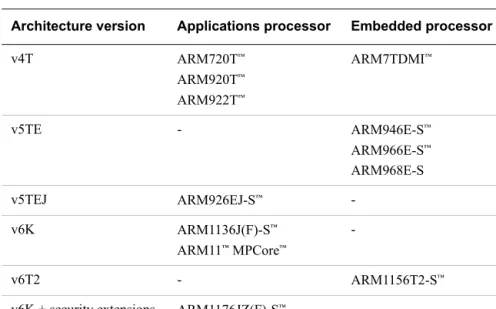
Table 2-1 lists the architecture version implemented by a number of older ARM processors.
Table 2-2 lists the architecture version implemented by the Cortex family of processors.
Table 2-3 on page 2-9 compares the properties of Cortex-A series processors. For processor cache information, see Table 8-1 on page 8-11.
Table 2-1 Older ARM processors and architectures Architecture version Applications processor Embedded processor
v4T ARM720T™ ARM920T™ ARM922T™ ARM7TDMI™ v5TE - ARM946E-S™ ARM966E-S™ ARM968E-S v5TEJ ARM926EJ-S™ -v6K ARM1136J(F)-S™ ARM11™ MPCore™ -v6T2 - ARM1156T2-S™
v6K + security extensions ARM1176JZ(F)-S™
-Table 2-2 Cortex processors and architecture versions v7-A (Applications) v7-R (Real Time) v6-M/v7-M (Microcontroller)
Cortex-A5 (Single/MP) Cortex-R4 Cortex-M0+ (ARMv6-M)
Cortex-A7 (MP) Cortex-R5 Cortex-M0 (ARMv6-M)
Cortex-A8 (Single) Cortex-R7 Cortex-M1™ (ARMv6-M)
Cortex-A9 (Single/MP) Cortex-M3™ (ARMv7-M)
Cortex-A12 (MP) Cortex-M4(F) (ARMv7E-M)
ARM Architecture and Processors
Table 2-3 Some properties of Cortex-A series processors Processor
Cortex-A5 Cortex-A7 Cortex-A8 Cortex-A9 Cortex-A12 Cortex-A15
Release date Dec 2009 Oct 2011 July 2006 March 2008 June 2013 April 2011
Typical clock speed ~1GHz ~1GHz on 28nm ~1GHz on 65nm ~2GHz on 40nm ~2GHz on 28nm ~2.5GHz on 28nm
Execution order In-order In-order In-order Out of order Out of order Out of order
Cores 1 to 4 1 to 4 1 1 to 4 1 to 4 1 to 4 Peak integer throughput 1.6DMIPS/ MHz 1.9DMIPS/ MHz 2DMIPS/MHz 2.5DMIPS/M Hz 3.0DMIPS/ MHz 3.5DMIPS/ MHz VFP architecture VFPv4 VFPv4 VFPv3 VFPv3 VFPv4 VFPv4 NEON architecture
NEON NEONv2 NEON NEON NEONv2 NEONv2
Half precision extension
Yes Yes No Yes Yes Yes
Hardware Divide
No Yes No No Yes Yes
Fused Multiply Accumulate
Yes Yes No No Yes Yes
Pipeline stages 8 8 13 9 to 12 11 15+ Instructions decoded per cycle 1 Partial dual issue 2 (Superscalar) 2 (Superscalar) 2 (Superscalar) 3 (Superscalar) Return stack entries 4 8 8 8 8 48
LPAE No Yes No No Yes Yes
Floating Point Unit
Optional Yes Yes Optional Yes Optional
AMBA interface 64-bit AMBA 3 128-bit AMBA 4 64 or 128-bit AMBA 3 2× 64-bit AMBA 3 128-bit AMBA 4 128-bit AMBA 4 Generic Interrupt Controller (GIC)
Included Optional Not included Included External Optional
Trace Optional ETM Optional ETM separate macrocell Integrated ETM Integrated PTM Integrated PTM Integrated PTM
ARM Architecture and Processors
2.4
Cortex-A series processors
In this section, we take a closer look at each of the processors that implement the ARMv7-A architecture. Only a general description is given in each case, for more specific information on each processor, see Table 2-3 on page 2-9 and Table 8-1 on page 8-11.
2.4.1 The Cortex-A5 processor
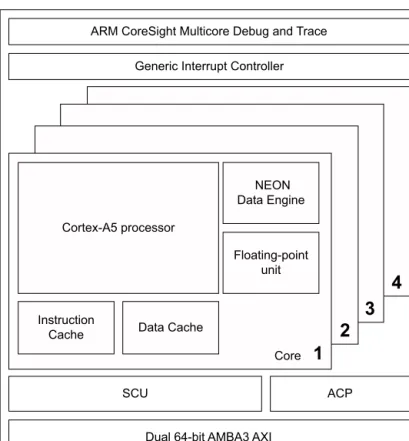
The Cortex-A5 processor is the smallest ARM multi-core applications processor. Devices based on this processor are typically low-cost, capable of delivering the internet to the widest possible range of devices from low-cost entry-level smartphones and smart mobile devices, to
embedded, consumer and industrial devices.
Figure 2-3 Cortex-A5 processor
The Cortex-A5 processor has the following features:
• Full application compatibility with other Cortex-A series processors. • Multiprocessing capability for scalable, energy efficient performance. • Optional Floating-point or NEON units for media and signal processing.
• High-performance memory system including caches and memory management unit. • High value migration path from older ARM processors.
4
Dual 64-bit AMBA3 AXI
ARM CoreSight Multicore Debug and Trace Generic Interrupt Controller
3
2
Cortex-A5 processor
Instruction
Cache Data Cache
NEON Data Engine Floating-point unit Core
1
SCU ACPARM Architecture and Processors
2.4.2 The Cortex-A7 processor
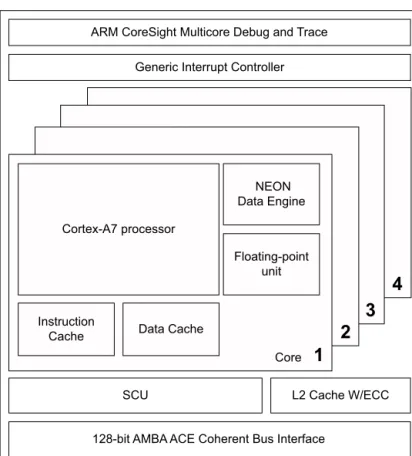
The ARM Cortex-A7 processor is the most energy efficient application processor developed by ARM and extends ARM’s low-power leadership in entry level smart phones, tablets and other advanced mobile devices.
Figure 2-4 Cortex-A7 processor
The Cortex-A7 processor has the following features:
• Architecture and feature set identical to the Cortex-A15 processor, enabling big.LITTLE configuration.
• Less than 0.5mm2, using 28nm process technology.
• Full application compatibility with all Cortex-A series processors. • Tightly-coupled low latency level 2 cache (up to 4MB).
• Floating-point unit.
• NEON technology for multimedia and SIMD processing.
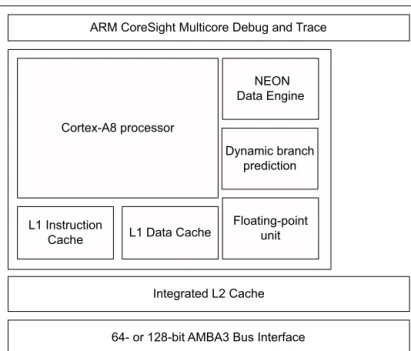
2.4.3 The Cortex-A8 processor
The ARM Cortex-A8 processor, has the ability to scale in speed from 600MHz to greater than 1GHz. The Cortex-A8 processor can meet the requirements for power-optimized mobile devices needing operation in less than 300mW; and performance-optimized consumer
4
128-bit AMBA ACE Coherent Bus Interface ARM CoreSight Multicore Debug and Trace
Generic Interrupt Controller
3
2
Cortex-A7 processor
Instruction
Cache Data Cache
NEON Data Engine
Floating-point unit
Core
1
ARM Architecture and Processors
i.MX515 from Freescale. From high-end feature phones to netbooks, DTVs, printers and automotive-infotainment, the Cortex-A8 processor offers a proven high-performance solution with millions of units shipped annually
Figure 2-5 Cortex-A8 processor
The Cortex-A8 processor has the following features: • Frequency from 600MHz to more than 1GHz. • High performance superscalar architecture.
• NEON technology for multi-media and SIMD processing. • Compatibility with older ARM processors.
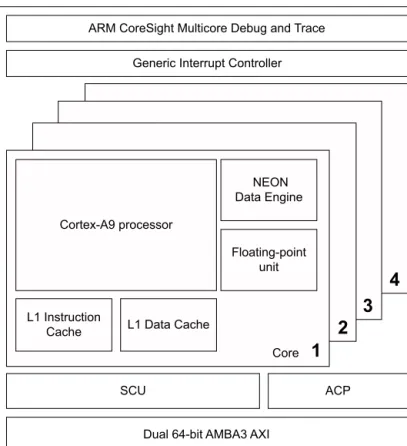
2.4.4 The Cortex-A9 processor
The ARM Cortex-A9 processor is a power-efficient and popular high performance choice in low power or thermally constrained cost-sensitive devices.
It is currently shipping in large volumes for smartphones, digital TV, consumer and enterprise applications. The Cortex-A9 processor provides an increase in performance of greater than 50% compared to the Cortex-A8 processor. The Cortex-A9 processor can be configured with up to four cores delivering peak performance when required. Configurability and flexibility makes the Cortex-A9 processor suitable for wide variety of markets and applications.
64- or 128-bit AMBA3 Bus Interface ARM CoreSight Multicore Debug and Trace
Cortex-A8 processor
L1 Instruction
Cache L1 Data Cache
NEON Data Engine Floating-point unit Integrated L2 Cache Dynamic branch prediction
ARM Architecture and Processors
Figure 2-6 Cortex-A9 processor
Devices containing the Cortex-A9 processor include nVidia’s dual-core Tegra-2, the SPEAr1300 from ST and TI’s OMAP4 platform.
The Cortex-A9 processor has the following features: • Out-of-order speculating pipeline.
• 16, 32 or 64KB four way associative L1 caches. • Floating-point unit.
• NEON technology for multi-media and SIMD processing.
• Available as a speed or power optimized hard macro implementation.
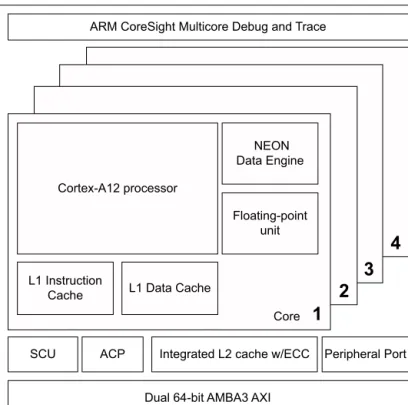
2.4.5 The Cortex-A12 processor
The Cortex-A12 processor is a high performance mid-range mobile processing solution designed for mobile applications, for example, use in smartphones and tablet devices. The Cortex-A12 processor is a successor to the highly successful Cortex-A9 processor and is optimized for highest performance in the mainstream mobile power envelope leading to best-in-class efficiency.
The high performance and high-end feature set of the Cortex-A12 processor is suitable for many use cases. Mid-range devices can build on the success of high-end devices and continue driving the fastest growing market segment in mobile.
4
Dual 64-bit AMBA3 AXI
ARM CoreSight Multicore Debug and Trace Generic Interrupt Controller
3
2
Cortex-A9 processor
L1 Instruction
Cache L1 Data Cache
NEON Data Engine Floating-point unit Core
1
SCU ACPARM Architecture and Processors
Figure 2-7 Cortex-A12 processor
The Cortex-A12 processor has the following features:
• 40-bit Large Physical Address Extensions (LPAE) addressing up to 1 TB of RAM. • Full application compatibility with all Cortex-A series processors.
• NEON technology for multi-media and SIMD processing. • Virtualization and TrustZone security technology
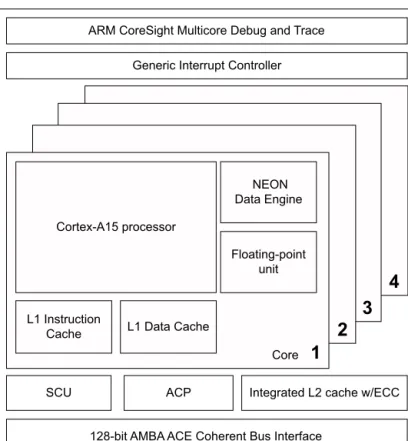
2.4.6 The Cortex-A15 processor
The ARM Cortex-A15 processor is designed to deliver unprecedented flexibility and processing capability. This processor is designed with advanced power reduction techniques, and enables products in a wide range of markets ranging from mobile computing, high-end digital home, servers and wireless infrastructure.
The Cortex-A15 MPCore processor has full application compatibility with all other Cortex-A series processors.
4
Dual 64-bit AMBA3 AXI
ARM CoreSight Multicore Debug and Trace
3
2
Cortex-A12 processor
L1 Instruction
Cache L1 Data Cache
NEON Data Engine
Floating-point unit
Core
1
ARM Architecture and Processors
Figure 2-8 Cortex-A15 processor
The Cortex-A15 processor has the following features: • Highly scalable, up to 2.5GHz performance.
• Full application compatibility with all Cortex-A series processors. • Out-of-order superscalar processor.
• Tightly coupled low-latency level 2 cache (up to 4MB). • Floating-point unit.
• NEON technology for multi-media and SIMD processing. • Available as a quad-core hard macro implementation.
4
128-bit AMBA ACE Coherent Bus Interface ARM CoreSight Multicore Debug and Trace
3
2
Cortex-A15 processor
L1 Instruction
Cache L1 Data Cache
NEON Data Engine
Floating-point unit
Core
1
SCU ACP Integrated L2 cache w/ECC
ARM Architecture and Processors
2.5
Key architectural points of ARM Cortex-A series processors
A number of key points are common to the Cortex-A family of devices:• 32-bit RISC core, with 16 × 32-bit visible registers with mode-based register banking. • Modified Harvard Architecture (separate, concurrent access to instructions and data). • Load/Store Architecture.
• Thumb-2 technology as standard.
• VFP and NEON options.
• Backward compatibility with code from previous ARM processors.
• 4GB of virtual address space and a minimum of 4GB of physical address space. • Hardware translation table walking for virtual to physical address translation.
• Virtual page sizes of 4KB, 64KB, 1MB and 16MB. Cacheability attributes and access permissions can be set on a per-page basis.
• Big-endian and little-endian data access support.
• Unaligned access support for basic load/store instructions.
• Symmetric Multi-processing (SMP) support on MPCore™ variants, that is, multi-core versions of the Cortex-A series processors, with full data coherency at the L1 cache level. Automatic cache and Translation Lookaside Buffer (TLB) maintenance propagation provides high efficiency SMP operation.
• Physically indexed, physically tagged (PIPT) data caches. See Virtual and physical tags and indexes on page 8-11.
Chapter 3
ARM Processor Modes and Registers
The ARM architecture is a modal architecture. Before the introduction of Security Extensions it had seven processor modes, summarized in Table 3-1. There were six privileged modes and a non-privileged user mode. Privilege is the ability to perform certain tasks that cannot be done from User (Unprivileged) mode. In User mode, there are limitations on operations that affect overall system configuration, for example, MMU configuration and cache operations. Modes are associated with exception events, which are described in Chapter 11 Exception Handling.
Table 3-1 ARM processor modes before ARMv6
Mode Function Privilege
User (USR) Mode in which most programs and applications run Unprivileged
FIQ Entered on an FIQ interrupt exception
Privileged
IRQ Entered on an IRQ interrupt exception
Supervisor (SVC) Entered on reset or when a Supervisor Call instruction (SVC) is executed
Abort (ABT) Entered on a memory access exception
Undef (UND) Entered when an undefined instruction executed
System (SYS) Mode in which the OS runs, sharing the register view with
ARM Processor Modes and Registers
The introduction of the TrustZone Security Extensions (see Figure 2-2 on page 2-4) created two security states for the processor that are independent of Privilege and processor mode, with a new Monitor mode to act as a gateway between the Secure and Non-secure states and modes existing independently for each security state.
Figure 3-1 Secure and Non-secure worlds
The TrustZone Security Extensions are described in Chapter 21, but for the present, for processors that implement the TrustZone extension, system security is achieved by dividing all of the hardware and software resources for the device so that they exist in either the Secure world for the security subsystem, or the Normal (Non-secure) world for everything else. When a processor is in the Non-secure state, it cannot access the memory that is allocated for Secure state.
In this situation the Secure Monitor acts as a gateway for moving between these two worlds. If Security Extensions are implemented, software executing in Monitor mode controls transition between Secure and Non-secure processor states.
The ARMv7-A architecture Virtualization Extensions add a hypervisor mode (Hyp), in addition to the existing privileged modes. Virtualization enables more than one Operating System to co-exist and operate on the same system. The ARM Virtualization Extensions therefore makes it possible to operate multiple Operating Systems on the same platform.
Figure 3-2 The hypervisor
Non-secure Privileged
Non-secure User
Monitor
Normal world Secure world
Secure Privileged Secure User Application Guest OS Trusted services Trusted OS Secure monitor Application Guest OS Hypervisor
ARM Processor Modes and Registers
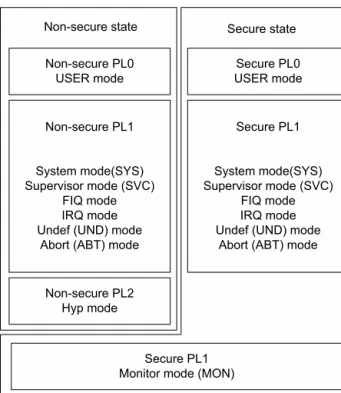
If the Virtualization Extensions are implemented there is a privilege model different to that of previous architectures. In Non-secure state there can be three privilege levels, PL0, PL1 and PL2.
PL0 The privilege level of application software, that executes in User mode. Software executed in User mode is described as unprivileged software. This software cannot access some features of the architecture. In particular, it cannot change many of the configuration settings.
Software executing at PL0 can make only unprivileged memory accesses. PL1 Software execution in all modes other than User mode and Hyp mode is at PL1.
Normally, operating system software executes at PL1.
The PL1 modes refers to all the modes other than User mode and Hyp mode. An Operating System is expected to execute across all PL1 modes and its applications executing in PL0 (User Mode).
PL2 Hyp mode is normally used by a hypervisor, that controls, and can switch between Guest Operating Systems that execute at PL1.
If Virtualization Extensions are implemented, a hypervisor will execute at PL2 (Hyp mode). A hypervisor will control and enable multiple Operating Systems to co-exist and execute on the same processor system.
These privilege levels are separate from the TrustZone Secure and Normal (Non-secure) settings.
Note
The privilege level defines the ability to access resources in the current security state, and does not imply anything about the ability to access resources in the other security state.
ARM Processor Modes and Registers
Figure 3-3 Privilege levels
The presence of particular processor modes and states depends on whether the processor implements the relevant architecture extension, as shown in Table 3-2.
A general purpose Operating System, such as Linux, and its applications, are expected to run in Non-secure state. The Secure state is expected to be occupied by vendor-specific firmware, or security-sensitive software. In some cases, software running in the Secure state is even more privileged than that running in Non-secure.
Non-secure PL0 USER mode Non-secure PL1 System mode(SYS) Supervisor mode (SVC) FIQ mode IRQ mode Undef (UND) mode
Abort (ABT) mode
Non-secure PL2 Hyp mode Non-secure state Secure PL0 USER mode Secure state Secure PL1 Monitor mode (MON)
Secure PL1
System mode(SYS) Supervisor mode (SVC)
FIQ mode IRQ mode Undef (UND) mode
Abort (ABT) mode
Table 3-2 ARMv7 processor modes
Mode Encoding Function Security
state
Privilege level
User (USR) 10000 Unprivileged mode in which most applications run Both PL0
FIQ 10001 Entered on an FIQ interrupt exception Both PL1
IRQ 10010 Entered on an IRQ interrupt exception Both PL1
Supervisor (SVC)
10011 Entered on reset or when a Supervisor Call instruction (SVC)
is executed
Both PL1
Monitor (MON) 10110 Implemented with Security Extensions. See Chapter 21 Secure only PL1
Abort (ABT) 10111 Entered on a memory access exception Both PL1
Hyp (HYP) 11010 Implemented with Virtualization Extensions. See Chapter 22 Non-secure PL2
Undef (UND) 11011 Entered when an undefined instruction executed Both PL1
ARM Processor Modes and Registers
The current processor mode and execution state is contained in the Current Program Status Register (CPSR). Changing processor state and modes can be either explicit by privileged software, or as a result of taking exceptions link to relevant section.