Journal of Biology, Agriculture and Healthcare www.iiste.org ISSN 2224-3208 (Paper) ISSN 2225-093X (Online)
Vol.3, No.11, 2013
Validity and Reliability of Checklists Used for Objective
Structured Clinical Examination: Piloting Modified Tools.
*Dr. Safaa Hassanein, Dr. Zeinab El-Sayed, Dr. Hoda Abdel Raouf
.DNS: Lecturers & Researchers of Medical-Surgical Nursing science, Cairo University, Egypt. *Email of the corresponding author: [email protected]
Abstract
Background: Developing tools for evaluating students' performance is one of the important tasks required from faculties. The validity and reliability of tools increase its significance and the objectivity of using these tools in the field of research, as well strengthen the results.
Aim: Was to test validity and reliability of the selected checklists of the objective structured clinical examination which assess the Medical-Surgical Nursing competencies.
Design: Test-retest, Six Sigma was utilized to answer the research questions.
Research questions: 1-Are the ten selected checklists valid? 2-Are the ten selected checklists reliable?
Sample: Ten checklists were selected out of the required competencies of Medical-Surgical Nursing course during the academic year of (2010-2011 & 2011-2012).
Results: The results of the tested checklists revealed that the selected checklists are valid while the reliable checklists were fluid balance, (intramuscular, intravenous) injections, surgical scrub, gloving, wound dressing and wound drain. However subcutaneous injection and withdrawal of drugs from a vial were not reliable. While the surgical gown checklist was questionable.
Conclusion: Seven out of the tested ten checklists were reliable while all the checklists were valid.
Recommendation: Revise and modify the unreliable checklists and retest its reliability. Go through studying validity and reliability of other competencies in the Medical-Surgical Nursing field. OSCE checklists are strongly suggested as reliable and valid assessment of the growing number of nursing students.
Key words: OSCE, validity, reliability, clinical assessment. INTRODUCTION:
For nursing, assessment of competence is crucially important to maintain professional standards, identify areas for professional development and educational need. Validity and reliability of assessment methods are considered the two most important characteristics of a well-designed assessment procedure. Validity refers to the degree to which a method assesses what it claims or intends to assess. The different types of validity include: Validity Definition: content the assessment method matches the content of the work criterion relates to whether the assessment method is explicit in terms of procedures correlating with particular behaviors. Construct relates to whether scores reflect the items being tested Evans, (2008). Performance based assessments are typically viewed as providing more valid data than traditional examinations because they focus more directly on the tasks or skills of practice (Gronlund, 2006).
Reliability refers to the extent to which an assessment method or instrument measures consistently the performance of the student. Assessments are usually expected to produce comparable outcomes, with consistent standards over time and between different learners and examiners. However, the following factors impede both the validity and reliability of assessment practices in workplace settings: • Inconsistent nature of people, • Reliance on assessors to make judgments without bias, • Changing contexts/conditions, • Evidence of achievement arising spontaneously or incidentally Gronlund, (2006). Explicit performance criteria enhance both the validity and reliability of the assessment process. Clear, usable assessment criteria contribute to the openness and accountability of the whole process. The context, tasks and behaviors desired are specified so that assessment can be repeated and used for different individuals. Explicit criteria also counter criticisms of subjectivity (Kurz, Mohoney, Plank & Lidicker 2009).
There are two broad approaches to record performance based assessment analytic and holistic scoring Truemper, (2004). Holistic scoring and recording reflects an overall impression of performance and results in a single score or grade. Holistic scoring tools can be developed and applied more rapidly; an example of holistic scoring includes a scale such as: Excellent, Good, Fair and Unsatisfactory Linn & Milter, (2005) & Airasian & Russell, (2008). By contrast, analytical scoring and reporting methods view performance as being made up of many components and provide separate scores for each component and more detailed information that may be useful when providing feedback. The analytical approach minimizes bias, allowing for all activities or answers to be remembered and documented as they occurred. (Truemper, 2004; Linn, & Miller, 2005; Airasian & Russell,
elements of a task or standards of performance a set of rubrics, consisting of descriptions or indicators of performance for each criterion that distinguish between levels of performance. Example of criteria and rubrics:
Criteria Rubrics/Indicators Comments flushes the device between drugs and after administration. The rubrics may then be mapped to an overall rating scale for example: Does not flush device, follows protocol/ orders safely, ensures compatibility and appraises (Truemper, 2004; Linn, & Miller, 2005; Airasian & Russell, 2008 & Issacson, & Stacy, 2008).
Competencies assessment tools to be considered valid and reliable, analytic scoring should undergo testing. Content validity can be established by expert panels. Panellists possessing expertise in academic or clinical education, outcome assessment, evaluation and psychometric testing or measurement, can be asked to comment on the feasibility, clarity of the tools and relevance or number of performance criteria (Tolhurst, & Bonner, 2000; Meretoja, & Leino-Kilpi, 2001; Pirie, & Gray, 2007 & Lunney, Gigliotti, & McMorrow, 2007).
The objective structured clinical skills examination (OSCE) has over the years emerged as a method of evaluating clinical skills in most medical and allied professions Oranye; Ahmad; Ahmad & Abu Bakar, (2012). It has been described as a practical test to assess specific clinical skills’ Ahuja, (2009). The OSCE represents an approach to clinical skills assessment, the practice of which can enable the student to develop these skills further. It is a well established method of assessing clinical competence among practitioners in the clinical field, with an enormous advantage for testing a number of skills in a limited time. (Peeraer, Muijtjens, Winter, Remmen, Hendrickx, Bossaert & Scherpbier, 2008).
According to Franklin (2005), the OSCE requires the student to actively demonstrate how she/he would apply acquired knowledge to a simulated ‘real world’ situation. The OSCE was designed by creating a multistation arrangement in which a student performed an assigned skill or assessment using a standardized patient, while being watched by faculty members before moving on to the next station. Every station assess different clinical competency such as history taking, interpretation of clinical data, nursing diagnoses, giving injection and so on. Each student performs the same set of tasks and was marked according to the same criteria on the examiner’s mark sheet. Ahuja (2009) also stated that the assessor will rate each student’s performance using the checklist or rating scale. The students are given an overall score based on the overall performance and according to her or his clinical judgment.
Many authors agreed that OSCE is a valid, reliable and objective method of assessing clinical competence in various setting Kurz, Mohonay, plank & Lidicker, (2009) & Robbin & Hoke (2008) proposed three components for a valid clinical competence evaluation system: validity, reliability and practicality. OSCEs provide a valid mean to evaluate a student’s performance in a holistic manner. Specifically, exercises are designed to allow student evaluation through the entire patient encounter, including history, examination, identification of initial problems, selection of tests needed, interpretation of the results of the encounter, and appropriate treatment recommendations. Reliability of the OSCE is based on the interaction among the standardized patient, the student, and the evaluator. Increasing the number of evaluators increases the OSCE reliability. Practicality is a mediating factor when working with OSCEs.
Therefore OSCE examiners should have a standard printed checklist or blueprint for each station that they have to fill out while observing the student. These checklists are standardized to reduce examiners' bias. On these checklists, there are station specific points and a general performance points to be assessed.
Aim of the study:
The aim was to test validity and reliability of the selected checklists of the objective structured clinical examination which assess the Medical-Surgical Nursing competencies.
Significance of the study:
The number of students enrolled in Faculty of Nursing-Cairo University increased dramatically. Moreover it was the first time of using OSCE as a part of the student evaluation during the academic year of (2010-2011) which raise the importance of testing the validity and reliability of OSCE checklists required for the Medical-Surgical Nursing competencies. Consequently OSCE was crucial to record students’ grade accurately without time consuming. By revising the ordinary nursing laboratory checklists, the researchers found that; several inapplicable steps per each checklist which does not suit the OSCE exam while other needed checklists were not existed. The researchers selected nine checklists to modify it and test its validity and reliability plus establishing the tenth checklist. Selection of tested checklists was based on the frequency uses of these tools during OSCE exam. So it was important to modify the selected nine checklists to highlight the critical points and establish the other tool by using literature and researchers' clinical experience. Hopefully this study might enrich the nursing body of knowledge which supported by strong statistical evidence. Moreover this study might play a corner stone in the field of both clinical experiences and nursing clinical teaching.
Journal of Biology, Agriculture and Healthcare www.iiste.org ISSN 2224-3208 (Paper) ISSN 2225-093X (Online)
Vol.3, No.11, 2013
Research questions:
The following research questions were formulated:
1-Are the following checklists (fluid balance, withdrawal drug from a vial, intramuscular (I.M.), intravenous (IV.), subcutaneous (SC.) injections, surgical gown, Surgical scrub, Glove technique, wound dressing and drain care) valid?
2-Are the following checklists (fluid balance, withdrawal drug from a vial, intramuscular (I.M.), intravenous (IV.), subcutaneous (SC.) injections, surgical gown, Surgical scrub, Glove technique, wound dressing and drain care) reliable?
Subjects and methods: Research design:
Test-retest, using Six Sigma (DMADV/ DFSS): Define – Measure – Analyze – Design – Verify. While the traditional DMAIC was (Define – Measure – Analyze – Improve – Control). Six Sigma is usually practiced and focused on evolutionary and continuous improvement manufacturing or service process development. On the other hand, DFSS (or DMADV) strives to generate a new process which not existed, or where an existing process is deemed to be inadequate and in need of replacement Yang & El Haik, (2003). Six Sigma healthcare projects currently underway in a few locations have already begun to reduce the number of defects in specific areas, including the nurse charting process. But there are many other patient care processes that seem to be begging for immediate attention and initiation of a Six Sigma review. Six Sigma alone may not be herald as the savoir of healthcare delivery in this country, but its judicious application along clinical lines, combined with the best treatment, technology and expertise available, will certainly improve care for the patient and diminish uncertainty for caregivers. Time will bear witness to the efficacy and extent of the transformation. (Feo, Joseph, William, 2005 & isixsigma, 2013)
Figure 1
(Feo, Joseph, William, 2005 & isixsigma, 2013)
Setting:
The study was carried out at the Medical-Surgical OSCE laboratory located at the Faculty of Nursing Cairo University, Egypt. The Medical-Surgical OSCE laboratory which is at the fourth floor is using for both undergraduate and post graduate students. It consists of eight stations equipped with different simulators and monitors. While in the middle of the OSCE laboratory there is the monitor unit which connected with eight cameras inside each OSCE station.
Tools:
Ten checklists were selected out of the required competencies of Medical-Surgical Nursing course during the academic year of (2010-2011 & 2011-2012). Nine checklists (tools) modified by the researchers while establishing the tenth checklist which based on literature review, clinical experience in laboratory and in real student training settings. The ten selected OSCE checklists labelled as (HZS). The tested modified tools were: Withdrawal drug from a vial (15 items), IM. Injection (12 items), IV. Injection (14 items), Sc. Injection (13
and drain care (26 items); While the newly established checklist was the fluid balance assessment (7 items).
Pilot study:
Pilot study conducted on 15 students who were repeating the first term of medical surgical nursing course and two faculties using the proposed checklists aiming to enhance clearance of steps, rubric as well detect time needed to implement each checklist, exploratory factor analysis was conducted using principal components extraction and oblique rotation.
Procedure:
By applying the Six Sigma (DMADV/DMAIC) following five steps were conducted.
(Content validity): After selection of the desired ten checklists; modification of the nine OSCE checklists was done and establishing the tenth checklist achieved. Then a panel of three juries' expertise from different nursing specialities (Medical-Surgical, Research and Education) conducted the ten checklists content validity. Based on the juries' panel expertise modifications the researchers improved and modified the checklists. Initially a pilot study was conducted on 10% of the students’ total numbe
evaluators who used the tested checklists were instructed by the researchers about OSCE rules focusing on avoiding giving any comment to the students during the OSCE exam; followed by students' orientation
stations in order to control the extraneous factors as it possible. The data were collected over three consecutive semesters. Second step: Measure; (Data collection): The OSCE checklists was piloted among all students of the second level who have been involved in this study. First reading OSCE checklists was taken by the end of the second semester during the academic year (2010
semester during the academic year (2011 semester of the academic year (2011
Third step: Analyze; (Omitted extreme scores); A
before proceeding in the research reliability test process to m
analysis): Finally conduction of statistical analysis was proceeded in order to test reliability of the examined checklists as follows: 3.1- Different mean scores was calculated over the three consecutive
checklists. 3.2- By using the Spss Cronbach’s alpha reliability coefficients was tested for each tool over the three consecutive readings.
psychometric test for a sample of examinees and considered significant at 0.70 conducted which is a descriptive measur
another R2 = SS (Between Groups)/SS (Total). R
percentage of a properly is quite respectable at 20%. (Henry, 2001). 3.4
was tested. It is a correlation between different items on the same scale of each of OSCE checklist. The closer the coefficient is to either −1 or 1, the stronger the correlation between the variables.
replaced. (Pennington, Donald 2003).
Fourth step: Improve; by optimize the current process based upon data analysis and standard work to create a new. And this step was achieved as tools were approved by the researchers based on the validity and reliability results. Fifth step: Control; finally researchers concl
OSCE checklists need further investigation. And the questionable one needs improvement. So continuously monitor process was required.
Statistical analysis:
Statistical analysis was done by using Mean +SD, Cronbach's alpha test, R reliability.
Results:
The collected data of this study will be presented into t
of the readings of the modified/developed ten checklists/tools. While checklists; using Cronbach's alpha (R
and drain care (26 items); While the newly established checklist was the fluid balance assessment (7 items).
Pilot study conducted on 15 students who were repeating the first term of medical surgical nursing course and using the proposed checklists aiming to enhance clearance of steps, rubric as well detect time needed to implement each checklist, exploratory factor analysis was conducted using principal components
g the Six Sigma (DMADV/DMAIC) following five steps were conducted.
(Content validity): After selection of the desired ten checklists; modification of the nine OSCE checklists was done and establishing the tenth checklist achieved. Then a panel of three juries' expertise from different nursing ical, Research and Education) conducted the ten checklists content validity. Based on the juries' panel expertise modifications the researchers improved and modified the checklists. Initially a pilot study was conducted on 10% of the students’ total number. B-(Examiner & students’ instructions): The five s who used the tested checklists were instructed by the researchers about OSCE rules focusing on avoiding giving any comment to the students during the OSCE exam; followed by students' orientation
stations in order to control the extraneous factors as it possible. The data were collected over three consecutive easure; (Data collection): The OSCE checklists was piloted among all students of the been involved in this study. First reading OSCE checklists was taken by the end of the second semester during the academic year (2010-2011). The second reading was taken by the end of the first semester during the academic year (2011-2012). While the last reading was taken by the end of the second semester of the academic year (2011-2012).
nalyze; (Omitted extreme scores); A-Exclude the items with either too high or too low scores before proceeding in the research reliability test process to maintain normal sample distribution. B
analysis): Finally conduction of statistical analysis was proceeded in order to test reliability of the examined Different mean scores was calculated over the three consecutive
By using the Spss Cronbach’s alpha reliability coefficients was tested for each tool over the three . It is commonly used as an estimate of the
for a sample of examinees and considered significant at 0.70 (Allen & Yen, 2002). 3.3
conducted which is a descriptive measure between zero and one, indicating how good one term at predicting = SS (Between Groups)/SS (Total). R2 depends on researcher measurement. R
percentage of a properly is quite respectable at 20%. (Henry, 2001). 3.4-Internal consisten
was tested. It is a correlation between different items on the same scale of each of OSCE checklist. The closer the coefficient is to either −1 or 1, the stronger the correlation between the variables. . Moreover items which reflecting less than 0.25 must be either rewrite or 2003).
; by optimize the current process based upon data analysis and standard work to create a step was achieved as tools were approved by the researchers based on the validity and reliability ontrol; finally researchers concluded and verified valid and reliable checklists. However two OSCE checklists need further investigation. And the questionable one needs improvement. So continuously
Statistical analysis was done by using SPSS version 16 statistical software package. Data were presented using SD, Cronbach's alpha test, R2, internal consistency analysis were conducted for OSCE checklist
The collected data of this study will be presented into two parts. Part I represents the mean and standard deviatio of the readings of the modified/developed ten checklists/tools. While part II represents the reliability of the ten
R2) as well internal consistency.
and drain care (26 items); While the newly established checklist was the fluid balance assessment (7 items).
Pilot study conducted on 15 students who were repeating the first term of medical surgical nursing course and using the proposed checklists aiming to enhance clearance of steps, rubric as well detect time needed to implement each checklist, exploratory factor analysis was conducted using principal components
g the Six Sigma (DMADV/DMAIC) following five steps were conducted. First step: Define; A-(Content validity): After selection of the desired ten checklists; modification of the nine OSCE checklists was done and establishing the tenth checklist achieved. Then a panel of three juries' expertise from different nursing ical, Research and Education) conducted the ten checklists content validity. Based on the juries' panel expertise modifications the researchers improved and modified the checklists. Initially a pilot (Examiner & students’ instructions): The five s who used the tested checklists were instructed by the researchers about OSCE rules focusing on avoiding giving any comment to the students during the OSCE exam; followed by students' orientation at OSCE stations in order to control the extraneous factors as it possible. The data were collected over three consecutive easure; (Data collection): The OSCE checklists was piloted among all students of the been involved in this study. First reading OSCE checklists was taken by the end of the 2011). The second reading was taken by the end of the first reading was taken by the end of the second Exclude the items with either too high or too low scores aintain normal sample distribution. B-(statistical analysis): Finally conduction of statistical analysis was proceeded in order to test reliability of the examined Different mean scores was calculated over the three consecutive reading of the ten By using the Spss Cronbach’s alpha reliability coefficients was tested for each tool over the three . It is commonly used as an estimate of the reliability of a (Allen & Yen, 2002). 3.3- R2 was e between zero and one, indicating how good one term at predicting depends on researcher measurement. R-squared as a Internal consistency of the ten checklists was tested. It is a correlation between different items on the same scale of each of OSCE checklist. The closer the coefficient is to either −1 or 1, the stronger the correlation between the variables. ecting less than 0.25 must be either rewrite or
; by optimize the current process based upon data analysis and standard work to create a step was achieved as tools were approved by the researchers based on the validity and reliability uded and verified valid and reliable checklists. However two OSCE checklists need further investigation. And the questionable one needs improvement. So continuously
SPSS version 16 statistical software package. Data were presented using , internal consistency analysis were conducted for OSCE checklist
represents the mean and standard deviatio represents the reliability of the ten
Journal of Biology, Agriculture and Healthcare www.iiste.org ISSN 2224-3208 (Paper) ISSN 2225-093X (Online)
Vol.3, No.11, 2013
Part I:
Table 1: Compare of mean scores of the total three readings regarding the selected tools.
Developed tools First reading Second reading Third reading X+ SD X+ SD X+ SD Fluid balance assessment 10.27+ 3.8 12.4 + 4.8 11.8+ 3.3
Withdrawal drug from a vial 20.3+ 2 18.7+2.7 18.9+3.7
I.M. injection 14.3 + 3.0 17.5+ 3.7 19.9+ 3.18 I.V. injection 20.6+ 2.3 19.9+ 3.9 19.6+ 2.6 S.c. Injection 18.7+ 2.3 17+3.4 17+ 1.8 Surgical gown 19.3+1 17.5+1.5 17.2+1.6 Surgical scrub 35.7+3.2 34.6+3.5 34.7+3.5 Glove technique 11.6+1 11.6+1 11.6+1 Wound dressing 34.2+ 3 31.2+3.8 32.9+3.5 Drain care 39+ 3 33.6+ 3.2 33.4+3.5
Above table showed that the mean+SD of the following OSCE checklists was stable approximately across the three readings. While the F test did not show any significant difference across the three readings; which reflected consistency of OSCE checklists.
Part II:
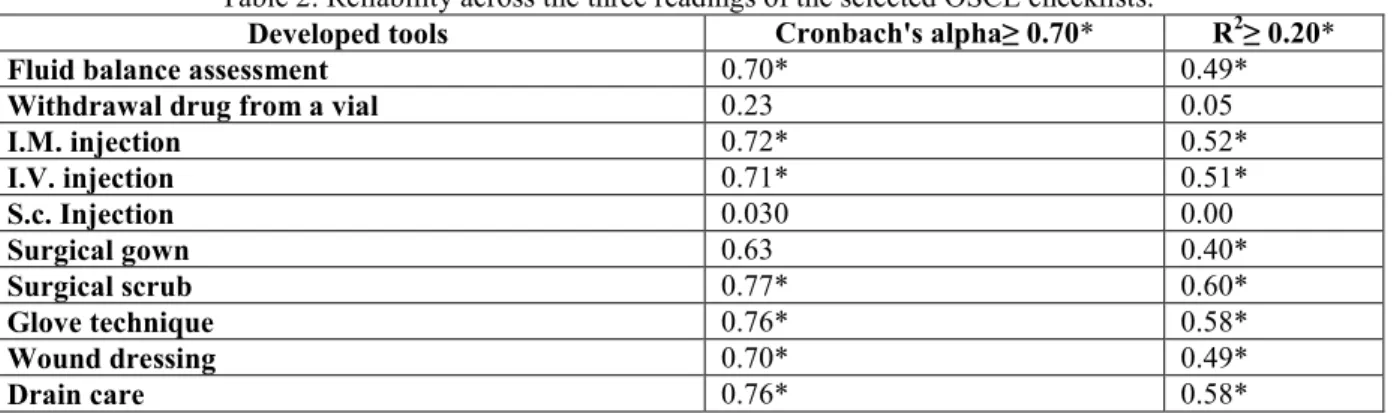
Table 2: Reliability across the three readings of the selected OSCE checklists.
Developed tools Cronbach's alpha≥ 0.70* R2≥ 0.20*
Fluid balance assessment 0.70* 0.49*
Withdrawal drug from a vial 0.23 0.05
I.M. injection 0.72* 0.52* I.V. injection 0.71* 0.51* S.c. Injection 0.030 0.00 Surgical gown 0.63 0.40* Surgical scrub 0.77* 0.60* Glove technique 0.76* 0.58* Wound dressing 0.70* 0.49* Drain care 0.76* 0.58*
It was observed that only checklists of subcutaneous injection and withdrawal drug from a vial were not reliable (Cronbach’s alpha= 0.23, R2=0.05) and surgical gown checklist was questionable (Cronbach’s alpha 0.63, R2 0.40).
Table 3: Internal consistency of the selected OSCE checklists:
OSCE checklists Subscales Items' Subscale Subscale to Subscale ≥ 0.25*
Fluid balance assessment
Total: (7) Items
-Assess hydration 3 items r= 0.58*
-Calculate Balance 4 items
-Withdrawal from a vial
Total: (15) items
-Syringe, vial preparation 5 items r= 0.27* -Medication aspiration process 10 items
-Intramuscular Injection
Total: (12) items
-Injection preparation 5 items r= 0.40* -Administer the medication 7 items
-Intravenous Injection
Total: (14) items
-Injection preparation 5 items r= 0.30* -Administer the medication 9 items
-Subcutaneous Injection
Total: (13) items
-Injection preparation 6 items r= 0.26* -Administer the medication 7 items
-Surgical gown
Total: (13) items
-Gown preparation 3 items r= 0.27*
-Gown put on 10 items
-Surgical scrub
Total: (20) items
-Hand scrub 12 items r= 0.30*
-Forearm scrub 8 items
-Glove technique
Total: (6) items
-Glove preparation 2 items r= 0.38*
-Glove put on 4 items
-Wound dressing
Total: (24) items
-Patient/dressing preparation 6 items r= 0.39* -Dressing achieving 18 items
While the above table showed that there was a statistical significant between the sub items within each OSCE checklist, (0.58, 0.40, 0.39, 0.38, 0.30, 0.30, 0.27, 0.27, 0.27, 0.26) Fluid balance assessment, intramuscular injection, wound dressing, glove technique, intravenous injection, surgical scrub, drain care, surgical gown, withdrawal drug from a vial and subcutaneous injection respectively.
Discussion
Medical-Surgical procedure laboratory book includes detailed steps per each checklist as well many training laboratory checklists steps such as hand wash, explain procedure to the patient which are inapplicable as students deal with simulators. As regard (Withdrawal drug from a vial) the following step was omitted in the modified OSCE checklists (change needle if medication irritant). While other checklists include complicated steps that are not in use when firstly applied to assess students' performance in the phase of the pilot study. The researchers observed the mass that occurred within faculty members in relation to using the traditional training laboratory checklists at the OSCE setting as these steps are inapplicable and time wasting and difficult to calculate students' gained scores. Moreover the rubric of each competency in the procedure laboratory checklists were not identifiable that make the assessment more subjective. On the other hand, it was the first experience time during the academic year (2010-2011) to apply it formally as a part of students working year’s grade. So, it is crucial to develop special checklists to suit OSCE setting, nature and time. Consequently the use of these checklists arise the need to have valid and reliable checklists .The aim of the current study is to examine the validity and reliability of the objective structured clinical examination assessment (Checklists) tool for the medical surgical nursing competencies. Furthermore, assessment is central of any programme of education but is particularly relevant to nursing in order to ensure those who become registered nurses are safe and competent practitioners ABA, (2003); In Mahomoud & Mostafa, (2011). Objective structured clinical examinations (OSCEs) are an effective assessment strategy for assessing clinical skills Alinier; Gordon, & Harwood, (2006) and for highlighting curriculum problem areas (Major, 2005).
Two research questions were formulated to carry out the present study the first question: Are the ten selected checklists valid? Juries of three expertises with different specialities (research, education and medical surgical nursing) approved the content validity of the selected tools, This strategy supported by Polit & Beck (2004) who revealed that the panel typically consists of at least 3 expertises as the experts are asked to evaluate individual item on the new measure as well as the entire instrument. The rubric level was added as follows (done completely, done incompletely / or not done) as well adding scores for each step of checklists according to task analysis. Boser, French & McCay,(2003) who claimed that the use of a structured assessment tool provides a standard scoring system allowing both the documentation of change over time and the evaluation of clinical interventions.
Regarding second question: Are the ten selected checklists reliable? The six steps of developing reliable tool were followed by the researchers as it is a philosophy, a measure, and a methodology that provides businesses with the perspective and the tools needed to achieve high levels of performance for both product and service offerings (El-Haik & Roy, 2005). The study showed that the mean of difference result across the three readings of each checklist measurement was almost stable as there was minimum difference. The conduction of the Cronbach’s reliability test revealed that surgical scrub had the highest reliability result while the gloving technique had equal reliability with the drain of care followed by IM., IV. Injections and fluid balance had equal result with the wound dressing. Accordingly the reliability of those checklists is approved depending on the fact that Cronbach's alpha as the primary measure of reliability, with a minimum acceptable alpha coefficient value of 0.70. Through the use of Cronbach's α, correlation coefficients. McGuiness & Sibthorpe, (2003) tested a measure of the coordination of health care services.
At the same time the R2 verify the reliability of the above tested tools with p<.001. However surgical gowning validity result was acceptable but some statisticians consider its Cronbach’s alpha reliability result is questionable as it equals 0.63. with R2=0.40 While withdrawal drug from a vial and subcutaneous injections Cronbach’s alpha= 0.23, 0.030, p<.001; with R2=0.05, 0.00 respectively. The researchers found that Internal consistency showed up integration and significance within each tool, as Polit & Beck, (2004) revealed that any instrument may be said to be internally consistency or homogenous to the extent that its items measure the same trait.
To sum up; the results revealed that all ten tested OSCE checklists are valid. While all tested OSCE checklists are reliable except withdrawal drug from a vial and subcutaneous injection were not reliable however the surgical gown checklist is questionable.
Conclusion
Seven out of the tested ten checklists were reliable of assessing the students' medical surgical nursing competency skills of (Fluid balance, (IM., I.V) Injections, surgical gown, glove technique, wound dressing,
Journal of Biology, Agriculture and Healthcare www.iiste.org ISSN 2224-3208 (Paper) ISSN 2225-093X (Online)
Vol.3, No.11, 2013
wound scrub). While surgical scrub was questionable. All the tested checklists were valid. Regarding the mentioned valid and reliable (HZS) Medical-Surgical Nursing OSCE checklists it can be a part of an effective assessment strategy of nursing clinical education. The study highlighted the differences between the laboratory and OSCE checklists of Medical-Surgical Nursing competencies and has the ability to objectively assess med-surg. nursing skills accurately without time consuming.
Recommendations
1- Revise and modify the unreliable checklists and retest its reliability.
2- Go through studying validity and reliability of other competencies in the Medical-Surgical Nursing field. 3- OSCE checklists are strongly suggested as reliable and valid assessment of the growing number of
nursing students.
Nursing implication
OSCE as an effective and valid assessment method can be used to assess students’ clinical competencies in different nursing specialties. Testing validity and reliability of checklists encourage their uses as well provide an opportunity to conduct other researches as valid and reliable tool are the corner stones of any scientific research specially in relation to nursing education .The increasing number of nursing students in Egypt increase the suitability of OSCE to assess undergraduates and postgraduate performance.
References
1- Ahuja, J. (2009). OSCE: A Guide for Students, Part 1. Practice Nurse, 37(1), 37 – 39.
2- Airasian, P. W. & Russell, M. K. (2008). Classroom assessment concepts and applications, 6th Edition, McGraw Hill Higher Education: New York.
3- Alinier, G.; Hunt, B., Gordon, R. and Harwood, C. (2006): Issues and innovations in nursing education: effectiveness of intermediate-fidelity simulation training technology in undergraduate education. Journal of advanced Nursing; 54 (3): 359-369.
4- Allen, M.J., & Yen, W. M. (2002). Introduction to Measurement Theory. Long Grove, IL: Waveland Press. 5- An Bord Altranais (ABA, 2003). Guidelines on the key points that may be considered when developing a Quality Clinical Learning Environment (first ed.). An Bord Altranais, Dublin IN Mahomud, M & Mostafa, M. (2011). The Egyptian Nursing Student's Perceptive view about an Objective Structured Clinical Examination (OSCE). Journal of American Science; 7 (4). 736.
6- Boser, J., French, R., & McCay, J.(2003). Scoring performance assessments: checklists, rating scales and rubrics. Institute of assessment and evaluation university of Tennessee.
7- El-haik, B., Roy, D.M., (2005). A rodemape to consistent, high –quality service for any organization. Published by John Wiley & Sons, Inc., Hobaken, New jersey. Published simultaneously in Canada.
8- Evans, A. (2008). Competency assessment in nursing - a summary of literature published since 2000, EdCaN. 9- Feo, D. Joseph A.; William B., (2005). JURAN Institute's Six Sigma Breakthrough and Beyond - Quality Performance Breakthrough Methods. Tata McGraw-Hill Publishing Company Limited. ISBN 0-07-059881-9 10- Franklin, P. (2005). OSCEs as a means of assessment for the practice of nurse
prescribing. Nurse Prescribing, 3: 14-23.
11- Gronlund, N. E. (2006). Assessment of student achievement, 8th Edition, Pearson Education Inc: Boston. 12- http://www.isixsigma.com/industries/healthcare/applying-six-sigma-patient-care/ retrieved on
(march/2013)
13- Kurz, J.M., Mohoney, K., Plank, L.M., & Lidicker, J. (2009). Objective structured clinical examination and advanced practice nursing students. Journal of Professional Nursing, 25(3), 186-191.
14- Issacson, J.J. & Stacy, A.S. (2008). Rubrics for clinical evaluation: objectifying the subjective experience, Nurs Educ Pract, Doi:101016/j.nepr.2008.10.015.
15- Linn, R. L. & Miller, M. D. (2005). Measurement and assessment in teaching, 9th Edition, New Jersey: Pearson Prentice Hall.
16- Lunney, M., Gigliotti, E. & McMorrow, M.E. (2007). Tool development for evaluation of clinical nurse specialist competencies in graduate students - a pilot study, Clin Nurs Spec, 21(3):145–151.
17- Major, D. (2005). OSCEs – Seven years on the Bandwagon: The progress of an objective structured clinical evaluation programme. Nurse Education Today; 25: 442-454.
18- McGuiness, C., & Sibthrope. B. (2003). Development and initial validation of a measure of coordination of health care. Int J Qual Health Care. 2003 Aug; 15(4): 309-318.
19- Meretoja, R. & Leino-Kilpi, H. (2001). Instruments for evaluating nurse competence, JONA, 31(7/8): 346– 352.
structured clinical examination (OSCE) for open distance learning students in Open University Malaysia.Contemporary Nurse: Vol. 41, No. 2, pp. 233-241.
21- Peeraer, G, Muijtjens, A.M.M, De Winter, B.Y, Remmen, R, Hendrickx, K, Bossaert, L and Scherpbier, Aj.J.A (2008). Unintetional failure to assess for experience in senior undergraduate OSCE scoring. Medical Education, 42:669-675.
22- Pennington, Donald (2003). Essential Personality. Arnold. pp. 37. ISBN 0-340-76118-0.
23- Pirie, E.S. & Gray, M.A. (2007). Exploring the assessors’ and nurses’ experience of formal assessment of clinical competency in the administration of blood components, Nurs Educ Pract, 7:215–227.
24- Polit D., Beck, C. (2004) , Nursing Research Principle and Method, 7th ed. (423).
25- Robbin, L.K., & Hoke, M.M. (2008). Using objective structural clinical examinations to meet clinical competence evaluation challenges with distance education students. Perspectives in Psychiatric Care, 44(2), 81 - 88.
26-Tolhurst, G. & Bonner, A. (2000). Development of clinical assessment criteria for postgraduate nursing students, Collegian, 7(2):20-25.
27- Truemper, C.M. (2004). Using scoring Rubrics to facilitate assessment and evaluation of graduate level nursing students, J Nurs Edu, 43(12):562–564.