A Thesis by XIABING XU
Submitted to the Office of Graduate Studies of Texas A&M University
in partial fulfillment of the requirements for the degree of MASTER OF SCIENCE
December 2010
A Thesis by XIABING XU
Submitted to the Office of Graduate Studies of Texas A&M University
in partial fulfillment of the requirements for the degree of MASTER OF SCIENCE
Approved by:
Chair of Committee, Nancy M. Amato Committee Members, Lawrence Rauchwerger
Marvin L. Adams Jennifer L. Welch Head of Department, Valerie E. Taylor
December 2010
ABSTRACT
The STAPL pList. (December 2010) Xiabing Xu, B.S., Jilin University, P.R.China Chair of Advisory Committee: Dr. Nancy M. Amato
We present the design and implementation of the Standard Template Adap-tive Parallel Library (stapl) pList, a parallel container that has the properties of
a sequential list, but allows for scalable concurrent access when used in a paral-lel program. The stapl is a parallel programming library that extends C++ with
support for parallelism. stapl provides a collection of distributed data structures
(pContainers) and parallel algorithms (pAlgorithms) and a generic methodology for extending them to provide customized functionality. stapl pContainers are
thread-safe, concurrent objects, providing appropriate interfaces (pViews) that can be used by generic pAlgorithms.
The pListprovides Standard Template Library (stl) equivalent methods, such
as insert, erase, and splice, additional methods such as split, and efficient asyn-chronous (non-blocking) variants of some methods for improved parallel performance. List related algorithms such as list ranking, Euler Tour (ET), and its applications to compute tree based functions can be computed efficiently and expressed naturally using the pList.
Lists are not usually considered useful in parallel algorithms because they do not allow random access to its elements. Instead, they access elements through a serializing traversal of the list. Our design of the pList, which consists of a collec-tion of distributed lists (base containers), provides almost random access to its base containers. The degree of parallelism supported can be tuned by setting the number
of base containers. Thus, a key feature of the pList is that it offers the advantages of a classical list while enabling scalable parallelism.
We evaluate the performance of thestaplpListon an IBM Power 5 cluster and
on a CRAY XT4 massively parallel processing system. Although lists are generally not considered good data structures for parallel processing, we show thatpList methods and pAlgorithms, and list related algorithms such as list ranking and ET technique operating on pLists provide good scalability on more than 16,000 processors. We also show that the pList compares favorably with other dynamic data structures such as thepVector that explicitly support random access.
ACKNOWLEDGMENTS
I want to thank my advisor, Dr. Nancy Amato, for her supervision and support over the last three years. I joined the group in 2007, and later Dr. Nancy Amato suggested that I work in the research area related to parallel computing. I found this to be an interesting subject, full of challenge, and I enjoy it a lot. Dr. Amato was very supportive when I decided to change from a Ph.D. program to a master’s program in order to stay close with my wife. I appreciate Dr. Amato very much for supporting my decision.
I also want to thank Dr. Lawrence Rauchwerger, Dr. Jennifer Welch and Dr. Marvin Adams for suggestions and help on research. Their comments and feedback on the thesis were helpful.
Gabriel Tanase, who is a senior student in our group, has given me lots of help since I joined the group. He is very nice and patient with all my questions, and behaves like a teacher and a close friend all the time.
I also want to thank every member in the STAPL group who also helped me. I could not have finished this work without their help.
I would like to thank my parents for their consistent support. Finally, I want to thank my wife for being an assistant in my life and always supporting whatever I want to do.
TABLE OF CONTENTS
CHAPTER Page
I INTRODUCTION. . . 1
A. Our Contribution . . . 2
B. Outline of Thesis . . . 4
II PRELIMINARIES AND RELATED WORK . . . 5
A. Preliminaries . . . 5
1. Linked List Data Structure . . . 5
2. STL List . . . 7
B. Related Work . . . 8
1. Concurrent Data Structures . . . 8
2. List Algorithms . . . 11
III STAPL . . . 13
A. Parallel Languages and Libraries . . . 13
B. staplOverview . . . . 14
C. Parallel Container Framework (PCF) [45] . . . 16
D. PCF Design . . . 17
1. Shared Object View . . . 19
IV STAPL PLIST. . . 22
A. pList Interface . . . 22
1. Complexity of Methods . . . 25
B. pList Design and Implementation . . . 26
1. Base Container . . . 26
2. Global Identifiers (GID) . . . 27
3. Domain . . . 28
4. Data Distribution . . . 28
5. pView . . . 29
6. Implementation of pList Methods . . . 30
C. pList Advanced Methods . . . 30
1. Splice . . . 31
2. Split . . . 32
A. List Ranking . . . 34
1. List Ranking via Pointer Jumping with Global Synchronization (LR-glob-sync) . . . 35
2. List Ranking via Pointer Jumping with Point-to-point Synchronization (LR-pt2pt-sync) . . . 36
3. List Ranking in STAPL (LR-STAPL) . . . 38
B. Euler Tour and Its Applications . . . 39
1. ET Technique Overview . . . 41 a. ET Construction . . . 41 b. ET Technique . . . 42 2. ET in STAPL . . . 43 a. Complexity Analysis . . . 45 3. ET Application in STAPL . . . 46 a. Rooting a Tree . . . 46 b. Postorder Numbering . . . 47
c. Computing Vertex Level . . . 48
d. Computing Number of Descendants . . . 49
e. Complexity Analysis . . . 50
VI PERFORMANCE EVALUATION . . . 52
A. Machine Specification . . . 52
B. pList Constructor and Memory Usage . . . 52
C. pList Methods . . . 54
D. pAlgorithms Comparison . . . 56
E. Comparison of Dynamic Data Structures in stapl . . . . . 59
F. List Ranking . . . 60
G. Euler Tour and Its Application . . . 61
1. Euler Tour . . . 61
2. Euler Tour Application . . . 63
VII CONCLUSION . . . 65
REFERENCES . . . 66
APPENDIX A . . . 72
APPENDIX B . . . 79
LIST OF TABLES
TABLE Page
I Concurrent data structure related work comparison. CAS: com-pare and swap operation. nE: the average number of elements in the list during any execution E. cE: the average operation con-tention during E. mE: the total number of operations invoked
during E. . . 9 II STL equivalent methods of the pList. P: the number of
lo-cations; Mi: the number of base containers in one location; N: the total number of elements in the list; TB(N): the time of a broadcast communication of N elements; TR(N): the time of a reduction communication of N elements; Tǫ: the time of a single
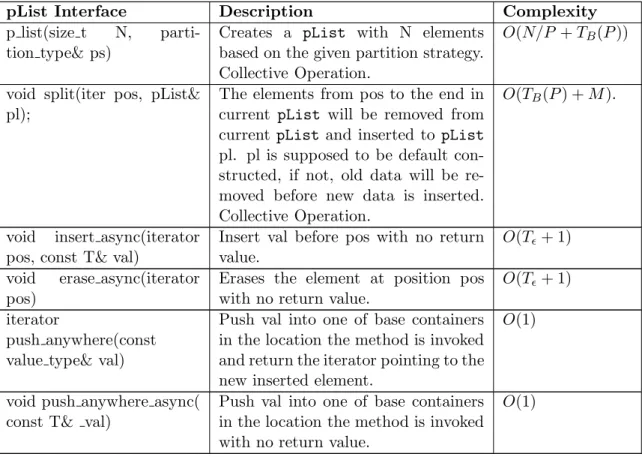
message communication time. . . 23 III Non-STL equivalent methods of the pList. P: the number of
locations; M: the total number of base containers in pList; N: the total number of elements in the list; TB(N): the time of a broadcast communication of N elements; Tǫ: the time of a single
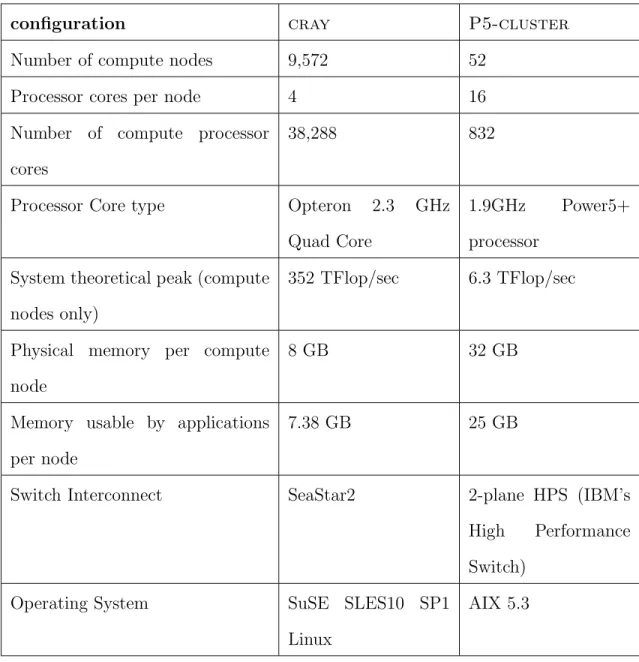
message communication time in the following sections. . . 24 IV Machine specifications aboutP5-clusterand cray. . . . . 53
LIST OF FIGURES
FIGURE Page
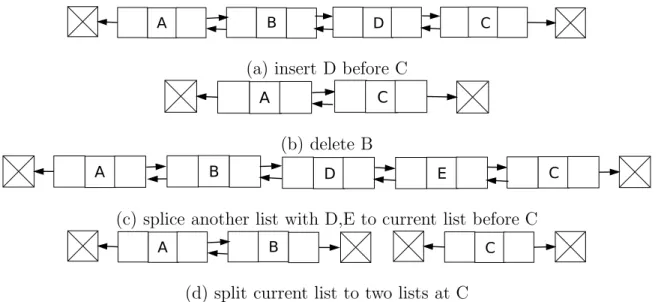
1 Example of a singly (a) and a doubly (b) linked list. A, B and C represent the data of each node. Each arrow represents a pointer
to the previous or next node. . . 6
2 Result lists of applying methods insert, delete, splice and split to the doubly linked list in Figure 1(b). . . 6
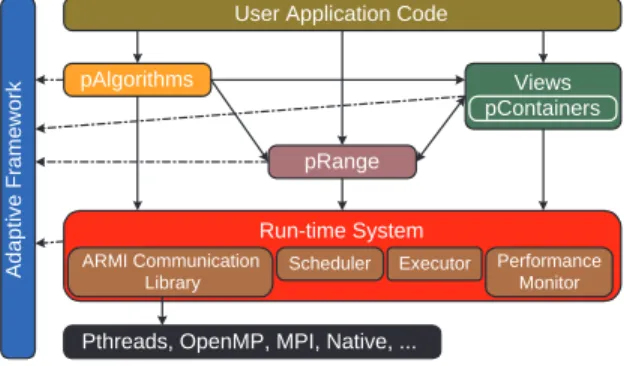
3 STAPL overview. . . 13
4 PCF design.. . . 17
5 pContainermodules for performing address resolution to find the element reference corresponding to a given GID.. . . 19
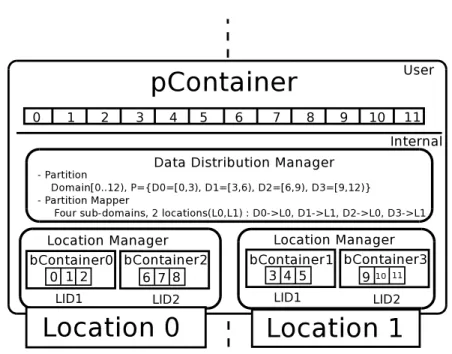
6 Example of pContainer modules for performing address resolu-tion to find the element reference corresponding to a given GID. . . . 21
7 pList method implementation. . . 30
8 pList splice pList implementation. . . 31
9 pList splice range implementation. . . 32
10 pList split implementation. . . 33
11 LR-glob-sync pointer jumping algorithm for list ranking. . . 35
12 Illustration of the LR-glob-sync algorithm. (a) A list with eight elements. (b) The result after the first jump. (c) The result after the second jump. (d) The result after the third jump. . . 37
13 LR-pt2pt-sync algorithm. . . 38
14 LR-STAPL algorithm. . . 40
16 Generic algorithm of Euler Tour applications. . . 43
17 Euler Tour [30] construction. . . 44
18 Euler Tour [30] linking. . . 45
19 Rooting a tree [30]. . . 47
20 Postorder numbering [30]. . . 48
21 Computing vertex level [30]. . . 49
22 Computing number of descendants [30]. . . 50
23 pListconstructor. (a) Execution times of constructors using dif-ferent number of base containers per location in a default, blocked and cyclic distributed fashion (weak scaling each processing unit has 20 millions). (b) Metadata size for the default, blocked and cyclic constructor used in (a). . . 54
24 Kernel used to evaluate the performance ofpList methods. . . 54
25 pList methods comparison. (a) Splice for 5000 to 20000 base containers per location. (b) Execution times for insert and insert async when 1% and 2% of operations are remote. (c) Execution times when all operations are executed locally (N=64 millions). (d) Weak scaling for pList methods on large number of processors using 25 million elements per processor. . . 55
26 Execution times for p foreach, p generate, p accumulate algo-rithms on cray for different data structures. . . . . 57
27 P5-cluster: weak scaling forp foreach allocating processes on the same nodes when possible (curve a) or in different nodes (curve b). Experiments are for 20 million elements/processor. . . 58
28 ComparisonpList andpVector dynamic data structures using a mix of 10M operations (read/write/insert/delete). . . 59
29 List Ranking performance comparison (LR-glob-sync refers to Pointer Jumping algorithm. LR-pt2pt-sync refers to point-to-point synchronization Pointer Jumping algorithm. LR-STAPL refers to stapl implementation of point-to-point
synchroniza-tion Pointer Jumping algorithm. The number means how many
bContainers per location). . . 60 30 Euler Tour with two different types of trees. . . 62 31 Euler Tour application. . . 64
CHAPTER I
INTRODUCTION
Parallel programming is becoming mainstream due to the increased availability of multiprocessor and multicore architectures and the need to solve larger and more complex problems. To help programmers address the difficulties of parallel program-ming, we are developing the Standard Template Adaptive Parallel Library (stapl)
[1, 2, 3, 4, 5, 6, 7, 8, 9, 10, 11].
staplis a parallel C++ library with functionality similar tostl, the C++
Stan-dard Template Library. stl is a collection of basic algorithms, containers and
itera-tors that can be used as high-level building blocks for sequential applications. stapl
provides a collection of parallel algorithms (pAlgorithms), parallel and distributed containers (pContainers), and pViews to abstract the data access in pContainers. These are the building blocks for writing parallel programs using stapl. An
im-portant goal ofstapl is to provide a high productivity development environment for
applications that can execute efficiently on a wide spectrum of parallel and distributed systems.
pContainersare collections of elements that are distributed across a parallel ma-chine and support concurrent access. staplprovides a unified approach for
develop-ing pContainers. It uses object-oriented technology to build distributed thread-safe containers that can easily be extended and customized. This approach allows us to provide a large variety ofpContainers such as pArray [10], pMatrix[4], associative containers such aspMap and pSet [8], pVector and pGraph.
Distributed and concurrent data structures are an active research area that has The journal model is IEEE Transactions on Automatic Control.
received significant attention. However, most of the research focuses on array-like static data structures. Due to their intuitively sequential structure, linked list data structures have presented a challenge to be used efficiently in parallel, and consider-able effort has been devoted to designing efficient concurrent linked list data structures [12, 13, 14, 15, 16, 17].
A. Our Contribution
In this thesis, we present the design and implementation of the stapl pList, a
parallel container that has the properties of a sequential list, but allows for scalable concurrent access when used in a parallel program. In particular, the pList is a distributed doubly linked list data structure that is the stapl parallel equivalent of
the stl list container. The pList interface includes threadsafe methods that are
counterparts of thestl list such as insert, erase, and splice, additional methods such
as split, and asynchronous (non-blocking) variants of some methods for improved performance in a parallel and concurrent environment. As described in more detail before, a summary of our contributions includes:
• a novel design that supports an arbitrary and tunable degree of random access to match desired degree of parallelism;
• interfaces that enable the natural expression of list related algorithms that are efficient to execute.
Lists are not usually considered useful in parallel algorithms because they do not allow random access to its elements. Instead, they access elements through a serializing traversal of the list. Our design of the pList, which consists of a collec-tion of distributed lists (base containers), provides almost random access to its base containers. The degree of parallelism supported can be tuned by setting the number
of base containers. Thus, a key feature of the pList is that it offers the advantages of a classical list while enabling scalable parallelism.
List related algorithms are shown to be expressed naturally using pList. Un-der the stapl programming model, an algorithm is expressed as a combination of
work function and data. Algorithms such as list ranking, Euler Tour (ET) and its applications all can be naturally expressed using this model. In this thesis, we ex-amine various list ranking algorithms including a classic pointer jumping algorithm, a point-to-point synchronized version of the pointer jumping algorithm and an im-plementation of later in stapl. We also describe an implementation of the classic
ET technique in stapl, that uses a list ranking algorithm internally. We study the
Euler Tour and four of its applications including rooting a tree, postorder numbering, computing vertex level and computing the number of descendants.
We evaluate the performance of the pList on an IBM Power5 cluster and an Opteron-based CRAY XT supercomputer. We analyze the running time and scala-bility of different pList methods as well as the performance of different algorithms using pListas data storage. We also compare thepListto the pArrayand pVector to understand the relative trade-offs of the various data structures. Our results show that the pList outperforms the pVector when there are a significant number of in-sertions or deletions. List ranking, Euler Tour (ET) computation and use of the ET technique to compute tree based functions such as rooting a tree, postorder num-bering, computing vertex level and computing the number of descendants are are evaluated to show scalable performance when the pList is used as the intermediate data structure.
B. Outline of Thesis
Chapter II describes related work to this research area. Chapter III gives an overview of stapl and its components. Chapter IV describes the design and
implementa-tion of the pList, and its interface. Chapter V illustrates how list ranking can be implemented using our pList, and the application of the pList in the Euler Tour technique and its applications to compute tree based functions. Chapter VI shows the performance of the pList methods and of applying different parallel algorithms on the pList. Chapter VII concludes this work.
Portion of this work has been published as “stapl: Standard Template Adaptive
CHAPTER II
PRELIMINARIES AND RELATED WORK
This chapter presents preliminaries and related work. Preliminaries first describes in general the linked list data structure and its characteristics. The Standard Template Library (STL) List which is a generic linked list data structure is then introduced. Related work discusses previous work on concurrent data structures, parallel pro-gramming languages and parallel libraries, and list related algorithms such as list ranking and Euler Tour.
A. Preliminaries
This section presents the basics of the linked list data structure and the STL (Standard Template Library) list.
1. Linked List Data Structure
The linked list in its most basic form is a collection of elements that together form a linear ordering. There are different variants such as a singly linked list, doubly linked list and circularly linked list [18]. Each element of the linked list is called a node which stores the data and pointers. Singly linked list only stores pointers to next node (Figure 1(a)) and doubly linked list stores pointers to previous and next node (Figure 1(b)). The first and last node of a linked list are called the head and tail of the list, respectively. The elements of the list can be traversed by following the pointers to next node.
The linked list is one of the fundamental data structures which is developed as early as 1960s [19, 20]. It plays a very important role in real world applications and is used by many areas such as the file system in many operating systems, genetic
(a) singly linked list
(b) doubly linked list
Fig. 1. Example of a singly (a) and a doubly (b) linked list. A, B and C represent the data of each node. Each arrow represents a pointer to the previous or next node.
algorithms, built in data structures in languages such as Lisp and Scheme, and serves as the basic data structure for other data structures such as stacks. Also many variants have been proposed and implemented to obtain better performance.
Given a doubly linked list (Figure 1(b)) the previous node of head and the next node of tail point to a sentinel node (NULL in most implementations). Such a common doubly linked list has many characteristics (same for singly linked list) :
(a) insert D before C
(b) delete B
(c) splice another list with D,E to current list before C
(d) split current list to two lists at C
Fig. 2. Result lists of applying methods insert, delete, splice and split to the doubly linked list in Figure 1(b).
• Given a pointer to a specific node, insertion of an element at a specific node is a constant time operation. (Given a pointer to C, insertion of D results in Figure 2(a). Four operations to perform: update next pointer of B to point D; set previous pointer of D to B; update previous pointer of C to point D; set next pointer of D to C.)
• Given a pointer to a specific node, deletion of an element at a specific node is a constant time operation. (Given a pointer to B, deletion of B results in Figure 2(b). Three operations to perform: update next pointer of A to point c; update previous pointer of C to point A; delete B.)
• Given a pointer to a specific node of list1, splice list2 before that node is a constant time operation. (Given a pointer to C, splice another list with D,E results in Figure 2(c). Four operations to perform: update next pointer of B to point D; set previous pointer of D to B; update previous pointer of C to point E; set next pointer of E to C.)
• Given a pointer to a specific node, split one list to two lists at that node is a constant time operation. (Given a pointer to C, split current list results in two lists Figure 2(d). Four operations to perform: update next pointer of B to the sentinel node; set previous pointer of D to B; update previous pointer of C to point D; set next pointer of D to C.)
• Does not support random access. (In order to access C, you have to start from A, traverse the list by following pointer to next node until reach C)
• Maybe slow to traverse because elements maybe scattered in memory.
2. STL List
The STL list is one of the many generic containers provided by the Standard Template Library (STL). It is a doubly linked list which supports both forward and backward
traversal and special methods such as splice which are constant time operations. Also splice does not invalidate the iterators (iterators are a generalization of pointers: they are objects that point to other objects) to list elements and deletion only invalidates iterators to elements that are deleted.
Compared to other STL containers such as the vector and deque, the STL list has several differences: Insertions and deletions at any position in a list are constant time operations, not just at one or both ends; Insertions never invalidate any iterators, and deletions invalidate only iterators that refer to the deleted element. The lack of random access means that many of the STL generic algorithms cannot operate on lists, including random shuffle, random sample, nth element, make heap, is heap, sort heap, sort, stable sort, partial sort.
When many insertions or deletions are required in interior positions and when random access is not needed, then the list data structure may be a good choice.
B. Related Work
1. Concurrent Data Structures
Significant research has been done in the area of distributed and concurrent data structures. Most of this effort focuses on how to implement concurrent objects using different locking primitives or how to implement concurrent data structures without locking, namely lock free data structures [12, 13, 14, 15, 16, 17, 21, 22]. Table I summarizes the previous work, shows the operations the data structures provide, the architectures they support, and the primitives they use.
Valois [12] was the first to present a non-blocking singly-linked list data structure by using the Compare&Swap (CAS) synchronization primitives rather than locks. The basic idea is to use auxiliary nodes between each ordinary node to solve the
9
Paul [22] (Lock-based concur-rent list)
Insert front end, traverse
shared Lock-based Worst case amortized
cost is linear in length of list plus contention Valois [12] (First lock free
algo. Uses auxiliary nodes be-tween each node)
Insert delete
anywhere, traverse
shared Using Single CAS
synchro-nization primitive
Ω(mE) [16]
Harris [14] (Two CAS opera-tions used, one to mark and the other one to delete)
Insert delete
anywhere, traverse
shared Using Double CAS
syn-chronization primitive
Ω(nEcE) [16]
Michael [15] (First CAS-based lock-free list-based set algo)
Insert delete
anywhere, traverse
shared CAS-based, compatible
with all lock-free memory management methods
Worst case amortized cost is linear in length of list plus contention Fomitchev [16] (Combination
of the technique of marking node and backlink pointers)
Insert delete
anywhere, traverse
shared Using Single CAS
synchro-nization primitive
Ω(nE +cE)
Tanase [9] (staplpList) Insert, delete,
traverse, etc.
concurrent issues. Subsequently Michael and Scott [13] fixed a known bug in [12]. Later, Harris [14] proposed another lock-free implementation. Two CAS opera-tions are used in this implementation to deal with the problem of concurrent insertion and deletion. The first one is used to mark the next field of the deleted node and the second one is used to delete the node. If during the deletion a concurrent insertion accesses the marked field of the deleted node, it should halt the insertion and retry later. It will proceed successfully if it tries after the second CAS and before any other list operation. The correctness is proved and also a comparison with Valois [12]’s algorithm and the lock-based implementation is done. The result shows that Harris’s algorithm has better performance compared to previous algorithms.
Another lock-free linked list was proposed by Michael [15]. It points out that previous work for non-blocking data structures shows many drawbacks including size inflexibility, dependence on some primitives not supported in hardware, and depen-dence on some inefficient memory management techniques. In this paper, the author first proposes a CAS-based lock-free list-based set algorithm which is compatible with all lock-free memory management methods. Experimental results shows that in all lock-free cases, the new algorithm has better performance by a factor of 2.5 or more compared to [14].
Fomitchev [16] showed a linked list based on the techniques of node marking [14] and using backlink pointers [17]. A marking bit is used the same way as in [14] to mark the next field of a deleted node. A backlink pointer is used to track the predecessor of the deleted node so that other operations can proceed efficiently. A flag bit is used to indicate the next node in the list that is going to be deleted. Improved performance in [16] derives from the coordinated use of the marking bit, backlink pointer and flag bits.
for shared memory architectures, emphasizing the benefits of non-blocking implemen-tations in comparison with lock based solutions. In contrast, thepListand the other
staplpContainers are designed to be used in both shared and distributed memory
environments. By default pList and other pContainers use lock based solutions, but non-blocking concurrent data structures discussed can be integrated into stapl
as customization for current design.
2. List Algorithms
List ranking is a fundamental technique used in many parallel algorithms. The list ranking problem is to compute the distance of each list element from the head or tail of the list. Sequentially, it can be done by simply traversing the list from beginning to the end. Much research effort has been devoted to solving this problem efficiently in parallel [23, 24, 25, 26, 27, 28, 29]. Wyllie [27] proposed the first parallel list ranking algorithm which is based on the Pointer Jumping technique. WhenP is equal or larger than N where P is the number of processors andN denotes the number of elements stored in the list, it takes O(logN) time using O(NlogN) operations running on EREW PRAM. When P is less than N and each processor with N
P elements, it takes O(N
P + logP) time and O(N +P logP) work. After that, many parallel list ranking algorithms were proposed to improve the work or time. The first optimal
O(logN) time and O(N) work algorithm using N
logN processors running on EREW PRAM model was proposed in [28]. And another optimalO(logN) time and O(N) work algorithm using N
logN processors under EREW PRAM model is described by [23] later. Another O(N
P) time and (N) work optimal algorithm where P is equal or less than N
logN for CRCW PRAM model is presented in [29].
The Euler Tour (ET) is an important representation of a graph for parallel pro-cessing, since the ET represents a depth-first-search (DFS) traversal and no other
efficient parallel DFS exists so far. The ET of a tree can be used to compute a num-ber of tree functions such as rooting the tree, postorder numnum-bering, vertex levels, and number of descendants [30]. Tarjan and Vishkin [31] first proposed a constant time and linear work algorithm under EREW PRAM model to compute an ET that needs an additional pointer from an edge to its reverse edge in the tree’s adjacency lists. Later, Cong and Bader [32] described another algorithm to compute the Euler Tour when the pointer is not given in the adjacency list.
CHAPTER III
STAPL
stapl [1, 2, 3, 4, 5, 6, 7, 8, 9, 10, 11] is a framework for parallel C++ code
devel-opment; see Fig. 3. Its core is a library of C++ components implementing parallel algorithms (pAlgorithms) and distributed data structures (pContainers) that have interfaces similar to the (sequential) C++ standard library (stl) [33]. Analogous to stlalgorithms that useiterators,staplpAlgorithmsare written in terms ofpViews
so that the same algorithm can operate on multiplepContainers. ThepRange is the
stapl concept used to represent a parallel computation which is essentially a task
dependence graph. The runtime system (RTS) and its communication libraryARMI
(Adaptive Remote Method Invocation [7, 34]) provide the interface to the underlying operating system, native communication library and hardware architecture.
User Application Code
pAlgorithms Views
pRange
Run-time System
Pthreads, OpenMP, MPI, Native, ...
Adaptive Framework ARMI Communication Library Scheduler Executor PerformanceMonitor pContainers
Fig. 3. STAPL overview.
A. Parallel Languages and Libraries
There are several parallel languages and libraries that have similar goals as stapl
[35, 36, 37, 38, 39, 40]. While a large amount of effort has been put into making array-based data structures suitable for parallel programming, more dynamic data
structures that allow insertion and deletion of elements have not received as much attention. The PSTL (Parallel Standard Template Library) project [41] explored the same underlying philosophy as stapl of extending the C++ stl for parallel
programming. They planned to provide a distributed list, but the project is no longer active. Intel Threading Building Blocks (TBB) [42] provide thread-safe containers such as vectors, queues and hashmaps for shared memory architectures, but they do not provide a parallel list implementation. Parallel languages such as Chapel [43] (developed by CRAY), X10 [44] (developed by IBM), and many others are all aiming to ease parallel programming and to improve productivity for parallel application development. However, most of these languages only provide high level constructs such as multi-dimensional arrays and facilities to specify the distribution of the arrays. A major difference between stapl and all these new programing languages is that staplis a parallel programming library that is written in standard C++ thus making
it compatible with existing applications.
B. stapl Overview
stapl pContainers are distributed, thread-safe, concurrent objects, i.e., shared
ob-jects that provide parallel methods that can be invoked concurrently. They are com-posable and extendible by users via inheritance. Currently, stapl provides
coun-terparts of all stl containers (e.g., pArray, pVector, pList, pMap, etc.), and two
pContainersthat do not have stlequivalents: parallel matrix (pMatrix) and
paral-lel graph (pGraph). pContainersare made of a set ofbContainers, that are the basic storage components for the elements, and distribution information that manages the distribution of the elements across the parallel machine.
pContainers provide methods corresponding to those provided by thestl
con-tainers, and some additional methods specifically designed for parallel use. For ex-ample,staplprovides aninsert async method that can return control to the caller
before its execution completes, or aninsert anywherethat does not specify where an element is going to be inserted and is executed asynchronously. While apContainer’s data may be distributed,pContainersoffer the programmer ashared object view, i.e., they are shared data structures with a global address space. This is supported by assigning eachpContainer element a unique global identifier (GID) and by providing eachpContaineran internal translation mechanism which can locate, transparently, both local and remote elements. The physical distribution of pContainer data can be determined automatically bystapl or it can be user-specified.
stapl algorithms are written in terms of pViews [1], which provide a generic
access interface to pContainer data by abstracting common data structure concepts. Briefly, pViews allow the same pContainer to present multiple interfaces, e.g., en-abling the same pMatrix to be ‘viewed’ (or used) as a row-major or column-major matrix, or even as a vector. staplpViews generalize the iterator concept — apView
corresponds to a collection of elements and provides an ADT for the data it represents.
stapl pViews enable parallelism by providing random access to the elements, and
support for managing the trade-off between the expressivity of the pViews and the performance of the parallel execution. pViews trade additional parallelism enabling information for reduced genericity.
The pRange is the stapl concept used to represent a parallel computation.
In-tuitively, apRange is a task graph, where each task consists of a work function and a view representing the data on which the work function will be applied. The pRange provides support for specifying data dependencies between tasks that will be enforced during execution.
The runtime system (RTS) and its communication libraryARMI(Adaptive
Re-mote Method Invocation) provide the interface to the underlying operating system, native communication library and hardware architecture [7]. ARMI uses the
re-mote method invocation (RMI) communication abstraction to hide the lower level implementations (e.g., MPI, OpenMP, etc.). A remote method invocation in stapl
can be blocking (sync rmi) or non-blocking (async rmi). ARMI provides the fence
mechanism (rmi fence) to ensure the completion of all previous RMI calls. The asynchronous calls can be aggregated by the RTS in an internal buffer to minimize communication overhead.
The RTS provideslocationsas an abstraction of processing elements in a system. Alocationis a component of a parallel machine that has a contiguous memory address space and has associated execution capabilities (e.g., threads). A location can be identified with a process address space. Different locations can communicate to each other only through RMIs. Internalstaplmechanisms assure an automatic translation
from one space to another, presenting to the less experienced user a unified data space. For more experienced users, the local/remote distinction of accesses can be exposed and performance enhanced for a specific application or application domain. stapl
allows for (recursive) nested parallelism.
C. Parallel Container Framework (PCF) [45]
The objective of thestapl Parallel Container Framework (PCF) is to simplify the
process of developing generic parallel containers. It is a collection of classes that can be used to construct new pContainers through inheritance and specialization that are customized for the programmer’s needs while preserving the properties of the base container. In particular, thePCFcan generate a wrapper for any standard data
struc-ture, sequential or parallel, that has the meta information necessary to use the data structure in a distributed, concurrent environment. ThePCFprovides a shared object view to allow the programmer to ignore the distributed aspect of the pContainer if they so desire. And thread safety is also enabled internally by design. All these allow the programmer to concentrate on the semantics of the container instead of its concurrency and distribution management. Thus, the PCF makes developing a pContaineralmost as easy as developing its sequential counterpart. More details are discussed in [45].
stapl provides a library of pContainers constructed using the PCF. These
in-clude counterparts of stl containers (e.g., pVector, pList [9], and associative
con-tainers [8] such aspSet,pMap) and additional containers such aspArray[10],pMatrix, and pGraph. D. PCF Design Base pContainer Static pContainer Dynamic pContainer Indexed < V a l u e > Associative < K e y , V a l u e > Relational < E l e m e n t , R e l a t i o n > Sequence < V a l u e > Associative pContainers Relationship pContainers
User Specific Container Extensions Index is the implicit
key - pArray - pMatrix - pVector Simple Associative < k e y = v a l u e > - pSet, pMultiset Pair Associative < k e y , v a l u e > - pMap, pMultimap - pHashMap - pGraph - pList - pVector Fig. 4. PCF design.
ThePCFis designed to allow users to easily buildpContainersby inheriting from appropriate modules. It includes a set of base classes representing common data struc-ture feastruc-tures and rules for how to use them to build pContainers. Figure 4 shows the main concepts and the derivation relations between them; also shown are the
stapl pContainers that are defined using those concepts. All stapl pContainers
are derived from the pContainer base class which is in charge of storing the data and distribution information. The remaining classes in the PCF provide minimal in-terfaces and specify different requirements about bContainers. First, the static and dynamic pContainers are tag classes that indicate if elements can be added to or removed from the pContainer. The next discrimination is between associative andrelationalpContainers. In associative containers, there is an implicit or explicit association between a key and a value. For example, in an array there is an implicit association between the index and the element corresponding to that index; we refer to such (multi-dimensional) arrays as indexed pContainers. In other cases, such as a hashmap, keys must be stored explicitly. The PCF provides an associative base pContainer for such cases. The relational pContainers include data structures that can be expressed as a collection of elements and relations between them. This includes graphs and trees, where the relations are explicit and may have values asso-ciated with them (e.g., weights on the edges of a graph, pList in chapter IV), and lists where the relations between elements are implicit.
All classes of the PCF have default implementations that can be customized for eachpContainer instance using template arguments called traits. This allows users to specialize various aspects, e.g., thebContaineror the data distribution, to improve the performance of their data structures.
1. Shared Object View
Shared object view is an important concept in stapl which is defined as that each
pContainerinstance is globally addressable. It is provided to relieve the programmer from managing and dealing with the distribution explicitly, unless he desires to do so. The fundamental concept required to provide a shared object view is that each pContainer element has a unique global identifier (GID). The GID provides the shared object abstraction since all references to a given element will use the same GID. Examples of GIDs are indexes for pArrays, keys for pMaps, vertex identifiers for a pGraph, and complex types forpList (defined in chapter IV).
(BCID, LOC) computation transfer partition yes mapper computation transfer to LOC GID element reference locationmanager base container (BCID, LID) BCID valid? to LID
Fig. 5. pContainermodules for performing address resolution to find the element reference corresponding to a given GID.
The PCF supports the shared object view by providing an address translation mechanism that determines where an element with a particular GID is stored (or should be stored if it does not already exist). We now briefly mention the PCF components involved in this address translation. The set of GIDs of a pContainer is called a domain. For example, the domain of a pArray is a finite set of indices while it is a set of keys for an associative pContainer. A pContainer’s domain is partitioned into a set of non-intersecting sub-domains by a partition class, itself a distributed object that also provides a map from a GID to the sub-domain that contains it, i.e., a directory. There is a one-to-one correspondence between a sub-domain and a base container. In general, there can be multiple base containers allocated in a location, where a location denotes a unit of a parallel machine that has a contiguous memory address space and associated execution capabilities (e.g., threads); a location may, but does not have to, be identified with a process address space. Finally, a class called a partition-mapper maps a sub-domain (and its corresponding base container) to the location where it resides, and a location-manager manages the base containers of a pContainer mapped to a given location.
We now describe how a pContainer method is executed using the above concepts. In Figure 5 we show a flowchart of the address resolution procedure. Given the unique GID identifying a pContainer element, the data-distribution-manager queries the partition class about the sub-domain associated with the requested GID. If the base container (specified by a base container identifier, or BCID) is not available, the partition provides information about the location (LOC) where it might be retrieved, and the process is restarted on that location. If the BCID is available and valid, then the partition-mapper gets information about the location where the base container resides (LID); if the operation is not local, the method is re-evaluated on that location, otherwise the location-manager provides the proper base container address and the
operation is performed.
Fig. 6. Example of pContainer modules for performing address resolution to find the element reference corresponding to a given GID.
Figure 6 shows an example how the translation mechanism works. Here we have apContainer of 12 elements with GIDS integers in the range [0, 11]. The partition specifies a block size of 3 which results in 4 sub-domains. By using a cyclic mapping we have sub-domains 0 and 2 mapped to location 0 and sub-domains 1 and 3 mapped to location 1. The location manager manages two base containers with LID 0 and 1 on each location. Suppose we want to find element with GID 9. The partition indicates it is in sub-domain D3 and the partition mapper indicates it is in location 1. The location manager in location 1 can tell the LID2 corresponds to sub-domain D3 and it is base container 3. Then 9 is the first element in base container 3.
CHAPTER IV
STAPL PLIST
The stapl pList is a parallel linked list data structure developed using the
pContainer framework. This chapter describes the pList interface and its design and implementation in stapl.
A. pList Interface
The linked list is a fundamental data structure that plays an important role in many areas of computer science and engineering such as operating systems, algorithm de-sign, and programming languages. A large number of languages and libraries provide different variants of lists with C++stlbeing a representative example. The stllist
is a generic dynamic data structure that organizes the elements as a sequence and allows fast insertions and deletions of elements at any point in the sequence.
The stapl pList is a parallel equivalent of the stl list with an interface for
efficient insertion and deletion of elements in parallel. Other interfaces such as size, testing whether the list is empty or not, accessing front and back elements, pushing elements to the front or back of the list, popping an element from the front and the back of list, etc., are also provided for convenient usage as stl lists. Analogous to stllists, elements in apList can be accessed through iterators. The STL equivalent
Table II. STL equivalent methods of the pList. P: the number of locations; Mi: the number of base containers in one location; N: the total number of elements in the list;
TB(N): the time of a broadcast communication of N elements; TR(N): the time of a reduction communication of N elements; Tǫ: the time of a single message communication time.
pList Interface Description Complexity
p list(size t N, const T& value = T())
Creates a pList with N elements, each of which is a copy ofvalue.
Collective Operation.
O(N/P +TB(P))
size t size() const Returns the size of thepList. O(N+TR(P)) bool empty() const True if the pList’s size is 0. O(M AX(Mi) +
TR(P)) T& [front|back]() Access the first/last element of the
se-quence.
O(Tǫ+ 1) void
push [front|back](const T& val)
Insert a new element at the begin-ning/end of the sequence.
O(Tǫ+ 1)
void pop [front|back]() Remove the first element from the be-ginning/end of the sequence.
O(Tǫ+ 1) iterator insert(iterator pos,
const T& val)
Insert val before position pos and re-turn the iterator to the new inserted element.
O(Tǫ+ 1)
iterator erase(iterator pos) Erases the element at position pos and returns the iterator pointing to the new location of the element that followed the element erased.
O(Tǫ+ 1)
void splice(iter pos, pList& pl);
Splice the elements of pList pl into the current list before the position
pos.
Collective Operation.
O(TB(P) +
M AX(Mi)).
All stl equivalent methods require a return value, which in general translates
into a blocking call. For this reason, we provide a set of asynchronous (non-blocking) methods, e.g.,insert asyncanderase async. They are generally provided instapl
and used bypVector,pMap,pSet, etc. Non-blocking methods will return immediately and they do not wait for the communication event to complete, thus allowing for better communication/computation overlap and enabling thestaplRTS to aggregate
Since there is no data replication, operations such aspush backandpush front, if invoked concurrently, may produce serialization in the locations managing the head and the tail of the list. For this reason, we added two new methods to thepList in-terface, push anywhere and push anywhere async (also used by other pContainers such aspVector), that allow the pList to insert the element in an unspecified loca-tion in order to minimize communicaloca-tion and improve concurrency. The Non-STL equivalent new methods are shown in Table III.
Table III. Non-STL equivalent methods of the pList. P: the number of locations; M: the total number of base containers in pList;N: the total number of elements in the list;
TB(N): the time of a broadcast communication of N elements; Tǫ: the time of a single message communication time in the following sections.
pList Interface Description Complexity
p list(size t N, parti-tion type& ps)
Creates a pList with N elements based on the given partition strategy. Collective Operation.
O(N/P +TB(P))
void split(iter pos, pList& pl);
The elements from pos to the end in current pList will be removed from current pList and inserted to pList
pl. pl is supposed to be default con-structed, if not, old data will be re-moved before new data is inserted. Collective Operation.
O(TB(P) +M).
void insert async(iterator pos, const T& val)
Insert val before pos with no return value.
O(Tǫ+ 1) void erase async(iterator
pos)
Erases the element at position pos with no return value.
O(Tǫ+ 1) iterator
push anywhere(const value type& val)
Push val into one of base containers in the location the method is invoked and return the iterator pointing to the new inserted element.
O(1)
void push anywhere async( const T& val)
Push val into one of base containers in the location the method is invoked with no return value.
O(1)
The pList has both collective and non-collective operations. Non-collective op-erations are those opop-erations which can be invoked in only one location, and different
locations may invoke different number of operations concurrently. Collective opera-tions have to be invoked by all locaopera-tions and communication may happen to accom-plish the work. Each collective operation ends with a global barrier to guarantee all the communication is finished.
1. Complexity of Methods
We define P as the number of locations, Mi as the number of base containers in one location,M as the total number of base containers in pList, N as the total number of elements in the pList, TB(N) as the time of a broadcast communication of N
elements. TR(N) as the time of a reduction communication of N elements and Tǫ as the time of a single message communication time in the following discussion.
The complexity of non-collective operations such as the size method is propor-tional to the total number of elements in the pList and TR(P). It needs to collect the size information of each base container and then perform a reduction to compute the total size. The empty method is similar to the size method except that the empty method of each base container is constant time. So the complexity of pList empty method is proportional to the max number of base containers over all locations and
TR(P). Methods such as back, front, insert and erase may be invoked locally or re-motely in a synchronous way. When invoked locally, it is a constant time operation. When invoked remotely, the complexity depends on the time Tǫ to send a request and receive an answer back. The asynchronous methods such as insert async and erase async may be invoked locally or remotely. When invoked locally, they are con-stant time operations. When invoked remotely, the complexity depends on the time
Tǫ to send a request and O(1) to finish remotely.
The complexity of collective operations such as different constructors take time proportional to the number of elements over locations and TB(P). By default the
constructor will construct an equal number of elements in each location. Broadcast communication is used to broadcast the head and tail base container information in order to be able to traverse from the beginning to the end ofpList. The complexity of advanced methods such as splice and split is discussed in later sections.
B. pList Design and Implementation
The stapl pList is designed using the PCF Figure 4. It is a dynamic pContainer
and derives from the sequence pContainer. Specialized Global Unique Identifier (GID) and base container identifier (BCID) are designed and different domains and data distributions are used for the pList. This section discusses the design and implementation of the various modules.
1. Base Container
The pContainer base container is the basic storage unit for data. For the stapl
pList, we use the stl list as the base container. Most pContainer methods will
ultimately be executed at the base container level using the corresponding method of the base container. For example, pList insert will end up invoking the stl list
insert method. The pList base container can also be provided to the user so long as insertions and deletions never invalidate iterators, and so that base containers provide thedomaininterface (see below). Additional requirements are relative to the expected performance of the methods (e.g., insertions and deletions should be constant time operations).
Within each location of a parallel machine, a pList may store several base con-tainers and the pList employs a location-manager module to allocate and handle them. The pList has the global view of all of the base containers and knows the
order between them in order to provide a unique traversal of all its data. For this reason each base container is identified by a globally unique base container identifier (BCID). The pList, needs a base container identifier that allows for fast dynamic operations. For example during the splice operation, base containers from a pList instance need to be integrated efficiently into anotherpListinstance while maintain-ing the uniqueness of their BCIDs. For these reasons the BCID for the pList base containers is currently defined as follows:
typedef std::pair<plist_bcontainer*, location_identifier> BCID
This BCID will provide the location information and a pointer to the base container. It is a unique identifier and the pointer can only be used when the current location is the same as the location specified in the BCID.
2. Global Identifiers (GID)
In the stapl pContainer framework, each element is uniquely identified by its GID.
This is an important requirement that allowsstaplto provide the user with a shared
object view. Performance and uniqueness considerations similar to those of the base container identifier, and the list guarantee that iterators are not invalidated when elements are added or deleted lead us to use the following definition for the pList GID.
typedef std::pair<std::list<>::iterator, BCID> GID;
This GID contains an iterator pointing to the element in the base container and the base container ID. It is unique since the BCID is unique. With this definition the pList can uniquely identify each of its elements.
3. Domain
In thestaplpContainerframework the domain is the universe ofGIDsthat identifies
the elements of a particularpContainer. A domain also specifies an order that defines how elements are traversed by the iterators of the pList. This order is specified by two methods: get first gid() which returns the first GID of the domain and get next gid(GID) which returns the next GID in the domain of the GID provided as argument. The domain can also be specified as the union of sub-domains. The pListderives a specialized domain from thePCFto supportpListspecific operations. The pList base container serves as the storage of data and also the sub-domain by providing domain-specific interfaces.
4. Data Distribution
Data distribution is essential to the performance of the various parallel algorithms. The data distribution of the pList is managed by the PCF as discussed in chap-ter III. The pList has its own distribution-manager which derives from the base distribution-manager. In addition to the functionality provided by the base, it is able to manage the distribution information of its advanced methods such as the splice and split operations.
When default constructing a stapl pList with a known size, the balanced
dis-tribution is used and each location is allocated an equal number of elements. The balanced distribution will guarantee the best performance if every processing unit of the machine is the same. A constructor to build a pList with multiple base contain-ers per location is also provided and these base containcontain-ers can be linked together in a blocked or cyclic manner. We use N to refer to the total number of elements in pList and P to refer to the number of locations. Blocked means to distribute N/P
base containers per location and all the base containers in one location will be linked together before linking to the base containers in the next location. Cyclic means to distribute all base containers in a cyclic fashion over the locations. The choice of which constructor to use is decided by the pList users since they have the knowl-edge of the algorithms they will use and different algorithms benefit from different distributions.
Even if it was initially balanced, thepList may reach an imbalance distribution after insertions, deletions, splices or splits. For this reason, the pList provides a redistribution method to evenly redistribute the data. The order between the elements is preserved by this operation.
5. pView
In thestapl framework, pViews are the means of accessing data elements stored in
thepContainer within generic algorithms. staplpAlgorithms are written in terms
of pViews, similar to how stl generic algorithms are written in terms of iterators.
The pList currently supports sequence pViews that provide an iterator type and begin()and end()methods. ApViewcan be partitioned into sub-views. By default the native pView of a pList matches the subdivision of the list in base containers, thus allowing random access to portions of thepList. This allows parallel algorithms to achieve good scalability (see Section VI). The native pList pView also provides similar interfaces as those provided by thepListto support dynamic operations such as inert and delete.
The pList pViewhas to perform the validity test for the rank of each base con-tainer in order to be used with certainpAlgorithms such as those need the reduction with a non-commutative operator, and the rank of each base container of thepList has to be computed in this case. The computation of rank will increase the overall
1 void plist::insert_async(iterator it, value_type val) 2 Location loc; 3 dist_manager.lookup(gid(it)) 4 BCID = part_strategy.map(gid(it)) 5 loc = part_mapper.map(BCID) 6 if loc is local 7 location_manager.bcontainer(BCID).insert(gid(it)) 8 else
9 async_rmi (loc, insert_async(it, val));
Fig. 7. pList method implementation.
execution time of the algorithm. When a pList is instantiated it initializes the rank of all of its base containers. However, dynamic operations such as splice and split modify the number of base containers of a pList and invalidate the ranking of the pList’s base containers.
6. Implementation of pList Methods
The pList methods are implemented using the distribution-manager and the location-manager. A typical implementation of a pList method that operates at the element level is included in Figure 7 to illustrate how the pContainer modules interact. The run-time cost of the method has three constituents: the time to decide the location and the base container where the element will be added (Figure 7, lines 3-5), the communication time to get/send the required information (Figure 7, line 9), and the time to perform the operation on a base container (Figure 7, line 7).
C. pList Advanced Methods
The pList provides methods to rearrange data in bulk. These methods are splice and split, which merge multiple lists and split lists into multiple pieces, respectively.
1. Splice
splice is a pList method and it is an overloaded name. There are two versions of splice (Figures 8 and 9) whose signatures are
void pList::splice(iter pos, pList& pl, iter it1, iter it2); void pList::splice(iter pos, pList& pl);
void splice (iterator pos, PLIST& pL) { //find gid of the element pointed by pos. GID gid = gid_of(pos);
//find bcontainer id by asking partition strategy PS* ps = this->m_dist->get_partition_strategy(); BCID cid1 = ps->get_info(gid);
//split bcontainer associated with bcontainer id cid1 to two //bcontainers (having id cid1 and cid2) from pos.
BCID cid2 = split_bcontainer(cid1);
//update the corresponding link of pL cid1 next bcontainer = pL first bcontainer; pL first bcontainer previous bcontainer = cid1; cid2 previous bcontainer = pL last bcontainer; p2 last bcontainer next bcontainer = cid2;
//add all bcontainers to this pList in parallel for all bcontainers in each location
this->add_bcontainer(bcontainer) //release all bcontainers from pL. pL.release();
//update pL to default constructed state pL.reset_cidsinfo();
pL.add_bcontainer(empty bcontainer); }
Fig. 8. pListsplice pListimplementation.
whereiter stands for an iterator type, pos is an iterator of the calling pList, pl is another pList, and the iterators it1 and it2 are iterators pointing to elements of pl. splice removes from pl the portion enclosed by it1 and it2 and inserts it at pos. When it1 and it2is not specified, the pList pl will be spliced at pos.
We use the same notation from Table II and III for complexity analysis. The complexity of splice depends on the number of base containers included within it1 and it2. If it1 or it2 points to elements between base containers, then new base
void splice (iterator pos, PLIST& pL, iterator f, iterator l) { //find gid of the element pointed by pos.
GID gid = gid_of(pos);
//find bcontainer id by asking partition strategy PS* ps = this->m_dist->get_partition_strategy(); BCID cid1 = ps->get_info(gid);
//split bcontainer associated with bcontainer id cid1 to two //bcontainers (having id cid1 and cid2) from pos.
BCID cid2 = split_bcontainer(cid1);
same process as above to split from iterator f to cidf_prev and cidf split from iterator l to cidl_prev and cidl
//splice [cidf, cidl) between cid1 and cid2 while (cidf != cidl) {
BCID cid = cidf; cidf = get_next(cidf); release cid from pL; add cid to *this
link cid between cid1 and cid2; }
}
Fig. 9. pList splice range implementation.
containers are generated in constant time using a sequential list splice. When the entire pListneeds to be spliced, the complexity depends on the maximumMi among all locations since base containers on every location have to be removed from the old pList and inserted into another pList. The re-construction of the old pList takes
TB(P) since the head and tail BCID needs to be broadcast. So the total time is
O(TB(P) +MAX(Mi)).
2. Split
split is also a member method of pList that splits one pList into two. The algo-rithm for this method is described in Figure 10. It is a pListspecific parallel method that is implemented based on splice with the following signature:
void pList::split(iterator pos, pList& other_plist).
When pList.split(pos, other plist) is invoked, the part of pList starting at pos and ending at pList.end() is removed from current pList and appended at
void split (iterator pos, PLIST& pL) { BCID cidf = first cid of pL; BCID cidl = last cid of pL;
iterator end = one past end iterator of pL;
iterator this_end = one past end iterator of *this pList; pL.splice(end, *this, pos, this_end);
//traverse first P bcontainers, remove empty bcontainer if more //than one bcontainer in that location.
cidl = next cid of cidl; while (cidf != cidl) {
BCID cid = cidf; cidf = get_next(cidf);
delete bcontainer having BCID cid from pL if more than one bcontainer in that location;
} }
Fig. 10. pListsplit implementation.
the end of the other plist. If any data was stored in the other plist before split operation, they will be removed and the data inside other plist will only be the data from current pList.
We use the same notation from Table II and III for complexity analysis. In the worst case scenario, the wholepList will be splitted to an empty pListand another pList contains all the data from original pList. It takes O(M) to split all base containers and TB(P) to rebuild the pList. So the total time is TB(P) +O(M).
CHAPTER V
LIST RELATED ALGORITHMS
The linked list is an important data structure and there are algorithms specific to it. In this chapter, we consider two such algorithms, list ranking, which computes the distance of each element from the head or the tail, and the Euler Tour (ET) technique which can be used to compute interesting functions for trees such as rooting a tree and postorder numbering. This chapter first describes the design and implementation of different list ranking algorithms. Next, applications such as Euler Tour and computing tree functions including rooting a tree, postorder numbering, computing vertex level and computing number of descendants using Euler Tour and list ranking are shown to demonstrate the usefulness ofstapl pList in parallel algorithms.
A. List Ranking
The classic list ranking problem is to identify the distance for each element in the list from either end of the list. Here we will consider the distance from the beginning. List ranking is a special case of prefix scan in which each element is initialized with a value of 1 and the operation to be performed is addition.
The sequential algorithm simply traverses the entire list and sets the rank of each element if reaches. It takes O(N) for list with N elements. As mentioned in Section II.B2, many algorithms have been proposed for parallel list ranking, with the most efficient requiring O(logN) time and O(N) work using N
logN processors in EREW PRAM model [23].
The best known algorithm for parallel list ranking is based on the pointer jump-ing or recursive doubljump-ing technique. We first implemented this algorithm with barriers between each step. Next, we designed and implemented a point-to-point
synchroniza-Input:
A linked list of N nodes such that
(1) the predecessor of each node i is given by pred(i) (2) the successor of each node i is given by succ(i)
(3) the pred value of the first node is equal to sentinel value (4) the succ value of the last node is equal to sentinel value
Output:
For each 0 <= i < N, the distance Rank(i) of node i from the beginning of the list
Algorithm:
P(i) denotes the current predecessor S(i) denotes the current successor
begin
1: for i from 0 to N - 1 pardo
2: Rank(i) = 1 //initialize the rank of each element to be 1
3: P(i) = pred(i) //initialize the current predecessor to be initial predecessor 4: S(i) = succ(i) //initialize the current successor to be initial successor
5: for i from 0 to N - 1 pardo 6: for j from 0 to logN - 1
7: send P(i) and Rank(i) to S(i) //send current predecessor and rank to current successor 8: send S(i) to P(i) //send current successor to current predecessor
9: global synchronization //guarantee all the communication complete 10: R(i) = R(i) + R_received //update current rank
11: P(i) = P_received //update current predecessor 12: S(i) = S_received //update current successor
end
Fig. 11. LR-glob-sync pointer jumping algorithm for list ranking.
tion version of the pointer jumping algorithm. Also we redesigned and implemented this new algorithm under the stapl programming model.
1. List Ranking via Pointer Jumping with Global Synchronization (LR-glob-sync) Pointer Jumping is a very simple technique to compute rank of all elements of a list in parallel. Figure 11 shows pseudo code for the algorithm.
The algorithm first initializes the rank of each element to 1 in parallel. The rank of Ei denotes the number of elements known to be before Ei and is also the number of nodes current node will skip in the next step. When P is equal or larger than N
takes O(logN) steps to jump from one end to another end. And the total time is
O(logN)∗(1 +TB) (TBrepresents time for a single global barrier) since the algorithm takesO(logN) steps and each step performs the computation in constant time and a barrier, the total work is O(NlogN). WhenP is less than N, each processor with N
P nodes. The algorithm takesO(N
P + logP ∗(1 +TB)) time andO(N +P logP) work. It is important to notice that every step has to be synchronized before proceeding to line 10 in Figure 11. This implies a barrier to synchronize all processing units which is highly inefficient, especially for large scale machines.
Figure 12 shows an example execution of the LR-glob-sync algorithm. Fig-ure 12(a) shows a list with eight elements. The algorithm takes three steps to finish. Figure 12(b) is the result after the first jump. Figure 12(c) refers to the result of the second jump. Figure 12(d) shows the conclusion of the algorithm with the correct rank associated with each element.
2. List Ranking via Pointer Jumping with Point-to-point Synchronization (LR-pt2pt-sync)
In an effort to improve the scalability of the list ranking via Pointer Jumping al-gorithm, we designed a version that replaced the global barrier of each step with point-to-point synchronization between the communications of the list elements. The point-to-point synchronization version uses an auxiliary data structure associated with each node to store the rank of the different steps. This is a typical trade off between time and space. We are trading space for time since this algorithm will be used to compute ranks based on the base containers and the number of base con-tainers is proportional to the number of locations, which is typically not as large as the number of elements. After the rank is computed, the auxiliary data structure is cleared immediately.
1 1 1 1 1 1 1 1 (a) 1 1 1 1 1 1 1 1 2 2 2 2 2 2 2 (b) 1 2 2 2 2 2 1 2 3 4 4 4 4 4 (c) 1 2 3 4 1 2 3 4 5 6 7 8 (d)
Fig. 12. Illustration of the LR-glob-sync algorithm. (a) A list with eight elements. (b) The result after the first jump. (c) The result after the second jump. (d) The result after the third jump.
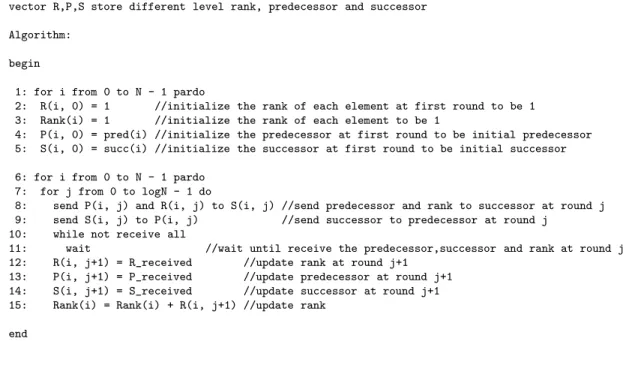
Figure 13 illustrates the LR-pt2pt-sync algorithm. For each node of the list, the rank field records the final rank, the vector R stores the rank for different steps, and vectors P and S store the predecessors and successors for different steps. Each node will send its information to its current predecessor and successor and wait to proceed until all the information it needs has been received. There is no explicit global synchronization required among all the processing units, thus we expect this