W&M ScholarWorks
W&M ScholarWorks
Dissertations, Theses, and Masters Projects Theses, Dissertations, & Master Projects
2019
Teacher Perceptions of the Virginia Evaluation Process: A
Teacher Perceptions of the Virginia Evaluation Process: A
Program Evaluation of Northshore High School’s Teacher
Program Evaluation of Northshore High School’s Teacher
Evaluation Process
Evaluation Process
Douglas Fulton
William & Mary - School of Education, [email protected]
Follow this and additional works at: https://scholarworks.wm.edu/etd Part of the Educational Leadership Commons
Recommended Citation Recommended Citation
Fulton, Douglas, "Teacher Perceptions of the Virginia Evaluation Process: A Program Evaluation of Northshore High School’s Teacher Evaluation Process" (2019). Dissertations, Theses, and Masters Projects. Paper 1582642239.
http://dx.doi.org/10.21220/m2-xhjh-p728
This Dissertation is brought to you for free and open access by the Theses, Dissertations, & Master Projects at W&M ScholarWorks. It has been accepted for inclusion in Dissertations, Theses, and Masters Projects by an authorized administrator of W&M ScholarWorks. For more information, please contact [email protected].
TEACHER PERCEPTIONS OF THE VIRGINIA EVALUATION PROCESS: A PROGRAM EVALUATION OF NORTHSHORE HIGH SCHOOL’S TEACHER
EVALUATION PROCESS
A Dissertation
Presented to the
The Faculty of the School of Education
The College of William and Mary in Virginia
In Partial Fulfillment
Of the Requirements for the Degree Doctor of Education
By Douglas Fulton
TEACHER PERCEPTIONS OF THE VIRGINIA EVALUATION PROCESS: A PROGRAM EVALUATION OF NORTHSHORE HIGH SCHOOL’S TEACHER
EVALUATION PROCESS Approved August 28, 2019 by Meaghan Tschannen-Moran, Ph.D. Committee Member Dr. Tom Ward, Ph.D. _______________________ Committee Member James Stronge, Ph.D.
Dedication
This research is dedicated to all the excellent teachers, administrators, and other
educators I have worked with or had the pleasure to meet in over three decades of public-school work. The educators who treat their career as a professional and who are open to continual learning have inspired me.
I would like to make a special dedication to elementary teacher and my wife Diane Fulton. Diane embraces teaching and her students with a passion that continually brings out the best in students. Her ability to reach students at their level and build relationships is why she enables her students to love learning. Diane and teachers like her, bring a sense of joy and a spirit of dedication to our profession.
Table of Contents
Acknowledgements ... vii
List of Tables ... viii
List of Figures ... ix Abstract ...x Chapter 1: Introduction ...2 Background ...3 Program Description ...6 Context ...7
Description of the Program ...11
Overview of the Evaluation Approach ...17
Program Evaluation Model ...20
Purpose of the Evaluation ...20
Focus of the Evaluation ...22
Evaluation Questions ...22
Definition of Terms...24
Chapter 2: Review of Literature ...26
Introduction ...26
History and Purpose ...26
Government Influence ...28
Research Support ...29
Student-Growth Measures ...30
Teacher Perceptions ...33
Multiple Data Sources in Teacher Evaluation ...34
Goal Setting Conferences ...35
Classroom Observation ...38 Teacher Reflection ...40 Summary ...42 Chapter 3: Methods ...44 Introduction ...44 Participants ...46 Data Sources ...48
Focus Group Questions ...49
Focus Group Procedures ...51
Field Test ...52
Data Collection ...53
Data Analysis ...54
Researcher as Instrument ...57
Assumptions, Delimitations, and Limitations ...59
Delimitations ...59 Limitations ...60 Assumptions ...61 Ethical Considerations ...61 Chapter 4: Findings ...64 Introduction ...64 Research Question 1 ...65 Research Question 2 ...69 Research Question 3 ...73 Research Question 4 ...75 Research Question 5 ...78 Research Question 6 ...81 Summary of Findings ...83
Chapter 5: Discussion, Conclusions, and Recommendations ...85
Discussion of Findings ...85
Implications for Policy or Practice ...88
Adopted Recommendations ...99
Recommendations for Future Research ...102
Summary ...104
Appendix A: School District Teacher Evaluation Standards and Indicators ...106
Appendix B: Teacher Observation Form 17-18...110
Appendix C: Teacher Observation Form 18-19...114
Appendix D: Advance Ed email Permission ...121
Appendix E: Presurvey Responses ...122
Appendix G: Teacher Focus Group Prompts, Field Test Interview Questions ...124
Appendix H: Focus Group Introduction ...125
Appendix I: Field Test Focus Group Interview Questions ...126
Appendix J: Focus Group Norms ...127
Appendix K: 2020 Northshore Teacher Evaluation Schedule 2019-2020...128
Appendix L: Email permission from Mike Rutherford ...131
Appendix M: Northshore Classroom Observation Form 2019-20 ...132
References ...133
Acknowledgments
I would like to acknowledge the faculty of the College of William and Mary for their guidance and support through the dissertation process. I would especially like to thank my dissertation committee of Dr. Tom Ward, Dr. Meghan Tschannen-Moran, and my chair Dr. James Stronge. The committee was instrumental in focusing the research and helping me produce a study that provided practical information to support my duties as a principal. Dr. Stronge’s expertise and guidance were especially helpful to meet the demands of research and writing while also leading and managing a school with over 2000 students and 200 staff members.
As valuable to this study was support and feedback from the district’s HRTD staff, my director Neri Gonzalez-Sales, and the staff at Northshore High School. Without their work, feedback, and willingness to help, this study would not have been possible.
List of Tables Table
1. Virginia Teacher Evaluation Standards ...9
2. Northshore High School Teacher Evaluation Components and Elements ...13
3. Northshore High School Teacher Timeline of Teacher Evaluation ...14
4. Table of Specifications ...50
5. Data Analysis ...58
6. JCSEE Standards of Research Team……….63
7. Focus Groups’ Responses Aligned to Research Question 1 ...67
8. Focus Groups’ Responses Aligned to Research Question 2 ...71
9. Focus Groups’ Responses Aligned to Research Question 3 ...74
10.Focus Groups’ Responses Aligned to Research Question 4 ...76
11.Focus Groups’ Responses Aligned to Research Question 5 ...79
12. Focus Groups’ Responses Aligned to Research Question 6 ...82
13.Recommendations to Improve Current Practice in Northshore Teacher Evaluation System ...89
List of Figures
Figure 1. Northshore teacher support in the evaluation cycle ...18
Figure 2. Northshore teacher evaluation system with the intended outcome of effective teachers in every classroom ...21 Figure 3. Focus Group Analysis Code Organizer ...56 Figure 4. JCSEE Standards of Research Team ...63 Figure 5. Northshore teacher evaluation system with research support intended outcomes of effective teachers in every classroom ...99
Abstract
Teacher evaluation systems have served to remove ineffective teachers and support teacher professional development. Even with changes in evaluation systems that incorporated student-growth measures, teacher evaluation systems are more likely to serve for teacher development than teacher removal. This qualitative study focused on teacher perceptions of one school’s evaluation components in supporting teacher
professional growth and student learning. The study broke the teachers into career level experience groups of novice, early career, and experienced. The required district/state evaluation components of goal conferences, classroom observations, and student-growth measures were selected for the study. The study also looked at the school practice of teacher-reflection in the evaluation system. Twenty-one teachers participated in focus group interviews designed to understand how teachers use goal setting conferences, classroom observations, student-growth measures, and teacher reflection. Focus groups were designed to protect teacher anonymity and reduce bias in the study. The results revealed differences in how teachers value the evaluation components based on the teacher’s experience level. At times teachers questioned the value of the evaluation system, goal meetings, classroom observations, and student-growth measures, yet teachers understood the need for the components in evaluations. Teachers requested more frequent observations and opportunities to review goals, and professional practices. They also wanted fidelity in the evaluator the tools for the evaluation. Perceptual data identified teacher reflection emerged as the most influential component in improving teacher practices.
TEACHER PERCEPTIONS OF THE VIRGINIA EVALUATION PROCESS: A PROGRAM EVALUATION OF NORTHSHORE HIGH SCHOOL’S TEACHER
CHAPTER 1 INTRODUCTION
Effective, confident teachers are a significant contributor to the academic development of students and overall school climate (Hall & Simeral, 2015; Miller, Ramirez, & Murdock, 2017; Stronge, 2010a). Effective teachers are also a major part of a successful school culture. Developing and creating a culture that encourages teachers continued professional growth falls on the shoulders of the building principal. Relatedly, a Wallace Foundation report (2011) stated the principal is responsible for combining the variables, including teacher development, that create a successful school environment.
Research on teacher quality has led to changes in teacher evaluations throughout the United States (Danielson, 2010; Marzano, Frontier, & Livingston, 2011; Stronge, 2007). As part of any effort to support teacher quality and a positive school climate, teacher evaluations and evaluation components such as classroom observation, goal conferences, teacher reflection, and student-growth measures are tools principals use that play a role in improving teacher performance. The evaluation methods adopted in Virginia and many other states are reflect research-supported standards for effective teachers. These standards have been used to construct new teacher evaluations and to create teacher training. As of 2013, 31 states in the United States were using results and data from teacher evaluations to construct state-wide or school-based teacher professional development (Hull, 2013). With the changes in teacher evaluations, there is a need to
understand more about the effectiveness of evaluation components as they relate to teacher improvement.
Background
Principals take on many roles in a school; however, the role that often comes to the forefront in the age of education reform is that of instructional leader. Federal accountability measures passed through policies such as No Child Left Behind Act ([NCLB], 2002) and Every Student Succeeds Act (2015) emphasize the role of principal as both the key figure in improving teacher performance and in removing ineffective teachers. A Michigan study found principals evaluate on average 25 teachers a year and consumed approximately 31 full workdays to complete the evaluations (Rowan et al., 2018). The principal’s support, leadership, and confidence the evaluation will improve teacher performance is vital for the success of evaluation systems (Derrington & Campbell, 2015; Finnegan, 2016). Additionally, as instructional leader, the principal is often both the leader for professional development and the primary developer of teacher talent.
Based on the need to keep and develop effective teachers, the importance of the evaluation process to improve teacher performance is vital for the success of schools. Research labels the teacher as the most crucial factor in student growth (Aaronson, Barrow, & Sander, 2007; Danielson, 2010; DiPaola & Hoy, 2014; Stronge, 2010a). Hanushek (2011) found effective teachers can improve student performance by 0.2 to 0.3 standard deviations above an ineffective teacher. Hattie’s list of high-yield educational interventions notes teacher skills as three of the top five effects on student learning, with teacher attributes (1.62) having the greatest effect (Killian, 2017).
Teacher evaluation systems become a significant part of school reform, school accountability, and school culture. Evaluation systems can be avenues to support and build professional development, by identifying strengths and areas of growth. Teacher evaluation components, when developed and used effectively, become tools that
principals can use to improve teacher effectiveness (Danielson, 2010; Darling-Hammond, 2014).
Improving the teaching craft is one established goal of teacher evaluations. Evaluations can also be the basis to remove or reassign ineffective teachers. This combination of teacher improvement and teacher accountability creates a heightened focus on evaluation systems (Aldeman, 2017; Danielson, 2010; Darling-Hammond, 2014; Stronge, 2010b) and often puts the principal in a management or supervisory role (Wiles & Bondi, 2004). While the two purposes of teacher evaluation systems have stayed primarily the same for many decades, federal and state legislation in the early 2000s highlighted teacher evaluation as a tool for teacher and school accountability. Thus, evaluations are now a principal’s primary tool for “quality assurance and professional growth” (Danielson & McGreal, 2000, p. 9). Darling-Hammond (2014) called this era a “critical moment in teacher evaluations” (p. 4).
Despite federal and state foci on teacher evaluation as a tool to rate teachers, effective principals and other school-based administrators strive to avoid the teacher removal purpose of evaluation. A Measures of Effective Teacher analysis fount 98% of teachers were rated “satisfactory” (Kane & Staiger, 2012). A separate study of state evaluations found the number of teachers with unsatisfactory ratings stayed the same or dropped even after states adopted high-stakes evaluations (Hull, 2013). A 2015 study of
state evaluations also found the number of teachers with unsatisfactory ratings stayed the same or dropped after the surveyed states adopted high-stakes evaluations (Aldeman, 2017). Only seven states reported more than 5% of teachers rated below proficient (Aldeman, 2017, p. 66). While many states have moved toward high-stakes teacher evaluations that incorporate student-growth measures, the results do not show the practice is removing ineffective teachers.
The reasoning for not using evaluations as a tool to remove ineffective teachers is two-fold. First, there complex and expensive processes of removing a teacher for cause must withstand the scrutiny of the teachers’ union, central office staff, and judicial review (Chait, 2010). Principals may search for methods to retain teachers, especially in schools with ineffective evaluation systems (Chait, 2010).
The second reason for retaining teachers is the current teacher shortage and concern about teacher turnover may leave administrators without any other options to replace a teacher who is removed. Teacher shortages (Sutcher, Darling-Hammond, & Carver-Thomas, 2016) may force a school administrator to keep a teacher instead of taking the chance of not finding a satisfactory replacement. Like many states, Virginia has a shortage of qualified teachers. According to Virginia Secretary of Education Artif Qarni, Virginia opened the 2018-19 school year with 935 unfilled teaching positions (personal communication, September 12, 2018). Further Virginia reviews on teacher retention focused on other negatives of removing teachers through evaluations. Katz (2018) noted high teacher turnover negatively impacts student achievement and creates added expenses for teacher recruitment to replace teachers who have left or been removed for cause.
The primary purpose of teacher evaluation system appears is to develop effective teachers and then support those effective teachers. Principals need to differentiate between evaluation as supervision and evaluation as professional development (Mette et al., 2017). DiPaola and Hoy (2014) stated teacher evaluation systems should include relevant and timely feedback for teachers and reference specific instructional strategies. Additionally, evaluation systems should rely on identified standards or descriptors of effective teachers (Stronge, 2007). If teacher evaluations are to meet this primary purpose, there is a call for greater understanding among school principals related to how evaluations can produce effective teachers and support those teachers who are already effective in their practices.
Program Description
The purpose of this study is to review major components of the teacher evaluation system at Northshore High School (a pseudonym) in Virginia to understand whether teachers perceive the components of the evaluation system as contributing to
improvements in teacher performance. Northshore High School teachers are evaluated using required processes of the Virginia Board of Education and the school district’s board of education. Northshore High School administrators added components to the teacher evaluation designed to provide unbiased coaching and peer support, and to promote teacher reflection. The current district evaluation system is used as both a formative tool to improve teacher practices and a summative tool to grade a teacher on their performance.
Fullan (2014) wrote that principals maximize the impact of their leadership when they have the right drivers in place. Fullan identified these drivers as capacity building,
collaborative effort, pedagogy, and systemness. At Northshore High School, school leaders tried to create an environment in which the teacher evaluation system is formative and implemented to encourage teachers to be part of a growth process. For the teacher evaluation system to have the desired impact, there was a need to construct an
understanding of the components of effectiveness and ensure the evaluation system was not composed of fragmented strategies (Fullan, 2014, p. 25). The components needed to align in the overall evaluation system to produce the desired effect of teacher growth. This study of the teacher evaluation components was intended to help better understand the effectiveness of each evaluation component through the perceptions of teachers who had completed at least one evaluation cycle (1 school year) at Northshore High
School. To achieve this purpose, a qualitative study constructed the reality of how teachers view, use, and understand the evaluation system and selected key components. Through the study, school-based administrators developed an improved understanding of how they can use the evaluation processes to support teacher growth and teacher
professional development and improve student learning. This study did not look at the teacher’s final evaluation score or summative purpose of teacher evaluations. Rather, this research focused on whether evaluation components can lead to professional growth or be a formative tool for teacher development.
Context
In 2011, the Virginia Department of Education (VDOE) adopted a new teacher evaluation system and required its implementation statewide. The Virginia 2011 teacher evaluation was based on the research of Stronge (YEAR[s]), who served as consultant in the development of the evaluation system (VDOE, 2011b). A state committee that
included superintendents, principals, teachers, parents, and members of the VDOE, used the research to draft the Guidelines for Uniform Performance Standards and Evaluation Criteria for Teachers (VDOE, 2011a). The stated purposes of the evaluation system include optimizing student learning, improving instruction, promoting collaboration between teacher and evaluator, and promoting self-growth (p. 5).
The VDOE requires teacher evaluations in each of a teacher’s first 3 years in the state. After the first 3 years, teachers with successful evaluations (an overall rating of at least proficient in Year 3) become continuing contract teachers. After the first 3 years, continuing contract teachers must be formally evaluated every 3 years. However, a school administrator may place teachers on formal evaluation in any year if there is concern about teacher performance.
The guidelines list seven teacher professional standards that are intended to define qualities of effective teachers (see Table 1). Forty-eight indicators of teacher
performance were aligned with the full set of standards. The VDOE then published Virginia Standards for the Professional Practice of Teachers (2011c). In this document, key elements were listed with each standard. The number of key elements aligned to a standard differed depending on the standard and the content taught. Virginia legislative code requires student-growth measures must be included in the teacher evaluation. The code states teacher evaluations “shall include student academic progress as a significant component and an overall summative rating” (Quality of classroom instruction and educational leadership, 1984, 2004).
Table 1
Virginia Teacher Evaluation Standards
Standard Description
1: Professional Knowledge Teachers demonstrate an understanding of the curriculum, subject content, and the
developmental needs of students by providing relevant learning experiences.
2: Instructional Planning Teachers plan using the Virginia Standards of Learning, the school’s curriculum, effective strategies, resources, and data to meet the needs of all students.
3: Instructional Delivery Teachers effectively engage students in learning by using a variety of instructional strategies to meet individual learning needs.
4: Assessment of and for Student Learning
Teachers systematically gather, analyze, and use all relevant data to measure student academic progress, guide instructional content and delivery methods, and provide timely feedback to both students and parents throughout the school year.
5: Learning Environment Teachers use resources, routines, and procedures to provide a respectful, positive, safe, student-centered environment that is conducive to learning.
6: Professionalism Teachers maintain a commitment to professional ethics, communicate effectively, and take
responsibility for and participate in professional growth that results in enhanced student learning. 7: Student Academic Progress The work of the teacher results in acceptable,
measurable, and appropriate student academic progress.
The VDOE established Standard 7 as a growth measure required by the legislative code of Virginia. Standard 7 represents 40% of the overall teacher evaluation.
Clarification of Standard 7 came from the teacher guidelines published by the Virginia Board of Education and the VDOE in Guidelines for Uniform Performance Standards and Evaluation Criteria for Teachers (2011a):
To the extent possible, teachers and administrators should choose measures of student academic progress based on validated quantitative measures and provide data that reflect progress in student learning. Validated assessment tools that provide quantitative measures of learning and achievement should be the first choice in measuring student academic progress. Often, a combination of absolute achievement, as measured by nationally validated assessments and goal setting (described later in this document) is appropriate. (p. 43)
Virginia teachers meet state expectations for Standard 7 through writing specific, measurable, attainable, realistic, and time-bound (SMART) goals and keeping data to document student progress.
Virginia Code required school district to adopt the standards, but districts did not have to adopt all the indicators. The school district in this study used a committee of administrators, teachers, and parents to create an evaluation that used 47 indicators (the study site's handbook, 2013).
Subsequently, the school board incorporated the VDOE seven performance standards and 47 indicators into its teacher evaluation system. Each indicator is aligned with one of the seven standards (Appendix A). The same indicators are used for all district teachers. Teachers are evaluated on the standards using a 4-point scale of exemplary (4), proficient (3), developing/needs improvement (2), and unacceptable
(1). The first six standards are valued at 10% each and Standard 7 is valued at 40% of the final evaluation. Teachers need to earn a 3 or higher overall average score for a
The school district that is the setting for this study trained administrators on how to use the evaluation system to rate teachers. The training is offered every summer and administrators are encouraged to take refresher training. In the summer of 2017, the school district provided a more in-depth training on the evaluation system through the new department of Human Resources and Talent Development (HRTD).
Description of the program. The growth of Northshore High School’s student and staff population and the addition of school-based evaluation components to the teacher evaluation process are factors in the selection of the school for a program evaluation. In the 2018-2019 school year, Northshore High School served a student population of more than 2,000 students and had 148 instructional staff. Since the 2012-2013 school year, Northshore High School’s student population increased by over 500 students. The student growth has created 57 new staffing positions since 2012-2013, with 94 teachers hired (new or replacement) in the same time span. Approximately 54% of teachers hired at Northshore since 2012 were first-year teachers.
The rapid addition of teachers, especially teachers new to the profession, makes Northshore High School a suitable selection to document teacher growth and perceptions about their growth. Of the 124 Northshore High School teachers who have completed a full evaluation cycle, 26 were second- or third-year teachers during the 2018-2019 school year. For this study, teachers with fewer than three years of experience, but with at least one full evaluation cycle at Northshore High School, are considered novice teachers. Teachers with more than three years but less than eight are considered early career and teachers with more than eight years are considered experienced teachers.
The district requires three specific teacher evaluation components that form the basis of this study: goal conferences, classroom observations, and student-growth measures. Northshore requires an additional component—teacher reflection—that will also be included in the study. Northshore aims to exceed district requirements for teacher evaluations (Table 2). Additional elements were added to promote teacher and
administrator collaboration, teacher peer collaboration, and teacher reflection on instructional practices. Teacher reflections, in which teachers are asked to write about how their instructional strategies impacted student growth, were added to Northshore teacher evaluations during the 2012-2013 school year.
Table 2
Northshore High School Teacher Evaluation Components and Elements
Elements Virginia Requirement District Requirement Northshore Requirement Goal Writing PLC Training Goal Meeting Mid-Year Meeting Common Planning Final Evaluation Classroom Observation Mentor District Coach Primary Evaluator Secondary Evaluator Primary Evaluator Peer
Standard 7: Student Growth Goal Writing Tiered Students Instructional Strategies Documented Student Growth Reflection Teacher reflection on
student progress and on teacher’s instructional strategies
Note. Mentors are required for first-year teachers and teachers new to the district. Teacher reflection questions were suggested in state guidelines.
The proposed study will gather data related to teacher perceptions of selected evaluation components. The other added components of the Northshore teacher
evaluation—peer reviews, tiered placement of students, and implementing instructional strategies for each tier, could be discussed during the teacher focus group interviews. Table 3 reflects the Northshore teacher evaluation timeline. Additionally, the following subsections provide details for four important aspects of the evaluation process: goal
setting conferences, classroom observations, student-growth measures, and teacher reflection.
Table 3
Northshore High School Teacher Timeline of Teacher Evaluation
Timeframe Teacher Evaluation Activities
First Seven Weeks of School • Faculty meeting held for all teachers on evaluation cycle.
• Teacher evaluations covered in weekly administrative meetings • Teacher assesses their student’s current knowledge and skills in
content area
• Teacher tiers students
• Teacher writes a student-growth goal • Teacher develops instructional strategies (3)
• Teachers are observed by primary evaluator using a school selected
classroom observation document.
• Teacher and evaluator meet within 10-days after observation. End of First Quarter • Goals and strategies are reviewed by teacher and primary evaluator
• Teacher may adjust goals, tiers, and strategies
• Division’s classroom observation form is used a check on teacher
overall evaluation
• Teacher evaluations covered in weekly administrative meetings
Second Quarter • Secondary Evaluator completes a classroom observation
• Teacher and secondary evaluator meet within 10-days after
observation.
• Teachers completes a mid-year assessment of student progress
• Mid-Year meeting with primary evaluator and teacher • Goals are reviewed and adjusted if needed
• Teacher evaluations covered in weekly administrative meetings
Third Quarter • First year teachers, and teachers in need of support are observed a third time.
• Teacher and evaluator meet within 10-days after observation. • Teacher evaluations covered in weekly administrative meetings End of April • Teacher completes an assessment on student progress
• Teacher submits data and reflection to primary evaluator • Teacher evaluations covered in weekly administrative meetings
May • Administrators meet to review all teacher evaluations
• End of Year conference with teacher
Note. This timeline only reflects evaluation components for this study.
Goal setting conferences. Northshore teachers meet with their primary evaluator (principal or an assistant principal) near the end of the first grading period. Prior to the conference, teachers have tiered their students through a diagnostic assessment, practice test, grades on assignments, or a combination of assessments. Teachers are asked to, if
possible, develop their tiers that gather the students based on current knowledge and skills. The first tier are the students starting at the highest level and the third tier is the students who will need the greatest support. Tiers are flexible throughout the school year.
For each tier, teachers will develop at least one instructional strategy to support student growth. The instructional strategy is “what the teacher will do.” Evidence collected for the strategies can include documentation on how often and fidelity of use and how did the student’s academic performance improve.
Three meetings or conferences will occur between teacher and the primary evaluator to review student-growth goals. During the initial goal setting conference, the teacher and primary evaluator will review the student tiers, the student-growth goal, the instructional strategies, and the evidence the teacher will use to document the impact of the strategies and student progress toward goals. A mid-year meeting between the
teacher and primary evaluator will include a similar review. At this time, the teacher will have mid-year data to share. The teacher may adjust the goal during the mid-year review. In the end of year meeting, the teacher presents a review of student growth and discusses what impact the instructional strategies had on student growth.
Classroom observations. The school district uses the final evaluation form for classroom observations. Northshore has received verbal permission from HRTD to use a different observation form. The district’s observation form is used as a teacher
checkpoint at the end of the first quarter and at mid-year.
Northshore administration elected to use a school-based tool to provide better feedback about instructional planning, instructional delivery, and student engagement.
Northshore’s administration felt many (24 of 47) of the indicators on the district’s form, were not easily identified in a classroom observation. Northshore’s classroom
observation form has been modified four times since SY 2013-14. Northshore’s classroom observation tool for SY 16-17 and 17-18 (Appendix B) and SY 18-19 (Appendix C) are the most recent forms. Northshore High school received permission from AdvancEd to use their classroom observation form in SY 18-19 (Appendix D).
Student-growth measures. The student-growth measure is Standard 7 of the Virginia teacher evaluation system. Documenting student growth accounts for 40 % of the teacher’s final evaluation.
District teachers are encouraged to develop SMART goals. SMART goals are specific, measurable, attainable, realistic, and timely goals that document student growth during the school year. Teacher selected goals enables a teacher to select goals that relate to their content and meet student needs.
Northshore teachers set a goal that usually has specific growth measures for each student tier. The tiering of students allows a teacher to set specific growth measurements for student groups based on the student groups’ levels of knowledge and skills. Goals are agreed upon by the teacher and primary evaluator in the goal setting meeting. Goals are reviewed at the mid-year meeting. Northshore does not use a rubric to grade a teacher’s SMART goal.
Teacher reflection. Northshore added the reflection requirement (at first called a teacher narrative) in SY 13-14. Teacher reflections are not required by either the state teacher evaluation system or the district teacher evaluation system. Northshore
progress by describing the impact of their instructional strategies Teachers submit their reflection with the final data on student growth.
In the reflection, teachers are asked to Describe how you met or did not meet your student-growth goals. The teachers also respond to the following questions: How effective were your instructional strategies in meeting those goals? As you reflect on the year, what have learned about your planning, instruction, and assessment practices?
Overview of the Evaluation Approach
The teacher evaluation system design provides opportunities for growth, collaboration, and improving teacher effectiveness. The teacher evaluation also is a summative assessment of the teacher’s performance. Administrators need to find ways to use the evaluation formative components effectively. In general, teachers who are
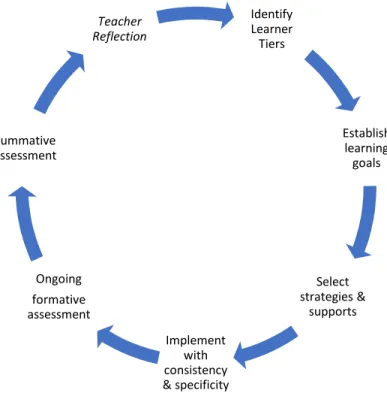
satisfied with their principal’s instructional leadership and who are provided greater teacher autonomy in the evaluations are more likely to have a positive view of the evaluation process (Lacireno-Paquet, Bocala, & Bailey, 2016; Scudella, 2015). Nonetheless, more specific information is needed to determine whether the teacher evaluation and its components are viewed as promoting teacher improvement. The purpose is to determine whether teachers perceive selected evaluation components (goal conferences, classroom observations, student-growth measures, and teacher reflection). Specifically, the intention is to construct an understanding of how teachers view selected evaluation components if different stages of their teaching careers. Deeper understanding of teacher perceptions might lead to more effective and efficient evaluation systems. The Northshore teacher evaluation cycle is shown in Figure 1.
Figure 1. Northshore teacher support in the evaluation cycle.
The four program evaluation standards—propriety, utility, feasibility, and accuracy—are important characteristics of this program evaluation. Propriety ensures a fair and open evaluation process. Utility requires the evaluations have clarity of purpose and are completed by qualified staff. Feasibility ensures the evaluations are practical and applicable to a teacher’s specific job. Finally, accuracy requires the evaluators to link teacher performance to the effective Virginia teaching standards.
Teachers’ perceptions of evaluation are important for understanding what value teachers place in the evaluation processes. Extant research shows that teachers want accountability measures used both to remove poor teachers and improve good teachers (Clipa, 2011; Sartain & Steinberg, 2014). Moran (2017) found teachers wanted
accountability for teachers who do not carry out their responsibilities. On the other hand,
Identify Learner Tiers Establish learning goals Select strategies & supports Implement with consistency & specificity Ongoing formative assessment Summative assessment Teacher Reflection
some researchers have found teachers who receive quality feedback and work jointly with an administrator view the evaluation as a tool to improve their craft (DiPaola & Hoy, 2014; Lacireno-Paquet et al., 2016).
There is a need to include teacher perceptions in understanding the narrative of evaluations (Jiang, Sporte, & Luppescu, 2015). Administrators who can build a
collective focus and trust with teachers can generate greater student achievement (Hoy, 2002). Given these points, it is reasonable to state that the following six assumptions guided this research study (not listed in order of importance):
1. Effective teachers significantly improve student academic growth.
2. It is important for school leadership to understand teacher perceptions of the evaluation system and evaluation processes.
3. It is important for school leadership to understand how their teachers learn. 4. Teachers have a wide range of perceptions of the how their evaluation
connects to student learning.
5. A teacher evaluation process that includes teacher reflection will help teachers see the direct impact on student learning from their pedagogical methods. 6. It is a moral imperative of school leaders to provide all students with an
Program Evaluation Model
The research study was approached through a constructivist lens. Constructivists create meaning by listening to views of those living in the environment (Creswell, 2014). Through the research, I built an understanding of how teachers create meaning about the evaluation components (Ford, Sickle, Clark, Fazio-Brunson, & Schween, 2017; Jiang et al., 2015).
The CIPP Model (Stufflebeam, 2003) served as the framework for the evaluation of Northshore’s teacher evaluation system (Figure 2). Stufflebeam’s (2003, 2004) CIPP model includes context (teacher experience); input (mentors, evaluation resources, goal conferences); process (professional development, coaching meetings, classroom
observations); and product (Did staff feel they grew professionally and did the evaluation process improve student learning?).
Purpose of the evaluation. Research connects the effectiveness of a teacher to student academic achievement. Effective teachers have a significant positive impact on student performance (Hattie, 2009; Stronge, 2010a). A teacher’s effectiveness is the major factor in student academic growth for both low and high performing students (Stronge, 2010a; Wright, Horn, & Sanders, 1997). Ineffective teachers produce less academic achievement no matter the level of the student (Stecher, Garet, Holtzman, & Hamilton, 2012).
Figure 2. Northshore teacher evaluation system with the intended outcome of effective teachers in every classroom.
Building effective evaluation processes is a key part of administrative
leadership. To build and support effective teachers, administrators must enter a coaching and supporting relationship with their staff (Marzano & Simms, 2013). Sergiovanni (1992) wrote that a school leader must understand what motivates and inspires his or her staff. With an understanding of staff perceptions, a school administrator can develop effective ways to use the evaluation components to improve teacher performance.
Effective
Teachers In Every
Classroom
Context Experience Number of Evaluations Input Goal Meetings Instructional Strategies Student Growth Measures Process Classroom Observations Goal Meetings Student Growth MeasuresTeacher Reflections Product
Teacher Improvement Student Growth
Focus of the evaluation. The state of Virginia implemented a new evaluation system for the 2012-13 school year. The new system incorporated traditional evaluation components (observations) with a student-growth measure. If a school principal is to understand the effectiveness of evaluation components in the new system, there is a need to gather teachers’ perceptions around the propriety, utility, feasibility, and accuracy of the evaluation components. For the principal to understand the effectiveness of the system in improving teacher performance, it is necessary to review whether teachers believe they have improved in practices because of evaluation components. The objective of this review is to provide school-based leadership with an understanding of how teachers use and view the evaluation process and to help principals improve the way evaluation components are implemented. Other researchers have evaluated evaluation systems (Moran, 2017; Sartain & Steinberg, 2014), but few have looked at the combined components or multiple data sources used in teacher evaluations.
Evaluation questions. Program evaluations that involve teacher perceptions of their employment reviews must ensure confidentiality of the participants. This study adhered to the Joint Committee on Standards for Educational Evaluation (JCSEE)
standards of propriety, utility, feasibility, and accuracy. The following research questions were developed to maintain the standards of JCSEE.
1. What are key similarities and differences in the perceptions of novice (>1 and <3 years), early career (>3 years and < 8 years), experienced (>7 years) teachers regarding their instructional effectiveness in relation to the school district’s teacher evaluation system?
2. What are key similarities and differences in the perceptions of novice (>1 and <3 years), early career (>3 years and < 8 years), experienced (>7 years) teachers regarding the goal meeting component of the school district evaluation system?
3. What are key similarities and differences in the perceptions of novice (>1 and <3 years), early career (>3 years and < 8 years), experienced (>7 years) teachers regarding the classroom observation component of the school district evaluation system?
4. What are key similarities and differences in the perceptions of novice (>1 and <3 years), early career (>3 years and < 8 years), experienced (>7 years) teachers regarding the teacher evaluation component that relates to the school district’s measure of student progress (Standard 7)?
5. What are key similarities and differences in the perceptions of novice (>1 and <3 years), early career (>3 years and < 8 years), experienced (>7 years) teachers regarding the impact of the teacher reflection component of their evaluations on selected teaching practices (instructional planning,
instructional delivery, assessment of/for learning, learning environment, professionalism, and student growth)?
6. What are key similarities and differences in the perceptions of novice (>1 and <3 years), early career (>3 years and < 8 years), experienced (>7 years) teachers regarding how the teacher evaluation process can be improved to effectively support teacher quality and professional growth?
Definitions of Terms
Coach or coaching: Evaluator or evaluator feedback used in a formative process for teacher improvement and professional development.
Early career teacher: Teachers who taught for more than 3 years in the school division, but less than 8 years in Virginia. Early career teachers are on continuing contract after three years of successful evaluations. Early career teachers have only been evaluated by the current Virginia evaluation system. Some early career teachers may have experience in other states.
Evaluation components: Parts of the evaluation system such as goal conferences, classroom observations, teacher reflection, and student-growth measures.
Experienced teacher: Teachers with 8 or more years teaching experience in Virginia. Teachers will 8 or more years’ experience in Virginia, were evaluated at least once under the previous evaluation system.
Formative teacher evaluation: Components and processes in the teacher evaluation cycle that promote growth in teacher practices and effectiveness.
Novice teacher: A teacher with at least one completed evaluation cycle in the Northshore evaluation process but fewer than 3 years’ total teaching experience. Novice teachers are under provisional contracts.
School-based administrators: Principals or assistant principals who evaluate teachers.
Summative teacher evaluation: The end of year evaluation score received by a teacher that labels a teacher’s performance as unsatisfactory, developing, proficient, or accomplished.
Teacher reflection: A teacher narrative completed at the end of the evaluation year. A teacher’s self-evaluation of their instructional, delivery, and assessment practices and the impact of those practices on student learning.
Tiered students: Northshore High School teachers placed students in tiers based on pre-test scores, class grades, and skill assessments using a combination of
instruments. The three tiers identify levels of support needed for students to successfully meet course expectations, with Tier 3 students identified as in need of specialized
CHAPTER 2
REVIEW OF RELATED LITERATURE
It is imperative for a school principal to use the teacher evaluation process to develop effective teachers for every classroom. Effective teachers are vital for student success; emphasis on effective teachers has led to state and federal legislation focused on a teacher’s abilities to drive student learning.
The literature review in this chapter provides background for Northshore High School’s teacher evaluation components and describes the need for understanding teachers’ perceptions of the evaluation components. Literature related to the four Northshore teacher evaluation components of classroom observations, goal conferences, teacher reflection, and student-growth measures are included in this review.
The literature review is divided into two sections. First, this chapter is a review of teacher evaluation systems from the 1980s to current evaluation systems. The review of teacher evaluations includes legislation directed at teacher evaluations, current evaluation systems with student-growth models, and recent research concerning teacher perceptions of evaluations. The second part of the chapter reviews literature related to three
components of the Northshore High School evaluation system—classroom observations, goal conferences, and teacher reflections.
History and Purpose
Most teacher evaluation systems through the 1980s were clinical observations based on a belief that physical and personal trait made an effective teacher (Danielson &
McGreal, 2000) or were driven by school or state initiatives to change teaching practices (Richardson, 1990). Characteristics such as voice and physical appearance were
evaluated as important teacher skills (Danielson & McGreal, 2000). The clinical supervisory practices were based on the works of Harvard Education professor Morris Cogan and a student in the Harvard Master of Arts program, Robert Goldhammer (Marzano et al., 2011). Marzano and colleagues wrote that the original ideas of the Goldhammer supervisory model that included dialogue and the importance of student teacher interaction sometimes were reduced to a checklist of observable teacher actions (Marzano et al., 2011).
The next influence of teacher supervision came through the works of Madeline Hunter. A teacher and administrator, Hunter developed a teaching model and framework that emphasized drills and skills (Wilson, n.d.). Hunter’s teaching model included seven steps: Stated objectives, Anticipatory set, Input Modeling/Modeling practice, Check understanding, Guided practice, Independent practice, and Closure. The Hunter model, not intended as tools for supervision, was made into evaluations that gained the support of local and state policy makers (Danielson & McGreal, 2000, p. 14; Wilson, n.d.). Hunter’s teaching model became a new set of checklists administrators used to rate teachers. However, there was no evidence of the impact Hunter’s instructional strategies had on student learning (Danielson & McGreal, 2000, p. 13). After a 3-year study, Slavin (1986) reported schools using the Hunter model documented a minimal impact on student achievement.
In the 1980s, as part of a Rand Corporation study, Linda Darling-Hammond and other researchers began searching for effective teacher evaluation systems.
Darling-Hammond (2014) reported she could find only a few exemplary models. She noted Toledo school districts in Greenwich, Connecticut developed the Peer Assessment and Review and a model of goal setting and continual feedback. Both these models viewed the teacher as a professional who best learned from continual feedback and peer support. Darling-Hammond (2014) wrote that, as use of successful models has spread, the “broad landscape” has seen little real change. However, change in teacher evaluation models was not widespread. Haefele (1993) wrote that evaluations continued to judge faults rather than strengths and Bryk and Schneider (2002) found that faculty lacked trust in school leadership to promote teacher development.
Government influence. By the 1980s, the federal government became a more active participant in defining effective teachers and teaching. The federal government’s intense focus on teachers and teaching skills dated back to when the National
Commission on Excellence in Education published the Nation at Risk in 1983. Milton Goldberg (1984), the former Executive Director of the National Commission on
Education, wrote that the Nation of Risk report emphasized two points directly related to the effect teachers, especially effective teachers, have on student learning: a set of teaching standards expected in the classroom and a way to recognize and understand the qualities of effective teachers.
Nation at Risk acknowledged not only the need to recognize the qualities of effective teachers, but also the need to improve teacher training. By the late 1990s, the government and the public wanted accountability measures to be part of evaluating teachers’ performance. Poor student performance on international tests enhanced the notion schools were failing to provide a quality education (Dillon, 2010). Using national
standards and state test scores as measures, the federal government got directly involved in teacher evaluations. With the No Child Left Behind Act ([NCLB], 2002), federal legislation was used to connect teacher performance with student academic growth.
Despite the renewed interest and NCLB measures to improve schools by
removing poor teachers and identifying effective teachers, evaluation systems continued to focus more on teacher behaviors then teacher impact. Stronge (2012) noted that teacher evaluations often used classroom observations as the only standard for the
evaluation. In a 2009 executive summary for the New Teacher Report, the authors stated teacher evaluations created the “widget effect” (Weisberg, Sexton, Mulhern, & Keeling, 2009). The widget effect refers to evaluations that created interchangeable parts expected from all teachers. The evaluations and the process did not identify areas of growth, did not link teacher performance to student performance, and was unlikely to change teacher practices (Weisberg et al., 2009).
Research support. By the start of the 21st Century, teacher evaluations linked to student academic growth became key legislative policy, but not always school practices. Legislators advocated measures to keep teachers accountable and improve student learning. The calls for changes in teacher evaluations also came from researchers. Researchers provided data that an effective teacher can produce a lasting effect on student academic growth (Marzano, 2014; Stronge, 2007, 2010a). The effect of good teachers is even more pronounced for student learning among struggling students (Aaronson et al., 2007).
The new educational research demonstrated that effective teachers improve student learning and traditional teacher evaluations were not satisfactory in looking at
student growth (Aldeman, 2017; Danielson & McGreal, 2000). The result was further changes in teacher evaluations using research-based practices (Danielson & McGreal, 2000; Darling-Hammond, 2014; DiPaola & Hoy, 2014; Marzano et al., 2011). Advancement in education research also focused on using teacher evaluations as
professional growth tools, with principals and teachers working together for professional growth. The new evaluation systems focused on real teacher practices (lesson planning, lesson delivery, assessment, professionalism) and encouraged administrators to look at collaboration with teachers as well as collaboration among teachers (Danielson, 2010; Marzano & Simms, 2013).
It seemed that researchers and legislators agreed that good teachers and good teaching matter for student growth. The changes in teacher evaluation designed to develop effective teachers satisfied policy directives such as NCLB and Race to the Top (2009). The federal policies emphasized an accountability measure in teacher
evaluations, while the research advocated evaluations to develop and improve content and instructional pedagogy. The result of the mix of research and accountability led to current evaluations used by many states that connect teacher professional standards with student progress to provide an overall teacher rating. The Center for Public Education reported that since 2009, over two-thirds of the states made significant changes to their evaluation systems (Hull, 2013). Most states included teachers as stakeholders in
designing the new evaluation system and all states included classroom observations in the systems (Hull, 2013).
Student-growth measures. Grants and waivers associated with NCLB and Race to the Top encouraged states to build student-growth measures into the teacher
evaluations. Even though ESSA has relaxed the expectation of including student-growth measures into teacher evaluations, only a few states with student-growth measures opened the door to revamp current evaluations and remove the growth measures (Sawchuck, 2016).
Researchers have continued to link teacher quality to student growth (Ford et al., 2017; Hattie, 2009; Napoles & MacLeod, 2016; Stronge, 2010a). By 2015, 45 states had a student-growth measure in their teacher evaluations (Doherty & Jacobs, 2015). In 18 states, student performance was made a significant factor; in 17 states, student
performance was the “preponderant” factor in teacher evaluations (Doherty & Jacobs, 2015). In a 2016 report, The Education Commission of the United States stated 43 states had incorporated a student-growth objective into their teacher evaluation systems. The report listed 35 states where student achievement was either a preponderant or significant “criterion” in teacher evaluations (Education Commission, 2016). Virginia is one of 19 states where the student-growth measure is a significant criterion.
Growth measures varied by state. Tennessee and Florida created a Value-Added Growth Measure with specific student assessments and measures in their evaluation systems (Florida Department of Education, n.d.; Tennessee Department of Education, n.d.). New Jersey required teachers to use a Student Growth Objective set by the teacher and principal. Language arts teachers (Grades 4-8) and math teachers (Grades 4-7) are required to add to their evaluations a Student Growth Percentile measured through a state assessment (New Jersey Department of Education, n.d.). Virginia required the student-growth measure to account for 40% of a teacher’s evaluation rating, but the state did not prescribe a specific student assessment or measure (VDOE, 2011c).
There are challenges to the use of student-growth measures in teacher evaluations and mixed results concerning the effectiveness of such measures. Conroy and Loeb (2002) found states with high-stakes accountability measures saw greater gains in math scores than states without high-accountability measures. Despite the positive reports of student growth, a Brookings Institution report (Whitehurst, Chingos, & Lindquist, 2014) noted that only a small number of teachers (1 in 5) could be accurately evaluated using state exams. Teachers in disciplines outside of English, math, science, and social science, found the new evaluations were not effective measures of their performances (Callahan & Sadeghi, 2015; Moran, 2017). Other teachers, such as Physical Education teachers, felt less confident in evaluation systems that were not designed to measure their
performances (Norris et al., 2017). However, Hopkins (2013) found a strong agreement among K-12 teachers in Virginia that student-growth measures would improve teacher evaluations.
The use of growth measures faced legal challenges with varying results. Cases originating in Florida (Cook v. Bennett, 2015; Robinson v. Stewart, 2015) and heard before federal and state judges resulted in decisions that favored the state’s ability to include student-growth measures in evaluations. The New York Supreme Court (Lederman v. King, 2016) found the teacher evaluation system to be arbitrary and capricious because the value-added measures hurt teachers with high-performing
students. A 2016 California Superior Court ruling (Doe v. Antioch) stated school districts did not have to include student progress in teacher evaluations. This was despite
California’s 1971 legislative code that specified states schools could use student progress toward goals or state measures in teacher evaluations (Freedberg, 2016).
Teacher perceptions. Teacher perceptions related to the effectiveness of
evaluations to improve instructional practices and student learning varied. Teachers want evaluations that can be used as accountability for poor teachers, not as a method to improve good teachers (Clipa, 2011; Sartain & Steinberg, 2014). Similarly, Moran (2017) found teachers wanted accountability for teachers who do not carry out their responsibilities. In research of six suburban school districts in New Jersey, Ladd (2016) found teachers understood the research and purpose of evaluations, but they lacked training opportunities to turn evaluation feedback into effective classroom practices. Teacher’s confidence in evaluations can mirror teacher confidence in their principal. In a study of Chicago teachers, researchers found teachers were supportive of evaluations if they trusted the principal’s instructional leadership (Jiang et al., 2015).
Teachers have often perceived the evaluation as a checkbox or required activity for principals. Researchers have found that teachers see evaluations as a summative process used to remove ineffective teachers and not a formative process to improve teacher skills (Callahan & Sadeghi, 2015; Moran, 2017). Researchers who interviewed physical education teachers (Norris et al., 2017; Seymour & Garrison, 2016) and art teachers (Shaw, 2016) found teachers assigned to areas outside of the core content, or content areas without state tests did not perceive the evaluation process as contributing to their professional growth. In one New Jersey study, over 40% of the teachers surveyed in 2012 and 2014 did not see the evaluation as impacting their teaching practice (Callahan & Sadeghi, 2015). Despite varying perceptions about the impact of teacher evaluations, researchers have found evidence that evaluations can improve teacher performance (Taylor & Tyler, 2012). Teachers in Cincinnati improved instructionally during the first
year with a new evaluation system and improvement continued over the next two years. When teachers are involved in determining the evaluation criteria, they are more likely to see the evaluation as a measurement of teaching professionalism (Kyriakides, Demetriou, & Charalambous, 2006).
If evaluation systems are going to have fidelity of purpose, the principal must have confidence the teacher evaluation will improve teacher practices. The principal, as instructional leader, is often required to put considerable time into the teacher evaluation process. A Michigan study found principals evaluate on average 25 teachers and
consumed approximately 31 full work days of the principal’s time. The support, leadership, and confidence the evaluation will improve teacher performance is vital for the success of evaluation systems (Derrington & Campbell, 2015; Finnegan, 2016).
Teachers’ perceptions of evaluations are important for understanding the value teachers place on the evaluation processes. There is a need to include teacher perceptions in understanding the narrative of evaluations (Jiang et al., 2015). Principals who can build a collective focus and trust with teachers can generate greater student achievement (Hoy, 2002).
Multiple Data Sources in Teacher Evaluation
The use of multiple data sources or evaluation components has become more prominent in teacher evaluation systems because the measures provide a more accurate representation of teacher effectiveness. Virginia’s teacher evaluation system requires the use of multiple data sources (VDPE 2011a), including classroom observations, teacher goals, and student-growth measures.
Evaluations using multiple data sources, such as classroom observations and measurable goals, can produce a clearer picture of a teacher’s abilities than systems that rely on only a single data source. Peterson (2000) called for the use of multiple sources of aligned information to improve teacher quality. The use of multiple data sources in evaluations is supported through research and is reflected in current teacher evaluation systems (Danielson, 2010; DiPaola & Hoy, 2014; Stronge, 2010a). Multiple data sources have also redefined the role of principal making the school leader more visible and involved with instruction (Neumerski et al., 2018). Multiple data sources can connect teacher planning and instruction to student learning and support professional
development to improve teacher practices (Hanover Research, 2012). Goal Setting Conferences
Teacher goal setting and goal conferences between teacher and principal are established practices in Virginia and many other states teacher evaluation systems. States such as Virginia require the teacher’s goals to relate to student academic improvement. Teacher goal setting is defined as setting a target for student learning and establishing how the student progress is measured (Stronge & Grant, 2009). In Virginia, the purpose of goal setting is for the teacher to establish clear expectations of how to support and measure student growth (VDOE, 2013). Virginia teachers are encouraged to establish SMART goals that document student growth during the school year.
Some states have teachers develop goals by incorporating student learning targets or objectives as part of the evaluation process. The student-growth measures are also referred to as student learning objectives (SLOs). Use of SLOs has been established in teacher evaluations in several school districts. Denver, Colorado, schools is credited with
starting the movement in 1999 and now New York, Georgia, North Carolina, Rhode Island, and Virginia are among the states where school districts use SLOs to measure teacher effectiveness (Reform Support Network, 2013). The use of SLOs for goal settings in the Virginia teacher evaluation system creates a direct relationship between teacher goal setting and student-growth measures used in Standard 7 (VDOE, 2013).
Teacher goal setting has been linked to teacher and student self-efficacy and improved student motivation (Aaronson et al., 2007; Awkard, 2017; Danielson & McGreal, 2000). Schmoker (2018) wrote that the most effective learning occurs when the student knows exactly what they are learning and how it is evaluated. Teacher goals show understanding of where the student starts and document where the student is expected to finish (Stronge & Grant, 2009). Hattie (2003) found effective teachers were better able to assess a student’s level and rates student progress through goal setting. In Hattie’s index of factors related to student achievement, four are connected to teacher goal setting. Hattie’s factors of teachers estimate of student achievement (1.29), learning goals vs. no goal (0.68), clear goal intentions (0.48), and goal commitment (0.40) are all considered effective practices in the index (Waack, 2018). Teachers’ goals should not only reflect the desire for student growth, but also a plan for teacher growth (Marzano & Simms, 2013). Strong and Grant (2009) wrote that student achievement goal setting is meant to “improve student learning and support teachers in their work with students” (p. 4). A review of consistently high-performing high schools found teachers in those
schools incorporated state learning targets into their curriculum and goals (Dolejs, 2006). In a comparison of schools serving similar populations, the schools with clear and
measurable goals saw greater student achievement on a state assessment (Williams et al., 2007).
Successful goal setting has been linked to an important quality of effective
teachers. Fisher and Frey (2014) used the word purpose rather than goal when they wrote that a teacher with a clearly defined purpose could help students meet learning targets (pp. 4-6). When teachers create specific and attainable student learning goals it can improve teacher effectiveness (Fisher & Frey, 2014; Glickman, Gordon, & Ross-Gordon, 2013). In their extensive review of teacher self-efficacy studies, Zee and Koomen (2016) found effective teachers were more likely to use goal setting and teachers who believed they could help students meet learning targets had higher degrees of self-efficacy.
Thus, goal setting appears not only as an avenue for student growth, but as a necessary skill of effective teachers. Developing goal setting skills should be part of a teacher’s professional growth (Camp, 2017; Cwikla, 2003; Stronge & Grant, 2009). Elmore (2005) wrote that clear and consistent goals build effective practices and collegial support. Other researchers have found intrinsic motivators or teacher goals had a greater impact on teacher performance and development than organizational goals (Mintrop & Ordenes, 2017).
Support for using goal setting for teacher improvement originated with human behavior research (Bandura, 1977, 1986; Locke, 1996). The seminal work of Locke and Latham (1990) established five effective goal-setting principles of clarity, challenge, commitment, feedback, and task complexity. In later research, Locke (1996) found that the more specific a goal, the more performance is regulated. He also found people need to believe that a goal is valuable and attainable. Similarly, in their research on goal
setting within organizations, O’Hora and Maglieri (2006) found an increase in individual performance with goal setting. Locke (1996) advocated goal setting and training
programs to help individuals manage their own performances.
There is a limited research in the value of goal setting conference in improving teacher performance. Several educational writers have defined the role and purpose of goal conferences between principal and teacher. Johnson, Leibowitz, and Perrett (2014) opined that the principal must “balance” expectations and supports while encouraging teachers (p. 9). Other authors have offered guidelines as to the role of principal as a coach, moderator, and evaluator in defining teacher goals (Danielson & McGreal, 2000; DiPaola & Hoy, 2014; Glickman et al., 2013; Johnson et al., 2014). Goal conferences can produce different outcomes depending on the approach to the goal setting process (Glickman et al., 2013). Glickman and colleagues found conferences between
administrators and teachers approaches and outcomes have followed four main styles: nondirective (teacher self-plan); collaborative (mutual plan); directive informational (supervisor-suggested plan); directive control (supervisor-assigned plan). A
collaborative and coaching approach is advocated; the literature does highlight the need to understand teacher perceptions of the goal setting and whether it does improve their practices.
Classroom Observations
Historically, many teacher evaluation systems have included classroom
observations as a data source. A research review of teacher evaluation systems in several school districts found that all listed classroom observations as a required component (Kane & Staiger, 2012). In a Brookings study of urban schools, researchers found only