AN ANALYSIS OF LEARNING CHARACTERISTICS, PROCESSES, AND REPRESENTATIONS IN MATHEMATICAL MODELLING OF MIDDLE SCHOOL
LEARNERS WITH SPECIAL EDUCATIONAL NEEDS
BY RINA SCOTT-WILSON
DISSERTATION PRESENTED IN PARTIAL FULFILMENT OF THE REQUIREMENTS
FOR THE DEGREE OF DOCTOR IN PHILOSOPHY AT
STELLENBOSCH UNIVERSITY PROMOTER: PROF. DCJ WESSELS
CO-PROMOTERS: DR H WESSELS and PROF E SWART
DEPARTMENT OF CURRICULUM STUDIES DECEMBER 2014
ABSTRACT
The special needs community is in the midst of a philosophical and physical shift from a segregated system to an integrated system, not only in placement, but more importantly, in terms of learning and affording learners with special needs access to mainstream curricular materials. Mathematical modelling, or challenging mathematics problems solved in small groups, is part of the Australian mainstream curriculum.
The purpose of the study was to investigate the way special needs learners learn mathematics from a modelling learning environment. To do this, it was necessary to identify the critical characteristics of the best practice in teaching and learning for learners with special needs, and the critical features of modelling. One theory of learning that has the capacity to promote special needs learners' interaction with mathematical modelling is Feuerstein’s theory of Structural Cognitive Modifiability. A hypothetical learning trajectory was designed for special needs learners at middle school according to general design principles from theory, which was adapted to the learning characteristics of the class. The learning environment comprised of three challenging modelling tasks, together with recommended implementation and support conditions in the classroom. Specifically, the research sought to investigate the ways in which special needs educators can support the higher reasoning processes of special needs students during modelling through design in general, and through mediation specific to each learner. The research took the form of a qualitative study, combining the phases of design-based research with a multiple case study approach. Three cases were analysed in depth. Empirical data were collected through a range of qualitative methods, which included data from student files, field observations, video and audio recordings, focus group
interviews with students, and the input of various collaborators across the different phases of planning, design, implementation, and revision. Data were coded and analysed inductively according to emerging patterns and themes. Findings suggest that the use of modelling was successful when implemented with certain characteristics defined in the literature, and that it enabled learners to learn mathematics and also to develop additional outcomes such as social skills and language. During this study, learners' higher-order reasoning was supported
through dynamic assessment and subsequent mediation.
KEY WORDS: mathematics teaching and learning, mathematical modelling, special needs learners, middle school, design based research
ii
'n Analise van leerkenmerke, prosesse en voorstellinge in wiskundige modellering van middelskool leerders met spesiale behoeftes.
ABSTRAK
Die onderwysgemeenskap vir leerders met spesiale behoeftes bevind hulle in die middel van filosofiese en fisiese verskuiwings van 'n geskeide sisteem na 'n geïntegreerde sisteem. Dit omvat die plasing van leerders, maar meer belangrik ook die bemoontliking van toegang van hierdie leerders tot hoofstroom kurrikulêre materiale. Wiskundige modellering, en uitdagende wiskundeprobleme wat deur leerders in klein groepies opgelos word, is deel van die Australiese hoofstroomkurrikulum.
Die doel van die studie was om die wyse te ondersoek waarvolgens leerders met spesiale behoeftes wiskunde in 'n modelleringsomgewing leer. Dit is gedoen deur die belangrike kenmerke van beste praktyk vir onderrig en leer in spesiale onderwys, asook die kritiese kenmerke van modellering, te vind.
Een leerteorie wat die interaksie van leerders met spesiale behoeftes met wiskunde bevorder, is Feuerstein se teorie van Strukturele Kognitiewe Modifieerbaarheid. 'n
Hipotetiese leertrajek was ontwerp vir leerders met spesiale behoeftes op middelskoolvlak. Empiriese data is deur 'n reeks kwalitatiewe aksies: data van studentelêers, veldwaar-nemings, video en klankopnames, fokusgroeponderhoude met studente, asook die insette van verskeie medewerkers oor die verskillende fases van beplanning, ontwerp,
implementering en hersiening gegenereer. Die spesifieke leerkenmerke van hierdie leerders volgens algemeen-teoretiese en lokaalgekontekstualiseerde ontwerpbeginsels is nagekom. Die leertrajek het bestaan uit drie uitdagende modelleringsprobleme met aanbevole implementering en ondersteuningsriglyne in die klaskamer.
Die navorsing het spesifiek gesoek na wyses waarop hierdie leerders se hoër
beredeneringsvaardighede deur hul onderwysers, volgens elkeen se eie behoefte gedurende modellering, deur ontwerp in die algemeen en mediasie in die besonder, ondersteun kan word. Die navorsing, 'n kwalitatiewe studie, was gekombineer met fases van
ontwikkelingsgebaseerde ontwerp wat uitgespeel het in 'n veelvuldige
gevallestudiebenadering. Drie gevalle is in diepte ondersoek. Data was induktief gekodeer en geanaliseer volgens ontluikende patrone en temas. Bevindinge wys uit dat die gebruik van modellering suksesvol was wanneer die implementering volgens spesifieke kenmerke in die literatuur was. Dit het leerders instaat gestel om wiskunde te leer asook om addisionele uitkomste soos sosiale vaardighede en taal te ontwikkel.
In hierdie studie is hoër-orde denke ondersteun deur dinamiese assessering en voortspruitende mediasie.
SLEUTELWOORDE: wiskundeonderrig en leer, wiskundige modellering, leerders met spesiale behoeftes, middelskool, ontwikkelingsgebaseerde ontwerp.
iii ACKNOWLEDGEMENTS
I would like to thank my supervisors for their time, wisdom and input into this study. I will remember Prof D.C.J. Wessels for his rich experience and patient endurance, especially his patience in continuing the project during times when there were sufficient reasons not to do so, Dr. H. Wessels for her kind words of encouragement, and Prof. Swart for her depth of knowledge.
I would like to thank my husband and my Mom for their support over the many years of study.
I am grateful to the students who participated in this study, and who in the end became my teachers.
I'm thankful to my collaborators who started as "critical friends" and became real friends through the process.
To Meg, for being there,
iv DECLARATION
I, the undersigned, hereby declare that the work continued in this dissertation is my own original work and that I have not previously in its entirety, or in part, submitted it to any university for a degree.
December 2014 &RS\ULJKW6WHOOHQERVFK8QLYHUVLW\ $OOULJKWVUHVHUYHG
v
Table of Contents
ABSTRACT ... i ACKNOWLEDGEMENTS ... iii DECLARATION ... iv Tables ... xii Figures ... xiv CHAPTER 1 ... 1BACKGROUND AND RATIONALE OF THE RESEARCH ... 1
1.1. BACKGROUND ... 1
1.1.1 Mathematical modelling and the special needs environment ... 2
1.2 STATEMENT OF THE PROBLEM ... 4
1.2.1 Instructional design to support learners with SEN ... 5
1.3 AIMS OF THE STUDY ... 9
1.3.1 Local Theory of Instruction ... 9
1.3.2 Contributing to Socio-Constructivist Learning Theory ... 10
1.3.3 Contributing to inclusive practice ... 13
1.3.4 Contributing to policy and practice ... 14
1.4 RESEARCH QUESTIONS AND TASK ANALYSIS ... 14
1.4.1 Task A: Define the critical characteristics of learning environments for learners with SEN to access common core curricula ... 15
1.4.2 Task B: Define the critical characteristics of modelling as an instructional task and analyse it as an option for SEN classrooms ... 16
1.4.3 Task C: Establish the specific strengths and vulnerabilities of the research cohort ... ... 16
1.4.4 Task D: Designing the hypothetical learning trajectory ... 16
1.4.5 Task E: Pre-Evaluation: Screening, Co-Teaching, and Tryout of Approach (not activities), Practitioner Consultation, Consultation with Cultural Advisor, Expert Consultation ... 17
1.4.6 Task F: The implementation of three modelling tasks in a SEN classroom ... 18
1.4.7 Task G: Reflection ... 19
1.4.6 Task H: Preparing for publication ... 19
1.5 METHODOLOGY ... 20
1.6 DELINEATION AND LIMITATIONS ... 24
vi
1.6.2 Localised and personalised knowledge structures ... 25
1.6.3 Learning and Dynamic Assessment ... 25
1.6.3.1 Dynamic Assessment and the timeline of the intervention ... 26
1.6.3.2 Dynamic assessment and the scope of the intervention ... 27
1.6.4 Contraventions between the nature of modelling and the type of intervention proposed by Feuerstein ... 28
1.7 ORGANISATION OF THE CHAPTERS ... 29
CHAPTER 2 ... 30
AN ANALYSIS OF THE CRITICAL CHARACTERISTICS OF LEARNING ENVIRONMENTS FOR LEARNERS WITH SEN TO ACCESS COMMON CORE CURRICULA ... 30
2.1 INTRODUCTION ... 30
2.2 "ACCESS TO COMMON CURRICULA" TENSION ... 31
2.2.1 Historical progression ... 31
2.2.2 Supported in the national curriculum ... 32
2.2.3 The developmental delay model ... 33
2.2.4 Models of disability which influence curricular decisions ... 34
2.2.5 The implications of disability models for learners with SEN ... 39
2.3 HOW DO WE GET LEARNERS WITH SEN TO ACCESS COMMON CURRICULA? ... 41
2.3.1 Socio-spatial inclusion ... 41
2.3.2 Staff and structural re-organisation ... 45
2.3.3 Differentiation ... 46
2.3.3.1 Universal design for learning ... 49
2.3.4 Learner support assistants ... 50
2.4 THE NEED FOR MORE RESEARCH ... 51
2.4.1 What do we already know from research? ... 52
2.4.2 Factors hampering research ... 53
2.4.3 Alternatives to labelling ... 57
2.5 ACCESS THROUGH THEORIES OF LEARNING ... 64
2.5.1 Introduction ... 65
2.5.2 Neuroscience ... 80
2.5.3 Which learning theory for learners with SEN? ... 81
2.6 SUMMARY OF THE CRITICAL FEATURES OF LEARNERS WITH SEN TO ACCESS MAINSTREAM CURRICULA ... 93
2.7 THE ROLE OF FEUERSTEIN IN THIS STUDY ... 93
2.7.1 Well-trained teachers, curricular differentiation, AND individual modification ... 96
vii
2.7.3 Feuerstein's list of cognitive deficits ... 99
2.7.4 Feuerstein and mediation ... 100
2.7.5 Feuerstein's work on intelligence ... 101
2.7.6 Other studies using Feuerstein's work in mathematical learning ... 102
2.9 CONCLUSION ... 103
CHAPTER 3 ... 105
MODELLING AS A VIABLE OPTION FOR TEACHING MATHEMATICS TO LEARNERS WITH SEN... 105
3.1 INTRODUCTION ... 105
3.2 AN ANALYSIS OF MODELLING AS AN OPTION FOR ALL CLASSROOMS ... 105
3.2.1 What is mathematical modelling? ... 106
3.2.2 Modelling and learning theory ... 106
3.2.3 Policy, disability discourses, and curricular situations are favouring modelling . 108 3.3 THE ROLE OF THE LEARNER ... 109
3.3.1 Learners are active ... 109
3.3.2 Learners construct conceptual frameworks ... 112
3.3.3 Learners develop concepts through cyclical processes ... 115
3.3.4 Learners' conceptual development is neither linear nor hierarchical ... 118
3.3.5 Learners make multiple connections ... 119
3.3.6 Learners represent their work ... 119
3.3.8 Learners' models will be unstable ... 123
3.4 THE ROLE OF THE TEACHER ... 128
3.4.1 The teacher has to select suitable problems ... 129
3.4.2 The teacher needs to let the learners experience cognitive conflicts... 132
3.4.3 The teacher has to mediate between learners and between learners and content . 133 3.4.4 The teacher helps learners formalise their knowledge ... 134
3.4.5 The teacher helps learners generalise ... 135
3.4.6 The teacher believes that learners learn through modelling ... 136
3.4.7 The value of modelling for teachers ... 136
3.5 WHAT DOES MODELLING HAVE TO OFFER LEARNERS WITH SEN ... 137
3.5.1 Beyond essentialism ... 137
3.5.2 Beyond mindless compliance ... 138
3.5.3 Beyond "Be Quiet" ... 140
3.5.4 Beyond School ... 140
.3.5.5. Beyond a personal sense of failure ... 141
viii
3.5.7 Summary ... 143
3.6 LIMITATIONS OF MODELLING FOR LEARNERS WITH SEN ... 144
3.7 DOES THIS MEAN MATHEMATICS FOR ALL? ... 144
3.7.1 The way forward ... 146
3.7.2 What would this look like in inclusive practice? ... 148
3.7.3 What does it mean for instructional task design? ... 149
3.8 CONCLUSION ... 151
CHAPTER 4 ... 153
METHODOLOGY AND PROTOCOL DESIGN ... 153
4.1 INTRODUCTION (Re-iteration of the need for this research) ... 153
4.2 DESIGN-BASED RESEARCH ... 154
4.2.1 The DBR Family ... 155
4.2.2 When to use DBR ... 155
4.2.3 Working through the cycles of DBR ... 160
4.2.4 Supporting DBR with a case study approach ... 165
4.3 DATA PROTOCOLS: GENERAL PRINCIPLES OF DESIGN ... 167
4.4. ADAPTING THE DESIGN TO A LOCALISED CONTEXT ... 168
4.4.1. My own professional experiences as a teacher ... 168
4.4.2 The school setting ... 171
4.4.3 The special needs unit ... 172
4.5. A DISCUSSION OF THE INSTRUMENTS USED FOR THE PROFILES ... 177
4.5.1 Documents in School Files ... 178
4.6 DESIGNING FOR THE LEARNERS... 183
4.6.1 Design principles taken from theory ... 183
4.6.2 Design principles informed by the school itself ... 185
4.6.3 Designing the instructional activities ... 186
4.6.4 A Hypothetical Learning Trajectory ... 188
4.7 SEEKING EXTERNAL FEEDBACK ON THE TASKS ... 191
4.7.1 The need for external feedback ... 192
4.7.2 Interviewing collaborators ... 192
4.7.2 The types of external feedback used in this study ... 194
4.7.3 The role of the cultural advisor in the study ... 196
4.8 IMPLEMENTING THE ACTIVITIES IN THE CLASSROOM ... 197
4.8.1 How data were collected in the classroom ... 198
4.8.2 A discussion of the data collection methods used ... 198
ix
4.8.4 The time frame for the intervention ... 209
4.9 VALIDITY, CREDIBILITY AND RELIABILITY ISSUES IN DBR ... 212
4.10 ETHICAL CONSIDERATIONS ... 215
4.10.1 Special Education Professional Ethical Principles ... 216
4.11 CONCLUSION ... 224
CHAPTER 5 ... 228
PROCESSING AND INTERPRETING DATA ... 228
5.1 INTRODUCTION ... 228
5.2. FRAMEWORK AND METHOD OF ANALYSIS ... 229
5.2.1 Analysing the data ... 229
5.2.3 Assessments ... 230
5.3 A SUMMARY OF THE LEARNERS' PROFILES ... 232
5.4. CHALLENGE 1: EASTER EGG HUNT ... 233
5.4.1 Planning the approach ... 233
5.4.2 Implementing the approach through the modelling cycles of learners ... 236
5.4.3 Reflective Evaluation ... 243
5.4.4 Collaborative Evaluation ... 245
5.4.5 Learners' reflection ... 246
5.5 CHALLENGE 2: DEFUSE THE BOMB ... 246
5.5.1 Adapting the approach ... 246
5.5.2 Implementing the approach through the modelling cycles of learners ... 247
5.5.3 Reflective Evaluation ... 251
5.5.4 Collaborative Evaluation ... 253
5.5.5 Learners' reflection ... 255
5.6 CHALLENGE 3: FLY THE HELICOPTER ... 256
5.6.1 Adapting the approach ... 256
5.6.2 Implementing the approach through the modelling cycles of learners ... 257
5.6.3 Learners' reflections ... 270
5.7 SUMMARY OF THE ACTUAL LEARNING TRAJECTORY ... 271
CHAPTER 6 ... 274
AN ANALYSIS OF THE CASE STUDIES AND AN EVALUATION OF THE DESIGN ... 274
6.1 AN OVERVIEW OF THE CASE STUDIES ... 274
6.2 CASE STUDY: LEARNER A... 275
6.2.1 Psycho-educational profile of Learner A ... 275
6.2.2 EASTER EGG HUNT ... 282
x
6.2.4 FLY THE HELICOPTER ... 295
6.2.5 RESEARCH QUESTIONS: LEARNER A ... 308
6.3 CASE STUDY: LEARNER B ... 314
6.3.1 Psycho-educational profile of Learner B ... 314
6.3.2 EASTER EGG HUNT ... 320
6.3.3 DEFUSE THE BOMB ... 325
6.3.4 FLY THE HELICOPTER ... 330
6.3.5 RESEARCH QUESTIONS: LEARNER B ... 337
6.4 CASE STUDY: LEARNER C ... 342
6.4.1 Psycho-educational profile of Learner C ... 342
6.4.2 EASTER EGG HUNT ... 347
6.4.3 DEFUSE THE BOMB ... 351
6.4.4 FLY THE HELICOPTER ... 355
6.4.5 RESEARCH QUESTIONS: LEARNER C... 360
6.5 A SUMMARY OF RESEARCH QUESTIONS FROM Task F (IMPLEMENTATION) ... 365
6.5.1 What is the relation (if any) between the learning behaviours during mathematical modelling and the psycho-educational profile? ... 365
6.5.2 How do the learners' processes, solely in respect to Feuerstein's cognitive functions, affect their modelling? ... 365
6.5.3 What evidence of learning can be found in the analysis of learner's reasoning and representations over time. ... 366
6.6 RESEARCH QUESTION FROM TASK G: REFLECTION ... 367
6.6.1. How does the learners' learning correspond with the proposed learning trajectory? 367 6.6.2 To what extent does modelling benefit and/or impede the mathematical learning of learners with SEN? ... 368
6.6.3 Additional frameworks of programme evaluation ... 376
6.7 RESEARCH QUESTION FROM TASK H OF THE DESIGN ... 379
6.7.1 How viable is modelling as an instructional approach in a SEN classroom ... 379
In this section I consider how viable modelling is as an instructional approach in a SEN classroom based on an analysis of learning characteristics, processes and representations in ... 379
6.7.2 Contribution to practice... 379
6.7.3 Contribution to theory ... 387
6.8 The primary research question ... 392
6.9 CONCLUSION ... 394
SUMMARY, CONCLUSION, AND RECOMMENDATIONS ... 395
xi
7.1 INTRODUCTION ... 395
7.2 SUMMARY ... 395
7.3 RESEARCH QUESTIONS AND RESEARCH AIMS ... 397
7.4 LIMITATIONS ... 399
xii Table of Content for Tables and Figures
Tables
Table 1.1 Comparing Piaget, Vygotsky and Feuerstein's notion of learning... 11
Table 1.2 Comparing the roles of DBR and case study ... 22
Table 1.3 Showing how the Index of Inclusion is worked out in the study ... 23
Table 2.1 Teaching and learning strategies from behaviourism ... 68
Table 2.2 Teaching and learning strategies from cognitivism ... 70
Table 2.3 Teaching and learning strategies from Piagetian constructivism ... 72
Table 2.4 Teaching and learning strategies from social constructivism ... 75
Table 2.5 Teaching and learning strategies from situated cognition ... 78
Table 2.6 Teaching and learning strategies from distributed cognition... 79
Table 2.7 Teaching and learning strategies from neuroscience ... 81
Table 3.1 The ideal role of the learner in modelling ... 109
Table 3.2 A comparison of three authors' cycles of modelling... 117
Table 3.3 The ideal role of the teacher in modelling ... 128
Table 3.4 The benefits of modelling for learners with SEN ... 137
Table 3.5 Compatibility between Feuerstein and modelling ... 146
Table 3.6 Principles for instructional design to strengthen cognitive functions ... 150
Table 4.1 Usefulness of DBR in general and its relevance to this study ... 159
Table 4.2 Timeline showing how the phases of DBR materialised in this study ... 162
Table 4.3 A list of the sources used to compile the learners' psycho-educational profiles ... 178
Table 4.4 General principles of design from modelling literature and from disability discourses ... 184
Table 4.5 The localised Hypothetical Learning Trajectory used in this study ... 189
Table 4.6 Interview structure continuum showing the type of interview used in this study . 193 Table 4.7 Types of knowledge elicited from collaborators ... 193
Table 4.8 Sources for evaluation of the design prototype and their input into the design ... 195
Table 4.9 Role of the cultural advisor in this study ... 196
Table 4.10 A list of data collection methods during the implementation phase of the study 200 Table 4.11 Field observation guidelines ... 202
Table 4.12 Interview questions for learners in focus group setting ... 206
xiii
Table 4.14 Actual implementation timeline of the study – Week 1 and 2 ... 211
Table 4.15 Actual implementation timeline of the study – Week 3 and 4 ... 211
Table 4.16 Techniques to safeguard against researcher subjectivity ... 215
Table 4.17 Benefits of the research from an ethical perspective ... 217
Table 4.18 Data matrix ... 224
Table 5.1The process of coding the data ... 229
Table 5.2 A mainstream example of how to assess modelling in a classroom ... 231
Table 5.3 Webb (1997) Depth of Knowledge Matrix ... 232
Table 5.4 A summary of how the HLT developed in practice ... 271
Table 6.1 A comparative overview of the three cases ... 274
Table 6.2 Support and intervention history of Learner A ... 276
Table 6.3 Present challenges for Learner A as per ALSUP ... 280
Table 6.4 Strengths and vulnerabilities of Learner A during the Easter Egg Hunt ... 283
Table 6.5 Cognitive functions from the Elaboration Phase: Learner A ... 285
Table 6.6 Examples of Learner A's representations... 287
Table 6.7 Strengths and vulnerabilities of Learner A during the Defuse the Bomb Challenge ... 290
Table 6.8 Cognitive functions from the Input Phase: Learner A ... 292
Table 6.9 Mediation: Learner A ... 293
Table 6.10 Strengths and vulnerabilities of Learner A during the Fly the Helicopter Challenge ... 304
Table 6.11 Cognitive functions from the Output Phase: Learner A ... 306
Table 6.12 Learner A's representations from the Fly the Helicopter challenge... 307
Table 6.13 Depth of Knowledge: Learner A ... 311
Table 6.14 Progression along a standard matrix:Learner A ... 312
Table 6.15 Reflections on modelling: Learner A ... 313
Table 6.16 Support and intervention history of Learner B ... 314
Table 6.17 Present challenges for Learner B as per ALSUP ... 318
Table 6.18 Cognitive functions from the Elaboration Phase: Learner B ... 322
Table 6.19 Mediation: Learner B ... 324
Table 6.20 Cognitive functions from the Input Phase: Learner B ... 327
Table 6.21 Mediation becoming less over time: Learner B ... 335
Table 6.22 Learner B's representations from Fly the Helicopter challenge ... 336
Table 6.23 Depth of Knowledge: Learner B ... 339
Table 6.24 Progress on modelling matrix: Learner B ... 339
Table 6.25 Reflections on modelling: Learner B ... 340
Table 6.26 Support and intervention history of Learner C ... 342
Table 6.27 Present challenges for Learner C as per ALSUP ... 345
Table 6.28 Cognitive functions from the Elaboration Phase: Learner C ... 349
xiv
Table 6.30 Examples of Learner C's representations from Defuse the Bomb ... 354
Table 6.31 Cognitive functions from the Output Phase: Learner C ... 358
Table 6.32 Examples of Learner C's representations ... 360
Table 6.33 Comparing modelling tasks that Learner C participated in and those he did not 361 Table 6.34 Depth of Knowledge: Learner C ... 363
Table 6.35 Progress on modelling matrix ... 364
Table 6.36 Reflections on modelling: Learner C ... 365
Table 6.37 Tyler's (2013) principles of general learning experiences ... 368
Table 6.38 Evaluating the design against principles from theory ... 377
Table 6.39 Examples of Life Outcomes achieved ... 383
Figures Figure 1. 1 Bridging inclusive pedagogy and modelling with Feuerstein ... 16
Figure 1. 2 Developing a localised HLT for learners with SEN through collaborative evaluation ... 18
Figure 1. 3 The implementation, evaluation and refinement of the modelling process towards generalised design principles ... 20
Figure 2. 1 Carlson's four major paradigm shifts and the Dilemma of Difference ... 37
Figure 4. 1 ALSUP questionnaire in Likert scale ... 182
Figure 4. 2 Teacher-Researcher's role in the field ... 198
Figure 5. 1 Processes of how the intervention was implemented, evaluated and refined ... 230
Figure 6. 1 Functional brain map: Learner A ... 279
Figure 6. 2 Functional status in comparison to age-typical peers: Learner A ... 280
Figure 6. 3 Functional brain map: Learner B ... 317
Figure 6. 4 Functional status in comparison to age-typical peers: Learner B... 318
Figure 6. 5 Mediation decreasing over time ... 329
Figure 6. 6 Functional brain map: Learner C ... 344
xv LIST OF ABBREVIATIONS
ABA Applied Behaviour Analysis
ACARA Australian Curriculum, Assessment and Reporting Authority DA Dynamic assessment
DBR Design-based research
DSM Diagnostic and Statistics Manual EAP Education Adjustment Programme
ICTMA International Conference on the Teaching of Mathematical Modelling and Applications
HLT Hypothetical Learning Trajectory IQ Intelligence Quotient
LSA Learner Support Assistant
NME Neurosequential Model of Education NMT Neurosequential Model of Therapeutics RtI Response to Intervention
SEN Special Educational Needs SNE Special Needs Education UDL Universal Design for Learning
UNESCO United Nations Educational, Scientific and Cultural Organization ZPD Zone of Proximal Development
1 CHAPTER 1
BACKGROUND AND RATIONALE OF THE RESEARCH
1.1. BACKGROUND
Decades of research have confirmed the need for all learners to have access to quality mathematical teaching and learning. There is always the fear that reduced learning opportunities at school may lead to reduced life opportunities later on. Likewise, the archetype that mathematical concepts and skills are significant for "life-after-school" is well established in education. This thought frequently appears in all kinds of literature, rendering it simultaneously scientific and stereotypical. Though the premise may be true that knowing mathematics is necessary and beneficial to learners, the processes and mechanisms of learning mathematics are much more controversial. Since learning is in itself a psycho-educational concept that comes with freight attached, educators are still trying to determine those elements of instruction that are worthwhile adopting in the teaching and learning of mathematics. Equally important, and following on from these resolutions, is the kinesis of investing educational thought into the development of a philosophy or a paradigm that holds promise.
In this study, the difference of opinion as to which aspects of mathematics should be taught, which hold promise and which do not, weighs upon the affordance of mathematical
modelling in school curricula. According to authors of modelling (Freudenthal, 1971, Blomhøj & Jensen, 2003, Doerr & Pratt, 2008) modelling is about interpreting and finding solutions to everyday life situations mathematically through building and testing models. A complex problem is placed in a culturally meaningful real-life setting. Learners work
collaboratively1 to identify the problem, imagine and implement a solution, and then evaluate and modify it through feedback. The primary objective is to use contextualised mathematics that are experientially real to learners and to generate formalised and decontextualised mathematical principles (Treffers, 1993, p. 94).
Mathematical modelling has been around since the invention of mathematics, but its
1
2 appearance in the classroom is relatively new. In his analysis, Burkhart (2006) provides an international perspective of the process of introducing mathematical modelling into
mainstream school curricula. He identifies three periods: 1960 to 1980, 1980 to 2000, and 2000 onwards. From 1960 to 1980 there was a period that Burkhart refers to as a time of tentative exploration occurring in England, America, Netherlands, and Australia. The desire for change was partly stimulated by the worldwide movement towards reforming
mathematics and their call for a more interactive rather than transmissive approach to teaching. It was also during this time that computers were being introduced into schools in pockets of the Western world. The period from 1980 to 2000 portrayed a move towards formalising the modelling movement by introducing international movements dedicated to modelling, such asthe International Conference on the Teaching of Mathematical Modelling and Applications (ICTMA) established in 1981, in addition to a range of international
workshops and conferences, and the development of coherent exemplar modelling curricula. Burkhart states that in the current period from 2000 onwards, modelling has had a relatively modest effect on mathematical teaching and learning worldwide, and that more work needs to be done to reach the large scale impact that is hoped for by it supporters. In Australia,
modelling is included in the national curriculum, Australian Curriculum, Assessment and Reporting Authority (ACARA, 2013c) from Foundation Phase upwards. It is found under the problem-solving descriptor where it is noted that problem-solving, amongst other directives, includes the fact that learners need to use materials to model authentic problems and discuss the reasonableness of the answer.
1.1.1 Mathematical modelling and the special needs environment
It is important to realise that whereas modelling may be a legal requirement in
Australia because of its position in ACARA, it has had almost no effect in the special needs sector, where it remains largely underdeveloped. Van den Akker (2010, p. 56) mentions how some education scenarios are marked by a substantial disconnect between the intended curriculum, the implemented curriculum, and the attained curriculum, where the intended curriculum expresses and contains the world of policy and design, the implemented curriculum the world of schools and teachers, and the attained curriculum the world of learners. This seems to be the case of modelling in Special Educational Needs (SEN) classrooms — permitted in policy and omitted in practice.
3 1.1.1.1 In policy, not in practice
With regard to classroom practice, most scholars in the field believe that explicit, direct, and systematic teaching of concepts are best practice in the field of special needs education, where each step is modelled by the teacher and then reproduced by the learner. For instance, meta-analysis researchers such as Kroesbergen and Van Luit (2003, p. 97) endorse the continuation of a behaviourist approach in the form of direct, explicit teaching in a scaffolded manner to learners with special needs. As a result, mediated-centred learning techniques are commonly not used for special needs learners in Australia. From Diezman, Stevenson and Fox's (2012) overview of the state of research around learners who are underperforming in mathematics in Australasia, we know that the focus so far has been on early identification and intervention and subsequent recovery methods (Diezman et al., p. 99). Direct instructional approaches, such as the QuickSmart programme, have been associated with positive outcomes for learners with learning difficulties and for this reason are promoted with learners who are struggling with mathematics (Diezman, et al., 2012, p. 101). Accordingly, Diezman et al. (2012), conclude that while
"problem-based approaches are recognised as a valid method for teaching primary mathematics in current curricula (ACARA, 2013c), little empirical evidence has been generated from research to substantiate its use as an instructional approach for teaching learners with learning difficulties.... This significant gap in literature needs to be addressed..." (p. 100).
In addition to needing more research on learners with SEN and problem-solving, Diezman et al. (2012) showed that there is a need in Australasia "for more detailed attention being given to understanding the particular
characteristics of learners and local school settings as influences impacting on programme implementation..." (p. 99). In other words, the impact of
contextual factors on intervention needs to be understood.
1.1.1.2 In policy, not in research
4 between research and practice. Internationally, research has been generated into mathematical modelling for a diverse range of cohorts and settings
including but not limited to the gifted (Brandl, 2011), young children (English, 2004), and ethnic and linguistic minority groups from low socio-economic backgrounds (Boaler, 2008, p. 609). On the South African front, the concept of how learners learn through modelling started with the work of researchers like Hiebert et al. (1996). For the most part, there is little said on mathematical modelling for learners with special needs. An exception is the work of Van den Heuvel-Panhuizen and her doctoral learners (Van den Heuvel-Panhuizen, 2012, Peltenburg, van den Heuvel-Panhuizen, & Robitzsch, 2012) who since 2008 have been investigating the potential of special needs learners to manage a problem-centred approach.
Consequently, there is opportunity to extend the existing practice of mathematical modelling to a community of learners who are still largely unfamiliar with its practice.
1.2 STATEMENT OF THE PROBLEM
We know from an Australian review on special needs education, that learners with SEN make learning gains from direct instructional approaches (Ellis, 2005). Even so, the scarcity of reference to modelling in Australia's special needs sector is of concern. What should our response be as educators, seeing that its position in ACARA makes it part of the teaching load? Specifically, how should we approach modelling, granted that modelling is a
challenging form of mathematics and learners with SEN typically have significant learning difficulties?
I suggest that we restrain our inclinations to deal with diversity by excluding learners from certain educational experiences. Given that, we engage with modelling as a practical possibility for all learners without trying to circumvent or suppress the obvious challenges emerging from this type of instruction with learners with SEN. That is to say, I concede with Nordenfelt (2010) that “practical possibilities for people with disabilities depend on a
supportable (my emphasis)interrelationship between opportunity and ability” (p. 52). In the context of this study, I refer to ability as an entity with growth potential, and like a growth
5 point is not fixed, but having the capacity for change. The emphasis of my own position in the debate is on the notion of "supportable".
1.2.1 Instructional design to support learners with SEN
I am positive about modelling as a learning option for learners with SEN in spite of its foreseeable challenges. Nevertheless, a key point is that learners with SEN may require extraneous support and educators should adapt and readapt the approach with that support in mind. On the whole, I see the way forward through designs where the elements of their successes are critically connected to the challenges of providing suitable support.
There are two aspects from literature that will inform my attempt to design modelling tasks forl.
1.2.1.1 Developing transparent solutions
A criticism that emerged from within disability discourse is the outcry that abled people are misrepresenting the non-abled by abridging who they are (Silvers, 2010, p. 33). For this reason, researchers must take care to reflect accurately who people with disabilities are within their context, including their experiences, priorities, and needs. Accurate representation depends on
differences between people being addressed instead of being suppressed. The assumption from this criticism is that we should admit that learners with SEN face significant challenges when it comes to their learning. With this in mind, the goal is a balanced outcome, not ignoring differences nor making them the only point of focus while working towards solutions. For this reason, the design process needs to be honest and transparent in cultivating strengths and in supporting vulnerabilities and/or dysfunctions as well, yet at the same time be protective of the learners' dignity and sense of self-efficacy.
6 The second aspect influencing the nature of this study is the United Nations Educational, Scientific and Cultural Organization (UNESCO, 2005, p. 15) elements for inclusion. They are restated in Black-Hawkins's (2014, p. 391) framework for participation and suggests that there are four objectives towards inclusive practice. These are access, collaboration, achievement, and diversity.
Access focuses on the learners being there for the activity, and more importantly in this context, the activity being there for the learners;
collaboration captures the idea of learning and working together; achievement
presses home the need that the activity is about learning; and, diversity
monitors processes of and barriers to participation that are experienced by learners.
There is a natural synergy between the objectives from the framework of participation and the intended aims of this study. On the whole, modelling actualises the framework's principles of collaboration and achievement in so far as modelling is about small groups of learners working together on challenging maths problems as a way to learn worthwhile mathematics. Likewise, supporting learners with SEN in their modelling realises the
framework's objective of diversity, since it implies addressing their barriers to participation in modelling.
Consider the present educational situation against the framework for participation:
● Modelling is not a common instructional task for learners with SEN — limited access.
● Learners with SEN are typically taught through direct instruction — limited collaboration.
● Learners with SEN, by nature of their category, tend to have significant learning difficulties — limited achievement.
● Learners with SEN experience a range of barriers — high diversity.
For most part, I concur with Black-Hawkins's (2014) notion that “the best way to increase participation in an activity is to reduce barriers to participation, and that the best way to reduce barriers to participation is to increase participation”
7 (p. 397). Accordingly, to secure inclusive practice for learners with SEN in mathematics, I propose starting with the fourth objective, which is addressing diversity, and use our efforts in this regard as a bridge towards
accommodating the other three outcomes. With this in mind, we start by identifying the barriers in terms of access, in terms of collaboration, and in terms of achievement.
i) Securing access for diverse learners:
The first barrier to overcome is the exclusion of learners with SEN from modelling tasks. Dai (2012, p. 196) reminds us that we need to be careful as educators to not exclude learners from opportunities like modelling on the basis of how "smart" we estimate the learners to be. Instead, we should focus on how "smart" our instructional design is. The basis of Dai's thinking is a much larger debate in psychological circles on whether development is a prerequisite for modelling, whether modelling is development, or whether modelling can be used for development. In the first instance, as educators we could argue that learners with SEN have not developed the higher-reasoning processes needed by modelling, and therefore modelling will not prove useful to them. In the second instance, we assume that as learners do modelling they will learn mathematics at the same time, provided that the
modelling tasks match their actual developmental level. In the third instance, we anticipate that learners with SEN are generally not ready for independently learning mathematics through modelling. Yet, we still model, in the conviction that modelling with a more
knowledgeable other becomes the tool for developing and
strengthening the cognitive and social processes and functions of these learners, and in the hope of activating learning through modelling as a result. I approach this study from the latter framework, using
modelling to develop the necessary processes in learners. My intent in the matter is not to get caught up in the current state of the learners by waiting for development before teaching but to take the learners further
8 by teaching for development instead.
ii) Securing collaboration for learners with SEN:
Some learners may need additional support with social processes and with negotiating the interpersonal dimensions of modelling. Their required level of support in these matters will depend on their respective strengths and vulnerabilities as per their profiles. These processes will be supported in this study through explicit teaching, imitation, and reflective conversations with the learners.
iii) Securing learning for learners with SEN:
Modelling relies on higher-order cognitive processes. The form and nature of higher-order processes are still being debated. If we use Resnick's (1987b, p. 3) list we have a great fit with modelling. Resnick suggests thathigher order processes are non-algorithmic (action is not fully specified in advance); complex (the total path is not mentally visible from a single perspective); and, that these use nuance, meaning, interpretation, varied criteria, effort, and uncertainty to arrive at
multiple solutions.
This study starts with the premise that forms of higher reasoning processes are likely to be vulnerable and underdeveloped in learners with SEN. With this in mind, Feuerstein's theory of Structural Cognitive Modifiability (Feuerstein, Rand, & Rynders, 1988; Feuerstein, Feuerstein & Falik, 2010, p. 13; Feurerstein, 2013) is applied to the premise. In his framework, Feuerstein is well aware that learners with SEN typically have poor thinking skills and approaches it as follows: First, he specifies that poor thinking, reasoning and problem-solving are related to cognitive deficits in learners with SEN. Second, he suggests that these cognitive deficits be identified and strengthened through mediation. Third, he argues that by addressing the cognitive deficits we bring about structural changes in cognition. These structural changes serve to support further learning experiences.
9 From Feuerstein's work, we can use the concept that mathematical modelling content and processes will need to be supplemented with the mediation of specific cognitive functions. To this end, I believe that modelling provides a natural environment to help learners not only acquire mathematical knowledge but, more importantly, to acquire psychological tools that allow for the acquisition of mathematical knowledge.
Likewise, from Black-Hawkins's (2014, p. 396) work we can anticipate that the support needs of the same individual will likely be shifting, and that support is a very individual, even idiosyncratic process where the kind of support intended for one individual may reinforce barriers for another. For this reason, Black-Hawkins cautions that the ideal of full
participation in classroom setups, and in this instance in modelling activities should not necessarily be viewed as a state to be achieved but as a series of ever-shifting processes that require careful attention.
In the light of the push for inclusive educational practices, the intentions of this study are neither capricious nor careless towards the well-being of learners with SEN. Similar sentiments are found internationally. For example, the National Education Standards in Europe is moving in a new direction by recognising the following needs (Linneweber-Lammerskitten & Wälti, 2008):
● It is necessary to find better ways to deal with heterogeneity — especially to provide more support for weaker pupils.
● It is necessary to give more attention to the non-cognitive dimensions of mathematical competency, such as motivation, sustaining interest, and the ability to work in a team. ● It will be necessary to deal with aspects of mathematical competence that were mostly
neglected in the past — especially the ability and readiness to explore mathematical states of affairs, to formulate conjectures, and to establish ideas for testing
conjectures.
1.3 AIMS OF THE STUDY
1.3.1 Local Theory of Instruction
10 purpose of using data generated by the setting to improve my own pedagogical
practice in this regard. Considering the challenges that learners with SEN face, the interactions between the design and the learners were unpredictable at the outset. It was hoped that the design would affect the participants' learning of mathematics and that the response of learners with SEN to the design would in turn improve the understanding of educators and researchers as to how to approach modelling tasks in this context. As was noted earlier, interpretations and interventions from within a particular context shape both the original design and influence the intended outcomes. To this end, the innovation was flexible and continuous adaptations, including
undesired mutations, were expected and studied as sources to improve the design and to contribute to theory. Since the design is a local theory of instruction, it embodies what is relevant and meaningful to local use and promotes local capacity, ownership, and development. Accordingly, I consider this research and its analysis as the basis of a self-review framework through which I can reflect on and improve my practice.
The focus in designing a local theory of instruction is on producing research that is useful. Usefulness lies on two planes. Whereas one level has to do with finding a workable intervention or prototype that is continually moving towards the ideal, the other level concerns drawing out general design principles that are scientifically sound to support both theory development and future prototype evolution (Van den Akker, 1999, p. 9; Anderson & Shattuck, 2012, p. 16). To clarify, the real usefulness of design-based research (DBR) is its potential to improve learning, both at a
pragmatic level and a theoretical level (Herrington, Reeves & Oliver, 2010, p. 3959 Kindle edition). The theory that I associate with this study is the Social Constructivist
theory, also known as the cultural-historical orientation. With regards to the Social Constructivist framework, I put specific emphasis on Feuerstein's theory of Structural Cognitive Modifiability as an application of Vygotsky's (1978b, p. 86) notion of emergent cognitive functions being strengthened through joint activity in the Zone of Proximal Development (ZPD).
1.3.2 Contributing to Socio-Constructivist Learning Theory
11 resemble the Zone of Proximal Development (ZPD) space, where learners'
development is being pulled along through peer and adult mediation in the context of joint activity. According to Vygotsky, two very important processes happen in the ZPD, namely immature and emergent mental functions are strengthened and the everyday and intuitive concepts of the learner meet the scientific concepts of the subject domain.
Vygotsky's (1978b) notion of strengthening emergent mental functions and
Feuerstein's work on strengthening weak cognitive deficits are essentially the same. It is important to remember that as much as Feuerstein was a protégé of Piaget at the Geneva Institute, his work is generally considered to be more in line with Vygotsky. To explain, I use Kozulin's (2013) comparison of Piaget, Vygotsky and Feuerstein as the key conceptions of how learning occurs. Whereas Piaget suggested that learners learn through direct interaction with the environment (curricula), Vygotsky proposed that learners learn through mediation with psychological tools and that they respond through psychological tools. In other words, Vygotsky placed psychological tools between the child and the environment. A key point to remember is that Feuerstein's work is almost identical to Vygotsky's except that he replaces psychological tools with human mediation alone, meaning that in his view it is only humans who will effectively mediate between a child and his environment. A comparison of Piaget, Vygotsky, and Feuerstein's view of learning is found in Table 1.1.
Table 1.1 Comparing Piaget, Vygotsky and Feuerstein's notion of learning
Theorist Theoretical orientation Applied to Modelling
Piaget material - learner - response maths problem - learner - model Vygotsky material - psychological tools - learner -
psychological tools - response
maths problem - tools (material, symbolic, humans) - learner - tools - model
Feuerstein material - mediator - learner - mediator - response
maths problem - teacher/peer - learner - teacher/peer - response
12 These processes are not necessarily mutually exclusive. For example, human
mediators provide psychological tools, and as the learners' psychological functions are strengthened, they become more able to interact directly with materials outside of mediation.
Furthermore, the similarities in ideas between Vygotsky and Feuerstein are apparent in their work on how to develop higher order processes in a learner. For this reason, Miller (2013) concludes that "Feuerstein's work on Mediated Learning provides an outstanding example of the application of Vygotsky's ideas" (p. 7). Kozulin (2014) expands on Vygotsky’s view of cognitive work in the ZPD:
Vygotsky (1935/2011) argued that typical psychological studies focus only on those psychological functions that have already fully matured and as such are displayed by children in their independent activity. By suggesting an analogy with a gardener who is expected to foresee the development of his crop already at the bud and flower stage, Vygotsky pointed out the need to study those emergent mental functions that have not yet matured. The way to
identify these emergent functions is to engage the learner in joint activity with adults. In the context of such joint activity, the learner reveals some of the functions that are not mature enough for independent performance, but are already 'in the pipeline'. This model is based on the assumption that children's functions first appear in the joint activities of children and adults and only then are they internalized and transformed to become inner mental functions. Education is a source of the child's development rather than just a supplier of content knowledge that can be absorbed by the child with the help of already existent psychological functions. Curriculum should be closely analysed for its development-generating potential. (p. 554)
It is important to realise that Feuerstein, like Vygotsky, supports the notion of emergent functions, which are not yet mature enough for independent performance, but are in the pipeline. Feuerstein refers to the emergent functions as cognitive deficits. Consequently, an important aspect of teaching is developing these processes in learners.
13 1.3.3 Contributing to inclusive practice
Essentially, the aim of the project is to contribute to the fledgling discourse on mathematical modelling in SEN settings and to begin the process of collecting empirical data towards the articulation of its complexities and the consequent development of systematic practice in this field. The practical and theoretical gaps between policy, research, and practice leave the question unanswered whether mathematical modelling in a special needs environment is nothing but an idealist's chimera or whether it has something more substantial to offer this cohort of learners. In the case of modelling, there is not yet enough said to make scientific judgements as to whether modelling advances or hinders the mathematical learning of learners with SEN. In this event, it becomes difficult to scientifically justify either decision to withhold modelling tasks from learners with SEN or to incorporate modelling into their learning. For this reason, I am reviewing the aspects of mathematics that are most relevant to learners during the compulsory years of schooling, granted that certain learners have special educational needs. Yet, such a review cannot be made unless there is clear evidence demonstrating learning (or the lack thereof) during modelling tasks.
Data from my previous research project (Scott-Wilson, 2010), suggested that
modelling developed a sense of well-being in the learners in that study. After initially resisting the move from a direct instructional approach to modelling, the learners' levels of interest, engagement, and enjoyment of the activities seemed to increase during the study. At the end of the study, the learners indicated that they preferred modelling as a teaching method over the more direct approach that was previously used in their class. The finding that modelling increases a sense of well-being in learners is collaborated by other international research projects (Schoen, 1993; Boaler, 1998; Riordan & Noyce, 2001; Clarke, Breed & Fraser, 2004). In terms of my own professional development, authors such Ecclestone and Hayes (2008) admonish educators that the well-being/therapeutic agendas are not sufficient measures of education, and that educators first and foremost have to account for the learning of learners. In other words, it is not sufficient to only note the positive attitudes
developing in learners towards mathematics alongside the introduction of modelling activities. It is necessary to demonstrate that learners with SEN are actually learning
14 from modelling.
With this in mind, the next step in my research was to examine how modelling contributes to expanding and enhancing learners' knowledge, skills, and value sets. In this study, I investigated whether learners with SEN stand to benefit from modelling tasks designed for them by analysing an instructional setting to see what evidence (if any) it yields to support the notion that they are learning mathematics from modelling tasks. Yet, as was explained earlier, there is another dimension to the study, that is, the strengthening of cognitive functions necessary for higher-order reasoning needed in modelling, which is in addition to the learning of mathematics.
1.3.4 Contributing to policy and practice
Findings from this research can strengthen the relationships between curricular research, policy, and practice by generating descriptions on how learners with special needs develop mathematically in terms of their reasoning processes and
representations. It could also provide suggestions on how to deal with some of the more challenging characteristics that learners with SEN might display during modelling. Moreover, these types of research findings could aid the professional development of teachers by promoting capacity-building knowledge around the planning and performing of curricular designs for mathematical modelling in a special needs context, with the purpose of helping educators like myself become better
teachers of learners with disabilities.
1.4 RESEARCH QUESTIONS AND TASK ANALYSIS
My intention was to add science to the speculation of how viable mathematical modelling is as an instructional addition or alternative for learners with SEN. To do so I needed evidence to show that learners with SEN are benefiting from modelling. Simply put, are they learning, and are they learning mathematics of the kind that is socially acceptable and institutionally sound?
15 The primary research question of the study is: "How can mathematical modelling be used with learners with SEN to improve their understanding of mathematics?"
To answer the primary research question, I divided the study into a series of sub-tasks with secondary research questions attached to certain of these tasks:
● How do the learners' characteristics, taken from their psycho-educational profiles, affect their modelling?
● How do the learners' processes, solely in respect to Feuerstein's cognitive functions, affect their modelling?
● What evidence of learning could be found in the analysis of learners' reasoning and representations over time?
● How did the learners' learning correspond with the proposed learning trajectory? ● To what extent did modelling benefit and/or impede the mathematical learning of
learners with SEN? An evaluation of the design against Tyler's (2013) general learning principles.
● How viable is modelling as an instructional approach in a SEN classroom based on an analysis of learning characteristics, processes, and representations in
mathematical modelling of middle school learners with special needs?
1.4.1 Task A: Define the critical characteristics of learning environments for learners with SEN to access common core curricula
The ideal of education-for-all is not new, but its realisation in practice is an ongoing pursuit towards optimisation. The first stage of the research was to conduct a literature review of the existing knowledge base to identify the critical characteristics of a learning environment considered suitable for the instructional needs of learners with SEN. Simply put, what do learners with SEN need from instruction to support their learning? With this in mind, I examined pedagogical discourses generated by general education, inclusive education, and SEN domains. First, I considered the influence of disability models in bringing about inclusion. Second, I critically reviewed current pedagogical strategies in place to support and advance inclusion. Third, as this study is concerned with how learning happens in a SEN environment, I analysed the contributions of psychological theories of learning to inclusion. Last, I explained Feuerstein's theory of Structural Cognitive Modifiability, its commonalities and
16 contrasts to current inclusive practices, and its suggestions for restoring learning in an inclusive environment.
1.4.2 Task B: Define the critical characteristics of modelling as an instructional task and analyse it as an option for SEN classrooms
In this section, I analysed the core components of modelling tasks from literature and critically evaluated their suitability for learners with SEN. I also propose that
Feuerstein's list of cognitive deficits is the proverbial missing link between modelling and learners with SEN and discuss how these cognitive deficits can be strengthened through mediation in the context of modelling. In Figure 1.1 I depict my intention to bridge inclusive practices and modelling with the work of Feuerstein.
1.4.3 Task C: Establish the specific strengths and vulnerabilities of the research cohort
The third level of analysis was more personalised and unique to the learners themselves. It involved consulting the participants' school files to build a psycho-educational profile of each learner and his/her strengths, vulnerabilities, and required support. The elements identified in this phase of the study provided a framework for thinking about the design, specifically in terms of which type of support (if any) would be necessary and at what level of instruction the mathematical concepts should be pitched
1.4.4 Task D: Designing the hypothetical learning trajectory .
I used information from Tasks A to C to design a hypothetical learning trajectory (HLT) with tasks in mind that are age-appropriate, developmentally appropriate, and culturally sensitive. The tasks were for implementation in a SEN classroom in a state middle school.
17 1.4.5 Task E: Pre-Evaluation: Screening, Co-Teaching, and Tryout of Approach (not
activities), Practitioner Consultation, Consultation with Cultural Advisor, Expert Consultation
Moreover, the information provided in this stage of the study enabled further
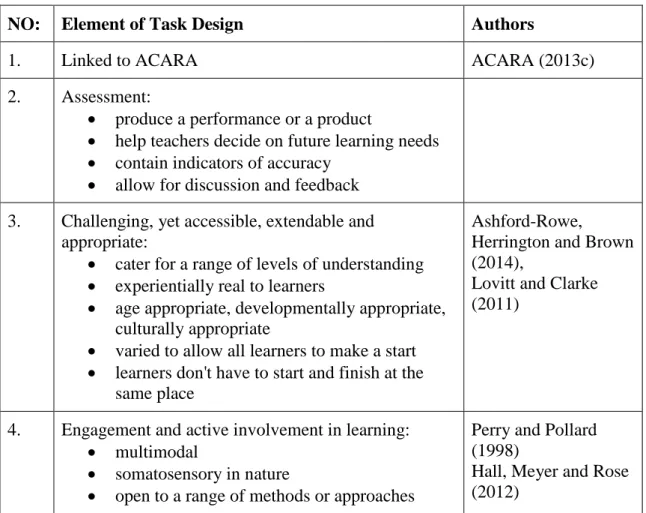
refinement of the modelling tasks as well as the refinement of the methodology used for Task E of the study. With this in mind, several measures were taken to determine the feasibility of the proposed research design and to begin the process of developing a classification scheme to analyse the learners' response to the designs. The measures involved screening the tasks against assessment criteria from literature. I also
arranged to co-teach the intended class with an experienced colleague from another SEN unit. Together, we trialled some of the features of the approach (not the actual activities) in Social Science and English by letting learners present projects and give and receive feedback to one another on these projects. Thereafter, we reviewed the proposal together, its intended tasks, its instruments, and its methodology in relation to the needs of the learners. After this event, I invited a Student Services Advisor to conduct a review of the suitability of the modelling tasks. Likewise, I invited a
cultural advisor to sit in on the teaching sessions to monitor the instructional practices, the classroom environment and routines, and to analyse the tasks I intended to use in
Feuerstein
An analysis of what modelling can offer learners with SEN in respect
of their needs.
General instructional principles for designing modelling tasks for learners with SEN.
Connect learners with SEN with modelling through Feuerstein. Task A General pedagogical practices and strategies for learners with SEN Task B Modelling as a general strategy for instruction
DBR Phase: Analysis of the problem
18 the upcoming study for cultural sensitivity and appropriateness. Figure 1.2 depicts how Tasks C, D and E combine in this study.
1.4.6 Task F: The implementation of three modelling tasks in a SEN classroom
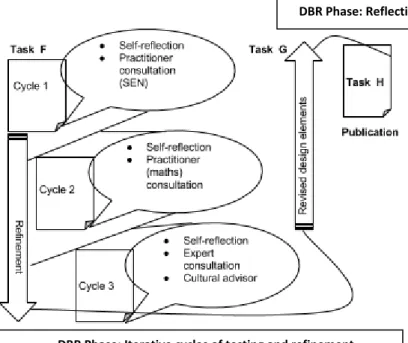
The intention of this part of the study was to teach mathematics using modelling tasks informed by the Australian Curriculum framework. This part of the study examined learners' responses to the design in their normal classroom environment, with a particular interest in their use of Feuerstein's cognitive functions.
For this reason, learners were given three challenging modelling tasks, which they had to solve by working through the cycles of modelling in small groups.
My own role was as teacher-researcher. During the lessons, I worked with the participants while investigating their learning and their responses to elements of the instructional settings, with the purpose of identifying affordances and constraints that emerged, which may aid or hinder their achievement of the intended learning
HLT
Task E
Contextualised modelling tasks for local instruction.
Pre-evaluation through screening, practitioner consultation, cultural advisor, expert consultation
Task C Psycho-educational profile showing specific strengths and vulnerabilities of learners Task D Localised school context
DBR Phase: Development of solutions
Figure 1.2
19 outcomes, and by considering how to overcome these through mediation.
After each challenge, I went through a process of reflection, collaboration and refinement before the implementation of the next cycle of modelling in the form of a new maths challenge for the learners. (Herrington, McKenney, Reeves & Oliver, 2007, p. 4-5). It was necessary to analyse the learning characteristics, processes, and representations of the learners in response to the tasks implemented. Consequently, the following three research questions were attached to Task F:
● How do the learners' characteristics, taken from their psycho-educational profiles, affect their modelling?
● How do the learners' processes, solely in respect to Feuerstein's cognitive functions, affect their modelling?
● What evidence of learning could be found in the analysis of learners' reasoning and representations over time?
1.4.7 Task G: Reflection
This part of the research focused on evaluating the programming by conducting an audit to generate data on how the design evolved and the degree to which general learning principles were actualised. For this purpose, the following two research questions were included in the study:
● How did the learners' learning correspond with the proposed learning trajectory? ● To what extent did modelling benefit and/or impede the mathematical learning of
learners with SEN? An evaluation of the design against Tyler's (2013) general learning principles.
1.4.6 Task H: Preparing for publication
The final secondary research question was necessary to create a reasoned response to the value of modelling in the local context of the study and the value of the design for informing general theory.
20 How viable is modelling as an instructional approach in a SEN classroom based on an
analysis of learning characteristics, processes, and representations in mathematical modelling of middle school learners with special needs?
The last research question evaluates the viability of modelling as an instructional approach for learners with SEN by examining its potential for local use and for informing theory. Figure 1.3 depicts how the evaluation of the viability of modelling began with the process of modelling challenges being implementation in Task F, an evaluation in Task G, and a reflection of its value in the form of completed study for publication in Part H.
1.5 METHODOLOGY
In the final analysis, the aim of the research is modelling-for-all by designing lessons to support more vulnerable or weaker learners. Equally important is the intent to cultivate design principles that will culminate in increasing levels of sophistication in how teachers
Figure 1.3
DBR Phase: Iterative cycles of testing and refinement
DBR Phase: Reflection to produce design principles
Figure 1. 3 The implementation, evaluation and refinement of the modelling process towards generalised design principles
21 respond to this cohort of learners' needs during instructional situations that use modelling. I see two processes as salient to this study, namely, designing and describing. Accordingly, this study will use design-based research (DBR) as its primary research vehicle and a multiple-case study approach as it second research methodology.
Whereas the design-based research will capture the cycles of the design, its planning, its implementation, and its evaluation, a case study approach will cover the descriptive part of the study. Merriam (2009) notes that the case study approach will allow for "rich descriptions and analysis in a bounded setting" (p. 40), while Kelly (2003) argues that the design-based perspective produces “operative dialogue “ (p. 3) on mathematical modelling in a SEN environment.To clarify, design-based research is "use" orientated — it works towards developing a model of how mathematical modelling tasks can be developed, enacted, and sustained within a special needs environment, while the case study approach allows for detailed documentation of the complexities, subtleties, nuances, and contextual factors that affect the designs. For this reason, the case study approach was used to provide data on the progression of the design with a careful mapping of how three learners with SEN engaged with and explored mathematical problems and established mathematical ideas in relation to a scientific learning trajectory. The three cases refer to a learner with autism spectrum disorder, a learner with developmental delay, and a learner with foetal alcohol spectrum disorder, respectively. On balance, when combined, these two processes of design and rich
descriptions provided a body of knowledge on how learning occurs in a modelling context in a SEN setting. Table 1.2 shows the comparative roles of DBR and the case study
22
Table 1.2 Comparing the roles of DBR and case study
Role of DBR Role of Case Study
Design for support:
Using principles from literature Adjust design to support:
Through cycles of planning, implementation, and evaluation
General design principles:
Draw out general design principles to inform theory and practice
Rich description of:
Characteristics of learners:
Analyse dimensions of the psycho-educational profile, its influence on learning in modelling situations
Processes of learners:
Analyse how Feuerstein's cognitive functions influence their models
Representations of learners:
Analyse their representations as evidence of learning
Table 1.2
Qualitative data collection methods are used. Wolcott (2009) believes that, "There is no longer the need to defend qualitative research or to offer the detailed explication of its
methods that we once felt obligated to supply"(p. 25). The logic of qualitative data collection methodology suits several basic features of the study: namely, that progress in individual learners were described and monitored; that data were monitored as it occurred across time rather than at the beginning and end of the study; and, that systematic visual inspection was the primary analyses of the intervention effects (adapted from Odom & Lane, 2014, p. 376). In Table 1.3, I show the connection between the Index of Inclusion, the development of the study, the role of the tasks in the study, and the phases of DBR.