Theses and Dissertations
2006
Effects of using corpora and online reference tools
on foreign language writing: a study of Korean
learners of English as a second language
Kyosung Koo
University of Iowa
Copyright 2006 Kyosung Koo
This dissertation is available at Iowa Research Online: http://ir.uiowa.edu/etd/65
Follow this and additional works at:http://ir.uiowa.edu/etd
Part of theFirst and Second Language Acquisition Commons Recommended Citation
Koo, Kyosung. "Effects of using corpora and online reference tools on foreign language writing: a study of Korean learners of English as a second language." PhD (Doctor of Philosophy) thesis, University of Iowa, 2006.
1 EFFECTS OF USING CORPORA AND ONLINE REFERENCE TOOLS ON
FOREIGN LANGUAGE WRITING: A STUDY OF KOREAN LEARNERS OF ENGLISH AS A SECOND LANGUAGE
by Kyosung Koo
An Abstract
Of a thesis submitted in partial fulfillment of the requirements for the Doctor of
Philosophy degree in Second Language Acquisition in the Graduate College of
The University of Iowa May 2006
1 ABSTRACT
The general aim of this study is to better understand aspects of using reference tools for writing and to identify technologies that can assist foreign language writers. The specific purpose of this study is to look closely at how English as a Second Language (ESL) students from Korea use a corpus as a reference tool in conjunction with
dictionaries when paraphrasing English newspaper articles. The participants were Korean graduate students with advanced English proficiency (N=10). Their task was to paraphrase an English newspaper article.
The results show that purposes for using a concordancing program include collocations, definitions, context, and parts of speech. The subjects looked for a variety of information in a concordancing program, including prepositions, authentic samples, and the context in which the search terms were used. Reasons for using dictionaries include definitions, parts of speech, and sample sentences. The most common strategy was to combine reference tools, while the second most common was to use a specific search word. Subjects who used more than one tool for a search or performed multiple searches were more successful in finding what they were looking for.
A concordancing program enabled users to see multiple examples of everyday language use. By using the concordancing program, learners were able to see words that were used most frequently, their patterns, and collocations. Learners took more
responsibility for their language learning, as they became researchers in their own right. They gained confidence as L2 writers as they had inside access to linguistic resources. The subjects became more independent and were able to solve their own writing and linguistic problems as they became more aware through the use of authentic texts. In this study, the subjects found the corpora to be useful for sentence-level composition and revision. Overall, the use of reference tools led to an improvement in the accuracy of
2 writing. A concordancing program played an important role in defining the structure and
context of English phrases and sentences.
Abstract Approved: ____________________________________ Thesis Supervisor
____________________________________ Title and Department
____________________________________ Date
1 EFFECTS OF USING CORPORA AND ONLINE REFERENCE TOOLS ON
FOREIGN LANGUAGE WRITING: A STUDY OF KOREAN LEARNERS OF ENGLISH AS A SECOND LANGUAGE
by Kyosung Koo
A thesis submitted in partial fulfillment of the requirements for the Doctor of
Philosophy degree in Second Language Acquisition in the Graduate College of
The University of Iowa May 2006
2 Copyright by
KYOSUNG KOO 2006
Graduate College The University of Iowa
Iowa City, Iowa
CERTIFICATE OF APPROVAL _______________________
PH.D. THESIS _______________ This is to certify that the Ph.D. thesis of
Kyosung Koo
has been approved by the Examining Committee for the thesis requirement for the Doctor of Philosophy
degree in Second Language Acquisition at the May 2006 graduation. Thesis Committee: ___________________________________
James P. Pusack, Thesis Supervisor ___________________________________ Stephen M. Alessi ___________________________________ L. Kathy Heilenman ___________________________________ Sue K. Otto ___________________________________ Carol J. Severino
ii
2
iii
3
What the concordancer does is make the invisible visible. Chris Tribble Concordancing and an EAP writing programme
iv
4
ACKNOWLEDGMENTS
I would like to take this opportunity to thank those who so generously gave of their time, expertise, and support in order to help me successfully complete this dissertation. Professor James Pusack was a tremendous help throughout the entire
process. He has been my academic advisor during my time at the University of Iowa and a great inspiration. Also, Professor Carol Severino, Director of the Writing Center at the University of Iowa, assisted in recruiting the research subjects. I want to thank Professor Stephen Alessi for his input on research design and methodology. Professor Kathy Heilenman’s expertise in corpus and analysis of data also contributed to the successful completion of this project. Sue Otto, Professor and Director of the Language Media Center at the University of Iowa advised and supported me in the field of instructional technology, and was a great source of encouragement to me to complete this dissertation when I moved away from Iowa. Finally, I would also like to thank Joshua Thoms for his contributions to this research during his busy schedule.
v
5
ABSTRACT
The general aim of this study is to better understand aspects of using reference tools for writing and to identify technologies that can assist foreign language writers. The specific purpose of this study is to look closely at how English as a Second Language (ESL) students from Korea use a corpus as a reference tool in conjunction with
dictionaries when paraphrasing English newspaper articles. The participants were Korean graduate students with advanced English proficiency (N=10). Their task was to paraphrase an English newspaper article.
The results show that purposes for using a concordancing program include collocations, definitions, context, and parts of speech. The subjects looked for a variety of information in a concordancing program, including prepositions, authentic samples, and the context in which the search terms were used. Reasons for using dictionaries include definitions, parts of speech, and sample sentences. The most common strategy was to combine reference tools, while the second most common was to use a specific search word. Subjects who used more than one tool for a search or performed multiple searches were more successful in finding what they were looking for.
A concordancing program enabled users to see multiple examples of everyday language use. By using the concordancing program, learners were able to see words that were used most frequently, their patterns, and collocations. Learners took more
responsibility for their language learning, as they became researchers in their own right. They gained confidence as L2 writers as they had inside access to linguistic resources. The subjects became more independent and were able to solve their own writing and linguistic problems as they became more aware through the use of authentic texts. In this study, the subjects found the corpora to be useful for sentence-level composition and revision. Overall, the use of reference tools led to an improvement in the accuracy of
vi
6
writing. A concordancing program played an important role in defining the structure and context of English phrases and sentences.
vii
7
TABLE OF CONTENTS
LIST OF TABLES ...ix
LIST OF FIGURES...xii
CHAPTER I. INTRODUCTION...1
1.1. Background...1
1.2. The role of corpora in language teaching and linguistics...1
1.3. Dictionaries...2
1.4. Corpora and SLA ...3
1.5. Overview of the study ...4
1.6. Research questions ...5
CHAPTER II. REVIEW OF THE LITERATURE...7
2.1. Introduction ...7
2.2. Corpora and concordancing...7
2.2.1. Corpora ...7
2.2.2. Concordancing ... 14
2.3. Dictionary use... 20
2.3.1. Dictionary use and benefits... 20
2.3.2. Concerns about dictionary use ... 27
2.4. Corpora in second language acquisition... 34
2.4.1. Context... 35
2.4.2. Collocation... 41
2.4.3. Active and discovery-style learning... 43
2.4.4. Strategies and techniques of corpus use in second language learning and teaching... 46
2.4.5. Using parallel corpora for second language learning... 50
2.5. Concerns about concordancing... 52
CHAPTER III. METHODOLOGY... 59
3.1. Data gathering techniques ... 59
3.2. Pilot study... 64
3.2.1. Research questions for the pilot study... 64
3.2.2. Subjects... 64 3.2.3. Materials ... 65 3.2.4. Procedures... 66 3.2.5. Results ... 68 3.3. Main study ... 71 3.3.1. Subjects... 71 3.3.2. Materials ... 72 3.3.3. Procedures... 75 3.4. Analysis ... 79 3.4.1. Interrater reliability ... 79 3.4.2. Units of analysis... 81 3.4.3. Coding ... 82
viii
8
CHAPTER IV. RESULTS... 87
4.1. What are the reasons why ESL learners consult a concordancing program while writing in English? ... 87
4.2. What kind of information do learners look for in a corpus and dictionaries while writing in English? ... 97
4.3. What strategies do learners use when they consult a corpus? ... 105
4.4. How does a corpus complement the use of dictionaries?... 116
4.4.1. Combination of thesaurus and MonoConc... 117
4.4.2. Combination of English-Korean dictionary and MonoConc... 121
4.4.3. Combination of English-English dictioanry and MonoConc... 135
4.4.4. Combination of MonoConc and MonoConc... 137
4.5. What are the effects of using a corpus on the accuracy of learners’ writing? ... 143
4.5.1. Repeated search word... 147
4.5.1.1. Repeated search word: “blame”... 147
4.5.1.2. Repeated search word: “criticize”... 153
4.5.1.3. Repeated search word: “accuse” ... 157
4.5.2. MonoConc leading to wrong grammar... 163
4.5.3. Using phrases as search terms... 169
4.6. What are learners’ attitudes toward using a corpus as a reference tool?... 172
CHAPTER V. DISCUSSION... 176
5.1. Purposes of using a concordancing program... 176
5.2. Learner strategies for using a concordancing program ... 181
5.3. Corpus use and accuracy of writing... 186
5.4. Learners’ attitudes toward using a corpus as a reference tool... 189
5.5. Implication for corpus use in language teaching ... 191
5.6. Future research... 195
APPENDIX A. NEWSPAPER ARTICLE ON KOREAN PRESIDENT IMPEACHMENT ... 197
APPENDIX B. NEWSPAPER ARTICLE ON NORTH KOREAN NUCLEAR PROGRAM... 201
APPENDIX C. PLANS FOR PARAPHRASING SESSIONS ... 205
APPENDIX D. DIRECTIONS FOR PARAPHRASING ... 207
APPENDIX E. DIRECTIONS FOR STIMULATED RECALL SESSION ... 209
APPENDIX F. DEMOGRAPHIC DATA... 211
APPENDIX G. SURVEY... 214
APPENDIX H. IRB DOCUMENTS: INFORMED CONSENT DOCUMENTS... 218
ix
9
LIST OF TABLES Table
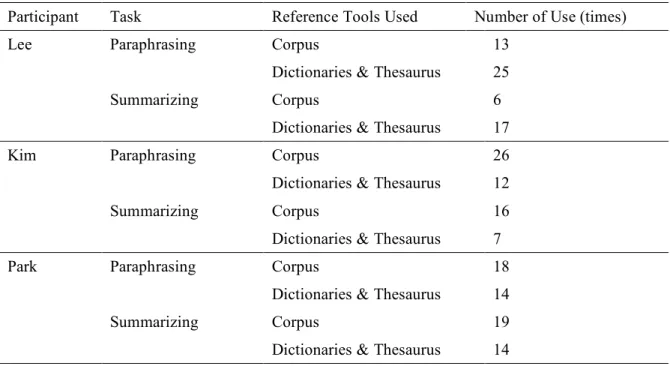
3.1. Individual subjects’ use of reference tools when paraphrasing and
summarizing... 69
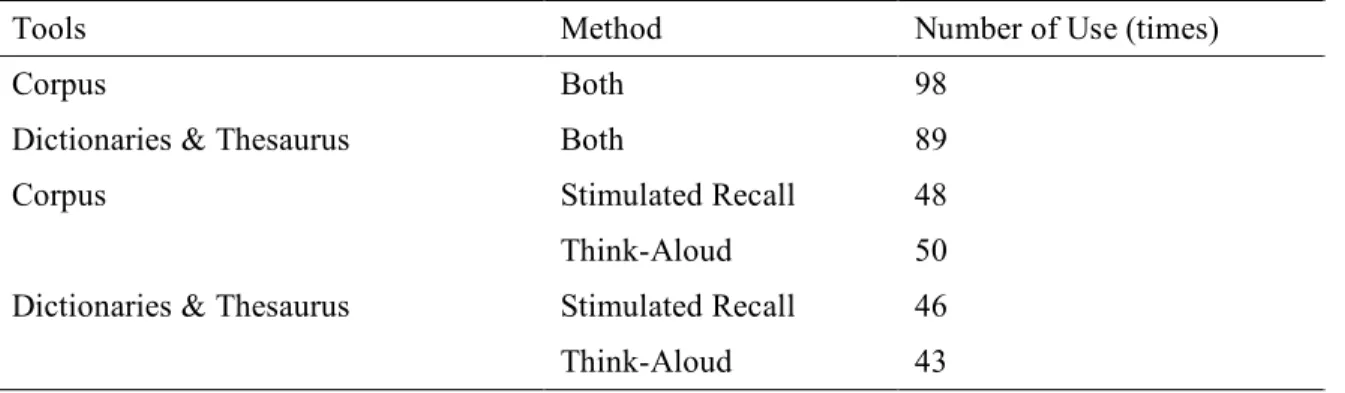
3.2. Use of reference tools for different tasks... 69
3.3. Use of reference tools for different methods ... 71
3.4. Time frame of the meetings ... 79
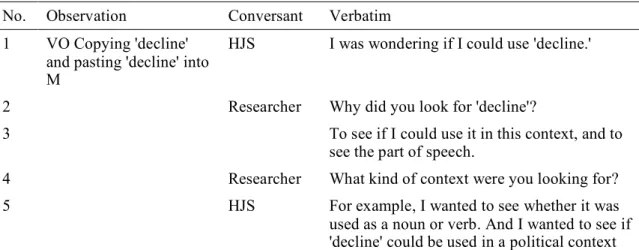
4.1. Subject JWK using MonoConc with search term "accus" ... 89
4.2. Subject HJS using MonoConc with search term "destruction @ country"... 90
4.3. Subject JWK using MonoConc with search term "restrain" ... 91
4.4. Subject MKS using MonoConc with search term "planned visit" ... 92
4.5. Subject HJS using MonoConc with search term "decline"... 92
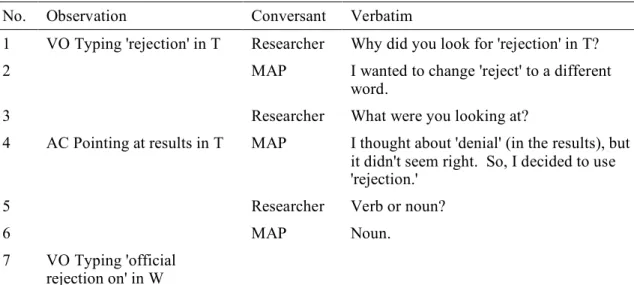
4.6. Subject MAP using thesaurus with search term "rejection" ... 93
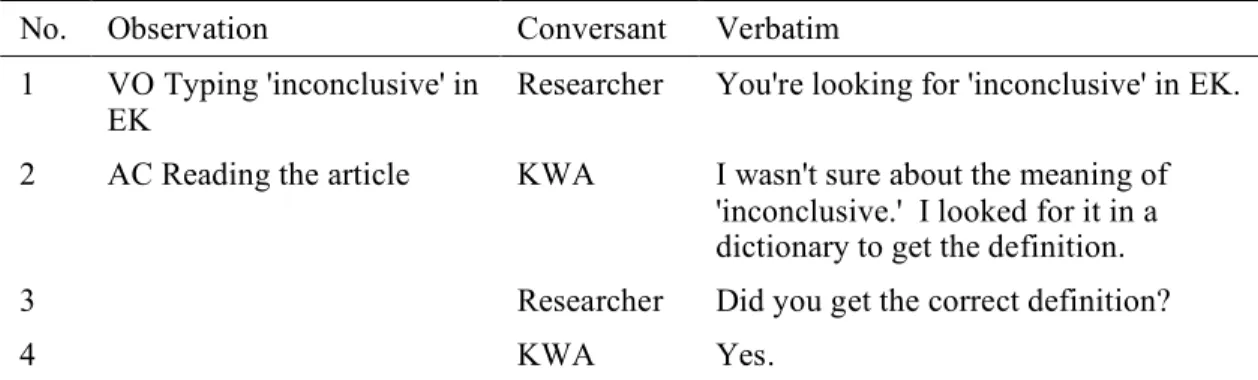
4.7. Subject KWA using English-Korean dictionary with search term "inconclusive" ... 94
4.8. Subject KYL using Korean-English dictionary with search term "dedam" ... 95
4.9. Subject YJK using English-English dictionary with search term "noose" and “accord” ... 95
4.10. Subject KYL using English-English dictionary with search term "bottom-line"... 96
4.11. Subject JYP using MonoConc with search term "skeptical about"... 100
4.12. Subject JDO using MonoConc with search term "agreed" ... 101
4.13. Subject MKS using thesaurus with search term "dismantle"... 102
4.14. Subject MAP using English-Korean dictionary with search term "move"... 103
4.15. Subject KWA using Korean-English with search term "palsang" ... 103
4.16. Subject JWK using English-English dictionary with search term "explicitly"... 104
4.17. Subject HJS using thesaurus with search term "reject" and MonoConc with search term “decline”... 107
x
10
4.19. Subject JDO using MonoConc with search term "visit"... 109
4.20. Subject JWK using thesaurus with search terms "carry" and “monitory”... 110
4.21. Subject KWA using MonoConc with search term "insist" ... 111
4.22. Subject KWA MonoConc with search term "press"... 112
4.23. Subject KWA using MonoConc with search term "reproach"... 113
4.24. Subject KWA using MonoConc with search term "make an agreement" ... 113
4.25. Subject JYP using MonoConc with search term "announc*" ... 114
4.26. Subject JYP using MonoConc with search term "blame*"... 115
4.27. Subject HJS using thesaurus with search term “reject” and MonoConc with search term "decline"... 118
4.28. Subject MKS using thesaurus with search term “inconclusive” and MonoConc with search term "ambiguity"... 120
4.29. Subject JYP using English-Korean dictionary with searcher term “reject” and MonoConc with search term "reject*"... 121
4.30. Subject MAP using English-Korean dictionary with search term “trust” MonoConc with search term "trust" ... 123
4.31. Subject MKS using English-Korean dictionary with searcher term “boon” and MonoConc with search term "boon" ... 124
4.32. Subject JDO using Korean-English dictionary with search term “chujanghada” and MonoConc with search term "assert" ... 125
4.33. Subject KWA using Korean-English dictionary with search term “tae-ung” and MonoConc with search term "respond*"... 126
4.34. Subject MKS using Korean-English dictionary with search term “hasu” and MonoConc with search term "underling" ... 128
4.35. Subject MKS using Korean –English dictionary with search term “nagada” and MonoConc with search term "step forward" ... 129
4.36. Subject JHC using MonoConc with search term "plot" and English-Korean dictionary with search term “plot” ... 131
4.37. Subject KWA using MonoConc with search term "criticiz*” and Korean-English dictionary with search term “binan” ... 133
4.38. Subject MKS using MonoConc with search term "fitful" and English-Korean dictionary with search term “fitful”... 134
4.39. Subject JWK using MonoConc with search term "put@forward" and English-English with search term “put forward” ... 136
xi
11
4.40. Subject KYL using MonoConc with search term "aim"... 139
4.41. Subject JYP using MonoConc with search term "announc*" ... 140
4.42. Subject JYP using MonoConc with search term "skeptical" ... 141
4.43. Subject HJS using MonoConc with search term "destruction"... 143
4.44. Reference Tool Use and Grammaticality... 145
4.45. Subject JDO using MonoConc with search term "blame" ... 148
4.46. Subject JYP using MonoConc with search term "blame* that”... 149
4.47. Subject KWA using MonoConc with search term "blame"... 150
4.48. Subject KWA using thesaurus with search term “blame” and MonoConc with search term "condemn"... 152
4.49. Subject JHC using MonoConc with search term "criticize*" ... 154
4.50. Subject JYP using MonoConc with search term "criticism"... 155
4.51. Subject KWA using MonoConc with search term "criticiz*"... 156
4.52. Subject JDO using MonoConc with search term "accused" ... 158
4.53. Subject JHC using MonoConc with search term "accuse*" ... 159
4.54. Subject JYP using MonoConc with search term "accus* @ of"... 160
4.55. Subject YJK using MonoConc with search term "accus*" ... 162
4.56. Subject JDO using MonoConc with search term "as usually" ... 164
4.57. Subject JHC using MonoConc with search term "settle" ... 165
4.58. Subject JWK using thesaurus with search term “supervise” and MonoConc with search term "watch over" ... 167
4.59. Subject JYP using MonoConc with search term "conflict over" ... 169
4.60. Subject JYP using MonoConc with search term "made it clear that" ... 170
4.61. Subject YJK using MonoConc with search term "negotiating table"... 171
xii
12
LIST OF FIGURES Figure
2.1. The Brown Corpus: sample text without tags...9
2.2. The Brown Corpus: sample text with tags...9
2.3. Concordancing program: MonoConc Pro 2.2 (Barlow, 2002) and English Gigaword (Graff, 2003)... 15
2.4. Concordancing program search results: MonoConc Pro 2.2 (Barlow, 2002) and English Gigaword (Graff, 2003)... 15
2.5. Concordancing program collocation frequency: MonoConc Pro 2.2 (Barlow, 2002) and English Gigaword (Graff, 2003)... 16
2.6. ParaConc (Search word “head”) (Barlow, 2001) ... 18
2.7. Concordancing program search results in KWIC format: MonoConc Pro 2.2 (Barlow, 2002) and English Gigaword (Graff, 2003) ... 18
3.1. Use of corpus and other reference tools ... 70
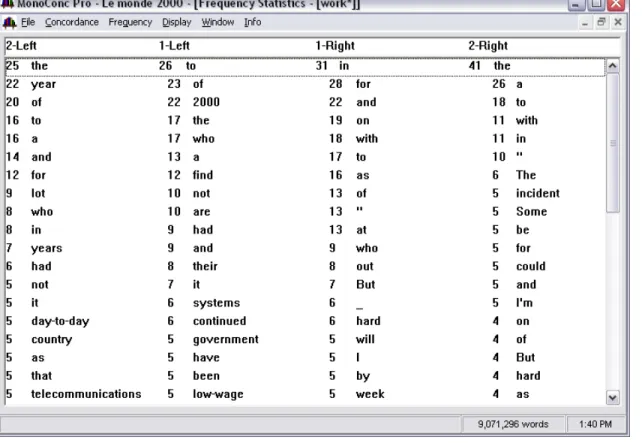
3.2. Collocation frequency statistics (search word: work*) ... 73
3.3. Yahoo Online Korean Dictionaries... 75
3.4. Screen recording for stimulated recall... 78
3.5. Units of analysis ... 82
4.1. Reasons for using MonoConc... 88
4.2. Types of search word... 98
4.3. Information looked for in MonoConc... 99
4.4. Strategies for using a concordancing program... 106
4.5. Ratio of Grammaticality (Correct: Incorrect: Null)... 145
4.6. Ratio of Grammaticality (Correct: Incorrect) ... 146
4.7. Ratio of MonoConc Use and Grammaticality... 146
1 CHAPTER I
INTRODUCTION 1.1. Background
A corpus is a collection of authentic language production. The size of a corpus can vary from thousands to millions of words. So, why, one may ask, is such a large collection of language necessary? From Chomsky’s viewpoint (McEnery & Wilson, 2001), our knowledge of rules enables us to create original sentences. His theory is that by nature, corpora are incomplete and skewed. Some sentences are found in corpora because they are commonly used constructions, while others may be found in corpora by chance. An empirical approach can be carried out by observing natural language data through a corpus. For example, how is it possible to know why “which” is used instead of “that” in a relative clause? For this question, Chomsky may say that he knows because he is a native speaker of English. Conversely, a corpus linguist would say to look in the corpus and find out.
Corpora serve many purposes. Historically, they were used in the production of dictionaries and language textbooks. For this purpose, a corpus must be tagged, or given annotations such as the part of speech and syntactical placement in a sentence. In order to analyze such a large quantity of data, the text must be machine-readable and loaded into a concordancing program. A corpus can also be a source of empirical (quantitative) data for linguistic research. Such research may include speech, lexical studies, grammar, semantics, pragmatics, discourse analysis, and the teaching of language and linguistics.
1.2. The role of corpora in language teaching and linguistics
This study focuses on using a corpus for the purpose of language learning. Kennedy (1987a; G. Kennedy, 1987b), for example, has researched how to express
2 quantification and frequency in English as a Second Language (ESL) textbooks. Foreign
or second language teaching includes a category entitled English for Specific Purposes, or ESP — for example, teaching medical English to medical students or legal English terminology to law students. In cases such as these, having access to a corpus with this specific information can be invaluable to students. Computer-assisted language learning (CALL) is another application of corpora in language and linguistics in which a corpus, or corpora, may be utilized. Lancaster University has been researching the role computer software that is corpus-based plays with grammatical analysis taught to undergraduates (McEnery & Wilson, 1993). Multilingual parallel corpora are also becoming more available and serve as a basis for teaching translation. These corpora provide side-by-side examples of style and idioms in multiple languages and can create exercises that students can use to compare their own translations with an actual professional translation
(Zanettin, 1994).
1.3. Dictionaries
As mentioned above, corpora have historically been utilized in creating dictionaries. Dictionaries have traditionally been the main reference tool used by language learners, but are largely deficient in the more holistic information included in corpora. In order to understand the advantages of using corpora, it is important first to recall what is offered by dictionaries. They provide definitions, parts of speech, phonetic spelling, sample sentences, related phrases, and word etymology. Different types of dictionaries are available, such as monolingual, bilingual, and bilingualized (see definitions in Section III). Both language professionals and language learners have differing opinions about which is the best.
Some studies show that dictionaries do not provide enough context for synonyms, which may result in incorrect choices of words (Harvey & Yuill, 1997). Sometimes the format of dictionaries may confuse the users (Parry, 1991, 1993); as a result, learners
3 may not make use of all of the features, such as grammar-related information (Bejoint,
1981) and make incorrect lexical choices (Varantola, 1998). For these reasons, language learners need strong dictionary skills to understand unfamiliar words. Barlow (Barlow, 1996b) claims that dictionaries do not have enough context to be of any value to language learners. Parallel texts, he suggests, may be richer and more flexible, providing patterns that language learners can use as a search tool.
1.4. Corpora and SLA
By using corpora in conjunction with dictionaries, students may reap more benefits by looking at authentic examples, context, and word collocations. Additionally, language learners who have access to corpora experience a more student-centered and active learning environment. The following is an explanation of each of these benefits.
By using corpora in a second language or foreign language class, students will be exposed to authentic examples instead of fixed or artificial examples not necessarily used in daily life. Use of fabricated examples may distort learners’ views of actual language use (Flowerdew, 1993). Most sources of corpora are collected from newspapers, magazines, novels, actual conversations, and the like. Learners are provided with a wealth of examples taken from these sources.
Another advantage that a corpus brings to second language acquisition is the context it provides in the examples. By looking at examples, learners can understand the context in which words should be used. Learners may be able to discover the meaning of a word by inferencing (Stevens, 1991b). However, there may be some contradictory claims that context is not helpful for inferring vocabulary meaning through context (Maddalena, 2001). If the context is associated with the search word, there could still be some benefits (Laufer & Shmueli, 1997). Context also becomes an issue when learners’ proficiency is too low to infer the meaning of words from context. In this case, using a parallel corpus could be a solution (St. John, 2001).
4 Corpora can also create an environment in which inductive learning takes place.
This allows for students to be in control of their learning (Barlow, 1996b; C. Kennedy & Miceli, 2001). In this environment, the role of the students becomes that of linguistic researchers in which they explore the data and create their own rules and conclusions, which also changes the dynamics of teacher-student interactions. Johns (1991a) dubbed this the Data-Driven Learning (DDL) approach. The methodology of this approach allows learners to select strategies that allow them to perceive similarities and differences of word items.
When providing examples, corpora also simultaneously display word collocations via the concordancing program into which they have been loaded. Collocations are words that commonly appear together in a sentence. By looking at collocational
frequencies, learners can see preceding and following information for their search word. For learners, this kind of information is also a reliable indicator of correct grammar structures. Concordancing programs are organized in such a way that language learners can understand lexical items and their relationship to each other. While this is not the case when using a dictionary, a dictionary still provides a small number of collocations.
1.5. Overview of the study
The general aim of this study is to better understand aspects of using reference tools for writing and to identify technologies that can assist foreign language writers. The specific purpose of this study is to look closely at how English as a Second Language (ESL) students from Korea use a corpus as a reference tool in conjunction with
dictionaries when paraphrasing English newspaper articles.
The participants were Korean graduate students with advanced English
proficiency (N=10). Their task was to paraphrase an English newspaper article. This task was chosen based on the results of the pilot study, which was conducted prior to the actual study. The pilot study provided an opportunity to test two data-gathering
5 techniques (think-aloud and stimulated recall protocols). Further details about the pilot
study are presented in Chapter III, Methodology. The corpus they consulted was English Gigaword, published by Linguistic Data Consortium. MonoConc Pro was used as a concordancing program. The participants were allowed to use the online Yahoo Korean dictionaries, which include Korean-English, English-Korean, English-English, and a thesaurus.
The results of this research study will be beneficial for designing ESL writing classes utilizing the data-driven learning approach. Data-driven learning places an emphasis on the exploration of authentic materials and authentic exploratory tasks in a student-centered environment as opposed to traditional drill exercises.
The results show how beneficial consulting a corpus is in ESL writing, and since the students are the primary beneficiaries of using such reference tools, ESL educators can adapt the results to create more effective and meaningful learning environments. Students will then be exposed to authentic discourse that, as a number of corpus linguists point out, is generally the most useful for learners. By being exposed to authentic texts, students can expand their understanding of word functions in particular contexts. Students will also be able to make inductive discoveries about English while they are examining a number of examples of vocabulary items in context. This will result in student-centered learning that promotes self-confidence and mastery of the learning process.
1.6. Research questions
This study will extend the horizon of corpus linguistics research. Most corpus linguistic studies have used corpora as data and concordancing programs as investigation tools for language use. By contrast, this research study focuses on using corpora and concordancing programs as learning tools. Since writing activities are text-oriented and make use of word combinations and lexical patterns, a corpus approach clearly has the
6 potential to benefit second language writing. This research study should give corpus
linguists a new perspective on the use of corpora. The foci of this research are to better understand aspects of using reference tools for writing and to identify technologies that can assist foreign language writers. The study will encompass the following six questions:
(1) What are the reasons that ESL learners consult a concordancing program while writing in English?
(2) What kind of information do learners look for in a corpus and dictionary while writing in English?
(3) What strategies do learners use when they consult a corpus? (4) How does a corpus complement the use of dictionaries?
(5) What are the effects of using a corpus on the accuracy of learners’ writing? (6) What are learners’ attitudes toward using a corpus as a reference tool?
7 CHAPTER II
REVIEW OF THE LITERATURE 2.1. Introduction
The growing availability of innovative technology has allowed corpora to be used more frequently as a reference tool for language teachers and learners. Traditionally, dictionaries have been used as the primary reference tool in second language classrooms. Online dictionaries provide definitions of words and phrases that include some context and grammar. However, learners sometimes become confused about which definitions are the ones they are searching for in the context in which they are used. Moreover, learners do not always receive sufficient information about how to use the word or phrase in an original sentence. Concordancing programs, on the other hand, are structured to solve these problems by providing authentic examples in realistic contexts. Through the provided context, the learner can also learn about grammatical structures by examining a variety of examples. In addition, concordancing programs provide an active environment in which learners become researchers and test their hypotheses. They encounter
problems along the way and revise their hypotheses by having direct access to the data. In the following sections, I will discuss the definition of a corpus, the design of
concordancing programs, ways in which a corpus complements dictionary use, how to use a corpus for the purposes of teaching and learning, and suggestions for using a corpus.
2.2. Corpora and concordancing 2.2.1. Corpora
The word “corpus” originates from the Latin word meaning “body.” In modern linguistic terms, a corpus is a large collection of language production that can be used to investigate lexis, syntax, text and discourse, regional differences, differences between
8 learners and native speakers, and historical changes. In broad terms, corpus linguistics is
the study of linguistic phenomena by means of a set of investigative tools such as corpora and concordancing programs. Its main features include computational techniques and a large collection of language samples in the form of written or transcribed spoken language. For example, a corpus may consist of texts taken from newspapers, journals, books, or other speech productions. The texts can then be analyzed by a concordancing program and immediately displayed on a monitor.
In order to analyze a corpus, the texts must be in machine-readable format. This means that a linguist can use a computer to call up a number of examples of a word or phrase in context from millions of words in a short time. With this text format and computer technology, not only can dictionaries be produced more quickly than before, but the information can also be up to date and more precise. A computer-readable corpus may consist of raw texts that are taken directly from the sources without any additional information added. For concordancing purposes on a computer, many corpora
additionally contain some types of linguistic information. This linguistic information is called a “markup,” “annotation,” or “tag.” Depending on the purposes of concordancing, this information can be grammatical, prosodic, semantic or historical. Grammatical annotation is the most common type. In a grammatically annotated corpus, each word is assigned a word class label, which is a tag that indicates the part of speech. The Brown Corpus, the Lancaster-Oslo/Bergen Corpus, and the British National Corpus are examples of grammatically annotated corpora. Figure 2.1 and Figure 2.2 show a small portion of two versions of the Brown Corpus: without and with tags. Figure 2.1 contains the original or raw text and line numbers, while Figure 2.2 contains grammatical tags as well as the original text and line numbers. Each tag represents grammatical functions of the tagged word. For example, “AT” in the first line of SA01:1 explains that “the” is an article, “NP” shows that “Fulton” is a proper noun, “VBD” indicates that “said” is a past-tense verb.
9 Figure 2.1. The Brown Corpus: sample text without tags
Figure 2.2. The Brown Corpus: sample text with tags
A01 0010 The Fulton County Grand Jury said Friday an investigation A01 0020 of Atlanta's recent primary election produced "no evidence" that A01 0030 any irregularities took place. The jury further said in term-end A01 0040 presentments that the City Executive Committee, which had over-all A01 0050 charge of the election, "deserves the praise and thanks of the
A01 0060 City of Atlanta" for the manner in which the election was conducted. A01 0070 The September-October term jury had been charged by Fulton A01 0080 Superior Court Judge Durwood Pye to investigate reports of possible A01 0090 "irregularities" in the hard-fought primary which was won by
A01 0100 Mayor-nominate Ivan Allen Jr&.
SA01:1 the_AT Fulton_NP County_NN Grand_JJ Jury_NN said_VBD Friday_NR an_AT investigation_NN of_IN Atlanta's_NP$ recent_JJ primary_NN election_NN produced_VBD no_AT evidence_NN that_CS any_DTI irregularities_NNS
took_VBD place_NN ._.
SA01:2 the_AT jury_NN further_RBR said_VBD in_IN term-end_NN
presentments_NNS that_CS the_AT City_NN Executive_JJ Committee_NN ,_, which_WDT had_HVD over-all_JJ charge_NN of_IN the_AT election_NN ,_, deserves_VBZ the_AT praise_NN and_CC thanks_NNS of_IN the_AT City_NN of_IN Atlanta_NP for_IN the_AT manner_NN in_IN which_WDT the_AT election_NN was_BEDZ conducted_VBN ._.
SA01:3 the_AT September-October_NP term_NN jury_NN had_HVD been_BEN charged_VBN by_IN Fulton_NP Superior_JJ Court_NN Judge_NN Durwood_NP Pye_NP to_TO investigate_VB reports_NNS of_IN possible_JJ irregularities_NNS in_IN the_AT hard-fought_JJ primary_NN which_WDT was_BEDZ won_VBN by_IN Mayor-nominate_NN Ivan_NP Allen_NP Jr._NP ._.
10 A corpus represents a sample of language and contains a cross-section of text
from a variety of genres; or it can be compiled within a particular knowledge domain. The texts that constitute a corpus can be organized into general or specialized corpora. A corpus for either specific or general purposes may contain a few thousand words of text to hundreds of millions of words. Since a corpus represents language production from a defined time and genre, access to such large quantities of authentic data increases opportunities for empirical observation of linguistic phenomena at the word, clause, phrase, and textual levels of analysis (Francis, 1993).
A general corpus is most useful for building up an idea of the global behavior of vocabulary items or phrases. A general corpus can be used for publishing dictionaries and textbooks. For example, all cited examples for interactive dictionary resources on the CD-ROM, the Collins Cobuild English Grammar (Sinclair, 1990), were drawn from the Birmingham Corpus materials. This demonstrates that the reference publications depend on the provision of frequency information. Unlike this corpus for dictionaries, a
specialized corpus consists of language selected for specific purposes. A specialized corpus is particularly useful for understanding how language is used in a particular register of the language (Tribble, 1990). For instance, a corpus that consists of news articles on a certain world event such as a war can help journalists understand a particular group's perspectives at a particular time. A corpus that consists of creative writing allows for an analysis of images and metaphors that were applied by specific writers or
facilitates comparative studies on writers. Similarly, a corpus that consists of business letters can provide an insight into the grammar and types of wording that are appropriate to a variety of commercial transactions.
A learner corpus is another example of specialized corpora. A learner corpus has a variety of subcorpora, which represent different types of learners. In the study by Karin Aijmer (2002), 200,000 words constitute a corpus consisting of four subcorpora, each of which was taken from argumentative texts of university students with an advanced level
11 of proficiency in English: the LOCNESS (NS corpus), the ICLE Swedish, the ICLE
French, and ICLE German. Aijmer encourages researchers to interpret quantitative results cautiously because native speakers and nonnative speakers express modality differently, depending on the topics and text type, such as literary versus argumentative.
Additionally, subcorpora play an important role as a resource tool. These can aid a language teacher in finding items that are typically over used, underused, or misused by nonnative speakers (Leech, 1997). Despite the advantages of using corpora for ESL education, especially for English for Academic Purposes (EAP), they have been relatively underused in language teaching and learning (Thompson, 2002). Relatively smaller or midsize corpora can be used to meet the interests and demands in academic and professional settings (Curado, 2002; Scott, 2000a).
Transfer problems or the general strategies that L2 learners use may also lead to an over- or underrepresentation of a specific structure or word in a NNS corpus.
Additionally, language-specific cultural norms, differing rhetorical traditions, or ways of teaching composition can also be reflected in a nonnative speaker (NNS) corpus. For example, some cultural groups value directness and certainty in academic writing,
whereas others prefer a more indirect style. In response to this, the native speakers’ (NS) essays were used as a backdrop with which characteristics of learners' use of modal expressions could be compared in terms of underuse and overuse of modal forms and meanings.
In the study by Aijmer (2002), it was found that modality in advanced learner writing was generally overused in all formal categories of modality, and underuse of modality was only found to be at the functional level. The corpora of NNS usually contained language that is more speech-like, when compared to the native English writing samples. Implications show that future work on learner writing using modality should control the topic more, as it has been a key factor in modal use. Additionally,
12 more learner groups at varying proficiency levels should also be investigated in order to
have a clearer picture of the use of modality, specifically, in learner corpora.
Such varied levels of analysis through observation and evaluation of the facts of language shown in authentic language production can be utilized in second language learning and teaching (Murphy, 1996). For example, second language learners who are studying to become lawyers where their second language is spoken will need to learn domain-specific vocabulary and expressions. They could use corpora that contain domain-specific terminology needed for their subject area. Similarly, in the case of English language learning for specific purposes, the corpus should be compiled with greater specificity. This corpus is likely to have a smaller number of texts adequate for ESP applications (Flowerdew, 1996). A corpus should contain appropriate examples of language production of the genre which learners are interested in. This corpus can then provide learners with important resources such as essential information about the lexicon, grammar, patterning and organization for the genre (Tribble, 2001). Leech (1997) refers to this as a "sub-language." On the other hand, if a corpus is compiled to be used for English as a second language (ESL) classes for general purposes such as survival English, it is important that the corpus consist of a wide variety of texts.
Second language learners can use corpora through a concordancing program because corpora provide authentic and naturalistic data. Through observing and evaluating the data, students can develop language awareness (Carter, 1993; Tribble & Johns, 1990). As a result, access to a corpus and concordancing program helps the learners to have a wider understanding of the language learning process. It also has a potential application in the language classroom by employing general principles and methods of corpus-based language analysis (Murphy, 1996). For this reason, corpora and concordancing programs have been used by second language learners and teachers in classroom exercises. These exercises include building vocabulary and exploring
13 Aston (1997a) suggests an exercise using a corpus that consists of several texts on the
same topic. By using this specialized corpus, the learners can retrieve multiple texts that contain recurrent patterns for analysis. The texts retrieved from such a corpus can serve as a source for discourse analysis. If learners understand the context, they can also be asked to produce texts that are similar to those retrieved from the corpus. In this case, a corpus can provide examples with particular collocations in particular situations.
Minugh (1997) encourages the use of newspaper CD ROMs as corpora, pointing out that contemporary newspaper CD ROMs are an excellent resource for new words or phrases. When using these corpora, it is possible to find many examples even if the words or phrases may not appear to be popular. Secondly, newspaper CD ROMs make it possible to see the extent to which a word or phrase goes from one dialect to another. Many EFL students need this variety—particularly if they are taught by UK-oriented teachers and use US produced class materials such as books and videos.
An example will indicate how a newspaper CD ROM can be used in the classroom for studying grammatical constructions and specifically, collocations. A minimal search in the New York Times for high time from January to March 1992 provided 13 examples. A few of those are as follows:
• high time + to-infinitive: 5 examples
EX: “Whatever the fate of this year’s nominee, it is in the party’s best interest to change the system. It’s high time for the Democratic Party to rediscover Democracy.“ (3 March)
• high time + subjunctive infinitive: 1 example
EX: “Consequently it is high time that ethnic Russians, those who suffered most under Communism, be given preferential treatment and that a strictly
Russian ethnic quota be restored to remedy seven decades of injustice.” (20 February).
It is also possible to examine style and register with newspaper CD ROMs. Various text types, such as economic news, editorials, sports, and the like, can be used to compare grammatical and lexical features of these subgenres. The expression dark horse
14 could be tested and found to be a political metaphor or racing term. However, newspaper
corpora may have a somewhat narrower range of registers than other corpora, such as those consisting of texts from fiction.
Corpus linguistics can be used as a study tool in conjunction with a dictionary to find authentic examples in learning a foreign language. It can also be used as a reference tool, especially in composition, to find the appropriate use of a word in a sentence and surrounding words. Using a corpus for second language learning and teaching will be discussed in further detail in Section 4.
2.2.2. Concordancing
A concordance is a list of all words found in a specific text or set of texts. It shows the larger context where each word is found. Concordancing is a way to access a corpus of texts in order to show how a word or expression was used in the given context (Flowerdew, 1996). Computer-based concordancing programs perform this analysis automatically. Such programs as Longman Mini-Concordancer (Chandler, 1989),
MicroConcord (Scott & Johns, 1993), WordSmith (Scott, 2000b) and MonoConc Pro
(Barlow, 2002) provide an option for users to retrieve contexts in which the search words or phrases occur. These contexts can be displayed in various ways. The advantages of using computers for corpus linguistic investigations include automatic searching, sorting and scoring. For example,MonoConc Pro 2.2 (Barlow, 2002) looks for the search word in the corpus and displays the results as it is performing the search. It is also capable of counting word and collocation frequencies.
15 Figure 2.3. Concordancing program: MonoConc Pro 2.2 (Barlow, 2002) and English
Gigaword (Graff, 2003)
Figure 2.4. Concordancing program search results: MonoConc Pro 2.2 (Barlow, 2002) and English Gigaword (Graff, 2003)
16 Figure 2.5. Concordancing program collocation frequency: MonoConc Pro 2.2 (Barlow,
2002) and English Gigaword (Graff, 2003)
In order for these procedures to be carried out, a corpus has to be in plain text format. In other words, a corpus has to be readable by a concordancing program, which will find each occurrence of any requested word and will also place it in context. The amount of context varies according to the settings the user chooses or the software that is used. Usually, only one line of text is provided, which may or may not be a complete sentence (see Figure 2.3). Concordancing programs can search not only for a single word, but also for all occurrences of a word with a specific stem. This can be done using special characters such as the asterisk (*) for partial words or the ‘at’ symbol (@) for any number of words occurring between two search words. For example, a search for the word itself only produces results with “work” only. Searching with "work*" will produce results with "worker," "working," and "worked," etc. in context (see Figure 2.4). Users can also type in groups of words or phrases on the computer screen. The concordancing program then displays the most typical patterns of the given words or phrases. A
concordancing program is able to provide additional information such as word frequency lists, collocation frequency, an alphabetical list of all words in a corpus, and the number
17 of times a word occurs (Murphy, 1996; Wichmann, 1995). Figure 2.5 shows the
collocation frequency list of “work*.” It indicates that “to” occurs 26 times right before the search word (“work*”), and it is the most frequently occurring word in this position. The figure also indicates that “in” occurs 34 times right after the search word, and it is the most frequent word in this position.
Some concordancing programs such as ParaConc (Barlow, 2001) can display search results in multiple languages (see Figure 2.6). One purpose of such programs is to permit investigations of translated texts. ParaConc (Barlow, 2001) allows loading of any language pairs. For example, this program can be used for English-Chinese or French-Italian texts. It accepts as many as four different languages. This means that the program can display search results in four different languages. When a user clicks on a line in the results window, the corresponding segment in different languages will be highlighted. The following figure shows the search results of “head” from an English corpus and corresponding text segments from a French corpus in the lower window.
Before going into detail about the use of concordancing programs, it is necessary to explain how a corpus can be utilized by a concordancing program. The Key Word In Context (KWIC) format is the most popular form of output. For example, a search word is shown in the middle of the line, surrounded by authentic contexts. The scope of the context words can be specified by the user (see Figure 2.7). Usually just a single line of text is provided, which may be a sentence fragment. The KWIC format enhances understanding of the key word by providing reliable and realistic contexts in which the word is used (Murphy, 1996). In some concordancing programs, a specific word order can be used as a search term.
18 Figure 2.6. ParaConc (Search word “head”) (Barlow, 2001)
Figure 2.7. Concordancing program search results in KWIC format: MonoConc Pro 2.2 (Barlow, 2002) and English Gigaword (Graff, 2003)
19 Kennedy and Miceli (2001) asked students to use a corpus while they revised
their own written work. The class was presented with anonymous sample sentences from the previous week's writing at regular intervals. They worked with this assignment in order to practice ways of using the corpus for correcting their writing. The goal of this research was to give students a corpus to use as a primary reference tool while writing. A corpus appropriate for their proficiency level and tasks was given in order to provide examples of personal writing on general topics.
Dodd (1997) studied the use of a corpus in a language classroom. The students were given a new raw corpus, which they used to compare with reference works. Dodd's conclusion was that a computer-supported investigation is a powerful but simple tool for language learning. This supports Leech’s opinion (1997) that a computer promotes a learner-centered approach with an open-ended supply of language data that encourages discovery learning.
In addition to serving pedagogical purposes, concordancing programs have played an important role for linguistic and literary researchers (St. John, 2001). For example, Mintz, Newport, and Bever (2002) investigated linguistic input directed at young children under two and a half years old. They wanted to find out whether this input contains adequate information for the acquisition of grammatical categories of noun and verb. Input corpora selected for the study was from the CHILDES database (Mac Whinney, 2000). The corpora selected from this database contain a significant number of utterances commonly directed at children under two and a half years of age. Two hundred of the most frequent words were used. Low-frequency words were not used because they include very few contexts applicable to this particular age group. The results demonstrated that the information in the input could help in constructing
grammatical categories of nouns and verbs. Additionally, they discovered what type of information must be available for learners to categorize nouns and verbs. This study supports nativist claims for the existence of innate lexical categories, which, according to
20 the theory, all humans possess, which makes it possible to categorize lexicon at even a
very early age.
Concordancing has various applications. Lexicography and dictionary making were the first applications of concordancing (Flowerdew, 1996). The Collins Cobuild Dictionary was a result of authentic concordancing examples. This corpus has also been utilized for literacy and linguistic research as well as stylistics. As stated previously, these applications could potentially contain millions of words. These tools challenge fundamental linguistic descriptions because they allow for explanations based on
evidence instead of intuition (Sinclair, 1986). Observation of language data seems to be the most reliable source of evidence for certain types of language phenomena, such as frequency, while Chomsky may suggest that this type of quantitative data is meaningless (McEnery & Wilson, 2001).
In addition to the aforementioned benefits, concordancing is extremely efficient and has great potential for innovation. Concordancing was characterized by Stevens (1990) as "economical in terms of time" to carry out text manipulation because it only requires a program and a collection of texts. For example, concordancing can be used as help for computerized cloze exercises so that students can find more about the nature of the word in the gap (Stevens, 1995).
2.3. Dictionary use
In this section, L2 learners and learners' usage of dictionaries (monolingual, bilingual, and bilingualized), will be discussed. The three parts include general use of a dictionary and how L2 learners benefit, problems with dictionary use, and how corpus usage complements dictionary use.
2.3.1. Dictionary use and benefits
Nation (2001) defines dictionary use as the "deliberate, explicit study of words." Traditionally, paper-based dictionaries are one of the main sources of information about
21 words that students can use. Paikeday (1993)considers examples in a dictionary even
more important than definitions. These examples become ideas. When one uses a dictionary to turn ideas into language, it is called encoding. Some professionals suggest using a monolingual dictionary, while others support bilingual dictionary use, and still others recommend using a combination of both. Bilingualized dictionaries are
recommended by other language professionals. Bilingualized dictionaries provide information about word entries in the learner’s target language and their translations in the learner’s L1.
In order to make a better judgment about dictionary use, it is helpful to look at other researchers’ findings. The aim of Knight's study (1994) was to find out whether there is a significant difference in students' vocabulary test scores when words appear in context versus words appearing without context. Knight was interested in finding the difference in vocabulary scores between high-verbal ability language students and low-verbal ability students, as well as the difference between vocabulary learning scores of students who used a dictionary and those who did not.
The participants consisted of 112 intermediate college-level students of Spanish. The students were asked to give definitions in an open-ended test and choose the correct definitions from a multiple-choice test. One group of students used a computerized dictionary on both of these tests, while the control group did not. This dictionary used was programmed to count the number of times the students looked up each word and the amount of time spent on each word. The students who had access to the dictionary pressed a key on the computer and typed the root form of the word in Spanish. They were then able to see the dictionary definition in the center of the screen if they typed in the correct root form in Spanish. Knight found that vocabulary comprehension and retention was greater for the students who used a dictionary than those who did not. Dictionary use did not appear to interfere with subjects’ reading comprehension.
22 High-verbal ability students performed better overall than low-verbal ability
students. The students with low-verbal ability did poorly when asked to guess from the context. High-verbal ability students spent less time looking up words in a dictionary than their low verbal-ability counterparts. The results suggest that the common practice of encouraging students to guess from context should be reconsidered. According to this study, dictionary use should be encouraged for low-verbal ability students unless they are able to derive meaning from context.
Gonzalez (1999) obtained results similar to those of Knight. Gonzales conducted a case study entitled "Building Vocabulary: Dictionary Consultation and the ESL
Student.” The subjects in this study were ESL high school graduates who were enrolled in an intermediate college reading course. For 12 weeks, the students participated in this study by selecting 36 content-specific articles of at least 180 words and writing a
summary or comments about the articles. They were told to choose five words unfamiliar to them from each article that were not necessary for comprehension. For each word, they could guess from the context or refer to a dictionary and then write the definition with a summary. The researcher then categorized each item as noun, verb, or adjective and then compared the lexical definition with text representation or context.
Students were interviewed on the amount of time it took to do the work, problems encountered while working and whether a bilingual or monolingual dictionary had been used. Approximately 79% of the word entries proved to be correct when paired with the text they represented. The words that caused the most problems were generally those that had unfamiliar morphological constructions. The conclusion of this study was that, although dictionary use is difficult and sometimes frustrating, it is necessary. One implication of this study is that beginning ESL students must be taught dictionary skills in order to enhance their vocabulary development. With these skills, they are better able to compensate for their lack of vocabulary by developing strategies that meet their specific needs.
23 It is important to remember that many dictionaries give not only definitions, but
also examples, morphology, and the part of speech. In his 1997 study, Christianson identified what helped students while they were using their dictionaries during the writing process and why. The participants were Japanese EFL students enrolled as freshmen in a Japanese university. They were told to underline all the words they looked for in a dictionary for their in-class writing assignments. Their grades were based on the length and extent of their writing development. However, grammatical accuracy was not considered as a criterion for their grade. The students were frequently told to underline words that they had looked up in a dictionary while writing. Because of this, most of the dictionary words were accurately accounted for. Analysis of the words students looked up indicated the students' vocabulary levels. After seeing the words the students looked up, Christianson categorized those dictionary words that caused problems for the students. He then interviewed eight students. Four of these were successful dictionary users and four were not. The results from the interview showed that students who read example sentences were able to apply such information to their writing and made fewer errors. It should be noted that knowledge of an entry's function and use, such as
prepositional allocations, noncount, and count, should enhance dictionary use.
Christianson also suggests that all dictionary entries should provide useful examples that students can apply to their writing. He concludes that some people still consider
dictionaries to be just another learning tool, while others believe that a conscious effort should be undertaken to improve students’ dictionary skills and FL writing ability.
Depending on what kind of dictionary is used, language learners can benefit in different ways. Baxter (1980) conducted a study in which he supported the use of a monolingual English learner’s dictionary. First, he took into consideration the nature of vocabulary in language and language instruction. He noted that students often felt frustrated because of their lack of words to express themselves. Spoken and written language differs in the time given to refer to a dictionary, thesaurus, etc., for assistance in
24 a word gap. A writer has sufficient time to search for help with a word, while a speaker
must continue with the flow of the conversation if he/she wishes to keep his/her turn. The group that Baxter chose to study dictionary use consisted of 342 Japanese university students in Japan in 1979. Sixty-two of the participants were majoring in English, while 280 were not. The participants were given a questionnaire on the use of monolingual English dictionaries, bilingual Japanese-English dictionaries, and bilingual English-Japanese dictionaries. (In Japan, the last two dictionaries are usually not combined into one volume.) The majority of the participants, English majors included, chose the English-Japanese dictionaries over the others. Monolingual dictionaries were often criticized for being too difficult to understand. Baxter endorses English learner’s dictionaries (dictionaries developed specifically for language learners) as the most appropriate choice for the ESL classroom because students often lack a way to describe a vocabulary term they cannot recall or have not encountered.
Baxter advises that students’ feelings should be considered when introducing a monolingual dictionary. Many students have already developed strategies tailored to their bilingual dictionaries, but they also need to be taught new ones in order to make the most of their monolingual dictionaries. Therefore, students will learn that a definition is always possible, even if a single lexical item does not come to mind.
Baxter's study indicated that a monolingual dictionary is more helpful than a bilingual dictionary. He supports the idea that monolingual dictionaries encourage the strategy of paraphrasing, while bilingual dictionaries discourage paraphrasing.
Paraphrasing, he asserts, makes up for gaps in productive vocabulary, while bilingual dictionaries encourage expressing a meaning through one single word, which may not encourage the more communicative skill of paraphrasing.
While a monolingual dictionary encourages paraphrasing strategies, a
bilingualized dictionary helps comprehension. Laufer and Kimmel (1997) investigated which part of the entry in a bilingualized dictionary EFL learners who were native
25 speakers of Hebrew read when they consulted the dictionary for unfamiliar words. This
dictionary provided definitions and examples in English and translations of entries in Hebrew. The students were divided into three groups — good, average, and unskilled dictionary users. The subjects were administered a multiple-choice test consisting of 15 unfamiliar words that are not taught in high school and university EFL courses. The students were told that there can be more than one answer. Each question had four choices including two answers and two distractors and was designed to find out which part of the entry the students read. If they read only one part of an entry in the dictionary, they would only be able to choose one of the two correct answers. If they read both parts of an entry, they should be able to choose the two correct answers. The results indicated that all learners scored best when they consulted the bilingualized dictionary. The researchers concluded that a bilingualized dictionary is the most useful for such learners.
Positive effects of using a bilingualized dictionary on comprehension and
production are also shown in a study by Laufer and Hadar(1997). The aim of their study was to investigate which of the three types of dictionary (monolingual, bilingual, and bilingualized) is most effective for comprehending unknown words and producing them in sentences. The Hebrew participants consisted of 76 high school students who had had 800 hours of EFL instruction, and 46 EFL university students who were not majoring in English. There were 15 test items that the participants were not familiar with. The dictionaries used in this study were Longman Dictionary of Contemporary English
(monolingual), The Megiddo Modern Dictionary of English-Hebrew (bilingual), and the
Oxford Student’s Dictionary for Hebrew Speakers (bilingualized). Participants then took a test consisting of five words on each of three test sheets. On each sheet, the researchers included five words with a monolingual entry, five words with a bilingual entry, and five words with a bilingualized entry. The participants were also asked to produce five sentences with each test item. The results show that the participants scored the highest when they consulted a bilingualized dictionary: Consulting a bilingualized dictionary
26 resulted in significantly better scores than monolingual and bilingual dictionaries for
comprehension, and significantly better scores than a monolingual dictionary for production. This means that the participants comprehended and produced vocabulary better when they were provided with definitions and examples in their L2 and with translations of new words. The results suggest that a good bilingualized dictionary can be appropriate for learners of all levels. It is also suggested that before learners choose the meaning of an entry, they should be taught to make use of all information in the dictionary.
Another setting designed to study the effective role dictionaries play in L2 students' understanding of meaning was designed by Bishop (2000). Students were allowed to use their dictionaries on a French exam. The methodology involved giving a questionnaire to students to complete within 14 days after the end of an exam period. A questionnaire was sent out to students up to two weeks after the exam period. The questionnaire was concerned with dictionary use in a particular exam and not during the entire course. Over half of the students commented that they believed their performance on the test was enhanced by using a dictionary. This qualitative study showed one particular group's opinion of dictionary usage. Students experienced positive
psychological effects from using a dictionary and also gave advice from their perspective as students on sensible dictionary use and time management.
Fraser (1999) also supports dictionary use from a psycholinguistic perspective. She encourages inferencing along with dictionary consultation in order to achieve the greatest positive effect on L2 reading and vocabulary learning. Evidence from think-aloud protocols indicates that strategic dictionary use enables cognitive processes necessary for vocabulary acquisition. Students, she suggests, should pay attention to form-meaning connections and practice the words for storage in long-term memory, as well as elaborate on associations with other information.
27 Supporters of dictionary use in the L2 classroom, in summary, have the following
aspects to consider. First, dictionary use may increase vocabulary retention rates. Both low- and high-level learners benefit from using a dictionary that provides not only definitions but also example sentences and collocational information. However, in order to utilize information in a dictionary, students need to be trained in dictionary skills (especially lower-level learners who cannot derive meaning from context). Additionally, advanced learners have an advantage over lower level learners when using a monolingual dictionary. Monolingual dictionaries provide a strategy for paraphrasing, which is
necessary for communicative academic language skills. Some language professionals encourage using bilingualized dictionaries rather than monolingual or bilingual
dictionaries because they appear to be more helpful when used in tests of comprehension and production.
2.3.2. Concerns about dictionary use
In contrast to these positive results of research studies of dictionary use, negative results have been found in some studies of dictionary use. For example, in the 1970s and 1980s, the prevalent processing model for L2 readers was that dictionaries should only be used as the final option. It was considered an interruption to use a dictionary because it was thought to take the reader out of the text (Carrell et al., 1988; Dubin et al., 1986). For this reason, inferencing was encouraged over dictionary use. Harvey and Yuill (1997) carried out a study in which English as a second language learners used a monolingual dictionary. The aim of the study was to find the reasons why learners consulted this dictionary, and how useful this dictionary was as a source of information for problems the learners have when writing in their second language. The participants were asked to write an essay on a given theme of any length within a limited timeframe. The results showed that the motivation for using the dictionary in order to deal with problems regarding word meanings was higher than that for either grammar or