ERP PROCESS MODELS: A FOCUS GROUP STUDY
Chng Serene
[email protected]
Vichita Vathanophas
[email protected]
Pan Shan Ling
[email protected]
School of Computing
Department of Information Systems
National University of Singapore
3 Science Drive 2, Singapore 117543
Telephone: +65 6874 2785
Fax: +65 6779 4580
Abstract
Since the past decade, many organizations have implemented ERP (Enterprise Resource Planning) systems as a panacea to integrate existing enterprise-wide. As case studies and surveys are mainly used in previous ERP academic research, this paper introduces the use of the focus group methodology as an exploratory means to gain new insights and different perspectives of ERP. Based on our extended-ERP framework that is adapted from previous ERP process models, we conduct focus groups to investigate the different phases of the ERP lifecycle. With the emergence of E-business and extended enterprises, empirical findings suggest that the existing process models should look beyond the intra-organizational level into the adoption, implementation and use of E-business, CRM (Customer Relationship Management) and SCM (Supply Chain Management) in an ERP environment.
1. Introduction
Throughout the 1990s, the Enterprise Resource Planning (ERP) vendors have experienced rapid growth and most Fortune 500 companies have installed ERP systems (Shanks and Seddon, 2000). In fact, adopting ERP systems as the primary platform for sharing and exchanging of organizational information and providing access to it through Internet technology is considered a hallmark of leading organizations (Davenport, 2000b). Robinson and Wilson (2001) further demonstrated that ERP systems are not just a fad but address fundamental issues in the processes of accumulation of capital.
Yet ERP publications within the academic information systems community are only emerging despite the growing prominence and pervasiveness of ERP in practice (Klaus, Rosemann and Gable, 2000). Currently, case studies and surveys are often used as part of the qualitative and quantitative methodologies respectively in ERP academic research. According to Berg (2001), the case study method is an extremely useful technique for participation observations in organizational settings. But Krueger (1998) pointed out that qualitative evaluations might be subjected to errors of human judgment whereas there is a limitation in the understanding of accurately measured quantitative data. In this paper, the focus group (FG) methodology is introduced, which is helpful when insights, perceptions, and explanations are more important than actual numbers (Krueger, 1998).
With the use of the FG study, we aim to close the theoretical gaps in the research of existing ERP process models. According to Rosemann, Sedera and Gable (2001), ERP systems success factor studies explicitly and implicitly state the importance of process modeling and its contribution to overall ERP success. With the emerging trends of the Internet technology, customer relationship management (CRM) and supply chain management (SCM) (Shanks and Seddon, 2000), it is timely to re-examine the applicability of the existing ERP process models by creating an extended-ERP framework for analysis.
This paper outlines issues and opportunities related to the applicability of existing ERP process models to an inter-organizational ERP system. In the following section, a review of exis ting ERP literature is presented. In particular, the model of Parr and Shanks (2000) is adapted to provide a foundation for our discussion on the ERP lifecycle as well as its applicability to the business processes and systems of E-business, CRM and SCM in the ERP environment. The paper then explains the FG research methodology adopted and provides detailed explanations on the use of thematic analysis and code development for this study. Based on the extended-ERP framework, findings highlight the inter-related ERP issues that are faced during different phases in the ERP implementation. The current role of ERP systems in E-business and extended enterprise is also explored and explained in the paper. Finally, the paper suggests future ES research directions concerning the planning, project and post-implementation phases at the inter-organization level.
2. Literature Review
According to Klaus et al (2000), ERP systems are defined as comprehensive, packaged software solutions, which seek to integrate the complete range of business processes and functions in order to present a holistic view of the business from a single information and IT architecture. Due to their enterprise-wide nature, these systems are also called Enterprise Systems, promising seamless integration of all the information flowing through a company (Davenport, 1998). In the last two years or so, the Gartner Group has coined the current ERP systems as ERP II - the next generation of ERP systems, which are based on collaborative commerce principles (Zrimsek, 2002).
Looking at the existing ERP studies, there is a great interest in methodologies that may be used in decreasing the risks inherent in ERP projects (Adam and O’Doherty, 2000) and having an adequate ERP implementation methodology contributes to one of the critical success factors in ERP projects (Esteves and Pastor, 2000; Parr and Shanks, 2000). According to Rosemann et al (2001), the modeling methodology is defined as a detailed set of instructions that describes and guides the process of modeling. Besson and Rowe (2001) further pointed out that the way in which organizational issues are understood and enacted is a critical factor in project dynamics, and ultimately in project success or failure. All of these explained why the researchers and practitioners have developed a number of ERP process models.
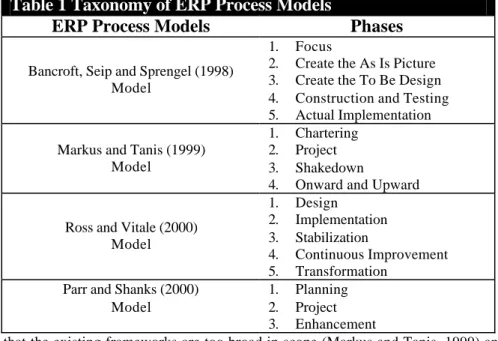
Whilst the ERP process models can provide the framework to guide the ERP project implementation, each one has its own differences. Firstly, among the existing ERP process models, only Parrand Shanks (2000) project phase model (PPM) relates critical success factors to each ERP phase. Secondly, both Markus and Tanis (1999) and Ross and Vitale (2000) models view the project phase as a single discrete phase. In contrast, the Bancroft, Seip and Sprengel (1998) model presents the project phase into 4 sub project phases (As Is, To Be, Construction and Testing, Actual Implementation) and Parr and Shanks (2000) model divides the project phase into 5 sub project phases (Setup, Re-engineer, Design, Configuration & Testing and Installation). Thirdly, while the 3 models (Bancroft et al, 1998; Ross and Vitale, 2000; Parr and Shanks, 2000) include a planning phase for the ERP project, Markus and Tanis (1999) model views the extent of planning before the organization actually decides to proceed with the decision. This involves building a business case to decide not to proceed or to proceed on implementing the ERP system. Fourthly, apart from the Bancroft et al (1998) model, the 3 models (Markus and Tanis, 1999, Ross and Vitale, 2000; Parr and Shanks, 2000) include a post-project phase (Onward and Upward, Continuous Improvement, Transformation, Enhancement).
However, Markus and Tanis (1999) argued that the concept of an ERP implementation is not a generic concept. Firstly, the traditional distinction between a Phased and Big Bang implementation is too coarse to codify the range of actual approaches to ERP implementation. Secondly, the ERP implementation falls into 3 broad categories: (1) Comprehensive, (2) Middle Road and (3) Vanilla. Thirdly, ERP implementation differs with respect to key characteristics namely: Physical Scope, the Business Process Re-engineering (BPR) Scope, Technical Scope, Module Implementation Strategy and the Resource Allocation (Parr and Shanks, 2000b). Hence, the theoretical framework is too broad in scope and the basic structure of the framework is a sequence of phases (Markus and Tanis, 1999). Therefore, the proposed framework will need to consider the various dimensions and implications in the enterprise. Table 1 summarizes the taxonomy of the existing process models.
Table 1 Taxonomy of ERP Process Models
ERP Process Models
Phases
Bancroft, Seip and Sprengel (1998) Model
1. Focus
2. Create the As Is Picture 3. Create the To Be Design 4. Construction and Testing 5. Actual Implementation Markus and Tanis (1999)
Model
1. Chartering 2. Project 3. Shakedown
4. Onward and Upward
Ross and Vitale (2000) Model 1. Design 2. Implementation 3. Stabilization 4. Continuous Improvement 5. Transformation
Parr and Shanks (2000) Model
1. Planning 2. Project 3. Enhancement
It can be seen that the existing frameworks are too broad in scope (Markus and Tanis, 1999) and they may not be able to cover the inter-organizational aspects of ES implementation, we propose in this study an adapted framework that includes various dimensions and implications within and across the enterprise during the entire ERP lifecycle – planning, project and post-implementation. An extended-ERP framework is proposed (Figure 1) to guide our discussion in the study. Adapting from Parr and Shanks (2000) project-phase model, there are three phases - planning, project and post-implementation, with the consideration of ERP systems in extended enterprises and E-business. Here, we refer to the post-implementation phase as one that consists of stabilization, enhancement and transformation sub-phases, which are similar to the last three phases of the Ross and Vitale (2000) model. As existing ERP process models mainly focus on the intra-organizational level, this extended-ERP framework synthesizes previous studies and adds a new dimension from the inter-organizational perspective.
3. Research Methodology
The Focus Group (FG) methodology is used to obtain ERP insights with the explicit use of group interactions (Morgan, 1988). Defined as a group of individuals selected and assembled by researchers, FG is used to discuss and comment from personal experience on the topic that is the subject of the research (Powell and Single, 1996). In existing academic ERP research, case studies constitute the largest category of publications (Esteves and Pastor, 2001), followed by surveys as part of the qualitative and quantitative methodologies respectively. However, qualit ative evaluations might be subjected to errors of human judgment and the understanding of accurately measured quantitative data is limited (Krueger, 1998). Hence, FG interviews are used such that a greater emphasis to the subjects’ viewpoints would be placed (Berg, 2001). Indeed, it is the interactive group energy that distinguishes FG interviews from the more conventional styles of one-on-one and face-to-face interviewing approaches.
Recently, the FG has reborn in social sciences and promises to become an integral part of the data-collection technology among qualitative researchers (Knodel, 1993; Berg, 2001; Blackburn and Stokes, 2000). Although FG may be useful at virtually any point in a research program, it is particularly useful for exploratory research where rather little is known about the phenomenon of interest (Stewart and Shamdasani, 1990; Berg, 2001).
Other uses of FG include organizational assessment (Leach et al, 1995), stimulating new ideas and creativity as well as generating impressions of products or programs (Stewart and Shamdasani, 1990). Whilst managers may not be in a position to gather primary information about customers, frontline employees and customers maintain a distinct psychological closeness (Clung, 1997). Hence, FG can be employed to gather feedbacks from frontline employees and customers in understanding their perceptions and the degree of consumer satisfactions (Jun et al, 1998; Kraft and Bush, 1998; Clung, 1997).
Before conducting the interviews, FG questions are developed. Brainstorming sessions are used to identify a range of possible FG questions that are both of interests to the participants and phrased in such a way that can be easily understood. Typically, open-ended questions are used so that participants contribute t heir opinions and insights on the subject topic. This allows them to determine the direction of the response and respond from a variety of dimensions. Secondly, FG interviews avoid dichotomous questions, which can be easily answered by a “yes” or “no” response. Thirdly, “why” questions are rarely asked in a FG as they usually imply a rational answer. Fourthly, FG questions are prepared by identifying potential questions based on the research topic (Krueger, 1998).
The next task is getting moderators and assistant facilitators. A moderator should be comfortable with group dynamics to control dominating respondents and encourage passive group members (Berg, 2001). While the moderator keeps the conversation flowing with the help of a direction guide that includes an estimate of the time for each question (Stewart and Shamdasani, 1990), the assistant facilitator takes comprehensive notes and is responsible for the audio recording. The third task is selecting group participants. A FG is usually composed of 6 to 12 people as fewer than 6 participants makes a rather dull discussion and more than 12 participants are difficult to manage (Stewart and Shamdasani, 1990). Due to the relatively high degree of moderator-imposed structure, fewer groups are needed.
After the data collection, thematic analysis encodes the qualitative information whereby an explicit “code’ consists a list of themes, indicators and qualifications (Boyatzis, 1998). Importance is placed on the comparisons among the different points of view to develop new code categories (Morgan, 1988). By using the data-driven approach, the codes are constructed inductively from the raw information. Next, sampling and design issues are considered. While the unit of analysis focuses the interpretation of the study, the unit of coding determines the comprehensiveness of the insight. For the research, each FG is the fundamental unit of analysis and the analysis begins from a group-by-group progression.
4. Focus Group Study
Preparation for the FG study began in August 2001 and the FG workshop was held in September 2001. Targeting postgraduate students, the majority of the participants were IT professionals in which there were about 10 ERP practitioners and 5 full-time students without working experiences. The rest of the participants were IT professionals whose titles ranged from IT manager to system analysts.
During the FG workshop, 30 out of the selected 32 participants attended. With a total of 4 sessions, each session lasted about 2 hours and had an average of 8 participants. Two sessions were held per day and all sessions were audio -taped. In each FG, there was a mixture of ERP practitioners and students as participants, 2 moderators, and 1-2 assistant facilitators.
The same set of FG questions was used fro m group to group and the limit of questions was set to 4 major topics, with preplanned probes under each. To facilitate the FG sessions, personal profiles were collected beforehand from the
participants. Pre-group briefings with the moderators and assistant facilitators were held so that research objectives were understood and clearly defined. A post-group briefing was held to identify any necessary changes needed for improvement in subsequent FG sessions (Greenbaum, 2000). In addition, visual aids were used to facilitate the FG discussions.
The FG discussions began with the topic of ERP systems and the ERP lifecycle. Participants shared their perceptions on the role of ERP systems within the enterprise, in a supply-chain network and business-to-consumer (B2C) E-business website. This was followed by discussions on the benefits of integrating business processes and applications, customizations as well as BPR. Furthermore, participants discussed ways to unearth the knowledge embedded in ERP systems as well as those embedded within the inter-organizational relationships. Lastly, they were asked about organizational transformation and remaining competitive with the changing business and IT environments. After the FG workshop, each participant submitted an individual report of their own views on the FG questions and inferences generated from other participants' responses.
5. Findings and Analysis
5.1 ERP Lifecycle: Planning Phase
Among the various potential themes as listed in Table 2, we highlighted 3 themes – implementation approach, assembly of steering committee, and the use of best practices due to the diverse perspectives shared by the respondents.
Table 2 ERP Process Models: Themes Within Sub Samples
Potentially Differentiating Themes FG 1 FG 2 FG 3 FG 4 Planning
1. Selection of ERP √ √ √
2. Assembly of Steering Committee √ √ √
3. Implementation Approach √ √ √
4. Project Scope √ √ √
5. Resource Determination √ √ √
6. Best Practices √ √ √
(1) Phased implementation approach is less risky
Participants mentioned about the different implementation approaches – Big Bang, Phased and Parallel. One practitioner felt that the type of the implementation approach depends on the situation, company direction and budget. Responses include the Big Bang approach as the most ambitious and difficult since people are resistant to change the way of doing things, the business processes and the mindset to adapt to an entirely new system. As pointed out, the Big Bang approach is more appropriate for either small companies with shorter implementation time or new business setups.
“ERP system should be implemented phase-by-phase … It needs a long time for an enterprise to fuse ERP into it. If a company is not well prepared, it should not hurry to use the ERP system. An adult’s shoes can only make a child run more slowly.”
Another viewpoint given is that the Phased approach works for large organizations with existing legacy systems. But consultants have to be engaged for a much longer period of time, which translates into huge costs involved. Alternatively, another practitioner suggested the Parallel approach to ensure a fall back plan if the implementation is not successful and allow a smoother transition to the new system.
“Phases are more favorable. From my personal experiences, we start from sales, move down to purchasing … by department. We can thus stay focused, and have internal advertisements to show how successful it is.”
(2) ERP project is dependable on the people involved
There was a uniform consensus among the re spondents that ERP project needs to form a steering committee to see it through. Some participants suggested engaging external consultants to share their expertise knowledge and act as the middle party. In addition, a practitioner noted that the role of the project champion contributes the success and failure of the ERP project - whether the organization can successfully transform would depend on the commitment from top management. Enabling reliable communication and information sharing across organizational boundaries, as supported in e-commerce in general or Internal in particular, the needs or nature of the implementation approach will be more
comprehensible and provide for a rapid and cost-effective planned integration among organization at the beginning of ERP life cycle.
“The stage involves the formation of development team and a steering committee comprising of the involved departments. This will expedite the deployment process and reduce any friction caused by the inter-departmental conflicts.”
(3) The best practices that are embedded in ERP systems help the company to maintain competitive advantage
Participants’ views diverged on whether “best practices” of ERP systems would help the company to maintain its competitive advantage. It was mentioned that ERP systems might affect the actual core competency of the company and, it may not be essential to change the existing business processes but rather the ERP software configuration. In some situations, organizations may find it advantageous to use their own enterprise systems instead of purchasing ERP packages offered by commercial vendors so that their own “best practices” can be kept as confidential.
Another point brought up was that the level of competitive advantage would depend on how organizations utilize their ERP systems. Specifically, business processes which are in line with its particular industry standard or “best practices” should be kept, whereas rules or company specific business logic should be re -evaluated seriously with the ERP vendor to minimize customizations.
“Each functional unit should be prepared to align the existing business processes with the recommended best practices of ERP systems because just the automation of the existing processes would not bring up the real benefits of ERP systems. But this approach becomes questionable if the existing processes withhold the actual competitive advantage of the enterprise. Under such situation, it’s better to concentrate more on the integration of processes rather than a large re-engineering.”
5.2 ERP Lifecycle: Project Phase
For the project phase, the participants emphasized the importance of business process re -engineering, minor customization, increasing user acceptance and better trainings (Refer Table 3).
(1) Business process re -engineering (BPR) during ERP implementation helps to reduce conflicts Participants pointed out that BPR should minimize possible conflicts. There is “no single rule of thumb” to decide which business processes should be changed to accommodate the ERP software as it would depend on the organizational needs and business processes. Also, organizations may want to retain some modules in existing legacy systems. While the standard processes are likely to change, value creating processes that differ from company-to-company are likely to be kept. BPR could result in deep changes in long-established ways of doing business and provide competitive advantages.
“Selecting which processes to keep and change during ERP implementation is one of the most challenging and daunting tasks. Organiza tion should evaluate this carefully, as this decision will impact greatly on the success of the ERP implementation and the worth of their investment.”
Results indicate that reengineering the support chain requires dynamic resource management. Therefore, real-time information between organizations supported by computer networks can help reinforce the reengineering process.
(2) Too much customization or modification of the ERP system is not be advisable
Some participants described customization as a “nightmare”. Not only do customizations incur further costs, it slows down the ERP project and introduces bugs into the system, thus making future software upgrades in the ERP vendor’s next release difficult. They felt that organizations should not make major customizations but wait for the ERP
Table 3 ERP Process Models: Themes Within Sub Samples
Potentially Differentiating Themes FG 1 FG 2 FG 3 FG 4 Project
1. Re-engineering √ √ √ √
2. Minor Customization √ √ √ √
3. User Acceptance Test √ √
vendors to introduce modifications in subsequent ERP releases. The use of ERP industry specific packages also helps to reduce the amount of customization.
“They did not like the idea of “mass-customization” in ERP. In fact it should be avoided at all cost as much as possible. Generally, this is the cause of all the “ERP horror stories.”
However, getting an ERP vendor to customize things may lead the vendor to develop similar processes and sell to competitors who are willing to pay for such advantages. Hence, in-house customizations could prevent competitors from gaining insights on how the business is run.
(3) User acceptance test is critical during project phase
Participants generally agreed that the ERP implementation success depends on the acceptance of end-users and customers. They also responded that the design and implementation phases are the most difficult due to the customer requirements. It is therefore important to get operational people to participate as full-time during the project phase.
“In real-life, after implementation, company may want to customize. Customers may not want to accept … there are some reports and interfaces that are allowed to be change but some are not to be changed.”
(4) ERP imple mentations can be more successful if training is structured and standards are specified As illustrated by participants, training is an “essential and crucial step in the whole implementation process”. There was a general consensus among the participants that training reduces the conflicting knowledge between the legacy systems and new systems. In addition, trainings help to transform organizations by allowing a smoother transition for the employees to accept the new system. It was suggested that organizatio ns provide training courses and incentives to shorten the learning curves of employees in order to cross the transition period quickly. These should be conducted during working hours to indicate its importance. It was further mentioned that the composition of the training team is important. For instance, there can be 3 levels of ERP training - the ERP consultants first train the IT staff whom in turn train the individual departmental representatives. These departmental representatives then teach their own d epartmental users. In addition, computer-based or web-based training should be introduced as a stream of the future.
“A training process may take place in a hierarchical way like a tree, that is, training is carried at different levels, and each level is responsible to train the next level. Compared with hiring consultants or implementation team to do all the training, this method is less expensive.”
In addition, XML (extensible Markup Language) was mentioned as the standard for data exchange across domain boundaries. Inter-organizational business solutions from the Internet should consider XML as a framework for business data exchange. Using XML-based platforms and applications, user can share a variety of enterprise devices, facilities, and data across their supply chain systems.
5.3 ERP Lifecycle: Post-implementation Phase
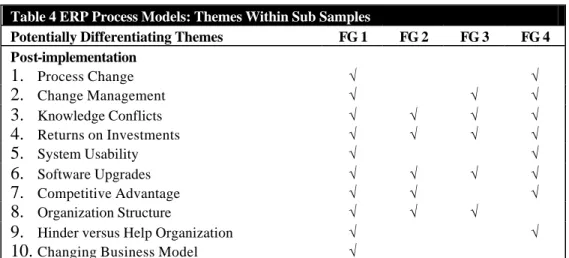
For the post-implementation phase, participants contributed about 10 potential themes (Refer Table 4). However, majority of them were not clear about how organizations can get the most benefits out of their ERP systems and below, we highlighted the issue about software maintenance and migration.
Table 4 ERP Process Models: Themes Within Sub Samples
Potentially Differentiating Themes FG 1 FG 2 FG 3 FG 4 Post-implementation
1.
Process Change √ √2.
Change Management √ √ √3.
Knowledge Conflicts √ √ √ √4.
Returns on Investments √ √ √ √5.
System Usability √ √6.
Software Upgrades √ √ √ √7.
Competitive Advantage √ √ √8.
Organization Structure √ √ √9.
Hinder versus Help Organization √ √1) After ERP implementation, the organization is dependent on software upgrades and new releases Software upgrading captures new business processes and adds more functionality to catch up with the rapidly changing business environment. Additionally, ERP software upgrades support the latest technology. But our participants agreed that software bugs from customization would make upgrading costly and “painfully difficult”. Hence, they advised that instead of customization, the organization should wait for the next software revision from the ERP vendor.
“Upgrades were always possible, and it represents a constant evolution of the systems rather than an one-off system.”
5.4 Extended Enterprises and E-business
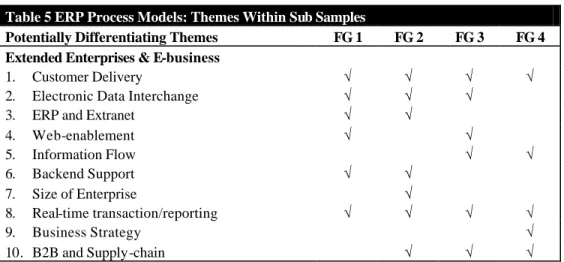
Looking from the inter-organization perspective, the FG participants shared their opinions about the role of ERP systems across the enterprises. Table 5 lists the 10 potential themes for extended enterprises and E-business.
Table 5 ERP Process Models: Themes Within Sub Samples
Potentially Differentiating Themes FG 1 FG 2 FG 3 FG 4 Extended Enterprises & E-business
1. Customer Delivery √ √ √ √
2. Electronic Data Interchange √ √ √
3. ERP and Extranet √ √
4. Web-enablement √ √ 5. Information Flow √ √ 6. Backend Support √ √ 7. Size of Enterprise √ 8. Real-time transaction/reporting √ √ √ √ 9. Business Strategy √ 10. B2B and Supply-chain √ √ √
(1) ERP systems improve customer delivery time
Most of our participants felt that ERP systems play a role in improving customer service and allow customers to trace the availability of goods, place orders over the Internet and provide information regarding the goods and delivery time. Thus, delivering the promise and shortening the delivery of sales order. With the tight integration of the business processes, sales strategies such as direct sales from wholesalers are made possible through bypassing the retailers.
“The ability to satisfy customers depends largely on the ability to deliver a consistent, accurate product lead time and delivery information in a moment’s notice. ERP systems can achieve this.”
(2) ES systems use EDI technology in business-to-business (B2B) exchange
Participants understood that EDI links up with suppliers and retailers. They, however, noted that organizations are going towards collaborative partnerships in B2B exchange and web-enablement, which can be facilitated by current ERP systems. As inter-organizational standards are pretty mature now with EDI messages, it is unlikely that the adoption of ERP system by few organizations can cause any major change in the current situation. Also, it depends whether the company is willing to share information with other companies.
“EDI supports dyadic relationships and the stronger firms force the weaker ones into adoption. The costs involved in integrating with different partners for similar transactions are huge and smaller firms may opt out.”
(3) ERP systems provide backend support in E-business
As stated by an enterprise systems practitioner in one of the FG sessions, ERP vendors have developed web interfaces and it is also the trend of the new business model. Many participants described ERP systems in the B2C business model as the backend system while the actual interfaces to customers are primarily web-based at t he front-end. ERP systems facilitate rapid responses to price changes as well as providing timely product and delivery status. The participants also cited organizations that offer customers the ability to track their packages across the world, thus addin g value to the business. But the decision of whether to implement ERP systems in E-business will depend on the cost-benefit analysis.
“The decision to use ERP for B2C depends on weighing the cost of the implementation versus the size of the customer pool. In most cases, unless the customer base is large and high volume of transactions, it is not worthwhile to use ERP as the backend system for e-business”
(4) ERP implementations with the right business strategy could contribute to E-business success A good strategy gives a direction to the organization and indicates which business processes to adapt or change. The lack of a business strategy could otherwise cause ERP implementations to fail. It was also pointed out that organizations face problems in the lack of understanding the customers’ needs.
“Even though the dotcom craze is over, most so called Old Economy companies are now beginning to realize the importance of having a sound E-business strategy.”
Quite a number of participants agreed that ERP systems act as an indispensable support to external operations in SCM, and business processes need to be integrated for the supply chain process to be efficient and streamlined. ERP systems provide high visibility by having a clear overview of the flow in processes. ERP systems also allow monitoring the availability of its raw materials as well as coordinating the logistics, manufacturing and distribution operations. Additionally, ERP systems enable planning and forecasting as well as order tracking of the delivery status.
“ERP monitor the whole process of the supply chain, and track every batch goods and record the state. The staff and customers can watch any goods in any point of the supply chain. It is a great revolution in the supply chain history.”
Moreover, information sharing between the various supply-chain partners is especially important, as organizations are moving towards collaborative SCM.
“Suppliers might now be willing to allow integration because it creates competition among suppliers. They thought that this model might only work if it is comprised of a community of companies that do not have conflict of interest.”
6. Implications of Findings
The FG study had revealed a spectrum of ERP issues relating to the different phases in the ERP process whereby we identify the future directions for ERP research.
v As revealed from the FG study, the bottom line to the appropriate type of implementation chosen depends by the company direction, situation and budget.With the E-business initiatives in an ERP environment, the notion of ERP implementation approach raises various implications for future ERP research: How does the implementation approach in an ERP installation differ from that of an E-business in an ERP environment? What are the necessary tasks in the project phase for business initiatives? To what extent are the critical success factors of ERP and E-business projects the same? This will further extend the development of existing process models.
v Findings also showed that organizations are facin g problems in understanding the needs of their customers as well as showing a reluctance to switch from the EDI technology to ERP systems in SCM. Besides, participants pointed out that the project phase is the most difficult due to the demanding customer requirements. Thus, the user acceptance testing would be critical and it is advised to involve operational people to participate as full-time in the process. One research area would be re-examining the criterion in the selection of ERP packages in today’s context. To what extent are the needs of the customer and supplier important in the selection of ERP packages?
v With the conflicts between the knowledge embedded in the ERP system and the organizational business processes, participants mentioned that trainings reduce these conflicts during the integration. One research issue that needs to be answered would be how the structure of training can be improved so that the management people, ERP project members and end-users can learn effectively and gain in-depth knowledge of ERP. This will be useful as many organizations fail to recognize the critical role of trainings in transforming the organizations after ERP implementations.
v Findings indicated that ERP systems in B2C E-business provided the backend support in improving customer delivery and fulfillment by providing accurate and timely product information. In fact, one of the key reasons why some ERP implementations fail is the lack of good business strategy. Moreover, despite the move towards information sharing between various supply -chain partners leads to collaborative SCM, many organizations
continue to use the EDI technology as they are not willing to share sensitive information with one another. One research question would be what are the critical succes s factors in integrating their ERP systems from different vendors in SCM? Besides, what are the implications of integrating ERP systems with SCM in comparison to organizations that do not implement ERP systems?
v The returns of the ERP investments are not clearly known and organizations are facing problems in utilizing their ERP systems. Participants also agreed that how organizations obtain their competitive advantage would depend on how they utilize their ERP systems. Therefore, more studies would be useful to address the issue of how organizations can leverage their potential benefits from the ERP investments. Future research can consider developing frameworks to determine how ERP systems create value within as well as across the enterprises in SCM, CRM and E-business.
v The FG study showed that organizations encounter problems during software maintenance such as costly to upgrade and dealing with software bugs from customizations in the previous ERP installations. Thus, research can further look into how organizations cope with new releases of ERP systems. If organizations decide not to opt for software migration, what are the long-term consequences? A framework can be developed to guide organizations to streamline the planning process in their migration path.
7. Conclusion
With different backgrounds and working experiences from the participants, the FG study managed to tap into the real-life interactions of people and allowed us to get in touch with the perceptions and attitudes from the participants. As a result, a wide range of ERP issues had been discussed during the FG sessions, which provided a richness of data ranging from generic to specific aspects of ERP.
Based on our extended-ERP framework, we have further examined the ERP phases in the lifecycle and we suggest that it is timely to develop frameworks that look into the adoption, implementation and use of E-business, CRM and SCM in an ERP environment. Evidence from the FG study highlights that more research would be needed to re-examine the following ERP issues at the inter-organizational level, namely: selection of ERP packages, integration of business processes, knowledge and applications, implementation approaches, training as well as organizational transformation and software migration.
The methodological contributions are twofold as the FG study brought diverse insights together to review the ERP process. First, the empirical findings would be useful to ERP practitioners by providing better understanding of ERP from both the user and organizational perspectives. Rather than strictly presenting a framework as a sequence of phases, the paper adds a new dimension at the inter-organizational level and further analyzes the different inter-related issues in various phases of the ERP lifecycle. This will provide better guidance in ERP implementations. Second, practitioners can use FG at the beginning of ERP projects to gather customer needs and organizational information, which can facilitate better business and IS planning. More empirical studies using other research methods such as case studies can be done to increase the validity of the ERP findings.
References
[1] Adam, P. and O’Doherty, P. (2000). Lessons From Enterprise Resource Planning Implementation in Ireland – Towards Smaller and Shorter ERP Projects. Journal of Information Technology, Vol. 15, 2000, pp. 305-316.
[2] Bancroft, N.H., Seip, H. and Sprengel, A. (1998). Implementing SAP R/3. Second Edition, Manning Publications, Greenwich, 1998.
[3] Berg. B.L. (2001). Qualitative Research Methods for the Social Sciences. Fourth Edition, Allyn and Bacon, 2001. [4] Besson, P. and Rowe F. (2001). ERP Project Dynamics and Enacted Dialogue: Perceived Understanding, Perceived
Understanding, Perceived Leeway, and the Nature of Task-Related Conflicts. The DATA BASE for Advances in Information Systems, Vol. 32, No. 4, Fall 2001, pp. 47-66.
[5] Blackburn, R.A. and Stokes, D. (2000). Breaking down the Barriers: Using Focus Groups to Research Small and Medium Sized Enterprises. International Small Business Journal, Vol. 19, No. 1, 2000, pp. 44-67.
[6] Boyatzis, R.E. (1998). Transforming Qualitative Information: Thematic Analysis and Code Development. Sage Publications, California, 1998.
[7] Clung, B.G. (1997). Collecting and Using Employee Feedback. Cornell Hotel and Restaurant Administration Quarterly, October 1997, Vol. 38, No. 5, pp. 50-52.
[8] Davenport, T.H. (1998). Putting the Enterprise into the Enterprise System. Harvard Business Review, Vol. 76, No. 4, July-August 1998, pp. 123-131.
[9] Davenport, T.H. (2000b). Mission Critical: Realizing the Promise of Enterprise Systems. Harvard Business School Press, Massachusetts, 2000.
[10] Esteves, J. and Pastor, J. (2001). Enterprise Resource Planning Systems Research: An Annotated Bibliography. Communications of the Association for Information Systems, Vol. 7, No. 8, August 2001, pp. 1-52.
[11] Greenbaum, T.L. (2000). Moderating Focus Groups. A Practical Guide for Group Facilitation. Sage Publications, California, 2000.
[12] Jun, M., Peterson, R.T. and Zsidisin, G.A. (1998). The Identification and Measurement of Quality Dimensions in Health Care: Focus Group Interview Results. Health Care Management Review, Fall 1998, Vol. 23, No. 4, pp. 81-96.
[13] Klaus, H., Rosemann, M. and Gable, G.G. (2000). What is ERP? Information Systems Frontiers, Vol. 2, No. 2, 2000, pp. 141-162.
[14] Knodel, J. (1993). The Design and Analysis of Focus Group Studies: A Practical Approach. In: Morgan, D.L. Successful Focus Groups: Advancing the State of the Art, Sage Publications, California, 1993, pp. 35-50.
[15] Kraft, M.K. and Bush, I.R. (1998). Accountable Welfare Reform: What Consumers Think. Public Administration Review, September-October 1998, Vol. 58, No. 5, pp. 406-416.
[16] Krueger, R.A. (1998). Focus Groups: A Practical Guide for Applied Research. Sage Publications, California, 1988. [17] Leach, J., George, B., Jackson, T., LaBella, A. (1995). A Practical Guide to Working with Diversity – The Process,
the Tools, the Resources. Amacom, New York, 1995.
[18] Markus, M. L. and Tanis, C. (1999). The Enterprise System Experience - From Adoption to Success. Claremont Graduate University, California, 1999, pp. 173-207.
[19] Morgan, D. L. (1988). Focus Groups As Qualitative Research. Sage Publications, California, 1988.
[20] Parr, A. and Shanks, G. (2000). A Model of ERP Project Implementation. Journal of Information Technology, Vol. 15, 2000, pp. 289-303.
[21] Parr, A.N. and Shanks, G. (2000b). A Taxonomy of ERP Implementation Approaches. In Proceedings of the 33rd Hawaii International Conference on System Sciences, (Maui, Hawaii, January 4-7, 2000) IEEE, 2000, pp. 1-10.
[22] Robinson, B. and Wilson, F. (2001). Planning for the Market? Enterprise Resource Planning Systems and the Contradictions of Capital. The DATA BASE for Advances in Information Systems, Vol. 32, No. 4, Fall 2001, pp. 21-33.
[23] Rosemann, M., Sedera, W. and Gable, G. (2001). Critical Successful Factors of Process Modeling For Enterprise Systems. In Proceedings of the 7th American Conference on Information Systems, (Boston, Massachusetts, August 3 – 5, 2001), AIS, 2001, pp. 1128-1130.
[24] Ross, J.W. and Vitale, M.R. (2000). The ERP Revolution: Surviving vs. Thriving. Information Systems Frontiers, Vol. 2, No. 2, 2000, pp. 233-241.
[25] Powell R.A. and Single H.M. (1996). Focus Groups. International Journal of Quality in Health Care, Vol. 8, No. 5, 1996, pp. 499-504.
[26] Shanks, G. and Seddon, P. (2000). Editorial.Journal of Information Technology, Vol. 15, 2000, pp. 243-244.
[27] Stewart, D.W. and Shamdasani, P.N. (1990). Focus Groups Theory and Practice. Sage Publications, California, 1990.