Performance analysis of energy detection over hyper-Rayleigh fading channels
Eleftherios Chatziantoniou, Ben Allen, Vladan Velisavljevic
Centre for Wireless Research, University of Bedfordshire, University Square, LU1 3JU Luton, UK
E-mail: [email protected]
Published inThe Journal of Engineering; Received on 10th October 2014; Accepted on 26th November 2014
Abstract: This study investigates the performance of energy detection (ED)-based spectrum sensing over two-wave with diffused power (TWDP) fading channels, which have been found to provide accurate characterisation for a variety of fading conditions. A closed-form expression for the average detection probability of ED-based spectrum sensing over TWDP fading channels is derived. This expression is then used to describe the behaviour of ED-based spectrum sensing for a variety of channels that include Rayleigh, Rician and hyper-Rayleigh fading models. Such fading scenarios present a reliable behavioural model of machine-to-machine wireless nodes operating in confined structures such as in-vehicular environments.
1 Introduction
We are experiencing a huge growth of interest in machine-to-machine (M2M) communications, sometimes referred to as the ‘internet of things’. Many such deployments are envisaged to represent wireless operating environments that differ significantly from that of current technologies since they may be deployed in enclosed environments such as in aircraft, vehicles and confined urban settings [1–3]. They are also expected to coexist with primary systems as a means of efficient spectrum utilisation by employing cognitive radio (CR) technology [4]. CR technology enables unlicenced users to monitor their spectral surroundings and adapt their parameters accordingly in order to opportunistically access temporally unoccupied licenced spectrum.
Energy detection (ED) also known as the radiometer is a non-coherent detection method that measures the energy of a received signal and compares it with a predefined threshold in order to deter-mine the presence or the absence of an unknown signal. ED is con-sidered as a popular detection method because of its low implementation complexity and no requirements on prior knowl-edge of the received signal. As a result, ED has been widely used in a number of wireless applications such as radar systems [5] and ultra-wideband communications [6]. Recently, ED has shown high applicability in the emerging technology of CR [7]. In this context, ED is used as a spectrum sensing mechanism in order for CR-enabled secondary users (SUs) to identify whether a primary user (PU) is present or absent.
M2M communication systems have recently gained increased interest for sensing and monitoring industrial and in-vehicular environments. Such environments are often enclosed, metallic structures where frequency selective fading should be expected with fading conditions that are not adequately characterised by existing fading models such as Rayleigh and Rician [8]. However, using traditional fading channels that stem from the
field of mobile communications [9], the behaviour relating to surface-mounted, static wireless nodes cannot be adequately characterised. For example, a recent study revealed that wireless sensors operating in an airframe suffer from frequency and spatially dependent fading that have severity exceeding that predicted by the Rayleigh fading model. Such small-scale fading, referred to as ‘hyper-Rayleigh’ fading, can be characterised by the two-wave with diffused power (TWDP) fading model, as verified experimen-tally in [8].
The TWDP fading model [10] utilises a family of probability density functions (PDFs) that mathematically describe small-scale fading in the presence of two strong multipath components. It can
characterise a wide variety of fading scenarios such as those experi-enced by narrow-band receivers or when directional antennas and wide-band signals are used. This fading model can also be reduced to the well-known Rician and Rayleigh distributions as special cases.
The detection performance of ED-based spectrum sensing has been analysed for Rayleigh, Rician and Generalised K channels in [11,12]. However, to the best of our knowledge, the ED-based spectrum sensing model has not yet been extended to account for TWDP fading channels such as‘hyper-Rayleigh’fading channels. Hence, the focus and contribution of this paper which provides insights into this open question.
In this paper, we derive and evaluate a closed-form expression for the average detection probability for ED-based spectrum sensing over TWDP fading channels, thus providing new insights into the performance of ED-based spectrum sensing over worst than Rayleigh fading conditions. The obtained results are expected to enable the design of energy-efficient CR wireless systems in the context of M2M wireless networks, and facilitate the analysis and development of diversity and cooperative sensing methods to mitigate such fades.
2 TWDP fading channel model
The TWDP fading model derived in [10] is reviewed as it provides the foundation for this work. The parametric family of PDFs approximates the TWDP PDF using two parameters related to the wireless channel. First, the ratio between the average specular and diffused power is given asK=(V12+V22)/2s2, whereV1andV2 denote the voltage magnitudes of the two specular waves, andσ2 indicates the average power of the diffused waves. Second, the rela-tive strength of the two specular waves is expressed as D=2V1V2/(V12+V22). The TWDP PDF, fr(r), of the fading amplitude,r, is then approximated as [10]
fr(r)= r s2exp − r2 2s2 −K M i=1 aiD r s;K; ai (1) where D(x; K;a)=1 2exp(aK)I0(x) 2K(1−a) +12exp(−aK)I0(x)2K(1+a) (2)
witha=Δcos (π(i−1)/2M−1),Mrepresenting the order of the ap-proximation of the TWDP PDF andI0(.) denoting the zero-order Bessel function of thefirst kind. The minimum required approxima-tion order,Mmin, is determined by the product of the fading para-meters K and Δ, Mmin≥⌈1/2KΔ⌉, with ⌈.⌉ denoting the ceiling function. The values ofaover the most useful range ofKand Δ, that is,M= 1−5, is given by Durginet al.[10].
In two special cases, the TWDP PDF is reduced to the Rician PDF whenK≠0 andΔ= 0, and to the Rayleigh PDF whenK= 0. Rayleigh fading arises from the summation of a large number of uncorrelated multipath components. However, if the number of multipath components reduces, the envelope fading statistics will no longer be Rayleigh. The extreme scenario of two summed multipath components with equal weights has been experimentally validated as a new worst-case fading scenario [8]. The two-ray model is also included as a special case of the TWDP model for K→∞ and Δ= 1. Therefore the TWDP PDFs give an accurate mathematical representation of a family of common PDFs as special cases for different values ofKandΔ, as shown in [10].
The relationship between the fading envelope and the instantan-eous signal-to-noise ratio (SNR) per symbol is given by [13]
fg(g)=Es N0fr2(r
2)
(3)
whereEsis the symbol energy andN0is the noise power spectral density. To estimate the energy of the received signal, a square transformation is applied to the random variable in (1), and thus fr2(r2) is expressed as [14] fr2(r2)= 1 2s2exp −K− r 2s2 M i=1 aiD r √ s ; K; a (4)
According to [10], the energy per bit to the noise power spectral density,Es/N0, of the average received signal can be expressed in terms of K as Es/N0=g/2s2(K+1), where g is the average SNR. As a result, the instantaneous SNR,γ, can be determined in terms of the average SNR and the channel fading parameters. Therefore, by substituting (4) in (3), the PDF of the SNR over TWDP fading can be rewritten as [14]
fg(g)=K+1 2g exp(−K) M i=1 ai exp(aiK)exp −(K+1)g g A+exp(−aiK)exp −(K+1)g g B ⎡ ⎢ ⎢ ⎣ ⎤ ⎥ ⎥ ⎦ (5) where A=I0 2 K(K+1)(1−ai)g g (6) B=I0 2 K(K+1)(1+ai)g g (7)
3 ED-based spectrum sensing over hyper-Rayleigh fading With reference to conventional ED, the probability of false alarm, Pfa, (i.e. the probability of false positive detection of a signal)
and probability of detectionPd(i.e. the probability of true positive detection of a signal) in the presence of additive white Gaussian noise (AWGN) are given as [11]
Pfa=G(u, l/2)
G(u) (8)
Pd=Qu(√2g, √l) (9) where λis the detection threshold and u is the time-bandwidth product. Furthermore, G(a, x)=1x t(a−1)e−tdt, G(a)= 1 0 t (a−1)e−tdt and Q m(a, b)=(1/a(m−1)) 1 b x me(−x2+a2/2)I (m−1)
(ax) dxdenote the upper incomplete gamma function, the gamma function and the generalised Marcum Q-function, respectively [15,16].
For a communication scenario over fading channels, the average probability of detection is obtained by averaging the average prob-ability of detection over AWGN, given by expression (9), over the corresponding SNR fading statistics, that is
Pd=10 Qu(√2g, √l)fg(g) dg (10) Hence, by substituting the PDF of the SNR over TWDP, (5) in (10), a closed-form representation for the average detection probability over TWDP fading channels is derived. Thus, by substituting x for √2g and based on [17, eq. (45)] the following lemma is proposed.
Lemma: The average detection probability over TWDP fading channels is expressed by a closed-form representation as (see (11)) The proof of Lemma is shown in Appendix. Note that the probabil-ity of false alarm,Pfa, remains the same under any fading channel since it is independent of the SNR statistics.
4 Numerical results and discussion
This section analyses the behaviour of ED-based spectrum sensing over TWDP fading channels, based on (11). The detection accuracy is evaluated in terms of the complementary receiver operation char-acteristic (ROC) curves (PmdagainstPfa), wherePmddenotes the probability of false negative detections, given asPmd= 1−Pd. In the context of CR, highPd, and hence low P−md prevents the SUs to interfere with the PUs. On the other hand, lowPfaresults in better spectrum utilisation. Therefore a pair of highPdand low Pfasuggests better performance for the CR system. To this end, according to the IEEE 802.22 standard for CR recommends a Pd≥0.9 andPfa≤0.1. Additionally, the detection performance in terms of the SNR requirements is evaluated by using thePd
TWDP
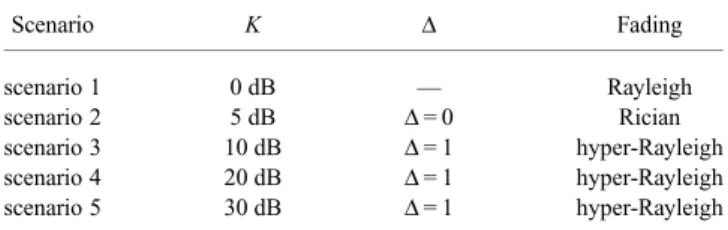
versus g curves. Both curves provide a comprehensive analysis Table 1 Fading scenarios
Scenario K Δ Fading scenario 1 0 dB — Rayleigh scenario 2 5 dB Δ= 0 Rician scenario 3 10 dB Δ= 1 hyper-Rayleigh scenario 4 20 dB Δ= 1 hyper-Rayleigh scenario 5 30 dB Δ= 1 hyper-Rayleigh Pd TWPD= M i=1 1 2ai Q 2Kg(1−ai) K+g+1 , l (K+1) K+g+1 +Q 2Kg(1+ai) K+g+1 , l (K+1) K+g+1 (11)
on the performance of ED-based spectrum sensing for a range of fading scenarios, as per Table1.
Scenario 1 describes typical Rayleigh fading, whereas Scenario 2 represents Rician fading with aK-factor of 5 dB. These scenarios can adequately describe fading conditions in both indoor and outdoor environments. On the other hand, Scenarios 3–5 are
chosen to be representative of fading conditions that are experi-enced in enclosed metallic structures. More specifically, based on the experimental results from [1], these scenarios can describe static cognitive M2M nodes that operate in confined environment such as in-vehicular environments including a single deck bus and two different types of airframe.
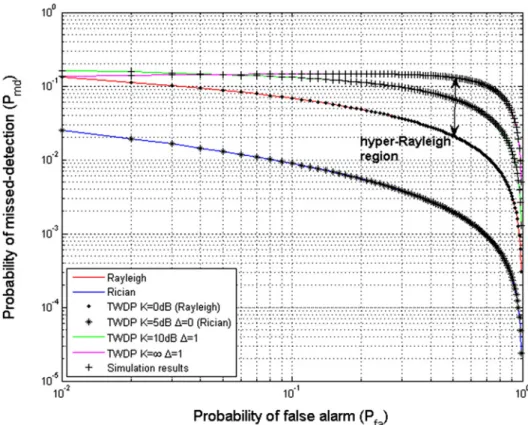
Fig. 1 Complementary ROC curves for ED-based spectrum sensing over TWDP fading for a range of K values andΔ= 1
Fig. 1 shows the complementary ROC curves for ED-based spectrum sensing over TWDP fading channels for the range ofK andΔvalues specified in Table1. The SNR isfixed to 10 dB as it has been found to provide adequate detection performance over AWGN channels [18]. The complementary ROC curves for Rician and Rayleigh fading channels are shown in the same
figure to provide comparison of the derived expression to the rele-vant expressions from [11]. Note that these two curves closely match the curves obtained using our derived expression for the special cases of Rayleigh (K= 0 dB) and Rician (K= 5 dB,Δ= 0). The good match between these curves and between the simulation and analysis results suggests that the proposed statistical model is valid as well as that the derived expression for the average probabil-ity of detection over TWDP fading channels presents an effective approximation of realistic fading scenarios.
Moreover, it can be seen that as the value of Kincreases, the ROC curve moves within the hyper-Rayleigh region towards the upper-bound of two-ray fading (K=∞, Δ= 1). These results suggest that the detection performance of ED deteriorates as a result of cancellation of two anti-phase specular waves and the low power of diffused components. Indicatively, for a target Pmd= 0.1, the corresponding Pfa is 0.05, 0.31 and 0.57 for Rician, Rayleigh and hyper-Rayleigh fading, respectively. Thus, the required criterion Pfa≤0.1 and Pmd≤0.1 is not met over ‘hyper-Rayleigh’ fading conditions resulting in 91 and 45% higher Pfa values when compared Rician and Rayleigh fading conditions.
Fig. 2shows the detection performance of ED-based spectrum sensing with respect to the required SNR for a range ofΔ= 1 and K values within the SNR region of 0–30 dB. The curve for the case of two-ray fading channel is also provided as the upper-bound of hyper-Rayleigh. The obtained results suggest that the average detection performance deteriorates as K increases, (the PDF moves from Rician to the two-wave fading scenario) as the two specular components cancel each other out and the power difference between the multipath components and the corresponding diffused components increases. More specifically, for Δ= 1, K= 10 dB, a minimum SNR of 18 dB is required to achieve a Pd= 0.9, whereas for Δ= 1, K= 20 dB and Δ= 1, K= 30 dB a minimum SNR of 21 and 23 dB is required, respectively. On the other hand, ED-based spectrum sensing over Rayleigh requires an SNR of 13 dB. According to these SNRfigures, it can be deduced that the SNR requirements forPd= 0.9 are increased up to 77%.
5 Conclusion
This paper analysed the performance of ED-based spectrum sensing over TWDP fading channels. A novel closed-form expression (12) for the average probability of detection over TWDP fading is derived. The accuracy andflexibility of this expression have been verified through analytical and simulation results as well as by com-parison with well-known benchmark results. The derived expres-sion enables the performance analysis of ED-based spectrum sensing under moderate and severe fading scenarios that can be characterised by the family of TWDP distributions. The obtained results are particularly useful for analysing the performance of ED over severe, moderate and worst than Rayleigh fading condi-tions that cannot be adequately characterised by traditional fading models. On the basis of the offered numerical results, it is con-cluded that the performance of ED is significantly affected by the hyper-Rayleigh fading conditions resulting on high SNR require-ments which in turn can significantly affect the energy efficiency of energy-constrained cognitive M2M wireless systems. To this end, the derived expression is particularly useful for identifying the limits of ED-based spectrum sensing as well as for investigating mitigation techniques as a means of improving future CR systems for emerging application spaces.
6 References
[1] Frolik J.:‘On appropriate models for characterizing hyper-Rayleigh fading’,IEEE Trans. Wirel. Commun., 2008,7, pp. 5202–5207 [2] Sen I., Matolak D., Xiong W.:‘Wireless channels that exhibit‘worse
than Rayleigh’fading: analytical and measurement results’. Military Communications Conf., 2006. MILCOM 2006. IEEE, October 2006, pp. 1–7
[3] Kim D., Ingram M.-A., Smith Jr., W.W.:‘Measurements of small-scale fading and path loss for long range RF tags’,IEEE Trans. Antennas Propag., 2003,51, pp. 1740–1749
[4] Zhang Y., Yu R., Nekovee M., Liu Y., Xie S., Gjessing S.:‘Cognitive machine-to-machine communications: visions and potentials for the smart grid’,IEEE Netw., 2012,26, pp. 6–13
[5] Dong J., Zhang S., Wu X.:‘Cross-correlation processing based an energy detection algorithm for non-carrier UWB radar’. 2013 IEEE Int. Geoscience and Remote Sensing Symp. (IGARSS), July 2013, pp. 1537–1540
[6] Rabbachin A., Quek T., Pinto P., Oppermann I., Win M.:‘UWB energy detection in the presence of multiple narrowband interferers’. IEEE Int. Conf. on Ultra-Wideband, 2007. ICUWB 2007, September 2007, pp. 857–862
[7] Haykin S., Thomson D., Reed J.:‘Spectrum sensing for cognitive radio’,Proc. IEEE, 2009,97, pp. 849–877
[8] Frolik J.:‘A case for considering hyper-Rayleigh fading channels’, IEEE Trans. Wirel. Commun., 2007,6, pp. 1235–1239
[9] Rappaport T.: ‘Wireless communications: principles and practice’ (Prentice-Hall PTR, Upper Saddle River, NJ, USA, 2001, 2nd edn.) [10] Durgin G., Rappaport T., De Wolf D.A.:‘New analytical models and probability density functions for fading in wireless communications’, IEEE Trans. Commun., 2002,50, pp. 1005–1015
[11] Digham F., Alouini M.-S., Simon M.K.:‘On the energy detection of unknown signals over fading channels’. IEEE Int. Conf. on Communications, 2003. ICC’03, May 2003, vol. 5, pp. 3575–3579 [12] Atapattu S., Tellambura C., Jiang H.:‘Performance of an energy de-tector over channels with both multipath fading and shadowing’, IEEE Trans. Wirel. Commun., 2010,9, pp. 3662–3670
[13] Simon M.K., Alouini M.-S.:‘Digital communication over fading channels’(John Wiley & Sons, New Jersey, 2005), vol. 95 [14] Subadar R., Singh A.: ‘Performance of SC receiver over
TWDP fading channels’,IEEE Wirel. Commun. Lett., 2013,2, pp. 267–270
[15] Abramowitz M.:‘Handbook of mathematical functions, with formu-las, graphs, and mathematical tables’ (Dover Publications, Incorporated, Washington, DC, 1974)
[16] Marcum J.:‘A statistical theory of target detection by pulsed radar’, IRE Trans. Inf. Theory, 1960,6, pp. 59–267
[17] Nuttall A.: ‘Some integrals involving the q-function’, Technical Report, Naval Underwater Systems Center (NUSC), 04 1972 [18] Lopez-Benitez M., Casadevall F.:‘Signal uncertainty in spectrum
sensing for cognitive radio’, IEEE Trans. Commun., 2013, 61, pp. 1231–1241
7 Appendix Proof of Lemma
For thefirst order, that is,M= 1, the average probability of detection is expressed as Pd TWDP=ai K+1 2g exp(K(ai−1)) 1 0 Qu2g, √l ×exp −(K+1)g g I0 2 K(K+1)(1−ai)g g dg +exp(−K(ai+1)) 1 0 Qu(2g, √l) ×exp −(K+1)g g I0 2 K(K+1)(1+ai)g g dg (12) By substituting forx=√2g(12) can be rewritten
Pd TWDP=ai K+1 2g exp(K(ai−1)) 1 0 Qu(x, √l) ×exp −(K+1)g g I0 2 K(K+1)(1−ai)g g xdx +exp(−K(ai+1)) 1 0 Qu(x, √l) ×exp −(K+1)g g I0 2 K(K+1)(1+ai)g g xdx (13) Foru= 1, the integrals in (13) can be solved according to [17, eq.
(45)] following that 1 0 Qu(ax, b)exp − p2x2 2 I0(cx)xdx = c2 2p2 Q ac pp2+a2, bp p2+a2 (14) with a= 1, b=√l, p=√(K+1)/g and c=2(K(K+1)(1+ai))/2g. For all approximation orders M, the average probability of detection is given as a summation by (see (15)) Pd TWPD= M i=1 1 2ai Q 2Kg(1−ai) K+g+1 , l (K+1) K+g+1 +Q 2Kg(1+ai) K+g+1 , l (K+1) K+g+1 (15)