Pharmacy Practice Faculty Publications Pharmacy Practice
2017
Practical considerations when generalizing study
results: a potential outcomes perspective
Catherine R. Lesko Ashley L. Buchanan
University of Rhode Island, [email protected]
See next page for additional authors
Follow this and additional works at:https://digitalcommons.uri.edu/php_facpubs The University of Rhode Island Faculty have made this article openly available.
Please let us knowhow Open Access to this research benefits you. This is a pre-publication author manuscript of the final, published article. Terms of Use
This article is made available under the terms and conditions applicable towards Open Access Policy Articles, as set forth in ourTerms of Use.
This Article is brought to you for free and open access by the Pharmacy Practice at DigitalCommons@URI. It has been accepted for inclusion in Pharmacy Practice Faculty Publications by an authorized administrator of DigitalCommons@URI. For more information, please contact [email protected].
Citation/Publisher Attribution
Lesko, C. R., Buchanan, A. L., Westreich, D., Edwards, J. K., Hudgens, M. G., & Cole, S. R. (2017). Practical considerations when generalizing study results: a potential outcomes perspective.Epidemiology, 28(4), 553-561. doi: 10.1097/EDE.0000000000000664 Available at:http://dx.doi.org/10.1097/EDE.0000000000000664
Practical considerations when generalizing study results: a potential outcomes perspective Catherine R. Lesko1,2 Ashley L. Buchanan3,4 Daniel Westreich1 Jessie K. Edwards1 Michael G. Hudgens3 Stephen R. Cole1
1Department of Epidemiology, Gillings School of Global Public Health, University of
North Carolina, Chapel Hill, NC
2Department of Epidemiology, Johns Hopkins Bloomberg School of Public Health,
Baltimore, MD
3Department of Biostatistics, Gillings School of Global Public Health, University of
North Carolina, Chapel Hill, NC
4Department of Epidemiology, TH Chan School of Public Health, Harvard University,
Boston, MA
Keywords: Causality; Effect modifier, epidemiologic; Selection bias; Sampling studies
Abstract
Great care is generally taken in epidemiologic studies to ensure the internal validity of causal effect estimates; however, the external validity of effect estimates, has received considerably less attention. The causal effect in a given target population is the average of heterogeneous subgroup effects, weighted according to the
prevalence of the subgroups in the target population. When the study sample is not a random sample of the target population, the sample average treatment effect, even if internally valid, cannot be expected to equal the average treatment effect in the target population. There are several categories of choices for the target population. The study sample may be a census of the target population; the population from which the study sample is a random sample or from which the study sample is not a random sample; or some other population of which, the study sample is not a subset of the target population. The identification conditions sufficient for external validity closely parallel the identification conditions for internal validity, namely:
conditional exchangeability; positivity; similar distributions of the versions of; similar patterns of interference; no measurement error; and correct model specification. The value of an effect estimate for planning purposes and decision making will depend on the degree of departure from both internal and external validity. If the study sample is not a random sample of the target population, direct standardization (the g-formula or transport formula) or inverse probability
Epidemiology as a discipline is distinguished by its efforts to identify causes of disease for the purpose of intervening to improve public health. Great care is generally taken in epidemiologic studies to ensure the internal validity of causal effect estimates,1 including the application of methods to minimize the potential for
bias due to measurement error, confounding, selection (specifically, due to missing data, including censoring and truncation), and model misspecification. However, the
external validity of effect estimates, has received considerably less attention. For the purposes of this discussion, we use the term external validity to refer to the
potential for an internally valid treatment (or exposure or intervention) effect measured in a study sample to differ from the treatment effect that would have been estimated in the population of interest2 (henceforth, the target population). External
validity encompasses generalizability and transportability, which we distinguish below. We advance the discussion of external validity herein using a potential
outcomes framework. We enumerate a set of identification assumptions sufficient to estimate an externally valid effect, and note the parallel between these and the identification assumptions sufficient to estimate an internally valid effect. Finally, we illustrate some issues regarding generalizability with a simple example and discuss practical considerations for addressing generalizability in epidemiological study design.
Definitions and causal framework
A well-defined causal question states the outcome(s) of interest, denoted by
described by a set of characteristics denoted by W. Here, we assume variables in W
are discrete, however, all concepts are easily extended to the case of continuous W. The causal effect of interest is a contrast (i.e., a difference or ratio) of the
distribution of potential outcomes, 𝑌(𝑎), in the target population under two different interventions, treatments, or policies of interest, for example:
𝐸𝑇{𝐸[𝑌(𝑎)|W]𝑃𝑇(W)} − 𝐸𝑇{𝐸[𝑌(𝑎′)|W]𝑃𝑇(W)} (1)
where 𝑌(𝑎) denotes the outcome that a participant would have if he or she received
treatment 𝑎, and the subscript 𝑇 denotes that the set of characteristics W takes the distribution seen in target population. This notation makes it clear that the overall causal effect in the target population is the average of effects that are heterogeneous according to W, with weights defined by the distribution of W in the target
population, 𝑃𝑇(W). 𝑃𝑇(W) is often omitted when the causal effect of interest is
written (i.e. E[𝑌(𝑎)] − E[Y(𝑎′)]) under the implicit assumption that either 1) the
study sample is a census of the target population; 2) the study sample is a simple random sample from the target population, i.e., the distribution of W in the study sample, denoted 𝑃𝑠(𝑊), is equal to 𝑃𝑇(W) in expectation; 3) there is a distinct target population, 𝑀, of which the study sample is not a proper subset, for which
𝑃𝑀(W) is equal to 𝑃𝑆(W); or 4) the causal effect is homogeneous across all 𝑊 for the causal contrast of interest.
It is helpful to distinguish threats to validity that arise after enumeration of the study sample, which we define as threats to internal validity, from threats to validity due to eligibility and enrollment of study subjects, which we define as threats to external validity. We define an estimator as internally valid when the
estimator of association in the study sample is a consistent estimator of the treatment effect in the source population from which the study participants are
randomly sampled (the sample average treatment effect). The distribution of 𝑊 in
the study sample, 𝑃𝑆(W), may differ from 𝑃𝑇(W) without threatening internal validity. We define a causal estimator to be externally valid when the sample
average treatment effect is a consistent estimator of the average treatment effect in the target population (population average treatment effect). An estimate will be externally valid under one of the first three scenarios described above, all of which result in the distribution of W in the study sample being equal to the distribution of
W in the target population.
Assumptions
Given we cannot observe all potential outcomes for subjects in our target population or our study sample,3,4 we can rely on a sufficient set of identification
assumptions under which (with a consistent estimator) an estimate of association could be interpreted causally.
These assumptions are well described in the literature for estimating an internally valid causal estimate. They include: 1) the unexposed are a good substitute for the experience of the exposed in the absence of exposure and vice versa (exchangeability), perhaps conditional on a set of covariates, Z (conditional exchangeability); 2) a non-zero probability of exposure within every stratum defined by Z (positivity); 3) treatment variation irrelevance or no versions of treatment (sometimes referred to as consistency);5-84) no interference or partial
interference (or some other restriction on the interference structure);9,10 5) no
measurement error; and 6) if Z is high dimensional and non-parametric inference is
unfeasible, correct specification of parametric models.
The identification conditions sufficient for external validity closely parallel the identification conditions for internal validity.18,27 First, we assume that the
participants included in the sample are exchangeable with members of the target
population who were not sampled, perhaps conditional on W (conditional
exchangeability):
𝑆 ⊥ [𝑌(𝑎), 𝑌(𝑎′)]|W
where 𝑆 is an indicator of enrollment into the study sample. Enrollment into the sample is both under the control of the researcher (in designing a recruitment strategy) and under the control of the participants (in deciding whether to provide consent to participate). For the purposes of identification of the causal contrast in the target population, the set of characteristics, 𝑊, is sufficient if it includes all causes of (or proxies for causes of) sampling and the outcome. If the researcher is willing to specify a single causal contrast of interest, then the set of characteristics
W may be restricted to a subset of W that are effect measure modifiers of that contrast.2 Second, we assume that, within strata of W, all subjects in the target
population have some probability of being selected into the sample (𝑆 = 1)
(positivity):
0 < Pr(S = 1|W) < 1, for all W, such that 𝑃𝑇(W) > 0
Third, we assume similar distribution of the versions of treatment in the study sample and the target population (of which treatment variation irrelevance is a
special case). This may be a strong assumption when the delivery mechanism for treatment differs dramatically between the study sample and the target population (e.g., treatment given to trial participants may have been accompanied by more adherence education and supportive services, as well as Hawthorne effects due to trial participation).11 Fourth, we assume similar patterns of interference in the
target population and the study sample (of which no interference is a special
case).11-13 Finally, we assume no measurement error for exposure, outcome, and all
variables W, and correct model specification (if we use a parametric model ).
Defining the target population
Failure to specify the target population explicitly precludes comparisons between the target population and the study sample of patient characteristics (exchangeability), details of the implementation of the intervention (treatment versions), or the comparison of patterns of interference between the target population and the study sample. In failing to make these aspects explicit in study design and planning, the generalizability of study results to some unspecified target population is nebulous.14-18
There are several categories of choices for the target population.19 First, the
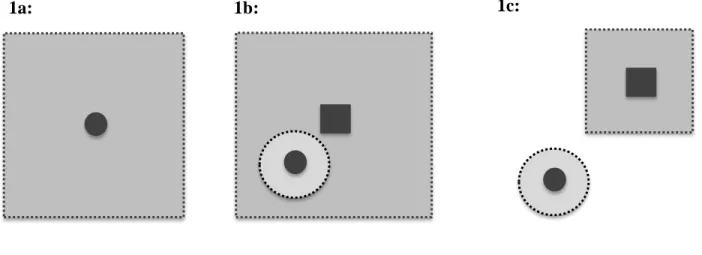
study sample may be a census of the target population. This is almost never the case, because in nearly all instances, we have done research to inform decisions about a population at least somewhat different than that under study. A second choice for the target population may be the population from which the study sample was sampled. When the sampling is random, 𝑃𝑆(W) is the same as 𝑃𝑇(W) in expectation
and sample average treatment effect equals the population average treatment effect in expectation (Figure 1a). When the study sample is not a random sample from the target population and 𝑃𝑆(W) differs from 𝑃𝑇(W), the sample average treatment
effect can be expected to differ from the population average treatment effect (Figure 1b). A third choice for the target population is some other population that does not include the study sample (Figure 1c). In both of the latter cases (study sample not a random sample of the target; external population), additional information is needed to estimate the effect of interest in the target population, namely the distribution of
𝑃𝑇(W).
A distinction between generalizing results to a target population that includes as members those persons included in the study sample (Figures 1a and 1b) and transporting results to a target population that is non-overlapping with the study sample (Figure 1c) has been made previously, but not discussed in depth.20 In
the former case, a physical probability of sampling can be envisioned;21 in the latter,
the probability of sampling is not physical.21,22 This should not alarm us;
transporting results to a target population that is non-overlapping with the study sample is simply direct standardization. Graphical criteria can assist in determining whether an estimate of effect is directly transportable and if not, can help identify
the appropriate “transport formula” for estimating an effect for the target
population.23,24 Despite these distinctions between target populations are
overlapping or non-overlapping with the study sample, the same set of generalizability assumptions described above holds in both scenarios.
Example
To demonstrate how the sample average treatment differs from the
population average treatment effect when the study sample is not a random sample of the target population, consider the following example. Imagine the target
population comprises 𝑁 = 50,000 individuals, in whom the prevalence of two
dichotomous causes of the outcome, 𝑊1 and 𝑊2, is 0.15 and 0.20, respectively. In the study sample (𝑛=1,000), as in many trials, participants at greater risk of the
outcome (𝑊1 = 1 or 𝑊2 = 1) were oversampled, with 𝑃(𝑊1) = 0.5 and 𝑃(𝑊2) = 0.5. In both the study sample and in in the target population, the exposure, 𝐴, is
randomly assigned with probability 0.5. The 1-year risk for the outcome is defined
by the function: 𝑃(𝑌 = 1) = 0.1073 − 0.05𝐴 + 0.20𝑊1+ 0.20𝑊2− 0.15𝐴𝑊1𝑊2. The
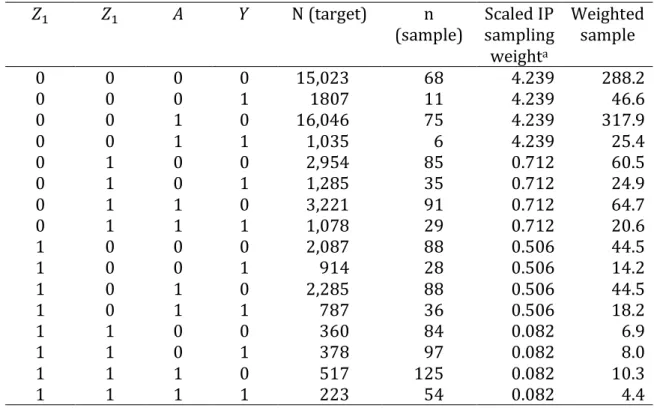
data from one realization of a target population and study sample generated under these conditions appears in Table 1.
Given this realization of the data, the estimate of the risk difference due to 𝐴
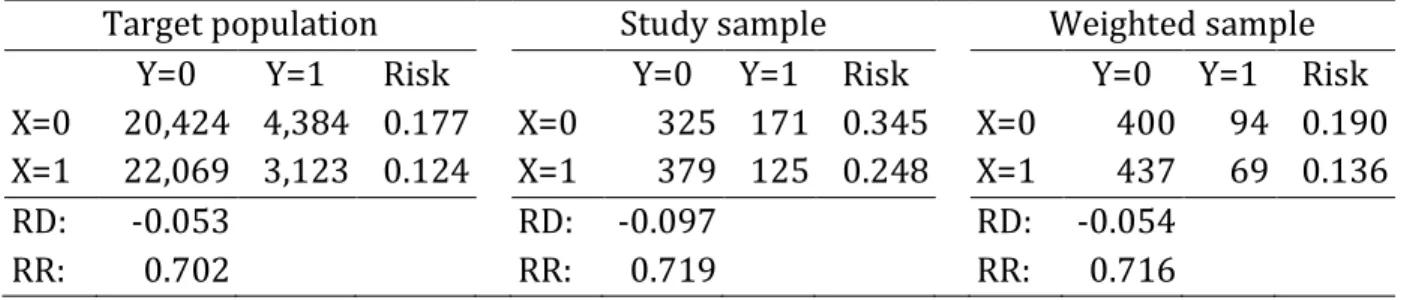
in the target population is -5.3%. The estimate of the risk difference due to 𝐴 in the study sample is -9.7%.
The g-formula or inverse probability (IP) of sampling weights can be used to use the study sample data to estimate the population average treatment effect. The g-formula (equivalent to Bareinboim & Pearl’s “transport formula”)23 and equation
(1) above is:
𝑃[𝑌(𝑎)] = ∑ 𝑃[𝑌(𝑎)|𝑊 = 𝑤]𝑃𝑇(𝑊 = 𝑤)
Which, if we assume consistency and conditional exchangeability given 𝑊, can be estimated by:
𝑃[𝑌 = 1|𝐴 = 𝑎] = ∑ 𝑃[𝑌 = 1|𝐴 = 𝑎, 𝑊 = 𝑤]𝑃𝑇(𝑊 = 𝑤)
𝑊
where the quantity 𝑃[𝑌 = 1|𝐴 = 𝑎, 𝑊 = 𝑤] is estimated in the study sample and
𝑃𝑇(𝑊 = 𝑤) is the probability that 𝑊 = 𝑤 in the target population. The estimate of effect in the target population using the non-parametric g-formula was -5.4%.
Scaled IP of sampling weights were defined:
𝑃(𝑆 = 1)
𝑃(𝑆 = 1|𝑊1 = 𝑤1, 𝑊2= 𝑤2)
If the set of covariates, 𝑊, that should be included in calculating IP of sampling weights is high dimensional, the denominator of the weights can be modeled parametrically. In this example, we used a fully saturated model for the
denominator of the weights. The IP of sampling weighted estimate of effect in the target population based on data from the study sample was -5.4%.
Note that the results from the IP of sampling approach and the g-formula/transport formula will be equivalent when both are estimated non-parametrically. In practice, if the dimension of 𝑊 is large and 𝑃(𝑆 = 1) or 𝑃(𝑌 = 1|𝐴 = 𝑎, 𝑊 = 𝑤) is modeled, the two approaches may give different results due to different modelling assumptions or model misspecification. Doubly robust
estimation of the population average treatment effect is also possible.25
The only way to ensure an estimate is directly generalizable (in expectation) to a particular target population would be draw the study sample as a random
sample from that target population as described above.12 However, beyond the
logistical, financial, and ethical challenges to conducting such a study, in certain circumstances, a study sample that is representative of the target population may be undesirable.18,26,27 When first exploring the existence of a causal effect, non-random
sample selection may be purposefully undertaken. For example, an investigator might enroll a sample for a trial that has a higher than average risk of disease to increase statistical efficiency, or restrict enrollment into an observational study to control for an important confounder. Oversampling to avoid sparse numbers of patients within subgroups improves precision during confounder control and also allows estimation of subgroup effects,18,26 although trials are rarely powered to
estimate such subgroup effects.
Epidemiologists are typically primarily concerned with the internal validity of effect estimates. However, the value of an effect estimate for planning purposes
and decision making will depend on the degree of departure from both internal and
external validity. External validity will be threatened to the degree that 1) the prevalence of other causes of the outcome (also versions of treatment, patterns of interference) differs in the study sample and the target population, and 2) the exposure or intervention causal contrast is modified by those other causes of the outcome that differ in the study sample and the target population.2 For example,
Greenhouse et al., describe a trial of antidepressants in adolescents that pointed to an increased risk of suicide, but which excluded participants with the most severe
depression who would have experienced the greatest benefits from the therapy.15 In
this case, while the trial effects were internally valid, the lack of external validity had serious implications for policy and removed potentially beneficial treatment options from depressed adolescent patients. A second example is, the discrepancies between the conclusions about the effects of combined estrogen/progestin menopausal hormone replacement therapy (HRT) on coronary heart disease based on the
Women’s Health Initiative trial and the Nurses’ Health Study can be recast as a
generalizability problem if we consider that the age- and time-on-exposure stratum specific effects of HRT estimated in both studies were similar,28 but the distribution
of women by age and time-on-exposure in the target population (young women with no prior exposure) did not match the distribution of women in the study sample
from the Nurses’ Health Study (older women with lots of prior exposure). In this
instance, while internal validity (confounding by some unmeasured factor) was initially blamed for the discrepancy, and while generalizability is typically only thought of as an issue for clinical trials, the generalizability of this observational study undermined policy recommendations based on its results. Such examples highlight the importance of balancing study design decisions to maximize both internal and external validity.
If our study sample is not a random sample of the target population, we can estimate causal effects in a specified target population using direct standardization or inverse probability weighting (a semiparametric extension of direct
standardization)29 if all predictors of both selection into the study sample and the
methodological solution would allow us to use a single study sample to calculate generalized estimates of effect for multiple different specified target
populations2,12,13 as long as the distribution of W was available for the target
population.15,30
Discussion
Commentaries on the lack of generalizability of randomized trials typically implore the reader to evaluate a lengthy check list of potential determinants of external validity,16,17,31 or further classify the list into categories to distinguish
“external validity”from “applicability.”32 We argue that such exercises could be
more efficient if considered quantitatively, within the potential outcomes framework. This approach would quickly narrow the scope of future research needed to ascertain the effect estimate of interest because specific threats to the external validity of the estimate could be identified and used to guide future study design. Furthermore, understanding the mechanism by which differences between the sample and the target population influence the generalizability of a sample estimate would help identify the most appropriate methods to account for those differences. Understanding differences in the distribution of risk factors for the outcome has implications for the selection of the study sample for future research.
Arguments about the generalizability of study results are not well-formed until the relevant characteristics of the target population are explicitly stated (i.e., patient characteristics are designated or interference patterns are specified or the types of therapy defined). This is analogous to the estimation of controlled direct
effects; such direct effects are not well-defined until the researcher specifies that the estimator is the direct effect not through M, where M is some possible mediator.33
Finally, distinguishing internal and external threats to validity is useful for determining which parameters in the study sample or target population are
estimable. When collider stratification bias due to selection is present in a study, it may threaten causal inference being made for any population,34 even the study
sample, and preclude attempts to generalize results to either the source population or any specified target population (associational estimate is biased for the causal effect in the study sample; generalizability is irrelevant). In contrast, if a study can be determined to be free of selection bias (and confounding) (associational estimate is an unbiased estimate of the causal effect in the study sample) and differences in average treatment effects attributed to nonrandom sampling of the study
population, methods exist to generalize results to a the target population
(contingent on all assumptions outlined above).2,35 Standardizing effect estimates to
the appropriate target population will improve their utility to clinicians and public health practitioners, and better inform implementation of interventions in target populations.
Funding
Dr. Westreich was supported in part by NIH grant DP2 HD084070. Dr. Cole and Dr. Lesko were supported in part by NIH grant R01 AI100654. Dr. Cole, Dr. Westreich
and Dr. Hudgens were supported in part by NIH grant P30 AI50410.Dr. Buchanan
content is solely the responsibility of the authors and does not necessarily represent the official views of the National Institutes of Health.
References
1. Hernan MA, Robins JM. Estimating causal effects from epidemiological data.
Journal of epidemiology and community health. Jul 2006;60(7):578-586.
2. Cole SR, Stuart EA. Generalizing evidence from randomized clinical trials to target populations: The ACTG 320 trial. Am J Epidemiol. Jul 1 2010;172(1):107-115.
3. Holland PW. Statistics and Causal Inference. Journal of the American Statistical
Association. Dec 1986;81(396):945-960.
4. Edwards JK, Cole SR, Westreich D. All your data are always missing: incorporating bias due to measurement error into the potential outcomes framework. Int J Epidemiol. Apr 28 2015.
5. Cole SR, Frangakis CE. The consistency statement in causal inference: a definition or an assumption? Epidemiology. Jan 2009;20(1):3-5.
6. Pearl J. On the consistency rule in causal inference: axiom, definition, assumption, or theorem? Epidemiology. Nov 2010;21(6):872-875.
7. VanderWeele TJ. Concerning the consistency assumption in causal inference.
Epidemiology. Nov 2009;20(6):880-883.
8. Hernan MA, Taubman SL. Does obesity shorten life? The importance of well-defined interventions to answer causal questions. International journal of obesity. Aug 2008;32 Suppl 3:S8-14.
9. Hudgens MG, Halloran ME. Toward Causal Inference With Interference. J Am
Stat Assoc. Jun 2008;103(482):832-842.
10. Tchetgen EJ, VanderWeele TJ. On causal inference in the presence of interference. Stat Methods Med Res. Feb 2012;21(1):55-75.
11. Hernan MA, VanderWeele TJ. Compound treatments and transportability of causal inference. Epidemiology. May 2011;22(3):368-377.
12. Stuart EA, Cole SR, Bradshaw CP, Leaf P. The use of propensity scores to assess
the generalizability of results from randomized trials. Johns Hopkins Department
of Biostatistics, Working Papers;2010.
13. Tipton E. Improving Generalizations From Experiments Using Propensity Score Subclassification: Assumptions, Properties, and Contexts. Journal of Educational
and Behavioral Statistics. 2013;38(3):239-266.
14. Gandhi M, Ameli N, Bacchetti P, et al. Eligibility criteria for HIV clinical trials and generalizability of results: the gap between published reports and study protocols. AIDS. Nov 4 2005;19(16):1885-1896.
15. Greenhouse JB, Kaizar EE, Kelleher K, Seltman H, Gardner W. Generalizing from clinical trial data: a case study. The risk of suicidality among pediatric antidepressant users. Stat Med. May 20 2008;27(11):1801-1813.
16. Rothwell PM. External validity of randomised controlled trials: "to whom do the results of this trial apply?". Lancet. Jan 1-7 2005;365(9453):82-93.
17. Rothwell PM. Commentary: External validity of results of randomized trials: disentangling a complex concept. Int J Epidemiol. Feb 2010;39(1):94-96.
18. Rothman KJ, Gallacher JE, Hatch EE. Why representativeness should be avoided.
19. Maldonado G, Greenland S. Estimating causal effects. International journal of
epidemiology. 2002;31(2):422-429.
20. Hoggatt KJ, Greenland S. Commentary: extending organizational schema for causal effects. Epidemiology. Jan 2014;25(1):98-102.
21. Good IJ. Kinds of Probability: Although there are at least five kinds of probability, we can get along with just one kind. Science. Feb 20 1959;129(3347):443-447.
22. Lindley DV. Understanding uncertainty. Revised edition. ed. Hoboken, New Jersey: John Wiley & Sons, Inc.; 2014.
23. Bareinboim E, Pearl J. A general algorithm for deciding transportability of experimental results. J Causal Inference. 2013;1(1):107-134.
24. Petersen ML. Compound treatments, transportability, and the structural causal model: the power and simplicity of causal graphs. Epidemiology. May
2011;22(3):378-381.
25. Rudolph KE, Diaz I, Rosenblum M, Stuart EA. Estimating population treatment effects from a survey sub-sample. American Journal of Epidemiology. 2014. 26. Rothman K, Hatch E, Gallacher J. Representativeness is not helpful in studying
heterogeneity of effects across subgroups. Int J Epidemiol. Apr 2014;43(2):633-634.
27. Rothman KJ, Gallacher JE, Hatch EE. Rebuttal: When it comes to scientific inference, sometimes a cigar is just a cigar. Int J Epidemiol. Aug
2013;42(4):1026-1028.
28. Hernan MA, Alonso A, Logan R, et al. Observational studies analyzed like randomized experiments: an application to postmenopausal hormone therapy and coronary heart disease. Epidemiology. Nov 2008;19(6):766-779.
29. Sato T, Matsuyama Y. Marginal structural models as a tool for standardization.
Epidemiology. Nov 2003;14(6):680-686.
30. Weisberg HI, Hayden VC, Pontes VP. Selection criteria and generalizability within the counterfactual framework: explaining the paradox of antidepressant-induced suicidality? Clinical trials. Apr 2009;6(2):109-118.
31. Szklo M. Population-based cohort studies. Epidemiologic reviews. 1998;20(1):81-90.
32. Dekkers OM, von Elm E, Algra A, Romijn JA, Vandenbroucke JP. How to assess the external validity of therapeutic trials: a conceptual approach. Int J Epidemiol. Feb 2010;39(1):89-94.
33. Cole SR, Hernan MA. Fallibility in estimating direct effects. Int J Epidemiol. Feb 2002;31(1):163-165.
34. Hernan MA, Hernandez-Diaz S, Robins JM. A structural approach to selection bias. Epidemiology. Sep 2004;15(5):615-625.
35. Stuart EA, Cole SR, Bradshaw CP, Leaf PJ. The use of propensity scores to assess the generalizability of results from randomized trials. Journal of the Royal
Table 1. Data from a hypothetical target population (𝑁=50,000) and nonrandom study sample (𝑛=1,000)
𝑍1 𝑍1 𝐴 𝑌 N (target) n
(sample) Scaled IP sampling weighta Weighted sample 0 0 0 0 15,023 68 4.239 288.2 0 0 0 1 1807 11 4.239 46.6 0 0 1 0 16,046 75 4.239 317.9 0 0 1 1 1,035 6 4.239 25.4 0 1 0 0 2,954 85 0.712 60.5 0 1 0 1 1,285 35 0.712 24.9 0 1 1 0 3,221 91 0.712 64.7 0 1 1 1 1,078 29 0.712 20.6 1 0 0 0 2,087 88 0.506 44.5 1 0 0 1 914 28 0.506 14.2 1 0 1 0 2,285 88 0.506 44.5 1 0 1 1 787 36 0.506 18.2 1 1 0 0 360 84 0.082 6.9 1 1 0 1 378 97 0.082 8.0 1 1 1 0 517 125 0.082 10.3 1 1 1 1 223 54 0.082 4.4
Table 2. Summary data from a hypothetical target population (𝑁=50,000) and crude
and inverse probability of sampling weighted nonrandom study sample (𝑛=1,000)
Target population Study sample Weighted sample
Y=0 Y=1 Risk Y=0 Y=1 Risk Y=0 Y=1 Risk
X=0 20,424 4,384 0.177 X=0 325 171 0.345 X=0 400 94 0.190
X=1 22,069 3,123 0.124 X=1 379 125 0.248 X=1 437 69 0.136
RD: -0.053 RD: -0.097 RD: -0.054
Figure 1. Possible choices for the target population of interest
The target population (large, light gray square) can relate to the study sample (small, dark gray circle) in multiple ways. (a) The study sample is a random sample from the target population. (b) The study sample is not a random sample from the target population. (c) The target population is external to the study sample. The target population can be described by either a census of the target population or a random sample of the target population (small, dark gray square). In situation (b) or (c), the study sample can be thought of as a random sample from a larger super-population (larger, light gray circle) that differs from the target super-population; if the analysis does not standardize or transport results to the target population, inference is restricted to this super-population.