175
Hunting Wolves In Montana - Where Are The Data?
Jay S. Mallonee
Wolf & Wildlife Studies, Kalispell, MT 59901
Abstract: Management agencies have claimed that the recovery and public hunting of wolves is based in science. A review of their statistics demonstrated that data collection methods did not follow a scientific protocol which resulted in flawed and often incorrect data. Consequently, agencies do not know the total number of wolves in Montana, a major reference point used by wolf managers. Therefore, the quotas proposed for public wolf hunts are completely arbitrary, and management decisions in general have not been based on facts. This has produced a wolf management system that lacks scientific perspective and does not utilize what is known about the wolves’ role in sustaining healthy ecosystems. Instead, the absence of verifiable data suggests that management decisions are often based on opinion and politics rather than science.
[Jay S. Mallonee. Hunting Wolves In Montana - Where Are The Data? Nature and Science 2011; 9(9):175-182] (ISSN:1545-0740). http://www.sciencepub.net.
Keywords: Montana, wolves, hunting, management.
Introduction
Wolf packs in Montana, Idaho, and Wyoming, have been subject to wolf recovery: a complex and convoluted social-political process in which the wolves must contend with some negative public opinions as well as official management, which now includes annual wolf hunts by the public. Wolf recovery began in 1974 with the passage of the Endangered Species Act of 1973 (ESA) (U. S. Congress 1973). The U. S. Fish and Wildlife Service (USFWS) was designated as the federal agency responsible for defining which species are endangered, placing them on the Endangered Species List, and eventually recover their numbers so that federal protection is no longer necessary. In May 2009, the USFWS determined that wolf populations in Montana and Idaho had recovered enough to remove them from the list (Montana Fish, Wildlife, and Parks2009). The responsibilities of wolf management then shifted to state agencies. Wolves in Montana fell under the jurisdiction of Montana Fish, Wildlife, and Parks (FWP), and by fall 2009 both Montana and Idaho had begun an annual hunting season to augment their current management techniques. Because Wyoming had not yet submitted a comprehensive management plan to the federal government, wolves in this state remained on the Endangered Species List. This eventually led to a legal dilemma.
On August 5, 2010, U.S. District Judge Donald Molloy of Missoula, Montana, ruled that the USFWS could not delist wolves in only two of the three wolf recovery states (U. S. District Court 2010). Wolves must be listed as endangered or not endangered in all three states simultaneously. Therefore, wolves in Montana and Idaho were again placed on the
Endangered Species List, which cancelled the fall 2010 hunt in both states.
Near the end of 2010, Montana Congressman Denny Rehberg, who had been up for reelection in November, introduced legislation to amend the ESA and prohibit the classification of wolves as either endangered or threatened (U. S. Congress 2010). The ESA is considered one of the strongest pieces of environmental legislation, because species are designated as threatened or endangered based on science rather than politics (U. S. Congress 1973, Raven and Berg 2004). Rehberg’s bill contradicted this premise and catered instead to a region of the United States where a vocal minority is intolerant of wolves (Switalski et al. 2002).
Montana senators Max Baucus and Jon Tester also introduced legislation to remove wolves from ESA protection. Ultimately, Tester provided a rider to the 2011 federal budget bill that called for the delisting of wolves, and was passed by Congress in April (Federal Register 2011). Unlike past delisting rules, however, this Congressional action prevents judicial review of the new ruling, even though wolves have little to do with the nation’s budget. However, wolf management must still comply with federal guidelines to ensure that each state (Montana, Idaho, Wyoming) maintain a population level of at least 100 wolves and 10 breeding pairs, along with two other contingencies, or wolves could again be placed back on the Endangered Species List (Montana Fish, Wildlife, and Parks 2011). FWP will begin the fall 2011 public wolf hunt on September 3 with a quota of 220 wolves (Montana Fish, Wildlife, and Parks 2011a), but out of how many?
Each year a summary of the wolf recovery process is published in the USFWS Annual Reports,
176
the only source of wolf numbers and population trends in each of the three recovery states. To determine the effects public hunts have on wolf populations and how they should be managed, the accuracy of these numbers is critical. For example, Creel and Rotella (2010) found that both hunting and management produced a super-additive increase in total wolf mortality, even at low rates of harvest, and lower than the 220 wolves currently planned. This quota is based on how many total wolves are thought to inhabit Montana. After I reviewed the data, it appears this number remains unknown. Nevertheless, FWP has stated that wolf hunts are based in science (Montana Fish, Wildlife, and Parks 2010, 2011) and cited two justifications for eliminating wolves through annual public hunts: increasing levels of wolf-livestock conflicts, and
concerns about the status of some deer and elk populations where wolves and other predators exist (Montana Fish, Wildlife, and Parks 2010). The numbers provided by management agencies, however, do not support these claims.
Are the data collected by FWP based in science?
In Montana, information about wolves is collected by the 5 Wolf Management Specialists of FWP who are distributed throughout the state. These data are analyzed by a FWP biostatistician and the University of Montana Wildlife Coop to create models and predictions of how hunting affects the wolf population (Kent Laudon, Wolf Management Specialist, FWP, 20 Sep 10, personal communication). The modeling information, however, is not provided in the annual reports. Data collection is crucial because analysis can only be as good as the quality of data collected. Therefore, a scientific approach is necessary.
Data are obtained using several methods, none of which follow a scientific protocol (Kent Laudon, Wolf Management Specialist, FWP, 7 Sep 10, personal communication). Potentially, the most detailed information comes from radio collared wolves (Kent Laudon, Wolf Management Specialist, FWP, 2 Sep 10, personal communication). From the signals, biologists know an animal’s location and identification, and therefore its gender and approximate age. Data from depredations and human-caused mortality is similar, in that something tangible can be measured, i.e., a body, radio signals, and prints. Overall, however, the wolves in these categories represent the minority of the total
known population. The remainder of data have often been opportunistic, including anecdotal information from the public (Montana Fish, Wildlife, and Parks 2010a, Kent Laudon, Wolf Management Specialist, FWP, 2 Sep 10, personal communication). Using such techniques has produced information that is inaccurate
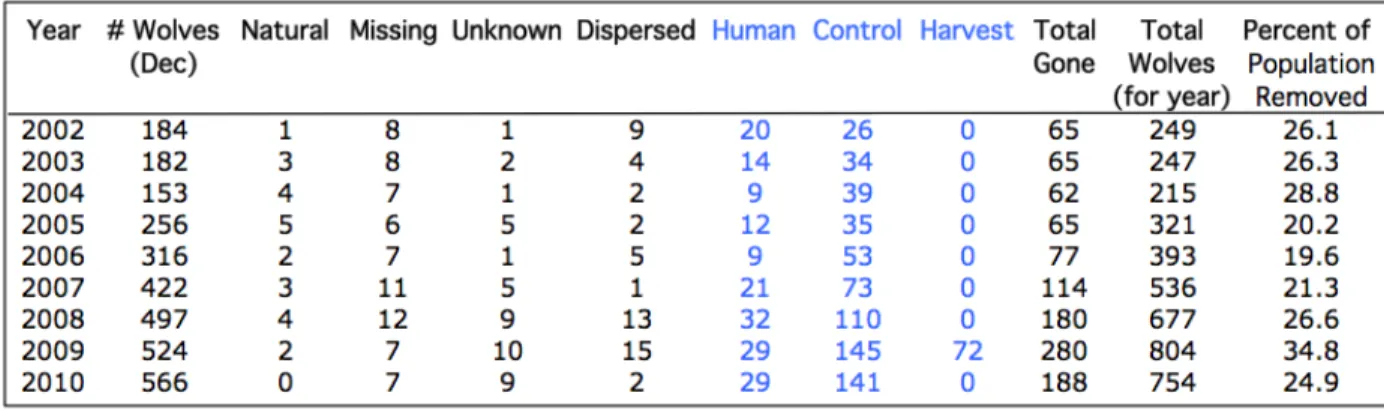
and questionable, which can be seen in the annual reports. Table 1 summarizes population numbers from 2002 through the present, along with factors that remove wolves from the population (Montana Fish, Wildlife, and Parks 1999 - 2010). As reported, human activity is the greatest cause of wolf mortality.
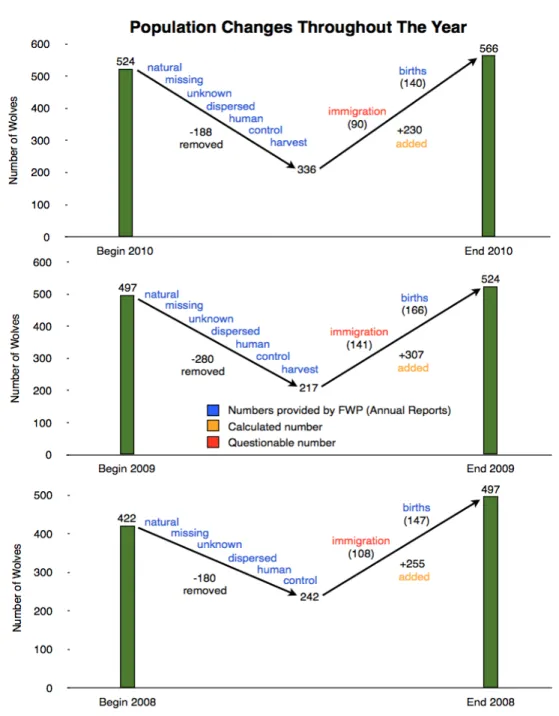
Populations are dynamic and change over time. This involves four components: births, deaths, immigration, and emigration. The overall equation is represented as: growth rate = (i - e) + (b - d) (Raven and Berg 2004). In 2009, for example, 804 wolves apparently existed in the wolf population (Table 1), but not all at once. As some were born or joined the population from other places (immigration), others died or left the population, i.e., dispersed (emigration). The wolves remaining in December are viewed as a “working” number by management agencies and represent the minimum number of wolves for that year (Kent Laudon, Wolf Management Specialist, FWP, 6 Aug 10, personal communication). Using these concepts, the government’s data provide a partial pathway that follows the changing number of wolves throughout the year (Figure 1).
In the middle graph, 497 wolves represent the minimum number at the beginning of 2009. This is the end of the year total (December) for 2008. The population changed, however, throughout the year. For various reasons (Table 1), 280 wolves were removed, which dropped the population to 217 animals. However, FWP claims that 307 wolves were added to the population to reach the December total of 524 wolves (524 - 217 = 307), through births and immigration. Although immigration data were not provided, the number of births reported was 166, so 141 wolves must have immigrated into the population from out of state or Canada (307 - 166 = 141).
Because wolves are constantly on the move (Mallonee 2008), immigration numbers are virtually impossible to collect and are missing from the annual reports. Even emigration numbers are based on only a few radio collared wolves and undoubtedly are not representative of the entire population. Regardless, wolves that have dispersed from their own packs do not necessarily immigrate to other states, but instead may join another pack within their home state (Mech and Boitani 2003). For example, the total number of dispersed wolves reported for Wyoming and Idaho in 2009 was 17 (Sime et al. 2010), and an additional 31 wolves were reported as missing. Even if added together, there would have been a potential of only 48 wolves leaving both states. It would be incorrect to assume they had all immigrated to Montana and stayed. Therefore, 141 seems like an astounding number of wolves to have joined the Montana wolf population in only one year. Where did they come from? This
177
number makes no sense because there are no verifiable data to demonstrate its validity. Given how FWP presents their data, the only way to know that 141 wolves were added to the 2009 population would be to perform the calculations represented in Figure 1. In practice, FWP apparently does not do this math, nor is there a category to report immigration data. The numbers for 2008 and 2010 show the same trend.
In reality, all four components of population growth (births, deaths, immigration, emigration) would need to be known for an accurate assessment of wolf population numbers. However, emigration is a guess and immigration is completely unknown. Together, they are half of the equation to determine the total number of wolves, either throughout the year or by December. There is no justification at all as to where the extra 141 wolves came from. This number is just
assumed in the annual report. The population numbers provided by FWP simply do not add up and the number provided for the total number of wolves is blatantly wrong. This matches well with how the majority of data are collected: opportunistic and without scientific protocol. Therefore, the hunting quotas are completely arbitrary, and to claim that wolf hunts are based in science is a falsehood. Because the total number of wolves is unknown, by default other management decisions are also flawed. FWP’s data appear to suffer from the same problems as past studies that have attempted to assess wolf populations in which pup mortality rates, dispersal, immigration, and other key factors remained virtually unknown (Fuller et al. 2003).
Livestock depredation
Depredation is the term used by biologists when predators kill domesticated livestock rather than their natural prey. In 2009, 97 cattle were lost to wolves (Sime et al. 2010). Government statistics show that 2.6 million cattle, including calves, live in Montana (U. S. Department of Agriculture 2007, 2009). Ninety-seven out of 2.6 million is only 0.004 percent. To be fair, these cattle are not evenly distributed across the landscape. Western Montana, where the wolves live, has fewer cattle than on the east side of the state. As of 2009, there were 494,100 cattle (U. S. Department of Agriculture 2009). However, only 97 of these animals were killed by wolves, or 0.02 percent of the western cattle population. Similar low percentages apply to sheep. There were approximately 33,000 sheep, including lambs, in western Montana in 2009 (U. S. Department of Agriculture2009). Wolves were documented to have killed 202 of these animals or 0.6 percent (Sime et al. 2010). In 2009, therefore, wolves were responsible for about 0.06 percent of total livestock loss. Undoubtedly there have been other depredations by wolves that could not be confirmed by
government biologists or ranchers. The number remains unknown, however (Sime et al. 2007). Even if 1,000 cattle were reported for 2009, this would only be 0.2 percent or less of the cattle in western Montana killed by wolves.
Statistically, the wolf depredation “problem” barely exists. Socially and economically, however, those who lost their cattle would likely disagree. There is nothing “statistical” about suffering a real financial loss, sometimes thousands of dollars, often accompanied by a range of emotions. However, some ranchers have prevented problems by using clean ranching practices: disposing of placentas during the birthing season or placing pregnant livestock into a smaller area where they can be observed. Although some ranchers have lost livestock to wolves, the statistics do not show how many animals they had to begin with. Losing 9 out of a 1,000 animals would be quite different from 9 out of 10 animals.
Despite the statistics, FWP insists that a hunting season is necessary to help prevent livestock losses to wolves (Sime et al. 2007). However, the vast
majority of wolf packs have not depredated on livestock (Bangs et al. 2005). When depredations have occurred, non-lethal methods have worked well to deter wolves from killing livestock, although 10 - 12 percent of the wolf population were removed annually to prevent repeated attacks (Sime et al. 2007). It appears that some wolf management is necessary, but annual hunts remain unjustified.
Threat to prey populations
The “potential” threat to prey populations, specifically elk, has been used as another reason to kill additional wolves each year (Montana Fish, Wildlife, and Parks 2010). However, no data are available to support this contention. In Montana, prey population numbers are not measured annually. So from year to year, as population numbers vary, it remains unknown how many deer, elk, and moose are really in the environment. However, some estimates are available for white-tailed deer, elk, and mule deer (Montana Fish, Wildlife, and Parks 2007, 2008, 2008a).
In northwest Montana, no relevant research has been conducted to determine the effects wolves have on wild prey populations (Kent Laudon, Wolf Management Specialist, FWP, 30 Jul 10 personal communication). Some elk populations, however, have been studied in southwest Montana and Yellowstone National Park. This research concluded that wolves at best had mixed impacts on these herds: some declined, some increased (southwestern Montana), and others showed little or no effect from wolves (Hamlin and Cunningham 2009, Sime et al. 2009). Many other factors, such as weather and predation by grizzly bears
178
and other animals, also affect total elk population numbers (Mech et al. 2001).
There is still no scientific consensus on how wolf predation influences prey population dynamics anywhere, currently or in the past (Mech and Peterson 2003). This is because of unpredictable environmental conditions, such as colder than normal winters, heat spells, disease, predation effects of other predators, and the interactions among all species in the environment which science does not yet fully understand. Therefore, without research in specific areas, such as the elk studies, the influence of wolves remains unknown.
2009 wolf hunt and the lack of science
On their website, FWP posted the summary of the 2009 wolf hunt in Montana (Montana Fish, Wildlife, and Parks 2010a). It summarizes how wolf recovery in Montana works and the lack of science involved, both in thought and practice. Key statements point this out:
There were no biological red flags in the harvest. Out of 72 wolves killed, 61 percent were subadults. Subadults are the future of wolf packs, both reproductively and socially (Mech and Boitani 2003). Killing mostly these age groups provides fewer wolves to replace those that will die or leave the pack during the year. Juveniles and yearlings are also still learning social skills and their place in the pack (Packard 2003), which may cause disruption of family units and the ability of the pack as a whole to fend for itself, i.e., hunting effectively. For example, human-caused mortality for wolves outside of Algonquin Park, Canada, was found to affect the evolution of important social patterns for wolf packs inside the protected park (Rutledge et al. 2009). This research demonstrated the need to consider the effects of hunting on social behavior as well as population numbers. Killing mostly the young of virtually any mammalian population would potentially cause the greatest influence on future population levels, ranging from slow population recovery to social and genetic effects (Raven and Berg 2004). Creel and Rotella (2010) demonstrated that human hunting of wolves caused a super-additive increase in wolf mortality, meaning additional wolves died as a result of human harvest than only those that were shot and killed directly. This contradicts the conventional belief by some management agencies, such as FWP, that wolf populations can sustain a high mortality rate of 30 percent or more, no matter the cause (Kent Laudon, Wolf Management Specialist, FWP, 20 Sep 10, personal communication).
Hunters report seeing wolves while hunting deer and elk, and it appears that they are able to detect wolves in their relative degrees of abundance on the western Montana landscape. Therefore knowledge about deer and elk hunter effort and success will provide important insight into future wolf harvest management.
Apparently FWP uses opportunistic data collection as a basis for management policy. They obtain “data” from the people who paid for the opportunity to kill wolves. Impressions about wolf abundance from hunters is not science. There are no controls in the data collection, the hunters’ ability to detect relative degrees of abundance were never tested, and hunters do not necessarily like wolves, given the fact they want to kill them. Plus, the hunters’ expertise of identifying wolf from coyote under field conditions, especially at a distance, was never evaluated. Therefore the data have great potential for bias.
Wolf hunter harvest decreased the size of individual packs by one to four wolves just ahead of the February 2010 breeding season. But even so, the level of hunter harvest combined with all other mortality in 2009 will not harm Montana’s wolf population.
To state with any certainty that hunting will not harm the wolf population would require a follow up study of any affects the killing had on wolf packs. By default, hunting wolves harms their population. That is the point of hunting them, to cut back on their numbers. The fact that FWP wanted to increase the 2010 wolf hunt to 186 wolves before it was cancelled indicates that no follow up study was planned. Even so, there are no baseline data to use as comparison on general wolf behavior and pack structure before the hunt occurred.
Total license revenue was $325,916.
Before wolf hunting seasons, wolf management officials often killed problem wolves. Yet, according to Sime et al. (2007), “Removal results in a cycle of wolf colonization, depredation, and wolf removal that repeats itself.” Thus, the killing of wolves can continue in a cyclic manner in certain places. By using a hunting season, however, FWP can adjust wolf quotas in areas where depredations may be a consistent problem for that year (Kent Laudon, Wolf Management Specialist, FWP, 17 Sep 10, personal communication) and the state receives revenue from hunting fees and permits. Now hunters can do the job instead, but without making the distinction between the “problem” wolves, of which there are few, and all the others. The state of Montana made $325,916 in a hunting season that lasted only 23 days, or about $99,000 per week. The hunting summary states that
179
“hunter harvest did not appear to accelerate or contribute to livestock conflicts.” Apparently, hunting wolves had no affect on any existing “conflicts,” according to FWP data. So why hunt them?
Summary and conclusions
Throughout their 15 month tenure of officially managing wolves, before they were placed back on the Endangered Species List, FWP posted policy information on their website and made the following statement:
FWP considers wolves as its does all other wildlife species it is charged to conserve and manage. An annual, regulated, well planned, and science-based hunt serves as one tool among many for Montana to use to conserve, manage and maintain a wild wolf population that's in balance with its habitat, other wildlife, and the people who live in Montana (Montana Fish, Wildlife, and Parks 2010).
To claim that wolf management and hunting will “maintain a wild wolf population that’s in balance with its habitat, other wildlife, and the people who live in Montana” is without merit. Wolves are not hunted for meat and consumed. Wolves are killed mostly out of fear, hatred, and a perceived competition for the other animals that we do eat (Lopez 1978, Mallonee unpublished data). Research has revealed the complex social nature of these animals, their intelligence, how they work together as a group to survive, and the pervasive influence they have on their surrounding environment (Mech and Boitani 2003, Hebblewhite et al. 2005, Mallonee 2008, Mallonee 2010, Estes et al. 2011). When pushed to their physical and psychological limits, they can also suffer emotional disorders similar to those observed in humans (Mallonee and Joslin 2004). Wolf packs are a process in which all members participate (Mech and Boitani 2003, Mallonee 2008), and these processes are linked in geographic regions to form networks (Miklosi 2007). Such a widespread social system cannot be managed, at least in the traditional sense. Hunts cause harm to wolf populations by removing a large number of individuals in a short time and disrupting regional population networks, which already help to control wolf numbers (Packard and Mech 1980, Miklosi 2007, Rutledge et al. 2009). This in turn has contributed to the trophic downgrading of ecosystems globally, as a result of predator loss and manipulation (Estes et al. 2011). Consequently, several concerns about hunting wolves and management need to be addressed by FWP:
1. The scientific method was not used during data collection which makes management decisions based on this information highly questionable.
2. There is no accountability for the repercussions of management decisions, such as killing wolves without proper scientific assessment.
3. There appears to be no quality control of the data which makes FWP seem as if they do not understand or are unaware of what their numbers say.
4. Wolves are managed without regard to their top-down influence throughout ecosystems by ignoring other areas of science, such as animal behavior, emotions, intelligence, interactions among life forms, and some basic ecological principles. Although some management may be necessary, hunting wolves remains scientifically unjustified.
5. When the state of Montana created revenue by killing its own wolves, hunting them became a self-serving process, as with the hunting of all managed wildlife. Hunting wolves can save the state money by reducing costs, creating revenue, and collecting opportunistic data from hunters. Therefore, money and convenience are some of the reasons to hunt wolves, which implies conflict of interest, especially when no scientific protocols were followed.
6. The actions of FWP bring up the moral issue of how a government agency can use flawed data to make management decisions, kill hundreds of wolves, and be allowed to do so.
Possible solutions
It appears that the basis of management problems stems from a lack of general knowledge about wolf behavior, an insufficient understanding of the scientific method, commercial interests, and using only 5 Wolf Management Specialists to collect all of the wolf information in the state. These setbacks can lead to the conclusion that wolf management is more of a social issue than a biological one, and tends to be guided by opinion and politics rather than science. Until the current management paradigm changes to include the full range of what science knows about wolves and collect data using the scientific method, accurate management decisions seem unlikely. Some possible solutions are:
1. Most wolf packs do not depredate on livestock, nor is there any evidence that prey populations are decimated by wolves. Instead of hunting all wolves statewide, manage the known problems locally, such as
180
the occasional depredation or concerns for specific prey herds.
2. To correct how science is used in wolf management would require a new view of wolves, one based in reality. These animals are constantly on the move and live in forests, which makes data collection problematic. Unless the wolves are radio collared, of which there are few, the only way to document their presence is by prints, scat, and vocalizations. This ground-based fieldwork is not practical for only 5 people. Nevertheless, these are accurate techniques to assess the total number of wolves in each pack and eventually the state. Therefore, additional specialists would need to be hired, all of whom are trained in science, research (data collection methods), and wolf behavior. Even top officials should be familiar with these concepts. To reduce costs, each of these specialists could use temporary assistants, such as volunteers or students, and by far more than is currently being done. Collectively, a statewide network of trained people could provide accurate information about Montana’s wolf population.
For 14 years I taught wolf survey classes for several major universities, and we collected data for the USFWS and the U. S. Forest Service. One person or class can collect a huge amount of information in a short time, at least in one area. However, obtaining quality data about wolves is tedious and time consuming. There is no way to avoid this reality. Nevertheless, it can be done properly if the scientific method is applied, which provides strict protocols to guide how data is collected. Perhaps a statewide survey program could be implemented in which people pay for the opportunity to collect wolf data with the experts, rather than a hunting season that may not be a necessary management practice.
Acknowledgments
Thank you to Calvin Hill for assisting in the data analysis, and to Dr. Karen Ebeling, Lori Perkins, Scott Sayler, and Calvin Hill for commenting on earlier drafts of this paper.
181
Figure 1: Changes in the Montana wolf population throughout the year.
References
1. Bangs, E. E., Fontaine, J. A., Jimenez, M. D., Meier, T. J., Bradley, E. H., Niemeyer, C. C., Smith, D. W., Mack, C. M., Asher, V., and Oakleaf, J. K. 2005. Managing wolf-human conflict in the northwestern United States. In People and wildlife: conflict or coexistence?, eds. R. Woodroffe, S. Thirgood, and A. Rabinwitz, pp. 340-356. Cambridge, UK: Cambridge University Press.
2. Creel, S., and Rotella, J. J. 2010. Meta-analysis of
relationships between human offtake, total mortality and
population dynamics of gray wolves (Canis lupus). PLoS ONE
5(9): e12918. doi:10.1371/journal.pone.0012918.
<http://www.plosone.org/article/info%3Adoi%2F10.1371%2Fj ournal.pone.0012918>
3. Estes, A. E., Terborgh, T., Brashares, J. S., Power, M. E., Berger, J., Bond, W. J., Carpenter, S. R., Essington, T. E., Holt, R. D., Jackson, J. B., Marquis, R. J., Oksanen, L., Oksanen, T., Paine, R. T., Pikitch, E. K., Ripple, W. J., Sandin, S. A., Scheffer, M., Schoener, T. W., Shurin, J. B., Sinclair, A. R., Soulé, M E., Virtanen, R., and Wardle, D. A. 2011. Trophic downgrading of planet earth. Science. 333:301-306.
4. Federal Register. 2011. 50 CFR Part 17.
<http://www.fws.gov/idaho/graywolves/Delisting050411/Wolf Delist050511FINALRULE.pdf>
182 5. Fuller, T. K., Mech, L. D., and Cochrane, J. F. 2003. Wolf
population dynamics. In Wolves: behavior, ecology, and conservation, eds. L. D. Mech and L. D. Boitani, pp. 161-191. Chicago, IL: University of Chicago Press.
6. Hamlin, K. L., and Cunningham, J. A. 2009. Monitoring and
assessment of wolf-ungulate interactions and population trends within the Greater Yellowstone Area, southwestern Montana, and Montana statewide: final report. Montana Department of Fish, Wildlife, and Parks, Wildlife Division, Helena, Montana, USA. <http://fwpiis.mt.gov/content/getItem.aspx?id=36743> 7. Hebblewhite, M., White, C., Nietvelt, C., Mckenzie, J., Hurd,
T., Fryxell, J., Bayley, S., and Paquet, P. C. 2005. Human activity mediates a trophic cascade caused by wolves. Ecology. 86: 1320–1330.
8. Lopez, B. 1978. Of wolves and men. Touchstone: Simon and
Schuster.
9. Mallonee, J. S., and Joslin, P. 2004. Traumatic stress disorder
observed in an adult wild captive wolf (Canis lupus). Journal
of Applied Animal Welfare Science. 7:107-126.
<http://www.animalsandsociety.org/assets/library/187_s153276 04jaws07023.pdf>
10. Mallonee, J. S. 2008. Movements of radio collared wolves and
their significance on pack assembly. The Journal of American
Science. 4(1):53-58
<http:www.americanscience.org/journals/am-sci/0401/07_0339_Mallonee_movement_am0401.pdf>
11. Mallonee, J. S. 2010. The truth about wolves. Flathead Living
Magazine. Summer:108-111.
12. Mech, L. D., Smith, D. E., Murphy, K. M., and MacNulty, D.
R. 2001. Winter severity and wolf predation on a formerly wolf-free elk herd. Journal of Wildlife Management. 65(4):998-1003.
13. Mech, L. D., and Boitani, L. D. 2003. Wolf social ecology. In
Wolves: behavior, ecology, and conservation, eds. L. D. Mech and L. D. Boitani, pp. 1-34. Chicago, IL: University of Chicago Press.
14. Mech, L. D., and Peterson, R. O. 2003. Wolf-prey relations. In Wolves: behavior, ecology, and conservation, eds. L. D. Mech and L. D. Boitani, pp. 131-160. Chicago, IL: University of Chicago Press.
15. Miklosi, A. 2007. Dog behaviour, evolution, and cognition. Oxford University Press.
16. Montana Fish, Wildlife, and Parks. 1999 - 2010. Wolf
recovery status: annual reports.
<http://www.fws.gov/mountain%2Dprairie/species/mammals/w olf/>
17. Montana Fish, Wildlife, and Parks. 2007. 2007 Montana
white-tailed deer distribution and population estimate. <http://fwpiis.mt.gov/content/getItem.aspx?id=29793>
18. Montana Fish, Wildlife, and Parks. 2008. 2008 elk objectives
and status.
<http://fwpiis.mt.gov/content/getItem.aspx?id=36361> 19. Montana Fish, Wildlife, and Parks. 2008a. 2008 mule deer
status. <http://fwpiis.mt.gov/content/getItem.aspx?id=36461>
20. Montana Fish, Wildlife, and Parks. 2009. Montana gray wolf
program.
<http://fwpiis.mt.gov/content/getItem.aspx?id=42353> 21. Montana Fish, Wildlife, and Parks. 2010. FWP fact sheet,
questions and answers: Montana’s regulated wolf hunt. <http://fwpiis.mt.gov/content/getItem.aspx?id=39994>
22. Montana Fish, Wildlife, and Parks. 2010a. The 2009 Montana
wolf hunting season summary. <
<http://fwpiis.mt.gov//content/getItem.aspx?id=41454>
23. Montana Fish, Wildlife, and Parks. 2011. Fact sheet:
Congress delists Montana wolf population.
<http://fwpiis.mt.gov//content/getItem.aspx?id=50145>
24. Montana Fish, Wildlife, and Parks. 2011a. FWP Commission
approves wolf hunt season and quotas.
<http://fwp.mt.gov/news/newsReleases/hunting/nr_1470.html>
25. Packard, J. M. 2003. Wolf behavior: reproductive, social, and
intelligent. In Wolves: behavior, ecology, and conservation, eds. L. D. Mech and L. D. Boitani, pp. 35-65. Chicago, IL: University of Chicago Press.
26. Packard, J. M. and Mech, L. D. 1980. Population regulation in
wolves. In Biosocial mechanisms of population regulation, eds. M. N. Cohen, R. S. Malpass, and H. G. Klein, pp. 135-150. New Haven, CT: Yale University Press.
27. Raven, P. H., and Berg, L. R. 2004. Environment. John Wiley
and Sons, Inc.
28. Rutledge, L. Y., Patterson, B. R., Mills, K. J., Loveless, K. M.,
Murray, D. L., and White, B. N. 2009. Protection from harvesting restores the natural social structure of eastern wolf
packs. Biological Conservation.
doi:10.1016/j.biocon.2009.10.017.
<http://www.sciencedirect.com/science/article/pii/S000632070 9004583>
29. Sime, C. A., Bangs, E., Bradley, E., Steuber, J. E., Glazier, K.,
Hoover, P. J., Asher, V., Laudon, K., Ross, M., and Trapp, J. 2007. Gray wolves and livestock in Montana: a recent history of damage management. In the Proceedings of the 12th Wildlife Damage Management Conference. pp. 16-35. 30. Sime, C. A., Asher, V., Bradley, L., Laudon, K., Lance, N.,
Ross, M., and Steuber, J. 2009. Montana gray wolf
conservation and management 2008 annual report.
Montana Fish, Wildlife & Parks, Helena, Montana, USA.
<http://www.fws.gov/mountain-prairie/species/mammals/wolf/annualrpt08/index.html> 31. Sime, C. A., Asher, V., Bradley, L., Laudon, K., Lance, N.,
Ross, M., and Steuber, J. 2010. Montana gray wolf
conservation and management 2009 annual report.
Montana Fish, Wildlife & Parks, Helena, Montana, USA.
<http://www.fws.gov/mountain-prairie/species/mammals/wolf/annualrpt09/index.html> 32. Switalski, T. A., Simmons, T., Duncan, S. L., Chavez, A. S.,
and Schmidt, R. H. 2002. Current public attitudes toward wolves in Utah. Natural Resources and Environmental Issues. 10(1):1-3.
33. U. S. Congress. 1973. Endangered Species Act of 1973,
Public Law 93-205, 87 Stat. 884, 16 U.S.C. 1531-1544. <http://www.epa.gov/lawsregs/laws/esa.html>
34. U. S. Congress. 2010. H. R. 6028, 111th Congress, 2D
Session.
<http://www.gpo.gov/fdsys/pkg/BILLS-111hr6028ih/pdf/BILLS-111hr6028ih.pdf>
35. U. S. Department of Agriculture. 2007. 2007 Census of
Agriculture: state profile - Montana.
<http://www.agcensus.usda.gov/Publications/2007/Online_Hig hlights/County_Profiles/Montana/cp99030.pdf>
36. U. S. Department of Agriculture. 2009. National Agricultural
Statistics Service - Montana cattle and sheep losses to predators. <http://quickstats.nass.usda.gov/>
37. U. S. District Court. 2010. Defenders of Wildlife, et al. v. Salazar, et al., 729 F. Supp. 2d 1207 (D. Mont. 2010). <http://fishandgame.idaho.gov/public/docs/wolves/ruling1.pdf>