Eamon J. Publication date 2012-01
Original citation FOLEY, A. M., LEAHY, P. G., MARVUGLIA, A. & MCKEOGH, E. J. 2012. Current methods and advances in forecasting of wind power generation. Renewable Energy, 37 (1), 1-8.
doi:10.1016/j.renene.2011.05.033 Type of publication Article (peer-reviewed)
Link to publisher's
version http://www.sciencedirect.com/science/article/pii/S0960148111002850http://dx.doi.org/10.1016/j.renene.2011.05.033 Access to the full text of the published version may require a
subscription.
Rights Copyright © 2011 Elsevier Ltd. Published by Elsevier Ltd. All rights reserved. NOTICE: this is the author’s version of a work that was accepted for publication in Renewable Energy. Changes resulting from the publishing process, such as peer review, editing,
corrections, structural formatting, and other quality control mechanisms may not be reflected in this document. Changes may have been made to this work since it was submitted for publication. A definitive version was subsequently published in Renewable Energy [Volume 37, Issue 1, January 2012, Pages 1–8]
http://dx.doi.org/10.1016/j.renene.2011.05.033 Item downloaded
from http://hdl.handle.net/10468/1735
Current Methods and Advances in Forecasting of Wind Power Generation
1
Aoife M. Foleya,b,*, Paul G. Leahya,b, Antonino Marvugliac and Eamon J. McKeogha,b
2
3
a Dept. of Civil & Environmental Engineering, School of Engineering, University College Cork, College
4
Rd., Cork, Ireland
5
b Environmental Research Institute, University College Cork, Lee Rd. Cork, Ireland
6
c Cork Constraint Computation Centre (4C), University College Cork, Western Gateway Building, Cork,
7
Ireland
8
9
*Corresponding author. Tel.: +353 87 2874092; fax: +353 21 427 6648
10
E-mail address: [email protected]
11
Abstract
12
Onshore wind power has seen considerable growth in all grid systems due to government-imposed
13
renewable energy targets, motivated by climate change and security of supply concerns. In the coming
14
decade offshore wind power is also expected to expand rapidly. Wind generation of electricity differs
15
from conventional thermal generation because it is more variable and intermittent due to the stochastic
16
nature of wind, and the power output is therefore not fully predictable over all time scales. Integration of
17
wind generation into existing grids requires additional power system and electricity market planning,
18
operation and management for system balancing. Low levels of wind power generally have little effect on
19
power systems. However, as penetrations increase studies indicate additional system balancing is required
20
with an associated extra cost. Wind power forecasting and prediction methods are used by system
21
operators to reduce these additional integration costs and by wind farm owners to maximize profit. This
22
paper presents an in-depth review of the current methods and advances in wind power forecasting and
23
prediction. Numerical wind prediction from global to local scales, ensemble forecasting and upscaling
24
and downscaling processes are discussed. Statistical and machine learning approach methods are detailed.
25
Techniques for benchmarking and uncertainty analysis of forecasts are overviewed, and the performance
26
of various approaches over different forecast time horizons is examined. Finally, current research
27
activities, challenges and potential future developments are appraised.
28
29
Keywords: Meteorology, Numerical weather prediction, Probabilistic forecasting, Wind integration
30
Wind power forecasting
31
1
1.0 Introduction
2
Over the last decade there has been rapid growth in wind generation of electricity, with the installed wind
3
power capacity worldwide has increased almost fourfold from circa 24.3 GW to an expected 203.5 GW
4
this year [1]. In power systems, balance is maintained by continuously adjusting generation capacity and
5
by controlling demand. As wind is inherently variable, wind power is a fluctuating source of electrical
6
energy. Short-term forecasts (ranging from 1 hour up to 72 hours) are useful in power system planning for
7
unit commitment and dispatch, and for electricity trading in certain electricity markets where wind power
8
and storage can be traded or hedged. Medium-term forecasts and predictions (ranging from 3 days to 7
9
days) are needed to plan maintenance of the wind farms, unit commitment and maintenance outages of
10
thermal generators and to schedule grid maintenance and energy storage operations. Forecast errors
11
typically increase as the time horizon increases. However, this is always not the case, as shown in Figure
12
1 [2]. When specifying a wind power prediction model, the desired time horizon will dictate the final
13
choice, as the different models are differently suited to certain power system planning and market
14
activities which occur over different timescales.
15
16
Wind forecasting for energy generation and power systems operations mainly focuses on the immediate
17
short-term of seconds to minutes, the short-term of hours up to two days, and the medium term of 2 to 7
18
days. This is because power systems operations such as regulation, load following, balancing, unit
19
commitment and scheduling, are carried out within these timeframes. The science of wind power
20
prediction is described as the application of the theories and practices of both meteorology and
21
climatology specifically to wind power generation [3]. The prediction of short-term wind power patterns
22
is discussed in Landberg [4].
23
24
Traditional thermal generators are also intermittent but with more predictability than wind power.
25
Nevertheless, thermal plant can experience sudden unplanned outages. In power systems a traditional
26
generator is usually described as ‘dispatchable’, whereas wind generation is often referred to as
‘non-27
dispatchable’. Accurate wind power forecasting reduces the risk of uncertainty and allows for better grid
28
planning and integration of wind into power systems. However, a common conclusion is that as the levels
29
of wind power penetration increase additional system balancing is required. The cost of the balancing is
30
linked to the flexibility of the existing power system. Wind power forecasting tools are therefore
31
invaluable because they enable better dispatch, scheduling and unit commitment of thermal generators,
32
hydro plant and energy storage plant and more competitive market trading as wind power ramps up and
1
down. Overall they reduce the financial and technical risk of uncertainty of wind power production for all
2
electricity market participants.
3
4
This paper provides a detailed review of current methods and recent advances in wind power forecasting.
5
The paper contains three sections. Section 2 overviews benchmarking and uncertainty analysis, examines
6
current forecasting methods, starting with a discussion of time horizons, followed by descriptions of
7
numerical wind prediction, ensemble forecasting, upscaling and downscaling methods, and physical,
8
statistical and learning approach methods. Section 3 presents current research activities and potential
9
future advances. Finally, section 4 gives a brief summary and conclusion.
10
11
2.0 Current Forecasting & Prediction Methods
12
Forecasting models for wind power can be divided into two overall groups. The first group is based upon
13
analysisof historical time series of wind, and a second group uses forecasted values from a numerical
14
weather prediction (NWP) model as an input. However, wind power forecasting is generally described in
15
terms of physical methods, traditional statistical or ‘black box’ methods and more recently the so-called
16
learning approaches, artificial intelligence or ‘grey box’ methods. Hybrid methods can involve some
17
aspect of all of these.
18
19
The models in the first group use the statistical approach to forecast mean hourly wind speed or to
20
directly forecast electric power production. The models in the second group use explanatory variables
21
(mainly hourly mean wind speed and direction) derived from a meteorological model of the wind
22
dynamics to predict wind power N-steps ahead. The models of the first group provide good results, in the
23
majority of cases, in the estimation of mean monthly or even higher temporal scale (quarterly, annual)
24
wind speed. However, in the short-term horizon, (mean daily or hourly wind speed forecasts), the
25
influence of atmospheric dynamics becomes more important, so that the use of the models of the second
26
group becomes essential [5].
27
28
There are three steps in wind power forecasting: firstly determining wind speed from a model; then
29
calculating the wind power output forecast or prediction; and finally regional forecasting or upscaling or
30
downscaling, which may be applied over different time horizons. Very short term forecasting models are
31
usually statistically-based. For statistical and the learning approach methods a large amount of historical
1
time series data is essential. The persistence method, also known as the naïve predictor, can be used to
2
benchmark other methods. Persistence usually performs better than NWP methods for short-term
3
prediction horizons of up to about 3 to 6 hours at a local level, whereas the climatologic mean is better for
4
prediction horizons longer than 15 hours [6]. Table 1 presents a non-exhaustive list of wind power
5
software models developed internationally.
6
7
2.1 Numerical Weather Prediction & Wind Forecasting
8
In developing a NWP-based wind power prediction model the selection of the particular NWP model is a
9
critical step. Important selection criteria include the geographical area, the resolution (both spatial and
10
temporal) and the forecast horizon, as well as the accuracy required and the computational time and
11
number of runs. NWP models usually have three main components, the dynamic centre, which represents
12
the adiabatic non-viscous flow, the physical equations describing variability of the meteorological
13
processes (e.g. turbulence and radiation) and the information gathering software code. Therefore the
14
output of a NWP model is a detailed forecast of the state of the atmosphere at a given time, not just the
15
wind. NWP forecasts are not specifically produced for the electricity industry and are used by a variety of
16
industries, sectors and government agencies. NWP is sensitive to initial conditions and to overcome this
17
ensemble forecasting is used [7]. Nielsen et al [8] demonstrated that if several NWP forecasts are used the
18
forecast error decreases. Louka et al [9] showed that the Kalman filter can remove systematic forecast
19
errors in NWP wind speed forecasts.
20
21
Ocean models are not included in most NWP as sea surface water temperatures are described by
22
climatology. Specific NWP models have been developed to identify storms in the Pacific and Atlantic,
23
which tend to be ensemble NWP models (e.g. Typhoon Ensemble Model by the Japan Meteorological
24
Agency). Most meteorological services provide only on-shore and near-shore weather predictions to meet
25
their client needs. Hence, the focus to date of global NWP models has been to provide more accurate
26
weather forecasts on land. As global NWP models need boundary conditions to solve their equations,
27
mostly land surface properties including temperature are used. NWP holds best for time horizons greater
28
than 4 hours. Most models are multi-step and provide look-ahead times for numerous horizons but the
29
bulk of these tools only produce a single expected value for each forecast timescale and are referred to as
30
deterministic, spot or point forecasts. Hence their use for stochastic optimization and risk assessment is
31
limited [10].
1
2
At a regional and mesoscale level another family of NWP models was developed to focus on particularly
3
local weather phenomena. Examples include the hydrostatic ETA model, the HIRLAM model and the
4
ALADIN model [11, 12 and 13]. Further examples include the freely downloadable MM5 regional model
5
developed at the Pennsylvania State University and used by the National Centre of Atmospheric Research
6
in the United States of America (USA) and the more recent Weather Research and Forecast (WRF)
7
regional model [14 and 15]. Some NWP models are used at a regional level to predict wind power in a
8
country or in a region of a country. Predicting the wind power output from each individual wind farm can
9
be time consuming so instead an approach called ‘upscaling’ is used. In upscaling the wind power output
10
from a sample number of wind farms forms the basis of reference data. Upscaling can have the apparent
11
effect of reducing forecast error because it becomes averaged over the whole region [16]. The process of
12
downscaling involves the production of more detailed spatial information from coarse NWP outputs using
13
physical and/or statistical models [17]. Physical downscaling models are similar to NWP but run at higher
14
resolution over a smaller area. Statistical downscaling models use power and/or wind speed at an actual
15
wind farm and NWP to generate a transfer function, which can be used to predict wind power from other
16
wind farms in a region. Table 3 provides a list of a number of NWP global and regional models in use.
17
18
2.2 Ensemble Forecasting
19
Ensemble forecasting employs a number of different model runs to predict a large sample of possible
20
future weather outcomes. The results are then evaluated by examining the the distribution across all
21
ensemble ‘members’ of the forecast variables. Another ensemble approach is the multi-model approach,
22
which uses a number of NWP models to produce an ensemble [18]. It is referred to as a multi-NWP
23
method. The members of the ensemble arise from different variants of the same NWP model (like
24
different physical parameterization of the sub-grid physical processes, or different initial conditions, or
25
different data assimilation techniques). They can also arise from completely different NWP models. An
26
interesting feature of ensemble forecasting lies into the fact that it also provides an estimation of the
27
reliability of the forecast. The idea is that when the different ensemble members differ widely the forecast
28
is affected by a large uncertainty; when there is a closer agreement between the ensemble member
29
forecasts, the uncertainty in the prediction is lower.
30
The MSEP approach is another ensemble method, based on predictions from one NWP with different
1
schemes [19]. A study of MSEP in Ireland compared against validated results from Denmark and
2
Germany established that forecast errors increased with increasing capacity factor due to an increase in
3
abnormal weather events and higher than normal wind speeds [20]. In Ireland, for instance, a study
4
showed that using a power curve derived from measured wind and power can improve the forecast root
5
mean square error (RMSE) by nearly 20% in comparison to using the power curve only [21]. The
6
nonlinearity of the wind power curves leads to a further amplification of the error, such that small
7
variations in the wind speed may result in much larger deviations in the power.
8
9
2.3 Physical Methods
10
Several physical models based on the use of weather data have been developed for wind speed forecasting
11
and wind power predictions [22]. The physical models generally make use of global databases of
12
meteorological measurements or atmospheric mesoscale models, but they require large computational
13
systems in order to achieve accurate results [23]. In the physical approach a detailed description of the
14
lower atmosphere is used to estimate the wind power output. An overview of some of the neural,
15
geostatistical and hybrid models used for space-temporal wind forecasting is contained in Cellura et al
16
[24]. The numerical codes for wind field modeling over rough terrain are generally divided into two
17
types: dynamic models (also called prognostic) and kinematic models (also called diagnostic) [25]. In
18
these models the momentum and energy equations are not solved explicitly but considered indirectly
19
using parametric relations and/or wind data [26]. Computational fluid dynamics (CFD) is also used as an
20
alternative method to the power law to adjust for the local conditions of the physical terrain [27]. Model
21
output statistics (MOS) are often used to avoid systematic forecasting errors and to correct the predicted
22
power output for unknowns [28].
23
24
2.4 Statistical and Learning Approach Methods
25
In the statistical approach a vast amount of data is analyzed and meteorological processes are not
26
explicitly represented. The link between historical power production and weather is determined and then
27
used to forecast the future power output. Unlike physical methods, statistical methods involve only
one-28
step to convert the input variables into power output. Hence, the methods used are described as ‘black
29
box’. Generally a statistical relationship is developed between the weather forecast or prediction and the
1
potential power output from the wind farm.
2
3
Other statistical techniques used include autoregressive (AR), moving average (MA), autoregressive
4
moving average model, (ARMA) and autoregressive integrated moving average model (ARIMA), the
5
Box-Jenkins methodology and the use of the Kalman filter. Torres et al [29] found it was possible to get
6
20% error reduction compared to persistence to forecast average hourly wind speed for a 10 hour forecast
7
horizon at a number of locations using nine years of historical data using an ARMA model. Classical time
8
series analysis is not the only way to model the statistical relationship among the data. The main soft
9
computing (or machine learning) approaches used are artificial neural networks (ANN) and fuzzy
10
systems, but also other models, like grey predictors or support vector machines (SVM) have been applied.
11
Learning approach methods are also often referred to as artificial intelligence (AI) methods. They are
12
called learning approaches because they learn from the relationship between the predicted wind and
13
forecasted power output using historical time series. More recently, they have been referred to as ‘grey
14
box’ methods. Wind speed and output power were forecasted using a grey predictor with a look-ahead
15
time of one hour with an accuracy respectively 11.2% and 12.2% better than persistence in terms of mean
16
absolute error [30]. In some studies an improvement, depending on the forecast horizon, between 9.5%
17
and 28.4% over persistence was the result of using a genetic algorithm (GA) to optimize a fuzzy inference
18
system (FIS) model [31].
19
20
ANN’s ‘learn from experience’ using data. For this reason, the approach they are based upon is called
21
data-driven approach. A number of studies apply the most commonly used neural models, which is the
22
standard multi-layer perceptron (MLP) network method [32] or the recurrent version of NN [33]. Welch
23
at al [34] compares three types of neural networks (namely MLP, simultaneous recurrent neural network
24
(SRN) and Elman recurrent neural network) trained using particle swarm optimization (PSO) for short
25
term prediction of wind speed. Ramirez-Rosado et al. compared forecasting schemes in which NWP
26
predictions were enhanced by various neural network and other machine learning approaches and
27
combined with turbine power curve models and demonstrated significant improvements over persistence
28
[35]. Recently, researchers have started to use decision tree techniques in data mining with interesting
29
results [36]. The results indicate that the predictive power of individual variables is dependent on the
30
seasons, with wind power most strongly related to atmospheric pressure in summer and to humidity in
31
winter. Wind power forecasts were determined at 10 wind farms and compared to the NWP data at each
32
wind farm using classical MLP ANNs, mixture of experts, SVM and nearest neighbor with PSO [37]. The
1
main conclusion is that combining several models for day-ahead forecasts produces better results.
2
3
Jursa and Rohrig [38] presented an approach which combined the ANN and the nearest-neighbor
4
approaches in an optimization model and the result was an improvement of 10.75% in the normalized
5
RMSE of the prediction compared to persistence (where the improvement equals RMSEpersistence minus
6
RMSEmodel divided by RMSEpersistence). In summary, five data-mining models used in wind speed and wind
7
power prediction include SVM, MLP ANN, regression trees and random forests. The review of
8
published literature and data indicates that the MLP ANN outperforms the other four models in both
very-9
short and short and long-term forecasts. The direct approach of feeding the wind ensemble NWP directly
10
into the model also outperformed the integrated approach for both very-short and short and long-term
11
models [39].
12
13
Mohandes et al [40] compared SVM to a multilayer perceptron ANN model to predict wind speed. The
14
SVM model gave lower RMSE than the MLP ANN model and it was established that SVM outperforms
15
MLP for system orders from 1 to 11. In data mining repeating patterns are identified. In Kusiak et al [41]
16
four time series models with different prediction horizons were developed with data mining algorithms
17
and it was established that the least accurate and stable was the integrated k nearest neighbor (kNN) for
18
power prediction. Larson and Westrick [42] used a support vector classifier to estimate the forecasting
19
error, obtaining lower mean square error and mean absolute percentage error than traditional SVM. A
20
novel approach for the analysis and modeling of wind vector fields was introduced by Goh et al [43] and
21
developed by Mandic et al [44] where the wind vector is represented as a complex-valued quantity and,
22
unlike the other commonly used approaches, wind speed and direction are modeled simultaneously.
23
24
Negnevitsky et al [45] combines two AI methods, ANN and fuzzy logic in a hybrid approach to develop
25
an adaptive neural fuzzy system model (ANFIS). Fuzzy models are employed in cases where a system is
26
difficult to model exactly or vagueness is the problem formulation is characterized by some indefinite and
27
vague elements. In Damousis et al [46] a fuzzy model was implemented for the prediction of wind speed
28
and the produced electrical power at a wind park. The model was trained using a genetic algorithm-based
29
learning. The efficiency of short-term forecasting was improved for ranges from a few minutes to several
30
hours ahead. However, the main drawback of the proposed method is the large number of fuzzy rule base
31
and the consequent large computational time. Pinson and G. Kariniotakis [47] developed a prediction
32
system that integrates models based on adaptive fuzzy-neural networks configured for short and
long-1
term forecasting.
2
3
Recently, Bayesian methods have started to be employed for wind speed prediction. Miranda and Dunn
4
[48] used an autoregressive model based on a Bayesian approach to obtain one-hour-ahead forecasts of
5
the wind speed. Fan et al [49] applied an integrated machine learning forecasting model, based on
6
Bayesian clustering by dynamics (BCD) and support vector regression (SVR), to provide short-term wind
7
power generation forecasts for a wind farm.
8
9
A general result worth noting is that there is a very strong interdependence between wind power
10
prediction model accuracy and NWP model accuracy. In all statistical models the data gathering and
11
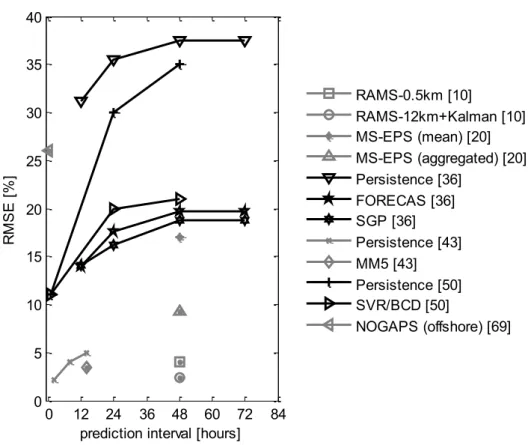
accuracy is key to producing good results. The dependence of prediction error on time horizon is
12
illustrated from a sample of models for which, RMSEs were reported is illustrated in Figure 2. The
13
increase in prediction error as time horizons become longer can be observed, and it is also apparent that
14
wind speed prediction models produce lower errors than models which attempt to predict wind power
15
outputs. In Fugon et al [50], it was found that if a number of statistical models are combined for
day-16
ahead predictions the forecast error decreases.
17
18
2.5 Benchmarking & Uncertainty Analysis
19
As wind power forecasting has intrinsic uncertainty, the results of any model must be tested. The
20
verification of wind power prediction models is complicated. As wind power prediction model outputs are
21
generally either a vast array of single value point forecasts for each look-ahead time or more recently
22
multiple ensembles from a multi-scheme ensemble prediction (MSEP), it is difficult to establish a
23
standard metric of accuracy. Therefore, a number of accuracy tests are used to benchmark or validate a
24
model and to determine the percentage of uncertainty of the results. The input data and the time horizon
25
usually determine the most appropriate accuracy test. In Madsen et al [51] three criteria were identified to
26
establish the ‘fitness for purpose’ of a weather forecast. These criteria are consistency, quality and value.
27
Consistency refers to the expectations of the model performance based on the skill and experience of the
28
modeler. Quality is defined as the correspondence between the observed and forecasted observations.
29
Value is related to the ‘fit for purpose’ or relevance of the forecast to its actual function and application.
30
The purpose of uncertainty analysis is to measure the degree of ‘wrongness’ of the model, often described
1
by a loss (or cost) function. Uncertainty analysis has three main approaches: probabilistic forecasting, risk
2
indices and scenario generation. In probabilistic forecasting the uncertainty in the future is estimated as a
3
probabilistic measure. Probabilistic measures include quantiles, interval forecasts and probability density
4
function (pdf) and probability mass function for each time step of the prediction horizon. Risk indices,
5
also referred to as skill forecasts, include the meteo-risk index (MRI) and the normalized prediction risk
6
index (NPRI). They are not related to the prediction method and provide a priori information on expected
7
level of forecast error.
8
9
A model’s prediction error is classically defined as the difference between the measured and the predicted
10
value. A number of standard error measures are also used to describe the error in point forecast models.
11
Models are assessed and compared using mean error (bias), mean absolute error (MAE), mean square
12
error (MSE), RMSE, histograms of the frequency distribution of the error, the correlation coefficient (R),
13
mean absolute percentage error (MAPE) and the coefficient of determination (R2), standard deviation of
14
the errors (SDE) and the normalized MAE and RMSE. These error measures do not depend on the size of
15
the test set. The ‘skewness’ of the prediction is often determined using Fisher’s equation. A negative
16
skew implies relatively few low results, whereas a positive skew implies few high results. The skill score
17
and measures to verify forecast models are proposed in Murphy and Epstein [52] and Murphy and
18
Winkler [53]. It is frequently recommended that three measures are taken to reduce forecast and
19
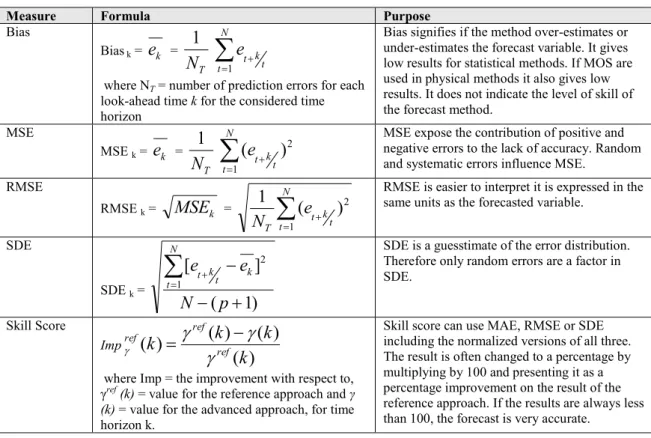
prediction errors. Table 2 gives a summary of some of the standard error measures.
20
21
The grouping of wind farms reduces the overall prediction error, an example of this is in Germany where
22
the forecast error for the aggregated wind power stays below 2.5% when the three control zones of E.ON,
23
Vattenfall and RWE are grouped together [54]. In the USA a MAE of 10 to 15% for day-ahead modeling
24
of the nameplate capacity of the wind farm has been obtained [55]. If the model is rerun a few hours
25
ahead on the same day the MAE range is typically 5% of the name plate capacity of the wind farm. The
26
Danish system operator has had similar results [56]. The RMSE is usually 10% of installed capacity for
27
most models. In Ireland the system operators (i.e. EirGrid in the Republic of Ireland and SONI in
28
Northern Ireland) have a target accuracy of 6 – 8% [57]. The operators have quoted individual wind farm
29
accuracy in the range of 10 – 20%.
30
As part of the European Union (EU) funded ANEMOS project, a number of models including Prediktor,
1
Previento and AWPPS, were benchmarked and a standardization approach was developed [58 and 59]. A
2
number of the key findings were that Kalman filters decrease NWP systematic error. Forecasts for
3
offshore wind farms appear to have similar performance results to those for flat terrain on-shore wind
4
farms and that none of the models could perform better than the others for each test case or look-ahead
5
time. Another benchmarking study was carried out by the Asociación Empresarial Eólica (AEE) in Spain
6
to study the effects of terrain and model selection [60].
7
8
3.0 Current Research Activities and Future Advances
9
Most wind power forecasting models study ‘regular’ wind conditions. The EU funded project called
10
‘Safewind’ aims to improve wind power prediction over challenging and extreme weather periods and at
11
different temporal and spatial scales [61]. Development activities are on-going to reduce error in wind
12
power prediction, to improve regionalized wind power forecasting for on-shore wind farms and to derive
13
methods for wind power prediction for offshore wind farms. It is possible that the use of ensemble and
14
combined weather prediction methods together may enhance forecasting.
15
16
If the error in wind power forecasting and prediction is reduced then electricity markets can trade with
17
more certainty. Contract errors as a function of time in electricity markets can be as high as 39% for a
18
forecasting lead time of 4 hours [62]. Gubina et al (2009) [63] presents a new tool called the WILMAR
19
and ANEMOS scheduling MeThodology (WALT) to reduce the number of thermal generators on
stand-20
by or in reserve using the probability of generation outages and load shedding are system reliability
21
criteria instead of generation adequacy based solely on generation outage. The wind and load forecast
22
errors are modeled using a Gaussian stochastic variable approach. However, in another study it was found
23
that the prediction errors do not satisfy the Kolmogorov-Smirnov test for normal distribution [64]. In
24
Ramìrez and Carta [65], it was shown that, the use of autocorrelated (and thus not independent)
25
successive hourly mean wind speeds, though invalidating all of the usual statistical tests, has no
26
appreciable effect on the shape of the pdf estimated from the data.
27
28
Offshore wind farms pose more of a challenge in terms of accurate wind power forecasting because the
29
environment is typically flat and smooth with very few obstacles so changes in wind speed and thermal
30
effects are felt more acutely than on land as weather fronts pass over the wind farm [66]. A review of
31
published data has gleaned very little knowledge of methods in use for offshore wind power prediction.
1
There are ambitious plans to develop large offshore wind farms (e.g. Horns Rev, Denmark, Arklow Bank,
2
Ireland and Hornsea, UK). Watson et al [67] discusses some of the issues associated with offshore wind
3
farm prediction, including:
4
Current forecasting and prediction models are designed for on-shore environment and still have
5
errors,
6
Resource assessment is difficult due to completely different conditions, offshore is vast, flat and
7
smooth (with a variable roughness) and thus weather fronts are felt more acutely than on land.
8
Therefore thermal effects, wake affects and coastal land mass effects are amplified.
9
Poor availability of meteorological data to validate NWP outputs for these offshore locations.
10
11
Current indications of best practice involve adapting existing models and using CFD adjusted for the
12
maritime conditions. To illustrate the difficulty of accurate prediction of offshore wind, a ‘nowcast’ (i.e.
13
zero time horizon) is included in Figure 2 for comparison purposes, and it can be seen that the RMSE
14
exceeds that of many onshore forecasts [68]. The increase in prediction error as time horizons become
15
longer can be observed, and it is also apparent that wind speed prediction models produce lower errors
16
than models, which attempt to predict wind power outputs.
17
18
4.0 Discussion & Conclusion
19
One of the ultimate goals of every wind power prediction model is to estimate the wind power output as
20
early and as accurately as possible. Wind power will become more attractive for system and market
21
operators as NWP model accuracy improves and as easier to use forecasting techniques are developed.
22
Wind power prediction tools are invaluable because they enable better dispatch, scheduling and unit
23
commitment of thermal generators, hydro plant and energy storage plant and more competitive market
24
trading as wind power ramps up and down. Overall accurate wind power prediction reduces the financial
25
and technical risk of uncertainty of wind power production for all electricity market participants. When
26
smart grid technology and intelligent load management techniques (such as controlled water and space
27
heating and chilling, and electric vehicle charging) are deployed, integration of wind power will become a
28
more straightforward task. Many aspects of existing grid systems, conventional thermal generation and
29
the management of the power system are circa 70 years old, whereas large-scale adoption of wind energy
30
has only occurred in just the last 15 years. Furthermore, a more diverse generation portfolio mix, which
31
includes energy storage plant, off-shore wind, wave and tidal will also make wind power integration less
1
operationally intensive for system operators.
2
3
In conclusion, the extensive body of literature has demonstrated that research; development and activity
4
in wind power forecasting are very active areas and are delivering results for generators, power system
5
operators and market operators. The rapid expansion of wind generation capacity in the past 15 years has
6
created demand for advances in wind forecasting techniques. Improvements in NWP, driven by advances
7
in the affordability and power of computing technology, have resulted in greater accuracy by enabling the
8
use of more sophisticated parameterizations and finer meshes. Continuing innovations in statistical and
9
machine learning prediction techniques have also paid dividends, particularly for forecasting on very
10
short term and short term timescales. Hybrid methods are delivering some of the benefits of both NWPS
11
(in terms of accuracy over medium term time horizons) and of statistical and machine learning techniques
12
(in terms of better time resolution and better representation of winds at local scales). Further increases in
13
wind energy penetration of power systems, with the associated issues of managing wind variability, are
14
likely to drive future developments in wind forecasting technology, and the current plans to hugely
15
increase offshore wind capacity will necessitate model improvements in this area.
16
17
REFERENCES
18
[1] World Wind Energy Agency (WWEA). World Wind Energy Report 2009; 2010 [2] EirGrid. Wind generation data. Available from:
http://www.eirgrid.com/operations/systemperformancedata/windgeneration/; 2009. [Accessed 03.02.10] [3] Petersen EL, Mortensen NG, Landberg L, Højstrup J and Frank HP. Wind Power Meteorology. Risø-I-1206(EN), Risø National Laboratory. Roskilde, Denmark; 1997.
[4] Landberg L. Short-term prediction of the power production from wind farms. Journal of Wind Engineering and Industrial Aerodynamics 1999; 80:1-2:207-220.
[5] Landberg L. Short-term prediction of local wind conditions. Journal of Wind Engineering and Industrial Aerodynamics 2001;89:3-4:235-245.
[6]Giebel G, Landberg L, Kariniotakis G and Brownsword R. State-of-the-Art on Methods and Software Tools for Short-Term Prediction of Wind Energy. Proceedings of the European Wind Energy Conference & Exhibition, EWEC2003, Madrid, Spain; 2003.
[7] Taylor JW, Buizza R. Using weather ensemble predictions in electricity demand forecasting. International Journal of Forecasting 2003;19:1:57-70.
[8] Nielsen HAa, Nielsen TS, Madsen H, Pindado M.J.S.I and Martí I. Optimal Combination of Wind Power Forecasts. Wind Energy 2007;10:5:471-482.
[9] Louka P, Galanis G, Siebert N, Kariniotakis G, Katsafados P, Kallos G, and Pytharoulis I. Improvements in wind speed forecasts for wind power prediction purposes using Kalman filtering. Journal of Wind Engineering and Industrial Aerodynamics 2008;96:12:2348-2362.
[10] Juban J, Siebert N and Kariniotakis GN. Probabilistic Short-term Wind Power Forecasting for the Optimal Management of Wind Generation. Proceedings of the IEEE Power Tech 2007, Lausanne, Switzerland; 2007.
[11] Lazić L, Pejanović G and Živković M. Wind forecasts for wind power generation using the Eta model. Renewable Energy 2010;35:6:1236-1243.
[12] Källén E. HIRLAM documentation manual, System 2.5, Technical report. S-60176 Norrköping, Sweden; 1996.
[13] Bubnova R, Hello G, Bénard P and Geleyn J-F. Integration of the fully-elastic equations cast in the hydrostatic pressure terrain-following coordinate in the framework of the ARPEGE/ALADIN NWP system. Monthly Weather Review 1995;123:515-535.
[14] Skamarock WC, Klemp JB, Dudhia J, Gill DO, Barker DM, Wang W and Powers JG. A Description of the Advanced Research WRF, Version 2. NCAR/TN– 468; 2005.
[15] Grell GA, Dudhia J and Stauffer DR. A description of the fifth-generation Penn System/NCAR Mesoscale Model (MM5). NCAR Technical Note NCAR/TN-39811A;1994.
[16] Focken U, Lange M, Mönnich K, Waldl H-P, Beyer HG and Luig A. Short-term prediction of the aggregated power output of wind farms – a statistical analysis of the reduction of the prediction error by spatial smoothing effects. Journal of Wind Engineering and Industrial Aerodynamics; 2002:90:231-246. [17] Lange M and Focken U, Physical Approach to Short-Term Wind Power Prediction. Berlin, Springer; 2005.
[18] Giebel G, Badger J, Landberg L, Nielsen HAa, Nielsen T, Madsen H, Sattler K, Feddersen H, Vedel H, Tøfting J, Kruse L, Voulund L. Wind Power Prediction Ensembles, Report 1527. Risø National Laboratory, Denmark; 2005.
[19] Lang SJ and McKeogh EJ. Forecasting Wind Generation, Uncertainty and Reserve Requirement on the Irish Power System using an Ensemble Prediction System. Wind Engineering 2009;33:5:433-448. [20] Lang S, Möhrlen J, Jørgensen J, O’Gallachóir BP and McKeogh E. Application of a Multi-Scheme Ensemble Prediction System for Wind Power Forecasting in Ireland and comparison with validation
results from Denmark and Germany. Proceedings of the European Wind Energy Conference, EWEC2006, Athens, Greece; 2006.
[21] Costello R, McCoy D, O'Donnell P, Dutton AG, Kariniotakis GN. Potential Benefits of Wind Forecasting and the Application of More-Care in Ireland. Proceedings of the 3rd MED POWER Conference 2002, Athens, Greece; 2002.
[22] Landberg L. A Mathematical Look at a Physical Power Prediction Model. Wind Energy; 1998:1:23-28.
[23] Landberg L, Myllerup L, Rathmann O, Lundtang Petersen E, Hoffmann Jørgensen B, Badger J, Gylling Mortensen N. Wind Resource Estimation - An Overview. Wind Energy; 2003:6:3:261-271. [24] Cellura M, Cirrincione G, Marvuglia A and Miraoui A. Wind speed spatial estimation for energy planning in Sicily: A neural kriging application. Renewable Energy; 2008:33:6:1251-1266.
[25] Lalas DP, Wind energy estimation and siting in complex terrain. International Journal Solar Energy; 1985:3:43–71.
[26] Dinar N, Mass consistent models for wind distribution in complex terrain - Fast algorithms for three dimensional problems. Boundary Layer Meteorology; 1984:30:177-199.
[27] Magnusson M and Wern L, Wind energy predictions using CFD and HIRLAM forecast. Proceedings of the European Wind Energy Conference EWEC2001, Copenhagen, Denmark; 2001.
[28] Glahn HR and Lowry DA, The use of Model Output Statistics (MOS) in objective weather forecasting. Journal of Applied Meteorology; 1972:11:8:1203-1211.
[29] Torres JL, García A, de Blas M and de Francisco A, Forecast of hourly averages wind speed with ARMA models in Navarre, Solar Energy; 2005:79:1:65-77.
[30] El-Fouly THM, El-Saadany EF and Salama MMA, Grey Predictor for Wind Energy Conversion Systems Output Power Prediction. IEEE Transactions on Power System; 2006:21:1450–1452.
[31] Damousis IG and Dokopoulos P. A fuzzy model expert system for the forecasting of wind speed and power generation in wind farms. Proceedings of the IEEE International Conference on Power Industry Computer Applications PICA 01; 2001.
[32] Hervás-Martínez C, Gutiérrez PA, Fernández JC, Salcedo-Sanz S, Portilla-Figueras A, Pérez-Bellido A and Prieto L, Hyperbolic Tangent Basis Function Neural Networks Training by Hybrid Evolutionary Programming for Accurate Short-Term Wind Speed Prediction. Proceedings of the 9th International Conference on Intelligent Systems Design and Applications, Pisa, Italy; 2009.
[33] Barbounis TG and Theocharis JB. Locally recurrent neural networks for wind speed prediction using spatial correlation. Information Sciences; 2007:177:24:5775–5797.
[34] Welch RL, Ruffing SM, Venayagamoorthy GK. Comparison of Feedforward and Feedback Neural Network Architectures for Short Term Wind Speed Prediction. Proceedings of International Joint Conference on Neural Networks, Atlanta, Georgia, USA; 2009.
[35] Ramirez-Rosado, IJ, Alfredo Fernandez-Jimenez L, Monteiro C, Sousa J & Bessa R. Comparison of two new short-term wind-power forecasting systems. Renewable Energy; 2009, 34:1848-1854.
[36] Mori H and Umezawa Y. Application of NB Tree to Selection of Meteorological Variables in Wind Speed Prediction. Proceedings of the IEEE Transmission & Distribution Conference & Exposition, Asia and Pacific; 2009.
[37] Jursa R. Wind power prediction with different artificial intelligence models. Proceedings of the European Wind Energy Conference, EWEC2007, Milan, Italy; 2007.
[38] Jursa R and Rohrig K. Short-term Wind Power Forecasting using evolutionary algorithms for the automated specification of artificial intelligence models. International Journal of Forecasting; 2008:24:4:694-709.
[39] Juban J, Fugon L and Kariniotakis G. Uncertainty Estimation of Wind Power Forecasts. Proceedings of the European Wind Energy Conference, EWEC2008, Brussels, Belgium; 2008.
[40] Mohandes MA, Halawani TO, Rehman S, Hussain AA. Support vector machines for wind speed prediction. Renewable Energy; 2004:29:6:939–947.
[41] Kusiak A, Haiyang Z and Song Z, Short-Term Prediction of Wind Farm Power: A Data Mining Approach. IEEE Transactions on Energy Conversions; 2009:24:1:125-136.
[42] Larson KA, Westrick K. Short-term wind forecasting using off-site observations. Wind Energy; 2006:9:1-2:55–62.
[43] Goh SL, Popovic DH, Mandic DP. Complex-valued estimation of wind profile and wind power. Proceedings of the 12th IEEE Mediterranean Electrotechnical Conference, MELECON 2004, Dubrovnik, Croatia; 2004.
[44] Mandic DP, Javidi S, Goh SL, Kuh A and Aihara K. Complex-valued prediction of wind profile using augmented complex statistics. Renewable Energy; 2009:34:1:196–201.
[45] Negnevitsky M, Johnson P and Santoso S. Short-term Wind Power Forecasting using hybrid intelligent systems. Proceedings of the IEEE Power Engineering Society General Meeting, Tampa, Florida, USA; 2007.
[46] Damousis IG, Alexiadis MC, Theocharis JB, Dokopoulos PS. A fuzzy model for wind speed prediction and power generation in wind parks using spatial correlation. IEEE Transactions on Energy Conversion; 2004:19:2:352–361.
[47] Pinson P and Kariniotakis G. Wind power forecasting using fuzzy neural networks enhanced with on-line prediction risk assessment. Proceedings of the IEEE Power Tech Conference, Bologna, Italy; 2003.
[48] Miranda MS, Dunn RW. One-hour-ahead wind speed prediction using a Bayesian methodology. Proceedings of the IEEE Power Engineering Society General Meeting, Montreal, Quebec, Canada; 2006. [49] Fan S, Liao JR, Yokoyama R, Chen L and Lee WJ. Forecasting the Wind Generation Using a Two-Stage Network Based on Meteorological Information. IEEE Transactions on Energy Conversion; 2009:24:2:474-482.
[50] Fugon L, Juban J, and Kariniotakis G. Data mining for Wind Power Forecasting. Proceeding of the European Wind Energy Conference, EWEC2008, Brussels, Belgium; 2008.
[51] H. Madsen, G. Kariniotakis, H.Aa. Nielsen, T.S. Nielsen and P. Pinson, A protocol for standardizing the performance evaluation of short-term wind power prediction models, Proceedings of the Global WindPower 2004 Conference, Chicago, Illinois, March 2004
[52] Murphy AH and Epstein ES. Skill scores and correlation coefficients in model verification. Monthly Weather Review 1989;117:572-581.
[53] Murphy AH and Winkler R.L. A general framework for forecast verification. Monthly Weather Review 1987;115:1330-1338.
[54] Smith JC, Thresher R, Zavadil R, DeMeo E, Piwko R, Ernst B and Ackermann T. A Mighty Wind – Integrating Wind Energy into the Electric Power System is Already Generating Excitement. IEEE Power & Energy Magazine 2009;7:41-51.
[55] Ahlstrom ML and Zavadil RM. The Role of Wind Forecasting in Grid Operations & Reliability. Proceedings of the IEEE PES Transmission and Distribution Conference & Exhibition, Asia and Pacific, Dalian, China; 2005.
[56] Ackermann T, Ancell G, Borup LD, Eriksen PB, Ernst B, Groome F, Lange M, Möhrlen C, Orths AG, O’Sullivan J and de la Torre M. Where the Wind Blows IEEE Power & Energy Magazine; 2009:7:6:65-75.
[57] O’Donnell P and Garrett D. EirGrid and SONI Scheduling & Dispatch Workshop. Available at: http://www.eirgrid.com/media/(4)%20Wind%20Forecasting%20Tools%20and%20Processes%20-%20Philip%20O'Donnell,%20EirGrid.pdf; 2008. [Accessed 04.03.10]
[58] ANEMOS. Development of ANExt Generation Wind Resource Forecasting SysteM for the Large-Scale Integration of Onshore and OffShore Wind. Available at: http://anemos.cma.fr/; 2010. [Accessed 02.03.10]
[59] Kariniotakis G, Martí I, Casas D, Pinson P, Nielsen TS, Madsen H, Giebel G, Usaola J, Sanchez I, Palomares AM, Brownsword R, Tambke J, Focken U, Lange M, Louka P, Kallos G, Lac C, Sideratos G and Descombes G. What performance can be expected by short-term wind power prediction models depending on site characteristics? Proceedings of the European Wind Energy Association Conference, EWEC2004, London, U.K.; 2004.
[60] Ceña A. Avanzando en la gestionabilidad (Advancing in Manageability). Asociación Empresaria Eólica, Wind Power 2006, Madrid, Spain; 2006.
[61] Safewind Project. Collaborative project funded by the European Commission (EC) under the 7th Framework Program, Theme 2007-2.3.2: Energy, Grant Agreement No 213740. Available at: http://www.safewind.eu/; 2010. [Accessed 01.03.10]
[62] Bathhurst GN and Strbac G, 2003. Value of Combining Energy Storage and Wind in Short-term Energy and Balancing Markets. Electric Power Systems Research, 67(1), 1 - 8.
[63] Gubina AF, Keane A, Meibom P, O’Sullivan J, Goulding O, McCartan T and O’Malley M. New Tool for Integration of Wind Power Forecasting into System Operation. Proceedings of the IEEE Bucharest Power Tech Conference, Bucharest, Romania; 2009.
[64] Miranda V, Bessa R, Gama J, Conzelmann G and Botterud A. New Concepts in Wind Power Forecasting Models. Proceedings of the WindPower 2009 Conference and Exhibition, Chicago, Ill, USA; 2009.
[65] Ramìrez P, Carta JA. Influence of the data sampling interval in the estimation of the parameters of the Weibull wind speed probability density distribution: a case study. Energy Conversion and Management; 2005:46:15-16:2419–2438.
[66] Watson S. Fresh Forecasts [wind power forecasting]. IEE Power Engineer; 2005:19:2:36-38. [67] Watson SJ, Landberg L and Halliday JA. Application of Wind Speed Forecasting to the Integration of Wind Energy into Large Scale Power Systems. IEE Proceedings of Generation, Transmission and Distribution; 1994:141:4:357-362.
[68] McQueen D and Watson S. Validation of wind speed prediction methods at offshore sites. Wind Energy; 2006:9:1-2:75-85.
Figure 1. Actual and Short Term Forecast Total System Wind Power Generation on the 10th January 2011 on the Republic of
Ireland System (data provided by Eirgrid).
0 12 24 36 48 60 72 84 0 5 10 15 20 25 30 35 40
prediction interval [hours]
R M S E [ % ] RAMS-0.5km [10] RAMS-12km+Kalman [10] MS-EPS (mean) [20] MS-EPS (aggregated) [20] Persistence [36] FORECAS [36] SGP [36] Persistence [43] MM5 [43] Persistence [50] SVR/BCD [50] NOGAPS (offshore) [69]
Figure 2 Some Prediction Errors (as percentage RMSE) as a Function of Forecast Horizon from different studies (Black markers indicate wind power generation prediction models, whereas grey markers indicate wind speed prediction models)
Table 1 Some Wind Power Forecasting & Prediction Models
Model Name Developer(s) Method Some geographical locations of applications
Prediktor L. Landberg at Risø, Denmark Physical Spain, Denmark, Republic of Ireland, Northern Ireland, France, Germany, USA, Scotland & Japan
WPPT Eltra/Elsam collaboration with Informatics and
Mathematical Modelling at Danmarks Tekniske Universitet (DTU), Denmark
Statistical Denmark, Australia, Canada, Republic of Ireland, Holland, Sweden, Greece & Northern Ireland Zephyr Risø & IMM ay DTU, Denmark Hybrid Denmark & Australia
Previento Oldenburg University Hybrid Germany, Northern Ireland
e Wind TM True Wind Inc., USA Hybrid USA
Sipreólico University Carlos III, Madrid, Spain & Red Eléctrica de
Espaňa Statistical Spain
WPMS Institut für Solare Energieversorgungstechnik (ISET),
Germany Statistical Germany
WEPROG J. Jørgensen & C. Möhrlen at University College Cork Hybrid Ireland, Denmark and Germany GH Forecaster Garrad Hassan Statistical Greece, Great Britain & USA AWPPS École des Mines, Paris Statistical Crete, Madeira, Azores & Ireland LocalPred
& RegioPred
M. Perez at Centro Nacional de Energias Renovables (CENER) and Centro de Investigaciones Energéticas, Medioambientales y Tecnalógicas, Spain (CIEMET)
Hybrid Spain and Ireland Alea Wind Aleasoft at the Universitat Polytécnica de Catalunya, Spain
(UPC) Statistical Spain
SOWIE Eurowind GmbH, Germany Physical Germany, Austria & Switzerland EPREV Instituto de Engenharia de Sistemas e Computadores do
Porto (INESC), Instituto de Engenharia Mecânica e Gestão Industrial (INEGI) and Centro de Estudos de Energia Eólica e Escoamentos Atmosféricos (CEsA) in Portugal
Statistical Portugal
Table 2 Commonly-used Error Measures
Measure Formula Purpose
Bias Bias k =
e
k = TN
1
N t t k te
1where NT = number of prediction errors for each look-ahead time k for the considered time horizon
Bias signifies if the method over-estimates or under-estimates the forecast variable. It gives low results for statistical methods. If MOS are used in physical methods it also gives low results. It does not indicate the level of skill of the forecast method.
MSE MSE k =
e
k = TN
1
N t t k te
1 2)
(
MSE expose the contribution of positive and negative errors to the lack of accuracy. Random and systematic errors influence MSE.RMSE RMSE k =
MSE
k =
N t t k t Te
N
1 2)
(
1
RMSE is easier to interpret it is expressed in the same units as the forecasted variable.SDE SDE k =
)
1
(
]
[
1 2
p
N
e
e
N t k t k tSDE is a guesstimate of the error distribution. Therefore only random errors are a factor in SDE. Skill Score Imp
)
(
)
(
)
(
)
(
k
k
k
k
ref ref ref
where Imp = the improvement with respect to, γref (k) = value for the reference approach and γ (k) = value for the advanced approach, for time horizon k.
Skill score can use MAE, RMSE or SDE including the normalized versions of all three. The result is often changed to a percentage by multiplying by 100 and presenting it as a percentage improvement on the result of the reference approach. If the results are always less than 100, the forecast is very accurate.
Table 3 Global & Regional NWP Models
Name Developer(s) Type
Global Forecast System (GFS) National Oceanic and Atmospheric Administration (NOAA), US Global Action de Recherche pour la Petite Echelle et la
Grande Echelle (ARPEGE) Météo-France (METEO FRANCE) Global
Global Meteorological Model (GME) Deutscher Wetterdienst (DWD), Germany Global Global Environmental Multi-scale Model (GEM) Recherche en Prévision Numérique (RPN), Meteorological Research
Branch (MRB), and the Canadian Meteorological Centre (CMC) Global Navy Operational Global Atmospheric Prediction
System (NOGAPS) United States Navy (USN) Global
Intermediate General Circulation Model (IGCM) NCAS Centre for Global Atmospheric Modelling, University of Reading,
United Kingdom (UK) Global
Unified Model (UM) Met Office, UK Global
Integrated Forecast System (IFS)
Note uses the same code as ARPEGE European Centre for Medium-Range Weather Forecasts (ECMWF), England Global
GSM Japan Meteorological Agency (JMA) Global
Global Analysis and Prediction (GASP) Bureau of Meteorology, Australia Global High Resolution Limited Area Model (HiRLAM) Current members include: Danmarks Meteorologiske Institut (DMI),
EESTI Meteoroloogia Ja Hüdroloogia Insitut (EMHI), Ilmatieteen Laitos (FMI), Veðurstofa Íslands (VI), Met Éireann, Koniklijk Nederlands Meteorologisch Instituut (KNMI), Meteorologisk instutt (met.no), Agencia Estatal de Meteorología (AEMET) and Swedish Meteorological and Hydrological Institute (SMHI)
Regional
Lokal-modell (LM) DWD, Germany Regional
ALADIN Météo-France with a consortium of16 European partners Regional
Mesoscale Model 5 (MM5) Mesoscale Prediction Group in the Mesoscale and Microscale Meteorology Division, National Center for Atmospheric Research (NCAR)
Regional
MSM and a number of Ensemble models Japan Meteorological Service Regional
Weather Research and Forecasting (WRF) Model A collaboration in the US, which includes NCAR, the National Oceanic and Atmospheric Administration (National Center for Environmental Prediction (NCEP) and the Forecast Systems Laboratory (FSL)), the Air Force Weather Agency (AFWA), the Naval Research Laboratory (NRL), the University of Oklahoma and the Federal Aviation Administration (FAA)
Regional
Consortium for Small-Scale Modelling (COSMO) A collaboration of 6 European met services led by the Federal Office of