INTRODUCTION
The current generation has seen enormous changes in technology, including personal com-puters becoming commonplace in the home and school. U.S. statistics (Cheeseman Day, Janus, & Davis, 2005) show a rise in the percentage of households with a computer at home, from 8% in 1984 to 62% in 2003. In Hong Kong the propor-tion of 12- to 15-year-old students having a com-puter at home was 91.3% in 2002 – an increase from 69.4% in 2000 (Education and Manpower Bureau, 2003). The utilization of computers by children is increasing accordingly. Recent figures from the United Kingdom show 98% of children aged 5 to 18 years use a computer at school,
home, or both (National Statistics UK, 2003). Sta-tistics are similar in Australia, with 89% of chil-dren aged 5 to 14 years using a computer at home (Australian Bureau of Statistics, 2006).
Exposure to computers starts early in affluent countries. An Australian study (Straker, Pollock, Zubrick, & Kurinczuk, 2006) reported that more than half of 5-year-old children used a computer each week, and in the United States 39% of 4- to 6-year-old children used a computer several times per week (Rideout, Vandewater, & Wartella, 2003). The recent and rapid uptake of computers by children has also outpaced the development of knowledge about the ramifications for the health of children. What is known is that many children ex-perience computer-related discomfort (Gillespie,
Computer Display Heights and During Paper
Information Technology Use
Leon Straker,Curtin University of Technology, Perth, Australia, Robin Burgess-Limerick,
University of Queensland, Brisbane, Australia, and Clare Pollock, Jemma Coleman,
Rachel Skoss, andBarbara Maslen,Curtin University of Technology, Perth, Australia
Objective: The 3-D posture and muscle activity in the neck and upper limb were assessed in children using high-, mid-, and book-level displays, which correspond to working conditions frequently observed when children interact with computers or books and paper. Background: The 3-D posture and muscle activity of children read-ing and inputtread-ing data with computers and paper had not been previously assessed. Methods: Twenty-four children aged 10 to 12 years and of normal height performed an interactive task involving reading from a book and writing on paper or reading from a computer display and inputting data using a mouse and keyboard. Results: Head and neck flexion increased as the visual target was lowered. The high display resulted in mainly upper cervical relative extension, and the book display resulted in both upper and lower cervical flexion. The book condition resulted in greater cervi-cal erector spinae and upper trapezius activity than did the mid and high conditions. Conclusion: The data suggest that a mid-level display may be more appropriate for children than a high display (e.g., when the display is placed on top of the central processing unit). The mid display also results in a more upright and symmetrical pos-ture and lower mean muscle activity than does working with books and paper flat on the desk. Application: This study provides short-term laboratory study evidence for the formulation of guidelines for workstation design and adjustment for children. Use of computers by children is increasing, yet ergonomic guidelines lag behind those for adults.
Address correspondence to Leon Straker, School of Physiotherapy, Curtin University of Technology, GPO Box U1987, Perth, WA, 6845, Australia; [email protected]. HUMANFACTORS, Vol. 50, No. 1, February 2008, pp. 49–61. DOI 10.1518/ 001872008X250575. Copyright © 2008, Human Factors and Ergonomics Society. All rights reserved.
2006; Harris & Straker, 2000). It is therefore crit-ical that the effects of different computer work-stations on children are understood.
The need for specific, evidence-based guide-lines for wise use of computers by children has been detailed by Straker, Pollock, and Burgess-Limerick (2006). Current guidelines for children are largely based on adult research, guidelines, and work practices. Differences in morphology between the immature and adult musculoskeletal systems, including a greater proportional head mass and different geometry of cervical vertebrae and joints, suggest that the effects of workstation setup must be directly assessed for children be-fore the applicability of adult recommendations can be known. Children may also interact with computers in ways different from adults (Adams & Sanders, 1995). With the rapid increase in ex-posure of children to computers, the need for specific evidence is clear.
One factor that has received considerable at-tention in workstation setup guidelines for adults is the height of the computer display in relation to the user’s eye height. It has been shown for adult populations that changing display height can alter musculoskeletal and visual stresses (Bauer & Wittig, 1998; Burgess-Limerick, Plooy, Fraser, & Ankrum, 1999; Sommerich, Joines, & Psihogios, 2001; Villanueva et al., 1997) and can even affect productivity (Sommerich et al., 2001). Adult published standards generally suggest a display placement between eye level and 40° to 60° below (e.g., Australia: Standard 3590.2; Canada: Can/CSA-Z412-M89; Europe: ISO-9241; United States: ANSI/HFES 100). The very broad suggest-ed range has persistsuggest-ed despite considerable recent research.
There is reasonable consensus on a suitable gaze angle to minimize visual discomfort: Visual preference studies have generally reported pre-ferred gaze angles of about 9° to 10° below the horizontal (Psihogios, Sommerich, Mirka, & Moon, 2001; Sommerich et al., 2001). However, suitable postures to minimize musculoskeletal stress are disputed (Ankrum & Nemeth, 2000; Bauer & Wittig, 1998; Burgess-Limerick, Mon-Williams, & Coppard, 2000; de Wall, van Riel, Aghina, Burdorf, & Snijders, 1992; Som-merich et al., 2001; Straker & Mekhora, 2000; Villanueva et al., 1997).
Lower displays are associated with an increase in head and neck flexion moment as the masses
of the head and neck move anteriorly to lower the gaze angle. The increase in activity of the superfi-cial cervical erector spinae muscle group observed with lower display heights (Greig, Straker, & Briggs, 2005; Sommerich et al., 2001; Turville, Psihogios, Ulmer, & Mirka, 1998; Villanueva et al., 1997) is considered to be in response to this gravitational demand. The flexion moment would be theoretically minimized when the center of mass of the head and neck is in line with the head/ neck joint, which Snijders, Hoek van Dijke, and Roosch (1991) suggested is with the head extended 30° with respect to the horizontal.
However, this extreme head extension position is not favored by computer users, perhaps because of the inherent spinal instability in this position (Bauer & Wittig, 1998; Burgess-Limerick et al., 2000), muscle length-tension considerations (Burgess-Limerick et al., 2000), and a conflict with visual demands (Sommerich et al., 2001.) In addition, activation patterns of the upper trapezius muscle generally do not increase in accordance with head/neck flexion moment, and they may even be reduced with lower display heights (Greig et al., 2005; Turville et al., 1998). As the upper tra-pezius is the most common site for discomfort in adult computer users (Bergqvist, Wolgast, Nils-son, & Voss, 1995), its activity is an important consideration.
Despite the rapid increase in computer use by children both at school and in the home, limited research is available that addresses the optimal display height for children. A U.S. study of 8- to 12-year-old schoolchildren found that 40% were using workstations that put their musculoskeletal systems “at postural risk” and the remainder were in a range that was “of concern” (Oates, Evans, & Hedge, 1998). Zandvliet and Straker (2001) reported that the physical setup of computer workstations was one of the worst aspects of child-computer interaction in schools in Canada and Australia.
We know of only one study (Briggs, Straker, & Greig, 2004; Greig et al., 2005) that directly addressed the postural and muscular activation consequences of differing display heights for children. These parameters were compared for three information technology (IT) types that are commonly found in schools: a desktop computer, a laptop computer, and a book placed flat on the desk. Cervical erector spinae and upper trapezius activity was lowest for the desktop computer
condition, a result that shows some correspon-dence with adult patterns.
However, that study did not consider the high display condition commonly observed for chil-dren, nor did it consider normal computer inter-action as no input was required (reading-only task). Further, Briggs et al. (2004) measured pos-ture in only two dimensions, but substantial non-sagittal plane postures have been observed with children using IT. Differences in the technology (desktop, laptop, and book) may also have mediat-ed posture and muscle activity differences, but no attempt was made to examine potential covariates such as task performance, perceived workload, and attentional absorption.
It is apparent that the assessment of postural optimization for computer use by children lags behind the recent, extensive uptake of computer technology by children both at school and in the home. The aim of this study, therefore, was to quantify for the first time the postural and muscle activity effects of different display conditions commonly observed when children read from computers and books and input data into comput-ers and write on paper, allowing for covariates.
METHODS Study Design
A within-subjects design was used to test the effect of three IT display conditions on head, neck, and upper limb posture and muscle activity.
Participants
Twenty-four children (12 girls, 12 boys) aged between 10 and 12 years were recruited through personal contact and advertisements placed in local and community newspapers. Children had a mean (SD) height of 154.9 (9.5) cm and weight of 43.7 (6.3) kg. Age/gender percentiles for height were between 10 and 95 for girls and 20 and 95 for boys, except for 4 taller boys; percentiles for weight were between 25 and 90 for girls and 10 and 95 for boys.
None of the participants had a history of mus-culoskeletal disorders or pain or were currently experiencing musculoskeletal discomfort. All participants had normal or corrected-to-normal vision and were right-hand dominant. The chil-dren had started using computers at 5.4 (2.1) years and were currently using computers at least twice per week for a total of at least 2 hr per week.
They had typing speeds of 16.9 (7.8) words/ min and used 3.7 (1.5) fingers to type. The study was approved by the Human Research Ethics Committee of Curtin University.
Independent Variable
Three display conditions that were represen-tative of real-world conditions experienced by children constituted the independent variable for this study. The authors have observed children in North America, Europe, Asia, and Australia work-ing with a computer display positioned on top of the central processing unit such that the child is required to look up to the display. In this study the
high display condition replicated this scenario,
with the center of the display placed level with the child’s eye height (see Figure 1). In the mid condition the computer display sat directly on the desk such that the bottom of the actual visual dis-play area was 100 mm above desk height (center of display 210 mm above desk height). The third level of the independent variable was the book condition, in which a book (285 ×225 mm) and A4-size paper were rested directly on the flat desk.
Participants sat in a standard office chair (Burg-tec, Perth, Western Australia) adjusted to the par-ticipant’s popliteal height, using a footrest if required so that the height-adjustable, rectangu-lar desk (1020 mm wide ×450 mm deep; PayCo, Orange Grove, Western Australia) was level with the child’s sitting elbow height. An adjustable-height display arm (Swing Arm Single, Atdec Pty Ltd., Padstow, New South Wales, Australia) was used to position the 38-cm active matrix thin film transistor LCD (Model LM520, AOC, Fremont, CA) at each of the two display heights; the display was turned away during the book condition. The same keyboard (Turbo-Star KM-2601, Key Mouse Electronic Enterprise Co., Ltd., Taiwan) and mouse (Optical Wheel Mouse, Microsoft, Redmond, WA) were used in both computer conditions.
Participants were discouraged from using fore-arm support by positioning of the keyboard, mouse, and paper close to the edge of the desk. The study was conducted in a climate- and lighting-controlled laboratory.
Task
Equivalent general-knowledge reading and activity sheets were developed using CD and book versions of the same history encyclopedia (the Dorling Kindersley History of the World;
Denton, 1998). The tasks involved searching for information contained either on CD or in the paper encyclopedia, checking boxes using mouse or pen, and writing or typing paragraphs of infor-mation. The different activity sheets were balanced across the display conditions and across genders.
Each task lasted for 10 min, and rest periods were provided between tasks.
Dependent Variables
Three-dimensional posture of the head, the neck, and both upper limbs was assessed using an eight-camera, infrared Peak Motus®3D Op-tical Capture System and Peak Motus®8 software (Peak Performance Technologies Inc., Centennial, CO). Reflective markers were attached to the skin over the outer canthi, tragi, 7th cervical ver-tebra, posterior acromial shelves, lateral humeral epicondyles, midpoint of radial and ulnar styloid processes, 3rd metacarpal head, suprasternal notch, spinous process of 3rd thoracic vertebra, femoral greater trochanters, and the four corners of the desk and computer display. The software calculated locations of “virtual” markers: mid-point of the outer canthi (“cyclops”), midmid-point of the tragi (representing the head-neck joint [OC1]), midtrochanter, center of computer display, and center of the desk.
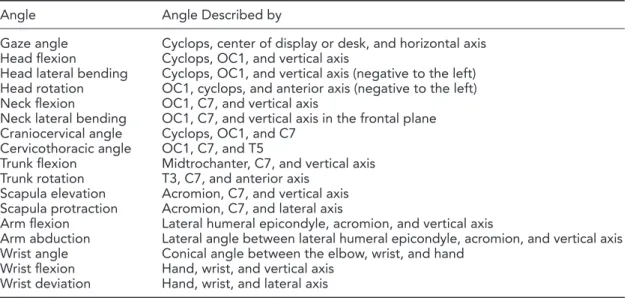
Mean angles (see Table 1 for definitions) over the last 2 min of each task were utilized for the current analysis. Data were sampled at 50 Hz and filtered and smoothed using a Butterworth filter with a cutoff frequency of 4 Hz prior to statistical analysis.
Surface myoelectric activity (EMG) was col-lected from the bilateral cervical erector spinae (CES), bilateral upper trapezius (UT), bilateral thoracic erector spinae/scapular retractors (TES), right anterior deltoid (RAD), and right wrist ex-tensor bundle (RWE). Pairs of 12-mm diameter Ag-AgCl disposable surface electrodes (Uni-Patch, Wasbasha, MN) were placed 25 mm apart (center to center) at each of these sites after the skin had been thoroughly prepared by shaving, lightly abrading, and cleaning.
CES electrodes were positioned on the muscle bulk midway between the external occipital pro-tuberance and C7, UT electrodes were positioned just lateral to the midpoint between C7 and the acromion process, TES electrodes were posi-tioned midway between the T3 spinous process and inferior angle of the scapula, RAD electrodes were positioned midway between the acromium and deltoid anterior insertion, and RWE electrodes were positioned 1/3 distance from the lateral humeral epicondyle and radial styloid process.
Raw EMG signals were collected via an eight-channel AMT-8 EMG cable telemetry system
Figure 1. Workstation configurations for the high (top
panel), mid (middle panel), and book (bottom panel) display conditions.
(Bortec Biomedical, Alberta, Canada) with ana-logue differential amplifiers and sampled at 1000 Hz. Amplitude normalization to maximal voluntary exertion (MVE) was performed using a previous-ly described method (Straker, Pollock, Burgess-Limerick, Skoss, & Coleman, in press). MVE EMG for the participants had good same-day intertrial reliability (inter-class correlation coefficient .718–.920). Mean EMG activity over the last 2 min of each task was utilized for the current analysis. In an attempt to monitor potential covariates of the different types of technology, we also mea-sured task performance (total number of answers attempted), perceived workload (Hart & Staveland, 1988), subjective experience of flow (Webster, Tre-vino, & Ryan, 1993), distance from eye to visual target, and forearm support. Perceived workload and flow were assessed by self-report question-naires. Distance from the eye to the visual target was estimated by the distance between the cy-clops and the center of the computer display or center of the desk, calculated by the motion analysis program. Forearm support was assessed by a single examiner via offline observation of video recordings of task performance, recording the time with and without the dominant forearm resting on the desk surface.
Procedure
Following electrode placement, participants performed MVEs for each muscle. They then moved to the study workstation and performed the
interactive task for each of the display conditions. After each 10-min task, the participant moved away from the desk area for 5 min, then returned to the (now-modified) workstation, and worked under the next display condition for 10 min.
Statistical Analysis
Univariate mixed-model ANOVAS with display (three levels) and gender as within- and between-subjects factors were initially performed. There was no gender main effect or Gender ×Display interaction effect for any posture or muscle activ-ity dependent variable. The analysis reported here therefore consists of one-way repeated measures ANOVAs (RANOVAs) with post hoc pairwise comparisons for each dependent variable using a critical alpha level of .01 to balance familywise error and power. Huynh-Feldt epsilon corrections were used if Mauchly’s test indicated lack of sphericity. All statistical analyses were performed using SPSS for Windows®Version 13 (SPSS Inc., Chicago, IL).
RESULTS
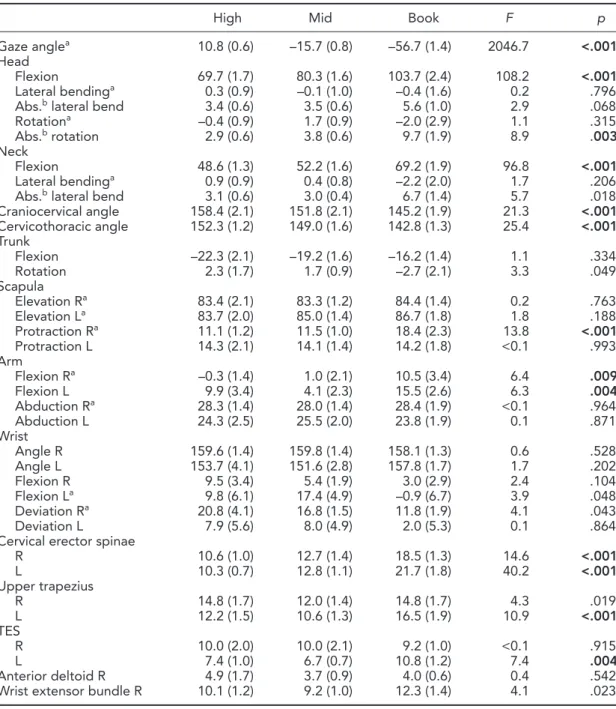
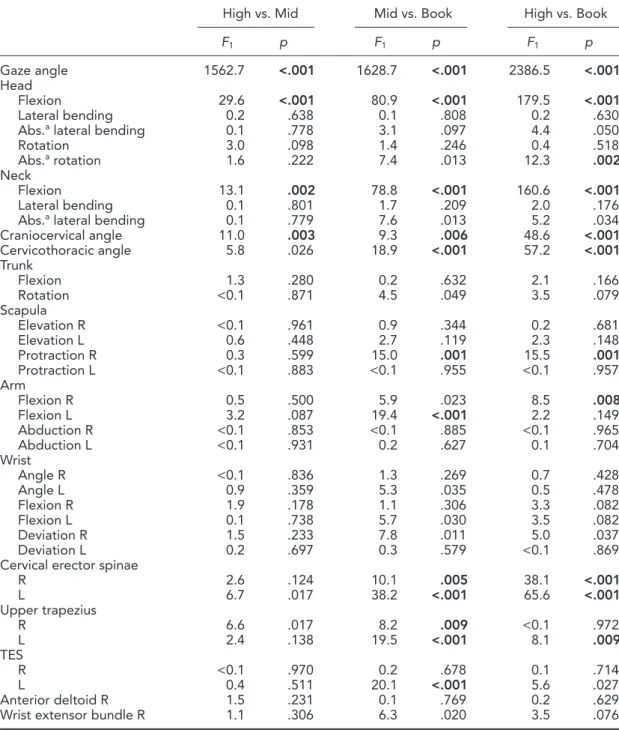
Table 2 shows the mean (and SE) postures for the high, mid, and book conditions, and Table 3 shows the RANOVA pairwise comparison results. Gaze angle as defined in this study represents the orientation of the center of the target display in relation to the position of the midpoint between the canthi. Moving from the high to mid to book TABLE 1:Postural Angles and Their Definitions
Angle Angle Described by
Gaze angle Cyclops, center of display or desk, and horizontal axis Head flexion Cyclops, OC1, and vertical axis
Head lateral bending Cyclops, OC1, and vertical axis (negative to the left) Head rotation OC1, cyclops, and anterior axis (negative to the left) Neck flexion OC1, C7, and vertical axis
Neck lateral bending OC1, C7, and vertical axis in the frontal plane Craniocervical angle Cyclops, OC1, and C7
Cervicothoracic angle OC1, C7, and T5
Trunk flexion Midtrochanter, C7, and vertical axis Trunk rotation T3, C7, and anterior axis
Scapula elevation Acromion, C7, and vertical axis Scapula protraction Acromion, C7, and lateral axis
Arm flexion Lateral humeral epicondyle, acromion, and vertical axis
Arm abduction Lateral angle between lateral humeral epicondyle, acromion, and vertical axis Wrist angle Conical angle between the elbow, wrist, and hand
Wrist flexion Hand, wrist, and vertical axis Wrist deviation Hand, wrist, and lateral axis
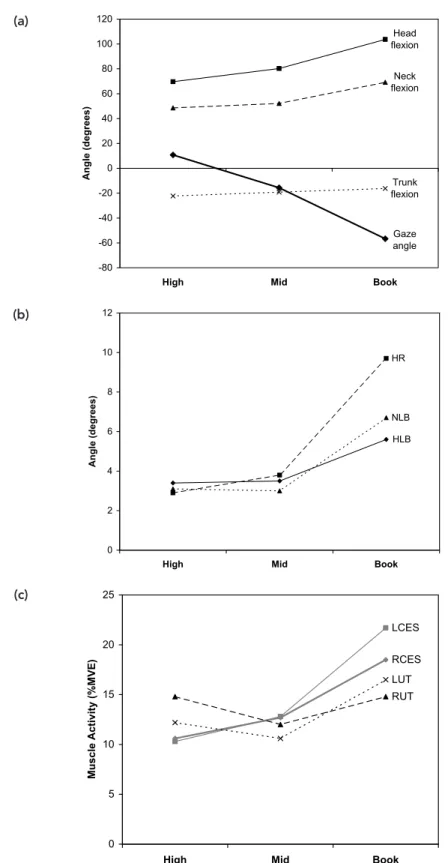
conditions significantly altered the gaze angle from 10.8° (positive angles are above the horizon-tal) to –15.7° to –56.7°. This represented angular changes between conditions of 25.6° from high to mid and 41° from mid to book. The associated alterations of segmental postures are presented in Figure 2a. Trunk flexion remained relatively
con-stant among the conditions and hence did not contribute significantly to changes in gaze angle. In contrast, both head flexion and neck flexion increased significantly from high to mid to book. Associated changes in the intersegmental cra-niocervical and cervicothoracic angles were also significant (Table 3).
TABLE 2:Means (SEs) and RANOVA Main Effect Statistics for Posture (Degrees) and Muscle Activity (% MVE) in Three Display Conditions
High Mid Book F p
Gaze anglea 10.8 (0.6) –15.7 (0.8) –56.7 (1.4) 2046.7 <.001
Head
Flexion 69.7 (1.7) 80.3 (1.6) 103.7 (2.4) 108.2 <.001
Lateral bendinga 0.3 (0.9) –0.1 (1.0) –0.4 (1.6) 0.2 .796
Abs.blateral bend 3.4 (0.6) 3.5 (0.6) 5.6 (1.0) 2.9 .068
Rotationa –0.4 (0.9) 1.7 (0.9) –2.0 (2.9) 1.1 .315
Abs.brotation 2.9 (0.6) 3.8 (0.6) 9.7 (1.9) 8.9 .003
Neck
Flexion 48.6 (1.3) 52.2 (1.6) 69.2 (1.9) 96.8 <.001
Lateral bendinga 0.9 (0.9) 0.4 (0.8) –2.2 (2.0) 1.7 .206
Abs.blateral bend 3.1 (0.6) 3.0 (0.4) 6.7 (1.4) 5.7 .018
Craniocervical angle 158.4 (2.1) 151.8 (2.1) 145.2 (1.9) 21.3 <.001 Cervicothoracic angle 152.3 (1.2) 149.0 (1.6) 142.8 (1.3) 25.4 <.001 Trunk Flexion –22.3 (2.1) –19.2 (1.6) –16.2 (1.4) 1.1 .334 Rotation 2.3 (1.7) 1.7 (0.9) –2.7 (2.1) 3.3 .049 Scapula Elevation Ra 83.4 (2.1) 83.3 (1.2) 84.4 (1.4) 0.2 .763 Elevation La 83.7 (2.0) 85.0 (1.4) 86.7 (1.8) 1.8 .188 Protraction Ra 11.1 (1.2) 11.5 (1.0) 18.4 (2.3) 13.8 <.001 Protraction L 14.3 (2.1) 14.1 (1.4) 14.2 (1.8) <0.1 .993 Arm Flexion Ra –0.3 (1.4) 1.0 (2.1) 10.5 (3.4) 6.4 .009 Flexion L 9.9 (3.4) 4.1 (2.3) 15.5 (2.6) 6.3 .004 Abduction Ra 28.3 (1.4) 28.0 (1.4) 28.4 (1.9) <0.1 .964 Abduction L 24.3 (2.5) 25.5 (2.0) 23.8 (1.9) 0.1 .871 Wrist Angle R 159.6 (1.4) 159.8 (1.4) 158.1 (1.3) 0.6 .528 Angle L 153.7 (4.1) 151.6 (2.8) 157.8 (1.7) 1.7 .202 Flexion R 9.5 (3.4) 5.4 (1.9) 3.0 (2.9) 2.4 .104 Flexion La 9.8 (6.1) 17.4 (4.9) –0.9 (6.7) 3.9 .048 Deviation Ra 20.8 (4.1) 16.8 (1.5) 11.8 (1.9) 4.1 .043 Deviation L 7.9 (5.6) 8.0 (4.9) 2.0 (5.3) 0.1 .864
Cervical erector spinae
R 10.6 (1.0) 12.7 (1.4) 18.5 (1.3) 14.6 <.001 L 10.3 (0.7) 12.8 (1.1) 21.7 (1.8) 40.2 <.001 Upper trapezius R 14.8 (1.7) 12.0 (1.4) 14.8 (1.7) 4.3 .019 L 12.2 (1.5) 10.6 (1.3) 16.5 (1.9) 10.9 <.001 TES R 10.0 (2.0) 10.0 (2.1) 9.2 (1.0) <0.1 .915 L 7.4 (1.0) 6.7 (0.7) 10.8 (1.2) 7.4 .004 Anterior deltoid R 4.9 (1.7) 3.7 (0.9) 4.0 (0.6) 0.4 .542
Wrist extensor bundle R 10.1 (1.2) 9.2 (1.0) 12.3 (1.4) 4.1 .023
Note. R = right, L = left, TES = thoracic erector spinae/scapular retractors. Significant p values are in bold. aMauchly’s sphericity = 0.bAbs. = absolute value disregarding left or right direction away from neutral.
Compared with the high and mid display con-ditions, the book condition tended to result in greater head lateral bending, head rotation, and neck lateral bending when absolute deviations from neutral were considered (Table 3; Figure 2b.) The book condition also resulted in some increase in arm flexion and right scapular
pro-traction and a tendency for wrist postures to be more neutral.
Table 2 also shows the mean (SE) EMG activity for the three display conditions, with Table 3 pro-viding a summary of the statistical analysis. The results for CES and UT are illustrated in Figure 2c. Compared with the mid display condition, the TABLE 3:Summary of RANOVA Pairwise Contrast Results for Spinal Posture and Muscle Activity Variables
High vs. Mid Mid vs. Book High vs. Book
F1 p F1 p F1 p
Gaze angle 1562.7 <.001 1628.7 <.001 2386.5 <.001
Head
Flexion 29.6 <.001 80.9 <.001 179.5 <.001
Lateral bending 0.2 .638 0.1 .808 0.2 .630
Abs.alateral bending 0.1 .778 3.1 .097 4.4 .050
Rotation 3.0 .098 1.4 .246 0.4 .518
Abs.arotation 1.6 .222 7.4 .013 12.3 .002
Neck
Flexion 13.1 .002 78.8 <.001 160.6 <.001
Lateral bending 0.1 .801 1.7 .209 2.0 .176
Abs.alateral bending 0.1 .779 7.6 .013 5.2 .034
Craniocervical angle 11.0 .003 9.3 .006 48.6 <.001 Cervicothoracic angle 5.8 .026 18.9 <.001 57.2 <.001 Trunk Flexion 1.3 .280 0.2 .632 2.1 .166 Rotation <0.1 .871 4.5 .049 3.5 .079 Scapula Elevation R <0.1 .961 0.9 .344 0.2 .681 Elevation L 0.6 .448 2.7 .119 2.3 .148 Protraction R 0.3 .599 15.0 .001 15.5 .001 Protraction L <0.1 .883 <0.1 .955 <0.1 .957 Arm Flexion R 0.5 .500 5.9 .023 8.5 .008 Flexion L 3.2 .087 19.4 <.001 2.2 .149 Abduction R <0.1 .853 <0.1 .885 <0.1 .965 Abduction L <0.1 .931 0.2 .627 0.1 .704 Wrist Angle R <0.1 .836 1.3 .269 0.7 .428 Angle L 0.9 .359 5.3 .035 0.5 .478 Flexion R 1.9 .178 1.1 .306 3.3 .082 Flexion L 0.1 .738 5.7 .030 3.5 .082 Deviation R 1.5 .233 7.8 .011 5.0 .037 Deviation L 0.2 .697 0.3 .579 <0.1 .869
Cervical erector spinae
R 2.6 .124 10.1 .005 38.1 <.001 L 6.7 .017 38.2 <.001 65.6 <.001 Upper trapezius R 6.6 .017 8.2 .009 <0.1 .972 L 2.4 .138 19.5 <.001 8.1 .009 TES R <0.1 .970 0.2 .678 0.1 .714 L 0.4 .511 20.1 <.001 5.6 .027 Anterior deltoid R 1.5 .231 0.1 .769 0.2 .629
Wrist extensor bundle R 1.1 .306 6.3 .020 3.5 .076
Note. R = right, L = left, TES = thoracic erector spinae/scapular retractors. Significant p values are in bold. aAbs. = absolute value disregarding left or right direction away from neutral.
Gaze angle Head flexion Neck flexion Trunk flexion -80 -60 -40 -20 0 20 40 60 80 100 120
High Mid Book
Angl e (degrees) HLB HR NLB 0 2 4 6 8 10 12
High Mid Book
Angl e (degrees) RCES LCES RUT LUT 0 5 10 15 20 25
High Mid Book
Muscl e Acti vi ty (% MV E )
Figure 2. (a) Sagittal spinal postures, (b) nonsagittal absolute head and neck postures, and (c) cervical erector spinae
and upper trapezius muscle activity in different display conditions. HR = head rotation, NLB = neck lateral bend-ing, HLB = head lateral bendbend-ing, LCES and RCES = left and right cervical erector spinae, LUT and RUT = left and right upper trapezius.
(a)
(b)
high condition resulted in a trend for slightly less CES activity and slightly more UT activity. The book condition resulted in more CES activity as well as more left UT activity and a trend for more left TES and RWE activity.
There were no significant main effects or interactions for performance or flow. For subjec-tive workload there was a significant effect, with the book condition having a higher perceived physical load (mean 2.920, SE 0.350) than the computer conditions (high: mean = 2.091, SE = 0.301; mid: mean = 2.265, SE = 0.310). There were no other effects of condition for the other five dimensions of subjective workload (mental load, time pressure, performance pressure, hard-ness and stress).
Distance between eye and display for the book condition was around 35 cm, compared with 45 cm for the mid display condition and 65 cm for the high display condition. No forearm support was observed for 31% (SD = 24) of task time for the book condition, 19% (SD = 17) for the mid condition, and 27% (SD = 21) for the high condi-tion. Based on the video analysis, during the book condition participants spent 63% of the time using the book and 37% of the time writing; during the computer conditions they spent 80% of the time using the mouse and 20% of the time keying.
DISCUSSION
Data collected in this study provide the first detailed description of 3-D head, neck, and arm posture and the associated muscle activity of children reading and inputting data with comput-ers and reading and writing with paper. Although these parameters have received some attention for adult populations, it was considered essential, given the increasing prevalence of computer use in even very young children (Straker, Pollock, Zubrick, et al., 2006), that this issue be assessed independently for children.
Posture
Lowering the visual target from the high to mid and from the mid to book locations resulted in alterations in gaze angle of 26.5° and 41°, respectively. Although there were differences between the book condition and the computer conditions other than display height (see the Limitations section later in this paper), the sagit-tal spinal postures were likely to be primarily
influenced by display height. The postural changes observed in this study as the target was lowered tend to follow the pattern seen in adult studies, with an increase in flexion of the head and neck (Bauer & Wittig, 1998; Burgess-Limerick et al., 2000; Sommerich et al., 2001; Straker, Briggs, & Greig, 2002; Villanueva et al., 1997) and limited contribution of the trunk (Burgess-Limerick et al., 1999; Psihogios et al., 2001; Straker et al., 2002).
The contribution of neck, head, and eye move-ments to maintaining visual contact varied with display height. Lowering gaze from the high to the mid display was mainly by eye (15.9°, 60%) and head (7.0°, 26%) movement, with less contribu-tion from neck movement (3.6°, 14%). In contrast, lowering gaze angle from the mid to the book dis-play was accomplished by equal contributions of eye (17.6°, 43%) and neck (17.0°, 41%), with a re-duced head (6.4°, 16%) contribution.
These results are broadly similar to those of adult studies, which have included a range of dis-play locations (Aaras, Fostervold, Ro, & Thoresen, 1997; Bauer & Wittig, 1998; Burgess-Limerick et al., 2000; Burgess-Limerick, Plooy, & Ankrum, 1998; Psihogios et al., 2001; Sommerich et al., 2001). Considerable interindividual variability in the relationship between eye and head postures with changes in visual target location were described by Mon-Williams, Burgess-Limerick, Plooy, and Wann (1999). The differences were thought to be related to individual variation within the relation-ship between ocular vergence parameters and gaze angle and may also be attributable to individual variation in cervical musculoskeletal structures. The mid position corresponds most closely to previously determined “preferred” gaze angles. The mean gaze angle of –15.7° for this condition was closest to the mean preferred values of 9° to 15° below horizontal reported by Psihogios et al. (2001) and Burgess-Limerick et al. (2000). In contrast, a gaze angle of 10.8° for the high con-dition suggests that the eyes were moved away from their preferred position, presumably at some cost. According to Mon-Williams et al. (1999) this orientation may be associated with high activation of the horizontal recti muscles of the eye, thereby producing visual fatigue or discomfort.
The different patterns of response from upper and lower cervical regions reinforce the need to consider these regions separately. Changes in head flexion will have little impact on net flexion
moments around the lower cervical joints, as the head’s center of mass is close to its axis of rota-tion around the upper cervical joints. Head flexion may therefore be an efficient method for altering gaze angle. However, head flexion will also rapid-ly change the length of deep subcapital muscles (Burgess-Limerick et al., 2000), which may be a source of discomfort with high visual targets.
In contrast, changes in neck flexion will rapid-ly change net flexion moments around the lower cervical joints, as the moment arm to the head’s center of mass will substantially change length. However, the capacity to reduce the net cervical flexion moment by reducing neck flexion appears limited, as reducing neck flexion was not the main strategy used for viewing a high target. A comparison with “resting” head and neck pos-tures reinforces this proposition.
As part of the current study, the range of head and neck motion under manual guidance was assessed. The resting head flexion of children in the study was 82.4° – this is similar to the posture adopted for the mid condition of the current study (80.3°) and to prior reports in children (Briggs et al., 2004) and adults (Ankrum & Nemeth, 2000.) Resting neck flexion averaged 49.0°, which was close to postures for both the high and mid con-ditions, though posture in the mid condition was closest to prior reports of resting neck flexion in children (Briggs et al., 2004). The trends for in-creased head and neck asymmetry when using paper IT match those previously reported in young adults (Straker, Burgess-Limerick, et al., in press) and suggest a different aspect to the risk of mus-culoskeletal problems related to paper IT tasks. The differences in scapular and glenohumeral posture and trends for wrist positions to be closer to neutral in the book condition probably reflect the differences in book task demands on the upper limbs, with the left arm used for page turning and the right for writing.
Muscle Activity
The CES muscle activation patterns recorded for children in this study follow the general pat-tern reported for adults, with an increase in activ-ity as the display is lowered from eye level (Sommerich et al., 2001; Turville et al., 1998; Villanueva et al., 1997). The CES activity for the book condition was substantially higher than that of either the high or mid conditions (Figure 2c; Tables 1 and 2.) Again, although there were
dif-ferences between the book condition and the com-puter conditions other than display height (see the Limitations section), CES activity was likely to be primarily influenced by display height. There was also a trend for the CES activity to be some-what higher in the mid than in the high condition. The results of the subjective physical load data parallel the CES data, with the book condition per-ceived to be more physically stressful than either of the two computer conditions.
The higher levels of muscle activation are generally considered to be a response to the increase in cervical flexion moment caused by anterior displacement of the center of mass of the head and neck (e.g., Sommerich et al., 2001). The current results support this principle, as increased flexion of both the head and neck segments was observed as the target display was lowered from high to mid to book level (Table 1). What is per-haps surprising is the relatively small (nonsig-nificant 2%) reduction in CES activity with the substantial (26.5°) reduction in gaze angle in the high condition. This may be attributable to most of the postural accommodation to the high con-dition occurring in the upper cervical spine (head flexion), which has little impact on the horizon-tal moment arm of head center of mass to C7.
Some concern has been expressed regarding the increase in CES activity, which is evident with lower display placement, with regard to the po-tential for sustained muscular contraction to cause musculoskeletal discomfort or injury. Mechanisms for such injury include the continual recruitment of particular motor units for long periods of time, such that localized fatigue and injury occur (Hagberg, 1991; Hagg, 1991).
Results of some long-term studies, however, suggest that lower display placement (despite the associated increases in head and neck flexion and the flexor moment about the cervical joints) actu-ally results in fewer musculoskeletal symptoms. Fostervold, Aaras, and Lie (2006) found that a lower line of sight (–30° compared with –15°) was associated with both an improvement in oculomo-tor status and a reduction of musculoskeletal symp-toms of the upper body, although both groups also had forearm support. Similarly, a prospective study (Marcus et al., 2002) of 632 newly recruited com-puter users showed a significantly lower risk of neck and shoulder musculoskeletal disorders with a greater downward head tilt, compared with neu-tral and extended head postures.
Changes of UT activity in response to different display heights are more complex. Many authors have recorded no difference in trapezius muscle activity with differing display heights (Aaras et al., 1997; Fostervold et al., 2006; Sommerich et al., 2001; Villanueva et al., 1997). Turville et al. (1998), however, reported a higher level of UT muscle activity when the display was centered at –15°, as compared with –40°, and Greig et al. (2005) found that UT activity was greater when reading from a laptop (middle display condition) as compared with either a book placed on a desk or a higher, desktop computer.
The differences in UT activity that have been reported for this and previous studies are not un-expected: This is a large, multidirectional muscle with compound actions, including scapular stabi-lization and head/neck stabistabi-lization. In accordance with this complexity, UT activation has been shown to be affected by factors such as display size, meth-od of interaction with the computer – whether reading, mousing, or keying (Sommerich et al., 2001) – and forearm support (Aaras et al., 1997). In the current study there was a tendency for the lowest UT activity to occur in the mid condi-tion; this was significant for the right but not the left side. This may reflect an increased stabiliza-tion demand in the high condistabiliza-tion, as suggested by Burgess-Limerick et al. (2000). UT also may have been influenced by some forearm support, as implied by the lack of increased activity in the RAD with a 10° increase in right shoulder flex-ion. The UT muscle has been shown to be a com-mon site of discomfort acom-mong adult computer users (Bergqvist et al., 1995); hence, changes in its activation are likely to be of importance for the prevention of injury.
CES activity levels in this study ranged from 10.3% MVE to 21.7%. These levels are higher than those generally reported for adults involved in com-puter work, which typically have been less than 10% MVE (Sommerich et al., 2001; Villanueva et al., 1997). Comparable levels have, however, been reported for children (Greig et al., 2005). A similar situation exists for UT activity levels: The values from 10% to 16% MVE observed in the current study were similar to those reported previously for children (Greig et al., 2005) but higher than those typically recorded for adults (Aaras et al., 1997; Sommerich et al., 2001; Villanueva et al., 1997). This discrepancy may reflect an actual bio-mechanical difference between children and
adults: Children have a proportionally larger head mass, so it is possible that relatively greater mus-cle activity is required to support this. The dis-parity could also be attributable to normalization procedures. Aconservative MVE protocol was uti-lized in the current study, with the aim of a high degree of reliability. The mean of the best two of three trials was calculated, with the mean root mean square over the highest 1-s period taken as the MVE for each muscle. This protocol would provide lower MVE values than those that utilize single, brief period peak values.
Limitations
The tradeoff for having conditions of high eco-logical validity, and therefore of optimum use for practical guidelines, was a number of covariates, including type of technology, display distance, and forearm support.
Although IT difference was not controlled for, the posture and EMG changes observed in the study are unlikely to be related to IT differences because we monitored flow, perceived workload, and task performance in order to better under-stand the influence of the type of technology and the condition differences. Only perceptions of physical workload differed (higher workload for the book condition), and this matched the posture and muscle activity results.
The display distance also varied with technol-ogy, with closer distances for book/paper than for computer displays. The location of the book/paper and computer display was standardized across all participants, again to replicate real-world condi-tions. However, as participant posture was not controlled (as this was a key dependent variable), the visual distance varied. An estimate of visual distance was measured (from eye to center of com-puter display/center of desk), but as eye tracking was not included, the precise visual distance is not known. Despite placement of keyboard, mouse, and paper to discourage forearm support, partici-pants were observed to use some forearm support for the majority of task time, but this did not dif-fer between conditions.
The children were positioned close to the desk to restrict the use of the desk for forearm support. This may have limited their trunk forward flexion. The short laboratory trial may also not represent how children respond to these conditions over pro-longed periods in their natural environments.
reported in this paper. Diversity and variation in posture and muscle activity may also be of im-portance for the prevention of musculoskeletal disorders related to IT tasks (Mathiassen, 2006). Similarly, this study examined only surface EMG activity and provided no evidence for the contribu-tion of deeper tissues. Modeling of deep cervical tissue stresses would be a valuable addition in fu-ture studies.
CONCLUSIONS
This study is unique in describing 3-D posture and muscle activity during reading/data input with display conditions that commonly occur in schools: high- and mid-level computer displays and book/ paper. It provides valuable evidence toward the development of children-specific guidelines.
Changes in the head and neck posture of 10- to 12-year-old children appear to be broadly similar to those observed for adults. The mid position was close to preferred viewing angles and resting head/ neck postures, and although it slightly increased CES activity, this may have been offset by slightly decreased UT activity. The mid position therefore appears to be a better option than a high position, based on variables reported in this paper. The book condition was associated with increased head and neck flexion and asymmetry and with increased CES and UT activity and subjective physical work-load. Therefore, based on these measures, the book condition may represent greater musculoskeletal risk, although there is no clear epidemiological evidence for this.
Although these findings suggest posture re-sponses by children similar to those that have been reported for adults, children may respond differ-ently, and further research should compare chil-dren and adults in their natural environments.
ACKNOWLEDGMENTS
The authors would like to thank the participat-ing children and their parents, the National Health and Medical Research Council of Australia for funding this research (Project 229011), Kevin Netto and Lisa Richardson for data collection and processing, and Paul Davey for programming.
REFERENCES
Aaras, A., Fostervold, K. I., Ro, O., & Thoresen, M. (1997). Postural load during VDU work: A comparison between various work pos-tures. Ergonomics, 40, 1255–1268.
Adams, E., & Sanders, E. B.-N. (1995). An evaluation of the fun fac-tor for the Microsoft Easyball mouse. In Proceedings of the Human
Factors and Ergonomics Society 39th Annual Meeting (pp.
311–315). Santa Monica, CA: Human Factors and Ergonomics Society.
Ankrum, D. R., & Nemeth, K. (2000). Head and neck posture at com-puter workstations – What’s neutral? In Proceedings of the XIVth
Triennial Congress of the International Ergonomics Association and 44th Annual Meeting of the Human Factors and Ergonomics Society (pp. 5.565–5.568). Santa Monica, CA: Human Factors and
Ergonomics Society.
Australian Bureau of Statistics (2006, April). 4901.0 – Children’s
par-ticipation in cultural and leisure activities. Retrieved September
4, 2007, from http://www.ausstats.abs.gov.au/ausstats/subscriber.nsf/ 0/4767CFCBCB66F4DECA2572440078021A/$File/49010_ apr%202006.pdf
Bauer, W., & Wittig, T. (1998). Influence of screen and copy holder positions on head posture, muscle activity and user judgement.
Applied Ergonomics, 29, 185–192.
Bergqvist, U., Wolgast, E., Nilsson, B., & Voss, M. (1995). Musculoskeletal disorders among visual display terminal workers: Individual, ergonomic and work organizational factors. Ergonomics, 38, 763–776.
Briggs, A., Straker, L., & Greig, A. (2004). Upper quadrant postural changes of school children in response to interaction with differ-ent information technologies. Ergonomics, 47, 790–819. Burgess-Limerick, R., Mon-Williams, M., & Coppard, V. (2000). Visual
display height. Human Factors, 42, 140–150.
Burgess-Limerick, R., Plooy, A., & Ankrum, D. R. (1998). The effect of imposed and self-selected computer monitor height on posture and gaze angle. Clinical Biomechanics, 13, 584–592.
Burgess-Limerick, R., Plooy, A., Fraser, K., & Ankrum, D. R. (1999). The influence of computer monitor height on head and neck posture.
International Journal of Industrial Ergonomics, 23, 171–179.
Cheeseman Day, J., Janus, A., & Davis, J. (2005). Computer and
Internet use in the United States: 2003 (Current Population Reps.,
P23-308). Washington, DC: U.S. Census Bureau.
de Wall, M., van Riel, M. P. J. M., Aghina, J. C. F. M., Burdorf, A., & Snijders, C. J. (1992). Improving the sitting posture of CAD/CAM workers by increasing vdu monitor height. Ergonomics, 35, 427–436. Denton, G. (Ed.) (1998). Dorling Kindersley History of the World.
London: Plantagenet Somerset Fry.
Education and Manpower Bureau (2003). Education statistics June
2003: Hong Kong Special Administrative Region of the People’s Republic of China. Hong Kong, China: Author.
Fostervold, K. I., Aaras, A., & Lie, I. (2006). Work with visual display units: Long term health effects of high and downward line-of-sight in ordinary office environments. International Journal of Industrial
Ergonomics, 36, 331–343.
Gillespie, R. M. (2006). CAKE (computers and kids’ergonomics): The
musculoskeletal impact of computer and electronic game use on children and adolescents. Unpublished Ph.D. thesis, New York
University, New York.
Greig, A., Straker, L., & Briggs, A. (2005). Cervical erector spinae and upper trapezius muscle activity in children using different infor-mation technologies. Physiotherapy, 91, 119–126.
Hagberg, M. (1991). Exposure variables in ergonomic epidemiology.
American Journal of Industrial Medicine 21, 91–100.
Hagg, G. M. (1991). Lack of relation between maximal force capacity and muscle disorders caused by low level static loads: A new expla-nation model. In Y. Queinnec & F. Daniellou (Eds.), Designing for
everyone: Proceedings of the 11th Congress of the International Ergonomics Association (pp. 9–11). Paris: Taylor & Francis.
Harris, C., & Straker, L. (2000). Survey of physical ergonomics issues associated with school children’s use of laptop computers.
In-ternational Journal of Industrial Ergonomics, 26, 337–346.
Hart, S., & Staveland, L. (1988). Development of the NASA-TLX (Task Load Index): Results of empirical and theoretical research. In P. Hancock & N. Meshkati (Eds.), Human mental workload (pp. 139–178). Amsterdam: North-Holland.
Marcus, M., Gerr, F., Monteilh, C., Ortiz, D. J., Gentry, E., Cohen, S., et al. (2002). A prospective study of computer users: 2. Postural risk factors for musculoskeletal symptoms and disorders. American
Journal of Industrial Medicine, 41, 236–249.
Mathiassen, S. E. (2006). Diversity and variation in biomechanical exposure: What is it, and why would we like to know? Applied
Mon-Williams, M., Burgess-Limerick, R., Plooy, A., & Wann, J. (1999). Vertical gaze direction and postural adjustment: An extension of the Heuer model. Journal of Experimental Psychology: Applied, 5, 35–53. National Statistics UK (2003). Activities undertaken on the computer
by 11–18 year-olds (Autumn 2002: Social Trends 34). Retrieved
Sep-tember 4, 2007, from U.K. Office for National Statistics Web site, http://www.statistics.gov.uk/StatBase/ssdataset.asp?vlnk=7206 Oates, S., Evans, G. W., & Hedge, A. (1998). An anthropometric and
postural risk assessment of children’s school computer work envi-ronments. Computers in the Schools, 14, 55–63.
Psihogios, J. P., Sommerich, C. M., Mirka, G. A., & Moon, S. D. (2001). A field evaluation of monitor placement effects in VDT users. Applied Ergonomics, 32, 313–325.
Rideout, V. J., Vandewater, E. A., & Wartella, E. A. (2003). Zero to six:
Electronic media in the lives of infants, toddlers and preschoolers.
Menlo Park, CA: Henry J. Kaiser Family Foundation. Snijders, C. J., Hoek van Dijke, G. A., & Roosch, E. R. (1991). A
bio-mechanical model for the analysis of the cervical spine in static posture. Journal of Biomechanics, 24, 783–792.
Sommerich, C. M., Joines, S. M. B., & Psihogios, J. P. (2001). Effects of computer monitor viewing angle and related factors on strain, per-formance, and preference outcomes. Human Factors, 43, 39–55. Straker, L., Briggs, A., & Greig, A. (2002). The effect of individually adjusted workstations on upper quadrant posture and muscle activ-ity in school children. Work, 18, 239–248.
Straker, L., Burgess-Limerick, R., Pollock, C., Murray, K., Netto, K., Coleman, J., et al. (in press). The impact of computer display height and desk design on muscle activity during information technology work by young adults. Journal of Electromyography and Kinesiology. Straker, L., & Mekhora, K. (2000). An evaluation of visual display unit placement by electromyography, posture, discomfort and prefer-ence. International Journal of Industrial Ergonomics, 26, 389–398. Straker, L., Pollock, C., & Burgess-Limerick, R. (2006). Towards evidence based guidelines for healthy and wise use of computers by children.
International Journal of Industrial Ergonomics, 36, 1045–1053.
Straker, L., Pollock, C., Burgess-Limerick, R., Skoss, R., & Coleman, J. (in press). The impact of computer display height and desk design on 3D posture during information technology work by young adults. Journal of Electromyography and Kinesiology. Straker, L., Pollock, C., Zubrick, S. R., & Kurinczuk, J. J. (2006). The
association between information and communication technology exposure and physical activity, musculoskeletal and visual symptoms and socio-economic status in 5-year-olds. Child: Care, Health and
Development, 32, 343–351.
Turville, K. L., Psihogios, J. P., Ulmer, T. R., & Mirka, G. A. (1998). The effects of video display terminal height on the operator: A compari-son of the 15° and 40° recommendations. Applied Ergonomics, 29, 239–246.
Villanueva, M.B.G., Jonai, H., Sotoyama, M., Hisanaga, N., Takeuchi,Y., & Saito, S. (1997). Sitting posture and neck and shoulder muscle activities at different screen height settings of the visual display terminal. Industrial Health, 35, 330–336.
Webster, J., Trevino, L. K., & Ryan, L. (1993). The dimensionality and correlates of flow in human-computer interactions. Computers in
Human Behaviour, 9, 411–426.
Zandvliet, D. B., & Straker, L. (2001). Physical and psychosocial aspects of the learning environment in information technology rich classrooms. Ergonomics, 44, 838–857.
Leon Straker is a professor and director of research in the School of Physiotherapy at Curtin University of Technology, Perth, Australia. He received his Ph.D. in musculoskeletal disorder risk assessment from Sydney University in 1995.
Robin Burgess-Limerick is an associate professor in the School of Human Movement Studies at the University of Queensland, Brisbane, Australia. He received his Ph.D. in occupational biomechanics in 1994.
Clare Pollock is a professor and head of the School of Psychology at Curtin University of Technology, Perth, Australia. She received her Ph.D. from University Col-lege London in cognitive ergonomics/human-computer interaction in 1988.
Jemma Coleman is a research officer in the School of Physiotherapy at Curtin University of Technology, Perth, Australia. She is currently studying for a master’s degree in ergonomics at the University of Queensland. Rachel Skoss is a postdoctoral research fellow in the School of Physiotherapy at Curtin University of Tech-nology, Perth, Australia. She received her Ph.D. in bio-mechanics from the University of Western Australia in 2003.
Barbara Maslen is a postdoctoral research fellow in the School of Physiotherapy at Curtin University of Tech-nology, Perth, Australia. She received her Ph.D. in bio-mechanics from the University of Western Australia in 1997.
Date received: November 21, 2006 Date accepted: August 17, 2007