A new species of
Entomobrya
(Collembola, Entomobryidae) from
La Caldera de Taburiente National Park (La Palma Island, Canary
Islands) and its associated collembolan fauna
Rafael Jordana
1, 2and Enrique Baquero
11 Department of Zoology and Ecology, University of Navarra, Irunlarrea 1, 31080 Pamplona, Navarra, Spain
2 Corresponding author: Rafael Jordana (email: [email protected])
Abstact
Entomobrya palmensis n. sp. is described from the Canary Islands (Macaronesian Region). The new species shares the colour pattern with E. multifasciata (Tullberg, 1871), but clearly differs in chaetotaxy. A list of species and locations of the collembolan fauna of the area is given.
Key words:
morphological characters, macrochaetotaxy, Macaronesian Region, faunistic
1. Introduction
In the course of study of invertebrate biodiversity in La Caldera de Taburiente National Park
(La Palma, Canary Islands, Spain) a new species of
Entomobrya
was found. With the traditional
examination of colour pattern and longitudinal or transversal colour stripes (Christiansen,
1958), the specimens, upon initial inspection, appeared to belong to the species
E. multifasciata
.
However, a careful study with use of morphology and macrochaetotaxy (Jordana & Baquero
2005) made it possible to detect a cryptic species, occuring syntopically with
E. nigrocincta
Denis, 1923. This is one of the results of the project ‘Convenio de Cooperación Parques
Nacionales - CSIC Inventario y estudio de la fauna invertebrada del Parque Nacional de la
Caldera de Taburiente’ (see Domingo-Quero et al. 2003).
Abreviations:
Abd = abdominal segment; Ant = antennal segment; asl = above sea level;
MNCN = Museo Nacional de Ciencias Naturales, Consejo Superior de Investigaciones
Científicas, Madrid, Spain; MZNA = Museo de Zoología Universidad de Navarra, Pamplona,
Spain; asl = above sea level; Th = thoracic segment
2. Material and Methods
The La Palma Island is the most north-westerly of the Canary Islands and, like the
other islands of the archipelago, is volcanic. The upland areas of La Palma are covered by
so-called ‘laurisilva’ (laurel forest), a temperate cloudy forest, dominated by
Laurus
sp.,
but which includes
Juniperus cedrus
(Canary Islands Juniper) and other trees. This is a
relic of the Pliocene subtropical forests and was established as a biosphere reserve in 1983.
It was extended and renamed in 1997 and 2002, respectively. The ‘Caldera de Taburiente
–a mountain arch with a curious crater shape– dominates the northern part of La Palma, having
a width of 9 km and a depth of 1500 m. It is surrounded by a ring of mountains (1600 m to
2400 m asl). It was designated as a national park in 1954.
The specimens were captured during systematic sampling at 31 localities using different
methods (see the faunal study part, below)
Some specimens were mounted in Hoyer medium, sometimes cleared with Nesbitt
solution. Observation of the slides was done under an Olympus BX51-TF microscope with a
multi-viewing system and phase contrast, and a Zeiss Axio Imager A1 with differential
interference contrast (DIC). For the measurements, a UDA drawing attachment UIS (Universal
Infinity System) and a scale calibrated with a Graticules Ltd slide (1 mm/0.01 div) were used.
3. Descriptions
Entomobrya palmensis n. sp.
Fig. 1 Entomobrya palmensis n. sp.; A: Colour pattern; B: labral papillae; C: unguis-claw. D: manubrial plate; E: end of dens and mucro.
Type locality.
Spain, Canary Islands, La Palma, Caldera de Taburiente, Roque de la
Cumbrecita (‘parcela de los
Heliantemum
’), UTM Coordinates 28RBS2177, Altitude
1377 m asl.
Type material.
Holotype, specimen on slide labelled as ‘M4-241199-01 1377 m, UTM
28RBS2177-1 24-11 1999 leg: T. Domingo-Quero Trampa Malaise; recogió 14 días seguidos
[works 14 days]’. 95 paratypes in ethyl alcohol. Deposited in MNCN. 1 Paratype on slide and
2 in alcohol deposited in the MZNA.
Other material.
See Table 3 and the faunal study part.
Description
Body length up to 2.3 mm excluding antennae. Body colour pattern as Fig. 1A, ground
colour white and coloured patches dark blue. Detailed morphometrical data are summarised
in Tab. 1
Head:
Eight eyes, G and H smaller than E and F. Antennae length 1000-1300 μm, 2.2-2.7
times as the length of the head. Relative length of Ant 1/2.1/2.1/2.1. Ant IV with bilobed apical
vesicle. Four labral papillae wrinkled or with some projections, but observed as smooth in
some specimens (Fig. 1B).
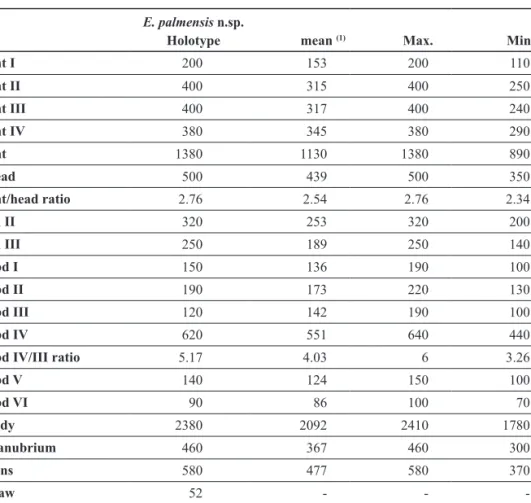
Tab. 1 Measurements of the new species (in micrometers), average from 7 specimens(1).
E. palmensis n.sp.
Holotype mean (1) Max. Min.
Ant I 200 153 200 110 Ant II 400 315 400 250 Ant III 400 317 400 240 Ant IV 380 345 380 290 Ant 1380 1130 1380 890 Head 500 439 500 350 Ant/head ratio 2.76 2.54 2.76 2.34 Th II 320 253 320 200 Th III 250 189 250 140 Abd I 150 136 190 100 Abd II 190 173 220 130 Abd III 120 142 190 100 Abd IV 620 551 640 440
Abd IV/III ratio 5.17 4.03 6 3.26
Abd V 140 124 150 100 Abd VI 90 86 100 70 Body 2380 2092 2410 1780 Manubrium 460 367 460 300 Dens 580 477 580 370 Claw 52 - - -Empodium 32 - - -Tenent hair 56 - -
-Body:
Length ratio Abd IV/III = 3-5. Claw with 4 internal teeth: first pair at 55% of distance
from base of claw, and two odd teeth, first at 80% of distance from base and the most distal
one minute; dorsal tooth in more basal position than the lateral ones that are below the level of
paired teeth. Empodium spike-like, with smooth inner edge on leg III (Fig. 1C). Furcal length
1080 μm (Holotype). Manubrial plate with 7-11 chaetae and 2 pseudopores (Fig. 1D). Mucro
with basal spine, subapical teeth similar to terminal one (Fig. 1E).
Chaetotaxy:
Simplified macrochaetae formula: 4-3-0-4-3/2-4/2-4/1-2-1/3-2-3-2-2.
Head chaetotaxy as in Fig. 2A. Thorax chaetotaxy: T1 area on Th II with 2 (m
1and m
2i) (3 in
some specimens by presence of m
2), T2 area on Th II with 4 (5 in some specimens by macrochaetae
duplication of a
5) macrochaetae present (a
5, m
4, m
4iand m
5) (Fig. 2B). Abdomen chaetotaxy
(Figs 2 C–D): A1 area on Abd II with two macrochaetae and A2 area on Abd II with four
macrochaetae. Abd III with one macrochaeta on area A3 and A5, two macrochaetae on A4 area.
Biology:
Habitats between 225 to 760 m asl mainly in soil, under stones and litter of
Pinus
canariensi
and
Salix
sp., and on or under low vegetation such as
Heliantemun
sp.,
Descurainia
millefolia
,
Viola palmensis
,
Erysimum scoparium
, and in mosses near water. This species
could be hygrophilous.
Discussion.
It has a colour appearance of
E. multifasciata
or the females of
E. nigrocincta
Denis, 1923, but the macrochaetotaxy is different from those species and others with a similar
colour pattern.
E. multifasciata
(3-1-0-2-2/2-3/2-2/1-2-1/0-2-3-2-2) is only coincident in Abd
III chaetotaxy,
E. nigrocincta
(3-1-0-2-2/2-3/1-2/1-1-1/0-2-3-2-2) present in the same area is
different in the whole chaetotaxy. The new species is the only known Entomobryini with this
chaetotaxy (4-3-0-4-3) on the head.
4. Faunal study
Localities with UTM-coordinates (all from the island of La Palma). All T. Domingo-Quero leg.
unless otherwise stated: Arroyo de la Cumbrecita (28RBS2078 4, 1200 m asl), 17 al 20 01 2001, 1; Arroyo Rivanceras (antes de juntarse con Almendro Amargo) (28RBS1879 4, 480 m asl), 27 07 1999, leg.: R. Araujo, 2; Barranco de las Traves (28RBS1780 2, 1040 m asl), 5 09 1999 al 16 07 2001, 3; Bejenado, comienzo de la senda de subida (28RBS2076 2, 1300 m asl), 26 03 2001, leg.: T. Domingo-Quero y A. Sánchez-Ruiz, 4; Casas de Taburiente (28RBS1880 3, 835 m asl), 13 12 1999 al 23 03 2001, 5; Casas de Tenerra (28RBS1780 2, 1090 m asl), 06 02 2001, 6; Cueva de los Arenales (28RBS2176 2, 1175 m asl), 16 06 2000 al 17 11 2000, leg.: R. García Becerra, 7; Cueva El Llanito, 02 03 1995, leg.: R. García Becerra, 8; El Riachuelo (28RBS2175 4, 950 m asl), 21 05 2001, 9; El Rodeo (28RBS1976 3, 1600 m asl), 25 11 1999, 10; Fuente de la Faya (Cumbrecita) (28RBS2176 4, 1100 m asl), 25 01 2001, 11; Fuente de la Zarza (28RBS1977 1, 1248 m asl), 18 09 1999 al 16 01 2001, leg.: T. Domingo-Quero y A. Sánchez-Ruiz, 12; Fuente de Viñátigo (28RBS2082 4, 1139 m asl), 03 07 2000 al 05 02 2001, 13; Fuente del Barranco del Limonero (28RBS2280 4, 1349 m asl), 03 07 2000 al 24 10 2000, 14; Fuente del Barranco Madera García (28RBS1977 3, 1152 m asl), 23 03 2000 al 16 01 2001, 15; Fuente Piedra Majorera (28RBS2281 2, 1410 m asl), 24 10 2000, 16; Genebuque (28RBS1680 2, 1150 m asl), 27 03 2001, leg.: T. Domingo-Quero y A. Sánchez-Ruiz, 17; Hoya de Lucía (cabecera del Barranco Hondo) (28RBS2382, 2100 m asl), 26 05 2000, 18; Hoyo Verde (28RBS1882 3, 1450 m asl), 21 09 1999 al 23 03 2001, 19; Huerto de Tenerra (28RBS1780 2, 1090 m asl), 27 03 2001, leg.: T. Domingo-Quero y A. Sánchez-Ruiz, 20; Junto a la entrada de la cueva de ‘Los Sorprendidos’ (28RBS1976 2, 1259 m asl), 25 01 2001, 21; Llano de los Pinos Chicos; junto a TS2 (28RBS1880 2, 800 m asl), 12 05 2001, 22; Lomo de las Chozas (28RBS2077 3, 1260 m asl), 06 10 1999 al 12 04 2000, leg.: T. Domingo-Quero y A. Sánchez-Ruiz, 23; Lomo Gazmil, base (28RBS1981 3, 850 m asl), 11 01 2000, 24; Lomo Gazmil; cementerio guanche (28RBS1981 3, 950 m asl), 11 01 2000, 25; Morro colorado (28RBS1880 1, 869 m asl), 12 05 2001, 26; Playa de Taburiente (28RBS1980 1, 760 m asl), 25 09 1999 al 18 09 2000, leg.: T. Domingo-Quero y A. Sánchez-Ruiz, 27; Recorrido de la Cumbrecita, barranco con humedad (28RBS2077 1, 1225 m asl), 30 03 2001, leg.: T. Domingo-Quero y A. Sánchez-Ruiz, 28; Roque de la Cumbrecita, parcela de los Heliantemun (28RBS2177 1, 1377 m asl), 25 08 1999 al 24 08 2000, 29; Roque de los Muchachos (parcela de la cebolla) (28RBS2084 3, 2250 m asl), 27 07 2000 al 09 05 2001, leg.: T. Domingo-Quero y A. Sánchez-Ruiz, 30; Tenerra (28RBS1680 2 y 28RBS1780 2, 1130 m asl), 06 12 1999 al 27 03 2001, leg.: T. Domingo-Quero y A. Sánchez-Ruiz, 31; Zona de Acampada; edificio (28RBS1980 1, 760 m asl), 12 05 2001, 32.
Sampling method. Under stones, a; Berlese under fig tree, b; Moss Berlese, c; Soil (organic matter
and needles) Berlese, d; Under wood stump, f; In the water and on shores, g; In the sediment and water column, h; Among stones and moss in damp area, i; Gallery forest litter, k; Pine litter, l; Phyllis nobla humus, m; Algae wash, n; Stone washing, o; Washing stones, sediments and mosses, p; Washing plant roots and moss, q; Washing plant roots, r; Washing roots beside a pool, s; Raising ‘madeira mahogany’ bark (Persea indica), t; Washing sediment pond with little current, v; Washing of moss and plant aquatic
Tab. 2
Comparative set of chara
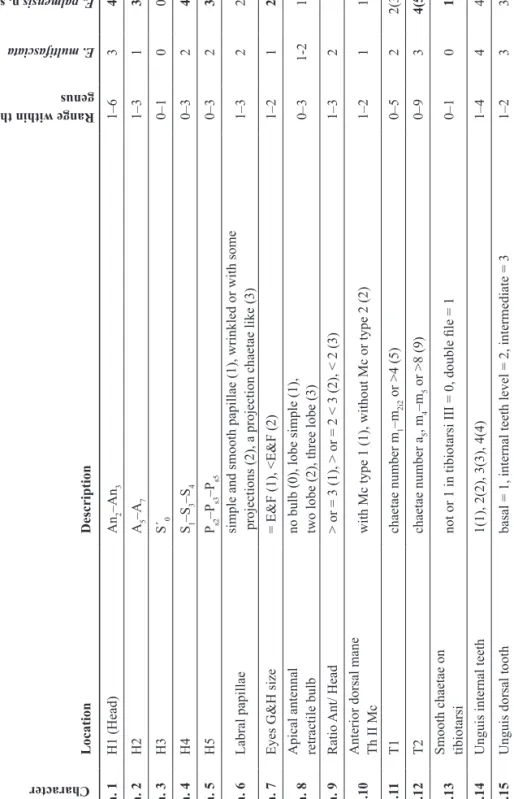
cteristics between E. palmensis n. sp. and E. multifasciata . Dif ferences in bold. Character Location Description
Range within the
genus E. multifasciata E. palmensis n. sp. Ch. 1 H1 (Head) An2 –An 3 1–6 3 4 Ch. 2 H2 A5 –A7 1–3 1 3 Ch. 3 H3 S´0 0–1 0 0 Ch. 4 H4 S1 –S3 –S4 0–3 2 4 Ch. 5 H5 Ps2 –Ps3 –Ps5 0–3 2 3 Ch. 6 Labral papillae
simple and smooth papillae (1), wrinkled or with some projections (2), a projection chaetae like (3)
1–3
2
2
Ch. 7
Eyes G&H size
= E&F (1), <E&F (2)
1–2
1
2
Ch. 8
Apical antennal retractile bulb no bulb (0), lobe simple (1), two lobe (2), three lobe (3)
0–3 1-2 1 Ch. 9 Ratio Ant/ Head > or = 3 (1), > or = 2 < 3 (2), < 2 (3) 1–3 2 Ch.10
Anterior dorsal mane Th II Mc
with Mc type 1 (1), without Mc or type 2 (2)
1–2 1 1 Ch.1 1 T1 chaetae number m 1 –m 2i2 or >4 (5) 0–5 2 2(3) Ch.12 T2 chaetae number a 5 , m 4 –m 5 or >8 (9) 0–9 3 4(5) Ch.13
Smooth chaetae on tibiotarsi
not or 1 in tibiotarsi III = 0, double file = 1
0–1
0
1
Ch.14
Unguis internal teeth
1(1), 2(2), 3(3), 4(4)
1–4
4
4
Ch.15
Unguis dorsal tooth
basal = 1, internal teeth level = 2, intermediate = 3
1–2
3
3
Ch.16
Unguis internal edge
without ciliation (0), with ciliation (1)
0–1
0
Ch.17 External unguiculous smooth (0), serrate (1) 0–1 0 0 Ch.18 A1 Abd II a2 –a3 0–2 2 2 Ch.19 A2 Abd II m3
series chaetae number
0–7 2 4 Ch.20 A3 Abd III a1 0–1 1 1 Ch.21 A4 Abd III above m 2 chaetae number 0–3 2 2 Ch.22 A5 Abd III m3 –m 4
series chaetae number
0–4 1 1 Ch.23 A6 Abd IV a1 –a5 (A 1 –D1 ) chaetae number; >8 (9) 0–9 0 3 Ch.24 A7 unpaired chaeta ma0 (A 03 ) 0–1 0 0 Ch.25 A7 Abd IV ma1 –ma 4 (A 2 –E1 ) chaetae number; >9 (10) 0–10 2 2 Ch.26 A8 unpaired chaeta m0 (A 04 ) 0–1 0 0 Ch.27 A8 Abd IV m1 –m 3 (A 4a –C 2a ) chaetae number; >5 (6) 0–6 3 3 Ch.28 A9 unpaired chaeta mp 0 (A 05 ) 0–1 0 0 Ch.29 A9 Abd IV mp 1 –mp 3 (A 5 –B5 ) chaetae number; >6 (7) 0–7 2 2 Ch.30 A10 Abd IV p1a –p3 (A 6 –B6 ) chaetae number; >5 (6) 0–6 2 2 Ch.31 A1 1 Abd IV T1 (ma 4e ) as trichbothrium 0–1 0 0 Ch.32 A12 Abd IV T2 (m 4 ) as trichobothrium 0–1 1 1 Ch.33 A13 Abd IV T4 (mp 4 ) as trichobothrium 0–1 1 1 Ch.34 A14 Abd IV T6 (p4 ) as trichobothrium 0–1 0 0 Ch.35 Ratio
Abd IV/Abd III
2 < R < 4 (1), R > 4 (2) 1–2 2 2 Ch.36 Manubrial plate chaetae number; >10 (1 1) 0–1 1 4 7-1 1 Ch.37 Manubrial plate pseudopores 1–2 1–2 2 2 Ch.38 Mucro
sub–apical tooth, without (0), normal (1), big (2), small (3)
0–1
1
1
Ch.39
Mucro
basal spine, absent (0), present (1)
0–1
1
Tab. 3 Collembolan fauna found in the ‘Caldera de Taburiente’. For localities and capture methods see the part of faunal study. sp or g. sp. meaning juveniles or deteriorated specimens.
Taxa, in alphabetic order Number of individuals Localities and sampling method
Arrhopalites sp. 6 7au
Bourletiellidae g. sp. 1 31ae
Brachystomella curvula Gisin, 1948 2 10l Brachystomella parvula (Schäffer, 1896) 2 27k
Ceratophysella gibbosa (Bagnall, 1940) 282 3aw, 3au, 23au, 27au, 31b, 31d
Dicyrtomidae g. sp. 5 3a, 13av, 16n, 24aq
Entomobrya nigrocincta Denis 1923 173 1n, 3av, 4ay, 5ac, 11p, 11ab, 13r, 19a, 19aq, 23au, 23av, 27k, 27ao, 27au, 27av, 29au, 32al Entomobrya palmensis n. sp. 866 3au, 3av, 4ay, 9a, 12g, 12p, 19as,
21a, 23au, 23av, 25ar, 26aa, 27k, 27au, 28ax, 29c, 29d, 29x, 29au, 29av, 30a, 30z, 30au, 30ak Entomobrya sp. juvenile 25 3aw, 3at, 3au, 13a, 19j, 19aq,
23au, 27au, 29at, 30au, 31d, 31b
Fasciosminthurus sp. 1 29at
Folsomides cf. zairensis Martynova, 1978 58 29c Hemisotoma cf. bituberculatus (Wahlgren, 1906) 24 3aw Hemisotoma debilis (Cassagnau, 1959) 1 29c Hemisotoma thermophilus (Axelson, 1900) 1 3au Heteromurus nitidus margaritaria
(Templeton, 1835) 31 7au, 8au
Isotomidae g. sp. 2 16h, 19v
Isotomurus cf. palustris (Müller, 1776) 32 1a, 12g, 12w, 12an, 13r, 14o, 15am, 16q, 19i, 27av, 28ax, 31b Lepidocyrtus nigrescens Szeptycki, 1967 200 3a, 3m, 3t, 3au, 3av, 8au, 19a,
21a, 22a, 27ag, 27au, 27av, 27az, 31a
Mesaphorura orousseti Najt, Thibaud & Weiner,
1990 1 31b
Metaphorura denisi Simón Benito, 1986 1 3aw Parisotoma notabilis (Schäffer, 1896) 16 27k, 29d, 31b Pratanurida boerneri (Schött, 1902) 3 31d
Pseudosinella sp. 1 31b
Seira dinizi Gama, 1988 129 3a, 3at, 3av, 6a, 18a, 19as, 30a,30au, 30av, 31d
Seira sp. 3 5ap, 27au
Sminthuridae g. sp. 9 29d, 31d, 31y
Sminthurinus sp. 2 29c, 29au
Sminthurus sp. 38 5ad, 6ai, 15p, 17aj, 20ah, 23av, 27ag, 28ax, 31a, 31af
Sphaeridia sp. 2 3av, 29au
Symphypleona varia 53 3aw, 3av, 23au, 27k
Vertagopus sp. 2 2am
roots, w; Beating Descurainia millefolia, x; Beating on low vegetation, y; Beating ‘alholí’ (Erysimum scoparium asl), z; Beating Saint-John´s-wort (Lotus hillebrandii), ‘tedera’ (Psoralea bituminoso), common bracken (Pteridium aquilinum asl) and faya (Myrica faya), aa; Beating faya (Myrica faya), crofton weed (Ageratina adenophora), tree heath (Erica arborea) and Canary Island pine (Pinus canariensis), ab; Beating herbaceous plants, ac; Beating herbaceous plants beside a road, ad; Beating purple viper‘s bugloss (Echium plantagineum asl) and common bracken (Pteridium aquilinum asl), ae; Discretionary beating, af; Beating at night, ag; Beating herbaceous plants and annual bastardcabbage (Rapistrum rugosum asl), ah; Beating grass, ai; Beating flowered viola (Viola palmensis), ak; Beating purple viper´s bugloss (Echium plantagineum asl) and Vicia, al; Water sampling, am; Water sampling: moss on stones, an; Nocturnal sampling, ao; On ‘bejeque’ (Aeonium sp.), ap; On crofton weed (Ageratina adenophora), common bracken (Pteridium aquilinum asl) and taro (Colocasia esculenta), aq; On pine (Pinus canariensis), ar; On ‘poleo’ (Bystropogon origanifolius), as; Yellow trap, at; Pitfall trap, au; Malaise trap, av; Moss on rocks, aw;Winkler trap (soil) and pine needles (Pinus canariensis), ax; Dead pine trunk (Pinus canariensis) and soil under it, ay; Winkler (soil of willows) (Salix sp.), az.
E. Palmensis
is the most abundant collembola species in the fauna of the Caldera de
Taburiente. Among the 1978 Collembola collected in the study, 866 are
E. palmensis
n. sp.
followed by
Ceratophysella
gibbosa
(Bagnall, 1940) (282 sp.),
Lepidocyrtus nigrescens
Szeptycki, 1967 (200 sp.),
Entomobrya nigrocincta
Denis 1923 (173 sp.) and
Seira dinizi
Gama, 1988. (129) (see Table 3)
Etymology.
The species was named after the island.
5. Acknowledgements
We wish express our gratitude to M. A. Alonso-Zarazaga, J. L. Nieves-Aldrey and other
project participants from the ‘Museo Nacional de Ciencias Naturales, Madrid’, for the
oppor-tunity to study the Collembola.
6. References
Christiansen, K. (1958): The Nearctic members of the genus Entomobrya (Collembola). – Bulletin of the Museum of Comparative Zoology 118 (7): 1–545, 24 pl.
Domingo-Quero, T., M. A. Alonso-Zarazaga, A. Sánchez-Ruiz, R. Araujo Armero, A. Navas Sánchez, S. Sánchez Moreno, R. García Becerra, M. Nebreda, M. Sánchez Ruiz, F. Fontal-Cazalla, & J. L. Nieves-Aldrey, (2003): Inventariando la biodiversidad en el Parque Nacional de la Caldera de Taburiente (La Palma, Islas Canarias, España): novedades científicas. – Graellsia, 59 (2-3): 45–68.
Jordana, R. & E. Baquero (2005): A proposal of characters for taxonomic identification of Entomobrya species (Collembola, Entomobryomorpha), with description of a new species. – Abhandlungen und Berichte des Naturkundemuseums, Görlitz 76 (2): 117–134.