SCHOOL AS ‘LEARNING ORGANISATION’ – PRELIMINARY
FOUNDATIONS
Katarzyna Ewa Potyrala
adjunct/assistant professor, Pedagogical University of Cracow, Institute of Biology, Department of Biology Didactics, 31-054 Cracow, Podbrzezie street no 3, Poland
Phone: +48126626705
E-mail: [email protected] ; [email protected] Website (institution): http://www.ap.krakow.pl
I.SCHOOL AS AN INSTITUTION TRANSFERRING KNOWLEDGE – EDUCATIONAL TASKS
The present educational tasks find reflection in syllabuses and educational standards. Their analysis reveals the general tendencies of changes in thinking about the new school of knowledge-based society.
A detailed analysis of educational objectives shows in a way the direction of activity at particular stages of education. Some detailed teaching aims relate to the tasks of school, declared by the authors of programmes, such as universalism and cultural identity, multiculturism, the principles of tolerance and democracy.
What should also be mentioned here is formation of attitudes of acceptance of one's responsibility for the survival of the Earth and attitudes increasing the awareness of the consequences of one's direct and indirect actions. New educational thinking should be governed by two new categories – in the global and local sphere and it should specify new competences of teachers.
School is usually perceived as an institution transferring knowledge, fulfilling educational tasks and realising educational objectives. New educational tasks determine new styles of teachers' work and also their competences, showing that the effects of the course of didactic process depend on the teacher's awareness to a large extent, on his or her way of understanding of the school's reality and the students themselves.
School achievements’ issues can be taken into account in several aspects: measuring of the teaching results, general student’s development, examination success and even life success due to efficient using of acquired knowledge. For biology teachers their students’ high results in every examination situations are still the measure of success (Fig. 1).
school grades school competitions result of secondary school final exam
Fig 1. The results of teacher’ answers on question: What is it the measure of school achievements?120 teachers participated in the survey in 2004-2007(Potyrala & Walosik, 2008).
The conditions for high students’ achievements are usually difficult to specife as it is very difficult to specify explicitly if the level of knowledge and development at the stage of education is a kind of pedagogical success.
Yet, we can state that the high school achievements in biology and environmental education are connected with the small number of students (Fig.2).
0 5 10 15 20
class A class B class C
number the grades A number the grades B number the grades C number the grades D number the grades E
Fig. 2. Comparison of the results of secondary school students’ achievements test. The students of the first level of education participated in the research (3 classesof the first level: A, B, C). The test concerned in the range of the teaching contents connected with the basis of heredity and changeability of organisms. The average result = C(3,2) (Potyrala & Walosik, 2008).
Excess of information connected with new achievements in the field of biology science leads to the awareness of existence of knowledge whose resources are unavailable in the course of school education. Currently the media are ever-present. The teacher must be aware of the influence of outside school interference and psychological barriers related to the communication process. Mass media and hypermedia shape new patterns and new values. The ‘overheated’ and synthetic announcements often limit the intellectual effort and the critical thinking the students. Mass medias prolong students’ senses but instead of they participations in life they give usually feeling of ‘second hand life’.
Overloading of science and biology curricula, few hours allocated for working on them and perceiving only simple cause and effect relations accompanying the didactic processes by the majority of teachers increase the distance between the student and the concept of metacognition necessary for the possibility of permanent education.
II.TEACHING TO LEARN SCHOOL –CHALLENGES FOR BIOLOGY EDUCATION IN
KNOWLEDGE-BASED SOCIETY
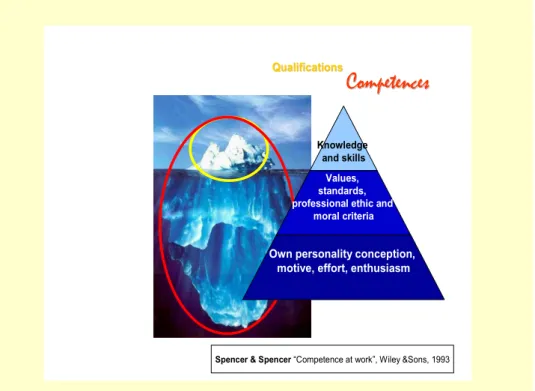
The model of Spencers’ iceberg (Spencer & Spencer, 1993) was very significant for the concepts of school evolution towards ‘the learning organisation’ or rather ‘teaching to learn organisation’. As can be seen (Fig 3) the top of the iceberg are knowledge and skills and they constitute qualifications (confirmed with diffrent diplommas). What can not be seen and forms the base of the iceberg are: own personality conception, motive, effort, enthusiasm,values, standards, professional ethic and moral criteria. Only all these together decide abort competence, which is so often given as the quality of school work.
13 Spencer & Spencer“Competence at work”, Wiley &Sons, 1993
Qualifications Qualifications
Competences
Competences
Knowledge and skills Values, standards, professional ethic andmoral criteria
Own personality conception, motive, effort, enthusiasm
Fig. 3. Relation between qualifications and competences (Model of Spencers’ iceberg).
In the course of learning the students’ system of values in connection with citizen’s, social-political, family and professional roles develops. The need for presenting teaching contents in the context of the world of values that exceeds the individual and their clarification. In order to move towards the model of generative education and critical – creative doctrine, there is a tendency to create and popularize the models of reflective education, oriented towards shaping and development of values. In biology education there is talk about shaping attitudes which are connected with the values, norms and patterns of conduct.
Information, which is a way of human communication; of one man going out towards another man, yet which is not built on substantial foundations of impartial truth, becomes a way of manipulating man. In information flowing from social groups to particular individuals there are contents of norms and principles of behavior, impulses to apply them or even warnings regarding all kinds of sanctions in case of disobeying them.
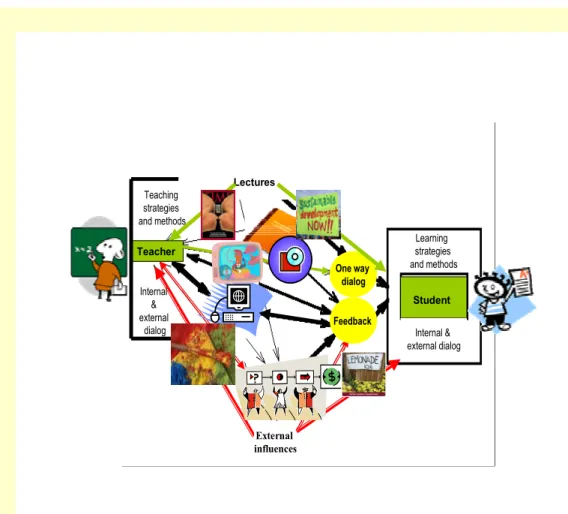
So, in the conceptof ‘teaching to learn school’ are also attributed an important funcion to the students’ dialog relationship in which the teacher appear as a facilitator and in the dialog feedback plays a significant role (Fig. 4). One way dialog was present because of the lectures but it was of lesser importance.
14 Lectures Teacher Student Teaching strategies and methods Internal & external dialog External influences Internal & external dialog Learning strategies and methods One way dialog Feedback
Fig. 4. Students’ dialog relationship
In view of numerous ethical and moral issues regarding the safety and security of applying biology achievements in various areas of knowledge and life, attention is drawn to the necessity of extensive discussion; not only among professionals (genetic engineers or physicians), but also among specialists in other areas of knowledge, e.g. philosophy, law, sociology, psychology and theology.
There also is a view that fast pace of development of science and technology as well as accompanying it civilization changes causes the necessity of moving away from traditional ethics and building the foundations of a new one, capable of facing difficult challenges of the contemporary world. It means mainly: culture and media. It makes biology education confront opinions, views and interests of various social and professional groups.
In addition to this we must take into account that learning is a function of activity and situational context, under which knowledge is acquired. Despite the feeling, that the global reality keeps shrinking, the' global village' seem to be something really elusive for 'MTV generation' students, the computer network is often visual representation of their identity ('the internet family’, team ‘grono’, ‘tribal bonds’ are as very important relationships for them), thanks to speed of transfer students have deep conviction about participation in creating mass culture, the cyberculture.
K. Potyrala & A. Walosik
K. Potyrala & A. Walosik
POLAND POLAND Imperium MP3 IPhonologia MTV Generation tamagotchi JINSEI
Family of the Internet
Cyberculture
It requires from teachers use of strategies leading to rebuilding the earlier structure of students’ knowledge, creating different structures in connection with new students’ concepts and needs in response to new information. Media become identified by receivers with reality, so, what seems real is more important from what is real in fact... It requires from teachers use of strategies leading to rebuilding this point of view.
K. Potyrala & A. Walosik
K. Potyrala & A. Walosik
POLAND
One can come up with a conclusion that there is a need to extend the research on individual competence which Lyle and Signe Spencer illustrated by means of an iceberg (Spencer & Spencer, 1993). Values are difficult to teach, yet they have unquestionable importance for efficiency and effectiveness of learning. Motives, labour ethics, enthusiasm and own image (the bottom of the iceberg) is not enough to acquire metacognitive skills, and the sole knowledge and abilities (surface and the top of the iceberg) shall not ensure a high level of efficiency of learning. Competence must be characterised by interactivity, which means its constant updating, appropriately to new contexts.
Members of ‘learning organization’must be aware that the final objective requires grading of difficulty and its achievement is a long-term process with many stages. Particular stages are consecutive degrees of development. Students should have a clear picture of what they are aiming at, be ready to change their concepts, their approaches and attitudes.
Hence, school as a ‘learning organization’ should be addapted for the general model of such an organization, however due to its own specific objectives it should be subject to slightly different processes (Potyrala, 2008).
III.THE STAGES OF SCHOOL EVOLUTION TOWARDS A ‘LEARNING ORGANIZATION’
The slogan ‘the learning organisation’ fashionable and popular since the nineties of the 20th century, is a notion which in reference to school is partly metaphorical and functioning without clear structure and organisational plan.
School evolution towards a ‘learning organization’ can increase the distance from traditional curriculum and traditional role of the teacher in the process of education. At a certain point ‘lerning schools’ can start following their own paths in connection with the ideas generated by them. Monitoring those paths is necessary. Like students learn from one another so ‘learning organizations’ must take advantage of each other’s experiences. Teachers must often contact one another and schools and students must have access to didactic materials. Free access to educational materials, information flow and comparative evaluation of effects are a priority. As the members of ‘strategic planning committee’ it is students who should help define future objectives and specify the ways of achieving them by instructions, ways of communication, technologies and strategies.
Bibliography referring to the favourable atmosphere for didactic innovations and active forms of science and biology learning is comprehensive. Publications about school biology education often refer to places (laboratory, school garden, field classes, museum) where the teachers have tools and experience necessary for teaching of predicted contents, less frequently they refer to what the teachers need in order to create a chance for cooperation and learning from others (Potyrala, 2008).
The diffrences in approach may be related to the debate about the definition and concept of learning in connection with the relations between learning and development (Piaget, 1946; Vygotsky, 1989 [1934]), question about dimensions of learning (Illeris, 2006) or conditioning factors while taking into account individual cognitive structures (Ausubel, 1968).
It seems however, that differentiated approaches to learning can be compatibile with one another and they point to the situations where they develop various form of knowledge, both subject knowledge and metaknowledge. In his learning model, Kolb (1984) provides an interesting and inspiring image of the internal structure of learning processes, Giordan (1995), exceeds the three basic dimensions of the learning act and constructivistic learning model while elaborating his own ‘allosteric learning model’,
which describes what is happening in the student’s mind when general conditions make learning (biology learning) easier.
In accordance with the latter model biology teaching and making it available for everybody or at least for the majority of people requires quite complex procedures. However it is possible through classifying the basic parameters which make the learning process easier on a regular basis. It supports the thesis that gradual transformation of school into a ‘learning organization’ and ‘learning to learn organization’ might begin with ourselves, formal and informal biology education understood and organized in a modern way.
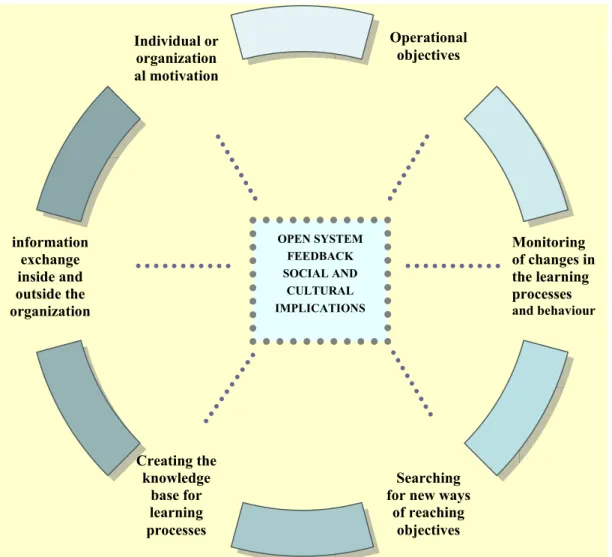
Transformation processes (Diagram 1) should begin with curriculum guidelines, through curriculum, updated educational objectives until new procedures of achieving them. This ‘school confusion’ must, however be accepted socially, information about changes is important as well as gathering opinions about innovative ideas.
Diagram 1. Transformation system towards ‘learning organization’
First step towards ‘teaching to learn school’ could be new type of learning oppotunities, as for instance:
bringing exciting curricula based on real-world problems into the classroom
providing scaffolds and tools to enhance learning
giving students and teachers more opportunities for feedback Operational objectives Monitoring of changes in the learning processes and behaviour Individual or organization al motivation Creating the knowledge base for learning processes Searching for new ways
of reaching objectives information exchange inside and outside the organization OPEN SYSTEM FEEDBACK SOCIAL AND CULTURAL IMPLICATIONS
reflection, and revision
building local and global communities
expanding opportunities for teacher learning.
Second step could be focused on the fact that student should be equipped not only with theorethical knowledge and some skills, but the knowledge and skills they acquire should influence the ways of thinking and acting. So, we have to deliver the situations in which, students can activate new knowledge and check the effectiveness and limits of it. Students have to be able to use “knowledge about knowledge” and exchange moments of learning on the metacognitive moments. The levels of cognitive activities can be connected with students’ improvement metacognitive competence (Table 1).
Table 1. The levels of cognitive activities and students’ improvement metacognitive competence
LEVELSOF COGNITIVE ACTIVITIES EXAMPLESOF STUDENTS ACTIVITIES EXAMPLESOFSTUDENTS’ IMPROVEMENT METACOGNITIVECOMPETENCE Level of theoretical structures and sensual
cognition
activity expressing itself in arriving at new
statements
Searching for information,
observation making, deepening knowledge of biological laws, rules and principles
Level of imaginative models
activity on the acquired material, when the individual participating in
its creation
Completing the existing structure of knowledge and forming new structures, forming imaginative
models of biological phenomena, analysis of interdependencies between structure
and function
Level of symbolic models
activities of the subject regarding arranging the
contents
Analysis of extra-textual sources of information and
realization of practical activities, construction and analysis of process and phenomena models
Level of sensual cognition and theoretical
structures
verbalization – naming what is given from outside,
what is happening or is going to happen (also in the
subject’s activities) in image (performance) form
Problem solving, verifying imaginings regarding phenomena and processes (e.g. phenomena and
experiments simulation)
Level of sensual cognition and theoretical
structures
repetitions serving cognition and revision
Choice of the way of working with the program (from experiment to theory or the other way round), developing individual plans for complex activities facilitating understanding of biological
laws, rules and principles
Next the task, as for example: solving problem situations basing on sience and biology knowledge and connections between different areas of knowledge, integrating knowledge from various areas of biology and ordering it in adequate structures; categorizing, looking for solutions using the patterns from various categories, communicating in various situations, looking for the patterns of non-verbal communication, control and correction of task situation, producing ideas and verifying theories, rearranging, creating, predicting, communicating.
Assuming the approach that comprehensive characteristics of cognitive skill should describe its acquisition as well as knowledge and strategies applied at all the levels of skills, this idea has been competed by essential operational objectives (Table 2).
Gagné gives 9 such verbs, and the list has been modified according to Klopfer’s suggestions, and then the list of those verbs has been extended by the author’s proposals together with the contextual and individualized completion for the elaborated preliminary foundation of the project (Potyrala, 2007).
Table 2. Skills (competences) and matching them verbs/activities *according to Gagne’s concept, ** completion according to Klopfer’s concept, *** completions according to the author’s concept and operational verbs created on their basis
SKILLS/COMPETENCES *VERBS /***STUDENT’S ACTIVITIES OPERATIONAL VERBS
*differentiating *differentiates, **analyzes, ***searches choose, find, analyze, recognize *specific notions *differentiates, **characterizes,
***concretizes
define, explain, specify, show *abstract notions *classifies, **orders, ***specifies associate, present,
order *rule *demonstrates, **transposes, ***gives
rules, ***poses hypotheses, ***assumes
specify in detail, give, use, *Intellectual skills *superior rule (problem solving)
*produces, **reveals, ***concludes, ***links the reasons, ***links
reveal, link, create
*cognitive strategy *assumes, **uses, ***justifies,
***creates, ***interprets, ***plans
apply, justify, interpret,
plan
*verbal information *expresses, **describes,
***generalizes/summarizes,***compares
summarize, compare, formulate, describe
***nonverbal information ***communicates, ***synthesizes use, give
*motoric skill *performs, **carries out experiments,
***checks theory in practice
perform, check, solve
*attitude *chooses, **evaluates, ***justifies,
***controls
choose, evaluate, justify
IV.AS A CONCLUSION…
Necessity of these changes of school is the consequence of psychical needs of learners in the situation of universal access to information. The changes must regard the content, form and range of information together with individual experience of the information user.
Functions which are transmitted to the user for realization by the hypermedia and the way of their realization may devoid him of habits connected with then process of communicating with people or lead to violation of the balance in contacts with the surrounding reality.
School transformation system towards ‘learning organization’ refers to people (teachers and learners) who participate in the process of changes (‘be’), develop the ways of thinking (‘know’), build strategic partnerships (‘do’) and have the motivation and capacity to learn (‘learn’).
Such elements of every ‘learning organisation’ as: communication, reward the process, building a collaborative environment, job orientation and capturing knowledge must be included into this scheme. ICT can be a stymulator of these changes. Information Systems professionals play a key part in the management of information and knowledge resources by providing key systems to manage the flow of information which is a crucial aspect of the learning organization. “The essence of a learning organization is that people
are changing, people are developing ways of thinking and ways of interacting (...)where people expand their capacity to create the results they truly desire, where new and expansive patterns of thinking are nurtured, where collective aspiration is set free, and where people continually are learning how to learn together” (Solomon, 1994).
BE
KNOW
DO
V.INVITATION
REFERENCES
Ausubel, D. P. (1968). Educational Psychology: A Cognitive View. New York: Holt, Rinehart and Winston
Giordan, A. (1995). Les nouveaux modèles pour apprendre: dépasser le constructivisme ? Perspectives, 25, 109-127
Illeris, K. (2006). Trzy wymiary uczenia się. Poznawcze, emocjonalne i społeczne ramy współczesnej teorii uczenia się, Wydawnictwo Naukowe Dolnośląskiej Szkoły Wyższej TWP, Wrocław
Kolb, D. A. (1984). Experiential learning. Englewood Cliffs: Prentice-Hall
Piaget, J. (1946). La formation du symbole chez l’enfant. Neuchåtel : Delachaux et Nestlé Potyrala, K. (2007). L'exploration de l'influence des technologie de l'information sur les capacités métacognitives des élèves de lycée, ACCEDIT
This invitation is sended to everyone, who is interested in the idea of school as ‘learning organisation’ and who wants to participate in the process of creating and introducing it in school life. If you would like to divide with your reflections, observations or results connected with the real functioning of some elements of ‘teaching to learn school’ system, then this invitation is directed just to You.
You are welcome... [email protected]
Potyrala, K. (2008). Teaching to learn school – challenges for biology education in knowledge-based society. Problems of Education in The 21st Century. Recent Issues in Education, 6, 159-168
Potyrala, K. & Walosik, A. (2008). Biology and environmental protection school achievements in the light of research at different stages of education. Edukacja biologiczna i środowiskowa. Innowacje. Inspiracje, 1-2 (25-26), 40-48
Solomon, C. M. (1994). HR facilitates the learning organization concept. Personnel Journal (73)11, p56, 9p, Retrieved from http://ecampus.phoenix.edu
Spencer, L.M. & Spencer, S.M. (1993). Competence at work. Models for superior performance, New York, Jon Wiley & Sons
Vygotsky, L.S. (1989) [1934]. Myślenie i mowa, Wydawnictwo Naukowe PWN, Warszawa