XV
Laminate
Flooring
Laminate
Flooring
XV. Laminate Flooring
Collection Thickness Installation System Residential Light Commercial Commercial Brand American Duet 8mm Lock&Fold x x Ar mstr ongClassics & Origins
8mm Angle/Angle x x Ar mstr ong Coastal Living 12mm Lock&Fold x x Ar mstr ong Cumberland II 7mm Angle/Angle x Ar mstr ong Exotics 8mm Lock&Fold x x Ar mstr ong Fine Finish 12mm Lock&Fold x x Ar mstr ong Grand Illusions 12mm Lock&Fold x x Ar mstr ong Hear tland 8mm/w pad Angle/Angle x x Ar mstr ong Illusions 8mm Lock&Fold x x Ar mstr ong Inspiration 12mm Angle/Angle x x Ar mstr ong Long Plank 12mm Lock&Fold x x Ar mstr ong Rustics 8mm Lock&Fold x x Ar mstr ong Rustics Pr emium 12mm Lock&Fold x x Ar mstr ong
Stones & Ceramics
8mm Angle/Angle x x Ar mstr ong Value Collection 8mm/w pad Angle/Angle x x Ar mstr ong Value Collection 8mm/w pad Lock&Fold x x Ar mstr ong Commer cial Lustr e 12mm Lock&Fold x x x Ar mstr ong Commer cial Pr emium 12mm Lock&Fold x x x Ar mstr ong Commer cial T raditional 12mm Angle/Angle x x x Ar mstr ong
American Home Elite
8mm Angle/Angle x x Br uce
Laminate Flooring
Armstrong and Bruce
Collection Thickness Installation System Residential Light Commercial Commercial Brand Chelsea Park HG 8mm Lock&Fold x x Br uce Gar denstone 8mm Angle/Angle x x Br uce Heritage Heights 7mm Angle/Angle x Br uce Park A venue 12mm Lock&Fold x x Br uce Reser ve 8mm Lock&Fold x x Br uce Reser ve Pr emium 12mm Lock&Fold x x Br uce Seams: Ar mstr ong 99 or Br
uce EverSeal Adhesive to be used in:
Full Bathr
oom Installations
– 100% silicone caulk must be used ar
ound the entir
e perimeter and a 3/32" bead of glue on the top of the
tongue ONL
Y. Bathr
oom installation is for r
esidential use only
.
Light Commer
cial & Commer
cial Installations – Must be installed using a 3/32
" (2.4 mm) bead of glue on the END gr
oove ONL
Y.
Place opened car
tons of planks in the r
oom wher
e they ar
e to be installed for at least 48 hours. In drier climates below 25% RH
or ver
y humid climates above 60% RH allow 96 hours of acclimation time. Example: dr
y envir
onments such as Colorado and
Arizona and wet envir
onments such as Florida and Geor
gia.
Special Pr
ecautions and Recommendations:
1.
Ar
mstr
ong and Br
uce Laminate Flooring may be installed in r
esidential full bathr
ooms following the guidelines outlined in the
Bathr
oom Installation – Section H of this chapter
.
2.
Ar
mstr
ong and Br
uce Laminate Flooring ar
e not r
ecommended over most carpets or in high-humidity ar
eas wher
e the floor is
nor
mally wet – e.g., steam r
ooms or saunas.
3.
Level floors with a suitable cement-based, self-leveling underlayment following the manufactur
er’
s r
ecommended guidelines.
4.
Radiant heated subfloors should not exceed 85°F (29°C).
5.
Ar
mstr
ong and Br
uce Laminate Flooring cannot be installed over carpet unless the carpet is a maximum 1/4" (6.35 mm) thick and
fully adher
S-1836 Quiet Comfort
Premium Underlayment
For use with the following Installation Systems:• Residential Laminate Flooring • Light Commercial Laminate Flooring • Commercial Laminate Flooring DESCRIPTION:
Warranty: 30-Year underlayment warranty Gauge: 0.075" overall thickness (+-0.010") Width: 45"
Shipping: 4.5 lbs./roll (100 sq. ft./roll) Weight: 66 lbs./roll (1500 sq. ft./roll) Color: White foam on black film
Acoustical Data: STC (Sound transmission class) – 67
IIC (Impact insulation class) over 6" concrete slab – 67 Installation: Location: Concrete, wood underlayment and existing vinyl
System: Laminate floating installations Install: Logo side up
Recommendation: Under all Laminate with no attached underlayment
(Use Armstrong moisture barrier under laminate with attached underlayment.)
Type: High density cross-linked polyethylene foam laminated to 0.003" polyethylene film moisture barrier.
Advantages: Noise: Provides superior reduction vs. standard closed cell foam and fiber pad underlayments.
Moisture: Does not promote mold or mildew growth and will not decay.
Subfloor: Provides a cushion between the floor and the subfloor and compensates for slight subfloor irregularities.
S-1837 Quiet Comfort
Underlayment
For use with the following Installation Systems: • Residential Laminate Flooring
• Light Commercial Laminate Flooring • Commercial Laminate Flooring DESCRIPTION:
Warranty: 30-Year underlayment warranty Gauge: 0.075" overall thickness (+-0.010") Width: 48"
Shipping: 2.67 lbs./roll (100 sq. ft./roll) Weight: 43 lbs./roll (1500 sq. ft./roll) Color: White foam on black film
Acoustical Data: STC (Sound transmission class) – Low to mid 50’s IIC (Impact insulation class) over 6" concrete slab – 54 Installation: Location: Concrete, wood underlayment and existing vinyl
System: Laminate floating installations Install: Logo side up
Recommendation: Under all Laminate with no attached underlayment
(Use Armstrong moisture barrier under laminate with attached underlayment.)
Type: Polyethylene closed-cell foam laminated to 0.003" polyethylene film moisture barrier.
Advantages: Noise: Provides superior reduction vs. standard closed cell foam and fiber pad underlayments.
Moisture: Does not promote mold or mildew growth and will not decay.
Subfloor: Provides a cushion between the floor and the subfloor and compensates for slight subfloor irregularities.
Armstrong 99 Adhesive
CAUTION! 99 EYE AND SKIN IRRITANT
For use with the following Installation Systems: • Residential Laminate Flooring
• Light Commercial Laminate Flooring • Commercial Laminate Flooring DESCRIPTION:
Type: Polyvinyl acetate cross-linking emulsion (water-based) Color: White when wet; dries opaque in 1 hour; contains no
visible taggants
Taggants: None
Applicator: Predrilled cap on 16 oz. bottle
Spread Rate: 3/32" (2.4 mm) bead up to 150 sq. ft. (500 lin. ft.)/ 16 oz. bottle
Units: Single unit 16 oz. bottle (473 ml) Removal
from surface: Wet: clean, white cloth dampened with warm water.Dry: can be easily peeled away. Remove residue/haze with cloth dampened with 8 oz. (1 cup) white distilled vinegar to 1 gal. water (1:16 ratio)
Advantages: Nonflammable Easy clean up
Designed to create a strong water resistant bond between tongue and groove; use for laminate installations in full bathrooms, high moisture areas, and light commercial environments
Shelf Life: 1 year, unopened Freeze/Thaw Stable: Keep from freezing
VOC Content: 25 g/L; calculated and reported, SCAQMD 1168 Storage: Keep from freezing
Items per carton: 12 per carton Weight: 14.4 lb./ctn
Bruce EverSeal Adhesive
CAUTION! EverSeal EYE AND SKIN IRRITANT For use with the following Installation Systems:
• Residential Laminate Flooring • Light Commercial Laminate Flooring • Commercial Laminate Flooring DESCRIPTION:
Type: Polyvinyl acetate cross-linking emulsion (water-based) Color: White when wet; dries opaque in 1 hour; contains no
visible taggants
Taggants: None
Applicator: Predrilled cap on 16 oz. bottle
Spread Rate: 3/32" (2.4 mm) bead up to 150 sq. ft. (500 lin. ft.)/ 16 oz. bottle
Units: Single unit 16 oz. bottle (473 ml) Removal
from surface: Wet: clean, white cloth dampened with warm water.Dry: can be easily peeled away. Remove residue/haze with cloth dampened with 8 oz. (1 cup) white distilled vinegar to 1 gal. water (1:16 ratio)
Advantages: Nonflammable Easy clean up
Designed to create a strong water resistant bond between tongue and groove; use for laminate installations in full bathrooms, high moisture areas, and light commercial environments
Shelf Life: 1 year, unopened Freeze/Thaw Stable: Keep from freezing
VOC Content: 25 g/L; calculated and reported, SCAQMD 1168 Storage: Keep from freezing
Items per carton: 12 per carton Weight: 14.4 lb./ctn
S-135 VapArrest Professional
Moisture Retardant System
CAUTION! S-135 EYE AND SKIN IRRITANT For use with the following Installation Systems:
• Residential Laminate Flooring • Light Commercial Laminate Flooring • Commercial Laminate Flooring DESCRIPTION:
Type: Two-part cross-linked epoxy resin
Color: Pale Red
Mixing: Stir well before using, mix both components A and B in the pail containing part A using a power mixer (1/2" drill and paint or plaster paddle). Mix thoroughly for 2 minutes eliminating all color/clear streaks. Do not over mix. Applicator: Medium nap paint roller with extension handle Spread Rate: 270 sq. ft./gal. unit at 6 mil using a medium nap roller Units: Each unit (ctn.) contains 1 part A and 1 part B quart, 1.1
gallon, or 2.2 gallon Removal
from surface: Remove wet or uncured materials with mineral spirits Advantages: Reduces water vapor transmission up to 75% (to less than
3 lbs./1000 sq. ft./24 hrs.;
Reduces potential for mold and mildew growth
No additional prep time, easy to apply, rapid curing; ready to install next day
Used over cementitous leveling compounds, environmentally friendly
Low odor, no VOCs & low perm rating Shelf Life: 1 year, unopened
Freeze/Thaw Stable: To 10°F (-12° C)
VOC Content: 0 g/L; calculated and reported, SCAQMD 1168 Open time: 8-24 hours when tack free
Working time: 60 minutes
Substrates: Concrete; properly mixed and applied Portland Cement-based underlayments; primed, properly prepared poured-in-place gypsum subfloors (dust free)
Bruce Equalizer Premium
Urethane Adhesive
CAUTION
! Equalizer EYE AND SKIN IRRITANT For use with the following Installation Systems:
• Residential Laminate Flooring • Light Commercial Laminate Flooring • Commercial Laminate Flooring DESCRIPTION:
Type: Moisture cured urethane adhesive contains no water. It cures by absorbing available moisture which causes a chemical reaction. The reaction causes the adhesive to turn from a liquid to an elastomeric solid.
Color: Brown
Taggants: None
Trowel: V-notch1/4"D x 3/16"W x 5/16"A Spread Rate: 50-60 sq. ft. /gal.
Units: 3.5-gallon pail Removal
from surface: Wet: clean white cloth with mineral spirits Advantages: Excellent bond strength
Long working time
Perfect for commercial or residential applications Shelf Life: 1 year, unopened
Freeze/Thaw Stable: 10° F (-12° C); avoid low temperatures or multiple freeze/ thaw cycles
VOC Content: 77 g/L; calculated and reported, SCAQMD 1168 Storage: Stored at 65°-90°
Unopened containers – Do not expose to direct sunlight. Opened containers – Because this material is a moisture cured urethane, exposure to atmospheric conditions rapidly diminishes the pot life of the material. Once exposed, the curing process cannot be stopped. The curing process can be slowed by placing a piece of polyethylene film on the surface (in contact with the unused portion of the adhesive) and replacing the lid making sure it is tight.
Items per carton: Sold individually Weight: 45.31 lbs. /pail
Summit All-in-One
Hardwood Adhesive
For use with the following Installation System:• Residential Laminate Flooring • Light Commercial Laminate Flooring • Commercial Laminate Flooring DESCRIPTION:
Type: Modified silane
Color: Off-white
Taggants: None
Trowel: Square notch: 3/32"D x 3/32"W x 3/32"A – Parquet; V-notch: 1/4"D x 3/16"W x 5/16"A – Hardwood and Laminate; Summit Trowel all-in one application: 1/4"D x 31/6"W x 1/2"A
Spread Rate: Square notch: 70-80 sq. ft. /gal.; V-notch: 50-60 sq. ft. /gal.; Summit Trowel all-in-one application: 30-35 sq. ft. /gal. Units: 4-gallon pail
Removal
from surface: Remove adhesive with low odor mineral spirits or a solvent based adhesive remover that is compatible with the hardwood manufacturer’s finish. Armstrong Summit Adhesive is easiest to remove in the wet state.
Advantages: • One solution for all hardwood and laminate floors • All-in-One Product
– Exceptional wood adhesive
– Sound diminisher - exceeds IIC & STC requirements* – Creates a moisture barrier to protect flooring* – Crack suppression*
• Can be used on wood floors of all thicknesses
*When Summit trowel is used
Shelf Life: 1 year if not opened
Freeze/Thaw Stable: Freeze-thaw stable to 10° F (-12° C)
VOC Content: 0.5 g/L; calculated & reported, SCAQMD 1168 Open Time: None – can install immediately
Substrates: Concrete, suspended wood and wood underlayments, existing well-bonded resilient flooring; (not perimeter-bonded or heavy cushion-backed), properly mixed and applied powder cementitious underlayments, radiant-heated subfloors where the surface temperature does not exceed 85° F (29° C), primed, poured-in-place gypsum subfloors, ceramic, cork flooring and acoustic cork, and aluminum and stainless steel.
Storage: If the adhesive has been exposed to cold temperatures, acclimate the adhesive to room temperature.
Items per carton: Sold individually Weight: 45.6 lbs
Armstrong 57 Premium
Urethane Adhesive
CAUTION! 57 EYE AND SKIN IRRITANT
For use with the following Installation Systems: • Residential Laminate Flooring
• Light Commercial Laminate Flooring • Commercial Laminate Flooring DESCRIPTION:
Type: Moisture cured urethane adhesive contains no water. It cures by absorbing available moisture which causes a chemical reaction. The reaction causes the adhesive to turn from a liquid to an elastomeric solid.
Color: Brown
Taggants: None
Trowel: V-notch1/4"D x 3/16"W x 5/16"A Spread Rate: 50-60 sq. ft. /gal.
Units: 3.5-gallon pail Removal
from surface: Wet: clean, white cloth with mineral spirits Advantages: Excellent bond strength
Long working time
Perfect for commercial or residential applications Shelf Life: 1 year, unopened
Freeze/Thaw Stable: 10°F (-12°C); avoid low temperatures or multiple freeze/ thaw cycles
VOC Content: 77 g/L; calculated and reported, SCAQMD 1168 Storage: Stored at 65°-90°
Unopened containers – Do not expose to direct sunlight. Opened containers – Because this material is a moisture cured urethane, exposure to atmospheric conditions rapidly diminishes the pot life of the material. Once exposed, the curing process cannot be stopped. The curing process can be slowed by placing a piece of polyethylene film on the surface (in contact with the unused portion of the adhesive) and replacing the lid making sure it is tight.
Items per carton: Sold individually Weight: 45.31 lbs. /pail
Armstrong ProConnect
Flooring Adhesive
CAUTION! ProConnect EYE AND SKIN IRRITANT For use with the following Installation Systems:
• Residential Laminate Flooring • Light Commercial Laminate Flooring • Commercial Laminate Flooring DESCRIPTION:
Type: Cross Linked Resin
Color: Yellow
Taggants: Yellow tracer
Trowel: V-notch1/4"D x 3/16"W x 5/16"A Spread Rate: 50-60 sq. ft. /gal.
Units: 1 gallon pail, 4 gallon pail Removal
from surface: Wet: With a clean cloth dampened with warm, soapy water. Cured: Remove with low-odor mineral spirits Advantages: Excellent bond strength
Easy clean up Solvent free Low VOC Nonflammable Shelf Life: 1 year, unopened
Freeze/Thaw Stable: 10°F (-12°C); avoid low temperatures or multiple freeze/ thaw cycles
VOC Content: 7 g/L; calculated and reported, SCAQMD 1168 Storage: Stored at 65°-90°
Unopened containers – Do not expose to direct sunlight. Items per carton: 4 – 1 gal. pail & 4 gal. pail
A. LAMINATE TOOLS AND MATERIALS • Laminate Flooring
• Armstrong Quiet Comfort Premium Underlayment S-1836 • Armstrong Quiet Comfort Underlayment S-1837
• Armstrong Moisture Barrier Sheeting S-1831A • Armstrong Laminate Flooring Accessories • Armstrong 99 Adhesive
• Bruce EverSeal Adhesive • Tapping block
• Pull bar • Spacers
• Laminate flooring coordinated transitions and molding pieces • Carpenter’s square • Tape measure • Polyethylene tape • Hammer • Utility knife • Safety glasses
• NIOSH-designated dust mask • Saw (see optional tools)
• 100% silicone caulk (for bathroom & high moisture installations) • Armstrong Touch-Up Kit/Filler Kit
• Splines 7mm, 8mm, 12mm
B. OPTIONAL TOOLS AND MATERIALS • Router • Drill • Saws – Table saw – Miter saw – Circular saw – Hand saw – Jigsaw – Undercut saw • Dividers • Chalk line
• Armstrong Hardwood & Laminate Floor Cleaner (S-302) or Bruce Hardwood & Laminate Floor Cleaner
• Trowel (glue down installations) • Pocket plane
CAUTION
! WOOD DUST
Sawing, sanding, or machining wood products can produce wood dust. Airborne wood dust can cause respiratory, eye, and skin irritation. The International Agency for Research on Cancer (IARC) has classified wood dust as a nasal carcinogen in humans.
Always follow the manufacturer’s recommended safety instructions and practices when using power tools.
Precautionary Measures if Power Tools Are Used:
Power tools must be equipped with a dust collector. If high dust levels are encountered, use the appropriate NIOSH-designated dust mask. Avoid dust contact with eyes and skin.
First Aid Measures in Case of Irritation:
Flush eyes and skin with water for at least 15 minutes. Seek medical attention if irritation persists.
IMPORTANT HEALTH NOTICE FOR MINNESOTA RESIDENTS ONLY: THESE BUILDING MATERIALS EMIT FORMALDEHYDE. EYE, NOSE, AND THROAT IRRITATION, HEADACHE, NAUSEA AND A VARIETY OF ASTHMA-LIKE SYMPTOMS, INCLUDING SHORTNESS OF BREATH, HAVE BEEN REPORTED AS A RESULT OF FORMALDEHYDE EXPOSURE. ELDERLY PERSONS AND YOUNG CHILDREN, AS WELL AS ANYONE WITH A HISTORY OF ASTHMA, ALLERGIES, OR LUNG PROBLEMS, MAY BE AT GREATER RISK. RESEARCH IS CONTINUING ON THE POSSIBLE LONG-TERM EFFECTS OF EXPOSURE TO FORMALDEHYDE. REDUCED VENTILATION MAY ALLOW FORMALDEHYDE AND OTHER CONTAMINANTS TO ACCUMULATE IN THE INDOOR AIR. HIGH INDOOR TEMPERATURES AND HUMIDITY RAISE FORMALDEHYDE LEVELS. WHEN A HOME IS TO BE LOCATED IN AREAS SUBJECT TO EXTREME SUMMER TEMPERATURES, AN AIR-CONDITIONING SYSTEM CAN BE USED TO
CONTROL INDOOR TEMPERATURE LEVELS. OTHER MEANS OF CONTROLLED MECHANICAL VENTILATION CAN BE USED TO REDUCE LEVELS OF
FORMALDEHYDE AND OTHER INDOOR AIR CONTAMINANTS. IF YOU HAVE ANY QUESTIONS REGARDING THE HEALTH EFFECTS OF
FORMALDEHYDE, CONSULT YOUR DOCTOR OR LOCAL HEALTH DEPARTMENT. C. INTRODUCTION
Floating Floor Structure
Armstrong and Bruce Laminate Flooring is considered a “floating” floor and is installed using a floating floor system. These floors are intended for indoor use only and can be installed over virtually any existing floor structure. Because these floors are composed of natural cellulose fibers, they will expand and contract with changes in relative humidity. In large Light Commercial or Commercial installations where the relative humidity cannot be controlled and excessive low humidity is common, the use of T-Moldings or wider molding systems is required.
• Do not attach to the subfloor at any point, unless a full spread glue down option is desired.
• Do not fit flush against any fixed vertical surfaces like walls, pipes, passageways, or staircases.
• Relative humidity must be maintained between 35% and 55%. A minimum 1/4" (6.35 mm) to 1/2" (12.7 mm) expansion zone is required around the perimeter of the room as well as against any fixed objects. This zone accounts for the normal movement of the floor system.
• Areas in which the room is larger than 40' (12.19 m) but less than 80' (24.38 m) in plank length or wider than 26' (7.92 m) but less than 52' (15.85 m) in plank width, a minimum of 1/2" (12.7 mm) expansion zone is required around the perimeter of the room as well as against any fixed objects, or T-moldings must be used to compensate for this movement. Refer to Section I, Coordinated Transitions & Molding Pieces in this chapter, for further details.
• Temperature changes will have little effect on the movement of these floors.
• The number of square feet of Laminate required is not equal to the number of square feet in the area of the room because the Laminate must be fit to walls and objects. An approximate cutting allowance of 10% for wood visuals and 15% for tile visuals must be added to the square footage estimate.
Flooring Glue (Armstrong 99 or Bruce EverSeal)
• Specifically designed to create a strong, water-resistant bond between the tongue and groove.
• The integrity of the floor installation depends on the use of the appropriate glue, the amount of glue and the proper installation techniques.
• Use for all Laminate installations in full bathrooms, high moisture areas and light commercial and commercial environments.
• Easy cleanup.
• Coverage for using flooring glue: up to 150 sq. ft. (500 lin. ft.)/16 ounce bottle.
Glue-down Laminate installation
• Laminate may be fully adhered to approved substrates using Armstrong ProConnect Wood Flooring Adhesive, Bruce EVERBOND Wood Flooring Adhesive, Bruce Equalizer, or Armstrong 57 urethane adhesives. (For full installation instructions, refer to the instructions on the adhesive label.) • For installations over VapArrest S-135 Professional Moisture retardant
system, use Bruce Equalizer or Armstrong 57.
• Maximum adhesive working times: Urethane adhesive – 60 minutes; ArmstrongProConnect Professional Hardwood Flooring Adhesive – 60 minutes. When not in use, keep the adhesive container tightly closed to prevent thickening. Thickening will cause difficulty in spreading the adhesive.
• Open times and curing times of ALL adhesives vary depending upon subfloor porosity, air movement, humidity, and room temperature. Urethane adhesive has a shortened working time in high humidity environments, whereas the working time for ProConnect and polymeric
resin adhesives will be lengthened. In areas of low humidity, open times will be longer with urethane adhesives and shorter with ProConnect. Adjust the amount of adhesive spread on the subfloor accordingly. The adhesive should not be applied if the subfloor or room temperature is below 60°F (16°C). WORKING TIME WILL VARY DEPENDING ON JOB SITE CONDITIONS. • Hold trowel at a minimum 45° angle firmly against the subfloor to
obtain a 50-60 ft.2 (4-5.5 m2) per gallon spread rate. The trowel will leave
ridges of adhesive and very little adhesive between the ridges. This will allow you to still see the chalk lines between the ridges and provide the recommended spread rate.
• For additional application instructions, follow the recommendations on the adhesive container.
• Proper ventilation within the room must be provided. An electric fan is helpful.
• Rolling is not required, but if desired, do not do so until the adhesive has cured for 2 hours.
• SPREAD THE ADHESIVE (Glue-Down Applications)
• Spread sufficient amounts of the recommended adhesive with the recommended trowel in an area that can be covered in 60 minutes (see adhesive information).
• If necessary, nail a sacrificial row with 1" (2.5 cm) nails on the dry side of your chalk line to help hold the first row in place.
• NOTE: Avoid installing on the surface of the flooring. If necessary, distribute weight using a kneeler board.
Moisture Barrier Sheeting
• Recommended under all laminate flooring with attached underlayment when installed over concrete.
• 0.006" (0.127 mm) polyethylene film.
• Acts as a moisture barrier when seams are taped together with polyethylene tape.
• Coverage: 30" x 40' roll – 100 sq. ft./roll 60" x 400' roll – 2,000 sq. ft./roll D. SUBFLOOR REQUIREMENTS
Armstrong and Bruce Laminate Flooring can be installed over most subfloors and existing floors on all grade levels.
All substrates must:
• meet applicable building codes • be structurally sound
• show minimal deflection • be dry, clean, and flat
Questions about Armstrong Laminate Flooring should be directed to our Customer Relations and Technical Services at 1 800 233 3823.
Precautions:
• Armstrong & Bruce Laminate Flooring may be installed in bathrooms following the guidelines outlined in the Bathroom Installation Section H of this chapter.
• Armstrong & Bruce Laminate Flooring is not recommended in high-humidity areas where the floor is normally wet – e.g., steam rooms or saunas.
• The slope should not exceed 1" in 6' (2.54 cm in 1.83 m).
• Variations in subfloor flatness should not exceed 3/16" in 10' (4.76 mm in 3.05 m) or 1/8" in 6' (3.17 mm in 1.83 m). Level floors with a suitable cement-based self-leveling underlayment following the manufacturer’s recommended guidelines.
• Radiant heated subfloors should not exceed 85°F (29˚C). Concrete Subfloors
• Concrete floors must be cured properly and allowed to dry for at least 60 days after the curing process.
• Concrete floors must not show any signs of moisture or alkali.
• Use Quiet Comfort or Quiet Comfort Premium Underlayments for Laminate with no attached backing (or Moisture Barrier Sheeting for laminate with attached backing), butt the edges together and tape the seams with polyethylene tape.
Test for moisture in concrete prior to installation. Too much moisture can cause significant damage to laminate flooring.
• Tape 3' x 3' (91 cm x 91 cm) pieces of polyethylene film to the subfloor. • After 24 hours, if moisture condensation appears on the film or the
concrete appears dark-colored, it is likely excessive moisture is present and a calcium chloride test must be run.
NOTE: The following tests are required in commercial applications. Either or both tests are acceptable.
• Calcium Chloride Test (ASTM F1869): The maximum moisture transfer must not exceed 5 lbs./1000 sq. ft. in 24 hrs.
• Relative Humidity Levels in Concrete Using In-situ Probes (ASTM F2170) should not exceed 80%.
• If excessive moisture is present or anticipated, use Armstrong VapArrest S-135 Professional Moisture Retardant System.
NOTE: DO NOT use Armstrong Proconnect Professional Hardwood Flooring Adhesive when using Armstrong VapArrest S-135 Professional Moisture Retardant System or sheet vinyl as a moisture retardant. Use only Bruce Equalizer, or Armstrong 57 Premium Urethane Adhesive.
Wood Subfloors
• Wood subfloors must be suspended and have a minimum of 18" (45.7 cm) of well-ventilated crawl space.
• Regardless of grade level, do not install over wood subfloors applied directly to concrete or on sleepers over concrete.
• Installation of a polyethylene film vapor barrier such as Armstrong Moisture Barrier Sheeting over the ground in the crawl space is recommended. The polyethylene film acts as a moisture barrier when seams are taped together with polyethylene tape.
• Use Quiet Comfort or Quiet Comfort Premium Underlayment for Laminate with no attached backing. No additional underlayment is needed for Laminate with attached backing.
Underlayment Boards
• Armstrong or Bruce Laminate Flooring can be installed over any wood, cement, or gypsum-based underlayment boards that are installed according to the manufacturer’s recommended guidelines.
• Use Quiet Comfort or Quiet Comfort Premium Underlayment for Laminate with no attached backing. No additional underlayment is needed for Laminate with attached backing.
Wood Flooring
• All wood flooring must be dry, level, flat, and installed over suspended subfloors.
• The wood subflooring materials must not exceed 13% moisture content. Using a reliable wood moisture meter, measure the moisture content of the subfloor.
• Sand any ridges or uneven portions and repair squeaks.
• Use Quiet Comfort or Quiet Comfort Premium Underlayment for Laminate with no attached backing. No additional underlayment is needed for Laminate with attached backing.
• Install Armstrong Laminate Flooring at a 90° angle to existing wood plank flooring.
• Wood flooring over concrete must be removed. Ceramic and Resilient Tile
• Tile installed over concrete:
Use Quiet Comfort or Quiet Comfort Premium Underlayment for Laminate with no attached backing (or Armstrong Moisture Barrier Sheeting for laminate with attached backing). All grout joints and broken corners that exceed 3/16" (5 mm) must be filled with a cementitious leveling compound such as S-194 Patch, Underlayment & Embossing Leveler with S-195 Underlayment Additive. The surface should be cleaned and abraded to create a good bonding surface for the adhesive. Loose tiles must be re-adhered to the subfloor or filled. Remove all sealers and surface treatments. Always check for adequate adhesive bond.
• Tile installed over wood:
Use Quiet Comfort or Quiet Comfort Premium Underlayment for Laminate with no attached backing. No additional underlayment is needed for Laminate with attached backing. All grout joints and broken corners that exceed 3/16" (5 mm) must be filled with a cementitious leveling
compound such as S-194 Patch, Underlayment & Embossing Leveler with S-195 Underlayment Additive. The surface should be cleaned and abraded to create a good bonding surface for the adhesive. Loose tiles must be re-adhered to the subfloor or filled. Remove all sealers and surface treatments. Always check for adequate adhesive bond.
Vinyl Sheet
• Vinyl sheet installed over concrete:
Use Quiet Comfort or Quiet Comfort Premium Underlayment for Laminate with no attached backing (or Armstrong Moisture Barrier Sheeting for laminate with attached backing).
• Vinyl sheet installed over wood:
Use Quiet Comfort or Quiet Comfort Premium Underlayment for Laminate with no attached backing. No additional underlayment is needed for Laminate with attached backing.
Carpet
• Fully adhered, maximum 1/4" (6.35 mm) carpet over a suspended wood subfloor is a suitable substrate.
• All other carpet and any carpet pad must be removed. If the carpet was glued in place, remove all remaining debris and excessive adhesive residue. Do not install laminate over carpet adhered to concrete. • Quiet Comfort or Quiet Comfort Premium Underlayment is not
recommended.
• Use moisture barrier sheeting over the carpet. The seams do not need to be taped.
E. ROOM PREPARATION Conditioning
1. Though Armstrong and Bruce Laminate floors do not require acclimation, depending on storage conditions, it is advised that the product being installed be within the same temperature range of the room during service conditions.
2. Relative humidity must be maintained between 35% and 55%.
3. The room temperature should be at a minimum of 65°F (18°C) for 48 hours before, during, and for 48 hours after installation.
4. During and after installation, the room temperature should not exceed a maximum of 100°F (38°C).
Preparation
1. Removal of existing wall base, millwork, or trim is optional.
2. Door trims and doorjambs must be undercut to allow the floor to move freely. Use a discarded piece of floor and foam underlayment to support the saw blade at the correct height for undercutting (Fig.1).
3. Sweep the subfloor and remove all dust and debris.
4. If the drywall is slightly elevated at the floor and wall juncture, create a solid wall surface by fastening a 2" to 3" (5 cm to 7.6 cm) wide facing strip (such as 1/4" (6.35 mm) plywood) to the wall at the stud location.
5. New wall base or molding must be installed at the end of the job to cover the 1/4" (6.35 mm) to 1/2" (12.7 mm) expansion zone around the perimeter of the floor. The wall base or molding coverage should be equal to the 1/4" or 1/2" expansion zone, especially in dry conditions.
6. It may be necessary to plane or cut the bottom of the door to accommodate the change in floor height.
7. Handle and unload with care. Store in a dry place, being sure to provide at least a 4" air space under cartons which are stored upon “on-grade” concrete floors. Flooring should not be delivered until the building has been enclosed with windows, doors are in place and cement work, plastering and all other “wet” work is completed and dry.
8. Although it is not necessary to acclimate Laminate flooring, prior to the installation, it is best to store it in the
environment in which it is expected to perform. Check adhesive label for adhesive storage limitations.
Layout
• Install parallel to incoming light from any windows or, if lighting is not a concern, parallel to the longest wall in the room (Fig.2).
High Moisture Areas
• It is a good idea to use 100% silicone caulk in areas of rooms where excessive moisture may be present, such as at kitchen sinks, dishwashers, and ice makers. See Bathroom Installation section for instructions on Full Bathroom Installations (Section H in this chapter).
Installing Cabinets
• Install cabinets and then the laminate around the cabinets, leaving the 1/4" (6.35 mm) to 1/2" (12.7 mm) expansion zone.
• If installing cabinets after the laminate has been installed, most or all of the cabinet weight should be supported by the wall mountings. To secure the cabinets to the substrate with screws or nails, drill holes through the laminate 1/2" (12.7 mm) diameter larger than the screw or nail to allow for expansion.
Installing Kitchen Islands
• The island must be freestanding and weigh less than 250 pounds if it is to be installed over the laminate.
• If the island weighs more than 250 pounds, the laminate is to be installed around the island, allowing the normal 1/4" (6.35 mm) to 1/2" (12.7 mm) expansion area around the base of the island.
• If the laminate has already been installed, and the island must be installed over the laminate, and the island weighs more than the 250-pound maximum, drill holes through the laminate 1/2" (12.7 mm) diameter larger than the bolts (to allow for expansion) and bolt the island to the subfloor. General Installation Tips
• If possible, remove all wall mounted moldings such as base and quarter-round.
• The floating floor underlayment already has double-sided tape for ease of taping the pre-cut overlapping seams. If a non-adhesive underlayment is used, tape all seams with the included tape, unless the installation is over wood or wood composite subfloor.
NOTE: DO NOT INSTALL FLOORING USING RUBBER MALLETS. STRIKING THE SURFACE WITH A RUBBER MALLET MAY “BURN” THE FINISH, CAUSING IRREPARABLE DAMAGE.
Getting Started: All Installations
Always check each board for damage before installing.
1. Avoid narrow pieces at the finish wall. Measure the distance between the starting wall and the finish wall.
2. Divide this number by the width of the board.
3. If the remainder is less than 2-1/2" (6.35 cm), cut off 2-1/2" (6.35 cm) from the width of the first row or (to balance the room) add the difference to the plank width and divide by two.
4. Roll out Armstrong Quiet Comfort or Quiet Comfort Premium
Underlayment or Armstrong Moisture Barrier Sheeting along the starting wall, and cut to length (Fig. 3). Kitchen and bathroom installations require folding the underlayment up the wall 2" (5 cm). Place additional sections with butt seams as the installation progresses.
To minimize pattern repeats in the floor, always pull from at least three cartons of flooring while installing.
Wall Irregularities
All wall irregularities require cutting the first or last row of boards to fit the contour of the wall.
1. Use dividers or a 1" (2.54 cm) spacer turned sideways to mark the contour (Fig. 4). 2. Cut to shape.
3. Position the cut piece, using the pull bar to tighten the last piece in place.
Fig. 3
4. Place a spacer between the end of the board and the side wall.
5. Two tapered spacers can be used as wedges to accommodate irregular walls (Fig. 5). Cutting
1. A good quality carbide-tipped cutting blade that has been designed for composition and laminate materials such as melamine,
coreboard, or other hard, dense, man-made materials is recommended. When extra clean-cut edges are required – e.g., custom installations – you may need more elaborate cutting equipment.
2. When using a hand saw, cut with the decorative side of the board facing up.
3. When using power saws, the direction of blade must cut into the decorative side of the board to minimize chipping.
4. Use a square to keep your cut line straight.
5. Cut the marked piece in another area to keep the sawdust away from the installation site.
Install Underlayments (all Installations) Cover subfloor with underlayment, logo
side up. If subfloor is concrete, or for any existing floor over concrete, tape the seams with clear plastic tape (Fig. 6).
Installing Under a Door Jamb or Toe Kick (all Installations)
Installation of locking laminate through a door jamb or under a toe kick requires the lip of the groove to be reduced in size.
1. Using a small plane or utility knife, plane or shave off 75% of the ledge of the groove (Fig. 7).
2. Be careful not to trim too much. Excessive reduction can weaken the joint.
3. After the groove ledge has been trimmed, place the board in position laterally and lightly pull the board into place using the pull bar.
4. Sometimes, more than one passing may be necessary in order to trim the ledge of the groove to the correct height.
5. Joint should be tight with no movement; however, a thin 3/32" (2.4 mm) bead of glue on top of tongue only should be used at this juncture to ensure joint integrity.
Fig. 5
Fig. 6
Finishing the Installation (all Installations)
1. Remove spacers and install molding pieces. (See Coordinated Transitions and Molding Pieces, Section I in this chapter.)
2. Always predrill transitions or moldings prior to nailing. To allow the floating floor to move freely, do not fasten the trim to the laminate flooring (Fig. 8).
3. For routine cleaning, vacuum or damp mop. To remove excessive dirt buildup, use Hardwood & Laminate Floor Cleaner (S-302) or Bruce Hardwood & Laminate Floor Cleaner.
4. DO NOT WAX OR POLISH your floor.
F. ANGLE/ANGLE LOCK, LOCKING LAMINATE PLANKS— WOOD AND TILE VISUALS
Installing the First Row 1. Begin on the left side of the
room and work right. 2. Lay the first full piece with
the small, tongue side facing the wall (Fig. 9).
3. Install second and subsequent full pieces in the first row by aligning short ends of boards and locking into place (Fig. 10).
4. Use spacers along all sides that butt up against walls to maintain 1/4" (6.35 mm) to 1/2" (12.7 mm) expansion zone (Figs. 10 & 11). Fig. 8 Fig. 9 Fig. 10 1/4" Fig. 11
5. Continue laying boards in the first row until you need to cut the last piece. 6. Measure the distance between the wall and the face surface of the last
board. Subtract 1/4" (6.35 mm) and cut the board. (See cutting instructions above.)
7. If this distance is less than 8" (20.32 cm) go back to the first full plank and cut approximately 8" (20.32 cm) from the end closest to the starting wall. This will leave a longer piece at the end of the first row.
8. When installing tile visuals, grout lines can be aligned or off-set. If the tiles are being balanced in the room with equal-sized tile along each wall, measurements and adjustments should be done before proceeding to the second row.
Installing Remaining Rows
1. Begin the second row of planks with the piece cut from the last piece in the first row. If the piece is shorter than 8" (20.32 cm), cut a new plank in half and use it to begin the second row. Whenever practical, use the piece cut from the preceding row to start the next row. End joints of all boards should be staggered 8" (20.32 cm) or more. Grout lines on planks with tile visuals can be aligned or off-set as long as end joints are staggered (Fig. 12). 2. Install the long end of the first board at
an angle to the board in the previous row. Keep this board at its natural angle slightly raised off the subfloor (Fig. 13). Use a scrap piece of laminate to support the row if needed.
3. Continue installing full boards in the second row by angling the short end of the next board in the row to lock into the previous board (Fig. 14). Position the board so that the long side of the board is close to boards in the previous row and overlapping the groove of the boards in the previous row.
4. Angle up and push forward until the boards lock together (Fig. 15). 5. Continue installing full boards in the
second and subsequent rows until you reach the wall on your right.
6. Mark the last piece, cut and install. After all boards in the row are installed, press or walk all boards flat to the subfloor to begin the next row (Fig. 16).
Fig. 12
Fig. 13
Fig. 14
Fig. 15
7. Use a pull bar when necessary to ensure joints are tight (Fig. 17). Installing the Last Row
1. The last row in the installation may need to be cut lengthwise.
2. Place the row of planks to be fit on top of the last row of installed planks. Use a divider or a piece of the plank as a scribe to trace the contour of the wall (Fig. 18).
3. Be sure to place a spacer between the marking pen and “scribe” piece of board. This adds the 1/4" (6.35 mm) to 1/2" (12.7 mm) space you need at the finish wall. (Fig. 18)
4. Mark where the board should be cut. 5. If the fit at the finish wall is simple and
straight, just measure for the correct width and cut.
6. After the last row is installed, use the pull bar to tighten the joints.
7. When appropriate, cut the
underlayment even with the top of the floor (Fig. 19).
G. LOCK&FOLD Refer to Section E. Install First Row
1. Inspect each piece prior to installation for damaged boards.
2. To minimize pattern repeats, always pull from at least 3 cartons while installing.
3. Lay first row of boards with tongue side facing the wall.
4. If the starting wall is crooked, trace the contour of the wall on the first row of planks and trim as needed.
5. Use spacers along all sides that butt up against walls to maintain 1/4" (6.35 mm) to 1/2" (12.7 mm) expansion zone.
6. Lay pieces from left to right. Lock the end joints by installing at an angle to the previous board.
7. When measuring the last piece in the row, subtract 1/4" (6.35 mm) from the end of the board to maintain expansion zone.
8. Cut decorative side up if using a hand saw or decorative side down if using a power saw to minimize chipping.
Fig. 17
Fig. 18
9. If the cut-off piece from the first row is 8" (20.32 mm) or longer, use it to start the second row. If it is less than 8" (20.32 mm), cut a full board in half and use that.
Install Remaining Row
1. Continue laying boards, one row at a time and staggering the end joints. 2. Install the long end of the first board
in the second row at an angle to the board in the first row (Fig. 20). Press flat to subfloor to lock into place. 3. Angle the long end of the next board
in the second row to lock into the first row while positioning the short end of the board over the groove from the previous board. Lock and fold into place. (Fig. 21)
4. Follow the order described above to continue laying the boards in the second and additional rows.
5. Use a pull bar if necessary to tighten joints.
H. FULL BATHROOM INSTALLATION RECOMMENDATIONS FOR LOCKING LAMINATE
Prolonged exposure to water could damage the laminate flooring. Installation recommendations should be closely followed to prevent water from contacting the core material of the flooring.
1. Full bathroom installations require folding the underlayment up the wall 2" (5 cm). Cut the underlayment even with the top of flooring after installation.
2. All joints must be properly glued. Apply a thin, continuous 3/32" (2.4 cm) bead of glue to the top of the tongue ONLY (Fig. 22).
3. A thin, continuous bead of glue must ooze to the surface as the laminate pieces are locked together. Proper gluing provides both strength and moisture resistance to the joint. Wipe off excess glue with a damp cloth.
4. Joint integrity is integral to moisture resistance. Avoid excessive joint flexing during installation.
5. Allow the installation to dry overnight before using the bathroom.
6. All perimeter expansion zones must be completely filled with 100% silicone caulk following the manufacturer’s recommendations. When applying
Fig. 20
Fig. 21
Fig. 22
caulk, it is helpful to first apply a strip of masking tape parallel to and approximately 1/32" (.79 mm) from the edge of the laminate (Fig. 23). Then fill the expansion zone with caulk, remove the excess with a plastic scraper or putty knife and remove the tape. 7. Molding may be used along a straight
tub or shower base (Fig. 24). The expansion zone should be filled with
100% silicone caulk and the molding seated in the caulk while it is still wet. The joint between the molding and the tub or shower base should also be caulked. If molding is not an option, a normal 1/4" (6.35 mm) expansion zone may be used at the tub and then completely filled with 100% silicone caulk.
8. The toilet should be removed before installing the laminate flooring. Allow a 1/4" (6.35 mm) expansion zone between the laminate flooring edge and the toilet flange. Completely seal the zone with 100% silicone caulk. 9. As with any hard-surfaced material, laminate flooring can be slippery
when wet.
I. COORDINATED TRANSITIONS AND MOLDING PIECES
Armstrong offers specially designed Quarter-Round Molding, T-Molding, Multi-Purpose Reducer, Flush Stair Nosing, Baby Threshold, Wall Base, and Over-the-Top Step Nosing to complete the floor installation.
• Attach any of these pieces with nails (6d finish nails) or construction adhesive. When using construction adhesive, weigh down the transition strip evenly to ensure proper contact with the subfloor. Do not use an excessive amount of construction adhesive that could ooze out and fill the expansion zone.
• To allow the floating floor to move freely, never fasten the transition pieces to the laminate flooring.
• Keep the placement of the transition strip such that the 1/4" (6.35 mm) expansion around the perimeter is maintained.
• When installing over a radiant heated floor, always use construction adhesive to attach transition pieces.
• Always pre-drill any of these pieces with the appropriate size drill bit to avoid cracking or splitting the strip.
• To prevent wood core from being exposed, add a “return” to the ends of molding at outside corners; for inside corners miter at a 45° angle if corner is square or use a cope saw if corner is not square.
The Track System
The track system is an optional installation method to use with certain moldings (Fig. 25). See specific moldings for further detailed installation instructions. 1. Screw or nail the track to the subfloor.
2. Snap in molding. Quarter-Round Moldings
Coordinate with floor to provide the perfect finishing touch.
1. Nail the molding to the wall, not the floor (Fig. 26).
2. Do not force the trim against the floor. 3. The floating floor must move freely. T-Moldings
Must be used in areas in which the room is larger than 80' (24.38 mm) in plank length or wider than 52' (15.85 mm) in board width. May be used where the flooring continues through a doorway or passageway into another room. If Installing Without The Track System:
1. Screw or nail a temporary spacer block 1/2" (12.7 mm) wide and a minimum of 1/2" (12.7 mm) high to the subfloor.
2. Install the laminate floor up to the spacer block using Armstrong spacers to obtain a 1/4" (6.35 mm) expansion zone.
3. Leave the spacer block and spacers in place and complete the entire floor installation.
4. Remove the spacer block and spacers. 5. Install the T-molding.
If Installing Using The Track System: 1. Install the track system FIRST.
2. Install the laminate floor up to the track system using Armstrong spacers to obtain 1/4" (6.35 mm) expansion zone.
3. Snap in T-molding. Multi-Purpose Reducer
Provides a smooth transition from your Laminate floor to another type of flooring of a lower height. Also finishes the space where Laminate flooring ends against a vertical surface and where quarter-rounds cannot be used.
If Installing Without The Track System:
1. Screw or nail a temporary spacer block 1-1/4" (3.18 cm) wide and a minimum of 1/2" (12.7 mm) high to the subfloor with one side located where the Multi-Purpose Reducer will eventually be located.
Fig. 25
2. Install the Laminate floor up to the other side of the spacer block using Armstrong Spacers to obtain a 1/4" (6.35 mm) expansion zone.
3. Remove the spacer block and spacers. 4. Install the Multi-Purpose Reducer. If Installing Using The Track System: 1. Install the Track System FIRST. 2. Install the Track System so that the
outside edge of the metal Track is 5/8" (15.88 mm) away from where the Multi-Purpose Reducer nose will eventually be located.
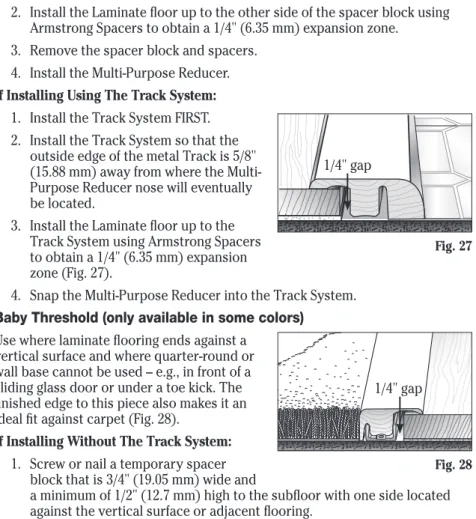
3. Install the Laminate floor up to the Track System using Armstrong Spacers to obtain a 1/4" (6.35 mm) expansion zone (Fig. 27).
4. Snap the Multi-Purpose Reducer into the Track System. Baby Threshold (only available in some colors)
Use where laminate flooring ends against a vertical surface and where quarter-round or wall base cannot be used – e.g., in front of a sliding glass door or under a toe kick. The finished edge to this piece also makes it an ideal fit against carpet (Fig. 28).
If Installing Without The Track System: 1. Screw or nail a temporary spacer
block that is 3/4" (19.05 mm) wide and
a minimum of 1/2" (12.7 mm) high to the subfloor with one side located against the vertical surface or adjacent flooring.
2. Install the laminate floor up to the spacer block using spacers to obtain 1/4" (6.35 mm) expansion zone.
3. Remove the spacer block and spacers. 4. Install the Baby Threshold.
If Installing Using The Track System: 1. Install the Track System FIRST.
2. Install the Track System so that the outside edge of the Track is 3/16" (4.76 mm) away from vertical surface or adjacent flooring.
3. Install the laminate floor up to the Track System using Armstrong spacers to obtain 1/4" (6.35 mm) expansion zone.
4. Snap Baby Threshold into the Track System.
Fig. 27 1/4" gap
Fig. 28 1/4" gap
Over-The-Top Step Nose
Use where laminate flooring meets a step down or landing. Install using the Track System. Do not use on individual stair treads. See Section J in this chapter (Flush Stair Nose Installation for Stair Treads and Risers) for Flush Stair Nose Installations.
1. Install the Track System FIRST.
2. Install the Track System so that the outside edge of the Track is 5/8" (15.88 mm) away from the edge of the stepdown.
3. Install the laminate floor up to the Track System using Armstrong spacers to obtain 1/4" (6.35 mm) expansion zone.
4. Measure and cut step nose to length.
5. Predrill holes in the step nose for finish nails. 6. Adhere the step nose to the subfloor using a
high quality, construction adhesive. 7. Apply a 3/16" (4.76 mm) bead of
adhesive in a serpentine pattern to the back of the step nose (Fig. 29).
Carefully read cautions on container and follow the manufacturer’s recommended instructions on the adhesive label.
8. Snap the step nose into the track and anchor the step nose with finish nails (Fig. 30).
9. DO NOT USE THE STEP NOSE ON INDIVIDUAL STAIR TREADS. 10. Always make sure to use mechanic
(nail) and adhesive (glue) fasteners to secure step nose.
J. FLUSH STAIR NOSE INSTALLATION FOR STAIR TREADS AND RISERS IMPORTANT SAFETY NOTICE: The installation of laminate flooring on stairs is a fully adhered system. Under no circumstances should foam underlayment be placed on stair steps or risers. This will result in an unsafe condition. Do not use over-the-top step nose molding on individual stair treads.
Tool List
• Table saw or miter saw
• 10" (25.4 cm) 60- or 80-tooth carbide-tipped ATB or triple chip saw blade • Power Drill • Hammer • 6d finish nails • Construction adhesive • 5-Minute epoxy Fig. 29 Fig. 30
Optional Tools • Router • Router table • 7 mm router bit • 8 mm router bit • 7 mm splines • 8 mm splines • 12 mm splines
• Armstong 99 or Bruce EverSeal Adhesives Preparation of STAIR TREADS
TREADS and RISERS should be structurally sound, flat, dry, clean, smooth, and free from paint, varnish, wax, oils, solvents, and other foreign matter. Cut off any existing bullnose flush with the RISER of the stair (providing the dimension change does not violate local building codes) (Fig. 31).
Installation of STAIR TREADS 1. Beginning at the bottom RISER,
measure and cut a piece of laminate plank to fit flush with the existing STAIR TREAD. If the laminate has an attached foam or fabric, it must be removed.
2. Glue in place by applying a 3" (7.6 cm) serpentine bead of construction adhesive to the back of the flooring (Fig. 32). Refer to construction adhesive label for all recommendations, warnings and safety precautions.
3. Press in place.
4. Measure and cut stair nose to length.
5. Dry fit the stair nose to the edge of the first TREAD with the molding nose overlapping the laminate piece on the riser below. Measure the distance from the edge of the stair nose to the next riser (Fig. 33).
6. Measure and cut to width and length another piece of laminate plank for the STAIR TREAD. Using a utility knife or table saw, remove the tongue. If the laminate has an attached fabric, it must also be removed.
Stair Nose Dimensions
Fig. 31
7. Apply a bead of construction adhesive in a 3" (7.6 cm) serpentine pattern to the back of the cut piece of stair nose and affix to the stair. (On wood subfloors, drill appropriate size holes into the installed stair nose and anchor with 6d finish nails (Fig. 34). Set nails using a nail punch. Fill holes with a repair stick.)
8. To avoid shifting over concrete, allow enough time for the
construction adhesive to set prior to continuing the installation. This time will vary depending upon the adhesive being used.
9. Apply construction adhesive to the TREAD of the existing stair and spread evenly using a 1/16" x 1/16" x 1/16" (1.59 mm x 1.59 mm x 1.59 mm) square-notch trowel. 10. Apply a bead of adhesive
(preferably a 5-minute epoxy) to the lip of the stair nose. Following
the manufacturer’s recommendations, immediately remove any excess adhesive from the laminate surface.
11. Place the tongue side of the flooring against the stair nose, being sure that the laminate plank surface is flush with the stair nose surface.
12. Push pieces together until joint is tight and flush, then remove excess adhesive.
13. Repeat steps 1 through 12 until installation is complete. 14. Allow 24 hours of curing time before exposing stairs to traffic.
Installation on step downs or landings using Armstrong Quiet Comfort Premium S-1836 or Quiet Comfort S-1837
1. Measure and cut stair nose to length.
2. Apply a bead of construction adhesive in a 3" (7.6 cm) serpentine pattern to the back of the cut piece of stair nose and affix to the stair. Refer to construction adhesive label for all recommendations, warnings and safety precautions. (On wood subfloors, drill appropriate size holes into the installed stair nose and anchor with 6d finish nails. Set nails using a nail punch. Fill holes with a repair stick.)
3. To avoid shifting over concrete, allow enough time for the construction adhesive to set prior to continuing the installation. This time will vary depending upon the adhesive being used.
4. Install the S-1837 Quiet Comfort Underlayment leaving a gap between the stair nose and the underlayment one-half the width of the laminate plank. Fig. 33
5. Using a utility knife or table saw, remove the tongue from the laminate plank to be installed to the stair nose.
6. Apply a bead of construction adhesive in a 3" (7.6 cm) serpentine pattern on the substrate between the stair nose and the underlayment.
7. Apply a bead of adhesive (preferably a 5-minute epoxy) to the lip on the stair nose. Following the manufacturer’s recommendations, immediately remove any excess adhesive from the laminate surface.
8. Place the tongue side of the flooring against the stair nose being sure that the laminate surface is flush with the stair nose surface.
9. From this point, continue the installation of the laminate flooring using the installation instructions provided with the laminate flooring.
Instructions for Installing Laminate Perpendicular to the Stair Nose 1. Measure and cut stair nose to length.
2. Using a utility knife or table saw, remove the bottom lip of the stair nose. 3. Following the instructions listed below, set the router bit and manufacture
a groove on the stair nose. Use a 7 mm router bit and 7 mm splines for 7 mm products and an 8 mm router bit and 8 mm splines for 8 mm products. 4. Apply a bead of construction adhesive in a 3" (7.6 cm) serpentine pattern
to the back of the cut piece of stair nose and affix to the stair. Refer to construction adhesive label for all recommendations, warnings and safety precautions. (On wood subfloors, drill appropriate size holes into the installed stair nose and anchor with 6d finish nails. Set nails using a nail punch. Fill holes with a repair stick.)
5. To avoid shifting over concrete, allow enough time for the construction adhesive to set prior to continuing the installation. This time will vary depending upon the adhesive being used.
6. Using a utility knife or table saw, remove the tongue or groove from the laminate plank to be installed to the stair nose.
7. Following the instructions listed below, set the router bit and manufacture a groove on the laminate plank.
8. Apply a bead of Armstrong 99 Flooring Glue or Bruce EverSeal to both sides of one edge of the spline and insert it into the groove of the stair nose.
9. Apply another bead of glue to the top of the exposed portion of the spline. 10. Apply a bead of glue to the bottom lip of the groove of the piece of flooring
to be installed.
11. Place the piece of flooring into position and gently tap the pieces together using the tapping block.
12. A small, continuous bead of glue must ooze to the surface to ensure a water-resistant joint.
13. Remove the excess glue with a damp cloth followed by wiping with a clean, dry, cotton cloth.
Setting the Router Bit
1. Set the depth of the router bit by placing two pieces of flooring on a flat, sturdy surface with the factory grooves facing each other.
2. After the bit has been installed into the router, place the router on the surface of the flooring and adjust the bit height visually to match the groove position.
3. To check the accuracy of your router bit setting, rout a groove on the tongue edge of a piece of scrap.
4. If there is a slight scrap of the tongue left above or below the groove, adjust the bit depth accordingly and recheck your adjustment. NOTE: If desired, the stair nose and laminate may be grooved and splined together regardless of the direction of the laminate installation. Use a 7 mm router bit and 7 mm splines for 7 mm products and an 8 mm router bit and 8 mm splines for 8 mm products. When using splines, the tongue or groove edge of the laminate flooring and the bottom lip of the stair nose must be removed.
Expansion Zone
All expansion zones between the edge of the laminate flooring installation and all vertical surfaces parallel to the stair nose should be increased according to the chart below:
If distance between nosing
and vertical surface is: Expansion zone should be:
5'–9' 1/4" 10’–14’ 3/8" 15’–19’ 1/2" 20’–24’ 3/4" 25’–29’ 7/8" 30' + 1"
K. SPECIAL CUTTING PROCEDURES Irregular-Shaped Pieces
Make a paper pattern for irregular-shaped pieces, and transfer the pattern to the piece to be cut (Fig. 35).
Holes for Pipes
1. In placing the hole on the end of the piece of laminate, measure and drill a hole that is 1/2" (12.7 mm) larger in diameter than the pipe.
2. Cut across the piece through the center of the hole (Fig. 36). 3. Glue the edge of the end piece. 4. Use the pull bar to put the piece in
place.
5. Use spacers as wedges to hold in place. 6. In placing the hole on the long side of
the piece of laminate, mark and drill a hole that is 1/2" (12.7 mm) larger in diameter than the pipe.
7. Cut in from the edge at a 45° angle toward the holes in the piece (Fig. 37). 8. Apply glue to the cut edges.
9. Use the pull bar to put the piece in place.
10. Use spacers as wedges to hold in place. Custom Cutting
Starting Point Modifications: When installing a custom floor, you may find starting the floor layout from the longest wall is not necessary. In many custom layouts, it may work to your advantage to start from the middle and work out toward the wall. This technique works well for borders and insets. To assist in the installation, a temporary starting block can be attached to the subfloor. This starting block acts much like the usual starting wall and gives you something to tap against during the installation. Once you have reached the opposite wall, the temporary starting block can be removed and the installation completed. Routing and the Use of Splines: Many custom installations require cutting the board to achieve a desired visual effect. If these cut pieces will be installed in the field of the floor, they will have to be routed. Use a router bit to modify the piece so it can accept the tongue of the next piece or be fitted with a spline. It is critical during the routing process that the groove being cut is properly lined up to match the next piece. This will eliminate any ledging that might occur if the router bit is too high or too low. Also, if the cut is exposed and not hidden from view, make sure the cut is as true and straight as possible.
How to Install Borders or Insets: To create a simple border, start by
determining the “visual center” of the room. Then, working out from that point, measure in whole width or length units of the piece you plan to install – a 7-1/2" x 50-5/8" (19.05 cm x 128.59 cm) board, a 15" x 15" (38.1 cm x 38.1 cm) square or a 15" x 25-5/16" (38.1 cm x 64.29 cm) block. Measure until you reach a suitable place for the border. Dry-fit the field and border to help arrange the layout. The majority of the cuts should fall at the perimeter of the floor and be hidden by the wall base or quarter-round. To install this type of floor layout, you could either start at the longest wall, if all the cut pieces have been calculated, or from the start of the border row. To start from the border, use a 2" x 4" as a straightedge and fasten it to the floor to use as a starting wall. Once the field and border have been installed, you can go back and fill out the perimeter of the floor.
Fig. 36
L. REPAIRING LOCKING LAMINATE Minor Repairs
Minor chips or scratches can easily be repaired using a color-matched Laminate Flooring Touch-Up Kit or Filler Kit.
Major Repairs – Close to a Parallel Wall
1. In case of a major problem with the locking system, it is possible to replace an entire piece of the flooring. In most cases, just remove the molding from the walls nearest the damaged board (Fig. 38).
Fig. 38
Fig. 39
2. Remove the boards by unlocking them (Fig. 39). Number the boards, on the back, so they may be repositioned later. You can work in either direction, carefully working back to the damaged piece.
3. Replace the damaged board with a new one. Reassemble the floor (Fig. 40).
Fig. 40
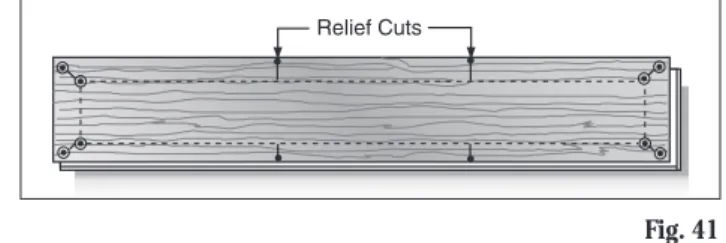
Fig. 41 Major Repairs – In Center of Room (Repair is Permanent) 1. Check replacement board for damage, size and fit.
2. Mark damaged board 1-1/2" (3.81 cm) from ends and sides. Drill 3/16" (4.76 mm) holes in corners and at relief cuts (Fig. 41).
3. Set saw depth to board thickness. Cut along lines and remove center section. Make relief cuts using drilled holes as visible stop.
4. Carefully lift and pull center length cut first, then work into corners to remove end pieces last.
5. If the floor was installed with Armstrong Laminate Glue, clean factory edges using a sharp chisel. Remove glue from top of groove using a tongue and groove cleaner tool or a small piece of laminate with tongue edge. 6. Prepare replacement board by removing bottom of groove on end and side
(Fig. 42).
7. Carefully remove tongue from end of board with sharp utility knife. 8. Clean area thoroughly and test fit. Check for high edges and adjust fit
Fig. 42 9. Apply Armstrong Laminate Glue to top of tongue and bottom of groove. 10. Carefully place the new piece into the opening. Press firmly.
11. Remove all residual glue on the surface with a clean, damp cloth. 12. Make sure all edges are even on either side of the joints. Apply pressure
for at least 24 hours using heavy weights.