P-ISSN 2355-2794 E-ISSN 2461-0275
Developing Critical Reading Module
Using Integrated Learning Content and
Language Approach
Annas Surdyanto1Wiwit Kurniawan*2
1Department of English Letters, Faculty of Letters, Universitas Pamulang, Pamulang 15417, INDONESIA
2Department of Economics Education, Faculty of Teacher Training and Education, Universitas Pamulang, Pamulang 15417, INDONESIA Abstract
The purpose of this research is to compile a teaching material in the form of critical reading modules that are effective, valid, and practical for English major students. Teaching materials developed are based on CLIL (Content and Language Integrated Learning) learning and are oriented towards students’ critical thinking skills. CLIL not only emphasizes language skills but also on how learning content can provide a stimulus to think and understand the goals of learning. This study uses a Research and Development (R&D) approach. The development model used is the ADDIE (Analyse, Design, Development, Implement, Evaluation). The results of the study show that the module that has been developed is valid, practical and effective. The validity of the module reaches a very good category based on the expert’s and validator’s evaluation. The practicability of the module is categorized as very good according to the students’ responses, observation on the implementation, and lecturer’s evaluation. The module effectivity reaches a very good category based on the students’ achievement on the tests.
Keywords: Critical reading, critical thinking, CLIL, ADDIE.
*Corresponding author, email: [email protected]
Citation in APA style: Surdyanto, A., & Kurniawan, W. (2020). Developing critical reading module using Integrated Learning Content and Language Approach. Studies in English Language and Education, 7(1), 154-169.
Received November 30, 2019; Revised January 15, 2020; Accepted February 25, 2020
https://doi.org/10.24815/siele.v7i1.15098
1. INTRODUCTION
Reading, which is a window to the world, is an activity that gives us various information and knowledge. But in the current information age, what is happening is a flood of information on society. Abundant sources of information have drowned the reader in the jungle of language. Readers only become passive subjects and accept what comes from the outside. For these problems, it is necessary to develop the ability to read and digest information. Reading should be critical, so it is not just absorbing information, but also processing, scolding, evaluating, and interpreting it. Critical reading competence and critical thinking are things that must be possessed to be able to face the challenges of this age.
At the English Department of Letters Faculty at Pamulang University, Indonesia, there are Critical Reading courses, but modules that are suitable and can develop critical reading skills have not been compiled. This course gives students the competence to be able to master the ability to read and think critically. Students are not only taught to look for information on reading but also to give feedback and criticism and place meaning in different contexts. Because it demands to provide teaching that can be analysed and stimulated thinking, there needs to be a module that not only looks at the mastery of language but also content that develops critical thinking skills.
Chomsky (2013) says that reading a book does not mean just turning the pages. It means thinking about it, identifying parts that one intends to go back to, asking how to place it in a broader context, and pursuing the ideas. Therefore, English Literature students need to have critical thinking skills (critical thinking) so that they can respond to various ideas that exist in the literature and literary works they read (Ilyas, 2016a). It is as asserted by Ruggiero (2012) that critical thinkers practice to restraint and control their feelings rather than be controlled, and think before they act.
A study related to the learning process in Indonesia was conducted by Rahma (2012) about developing learning material using an inquiry model. The study by Rahma (2012) used development research conducted at a state senior high school in Bogor. The subject of this research was 10 students for restricted implementation and 27 students for extended implementation. Her study shows that the learning process in educational institutions in Indonesia has so far tended to be memorization and factual knowledge. Of course, this is a learning process error that needs to be addressed in line with the promotion of educational goals that lead to critical thinking skills in the 2013 Curriculum. Hence, in terms of supporting the achievement of the 2013 Curriculum goals, it is essential to implement a learning process based on critical thinking at the university level.
In his view of critical thinking, Baker (1991) explained that critical thinking is an ability used in the process of mental activities such as identifying the central problem and assumptions in an argument, making correct conclusions from the information or data provided, interpretation of whether findings are obtained based on data given, and evaluating evidence or authority.
Tung and Chang (2009) conducted a study on enhancing students’ critical thinking through literature. Their study applied experiments carried out at a private University in Taiwan. The subject of research was 13 students selected through a random sampling technique. The study showed that the application of critical thinking based English learning can be made through learning to read literature. Furthermore,
Tung and Chang (2009) explain that reading literature had helped those who score low in the pre-test improve their overall critical thinking skills, especially in the analysis. Another research related to critical thinking was conducted by Khatib and Mehrgan (2012). This research study made use of 40 non-native advanced students all majoring in TEFL. The method applied by Khatib and Mehrgan (2012) was an experimental research method. The result of their study shows that reading literary works especially short stories can build critical thinking skills.
Although the ability of critical thinking has been intensified and is considered necessary by the Indonesian government, critical thinking skills are still not widely owned by students at various levels of education. Based on observations and pre-research results, this lack of critical thinking ability was also found in the English Department of Letters Faculty Pamulang University in Banten, Indonesia. It can be caused by the unavailability of teaching materials based on critical thinking in the department.
To compile teaching materials in the form of critical reading modules, a learning approach is needed, which also provides a focal point on the development of thinking. The approach used is CLIL (Content and Language Integrated Learning). This approach not only emphasizes language skills (language) but also on how learning content can provide a stimulus to think and understand the purpose of learning.
Marsh (2002) states that CLIL is a teaching approach in which students are taught in a foreign language with a dual focus on the subject and language. In other words, the teacher can focus the discussion on specific themes and issues while still improving students’ language skills. Themes and issues designed in learning will provide materials that can be used by students to develop a critical reading process. With a variety of themes from relevant and exciting literary works, students are required to not only seek information but analyse, evaluate and criticize the theme. In this aspect, CLIL will be relevant as an approach to develop practical, useful and valid Critical Reading modules for students.
2. LITERATURE REVIEW 2.1 Critical Thinking
Critical thinking which is the learning objective of various curricula has been interpreted by experts. One of the definitions of critical thinking was coined by Dewey (1934), who states that critical thinking is an active, persistent, and careful consideration of a reasonable belief or form of knowledge that supports it.
Besides, Ennis (1962) also explains the understanding of critical thinking. According to him, critical thinking is reflective and rational thinking that is intended to decide what should be believed or done. Ennis (1989) suggests the importance of helping students with the involvement of thinking processes that are more reflective, sensible, and directed towards what to believe or do.
Mulnix (2012) also explains the definition of critical thinking. He explained that critical thinking includes a commitment to use reason in the formulation of a belief. Based on the notions of critical thinking above, it can be concluded that critical thinking is a process of decision making or making conclusions about an object based on a thoughtful and reasonable thought process.
2.2 Content and Language Integrated Learning
According to Marsh (2000), CLIL can be implemented in an English classroom that gives specific focus on both language competency and critical reading. The results of several studies about the CLIL approach show that it motivates students to get their knowledge better than none-CLIL learners (Corrales & Maloof, 2011).
In addition, CLIL is also very well implemented in the classroom to improve students’ vocabulary mastery. Moghadam and Fatemipour (2014) conducted a research about the implementation of CLIL on Iranian students. This study used an experimental method with 40 samples chosen randomly. It was revealed by Moghadam
and Fatemipour (2014) that CLIL has improved students’ vocabulary development.
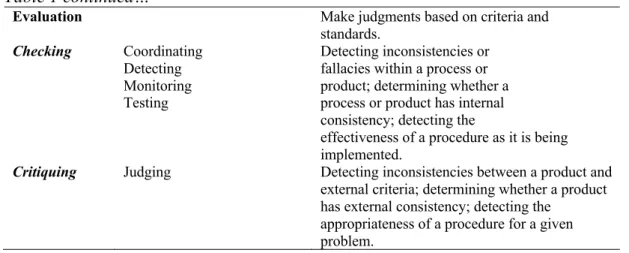
This is based on the results of their study on the CLIL application in schools. They also say that CLIL is very suitable to be applied at the school or university level. Concerning critical thinking, a study conducted by Hanesová (2014) about the development of critical and creative thinking skills in CLIL shows that the ability of critical thinking can be achieved with the CLIL approach in collaboration with the revised Bloom’s taxonomy (see Table 1). This notion shows that the CLIL approach is very suitable to be applied to the subject of critical reading.
2.3 Critical Reading
Bloom’s taxonomy has long been regarded as a set of categories that could encourage higher-order thinking, a closely related concept to critical thinking (Solihati & Hikmat, 2018). However, Bloom’s taxonomy lacks specific information about activities connected to each category. Applicable taxonomy is a necessity for education practice. Hence, Anderson and Collins (2001) have revised Bloom’s taxonomy which is easier to be implemented by teacher and it might be useful to apply in achieving critical thinking goals (see Table 1).
Table 1. Revisited Bloom’s taxonomy.
Analyse Break material into its constituent parts and determine how the parts relate to one another and to an overall structure or purpose.
Differentiating Discriminating Distinguishing Focusing Selecting
Distinguishing relevant from irrelevant parts or important from unimportant parts of the presented material.
Organizing Finding coherence Integrating Outlining Parsing Structuring
Determining how elements fit or function within a structure.
Attributing Deconstructing Determine a point of view, bias, values, or intent underlying presented material.
Table 1 continued…
Evaluation Make judgments based on criteria and standards. Checking Coordinating Detecting Monitoring Testing Detecting inconsistencies or fallacies within a process or product; determining whether a process or product has internal consistency; detecting the
effectiveness of a procedure as it is being implemented.
Critiquing Judging Detecting inconsistencies between a product and external criteria; determining whether a product has external consistency; detecting the
appropriateness of a procedure for a given problem.
A more advanced study that revised Bloom’s Taxonomy has been conducted by Ilyas (2016b). According to Ilyas (2016b), this framework to sustain the learning of critical thinking can be applied not only in teaching English as a foreign language but also in other school subjects. When compared with the Bloom taxonomy framework, the framework by Ilyas (2015) has a contextual advantage because it was created based on research conducted in Indonesia on textbooks used in Indonesia. To develop a critical reading module, this research used a critical thinking framework designed by Ilyas (2015). The framework of critical thinking by Ilyas (2015) comprise:
• Clarification • Assumptions
• Reasons and Evidence • Viewpoints or Perspectives
• Implication, Consequences, and Alternatives • Question
• Prediction
• Agreement and Disagreement • Summary and Conclusion
In addition, Ilyas (2016b) argues that the above framework can be applied into reading texts by generating additional questions that ask for clarification, assumptions, reasons and evidence, points of view or perspectives, implications, consequences and alternatives, questions, predictions, agreements and disagreements, and summaries and conclusions.
2.4 Module Development
One of the researches applied development procedures to create a quality product is ADDIE, which stands for Analysis, Design, Develop, Implementation and Evaluation. This procedure provides reasonable steps for developing a product that requires certain categories. According to Morrison (2010), ADDIE is an instructional system design framework (ISD) that is used by many instructional designers and training developers to develop courses. Furthermore, it is also perfect for developing teaching material for a particular course.
ADDIE is a unity of the stages of Analysis, Design, Development, Implementation, Evaluation. ADDIE stages are excellent to be applied in the process
of making teaching materials that are feasible and reliable because there is a process of analysis and evaluation that allows the design of instructional materials to determine the needs of users of teaching materials and test those teaching materials to get the best results.
3. METHODS 3.1 Type of Research
The type of research used is research and development (R&D). Research and development methods are research methods used to produce certain products and test the effectiveness of these products (Sugiyono, 2007). The teaching material to be developed is a module for Critical Reading courses. According to Hidayati and Widjajanti (2015), ADDIE provides coherent stages to create an effective, practical and valid product.
3.2 Development Procedure
There are five stages in this research development, which are in accordance with the ADDIE model procedure, namely the analysis, design, development, implementation, and evaluation stages.
1. First stage: Analysis
This stage is taken to conduct a needs analysis, in the form of what themes or competencies desired by students and their obstacles in learning. In addition, the characteristics of students will also be analysed.
2. Second stage: Design
This stage is to design or design learning in the form of syllabus and module teaching materials. At this stage, a blueprint module based on the analysis of the next stage will be prepared.
3. Third stage: Development
This stage is developing a module that matches the blueprint created in the previous stage. Furthermore, the modules and syllabus that have been prepared (or the first draft) will be validated by the expert/reviewer and revision on the first stage is done. 4. Fourth stage: Implementation
At this stage of implementation, the modules developed will be trialled on the test subjects and revised second stage is done if necessary.
5. Fifth Stage: Evaluation
The last stage is the evaluation, namely testing the module on the principle of practicality and effectiveness of teaching materials that are developed using instruments that have been prepared.
3.3 Data, Techniques, and Data Collection Instruments
In this study, there are two types of data, namely qualitative and quantitative data. Qualitative data were obtained from observations, suggestions, and criticisms from validators, test subjects, and instructors. The quantitative data came from the results of the validation, effectiveness, and practical analysis, as well as critical
thinking questionnaires from students. Data collection techniques in this study used test instruments. The instruments to be used in this study consisted of (1) validation sheets, (2) lecturer evaluation sheets, (3) student response sheets, (4) observation sheets, and (5) learning achievement test questions. The data obtained is used to determine the validity, practicality, and effectiveness of the modules developed. 3.4 Data Analysis Technique
The data analysis technique used in this study is both qualitative and quantitative analysis. Qualitative data sourced from observations, comments, and criticisms will be analysed and used as input to revise the modules developed. The form of quantitative data analysis is to convert raw data into a Likert scale with 5 categories namely very good, good, fair, bad, and very bad. In determining the interval score of each category, this research referred to formula adapted from Widoyoko (2012), as shown in Table 2.
Table 2. Categorization formula.
Interval Score Category
X > 𝑿"i + 1,8 Sbi Very Good
𝑿"i + 0,6 Sbi < X ≤ 𝑿"i + 1,8 Sbi Good
𝑿"i - 0,6 Sbi < X ≤ 𝑿"i + 0,6 Sbi Fair
𝑿"i - 1,8 Sbi < X ≤ 𝑿"i – 0,6 Sbi Bad
X ≤ 𝑿"i - 1,8 Sbi Very Bad
Information:
𝑋"i (average mean) = 1/2 (ideal maximum score + ideal minimum score)
Sbi = 1/6 (ideal maximum score - ideal minimum score) X = Empirical score
To see the effectiveness of the modules developed in generating critical thinking students, this was by looking at the percentage of students who can reach the high category. Meanwhile, to see the module validity, it was measured by a minimum average rating of experts in the ‘good’ category. While practicality is seen from the results of teacher assessments, student responses (module users) and minimal observation sheets in the ‘good’ category. Modules are said to be effective in terms of the level of critical thinking skills of students. If the students’ critical thinking scores are classically after using modules fall into the “high” category of at least 80%, then the module can be said to be effective.
4. RESULTS
This section describes the steps that have been carried out and the results during the seven-months course of study in developing the critical reading module. In this study, the stages to be carried out include Analysis, Design, Development, Implementation, and Evaluation (ADDIE). Meanwhile, during the seven months, the stages that have been carried out are the Analysis, Design, Development.
In the ADDIE development model, the first step carried out is the analysis. The analysis phase is carried out to determine how the module should be developed. In this research, a critical reading module was to be developed with integrated learning
content and language approach. The results of the module development at an early stage are called Draft 1. The basis of the preparation and development of Draft 1 is the analysis phase. The analysis phase carried out includes requirements analysis, analysis of student characteristics and material analysis. The following is the elaboration in the analysis phase.
4.1 Analysis
To develop a critical reading module with integrated learning content and language approach, that is suitable for the English Major students, observations and interviews with related parties are first carried out. Based on needs analysis, data can be obtained about the conditions and needs needed by students in learning to read. Besides, the needs analysis also revealed how the characteristics of students and the material used in reading subjects.
4.1.1 Needs analysis results
The needs analysis phase was done through observation of the class of critical reading subjects. Apart from observation, a needs analysis was also conducted by interviewing students who attended lectures and lecturers. Interviews were conducted with lecturers supporting critical reading subjects. This interview aimed to obtain information related to methods and teaching materials used in learning critical reading subjects. Based on the results of observations and interviews, data obtained and information results as material for analysis of needs in learning critical reading subjects are as follows:
1. Existing learning still emphasized only one aspect, namely the ability to read English texts.
2. Students felt bored or discontented with the material provided. 3. The reading material given was not attractive to students.
4. Learning did not optimize high-level thinking; this was because reading questions and the learning process only accommodated detailed questions that referred to the text.
5. There were no activities or materials that provided stimulus to students to provide an assessment of the reading text. What existed was only looking for information and inference on the existing text.
6. No learning module was suitable for critical reading, because the existing modules only emphasized ordinary reading or more on the work on problems like TOEFL or IELTS.
7. Student learning outcomes were not satisfactory; this is revealed by the lecturer who saw the development of the results based on weekly student assignments.
From observations and interviews that revealed the needs of the critical reading courses, it was concluded that there was a need to prepare an appropriate learning module for critical reading. Relevant modules were modules that could develop concepts of higher-order thinking or critical thinking. So, the module that would be developed should be able to solve the various problems mentioned earlier, which is able to provide not only language skills but also knowledge and be able to foster critical thinking to students.
4.1.2 Student analysis results
Based on the results of the analysis of student characteristics, it was obtained that they were less enthusiastic about the critical reading subjects, besides that the text and questions were less stimulating to critical thinking on students. They wanted exciting and challenging learning. In addition, the material presented or modules used should be more interesting and could increase interest in reading as well as critical thinking. So far, the module used were unappealing reading texts and questions with TOEFL models that tended to be restricted. Learning in critical reading subjects needed to use reading texts that are sourced.
4.2 Design
The module planning stage was the process by which the researchers compiled a blueprint to make a module. The modules developed would use the foundation of Content and Language Integrated Learning (CLIL) theory. The principle of CLIL is language learning coupled with a discussion of the contents of the language. In the implementation of reading learning, learning with CLIL is learning reading skills (vocabulary, skimming, scanning, finding detailed information, inferential and finding themes) which also discuss the contents of the reading. Therefore, the content or reading text must be chosen judiciously so that students and lecturers can carry out discussions. By discussing the themes of the reading, learning will activate critical thinking.
The CLIL concept emphasizes two things at once, discussion of content and language skills. CLIL also recommends cashing in authentic materials in language learning materials. Authentic material is the material that originates from real life, not material that is intentionally designed for learning. Thus, the basic principle of CLIL is to emphasize interesting themes, authentic material sources and learning as well as language skills and reading content. To improve students’ critical thinking skills, the theory referred to was the critical thinking category from Ilyas (2015).
The categories of critical thinking, according to Ilyas (2015), are Agreement/Disagreement, Assumption, Evidence, Clarity, Conclusion, Implication, Perspective, Prediction, Question, Reason, and Summary. The category would be used to arrange the learning, specifically the preparation of questions and assignments so that the questions and assignments were able to make students think critically. In this research, the developed media was a module. The critical reading module developed would be validated by three expert validators, namely the reading material expert, the learning media expert, and the education practitioner. The first validation was done by a material expert. Then the next module was validated by a media expert and an education practitioner. The elements contained in the critical reading module included learning objectives, the content of the material, examples of questions and their solutions, practice exercises and independent evaluation.
Furthermore, to find out the practicality of the developed media, instruments in the form of media assessment sheets were used by critical reading lecturers, students’ response sheets to the critical reading modules used and observation sheets of learning implementation. To find out the effectiveness of the developed media, the researchers have developed instruments in the form of critical reading learning achievement tests.
4.3 Development
At this stage, module development would be carried out. The development of the critical reading module refers to the design in the previous stage. The development of this module would use the principle of critical thinking and use reading texts from authentic material. The various questions in the critical thinking module referred to the critical thinking category from Ilyas (2015).
4.3.1 Media development
The developed module contained several elements, namely 1) learning objectives; 2) authentic text readings; 3) practice questions; 4) independent evaluation, and additional elements in the form of 5) interesting information and 6) pictures. Authentic texts took reading material from everyday life with interesting themes, such as news, advertisements, and articles. Interesting info and images added in the module were aimed to not bore students.
At this stage, the module development would be carried out. The development of the critical reading module referred to the design in the previous stage. The development of this module would use the principle of critical thinking and used reading texts from authentic material. The various questions in the critical thinking module referred to the critical thinking category from Ilyas (2015). Some features added to the chapter and the end of the module are:
1. Carefully controlled information, structure, and vocabulary
2. Glossary of the back of the module explains some of the difficult words and phrases 3. Points for Understanding section and Exercises.
At this stage, validation was carried out from experts both from the material and the media experts. Input from these experts were used to develop the modules to be better and more suitable for a critical reading course.
4.3.2 Validation results
The validity test of the critical reading module developed would be carried out by the media, material, and practitioner experts. The validity by media expert would see how the quality of the media was developed. Whereas the material expert would look at the contents of the material compiled in the critical reading module, both in grammatical terms and the concept of teaching reading. While the practitioner would see how the critical reading module was used in the learning process in the classroom. 4.4 Implementation
In the implementation phase, the developed Critical Reading Module was tested on the English Literature Study Program of the 4th semester Critical Reading class. The implementation of the Critical Reading module was carried out by the lecturer. In the implementation stage, the students at critical reading course used the module that had been developed in the teaching-learning process. The implementation stage continued in four meetings.
In each meeting, students were given reading material from the Critical Reading module that was made. The learning process followed the Semester Lesson Plan that
had been prepared by the researchers. Various activities such as discussion and answering questions on the module were one of the activities aimed at developing critical thinking of students.
After holding four meetings with the Critical Reading module, students were given a student questionnaire to assess the practicality of the modules developed. During the learning process, observations were made using the class observation sheet instrument. The response sheet was also given to the lecturers who supported the reading subject. The results of the implementation phase were practical data and effectiveness data. Practicality data was obtained from lecturer ratings, student responses, and observations. While the effectiveness data came from the results of student achievement tests.
4.4.1 Practicality
The practicality of the module was seen from three things, namely the assessment of lecturers, student responses, and observation. These three things gave a very good evaluation category on the modules developed. Lecturer assessment of modules designed and Semester Lesson Plan was in the excellent category. Therefore, both the module and the Semester Lesson Plan that were developed met the practical criteria. In addition, the response of students also gave an excellent rating. In the aspect of convenience and attractiveness, they were included in the excellent category, and the aspect of efficacy was included in the good category. Overall, students gave a ‘very good’ response to the modules developed. Based on the results of the observational analysis, it was found that the overall the implementation of learning had reached a very good category with a percentage of 96.66%. Of these three things, both lecturer assessment, student response and observation, the modules developed could be categorized as practical.
4.4.2 Effectivity
The effectiveness of learning tools in the form of modules can be seen from the completeness of student learning. After implementing the teaching learning process using the developed module, the next step was to conduct a student achievement test to test the module’s effectiveness. The average test score of student achievement is 88.76. Of the 25 students who took part in the study, the average score of their achievement test was above the completeness criteria, and 23 students met the completion criteria. Thus, the overall completeness percentage achieved more than 80%, namely 92%. The Critical Reading Module with integrated content and language learning approach and referred to Ilyas (2015) is a module that was designed not only to improve English language skills but also to improve students’ critical thinking. The module was designed to present a variety of authentic reading texts that were interesting and spark debate. The module also offered challenging questions and discussions that could improve students’ critical thinking processes.
The module contains a variety of interesting readings that foster critical thinking. Moreover, questions in the module guided and triggered students to think more deeply and critically. The following are examples of readings and questions on the module that has been developed. Figure 1 and Figure 2 show that the reading texts given are
of authentic material. This means that the reading text was adopted from daily life situations, such as news and articles.
The various questions were arranged based on Ilyas (2015) to stimulate students’ critical thinking. By these questions, students were expected to comprehend deeper into the information in reading text and use their critical reading skills to develop a better understanding.
Figure 2. Example of questions in the module. 5. DISCUSSION
The results of the study show that the module developed with the ADDIE model reached the valid, practical and effective criteria. The validation results from three validators showed that the module got an average score of 109.67, which was included in the very good category. The module practicality criteria are taken from observations of the implementation, student responses, and lecturer evaluations. The practicality of the module from the lecturer evaluation obtains a score of 75 which is included in the very good category. The practicality of the module from the students’ response gained a score of 51.64 which was included in the very good category. The practicality of the modules from observations reaches very good categories with a percentage of 96.66%. The module effectiveness, obtained from the results of student tests, reached 90%. The module’s effectiveness is included in the very good category.
This research is aligned with the study of Moghadam and Fatemipour (2014) which states that CLIL is able to improve their language skills. The module that had been developed had shown effective characteristic which means it was able to improve students’ critical reading skills. With contextual and interesting reading themes, students were stimulated to read the text and study the lesson in the module. As stated by Hanesová (2014), contextual material and related to student realism can develop curiosity and stimulate thinking skills.
Moreover, the various readings in the module contain themes about literature, politics, health, and economies that are closely related to students’ life. Therefore, the module could improve students’ thinking skills. Tung and Chang (2009) state that the theme of reading that contains interesting literature can enhance students’ critical thinking skills.
6. CONCLUSION
Critical reading courses not only equip students with the ability to write skills, but also critical thinking. Reading techniques, determining the main ideas, and the meaning of terms in reading are important competencies in reading. However, to form students’ critical awareness, there needs to be learning that enhances critical thinking skills. The ability to think critically is needed in reading. With this ability, the reader is not only a recipient of information that is positive but can further look deeper into the message conveyed, criticize information to see the relevance and application of the information obtained. Therefore, in critical reading courses, there needs to be strengthening students’ critical thinking.
To teach reading techniques as well as to search for critical thinking, modules must be able to accommodate both. Therefore, the critical reading module needs to present reading text that triggers thinking. In addition, assignments and questions must be able to provide stimulus in thinking. So, it is not just an increase in language ability. The critical reading module developed in this study accommodates the CLIL concept and the models by Ilyas (2015). With this basic concept, modules are formed so that learning also addresses content or material. Reading courses must be able to review the material in the reading. By conducting studies, examinations, evaluations, and criticisms of reading texts, critical thinking from students can emerge. In this way, focusing not only on language but on content, critical thinking can be realized.
This research has provided a module for a critical reading course that reaches a valid, practical and effective category. The module developed was based on the CLIL concept. This study is in accordance with Moghadam and Fatemipour (2014) and Hanesová (2014) who claim that CLIL is able to improve critical thinking and reading skills simultaneously.
This research was only conducted on limited subjects. Therefore, results on a broader scale may show differences. But these limitations do not make the results obtained in vain. Other researchers are recommended to conduct research on a broader scale and use the experimental method to prove the hypothesis.
REFERENCES
Anderson, M., & Collins, P. (2001). Race, class, and gender: An anthology (4 ed.). Wadsworth.
Baker, M. (1991). Relationships between critical and creative thinking. Texas Tech University Press.
Chomsky, N. (2013). Power systems: Conversations with David Barsamian on global
Corrales, K., & Maloof, C. (2011). Student perceptions on how content-based instruction supports learner development in a foreign language context. Zona
Próxima, 15, 40–53.
Dewey, J. (1934). Art as experience. Minton, Balch and Company.
Ennis, R. H. (1962). A concept of critical thinking. Harvard Educational Review, 32(1), 81-111.
Ennis, R. H. (1989). Critical thinking and subject specificity: Clarification and needed research. Educational Researcher, 118(4), 4-10.
Hanesová, D. (2014). Development of critical and creative thinking skills in CLIL.
Journal of Language and Cultural Education, 2(2), 33-51.
Hidayati, T., & Widjajanti, D. B. (2015). Pengembangan perangkat pembelajaran lingkaran SMP kelas VIII dengan suplemen materi History of Mathematics (HOM) [Development of 8th grade junior high school learning tools with supplement materials of History of Mathematics (HOM)]. Pythagoras: Jurnal
Pendidikan Matematika, 10(2), 211-221.
Ilyas, H. P. (2015). Critical thinking: Its representation in Indonesian ELT textbooks
and education. (Doctoral dissertation). University of York, York.
Ilyas, H. P. (2016a). Retaining literature in the Indonesian ELT curriculum. Studies in
English Language and Education, 3(1), 1-11.
Ilyas, H. P. (2016b). Infusing critical thinking into English coursebooks. Journal of
ELT Research, 1(1), 113-134.
Khatib, M., & Mehrgan, K. (2012). Achieving critical thinking skills through reading short stories. Advances in Digital Multimedia, 1(3), 155-172.
Marsh, D. (2000). An introduction to CLIL for parents and young people. In D. Marsh & G. Lange (Eds.), Using languages to learn and learning to use languages
(pp. 1-16). University of Jyväskylä.
Marsh, D. (2002). CLIL/EMILE: The European dimension - actions, trends and
foresight potential. UniCOM.
Moghadam, N. Z., & Fatemipour, H. (2014). The effect of CLIL on vocabulary development by Iranian secondary school EFL learners. Procedia - Social and
Behavioral Sciences, 98, 2004-2009.
Morrison, R. (2010). Designing effective instruction (6 ed.). John Wiley & Sons. Mulnix, J. W. (2012). Thinking critically about critical thinking. Educational
Philosophy and Theory, 44(5), 464-479.
Rahma, A. N. (2012). Pengembangan perangkat pembelajaran model inkuiri berpendekatan sets materi kelarutan dan hasil kali kelarutan untuk menumbuhkan keterampilan berpikir kritis dan empati siswa terhadap lingkungan [Development of inquiry learning model approach to the set of solubility material and the solubility product to foster students' critical thinking skills and empathy for the environment]. Journal of Educational Research and
Evaluation, 1(2), 133-138.
Ruggiero, V. R. (2012). Beyond feelings: A guide to critical thinking (9 ed.). McGraw-Hill.
Solihati, N., & Hikmat, A. (2018). Critical thinking tasks manifested in Indonesian language textbooks for senior secondary students. Sage Open, 8(3), 1-8. Sugiyono, M. P. P. (2007). Metode penelitian kuantitatif kualitatif dan R&D
Tung, C., & Chang, S. (2009). Developing critical thinking through literature reading.
Feng Chia Journal of Humanities and Social Sciences, 19, 287–317.
Widoyoko, P. (2012). Teknik penyusunan instrumen penelitian [Research instrument