Asian Journal of
Multidisciplinary Studies
ISSN: 2321-8819 (Online) 2348-7186 (Print) Impact Factor: 0.92
Volume 3, Issue 3, March 2015
Impact of Professional Development Program for Primary Teachers of
Tef – Network Schools
Syed Saghir Hussain1 and Javed Ahmed Siddiqui2 1Research Scholar, Faculty of Humanities & Social Sciences,
Hamdard University Karachi, Pakistan 2
Research Supervisor ABSTRACT
This study highlights the importance of need-based, purposefully designed and contextually relevant continuous teacher education for primary teachers to ensure accessible quality education. It highlighted that professional development (PD) opportunities should also be offered to teachers of underprivileged areas because; these teachers are low-paid, unable to afford the cost of professional development education and lack of motivation in this regards.
The Education Foundation is a Civil Society Organization, not-for-profit organization. It has been offering various courses for In-service teachers; TEF is networked with over100 schools located in under-privileged areas of Jamshed Town. Karachi. TEF is replacing traditional teacher-centered traditional teaching methods by promotion of activity-based /student-centered teaching-learning strategies in its network schools. It is being done successfully through awareness raising and professional skills development course for every subject exclusively. The targeted skills are: effective teaching strategies, development of low-cost or no-cost learning resources, innovative student-led activities and application of student-centered teaching-learning process followed by multiple assessment and evaluation techniques. In this study 70 teachers from 18 schools who has participated in different TEF-PD courses stated their views about five areas. These areas include the effectiveness of TEF-PD courses, TEF –PD’s faculty, TEF’s role in school development, TEF as a learning organization and TEF’s environment. This study also reflects the teachers’ perceptions about change in their belief and teaching practices.
Keywords: Professional Development Program; Primary Teacher; Tef – Network Schools 1. INTRODUCTION
1.1 BACKGROUND
This research was conducted in the primary schools to assess the impact of professional development courses for In-service teachers. It also focused to identify ground challenges, issues, problems which were being faced by all stakeholders and then on the basis of said findings a set of strategic review was also suggested as recommendations for further improvement in on-going professional development courses under the teacher education program of The Education Foundation (TEF). Therefore, this study was focused only those private schools who have been associated with TEF as a network - school.
The Education Foundation (TEF) is a Civil Society Organization, committed to teachers‟ professional development without discrimination since 1999 and it has been trained over 10500 teachers and head teacher in different courses including School Management course, Activity-based Course for Teachers, Early Childhood Education courses, Science/Computer, English language and Mathematics teaching courses for primary level teachers.
In 1999, The Education Foundation conducted a survey and found that over 70% teachers are just Matric, Intermediate and Graduates. It was also found that said teachers were teaching without acquiring any certificate or degree level professional qualification(s) like PTC, CT, B.Ed. & M. Ed.(TEF-Booklet). On the basis of that study TEF established a teacher education department exclusively for professional development of the in-service teachers. This department is called Universal Education department, it was aimed to promote the culture of activity-based and student –centered teaching-learning environment in the network-schools. This could be done through developing teachers‟ professional skills. These skills include effective teaching strategies, developing learning resources, develop and then implement the lesson plans effectively and enabled them to apply assessment and evaluation techniques.
Lingard, Hayes, Mills & Christie, (2003) stated that the ultimate purpose of any professional development initiatives is to impact on the classroom teaching-learning process, teachers and their practices. Knowing of the impact of teacher education is directly proportional to educational change that occurred
in the targeted schools. Poskitt,J.& Taylor,K. (2007) suggested that impact of teaching - learning process can be difficult to measure and for this purpose, indicators of its effects may be portrayed in various ways. This research activity was based on scientific way of educational research. As UNESCO highlights that most of the teacher training programs in Pakistan lack a scientific approach to evaluate the performance of their trained teachers(UNESCO: SATEP -2006). 1.2 STATEMENT OF THE PROBLEM
Assess the relevancy and effectiveness of TEF‟s professional development courses for in-service primary school teachers in order to enhance the quality of education under the teacher education program.
Sub‐problems: the above main problem statement can be described in the following sub-problems.
Assess the existing gap between offered and desired courses‟ that are being offered currently.
Determine the teachers‟ perception about competency of TEF –Professional Development Team
Evaluate the teachers‟ participation in school development initiatives
Suggest initiative(s) for further improvement in strategies, activities and approaches being followed for educational development.
Analyze the TEF‟s learning environment 1.3 PURPOSE OF THE STUDY
A. General purpose: the general purpose of the study would assess the impact of Professional Development Program for Primary Teachers of TEF – networking Schools.
B. Specific purpose: the specific purposes of the study are defined as the following;
To improve the learning resources and manual of in-service teacher education program being used for the professional development of the respective teachers.
To revisit the role and responsibilities of teacher-educators in order to make them a source of sustainable educational development
To assess the transformation of national, social and cultural values to the next generation in the context of the Ideology of Pakistan through the Professional Development Programs.
To evaluate the level of application of teaching strategies during followed by teachers in their respective classroom to enhance the students‟ participation in the learning process.
To assess the needs, challenges and issues being faced by the teachers during their job in order to take measures to address it effectively.
To take initiative for reducing the existing hurdle(s) occurred during implementation of student –centered and /activity –based teaching strategies.
To record the teachers‟ perceptions about the competency, punctuality and sincerity levels of professional development team of TEF.
To assess the effectiveness of TEF„s need based PD courses to achieve desired goals.
To explore any specific professional need which being expected from TEF by teachers for the school‟s improvement.
To record the teacher‟s perceptions about the TEF contribution as a learning organization
To get aware about teachers‟ perception regarding the TEF‟s learning environment
To compile the suggestions for enhancing the TEF„s contribution in quality enhancement initiatives.
1.4 SIGNIFICANCE OF THE STUDY
The followings are the stack holders / beneficiaries of the study.
TEF Board (trustees, founders and donors): they can get the evidence of their efforts in order for an enlightened, healthy and prosperous Pakistani nation
TEF Management (director and program coordinators): they can address the training needs and enabled to review the courses for further improvement.
Management TEF Network Schools: Principals/ Owners/ Administrators/ Headmasters and supervisors may address the teachers‟ needs and contribution in academic planning to ensure the quality of education
Public Department, institutions and Organizations: may amend in existing policy, rules and regulations regarding small scale private school located in under-privileged areas of the country
1.5 JUSTIFICATION OF THE STUDY
This study was justified on following grounds:
Education is the basis of change and development
Only professional teachers can teach the future generation accordingly
Teacher education is a continuous process
Courses should be reviewed periodically on the basis of ground realities that include emerging challenges of societal, national and
international levels, technological and social changes.
Accessible quality teacher education opportunity is right of every teacher
Free of any cost In-service teacher education opportunity is the valuable source of educational change.
Only need-based educational leadership and faculty development initiatives can enhance quality of education and efficiency of stockholders.
1.6 LIMITATION OF THE STUDY
During the research study researcher was focused only on TEF- Network schools of under-privileged areas that include Mehmoodabad, Azam Basti, Manzoor Colony, Azam Town and Akhtar Colony, Jamshed Town, District South, Karachi.
1.7 RESEARCH QUESTIONS
What are the teachers‟ perceptions about the effectiveness and contextual relevancy of TEF‟s professional Development Courses, manuals and learning resources?
Are the TEF‟s faculty members capable, competent and committed in their respective subject area(s) in order ensure the quality of learning resources and PD-course?
Are you feeling that school management, teachers and TEF are effectively contributing to the promotion of effective educational environment in their respective school?
Is there any agreement among the TEF trained teachers about its role for the provision of accessible and free of cost teacher education?
Is TEF providing an effective environment for professional development of in-service teachers?
1.8 SCOPE OF STUDY
During the research study researcher has to focus only on TEF- Network schools.
This research study will be focused to identify the measurable performance of the teachers who participated in the TEF Professional Development Program.
Research tools are developed to observe the effectiveness of on-going programs for Educational Development in TEF – Networking Schools.
1.9 DEFINITION OF KEY TERMS
Impact: To collide forcefully with; to strike (Dictionary of Education)
Professional Development Programs: These programs develop the professional skills of teachers and head teachers. They enable them to plan and teach students through innovative ways, to enhance the learning of the students. These programs enhance professional and managing skills
for running the school in a smooth way. (Dictionary of Education)
Primary School: It is a place where students study from class I to V.
1.10 BASIC ASSUMPTIONS
All programs and courses are directly and indirectly needs of the schools
TEF has changed the educational environment in various network schools
TEF is providing the opportunity to perform and polish their teaching -learning skills through practice the skills.
TEF is a source for learning of new and effective teaching methodologies in order to implementation in their classroom practices due to its professionally trained facilitators.
National aims & objectives are in viewed during Professional Development Courses.
TEF facilitators having command over the subject guides for selection of effective teaching methodologies
Through professional development courses, facilitators are promoting our National, Religious, Social and Cultural values.
TEF‟s facilitators and staff members are competent, punctual sincere cooperative and they can diagnose the strengths, weakness and aware about the needs of TEF-Networking schools
2. REVIEW OF THE LITERATURE 2.1 TEACHER EDUCATION
2.1.1 Current status of school and teachers: Quality of education is based on teacher‟s professional competency and teacher‟s competency is directly proportional to the product of both, academic as well as professional qualifications. However, in Pakistan, the majority of the in-service teachers is teaching without acquiring any professional qualification. In 1999, The Education Foundation (TEF) conducted a survey in Jamshed Town and found that found that 70% of teachers from 400 schools surveyed were Matric, Intermediate or Graduates and untrained (TEF, 1999).Similarly, as Hussain, S., (2012) highlighted that school teachers are often paid low salaries and are unable to attain higher degrees. The Same study also identified that teachers of the TEF-network schools are teaching without acquiring any pre- service professional education. Because, said school s‟ management and teachers are not yet realized the due importance and advantages of pre-service professional education before starting their teaching career as a professional teacher. Therefore, the said gap of professionalism has increased the issues regarding classroom teaching-learning process.
2.1.2 The Importance of professional education as a change agent: Borko and Putnam (1995) discussed the fact that professional education plays
an important role in changing teacher‟s teaching methods and always has a positive impact on students‟ learning. A professionally well-equipped teacher is enabled to use multiple teaching activities, strategies or methodologies in order to make learning simpler and understandable as per the students‟ level or desires. Another side, only academically qualified person unable to use multiple teaching strategies because these people are teaching only through a fix or particular teaching method which was mostly copied from someone‟s teaching approach. Therefore, academic and professional qualifications are equally important for an effective teaching like wheels of the vehicle. As Haycock (1998) stated that low-achieving students could be increasing their achievement level by as much as 53% when taught by highly effective teachers. Secondly, as Wenglin Sky (2000) explained that certain types of professional development may have an impact on the student‟s achievement. Students whose teachers receive professional development in working with different student populations are 107% of a grade level ahead of students of their peers in math. Similarly, students whose teachers receive professional development in higher-order thinking skills are 40 % of a grade level ahead of students whose teachers lack such professional qualification for training of teaching mathematics. Finally, the desired change in teachers is also expressed clearly; as Zwart, Wubbels, Bergen and Bolhuis (2007) defined that teacher learning is understood as a change in teachers‟ cognition and behavior.The Ministry of Education (2009) also highlighted need of change in the current teaching process that, a teacher education in Pakistan is witnessing a visible change and concern for quality enhancement. It was also emphasized by the same authority that Pakistan has to develop a world class education system that is not possible without a team of competent and qualified teachers who are dedicated to their profession and nation.
2.2 PROFESSIONAL EDUCATION FOR
TEACHERS’ PROFESSIONAL GROWTH
Teachers‟ professional education is a continuous process and it could be limited for any specific period of professional life. In the twenty –first century, educational approaches have shifted from traditional teacher-centered to student-centered approaches. This change has emerged the needs of continuous in-service capacity –building initiatives. These are the fundamentals domains like personal, professional, consequence and the external domain. These said domains are directly and indirectly influencing the teaching, quality of teaching and students‟ participation in the learning process. As Zwart, Wubbels, Bergen and Bolhuis (2007), emphasized that teachers‟ professional growth is directly proportional to change that should occur in the (i) personal domain, (ii)domain of practice, (iii) domain of consequence and (iv) the external
domain. In the same research above stated researchers also argued that change in one domain does not always lead to improvement or growth in the other three domains. However, when changes happened in all domains then teachers‟ knowledge, understanding and practice are transformed. This transformation enables a teacher as an ideal teacher or as reflective practitioner.
2.2.1 Professional education for sustainable teachers’ professional development: Professional development in a broader way refers to the development of a in his or her professional role. More specifically, it can be explained that professional development is a source of professional growth, which teacher achieves in gaining increased experience and examine his or her professional career systematically. Professional development may include formal experiences as well as informal experiences. According to Glatthorn,(1995) formal and informal experiences described further that formal experiences such as attending seminars, professional meetings and capacity-building workshops, etc. and informal experiences such as watching television documentaries, browsing professional websites, reading professional research articles, publications and etc.
Professional development for educational change is a viable and measurable process through learners‟ performance in classroom activities. However, its sustainability depends upon serious, continuous and durable efforts. Subsequently, as Darling Hammond (1998) elaborated that teacher‟s professional development is a continuous process in order to enhance the teacher‟s existing status through increased awareness and an expanding knowledge base. The researcher also interpreted teachers‟ professional development as an investigation of their practices is shared by others. 2.2.2 Barriers and challenges of professional development: Orgland, (1997) discussed that mostly challenges occur during implementation professional development initiatives, suggest a set of regular activities for its sustainability, and then apply different tools for measurement of change. Sometimes, lack of skills to implement, and teacher resistance to change are frequently observed as barriers. Similarly, some other challenges and barriers are highlighted by many researchers. For example, Guskey& Sparks, (1996) identified a lack of attention to student learning and school culture and leadership (Fullan, Hargreaves & Fink, 2006). Consequently, the teachers‟ perception about limited permissions in decision making processes, misunderstanding regarding proces of change and that the trust deficit upon the leadership may become a barrier.
Finally, Speck and Knipe (as cited in Poskitt,J&Taylor,K (2007) also indicated another challenge that a poor professional development plan and inadequate opportunities for teachers to
develop in-depth knowledge of new strategies are key reasons of limited impact on teacher learning. 2.2.3 Elements of a successful professional development: there are many aspects to evaluate the successful completion of the professional development (PD) initiatives. However, Speck and Knipe (as cited in Poskitt,J&Taylor,K ,2007) highlighted six fundamental elements of a successful PD initiative that elements are: (i)focusing on improving student learning,(ii) assessing needs and establishing goals, (iii) centering on the learner, (iv) sustaining growth, (v) acquiring resources and (vi) evaluating goals. Now, it is fact that the educationists recognize the effectiveness of interactive learning where every individual allowed to participate, discuss, share and express his believes freely that relevant to the topic. This approach ultimately encourages the participants to change his behavior toward his professional duties.
A gentle solution is suggested to maximize the probability of success in organizing successful professional development education initiatives by Landvogt(2005) that user-friendly professional development initiative for teachers may provide opportunities to bring together the theoretical and practical through dialogue about their practices. Another researcher described the user-friendly professional development initiatives with special consideration upon the Adult education strategies as Faryniarz & Rigazio-Di Gilio, 2006, p.131) and Poskitt,J & Taylor,K (2007) stated that,
“Like all adult learners, teachers need to connect new learning to previous learning; to develop a deep understanding of new content and skills; to receive relevant feedback about the application of their new learning; to have the opportunity to interact with colleagues as a learning community; and to view their professional development activities as part of meaningful, lifelong learning”(p.3) Writers, such as Borko (2004), Ingvarson, Meiers, and Beavis (2005) emphasize the need for inclusions of school -based action research and regular professional reading to develop teachers‟ content and pedagogical knowledge in their respective subject.
2.2.4 Standards for a professional teacher: Standards, rules, regulations and accreditation are the responsibilities of the competent authorities in a country. These competent authorities are generally the respective federal level or provincial ministries and departments. In Pakistan, before the 18th amendment in the constitution of Islamic Republic of Pakistan education was a National subject, but after saying legislation now education became a provincial chapter, however, many national level departments are still exiting like HEC. Similarly, some national level policies and standards are also
being followed by all provinces accordingly, for example, National Education policy 2009 ,National Curriculum 2006 and National teachers‟ Standard etc therefore, under the umbrella of the Ministry of Education, Govt. of Pakistan introduces the National Standards for Teachers in Pakistan in the year 2008, at that time education was a federal subject.These standards cover three major areas these areas are: (i) Knowledge i.e. Content (What the teacher knows), (ii) Dispositions (Behaviors, Attitudes & Values) and (iii) Performances i.e. Skills (What the teacher can do and should be able to do). This standard has also been divided 9 sub-items. These items explain these standards in details.
2.3 IMPACT OF TEACHER EDUCATION ON STUDENTS
Teachers‟ education is being offered to the teachers, but the ultimate purpose of teachers‟ education is the improvement of teaching and learning of the students. Therefore, there is no difference of opinion among the educationists in this regards as Haycock (1998) stated that low-achieving students increased their achievement level by as much as fifty-three percent (53%) if taught by a highly effective teacher. Similarly, Wenglinsky (2000) also highlighted the purpose of teacher education that certain types of professional
development have to impact on student
achievement.
Since, the education is indeed a source of behavior development of the students and it could not be compromised, but for achieving this objective teacher‟s behavior and personality should also be a role model for the students. Secondly, Khine and Fisher (2004) stated that interpersonal behavior of teachers always impacts powerfully on student learning. However, it is not a one time activity because change of behavior depends upon the relationship between a teacher and a student that creates a bond of trust and respect to each other‟s. The same writer also stated that “teachers need to establish good rapport with students so as to create “an enjoyable and productive learning environment”(Khine and Fisher, 2004, p. 109). Thirdly, other educationists also described the desired impact of professional development of the teachers on their teaching practices and classroom environment in order to enhance the students‟‟ learning. That‟s why, Lingard, Hayes, Mills & Christie,( 2003) emphasized that the ultimate purpose of continuous professional development (PD) of teachers is to impact on the learning of teachers and students, given that teachers and their practices have the most effect on student learning. 2.3.1 Impact of teacher education for the school’s development: any viable teacher education activity always reflects from classroom activities of a school. There are three major stakeholders who contribute to a successful learning process that held
in a school are students, teachers and management. Poskitt,J & Taylor,K (2007) highlighted that assessing the impact of teacher learning is consequently multifarious for school development. Another side Hoban‟s (2002) described that before conducting the impact study necessary information and findings of the assessment to explain the background about classroom activities that have been occurring after teachers‟ professional development. This data is a source of impact assessment, need analysis and strategic planning for the betterment of a school.
The gradual development in the education encourages the schools to develop their faculties in order to enhance their efficiency to attain mastery in their subject area especially about any innovative approach. After capacity-building initiative a need for measuring the impact of continuous professional development is also suggested by writers. As Huw Thoms (2006) emphasized that every generation has desired quality education for its children, and in many ways the system has responded by expanding opportunities to historically under-represented students, updating curriculum, and improving teaching techniques. 2.3.1.1 Aspects for assessing the impact: writers like Poskitt, J & Taylor, K (2007) described the areas that should be assessed during any impact assessment study are about teachers‟ perceptions change in knowledge, skills and teaching practices. The same writers also explained further important component of an impact study that the teachers‟ experiences and the perceptions of about the delivery or processes of professional development activity and its content were the context in which teacher‟s learning was occurred. Similarly, teachers‟ perceptions about the desired outcomes of any professional development initiatives also are assessed because of its importance. However, another aspect of impact assessment is also guides that a professional development course should also be linked with the curriculum that is being followed by the particular school for classroom teaching. It was also stated by Hoban (2002, as cited in Poskitt, J & Taylor, K) that “Teacher learning appears to occur in a web of interaction within and across these domains and perhaps most meaningfully when linked to the curriculum of the classroom” (2007.p-6).
3. RESEARCH METHODOLY 3.1 RESEARCH DESIGN
This study was designed to assess the impact TEF„s professional development courses for teacher education of TEF-network schools located in under-privileged areas of Jamshed Town. These schools are being managed by the individuals belong to the same vicinity. TEF has been offering many professional development courses in the said schools that are networked with TEF for the purpose of teacher education. If a school is always
ready to recommend the teachers for contextualized and need-based professional education on a regular basis, then it is declared as a “cooperative school” by TEF„s respective department.
In this study only shortlisted cooperative school was used to get their teachers‟ responses about the impact of TEF‟s Teacher education courses in their classroom teaching –learning process. The selected respondents were beneficiaries and successfully completed any Course at TEF.
The qualitative research approach was adopted for this research study and survey was done for data collection. A questionnaire was designed which was divided into two major parts. In first part teacher personal and professional information‟s were added, but the second part closed ended questionnaire. This questionnaire was divided into five thematic areas. These thematic areas were effectiveness of courses, professional development team, and TEF‟s role in school development, TEF as an organization and TEF as a learning organization.
Initially, a pilot study was done and on the basis of piloting a questionnaire was translated into Urdu language in order to ensure the validity and reliability of the data collected from the teachers There are five possible options for the responses against any item or statement. These five options are: Strongly Agree (SA), Agree (A), Undecided (UD), Disagree(DA) and Strongly disagree (SD), there were 20 schools and 70 teachers from these selected schools were responded.
All gathered data were analyzed by using MS Excel to calculating the percentage, average and graphs of the data.
3.2 STRATEGY
The strategy for this particular case study associated with the survey.
3.3 TYPE OF STUDY
Quantitative research type was followed in this study
3.4 UNIVERSE OF THE STUDY
According to L. R. Gay“that a population is grouped to which a researcher would like the result of a study to be generalizable” (P 18). Similarly, A defined population has at least one characteristic that differentiates is from other groups. The population chosen by the researcher should be according to the requirement and the nature of the problem. The population of the study is based on TEF-network school where TEF‟s trained teachers are teaching. There are over 100 TEF –network schools located in under-privileged areas of Jamshed Town, District central, Karachi
3.5 SAMPLING
The sampling for this research study was only those TEF-network schools who has approved as a cooperative school by TEF. The criteria for cooperative school is that a school is always ready to allow and facilitate its teachers for participation in need –based professional development courses held in TEF. However, a set of shortlisted also prepared from a list of TEF‟s Cooperative Schools‟. During shortlisting of the schools, it was also considered that presently, how many TEF trained teachers are teaching there. Simply, if a school has been declared as a cooperative school, then the strength of TEF trained teachers should be five or more, but the current strength of TEF trained teachers are four then that school was not selected for a sample set of the study.
3.5.1 The Sample of the research study: TEF-network schools located in Jamshed Town, Karachi were selected for the study and these schools were shortlisted from the list of TEF‟s Cooperative Schools. However, only those teachers were allowed to respond who had participated and successfully completed the professional development courses in TEF.
3.5.2 Sample size: There are twenty 20 schools and -70- teachers who were teaching at primary level 3.6 RESEARCH INSTRUMENTS
The researcher has used the following tools of research:
3.6.1 Questionnaire: according to Van Dalen “Questionnaire are widely by educator to obtain facts about current conditions and practices and make inquires‟ concerning attitudes and opinions” (p 301). Similarly, according to John W. Best questionnaire is used when factual information is desired. A closed ended questionnaire was administrated for collection of teachers‟ responses. 3.6.2 Interview of a focus group of principals: according to C. V. Good stated about the interview that an interview is “a face to face meeting of two or more persons for the purpose of eliciting through consultation certain types of information” (p 314). Meanwhile, with reference to New Webster‟s Dictionary interview is “a meeting of persons as formal conference” (P 50). During the interview of a focus group it was ensured that through discussion researcher must gather in depth information about the TEF and school relationship, TEF role in school development, effectiveness of TEF courses. For this purpose only principle was focused for the said discussions.
3.7 METHOD OF THE DATA COLLECTION PRE-TESTING
The data were collected through school visits where researcher explained objective of the study to TEF trained teachers. Meanwhile, researchers were discussing with the school‟s principal to know
his/her perceptions about the effectiveness of TEF professional development course.
3.7.1 Pilot study: Initially, the questionnaire was developed in English language, but during the pilot study, it was observed that the teachers were unable to understand the questionnaire clearly. In order to ensure the validity and reliability of the study all questions were translated into Urdu language and then circulated it to some language experts in order to make it simpler and easily understandable. After receiving the feedback of said experts it was reviewed again. After reviewing (Urdu version) the questionnaire was used for data collection..
3.8 ANALYSIS OF DATA The data was analyzed through:
3.8.1 Presentation of the data: the data wee presented in tables, charts and graphical forms. Further descriptive statistical methods were also used for describing details of information.
3.8.2 Data analysis: Simple percentage and average were used for analyzing of the data. 3.8.3 Triangulation: triangulation was also used for making reliable and valid the obtained results and observations were used for approving the gather from the questionnaire. After analyzing the results a discussion on the findings was also be held with different researchers and supervisor in order to prepare a reliable set of suggestions and recommendations.
4. COLLECTION OF DATA 4.1 Collection of data
The chapter contains the tabulation and calculation of data collected through a survey . It shows demographic illustration and the item by item analysis of the questionnaire by using simple percentage method and the analysis of research problems with the help of the pie graph. The chapter also contains the analysis of teachers‟ general profile about education, gender, salary package, age-group and professional experience.
4.2 Demographic illustrations
The demographic illustration is also added the information about the age, gender, education, remuneration and other information
4.2.1 Age Group of the Teachers:it explains the teachers‟ age group, gender wise, marital status and similar details;
80% male and female teachers are up to 30 years of age:
o 75.71% teachers are female and 4.29% male
o 55.71 % female teachers are in between 21-30 years age group
however 20% female are under 20 years.
Only 18.43% male and female teachers are more than 30 years and below 60 years.
o No male teacher is in between 31-40 years of age group
Only 5.6% teachers are more than 40 years of age in which 1.43% male teachers are above 50 years.
It was found that 90% teachers are female and only 10% are male teachers.
Study shows that58.47% male and female teachers are un-married and 41.43% are married.
The details were presented in Appendix -1 4.2.2 Financial Status :it includes the following
details about remuneration of the teachers;
20% female teachers are drawn below Rs.5
67.14 % male and female teachers are drawn from Rs. 5,001 to 10,000.
o 61.143% female teachers teaching in between Rs. 5,001 to 10,000.
No male teacher is earning in between 10,001 to 15,000 and only 2.86% female are teaching in this pay scale
8.57% male and female teachers are drawn
from Rs. 15,001 to 20,000
Only 1.43% (one) teacher is drawing the salary of Rs. 21000 or more per month (for more details see the Appendix-ii)
It is very interesting that the minimum salary package of a laborer approved by Govt. of Pakistan is Rs. 7000/; but, unfortunately, 40% teachers in Jamshed Town of Karachi city are earning below laborer payment At the same time public primary schools teacher salary average range is Rs. 15,000- 20,000 per month.
4.3 ANALYSIS OF RESEARCH
PROBLEM
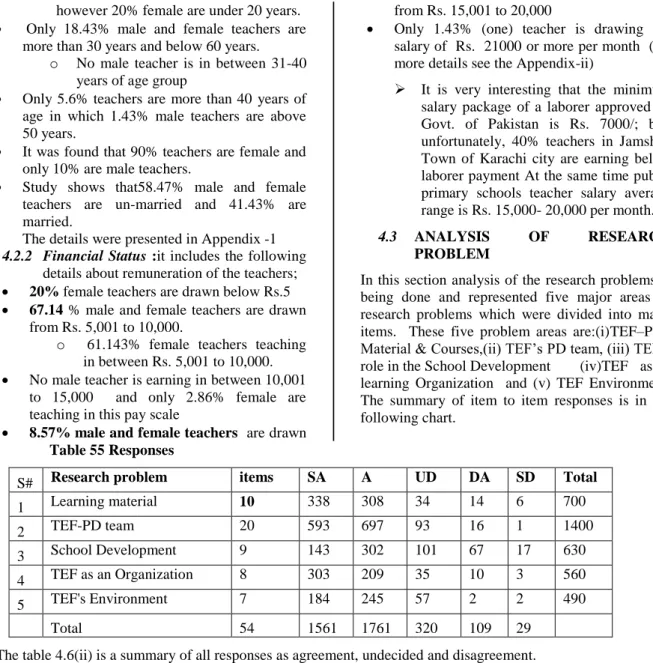
In this section analysis of the research problems is being done and represented five major areas of research problems which were divided into many items. These five problem areas are:(i)TEF–PDP Material & Courses,(ii) TEF‟s PD team, (iii) TEF‟s role in the School Development (iv)TEF as a learning Organization and (v) TEF Environment. The summary of item to item responses is in the following chart.
Table 55 Responses
S# Research problem items SA A UD DA SD Total
1 Learning material 10 338 308 34 14 6 700 2 TEF-PD team 20 593 697 93 16 1 1400 3 School Development 9 143 302 101 67 17 630 4 TEF as an Organization 8 303 209 35 10 3 560 5 TEF's Environment 7 184 245 57 2 2 490 Total 54 1561 1761 320 109 29
The table 4.6(ii) is a summary of all responses as agreement, undecided and disagreement.
Table56 responses in percentage (%)
S# Research problem items SA A UD DA SD Total (%)
1 Learning material 10 48.28 44.00 4.86 1.43 1.43 100
2 TEF-PD team 20 42.67 48.28 6.44 1.18 1.43 100
3 School Development 9 22.69 47.93 16.03 10.66 2.69 100 4 TEF as an Organization 8 54.10 37.33 6.25 1.78 0.54 100
5 TEF's Environment 7 37.55 50.00 11.63 0.41 0.41 100
Table 55 stating the teachers‟ responses into five keys is strongly agreed, agreed, undecided, disagree and strongly disagree. Table 56 is the summary of teachers‟ responses in percentage (%) in above stated five keys. 4.4.1 Problem-wise analysis and Graphical Representation of Research Problems
4.4.1.1 Quality of TEF–PD and Courses and Manuals : Research Problem No.# 1:
What are the teachers‟ perceptions about the effectiveness and contextual relevancy of TEF‟s professional Development Courses, manuals and learning resources?
Table 57
Analysis of Teachers’ Responses:
The table no. 57 endorsed that teachers are quite satisfied about the quality of TEF‟s professional development courses and manuals which are being used a major source of relevant literature. The teachers‟ responses also encourage that the existing manuals and other learning resources are successfully meeting their professional needs in order to improve their performance as an effective teacher in the classroom..
Key
SA = strongly agreed = 48.28% A = agreed =44% UD = undecided = 4.86% DA = disagreed =2.43% SA = strongly disagreed =1.43%
Result
The table and graph no. 57 enforced the findings that 92% teachers have responded that TEF-PDP courses outlines, manuals; activities and learning materials for professional development are very effective and comprehensive. Only, 2.86% teachers have desired to improve more things. However, 4.86% teachers did not want any amendment
4.4.1.2 TEF’S Professional Development Team Research Problem No.# 2
Are the TEF‟s faculty members capable, competent and committed in their respective subject area(s) in order ensure the quality of learning resources and PD-course?
Table 58
Analysis of Teachers’ Responses:
The table no. 58 proved that teacher have reflected their satisfaction about professional and academic qualifications, competency, content knowledge, professional skills, selection of learning strategies and behavior with the course participants and many other professional and personnel skills are really appreciable. There are only 2.6% teachers who have another opinion, it could a any misunderstanding or personal matter or about any specific individual, therefore, it couldn‟t be generalized for the whole or about the team that teachers are quite satisfied
Key:
Teachers' responses (%)
strongle agreed and agreed
undecided /no comments strongle disagreed and disagreed
S# Teachers‟ Responses against research problems
Strongly agree/agree
Undecided/No Comments
Strongly disagree/ disagree
reply % reply % reply %
A. 1 TEF–PD Manuals/ Courses 648 92.28 63 4.86 20 2.86
S# Teachers‟ Responses against research problems
Strongly agree/agree Undecided/No Comments
Strongly disagree/ disagree
reply % reply % reply %
SA = strongly agreed = 42.67% A = agreed =48.28% UD = undecided = 6.44% DA = disagreed =1.18% SA = strongly disagreed =1.43%
Result
The table and graph no. 58 enforced the findings that TEF‟s PDP Team including facilitators‟ resource persons for teacher education is performing well. It is endorsed by 90% teachers have acknowledged extraordinary level of commitment, cooperation, experience, behavior and mastery in their subject areas. But, 2.6% teachers have recommended that methodologies and teaching strategies might be replaced. However, 6.44% teachers didn‟t accepted or rejected any approach being followed by the TEF‟s existing professional development team.
4.4.1.3 TEF’s Role in School Development Research Problem No.# 3:-
Are you feeling that school‟s management, teachers and TEF are effectively contributing to the promotion of effective educational environment in their respective school?
Table 59
Analysis of Teachers’ Responses:
The table no. 59 has verified and endorsed two assumptions first about the TEF‟s role in school development and second is Teachers‟ contribution in the school development, especially effective contribution in quality enhancement initiatives being taken jointly by the teachers and school management. Similarly, teachers are contributing in preparation of the annual calendar, plan review of syllabus, selection of textbooks and other educational decisions and teachers are also satisfied about their current salary package, transport, first aid facilities in their respective school, separate rooms for male and female faculty members and any other facility. Key:
SA = strongly agreed =22.69% A = agreed =47.93% UD = undecided = 16.03% DA = disagreed =10.66% SA = strongly disagreed =2.69%
Teachers' responses(%)
Strongly agree/agree Undecided/No comments Strongly disagree/ disagreeTeachers responses(%)
Strongly agree/agree Undecided/No comments Strongly disagree/ disagreeS# Teachers‟ Responses against research problems
Strongly agree/agree Undecided/No Comments
Strongly disagree/ disagree
reply % reply % reply %
Result
The table and graph no. 59 enforced the findings that TEF role in School Development is needed. It is also endorsed by 70.62% teachers regarding effective relationship and coordination between TEF and School‟s teacher/management in order to improve the quality of teaching–learning process in their schools. But, 16% teachers stated their disagreement, especially about the relationship between school teachers and respective management. This also reflected that management should have a plan for teachers‟ career development, salary packages and trust between teachers and school management. However, 16.03% teachers did not reply against or favor of the said statement.
4.4.1.4 TEF as a Learning Organization Research Problem No.# 4:
-Is there any agreement among the TEF trained teachers about its role for the provision of accessible and free of cost teacher education?
Table 60
Analysis of Teachers’ Responses:
The table no. 60 enforced the result that TEF is playing an effective role in the target geographical areas as a learning organization in order to develop the professional skills of in-service teachers through its continuous professional development courses held at the TEF‟s community centr, Mehmoodabad, Karachi. It is also verified that TEF‟s policies and strategies about selection criteria, admission policy, coordination with the network-schools, learning strategies and efforts of promoting student-centered teaching culture is needed in the Network schools. Finally, it was also suggested that TEF shouldn‟t become a commercial institution.
Key:
SA = strongly agreed = 54.10% A = agreed =37.33% UD = undecided = 6.25% DA = disagreed =1.78% SA = strongly disagreed =0.54%
Result
The table and graph no. 60 enforced the findings that TEF is performing a very effective role as a learning organization. This was also endorsed by over 91.41% teachers about TEF commitment for their PD. It was also endorsed that TEF organization‟s strategies/policies and planning are contextualized and effective for the provision of different professional trainings without any fee. But, 6.25% teachers rejected the above stated statement. However, 2.31% teachers‟ expressed their opinions.
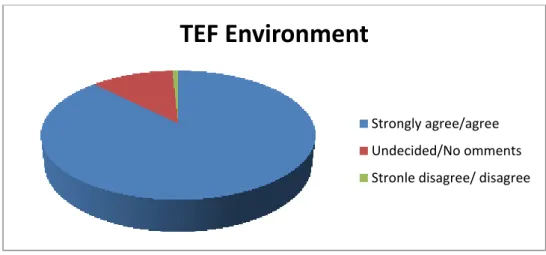
4.4.1.5 TEF Environment Research Problem No.# 5:
Is TEF providing an effective environment for professional development of in-service teachers?
Teachers' responses(%)
Strongly agree/agree Undecided/No Comments Strongly disagree/ disagreeS# Teachers‟ Responses against research problems
Strongly agree/agree Undecided/No Comments
Strongly disagree/ disagree
reply % reply % reply %
Table 61
Analysis of Teachers’ Responses:
The table no. 61 supported this assumption that TEF‟s learning environment is suitable and up to the mark for learning. This is also verified that teachers are feeling them very comfortable and secure within the campus. This comfort-ability is because of behavior and administrative arrangement with the faculty and administrative staff including supporting staff. It was also endorsed by the course participants that all TEF coordination and cooperation among all departments made, it is a more pleasant place for learning.
Key:
SA = strongly agreed = 37.55% A = agreed =50.00% UD = undecided =11.63% DA = disagreed =0.41% SA = strongly disagreed =0.41%
Result:
The table and graph no. 61 enforced the findings that TEF‟s environment is fit for comprehensive learning or professional development course. It was also endorsed by 87% teachers. These teachers expressed their satisfaction about available facilities including security, library, furniture, lunch, refreshment and all other basic necessities. But, 0.82% teachers not accepted said statement. However, only 12% did not recommend any amendment in the existing learning environment.
4.5 RESULT OF TEACHERS’ RESPONSES
4.5.1 Percentage wise Graphical Representation of Research Problems Table 62
S# Research Areas Strongly Agree/ Agree (%) Undecided (%) Strongly disagree/ Disagree (%) 1 TEF–PDP Material/Courses 92.28 4.86 2.86 2 PDP Team 90.3 6.44 2.6 3 School Development 70.62 16.03 13.38 4 TEF as an Organization 91.42 6.25 2.31 5 TEF Environment 87 11.63 0.82
TEF Environment
Strongly agree/agree Undecided/No omments Stronle disagree/ disagreeS# Teachers‟ Responses against research problems
Strongly agree/agree Undecided/No Comments
Undecided/No Comments
reply % reply % reply %
Result:
The table and graph no. 62enforced the findings that there is no comparison between a teacher who stated their agreement and those teachers who stated their disagreement. Therefore, with reference to above statistics teachers appreciated TEF as a learning organization, professional development team and learning environment. Similarly, teachers also endorsed the TEF‟s role in School development and the quality of TEF-PD manuals and courses.
4.5.2 Responses wise Graphical Representation of Research Problems; Table 63
S # Research Areas Str. / agree Undecided Str. / disagree
1 Quality of TEF–PD Manuals/ Courses 648 63 20
2 PDP Team 1290 172 17
3 TEF's role in School Development 445 169 85
4 TEF as a Learning Organization 512 51 13
5 TEF Environment 429 97 4
Result
The table and graph no. 63 enforced the findings that 0ver 664 responses have endorsed the TEF‟s effectiveness and successful contribution in educational development in the TEF-network schools and only 27 responses
0 10 20 30 40 50 60 70 80 90 100 Strongly agree/agree(%) Undecided/No Comments (%) Strongly disagree/ disagree(%) 0 200 400 600 800 1000 1200 1400
Strongly agree and agree
Undecided/No comments
Strongly disagree and disagree
didn‟t show their confidence in this regards but there is no comparison between 664 responses and just 27 responses.
4.6 SUMMARY
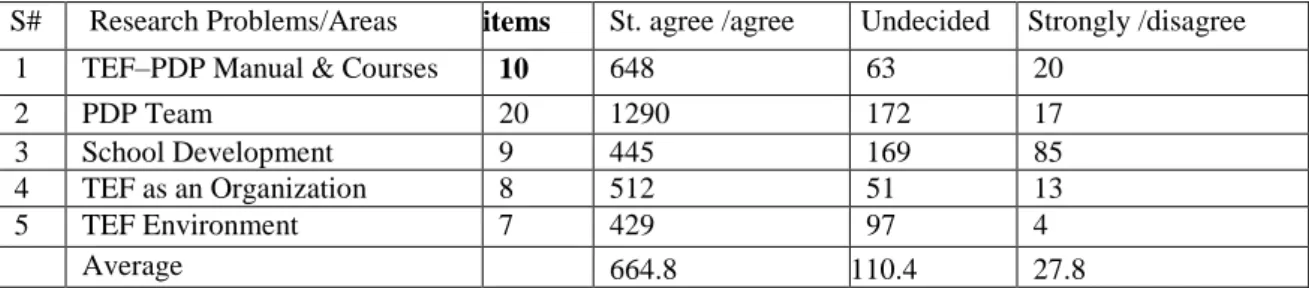
With the reference above stated fives problems areas that include: (i)TEF–PDP Material & Courses,(ii) TEF‟s PD team, (iii) TEF‟s role in the School Development (iv) TEF as a learning Organization and (v) TEF Environment. The matrix of item to item responses is explaining teachers‟ perceptions very clearly in the following chart.
Table 64 Summary of responses
S# Research Problems/Areas items St. agree /agree Undecided Strongly /disagree
1 TEF–PDP Manual & Courses 10 648 63 20
2 PDP Team 20 1290 172 17
3 School Development 9 445 169 85
4 TEF as an Organization 8 512 51 13
5 TEF Environment 7 429 97 4
Average 664.8 110.4 27.8
Similarly, table 64 is a summary of teachers‟ responses in three categories may call strongly or just agreement, undecided and strongly or just disagreement.
Table 65 Summary of Responses in Percentage (%)
S# Research Areas items Str./agree(%) Undecided Str./disagree (%)
1 TEF–PDP Manuals/Courses 10 92.28 4.86 2.86
2 PDP Team 20 90.3 6.44 2.6
3 School Development 9 70.62 16.03 13.38
4 TEF as an Organization 8 91.42 6.25 2.31
5 TEF Environment 7 87 11.63 0.82
Table 64 and Table 65 reflecting that more than eight-six percent (86%) teachers „responses were strongly agreed or agreed and another side less than five percent (4.4%) teachers‟ respondent strongly disagreed or disagreed. Meanwhile, just nine percent (9%) teachers were not stated, any statement as agreement or disagreement.
Conclusion: From table 56 to table 61, table 62 and table 63 and then the Matrixes‟ summarized in table 64 and 65 are endorsing the similar statement and hence there is no technical difficulty to conclude the result. Therefore, with reference to above statistics teachers were strongly appreciated TEF as a learning organization, professional development team and learning environment. Similarly, teachers also endorsed the TEF‟s role in School development and the quality of TEF-PD manuals and courses.
5. SUMMARY, FINDING &
RECOMMENDATIONS 5.1 SUMMARY
The objective of the study to assess impact of TEF‟s professional development courses for primary teachers of TEF-network schools. There are 70 teachers from 20 schools who expressed their views about the five major problems. The study highlighted that TEF course are contributing successfully for provision of accessible quality education effectively. This study also emphasized that TEF and school may increase the services for
educational development in the network school, meanwhile; teachers are extremely satisfied about the TEF‟s role in school development, effective professional development team, quality of learning resources, role as a learning organization and facilities being provided for the course participants. 5.1.1 Findings: There is a set of findings about the effectiveness of TEF professional development courses which were found through this research study:
It was found that a sustainable educational change has occurred in schools where TEF trained teachers were teaching. There are some examples of tangible developments.
Now the culture of usage and development of the low- cost and no-cost learning resources has been introduced. As a result, students‟ performance was improved in assessment and annual examination.
Teachers are enabled to actively involve their students in the teaching- learning process, preparing and implementing the Lesson Plan of different subjects, especially for k 3-5 or middle classes, designing the affective Assessment and Evaluation strategies.
TEF‟s trained teachers were following the philosophy of student-centered learning as replacement of teachers‟-centered traditional teaching and TEFs trained teachers‟ performance is remarkable
comparatively those teachers who were teaching without acquiring any
professional development
certificate/diploma or degree. This was also endorsed through the students‟ higher level of achievements during the teaching- learning process.
The difference between TEF‟s trained teachers and other teachers is also stated by the teachers that TEF‟s trained teachers are preparing varieties of materials for their classroom teaching practice, but the rest of the teachers did not yet realize the importance of student-led activities.
Untrained teachers of networking Schools are being inspired front by TEF trained teachers because of their effective teaching in order to motivate the students‟ in learning process.
Teachers want that TEF must start PTC, CT, B.Ed. and M. Ed Courses/degrees for the individual‟s career development along and holistic educational development along-with the TEF‟s existing continuous professional development courses. Similarly, this study also highlighted that another set of finding about Schools environment that include teachers‟ issues, need, challenges and desires. It also explains some mater about the management and the role and policies competent institutions of the Govt. of Sindh.
The salary package of the teachers is very poor because 87.12% teachers are earning less than Rs. 10,000/= per month.
There was no concept of any necessary facility for the teachers that include medical, transportation, financial assistance like. Eid/ Ramdan Packages/ scholarship and many others.
The school‟s leadership and teachers didn‟t see the most important national document called National Curriculum.
The scope, role and importance of the National Curriculum are not yet realized as a policy document for the preparation of Schools‟ syllabus or educational plan.
The management and faculty members are unable to integrate standards, benchmark, general and specific objectives of the teaching of the subject in order to achieve the desired aims of a particular subject.
There is no written criterion for selection of the text books and other reference books.
The Classes learning process doesn‟t develop understanding and connection with current The National Education Policy of Pakistan
The majority of the teachers is feeling insecure about their jobs, especially before
starting of summer vacations and at the completion stage of an academic year.
There is a majority of female teacher (over 90%) that reflect gender disparity.
The teachers aren‟t qualified up to required level regarding the Assessment process being followed by the “Examination Boards” because they don‟t have the exposure of Examination Boards is regarding Copy Checking and monitoring of Practical examinations and paper setter and other professional opportunities.
The schools‟ management is completely don‟t know about the competent authority (Directorate of Private Schools Sindh) regarding private school, its role about policy matters Equally acceptable throughout the country and abroad by public and private sector.
Schools management perception reflected that if NGOs like TEF‟s course are accredited at HEC –level and affiliated with any degree awarding institute or university.
Teachers want that TEF must start PTC, CT, B.Ed. and M. Ed. Courses for individual‟s career development along with TEF‟s continuous professional development courses.
5.2 SUGGESTIONS
There was no professional opportunity for those teachers in most of the projects funded local by or international by and due to very poor salary package they are not able to spend for basic and/or further necessary professional training or degree.
After 18th amendment now education has become a provincial responsibility, therefore, Govt. of Sindh (in consultation with other provinces and Federal Govt.) must take initiatives to increase the salary package for the teachers of private schools especially teacher who are teaching in under-privileged areas.
The classroom should be planned logically and can perform the primary responsibility of the school in transformation of society‟s values, traditions and socioeconomic norms as per John Dewey‟s Concept for Nation-based Education.
It must be considered that national objectives cannot be sacrificed for the scale of capitalism or globalization. Successes of Contextual Education in USA and Australia have proved that basis of educational activities depends upon values, tradition, beliefs and practices in order ensure social and environmental sustainability.
TEF may develop a comprehensive plan for physical and environmental development in its networking schools.
IT facilities in the networking schools, i.e. provision of computers, establishment of IT Labs for faculty and students is needed in order to enhance the use of Information Communication Technology.
TEF may develop an IT-based professional development environment for this purpose TEF classrooms should be equipped with the latest software which are being used for teaching of Science, Mathematics and other subjects.
All local and international educational projects are mostly based on teaching techniques of some subjects and English language. We should incorporate social, cultural, Islamic values and in–depth understating of the Ideology of Pakistan.
Through professional development programs we should guide the teachers regarding the importance and benefits of the National Curriculum and specified regarding general and specific objectives of the lesson as well as the subject.
Every school and institution should be registered with Employees old Age Benefit Institution of the Govt. in order to ensure provision of health facilities and to facilitate their academic and non–academic staff regarding transportation and benefits.
Salary package of academic staff should be linked with any standard/benchmark, i.e. public sector pay scale.
The Contextualiz education in the context of the history of the Sub-continent and Pakistan may be helpful for the promotion of nation– based wisdom and unity among all geographical and ethnic units of the state so
that Teacher Education may be reviewed as developed countries have been doing.
Establishment of recognized degree awarding institution may be established for the teachers in underprivileged areas by The Education Foundation.
5.3 RECOMMENDATIONS
Accreditation of TEF Courses with any University (Karachi University, Federal, Iqra, Hamdard and any other) may arrange for long term professional development of the school management and teachers.
Establishment of a recognized degree awarding institution may be for the teachers of underprivileged areas by The Education Foundation. Bachelors of Education (B.Ed. /B.S. Ed.) or ECED Diploma will be a good opportunity for the teachers.
TEF may develop an IT-based professional development environment. For this purpose TEF classrooms should be equipped with the latest multimedia based systems which are being used for teaching of Science, Mathematics and other subjects. It should be tending to latest Idea “Flipping the classroom” in future.
Role of Directorate of Private Schools and Institutions, Govt. of Sindh may be revisited and the primary role of the directorate is not only as a monitoring body, but it should deliver in order to facilitate the private schools/institutions, especially in the underprivileged areas regarding policy advocacy, registration, quality enhancement, medical facilities, Scholarship/fee concession for deserving students and teachers for professional development.
Reference
Aseltine, J., Faryniarz, J., & Rigazio-DiGilio, A. (2006).Supervision for learning. Aperformance-based approach to teacher development and school improvement. published by Association for Supervision and Curriculum Development (ASCD), Alexandria, VA
Best John W; Research in Education, Prentice Hall; England Cliff, New Jersey, 1977
Borko, H. (2004). Professional development and teacher learning: mapping the terrain. Educational Researcher, 33 (8), 3-15
Borko, H.; Putnam, R.T. (1995).Expanding a teacher's knowledge base: a cognitive psychological perspective on professional development. In: Guskey, T.R.;
Darling-Hammond, L. (1998). Investing in quality teaching: State-level strategies, 1999. Denver: Education Commission of the States.
Fullan, M. (2005). Leadership and sustainability: system thinkers in action. Thousand Oaks, CA: Corwin Press.
Fullan, M.G. (1990). Staff development, innovation and institutional development. In Gay L.R Educational Research: Competencies for analysis & application, (7thed), 2003
Glatthorn, A. (1995). Teacher Development. In L. Anderson (Ed.), International encyclopaedia of teaching and teacher education (p. 41). London, Pergamon Press.
Guskey, T.R., & Sparks, D. (1996). Exploring the relationship between staff development and improvements in student learning. Journal of Staff Development, 17(4), 34-38.
Hargreaves, A., & Fink, D. (2006). Sustainable leadership. San Francisco: Jossey-Bass.
Haycock, K. (1998). Good teaching matters. Washington, DC: Education Trust.
Hoban, G. (2002). Teacher learning for educational change. Professional Learning Series. Buckingham: Open University Press.
Hussain, S., (2012), Explore the teaching practices in TEF-network schools, The Education Foundation, Karachi
Huw Thoms Steps in Leader Ship David Fulton Pub. 1 Edition 2006
Ingvarson, L., Meiers, M., & Beavis, A. (2005). Factors affecting the impact of professional development programs on teachers‟ knowledge, practice, student outcomes & efficacy. Education Policy Analysis Archives, 13(10), 1-20.
Khine, M. S., & Fisher, D. (2004). Teacher interaction in psychosocial learning environments: Cultural differences and their implications in science instruction. Research in Science and Technological Education, 22, 99–111.
Landvogt, J. (2005). Sharpening up PD: Learning for teaching. Teacher, October, 6–9.
Lingard, B., Hayes, D., Mills, M., & Christie, P. (2003). Leading learning. Maidenhead, UK: Open University Press.
Ministry of Education (2009) National Standards for Accreditation of Teacher Education Programs, National Accreditation Council for Teacher Education, Govt. of Pakistan, Islamabad
New Webster‟s Dictionary of English Language by Lexicon Publication Inc, 1985
Orgland, M. (1997). Initiating, managing and sustaining strategies change – learning from the best. London: MacMillan Press Ltd.
Poskitt, J., & Taylor, K. (2007). Evaluation of assess to learn professional development end of year report, Massey University, Palmerstone North, New Zealand:
Poskitt, J and Taylor, K. (2006), Assess to Learn professional development: impact on teacher learning, Massey University, Palmerstone North, New Zealand
Speck, M., &Knipe, C. (2001). Why can’t we get it right? Professional development in our schools. Thousand Oaks, California: Corwin Press, Inc.
Survey Report (n.d.), Survey for assessing Training need analysis-1999 , The Education Foundation, Karachi, Van Dalen Deobod, Understanding Educational Research, McGraw Hill, 1966
Wenglinsky, H. (2000). How teaching matters: Bringing the classroom back into discussions of teacher quality.
Zwart, R., Wubbels, T., Bergen, T., Bolhuis, S. (2007). Experienced teacher learning within the context of reciprocal peer coaching. Teachers and Teaching, 13(2),165-187.