University of Wollongong
Research Online
Faculty of Engineering and Information Sciences
-Papers: Part A
Faculty of Engineering and Information Sciences
2015
Current MSIS students' views on program
outcomes
Heikki Topi
Bentley UniversityHelena Karsten
Abo Akademi UniversitySusan A. Brown
University of ArizonaJoao Alvaro Carvalho
Universidade do MinhoBrian Donnellan
Maynooth UniversitySee next page for additional authors
Research Online is the open access institutional repository for the University of Wollongong. For further information contact the UOW Library: [email protected]
Publication Details
Topi, H., Karsten, H., Brown, S. A., Carvalho, J., Donnellan, B., Shen, J., Tan, B. C. Y. & Thouin, M. F. (2015). Current MSIS students' views on program outcomes. Proceedings of the AIS SIG-ED IAIM 2015 Conference (pp. 1-11).
Abstract
This paper reports the results of a pilot survey sent to current specialized master’s students in Information
Systems at several universities around the world. The survey was developed to support the MSIS revision
process, but the results will also provide insights on the perceptions of current IS master’s students regarding
their current degree program. The results suggest that the respondents valued individual foundational skills
and high-level business competences more than technical or lower-level managerial competences. The study
utilized competence specifications from the European e-CF 3.0 model, which was useful and performed well
as a competence framework.
Disciplines
Engineering | Science and Technology Studies
Publication Details
Topi, H., Karsten, H., Brown, S. A., Carvalho, J., Donnellan, B., Shen, J., Tan, B. C. Y. & Thouin, M. F. (2015).
Current MSIS students' views on program outcomes. Proceedings of the AIS SIG-ED IAIM 2015 Conference
(pp. 1-11).
Authors
Heikki Topi, Helena Karsten, Susan A. Brown, Joao Alvaro Carvalho, Brian Donnellan, Jun Shen, Bernard C.
Y Tan, and Mark F. Thouin
Topi et al Current Students’ Views on MSIS
CURRENT MSIS STUDENTS’ VIEWS ON PROGRAM OUTCOMES
Heikki Topi
Department of Computer Information Systems Bentley University, USA
[email protected] Helena Karsten
Åbo Akademi University, Finland Susan A. Brown
University of Arizona, USA João Alvaro Carvalho
Universidade do Minho, Portugal Brian Donnellan
Maynooth University, Ireland Jun Shen
University of Wollongong, Australia Bernard C.Y.Tan
National University of Singapore, Singapore Mark F. Thouin
University of Texas at Dallas, USA
Abstract:
This paper reports the results of a pilot survey sent to current specialized master’s students in Information Systems at several universities around the world. The survey was developed to support the MSIS revision process, but the results will also provide insights on the perceptions of current IS master’s students regarding their current degree program. The results suggest that the respondents valued individual foundational skills and high-level business competences more than technical or lower-level managerial competences. The study utilized competence specifications from the European e-CF 3.0 model, which was useful and performed well as a competence framework.
Keywords: MSIS, model curriculum, IS education, IS competences
I. INTRODUCTION
ACM and AIS launched in fall 2014 a joint process to revise MSIS 2006 [Gorgone et al., 2006], the master’s level curriculum recommendation for Information Systems. The process is led by an international task force that consists of two members from Asia/Pacific, three members from Europe, and three members from North America. The task force started its work in December 2014, and it has as its goal to complete the revision process by December 2016.
As part of its work, the task force is collecting data on the perspectives of various stakeholder groups regarding the future curriculum and particularly its outcome expectations. In Spring 2015, the task force developed a survey targeted to several stakeholder groups, including the current students in MSIS and similar programs. The survey was partially built on the program director survey, which was based on some of the core ideas of IS 2010 [Topi et al., 2010] and the results of which were reported in [Topi, 2014]. The current survey does, however, include important additional elements, including and most importantly a segment that is based on the latest version of the European e-CF competence framework [e-CF, 2014].
The results reported here represent, in practice, a pilot study because of a relatively low number of responses that were received in spring 2015. The task force will continue its data collection work in fall 2015, once the new academic year gets started. Despite the low number of responses, the results provide interesting insights regarding the views that current students have regarding their MSIS experiences.
After a brief description of the project background and its context, we will discuss the survey instrument focusing particularly in the differences between the 2014 and the current instrument. We will also describe the characteristics of the data collection process. We will then present the key results of the survey and conclude the paper with an integrative summary.
II. BACKGROUND AND PROJECT CONTEXT
The launch of the MSIS revision process was a culmination of a lengthy preparation process that started already in 2010 [Topi et al., 2010] and has continued with varying level of intensity since [Topi et al., 2011, Topi et al., 2014; Yang, 2012; Topi, 2014]. As discussed above, the process is now in the hands of an international task force (see www.msis2016.org) with a goal completion date of December 2016.
The project has introduced multiple new perspectives to the curriculum revision process. Both ACM and AIS enthusiastically embraced the importance of establishing a truly global process instead of developing the curriculum from the North American perspective (as the past practice had been). This will require a deeper understanding of the global landscape of IS master’s programs and a broader consideration of the needs of a variety of educational contexts. The task force has emphasized in its early work the close linkage between the MSIS curriculum and the development and maturation of the IS profession. In addition, the task force has recognized the importance of developing the curriculum driven by target competences. For this to be successful, the curriculum development work needs to be based on a well-specified, carefully crafted competence framework. In its initial work, the task force has identified the European e-Competence Framework (e-CF 3.0; www.ecompetences.eu) and the Skills Framework for the Information Age (SFIA v. 6; sfia-online.org) by the SFIA foundation as possible candidates for competence frameworks. It also recognizes that these might not be sufficient, given the need to also be forward-looking. Finally, the task force acknowledges that technologies, organizational models, and the role of IS/IT in organizations are all in continuous change (as has been the case since our field was established).
As part of its work, the task force is collecting or planning to collect data from multiple constituent groups, including MSIS program directors [Topi, 2014], members of existing programs’ corporate advisory boards, IT consulting and advisory firms, and current and former students of MSIS programs. The survey, the pilot results of which are reported here, is part of this data collection effort.
III. AREAS OF INTEREST AND SURVEY INSTRUMENT
The original survey targeted to MSIS program directors [Topi, 2014] was developed to gain an understanding of the use and role of MSIS 2006, graduate outcome expectations, general suggested changes to the curriculum, and the respondents’ views regarding the overall long-term direction of the MSIS programs. The first and the third of these categories were specifically targeted to program directors, who at least had the potential to be MSIS 2006 users and have the background to propose changes to the curriculum recommendation. These elements were dropped from the survey targeted to non-academic stakeholders.
The revised survey did, however, expand the coverage of graduate outcome expectations beyond those covered in the program director survey. The most important addition was the inclusion of the 40 high-level ICT-related competencies from e-CF in the competence evaluation instrument. The new instrument includes four sections: 1) high-level IS capabilities (specified originally in IS 2010 [Topi et al., 2010] and later used in [Mandviwalla et al., 2013]); 2) graduate competences as
specified in e-CF; 3) IS specific knowledge and skills; 4) foundational knowledge and skills and domain fundamentals. Sections 3 and 4 were also adapted from IS 2010 and modified based on feedback from [Topi et al., 2013] and [Topi, 2014]. All four sections used the same slide control to indicate relative importance values between 0 and 100.
The European e-Competence Framework that was used as the foundation for the second section described above is the result of a long-term and comprehensive pan-European process that is described from the methodology perspective in [Hook, Marinoni, and Rogalla, 2014]. The framework consists at the highest level (Dimension 1) of five e-competence areas (ICT business processes): Plan, Build, Run, Enable, and Manage. Dimension 2 consists of 40 general e-competences, each of which belongs to one of the e-competence areas. Dimension 3 of the model specifies possible proficiency levels for each of the e-competences, and Dimension 4 lists specific knowledge and skills that are examples of e-competence content. In this survey, the focus was on the 40 Dimension 2 e-competences in their short description form (consisting of 1-5 words). The survey also included a hyperlink to the e-CF 3.0 document that provides a full description of the e-competences.
In addition to the quantitative instruments, the respondents had an opportunity to provide qualitative feedback regarding high-level IS capabilities and knowledge and skill categories). In most cases, the respondents used this option to suggest categories that were not included in the original instrument. At the end of the survey, the respondents had also an opportunity to provide free-form feedback to the task force.
The survey also included questions for collecting data regarding demographics and other respondent background. The full survey instrument is available from the authors per request.
IV. DATA COLLECTION
The population for the study reported here consisted of students in six master’s programs in Information Systems or a related field. The programs selected for this pilot study included programs with which the task force members were affiliated. The participants were invited to respond to the survey with a single e-mail in April and May 2015. Altogether, the task force received 33 usable responses from student respondents.
V. RESULTS
Respondents and Represented Programs
The respondents represented a broad variety of geographic contexts: 10 were from Portugal, 6 from Australia, 5 from the U.S., 5 from Russia, and the rest represented smaller nationality groups. Most respondents were male (85%) and under 30 years of age (79%). 45% of the respondents were full-time students, 25% were working part-time, and 30% full-time. Most of the respondents (64%) indicated that their program was in the school of information/informatics/ information technology, 15% in school of engineering, and 12% in school of management/ business. Schools of management/business were clearly underrepresented in this sample.
High-level Capabilities
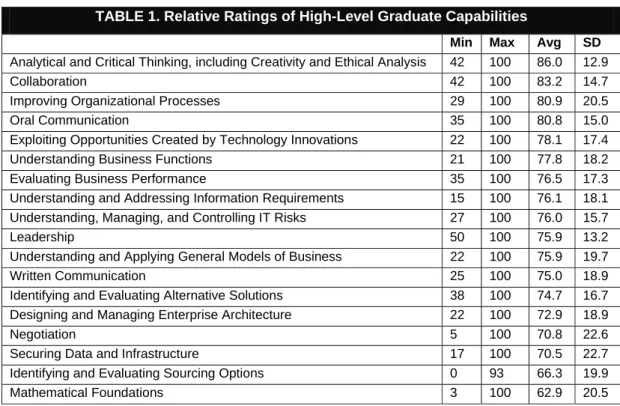
Table 1 describes the results of the students’ perceptions regarding the relative importance of the high-level graduate capabilities. It is interesting to note that three of the first four items on the list are foundational skills that apply to all knowledge professions and professionals: analytical and critical thinking, collaboration, and oral communication.
These (or corresponding ones) are in the core of the capabilities developed by most professional master’s programs as indicated, for example, by the fact that they are featured in the general accreditation requirements for both engineering and computing programs and very typical learning objectives for many business programs. The capability that the students ranked third in this analysis was primarily a managerial one: improving organizational processes. In this context, it is likely to be interpreted as one focused on improving the processes with information
technology, but still, it is not an pure technology-related capability, as are not the two that follow: exploiting opportunities created by technology innovations and understanding and addressing information requirements. Technically focused capabilities related to solution alternatives, enterprise architecture, security, and IS sourcing are al low in the student importance ranking, barely above mathematical foundations that the students ranked the lowest of them all. Compared to the program director survey reported in [Topi, 2014], the most noteworthy differences were as follows: the program directors ranked capabilities related to information requirements clearly as the most important one (with an average rating of 85.3) whereas students gave it an average rating of 76.1 and sixth place. Another key technical capability that program directors ranked much higher than the students was security (5th vs. 16th, with average ratings of
77.8 vs. 70.5). Students, in turn, ranked collaboration very highly (2nd, 83.2) whereas program
directors gave it (albeit together with leadership) a rank of 11 and rating of 64.5. Students also considered general business related capabilities related to business functions and business performance significantly higher.
The respondents provided few comments regarding capabilities that they perceived to be missing from the list, and the responses did not form a pattern. The observations are, however, worth considering: one suggested that a high-level capability item would be needed that covers IS development in a broad sense (“integrated ability of programming, database, systems analysis and design, and project management”). Another proposed the need for a category focusing on
TABLE 1. Relative Ratings of High-Level Graduate Capabilities
Min Max Avg SD
Analytical and Critical Thinking, including Creativity and Ethical Analysis 42 100 86.0 12.9
Collaboration 42 100 83.2 14.7
Improving Organizational Processes 29 100 80.9 20.5
Oral Communication 35 100 80.8 15.0
Exploiting Opportunities Created by Technology Innovations 22 100 78.1 17.4
Understanding Business Functions 21 100 77.8 18.2
Evaluating Business Performance 35 100 76.5 17.3
Understanding and Addressing Information Requirements 15 100 76.1 18.1 Understanding, Managing, and Controlling IT Risks 27 100 76.0 15.7
Leadership 50 100 75.9 13.2
Understanding and Applying General Models of Business 22 100 75.9 19.7
Written Communication 25 100 75.0 18.9
Identifying and Evaluating Alternative Solutions 38 100 74.7 16.7 Designing and Managing Enterprise Architecture 22 100 72.9 18.9
Negotiation 5 100 70.8 22.6
Securing Data and Infrastructure 17 100 70.5 22.7
Identifying and Evaluating Sourcing Options 0 93 66.3 19.9
solution and infrastructure deployment. The other two recommendations were related to the inclusion of project management and international business.
Technical Skills and Knowledge
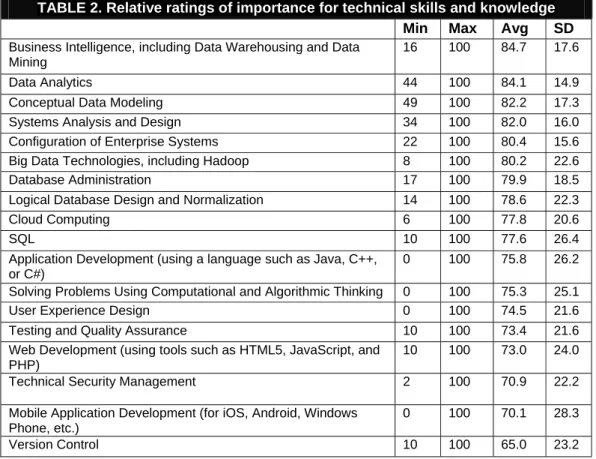
Table 2 describes the students’ perception regarding the importance of various technical skills and knowledge categories. This priority list was strongly dominated by categories related to data and information management and analytics: Of the top 10 categories, seven were related to this broad area of study. Given the small sample size it is possible that this was driven by the specific personal interests of the students, but the finding is consistent with the strong interest that students all around the world are demonstrating in the data management and analytics space [Watson, 2013]. The topics perceived to be most important included also systems analysis and design, enterprise systems configuration, and cloud computing. The low level of interest in mobile application development, security management, and web development is quite surprising, given the broad, highly visible, and ongoing conversation regarding these topics in trade press (and organizational practice) recently. The only free-form recommendation was related to the need to add a web-based development language (specifically Python) and coverage of NoSQL
(specifically, MongoDB).
Compared to the program director ratings reported in [Topi, 2014], the student respondents overall gave technical skill and knowledge categories significantly higher ratings (average ratings ranging from 84.7 to 65.0 compared to program director ratings from 80.8 to 51.6). The rankings followed a very similar pattern; the only significant difference was much higher rank of technical security management for program directors (#8 vs. #16).
TABLE 2. Relative ratings of importance for technical skills and knowledge
Min Max Avg SD
Business Intelligence, including Data Warehousing and Data Mining
16 100 84.7 17.6
Data Analytics 44 100 84.1 14.9
Conceptual Data Modeling 49 100 82.2 17.3
Systems Analysis and Design 34 100 82.0 16.0
Configuration of Enterprise Systems 22 100 80.4 15.6
Big Data Technologies, including Hadoop 8 100 80.2 22.6
Database Administration 17 100 79.9 18.5
Logical Database Design and Normalization 14 100 78.6 22.3
Cloud Computing 6 100 77.8 20.6
SQL 10 100 77.6 26.4
Application Development (using a language such as Java, C++, or C#)
0 100 75.8 26.2
Solving Problems Using Computational and Algorithmic Thinking 0 100 75.3 25.1
User Experience Design 0 100 74.5 21.6
Testing and Quality Assurance 10 100 73.4 21.6
Web Development (using tools such as HTML5, JavaScript, and PHP)
10 100 73.0 24.0
Technical Security Management 2 100 70.9 22.2
Mobile Application Development (for iOS, Android, Windows Phone, etc.)
0 100 70.1 28.3
Managerial Skills and Knowledge
As shown in Table 3, the managerial skill and knowledge category that the students perceived to be most important was IT project management, a finding that is not surprising given the
importance of project work for IS/IT professionals. It was followed by a broad IT strategy category, reflecting the students interests in reaching an organizational level where they can have an impact on the whole IT organization and its direction; the fourth item on the list, IT governance, is closely related. At the bottom of the list are IT sourcing and procurement and IT management frameworks, which is surprising, given the fundamental importance of these topics for operational and tactical implementation of IS strategy. There were no free-form recommendations from the respondents regarding missing managerial skills and knowledge.
The relative rankings of the managerial skill and knowledge categories were exactly the same for program directors (as reported in [Topi, 2014]) and students. As with technical categories, the rating values given by the students were overall higher than those given by the program directors (ranging from 84.5 to 74.6 vs. 85.0 to 62.8).
E-CF Competences
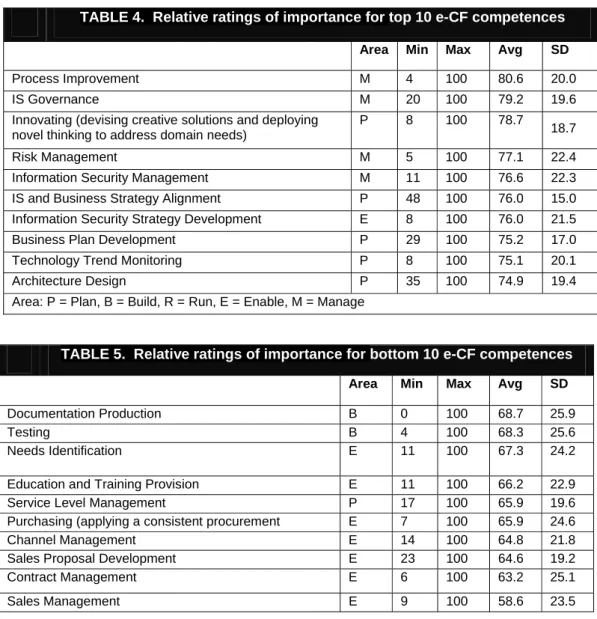
Tables 4 and 5 include the top 10 and bottom 10 e-CF competences based on the student respondents’ evaluation of their importance. In addition to the same descriptive statistical data as above, the tables include an indicator that shows the competence area to which each individual competence belongs. (As described above, the e-CF competences have been divided into five competence areas: Plan, Build, Run, Enable, and Manage). Interestingly, the profiles of the top 10 and bottom 10 are distinctively different: with one exception, the top 10 competences belong to the Manage and Plan areas whereas the bottom 10 are with one exception part of Build and Enable. The students responding to the survey appear to have had a clear shared sense of the types of jobs for which they hope to be preparing.
In the same way as in the context of managerial skills and knowledge, the students did not perceive significant tactical and operational level managerial competences to be important for them: service level management, purchasing, and contract management were all among the bottom five of the e-competences.
TABLE 3. Relative ratings of importance for managerial skills and knowledge
Min Max Avg SD
Managing IT Projects 54 100 84.5 13.4
Development and Management of IT Strategy 30 100 81.3 16.2
Business Process Modeling 5 100 79.9 20.3
IT Governance 17 100 79.3 19.3
Security Policy Management 20 100 78.4 18.1
Managing IT Professionals 0 100 77.7 21.4
Enterprise Architecture Development 2 100 76.4 21.3
Ensuring Business Continuity 22 100 76.0 20.6
Application of IT Management Frameworks (ITIL, COBIT, etc.) 1 100 75.5 21.9
Revision recommendations
There were a few key themes that emerged from the general free-form comments by the
respondents. Some of them were related to curriculum content and others to program pedagogy. The most common shared observation was related to the need for experiential and project-based learning. The respondents emphasized the important of real-world cases and the students’ involvement in addressing them. In one case a respondent took this further and proposed a single integrated project throughout the program. Others proposed an emphasis based on specific target professions, including business analysts, consultants, and project managers.
The respondents also provided suggestions regarding specific topics that should be covered in MSIS programs. Some of the suggestions were familiar with MSIS revision background work (e.g., [Topi et al., 2014]), such as focus on mobile and cloud technologies, security, IT governance or an emphasis on analytics. A couple of respondents suggested that the programs should focus more on providing students with a better understanding of business value of IT and the
opportunities for transforming business with IT. Other recommended topics included optimization TABLE 4. Relative ratings of importance for top 10 e-CF competences
Area Min Max Avg SD
Process Improvement M 4 100 80.6 20.0
IS Governance M 20 100 79.2 19.6
Innovating (devising creative solutions and deploying novel thinking to address domain needs)
P 8 100 78.7
18.7
Risk Management M 5 100 77.1 22.4
Information Security Management M 11 100 76.6 22.3
IS and Business Strategy Alignment P 48 100 76.0 15.0 Information Security Strategy Development E 8 100 76.0 21.5
Business Plan Development P 29 100 75.2 17.0
Technology Trend Monitoring P 8 100 75.1 20.1
Architecture Design P 35 100 74.9 19.4
Area: P = Plan, B = Build, R = Run, E = Enable, M = Manage
TABLE 5. Relative ratings of importance for bottom 10 e-CF competences
Area Min Max Avg SD
Documentation Production B 0 100 68.7 25.9
Testing B 4 100 68.3 25.6
Needs Identification E 11 100 67.3 24.2
Education and Training Provision E 11 100 66.2 22.9
Service Level Management P 17 100 65.9 19.6
Purchasing (applying a consistent procurement d )
E 7 100 65.9 24.6
Channel Management E 14 100 64.8 21.8
Sales Proposal Development E 23 100 64.6 19.2
Contract Management E 6 100 63.2 25.1
and modularization of IT resources, localization of IT resources, and legal implications of IT standards and policies.
In general, the students were strongly focused on getting an education that prepares them successfully to the specific job market that they are targeting. One of the reasons underlying the emphasis on project-based, experiential learning, preferably in a real-world enterprise context, was the understanding that it would help them gain an advantage in the job search context.
VI. DISCUSSION
The results of this survey help in moving towards a more comprehensive data collection effort to support the MSIS revision process. They give an initial understanding of the students’ perspective on the importance of high-level capabilities, technical and managerial skills and knowledge, and professional competences specified using the European e-competence framework.
When interpreting and discussing these results, it is essential to acknowledge that the sample consisted of only a limited number of master’s programs and that the percentage of students who responded was small. The data does not lend itself to in-depth statistical analysis, and analyzing the psychometric properties of the instruments at a detailed level is not possible, either. We do, however, believe that the data collection effort and these initial results are a valuable step in moving towards a survey with a larger number of respondents.
These results indicate that the instrument was understandable and comprehensive. Neither the detailed nor the general free-form comments showed confusion regarding the various categories (although it is likely that the terms are interpreted differently by different respondents). The results are mostly consistent with those of the 2014 program director survey [Topi, 2014] particularly in terms of the technical and managerial skill/knowledge categories. This appears to support the overall high level of understandability of the survey and consistency in its interpretation. Because of the low numbers of respondents, comprehensive statistical evaluation of the instruments is not possible, but nothing in the results points to significant problems, either. The results of the segment of the survey based on the e-CF 3.0 framework were highly consistent with the categorization of the competences into competence areas, suggesting that these IS graduate students’ interpretation of the competences was compatible with that of the framework. The following key content results are worth reiterating:
The students clearly perceived the development of individual foundational competences (communication, critical thinking, collaboration, etc.) a very important element of their studies, as indicated by the high relative ranking these high-level capabilities achieved.
The respondents perceived organizational and management-related high-level capabilities more important than the technical ones.
Of the technical knowledge and skills categories, the respondents overwhelmingly identified those related to data management and analytics most important, followed by systems analytics and design.
Overall, the respondents considered many operationally and tactically important IS management skill and knowledge categories less important than those associated with high-level IS management categories (such as IS strategy and IS governance). This was fully consistent with the way in which the respondents selected e-CF competences from the Plan and Manage competence areas as most important and those from the Enable and Build areas least important.
In the areas where comparison between this survey and an earlier one targeted to program directors [Topi, 2014] is possible, the perceptions of the two groups regarding the relative importance of both high-level capabilities and technical and managerial skills are surprisingly similar. The similarity was particularly striking in the context of the skills and knowledge categories (at a lower level of abstraction than the high-level capabilities).
The respondents did not provide significant new ideas regarding competences or skill and knowledge categories that should be included in the degree outcome set. They did,
however, use the free-form response opportunities to express a strong preference for hands-on, project-based, experiential learning (if possible, in a real-world context). It is important to consider carefully the ways in which feedback from current students will be used in the MSIS revision process. On one hand, students are clearly an important stakeholder group that needs to be listened to in the process. Particularly part-time students and those with significant internship experience may have a good understanding of what their immediate competence needs are for workplace success. On the other hand, there are, however, other students who have little or know experience from the employment contexts that they are striving to enter, and relatively few students have a good understanding of their long-term competence needs. This suggests that the task force should collect data regarding student perceptions, but that the results should be interpreted in the context of views by representatives of other stakeholder groups (program directors, faculty members, and particularly employers and IS/IT thought leaders). It is also important to remember that student perspectives regarding pedagogy and other aspects of program implementation can be highly valuable.
With additional data from this and other stakeholder groups, we will have opportunities with significantly more interesting analytical work. For example, we will be able to identify clusters of skill and knowledge categories and this way, gain a data-driven understanding of the higher-level capability structures. We will also be able to evaluate better whether or not the e-CF
competences in each of the five areas behave similarly in the significance ratings. Data from multiple stakeholder groups would allow us to compare the perceptions of various groups and understand better which views should directly inform choices regarding the curriculum and which should lead to efforts to educate specific groups regarding competence and curriculum choices that might not be fully consistent with their views.
Finally, it is clear that any quantitative survey work should be augmented with interviews and other qualitative methods to understand better the competences that are missing from e-CF or any other framework that might be used. The task force needs data collection approaches that will help it understand better the future needs of the IS organization and other organizational units hiring professionals with a strong IS background. Organizations and information technology are changing very rapidly and thus, being forward-looking is an essential characteristic of any curriculum recommendation.
VII. CONCLUSION
The study reported in this paper is part of a larger effort by the MSIS revision task force (www.msis2016.org) to understand the competence needs that an MS in IS program can and should address from the perspective of multiple stakeholder groups. In this study, we tested an instrument for evaluating the views of current students regarding the high-level capabilities, technical and managerial skills and knowledge categories, and competences that an MSIS program should develop. Despite the small sample size, it demonstrated that a survey of this type has the potential to provide interesting and important insights. The European Competence Framework e-CF provided a good foundation for evaluating the e-competences that are currently relevant. It will, however, also be important to use other mechanisms to understand the future competence needs. Overall, it will be important for the task force to collect broad-based data regarding the relevant competences and use results from different stakeholder groups in an integrated analysis.
REFERENCES
e-CF. (2014) European e-Competence Framework 3.0. A common European Framework for ICT
Professionals in all industry sectors. CWA 16234:2014 Part 3. CEN,
http://www.ecompetences.eu/e-cf-3-0-download/ (current August 21, 2015).
Curriculum and Guidelines for Graduate Degree Programs in Information Systems”,
Communications of the AIS, (17)17, pp. 1–58.
Hook, T., C. Marioni, and I. Rogalla. (2014) Building the e-CF -- a combination of sound methodology and expert contribution. Methodology documentation of the European
e-Competence Framework. CWA 16234:2014 Part 3. CEN,
http://www.ecompetences.eu/e-cf-3-0-download/ (current August 21, 2015).
Mandviwalla, M., C. Harold, P. Pavlou, and T. Petrucci (2013) 2013 Information Systems Job
Index, Report by AIS and IBIT at Temple.
Topi, H. (2014) "Program Directors' Perspectives on MSIS Outcome Expectations and Future Directions", Proceedings of AIS SIGED 2014, Auckland, New Zealand.
Topi, H., A. Harris, V. Ramesh, and R.T. Wigand (2013) “Launching a Comprehensive Review of MSIS 2006”, Proceedings of AIS SIGED 2013, Milan, Italy.
Topi, H., J.S. Valacich, R.T. Wright, K. Kaiser, J.F. Nunamaker, J.C. Sipior, and G.J. de Vreede (2010) “IS 2010: Curriculum Guidelines for Undergraduate Degree Programs in Information Systems”, Communications of the AIS, (26)18.
Topi, H., K. Conboy, B. Donnellan, V. Ramesh, C. Van Toorn, and R.T. Wright (2014) “Moving Toward the Next Generation of Graduate Degree Programs in Information Systems”,
Communications of the AIS, (34)35, pp. 1–21.
Topi, H., M. Helfert, V. Ramesh, and R.T. Wigand (2011) “Future of Master's Level Education in Information Systems”, Communications of the AIS, (28)27, pp. 1–15.
Watson, H. (2013) “The Business Case for Analytics”, BizEd, May.
Yang, S.C. (2012) “The Master's Program in Information Systems (IS): a Survey of Core Curriculums of US Institutions”, Journal of Education for Business, (87)4, pp. 206–213.
ABOUT THE AUTHOR
Sue Brown is Professor of Management Information Systems at University of Arizona. She is also serves as Visiting Professor at Hong Kong University of Science and Technology. Her research on the adoption and diffusion of IT by organizations and individuals has been published in MIS Quarterly, ISR, JMIS, ISJ, JASIST, EJIS, and other leading journals. She has served as Senior Editor for MIS Quarterly and Associate Editor for MISQ, ISR, JAIS, and Decision Sciences.
João Carvalho isProfessor of Information Systems Department at University of Minho in Portugal. João has coordinated BS, MS and Doctoral Programs and been the head of the department and deputy dean of the faculty. He has led a task group to propose an integrated Master (5 years) in IS. He collaborates with the Portuguese national agency for the accreditation of degree programs in computing and in management
Brian Donnellan isProfessor at Maynooth University Business School and Academic Director of Innovation Value Institute. In addition to developing the curriculum for MSc in IT Management, Brian has participated in several related European Union projects, and worked on IT competency issues in the context of the Innovation Value Institute. He has also participated in panels
discussing curriculum development (AIS SIG-ED IAIM 2011, AMCIS 2010 and ECIS 2008).
Eija (Helena) Karsten isAssociate Professor in Information Systems at the Åbo Akademi University in Finland. She has MSc in Computer Science (University of Helsinki) and MA in Education (University of Minnesota). She earned her PhD in 2000, supervised by Kalle Lyytinen and Matthew Jones. During 2012-2014, she led a Ministry of Education funded project on joint curriculum development for doctoral studies between Finland and China. In 2011, she was the Finnish representative in the team evaluating 32 Information Systems degree programs in 18 universities in Sweden.
Jun Shen is Associate Professor at School of Computing and Information Technology at University of Wollongong in Wollongong, NSW of Australia, where he had been Head of Postgraduate Studies, and Chair of School Research Committee since 2014. He had been Director of Masters of ICT for 9 years since 2006 and is currently Director of Masters of IT. He was awarded PhD in 2001 at Southeast University, China. He served as IEEE Education Chapter Chair of NSW from 2007 to 2014. He has been Editor, PC Chair, Guest Editor, PC Member for numerous journals and conferences published by IEEE, ACM, Elsevier and Springer.
Bernard Tan is Professor in the Department of Information Systems at the National University of Singapore (NUS) and has served as Vice Provost (Education) at NUS since 2012. His earlier administrative roles include Associate Provost and Head of the Department of Information Systems. He has served on editorial boards of numerous leading IS journals, including MISQ (senior editor), JAIS (senior editor), JMIS, and ACM Transactions on MIS. His research has been published in a variety of leading information systems and computing journals, including MIS Quarterly, ISR, Management Science, JAIS and several IEEE and ACM Transactions. He served as President of AIS in 2009-2010 and has been Fellow of AIS since 2011.
Mark F. Thouin is Director of Graduate Information Systems Programs at the University of Texas at Dallas where he teaches graduate and undergraduate courses, promotes academic programs in information systems, and founded an Information Systems Industry Advisory Board (IAB). His research interests include the study of clinical and administrative value of information technology in healthcare settings. He holds a Ph.D. from Texas Tech University, an MBA from George Mason University and a BS in Mathematics from Virginia Tech. Prior to joining UT Dallas, he worked for 13 years in a variety of management, technical, and business development positions providing IT consulting services.
Heikki Topi (Moderator) is Professor of Computer Information Systems at Bentley University. He has been actively involved in leadership roles in national computing curriculum development and evaluation efforts (including IS 2002, CC2005 Overview Report, and as co-chair of IS 2010 and the ongoing MSIS curriculum revision projects). He is coauthor of Modern Database Management
and co-editor of IS/IT volume of CRC/Chapman & Hall’s Computing Handbook. He is a member of the ACM Education Board and Council, the Board of CSAB, and TUN Executive Board.