Strathprints Institutional Repository
Qazi, Abroon Jamal and Quigley, John and Dickson, Alexander (2014) Interdependency modeling of supply chain risks incorporating game theoretic risks. In: 10th Doctoral Workshop on Purchasing and Supply Management and IPSERA International Nodes Meeting. Associazione Italiana di Ingegneria Gestionale, Bologna. ,
This version is available at http://strathprints.strath.ac.uk/50443/
Strathprints is designed to allow users to access the research output of the University of Strathclyde. Unless otherwise explicitly stated on the manuscript, Copyright © and Moral Rights for the papers on this site are retained by the individual authors and/or other copyright owners. Please check the manuscript for details of any other licences that may have been applied. You may not engage in further distribution of the material for any profitmaking activities or any commercial gain. You may freely distribute both the url (http://strathprints.strath.ac.uk/) and the content of this paper for research or private study, educational, or not-for-profit purposes without prior permission or charge.
Any correspondence concerning this service should be sent to Strathprints administrator: [email protected]
Interdependency Modeling of Supply Chain Risks incorporating Game
Theoretic Risks
Abroon Qazi1, John Quigley1, Alex Dickson2
1Department of Management Science, University of Strathclyde, Glasgow, G1 1QE, UK
2Department of Economics, University of Strathclyde, Glasgow, G4 0GE, UK
({abroon.qazi, j.quigley, alex.dickson}@strath.ac.uk)
Abstract – Most of the current risk quantification techniques being applied in the field of
Supply Chain Risk Management consider risk factors to be independent. This research considers risks as interdependent triggers, events and consequences. We propose a risk quantification framework based on Bayesian belief network modeling that is an effective method to capture the mentioned interaction between various risk factors. The conflicting incentives among stakeholders in a supply chain can jeopardize the success of a project and therefore, quantification of this category of risks named as ‘Game theoretic risks’ needs special consideration. We have assessed game theoretic risks in the development project of Boeing 787 aircraft. The game theoretic analysis captures uncertainty of the Tier-1 suppliers about the cost functions of each other and demonstrates that any uncertainty of information in a supply chain can adversely affect the intended outcome. Finally, we have designed a fair sharing partnership featuring continuous time domain and present value of money concept that aligns the conflicting incentives.
Keywords– Bayesian belief network, Game theoretic risks, supply chain risk management
I. Introduction
Supply chain risk management (SCRM) is an active area of research (Ghadge et al., 2012, Sodhi et al., 2012). There exists a research gap of exploring existing risk quantification techniques from other fields for application in the realm of SCRM (Khan and Burnes, 2007). Most of the applied techniques assume risks as independent whereas various risk factors interact and in order to model the real time risks, the modeling technique must capture the interdependency (Badurdeen et al., 2014). Furthermore, a number of recent literature reviews conducted by various researchers emphasize the need of capturing a holistic view of entire supply network for managing supply chain risks (Ghadge et al., 2012, Bellamy and Basole, 2013, Colicchia and Strozzi, 2012).
There is a research gap of exploring supply chain risks associated with the development of a new product. The development project of Boeing 787 aircraft has been explored through the lens of supply chain risk management but keeping in view the importance of such major projects for the manufacturer, there is requirement of devising a robust quantitative technique that can help managers visualize the holistic view of the interacting risk factors for implementing effective risk mitigation strategies.
We propose a modeling framework based on the technique of Bayesian belief networks (Qazi et al., 2014). Bayesian belief networks (BBNs) can capture the interdependency between risk factors. These are probabilistic graphs that consist of nodes and arcs. Nodes represent the variables and an arc connects two variables while the strength of connectivity is expressed in terms of conditional probabilities specified for each node (child) that is directly dependent on its parent nodes (Sigurdsson et al., 2001). BBNs have been applied in SCRM but mainly focusing on specific areas like supplier selection, site selection, risk profiling etc. (Lockamy and McCormack, 2009, Lockamy, 2011, Dogan and Aydin, 2011, Lockamy and McCormack, 2012, Dogan, 2012, Lockamy, 2014, Badurdeen et al., 2014). Our proposed framework considers the application of risk quantification scheme in a holistic manner.
Game theory is the study of strategic decision making. Game theory can help decision makers take appropriate decisions keeping in view the conflicting incentives among stakeholders in a supply chain (Lutz et al., 2012, Zhao et al., 2012). Game theory involves modeling simultaneous-move games and sequential-move games. Game theory can assess risks associated with the uncertainty about the information.
We have analyzed the development project of Boeing 787 through the lens of Game theory. The analysis revealed that any uncertainty about the information in a supply chain can result in an outcome detrimental to the project objective. The research objectives and methodology are described in Section II. The proposed risk quantification model is presented in section III. The characteristics of Boeing 787 Project are described in section IV. The game theoretic analysis is presented in section V. Section VI delineates the fair sharing partnership model followed by the conclusion described in section VII.
II. Research Methodology
We propose a hybrid method integrating techniques of Bayesian Belief Network (BBN) and Game Theory. BBNs can capture the interdependency between risk factors while Game theory can assess the conflicting incentives among stakeholders. The quantitative hybrid method will be applied to a case study concerning the development of a new commercial
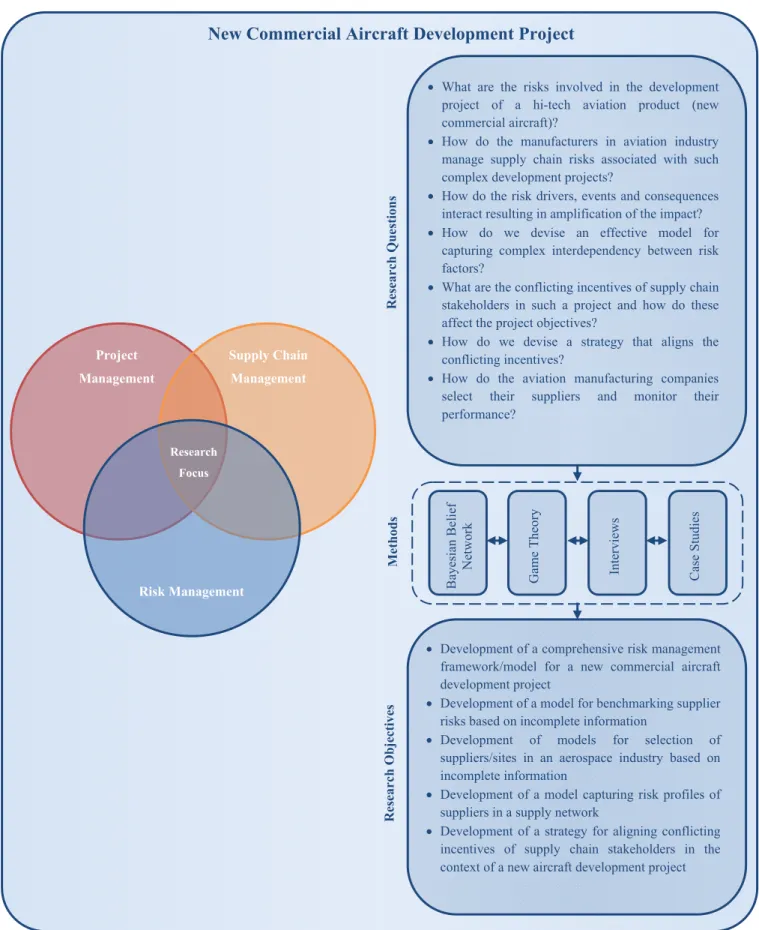
aircraft. The proposed risk management model will be beneficial to project managers supporting a holistic view encompassing interdependent risk factors and their relationship with appropriate risk mitigation strategies. The summary of research questions, objectives and methods is presented in Fig. 1.
Objectives
Following are the objectives of research project:
To develop a comprehensive risk management framework/model for the development
project of a new product (commercial aircraft)
To develop a model for benchmarking supplier risks in an aerospace industry based on
incomplete information
To develop models for selecting suppliers/sites for an aerospace industry based on
incomplete information
To develop a model capturing risk profiles of suppliers in a supply network
To develop a strategy for aligning conflicting incentives of Tier-1 suppliers in the
development project of a new commercial aircraft
Problem Statement
Based on the review of literature in the field of Supply chain risk management (SCRM), it is revealed that there are research gaps necessitating application of existing risk quantification techniques in other fields to the field of SCRM and exploration of supply chain risks involved in the development project of a new product (commercial aircraft). The research project is aimed at bridging the mentioned research gaps by addressing following research questions:
What are the risks involved in the development project of a new hi-tech aviation product
(commercial aircraft)?
How do the manufacturers in aviation industry manage supply chain risks associated
with such complex development projects?
How do the risk drivers, events and consequences interact resulting in amplification of
the impact?
How do we devise an effective model for capturing complex interdependency between
What are the conflicting incentives of supply chain stakeholders in such a project and how do these affect the project objectives?
Fig. 1. Research questions and objectives.
Project Management Supply Chain Management Risk Management Research Focus
What are the risks involved in the development
project of a hi-tech aviation product (new commercial aircraft)?
How do the manufacturers in aviation industry
manage supply chain risks associated with such complex development projects?
How do the risk drivers, events and consequences
interact resulting in amplification of the impact?
How do we devise an effective model for
capturing complex interdependency between risk factors?
What are the conflicting incentives of supply chain
stakeholders in such a project and how do these affect the project objectives?
How do we devise a strategy that aligns the
conflicting incentives?
How do the aviation manufacturing companies
select their suppliers and monitor their performance?
Development of a comprehensive risk management
framework/model for a new commercial aircraft development project
Development of a model for benchmarking supplier
risks based on incomplete information
Development of models for selection of
suppliers/sites in an aerospace industry based on incomplete information
Development of a model capturing risk profiles of
suppliers in a supply network
Development of a strategy for aligning conflicting
incentives of supply chain stakeholders in the context of a new aircraft development project
Ba ye sia n Be lie f N et w or k R es ear ch Q ue sti on s R es ear ch O bj ec tive s M et hod s G am e T he ory Int ervi ew s Ca se S tudi es
How do we devise a strategy that aligns the conflicting incentives?
How do the aviation manufacturing companies select their suppliers and monitor their
performance?
Research Methods
Review of the literature (Systematic review)
Case studies in aviation industry
Interviews with professionals in aerospace industry
Surveys
Bayesian belief network
Game theory
Research Outcome and Contribution
The research project will result in the development of risk management models for quantification and mitigation of supply chain risks. The research will address the research gap of exploring risk quantification techniques in other fields for application in the domain of supply chain risk management. Furthermore, the managers dealing with the complexity of such major projects will have access to a better risk management tool.
III. Risk Quantification Model
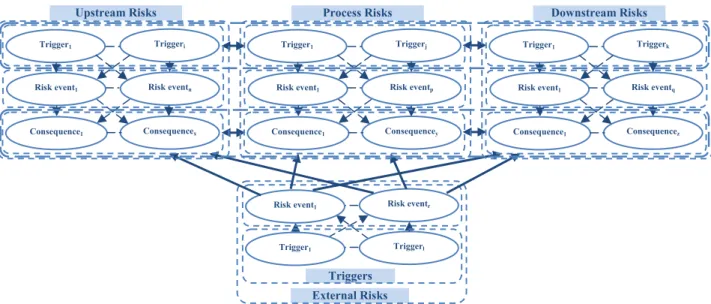
We consider the significance of interacting risk factors. The risks in a supply chain can be categorized into upstream, process, downstream and external risks. Upstream risks relate to the suppliers, process risks are associated with the management and processes of the focal manufacturer while downstream risks are linked with the customers. External risks are not associated directly with the supply chain but these can directly affect the entire supply chain. We present a risk quantification framework that captures the interdependency between risk factors as shown in Fig. 2. Each risk factor can be segregated into corresponding risk trigger, event and consequence that interact within and across the risk categories and modeling such interdependency represents a holistic view of risk quantification.
Fig. 2. Framework capturing interdependency between risk triggers, events and consequences IV. Boeing 787 Project
Boeing had outsourced 70 percent of the development and production tasks in the development of Boeing 787 aircraft (Tang et al., 2009, Zhao, 2013). More than 50 percent of the fuselage was planned to be made of composite material. In order to mitigate the financial risks, strategic partnership was made with Tier-1 suppliers that mandated payments being made to the suppliers after the delivery of first aircraft. The unconventional supply chain and unproven technology resulted in major delay of the project causing huge financial loss. The Boeing management had not planned for managing the interdependency between risks and the loss-sharing partnership incentivized suppliers to delay the respective tasks.
Fig. 3. Variation of direct cost with task duration. External Risks Risk eventr Risk event1 Triggerl Trigger1 Triggers Risk eventn Consequencex Triggeri Risk event1 Trigger1 Consequence1 Upstream Risks Risk eventp Consequencey Triggerj Risk event1 Trigger1 Consequence1 Process Risks Risk eventq Consequencez Triggerk Risk event1 Trigger1 Consequence1 Downstream Risks D ire ct c os t Task duration Cost of expediting Saving from delaying
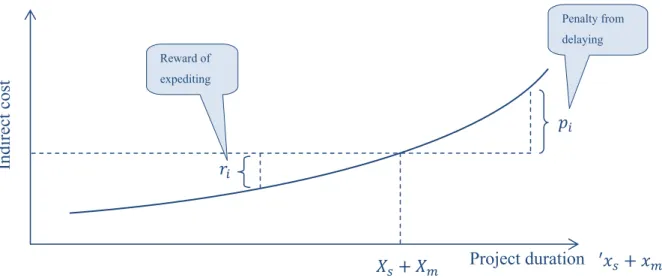
The variation of direct cost with the task duration is shown in Fig. 3 while that of indirect cost with the project duration is depicted in Fig. 4. If a supplier delays its task (D), it can save from the direct cost while the resulting project delay incurs penalty to each of the stakeholders. Therefore, longer task duration is associated with savings while longer project duration results in associated penalty. In case of loss sharing partnership, if a supplier delays the task and the overall project gets delayed, each stakeholder bears the penalty because of the delay even if the respective task was completed in time (K).
Fig. 4. Variation of indirect cost with project duration. V. Game Theoretic Analysis
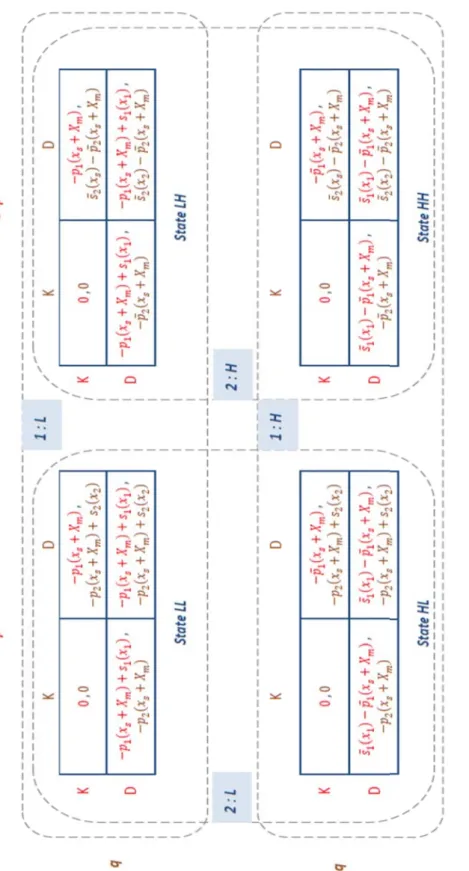
We analyze the game between two suppliers incorporating the uncertainty of both the suppliers regarding the type of other one in terms of the relative functions of penalty and saving. Both the suppliers are uncertain about the pay-offs of each other. Type ‘L’ indicates the supplier having penalty greater than the corresponding saving while type ‘H’ represents the supplier whose saving is greater than the relative penalty associated with the delay.
Supplier 1 has a common belief represented by ‘p’ of being sure about the type ‘L’ of
Supplier 2 while the Supplier 2 has a common belief represented by ‘q’ of being sure about
the type ‘L’ of Supplier 1. The game is shown in Fig. 5.
The expected pay-offs of type ‘L’ and type ‘H’ of Supplier 1 are given in Table I and Table II respectively. Each column represents actions of each type of the Supplier 2; the first action representing action of type ‘L’ of Supplier 2 followed by that of type ‘H’ of Supplier 2. For each of the columns, the greater value is selected out of the two actions of Supplier 1. The triple of actions corresponding to each greater value is checked for confirming the best action
Project duration Indi re ct c os t Reward of expediting Penalty from delaying
for each of the two types of Supplier 2. The same procedure is repeated for each of the types of Supplier 2 having expected pay-offs tabulated in Table III and Table IV for types ‘L’ and ‘H’ respectively. After considering the results of all the four expected pay-off tables, it is revealed that {(D,D),(D,D) and (K,D),(K,D)} are the Bayesian Nash equilibria of this game.
In a loss-sharing partnership between two suppliers and Original Equipment Manufacturer (OEM), both the suppliers will either delay or keep their tasks (in time) under following conditions:
Both the suppliers being uncertain about the cost function of each other
OEM completing its task within stipulated timeframe
( 1 )
( 2 ) Otherwise, in all other conditions,
( 3 )
The previous game assumed that Boeing would complete its task in time. Now, we
incorporate a possibility of Boeing expediting its task (E) but there is an uncertainty associated
with the possibility of project not getting completed in time. The common belief about the uncertainty is represented by ‘r’ as each of the suppliers will have prior belief that the project would not be completed in time because of delay in the first phase of project. The Bayesian Nash equilibria of this game are again {(K,D),(K,D)} and {(D,D),(D,D)}.
In a loss-sharing partnership between two suppliers and OEM, both the suppliers will either delay or keep their tasks under following conditions:
Both the suppliers being uncertain about the cost function of each other
An uncertainty associated with the possibility of OEM expediting its task to cover up
the delay caused by suppliers
Othherwise, in alll other condditions, Fi g. 5. G ame b etw ee n tw o s up pl ie rs w ith u nc er ta in ty ab ou t th e cos t fu nc tio ns of e ac h oth er . ( 5 ) ( 6 )
TABLE I. EXPECTED PAY-OFFS OF TYPE ‘L’ OF SUPPLIER 1 Supplier 2 (K,K) (K,D) (D,K) (D,D) Suppl ie r 1 K D
TABLE II. EXPECTED PAY-OFFS OF TYPE ‘H’ OF SUPPLIER 1
Supplier 2 (K,K) (K,D) (D,K) (D,D) Suppl ie r 1 K D
TABLE III. EXPECTED PAY-OFFS OF TYPE ‘L’ OF SUPPLIER 2 Supplier 1 (K,K) (K,D) (D,K) (D,D) Suppl ie r 2 K D
TABLE IV. EXPECTED PAY-OFFS OF TYPE ‘H’ OF SUPPLIER 2 Supplier 1 (K,K) (K,D) (D,K) (D,D) Suppl ie r 2 K D A. Theorem
In case of a loss-sharing partnership (between OEM and Tier-1 suppliers) within a supply chain, the Tier-1 suppliers will either delay or keep their tasks in case of uncertainty
about the cost functions of one another but the possibility of timely completion of project is very rare because of the requirement of meeting a very strong probabilistic condition on the part of each supplier.
Assumptions:
All the Tier-1 Suppliers perform their tasks simultaneously (Phase I)
The OEM undertakes its task after the completion of all the tasks of Tier-1 Suppliers
(Phase II)
The project duration is summation of the two phases
Let represent common belief of the suppliers about the possibility of OEM not
expediting its task in order to cover up the delay of Phase I. Let represent belief of a
supplier i about the cost functions of other supplier j being of the form
with p and s indicating the penalty and saving cost functions respectively.
Conditions: ( 7 ) ( 8 ) ( 9 )
Thus, in a supply chain, uncertainty about the information of other partners results in the worst selection of actions by each of the partners. The same phenomenon can be best described as a bullwhip effect. Uncertainty about the information is a major risk within a supply chain that can result into major losses.
VI. Fair-Sharing Partnership
The game theoretic risks revealed conflicting incentives among stakeholders. Therefore, there is requirement of designing a fair strategy that would lead to reduction in game theoretic risks. The details of the fair-sharing strategy can be found in the working paper (Xu Xin,
2013). The main purpose of the fair strategy is to make each player responsible for one’s own deeds. If the suppliers perform their tasks within the stipulated time then consequences of any delay on the part of Boeing would be completely compensated by the Boeing and in case of suppliers having expedited their tasks, Boeing would have to pay the reward that did not materialize because of its delay. Similarly, if a supplier is involved in the delay, it will be proportionately penalized for its part of delay. In case of delay on the part of both the suppliers and Boeing, the penalty would be distributed proportionately.
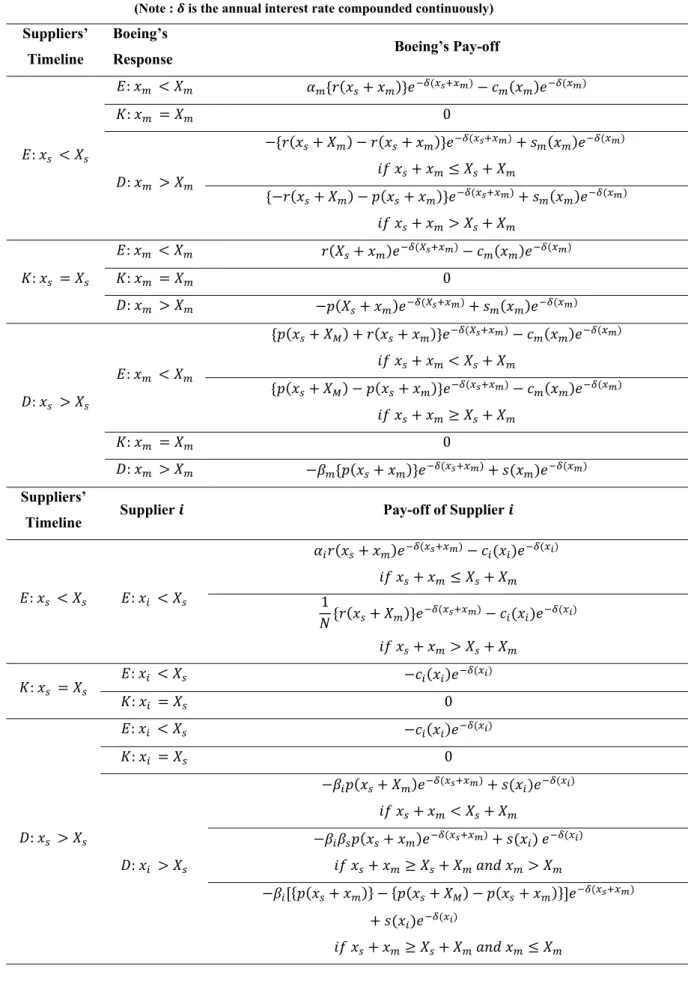
We have modified the mentioned fair strategy to incorporate features of present value of money and continuous timeframe. Boeing’s and suppliers’ pay-off functions considering the time value of money are tabulated in Table V. Following are the various symbols used in the pay-off functions: ( 10 ) ( 11 ) ( 12 ) ( 13 ) ( 14 ) ( 15 ) ( 16 ) ( 17 ) ( 18 ) ( 19 ) ( 20 )
TABLE V. PAY-OFF FUNCTIONS BASED ON FAIR-SHARING PARNERSHIP
(Note : is the annual interest rate compounded continuously) Suppliers’
Timeline
Boeing’s
Response Boeing’s Pay-off
Suppliers’
VII. Conclusion
Segregation of risks into triggers, events and consequences helps modeling supply chain risks as interdependent factors. Our proposed framework captures the interdependency between downstream, upstream, process and external risk factors. Risks associated with conflicting incentives of stakeholders can pose a serious threat to the success of a project. Our analysis of the strategic partnership between Boeing and Tier-1 suppliers, involved in the development project of Boeing 787 aircraft, revealed that any uncertainty about the information can lead to dominant game theoretic risks affecting the project outcome. Our proposed continuous timeframe based fair-sharing partnership can help aligning conflicting incentives among stakeholders in such a partnership. Modeling of interdependency between supply chain risks incorporating game theoretic risks is a major step towards bridging the research gap.
REFERENCES
BADURDEEN, F., SHUAIB, M., WIJEKOON, K., BROWN, A., FAULKNER, W., AMUNDSON, J., JAWAHIR, I. S., GOLDSBY, T. J., IYENGAR, D. & BODEN, B. 2014.
Quantitative modeling and analysis of supply chain risks using Bayesian theory. Journal of
Manufacturing Technology Management, 25, 631-654.
BELLAMY, M. A. & BASOLE, R. C. 2013. Network analysis of supply chain systems: A
systematic review and future research. Systems Engineering, 16, 235-249.
COLICCHIA, C. & STROZZI, F. 2012. Supply chain risk management: a new methodology
for a systematic literature review. Supply Chain Management: An International Journal, 17,
403-418.
DOGAN, I. 2012. Analysis of facility location model using Bayesian Networks. Expert
Systems with Applications, 39, 1092-1104.
DOGAN, I. & AYDIN, N. 2011. Combining Bayesian Networks and Total Cost of
Ownership method for supplier selection analysis. Computers & Industrial Engineering, 61,
1072-1085.
GHADGE, A., DANI, S. & KALAWSKY, R. 2012. Supply chain risk management: present
and future scope. International Journal of Logistics Management, The, 23, 313-339.
KHAN, O. & BURNES, B. 2007. Risk and supply chain management: creating a research
agenda. International Journal of Logistics Management, 18, 197-216.
LOCKAMY, A. 2011. Benchmarking supplier risks using Bayesian networks. Benchmarking:
An International Journal, 18, 409-427.
LOCKAMY, A. 2014. Assessing disaster risks in supply chains. Industrial Management &
LOCKAMY, A. & MCCORMACK, K. 2009. Analysing risks in supply networks to facilitate
outsourcing decisions. International Journal of Production Research, 48, 593-611.
LOCKAMY, A. & MCCORMACK, K. 2012. Modeling supplier risks using Bayesian
networks. Industrial Management & Data Systems, 112, 313-333.
LUTZ, H., VANG, D. O. & RAFFIELD, W. D. 2012. Using game theory to predict supply
chain cooperation. Performance Improvement, 51, 19-23.
QAZI, A., QUIGLEY, J. & DICKSON, A. A novel framework for quantification of supply chain risks. 4th Student Conference on Operational Research, 2014 University of Nottingham, UK.
SIGURDSSON, J. H., WALLS, L. A. & QUIGLEY, J. L. 2001. Bayesian belief nets for
managing expert judgement and modelling reliability. Quality and Reliability Engineering
International, 17, 181-190.
SODHI, M. S., SON, B.-G. & TANG, C. S. 2012. Researchers' Perspectives on Supply Chain
Risk Management. Production and Operations Management, 21, 1-13.
TANG, C. S., ZIMMERMAN, J. D. & NELSON, J. I. 2009. Managing New Product
Development and Supply Chain Risks: The Boeing 787 Case. Supply Chain Forum: an
International Journal, 10, 74-86.
XU XIN, Y. Z. 2013. Incentives and Coordination in Project Driven Supply Chains.: Rutgers Business School– Newark and New Brunswick, NJ.
ZHAO, R., NEIGHBOUR, G., HAN, J., MCGUIRE, M. & DEUTZ, P. 2012. Using game theory to describe strategy selection for environmental risk and carbon emissions reduction in
the green supply chain. Journal of Loss Prevention in the Process Industries, 25, 927-936.