Association for Information Systems
AIS Electronic Library (AISeL)
PACIS 2013 Proceedings
Pacific Asia Conference on Information Systems
(PACIS)
6-18-2013
Cloud ERP Adoption-A Process View Approach
Siti Aisyah Salim
Queensland University of Technology, [email protected]
Follow this and additional works at:
http://aisel.aisnet.org/pacis2013
This material is brought to you by the Pacific Asia Conference on Information Systems (PACIS) at AIS Electronic Library (AISeL). It has been accepted for inclusion in PACIS 2013 Proceedings by an authorized administrator of AIS Electronic Library (AISeL). For more information, please [email protected].
Recommended Citation
Salim, Siti Aisyah, "Cloud ERP Adoption-A Process View Approach" (2013).PACIS 2013 Proceedings. 281.
CLOUD ERP ADOPTION-A PROCESS VIEW APPROACH
Siti Aisyah Salim, Information Systems School, Queensland University of Technology, Australia,
[email protected]
Abstract
In spite of a wealth of studies on ERP adoption in recent years, prior studies have presumed ERP adoption as an immediate action rather than as a process. We also argue that cross-sectional research design does not adequately represent the complexity and the highly volatile nature of the process of ERP adoption. Based on a content analysis of one hundred studies on academic and vendor successes, we have identified 27 transition factors contributing to the adoption of cloud ERP. Building on two process research studies (Guttman et al. 1998; Klein and Sorra 1996), this research attempts to explore which transition factors are relevant to the distinct phases of cloud ERP adoption. These transition factors are classified as “necessary” or “sufficient”; where “necessary” transition factors need to exist in order for the firm to move to the next stage, while “sufficient” means assisting in the movement. This paper not only consolidates, but also extends the existing literature on the technology adoption process for complex organization-wide technologies. For practitioners, this study will assist ERP and cloud vendors in prioritizing and upgrading their business quality at any point in time during the adoption process, which would thus increase the likelihood of cloud-based ERP adoption among SMEs.
1
INTRODUCTION
Enterprise Resource Planning (ERP) systems have been popular information technology (IT) applications since the 1990’s (Robey et al. 2002). Prior research has focused predominantly on ERP implementation in large organisations, while research on ERP implementation in small and medium sized enterprises (SMEs) is still lacking. This is not surprising, since ERP systems could only be afforded by large companies in past years. Until recently, due to the realization of the importance of SMEs in global industry, several ERP providers have started to introduce new cloud-based ERP systems to the marketplace. These include SAP, Oracle, Microsoft and NetSuite. With more specialised features being embedded into cloud ERP, such as on-demand access, Project Management and transparency analytics tools (Pereira 2012), it has been expected the SME adoption of cloud ERPs would increase. However our expectations have not been correct. The percentage of SMEs that have adopted cloud ERP systems still remains relatively low (Haddara and Zach 2011).
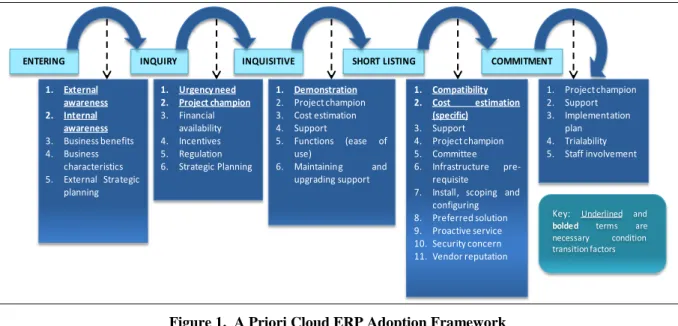
A number of researchers have attempted to study the factors that encourage firms to adopt cloud ERP systems. For example, Saeed et al. (2011) and Walther et al. (2012) have identified reduction of implementation costs, ease of use, extendibility, and ability to concentrate on core business activities, as the main influencing factors for cloud ERP adoption. However, these studies have only listed all influencing factors and conceived the adoption of cloud ERP as being a one-off dichotomous decision (Huizingh and Brand 2009). Exploring these factors without studying how these factors evolve over time is similar to placing all factors into a single phase, with the comprehensive view of the technology adoption unable to be achieved. Thus, in response to this research gap, this study attempts to develop a process framework for cloud ERP adoption. The framework presented (please refer to Figure 1) will show how the factors that influence cloud ERP adoption (named as transition factors) act as triggers that help the firm in moving from the initial stage of adoption (entering) until the last stage (commitment). By understanding how these transition factors work and flow, vendors as well as firms could identify their main role in completing the adoption process, and thus lead to a successful system implementation. Considering the fact that content analysis will help the researcher to explore the transition factors, aside from understanding the phases involved in complex technology adoption and research context (cloud ERP and SMEs), this research employs a content analysis method as suggested by Hsieh et al. (2005) and Krippendorff (2004). Studies by Klein et al. (1996) and Gutman et al. (1998) were used as a guidance to develop the process framework. This paper not only consolidates, but also extends the existing literature on the technology adoption process for a complex organization-wide technology. For practitioners, this study will help ERP and cloud vendors in prioritizing and upgrading their business quality at any point in time during the adoption process and thus will increase the likelihood of cloud-based ERP adoption among SMEs.
This paper is organized as follows: it commences by explaining the works related to this study. The discussion then continues with the methods used. Subsequently, the paper continues with a discussion and introduction of an a priori conceptual framework of the technology adoption process. Finally, the paper concludes with future studies proposed in this field and recommendations for academics and practitioners.
2
RELATED WORK
This section attempts to provide an overview of existing technology adoption topics in the literature reviews. It is highlighted that most academic literature focuses on factors that influence technology adoption and the sub-phases involved in the adoption. A small number of these studies attempt to gauge how and why these factors flow throughout the technology adoption phases.
2.1 Technology Adoption
New technology adoption (also known as innovation) is defined as an idea, practice, or object that is perceived as new by an individual or other unit of adoption (Rogers 1995). Technology adoption has been studied at two levels, namely: the individual (e.g., Brown and Venkatesh 2005) and the firm (e.g., Bajwa et al. 2004). The majority of technology adoption studies has typically focused on one dimension of research, namely: discovering the determinants (factors that influence) of technology adoption (Frambach and Schillewaert 2002) stages involved in technology adoption (e.g., Cooper and Zmud 1990; Wang et al. 2012) and the characteristics of technology adoption (e.g., Wang et al. 2010). Separating these dimensions will lead to several assumptions, for instance, treating technology adoption as a single phase decision (Thong 1999), simplifying the process of new technology adoption, picking and choosing constructs from multiple theories to develop new theories (Jeyaraj et al. 2006), and citing and adopting constructs from both domains regardless of whether they are studying an individual or organizational level of adoption (Plouffe et al. 2001). Based on the issues brought up, we believe that technology adoption at the firm level should be able to answer “how” and “why” questions (Chia and Langley 2004). Further, technology adoption should be treated as a process embracing movement, activity, event, change, and temporal evolution (Langley 2007). In the next section, typical phases used in technology adoption studies will be discussed.
2.2 Technology Adoption Phases in Organizations
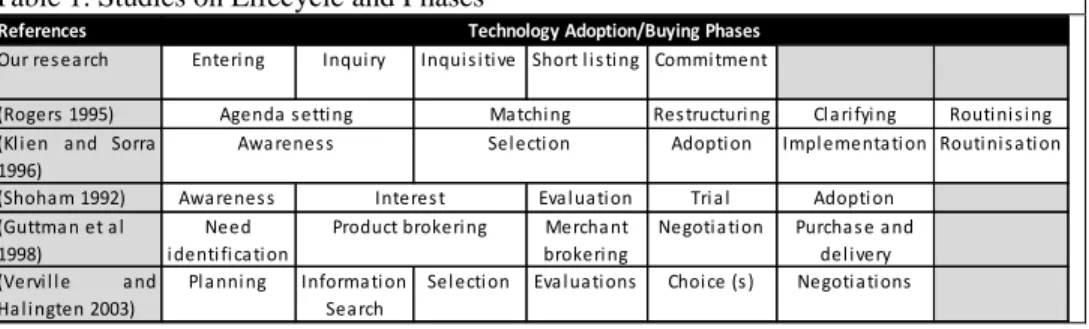
It is generally believed that organizations go through several phases of innovation. The innovation stages could consist of three to six phases and have similarities in terms of highlighting pre-implementation, implementation and post-implementation (Yu 2005). The pre-implementation or the adoption phase has proven to be a critical stage (Markus and Tanis 2000) in achieving a successful project. Therefore, this research focuses on the pre-implementation stage, focusing on what phases are involved in triggering SMEs to adopt cloud ERP. To select the most appropriate phases in relation to our research context, three research streams were reviewed: technology adoption, ERP lifecycle, and marketing lifecycle. Our search has found seven relevant studies1 (refer to Table 1 for the details of the stages). We also acknowledge that the use of different terms might provide different interpretations of activities, events, and players involved in each phase. However, it is not the main objective of this research to determine the best term to be employed for explaining the process of complex technology adoption, but rather, to understand and to explore how these phases evolve and interconnect with each other. Based on Table 1 summary, Guttman et al. (1998) and Klein et al. (1996) provide the nearest similarity to our stages. Therefore, these two studies were used to build up our research framework. The five stages used are: entering, inquiry, inquisitive, short listing and commitment.
Table 1. Studies on Lifecycle and Phases
References
Our res earch Entering Inquiry Inquis itive Short lis ting Commitment
(Rogers 1995) Res tructuring Clarifying Routinis ing (Klien and Sorra
1996)
Adoption Implementation Routinis ation
(Shoham 1992) Awarenes s Evaluation Trial Adoption (Guttman et al 1998) Need identification Merchant brokering
Negotiation Purchas e and delivery (Verville and
Halingten 2003)
Planning Information Search
Selection Evaluations Choice (s ) Negotiations Technology Adoption/Buying Phases
Awarenes s Selection Agenda s etting Matching
Interes t Product brokering
1
There are many more studies on process and lifecycle. However, we selected only eight studies that were relevant to our research context. Please refer Table 1 for details of studies selected.
3
METHODS – EXPLORING AND MAPPING
Two steps were carried out to produce the final framework. This entails two main phases: (1) content analysis phase – to explore the transition factors for technology adoption, and (2) mapping phase – to understand how transition factors could influence the movement of the overall technology adoption process.
3.1 Exploring Transition Factors
To ensure validity, a research study requires certain standards and processes. The selection of prior studies for analysis is based on the approach of Webster and Watson (2002), as well as prior exploratory studies (e.g., Gable 2010). To ascertain the relevant literature on cloud ERP adoption, a search was performed using the ScienceDirect database and top IS journals and conference proceedings. The inclusion of the ScienceDirect database ensured that the search results included complex technology adoption articles from multiple disciplines. The main keywords employed in the academic search were restricted to a title and body text search of, namely, (1) cloud ERP and (2) SaaS ERP2. Furthermore, the results were constrained between 2005 and 2012, with theoretical and conceptual studies excluded. The practitioner material was scanned using the vendor-stated “customer testimonials”. The search identified 86 academic studies and 14 customer testimonials (the reference list can be requested by emailing the authors).
All 100 “sources of evidence” were then scanned for the stated adoption factors (reason for adoption). This process yielded a total of 142 adoption factors. We also noted that approximately 80% of the stated adoption factors were benefits of cloud ERP (e.g., provision of consistent and accurate information, reduction of infrastructure and administrative costs, and standardization of reporting). As the intention of this study is not only to look at the benefits of cloud ERP adoption, we then synthesized the adoption factors benefits. The synthesis procedure attempts to reduce the identified adoption factors by removing overlapping measures so as to attain unique factors. The synthesis process was conducted with another two experts on Innovation and ERP systems, following two simple guidelines. The guidelines include: (1) when two technology adoption factors are identical, they were merged into a single statement, and (2) when two technology adoption factors use different keywords, but have a similar meaning, a list of synonyms were considered, using a thesaurus. The guidelines mentioned allowed us to follow the same logic when synthesizing the 142 citations. The synthesis process identified 27 unique technology adoption factors of cloud ERP systems.
3.2 Mapping the Transition Factors into Technology Adoption Phases
The main objectives of the mapping exercise are two-fold: (1) to provide a clear understanding how the transition factors flow throughout the adoption process; and (2) to differentiate between sufficient and necessary transition factors. The twenty-seven (27) transition factors found from the content analysis are then mapped into the adoption process framework. Each transition factor has a different level of importance. Two different types of transition factors were used in this paper. The first was transition factors with sufficient condition – meaning, the existence of these factors can help the movement of the adoption process (Hakansson et al. 1982). In this context, sufficient transition factors mean that these factors will be the gateway to move from one phase to another, and the desired output can still be obtained even though these transition factors do not exist. The second is transition factors with necessary
2
The main concern of the paper is to discuss the process of pooling and synthesizing the factors, therefore details of this method will only be provided upon request to the authors.
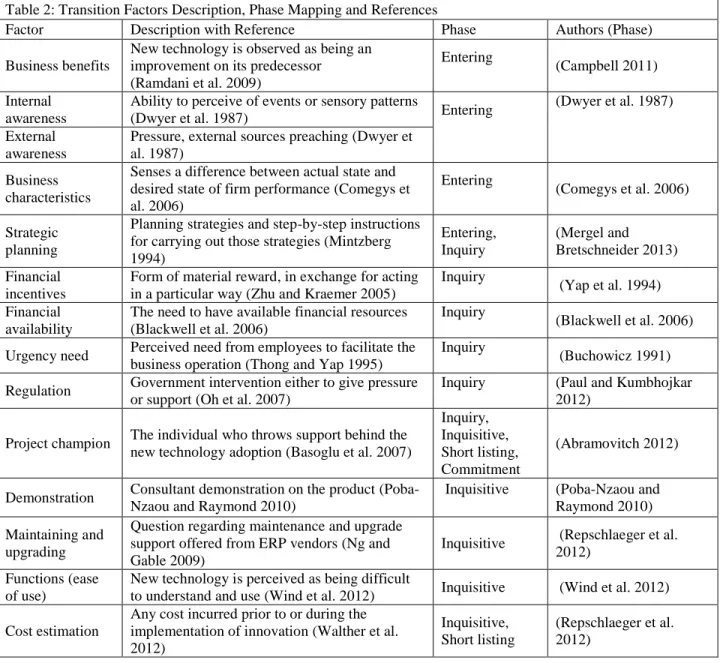
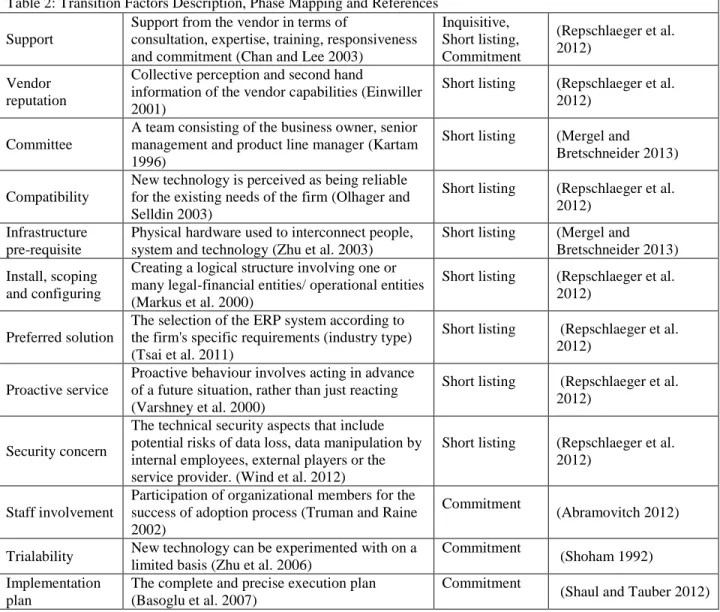
condition – meaning, transition factors that are categorized under this category need to exist (Hakansson et al. 1982) and be placed in the correct phase, in order to obtain the required output, or allow the firm to evolve to the next phase. Output here refers to the movement of the firm from the prior stage to the next stage of the cloud ERP adoption process. By differentiating between these two (sufficient and necessary) terms, firms or vendors could prioritize and aim for the best action to expedite the adoption process. In general, a necessary condition is more significant than merely a sufficient condition. Sufficient and necessary concepts are widely used in the fuzzy set QCA method to see the importance of certain conditions in relation to their experiments (e.g., Chaiken and Trope 1999; Ragin 2000; Sen and Pattanaik 2012). All the transition factors mapped into the technology adoption phases (entering, inquiry, inquisitive, short listing or commitment) are guided by academic literature studies and industry success stories. More than twenty studies were reviewed in order to understand the process of complex technology adoption (please refer to Table 1 for example of studies). Since our study is based on SMEs and cloud ERP technology, the stages used are more relevant to this research context. The combination and merging of several studies into a single adoption framework will assist us in understanding how this process was performed. Findings from the mapping exercise can be viewed in Table 2.
Table 2: Transition Factors Description, Phase Mapping and References
Factor Description with Reference Phase Authors (Phase)
Business benefits
New technology is observed as being an improvement on its predecessor (Ramdani et al. 2009)
Entering
(Campbell 2011) Internal
awareness
Ability to perceive of events or sensory patterns
(Dwyer et al. 1987) Entering
(Dwyer et al. 1987)
External awareness
Pressure, external sources preaching (Dwyer et al. 1987)
Business characteristics
Senses a difference between actual state and desired state of firm performance (Comegys et al. 2006)
Entering
(Comegys et al. 2006)
Strategic planning
Planning strategies and step-by-step instructions for carrying out those strategies (Mintzberg 1994) Entering, Inquiry (Mergel and Bretschneider 2013) Financial incentives
Form of material reward, in exchange for acting in a particular way (Zhu and Kraemer 2005)
Inquiry
(Yap et al. 1994) Financial
availability
The need to have available financial resources (Blackwell et al. 2006)
Inquiry
(Blackwell et al. 2006) Urgency need Perceived need from employees to facilitate the
business operation (Thong and Yap 1995)
Inquiry
(Buchowicz 1991) Regulation Government intervention either to give pressure
or support (Oh et al. 2007)
Inquiry (Paul and Kumbhojkar 2012)
Project champion The individual who throws support behind the new technology adoption (Basoglu et al. 2007)
Inquiry, Inquisitive, Short listing, Commitment
(Abramovitch 2012)
Demonstration Consultant demonstration on the product (Poba-Nzaou and Raymond 2010)
Inquisitive (Poba-Nzaou and Raymond 2010) Maintaining and
upgrading
Question regarding maintenance and upgrade support offered from ERP vendors (Ng and Gable 2009)
Inquisitive (Repschlaeger et al. 2012)
Functions (ease of use)
New technology is perceived as being difficult
to understand and use (Wind et al. 2012) Inquisitive (Wind et al. 2012) Cost estimation
Any cost incurred prior to or during the implementation of innovation (Walther et al. 2012)
Inquisitive, Short listing
(Repschlaeger et al. 2012)
Table 2: Transition Factors Description, Phase Mapping and References Support
Support from the vendor in terms of
consultation, expertise, training, responsiveness and commitment (Chan and Lee 2003)
Inquisitive, Short listing, Commitment (Repschlaeger et al. 2012) Vendor reputation
Collective perception and second hand
information of the vendor capabilities (Einwiller 2001)
Short listing (Repschlaeger et al. 2012)
Committee
A team consisting of the business owner, senior management and product line manager (Kartam 1996)
Short listing (Mergel and Bretschneider 2013)
Compatibility
New technology is perceived as being reliable for the existing needs of the firm (Olhager and Selldin 2003)
Short listing (Repschlaeger et al. 2012)
Infrastructure pre-requisite
Physical hardware used to interconnect people, system and technology (Zhu et al. 2003)
Short listing (Mergel and Bretschneider 2013) Install, scoping
and configuring
Creating a logical structure involving one or many legal-financial entities/ operational entities (Markus et al. 2000)
Short listing (Repschlaeger et al. 2012)
Preferred solution
The selection of the ERP system according to the firm's specific requirements (industry type) (Tsai et al. 2011)
Short listing (Repschlaeger et al. 2012)
Proactive service
Proactive behaviour involves acting in advance of a future situation, rather than just reacting (Varshney et al. 2000)
Short listing (Repschlaeger et al. 2012)
Security concern
The technical security aspects that include potential risks of data loss, data manipulation by internal employees, external players or the service provider. (Wind et al. 2012)
Short listing (Repschlaeger et al. 2012)
Staff involvement
Participation of organizational members for the success of adoption process (Truman and Raine 2002)
Commitment
(Abramovitch 2012)
Trialability New technology can be experimented with on a limited basis (Zhu et al. 2006)
Commitment
(Shoham 1992) Implementation
plan
The complete and precise execution plan (Basoglu et al. 2007)
Commitment
(Shaul and Tauber 2012)
4
DISCUSSION
For a clearer view, findings from Table 2 are transferred into Figure 1. As presented in Figure 1, the adoption of cloud ERP can be disseminated into five phases: entering, inquiry, inquisitive, short listing, and commitment. It is also shown that the transition factors have been classified as sufficient or necessary. In the entering phase, we found external awareness (information provided by vendors or business affiliations) and internal awareness (recognition of the firm’s needs) as the necessary transition factors. These two factors could assist in changing the ignorance of the firm’s owner or manager. Ignorance occurs when there is a lack of knowledge (Burke and Jarratt 2004) or incapability on the part of the firm’s members to articulate their long term vision (Mendelssohn 1991). However, only a reliable sense (information) of awareness could strongly lead the movement from being ignorant to being more curious about something (Comegys et al. 2006). While discovering business benefits, understanding business characteristics (the status quo of the firm) and strategic planning are considered as sufficient transition factors.
At the inquiry phase, the firm’s representative (business, manager or project champion) begins to gather relevant information (Comegys et al. 2006). The firm’s representative starts become familiar with the
products, pay attention to the advertisements, and find the most appropriate vendor and product so that they can ask more specific questions. Urgency needs and project champion are identified as necessary transition factors. Project champion is the one who sets goals and legitimates change by advocating and promoting the benefits of the new system (Shanks et al. 2000) to board members. Though cloud ERP will be managed and maintained by the selected ERP vendor, having a project champion will encourage the adoption process. For a firm in the category of an SME, any kind of investment or expense will be made only when it is required. Thus, urgency needs will expedite the adoption process. Not seeing the need to adopt a new system is also a key factor for not continuing on to purchase the system. The other four transition factors: financial availability, incentives, regulation and strategic planning, are classified as sufficient conditions.
In the inquisitive stage, more specific and informational questions will be asked (Verville and Halingten 2003). The potential ERP and cloud vendor will be asked to provide the product demonstration (Repschlaeger et al. 2012). Demonstration is needed to introduce some of the most important functions, ensure the compatibility of the system with the firm’s business model, andanswer specific questions in relation to the product (Poba-Nzaou and Raymond 2010). Queries regarding estimation costs, support and other system functions will also be raised during this phase. However all these are not considered as the main triggering factor, but rather, as the support for the process to move to the next stage. Therefore, only demonstration is considered as being a necessary transition factor, while issues such as project champion, cost estimation, support and functions are considered as sufficient transition factors.
At the short listing stage, the firm’s representative will attempt to screen available product and vendor choices (Comegys et al. 2006). Sometimes it is difficult to make a choice, especially between products and vendors that have a good reputation. For certain firms, setting rule cut-offs for the products in their short listing set will help them to make the decision (Comegys et al. 2006). Other studies suggest that cost (cost estimation (specific)) would be the major factor for SMEs, whether or not to select the product offered (Masset and Sekkat 2011; Raihana 2012; Walther et al. 2012). The compatibility of the existing system with the new technology is also an important aspect (Karahanna et al. 2006) to be considered. Therefore, cost estimation (specific) and compatibility are considered as necessary transition factors. At the same time, other transition factors listed in the phase are classified as sufficient transition factors. At the commitment stage, the firm members will express their agreement to buy and adopt the system. As the decision will be made at this stage, each of the transition factors will have the same condition (e.g., sufficient). Cloud and ERP vendor loyalty is achieved (Dwyer et al. 1987) as soon as the customer (firm) signs the contract. The pre-adoption process will end at this point. The new cloud ERP deployment concept is not the same as the traditional ERP system where firms are locked-in with a specific vendor for a certain period (Acumatica 2012). With new cloud technology concept, firms can decouple the system at anytime they want. This situation compels vendor to actively seek to maintain their relationship with customers (firms) so that they will not run away or terminate the service with them.
The classification of the transition factors into several phases shows that the process of cloud ERP adoption is affected either directly or indirectly by individuals, units or departments from both inside and outside the organisation. Consistent with Kimberly and Evanisko (1981) statement, firms’ decision-making process is perhaps being made by different individuals or groups of individuals. Therefore, even if this research tries to examine transition factors in technology adoption from firm level perspectives, the involvement from external parties or individuals cannot be avoided. As the technology adoption process moves into a more critical stage (from entering to commitment), the level of influence and involvement becomes more specific. For example, when the firm starts thinking of or realizing the need to have such a system, the factors that influence them to move can come from several sources. These usually include: external vendors, competitors and industry alliances. However, as the process moves towards making the final decision, only certain individuals or groups can actually make the decision. The findings from Table 1 have demonstrated that collaboration from several parties is needed in order to align business goals (Luftman 2000).
ENTERING INQUIRY INQUISITIVE SHORT LISTING COMMITMENT 1. External awareness 2. Internal awareness 3. Business benefits 4. Business characteristics 5. External Strategic planning 1. Urgency need 2. Project champion 3. Financial availability 4. Incentives 5. Regulation 6. Strategic Planning 1. Demonstration 2. Project champion 3. Cost estimation 4. Support 5. Functions (ease of use) 6. Maintaining and upgrading support 1. Compatibility 2. Cost estimation (specific) 3. Support 4. Project champion 5. Committee 6. Infrastructure pre-requisite
7. Install, scoping and configuring 8. Preferred solution 9. Proactive service 10. Security concern 11. Vendor reputation 1. Project champion 2. Support 3. Implementation plan 4. Trialability 5. Staff involvement
Key: Underlined and
bolded terms are necessary condition transition factors
Figure 1. A Priori Cloud ERP Adoption Framework
Conclusion and Future Works
This paper explores the transition factors that lead to the adoption of cloud ERPs in SMEs, and discusses the preliminary findings of research, with the objective of identifying and categorizing each of the factors into one of the five phases of the cloud ERP adoption framework (refer to Figure 1). The mapping of the factors could potentially be different in other scenarios; however, our goal is to derive a robust, valid, simple, yet applicable model of cloud ERP adoption for the SME market. The term “transition factors” was introduced after identifying the need to understand the factors that influence complex technology throughout the entire process stages, as opposed to being lumped into a single stage. These transition factors were also classified as being sufficient or necessary, depending on the condition of a particular phase.
The purpose of this paper is to extends the understanding of technology adoption process for complex organization-wide technologies. By understanding the evolving process, it could help vendors prioritizing and upgrading their business quality at any point in time during the adoption process. While for cloud ERP clients (firms), this study not only provides buying strategies, but could also help the firm in understanding how the collaboration between several components (individual, group, departments, firms and global) could influence and accelerate the adoption process.
As this is a preliminary finding, there are several plans that have been developed. First, the a-priori framework presented in this paper is conceptual. Hence, we will validate these preliminary findings by using a q-sorting procedure as suggested by Moore et al. (1991) in order to produce inter-rater reliabilities. Second, we will conduct a series of case studies with IT decision makers from two different types of SMEs, to assess the general relevance of each factor in each phase. We also believe that the management’s maturity level and firm’s technology infrastructures have an effect on the readiness and speed with which to adopt new technology. For us, this will be an interesting research area to be studied, as it will help us in understanding how the management pattern will actually influence the speeding-up of the adoption process. Therefore, understanding the level of firm maturity will become another agenda for our future research.