Investigating distribution of practice
effects for the learning of foreign language
verb morphology in the young learner
classroom
Article
Published Version
Creative Commons: Attribution 4.0 (CC-BY)
Open access
Kasprowicz, R. E., Marsden, E. and Sephton, N. (2019)
Investigating distribution of practice effects for the learning of
foreign language verb morphology in the young learner
classroom. Modern Language Journal, 103 (3). pp. 580-606.
ISSN 1540-4781 doi: https://doi.org/10.1111/modl.12586
Available at http://centaur.reading.ac.uk/84687/
It is advisable to refer to the publisher’s version if you intend to cite from the
work. See
Guidance on citing
.
To link to this article DOI: http://dx.doi.org/10.1111/modl.12586
Publisher: Wiley
including copyright law. Copyright and IPR is retained by the creators or other
copyright holders. Terms and conditions for use of this material are defined in
the
End User Agreement
.
www.reading.ac.uk/centaur
CentAUR
Central Archive at the University of Reading
Reading’s research outputs online
Investigating Distribution of Practice
Effects for the Learning of Foreign
Language Verb Morphology in the
Young Learner Classroom
ROWENA E. KASPROWICZ,1EMMA MARSDEN,2and NICK SEPHTON3
1University of Reading, Institute of Education, London Road Campus, 4 Redlands Road, Reading RG1 5EX, UK Email: [email protected]
2University of York, Department of Education, York YO10 5DD, UK Email: [email protected] 3University of York, Digital Creativity Labs, York YO10 5GE, UK Email: [email protected]
Within limited-input language classrooms, understanding the effect of distribution of practice (spacing between practice) on learning is critical, yet evidence is conflicting and of limited relevance for young learners. For second language (L2) grammar learning, some studies reveal advantages for spacing of 7 days or more, but others for shorter spacing. Further, little is known about the role of cognitive in-dividual differences (e.g., language analytic ability; LAA) in mediating practice distribution effects for L2 grammatical knowledge development and retention. To address this gap, this classroom-based study investigated whether distribution of practice and LAA moderated the effectiveness of explicit, input-based grammar instruction for young first language (L1) English learners of French (aged 8 to 11). The study revealed minimal differences between longer (7-day) versus shorter (3.5-day) spacing of practice for learning a French verb inflection subsystem, at either posttest or delayed posttest. Minimal group-level gains and substantial within-group variation in performance at posttests were observed. Accuracy of practice during training and LAA were significantly associated with posttest performance under both practice schedules. These findings indicated that within an ecologically valid classroom context, differ-ences in distribution of practice had limited impact on learner performance on our tests; rather, indi-vidual learner differences were more critical in moderating learning. This highlights the importance of considering individual learner differences in the development of resources and the potential of digital tools for dynamically adapting instruction to suit individuals.
Keywords: distribution of practice; foreign language learning; game-based learning; grammar; lag effects; language analytic ability; young learners
The Modern Language Journal, 103, 3, (2019) DOI: 10.1111/modl.12586
0026-7902/19/580–606 $1.50/0
C
2019 The Authors. The Modern Language Journal published by Wiley Periodicals, Inc. on behalf of National Federation of Modern Language Teachers Associations, Inc.
This is an open access article under the terms of the Creative Commons Attribution License, which permits use, distribution and reproduction in any medium, pro-vided the original work is properly cited.
This article has been awarded Open Data and Open Ma-terials badges. All data and maMa-terials are publicly acces-sible via the IRIS repository at https://iris-database.org. Learn more about the Open Practices badges from the Center for Open Science: https://osf.io/tvyxz/wiki.
ENGAGING IN EXTENSIVE, REPEATED, meaningful practice is an essential component of learning, facilitating the transition from initial reliance on declarative knowledge (e.g., explicit knowledge of a grammatical rule) to procedu-ralized and eventually automatized knowledge that can be accessed more efficiently under time pressured contexts such as spoken interaction (DeKeyser, 2007, 2015; Lightbown, 2008; Sega-lowitz, 2003). Evidence suggests that practice that draws attention to linguistic features can be particularly useful for learning forms that have low salience, low communicative value, or complex relationships between first (L1) and
second (L2) language (e.g., Doughty & Williams, 1998; R. Ellis, 2006; Kasprowicz & Marsden, 2018; Marsden, 2006; Marsden & Chen, 2011; McManus & Marsden, 2017, 2018, 2019a, 2019b; VanPatten, 2015). However, whilst there has been extensive focus on the nature of practice required to facilitate L2 learning, an important remaining question concerns the amount and frequency of practice that is needed to maximize its effectiveness (DeKeyser, 2015; Rogers, 2017).
This question, although relevant to all learn-ing and skill development, is particularly perti-nent to the foreign language (FL) classroom, where class time is severely limited (Swanson & Mason, 2018) and there is little exposure out-side of the classroom. For example, the Aus-tralian Curriculum recommends 350 hours across 7 years of schooling between Foundation (age 4–5) and Year 6 (age 11–12), approximately 1.25 hours per week (Australian Curriculum, As-sessment and Reporting Authority, 2011, p. 28). Similarly, in the United Kingdom, children be-tween the ages of 7 and 11 receive on average 30 to 60 minutes per week (Tinsley & Board, 2017). Teachers must, therefore, decide how to allocate this short time in order to maximize learning. For example, primary schools in the United Kingdom can either offer two shorter FL sessions per week or one longer session. Anecdotal evidence sug-gests considerable debate at local and national levels about such decisions, and yet there is little research demonstrating whether one approach is more beneficial than another.
The question of how practice should be dis-tributed to facilitate learning and retention of knowledge has received extensive attention within cognitive psychology (Cepeda et al., 2006), yet only a handful of studies have addressed this question in relation to L2 grammatical knowledge development (Bird, 2010; Rogers, 2015; Suzuki, 2017; Suzuki & DeKeyser, 2017a). Such studies have yielded conflicting results, in part due to methodological differences (e.g., length and na-ture of instruction, nana-ture of tests), and have fo-cussed exclusively on adult learner populations. Additionally, whilst increasing attention has been paid to the role of individual cognitive differ-ences (e.g., language analytic ability [LAA], work-ing memory) in moderatwork-ing the effectiveness of a given type of L2 practice (e.g., Li, 2015), lit-tle is known about their role in mediating learn-ing under different practice schedules (Suzuki & DeKeyser, 2017b).
The present study therefore aimed to con-tribute to this area of research by investigating the impact of a) practice distribution, and b) LAA on
L2 grammar learning by young learners in the pri-mary school classroom, an underresearched pop-ulation and context.
Another purpose of the current study is to ex-plore the potential of digital language-learning tools to enable learners to engage in practice and “offer a [still largely] unexploited opportu-nity to schedule study sessions in ways that op-timize long-term retention” (Rohrer & Pashler, 2007, p. 186). Additionally, such tools provide a rich source of data for improving our understand-ing in this area, in situ in classrooms, without compromising control over experimental design and internal validity, and can therefore enable more robust investigation of causal relationships between training and testing performance under different conditions.
LITERATURE REVIEW
Skill Acquisition and Practice Distribution
Practice plays a critical role in skill acquisition theories of learning (DeKeyser, 2015). Deliberate, intensive practice enables learners to move from an initial reliance on declarative, explicit edge to the development of procedural knowl-edge, which may in turn become automatized given sufficient practice opportunities. Such the-ories posit that these processes apply to the de-velopment of a wide range of skills, including L2 learning. Optimizing not only the nature but also the sequence and spacing of practice is therefore critical for efficient learning.
Studies from cognitive psychology have consis-tently demonstrated that temporally spacing prac-tice sessions leads to better learning and reten-tion than massing practice into a single session (for a review, see Cepeda et al., 2006); the so-calledspacing effect. Of even greater relevance to the instructed classroom context, where instruc-tion tends to be interspersed over days or weeks, is the question of whether varying the spacing (i.e., amount of time) between practice sessions also af-fects how well and for how long learnt informa-tion is remembered; the so-called lag effect. The time between practice sessions is known as the in-tersession interval (ISI). A comprehensive com-parison of multiple ISIs by Cepeda et al. (2008) re-vealed an interdependence between the optimal ISI and the amount of time between the final prac-tice session and the testing time, which is known as the retention interval (RI). They demonstrated that for the learning of trivia facts, as the RI in-creased, the optimal ISI also increased. For exam-ple, for a RI of 7 days, the optimal ISI was 3 days,
whereas for a RI of 35 days, the optimal ISI was 8 days. The optimal spacing of practice sessions, therefore, seems to be dependent upon when the learnt knowledge will be needed (e.g., in testing or use).
Numerous theoretical accounts have been pro-posed to explain the findings that (a) spacing practice is beneficial for learning, and (b) provision of longer spacing between practice sessions leads to better knowledge retention (Toppino & Bloom, 2002). Study-phase retrieval (Toppino & Bloom, 2002) and reminding (Ben-jamin & Tullis, 2010) accounts propose that suc-cessful retrieval of a previously learnt item at a later time point will serve to strengthen the repre-sentation of that item, particularly when success-ful reminding or retrieval occurs after a “high de-gree of forgetting or a low amount of reminding” (Benjamin & Tullis, 2010, p. 239).
Encoding variability accounts (Benjamin & Tullis, 2010) posit that it is not only the fact of hav-ing multiple retrieval opportunities that is impor-tant, but also the nature of the retrieval that oc-curs. Such accounts propose that environmental and contextual differences between practice ses-sions will result in each occurrence of a learning item being encoded differently, resulting in multi-ple effective retrieval routes. Similarly, the notion of transfer-appropriate processing suggests that providing multiple, varied practice opportunities will enable the learner to generate “richer, more contextualized representations of the learned ma-terial” (Lightbown, 2008, p. 38). An item encoun-tered in a range of contexts is likely to have mul-tiple associations, which will facilitate retrieval across different contexts. Such proposals tie into the concept of providing “desirable difficulty” (Bjork & Bjork, 2014, p. 58) in practice activities and sessions, in order to bring about deeper pro-cessing of target items and subsequently better learning. Bjork and Bjork propose that creating situations in which the learner has to work harder to retrieve information from long-term memory (e.g., through distributing practice sessions, vary-ing practice contexts, and introducvary-ing contextual interference) will ultimately result in better long-term retention.
These accounts provide complementary inter-pretations for the general finding that allowing spacing between practice sessions improves learn-ing and retention of target items and further that the amount of time between sessions should be balanced to create effortful retrieval, whilst lim-iting the likelihood of unsuccessful retrieval or complete forgetting. The question remains,
how-ever, as to the relevance of lag effects for L2 gram-mar learning.
Distribution of Practice Effects for L2 Grammar Learning
The investigation of lag effects (i.e., compar-isons of two or more practice distributions varying in length) has been the focus of a small but grow-ing number of SLA studies. Studies have begun to explore lag effects for L2 grammar learning (e.g., Bird, 2010; Rogers, 2015; Suzuki, 2017; Suzuki & DeKeyser, 2017a) and vocabulary learning (e.g., Nakata, 2015; Serrano & Huang, 2018), as well as general L2 proficiency in intensive versus ex-tensive instructional programmes (e.g., Collins & White, 2011; Serrano & Muñoz, 2007).
The four studies most relevant to the current study (on L2 grammar learning in FL contexts) have yielded conflicting results. See Appendix A for a detailed tabular overview of their de-signs and findings. Bird (2010) observed superior learning under a 14-day ISI than a 3-day ISI condi-tion for L1 Malay learners of the L2 English tense and aspect system, when measured on a written error-correction task at delayed posttest (60-day RI). Similarly demonstrating benefits for spacing that is longer than 2–3 days, Rogers (2015) ob-served for L1 Arabic learners of L2 English cleft syntactic structures that a 7-day ISI led to superior performance at delayed posttest (42-day RI) than a 2.25-day ISI on a written grammaticality judge-ment test.
In contrast, Suzuki and DeKeyser (2017a) and Suzuki (2017) found some benefits for spacing that was shorter than 7 days. Suzuki and DeKeyser examined the learning of L2 Japanese present progressive verb morphology under a 1-day and 7-day ISI. They observed an advantage for the shorter ISI, in terms of response speed on an oral picture-description task at delayed posttest (28-day RI). Extending these findings, Suzuki (2017) observed superior gains in accuracy on an oral production task for a 3.3-day group com-pared to a 7-day group at delayed posttest (28-day RI) for the learning of simple and complex morphology within an artificial language system.
As Appendix A illustrates, there was substantial variation between the studies, which may to some extent account for the difference in findings. The studies utilized different interventions (varying in type and amount), outcome measures, and language features (though Suzuki, 2017, was a conceptual replication of Suzuki & DeKeyser, 2017a). Differences in treatment and task
complexity (Donovan & Radosevich, 1999) and the type of knowledge trained and elicited (Suzuki & DeKeyser, 2017a) may have contributed to the contradictory findings. In addition, each study utilized a slightly different set of ISIs and RIs, which, as described previously, can impact test results (Cepeda et al., 2008). Further, the par-ticipants in Bird (2010) and Rogers (2015) were identified as intermediate-level learners but as beginners in Suzuki & DeKeyser (2017a) and Suzuki (2017). Practice distribution effects may manifest differently at different proficiencies, with, say, shorter spacing being more helpful among beginner learners or, more generally, lag effects being more difficult to observe at lower proficiencies. It is also important to note that the larger ISI conditions in these studies distributed practice sessions over a longer period of time than the shorter ISI conditions; for example, four sessions over 4 weeks (7-day ISI) versus four ses-sions over 2 weeks (3.3-day ISI) in Suzuki (2017). In the FL classroom, however, teachers are un-able to extend overall teaching time; therefore, a more relevant question concerns how practice can be optimally distributed within the specified curriculum time.
The conflicting findings highlight that lag ef-fects for L2 grammar learning may be influenced by a number of factors, including the amount and nature of training, the nature and modality of testing tasks, the nature of knowledge, and indi-vidual learner characteristics. Further research is needed to paint a clearer picture of the role of lag effects for different types of learners engaging in different types of L2 grammar practice.
Distribution of Practice and Child L2 Learning
Critically, it is also important to note that the four studies mentioned previously were con-ducted with similar learner populations (i.e., adult, university-based learners) and Cepeda et al. (2006) noted that 85% of the studies in their meta-analysis were conducted with adults. Whilst there is emerging evidence that younger learn-ers can benefit from focussed, explicit practice in particular language features (e.g., Kasprow-icz & Marsden, 2018; Lichtman, 2016), explicit learning by younger learners tends to be slower than for older, more cognitively mature learn-ers. Further, younger learners’ cognitive abilities (e.g., LAA, working memory) are still developing, which may affect the extent to which they are able to store, access, retain, and recall target knowl-edge over distributed practice schedules. An as yet underexplored question therefore relates to
the role of lag effects for L2 learning by younger learners.
A small number of studies have found advan-tages for distributed practice over massed prac-tice for language learning among children (e.g., Fishman, Keller, & Atkinson, 1968; Lotfolahi & Salehi, 2016). Additionally, some research (e.g., Collins et al., 1999; Collins & White, 2011) has investigated intensive (5-month) versus more dis-tributed (10-month) language programmes, but as this research was at the programme level and outcomes measures were wide ranging, the find-ings are less relevant to the rationale for the cur-rent study.
In sum, there is a limited amount of research into lag effects with children, particularly stud-ies investigating longer time periods (i.e., ISIs of days or weeks for learning at RIs of weeks or months; Cepeda et al., 2006). Further research is needed to investigate interactions between prac-tice distribution and specific aspects of L2 learn-ing (e.g., grammatical knowledge development), on a range of measures, for young learners. An-other issue that has been neglected to date is the potential influence of individual differences on lag effects. We now turn to one such difference, a component of aptitude: LAA.
Language Analytic Ability
LAA can be defined as “the capacity to infer rules of language and make linguistic generaliza-tions or extrapolageneraliza-tions” (Skehan, 1998, p. 204). LAA can be further broken down into two sub-components: grammatical sensitivity (the ability to recognize the grammatical function of words) and inductive learning ability (the ability to in-fer the grammatical rules governing a set of lan-guage; Carroll, 1990; Roehr, 2008), both key to identifying and extrapolating linguistic patterns (Skehan, 2002). Given the emphasis on pattern recognition and application, LAA is thought to be particularly relevant to explicit language learning (DeKeyser, 2012; Robinson, 1997; Roehr, 2008; Skehan, 2002). We would also add deductive language-learning ability to previous models of LAA, the ability to understand a rule and apply it consistently where appropriate. This is likely to be particularly relevant to learning under in-struction, where rules are frequently given before practice.
Language Analytic Ability and Lag Effects
To the best of our knowledge, only one study (Suzuki & DeKeyser, 2017b) has investigated the
relationship between components of aptitude and learning under different practice distributions. Suzuki and DeKeyser investigated whether LAA and working memory capacity moderated learn-ing under shorter (1-day) and longer (7-day) ISIs. The results of Suzuki and DeKeyser’s study indi-cated a clear interaction between aptitude and treatment for their adult L1 Japanese learners of L2 English, with LAA correlating positively with learning under the longer practice distribution and working memory with learning under the shorter practice distribution. The reasons why LAA played a role in the more distributed prac-tice but not in the less distributed pracprac-tice, whilst both involved the same grammar instruction, are not clear. As discussed previously, it is hypothe-sized that distributed practice benefits learning if an individual can recall previously learnt in-formation at the time the practice occurs (Ben-jamin & Tullis, 2010; Toppino & Bloom, 2002). It may be, then, that higher LAA enables learn-ers to establish more robust or accurate initial knowledge of the target structure, which can then be recalled more successfully in later sessions, thereby allowing learners with high LAA to bene-fit to a greater extent from longer spacing. Never-theless, as acknowledged by Suzuki and DeKeyser (2017b), given the limited research in this area such a conclusion is tentative.
Language Analytic Ability and L2 Grammar Learning by Young Learners
Whilst numerous studies (e.g., Erlam, 2005; Li, 2015; Ranta, 2002; Robinson, 1997) have demonstrated that LAA does indeed influence L2 grammar learning by adolescents and adults, the role of LAA for younger learners has received much less attention. DeKeyser (2012) proposed children may rely less on more analytical com-ponents of aptitude such as LAA, due to the different learning processes involved in child ver-sus adult learning, with children relying on more implicit learning and older learners on their developing explicit learning abilities (see also Doughty, 2003). Indeed, some findings suggest a much smaller or nonexistent role for LAA among young learners compared to older learners (e.g., DeKeyser, 2000; Harley & Hart, 1998), whereas others have observed that LAA can be predictive of L2 performance by young learners in both immersion classrooms (Ranta, 2002) and natural-istic contexts (Abrahamsson & Hyltenstam, 2008). However, these studies with younger learners have tended to be within naturalistic or immersion settings with sufficiently large amounts of input
to facilitate implicit learning processes, leading to a greater reliance on memory-based com-ponents of aptitude than on analytical abilities (DeKeyser, 2012). In contrast, younger learners’ ability to draw on implicit learning mechanisms is restricted by the severely limited exposure of FL classrooms (DeKeyser, 2000; Muñoz, 2008). However, there is evidence that with explicit in-struction, younger learners can begin to learn ex-plicitly (Kasprowicz & Marsden, 2018; Lichtman, 2016). Therefore, young learners’ developing analytical abilities may play a role in such settings. Only a handful of studies have investigated LAA and L2 grammar learning by young learners within the instructed FL context (e.g., Hanan, 2015; Kiss & Nikolov, 2005; Muñoz, 2014; Tellier & Roehr–Brackin, 2013, 2017). Tellier and Roehr– Brackin (2013) investigated the relationship between aptitude, measured by the Modern Lan-guage Aptitude Test-Elementary (MLAT-E), and L2 French learning by L1-English children aged 8–9. LAA was a significant predictor of L2 profi-ciency and correlated significantly with gains in grammar knowledge, as well as listening and read-ing abilities. Similarly, Kiss and Nikolov (2005) found that aptitude, including language analysis and grammatical sensitivity, was the strongest predictor of L2 English proficiency for young L1 Hungarian learners (aged 11 to 12), explaining over 20% of the variation in scores. These studies provide some evidence that LAA can indeed relate to L2 learning for young instructed FL learners.
The current study sought to expand on this research by not only investigating whether LAA moderated L2 grammar learning by young learn-ers but also whether there was a differential effect depending on practice distribution.
RESEARCH QUESTIONS
The aim of this study is to explore the ef-fects of longer versus shorter spacing of practice sessions in L2 grammar (inflectional verb mor-phology) learning in a hitherto underresearched learner population (young, beginner learners) in an ecologically valid FL classroom, and also to in-vestigate whether LAA moderated learning suc-cess under either practice distribution. An ad-ditional contribution of our study is that, un-like in much instructed SLA research where per-formance during practice is not documented or reported, our digital tool enabled recording of learners’ accuracy during the training. This al-lowed us to identify, rather than assume, any causal relationship between training and posttest
performance under either practice distribution. To this end, the following research questions were addressed:
RQ1. To what extent do shorter (3.5-day) and longer (7-day) spaced practice sched-ules influence development of verb in-flections in young L1-English learners of L2 French?
(a) To what extent does accuracy dur-ing input-based traindur-ing moderate learning outcomes under 3.5-day and 7-day spacing schedules? (b) To what extent does LAA moderate
learning outcomes under 3.5-day and 7-day spacing schedules? METHOD
Participants
One hundred and thirteen beginner-level L1-English learners of L2 French (aged 8–11) from eight classes across seven primary schools partic-ipated in the study (60 boys, 53 girls). Six of the schools were part of one school alliance and were invited to participate following a presentation at a FL teacher-training session. The seventh school was located in the same region. The children had been learning French in school for a minimum of one academic year prior to the study and had minimal access to the language outside of the classroom.
Prior to the current study, French instruction tended to consist of weekly 40- to 60-minute lessons, focussing on learning of key vocabulary, development of comprehension and production skills, and some word-level grammar instruction (e.g., definite and indefinite articles, gender, pronouns, adjective agreement). There is no set scheme of work for UK primary school FL teaching; therefore, the exact content of lan-guage lessons in each class varied. Due to the large variation in FL teaching provision across UK primary schools (Tinsley & Board, 2017), this was impossible to avoid. To account for its potentially confounding effect, class was included as a random variable in the analysis (seeAnalysis
section). Additionally, a 4-week preexperimental phase was included. All classes received four lessons introducing the core vocabulary utilized in the main experimental instruction. Each class teacher completed the activities with their class. The researcher observed one preexperimental lesson per class to ensure the materials were delivered consistently across classes.
Intact classes were assigned to the experimen-tal conditions (7-day, 3.5-day, and control group). Random assignment within classes was not pos-sible, due to practical constraints: (a) It was not possible to have learners within the same class completing the training activities at different days or times, and (b) having control and treatment participants within the same class would have in-creased the likelihood of control participants be-ing exposed to the treatment. The 7-day group included two mixed Year 5/6 classes (ages 9–11) and one Year 5 class (ages 9–10). The 3.5-day group included two Year 5 classes and one Year 4 class (ages 8–9). The control group included one mixed Year 4/5/6 class (ages 8–11) and one mixed Year 5/6 class.
Procedure
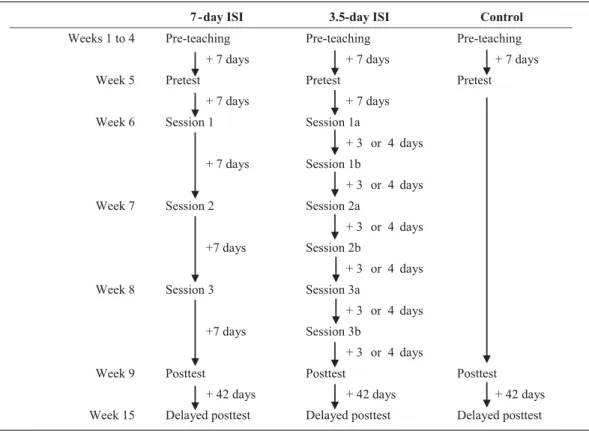
A quasi-experimental design was employed. The control group completed the tests only and reverted to their normal French lessons between pre- and posttests. The treatment groups under-took identical tasks, both totalling 180 minutes (seeTrainingsection) but differing in the distri-bution of the sessions (all treatment and testing materials are available on IRIS). The ISIs were 7 days and 3.5 days, in line with Suzuki (2017) and reflecting the most common lesson frequency in UK primary schools (one or two lessons per week). The 7-day group completed three ses-sions of 60 minutes, each occurring 7 days apart, whereas the 3.5-day group completed six sessions of 30 minutes each occurring 3.5 days apart. Figure 1 illustrates the timing of each testing and training session. The timing of the posttest mir-rored the respective ISI for each treatment group (ISI:RI ratio=100%). The delayed posttest took place exactly 6 weeks after the posttest, giving an RI of 42 days for both groups (ISI:RI ratio=16.7% for 7-day group, 8.3% for 3.5-day group); the ISI:RI ratio was calculated from the first posttest, rather than the final intervention session, as the first posttest provided an additional opportunity for practice. The 3.5-day group’s ISI:RI ratio fell just outside Rohrer and Pashler’s (2007) observed optimum of 10 to 30%. The timing was chosen to ensure that all classes could adhere to the sched-ule, whilst fitting within the constraints of the schools’ timetables and term dates.
Participants were included in the analysis if they had attended all training sessions and both posttests. One 3.5-day participant did not com-plete the sentence–picture matching pretest, whilst two 7-day participants and four 3.5-day participants did not complete the acceptability
FIGURE 1 Study Schedule
7 -day ISI 3.5-day ISI Control
Weeks 1 to 4 Pre-teaching Pre-teaching Pre-teaching + 7 days + 7 days + 7 days Week 5 Pretest Pretest Pretest
+ 7 days + 7 days Week 6 Session 1 Session 1a
+ 3 or 4 days + 7 days Session 1b
+ 3 or 4 days Week 7 Session 2 Session 2a
+ 3 or 4 days +7 days Session 2b
+ 3 or 4 days Week 8 Session 3 Session 3a
+ 3 or 4 days +7 days Session 3b
+ 3 or 4 days
Week 9 Posttest Posttest Posttest + 42 days + 42 days + 42 days Week 15 Delayed posttest Delayed posttest Delayed posttest
judgement test (AJT) pretest. Due to limited time available for testing, a number of participants were unable to complete the AJT at post- and de-layed posttest; therefore, the participant number for this task is lower.
Target Feature
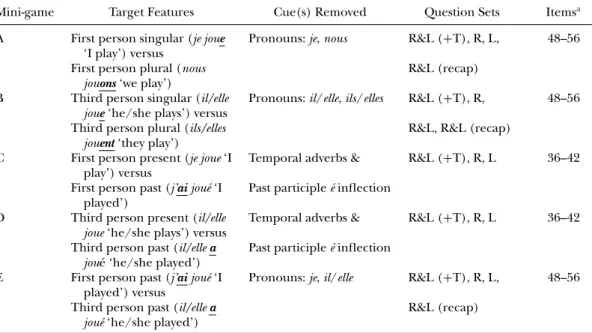
The target language system being taught and tested was regular French verb inflections in the present and perfect tenses (Table 1) for first- and third-person singular and plural forms: null (-e),-ons,-ent(present tense number inflec-tions) andaianda(avoirauxiliaries for the per-fect tense), in both oral and written forms. This choice was in line with the curriculum, which states that children should be taught the “conju-gation of high frequency verbs” (Department for Education, 2013, p. 2). The participants had not previously received explicit instruction in the fea-tures. Such features can be problematic for L2 learners due to an overreliance on lexical items that convey the same semantic information (e.g., subject pronouns indicating person and num-ber; temporal phrases indicating tense), as noted in the Lexical Preference Principle (VanPatten, 2015); see also Marsden (2006) for a study using a
similar rationale and Processing Instruction to fo-cus on the same inflectional features with slightly older learners in the same educational context. Additionally, associative theories of learning at-tribute such difficulties to phenomena such as entrenchment, attention blocking, and overshad-owing, which account for effects of (L1) prior experience, salience, and frequency in the input (N. Ellis, 2006).
Training
Training for the 7-day and 3.5-day groups was delivered via a bespoke, digital, game-based ap-plication containing a series of mini-games, with each game teaching just one particular grammati-cal contrast that is expressed by one pair of inflec-tions (e.g., first person singular vs. plural present tense inflections; see Table 1). Training was com-pleted on individual laptops with headphones. All sessions were overseen by the first author; class teachers were present during the training sessions but provided technical support only.
Each mini-game utilized form–meaning map-ping activities consisting of brief (approximately 2 minute) explicit information followed by refer-ential reading and listening activities. Referrefer-ential
TABLE 1 Training Activities
Mini-game Target Features Cue(s) Removed Question Sets Itemsa
A First person singular (je joue
‘I play’) versus
Pronouns:je,nous R&L (+T), R, L, 48–56
First person plural (nous
jouons‘we play’)
R&L (recap)
B Third person singular (il/elle
joue‘he/she plays’) versus
Pronouns:il/elle,ils/elles R&L (+T), R, 48–56
Third person plural (ils/elles
jouent‘they play’)
R&L, R&L (recap)
C First person present (je joue‘I
play’) versus
Temporal adverbs & R&L (+T), R, L 36–42
First person past (j’aijoué‘I
played’)
Past participleéinflection
D Third person present (il/elle
joue‘he/she plays’) versus
Temporal adverbs & R&L (+T), R, L 36–42
Third person past (il/ellea
joué ‘he/she played’)
Past participleéinflection
E First person past (j’aijoué‘I
played’) versus
Pronouns:je,il/elle R&L (+T), R, L, 48–56
Third person past (il/ellea
joué‘he/she played’)
R&L (recap)
Note.R&L=reading and listening; R=reading only; L=listening only; T=tutorial.
aRange from minimum number if all answers correct to maximum number of attempts possible.
activities (a component of Processing Instruction; VanPatten, 2015) are input-based tasks that re-quire learners to notice a feature and connect it with a meaning or function to complete the ac-tivity. Numerous studies have demonstrated the effectiveness of such activities for L2 morphosyn-tax (e.g., DeKeyser & Botana, 2015; Kasprowicz & Marsden, 2018; Marsden & Chen, 2011; Shin-tani, 2015), including Marsden (2006), who also investigated the teaching of French inflectional verb morphology for person, number, and tense among FL learners aged 13–14 years; and Mc-Manus and Marsden (2017, 2018, 2019a, 2019b), who investigated the learning of French impar-fait. Referential activities make the target gram-matical feature task-essential by removing other cues that learners could rely on (e.g., subject pro-nouns indicating person and number; temporal adverbs indicating tense). For example, in the cur-rent study, in mini-game A (first person singular [null] vs. plural [-ons] present tense inflections), a robot described the food that it (je ‘I’) or all the robots (nous ‘we’) liked. The learner chose whether to feed only the robot that spoke or all the robots. After the first set of practice items, the subject pronoun was obscured (by *** in the read-ing version and by a beep in the listenread-ing version). The learners, therefore, had to notice the verb in-flection, interpret its number meaning, and feed
the correct robot(s). The training utilized 12 reg-ular-erverbs (see Appendix B), which were cho-sen because they are commonly taught to begin-ners (e.g.,aimer‘to like’), are cognates of English verbs (e.g.,poster‘to post’), or fit the game context (e.g.,surveiller‘to watch or survey’).
Each mini-game contained three question sets (see Table 1). The first question set included the tutorial (brief explicit information pro-vided alongside the first two question items; see Appendix C). Response options for the tutorial question items were restricted so that the learner had to answer correctly. Learners then completed the main question items. Correct and incorrect re-sponses were indicated aurally by different sounds and visually via the progress bar. Following incor-rect answers, learners also received a short expla-nation (see Appendix D). To successfully com-plete a question set, the learner had to answer 12 items correctly and received a number of stars upon completion (three stars if all correct, two stars if one incorrect, one star if two incorrect). Learners answered up to two additional questions for each previous item that had been answered correctly. If the learner answered three items in-correctly, they lost the question set and had one opportunity to replay the set. After one replay, the learner automatically moved on to the next ques-tion set, regardless of their score. The restricques-tion
of one replay was included to ensure that all learn-ers had the opportunity to answer all question sets within the time available. These success and re-play features also helped to maintain engagement in the game.
Learners completed all three question sets for one mini-game (one grammatical contrast) before moving onto the next mini-game (and next grammatical contrast). The order of mini-games was counterbalanced across the 7-day and 3.5-day groups, with learners either practising present tense inflections before past tense inflec-tions or vice versa. The 3.5-day group completed one mini-game (three question sets) in each ses-sion; the 7-day group completed two mini-games (six question sets) in each session. In the final part of the training (second half of session 3 for the 7-day group; session 3b for the 3.5-day group), the learners completed a final additional question set from mini-games A, B, and E, in order to review each of the grammar features.
Test Materials
Learners completed, on laptops, a sentence– picture matching test and an AJT at pre-, post- and delayed posttest. Three versions of each test were created. Each version contained the same num-ber of items, in the same format, and included stimuli created from the same set of lexical items, but with different noun–verb combinations (see Appendix B for the list of verbs included). The three versions were counterbalanced within each experimental group and class, and each learner completed a different version at each time point. Learners (n=22) of equivalent age and language experience to the main study participants piloted the tests to check the comprehensibility of the in-structions, test format, and picture stimuli. Sim-ilar tests have been utilized in previous studies with participants of a similar age (e.g., sentence– picture matching task test, Kasprowicz & Mars-den, 2018; AJT, Marsden & Chen, 2011).
Sentence–Picture Matching Test. Learners saw a sentence containing a target feature and chose which of two images matched the sentence. The test contained eight items, four for number and four for present or perfect tense inflections (first and third person). The limited time available in class for testing necessitated the low number of items.
For the items targeting number inflections, pronouns were obscured, for instance, ***joue au foot, ‘*** playSING football’ and learners chose between a picture of one person and a picture
containing three people. For the items target-ing the tense inflections, temporal phrases were eliminated to test interpretation of the presence or absence of the perfect tense auxiliary, for in-stance,j’ai joué au foot‘I played football.’ The pic-tures were an arrow pointing down (to indicate happening now) and an arrow pointing to the left (happened in the past). Learners completed training before the test that ensured they consis-tently understood the meanings of the pictures (e.g., “Which picture meanswe?” [one person or three people]; “Which picture meanshappened in the past?” [down or left arrow]). One point was awarded for selecting the correct image, giving 8 possible points.
Acceptability Judgement Test. Learners were pre-sented with a series of sentences and told, “There may be a mistake in some of the sentences. Decide whether each sentence is right or wrong.” Learn-ers answered on a 4-point scale (definitely right,
right, wrong,definitely wrong). Ifwrongordefinitely wrongwas selected, the learner was asked to “click on any word or words that are wrong” and then write the correct word in the text box provided.
There were six grammatical (G) and six un-grammatical (UG) items. For the number items, the error was due to a mismatch between the pro-noun and the inflection (e.g.,je jouons*au foot
‘I play* football’). For the tense items, the error was due to the absence of the auxiliary (e.g.,Hier,
je* joué au foot‘Yesterday, I play* football’). For G items, learners received 1 point if they correctly selectedright/definitely right. For the UG items, learners received 1 point if they correctly selectedwrong/definitely wrongand clicked on the correct word(s) in the sentence (e.g., for number items, the pronoun or incorrectly inflected verb; for the tense items, the pronoun, verb or temporal phrase). Learners’ corrections of UG items were scored separately, as producing correct versions likely constitutes a slightly different knowledge or skill to recognizing ungrammaticality as it involves production. The presentation of those results is beyond the scope of this article. Note, however, that incorporation of these correction scores in the AJT accuracy scores did not change the pat-terns of results found and presented here.
Language Analytic Ability Test. The LAA test was a paper-and-pencil test consisting of two parts. Part 1 contained five questions, adapted from the standardized UK Department for Ed-ucation’s spelling, punctuation, and grammar test (Standards and Testing Agency, 2014, 2015, 2016), which targets learners’ knowledge of grammatical terminology and concepts in their
L1 English, including grammatical rules relating to pronouns, number, and tense. These questions tested metalinguistic knowledge and grammatical sensitivity, in line with our expanded definition of LAA (i.e., including deductive as well as in-ductive learning abilities; seeLAAsection). Part 2 contained four questions testing learners’ abil-ity to spot patterns and apply rules to novel language. The questions, adapted from Tellier (2013) and the UK Linguistics Olympiad (UKLO, 2016), tested learners’ ability to separate noun and verb stems from inflections and spot patterns relating to changes in number and tense. This be-spoke measure was used as existing LAA measures can be problematic due to their length and diffi-culty (e.g., LLAMA-F, see Rogers et al., 2017), thus are unsuitable for young children, and do not nec-essarily measure the full construct of LAA (i.e., including grammatical sensitivity and inductive and deductive learning abilities); for example, MLAT-E (Part 2) focusses solely on grammatical sensitivity.
Each question item was scored 0/1 for incorrect or correct answer, with 30 points available in Part 1 and 14 in Part 2.
Instrument Reliability. Ordinal omega hierar-chical was calculated as a measure of test re-liability for the sentence–picture matching and AJT tests, as it is considered appropriate for binomial, unit-weighted scales, which do not meet the assumption of unidimensionality (McNeish, 2018): sentence–picture matching, pretest=.28, delayed posttest = .44; AJT (G items), posttest
= .81, delayed posttest= .73; AJT (UG items), posttest=.74, delayed posttest=.79. The reliabil-ity indices could not be calculated for the match-ing posttest data or the AJT G and UG pretest data, because R returned an N/A response for these subsets of data, possibly due to problem-atic factor scores.1 However, the indices elicited
for the same tests at the two other time points give a good indication of the reliability of each measure. The indices yielded for the sentence– picture matching test indicated that the items were not consistent with each other, possibly due to the small number of items or a high incidence of guessing in participants’ responses (Bush, 2015). An additional reason may be because the items elicited different verb inflections, some of which may have been more difficult than others. Question was included as a random variable (as described in the next section) in analysis of test performance, to account for variation across ques-tion items. Nevertheless, given the low reliability of the sentence–picture matching test and
miss-ing indices, the results should be interpreted with caution.
Omega total, which is appropriate for use with unit-weighted, congeneric scales (McNeish, 2018), was calculated as a measure of reliability for the LAA test (.78).
Analysis
Descriptive statistics (means, standard devia-tions) of raw scores on each test are provided. Ef-fect sizes (Cohen’sd, calculated using the pooled standard deviation) and their confidence inter-vals (CIs), for comparisons between groups and between time points, are interpreted based on Plonsky and Oswald’s (2014) field-specific medi-ans (between-group: small,d=0.40; medium,d=
0.70; large,d=1.00; within-group: small,d=0.60; medium,d=1.00; large,d=1.40; p. 889).2
(Addi-tionally, between-group effect sizes corrected for differences at pretest are provided in Appendix E. Although these corrected effect sizes give some descriptive indication of change that takes into ac-count baseline differences, there is unfortunately no known way to date for calculating CIs for these corrected effect sizes, making them inappropriate to interpret within the main article.) Data were nonnormally distributed; therefore, Spearman’s
rho(including bootstrapped, bias-corrected, 95% CIs) is provided for analysis of the relationship between performance on the outcome mea-sures and (a) the LAA test, and (b) practice accuracy.3 The strength of the relationship
in-dicated by Spearman’srhois interpreted against the following benchmarks: small=0.25; medium
= 0.4; large = 0.6 (Plonsky & Oswald, 2014, p. 889).
To model the effect of the categorical variables group (7-day, 3.5-day, control) and time (pre-, post-, delayed posttest) on test performance, and to account for random effects of learner, class, and question item, the data were analysed via mixed-effects logistic models fit by maximum like-lihood with binomial logit functions using the lme4 package in R 3.4.3 (Bates et al., 2015). The data were binary (correct or incorrect). The models included random intercepts to account for variation in average scores by learner, class, and question item. The base model for analysis of each outcome measure can be described as follows:
model<−glmer(Score∼Group∗Time
+(1|Pupil)+(1|Class)+(1|Question), data=dataset,family=binomial,control
TABLE 2
Descriptive Statistics for Outcome Measures
Pretest Posttest Delayed
Test Group n M(SD) M(SD) M(SD)
Sentence–picture matching (/8) 7-day 38 4.68 (1.35) 4.68 (1.60) 4.53 (1.31)
3.5-day 41 3.95 (1.36) 4.88 (1.87) 4.27 (1.55)
Control 34 4.50 (1.29) 4.44 (1.62) 4.65 (1.45)
AJT grammatical (/6) 7-day 20 3.16 (1.46) 2.75 (2.00) 2.70 (1.72)
3.5-day 26 2.95 (1.28) 3.19 (1.79) 3.23 (1.63)
Control 16 3.56 (1.15) 3.13 (1.71) 2.25 (1.88)
AJT ungrammatical (/6) 7-day 20 0.51 (0.67) 1.05 (1.00) 0.70 (0.86)
3.5-day 26 0.83 (0.51) 1.12 (1.21) 0.73 (1.12)
Control 16 0.56 (0.73) 0.38 (0.62) 0.38 (0.62)
Note.AJT=acceptability judgement test;M=mean;SD=standard deviation.
RESULTS
Influence of Practice Distribution (RQ1)
Sentence–Picture Matching Test. Table 2 details the descriptive statistics for performance on the matching test at pre-, post-, and delayed posttest.4
Examination of the descriptive statistics indicated minimal changes in group-level mean scores over time and minimal differences between groups, with two notable exceptions: First, the 3.5-day group’s performance at pretest was lower than both the 7-day and control groups, with these differences representing small effects (Table 3a). Although the group differences at baseline were generally unreliable as their 95% CIs pass through zero, one effect (3.5-day vs. 7-day) had a reli-able, albeit small, effect. The effect of group at pretest was approaching significance, Kruskal– Wallisχ2(2)=5.396,p=.067. Second, there was
an increase in the 3.5-day group’s scores between pre- and posttest (Table 3b), with a small withgroup effect size whose CIs did not cross zero, in-dicating a reliable effect.
Analysis, via the Anova() function (Type III) in the car package in R, of the fixed effects within the model of the matching test data revealed no main effects for group,χ2(2)=4.538,p=.103,
or time,χ2(2)= 0.272,p= .873, nor any
inter-action between group and time,χ2(4)= 5.060, p = .281. Nevertheless, a marginal fixed effect for the interaction between the 3.5-day group at posttest in comparison to the control group was observed (estimate=0.46,SE=0.236,z=1.933,
p = .053), reflecting the change in the 3.5-day group’s scores from below to above the control group’s scores between pre- and posttest. These results mirrored the observations made based on the descriptive statistics, reflecting minimal
changes in group-level performance over time and between groups.
Given the difference observed in group scores at pretest, the model was rerun with pretest as a control variable, rather than as part of the in-dependent variable time. However, no significant main effect for pretest was observed, χ2(1) =
1.371, p = .242, suggesting that pretest mance was not an indicator of the groups’ perfor-mance on the matching test at subsequent time points. Pretest was therefore not included as a control variable in subsequent models.
Acceptability Judgement Test: Grammatical Items.
Table 2 details the descriptive statistics for AJT G items at pre-, post- and delayed posttest. These indicate minimal group-level change over time for the 7-day and 3.5-day groups, but a decrease in scores for the control group most notable be-tween pre- and delayed posttest (Table 3b). Fur-ther, there was a small difference in the 3.5-day and control groups’ performance at pretest (con-trol> 3.5-day) and at delayed posttest (3.5-day
>control), although the CIs for both effect sizes cross zero, suggesting that this effect is not reliable (Table 3a).
Analysis of the fixed effects within the model revealed no significant effect of group,χ2(2)=
0.848,p=.655, and no significant interaction be-tween group and time,χ2(4)= 7.611,p= .107;
however, a significant fixed effect for time was re-vealed,χ2(2)=10.459,p=.005. This effect was
qualified by a significant fixed effect for the in-teraction between the 3.5-day and control groups’ scores at delayed posttest (estimate=1.076,SE=
0.408,z=2.640,p=.008); reflecting the decrease observed in the control group’s scores at delayed posttest, whilst the 3.5-day group maintained their scores.
TABLE 3a
Effect Sizes Comparing Scores Between Groups
Test Group Pretest d(CIs) Posttest d(CIs) Delayed Posttest d(CIs) Sentence–picture matching (/8) 7-day / 3.5-day 0.54 (0.08, 0.98)a −0.11 (−0.56, 0.33) 0.18 (−0.26, 0.62) 7-day / control 0.14 (−0.33, 0.60) 0.15 (−0.32, 0.61) −0.09 (−0.55, 0.38) 3.5-day / control −0.41 (−0.87, 0.05) 0.25 (−0.21, 0.70) −0.25 (−0.71, 0.21)
AJT grammatical (/6) 7-day / 3.5-day 0.15 (−0.43, 0.74) −0.23 (−0.81, 0.36) −0.31 (−0.90, 0.28)
7-day / control −0.30 (−0.95, 0.37) −0.20 (−0.86, 0.46) 0.25 (−0.41, 0.91) 3.5-day / control −0.49 (−1.12, 0.15) 0.03 (−0.59, 0.66) 0.57 (−0.08, 1.19) AJT ungrammatical (/6) 7-day / 3.5-day −0.55 (−1.13, 0.06) −0.06 (−0.64, 0.52) −0.03 (−0.61, 0.55) 7-day / control −0.07 (−0.73, 0.59) 0.79 (0.09, 1.45)a 0.42 (−0.25, 1.07) 3.5-day / control 0.45 (−0.19, 1.07) 0.72 (0.06, 1.35)a 0.36 (−0.27, 0.98)
Note.AJT=acceptability judgement test;d=Cohen’sdeffect size; CIs=confidence intervals.
aCIs do not pass through zero. TABLE 3b
Within-Group Effect Sizes Comparing Scores Between Time Points
Test Group Pretest vs. Posttest d(CIs) Posttest vs. Delayed Posttestd(CIs) Pretest vs. Delayed Posttestd(CIs) Sentence–picture matching (/8) 7-day 0.00 (−0.45, 0.45) −0.10 (−0.55, 0.35) −0.11 (−0.56, 0.34) 3.5-day 0.57 (0.12, 1.00)a −0.36 (−0.79, 0.08) 0.22 (−0.22, 0.65) Control −0.04 (−0.52, 0.43) 0.14 (−0.34, 0.61) 0.11 (−0.37, 0.58)
AJT grammatical (/6) 7-day −0.23 (−0.85, 0.39) −0.03 (−0.65, 0.59) −0.29 (−0.91, 0.34)
3.5-day 0.15 (−0.39, 0.70) 0.02 (−0.52, 0.57) 0.19 (−0.36, 0.73)
Control −0.30 (−0.98, 0.41) −0.49 (−1.18, 0.23) −0.84 (−1.54,−0.10)a
AJT ungrammatical (/6) 7-day 0.63 (−0.01, 1.26) −0.38 (−0.99, 0.26) 0.25 (−0.38, 0.86)
3.5-day 0.31 (−0.24, 0.85) −0.33 (−0.88, 0.22) −0.11 (−0.66, 0.43)
Control −0.27 (−0.95, 0.44) 0.00 (−0.69, 0.69) −0.27 (−0.95, 0.44)
Note.AJT=acceptability judgement test;d=Cohen’sdeffect size; CIs=confidence intervals.
aCIs do not pass through zero.
Acceptability Judgement Test: Ungrammatical Items.
The descriptive statistics for the AJT UG items revealed low scores on these items across all groups (Table 2). Nevertheless, the effect sizes for between-group comparisons (Table 3a) indicated that both the 7-day and 3.5-day groups scored higher than the control group at posttest and at delayed posttest, although the CIs for the delayed posttest effect sizes crossed zero, indicating less certainty in this effect.
The model of scores on the AJT UG items revealed no significant fixed effect of group,
χ2(2) = 1.839, p = .399; time, χ2(2) = 1.020, p = .601; or interaction between group and time, χ2(4) = 3.803, p = .433. Nevertheless, a
marginal fixed effect for the 7-day group in com-parison to the control group at posttest was ob-served (estimate=1.324,SE=0.695,z=1.906,
p = .057). This reflected the small increase in the 7-day group’s scores between pre- and posttest compared to the lower performance of the con-trol group.
Influence of Practice Accuracy (RQ1a)
Analysis was conducted to explore the asso-ciation between the accuracy of learners’ formance during training and subsequent per-formance at post- and delayed posttest. As the control group did not complete the training ac-tivities, it is excluded from this analysis.
Practice Accuracy. The learners’ global prac-tice accuracy score (i.e., percentage of questions answered correctly out of all those attempted across the training sessions) provided an indica-tion of how successfully the learners completed
the training.5The global practice accuracy scores
were high for both the 7-day (n = 38, M =
79.6%, CI [76.7%, 82.4%], SD = 8.7%) and 3.5-day groups (n=41, M=82.5%, CI [79.9%, 85.2%], SD = 8.4%), with both groups answer-ing more than 75% of practice items correctly on average. The standard deviation and CI around each mean indicate some variation between individuals’ practice scores. The minimum score from any individual within the 7-day group was 62.8% and within the 3.5-day group was 55.4%. An independent samplest-test indicated no sig-nificant difference in global practice accuracy be-tween the two groups,t(77)= −1.522,p=.132,
d= −0.34, CI [−0.78, 0.11].
To examine the relationship between perfor-mance during training sessions (i.e., practice ac-curacy) and performance on the outcome mea-sures, the models of learners’ performance on each outcome measure were expanded to include practice accuracy (with scores centred on the grand mean to avoid multicollinearity) as a pre-dictor variable:
PracticeAccuracy_model<−glmer(Score∼ Group∗Time+PracticeAccuracy+(1|Pupil)
+(1|Class)+(1|Question),data=dataset, family=binomial,control
=glmerControl(optimizer=“bobyqa”))
Sentence–Picture Matching Test. Including prac-tice accuracy as a predictor variable within the model yielded a significant effect of group,χ2(1) =5.341,p=.021, qualified by a fixed effect for the 3.5-day group in comparison to the 7-day group (estimate = −0.378, SE = 0.164, z = −2.311,
p = .021), reflecting the change in the 3.5-day groups’ scores between pre- and posttest. Fur-ther, a significant effect of practice accuracy was observed, χ2(1) = 11.039, p < .001, indicating
that learners’ overall success at completing the training activities predicted performance on the matching test.
A small–medium, significant association with practice accuracy was observed for both groups at posttest and for the 3.5-day group at delayed posttest (Table 4). For the 7-day group at delayed posttest, the association had weakened slightly and the lower CI bound just crossed zero, suggest-ing a marginally reliable small association.
Acceptability Judgement Test: Grammatical Items.
The expanded model of performance on the AJT G items yielded a significant effect of practice ac-curacy,χ2(1)=4.026,p=.045, but no significant
effect of group,χ2(1)=0.074,p=.786; or time,
χ2(2)=1.675,p=.433.
Correlations (see Table 4) indicated medium, significant associations with the 3.5-day groups’ practice accuracy at post- and delayed posttest. In contrast, for the 7-day group, the association was not reliable or statistically significant at posttest or delayed posttest. The findings suggest that practice accuracy was a significant predictor of posttest performance on this test for the 3.5-day group only.
Acceptability Judgement Test: Ungrammatical Items.
For AJT UG items, the expanded model yielded a significant effect of practice accuracy,χ2(1)=
17.441,p < .001, but no effect of group, χ2(1) = 0.635,p = .426; or time,χ2(1)= 4.071,p =
.131. A medium–large, significant association be-tween practice accuracy and performance on AJT UG items at posttest was observed for both the 7-day and 3.5-day groups (Table 4). At delayed posttest, this association remained reliable and statistically significant for the 3.5-day group, but weakened considerably for the 7-day group and was no longer reliable or statistically significant.
Influence of Language Analytic Ability (RQ1b)
Although little change was seen in group-level mean scores, the standard deviations (Table 2) suggest substantial within-group variation in per-formance on each test. We now examine whether this variation can be accounted for by individual differences in LAA.
Language Analytic Ability Test Performance. The descriptive statistics for the three groups’ perfor-mance on the LAA test are presented in Table 5. The 3.5-day group’s performance was marginally higher than both the 7-day (d= −0.46, CI [−0.90,
−0.01]) and control group (d=0.36, CI [−0.10, 0.81]), although a Kruskal–Wallis test revealed no significant effect of group, χ2(2) = 3.607, p = .165. The CIs around the mean overlapped be-tween all three groups, indicating that perfor-mance of all three groups fell within a similar range. Notably, the large standard deviations indi-cate a large amount of within-group variation on this test (Table 5).
To examine the impact of LAA on performance on the outcome measures, the mixed effects logis-tic models were expanded to include LAA scores (centred around the grand mean) as a predictor variable6:
LAA_model<−glmer(Score∼Group∗Time
+LAA+(1|Pupil)+(1|Class)
+(1|Question),data=dataset,family
=binomial,control=glmerControl(optimizer
TABLE 4
Correlation Between Practice Accuracy and Outcome Measures
Posttest Delayed Posttest
Test Group n rho(CIs) p rho(CIs) p
Sentence–picture matching 7-day 38 .38*(.08, .61) .018 .32 (−.01, .60) .052
3.5-day 41 .36*(.10, .59)a .020 .38*(.11, .59)a .016
All 79 .38*(.21, .54)a .001 .33*(.12, .52)a .003
AJT grammatical 7-day 20 .19 (−.37, .63) .429 .16 (−.31, .61) .508
3.5-day 26 .41*(−.02, .78) .040 .51*(.11, .81)a .009
All 46 .36*(.04, .61)a .014 .37*(.08, .60)a .013
AJT ungrammatical 7-day 20 .53*(.09, .85)a .016 .16 (−.48, .64) .508
3.5-day 26 .64*(.34, .83)a .001 .49*(.17, .74)a .010
All 46 .60*(.34, .77)a .001 .31*(−.02, .59) .038
Note.AJT=acceptability judgement test;rho=Spearman’srhocorrelation coefficient; CIs=confidence intervals.
aCIs do not pass through zero. *Significant at .05 level. TABLE 5
Performance on Language Analytic Ability Test
Group n M(SD) CIs
7-day 38 26.7 (9.8) 23.4, 29.9
3.5-day 41 30.8 (8.4) 28.2, 33.5
Control 34 27.7 (9.2) 24.5, 30.9
Note.M=mean;SD=standard deviation; CIs=confidence intervals.
Sentence–Picture Matching Test. The expanded model yielded a significant effect of group,χ2(2) = 6.028,p =.049, which was qualified by a sig-nificant fixed effect for the 3.5-day group in com-parison to the control group (estimate= −0.329,
SE = 0.167, z= −1.967, p = .049). No signifi-cant effect of time, χ2(2)= 0.273,p =.872, or
interaction between group and time was observed in the expanded model,χ2(4)=5.020,p=.285.
However, a significant effect of LAA was observed,
χ2(1) = 5.924, p = .015. Further, comparison,
via the Anova() function in R, of the original and expanded models for the matching test re-vealed that including LAA significantly improved the model fit, χ2(1)= 5.819, p =.016,
indicat-ing that learners’ performance on the LAA test was a significant predictor of performance on the matching test.
Spearman’srhoindicated a small but nonstatis-tically significant association at posttest for both the 7-day and 3.5-day groups and no associa-tion for the control group (Table 6). At delayed posttest, a stronger association was observed for the 3.5-day group, which was borderline statisti-cally significant and had 95% CIs forrhothat only just passed through zero. The association between LAA and matching test performance for the
con-trol group at delayed posttest was also stronger with a similar pattern of marginal reliability and significance.
Acceptability Judgement Test: Grammatical Items.
The expanded model for the AJT G items re-vealed a significant effect of time,χ2(2)=10.460, p=.005, which was qualified by a significant fixed effect of delayed posttest compared to pretest (estimate = −0.997, SE = 0.314, z = −3.178,
p = .001) and a significant fixed effect of 3.5-day group compared to control group at delayed posttest (estimate=1.085,SE=0.408,z= −2.661,
p=.008), reflecting the decrease in the control group’s scores. Within the expanded model, there was also a significant effect of LAA,χ2(1)=4.163, p=.041, and the addition of LAA significantly im-proved the model fit,χ2(1)=4.052,p=.044.
Correlations between LAA and AJT G scores revealed significant medium associations for the 3.5-day group at post- and delayed posttest (Table 6). In contrast, for the 7-day and con-trol groups at both posttest and delayed posttest, associations were unreliable and nonstatistically significant.
Acceptability Judgement Test: Ungrammatical Items.
TABLE 6
Correlations Between Language Analytic Ability and Outcome Measures
Posttest Delayed
Test Group n rho(CIs) p rho(CIs) p
Sentence–picture matching 7-day 38 .22 (−.09, .51) .186 .15 (−.21, .47) .359
3.5-day 41 .24 (−.06, .50) .125 .30 (−.04, .61) .054
Control 34 −.02 (−.39, .32) .906 .29 (−.01, .54) .087
All 113 .17 (−.02, .34) .065 .24*(.07, .41)a .011
AJT grammatical 7-day 20 .18 (−.38, .71) .447 .10 (−.37, .59) .691
3.5-day 26 .48*(.10, .75)a .012 .54*(.19, .81)a .004
Control 16 .29 (−.24, .73) .264 −.09 (−.64, .50) .729
All 62 .34*(.09, .54)a .007 .22 (−.05, .46) .080
AJT ungrammatical 7-day 20 .42 (−.07, .74) .068 .33 (−.14, .73) .153
3.5-day 26 .65*(.37, .84)a .001 .28 (−.23, .71) .167
Control 16 −.10 (−.54, .42) .726 .05 (−.65, .54) .868
All 62 .40*(.13, .61)a .001 .24 (−.04, .50) .057
Note.AJT=acceptability judgement test;rho=Spearman’srhocorrelation coefficient; CIs=confidence intervals.
aCIs do not pass through zero. *Significant at .05 level.
yielded a significant effect for LAA, χ2(1) =
18.425,p<.001. No significant effect for group,
χ2(2) = 1.085, p = .581; time, χ2(2) = 0.978, p=.613; or interaction between group and time,
χ2(4)=3.711,p=.447, was observed within the
expanded model, mirroring the findings of the original model; however, the expanded model sig-nificantly improved the model fit,χ2(1)=16.203, p<.001.
For the AJT UG items, at posttest, a large, re-liable and statistically significant association was observed with LAA for the 3.5-day group and a medium association for the 7-day group, but this was nonstatistically significant and had border-line reliability as the CIs just passed through zero (Table 6). By delayed posttest, the correlations weakened to small nonsignificant and unreliable associations for both groups. No associations were observed for the control group at post- or delayed posttest. These findings indicate that for both the 7-day and 3.5-day groups, LAA had some relation with learners’ performance on the AJT UG items at posttest.
DISCUSSION
This study investigated the impact of practice distribution on grammar learning and explored the extent to which accuracy during training and LAA moderated learning under shorter and longer practice schedules. Our sentence–picture matching test had low reliability, whilst reliabil-ity for the AJT G and UG items was acceptable. We were unable to obtain indices for three out of
the nine test administrations and both tests had a low number of items, thus we interpret our results with caution whilst also noting that our mixed-model analyses did account for random variation between test items.
Group-Level Performance Compared to Control
Before discussing the findings in relation to the impact of practice distribution, it is neces-sary to address the (somewhat surprising) finding that, at group-level, minimal differences were ob-served in the treatment groups’ performances on the outcome measures compared to the control group and, further, that minimal changes over time were observed between time points for all groups. The group-level statistics could suggest minimal learning as a result of the intervention, potentially contrary to much of the existing re-search on form–meaning mapping (a component of the wider Processing Instruction approach; see DeKeyser & Botana, 2015; and Shintani, 2015 for reviews). For example, Shintani (2015) found a large overall effect (d=2.60) for Processing In-struction on receptive knowledge at posttest in a meta-analysis of 42 Processing Instruction studies. Additionally, Marsden (2006) used a similar ap-proach to teach a slightly larger grammatical sub-system (inflectional verb morphology for person, number, tense) and found clear learning gains on a battery of measures. However, a number of con-siderations should be taken into account when in-terpreting the current findings.
First, in Marsden’s (2006) study, the interven-tion was considerably longer (4.5 hours over