Dissertations, Theses, and Projects Graduate Studies
Spring 4-29-2019
Speech-Language Pathologists’ Perspectives on
Preparedness for Interprofessional Collaborative
Practice in School Settings
Rachel Sawatzky
Follow this and additional works at:https://red.mnstate.edu/thesis
This Thesis (699 registration) is brought to you for free and open access by the Graduate Studies at Red. It has been accepted for inclusion in Dissertations, Theses, and Projects by an authorized administrator of Red. For more information, please [email protected]. Recommended Citation
Sawatzky, Rachel, "Speech-Language Pathologists’ Perspectives on Preparedness for Interprofessional Collaborative Practice in School Settings" (2019).Dissertations, Theses, and Projects. 187.
Speech-Language Pathologists’ Perspectives on Preparedness for Interprofessional Collaborative Practice in School Settings
A Thesis Presented to the Graduate Faculty of Minnesota State University Moorhead
By
Rachel Sawatzky, B.S.
In Partial Fulfillment of the Requirements for the Degree of
Master of Science in Speech-Language Pathology
May 2019
Announcement of Oral Defense
Name of Candidate: Rachel Sawatzky, B.S.
Degree Program and Major: Master of Science Speech-Language
Pathology
Project Title: Speech Language Pathologist Perspectives
on Preparedness for Interprofessional Collaborative Practice in School Settings
Date and Time: April 17th, 2019 at 3:00 pm
Location: Murray Hall 210
Examining Committee: Elaine Pyle, Ph.D., MS/CCC-SLP, Chair
Kris Vossler, Ph.D., MS/CCC-SLP Vicki Riedinger, M.S., CCC-SLP Shirley Johnson, Ph.D.
Acknowledgements
I would like to thank my family who has provided me with support and encouragement throughout my graduate school studies. I would like to give a special thanks to my husband, John, who has been the most supportive person the last two years and has been understanding and patient with my constant amount of school work and traveling back-and-fourth between home and Moorhead. I would also like to thank my writing supervisor, Dr. Pyle, who has
provided constant positive words and support throughout the stress of graduate school, writing a thesis, and presenting at ASHA. Thank you for all your help in writing this paper and I will forever be grateful for your knowledge and guidance.
Thesis Abstract
According to a recent study (ASHA, 2017), only 54% of speech-language pathologists (SLPs) employed in a school reported they felt very prepared to engage in interprofessional collaborative practice (IPCP). It is essential for SLPs to engage in IPCP with a wide range of other professionals including, but not limited to: regular education teachers, special education teachers, occupational therapists (OT), physical therapists (PT), administrators, nurses, social workers, psychologists, and audiologists. The purpose of this qualitative phenomenological study was to explore the perspectives of new SLPs on their preparedness for IPCP. The study sheds light on whether the SLP felt prepared for IPCP at the beginning and end of the CF year from their educational training. It also describes their experiences with interprofessional collaborative practice and their interprofessional education (IPE) experiences in school settings during their Clinical Fellowship (CF) year.
Keywords: Interprofessional Collaborative Practice, Speech-Language Pathology, Clinical Fellowship Year
Table of Contents
Notice of Oral Examination ………2
Acknowledgments………...3
Chapters Chapter I: Introduction ………...6
Chapter II: Literature Review………15
Chapter III: Methodology and Data Analysis………....………...……….32
Chapter IV: Results………...……….38
Chapter V: Discussion ………...51
References ……….…………57
Appendices Appendix A: Interview Protocol………...62
CHAPTER I Introduction
Speech-language pathologists (SLPs) work in a variety of settings (e.g., schools, hospitals, nursing homes, clinics, and private practice). According to the American Speech-Language and Hearing Association (ASHA, 2018d), 39% of SLPs are employed in health care settings, 19% are employed part-time or full-time in private practice, and more than half of SLPs (56%) are employed in educational settings. SLPs in school settings are expected to work closely with their students as well as the students’ families at all levels over the course of therapy, from evaluation to discharge, to determine the needs and goals of the family as well as the student. Along with the student and families, it is also essential for SLPs to engage in interprofessional practice (IPP), also called interprofessional collaborative practice (IPCP), with a wide range of other professionals including, but not limited to: regular education teachers, special education teachers, occupational therapists (OT), physical therapists (PT), administrators, nurses, social workers, psychologists, and audiologists.
ASHA joined the Interprofessional Education Collaborative (IPEC) in 2017. This is “an influential collaborative of largely medical professions that developed widely used competencies for interprofessional education and practice” (ASHA, 2018c, para. 1). Within IPEC, ASHA has a list of core competencies in the area of interprofessional collaboration that is divided into four categories: a) values/ethics, b) roles/responsibilities, c) interprofessional communication, and d) teams and teamwork (“Interprofessional Education, 2016). In the American Speech-Language-Hearing Association’s Envisioned Future: 2025, it is stated that:
An Interprofessional Education (IPE) approach to training and educating new
teaching, scholarly research, and technological needs of academic programs as they strive to enhance the scientific base of the discipline and educate qualified speech-language pathologists and audiologists to meet consumer needs. (ASHA, 2018b, para. 8) This vision will require an understanding of how SLPs are currently prepared and an analysis of their IPE experiences in formal education and in early SLP training (i.e., Clinical Fellowship (CF)) in order to understand where the gaps occur in training and how initial clinical
employment experiences affect student preparedness for engaging in IPCP. ASHA has adopted the World Health Organization’s (WHO) definition of
interprofessional education as: “when two or more health professions learn about, from, and with each other to foster effective collaboration and improve the outcomes and quality of care”
(Hopkins, 2010, p.7). IPE applies to future SLPs as they engage in preparatory coursework at the undergraduate and graduate level. ASHA has also adopted WHO’s definition of
interprofessional practice (IPP), also known as interprofessional collaborative practice (IPCP) as: “when two or more professionals effectively collaborate together to improve outcomes and the quality of care for their client (patient)” (Hopkins, 2010, p.7). IPCP applies to SLPs as soon as they engage in clinical practicums and internships, extending into their first employment settings in the form of their clinical fellowship year (CF year).
SLPs are expected to engage in IPCP and IPE in academic and practice settings.
Examples of this type of activity include case presentations, clinical practice, leadership training, interdisciplinary seminars, research, and service learning (“Role of”, 2018). Loretta Nunez, ASHA director of academic affairs and research education, explains that: “Interprofessional practice results in better outcomes, greater satisfaction and more cost-effective care for
ASHA provides an Interprofessional Practice (IPP) Case Rubric that can be used as a framework to plan and coordinate in an IPCP team to develop and monitor a plan for individuals. ASHA states in the Interprofessional Case Rubric (2018), that
Successful IPP requires a well-developed team process that includes the
following elements: a) collaborative team facilitation, b) shared goal/objective, c) specific roles or functions for individual members based on expertise, knowledge and skills e) flexibility and adaptability, f) deliberative and continuous team communication, g) mutual trust, respect, and support, h) team decision making, I) reflective practice (ASHA, 2018f, para.4).
Statement of the Problem
It is common for SLPs to identify a range of professionals they may collaborate within a medical setting. The connection to IPCP may not be as straightforward in a school due to an extensive range of potentially involved personnel. Although IPCP is discussed generally as it relates to school settings, it is not as prevalent in the literature as IPCP is in medical settings (Harvey et al., 2014, Suarez & Koole, 2014, Suleman et al., 2014, Hagge & Noureddine, 2016). After completion of graduate school and in a SLP clinical fellowship year (CF year), SLPs are expected to effectively collaborate with other professionals in a school setting. Unfortunately, not all SLP graduate programs offer courses or opportunities that collaborate with other fields of study (e.g., physical therapy, occupational therapy, education) or to teach effective ways to collaborate with these other professions as an SLP. Teeters & Meyers (2014) stated that “this is typically because professional education curriculums create unique course schedules and require offsite clinical fieldwork for extended time periods” (p. 179). They also argue that “IPE is highly
encouraged in courses throughout the program, but courses that reach across disciplines are difficult to schedule” (p. 179). Nunez stated that:
Audiology and speech-language pathology students and practitioners need to learn how to be more effective IPP team members. IPE education includes a common set of values that each profession adopts and practices, and the skills needed to facilitate or work effectively on a team. At its most basic level, IPE provides opportunities to learn about and interact with other professions to foster understanding, respect, trust and
communication (“ASHA’s Strategic”, 2016, para.7).
When working in a school setting, speech-language pathologists are expected to be able to work collaboratively with other professionals such as special education teachers, general education teachers, occupational therapists, physical therapists, and psychologists. According to a study from ASHA in 2017, 89.9% of the respondents that worked in a school reported they engaged in interprofessional collaborative practice in the previous 12 months. In the same survey, only 53.8% of the respondents employed in a school reported that he/she felt ‘very prepared’ to engage in interprofessional collaborative practice. Only 27.4% of those SLPs in the schools had formal education or training in interprofessional collaborative practice (e.g.,
academic, or clinical coursework) (“Interprofessional Practice”, 2017, p.9). The relatively low level of perception of preparedness compared to the prevalence of IPCP is a concern, especially given the importance of interprofessional collaboration in our scope of practice and its expected growth in the future (” Interprofessional Practice”, 2017).
One limitation of the ASHA (2017) survey is that it does not provide a context for the response of the participant. For example, although only 53.8 % felt prepared to engage in IPCP, the survey did not specifically explore what specific factors contributed to or prevented their
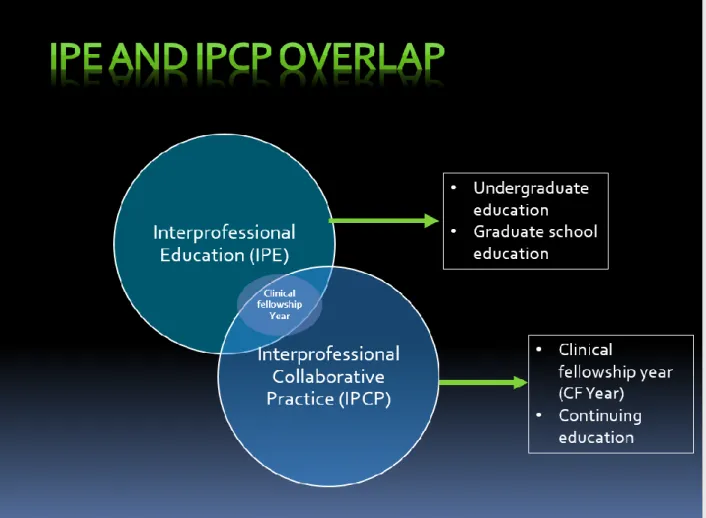
preparedness. Without training or practice in IPCP before entering a clinical or school practice setting, the SLP may find the act of IPCP much more difficult than it may sound while learning about it in a course while completing a master’s program. The CF year then may become a primary opportunity for SLPs to develop IPCP abilities and therefore, an appropriate context to study preparedness for IPCP. IPE does not end with the completion of formal education and IPCP is not isolated to practice (See Figure 1.) There likely is an overlap between IPE and IPCP during the CF experience. Given the challenges of developing IPE in a curriculum, it is ideal to understand how SLPs view their preparedness for IPCP as soon as possible following their formal education while perspectives are fresh. Understanding and exploring how their early practice opportunities may or may not foster IPE and IPCP development during their CF year may provide insight for educators developing future course program development. It also may be of benefit for the study participants or SLPs in practice. For example, individual accounts of CF experiences may provide a more in-depth look at actual practice and help explore the reasons why SLPs may or may not feel prepared for interprofessional collaboration specific to the school practice setting.
Figure 1. IPE and IPCP Overlap.
Purpose of the Study
The purpose of this qualitative phenomenological study was to explore the perspectives of SLPs who are nearing completion or recently completed their CF year to understand what experiences or factors influenced their preparedness for interprofessional collaborative practice in school settings. It also provides a rich description of the IPCP experience of a school SLP during the CF year and identifies potential opportunities for improving preparedness. The study sheds light on whether the SLP felt prepared for IPCP at the beginning and end of the CF year from their educational training. The study also identifies potential factors leading them to feeling more prepared, which settings or experiences (e.g., continuing education,) prepared them
individually for IPCP, and what can be done in the future to help new clinicians feel more prepared when going into a school setting to be able to effectively collaborate with other professionals. By exploring the perspective of the SLPs and their experience with IPCP, this study intends to provide supporting evidence for graduate programs and clinical educators as they work towards providing more courses taught collaboratively with other fields of study (e.g., education, occupational therapy (OT), and physical therapy (PT)) to help students in SLP
master’s programs learn to collaborate with other professions in school settings. The research questions are as follows:
1) How do SLPs perceive their preparedness about interprofessional collaborative practice (IPCP) upon completion of a CF experience in a school setting?
2) What aspects of a SLPs graduate education and/or their CF school placement experience influence perceptions of the development IPCP?
Significance of the Study
It is highly likely that SLPs will be required to engage in IPCP while working in a school setting as supported by recent employment data (ASHA, 2017). In addition, it is within the SLP scope of practice to engage in IPCP. According to ASHA’s Scope of Practice (2016):
SLPs share responsibility with other professionals for creating a collaborative culture. Collaboration requires joint communication and shared decision making among all members of the team, including the individual and family, to accomplish improved service delivery and functional outcomes for the individuals served. When discussing specific roles of team members, professionals are ethically and legally obligated to determine whether they have the knowledge and skills necessary to perform such
services. Collaboration occurs across all speech-language pathology practice domains. (“Scope of”, 2018, pp. 8-9)
Therefore, in order to develop an educational experience that aligns with the SLP's scope of practice and helps support the ASHA 2025 vision, it is important to explore and understand the perspectives of the individuals who actively engage in IPCP through the completion of this study.
Delimitations of the Study
This study involved interviewing and discussing experiences of new SLPs that were either at the end or have recently ended their CF year. The participants in this study were employed at schools in the states of Minnesota, North Dakota, and South Dakota and reflect graduate education experiences from this region. The respondents, their colleagues, and students were predominately Caucasian based on regional demographics, however, this data was not identified. The respondents for this study were all female. Additionally, the study used
purposive, snowball sampling, which can result in an unrepresentative sampling of the desired population. However, it served to generate a starting point for understanding the lived
experiences of SLPs as they engage in collaborative practice.
Definitions
Interprofessional education (IPE): “Occurs when students from two or more professions learn about, from and with each other to enable effective collaboration and improve health outcomes” (Hopkins (Ed.), 2010, p.7).
Interprofessional Practice (IPP) Also known as interprofessional collaborative practice (IPCP): “happens when multiple health workers from different professional backgrounds work
together with patients, families, carers, and communities to deliver the highest quality of care” (Hopkins (Ed.), 2010, p.7).
Clinical fellowship year (CF year): “The transition period between being a student enrolled in a communication sciences and disorders (CSD) program and being an independent provider of speech-language pathology clinical services. The CF involves a mentored
professional experience after the completion of academic course work and clinical practicum” (ASHA, 2018e)
American-Speech-Language Hearing Association (ASHA): “ASHA is the national
professional, scientific, and credentialing association for 198,000 members and affiliates who are audiologists; speech-language pathologists; speech, language, and hearing scientists; audiology and speech-language pathology support personnel; and students” (ASHA, 2018a).
Introduction Summary
In conclusion, it is important to explore the thoughts of recently graduated SLPs who have recently completed their CF year for their perspectives on their level of preparedness for IPCP for multiple reasons. It is important for schools with multiple collaborating professionals to understand the positive outcomes of IPCP and see how often professions are working together to provide more effective services for their students. It can help show SLP graduate programs the importance of educating future SLPs in IPCP in coursework, as well as to help guide in practice IPCP case studies with other programs. Finally, it is important for students to see that they will undeniably engage in IPCP in schools, and it is important to understand the impact and
importance of successful and efficient collaboration to obtain the most positive results for student served by SLPs.
CHAPTER II Literature Review History of IPE/IPCP
Interprofessional education (IPE) roots began in the 1960s and 1970s with one of the first reports in a paper titled Interprofessional Education in the Health Sciences published in 1969. The IPE movement became widespread throughout the United States in the late 1980s, primarily through two World Health Organization reports titled Continuing Education for Physicians and Learning Together to Work Together (Fransworth, Seikel, Hudock, & Holst, 2015). The Centre for the Advancement of Interprofessional Education (CAIPE) was created in 1987 and formally defined IPE in the mid-1990s as “occasions when two or more professions learn from, and about each other to improve collaboration and the quality of care” (Fransworth et al., 2015, p.1). IPE was further defined by the World Health Organization (WHO) in 2008. At this time, it was observed that health care professionals were working in teams and already using communication to plan and deliver care to patients. The WHO determined that this current level was cooperative and coordinated, but not collaborative (Fransworth et al. (2015). Due to this observation by the WHO, the concept of IPE now includes collaboration.
The WHO has also been directly involved in advancing IPE internationally. Fransworth et al. (2015) report that:
The IPE movement has been greatly energized by the creation of the Canadian
Interprofessional Health Collaborative (CIHC), the American Interprofessional Health Collaborative (AIHC), and Collaborating Across Borders (CAB), all of which were organized to express purpose of advancing interprofessional education and collaborative practice locally and abroad (p.2).
The WHO published a report in 2010 titled Framework for Action in Interprofessional Education and Collaborative Practice, which further promoted IPE/IPCP globally when it recognized IPE/IPCP as a necessary component to every health professional’s education.
Speech-language pathologists (SLPs) work in settings where opportunities for
collaboration are abundant and necessary. According to Johnson, Prelock, & Apel (2016), “in certain settings, accreditation, reimbursement, and other regulatory systems mandate such collaboration…. Rarely is the exchange between the client and the SLP alone enough to produce optimal improvement in communication or swallowing function” (p.2). Professionals in speech-language pathology now commonly use the definition from the WHO as, “when two or more health professionals learn from, about, and with each other to foster effective collaboration and improve the outcomes and quality of care. (Hopkins, 2010, p.7). Johnson et al. (2016) describe that IPE “typically happens in pre-professional programs, so that when they become
professionals and engage with other professionals to serve their clients (patients), they can do so knowing the skills, strengths, and expertise that each person brings to the situation” (p.2). When this happens, then those professionals are engaging in interprofessional practice (IPP). Common across each of these statements pertaining to IPE is an underlying theme of the necessity of collaboration for serving clients and improving the care provided.
The American Speech-Language-Hearing Association (ASHA) has been working
towards the implementation of successful interprofessional collaborative practice for many years. In 2002, ASHA along with the Occupational Therapy Association (AOTA) and the American Physical Therapy Association (APTA) created guidelines for co-treatment for patients under Medicare. The following was determined:
Co-treatment may be appropriate when practitioners from different professional
disciplines can effectively address their treatment goals while the patient is engaged in a single therapy session. For example, a patient may address cognitive goals for
sequencing as part of a speech-language pathology (SLP) treatment session while the physical therapist (PT) is training the patient to use a wheelchair, or a patient may address ADL goals for increasing independence as part of an occupational therapist (OT)
treatment session while the PT addresses balance retraining with the patient to increase independence with mobility (ASHA, 2018g, para 1).
The following guidelines were also determined: 1) Co-treatment is appropriate when coordination between the two disciplines will benefit the patient, not simply for scheduling convenience; 2) Documentation should clearly indicate the rationale for co-treatment and state the goals that will be addressed through this method of intervention; 3) Co-treatment sessions should be documented as such by each practitioner, stating which goals were addressed and the progress made, and 4) Co-treatment should be limited to two disciplines providing interventions during one treatment session. (ASHA, 2018g)
In 2006, The Interprofessional Professionalism Collaborative (IPC) formed, which comprises of 13 health professions. The IPC “develops tools to assess interprofessional interactions during clinical training and to develop educational resources that foster
professionalism in collaborative practice settings” (ASHA, 2018C, para.7). ASHA joined the Institute of Medicine’s (IOM) Global Forum on Innovation in Health Professional Education in 2012. ASHA provided decisions and outcomes for audiologists and speech-language pathologists regarding outcomes for collaborative practice with other health professionals. The Ad Hoc Committee on Interprofessional Education was formed by ASHA in 2013 to develop
recommendations that “address education and core competencies of interprofessional education related to reimbursement models for students and members” (ASHA, 2018C, para.5).
In November of 2013, the Ad Hoc Committee on Interprofessional education created several recommendations to the ASHA Board of Directors for action to be taken in regard to IPE/IPCP. The first topic discussed was on educating students, faculty, and practitioners about IPE/IPCP and its value. With this topic, it was recommended that:
ASHA, Council of Academic Programs in Communication Sciences and Disorders (CAPCSD), Special Interest Groups (SIGs) 10 (Higher Education) and 11
(Administration and Supervision) collaborate to promote infusion of IPE across
professional program curricula (e.g., ASHA Academy) such as 1) offering an IPE course taught by faculty from different professions to students from all disciplines, 2) promotion of IPE in clinical practica, 3) promotion of faculty development (i.e., academic and clinical faculty, externship supervisors) and 4) develop online resources that define and illustrate IPE/IPP and the role of core competencies and link IPE/IPP to changes in health care. (“Final Report”, 2013, p.6).
ASHA’s board of directors approved a resolution to support IPEC Core Competencies for IPCP in 2014. ASHA made large steps in 2016 regarding IPE and IPCP. A membership survey on IPCP was used for the first time as a baseline measure for ASHA’s strategic objective. CAA Standards for Accreditation of Graduate Education Programs in Audiology and
Speech-Language Pathology were approved to include IPE language, which went into effect on August 1st of 2017. The Scope of Practice in Speech-Language Pathology was also approved to include IPE/IPCP language along with the Code of Ethics. ASHA’s Federal and Private Funding Sources for Researchers added funding sources for IPE/IPCP research, also. ASHA participated in
IPE/IPCP conferences and developed resources to assist and advance understanding for members and engagement.
Most recently in 2017, ASHA joined the Interprofessional Education Collaborative (IPEC), which is “an influential collaborative of largely medical professions that developed widely used competencies for interprofessional education and practice” (ASHA, 2018c, para.1). A travel stipend program was also started to allow professions not involved in ASHA to travel or present at the ASHA Convention as part of interprofessional teams.
According to Fransworth et al. (2015), “there is now sufficient evidence to indicate that IPE enables effective collaborative practice which in turn optimizes health services, strengthens health systems, and improves health outcomes” (p.2). Fransworth et al. (2015) used research evidence to determine that interprofessional collaborative practice (IPCP) can improve: 1) access to and coordination of health services, 2) appropriate use of specialist clinical resources, 3) health outcomes for people with chronic diseases, and 4) patient care and safety. It was also determined that IPCP can decrease: 1) total patient complications, 2) tension and conflict among caregivers, 3) length of hospital stay, 4) staff turnover, 5) hospital admissions, 6) clinical error rates, and 7) mortality rates (p.2).
The increasing frequency of IPE and IPCP related events shows an increasing presence and level of importance of IPCP and IPE in the field of speech-language pathology. The chronological list of progress stated above is important to show the efforts that ASHA has undertaken in order to increase effective collaboration throughout the profession. As 2025 nears, these events are significant for ASHA’s envisioned future regarding IPE and IPCP.
Interprofessional education and collaboration stemmed from the need for increased communication between professionals in the field of health care to better serve patients. A large body of research exists for professionals using IPCP in medical settings, however, little research has been identified in this review of the literature on the topic of interprofessional collaboration for SLPs in school settings.
ASHA focused on advancing IPE and IPCP by including it in its 2015-2017 Strategic Plan. As part of this plan, ASHA surveyed a random sample of 4,197 ASHA-certified SLPs and audiologists who were employed full time in the United States, with a final total of 522 number of total respondents to the survey (“Interprofessional Practice”, 2016). ASHA completed this survey in 2016 in order to “gather baseline data for the performance measure of Strategic Objective 2 (SO2), specifically to assess the degree of engagement among audiologists and speech-language pathologists in interprofessional collaborative practice (IPP) (“Interprofessional Practice”, 2016, p.1). According to the Interprofessional Practice Survey Results (2016), 38% of the respondents were employed in a school setting. SLPs in the school settings indicated that 88.9% engaged in IPP during the previous 12 months. In this survey, the following average number of SLPs indicated they were involved in IPP in the following items daily: assessment (6.8), treatment (19.1), documentation (10.1), interprofessional collaborative team meetings (4.5), and patient/student/family meetings (3.0).
This study was completed again in May of 2017 by ASHA to gather progress data for the ASHA 2015-2017 Strategic Plan Initiative on advancing IPCP. In this second survey, 37% of the respondents were employed in a school setting. The percentage of those engaged in IPCP in the previous 12 months went up slightly to 89.9%. No data was collected on IPCP in daily
assessment, treatment, and meetings. (“Interprofessional Practice”, 2017). These findings from the survey are significant to show how often IPCP is used on a daily basis.
Implementation of IPE at the University Level
Successful IPCP has its foundations in earlier graduate level education experiences.
Blaustein (2017) stated:
Interprofessional education (IPE) is an essential part of graduate education in the discipline of communication sciences and disorders (CSD) to prepare future speech-language pathologists (SLPs) to function as full members of interprofessional
collaborative practice (IPP) teams and demonstrate the added value contributed by SLPs (para.1)
Fransworth et al. (2015) reported that R.M. Harden first introduced in 1998 that “health professions students should be exposed to a “spectrum” of learning with others. Within this spectrum there are profession-specific competencies that are best taught in a uniprofessional manner that employs the most appropriate, discipline-specific teaching and learning
methodologies” (p.2). While interdisciplinary training is a standard component of health science programs, it is missing or poorly represented in other fields, such as speech-language pathology. According to Harvey, Aaron, & McClure (2017), “the typical focus of SLP academic programs is to provide academic and clinical competencies for practice, with some including
interdisciplinary programs particularly when an associated health science college and/or a University-based hospital is represented at the university providing this academic program” (p.6). Interprofessional collaboration is considered a basic skill acquired during SLP education and training, but few curriculum-based practices exist to support such collaboration during educational training (Harvey et al., 2017). This gap in educational practice is being addressed by
the American Speech-Language and Hearing Association’s (ASHA) Strategic Pathway to Excellence plan which has made the integration of interdisciplinary education into academic Communication Sciences and Disorders (CSD) curriculum a standard that should be fulfilled by 2025 (Johnson, 2016). As ASHA and programs in the field of speech-language pathology move towards this goal, models for developing programs and researching their impact will be needed, though, there are a handful of universities that already have such programs in place that have been shown to be beneficial.
For example, Midwestern University developed an interprofessional training program for nursing and speech-language pathology students that continued over a three-year period (Harvey et al., 2017). The students in this study gained interprofessional skills through assessment and intervention clinical simulations. The students were exposed to language, cognitive, and
swallowing disorders and facilitated different scenarios and situations to understand what aspects of care SLPs might be responsible for versus nurses and how to collaborate together.
The program achieved IPE by using clinical simulations in different levels of care, simulations including; in-patient, rehabilitation, out-patient rehabilitation, and skilled nursing facilities. Simulation patients suffered from various diseases and disorders including; traumatic brain injury (TBI), Parkinson’s disease, and amyotrophic lateral sclerosis (ALS). These nursing and SLP students also participated in a field experience together at a nursing home interacting with older adult patients. These patients had limitations in cognitive function, speech, and swallowing, which allowed students to observe and assist in feeding, positioning, alertness, and use of
adaptive equipment to improve intake and increase safe swallowing. This experience also
allowed the students to experience family involvement and dynamics in this level of patient care. Overall, the supervisors and students had positive results from this collaborative education and
training. Students agreed that “collaboration is essential for proper patient care” and that they had an “increased understanding of scope of practice for other disciplines and an increased openness to communicating with other disciplines”. (Harvey et al., 2014, p.15).
In another study, Suarez and Koole (2014) developed an interprofessional education program for occupational therapists (OTs) and SLPs at Western Michigan University. They stated that “despite the fact that health care educational programs exist in close spatial proximity and offer services to the same population of clients, collaboration is rare” (p.1). They found overlap of clients between SLP and OT students in their clinic, yet they were not interacting with each other or collaborating on treatment plans. This pilot program was led by one OT professor and two SLP professors with over 30 years of combined experience in pediatrics. Students in each program were paired together and first completed a set of modules, including 1) getting to know you, 2) understanding the role of SLPs and OTs in pediatric practice, 3) pediatric
development from two different perspectives, 4) integration of theory with practice; exploration of what we have in common and our unique contributions, and 5) teachers as role models, interprofessional collaboration examples in the field. After completing the modules together, a comprehensive developmental evaluation of a pediatric client was conducted. This evaluation included planning, meeting with the family, assessment, and documentation as a joint SLP-OT team (Suarez and Koole, 2014).
The students in this experience ultimately had positive results from working
collaboratively with students in another profession. Suarez and Koole (2014) reported that the students consistently identified growth in their own professional identity as one of the biggest benefits. Students also benefited from having the opportunity to ask and be asked about the ‘what
and why’ of each profession, realized the importance of advocating for your own profession, and gained the insights and benefits of a collaborative partnership.
The University of Alberta in Edmonton, Canada implemented an IPE experience for SLP students and student teachers in 2011. The main focus of this experience was related to
knowledge and application of models of specialized service delivery. Suleman et al. (2014) stated that “although S-LPs and teachers are being encouraged to engage in collaboration, S-LPs continue to spend the majority of their time working in isolation, using a pull-out model” (p.3). The three-hour IPE experience was embedded in two undergraduate education courses and one graduate level SLP course. All students completed online reflective surveys before and upon completion of each interaction between the two professions. Both fields of study also
participated in an interactive seminar. The final portion of the experience involved a
collaborative case study. After the IPE experience students were able to describe more models of specialized service delivery, apply and advocate for more integrative models of service delivery, better describe characteristics of models of service delivery that extend beyond merely
mentioning ‘working together’, and regardless of discipline, the IPE experience provided practical information to participants regarding models of specialized service delivery (Suleman et al., 2014).
In 2015 a survey of 719 speech-language pathologists revealed that 61% of the
participants did not feel adequately prepared to assess and manage persons with dysphagia upon completion of a master’s program (Desai, 2016). In result of this finding, the SLP department at Sacramento State in California decided to take initiative to increase student’s knowledge in dysphagia by providing IPE to first-year SLP graduate students and undergraduate nursing students. All student’s first received education on dysphagia, feeding issues, and nursing
swallow screen tools, along with some instruction in lab values and vital signs. After education, the students practiced administering a nurse swallow screen to each other. In addition to rigorous instruction, multiple in-class active learning activities were provided including: “the preparation and administration of PO trials, administration of a bedside swallow evaluation using different case studies and role-play, as well as requiring students to demonstrate clinical understanding of the purpose and differences between a nurse swallow screen and a bedside swallow evaluation” (Hagge & Noureddine, 2016).
In addition, the same university collaborated to integrate social work and SLP students in two IPE activities. These included “team-building exercise followed by two problem-based team activities. One case study involved a medical-based issue and the other included a school-based scenario. Student reflections revealed that the students highly valued the IPE experiences, and indicated a desire for additional IPE events with social work students” (Hagge, D. &
Noureddine, N., 2016).
As there are multiple universities that have successfully implemented IPE, these
programs have focused on SLPs working in the healthcare/medical field. There continues to be a lack of review on literature for IPE programs that are geared towards school-based SLPs.
Gaps and Difficulties in IPE Programs
“At the university level, it has historically been most common for preservice education training to take place in separate programmes that have little sustained contact
with each other…common practice still appears to be specialised training in separate silos with little curricular room dedicated to cross-disciplinary collaboration” (Dobbs-Oates and Wachter-Morris, 2016, p. 4). These two authors continue to discuss how this solo education leads to new professionals with a lack of understanding of what other educational professionals’ roles are and
how they may work together once beginning a career in a school setting. Interprofessional education has shown to be successful in the section prior, though it can be difficult to implement at the university level.
Suarez and Koole (2014) stated that “there are several difficulties in developing interprofessional education programs. These challenges include organizational barriers to
implementation, such as incongruent class schedules and curriculums among disciplines, the lack of shared meeting space, and financial disincentives” (p.2). Suarez and Koole (2014) also
recognized that there are no standard measuring tools and a lack of well-developed tools for measuring outcomes to determine changes in skills after engaging in an IPE program. Suarez and Koole (2014) identified two measuring tools that had limited research that were used in their own personal research, including The Interdisciplinary Education Perception Scale (IEPS) and the Readiness for Interpersonal Learning Scale (RIPLS). The IEPS is a “Likert scale designed to measure attitudinal changes pre- and post interprofessional education” and “the RIPLS measures students’ readiness for learning information and skills related to interprofessional development” (Suarez and Koole, 2014, p.6). These tools could be an important component as universities continue to add IPE programs to their graduate school curriculum as a way to measure student’s perceptions on the knowledge they gained and as a means to compare to other programs utilizing IPE programs, as well.
Another difficulty with planning IPE programs is that the definition of what IPE and IPCP are is often unclear or misinterpreted. IPE/IPCP is sometimes confused with other cooperative models of education such as multidisciplinary education, interprofessional
education, multidisciplinary interaction, multidisciplinary teamwork, and interprofessionalism (Johnson et al., 2016). “In many cross-training educational models, pre-professional students
take courses from an instructor who does not represent their professions; that student, then, is essentially learning to perform job functions for other professions. This is not the goal of IPE” (Johnson et al., 2016, p.3).
Fransworth et al. (2015) stated that “programs in speech-language pathology and audiology that are within rich health professions environments are well situated to alter their curricula to embrace IPE, while those within colleges of liberal arts or education may well have to be more creative in their approaches” (p.4). Fransworth et al. (2015) reported (as cited by Farnsworth et al., 2015) “it is critical to actively nurture administrative interest in IPE,
emphasizing the direction that ASHA and other allied health professions accrediting bodies are taking. Interprofessional education required buy in from faculty. IPE will be developed most successfully by a program whose leadership embrace and embodies the change that is desired (p.101).
It is well known that interprofessional collaboration is inevitable in a school setting for a SLP and that IPE is valuable at the university setting in order to have a greater understanding of roles and responsibilities of other school-based professionals. All programs with students that will make a career in a school setting first need to be able to place IPE into a curriculum in conjunction with other programs with faculty members that are on board for IPE. This is easier said than done, though, as this takes time away from schedules that are already overwhelming and busy and then finding the time that works for multiple programs can be extremely difficult. As ASHA continues to advance the Envisioned Future for 2025 in regard to collaboration, this will ideally encourage more university programs to find a way to add more IPE into the graduate curriculum in conjunction with other students from other programs.
The Future of IPCP for Speech-Language Pathologists
Loretta Nunez, ASHA director of academic affairs and research education, says:
Audiology and speech-language pathology students and practitioners need to learn how to be more effective IPP team members. IPE education includes a common set of values that each profession adopts and practices, and the skills needed to facilitate or work effectively on a team. At its most basic level, IPE provides opportunities to learn about and interact with other professions to foster understanding, respect, trust and
communication. (“ASHA’s Strategic”, 2016, para.7).
ASHA's Envisioned Future: 2025 (ASHA, 2018b) intends for programs to be integrating IPE into academic and clinical education experiences for students and for ASHA members to be engaging in IPP by 2025. The Council on Accreditation in Audiology and Speech-Language Pathology (CAA) include standards that allow graduate programs to demonstrate IPE. “It is incumbent upon each program to identify its specific needs as well as opportunities and challenges for effective IPE planning, development, and implementation” (Blaustein, 2017, p.11).
ASHA has adopted the Interprofessional Education Collaborative Core Competencies with the intention to guide interprofessional education. The four competencies from the IPEC Core Competencies (2016) include: (1) Values/ethics for interprofessional practice: work with other professions to maintain a climate of mutual respect and shared values; (2)
Roles/responsibilities: professions should work together to appropriately assess and address the health care needs of patients; (3) Interprofessional communication: communicate within a
and the principles of team dynamics to perform effectively in different team roles to plan, deliver and evaluate patients. (pp.1-2)
Benefits of IPCP
According to a literature project by Suter et al. (2012) that looked at the literature and research on the effects of IPCP interventions on health human resource outcomes, it was found that IPCP improved provider satisfaction and workplace quality, reduced patient care costs, increased client safety, decreased length of hospital stay, and improved client satisfaction. They also found that there were increased employment rates when IPE was incorporated in rural communities or less popular healthcare specialties.
Yan Li (2007) also described the benefit of IPCP. With IPCP, professionals are “better able to make informed decisions for the benefit of their patients as a result of increased
communication, trust, understanding, respect, and knowledge among professionals in different disciplines” (p.53). It was also written that “an increase in personal and professional confidence and enhanced job satisfaction among health professionals” (p.53) is also an outcome of IPCP.
IPCP has been found to be beneficial for patients and professionals working with those patients. Research on IPCP benefits in school settings was limited. As expected, though, when there is a combination of professionals and personalities, there are also limitations and challenges that can arise with IPCP.
Challenges with IPCP
Eaton and Regan (2015) identified barriers that can arise in IPCP. “Turf wars” where professionals may become territorial of their patients or roles, or the opposite, where other professions overstep their scope of practice. Negative attitudes, stereotypes, and professional cultures were also identified as barriers along with poor communication and medical hierarchies.
Lack of understanding of other professionals and their roles and expertise can also make IPCP difficult.
Grant & Finnocchio (1995) composed a list of barriers at the organizational level, the team level, by individuals, and by providers. Some of the organizational barriers include; reimbursement structures, lack of knowledge and appreciation of other roles, and administrative and educational structures that discourage IPCP. Some barriers at the team level could include: a team not having the appropriate professionals, lack of a clearly shared purpose, and inadequate decision making. Barriers for individuals could be having too many responsibilities/job titles, reluctance to accept suggestions, and lack of trust in the collaborative practice. Finally, some barriers for providers include legal liability, going away from traditional one-to-one patient/client relationships, and unease with allowing others to be involved in clinical decision-making.
Although there are were multiple barriers identified, ways to overcome these barriers were also described. Some ways to overcome the barriers include: learning about other
professions, respecting others’ skills and knowledge, establish methods for resolving conflicts, be willing to work continuously on overcoming barriers, and develop commitments to the common goal.
Summary
This literature review has presented the benefits and challenges in IPCP, the history of IPE/IPCP, provided examples of universities that have successfully implemented IPE programs, explained gaps or difficulties in IPE at the university level, and described the future for IPE and IPCP. Since the late 1960s and ’70s, ASHA as an organization had made significant gains in implementation and promotion of IPE and IPCP for all SLPs in all settings. ASHA’s Envisioned Future of 2025 to implement more IPE is anticipated to help students and professionals become
more proficient in working with professionals from other fields in successful collaboration for better care for clients/patients/students. As it is difficult for universities to find time to add IPE programs into already busy curriculums, it is appearing to be becoming more prevalent in SLP graduate programs. There are many disciplines that could implement IPE programs together, but in the literature, OT, PT, and nursing programs appear to be the most popular with SLP
programs. Although it is also important to learn the medical aspects of the field, it is important to remember that over 50% of SLPs work in a school setting. There is a lack of literature on SLP programs working with school-based programs (e.g., special education, school psychology, counseling), though it is inevitable that SLPs will need to work collaboratively with multiple professions in a school setting. In conclusion, the literature described the rationale and design for this study. In the next chapter, the research methodology will be presented.
CHAPTER III Methods
The purpose of this qualitative phenomenological study was to explore the perspectives of SLPs—who are nearing completion or have recently completed of their clinical fellowship CF year—to understand what experiences or factors influenced their preparedness about
interprofessional collaborative practice (IPCP) practice in school settings. The researcher conducted interviews with SLPs who worked in a school setting for their CF placement. The study intended to shed light on whether the SLP felt prepared for IPCP at the beginning and end of their CF year from their educational training. It also intended to identify potential factors leading the participants to feel more prepared, which settings or experiences prepared them individually, and what can be done in the future to help new clinicians feel more prepared in a school setting.
Study Research Questions
The following research questions were addressed: 1) How do SLPs perceive their
preparedness about interprofessional collaborative practice (IPCP) upon completion of a clinical fellowship (CF) experience in a school setting? 2) What aspects of a SLPs graduate education and/or their CF school placement experience influence perceptions of the development IPCP?
Study Participants and Setting
The participants were school-based SLPs who all had recently completed their CF year (i.e., within 4 months of CF completion). There were six participants in this study. Nonrandom sampling was used, specifically purposive, snowball sampling. Purposive sampling uses a “smaller group of “key” individuals that are targeted to focus or represent the attitudes, interests,
or attributes of a larger group” (Maxwell & Satake, 2006, p. 97). In snowball sampling, the researcher may have limited contact with the target population and after one or more participant is identified, through the use of social networking, those participants can then identify other participants in the target population as possible candidates for the study through personal connections. (Maxwell & Satake, 2006, p. 97). Participants were identified by contacting graduate coordinators of speech-language pathology programs at universities in the upper Midwest (e.g., Minnesota, Wisconsin, South Dakota, and North Dakota) via email
communication. See Figure 2 for data on participant’s graduate school and CF year locations. Four different graduate schools were represented.
Participant’s graduate school locations
Minnesota: 4 South Dakota: 0 North Dakota: 1 Wisconsin: 1
Participant’s CF year locations
Minnesota: 4 South Dakota: 1 North Dakota: 1 Wisconsin: 0 Figure 2. Participant’s graduate school and CF year locations
Research Design
A non-experimental qualitative research design was used, specifically qualitative phenomenological method, to interview the participants and explore their reflections and perspectives at the completion of their CF year. According to Maxwell and Satake (2006),
Qualitative research results in findings that are not easily quantified using the techniques of statistical hypothesis testing, Instead, such research is geared toward describing peoples’ lives, social relationships, cultural values, thought processes, personal likes, and dislikes, feelings and emotions, or how they function within the structure of various groups, organizations, or nations. (p. 246).
Although ASHA has quantitative data from the 2016 and 2017 surveys supporting the
importance of IPCP, this qualitative research design methodology was selected to form a deeper understanding of the SLP experience during their CF year. “The goal of qualitative
phenomenological research is to describe a "lived experience" of a phenomenon” (Waters, 2017, p.1). Maxwell & Satake (2006) also stated (as cited in Reeder, 1989) that “the goal of the
researcher is to gain an understanding of people’s “sense of things” or of such phenomena as seeing, hearing, feeling, believing, judging, imagining, remembering, caring, willing, and the like.” (p. 257). These goals align with the intended purpose of this study.
Data Collection
Written narrativedata was collected through personal, oral interviews with the
participants via online video conferencing, i.e., Skype©. The interviews were semi-structured ranging from 18 to 34 minutes in duration. Interviews took place in various locations, including the participants home or place of employment. A recording device using the application “Voice Recorder” was used to record all data, which was transferred to a portable storage device and then transcribed to a written narrative transcript and deidentified. Pseudonyms were assigned to each participant to unsure anonymity. The researcher utilized a mix of structured and
unstructured interview questions (See Appendix A). The researcher asked pre-determined questions along with follow-up questions to gain more knowledge from the participant. The
interview questions were mostly open-ended to allow the participants to express and expand on the questions and their thoughts, although there were also closed-ended questions to find out concrete information (e.g., university attended, current job, caseload, etc.). This study was
submitted to the Minnesota State University Moorhead IRB and was approved on June 6th, 2018. Data collection continued through November 2018.
Instruments
An interview protocol developed by the investigator, with input from thesis committee members, was used for each interview (See Appendix A). A mix of structured and unstructured interview questions with a focus on how interprofessional collaboration evolved in their setting and what factors influenced their preparedness formed the basis of the interview instrument. The software program, MAXQDA™, was utilized for coding interviews. MAXQDA™ is a
comprehensive software program for qualitative and mixed methods research that supports multiple methodological frameworks (e.g., grounded theory, literature reviews). It was used to help collect, organize, and analyze data.
Data Analysis
The investigators transcribed the interviews verbatim using a word processing program along with a transcription service. Each interview was closely read through by each investigator and the interviews were coded. Assigned codes were organized into categories using a content
analysis approach. Codes were compared by each investigator, so the investigators could confirm the meaning of the participants’ responses for assigning broad categories and later development of narrative themes. Themes emerged through comparison of significant codes identified in each interview. Key quotes from participants were selected to relate to each theme. These codes and exploring of themes took place until saturation of themes occurred.
Steps for Validity, Reliability, and Trustworthiness
According to Noble and Smith (2015), validity refers to “the precision in which the findings accurately reflect the data” and reliability refers to “the consistency of the analytical procedures, including accounting for personal and research method biases that may have influenced the findings” (p.34). Creswell and Miller (2000) also describe that in qualitative research validity means that the findings are accurate and can be assessed through the eyes of the researcher, the views of participants, and by readers/reviewers. To ensure that this study had validity and reliability, the following steps were taken. The interviews were transcribed verbatim. The researcher and supervisor coded the interviews to confirm the meaning of the participant's responses Each investigator read the transcripts independently and assigned thematic codes. Comparison of the analysis resulted in the generation of thematic statements. According to Creswell (2016) “triangulation occurs naturally during the coding process as the researcher looks across different sources of information, such as documents, and finds evidence for themes” (p.191). Multiple participant perspectives were intended to provide triangulation.
Co-analysis of data was intended to support trustworthiness and credibility of the results. “Unlike quantitative researchers, who apply statistical methods for establishing validity and reliability of research findings, qualitative researchers aim to design and incorporate
methodological strategies to ensure the ‘trustworthiness’ of the findings” (Noble & Smith, 2015). The following strategies were used in this research to ensure trustworthiness: thorough record keeping, seeking out similarities and differences across accounts (i.e., triangulation) to ensure different perspectives were represented, rich and thick verbatim descriptions of participants to support findings, acknowledging biases in sampling, and accounting for personal biases which may have influenced findings as noted in the following reflexivity statement. Member checking
was also used to ensure trustworthiness and validity in this study. “Member checking, also known as participant or respondent validation, is a technique for exploring the credibility of results. Data or results are returned to participants to check for accuracy and resonance with their experiences” (Birt, Scott, Cavers, Campbell, & Walter, 2016). The researcher provided each participant with the current themes to determine if the participants agreed with the themes. The participants did not report any discrepancies with the themes.
Reflexivity Statement of Potential Bias
As the primary researcher conducting interviews, my experiences as a current graduate student with an understanding of the lack of IPE/IPCP in speech-language pathology program’s may be a source of bias. In my current SLP graduate courses, I feel that I have had some, but overall a limited amount of coursework covering IPCP throughout the program. Though, I have now had the opportunity to participate in an IPE/IPCP experience with occupational therapy and physical therapy programs from nearby universities. This was an experience of particular interest for myself as I have researched the valuable outcomes of these experiences. Through my
interviews, it was found that only two of the participants, from the same university, also had an IPE experience similar to this. It was the pilot year for those participants as well as for my university. This experience was one day for approximately an hour and a half that involved working through a case study together about an elderly man with dementia and dysphagia. This was a great experience for me as I was fortunate to work with a group that put in a lot of effort into this project. I am aware that not everyone had this same experience, though, and my opinions on the importance of these IPE experiences along with how they can be improved may also be a source of bias.
CHAPTER IV Results
This study explored the perspectives of new speech-language pathologists (SLPs) on their preparedness and experiences with interprofessional collaborative practice (IPCP) in school settings during their Clinical Fellowship Year (CF year). The research questions were, 1) “How do SLPs perceive their preparedness about interprofessional collaborative practice upon
completion of a CF experience in a school setting?” and 2) “What aspects of a SLP’s graduate education and/or their CF school placement experience influence perceptions of the development IPCP?” The six participants shared their personal experiences in IPE and IPCP through
interviews. Analysis of the qualitative data resulted in the following major themes derived from the interviews with the participants (See Table 1)
Table 1. Summary of Major Qualitative Themes
1. Limited formal IPE in graduate school contributed to unknown expectations of IPCP in the participant’s CF year
1a. Observation of experienced supervisors actively engaging in collaboration during internships, externships, practicums were the first significant experiences with IPCP 2. Applied problem solving, experience, and knowledge of veteran collaborators in the
moment of need was an influence for developing skills for IPCP
3. Understanding of other professional roles was gradually gained throughout the CF year resulting in perceptions of increased confidence in IPCP at the end of the CF year
Direct quotes from the participants are italicized to emphasize when their own words were included and to provide the reader with examples of the participant's thoughts, feelings, and reactions to interview questions. The participant's real names are not used and will be identified
using pseudonyms. All the participants identified multiple professionals that they collaborate with ranging anywhere from daily to just occasionally during their CF year. The professionals identified include: classroom teachers, special education teachers, school psychologists,
occupational therapists, physical therapists, social workers, counselors, deaf educators, resource teachers, music teachers, developmental and cognitively delayed teachers, intellectual disability teachers, autism spectrum disorder teachers/behavior analysts, assistive technology
professionals, paraprofessionals/teacher’s aides, main office receptionists, and principals. The first major qualitative theme was applicable to this research question: What aspects of a SLP’s graduate education and/or their CF school placement experience influence
perceptions of the development IPCP?
Theme 1 Limited Formal IPE in Graduate School Contributed to Unknown Expectations of IPCP in the Participant’s CF Year
Participants unanimously described a deficit in interprofessional education in their
graduate school courses. Most participants discussed not having any specific education related to IPE. One participant described her feeling that her professors tried to include IPCP, but they could have used more. Bethany stated:
I feel like we got a little glimmer of it in grad school, we talked a little bit about why it's important. I don't know. I think it could be better though because honestly, I felt kind of dumb, like not knowing exactly who was working on what and I just had to get over it and ask questions.
Bethany’s frustration identifies a perceived lack of readiness that was resolved during her CF year by asking questions. In another perspective, Kayli stated: “We just kind of touched on what other professionals do”., which created uncertainty at the start of the CF year.
Two of the participants (from the same university) described their experience with collaborating with an occupational therapy (OT) graduate program as an example of an IPE experience. Both described that it was only one or two times for less than an hour each. Both participants also pointed out that the case studies used were medically based and that it was apparent in the given case studies what the SLPs and the OTs role would be, so there was little discussion or learning from this experience. Bethany commented, “I feel like we got a lot of information on PT and OT but not on a lot of other areas”. This was a common comment among the participants which may explain frustration as they began their careers in school settings, where they work with other professionals such as teachers and psychologists more often than the occupational and physical therapists. All participants also reported that they were unsure what most other professionals did when they began their CF year and had to spend time learning about the other professions and their roles. Statements reflected the participants perspective that there was minimal education or that they did not recall learning about IPCP in graduate courses until they were experiencing it first-hand in their CF settings. Kayli stated “I couldn't tell you what the school psychologist did. I learned so much in my first year it was ridiculous and almost
embarrassing”.
Without formal IPE, IPCP was described as challenging for most of the participants. It was difficult because the participants were unsure of the roles of other professionals and had little experience in when to consult someone from another profession to help a student and how to work effectively with the other professionals in a school setting.
The perceptions of IPE differed when participants discussed their externship and practicum experiences, leading to the following subtheme: Observation of experienced
the first significant experiences with IPCP (Theme 1a). Participating in internships, practicums, and/or externships were described as the most helpful experiences for learning about other roles. If the participant had an external experience in a setting other than a school, though, these experiences may not be as helpful if the participants did not observe other professionals in this specific school setting. For example, Amelia reported that she did not have a placement in a school but saw a lot of IPCP at a private practice where she had her internship and OTs and PTs may have different roles in private practice compared to a school setting. The participants described how prior knowledge on collaborator roles was limited until the necessity of specific concerns with students developed in their CF, despite having some exposure in externship experiences. Although participants describe limited formal IPE, experiences outside of the classroom (during graduate school) were described as the most beneficial aspect of gaining experience with IPCP prior to their CF. These externship/internship/practicum experiences were valuable and key components in the participants learning about and experiencing IPCP through observation or first-hand experience. Carly commented: “my practicum experiences were really valuable for that [IPCP]. The first couple of weeks of both of my practicums, I kind of just got to observe my mentor and I could see the questions that they would ask the other professionals and just kind of sitting in meetings, I could see the questions they would ask”. Kayli stated: “that experience outside of the classroom, being able to work with those individuals, even if it was under a supervisor, you got to see how it's done and then take note on that and then apply it, when I entered my CF”. Addy described her externship: “I feel like my externship in the elementary school when I was in grad school was really the thing that helped me the most just because my preceptor was so great at collaborating with other professionals… she just made it so straightforward and so like it was like duh, we should be doing this all the time”. Because of
her experience learning from a supervisor who valued IPCP, Addy also described how this helped her in her CF year. “When it came time for my CF, I started doing that pretty close to the beginning of the year. I tried to reach out to other professionals and I actually got a comment later on in the year that they were like, wow, people haven't really tried to reach out to me the way that you have, and I'm like, really? It seems so easy”. Carly, Kayli, and Addy’s statements suggest that despite a perception of limited IPE, experiences in outside placements were still helpful as they entered their CF year.
Without formal IPE, graduate SLP students still gained experience in IPCP, in a supervised setting. These experiences of observing supervisors using IPCP were described as having value, even when the participants were unsure of exactly the scope of practice for other professionals encountered at the start of their CF year. The next two themes address the other research question, how do SLPs perceive their preparedness about interprofessional collaborative practice upon completion of a CF experience in a school setting?
Theme 2 Applied Problem Solving, Past Experience, and Knowledge from Veteran Collaborators in the Moment of Need Was an Influence for Developing Skills for IPCP
Observation of experienced supervisors actively engaging in collaboration during internships, externships, and practicums were the first significant experiences with IPCP that then helped the participants to utilize collaboration when on their own in their CF year. There seemed to be a combination of past experiences and prior gained knowledge that helped the participants in the study develop skills to effectively participate in IPCP during their CF year. Carly explained how seeing her off-campus mentors in graduate school helped her feel more prepared for IPCP in her CF year: “reading about it is one thing but actually seeing someone do it real time is extremely helpful. I think that was probably the biggest way that I learned how to