Postdoctoral researcher development in the
sciences: a Bourdieusian analysis
Sandrine Soubes, PhD.
A thesis submitted in partial fulfilment of the
requirements for the degree of Doctor of
Education
School of Education
The University of Sheffield
Abstract
The purpose of this research was to explore how postdoctoral researchers and principal investigators (PIs) in scientific disciplines experience researcher development, following the implementation of the Roberts researcher development policies.
This doctoral research used a qualitative methodology with a dual approach of “at-home ethnography” (Alvesson, 2009, p. 174) and semi-structured interviewing to explore the experiences of being and developing as a postdoctoral researcher, as well as being an academic employing postdoctoral researchers, within the structural context of a research- intensive institution. Data from 9 Postdoctoral researchers and 12 Principal investigators (academics) interviewed between 2013-14 is presented in this analysis. The Bourdieusian concepts of field, capital and habitus (Bourdieu & Wacquant, 1992) have been used to frame the analysis of researcher development, as a practice within the field of postdoctoral research. An ethnographic exploration permitted to narrate the institutional implementation of researcher development policies; it also allowed to identify objective structures contributing to shaping the Postdoc habitus and the positioning of researchers within the institutional context.
From this small-scale explorative study emerged 6 domains of postdoctoral researcher positioning (projecting, grafting, hopping, stepping, resisting and bobbling) within the field of postdoctoral research. These domains were conceptualised on the basis of volumes and configuration of capital, particular habitus, modes of entry into the postdoctoral field and trajectory within the field. The study identifies instances of symbolic violence that pertain to the lack of capital afforded to postdoctoral researchers. An exploration of PIs’ habitus highlights particular stances in approaching researcher development, that point to a reproduction of the field doxa. The findings bring to the fore that researcher development policies have had limited impact in reconfiguring the postdoctoral field logic and challenge researcher developers in their role within the postdoctoral field.
Acknowledgements
I am grateful for the support of many along this windy road:To my beloved husband Alastair who has encouraged me tirelessly not only through a PhD, but also this Doctorate in Education. You have been my most dedicated supporter; you kept me believing that I could do this and finish during times of doubts. You have kicked my imposter syndrome time and time again, trusting my capacity to take this to its conclusion and telling me to get on with it. I would like to give you my most heartfelt thanks and my sincere apologies for being a bit of a boring wife.
To my three boys Etienne, Rémi and Romain who make my life full, busy and joyous. I hope that seeing my struggling journey through the EdD will not put you off from studying, but in contrast, will inspire you to take challenges at any points in life, and show you that resilience is learnt throughout. Thank you for all your hugs and encouragements.
To my dad Alain who patiently listened to my moaning phone calls over these EdD years, and helped me feel that all would be well. The time I spent in your house in August 2015 was very precious; it helped me focus on the thesis but it was much more than that, one of the best time we have had together.
To my sister Laetitia who hosted me in her house for a few weeks one summer and looked after Romain, while I was trying to figure out how to analyse my data. Thank you for your confidence in me and for reminding me about having fun.
To Vassiliki Papatsiba, who has been a very patient and gracious supervisor and has taken me through the end of a bumpy ride.
To all my colleagues from the researcher development team, particularly Lucy, Kay, Helen, Keira, Jane and Bryony who have been very supportive; thank you for your ongoing, kind and encouraging words and your back-up during my period of leave to finish this thesis. Special thanks to Keira for help with proofreading.
To my previous head of department, the faculty and the University for
financially supporting the uptake of this postgraduate programme, but also for giving me work flexibility and periods of leave to finish this work.
To my friends who did not give up on me, whilst I was locked in my bubble. And of course to Martine and Susie, my mum and grandma, long gone but still with me.
Table of contents
Abstract ... 2
Acknowledgements ... 3
Table of contents ... 4
List of illustrations ... 7
Abbreviations and acronyms ... 8
Chapter 1 ... 10
Introducing the research ... 10
1.1 General overview ... 11
1.2 Situating the self and motivation for the study ... 14
1.2.1 Becoming a professional of researcher development ... 14
1.2.2 Shift towards a need for scholarly exploration ... 16
1.3 Research purpose and questions ... 18
1.4 Chapter outline ... 20
Chapter 2 ... 22
Policy context: skills and researcher development agendas ... 22
2.1 Introduction ... 23
2.2 Emergence of the skills agenda ... 23
2.3 Introducing the Roberts Researcher Development Agenda ... 26
2.4 Influence of the European context ... 30
2.5 Conclusion ... 32
Chapter 3 ... 33
Literature review: researching researchers ... 33
3.1 Introduction ... 34
3.2 Studying higher education: a sociological approach ... 34
3.3 Demography of the research workforce ... 35
3.4 Studying postdoctoral researchers ... 37
3.5 Studies on principal investigators ... 43
3.6 Summary ... 44
Chapter 4 ... 46
Theoretical framework ... 46
4.1 Introduction ... 47
4.2 Analytical meanders ... 47
4.3 Theoretical underpinning for analysis ... 50
4.3.1 Justifying the approach ... 50
4.3.2 Using the concepts of field and capital ... 53
4.3.3 Using the concept of habitus ... 57
4.4 Summary ... 59
Chapter 5 ... 61
Research methodology, ... 61
data collection and analysis ... 61
5.2 Reflection on early methodological intentions ... 62
5.3 Developing the methodological approach ... 64
5.4 Challenging insiderness ... 65
5.5 Enquiry design... 67
5.5.1 Writing fieldnotes ... 67
5.5.2 Approaching the interview process ... 69
5.5.3 Accessing, choosing and interviewing participants ... 70
5.5.4 Academic participants ... 71
5.5.5 Postdoctoral researcher participants ... 73
5.6 Secondary data ... 75
5.7 Strategies for data analysis and representation ... 75
5.8 Summary ... 79
Chapter 6 ... 80
Researcher development: ... 80
sites of struggle in the field of postdoctoral research ... 80
6.1 Introduction ... 81
6.2 Local implementation of researcher development policies ... 81
6.2.1 Early-stage in the implementation of the Roberts recommendations ... 81
6.2.2 Position-taking of actors in the field ... 86
6.3 Researcher development agenda: does it have any currency? ... 91
6.4 Perceptible sites of tension regarding researcher development ... 95
6.4.1 Postdoctoral time ... 95
6.4.2 Researcher development on the fringe ... 97
6.4.3 Academics’ perceptions about researcher development initiatives ... 99
6.5 Conclusion ... 101
Chapter 7 ... 102
Locating researchers in the fabric of the institution ... 102
7.1 Introduction ... 103
7.2 The populations of researchers ... 103
7.3 Subtleties of researchers’ job titles ... 106
7.4 Induction practices ... 109
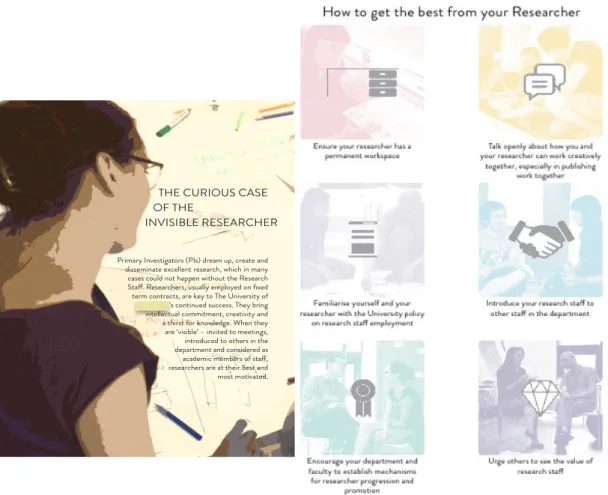
7.5 The curious case of the invisible researcher ... 113
7.5.1 Through information confinement ... 113
7.5.2 Within institutional strategies and processes ... 115
7.5.3 In physical and digital space ... 117
7.5.4 Embodied invisibility ... 117
7.6 Corporeal space of Postdoc work ... 119
7.7 Integration of postdoctoral researchers into institutional structures ... 120
7.8 Summary ... 122
Chapter 8 ... 124
The habitus of Postdoctoral researchers ... 124
8.1 Introduction ... 125
8.2 Postdoctoral participants: career history overview ... 129
8.3 Doctoral socialisation: shaping researchers’ habitus ... 130
8.4 Entering the field of postdoctoral research ... 133
8.4.1 Entering the field on a ‘high’ ... 133
8.4.2 Mobility and temporality at the point of entry ... 135
8.4.3 Emotional leverage in Postdoc choices ... 137
8.5 Trajectory of actors within the field ... 138
8.5.1 Projecting ... 140
8.5.3 Hopping ... 145
8.5.4 Stepping ... 147
8.5.5 Resisting ... 148
8.6 Summary ... 152
Chapter 9 ... 153
The habitus of principal investigators ... 153
9.1 Introduction ... 154
9.2 Academic participants: diversity of career history ... 154
9.3 The shaping of PIs’ habitus ... 157
9.3.1 Compelling socialisation experiences ... 157
9.3.2 Positions in the postdoctoral field ... 160
9.4 Ways of talking about postdoctoral researchers ... 163
9.4.1 ‘Being cut out for’ academic research ... 164
9.4.2 Positioning Postdocs in spaces of deficit ... 166
9.4.3 Getting them to work hard ... 167
9.5 Approaches to postdoctoral researchers’ development ... 169
9.5.1 Researcher development through practical mastery ... 169
9.5.2 Researcher development through assessing and advising ... 172
9.5.3 Researcher development through idea-ing and collaborating ... 174
9.7 Summary ... 177
Chapter 10 ... 179
Conclusion ... 179
10.1 Introduction ... 180
10.7 Limitations and future research ... 189
Bibliography ... 193
Appendices ... 210
Appendix 1. The 7 principles of the Concordat to support the career development of researchers ... 211
Appendix 2. Ethics Application ... 212
Appendix 3. Information sheet ... 225
Appendix 4. Informed consent for interviews ... 227
Appendix 5. Interview schedules for academics ... 228
Appendix 6. Interview schedules for researchers ... 230
Appendix 7. Secondary data ... 232
Appendix 8. Example of early coding on an interview transcript ... 233
Appendix 9. Additional job titles used in the Grade 7 research-only staff category ... 234
List of illustrations
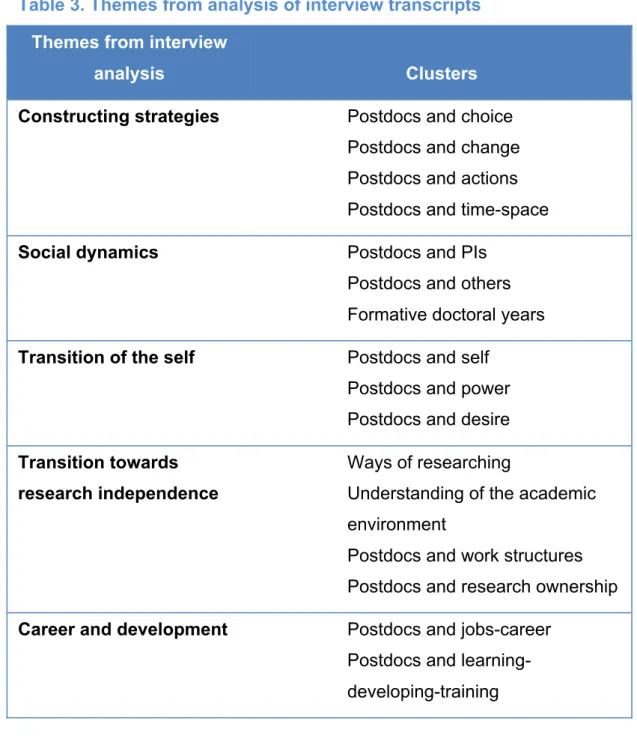
TablesTable 1 Demographic data of UK research staff 36 Table 2 Linking research questions to data collection and analysis 74 Table 3 Themes from analysis of interview transcripts 76 Table 4 Practices mediating acquisition of capital in the field of
postdoctoral research 125
Figures
Fig. 1 Examples of headlines and illustrations representing the
postdoctoral situation 13
Fig. 2 Roberts Recommendation 5.3: A vision for postdoctoral
researchers 28
Fig. 3 Agents in or contributing to the field of postdoctoral research 56 Fig. 4 Percentage of FoS research-only staff who started their
employment between 1993- 2015 103
Fig. 5 Proportion of different job titles used for researchers
at grade 7 106
Fig. 6 The curious case of the invisible researcher 112 Fig. 7 Schematic representation of 3 dimensions of capital 124 Fig. 8 Schematic representation of participants’ volumes and
configuration of capital 137
Vignettes
Vignette 1 Postdocs are employed to work full time on their PI’s grant 94 Vignette 2 The Faculty is not supportive of this initiative 96
Abbreviations and acronyms
Co-I Co-investigator (term given to an academic who holds a researchgrant, but not as the main applicant) CROS Contract Researchers Online Survey ECR(s) Early Career Researcher(s)
FoS Faculty of Science HE Higher Education
HEI(s) Higher Education Institution(s)
HEFCE Higher Education Funding Council for England HR Human Resources
L&T Learning and Teaching
OECD Organisation for Economic cooperation and Development PI Principal Investigator (term given to an academic who holds a
research grant in their own name)
PGR Postgraduate research student or postgraduate researcher RCUK Research Councils UK
REF Research Excellence Framework RIS Research and Innovation Services
STEM Science, Technology, Engineering and Mathematics UK United Kingdom
“As we read more, learn more, experience more, our confident hold on what we study lessens. Our interests broaden, our assumptions and conceits are
challenged, our positions in the world change and we discover that things are always far more complicated and less stable than our early portraits or models would suggest. I now despair of ever tying things down – anything really – neatly and definitively.”
Chapter 1
1.1 General overview
This thesis presents an analysis of how postdoctoral researchers and academics in scientific disciplines see, think, and experience researcher development within a research-intensive academic environment. This work is set in the context of recent UK policy implementations related to the career development of postdoctoral researchers. This enquiry makes an original contribution to knowledge in three ways.
Firstly, it documents at the micro-level of an institution the unfolding of national UK policies concerned with researcher professional development. This provides focused insights into the field of postdoctoral research and reveals sites of struggle in this social space within Higher Education (HE).
Secondly, it offers an analysis of the experience of being an early career researcher negotiating career progression. The study aims to bring what
Carrozza and Minucci (2014, p. 493) label the “flesh and blood” in studies about researchers. In addition, it contributes to a significant gap in the literature by offering perspectives from the academics employing postdoctoral researchers. Thirdly, it demonstrates, through an empirical approach the continuing
usefulness of Bourdieu’s theoretical tools of habitus, field and capital (applied here to develop our understanding of researcher development), in decoding the rules of the game in the social world, here the field of postdoctoral research. Postdoctoral positions are temporary research appointments held by
researchers after the completion of a doctoral thesis; these appointments are funded via research funds obtained by academics (called Principal
Investigators or PIs) on specific research proposals. For researchers from scientific disciplines within many different national research systems, a period of postdoctoral research is now a necessary transitional stage, but far from a guarantee to progress into longer-term university research careers or
lectureship positions. A 2010 Royal Society report ‘The Scientific Century: securing our future prosperity’ suggests that in the UK, while 30% of PhD
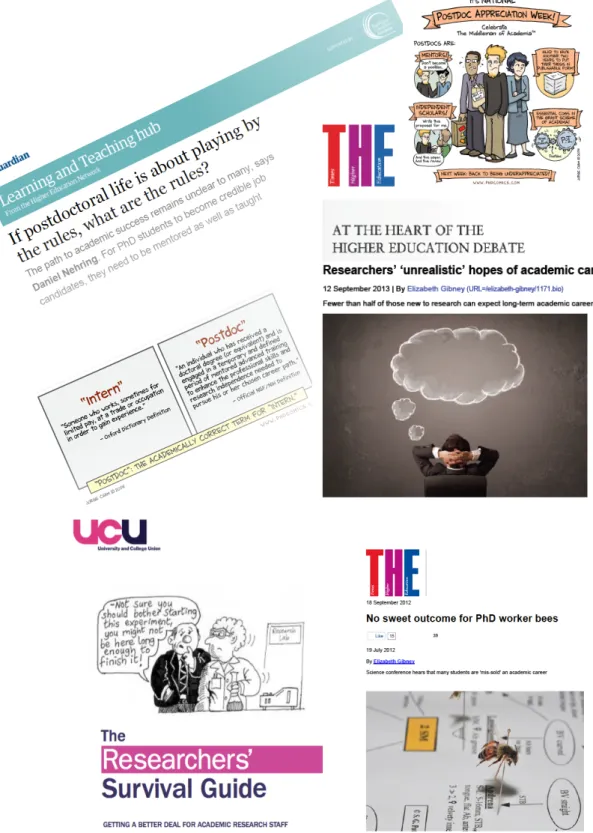
graduates undertake postdoctoral research, only 3.5% of UK PhD graduates transit to permanent academic positions. Strong words are used to describe the situation: “the plight of young scientists” (Fox & Stephan, 2001, p. 110), “a generation at risk” (Daniels, 2015, p. 313) or “the postdoctoral glut” (Gould, 2000, p. 453). I have presented in figure 1 a number headlines from online magazines, a document cover (from a booklet developed by the University and College Union) and cartoons from blogs, selected for the powerful metaphors used to describe the contemporary research system. They depict stories of poor management, lack of transparency, misunderstanding about progression, false expectations, lack of recognition, exploitation, and survival in a ruthless and competitive environment. The literature based on quantitative and
qualitative data on research staff has repeatedly described the same issues with career structure, uncertainties of employment, unfavorable employment conditions and limited institutional status (Åkerlind, 2005; Bryson, 1999; Campbell et al., 2003). Bourdieu (2004) in his analysis of the scientific field expressed concerns about this social space: “the world of science is threatened by a serious regression” (p. vii) losing its autonomy to the dominant economic power. Science policies have focused on the supply chain of the research workforce (Bray & Boon, 2011; Evans, 2011; Kent, 2005; Mellors-Bourne, 2012). To retain a dynamic research and innovation system, a key policy concern has been the imperious need to ensure that research careers are perceived as an attractive career path even within the restricted scope for academic career progression and the high probability for moves to careers outside of academia for many trained researchers (Ackers & Gill, 2005).
Highly trained knowledge workers such as postdoctoral researchers are told to acquire the flexibility and adaptability to move across the employment sector, and be better prepared to succeed within an extremely competitive academic environment (Concordat, 2008; Roberts, 2002). Science policy documents champion the idea that if the aspirations of the knowledge economy are to be realised, new approaches for the training and management of the scientific workforce will need to be explored (Roberts, 2002).
Fig. 1 Examples of headlines and illustrations representing the postdoctoral situation
Headlines from the Times Higher Education online magazine (https://www.timeshighereducation.com/),
The Guardian online Higher Education Network, front cover of a booklet produced by the trade union University and College Union. Cartoons from Piled Higher and Deeper by Jorge Cham at www.phdcomics.com (permission for image usage obtained).
The motivational rhetoric from science policy documents about supporting the best researchers and fostering innovation (e.g. the 2007 Council for Science and Technology report, Pathways to the future or the BIS 2009 Higher Ambition paper) felt at odds with the disjunctions and status quo of postdoctoral
researchers’ experiences of being and doing a postdoc at a research-intensive institution. At the time I started the EdD, little work had been done on
documenting the lives and work context of postdoctoral researchers but interest in the area has been emerging (Åkerlind, 2005, 2009; Scaffidi & Berman,
2011). Considering the vulnerability of this category of staff within HE with the majority of them on short-term contracts (Laudel & Gläser, 2007) and limited prospects of progressing to academic positions, I felt it was critical to document the realities of these experiences in the context of changing national and
institutional policies regarding researchers’ professional and career development.
1.2 Situating the self and motivation for the study
1.2.1 Becoming a professional of researcher developmentIn this section, I offer a narrative about my professional path to provide clarity and openness about my context in entering the emerging profession1 of
researcher developer, educational research and this study in particular. I aim to emulate the approach coined by Bourdieu (2004) as “sketch for a self-analysis”, a “reflexive analysis” or “objectification of my point of view” (p. 94), where my social and educational trajectories have become part of my ways of seeing and thinking, constitutive of a specific habitus that position me within a “space of possibles” (p. 97), within the field of educational research but also within the field under scrutiny, the field of postdoctoral research. Maton (2003) may
reduce such attempts as being limited to an “autobiographical reflection” (p. 54)
1 I use the term profession loosely and will not delve into a discussion on whether researcher
developer fit the definition of a ‘profession’ as it is beyond the scope of this thesis. However, it is worth mentioning the recent publication of a career framework for researcher developers and the burgeoning of conferences, symposia and networks of researcher developers, which are elements in structuring a new profession.
https://www.vitae.ac.uk/researchers-professional-development/practical-resources-for- researcher-developers-1/the-vitae-career-framework-for-researcher-developers-cfrd/introduction-to-the-vitae-career-framework-for-researcher-developers-cfrd
because “reflexive practice is paved with good intention. However theoretical intentions are one thing, research effects are another” (p. 56). Nevertheless, exploring my own positioning within the field felt an important element to present to the readers.
I had originally trained as a biologist in laboratories of the National Institutes of Health in the USA, while maintaining a French university registration. I had carved an unusual career path, which enabled me to do a PhD in a world- leading research institute where no PhD students were then being trained. I had gained permission from my university to undertake such an international exchange, at a time when none of my contemporaries had dared to ask. This was followed by several years of research in a laboratory in the UK, in a department of the faculty where I currently work. My research period as a postdoctoral researcher was a time of struggle, adjusting to a new research domain at the same time as adapting to life as a parent of young children. During the last 6 months of my postdoctoral research contract, I realised that I had lost the pleasure of doing experimental work. At the time, no structures were in place to support postdoctoral researchers manage their career
transition and progression. Although I had published well during my PhD, I had not been able to publish during the three years of my Postdoc. I only had one manuscript being reviewed at the end of my contract. I made the decision, based on what I considered my dry publication record, that my academic
progression in scientific research was compromised. I decided, without seeking any mentoring, that I would leave the bench behind at the end of my contract, not really knowing where I would take my career.
I became an actor in the implementation of researcher development policies when I took a position, in September 2006, as postgraduate training coordinator within another biology department in the same faculty as my previous Postdoc and started working with PhD students, with the remit to develop their
transferable skills. Following the publication of a very significant report, SET for success also known as the Roberts report (2002), which had made a number of recommendations regarding the training, career and professional development
of researchers, large amounts of funding from RCUK went into Higher Education Institutions (HEIs). My position was supported with this funding.
1.2.2 Shift towards a need for scholarly exploration
Considerations started to emerge about the impact of the large investments made with the Roberts funding (Bromley, 2009; Bromley et al., 2008); it had enabled the creation of many researcher developers’ positions across the UK2, as well as many training and development programmes and initiatives. The funding had also contributed towards establishing a researcher development community, national policy leadership and good practice structures, through setting up a national organisation, Vitae, to promote the professional
development of researchers. There was a need to build a picture about the impact of the Roberts funding. The Roberts implementation was followed at national level by the Roberts Policy Forum, which established, in 2005, a national, HE-wide task group, the Rugby group (which later became the Impact and Evaluation Group), to construct a methodology that could collate and construct evidence about the impact of researcher development activities developed with Roberts funding (Bromley & Metcalfe, 2012; Bromley et al., 2008).
The Research Councils were keen to see an integration of transferable skills and researcher development initiatives as core universities activities, and move away from a ring-fenced funding model (from which they did eventually). The Roberts funding stopped in 2011 (Wood & Denicolo, 2013), but the Research Councils continued to expect research organisations to deliver researcher development activities under a new funding regime (RCUK, 2011). Concerns were expressed about the impact of changed funding arrangements for
researcher development activities (Hodge et al., 2010). There was a period of uncertainty (2008-2011) about Roberts funding, during which researcher developers’ jobs felt contingent on demonstrating a positive impact of researcher development activities. I felt puzzled about the types of impact (impacts of/on what, or on whom) that researcher developers were being asked
2 By 2009, 359 staff had been recruited as co-ordinators or trainers for all “transferable skills”
to identify and demonstrate. This posed, in my view, an ethical and research integrity issue with regard to the types of evidence we could offer. My concerns mirrored similar feelings of the struggles expressed by academic developers about clarity in defining the purpose of academic development, issues of evaluative practices and methodologies (McCulloch & Loeser, 2016), and consideration for practitioners’ employment:
a lack of coherence in the understood purpose of development and uncertainty of direction within the community of developers […] these issues are compounded by the lack of an agreed framework for evaluation of the impact, added value and effectiveness of academic development. (Stefani, 2011, p. 3 & 4)
Recently, Hoessler et al. (2015) have argued for a broadening of the use of multiple evaluative lenses in the evaluation of academic development, in order to capture the complexity of multiple influences, since “professional learning embodies a complex interplay between individuals and their environment” (p. 224). Whilst in other contexts, clarity about the purpose of researcher
development programmes were in place, “expectation of an increase in publications and grant applications by this cohort of early career researchers, and contributing to developing an engaging research culture across the
university” (Browning et al., 2014, p. 128), my own institutional context did not offer any defined scope for evaluating the impact of researcher development activities.
Within this context, I felt that the points of tension were numerous. I began to question how we should or could define what represented impact in researcher development. I also started to ask the basic question of what constituted
researcher development: were we talking about workshops, coaching sessions, informal conversations or departmental culture? I wondered about the
consequences one might face in setting an impact agenda regarding researcher development, with the awareness that when it comes to impact “what gets counted is not always what counts” (Molyneux-Hodgson, 2009, p. iii). The core question of what was meant by researcher development linked all my wanderings. This became the trigger, which lead to my decision to join the EdD and was part of starting to question HE policies.
In the next section, I introduce the purpose established for this study, the derived research questions I aim to answer and the focus of exploration.
1.3 Research purpose and questions
Evans (2011) was one the first scholars to discuss researcher development as “an emergent new field of research and scholarship” (p. 76). She laments the lack of precision, clarity and consensus in defining researcher development and describes the fuzziness in defining researcher development in the literature and policy documents of funders and learned organisations. There is ambiguity over what is meant by researcher development, as it seems to amalgamate many strands of issues, discourses, activities and policies articulated by different stakeholders and agents: career and professional development, training provision, career path of researchers, practices of becoming a researcher, socialisation to academic life, transferable/generic or employability skills, access to research funding, enhancement of publication record, as well as becoming a more collaborative researcher or a better researcher, enhancing technical skills and expertise, and developing more innovative and creative researchers. Evans (2011) forcefully advocates theory building in the area of researcher development that would be “universally applicable” and “context-independent” (p.93):
But a conceptual analysis involves more than the presentation and explanation of a stipulative definition. It involves examining the very essence of the concept in question: what is conceived as its substance, or its quiddity. In communicating my conceptualisation of researcher development I find it impossible to choose between the terms essence, substance and quiddity. (p. 82)
To address the call of Evans (2011) for a conceptualisation of researcher development, but in contrast to her interest in the “essence, substance and
quiddity” (p.82) of researcher development, this study is concerned with the
sociological dimension of researcher development. My own understanding of researcher development is that of a practice embedded in context, shaped by actors, structures and policies, enacted and experienced in a multitude of ways.
This study aims to offer a scholarly focus on the particularities of postdoctoral researchers, an understudied population in the research system and HE (Cantwell, 2009), particularly when it comes to the development of evidence-based policies to support professional development (Scaffidi & Berman, 2011). This work is set in the context of a UK institution following the Roberts
recommendations. This study intends to depict some of the tensions between desired environments articulated by policy makers, and the academics’ and postdoctoral researchers’ own understandings of researcher development derived from lived experiences.
I am asking the following question to frame this research project:
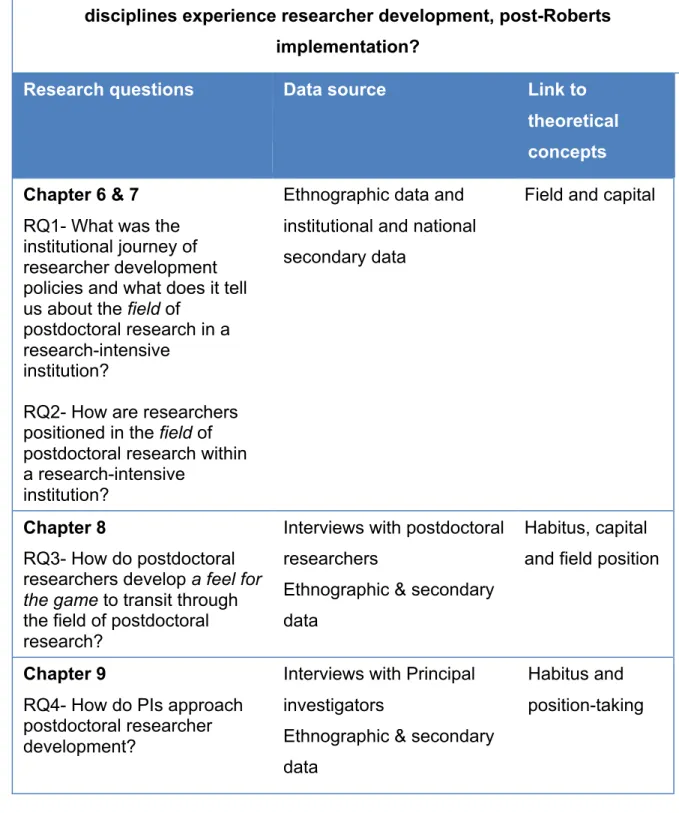
How do postdoctoral researchers and principal investigators from scientific disciplines experience researcher development, post-Roberts
implementation?
The core research question is supported by four supplementary questions described below.
The study aims to provide a space of reflexivity for a practitioner of researcher development, reflecting on the structures within which I function as agent in interpreting, enacting, shaping and embedding policies, and considering the position of postdoctoral agents in the field.
RQ1- What was the institutional journey of researcher development policies and what does it tell us about the field of postdoctoral research in a research-intensive institution?
RQ2- How are researchers positioned in the field of postdoctoral research within a research-intensive institution?
In addition, the analysis I propose is about documenting what it is like to be a postdoctoral researcher in a research-intensive institution, in the context of developing as a researcher, and how PIs think about the development of their postdoctoral researchers.
RQ3- How do postdoctoral researchers develop a feel for the game to transit through the field of postdoctoral research?
Explorations of policy enactments at the micro-level of individual researchers and academics matter as perceptions vary greatly between individuals as well as across disciplinary fields and institutional structures (Bryson, 2004b). Academics attempt to maintain academic values while engaging in new practices (e.g. academic capitalism) and are torn between different value sets (Ylijoki, 2003).
While I battled with the construction of the object under study, I could hear the warnings from sociologists against the “narcissistic complacency” (Bourdieu in Bourdieu & Wacquant, 1992, p. 231). This is particularly salient when the researcher has an interest or first-hand experience in the object, and is
somehow tied by “affective attachments, positive or negative, produced by my prior investments” (Bourdieu in Bourdieu & Wacquant, 1992, p. 232). My
challenge in this research was to practise “a radical doubt” in the analysis of the construction of researcher development (Bourdieu & Wacquant, 1992, p. 235). It required “a break from common sense” (Bourdieu & Wacquant, 1992, p. 235) and a consideration of how researcher development has been shaped. I am compelled to work towards better sociological understandings of HE and the “need to be more reflexive about the social processes within HE” (Lucas, 2006, p. 4).
1.4 Chapter outline
Following this introduction (chapter 1), which has explored the origins of my motivation for this study, my positionality and an articulation of the research questions, I now provide a description of the chapters which follow.
Chapter 2 offers an overview of the contemporary research systems and a description of the policy context for the study with the inception of researcher development policies in the UK, against the backdrop of broader European policies.
Chapter 3 provides the literature review, considering key issues and
methodologies to studying HE and the academic profession. It presents current understanding of postdoctoral researchers’ lives and careers, and highlights gaps and limitations justifying the purpose and approach for this enquiry. Chapters 4 and 5 provide the theoretical framing and methodological approaches of this study. They explain in a somewhat candid way the turbulences of the research path that led to my choice of Bourdieusian concepts as analytical tools.
The findings are presented in chapters 6 to 9.
In chapter 6, I narrate the policy journey of the Roberts agenda through an ethnographic account of its implementation in my institution. This contributes to a conceptualisation of policy as a “sociocultural practice” (Gerrard & Farrell, 2013, p. 2), where:
policy practice comes to refer to the diverse ways in which people in local settings come to produce, read, interpret, act upon, ignore, dismiss, adapt, co-opt, reject, disseminate and perform formal policy directives. (Gerrard & Farrell, 2013, p. 2)
In chapter 7, I explore how postdoctoral researchers as agents are positioned in the institutional context. An analysis of structures, sites of practices, and enactments permits an exploration of the structuring structures (Bourdieu, 1984) shaping agents’ dispositions and understandings of researcher development.
Taken together, chapters 6 and 7 contribute to an analysis of the field of postdoctoral research within a local context, encompassed by national discourses about skills, mobility, and innovation.
In chapters 8 and 9, I explore researcher development, by considering the habitus of postdoctoral researchers and academics within the field of research. In chapter 10, I provide a conclusion for this study, encapsulating evidence gathered to respond to the research questions, and consider the limitations of the study and potentials for further research.
Chapter 2
Policy context: skills and
researcher development
2.1 Introduction
I situate my study in the contemporary research system, during the emergence of UK policies aimed at researchers’ professional development. Researcher development policies sit at the intersection of policies related to science and innovation and policies about skills and employment. In addition, UK policies cannot be seen in isolation from the European policy context that sought to develop the mobility of the research workforce across Europe with the creation of the European Research Area, perceived as a motor for research innovation. Policies impacting postdoctoral researchers have tagged along policies on more formal doctoral research training; such origin may have influenced perceptions about postdoctoral researcher development. In this chapter, I introduce policy elements at the national, European and international levels relevant to an exploration of postdoctoral researcher development.
2.2 Emergence of the skills agenda
Scholars describe many ideological, political and economic discourses that circulate within institutions and influence HE (Barnett, 1990, 2011). Changes are a constant in descriptions of the HE environment (Enders & De Weert, 2004; Trowler, 1996, 1998; Trowler et al., 2012). HEIs negotiate their
structures, values and strategies in the context of neoliberal discourses with multiple impacts, from policy changes on academic cultures, attitudes and identities (Billot, 2010; Deem & Lucas, 2007; Trowler, 1998). Shifts in management (Deem, 1998), funding regimes (Liefner, 2003), research
assessment (Lucas, 2006) and employment practices (Bryson, 2004b; Bryson & Barnes, 2000) have created an academic space of supercomplexities
(Barnett, 2000) and “multi-level competition” (Müller, 2014, p. 330). These contribute to changes and challenges for innovation systems, reshaping
meanings about knowledge production (Barnett, 2000), conceptions of research or being a researcher (Åkerlind, 2008a, 2008b; Brew et al., 2016). Rhoades and Slaughter (1997) label the range of changes seen in HE, affecting ways of working and individuals, as “academic capitalism”. Academic capitalism entails practices linked to an economic model for knowledge production. Academics
are pressured to diversify the sources of income to fund research and to increase linkage with industry and the third sector.
It is no surprise that within the context of the contemporary research system, the professional development of early career researchers has faced
reorientation, starting with transformation in the purpose and processes of postgraduate education (Austin & Wulff, 2004; Delamont et al., 1997a; Enders & De Weert, 2004). In the 80s, policy concerns placed an emphasis on
submission rates, and increasing the balance between different skills sets to be acquired by doctoral students (Delamont et al., 1997a). Epistemological
questions have been asked about the role played by postgraduate training and education (McAlpine & Norton, 2006); the very nature of the doctorate and “doctorateness” (Wellington, 2013) are contested. Postgraduate education is described as not fit for purpose: “it is no longer adequate or appropriate for current faculty members to prepare graduate students as clones of themselves” (Austin & Wulff, 2004, p. 11). Common trends in the restructuring of research training have been observed across very different national systems (Austin & Wulff, 2004; Bleiklie & Høstaker, 2004; Enders, 2004). However, these changes have been implemented and experienced differently in countries with various levels of national coordination of HE policies, but also across different
disciplinary environments (McAlpine et al., 2011).
Enders (2004) proposes that these policy changes towards a shift from the traditional model of doctoral education, often referred to as the German
“Humboldtian apprenticeship model” (p. 428), towards more structured training programmes, are part of a set of four different trends. These are: expansion3 and diversification of the student population (e.g. doubling of PhD graduates in the UK during the 90s), changes in modes of knowledge production,
“internationalisation of the PhD factory” (p. 420) and centralisation of decisions related to research training, with increased governmental control aimed at rationalising the production of knowledge workers. Changes seen in postgraduate education and research training have implications on the
3 In the European Union, the overall student population increased by 13.2% between
2003-2012, while the number on PhD programmes increased by 40% between 2006-2012 (Afonso, 2016)
organisation of research cultures and the socialisation of researchers (Delamont et al., 1997a).
Delamont et al. (1997a) has argued that changes in postgraduate education are part of a “dirigiste”4 and “imposed system of structural and cultural changes” (p. 320) that favoured the science model of critical mass in the research
environment. The rise in structured and formalised research education across many countries is perceived as being associated with an increase in national research assessment mechanisms and the need to enhance research
performativity (Browning et al., 2016; Delamont et al., 1997a). In contrast, Rip (2004) proposes that these changes towards “a regime of strategic science” (p. 154) might help to produce “T-shaped people” (p. 154) (depth of specialist, technical knowledge while maintaining broad scope and flexibility) or what he refers to as “homo universalis” (p.159), individuals able to be effective
knowledge producers within new forms of knowledge production (e.g. mode 2). For example, the “Triple helix” model – deployed to describe a desired
connectivity between government, academia and industry for effective innovation within the knowledge economy (Etzkowitz & Leydesdorff, 2000) – has impacted on how research funders set requirements and expectations on research training programmes, as this stage of socialisation shapes scientists’ identity and professional practice (Thune, 2010), and indeed can:
Represent a necessary precondition for the further expansion of triple helix interactions since it will be dependent on people with transferable competencies […] The government plays an important role in adapting doctoral education to a triple helix framework by stimulating the
development of new types of researcher training and by promoting policies that focus on a broader set of skills for researcher training and multiple career tracks for people with doctoral level qualifications. (p. 465-466)
Changes proposed for postgraduate and research education have mostly been framed by the notion of “learning as skills acquisition” (Hopwood, 2010, p. 829), with the terms transferable, employability or generic skills development as core concepts in this policy area. The skills agenda or debate, although “contested and continuously evolving” (Cumming, 2010, p. 406),has become dominant in
the policy discourse of UK HE institutions (Mellors-Bourne, 2012; Payne, 2000; Roberts, 2002); it has raised tensions within academic circles (Gilbert et al., 2004). Cumming (2010) regrets that the skills debate is mostly conceived in terms of a deficit model of the skills perceived as deficient in researchers, but demanded by employers (mostly non-academic employers). Hopwood (2010), on the other hand, points to flawed conceptions of doctoral training that fail to consider the social and agentic process of learning.
Following this overview of the context of changes in research education, I now provide a perspective on the key policy developments that led to establishing researcher development programmes in UK institutions.
2.3 Introducing the Roberts Researcher Development Agenda
An historical perspective on the researcher development agenda in the UK traces its origin to the 1996 White paper ‘Realising Our Potential: A Strategy for Science, Engineering and Technology’5, published under a conservativegovernment (Åkerlind, 2005). The White paper is described as having an “emphatically utilitarian emphasis” (Kent, 2005, p. 4), but it initiates substantial work on researchers’ career management (Åkerlind, 2005). From this period, governmental science policies portray science as an economic driver, and the intersection between government, industry and universities becomes the recurring feature of subsequent science strategies. Scientists in universities become the actors of economic growth, the highly skilled workers of the knowledge economy. From this is born a discursive prose about the need to consider the attractiveness of researchers’ careers, and the retention and development of researchers within STEM careers. An initial framework to support the career management of contract research staff was set in motion with the 1996 Concordat, followed by the Research Careers Initiative (RCI) set up in 1997 to monitor the implementation of this first Concordat. However, Bryson (1999) was highly critical of the limited impact of this early period of
5
national policy development and perceived these national initiatives as having “failed to address the real issues” (p. 29).
The turning point for UK researcher development policies came with the recommendations made in the 2002 Roberts report “SET for success”. In his report, Sir Gareth Roberts reviewed the supply of people with science and engineering skills needed for the knowledge economy, from school to academia and industry. As part of the report, 40 recommendations were made, and
among these, clear recommendations for the need to enhance the skills training of researchers (PhD students and Postdocs). Recommendation 5.3, presented in figure 2, set a “vision for postdoctoral researchers”. It advocates for a
conception of “individual career path” (p.154) and the need for a “career development plan” (p.154), supported by access to further professional development and training. Although discussions abound about the types of skills researchers should develop, Roberts recommendation 5.3 is particularly significant, as it makes a strong case towards dissociating the postdoctoral period from being the default stage prior to transition to an academic career, moving towards a conception of this period as entry towards “different career destinations”. While the Roberts report (2002) hosted a rhetoric about
“improving the attractiveness of postdoctoral research” (p. 17) and, as such, aimed to sustain the scientific pipeline, the intentions of Sir Gareth Roberts went beyond the discourse the government was keen to hear about the linkage between innovation, research and economic impact. Sir Gareth Roberts was very committed to supporting an agenda that would have an impact on the lives of young researchers but he also saw its broader impact on the knowledge economy as a whole. In the foreword of a cross institutional report (Campbell et al., 2003), Roberts advocates:
The research staff in our universities are a very precious asset. We must do all that we can to support their personal and career development. This is not only in their own interests and those of their universities, but it is also in the interests of the nation as a whole since such support
capitalises on and further develops the enormous intellectual and human capital vested in them. (p. 1)
Following the report, the government committed (in the July 2002 Spending Review and Strategy for Science) to invest considerable targeted funding around 3 core areas: funding to increase researchers’ salaries, funding for professional development and an increase in funding for fellowships. Interestingly, shortly after these commitments were made, the Science and Technology Committee of the House of Commons reviewed evidence and published the report “Short-term research contracts in science and engineering” (2002), regarding the situation of contract researchers in the UK. This
committee challenged the government, funders and institutions regarding the upheaval faced by early career researchers within the UK research system. The tone of the report is bold and abrupt; it conveys a sense of frustration about the lack of progress made in supporting the employment and career
management of researchers, considering that knowledge of the problems faced by contract researchers is not new. The report critiques previous approaches where the focus has been on “managing the problem rather than solving it” (recommendation 4) and the lack of accountability of HEIs in their strategies to
Figure 2. Roberts Recommendation 5.3: A vision for postdoctoral researchers
“It is important for postdoctoral researchers to be able to develop individual career paths, reflecting the different career destinations – Industrial, Academic and Research Associate– open to them, and that funding arrangements reflect the development of these career paths. The Review believes that enabling the individual to establish a clear career path, and a development plan to take them along it, is critical to
improving the attractiveness of postdoctoral research. The Review therefore recommends that HEIs take responsibility for ensuring that all their postdoctoral researchers have a clear career development plan and have access to appropriate training opportunities – for example, of at least two weeks per year. The Review further recommends that all relevant funding from HEFCE and the Research Councils be made conditional on HEIs implementing these recommendations.” (Roberts, 2002, p. 154)
manage researchers. It makes aspirational recommendations aiming to shake the UK research system, which it accuses of having failed to take responsibility for its research workforce.
The term skills established itself as the buzz word of new Labour governmental policy documents; strategies for economic success are perceived as directly linked to the concept of skills:
at the heart of this strategy are skills, which are represented as the central formula for both economic and social success… the highest-ranking keyword in this period, occurring 1473 times. Indeed, in so far as skills represent a key element of Labour power in a knowledge-based economy. (Mulderrig, 2011, p. 574)
Between 2002 and 2010, around £120 million was allocated to UK HEIs. This became known as the Roberts funding. In a review about the impact of this investment, the legacy of the Roberts funding regarding researcher
development is described as follows: “The UK is perceived to be leading the world, other nations are attempting to emulate what is being done.” (Hodge et al., 2010, p. 37).
In the years following the Roberts report, an ongoing wave of reports concerned with research careers have been published (around 100 reports cited by the reports of the Funders’ Forum Researchers: what is the situation? (RCUK, 2006, 2007)) but few capture as vividly as the 2002 House of Common Science and Technology Committee the experiences of postdoctoral
researchers (House of Commons & Science and Technology Committee, 2002). In my view, this report remains one of the best documented and
evidenced accounts of the situation and experiences of researchers in the UK. Explorations of researchers’ experiences, career aspirations and development following the UK Roberts policy developments, have mostly been framed by normative and evaluative national surveys organised by Vitae: The Career in Research Online survey (CROS 2009, 2011, 2013, 2015) and the Principal Investigators and Research Leaders Surveys (PIRL 2011, 2013 and 2015).
2.4 Influence of the European context
The European Research Area (a space for the free movement of researchers, knowledge and innovation across the European Union) was constructed as the instrument to realise the ambition of a knowledge economy. The UK researcher development policies arose alongside European policy developments. In March 2005, the European Commission approved the European charter for
researchers and Code of conduct for their recruitment6, with a view to
homogenising conditions of employment, rights, responsibilities and support for researchers, and facilitating uptake of research careers and mobility across Europe. The charter and code did not represent legislative engagements but provided best practice guidelines and principles aimed at fostering further national and institutional policy commitments. A UK HE sector working group responded to the European Commission by providing a mapping of the
recommendations made in the Charter and Code with UK policies, legislations and guidelines (RCUK, 2008). The gap analysis, made through this enquiry, established that the UK had already instituted a close alignment with the Charter and the Code. In June 2008, a new Concordat7 was launched and signed by all major UK funders. The 2008 Concordat to support the Career Development of researchers established 7 key principles, presented in
Appendix 1, to address support for the career development of researchers. Its target audience and aims were diverse: “to provide an unambiguous statement of the expectations and responsibilities of researchers and their managers, employers and funders” (Mellors-Bourne, 2012, p. 7). However, the
implementation of its principles has varied greatly between institutions (Mellors-Bourne, 2012). In addition, while national and institutional policies may be in place and the implementation of a number of practices enhanced through the work of Human Resources teams, it does not guarantee cultural changes in individuals and departmental academic practices; Dear (2010) queries whether the application of the Concordat principles is even feasible, considering the contradictions between the needs of the knowledge economy and those of the transient research population.
6 http://ec.europa.eu/euraxess/index.cfm/rights/europeanCharter 7 https://www.vitae.ac.uk/policy/vitae-concordat-vitae-2011.pdf
The Charter and Code implementation tool, set by the European Commission, was addressed through the Human strategy for Researchers8, with the
establishment of the HR Excellence in Research Award, as a recognition mechanism for implementation. The UK manages the accreditation system for the HR Excellence in Research Award via Vitae, with linkage to the Concordat principles and QAA9. The award requires institutions to make public their action plans for the implementation of the Concordat. As of 2016, the UK is the
European country with the largest number of institutions in receipt of the award, with 95 institutions awarded. Institutions are also required to review the
implementation plan 2 years after recognition through an internal audit, and then 4 years after through an external one. Institutions are now using the award as a marketing tool in their aspirations to attract the ‘best’ researchers, but also within their funding applications as proof of commitment towards a supportive environment for researchers.
The role played by the European Charter and Code in addressing the professional development of researchers seems quite variable across European countries, with researchers’ career management and researcher development remaining new concepts for many European research
organisations (Bromley & Metcalfe, 2012; ESF, 2012a). For example, in a survey of the European Science Foundation, only 8 member organisations out of 20 had policies related to researcher professional development and only 4 countries (including the UK) had national strategies or initiatives (ESF, 2012b). During the same period, other countries (USA, Canada and Australia) started reviewing their own approaches to researchers’ training and management, although these do not follow the same path or timeframe in all national contexts (Åkerlind, 2005). In the UK, the drive for implementation of change in practices, related to the career management and professional development of
researchers, came from the government and were linked to reinforcing European policies. The situation appears quite different in North America,
8 http://ec.europa.eu/euraxess/index.cfm/rights/strategy4Researcher 9 http://www.qaa.ac.uk/
where grassroots organisations, such as the National Postdoctoral Association, have been described as driving forces for change (McDowell et al., 2015; Scaffidi & Berman, 2011). While a number of early reports had been published and knowledge about the increasing challenges (e.g. terms and conditions of employment, lack of professional development and reduced opportunities in transiting to academic positions) faced by Postdocs in the US were available, limited policy developments seemed to have challenged practices at
institutional, federal or national level (Davis, 2005; National Academy of Science et al., 2014). By 2009, 50 postdoctoral associations were reported in the US, with 40 US institutions having created administrative postdoctoral hubs aimed at addressing postdoc issues (Davis, 2009). It appears that a major focus of the work of these offices related to the great diversity of employment conditions of postdoctoral researchers (Davis, 2009), and with a lesser focus on researchers professional development. More recently, some focus has been placed on the issues of scientific careers in the US10, but as yet there is no umbrella programme envisaged for the national coordination of policies to support the career and professional development of researchers.
2.5 Conclusion
In this chapter, I have presented an overview of the policy landscape in which my study came to be. It posits that the UK researcher development agenda originated from policy concerns linked to aspirations of establishing a knowledge economy, with issues surrounding skills training and shortage, attracting, recruiting and maintaining the best researchers, and displaying a research environment, intended to motivate the commitment of young
researchers, even within a hyper competitive environment. I propose that this study may consider, at the micro level, how these policies were enacted and perceived. So, while the institution may have in place policies for researcher development, researcher development practices and enactments by agents in the field may differ. In the next chapter, I review the literature on postdoctoral researchers and the methodological approaches which have been used to explore researchers’ lives.
10 2012 - www.pathwaysreport.org
Chapter 3
Literature review: researching
researchers
3.1 Introduction
In this literature review chapter, I present the situation of postdoctoral researchers with regard to their demography, employment conditions and experiences of working in a hypercompetitive research environment (Alberts et al., 2014). I offer an overview of previous studies and methodological
approaches that have explored the particularities of postdoctoral researchers’ experiences. Furthermore, I illustrate the gap in considering the role of
academics as principal investigators in the context of postdoctoral research. I present the knowledge gaps that justify the approach and focus of this empirical study.
3.2 Studying higher education: a sociological approach
This study intends to contribute to a tradition of sociology of HE, as superbly accomplished by Clark (1987, 1997, 2008), who has been one of its prolific contributors. (Clark, 2007) describes the “study of the academic man” (p. 8), of the academic profession and of HE institutions, as units of study working in parallel to other more popular foci of enquiry. Clark (2008) advocates for an increase in comparative studies of national university systems and for the complementarity of micro and meso research approaches, but also for the inclusion of historical perspectives of organisational systems. He zealously encouraged researchers to reduce the “large chasm between researchers and practitioners” (Clark, 2008, p. 540), and perceived the approach of case studies narratives, as well as comparative approaches, as powerful methodological approaches. Studies in the sociology of HE have been dominated by the American context (for a review of this literature, see: Clark, 2008; Gumport, 2007). The progression of the sociology of HE in the UK has been hampered by conflicted relationships between different disciplinary perspectives and3.3 Demography of the research workforce
Kent (2005) traces the origin of UK postdoctoral research-type contracts to 1916, with the establishment of the Department of Scientific and Industrial Research, which started to provide funding for specific research projects. From an initial system aimed at bringing complementary funding, we now have a system, where temporary research staff are responsible for the bulk of the research being done in research organisations. Research staff started to be categorised within a specific HE staff category from the mid- 70s (Bryson, 1999; Campbell et al., 2003). The challenge in accessing consistent data about
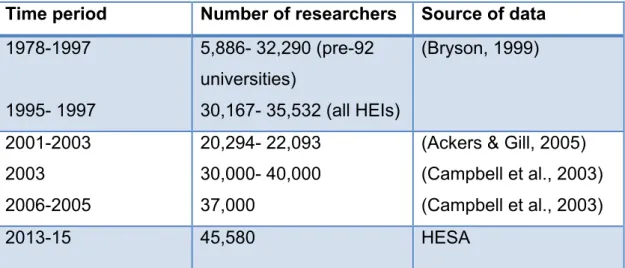
postdoctoral researchers is complicated by the use of multiple definitions of what constitutes postdoctoral roles and positions, appointments with a diversity of job titles, types of appointment (academics, academic-related, technical), and also the types of contracts (fixed-term versus open-ended) (Ackers & Oliver, 2007; Åkerlind, 2005, 2009; Coey, 2013). The number of HE research staff has continued to increase over the last forty years (Table 1), with
increases in research funding. Postdoctoral researchers constitute a sub-category of the research-only HE staff group, but national statistical data offer scarce information between these categories. The 2013-15 HESA data bring the number of research-only staff in the UK up to 45,580, with a gender split of 47% female and 53% male researchers (HESA, 2015). UK research-only HE employees represent 23% of the academic population and 11.5% of the overall HEIs’ staff population. The increase of the research staff demography is
observed in numerous other countries. For example, in the US, the postdoctoral research workforce has shot from 18,101 Postdocs in 1980 to 57,805 Postdocs in 2009 (Cantwell & Taylor, 2013), and estimations of around 60,000 to 100,000 in 2014 (Gibbs et al., 2015).
There is a reliance on fixed-term contracts for the employment of research staff (Ackers & Oliver, 2007) 11. Differences are observed between disciplines, with higher numbers of fixed-term contracts for staff in the biomedical sciences (Ackers & Oliver, 2007). Concerns have been raised about the potential impact of casualisation of the scientific workforce on loss of career attractiveness and
11 This paper refers to 2002-3 HESA data reporting that 93.2% of fixed-term contracts are
commitment to science (Ackers & Gill, 2005; Adams, J. et al., 2005). Some studies seem to indicate that this is not the case, with researchers on fixed-term contract remaining as committedto their research careers as permanent
contract holders (Adams, J. et al., 2005; Kidd & Green, 2006). In addition, Khattab and Fenton (2015) report, that between 2001-2010, there was an increase of the non-UK research workforce with a reduction of the home-grown workforce. The trend in the increase of non-UK academics is observed in all types of contracts, but most prominently for research-only posts (41% of research-only positions are held by non-UK researchers). Essentially, non-UK HE staff are postdoctoral researchers (Smetherham et al., 2010). Research-only positions are concentrated in research intensive universities, which benefit from the largest proportion of research incomes (Ackers & Oliver, 2007;
Khattab & Fenton, 2015). Khattab and Fenton (2015) describe these non-UK researchers, mostly originating from European countries, as “global movers” (p. 13). Khattab and Fenton (2015) argue, that while these researchers are
perceiving their move to the UK, as a career development opportunity, they are used by research organisations as “a replacement labour” (p. 13) for the
decreasing UK research workforce. Rising internationalisation of the research workforce is also observed in the US (since 2000, foreign Postdocs represent 56-60% of US research labour) (Cantwell & Taylor, 2013).
Table 1. Demographic data of UK research staff
Time period Number of researchers Source of data 1978-1997 1995- 1997 5,886- 32,290 (pre-92 universities) 30,167- 35,532 (all HEIs) (Bryson, 1999) 2001-2003 2003 2006-2005 20,294- 22,093 30,000- 40,000 37,000
(Ackers & Gill, 2005) (Campbell et al., 2003) (Campbell et al., 2003)
2013-15 45,580 HESA
Little data exist about the progression of postdoctoral researchers into other types of positions – academic posts or other forms of employments – within and outside of HEIs, in contrast to the systematic data collection about the
progression of PhD graduates into different occupational positions (e.g. HEFCE destination of leavers from HE survey or Vitae surveys12“What do researchers do?”).
3.4 Studying postdoctoral researchers
A systematic focus on the experiences, career transitions and issues of
postdoctoral researchers remains limited (Miller, 2011; van der Weijden et al., 2016). Some studies amalgamate all academic groups, and Postdocs may only represent a subset of the populations being investigated (Delamont et al., 1997b; Wohrer, 2014). Other studies may use the term faculty (Austin & Wulff, 2004; Earle Reybold & Alamia, 2008) or early career academics (Archer, 2008; Dwyer et al., 2012; Hemmings et al., 2013; Matthews et al., 2014; Remmik et al., 2011); these studies may not include postdoctoral researchers, although the term researcher may be used. In studies concerned with preparation and
socialisation of the next generation of academics, the focus has remained on postgraduate education, with little consideration of the particularities of the postdoc period (Wulff & Austin, 2004). In contrast, some authors suggest that exploring postdoctoral narratives provides “rich accounts of perceptions of the relationship between contemporary career rationales and the social structures” of laboratory life (Müller, 2012, p. 295), offering particularly attuned accounts of the contemporary academic system and mechanisms of knowledge production (Felt et al., 2012; Müller, 2012). In what follows, I offer an overview of
approaches used in studies of postdoctoral researchers
3.4.1 Ethnographic studies of scientific communities in the laboratory Knowledge on researchers’ communities has come from a long tradition in the sociology of science, of studying scientific work through ethnographic
laboratory studies. These approaches, usually referred to as “scientific
practice”, have addressed “what scientists do, rather than what they say they do” (Mody, 2015, p. 1026). Some examples of these ethnographic studies of scientific communities include early studies by Latour and Woolgar (1979), studies of physics (Sormani, 2014) and physicists (Traweek, 2009), as well as studies about the development of particular technologies (Rabinow, 1996,
1999). These studies acknowledge the “social conditioning of scientific
knowledge” (Knorr-Cetina, 1983, p. 117), and make the practice of knowledge production visible and a more transparent human endeavour, fuelled by human emotions. Some authors advocate for long-term embeddedness in a research environment, permitted through ethnographic studies of laboratory work (Benninghoff & Sormani, 2008), to investigate the permutations of academic identities within a changing policy landscape.
However, accounts in these ethnographic studies rarely differentiate the specific roles of postdoctoral researchers, within academic research
communities. A rare exception is the ethnography of physicists in the US by Traweek (2009), who dedicates a number of pages specifically to Postdocs. Traweek’s account of Postdocs’ experiences in Physics paints a picture of struggle and survival, of those who make it and others who could not. Traweek (2009) describes an environment where Postdocs develop as researchers through an “oral tradition”, seen as a “subtle tool” (p. 86), where their technical skills are “taken for granted” (p. 87), part of the mundane. Transition from this “long apprenticeship” (p. 85) requires Postdocs to exhibit confidence,
bolshiness, “a careful form of insubordination” (p. 88) in developing
independent projects. Barriers are erected and unarticulated expectations are in place; only those able to surpass these obstacles will be able to join the core of the physicist community. Novice physicists are kept in the dark about the game at play and may only discover it too late. Group leaders expect the novice physicists to exhibit the same behavioral traits as themselves: “The immortal heroes of science in the margins of the undergraduate textbook define the posture one must display and the genealogy one must acquire.” (Traweek, 2009, p. 93).
3.4.2 Survey research on postdoctoral researchers
Many studies exploring postdoctoral researchers’ experiences of research, careers, motivations, expectations, working environments or influential career factors are based on quantitative survey data (van der Weijden et al., 2016; Wohrer, 2014). These have been useful in providing overall perspectives about