THE IMPLEMENTATION AND EVALUATION OF A PROBLEM BASED
LEARNING PILOT MODULE IN A FIRST YEAR ELECTRONIC
ENGINEERING PROGRAMME
Bob Lawlor*, Séamus McLoone, Andrew MeehanDept of Electronic Engineering National University of Ireland, Maynooth
Abstract: This study involved the design, implementation and evaluation of a group Problem-Based Learning (PBL) pilot module with a cohort of first year students on the BE in Electronic Engineering Programme in the Department of Electronic Engineering, National University of Ireland, Maynooth. The pilot module was implemented during semester 2 of the 2012/13 academic year and involved a total of 18 students working in 3 project groups. The self-selecting group sizes were 5, 6 and 7. The pilot module was based on the Aalborg PBL educational model but was adapted to take account of local contextual differences such as student demographics and prior experience of group project work. The pilot module was integrated into the second semester of a four-year conventional engineering programme such that the project theme was closely associated with previous and parallel taught module content while still allowing significant scope for student direction/ownership. The project module comprised one third of the total student workload i.e. 10 out of 30 ECTS credits which equates to a nominal total of 250 hours project work per student over the semester. A range of evaluation instruments were employed including detailed student quantitative and qualitative surveys and independently facilitated student and staff focus groups. The pilot module proved very effective as a means of enhancing student engagement and promoting effective peer-learning. Of the 17 students who completed the module, 15 expressed a preference for PBL relative to conventional teaching methods. A number of recommendations for the design of similar pilot modules are presented.
Keywords; project-based learning, problem-based learning, peer-learning, collaborative enquiry-based learning.
*Correspondence to: Bob Lawlor, Electronic Engineering, National University of Ireland, Maynooth. E-mail: [email protected]
1. INTRODUCTION 1.1 The Development of the Project Method
Although the so-called project method is generally associated with Kilpatrick (1918), the use of project work in educational programmes can actually be traced back to 1590 when architectural schools in Europe would have students undertake project work such as the design of a church, a monument or similar (Knoll 1991; Knoll 1997).
From around 1765 project work was used as a regular teaching method and was transplanted from Europe to America as well as beginning to find application in engineering education. However, the acceptance of the project method by the engineering education community was neither unanimous nor smooth. Two schools of thought emerged, namely, those who argued that
‘theory and practice belonged together’ and saw the project method as an effective means to facilitate this and those who argued that ‘the scientific engineer was the ideal’ (Knoll 1997 pp 61). 1915 saw the beginning of a redefinition of the project method and its transplantation from America back to Europe. An educational philosophy emerged which promoted the co-education of the hand as well as the brain, but striking the right balance between the hand and brain was an issue which generated a lot of debate among the pedagogical community (Woodward 1887 pp 264). One of the pioneers of this era was John Dewey (1859 – 1952), an American philosopher whose ideas had a strong influence on the development of both problem and project-based learning. A central facet of Dewey’s educational philosophy was the need to strike the right balance between knowledge-delivery and hands-on or experiential learning through active enquiry. A popular quotation of Dewey’s is: ‘we do not learn from experience, we learn from reflecting on experience!’. Another pioneer of this period was William H. Kilpatrick (1871 – 1965). Kilpatrick was an American pedagogue who was strongly influenced by Dewey’s ideas on education. Kilpatrick’s 1918 publication titled ‘The Project Method: The Use of the Purposeful Act in the Educative Process’ led to his name being widely associated with the modern project method.
The 1960’s saw a significant growth in demand for higher education in the more industrialized nations. This in turn resulted in a growth in interest in the effective delivery of quality higher education programmes (DeGraaff & Kolmos 2007). It was against this backdrop that interest emerged in the adaptation of project and problem-based learning for use in higher education. Much of the early development in this regard is associated with medical education (Spaulding 1969; Spaulding 1991) although interest quickly spread to other disciplines such as engineering and science as academics and employers began to recognize the potential of these techniques (Boud 1991).
1.2 PBL in Engineering Education
Engineering as a profession became established around the late 18th century and through its close association with architecture, engineering education began to inherit some of the project work practices which were well established in the architectural schools in Europe at that time (Knoll 1991). Despite such early developments, it wasn’t until the early 1970’s that the systematic integration of PBL into engineering curricula began in earnest. Following the pioneering work by Spaulding, Barrows and their colleagues at the McMaster medical school on the use of PBL in medical education, Donald Woods in the Faculty of Engineering also at McMaster began to develop PBL approaches to engineering education (Woods 1994). Around the same time that Woods and his colleagues were exploring the use of PBL in engineering education, interest in ‘project pedagogy in engineering education’ began to emerge in Denmark. Such interest was marked by the establishment of two new universities, namely, Roskilde university in 1972 and Aalborg university in 1974 (Degraff & Kolmos 2007). Woods (2000) also offers a wealth of practical guidelines relating to tried and tested instructional methods aimed at the integration of PBL techniques into engineering educational programmes. Moesby (2004) also offers detailed guidelines relating to making the transition from a conventional lecture-based
delivery of an engineering education programme to one based on the Aalborg model. In this paper, Moesby stresses the importance of adapting the core principles of the Aalborg model to the local context rather than trying to replicate it in detail.
2. MODERN PBL MODELS 2.1 Modern PBL Models and Assessment Methodologies
Since the work of Spaulding, Barrows and Woods in the early 1970’s interest has grown steadily in PBL educational techniques. Such interest is often stimulated by the positive response from industry relating to graduates of higher education programmes which make effective use of these techniques. As the PBL approach has been adapted by educational institutions for a growing range of disciplines, the number of variations of the PBL model has also grown. Barrows (1996), Savin-Baden (2000) and DeGraaff and Kolmos (2003) have studied these PBL model variations and identified common pedagogical principles. DeGraaff and Kolmos (2003) looked in detail at a number of universities at which PBL has been used extensively for many years. These universities included Maastrict University in Holland, Linkoping University in Sweden, McMaster University in Ontario, Canada and Newcastle University in Australia. They also considered the PBL-related practices at their own university, namely Aalborg University in Denmark which, since its foundation in 1974, has developed a worldwide reputation as a centre of excellence in project- and problem-based learning. Based on their analysis of the PBL-related practices at Aalborg and the other universities listed above, which are also recognized centres of excellence in PBL, they identified three common characteristics of the PBL models in use at these universities. These common characteristics are:
• Programme or Curriculum Structure
Each study programme is structured into a logical series of thematic semesters. In this way, all of the taught modules delivered in a particular semester are somehow related to the semester theme. The student project topics within any particular semester are also closely associated with the semester theme and provide a structured mechanism for each project group to discuss, reflect on and use the taught module content in specifying, orienting, analyzing and ultimately solving the problem upon which their group project is based.
• The Learning Process
Students work in groups. Group sizes vary across different universities as well as across semesters within individual university programmes. Often in the early semesters of a study programme group sizes are relatively large, for example 8 to 12 students. One reason often cited for having relatively large groups in the early semesters is that at this stage the pedagogical emphasis is on the mastery of discipline-specific fundamentals and the development of so-called process competences (Moesby 2002).
• Assessment
‘Assessment drives learning’ and close alignment of the assessment methodologies with the programme learning objectives is another characteristic of the fully integrated PBL models. DeGraff and Kolmos cite the absence of such alignment as ‘one of the classic mistakes made when changing to PBL’. If important process competences are to be
effectively achieved, then this importance needs to be reflected in the assessment methodology. Fundamental to this alignment of assessment methodology with programme learning outcomes is the percentage allocation of marks to the programme components. At Aalborg University project work accounts for 50% of the students’ time and this percentage is also allocated to the project assessment (Moesby 2004). Studies show that this percentage is optimal in the sense of allowing students sufficient time to actively reflect on the application of the taught material in a real problem-solving scenario (Moesby 2002, Kjersdam 1994).
3. PILOT MODULE 3.1 Pilot Module Design & Implementation
The theme of the pilot module was electronic circuit design and implementation and it replaced two previously taught modules on the programme, namely, professional skills and introduction to engineering design. These previously taught modules were each allocated 5 ECTS credits so that the pilot project module was allocated 10 ECTS credits.
The primary objectives of the pilot module were as follows:
• To investigate the feasibility of making a transition from the existing educational model used in the BE Electronic Engineering programme to a PBL model.
• To investigate the physical resourcing implications associated with a transition to the PBL model.
• To gauge student reaction to the PBL model.
• To investigate the effectiveness of the PBL model in meeting the learning outcomes of the BE programme in relation to Engineers Ireland’s accreditation requirements.
Five three-hour workshops were given to the students early in the semester. The topics of these workshops were as follows:
• Project-based learning & Group work • Engineering design fundamentals • Engineering ethics
• Technical report writing • Presentation skills.
3.2 Pilot Module Evaluation
A number of evaluation instruments were used to analyze the pilot module. These included: • A student focus group hosted by an independent PBL expert
• A staff focus group also hosted by an independent PBL expert
• A detailed end-of-semester student survey which included significant quantitative and qualitative feedback data
• The various assessment submissions such as the interim and final project reports, 2-weekly group and individual reflective submissions and end-of-project process reports • General project documentation such as meeting agendas and minutes.
3.3 Key Findings
The pilot module proved a most worthwhile exercise in the sense that the lessons learned in undertaking it could only have been learned experientially. Despite studying the available literature and detailed guidelines relating to the Aalborg PBL model, mistakes were nonetheless made at the implementation stage. These mistakes were, however, very valuable learning experiences.
3.3.1 Staff Workload
As mentioned above, one of the primary objectives was to investigate the feasibility of making a transition from our existing educational model to a fully integrated PBL model for our entire BE programme. This investigation involved a detailed analysis of the resources required in carrying out the pilot. We compiled a detailed record of the staff time required on all aspects of the pilot, namely, weekly group facilitation, workshops, assessment of interim and final reports, presentations and interviews. Based on this record, to our surprise, the pilot proved significantly less (approx 50%) demanding of staff time than the workload associated with 10 ECTS credits worth of conventional module delivery.
3.3.2 Physical resourcing implications
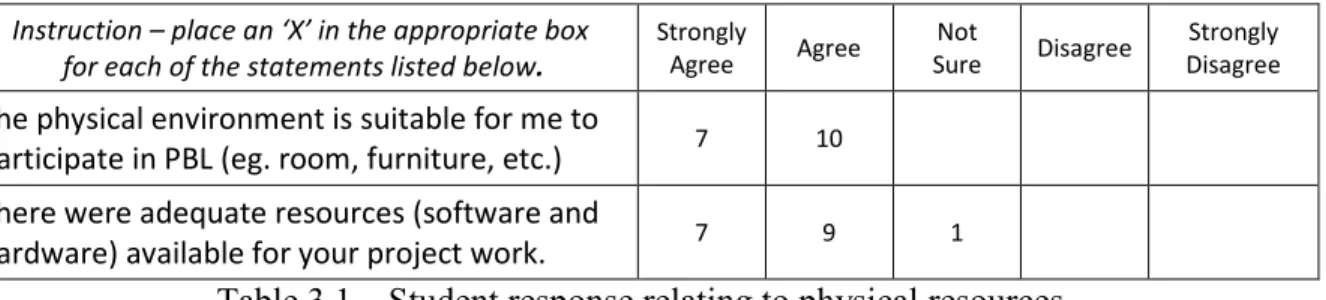
We were not in a position to offer each project group its own exclusive project room as is the case in Aalborg University. However, the existing hardware and software laboratories were generally available to the students. As shown in Table 3.1, the student feedback indicates that they were generally satisfied with the physical resources provided in order for them to complete their project work.
Instruction – place an ‘X’ in the appropriate box for each of the statements listed below.
Strongly Agree Agree Not Sure Disagree Strongly Disagree
The physical environment is suitable for me to
participate in PBL (eg. room, furniture, etc.) 7 10
There were adequate resources (software and
hardware) available for your project work. 7 9 1
Table 3.1 – Student response relating to physical resources
The relatively low number of students involved in the pilot meant that the existing physical resources were not put under pressure. If we were to move to a fully integrated PBL model for the entire four-year programme then this issue would need to be considered in advance. Ideally it would be best to provide each project group with their own dedicated room and this would require the adaptation of existing space and/or the development of new project space.
3.3.3 Student reaction
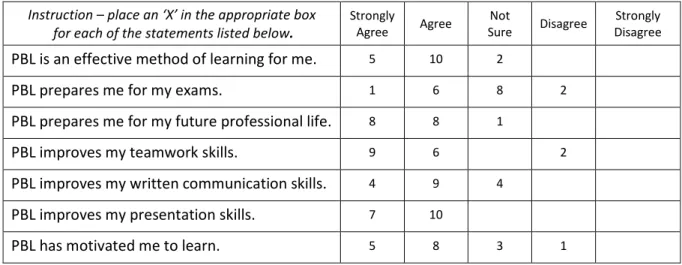
As part of the end-of-pilot survey we questioned the students on how they felt the PBL approach worked for them in relation to their development of certain key skills often associated with PBL. As shown in Table 3.2 below, the overall student reaction was generally positive although 8 of the 17 students were unsure as to effectiveness of PBL for exam preparation. In the focus group session, the students indicated several positive aspects of the pilot which they felt had worked well, namely, the workshops, the reflective journals, the online discussion, the practical
application of theory, the group work, the self-directed learning, the ‘real-life’/experiential learning and the ‘variety of roles’ which they had the opportunity to experience.
Instruction – place an ‘X’ in the appropriate box for each of the statements listed below.
Strongly Agree Agree Not Sure Disagree Strongly Disagree
PBL is an effective method of learning for me. 5 10 2
PBL prepares me for my exams. 1 6 8 2
PBL prepares me for my future professional life. 8 8 1
PBL improves my teamwork skills. 9 6 2
PBL improves my written communication skills. 4 9 4
PBL improves my presentation skills. 7 10
PBL has motivated me to learn. 5 8 3 1
Table 3.2 – Student overall response in relation to certain skills
3.3.4 Engineers Ireland accreditation
In order to achieve accreditation from the body which recommends and assesses standards for professional engineering education in Ireland, graduates of the engineering programme must be able to demonstrate the following (Engineers Ireland 2007):
• The ability to derive and apply solutions from a knowledge of sciences, engineering sciences, technology and mathematics;
• The ability to identify, formulate, analyse and solve engineering problems;
• The ability to design a system, component or process to meet specified needs, to design and conduct experiments and to analyse and interpret data;
• An understanding of the need for high ethical standards in the practice of engineering, including the responsibilities of the engineering profession towards people and the environment;
• The ability to work effectively as an individual, in teams and in multi-disciplinary settings together with the capacity to undertake lifelong learning;
• The ability to communicate effectively with the engineering community and with society at large.
The staff involved in the pilot, as well as the other department staff who approved the pilot, felt that the PBL approach was well aligned with the above accreditation criteria. For example, the problem-solving, system design, team work and communication skills development were central aspects of the approach. This was further supported by much of the student feedback. Representative examples of such feedback from the student focus group (in response to ‘What Worked?’) include:
Learned more about the theory: learned to apply the theory – the practical application of the theory made the theory more understandable; Group meetings worked; Experimenting and self-directing the projects; The ‘real life’ aspect of the experience and the skills learned doing the project; Experienced a wide variety of roles – this was good; Reflective journals worked well – kept students ‘on track’. Moodle discussion was good.
3.3.5 Some other findings
• An important outcome from the staff perspective was that despite some short-comings of the PBL pilot implementation, all three staff nonetheless found the experience far more interesting and enjoyable than the conventional module delivery. For example, all three felt that reading one substantial project report having significant elements of self-directed and peer-learning was far more gratifying than reading several sets of individual lab reports where students have simply followed pre-defined procedures without necessarily having to reflect deeply on the development of those procedures or having to devise and refine their own analytical procedures in orienting and addressing their group problem.
• The PBL assessment was based on the following components:
o A Group Interim Report, Presentation & Interview = 20% o A Group Final Report, Presentation & Interview = 70%
o A Process Report (to include individual and group reflections) = 10%
In general all three staff involved were satisfied with the assessment methodology although they felt that performing individual student assessment in a group interview situation was challenging. The difficulty here was ensuring that each student was asked a different yet equally testing set of questions spanning a sufficient cross-section of the project.
• At the beginning of the semester, we allowed the groups to ‘self-select’ which resulted in two strong groups and one weak ‘left-over’ group. The two strong groups engaged well and performed well in the overall assessment while the weak group engaged very poorly and subsequently failed the module.
4. CONCLUSIONS, RECOMMENDATIONS AND FURTHER WORK
Despite the small number of students involved in the PBL plot, the findings are very encouraging and suggest, subject to further validation, that the PBL model is an effective way to engender a range of important skills such as communication skills, teamwork, enquiry-based learning, peer-learning, project management, collaborative and individual innovation and creativity. However, in order to be most effective and efficient, it needs to be compliant with the three central attributes outlined in section 2.1 above and carefully integrated into the electronic engineering programme. For example, the careful coordination of semester project-themes with related pre- and parallel taught modules is likely to have a strong influence on the success of this educational model. During a group project, a fine balance needs to be struck between imposed structure and student/group-driven structure. This balance is likely to vary from one semester to the next and even between groups in the same semester. Some introductory training in group facilitation is strongly recommended (Aalborg MPBL 2014) although effective facilitation is probably best learned experientially. In future iterations of the PBL module we will reconsider the group formation process and may look at alternatives to self-selection, for example, having the students to individually rank their project choices and basing the team formation on the individual student preferences. We will also look at the feasibility of holding individual as opposed to group interviews as part of the assessment described above. The next phase of this project is to build on these preliminary findings with a view to further refinement and integration of the PBL educational model into the BE in electronic engineering programme.
5. REFERENCES
Aalborg University MPBL, 2014. Master in Problem Based Learning in Engineering and Science, http://www.mpbl.aau.dk/. Accessed 5/June/2014
Barrows, H. S., 1996. Problem-based learning in medicine and beyond: A brief overview, in L. Wilkerson and W. H. Gijselaers (eds.), Bringing Problem-Based Learning to Higher Education: Theory and Practice, Jossey-Bass, San Francisco.
Boud, D. J., and Felleti, G. (eds.) 1991. The Challenge of Problem-Based Learning. New York: St. Martin’s Press.
De Graaff, E. and Kolmos, A., 2003. Characteristics of Problem-Based Learning, International Journal of Engineering Education, Vol. 19, No. 5, pp. 657-662.
De Graaff, E. and Kolmos, A., 2007. History of Problem-based and Project-based learning, Chapter 1 (pp 1-8) in Management of Change: Implementation of Problem-based and Project-based learning in Engineering, edited by De Graaff, Erik and Kolmos, Anette, Sense Publishers. Engineers Ireland, 2007. Accreditation Criteria for Engineering Education Programmes,
http://www.engineersireland.ie/ Accessed 5/June/2014
Kilpatrick, W. H., 1918. The project method. Teachers College Record, 19, 319-335.
Kjersdam, F. and Enemark, S., 1994. The Aalborg Experiment: Project Innovation in University Education. Aalborg: Aalborg University Press.
Knoll, M., 1991. Europa-nicht Amerika: Zum ursprung der projektmethode in der pädagogik, 1702-1875. Pädagogische Rundschau, 45, 41-58.
Knoll, M., 1997. The project method: Its vocational education origin and international development. Journal of Industrial Teacher Education, 34(3), 59-80.
Moesby, E., 2002. From pupil to student – a challenge for universities: an example of a PBL study programme. Global Journal of Engineering Education, Vol. 6, No. 2, 145-152.
Moesby, E., 2004. Reflections on making a change towards Project Oriented and Problem-Based Learning (POPBL). World Transactions on Engineering and Technology Education, Vol.3, No.2.
Spaulding, W. B., 1969. The Undergraduate Medical Curriculum (1969 Model): McMaster University. Canadian Medical Association Journal, 100, 659-664.
Woods, D.R., 1994. Problem-based learning: how to gain the most from PBL, 2nd Ed., Publisher: D. R. Woods, ISBN: 096987250X, 9780969872504
Woods, D.R., Felder, R.M., Rugarcia, A. and Stice, J.E., 2000. The future of engineering education III. Developing critical skills. Chem. Engr. Education, 34(2), 108-117.
Woodward, C. M., 1887. The manual training school, comprising a full statement of its aims, methods, and results. Boston: Heath.