CHAPTER 6
ELECTRONIC FARE PAYMENT OPTIONS
INTRODUCTION
In line with the notion of a National Transportation System in the United States, the vision for transit is that of a "seamless" network, in which one can conveniently travel via a multitude of independent transit partners, using a single universal fare card. Historically, the U.S. transit environment has been anything but seamless—each transit agency has maintained its own fare structure and its own combination of fare media (e.g., cash, tokens, multiple-ride tickets, unlimited ride passes, and transfers). The situation is beginning to change, however, as increasing numbers of transit agencies are considering and implementing electronic fare payment methods that will facilitate convenience of travel both within and between transit agencies. These emerging technologies permit progress toward the vision of seamless travel.
A major focus of this study has been to review these emerging technologies and their implications for transit fare payment. The basic elements of this part of the study effort included the following:
• Identification of the key fare technologies and related developments,
• Review of financial implications of the emerging technologies,
• Examination of opportunities and barriers related to the emerging technologies and associated developments, • Identification of key trends related to the emerging
technologies, and
• Review of applications of the emerging technologies and developments.
The results of these tasks are presented in the remainder of this report. This chapter discusses the characteristics of existing and emerging electronic payment methods, particularly magnetic and smart card technologies. The advantages and disadvantages of these technologies are reviewed, and examples of each are discussed.*
Emerging Technology Research Approach
The research approach in this phase of the project entailed the following:
• Reviewing existing and planned tests and applications of
*
This discussion represents information available to the researchers at the time the report was written. Other suppliers may exist, and omissions were inadvertent. This discussion is not intended to endorse specific products or manufacturers.
emerging technologies throughout the world: information on a broad range of transit applications was compiled; • Reviewing related research and development efforts:
other researchers in the field were contacted and their studies were reviewed; and
• Reviewing trends and developments in non-transit sectors that could have potential for transit: applications and developments related to emerging payment technologies and methods were studied.
These efforts and the key issues addressed are summarized below.
Applications of Emerging Technologies
The focus of the research was on current and planned transit applications of electronic fare payment methods. Through the Phase I state-of-the-art research and the ongoing literature review, attendance at relevant conferences, and discussions with researchers and practitioners, the research team identified a broad and, presumably, comprehensive listing of such applications in the United States and abroad. Many of these agencies, as well as a range of equipment suppliers, were contacted to 1) make them aware of Project A-1 and to 2) solicit their input on their experiences and plans in this area. Information on the various tests, ongoing programs, and new technological developments was compiled and served as the basis for much of the analysis presented in this report. The types of projects reviewed included smart card tests, both transit-initiated and initiated by other entities, and new developments involving magnetic stripe technology; the latter includes regional fare integration projects, multiple use systems, and post payment/employer billing programs. Many of these applications are discussed in this chapter and Chapter 7, and several are described in more detail in Appendix A.
Related Research and Development Efforts
A number of research and development efforts were being conducted simultaneous to this study in areas of direct relevance to the research. Much of this work falls within the realm of Intelligent Transportation Systems (ITS)—formerly known as Intelligent Vehicle Highway Systems (IVHS)—research, and Advanced Public Transportation Systems (APTS) in particular. There are several ITS committees and working groups concerned with various issues associated with smart card technologies; for instance, the APTS Electronic Transportation
Card Systems (formerly known as Smart Card/Tag Systems) Working Group has been working toward defining transportation-related user and technical requirements for this technology. Meanwhile, several ITS/APTS demonstration projects will be testing the operational feasibility and impacts of smart cards on buses (and other applications). Another demonstration was sponsored by the California Department of Transportation, with tests on buses in three agencies in Southern California; this represented Phase II of the FTA-sponsored Advanced Fare Payment Media Study, which assessed the potential for various fare technologies. Another research and development effort has been the Ridetracking project being developed by IMMI; this project has focused on an electronic fare payment and trip monitoring system for use in human-service-agency-sponsored transportation programs. Finally, the research team reviewed a recently completed study, sponsored by the Volpe National Transportation Systems Center, that considered the development of a common card-based transit and toll payment system. Information on other efforts dealing with the development and potential application of smart cards in transit was also sought and reviewed. A summary of the key efforts in this area is included in Appendix C.
Trends and Developments in Non-Transit Sectors
This research focused on activities and developments in the banking and payments (e.g., credit card companies) industries, as well as in government activities related to the distribution of benefits. There has been increasing interest in the banking and payments sectors in the use of smart cards in general, as well as in the development of "electronic purse" applications involving multiple uses; transit has become one of these uses in several projects, and this appears to be a key area of development affecting future transit fare payment methods. Several key groups are involved in the establishment of standards and regulations governing smart card use. Review of activity in the banking and payments industries was also important in the consideration of electronic funds transfer forms of fare media purchase and the associated "back-end" settlement and processing requirements and regulations. The Federal and several state governments have become involved in smart card use in the electronic benefits transfer area; food stamp and other social service benefits are distributed to recipients via smart cards.
ELECTRONIC PAYMENT METHODS Overview
The two basic parameters of fare payment methods are as follows:
• Payment options (e.g., single-ride, multi-ride, period pass, stored value, and post payment) and
• Payment media (e.g., cash, token, paper ticket, magnetic ticket, smart card, credit card, debit/ATM card, and transit voucher).
There has been a general trend in the transit industry toward greater prepayment, so as to reduce the use of cash and the purchase of one trip at a time. Although non-electronic media allow prepayment—e.g., through multi-ride tickets or tokens or monthly flash passes—these media have various shortcomings, including lack of flexibility for the agency (in terms of modifying fare structures and levels and intermodal integration) and problems with security (theft and counterfeiting). Electronic payment media (i.e., primarily those based on magnetic stripe or smart card technologies) have been designed to overcome these deficiencies while offering other types of benefits—to both agencies and riders. This chapter discusses electronic payment options (i.e., stored value and other prepayment options) and the advantages and disadvantages of electronic payment methods in general—as well as those of the specific types of media.
With regard to the media technologies, the research team has focused on those media that offer the most promise as transit fare payment mechanisms: magnetic stripe and smart cards. Although other card technologies (e.g., laser cards and long distance radio frequency [RF] tags) exist, past evaluations (i.e., other fare technology studies and agency reviews) have deemed these generally inappropriate for use in transit applications. RF tags are, however, an important element in highwaytoll fare collection and are discussed briefly in Appendix B. One technology that has seen limited use in public transportation is the use of bar codes. Although this technology is not seen as a major development or trend in fare collection, an application of this technology is reviewed in Appendix B.
Stored-Value and Prepayment Options
The Basic Concept
The basic electronic payment options involve stored value (and the full range of prepayment and post payment options). "Stored value" formally refers to a specific option in which a dollar value is held on the card and the amount of each transit trip (or other purchase) is decremented on each use. The term is often used in a broader sense—as it is in the remainder of this report—to describe any prepaid option that is then decremented. A prepaid card can also include period pass options. Thus, the stored-value or prepaid card can take one of the following forms:
• Value-based—contains a dollar value,
• Trip-based—contains a predetermined number of trips, or • Time-based—can be used for a specific period (i.e., an
unlimited-ride pass).
Electronic fare collection equipment can be programmed to accommodate a wide variety of fare structures. This offers the transit agency tremendous flexibility in setting fare structures that can be differentiated by type of payment option, time of day (e.g., peak/off-peak), mode (or level of service), and the nature of minimum purchase price and discount offered. The farecard can include transfers between vehicles or modes.
The array of options is further complicated by the fact that a farecard can accommodate more than one type of fare structure on the same card (e.g., a period pass for use on one operator's service or a particular mode, plus a stored dollar value amount for use on another operator or mode). Examples of such combined time-and value-based media are found in the Washington, DC, and San Francisco areas. For instance, WMATA offers six different types of 2-week passes that can be used on bus (unlimited rides) and rail (each type of pass carries a different amount of stored value).
Purchase and Pricing Parameters
With regard to purchase parameters for a stored-value card, the basic alternatives are as follows:
• User-encoded (one-trip minimum)—This is the approach at BART and WMATA. Fare cards can be purchased for any amount equal to or greater than the single-ride adult base fare, and value can subsequently be added (in "addfare" machines). The advantage of this method over one that has a higher minimum initial payment is that it addresses issues related to equity (i.e., ability to produce the minimum payment) and the need for a fare medium for the one-time user (e.g., a visitor to the city).
• User-encoded (higher minimum initial purchase price)— In addition to the fixed $15.00 cards, NYMTA MetroCards can be purchased in $5.00 increments (from $5.00 up to a maximum of $80.00); value is added in the same increments. An alternative is to allow adding value in any increment once the initial minimum payment is made. CTA plans to require a $5.00 minimum payment in its system—and the AVMs will not provide change; however, CTA has not yet formally established its payment parameters. The advantages of this approach over the above option are 1) that it will reduce both the number of cards that must be supplied and, presumably, the number of AVM transactions; and 2) it should increase revenue to the agency through the float associated with greater prepayment. This option, however, has key drawbacks—the equity and one-time user issues mentioned above. It means that the agency probably always will have to permit use of cash, tokens, or both.
• Pre-encoded (fixed amount)—The third option is a card that is pre-encoded with a certain value (e.g., $5.00, $10.00, $15.00, or higher) and thus can be sold manually (i.e., without an AVM) at off-site locations. NYMTA sells a $15.00 card at outside vendors (as well as in rail stations). CTA may sell pre-encoded cards at off-site locations, although the details have not been finalized; one option under consideration is for cards to be sold through ATMs—both on and off CTA property. Prepaid telephone cards are extremely popular in Europe and are beginning to see more widespread use in the United States. The U.S. version of the prepaid telephone card actually represents a variation on the stored value concept. Unlike the transit cards and the European telephone cards, the value is not actually carried on the
card; rather, each card has a central account that is accessed by dialing a special code number. When the cardholder calls, he or she is told the remaining value. The options for a stored-value pass include the following: • Unlimited trips—at all times—during a calendar month:
This is equivalent to a regular monthly pass. Its advantages are that it maximizes rider convenience and system ridership; on the other hand, it generates less revenue than other options. CTA may introduce such a pass on its stored-value card eventually.
• Unlimited trips—at all times—during a specified period (e.g., 28-, 14-, 7-, or 1-day periods): This is similar to the above, except that the period of availability typically begins with the first use of the card. For instance, WMATA has rail-only passes (priced at $50.00 and $100.00) valid for 14 or 28 days, respectively, beginning with the first use; WMATA also has a 1-day pass (costing $5.00) that can be used only after 9:30 a.m. (or all day on Saturday or Sunday). Delaware Authority for Regional Transportation in Wilmington, Delaware, has a "rolling" 7-day pass and also issues 1-day passes on board its buses through TPUs.
• Unlimited trips—peak or off-peak only, or weekday-only: Similar to the former CTA weekday-only pass, this option limits the use of the pass to specific periods, which minimizes usage—and concomitant revenue loss—of passes.
• Capped number of trips: The programming capabilities of electronic fare systems actually create the opportunity to offer passes that are "capped" at a certain number of rides per month (or per week or 2-week period), thereby limiting the revenue that is "lost" through very high usage of a pass as well as limiting the extent of pass "sharing"—but also limiting the benefit to the pass user. NYMTA, very concerned about the potential for lost revenue but committed to introducing passes, considered a capped pass (e.g., 60 rides per month) on its MetroCard, although this option was ultimately rejected.
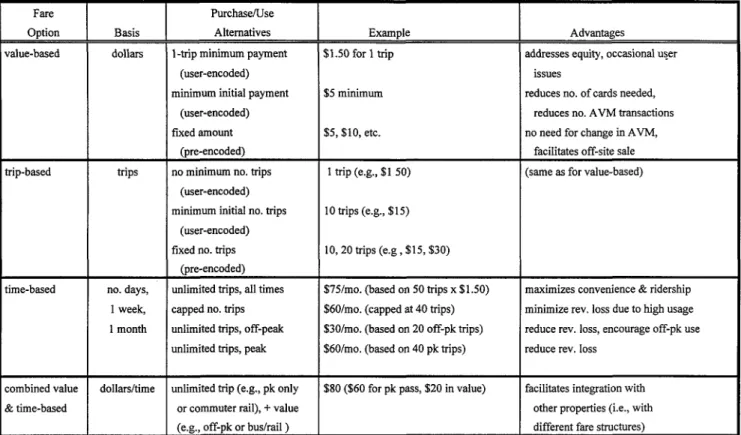
The basic stored-value farecard options are summarized in Table 44. The options for discounts and/or bonuses related to buying and using the cards are described below.
Discount and Bonus Options
One of the key parameters of a stored value fare structure is the nature of the discount or bonus—if any—offered as an incentive to purchase and/or use the card. Stored-value farecards can be configured to include a range of discount and bonus options related to time-of-day or modal differentials, in addition to volume purchase or frequent use. The basic types of discount or bonus that might be considered are presented in Table 45 and can be summarized as follows:
• Initial purchase bonus: A certain additional value is offered for purchase of a certain amount. The percentage
TABLE 44 Stored-value farecard options
TABLE 45 Stored-value bonus and discount options
can either be fixed, regardless of the amount of value, or can increase with higher initial purchases. The former approach is like a bulk token or ticket discount. WMATA uses the latter approach, offering a 10 percent bonus if a rider buys a card for $20.00 or more; WMATA formerly used the latter approach, offering a 5 percent bonus if a rider bought a card for more than $10.00, or 10 percent for more than $20.00, but recently eliminated the lower level discount. Both options encourage prepayment, although the latter encourages greater prepayment. • Add-value bonus: To encourage long-term use of
individual cards (i.e., rather than disposing of them after using up the initial purchase value), users of farecards receive a certain percentage bonus each time they add a certain minimum amount to the card—but not with the initial minimum purchase. This approach is being tried in the Harrow area of London and has been considered in New York.
• Per-ride discount (above a threshold number of rides): This option offers a reduced price per ride for each ride above a certain minimum number; this is similar in theory to the bonus for adding value, except that it is designed to maximize transit usage rather than prepayment.
• Fare differentials: An electronic fare system can accept a peak/off-peak or bus-rail differential without requiring action by a ticket agent or bus operator—in contrast to the existing off-peak bus discount. The fare collection equipment can be programmed to deduct the appropriate amount automatically.
• Farecard discount and cash premium: Another option is a per-ride discount for use of a farecard as opposed to using cash (or, conversely, a premium for use of cash). This can be offered in addition to one of the other options.
• Guaranteed last ride: In this option, a last ride is guaranteed, regardless of the amount of value remaining on a person's card. In other words, if someone attempts to board a bus or use a turnstile with insufficient funds left on his or her farecard, the equipment will "zero out" the amount of value remaining and allow the rider to complete the trip. This is designed to overcome people's resistance to using farecards because of fear that they will run out of stored value where it is inconvenient to add value (i.e., on many bus routes). On the other hand, this can result in substantial revenue loss, i.e., if riders take advantage of the option; it also discourages extensive prepayment and retention and reuse of the cards.
• Transfer discount: The equipment can be programmed so as to deduct the appropriate transfer price automatically. One option to encourage card use is to charge a lower transfer fee with the card than if using cash.
There is also a discount inherent in any time-based pass, but, unlike the value- or trip-based options, the extent of the discount is controlled by the rider rather than by the agency. As explained above, it is possible to limit the discount on a pass by restricting the period of available usage (by time of day or day of week) or by capping the number of rides that can be taken.
Thus, the type—and size—of the discount or bonus offered is an important element of the stored value fare structure. A discount and bonus in general provide an incentive to purchase and/or use a farecard (as opposed to cash or token), and the exact nature of the discount affects the extent of the incentive and, thus, the impact on ridership, fare revenue, and fare collection costs. The alternative is to not offer any discount or bonus with purchase or use of the farecard; in such a case, the only incentive for riders is the convenience of prepayment and not having to carry exact change or tokens.
The Multiple Use Card and Electronic Purse
A transit prepaid farecard can be configured in many different ways—this flexibility can be further expanded if the card is a "multiple-use" card. This is a stored-value card that can be used for various small purchases or payments (e.g., for telephone calls, use in vending machines, and use in parking lots), in addition to transit trips. Various multiple use card projects—also called expanded utility or universal card—are underway around the world; issues associated with this development, along with several examples (including those in Great Britain, Denmark, and Switzerland), are described in Chapter 7.
All of the existing and planned applications identified through this study are using smart cards; the smart multiple use card is known generically as an "electronic purse." The first major U.S. application—planned for the New York area, as part of the NYMTA's MetroCard project—was designed to use the magnetic stripe MetroCard; however, NYMTA has revised its plans and now envisions a smart-card-based program, with magnetic cards probably still available to accommodate occasional transit riders. NYMTA is negotiating with a private company interested in forming a joint venture with the MTA Card Company (a subsidiary of NYMTA) to develop arrangements with businesses willing to accept the MetroCard for small purchases; the MetroCard project is discussed further in Chapter 7.
Stored value and prepayment options are the key elements of electronic payment. Post payment, i.e., in which the rider— or his or her employer—is billed for trips taken after the fact, is a newer use for electronic media. This concept is discussed in Chapter 7. The basic options and issues mentioned above apply to either magnetic or smart card technologies; technology-specific issues are discussed below.
ADVANTAGES AND DISADVANTAGES OF ELECTRONIC PAYMENT METHODS
Electronic payment methods offer transit agencies and riders a range of benefits unmatched by traditional payment methods and present new opportunities to expand the integration of transit fare payment with payment for other transit services, other travel modes, and other types of expenditures. Barriers to these new developments and disadvantages associated with these media in general do exist. These general opportunities and barriers are reviewed below; relative advantages and
disadvantages of the individual types of electronic media are discussed in the remainder of the chapter.
Advantages and Opportunities
The primary advantages of electronic payment methods over more traditional methods can be summarized as follows:
• Improved flexibility, in terms of the range of fare options that can be offered and the ability to modify the fare structure; this can produce increased ridership, because of the ability to better target different fare options to specific markets;
• Improved revenue accountability and security, in terms of improved ability to track transactions and discourage employee theft or mishandling of fare revenue; this in turn should result in increased revenues;
• Reduced fare abuse, including counterfeiting of media and short payment or illegal reuse of media;
• Improved ridership data, i.e., generated from fare payment; these data can be collected without the additional expense of special surveys, and the data stream is continuous rather than discrete "snapshots" of the system as provided by surveys;
• Reduced transit operator and rider interaction and administrative and operational requirements, i.e., related to the need for operators to sell and verify the validity of media (flash passes and transfers, in particular);
• Improved convenience for riders, for both purchasing and using the media; in a fare system with many options, for example, the rider does not have to carry exact change or know the specific fare for every trip; and
• Ancillary revenue from unused value on stored value cards; the agency benefits from the "float" associated with prepayment in general, as well as the remaining value on cards never actually used for purchasing trips (e.g., out-of-town visitors buy cards with greater value than they end up using, or, if there is an expiration date for a card, riders may end up with some unused value); this can be a significant source of revenue, although an agency must address possible concerns regarding rules (local and possibly federal) for refunds for unused value (at this point federal regulations regarding prepaid cards in general are being formulated, and they ultimately could have implications for transit; these issues are discussed in Chapter 7).
Beyond these advantages, however, electronic payment methods offer benefits and opportunities related to expanding the existing capabilities of the fare media themselves; these include the following areas:
• Regional fare integration—electronic media and the appropriate equipment can allow the use of a single farecard on multiple transit operators in a region; each participating agency can still function independently and set its own fares.
• Multiple use or electronic purse—as indicated above, an
electronic farecard can function as an electronic purse to allow small purchases for various goods or services, including transit.
• Post payment and employer billing—as mentioned above, electronic payment methods can provide a means to capture transaction data for billing of actual trips; this also offers a means of monitoring demand management and Clean Air Act requirements.
These functions are discussed later in this chapter and in Chapter 7.
Disadvantages and Barriers
The disadvantages of electronic payment methods are related primarily to the very complexities that produce the above benefits. Because these methods depend on complex technologies in equipment—and perhaps the media themselves—there are greater costs involved in many aspects of introducing and maintaining these options. The general disadvantages of electronic methods versus non-electronic methods can be summarized as follows:
• High cost of equipment and production of media, although the cost of the media depends on the specific media technology used (discussed in Chapter 8);
• Higher maintenance cost of fare collection equipment, including higher number of maintenance personnel and possibly greater skill level—and higher training costs— required for maintenance personnel;
• Greater lead time for implementation, because of an often lengthy procurement process, followed by the need to test equipment, modify and/or prepare stations or vehicles, and phase in introduction of system (depending on size and complexity);
• Possibly long "break-in" period, because of limited in-service testing of equipment and possible reliability problems with very new designs;
• Greater planning required for developing new fare structures, in light of the broad array of possibilities; new planning and modeling techniques are needed to understand riders' potential reactions to and usage of new fare options—and new media; for instance, NYMTA recently completed a more than 2-year-long process of developing a new structure for use with its MetroCard, and this effort required extensive surveys of riders and non-riders, analysis of potential use of different pricing options, and evaluation of alternatives; CTA has recently completed a similar study in conjunction with procurement of its new fare system;
• Possible union resistance, given that a key benefit is reduced operating and maintenance costs — primarily through personnel reductions; and
• Privacy concerns on the part of riders; card users may not want the transit agency to be able to track their ridership patterns; this is discussed further later in this chapter. The specific cost impacts are discussed in Chapter 8.
Although the potentially high costs are perhaps the most important barrier, the concerns associated with reliability of new equipment and the long implementation period also represent serious barriers to the pursuit of electronic methods for many transit agencies. Some agencies generally are more inclined to try out new developments and like to be on the "cutting edge" of technological advancements. For instance, WMATA had one of the first stored-value systems in the world and is now testing contactless smart cards in a portion of its system; meanwhile, the Ann Arbor Transportation Authority (AATA) is planning to test a full "intelligent vehicle" system, which will include smart cards for fare payment. In fact, it may be a single individual in a transit agency who drives innovation and pushes to acquire the latest technology. Much more common, however, is a reluctance to try out a new technology; given the funding pressures facing most transit agencies, they much prefer to wait until a technology has been proven to be reliable and cost-effective before considering it. Most agencies are unwilling to risk potentially long "down time" periods for their fare collection equipment; this can mean significant lost or improperly accounted for revenue, as well as the negative public relations resulting from equipment problems.
A less obvious, but related, concern is what can be termed the fear of immediate obsolescence. With the rapid advancements taking place in electronic fare technologies and equipment, an agency may be reluctant to acquire a particular piece of equipment or a new media technology, for fear that it will soon be replaced in the marketplace by something new and improved. In light of the long implementation lead time that often occurs, an agency may end up finally installing a new fare collection system or piece of equipment after an improved version—or improved technology altogether—has already been introduced. As is discussed below, the rapid pace of development in the smart card arena falls into this category. The prospect of a long research and development period before an agency can get the type of system or equipment that meets its particular needs can be a barrier. NYMTA is the extreme example, with its 10-year process leading to the installation of the first phase of its new fare collection equipment. Other projects, however, such as the integrated ticketing effort in the San Francisco (TransLink) area, are also in the midst of what will end up being long development and implementation periods.
There are also several barriers related specifically to efforts to take advantage of the expanded opportunities identified above. In regional fare integration, as well as multiple use card projects, extensive coordination among participating parties is required. This often involves development of complicated revenue and cost-sharing agreements and can be extremely time-consuming. Typically, a single agency initiates the project (as with NYMTA, LACMTA, and the Metropolitan Transportation Commission in the San Francisco Bay area), but if not, one must be designated. Once the program is operational, there is a need for additional administration—on the part of the lead agency, as well as at the other participating agencies. NYMTA has established a separate subsidiary, the MTA Card Company, to implement and administer the MetroCard expanded utility program. Another key element of
a multi-entity payment effort is some type of "back-end" clearinghouse system for distributing revenues to the appropriate parties; these systems are discussed in Chapter 7.
Electronic payment methods offer a range of benefits to transit agencies and their riders, although there are also several important costs and other disadvantages. The specific costs and benefits are linked closely to the particular media and equipment technology selected; these, along with descriptions of current and planned applications of these methods, are discussed in the following sections.
MAGNETIC STRIPE TECHNOLOGY Overview
Magnetic stripe technology has represented the state of the art in fare technology in the U.S. transit industry for many years. Magnetic tickets have been in use in the transit industry for 30 years, beginning in London and the LIRR in 1964. The first stored value application was in Chicago (Metra Electric ICGRR Line) in 1966, followed by PATCO (1968). Although development has continued and the equipment has been improved considerably, the technological advancements in the basic rail electronic fare collection system have been relatively minor, especially when compared to advancements in other areas (e.g., computers). Even judged by today's standards, the distance-based read-write-print BART (1972) and WMATA (1976) systems are quite sophisticated. Of course, the pace of development is related largely to the slow acceptance of the technology. Despite the fact that magnetic stored value systems have been "proven" at BART, WMATA, Baltimore MTA, and several other agencies around the world, relatively few agencies have introduced stored-value magnetic media to date. Although 12 of the North American heavy rail systems have some type of magnetic media, only 4 have an electronic fare system (i.e., rather than just magnetic pass readers). On the other hand, application of the technology has been expanding considerably over the last couple of years, with NYMTA, CTA, MBTA, and GCRTA (Cleveland) all introducing (or in the procurement process for) electronic fare collection. (See Table 46 for examples of current and planned applications.)
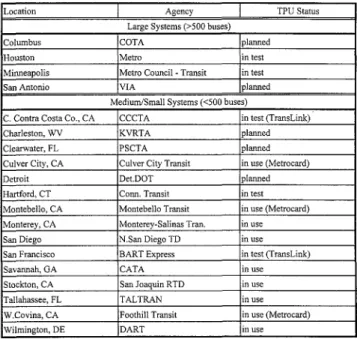
The use of magnetic technologies in the bus arena has been even slower to take hold. Approximately 20 North American bus agencies have magnetic media (predominantly swipe pass readers), with another 12 or so systems in test phases—thus, less than 10 percent of bus systems have incorporated any type of magnetic technology; however, magnetic technology is a much more recent development for bus than for rail. Electronic registering fareboxes were not introduced until the early 1980s, and magnetic swipe readers (for passes) were first installed in the mid-1980s. Bus TPUs—also known as bus ticket validators (BTVs)—have been in existence for several years but are just beginning to see significant usage. A number of agencies are installing and testing—or have initiated the procurement of—TPUs (see Table 47). Some agencies are apparently delaying
TABLE 46 Magnetic tickets for North American heavy rail systems
Notes
(a) - Baltimore and Montreal have Edmondson size tickets in ticket transports. Montreal has swipe readers for reading passes which are credit card size. All other systems have credit card size tickets.
(b) - TPU's tested on connecting bus services: CCCTA, BART Express (c) - planned
(d) - read/write swipe reader
decisions to move to this technology pending further in-service testing of the equipment because of continuing concerns about the reliability of TPUs. Nevertheless, there has been considerable advancement in bus fare collection technology over the past few years, and the reliability of the equipment should improve with further usage and refinement by the manufacturers.
Examples of Magnetic Ticket Applications
The following represent examples of the types of emerging developments and trends using magnetic stripe technology:
• Multiple Use Card: MetroCard (New York City)— MetroCard is a stored-value card that is being introduced
by MTA-NYCT. A key aspect of the project is to have a multiple use card available for transit as well as other uses; it appears likely that the multiple use card will be a smart card, rather than the current magnetic card (which will be retained for low-frequency transit users). The MTA Card Company has been established for the purpose of implementing this program, in which the card will be used for non-transit uses such as telephones and other small point of sale purchases.
• Post Payment: Bus Card Plus and Credit Card Acceptance (Phoenix)—The Phoenix Transit System has installed a magnetic card system called Bus Card Plus. It provides for billing of employers on the basis of number of uses of the card per month (for each employee), although the bill is capped at the cost of a monthly pass. PTS also
TABLE 47 Magnetic bus ticket processing units
accepts credit cards (e.g., MasterCard, VISA, American Express, and Discover) directly in its bus swipe readers. • Electronic Fare Collection on Buses: Delaware Authority
for Regional Transportation (Wilmington, Delaware)— This system in Wilmington uses TPUs on its buses for several innovative fare functions: stored-ride tickets (10 rides; a ride is automatically decremented on each boarding), "rolling" passes (good for 7 days once they have been activated on the first use), automated issuance of 1-day passes, and automated issuance and handling of transfers. This system is also to participate in a smart card demonstration, as discussed below.
• Bus TPUs/Vehicle Area Network (VAN) (Houston)— Houston Metro has installed TPUs and plans to offer stored-value tickets; the agency also plans to expand the SAEJ 1708 standard to include a VAN for transit vehicles by specifying an on-board data controller that will provide a central control for all devices, i.e., radios, passenger counters, and fare collection functions.
These developments are discussed in greater detail in this and the next chapter.
Characteristics of Magnetic Tickets
There are two basic types of magnetic tickets available: • Low coercivity tickets (approx. 300 oersteds), called "soft
magnetics" and
• High coercivity tickets (approx. 3000 oersteds), called "hard magnetics."
Encoded data on low coercivity tickets, such as those used at Metra, BART, and WMATA, can be destroyed by a
refrigerator magnet. High coercivity tickets, such as those used by CTA and PATH, cannot be altered by refrigerator and other soft magnets. The CTA "QuickPass" uses high coercivity magnetics and a hologram, which is employed for visual inspection. Magnetic verification is done by reading the encoded bit pattern and cancellation is achieved by altering the magnetic codes associated with items such as rides left or value remaining. Some systems (e.g., WMATA and BART) require the rider to insert his or her ticket on both entering and departing a station; the proper fare amount is deducted according to the specific origin-destination station combination.
Both printed and magnetic types of tickets are predominantly made of paper, with the thickness varying between 7 and 12 thousandths of an inch depending on the system requirements. WMATA and BART tickets are examples of 7 thousandths of an inch. However, "tickets" can be made of plastic. For example, MBTA uses a 10-mm-thick plastic card with a "hard magnetics" stripe for read-only operation by swipe readers. Plastic tickets can be recirculated for use in a "closed" magnetic ticket system, such as at PATCO, where entry and exit control are used. In such a system, single- or multi-ride tickets can be captured, re-encoded, and reused. There is no printing by the AVM or turnstiles. The life cycle has proven to be at least 100 uses. Similar tickets are employed in the Hong Kong and Singapore systems. Use of plastic tickets is an attraction, especially for systems that experience high humidity and that have machine-readable ticket devices. However, if printing is to be done by the turnstile or bus validator, the plastic material must be thermally coated to retain a smudge-proof printed image.
Counterfeiting of magnetic tickets—and all types of tickets—has been raised as an issue by some transit operators. Although this has plagued the commercial banking industry (i.e., in terms of counterfeit credit cards), there is little evidence that counterfeiting has been a problem in the transit industry to date. Nevertheless, efforts continue to develop improved anti-counterfeiting techniques. With increased density of magnetic encoding and use of hard magnetics, the degree of difficulty of duplication is increased. Other improvements in encoding technology include Thorn EMI's patented "Watermark" magnetic encoding technology. The magnetic elements are fixed in a particular pattern when the stripes are formed and cannot be altered later. Watermark magnetics offer protection against the two most common forms of fraud used on magnetically encoded tickets — skimming and buffering. Another method to thwart the potential counterfeiter is to include means in the system to track the use of the tickets. Tickets in the Southern California Metrocard project are serialized and these serial numbers can be tracked by the computers. Value remaining patterns of abnormal ticket use can be flagged and fraud prevented. A new technology called XSec Security System offers installing a "chip" set in existing reader devices. It uses the fuzzy logic technique to establish a digital signature unique to that ticket.
Capabilities of Magnetic Stripe Technology
A magnetic stripe ticket can be used for any type of payment option—i.e., single-ride, multi-ride, or period pass—and can
allow for differentiation of fares by time, type of service, and distance (depending on overall system configuration). It can also be used in a post payment format. The technology offers a transit agency extensive flexibility in pricing and payment options. This flexibility has expanded to include the aforementioned regional integration and multiple use applications.
Magnetic stripe technology offers the basic advantages, opportunities, and disadvantages ascribed to electronic payment methods in general. Its specific advantages over smart cards can be summarized as follows:
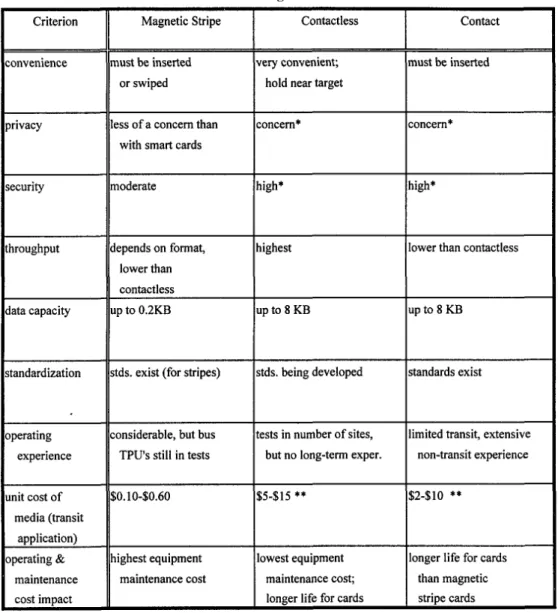
• The media are considerably less costly to produce; whereas the unit price of a magnetic ticket is between $0.10 and $0.60 (depending on the specific characteristics of the card and the volume purchased), a smart card costs anywhere from $3.00 to $10.00 (again, depending on the specific characteristics of the card and the volume purchased); the cost issues are discussed in Chapter 8. • It is a proven technology, in both transit and other
applications (particularly credit and ATM cards); there has been considerable development and testing of magnetic-based fare collection equipment, as well as advancements in the medium itself.
Another advantage lies in the fact that there are industry standards for the technology and an extremely extensive usage base—i.e., in the form of credit and ATM cards. Because transit systems tend to be closed systems, their media do not have to conform to standards for other systems, and many transit applications do not necessarily follow International Standardization for Organization (ISO) standards. The move toward more "open" applications, such as regional fare integration and multiple-use cards, however, suggests an advantage in being able to use a standardized technology. Thus, this will become a greater advantage as the trend toward integration of uses expands.
The disadvantages of magnetic stripe technology as compared to smart card technology are as follows:
• Magnetic tickets are not as secure as smart cards (i.e., in terms of being counterfeited), although there have been continuing developments in improving the anti-counterfeiting characteristics of the technology.
• Magnetic tickets have considerably less data storage than—and lack the logical capability of—smart cards; this issue is discussed later in this chapter.
The benefits and costs of the two technologies have to be considered in determining the best approach for a particular transit application. To this point, the transit industry has generally accepted magnetic ticket technology as a proven, cost-effective technology, although there is increasing consideration of the use of various types of smart cards. Some agencies are considering smart cards as complementary media, for special uses; others are planning to test the feasibility of using smart cards as their basic fare media. The characteristics and advantages and disadvantages of smart cards for use in transit applications are addressed in the following section.
SMART CARD TECHNOLOGY Overview: Definition of Smart Card
The term smart card has been used to describe a range of automated card technologies. The various types of cards are defined and categorized in many different ways and the characteristics of individual types of cards are changing as development continues. The different definitions reflect evolving features and that smart cards can be — and have been — categorized according to several different characteristics, including the following:
• The form and quantity of memory and the logic capabilities and
• The technique by which the card and the reader communicate (i.e., transfer data).
When defined according to the first approach, automated cards (other than magnetic stripe, bar code, and optical/laser cards, which are discussed in separate sections) can be categorized as follows:
• Memory cards—These are credit-card-size integrated circuit cards that store information but do not contain on-board microprocessors.
• Microprocessor cards—These are credit-card-size integrated circuit cards that have internal logic capabilities because of the presence of a microprocessor; in other words, they are essentially tiny computers. An advanced version is the "super smart card," which includes a miniature keypad and display.
When defined on the basis of communication technique, smart cards can be categorized as follows:
• Contact cards—These cards (memory or microprocessor) require a physical contact between the card and the reader-writer unit. Examples are cards made by Schlumberger, Gemplus, MicroCard, Bull, and Solaic. • Contactless cards—These "remote coupling" or "close
coupling" cards use a contactless interface to provide power to the card and transfer data using inductive and capacitive techniques. Examples are close coupling cards developed by AT&T and remote coupling cards developed by GEC, Racom, and Mikron; the card does not have to be inserted into a slot but is simply placed close to the reader.
• RF identification (RFID) cards or tags — RFID cards transfer data between the card and the reader-writer unit using RF techniques. The card can be held 1 or more in. (up to 100 ft in some toll applications) away from the reader. Power is supplied either with a battery (as in cards produced by Sony and Cubic) or by means of received magnetic energy. Close-distance RFID cards are often known as contactless cards,
There is significant overlap between contactless and close-distance RFID cards—all of these cards are increasingly being
referred to as contactless cards. The key distinction for transit users—and for the agencies for most issues—is whether or not the card has to be inserted physically into a reader slot. For purposes of evaluating potential transit applications, the research team adopted the following categorization of smart cards:
• Contact cards are any cards that require insertion into a slot.
• Contactless cards are any cards that do not require insertion but must only be held close to (i.e., within a few inches of) the reader-writer; this includes remote coupling, close coupling, and RFID cards.
A hybrid card configuration, born of practical necessity, is a smart card with a magnetic stripe. This allows both technologies to be used during the transition stage—or permanently, if there is a need for both. This has been done in France and other places that have used contact cards. AT&T, in alliance with Chemical Bank, is testing its card with a magnetic stripe in a smart banking and stored-value card trial in New York City. Another type of hybrid card would include both contact and contactless functions; this would allow a single card to best meet the needs associated with transit and other types of applications (e.g., banking). Such cards are now being developed by several manufacturers and are expected to be available commercially by 1997. An alternative means of integrating the two card types—inserting a contact card in a contactless "sleeve,"—has been developed (by Innovatron of France) for use in Paris.
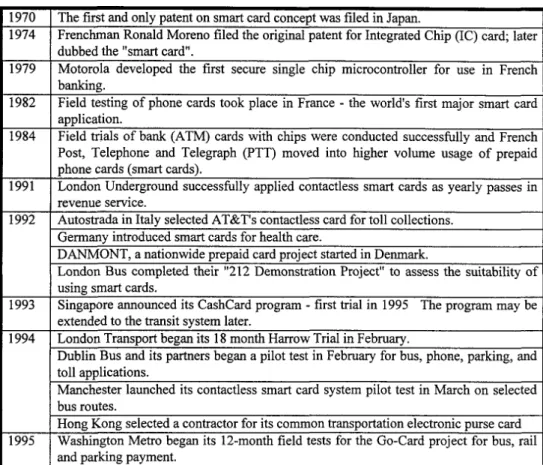
Background: Smart Cards in the United States Although smart cards have existed in Europe for more than a decade, the United States has been slow to use the technology. Table 48 gives a historical perspective. Contact smart cards, originally developed in France in the early 1970s, are used by millions of cardholders worldwide. More than 36 countries, primarily in Europe and the Far East, are using or testing the cards in a variety of applications, particularly prepaid telephone cards. In France alone, more than 70 million Telecom cards were sold in 1992. These cards are discarded when exhausted.
The United States has lagged behind in smart card applications, although serious efforts are underway by the banking, telecommunications, and government sectors to use the card in a range of applications, including financial, social benefit delivery, and prepayment applications. For instance, the AT&T smart card was designed for use in its AT&T 2000 telephones, and, as indicated above, the card is being tested in collaboration with Chemical Bank in New York. This and other U.S. applications and developments are as follows:
• AT&T and Chemical Bank Project—This banking application is using a hybrid magnetic stripe and smart card technology. In November 1993, Chemical Bank announced it planned to test the AT&T contactless card as a debit card, first with its employees as a cafeteria card, then (by 1995) with its customers in New York City.
• Peanut Commodity Card—This is a program initiated by the Department of Agriculture in 1987 to reduce the amount of paperwork, increase the accuracy of the transactions, and reduce the manual effort in administering the peanut price support program by providing a smart card. The smart card records the producer's peanut sales and tracks sales against a quota. Approximately 200,000 cards are used. By 1990, the $12 million implementation cost was recovered, and, in 1996, the U.S. government anticipates a net savings of $14 million.
• Women, Infants, and Children (WIC) Electronic Benefits Program—A test was initiated in one county in Wyoming using smart cards in place of paper checks for disbursing WIC benefits. The card was encoded with the cardholder's personal identification, clinic, and food package benefit data. The cardholder was able to spread food purchases throughout a month and the support system automatically tracked allowed purchases.
• State of Ohio Food Stamp Program—This is similar to the WIC program in that smart cards are used to carry food stamp benefits for redemption at food retailers. Approximately 11,000 food stamp recipients received cards to use at 93 food retailers in one county near Dayton. A request for proposal has been issued to expand the demonstration project statewide and to add other benefit programs to the card.
Of broader significance regarding the potential for smart cards in this country and around the world is that MasterCard International, VISA International, and Europay International (of Belgium) are developing international specifications for smart card payment systems. These companies ultimately plan to replace the current magnetic stripe technology on their payment cards with contact smart card technology. The joint "EMV" specifications are evolving in three parts: 1) definition of the mechanical and electrical characteristics along with card and terminal transmission protocols; 2) definition of the terminal commands, applications, and data elements; and 3) definition of how the smart card, terminal, and back-end transaction processing network will work together. The initial plan was to complete the specifications and establish rules regarding the acceptance and issuance of smart cards by the end of 1995 and make terminals available to merchants within the next few years.
MasterCard and VISA, along with AT&T, Chemical Bank, and a number of other key entities (including the U.S. Treasury Department; American Express; and various banks, vendors, and consultants) are also involved in the Smart Card Forum, founded to discuss smart card infrastructure standards in the United States. With regard to specific smart card trials, VISA will be rolling out its VISACash prepaid card in Atlanta in conjunction with the 1996 Summer Olympics. This roll-out will actually involve a transit element, as MARTA will accept the cards (to be issued by three banks) for fare payment in its rail stations. Meanwhile, MAC/CoreStates—the largest northeast ATM network services company—is running a prepaid card pilot program among its employees; MAC has announced plans to offer a prepaid smart card to its ATM customers. Bank
TABLE 48 Time line for smart card developments
of America is also conducting a smart card test at its campus in Concord, California. Finally, there are smart card initiatives underway at several universities, including a demonstration of five campuses in the University of Michigan system. Thus, there is considerable interest in the technology in the United States in several sectors. These developments ultimately may have a significant effect on the use of smart cards in transit, as is discussed below.
There are also several research and development efforts underway related to the usage of smart cards for transit. For instance, ITS America has a smart card working group whose purpose is to define technical and user requirements and system standards for smart cards and tags to be used in transit applications; this group is made up of representatives of research firms, manufacturers, and government agencies. The Volpe National Transportation Systems Center is also sponsoring an effort that is developing a plan for a common standard card-based toll and fare payment system for all modes of transportation. Finally, the FTA has sponsored the Advanced Fare Payment Media projects, aimed at developing cost-effective advanced fare media. A key concern of all of these efforts is the issue of standardization. Currently, there are probably as many standards as there are suppliers of the product. This is another barrier to the widespread adoption of smart card technology by the transit industry; issues related to standardization are discussed later in this chapter.
U.S. Transit Applications
The potential for transit smart card applications has received increasing consideration during the past few years. There have been several studies and development efforts related to potential use in transit. A number of pilot projects and tests are in progress—or planned—around the world, including several in the United States. The emergence of contactless cards has sparked interest within the U.S. transit industry, and the development of multiple use smart card systems that include transit has expanded the use of smart cards by transit agencies abroad. The use of smart cards was first tested at the Port Authority of Allegheny County (Pittsburgh) in 1990; Schlumberger, manufacturer of the cards, sponsored this test, which applied only to monthly passes. Example of smart card projects in test phases or under development are as follows:
• WMATA Contactless Card Demonstration—In December 1995, WMATA completed a 1-year test of the feasibility of a contactless card (using Cubic's Go-Card) for use on rail and bus, as well as at park and ride lots. The project includes installation of reader-writer units in 24 rail mezzanines, 21 buses (on 3 routes), 1 bus depot, and 5 park and ride facilities and is testing the ability to use the Go-Card as a common payment instrument. The basic Go-Card technology was extensively tested by London
Underground in 1990 and 1991 in its "Touch and Pass" Program. The card uses a battery-operated contactless, low power, RF data link to communicate and receive fareand fee- related data to and from a "target reader," which is integrated with the fare collection and parking equipment. AVMs can read and display the value remaining on a Go-Card and add value to the card when payment is made in the AVM. The Go-Cards are used in the faregates to enter and exit the Metro system. On the bus, the maximum fare is deducted on entry by the "target reader" (three-zone fare, for example). The passenger must check out on leaving, using either the front or rear door; if a one- or two-zone ride is taken, the appropriate value is restored. The same concept is used to pay for parking fee collection. Data from rail, bus, and parking subsystems is transmitted via modem to WMATA's Central Computer System to apportion revenue. The test began with 5,000 Go-Cards given to Metro employees and 1,000 to selected Metro riders.
• Southern California Advanced Fare Payment Media Test—As part of Phase II of the Advanced Fare Payment Media Study (funded by FTA and the California Department of Transportation), the contractor, Echelon Industries, developed bus card read-write units and installed them on buses at three transit agencies in Southern California (Gardena, Torrance, and LA DOT). Echelon tested these units with contact cards on some buses and contactless cards on others, in order to evaluate the user acceptance and performance of the two types of cards. In Phase III, the read-write units are being used by seven transit operators in Ventura County, California. • AATA Smart Intermodal Project—As part of a
multifaceted FTA-funded Advanced Public Transportation System (APTS) project, AATA plans to introduce smart cards for use on its system—as well as in designated parking lots. The plan is to use contact cards, at least initially, to accommodate the University of Michigan campus card now offered on the Ann Arbor campus. The demonstration is being designed to test, among other issues, the feasibility of the cards on buses and the potential for integrating the cards with an automated vehicle location system.
• Wilmington (Delaware) Smart Card Project—As part of a Federally funded ITS Operational Test, the Delaware Authority for Regional Transportation will be testing the use of contact smart cards on its bus system. The cards themselves will be provided by a local bank and will eventually be usable in ATMs and for other services at designated locations; the project is discussed further in Chapter 7.
• Central Puget Sound Integrated Fare Project—Transit agencies (and the ferry operator) in the Seattle/Central Puget Sound area are planning to conduct a trial of contactless smart cards as a common fare medium that will be used throughout the region. A comprehensive feasibility study has been conducted, and the plan is to develop an integrated system, including a regional clearinghouse, over the next 2 years.
• San Francisco Bay Area TransLink Project—This project involves development of a regional integrated stored-value card system for transit operators in the Bay Area. It was initially intended that the project would use magnetic tickets, similar to the existing BART ticket, and the original TransLink ticket was tested at BART and two bus systems (BART Express and Central Contra Costa County) in 1994 and 1995. However, following a trial period, it was decided not to proceed with the original plan. The Metropolitan Transportation Commission (MTC), the lead agency, commissioned a study to determine the most appropriate technology. This study, completed in late 1995, recommended a contactless card system, and MTC planned to commence development of the regional system in mid-1996.
• MARTA Smart Card Project—As part of the introduction of a stored-value smart card (VISACash) in Atlanta, the Metropolitan Atlanta Rapid Transit Authority will be accepting the contact smart cards for the payment of fares on the rail system. The cards and the card read/write units will be provided by VISA and the three participating banks; the project is discussed further in Chapter 7. Various other U.S. transit agencies are considering smart cards either for use by specific market segments (e.g., the disabled) and/or for use by maintenance personnel. For instance, CTA plans to install contactless card readers on all turnstiles in its new fare collection system. Maintenance personnel will use the cards to gain access to the equipment. It is possible that disabled riders could receive the cards for use instead of the magnetic stripe fare card to be used by other riders. CTA tested the use of contactless cards in one station in mid-1995. NYMTA is planning to introduce smart cards along with its current magnetic stripe cards. The extent to which smart cards ultimately become used on a broad scale by U.S. agencies will depend on various factors, including the cost of the technology, the results of the above and other tests (e.g., related to the reliability of the technology), and the extent of the cards' adoption in banking and other industries. These issues are addressed later in this chapter and in Chapter 7.
Transit Applications Abroad
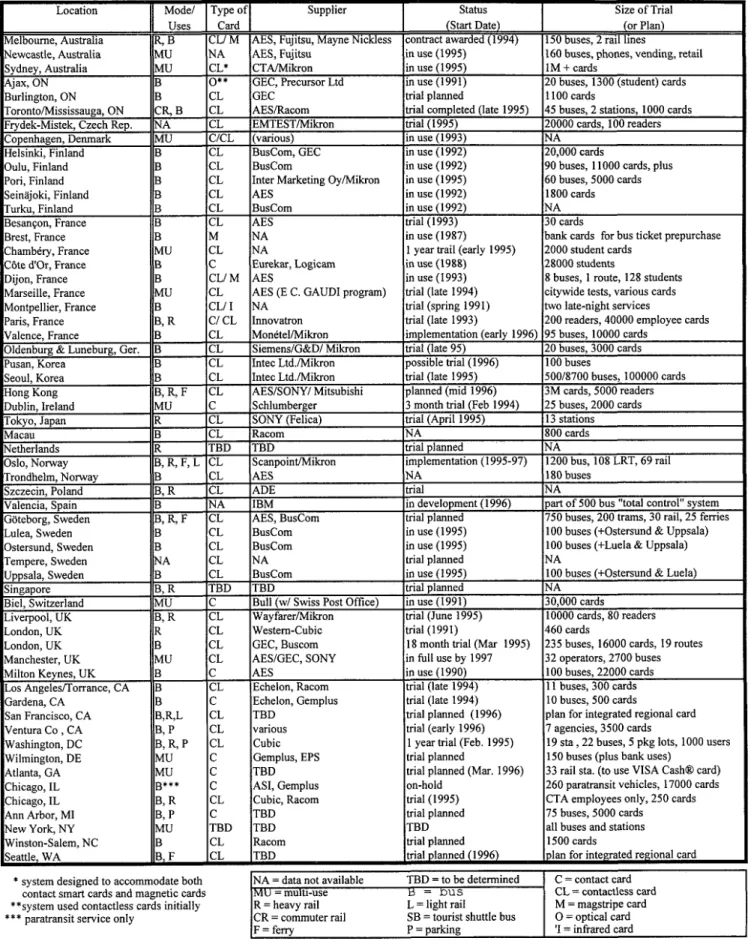
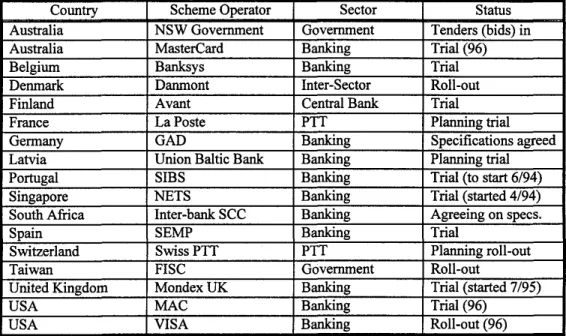
The use of smart cards in general is considerably advanced outside of the United States. This applies to transit usage as well. A number of transit agencies and government agencies overseas, as well as in Canada, have developed smart card projects over the past several years; several of these have been implemented; others are in the planning stage. Many of the current projects and those nearing implementation (both in the United States and abroad) are summarized in Table 49. Several of these efforts (i.e., those in Manchester, England; Dublin, Ireland; Hong Kong; Toronto, Canada; Copenhagen, Denmark; and Biel, Switzerland) were designed as regional integration and/or multiple use and electronic purse programs; these are described in Chapter 7. Other representative projects and tests are summarized below; these represent examples of the two
basic smart card technologies, although most are using contactless cards.
• London Underground—London Underground conducted an extensive test of a contactless card system ("Touch and Pass") in 1990 and 1991. London Underground tested 458 cards and the trial had over 190,000 uses. On the basis of technical evaluation and surveys, the Touch and Pass program showed great promise in terms of ease of use, throughput, and passenger acceptability. Plans for systemwide expansion, however, are on hold for budgetary reasons. (Additional details are presented in Appendix A.)
• London Bus—A Stored Value Ticketing project, using contactless cards, has been initiated on London's buses. The trial is being conducted in two phases—the 212 Demonstration Project and the Harrow Trial. The 212 Demonstration was completed in 1992. The Harrow Trial began in February 1994 with over 200 buses (on a total of 21 routes) operated by 5 different operators for London Transport's Tendered Buses (contracted services). Phase II of the trial began in February 1995; the overall trial is scheduled to last 18 months. (Additional details are presented in Appendix A.)
• Milton Keynes, England—The town of Milton Keynes has used contact smart cards for riders for over 3 years. Approximately 40,000 passengers use smart cards on fixed-route service, and smart cards are also used on demand-responsive service. Passengers can pre-purchase a fixed number of rides at a slight discount; the system also supports unlimited-ride passes that begin on first use. The plan is that, eventually, passengers will be able to sign up to have their bank accounts debited, with value transferred to the smart card. A list of rides taken will appear on their monthly bank statements.
• Japan Railway East (JRE)—In February 1994, JRE started field tests in the Tokyo area with Sony's Remote Card System (called the Felica Touch-and-Go system). JRE has been researching the application of contactless cards for its automated (gated) fare collection system since 1987. The test involved 8 stations and 18 magnetic ticket-accepting faregates modified to include contactless card read-write operations. Preliminary results discovered some minor flaws that JRE believes can be fixed before the next trial.
• Singapore—A nationwide smart card system (CashCard) is being developed and will be introduced within the next 5 years. Although this is primarily a banking system, serious consideration will be given to using the CashCards for trains and buses.
• Ajax and Burlington, Ontario—A contactless card system is being developed for the towns of Ajax and Burlington. The original card vendor had to be replaced because the company decided not to develop the product.
• Oulu, Finland—Oulu has had a contactless card (supplied by Buscom of Finland) for use on its bus system since 1992. The card can be read and written to when it is held within about an inch of the reader-writer unit.
• Helsinki, Finland — The Helsinki Metropolitan Area Council and Helsinki City Transport tested contact, contactless (insertion-type), and contactless cards on its buses in 1991 and 1992. On the basis of the results of these tests, contactless cards were selected as being the most appropriate medium; plans call for the distribution of 20,000 cards.
• Oslo, Norway—The Oslo region is served by three transport authorities. The companies planned to introduce smart cards for an initial trial at the end of 1994. Prior to that, 100 smart cards were used by bus drivers for initializing 40 ticket issuing machines. These cards enable the drivers to log-on their paddle and sign-off and off-load data for manual transfer at the depot. Systemwide implementation was scheduled for 1995. The system employs contactless cards, which are validated before each ride. The system will include period passes and stored value cards that can be used throughout the region. Single trips (without transfers) will be made using paper tickets.
• Szczecin, Poland—In partnership with the AutoKomp Company, ADE is testing its contactless card as a fare medium on buses and has plans to expand the functionality of the card to payment for parking and taxi service.
• Melbourne, Australia — Melbourne's Public Transport Corporation (PTC) has awarded a contract to a consortium called "Onelink" to develop, implement, operate, and manage a smart-card- and magnetic-ticket-based system for the region's network of trams and light rail vehicles, buses, metropolitan trains, and over 1,000 private buses. A major decision by the government was to outsource the entire ticket and revenue handling system and associated services. Fares will continue to be set by PTC. All smart cards will be contactless and have a magnetic stripe. It is expected that ultimately the fare media for low-value rides (under 10 rides) will be one-shot, magnetic tickets. The availability of smart cards for the full range of ticket types, i.e., monthly, weekly, multi-ride, will be progressively introduced over an extended period, the rate of introduction being related to customer demand. The new fare system will be introduced in two stages; the first stage began in late 1994. Riders who will be provided with smart cards will include disabled persons, long-term riders who normally buy yearly passes and school children.
• Netherlands Railways—In 1992, the Netherlands Railways (NS) conducted a feasibility study for use of smart cards. The aim of the study was to establish whether paper tickets used for NS could be replaced by a smart card that would 1) combine tickets for bicycle sheds, parking facilities, buses, and trains; 2) would offer more suitable tariffs; and 3) provide better statistics for allocation of revenue. The specifications were finalized in 1994. (Additional details are provided in Appendix A.) The following sections discuss the characteristics and advantages and disadvantages of the different types of smart card. A general comparison and assessment of the different card technologies is presented at the end of the chapter.
Contact Cards
A contact card consists of an integrated circuit chip (ICC) in a credit-card-size plastic transport media. The card has five to eight metallic contacts that connect directly to a read-write terminal when the card is inserted into the terminal slot. Data (and programs, if a microprocessor is contained) are stored on the chip itself. Contact cards are configured as either electronically programmable, read-only memory (EPROM) or electronically erasable, programmable, read-only memory (EEPROM). In other words, once data have been encoded on an EPROM card, they cannot be erased; these cards are updated by adding data to unused sectors of the card. When capacity is reached, the card must be discarded. Data on EEPROM cards, on the other hand, are erasable and modifiable. Hence, an EEPROM card can be reused until the card itself malfunctions or wears out. Industry vendors guarantee a minimum of 10,000 read and writes to an EEPROM contact card. Most contact cards on the market today are of the EEPROM variety. A typical contact card is a microprocessor EEPROM card carrying 16 KBit of data. Using various bit-mapping techniques, it is possible to extend the amount of data stored beyond the 2,048 bytes (8 bits per byte) of a 16-KBit card.
The smart card with its on-board microprocessor, user memory, and chip operating system provides extensive data security. The security capabilities include maintenance of a log of transactions in the card itself for audit purposes. In addition, each smart card has a unique internal serial number, encoded by the manufacturer, which cannot be altered or erased. So, even if a card record is duplicated, the new card retains its original serial number. This makes it possible to list stolen cards, issue replacements, and have the system distinguish between the two.
Like the magnetic stripe card, the contact card follows an established international standard (ISO 7816 Series); thus, it is not the proprietary product of one vendor. There are multiple, competitive sources for the card. Hence, there is no risk to an agency of becoming dependent on a sole source. Next to magnetic stripe cards, contact cards have, among advanced card technologies, the broadest acceptability and use worldwide. Furthermore, the international "EMV specifications" now being developed for payment cards will lead to a tremendous increase in contact card usage in the United States and throughout the world. Although Europe and the Far East have used contact card technology primarily in financial applications (such as prepaid phone cards and other financial transaction cards), contact card activity in the United States has been prompted largely by government programs (e.g., the WIC example presented earlier).
Several transit applications of contact cards exist. The aforementioned Ann Arbor project plans to use contact cards, and a project in Dublin, Ireland—the Dublin Dash Card, which was a multiple use card—used contact cards; the Dublin project is discussed in Chapter 7. Other contact card applications include Milton Keynes (England), Biel (Switzerland), and Copenhagen (Denmark). Finally, contact cards have been tested in the Echelon AFPM study in Southern California and will be used in the Atlanta and Wilmington projects.
Contact cards are, by and large, employed in multiple use
applications. In other words, they are used for various combinations of goods and services in addition to transit. There are international standards for these cards, which makes them more readily usable in multiple applications. As discussed later in this chapter, this represents a potentially major factor in the expansion of smart card use. Contact cards are widely viewed as being less attractive for transit usage than are contactless cards, because of concerns regarding rider throughput. The need for the contact cardholder to insert the card into a slot is often seen by transit agencies as being too time-consuming to meet throughput requirements; the cards are also considered less convenient than contactless cards for riders to use.
The relative rate of speed for using the different types of cards was demonstrated in a test on buses in Helsinki (Finland). The following results were reported on the basis of stop delay measurements carried out on the buses. The average boarding speed of the card options as compared to the conventional monthly flash pass (with a boarding time of 1.7 sec per person) was:
Contact cards—1.6 sec slower per person (total of 3.3 sec per person) and
Contactless cards—0.2 sec faster per person (total of 1.5 sec per person).
Thus, only the contactless card improved on the speed of a flash pass. Contact smart cards were also considered awkward to use by passengers. On the basis of these results, Helsinki decided that the most suitable technology for transit fare payment was contactless cards.
Contactless Cards
Transit agencies in the United States and abroad are increasingly looking at contactless card technologies for fare payment. "Contactless" is a generic term describing a group of proprietary devices that do not require insertion into a reader slot or any direct physical contact to interface with a reader-writer terminal. There is also a longer-distance RFID technology—typically in the form of a tag—that is used in toll applications; this is reviewed briefly below. These tags can interface with a reader or reader-writer terminal containing an antenna at a distance up to several feet.
Within this general category, the existing cards include a range of physical and operating characteristics. The parameters in which they can differ include the following:
• Farthest distance possible from the reader-writer to effectuate an interface;
• Internal logic and memory capacity (e.g., microprocessor or not);
• Active (has a battery) or passive (no battery), which affects the size of the card; and
• Data transfer rate.
The interface distance is determined by the presence—and size and signal strength—of an antenna used to collect and send data from and to the card. The distance is also affected