i
(An Experimental Research on the Tenth Grade Students of MAN 3 Sragen) THESIS
Submitted as A Partial Requirements
For the Degree of Sarjana in English Education Program
By: Erna Yunyta SRN. 13.32.2.1.238
ENGLISH EDUCATION DEPARTMENT
THE ISLAMIC EDUCATION AND TEACHER TRAINING FACULTY THE STATE ISLAMIC INSTITUTE OF SURAKARTA
ii
SRN : 133221238
To:
The Dean of islamic Education and Teacher Training Faculty IAIN Surakarta
In Surakarta Assalamu’alaikum Wr. Wb
After reading throughly and giving necessary advices, herewith, as the advisor, we state that the thesis of:
Name : Erna Yunyta
SRN : 133221238
Title : The Effectiveness of Using Project Based Learning to Teach Students’ Speaking Skill (An Experimental Research on the Tenth Grade Students of MAN 3 Sragen)
Has already fulfilled the requirements to be presented before The Board of Examiner (Munaqosyah) to gain Degree of Sarjana in English Education.
Thank you for the attention. Wassalamu’alaikum Wr. Wb.
Surakarta, July 2017 Advisor,
iii
BasedLearning to Teach Students’ Speaking Skill (An Experimental Research on the Tenth Grade Students of MAN 3 Sragen)”by Erna Yunyta has been approved by the Board of Thesis Examiners as the requirements for the Sarjana in English Education Department.
Chairman : Dra. Hj. Woro Retnaningsih, M.Pd (...) NIP.19681017 199303 1 002
Secretary : Zainal‘Arifin, M.Pd (...) NIP.19730820200312 1 003
Main Examiner : Hj. Suprapti, M.Pd (...) NIP. 19740807200501 2 004
Surakarta, August 2017 Approved by
iv
SRN : 133221238
Study Program : English Education Departement
Faculty : Islamic Education and Teacher Training Faculty
I hereby sincerely state that the thesis titled “The Effectiveness of Using Project Based Learning to Teach Students’ Speaking Skill (An Experimental Research on the Tenth Grade Students of MAN 3 Sragen)” is my real masterpiece. The things out of my masterpiece in this thesis are signed by citation and referred in the bibliography.
Of later proven that my thesis has discrepancies, I am willing to take the academic sanctions in the form of repealing my thesis and academic degree,
Surakarta, August 2017 Stated by,
Erna Yunyta
v With deep love, this thesis is dedicated for:
1. My beloved parents (Mr. Supardi and Mrs. Heni)
2. My beloved Grandmother and Grandfather (Mrs. Sumarni, Mrs. Karinem and Mr. Sasmo Rejo)
3. My beloved little sister (Icka Veronika) 4. My beloved friends
vi
“Maka sesungguhnya bersama kesulitan ada kemudahan. Sesungguhnya bersama bersama kesulitan ada kemudahan. Maka apabila engkau telah selesai
(dari suatu urusan), tetaplah bekerja keras (untuk urusan yang lain). Dan hanya kepada Tuhanmulah engkau berharap.” (QS. Al-Insyirah, 6-8)
vii
universe, master of the day of judgment, God all mighty, for all blessings and mercies so the researcher was able to finish this thesis entitled “The Effectiveness of Using Project Based Learning to Teach Students’ Speaking Skill (An Experimental Research on the Tenth Grade Students of MAN 3 Sragen)”. Peace be upon Prophet Muhammad SAW, the great leader and good insporation of world revolution.
The researcher is sure that the thesis would not be completed without helps, support, and suggestions from several sides. Thus, the researcher would like to express her deepest thanks to all of those who had helped, supported, and suggested her during the process of writing this thesis. This goes to:
1. Dr. Mudhofir, S.Ag, M.Pd the rector of the State Islamic Institute of Surakarta.
2. Dr. H. Giyoto, M.Hum as the Dean of Islamic Education and Teacher Training Faculty and advisor, for this permission, and approval.
3. Dr. Imroatus Solikhah, M.Pd as the Head of English Education Department of Islamic Education and Teacher Training Faculty.
4. Zainal ‘Arifin, M.Pd., as the consultant for his guidance, precious advices, and motivation for the researcher and for his precious corrections and help to revise the mistake and during the entire processs of writing this thesis.
5. Drs. Warsam as the headmaster of MAN 3 Sragen and Mrs. Cetty Wahyu Muslimah S.Pd, as the English teacher . thanks for giving permission for the researcher’s research.
6. All the officials’ employees of MAN 3 Sragen, thanks for giving the service and time during the researcher’s research.
7. The researcher beloved big family for uncountable and endless love, support, help, prayer, and everything that they give to the researcher.
8. The reseracher’s beloved friend Fahrudin Syahroni for motivating, accompanying, and sharing in her every day and also SEKOCIfor the beautiful friendship.Thank you for the beautiful and unforgettable moment.
viii
10. All the researcher’s friends in English Education Department that the researcher cannot mention all. Thanks for their help and their togetherness. 11. Everyone who has helped the researcher to conduct the research and write
this thesis.
The researcher relizes that this thesis is still far from being perfect. The researcher hopes that this is usefull for the researcher in particular and the readers in general.
Surakarta, August 2017
The Researcher
Erna Yunyta
ix TITLE ... i ADVISOR SHEET ... ii RATIFICATION ... iii PRONOUNCEMENT ... iv DEDICATION ... v MOTTO ... vi ACKNOWLEDGEMENT... vii TABLE OF CONTENT ... ix ABSTRACT ... xi
LIST OF TABLE ... xii
LIST OF FIGURE ... xiii
LIST OF APPENDICES ... xiv
CHAPTER I : INTRODUCTION A. Background of Study... 1
B. Problem Identification ... 5
C. Problem Limitation ... 6
D. Problem Statement ... 6
E. Objective of the Study ... 6
F. Benefits of the Study ... 7
CHAPTER II: LITERATURES REVIEW A. Speaking ... 8
B. Teachig Speaking ... 11
C. Project Based Learning ... 21
D. Direct Instruction Method ... 34
E. Previous Study ... 38
x
A. Research Design ... 43
B. Setting of the Research ... 44
C. Population, Sample and Sampling Technique ... 45
D. Technique of Collecting Data ... 46
E. Validity of Test ... 48
F. Reliability of Test ... 49
G. Technique of Analyzing Data ... 49
CHAPTER IV: RESEARCH FINDINGS AND DISCUSSION A. Research Findings ... 54
1. Quantitative Descriptive of Experimental Group... 54
2. Quantitative Descriptive of Control Group ... 55
B. Pre- Requisite Test ... 56
1. Normality ... 56
a. Normality in Experimental Group ... 57
b. Normality in Control Group ... 58
2. Homogeneity Test ... 59
C. Hyphothesis Testing ... 60
D. Discussion of the Result ... 61
1. Discussion ofExperimental Class’s Result... 61
2. Discussion of Control Class’s Result ... 64
CHAPTER V: CONCLUSION, IMPLICATION, SUGGESTION A. Conclusion ... 67
B. Implication ... 67
C. Suggestion ... 68
BIBLIOGRAPHY ... 71
xi
Erna Yunyta. 2017. The Effectiveness of Using Project Based Learning to Teach Students’ Speaking Skill (An Experimental Research on the Tenth Grade Students of MAN 3 Sragen). Thesis. English Education Department, Islamic education and Teacher Training Faculty.
Advisor : Zainal ‘Arifin, M.Pd
Keyword : Speaking, Teaching Speaking and Project Based Learning
The objectives of this research are to find out the effectiveness in students’ speaking skill between students taught by project based learning and those who are taught by direct instruction method at the tenth grade students of MAN 3 sragen in academic year 2016/2017.
The researcher use experimental quantitative research design. Techniques of collecting data are by using speaking test. Test is administered during the learning process. The test is post test. Post test devided become two group, control group and experimental group. The post test is given after treatment, to know whether the treatment is effective or not.
The result of this research show that the post test result showed the mean score of the experimental class was higher than the control class. the mean score of experimental group in the post test was 78,25 while the control group was 68. In the post test of an experimental class, the maximum score that the students could get was 85 and the minimum score was 70. In the post test of control class, the maximum score that the students could get was lower, it was 80 and the minimum score was 60. It means that in teaching speaking, students who were taught using project based learning have higher score than those who were taught using direct instruction method.
xii
Table 2.1 Nunan’s Criteria Speaking Score ... 20
Table 2.2 The Processes and Roles of Project Based Learning ... 26
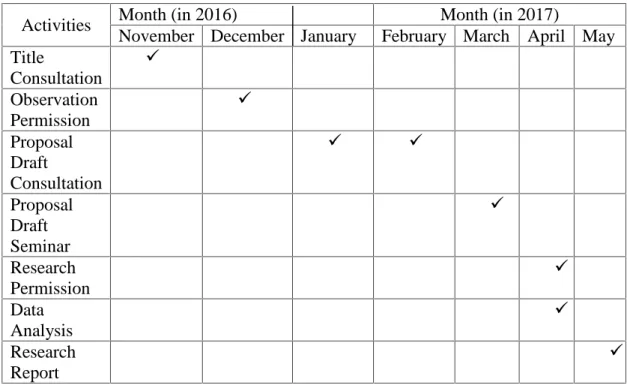
Table 3.1 Schedule of Result ... ... 45
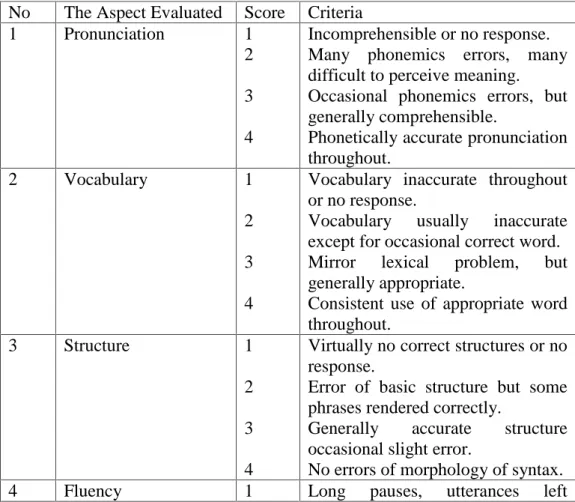
Table 3.2 The Criteria of Speaking Performance ... 47
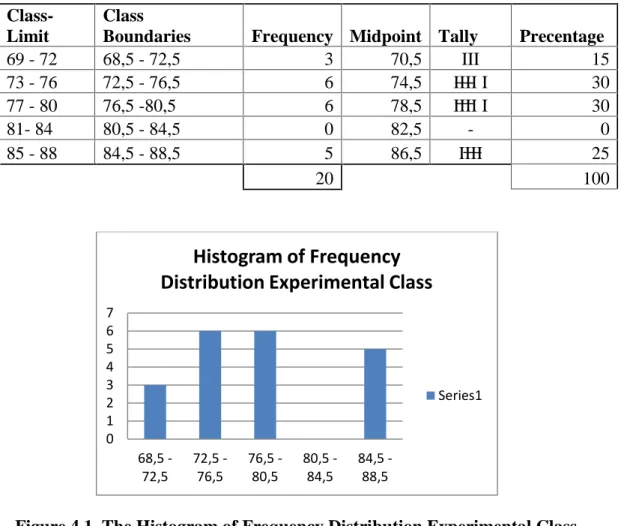
Table 4.1 Frequency Distribution of Experimental Class ... 55
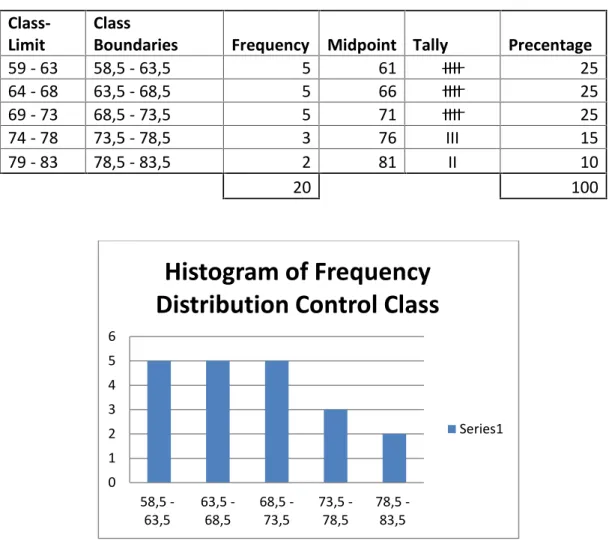
Table 4.2 Frequency Distribution of Control Class ... 56
Table 4.3 Normality Post Test of Experimental Class ... 57
Table 4.4 Normality Post Test of Control Class ... 58
Table 4.5 Homogeneity Test ... ... 59
xiii
Figure 4.1 The Histogram of Frequency Distribution Experimental
Class ... ... 55
xiv APEENDIX 1
Syllabe ... ... 74
APPENDIX 2
Lesson Plan Experimental Class ... ... 75
APPENDIX 3
Lesson Plan Control Class ... ... 76
APPENDIX 4
Sample of Students’ Post Test Score of Experimental Class... 77 APPENDIX 5
Sample of Students’ Post Test Score of Control Class ... 78 APPENDIX 6
1 A. Background of the Study
There are four skills which learners need to complete in mastering the
language when they learn a language. Those four skills include listening,
speaking, reading and writing which are called as the four “language skills”. Similar to any other language, English consist of those four skills. Of the four
language skills, speaking seems literally to be the most important skill to
master. According to Qureshi, the importance of Speaking skill as follows:
(1) Language is a tool for communication. We communicate with others, to
express our ideas and to know others’ ideas as well. (2) For a smooth running of any system, the speakers of a language need to be especially and
purposefully trained in the skill of speaking. (3) in order to become a well
rounded communicator one needs to be proficient in each of the four
language skill, but the ability to speak skillfully, provides the speaker with
several distinct advantages. (4) An effective speaker can gain the attention of
the audience and hold it till the completion of this message.
The new curriculum nowadays gives more chances for the students to
explore their ability in learning language by providing materials which can
enhance their language competence. Meanwhile, the students are asked to
explore the texts and present them by their own language. The students will
feel free to express the language spontaneously. As stated on the explanation
above, teaching English based on the 2013 curriculum is integrated. There are
However, as stated in the fourth core and basic competence, speaking skill is
required as the final product of teaching and learning English (Kemendikbud,
2013).
Nunan (1991: 23) states that the ability to function in another
language is generally characterized in terms of being able to speak that
language and the success of which is measured in terms of the ability to carry
on a conversation in that language. It means that the speaker should be able to
communicate so they can be understood by listener. Therefore, students are
expected to master speaking skill well to use as a system of communication to
obtain and share information with others.
According to Aprilian in her paper, there are two factors influencing
the successful achievement in teaching learning process. They are internal
and eksternal factors. Eksternal factors influencing the teaching learning
process. Eksternal factors include the social and nonsosial environment.
Factors including nonsosial one of them is the curriculum. Curriculum is a
plan for learning which is a substantial element in education. Without
curriculum, teaching and learning can not take place. The planning includes
materials and methods used by teachers. According Sudjana (in Wijayanti’s
paper), learning methods are the ways that teachers make contact students
during the learning takes place. In other words, the methods used in the
context of personnel approach between teachers and students, so that the
students are interested with the material being taught. A study will never be
Based on the researcher’s experience during Praktek Pengalaman
Lapangan (PPL) in the Tenth Grade students of MAN 3 Sragen, the 2013
curriculum is used. Kemendikbud in 2013 curriculum mentions three kinds of
learning methods that can be used by the teacher. They are Project Based
Learning (PjBL), Problem Based Learning (PBL) and ddiscovery learning.
The researcher proposes the use of Project Based Learning (PjBL) as a
method in teaching speaking.
Kemendikbud (2013: 182) defines project based learning is more
emphasis on individual or group projects carried out within a specified
period. Fried-Booth as quoted by Fauziati (2014: 168) state that Project Based
Learning (PjBL) as a bridge between using English in class and using English
in real life situations outside of class. According to the explanation found in
Project Based Learning handbook (2006: 3) Project Based Learning (PJBL)
learning activities are long-term, interdisciplinary, student-centered, and
integrated with real world issues and practices. By bringing real life, students
are encouraged to become independent workers, critical thinkers and lifelong
learners. Students can use the language throughout a Project as they negotiate
plans, analyze, and discuss information and ideas. This method gives students
big opportunities to present their own project.
Project based learning is an instructional strategy centered on the
learner. Blumenfeld et al., (1991: 53) Project Based Learning (PjBL)
develops students’ skills in areas such as problem solving, critical thinking, visualizing, decision making, cross cultural understanding, and reasoning, as
project based learning is instructional strategy of empowering learners to
pursue content knowledge on their own and demonstrate their new
understandings through a variety of presentation modes. Railsback (2002: 6)
say that project based instruction is an authentic instructional model or
strategy in which students plan, implement, and evaluate projects that have
real world applications beyond the classroom.
To teach speaking by using project based learning method there are
some activities that can be use by the teacher in teaching learning process.
The effective one is role play. According to Matthews, Sprat, and Dangerfield
(1991: 34) Role play is an activity in which the context and the roles of the
students are determined by the teacher, but students have freedom to produce
language which they feel appropriate to that context and to their assigned
roles. Based on explanation above, that is appropriate with project based
learning’s principle which stated that students as centred of teaching learning process.
Although 2013 curriculum is used at MAN 3 Sragen. The teachers
engage traditional method or direct instruction method in teaching English.
This method of teaching makes the teacher as the center of the teaching and
learning process. The teacher explains the material and asks students a
number of questions in the target language, which the students have to
understand and to be able to answer correctly. When the teacher is the center
of the teaching and learning, it means he/she is the real actor in the classroom.
Teacher gives explanation, present the material there by it can be concluded
(Arends, 1997: 64). These activities make the students get bored in joining
the teaching learning process. The students lose their interest in class and they
do not focus on learning anymore. The researcher argues that the teacher
should have some interesting teaching methods to motivate the students in
learning.
Based on the explanation above, the researcher wants to reveal
whether Project Based Learning (PjBL) is more effective than Direct
Instruction (DI) method. This method is believed to be useful to teach the
students’ speaking skill. Theresearcher is motivated and interested to analyze the effectiveness of this method to teach students’ speaking skill through a researcher entitled“The Effectiveness of Project Based Learning to Teach Speaking Skill in Tenth Grade Students at MAN 3 Sragen for Academic Year 2016/2017 (An Experimental Research)”
B. Problem Identification
In relation to the background of the study, the writer identifies several
problems as follows:
1. What is the importance of teaching speaking?
2. What factors determined the students’speaking skill?
3. Do teaching methods play significant roles to the students’ skill in Speaking English?
4. What is Project Based Learning (PjBL) method?
5. How is Project Based Learning Method (PjBL) applied to teach speaking
6. What is Direct Instruction (DI) method?
7. How is Direct Instruction (DI) method applied to teach speaking skill to
the students?
8. Is project based learning method more effective than direct instruction
method to teach speaking English to the students?
C. Problem Limitation
This research only focused “The effectiveness of project based learning to teach speaking skill in tenth grade students at MAN 3 Sragen for
academic year 2016/2017.”
D. Problem Statement
In order to be consistent and not out of track, the writer formulates the
research problems as “Is using project based learning more effective than direct instruction method to teach students’ speaking skill at the tenth grade students of MAN 3 Sragen for academic year 2016/2017?”
E. Objective of the Study
Referring to the problems above, the objectives of this research is“To know the effectiveness between project based learning and direct instruction
methodto teach students’ speaking skillat the tenth grade students of MAN 3 Sragen for academic year 2016/2017.“
F. Benefits of the Study 1. For the Teacher
For the English teacher, the result of the research is useful information
about the effectiveness of project based learning as a method on language
learning process, especially for speaking. The finding can give
advantages on their professional works. The teachers have to know which
method works best in the class considering the learning. It also motivates
them to find other method in order to develop a more creative teaching.
Using project based learning is one of teaching method in learning.
2. For the Students
This research is expected to increase their speaking skill through active
learning. Students are the subject of learning, so they should be active
and creative in doing all activities during the teaching and learning
process. Project Based Learning (PjBL) makes the students do their own
projects, they have to be active to look for some appropriate sources. If
they are active, they will have many ideas to get the best way for creating
a good speaking, so they can avoid being stuck.
3. For the other researchers
The findings can give advantages on their professional works since they
may find the methods used in this research as new method which are
appropriate in teaching speaking. It can also motivate them to find other
8
In this chapter, some theoris are provided to support the research, the
theories are devided into some parts. Those are speaking, teaching speaking,
project based learning, direct instruction method, previous study,rationale and
hypothesis. Beside those mention, there are some parts which are still devided into
sub units.
A. Speaking
1. Definition of Speaking
Speaking is communicative and interactive activity in which the
speaker and listener produce and receive meaning uttered among them. It
is supported by Nurgiantoro (in Siregar’s paper) says that speaking is the
activity delivering language and communicating ideas through orally.
Meanwhile, Brown (2004: 140) states that speaking is a productive skill
that can be directly and empirically observed. Those observations are
invariably colored by the accuracy and effectiveness of a tes-takers in
listening skill, which necessarily copromises the reliability and validity of
an oral production test. Furthermore, Lado (1961: 240) states that
speaking ability as the ability to express oneself in one sitiation or the
ability to report art or situation in precise words or the capability to
express sequence or ideas fluently.
Based on the definition above, it can be conclude that speaking is
speaker and listener. It means that we must speak fluently, accurately,
reasonably, and without too much doubt.
2. The Aspect of Speaking Skill
As one of the important subject in English as a Foreign Language
(EFL) learning, speaking is sometimes considered by the students more
difficult than other skills. It is due to the many aspects or components to
be mastered in order for the students to have perfect speaking. The
indicator of speaking can be infered by considering the aspects of
speaking proposed by some experts. According to Harris (1969: 81-82)
there are some aspect that should be recognized by language learners in
learning speaking, namely:
a. Pronunciation
Pronunciation is difficult component in learning speaking ability.
Pronunciation itself is defined as the way in which a word is
pronounced.
b. Grammar
Grammar is the rule in language for constructing and combining
sentences. It is important to be learned by language learner to produce
sentence correctly.
c. Vocabulary
Vocabulary is the basic knowledge to be own by language learners.
There will be a big problem for a language learner if he or she does
communicate effectively in term or producing and constructing
English sentence.
d. Fluency
Sometimes fluency is also used to measure that someone is capable or
incapable of using the language. Fluency is the speed of the flow of
the speed, it is the quality of being fluent in using the language suited
with flow or thinking and correct grammar.
e. Comprehension
Comprehension refers to the understanding of language including
comprehending what the speaker says. For oral communication, it
requires someone to response the speech if someone cannot
understand and comprehend someone speech, he or she cannot
respond what other speaker says automatically.
The researcher conclude that someone who wants to speak a
foreign language has to know the rules of that language, like
pronunciation, grammar, vocabulary, fluency, comprehension, word
formation, and to apply them properly in communication.
3. The criteria of Successful Speaking Activity
Based on Ur (in Nilsson, 2011: 7) said that the speaking is the
important part of language course, and there five characteristics for a
successful speaking activity:
a. Learners talk a lot
The students dominate the learning process, the teacher can encourage
b. Participation is open
The lesson should not dominate by only some students but all get
chances to talk and contributions are fairly evenly distributed.
c. Motivation is high
The teacher should prepare interesting topic to make the students
eager to speak or say about the topic. The teacher involves the
students in communicating and achieving task objectives.
d. Language is an acceptable level
Learners express themselves in utterances that are relevant, if the
language is too easy the motivation disappears. However, it is too
challenging students can be dejected and eventually give up their
work.
B. Teaching Speaking
1. Definition of Teaching Speaking
According to Brown (2000: 7) teaching is showing or helping
someone to learn how to do something, giving instructions, guiding in the
study of something, providing with the knowledge, causing to know or
understand. Thus, when the teacher teaches the students, it means that
teacher gives instruction for students to do something through some
techniques.
Teaching speaking which is oriented towards communicative
competence will develop students’ ability to communicate foreign language. According to Fauziati (2010: 15), teaching speaking should be
figured as central in foreign language pedagogy. The goal of teaching
speaking is communicative efficiency. This means that the learners should
be able to make themselves understood using their current proficiency.
Fauziati (2010: 16) also added that teaching foreign language is no
longer acceptable when focuses only on form since meaning is
paramount. She also said that the goal of foreign language teaching is to
develop communicative competence. According to Brown (1987: 8)
teaching is guiding and facilitating learning, enabling the learner to learn,
setting the condition for learning. Your understanding of how the learner
learns will determine of your philosophy of condition, your teaching style,
your approach, methods, and classroom techniques.
The definition above shows that teaching not only delivers
knowledge or information to the students, but also needs methods,
techniques and approach. The teacher must be able to decide what
techniques or methods which can be used to teach subject to reach the
goals.
2. Classroom Speaking Activities
Teaching speaking should be taught in attractive and
communicative activities. There are many types of classroom activities.
Kayi (2006) states thirteen classroom activities. They are Discussion,
Role Play, Simulations, Information Gap, Brainstorming, Storytelling,
Interviews, Story Completion, Reporting, Playing Cards, Picture
a. Discussion
After a content-based lesson, a discussion can be held for various
reasons. The students may aim to arrive at a conclusion, share ideas
about an event, or find solutions in their discussion groups. Before the
discussion, it is essential that the purpose of the discussion activity is
set by the teacher. In this way, the discussion points are relevant to
this purpose, so that students do not spend their time chatting with
each other about irrelevant things. For example, students can become
involved in agree/disagree discussions. In this type of discussions, the
teacher can form groups of students, preferably 4 or 5 in each group,
and provide controversial sentences like “people learn best when they read vs. people learn best when they travel”. Then each group works on their topic for a given time period, and presents their opinions to
the class. It is essential that the speaking should be equally divided
among group members. At the end, the class decides on the winning
group who defended the idea in the best way.
This activity fosters critical thinking and quick decision making, and
students learn how to express and justify themselves in polite ways
while disagreeing with the others. For efficient group discussions, it is
always better not to form large groups, because quiet students may
avoid contributing in large groups. The group members can be either
assigned by the teacher or the students may determine it by
themselves, but groups should be rearranged in every discussion
open to different ideas. Lastly, in class or group discussions, whatever
the aim is, the students should always be encouraged to ask questions,
paraphrase ideas, express support, check for clarification, and so on.
b. Role Play
One other way of getting students to speak is role-playing. Students
pretend they are in various social contexts and have a variety of social
roles. In role-play activities, the teacher gives information to the
learners such as who they are and what they think or feel.
c. Simulations
Simulations are very similar to role-plays but what makes simulations
different than role plays is that they are more elaborate. In
simulations, students can bring items to the class to create a realistic
environment. For instance, if a student is acting as a singer, she brings
a microphone to sing and so on. Role plays and simulations have
many advantages. First, since they are entertaining, they motivate the
students. Second, they increase the self-confidence of hesitant
students, because in role play and simulation activities, they will have
a different role and do not have to speak for themselves, which means
they do not have to take the same responsibility.
d. Information Gap
In this activity, students are supposed to be working in pairs. One
student will have the information that other partner does not have and
the partners will share their information. Information gap activities
information. Also, each partner plays an important role because the
task cannot be completed if the partners do not provide the
information the others need. These activities are effective because
everybody has the opportunity to talk extensively in the target
language.
e. Brainstorming
On a given topic, students can produce ideas in a limited time.
Depending on the context, either individual or group brainstorming is
effective and learners generate ideas quickly and freely. The good
characteristic of brainstorming is that the students are not criticized
for their ideas so students will be open to sharing new ideas.
f. Storytelling
Students can briefly summarize a tale or story they heard from
somebody beforehand, or they may create their own stories to tell
their classmates. Story telling fosters creative thinking. It also helps
students express ideas in the format of beginning, development, and
ending, including the characters and setting a story has to have.
Students also can tell riddles or jokes. For instance, at the very
beginning of each class session, the teacher may call a few students to
tell short riddles or jokes as an opening. In this way, not only will the
teacher address students’ speaking ability, but also get the attention of the class.
g. Interviews
Students can conduct interviews on selected topics with various
people. It is a good idea that the teacher provides a rubric to students
so that they know what type of questions they can ask or what path to
follow, but students should prepare their own interview questions.
Conducting interviews with people gives students a chance to practice
their speaking ability not only in class but also outside and helps them
becoming socialized. After interviews, each student can present his or
her study to the class. Moreover, students can interview each other
and "introduce" his or her partner to the class.
h. Story Completion
This is a very enjoyable, whole-class, free-speaking activities for
which students sit in a circle. For this activity, a teacher starts to tell a
story, but after a few sentences he or she stops narrating. Then, each
student starts to narrate from the point where the previous one
stopped. Each student is supposed to add from four to ten sentences.
Students can add new characters, events, descriptions and so on.
i. Reporting
Before coming to class, students are asked to read a newspaper or
magazine and, in class, they report to their friends what they find as
the most interesting news. Students can also talk about whether they
have experienced anything worth telling their friends in their daily
j. Playing Cards
In this game, students should form groups of four. Each suit will
represent a topic. However, the teacher should state at the very
beginning of the activity that students are not allowed to prepare
yes-no questions, because by saying yes or yes-no students get little practice in
spoken language production. Rather, students ask open-ended
questions to each other so that they reply in complete sentences.
k. Picture Narrating
This activity is based on several sequential pictures. Students are
asked to tell the story taking place in the sequential pictures by paying
attention to the criteria provided by the teacher as a rubric. Rubrics
can include the vocabulary or structures they need to use while
narrating.
l. Picture Describing
Another way to make use of pictures in a speaking activity is to give
students just one picture and having them describe what it is in the
picture. For this activity students can form groups and each group is
given a different picture. Students discuss the picture with their
groups, and then a spokesperson for each group describes the picture
to the whole class. This activity fosters the creativity and imagination
of the learners as well as their public speaking skills.
m. Find the Difference
For this activity students can work in pairs and each couple is given
and another picture of girls playing tennis. Students in pairs discuss
the similarities and/or differences in the pictures.
3. Speaking assessment
After the teacher knows how to teach speaking, the teacher should
know the appropriate technique of speaking assessment and the criteria of
speaking score. There are many types of oral test, one of them is defined
by S. Kathlen Kitao (2009: 2). The testing can be describes as follows:
a. Reading aloud
Test involving reading aloud are generally used when it is desire to
asses pronunciation as distinct from the total speaking skills. In order
to construct suitable tests on reading aloud, it is helpful to imagine
actual situations in real life in which the tests may be required to read
aloud. A test more useful in many ways than reading aloud is the
retelling story (S. Kathlen Kitao: 2009: 2).
b. Conversational Exchange
This type of test are especially suitable for the language laboratory
and can serve to focus attention on certain aspects of the spoken
language, especially in those countries where English is taught as a
foreign language and the emphasis is primarily on the reading skill.
The items types ranges from items presenting the taste with situations
in which they imitative conversations to incomplete conversations. (S.
c. Using visual material
Pictures, maps, diagrams, and other types of visual material can be
used to test speaking without requiring the taste to comprehend
written or spoken material. Through careful selection of the material,
the tester can control the vocabulary and, to some extent, the
grammatical structures required. (S. Kathlen Kitao: 2009: 2)
d. Oral video
Oral interviews are interesting situations in which the tester and the
taste carry on a conversation. The advantage of an interview is that it
attempts to approximate a conversation situation, but the knowledge
that it is difficult to have a real, natural conversation. (S. Kathlen
Kitao: 2009: 2).
e. Role Play
Role play is important techniques for assessing oral production. The
tests are evaluated on their ability to carry out the task in the role play.
In both teaching and learning process, it can be used to provide an
opportunity for meaningful and active involvement. (S. Kathlen Kitao:
2009: 2)
f. Group pair activities
To avoid the types of problems associated with oral interviews,
sometimes students are put together in pairs or groups that are given
some task, such as the ones mentioned above in the section on using
how students are thinking and using the target language. (S. Kathlen
Kitao: 2009: 2).
To measure students’ speaking skill, the English teacher should know the criteria to rate the students’ performance, because measure speaking skill is different with other skills. According to Nunan (2003:
325) there are five criteria used torate the students’ performance, namely overall communicative effectiveness. They are pronunciation, vocabulary,
structure, fluency, and comprehension.
Table 2.1 Nunan’s Criteria Speaking Score No The Aspect Evaluated Score Criteria
1 Pronunciation 1
2
3
4
Incomprehensible or no response. Many phonemics errors, many difficult to perceive meaning. Occasional phonemics errors, but generally comprehensible.
Phonetically accurate pronunciation throughout.
2 Vocabulary 1
2
3
4
Vocabulary inaccurate throughout or no response.
Vocabulary usually inaccurate except for occasional correct word. Mirror lexical problem, but generally appropriate.
Consistent use of of appropriate word throughout.
3 Structure 1
2
3
4
Virtually no correct structures or no response.
Error of basic structure but some phrases rendered correctly.
Generally accurate structure occasional slight error.
No errors of morphology of syntax.
4 Fluency 1
2
3
Long pauses, utterances left unfinished or no response.
Some define strumbling, but manages.
To rephrase and continue
Speech is generally natural and continues, occasional slight
4
stumbling or pauses at unnatural points in the utterance.
Sppech is natural and continues any pauses correspond to those which might be made by native speaker.
5 Comprehension 1
2
3
4
Not on topic. Little or no communication.
Clear but no on topic, very hesitant and brief utterances, sometimes difficult to understand.
Understandable, effective communcation in short turn.
Logical and flowing, easy and effective communication, uses long turns.
The researcher using Nunan’s criteria speaking score to measure students’ speaking skill, because five components of speaking can be tested reliably. On the other hand, it is the simplest and most frequently
employed technique of measuring students’ speaking skill.
C. Project Based Learning
1. The Concept of Project Based Learning
Project based language instruction is a flexible methodology
allowing multiple skills to be develop in an integrated, meaningful,
ongoing activity. Project based instruction (also referred to as Project
Based Learning (PjBL) or PjBL has been defined differently by various
authors, but perhaps at its simplest, it is an instructional approach that
contextualizes learning by presenting learners with problems to solve or
products to develop (Moss and Duzer, 1998: 2). Stoller in Fragoulis
already taking place in class. Based on taveras, et al (2009: 8), Project
Based Learning (PjBL) is instructional strategy of empowering learners to
pursue content knowledge on their own and demonstrate their new
understandings through a variety of presentation modes. Railsback (2002:
6) say that project based instruction is an authentic instructional model or
strategy in which students plan, implement, and evaluate projects that
have real world applications beyond the classroom.
Project Based Learning (PjBL) is an instructional strategy centered
on the learner. Hedge as quoted by Backett and Slater (2005: 108) states
that project based instruction was introduced into English as a second
language (ESL) education as one way to reflect the principles of student
centered teaching. Organizing projects is seen as an effective way to teach
language and content simultaneously. The use of project establishes a
direct link between language learning and its application, as well as to
create opportunities which allows students to develop their abilities in the
target language by interacting and communicating with each other and
with native English speakers (Backett and Slater, 2005: 108). Fried-Booth
(cited in Moss and duzer 1998: 2) adds that Project Based Learning
(PjBL) functions as a bridge between using English in class and using
English in real life situations outside of class. It does this by placing
learners in situations that require authentic use of language in order to
communicate.
According to Moss and Duzer (1998: 2) Project Based Learning
skills and subject matter in the process of creating their own projects.
Sometimes, there projects are solutions to a real world problem.
Nevertheless, what is most important in Project Based Learning (PjBL) is
that students learn in the process of making something. They work in
groups and bring their own experiences, abilities, learning styles, and
perspectives to the project. Blumenfeld et al., (1991: 53) Project Based
Learning (PjBL) develops students’ skills in areas such as problem solving, critical thinking, visualizing, decision making, cross cultural
understanding, and reasoning, as well as in written and oral
communication. Students engaged in Project Based Learning (PjBL) take
responsibility for their own learning and in so doing they become lifelong
learners. They also develop better interpersonal and communication skills.
Project Based Learning (PjBL) recognizes the varying abilities of the
students, allowing them to draw from their individual strengths to work in
areas of their own interest, thus giving them the opportunity to achieve at
higher level.
A major goal of project based instruction is comprehensible output
which generally occurs both during the project and as the final product of
the project (Beckett, 2002: 54). In terms of the final product, Stoller
(1997: 2) outlines several variations such as production projects,
performance projects and organizational projects, all of which yield
qualitatively deifferent end products. Beckett, in her dissertation on 1999
(cited in backett and Slater, 2005: 08), found that teachers reported having
enhancing cooperative learning skills, building decision making, critical
thinking, and learning skills: and facilitating the language socialization of
students into local academic and social cultures.
Project Based Learning (PjBL) allows instructor to teach the four
cores of English skills (along with related cultural elements) while giving
both instructors and students freedom in what project they choose and
how they carry it out. It is advisable that teachers do not seize full control
of projects but rather leave many things to be determined by students
(Alan and Stoller, 2005). In speaking skill, the Project Based Learning
(PjBL) will be drive students to be more active in doing their speaking
activity. The teacher will become facilitator in the class where the
students will be the center of the teaching and learning process.
2. Procedure of Applying Project Based Learning
There are many experts showing the stages of project based
learning. Fragoulis (2009: 113) conducts four stages in doing project
based learning. They are:
Stage 1: Speculation
This stage includes choice of project topic and sensitisation
about it, aiming at arousing interest and developing aclimate
conductive to speculation and investigation that will lead
smoothly to the research process. Topic is chosen after a
dialogue among all members of the group, and the teacher. The
discussion about a contemporary local or wider topic of interest,
or from reading a newspaper or magazine article.
Stage 2: Designing the project activities
This stage includes formation of groups and assigning of roles,
decisions concerning methodology, sources of information,
activities that will take place, and places outside the classroom
that students will visit. The better organised and more analytical
the structuring of the activities, the easier and faster the research
will be conducted.
Stage 3: Conducting the project activities
At this stage the groups implement the activities designed in the
previous stage. Students gather information, process and
categorize it. If deemed necessary, there may be intervals of
information and feedback, in which students discuss issues
related with cooperation among group members, problems of
personal relations, and possible changes in group composition.
The next phase is synthesis and processing of information
gathered. The final products are displayed in the school or the
wider community, and become a stimulus for thought and action
for other students, teachers and local community. The project
moves away from school and becomes social intervention,
Stage 4: Evaluation
Evaluation refers to the assessment of the activities from
participants and discussion about whether the initial aims and
goals have been achieved, implementation of the process, and
final products (Brinia, 2006:82). Evaluation also entails
assessment of the experience at individual and group level,
identification of errors and problems, but also appraisal of the
rich cognitive and experiential material gathered. Evaluation
includes evaluation from others, as well as self-evaluation.
Korkmaz and Kapten in Bas (2008: 5) evaluated the project based
learning in context of six steps. The processes and roles in these steps
have been shown below:
Table 2.2 The Processes and Roles of Project Based Learning
Application Process Things that will be done a. Stating the subject and
sub-subject, organizing the groups.
Students explore the resource and in order to create a frame for the project they state questions.
b. Groups create projects Group members make a project plan.
c. Application of the project Group members are organized and analyze the data and information.
d. Planning of the presentation The members define the essential points in their presentation and then decide on how to present the project.
e. Making the presentation Presentations can be made in any places.
f. Evaluation Students share the feedback of everyone on their project. Both the students and the teacher share the project(s) with everyone.
By adapting the two kinds of the stages above, here the researcher
formulates the stages of project based learning in teaching speaking. They
are:
a. Selecting topic
A project should reflect the interest and concerns of the learners,
projects typically involve topics from the curriculum that have the
standards. As a teacher and learners talk about projects and get know
each other, new topic and issues may come to light that are
appropriate for project learning. The teacher should give brainstorm
and ask students what attracts them. Then, the teacher identifies
standards that could be met through the project and aligns the learning
objectives to those standards. Be sure to integrate both conceptual
learning and skill building.
b. Making Plans
Once a topic is selected, learners work together to plan the project,
conducted research, and develop their product. Learners with low
language proficiency or little experience working as part of a team
may require structure and support throughout the project.
c. Doing research
Pre-project activities introduce problem solving strategies, language
for negotiation and methods for developing plans. Learners may also
need practice in specific language skills to complete project tasks. For
example, learners using interviews as an information gathering
asking questions as well as in taking notes. Information can vary
widely depending on the project. It can include going to the library,
researching on the internet, interviewing people, gathering materials,
etc. The teacher monitors all of the groups during the project.
The researcher use role play/ simulation as a technique of teaching
learning. The students will took the video during they do the role play/
simulation and the materials depend on syllabus on MAN 3 Sragen.
The researcher choose the video as the final product.
d. Sharing Results with Others and Making the Presentation
Project result can be shared in a number of ways. Oral presentation
can company video products within the classroom. Project products
can also be disseminated in the larger community. In this stage student
can practice their ability to be a good speaker and get the feedback
from their friends or groups. Each group takes its finished product and
presents the product of their project in front of the class. during this
stage, students become aware of the ways their presentations meet the
criteria of assessment. The teacher observes how they are presenting
their projects. It can become a stimulus for thought and action for
other students. This stage also drives them to practice oral language.
e. Evaluation
Other groups and the teacher evaluate together. In this stage, the
students learn how to evaluate the quality of other’s work based on the assessment criteria given by the teacher. It is the time for the teacher
the components of a good speaker (pronunciation, fluency,
comprehension, grammar, and vocabulary). The evaluation includes
evaluation from others, and teacher evaluation.
3. The Role of Teacher and Students a. The Role of Teacher
According Fan and Lee, there are some roles of teacher in project
based learning:
1) Pre-Project Stage
Help students select a topic
Help students generate ideas through brainstorming/ mind mapping
Guide students to formulate their project objectives Develop a contract/ proposal for the group
2) During Project Stage; The teacher play the role of a consultant, a
facilitator or a co-learner
Help students gather ideas, define objectives, draw up the schedule and provide input for language skills
Intervene if students’ directions to solve problems Respond to requests from students
The teacher seeks to help the students to focus on relevant aspects.
The teacher guides the students by asking questions and negotiating meanings with them
The teacher tries to frame the problems by referring to the findings of the problem
The teachers tries to monitor the students’ strategy for solving the problem
The teacher attempts to guide the students’ negotiation of meaning
3) Post Project stage; teacher play the role of a commentator and
appraiser
Debriefing; Centre on what students learned during the project, share the reflection, provide a balanced picture of strengths and
weaknesses, and offer suggestions for improvement.
Evaluation; Collect and analyze feedback and revise and improve the project
b. Role of Students
1) The students select the topic to make a project helped by the
teacher
2) The students make a planning, work together to plan the project,
conducted the research, and develop their product.
3) The students do the practice.
4) Sharing result and make a presentation in front of the class
5) The students learn how to evaluate the quality of other’s work based on the assessment criteria given by the teacher.
4. The Role of Technology
According to Blumfield et al (1991: 384) Technology can play a
powerful role in enhancing student and teacher motivation to do projects
and in helping studnets and teachers implement projects. The aim is to
show how technology can share some of the teacher’s responsibility for
helping students as they engage in project based learning. There are two
devisions of the role of technology according to them.
The first is technology and students which includes enhanching
interest, access to information, active presentation, structuring the
process: providing tactical and strategic support, diagnosing and
correcting errors, managing coplexity and aiding production.
The second is technology and teacher. Technology can play a role
in supporting teachers as they learn about and implement projects in the
classroom. Specifically. Teachers need to know about; a) project content
and powerful ways to ilustrate that content, b) project instruction (how to
help students plan, carry out, and evaluate their work), c) management of
project based learning, d) adaptation or generation of projects in light of
their students’ specific needs.
5. The Advantages and Disadvantages of Project Based Learning
There are many advantages of project based learning. According to
Railsback (2002: 9-10) and Ivanova (2009- 14), the advantages of project
a. Project work is student centered
Students have a significant voice in selecting the content areas and
nature of the project that they do. There are considerable focus on
students understanding what it is they are doing, why it is important,
and how they will be assessed.
b. Preparing children for the workplace
Students are exposed to a wide range of skills and competencies such
as collaboration, project planning, decision making, and time
management.
c. Increasing motivation
Project work is potentially motivating, stimulating, empowering and
challenging. Teachers often note improvement in attendance, more
class participation, and greater willingness to do homework.
d. Connecting learning at school with reality
The students retain more knowledge and skills when they are engaged
in stimulating projects. With projects, the students use higher order
thinking skills rather than memorizing facts in an isolated context
without a connection to how and where they are used in real world.
e. Providing collaborative opportunities to construct knowledge
Project work is cooperative rather than competitive. Collaborative
learning allows students to bounce ideas off each other, voice their
own opinions, and negotiate solutions, all skills that will be necessary
f. Increasing social and communication skills
Students will learn how to communicate with other people in their
group when they are doing a certain project. It will automatically
increase their social and communication skill because they have to
interact with different people who have different ideas and point of
view.
g. Increasing problem solving skills
There could be some problems or misunderstanding among members
of the group. They are demanded to solve their own problem.
h. Enabling students to make and see connections between disciplines
each students has his/ her responsibility in finishing a project. It
means that they have to do what group has told them to do.
i. Providing opportunities to contribute to their school or community
One kind of contributions can be the product they have made. Project
work culminates in an end product that can shared with others and
giving the project a real purpose.
j. Increasing self-esteem
Students take pride in accomplishing something that has value outside
the classroom.
k. Allowing students to use their individual learning strengths and
diverse approaches to learning. Project work leads to the authentic
integration of skills and processing of information from varied source,
mirroring real life tasks.
m. Project work focuses on content learning rather than on specific
language targets.
Ivanova (2009: 21) says that the disadvantages of project based
learning are as the following:
a. The learners use their own language
b. Some of learners do nothing
c. The groups work as different speeds
d. The students has lack of enthusiasm
e. The learners fail to see the value in project work
f. There is mismatch in expectations between learners and teachers.
D. Direct Instruction Method
1. Definition of Direct Instruction Method
Direct instruction is contrasted to Project Based Learning. The
previous discussion it is obvious that Project Based Learning is learned
centered model, but Direct Instruction method is teacher centered model.
When the teacher is the center of the teaching and learning, it means
he/she is the real actor in the classroom. Teacher gives explanation,
present the material there by it can be concluded that Direct Instruction is
also closely related to “lecture and presentation” (Arends, 1997: 64). Nunan (1996: 49) “………… in direct instruction, the teacher explicitly instruction the learner” it seems that both Arends and Nunan agree with its name proposed, the essential thing in Direct Instruction is “Instruction”
teacher instructs the students while students listen to teacher’s instruction as well as do the required things by teacher.
In this method, the teacher becomes the decision maker. The
teacher will be engaged in many planning decision, such as deciding what
he/she wants to teach, when he/she wishes to teach, and how he/she will
go about the learning process (Parsons, Hinson, and Brown, 2001: 11).
Direct Instruction Method highly structured and teacher directed. The
students are under the teacher control. The teacher direction and control
occur when the teacher selects and directs the learning tasks, determines
grouping patterns maintains a central role during instruction, keeps
students choice and freedom and minimizes the amount of non academic
pupil task.
2. Teaching Steps
Different theorist described and implemented Direct Instruction
somewhat differently but in general, this approach involves small careful
sequence steps. Face pacing, and great deal of teacher student interaction.
Each lesson typically involves most or all of the following components
(Rosenshine & Steven as cited in Astuti, 2013: 31):
a. Introduction Review of previously learned material. The teacher
reviews relevant content from previous lesson, checks homework
assignments involving that content, and re-teaches any information or
skills that students have not yet mastered.
b. Statement of the objectives of the lesson. The teacher describes one or
c. Presentation of the new material in small, logical sequence steps. The
teacher presents a small amount of the information or specific skill,
perhaps through a verbal explanation, modeling, and one or more
examples. The teacher may also provide as advance organizer, ask
question, or in other ways scaffold students’ efforts to process and remember the material. Throughout this and other phases of direct
instruction, teachers check frequently for understanding of all students
and provide immediate corrective feedback when needed.
d. Guided student practice and assessment after each step. Students have
numerous opportunities to practice what they are learning, perhaps by
answering questions, solving problems. Teacher use these to ensure
that every student participates and to check the accuracy of the
students’ responses in order to provide immediate corrective feedback. The teacher will stop only when students show that they can work on
their own.
e. Independent practice. Once students have acquired dome mastery,
they engage in further practice independently.
f. Frequent follow up review. Over the course of the school year, the
teacher provides the opportunities for students to review previously
learned material through homework assignment, writing task, or paper
3. The Role of Teacher and Students a. The role of teacher
1) Teacher is the only demonstrator. The teacher never translates but
demonstrates the meaning through the use of regalia, pictures.
2) Direct the class activities.
3) Students and teachers are partners in the learning process and there
is a large amount of learner, learner interaction.
b. The role of students
1) The teacher and students are more like partners in the teaching/
learning process.
2) The students’ role in direct method is the active learner. 3) The students are also observer and practitioner.
4. The Advantages of Direct Instruction Method
a. The benefits of students are direct instruction method seems to satisfy
the learners because the students just become the follower and depend
on help.
b. Direct instruction method refers to a pattern of teaching which
consists of teachers’ explaining a new concept to a large group of students where the way of explanation is straight forward way where
the teacher always gives feedback and correction for the mistake that
students made.
c. Direct instruction is also academic focus. It means that academic
of academic tasks in the classroom. It does not build social
relationship among the students.
5. The Disadvantages of Direct Instruction Method
a. The teacher centrality is strongly occurred in this method. It makes the
students become passive in joining the learning process. Direct
Instruction Method demands not only teacher direction but also strong
teacher direction.
b. This method does not promote achievement in creativity, abstract
thinking, and problem solving.
E. Previous Study
The first identical study was done by Zainal ‘Arifin (2014) from Sebelas Maret University Surakarta. The title of his research is “The Effectiveness of Project Based Learning Method in Teaching Reading for
Academic Purposes Viewed from Students’ Reading Interest (An Experimental Research)”. He did the research at the English Education Study Program of Institut Agama Islam Negeri Surakarta (IAIN) in Sixth semester
class in the academic year of 2012/2013. He concluded that there was
significant difference of the students’ academic reading ability between those who are taught using Project Based Learning and those who are taught using
Direct Instruction method.
The similarities between the research done by Zainal and the research
done by the research are; those are an experimental research the variables
Based Learning and Direct Instruction Method. Beside the similarities there
are differences in both the research done by Zainal and by the researcher is on
the dependent variable and the subject of the research. Zainal used Reading as
dependent variable while the researcher use Speaking as dependent variable.
Zainal did his research at the English Education Study Program of Institut
Agama Islam Negeri Surakarta (IAIN) in Sixth semester class while the
researcher in MAN 3 Sragen.
The second previous study was done by Ardhika Sari (UNS, 2015)
entitled: The Effectiveness of Project Based Learning to Teach Speaking Skill
Viewed from Students Risk Taking (An Experimental Research at the
Eleventh Grade of SMA 1 Gebog in the Academic Year of 2013/2014). In
this research, she found that Project Based Learning is more effective to teach
speaking. The students in experiment group have an authority to do their
project in their own way the students will be very active busy and challenged
to find information and give their own opinion or ideas to solve or finish the
task given.
There are similarities between the research done by Ardhika and the
research done by the research the similarities are; both research are an
experimental research, both research used speaking skill as dependent
variable, and both researcher used Project Based Learning as independent
variable to teach experimental group. While the differences are; the research
was done by Ardhika the independent variable to teach control group is Role
Play and the researcher was done by the researcher is Direct Instruction