VISUAL LITERACY IN ANATOMY
J. Bradley Barger
Submitted to the faculty of the University Graduate School in partial fulfillment of the requirements
for the degree Doctor of Philosophy
in the Department of Anatomy & Cell Biology, Indiana University
Accepted by the Graduate Faculty, Indiana University, in partial
fulfillment of the requirements for the degree of Doctor of Philosophy.
Doctoral Committee
April 29, 2016 ___________________________________________ Valerie Dean O’Loughlin, Ph.D., Chair
___________________________________________ James Brokaw, Ph.D. ____________________________________________ David Estell, Ph.D. ____________________________________________ Anthony Mescher, Ph.D.
Dedication
This dissertation is dedicated to Laura and Simon. The two of you have been the most supportive and loving family I could ever want.
Acknowledgements
I would like to thank all of the people who helped me see this project to completion:
Valerie O’Loughlin for guidance, mentorship, and being a fantastic committee chair.
The other members of my research committee James Brokaw, David Estell, and Anthony Mescher for valuable input on the research and writing process Jackie Cullison for helping to distribute and de-identify surveys.
The faculty of the anatomy department for feedback on survey and research design.
The students in all of my classes who were always supportive of trying new teaching techniques, and (usually) happy to complete surveys.
The other graduate students in the department who were a constant source of good ideas, encouragement, and fun times.
J. Bradley Barger
VISUAL LITERACY IN ANATOMY
All branches of anatomy (gross anatomy, histology, neuroanatomy, and embryology) involve significant amounts of visual identification. Understanding the spatial
relationship and visual representations of anatomical structures forms the basis for much of anatomy education, particularly in laboratory courses. Students in these courses frequently struggle with the visual aspects of identification, and many lack the metacognitive awareness to identify this problem. The research presented here details a series of experiments designed to elucidate the factors involved in
students’ difficulties with studying the visual aspects of anatomy. All of the research projects discussed involved surveying students about their specific study habits. Student populations surveyed include first-year medical students and
undergraduates in anatomy, physiology. These populations were surveyed about their study habits in each course, and their level of familiarity with visual learning. Additionally some populations were given a mental rotation test to assess their spatial abilities. These survey data were then correlated with course grades in an effort to determine the most successful study strategies. Active learning approaches (including student-produced drawings) were most strongly correlated with high course grades. However, efforts to teach lower-performing students active learning skills did not produce significant results, possibly due to the lack of a metacognitive component in this instruction. The results of each project indicate a lack of good study skills among students at all levels of anatomy instruction, and highlight the
need for more instruction in how to study for anatomy, including metacognitive awareness, especially focused on the visual aspects of the course.
Table of Contents
CHAPTER 1: Introduction ... 1
Definitions ... 5
Dissertation Research Outline ... 8
General arrangement of the dissertation ... 12
CHAPTER 2: Visual Literacy and Spatial Ability in Educational Research ... 14
Visual Literacy ... 15
Visual literacy as a concept, construct, cultural resource or measurable phenomenon? ... 20
The ACRL List of visual literacy competency standards ... 22
Visual literacy in Fine Arts ... 30
Visual literacy in biochemistry ... 34
Visual literacy in astronomy ... 38
Visual literacy in anatomy ... 38
What does the visual literacy research in the other fields mean for anatomy? .. 39
Spatial Ability ... 42
Does Gender play a role in spatial ability skills? ... 43
SA in fields other than anatomy ... 45
Spatial ability in geology ... 46
Spatial ability in chemistry ... 48
Spatial ability in engineering ... 51
Spatial ability in physics ... 52
Non-discipline specific spatial ability ... 53
Summary of Visual Literacy and Spatial Ability ... 60
CHAPTER 3: Materials, Methods, and Research Questions ... 62
Student populations and courses examined ... 63
Research Questions and Methodology of Each Project ... 66
Methodology ... 72
CHAPTER 4: Assessing Student Study Habits in Anatomy and Physiology ... 87
Methodology ... 90
Results ... 92
Discussion ... 99
CHAPTER 5: Visual Study Skills in Anatomy ... 103
Methodology ... 112
Results ... 114
Discussion ... 118
CHAPTER 6: Mental Rotation ... 122
Methodology ... 126
Results ... 127
Discussion ... 132
CHAPTER 7: In-class Drawings ... 134
Methodology ... 137
Results ... 140
Discussion ... 144
CHAPTER 8: Online Drawing Instruction ... 147
Methodology ... 148
Results ... 151
CHAPTER 9: Conclusions ... 156
Discussion ... 158
Limitations ... 174
Future Directions ... 177
Final Summary ... 178
APPENDIX A: Survey Design, Validation, and Sample Surveys ... 180
APPENDIX B: Mental Rotation Test ... 185
APPENDIX C: Course Syllabus Excerpts ... 198
APPENDIX D: IRB Documents ... 201
APPENDIX E: SPSS outputs ... 205
References ... 207 Curriculum Vitae
List of tables
1.1 The relationship between research questions and the individual facets ... 9
2.1 Visual literacy skills and competencies ... 41
3.1The relationship between research questions and the individual facets ... 73
3.2 Populations and participants ... 77
3.3 Populations and participants MRT ... 83
4.1The relationship between research questions and the individual facets ... 91
4.2 Populations and participants study habits ... 91
4.3 Correlations between study habits and grade by course ... 97
5.1Visual literacy skills and competencies ... 108
5.2The relationship between research questions and the individual facets ... 111
6.1The relationship between research questions and the individual facets ... 125
7.1The relationship between research questions and the individual facets ... 137
List of Figures
3.1 Example drawing from visual lecture ... 82
3.2 Draw It to Know It software example ... 85
4.1 Correlations of active learning and course grade ... 95
4.2 Correlations of pasive learning and course grade ... 96
5.1 Comparison of early and late semester visual learning... 115
5.2 Correlation of visual learning and final grade ... 116
5.3 Correlation of visual preference and final grade ... 117
5.4 Correlation of visual preference and visual learning ... 118
6.1 Mental rotation scores ... 128
6.2 Correlation of mental rotation scores and final grade ... 129
6.3 Correlation of visual study skills and mental rotation score ... 130
6.4 Correlation of visual preference with mental rotation score ... 131
7.1 Mental rotation experimental and control ... 141
7.2 Visual preference experimental and control ... 142
7.3 Visual studying experiemntal and control ... 143
7.4 Correlation of drawing and final grade ... 144
8.1 Draw It to Know It software example ... 149
8.2 Active learning and software use ... 152
CHAPTER 1: Introduction
Success in anatomy courses requires a variety of study skills, including the ability to understand visual representations of anatomical structures. Students in anatomy courses are often provided with instruction in how to study, but this instruction rarely includes a visual element. That is, if visual learning is recommended to students, the recommendation may not include all of the information a student needs to confidently engage in visual learning. Consequently, students are often left to interpret images using their existing (often inadequate) visual skills. It is the goal of this multi-faceted dissertation project to examine the visual skills students bring to anatomy courses, to examine if certain prior visual skills are necessary (or sufficient) to succeed in anatomy, to determine if students leave anatomy classes with a greater development of visual skills, and to explore methods of teaching visual skills to anatomy students.
The current literature in anatomy education has many examples of teaching spatial ability (with few devoted to visual literacy) to students (Keehner et al. 2006, Provo et al. 2002, Lufler et al. 2012, Luursema et al. 2008, Boudreau et al. 2008, Hegarty et al. 2009, Wanzel et al. 2002, Fuks et al. 2009, Garg et al. 2001, Lawrence et al. 2014, Roach et al. 2012, Roach et al. 2014, Roach et al. 2016, Backhouse et al. 2016, Pickering 2015, Mione, et al. 2013), but these are examples of specific experimental implementations, or research on new types of visual representations. There is very little published literature regarding the basic visual instruction given to students (Bardes et al. 2001). That is, outside of specific visual learning interventions, it is
unclear how students are instructed to understand images in anatomy courses. While these specific interventions (described in the above citations) provide valuable information about how students use images in learning, the information about student use of images outside of experimental designs is lacking. Data
collected from course syllabuses and instructor comments (only from five courses at Indiana University, see course descriptions in chapter 3) indicates that visual
approaches to learning are encouraged, but no class time is spent developing the skills needed to engage in visual learning (see appendices for course syllabuses). The published literature in visual learning indicates that acquiring the skills needed to understand images is not a passive process, and specific instruction is required for students to access the informational content of images (Titus and Horsman 2009 is a notable exception, this paper demonstrated significant passive acquisition of spatial ability in geology students). For a detailed summary of the published literature concerning visual literacy and spatial ability in anatomy students, see chapter 2.
The research presented in this dissertation is divided into three main components- examining students study skills, comparing visual literacy and spatial ability skills to course performance, and improving visual literacy and spatial ability in students. These three main components are further discussed in the following paragraphs, with detailed methodologies and results discussed in chapters 4-8.
Having reviewed the existing literature, and finding a lack of information about the visual literacy skills naïve students bring to their anatomy courses, the first step of
this dissertation project was to determine what our students are doing when
studying for anatomy. By examining their study habits, their familiarity and comfort with visual literacy and spatial ability can be inferred. Knowing what the students do to study, when not provided with any explicit instruction in study methods, helps to fill the gap defined above. That is, what kind of visual literacy skills do students bring to class? The first phase of dissertation research used early-semester surveys to determine what kind of study techniques students are using, without any specific training in how to study. Chapters 4-6 explore this question in greater detail, with detailed methodology and results included.
The second step in this dissertation was to determine if visual literacy (and spatial ability) skills change during an anatomy course. Acquisition of spatial ability (but not visual literacy) has been documented (Keehner et al. 2006, Provo et al. 2002, Lufler et al. 2012, Luursema et al. 2008, Boudreau et al. 2008, Hegarty et al. 2009, Wanzel et al. 2002, Fuks et al. 2009, Garg et al. 2001, Lawrence et al. 2014, Roach et al. 2012, Backhouse et al. 2016, Pickering 2015, Mione, et al. 2013) in a variety of science courses, including anatomy, but often only through a specific pedagogical intervention. Some studies (Titus and Horsman 2009) have shown a passive
acquisition of visual skills simply by taking a course, but this has not been frequently repeated. This part of the dissertation work used early- and late-semester surveys and mental rotation tests (MRT) to examine passive acquisition of visual skills. Chapters 5-6 deal with this question in greater detail, including detailed
The final major facet of this dissertation work explored ways of instructing students in using visual literacy and spatial ability skills in their studying. There are many published studies describing the benefits and drawbacks of specific pedagogical interventions in teaching visual literacy or spatial ability (Keehner et al. 2006, Provo et al. 2002, Lufler et al. 2012, Luursema et al. 2008, Boudreau et al. 2008, Hegarty et al. 2009, Wanzel et al. 2002, Fuks et al. 2009, Garg et al. 2001, Lawrence et al. 2014, Roach et al. 2012, Backhouse et al. 2016, Pickering 2015, Mione, et al. 2013 are just a sample, for a full accounting of the various debates in the visual learning literature, see chapter 2). A number of contradictions are apparent in the literature regarding the teaching of visual skills. For example, the literature examining two-dimensional vs. three-dimensional images, static vs. animated images, or interactive vs. passive representations; contains support for any of these visual representations as the ‘best’ for teaching different facets of anatomy. It may be that all types of visual representations are useful in different contexts, or with different students populations, or maybe the instruction in visual learning is the important feature, and the type of image is less important than the underlying visual skills being conveyed in these different instructional contexts. Sadly, this question is still unanswerable. The existing literature has yet to converge on a consensus, and this dissertation project does not argue for one variety of image or instructional
technique over another, but rather makes the case for spending time providing instruction in visual literacy and mental rotation as part of an anatomy course. To make that case, two different methods of teaching visual literacy were used. The first method included in-person drawing instruction combined with anatomy
content. The second method used a series of web-based drawing tutorials which allowed students to draw along with a narrator explaining neuroanatomy content. Both of these methods showed some increase in student use of visual study skills, again indicating that the teaching of visual literacy, at all, may be more important than the specific type of images being used. This result is seen many times in the literature review in chapter 2 (under subheading “Non-discipline specific spatial ability”). Full details of the pedagogical interventions used to teach spatial ability and visual literacy can be found in chapters 7-8 with methodology and results.
Definitions
Before continuing, it is worthwhile to carefully define some of the terms that are used frequently throughout the following projects. Study skills, study habits, visual
skills, visual learning, and visual study skills are some terms with variable definitions,
and they may be used by different authors in different ways. The following paragraphs define these terms as they are used in the context of this research.
Study skills, study habits, and study strategies are sometimes defined differently
(Credé and Kuncel 2008, Morehead et al. 2016), but in this research they are used interchangeably. Study skills (a.k.a. study habits or study strategies) are patterns of effort and techniques used by students outside of class to learn course material and prepare for exams (Schutte 2013, Husmann et al. 2016, McGuire 2015).
Visual skills are the entire set of mental processes related to understanding the
visual world, and include spatial ability and visual literacy. This definition is unique to this dissertation, as the term ‘visual skills’ has been used by different fields to
refer to any and all types of vision. (For example, researchers in human vision use ‘visual skills’ to refer to normal operation of the visual apparatus and brain, see Achtman et al. 2008). Visual skills (as used in this dissertation) will be discussed at length in the literature review, including the historical arguments about definitions and utility of visual skills in education.
Visual learning includes all of the activities a student may use to employ visual
skills in studying. This is closely related to visual study skills, and these two terms will often be used interchangeably. Visual learning has a well-established definition in the educational literature (Azer 2013, Estevez et al. 2010, Fernandez et al. 2011, Lufler et al. 2012, Nelson 2004).
Some additional terms are used frequently in this research, and may need a definition for consistency. These terms have widely recognized definitions, but other authors may use them slightly differently, so I will define each of the following as they are used in this research.
Active learning is any study approach in which the student physically creates
something (Drapkin et al. 2015, Pickering 2014, Sweeney et al. 2014, for examples of active learning in anatomy). Active learning can include writing, making a chart, drawing, or modeling. Discussions with other students or instructors can also be considered active learning. Some sources (LCME 2015) require students to create their own learning objectives for an activity to be considered ‘active,’ but that definition is not used here.
Passive learning is any study approach that does not produce a physical artifact.
Passive learning primarily consists of reading or listening to lectures. Rote copying may also be considered passive learning because it does not engage a student’s higher cognitive faculties. These definitions of active and passive learning focus on the physical product made by a student for the sake of simplicity. In reality, the main difference between these approaches the level of mental engagement a student has during the learning activity; however, measuring mental engagement is difficult, while measuring products made by students is easy. Therefore, production of a physical product is used a proxy for the level of student engagement (Prince 2004 for a meta-analysis of active learning literature, Griffith 2015 for a primary school example, Meyers and Jones 1993 and Silberman 1993 for some early examples of active learning research).
Superficial learning is focused on reproducing results, and is often used by novice
students who are grade oriented (Marton and Saljo 1976, Biggs et al. 2001, Young 2005, Billett 2001, Pandey and Zimitat 2007, Ramberg and Karlgren 1998). This approach leads students to focus on memorizing content in anticipation of examinations.
Deep Learning is a learning approach focused on understanding content and
making connections to existing knowledge. This approach is often used by students with more experience studying, and tends to lead to greater long-term retention (Marton and Saljo 1976, Biggs et al. 2001, Young 2005, Billett 2001, Karjcik and Blumenfeld 2006).
Metacognition is a conscious awareness of one’s own understanding of a topic
(Biggs 1988, Bransford et al. 2000, Bjork et al. 2013, Flavell 1979, Hacker et al. 1998, Kamp et al. 2015, Kornell and Bjork 2007, Metcalfe 2008, Vadhan and Stander 1994, Zohar and Barzilai 2013). Students new to college often lack the study skills and self-reflective skills to regulate their own learning, they “don’t know what they don’t know;” a definitive lack of metacognition (Bransford et al. 2000). Further, these novice students (as defined by Bransford et al.) are often unaware of even the
concept of metacognition, and are therefore, not only unable to regulate their own
learning, but are lacking the tools necessary to understand self-regulation
(Bransford et al. 2000). Many students are able to ‘trick’ themselves into thinking they know more than they actually do. A lack of metacognitive skills makes self-regulation of learning nearly impossible, and students may study inefficiently and approach exams with undue confidence (Kruger and Dunning 1999).
Dissertation Research Outline
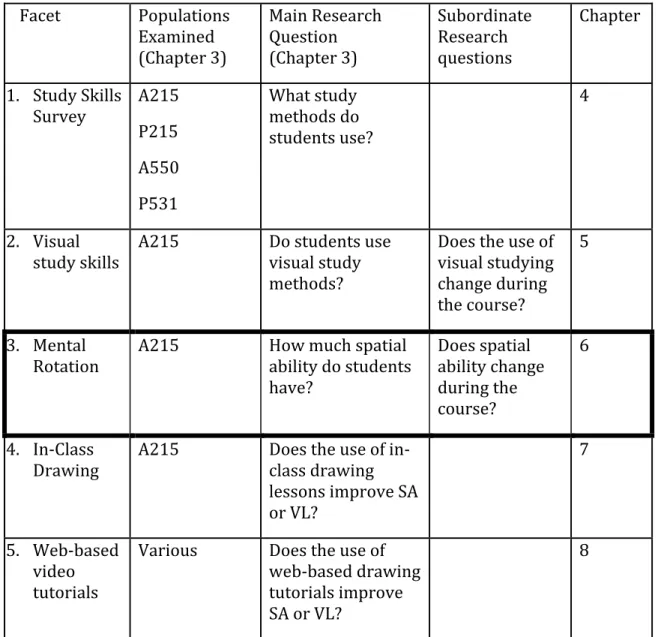
Unless one had abundant resources and an endless pool of volunteers, no single study could effectively address the three main components listed above (guided by the eight research questions described in chapter 3). Multiple different studies (entitled “facets”, below) were needed to examine each of the following research questions (for a detailed breakdown of the research questions see chapter 3, subheading “Research questions”). Sometimes, one study or facet could address multiple research questions. Thus, depending on the research question, one or more studies (facets) may provide evidence for the question. Table 1.1 provides a
Facet Populations Examined (Chapter 3) Main Research Question (Chapter 3) Subordinate Research questions Chapter 1. Study Skills Survey A215 P215 A550 P531 What study methods do students use? 4 2. Visual study skills
A215 Do students use visual study methods?
Does the use of visual studying change during the course?
5
3. Mental
Rotation A215 How much spatial ability do students have? Does spatial ability change during the course? 6 4. In-Class
Drawing A215 Does the use of in-class drawing lessons improve SA or VL? 7 5. Web-based video tutorials
Various Does the use of web-based drawing tutorials improve SA or VL?
8
Table 1.1- The relationship between research questions and the individual facets of the larger research plan.
The first facet of this dissertation research (entitled “what study methods do students use?“) examined the basic methods students use to study. A survey (see survey design in Appendix A) was developed which asks students to report how frequently they engaged in a variety of study habits while studying for courses. This survey was given to undergraduates in anatomy, undergraduates in physiology, first-year medical students (MS1) in anatomy, and MS1s in physiology. All students
surveyed were on the campus of Indiana University, Bloomington. A four-way comparison was then conducted to look for differences in study approaches in the two different classes at two different levels. Some of these data were previously reported in Husmann et al. 2016. Husmann et al. examined the changes in study skills exhibited by individual students between their different classes. The analysis of changing study skills is not part of this dissertation. The correlations of study skills with grades reported in this dissertation have also been presented as a poster at the Experimental Biology national meeting 2011 (Husmann and Barger 2011). The detailed methodology, results and discussion of this facet may be found in chapter 4 of this dissertation.
The next facet of this dissertation research (entitled: “visual study skills”) involved a more refined survey (Survey Appendix A), which included more specific questions dealing with visual approaches to studying. This survey was given only to
undergraduates, due to the relatively small number of medical students available for research (n = 36). Additionally, a mental rotation test (MRT) was developed by modifying the work of Bodner and Guay (1997). The MRT functions as a measure of students’ ability to mentally manipulate two-dimensional representations of three-dimensional objects. This ability is necessary in anatomy, and a student’s MRT scores have been shown to correlate with success in visually oriented science courses (Keehner et al. 2006, among many others detailed in the literature review). Preliminary versions of the results found in chapter 5 were also presented at the Experimental Biology national meeting 2012 (Barger 2012). The detailed
methodology, results and discussion of this facet may be found in chapters 5-6 of this dissertation
Having established a baseline of student performance and visual skills, the third part of this dissertation research introduced a pedagogical intervention designed to improve student MRT scores, visual approaches to studying, and course success metrics. This intervention consisted of teaching students how to draw specific anatomical structures, while learning the normal anatomy course content, during regular lectures. The instructor led the students through guided drawings of anatomical structures, while explaining their functions and relationships. Students involved in this intervention showed small improvements in the above measures, but none of the changes reached statistical significance. Preliminary versions of the results found in chapter 7 were also presented at the Experimental Biology national meeting 2013 (Barger and Husmann 2013). The detailed methodology, results and discussion of this facet may be found in chapter 7 of this dissertation.
In an effort to increase student exposure to anatomical drawing, the next facet of this research moved all of the experimental materials (surveys, MRT, and drawings) to an online environment, with the goal of delivering more drawing practice to busy students. The online drawings were part of a software tool called Draw It to Know
It. This software was developed by a neurologist (and former IU student) who was
unconnected to the research (Draw it to know it 2016). This phase of the research showed that a proportion of students are resistant to visual learning, an expected, but disappointing finding. However, even among students who reported a distaste
for visual learning in general (and drawing specifically) they reported
understanding the necessity of learning how to use images in their studying. The detailed methodology, results and discussion of this facet may be found in chapter 8 of this dissertation.
All of these pieces, taken as a whole, show the need for increased instruction in visual skills for anatomy students. Many students enter college (or medical school) with inadequate visual learning skills, do not necessarily understand the utility of visual communication, and have no way of improving these skills without specific instruction. The following chapters will explain each of these facets in greater detail, with a final summary detailing the pedagogical implications for anatomy instructors.
General arrangement of the dissertation
The following chapters in this dissertation are arranged around the research questions and individual projects defined in Table 1.1 (above), starting with chapter four. Preceding the individual projects chapters, chapter 2 is a summary and discussion of the existing publications related to visual literacy and spatial ability. Chapter 2 is subdivided in specific sections dealing with visual literacy (with specific examples from many of the disciplines to have researched the teaching of visual literacy) and spatial ability (again with a discipline specific organization of the literature). Chapter 3 outlines the research questions guiding the research conducted in chapter 4-8. Chapter 4 reports the detailed methodology, survey, and student populations used to establish the baseline of student study habits followed by results. Chapter 5 contains detailed methodology, survey, and
student populations used to research the visual literacy of anatomy
undergraduates, with results. Chapter 6 introduces a measurement of spatial ability, and contains the detailed methodology of measuring spatial ability in anatomy undergraduates, with results correlating spatial ability with a variety of other measures of success in an anatomy course. Chapter 7 introduces a
pedagogical intervention (in-class drawings) designed to teach spatial ability and visual literacy, and compares an experimental and control group in measures of spatial ability, visual literacy, and course grades. Chapter 8 uses a similar
pedagogical intervention to that in chapter 7, but the drawings are delivered through a web-based series of video tutorials. Chapter 8 contains detailed methodology and results, comparing use of the web-based tutorials to mental rotation score, visual literacy, and other study skills. Chapter 9 is a detailed
discussion, summarizing the results of the previous chapters, relating the research of this dissertation to the exiting literature, and discussing limitations of the
current research. Following chapter 9 are a series of appendices including the surveys used, the statistical validation of the surveys, the mental rotation test used, IRB approval numbers, IRB informed consent documents (also called ‘study
information sheets’), IRB recruitment documents, and syllabuses from courses surveyed.
CHAPTER 2: Visual Literacy and Spatial Ability in Educational Research
All four branches of the anatomical sciences (gross anatomy, neuroanatomy, embryology and histology) share the properties of visual identification, understanding of structure/function relationships, and understanding the
relationships and interconnections of all the parts of the body. To be successful in anatomy courses, a student needs a strong set of visual-spatial skills, due the importance of visual identification of structures in anatomy courses. To be
successful in visual identification, a student must be able to apply a variety of visual skills. These skills include visual literacy, spatial ability, and mental rotation. Visual
literacy (VL) is the skill of interpreting visual images (Avgerinou and Ericson 1997, Fransecky and Debes 1977). This skill includes interpreting drawings of anatomical structures, three-dimensional models, and charts or graphs. While this short
definition of VL seems simple, it contains a long and complicated history which will be discussed in the following section.
Another term occasionally seen in the literature is pattern recognition. This term is most frequently associated with foreign language learners (Martinez-Trinidad and Guzman-Arenas 2001), and computer-based neural networks designed to identify patterns (Carpenter and Grossberg 1988). While this term accurately describes some of the behaviors anatomy experts use in identifying structures and relationships (Berliner 1988), it is used infrequently in publications related to visual literacy pedagogy.
Spatial ability (SA) is the related, but distinct, ability a person has for mentally
manipulating three-dimensional mental objects (Linn and Peterson 1985, Linn and Peterson 1986, Lohman 1979). Mental rotation (MR) is a specific sub‐category of spatial ability, and will be used as a measurement of spatial ability (Bodner and Guay 1997). These three skills (VL, MR, and SA), which I will collectively define as
visual skills (VS), are critical for success in all fields of anatomy, and in many other
science courses, but are often overlooked by students. Instructors can also
overlook the need for visual skills, and it is often assumed that students will begin the course with the relevant background skills, or pick them up during the course, without any specific instruction in improving visual skills (Faurie and Khadra, 2012). (As clarification of the term ‘visual skills,’ I am unaware of any educational literature that uses this term. When the term ‘visual skills’ appears in published literature, it is often used as a near synonym for ‘visual ability,’ that is, the actual functions and processes related to normal human vision. I am using the term ‘visual skills’ to refer to the mental processes students use to make meaning from images, and not to the functioning of their eyes). Spatial ability and mental
rotation will be discussed in the last section of this chapter.
Visual Literacy
Visual literacy (VL) is the ability to meaningfully interpret static and dynamic
images, and has a long and contentious history, described in the following pages (Avgerinou and Ericson 1997). Despite the simple, one-line definition for visual literacy given above, it is a complicated and wide‐ranging topic that has resisted a
firm definition for the last fifty years. Practitioners and researchers in a variety of fields have each applied their own unique definition to this term, making it even harder to reach a consensus definition (Avgerinou and Ericson 1997). Very little has been written about visual literacy in anatomy or biology, so this review will include literature from other fields, including biochemistry, astronomy, and fine arts. Additionally, writings by philosophers and historians of science (Pauwels 2006, Marcaida 2016), sociologists (Grady 2006), and graphic designers (Tufte 1990) will be considered in order to help define the limits and goals of visual literacy. The other gap in the visual literacy literature is in assessment. So much time and effort has been spent in trying to define ‘visual literacy’ as a term, that few writers have commented on the most effective ways of teaching the actual skills involved in visual literacy. The lack of assessable goals for the visual literacy movement is directly linked to the definition problem, and a major source of concern for educational psychologists (Seels 1994).
Visual literacy was first defined in 1969 by John Debes as “…a group of vision-‐‐ competencies a human being can develop by seeing and at the same time having and integrating other sensory experiences… when developed they enable a visually literate person to discriminate and interpret visible actions, objects, symbols… Through the creative use of these competencies he is able to
communicate with others,” (Fransecky and Debes 1972, Avgerinou and Ericson 1997, p. 281.) In the intervening years, most other authors on the subject of visual literacy have modified this definition to best fit their field of study; these
will be discussed in greater detail in the discipline specific sections to follow. However, all of the subsequent definitions seem to retain the basic kernel of interpretation of symbols, and visual communication. A full summary of the historical debate concerning VL is beyond the scope of this work, as I will be focusing on the current definitions and applications in use across a variety of fields. For a review of the history of VL see Avgerinou and Ericson (1997).
While I will not be exploring the historical squabbles over semantics in VL, there have been a few interesting arguments made against VL as a term and as a concept. Some authors (e.g., Cassidy and Knowlton 1983, Suhor and Little 1988) have even argued for abandoning the term as a misleading and potentially damaging concept. Suhor and Little (1988) argue that semiotics already
encompasses the majority of what is meant by visual literacy, and that education in semiotics is more valuable than creating a new term of visual literacy. While I agree that semiotics and VL have some overlap (discussed in the section on Fine Arts, below) I do not think VL and semiotics are synonymous enough for one concept to replace the other. Cassidy and Knowlton (1983) argue that the term “visual literacy” is used as a scientific metaphor, and that it fails on the principles used to judge other scientific metaphors. However, I find their argument a weak one, because they have applied their own definition to the term “visual literacy” which seems to overlook the goal of the original definition. The definition used by Cassidy and Knowlton (1983) very literally interprets the various meaning of ‘visual’ and ‘literacy’ in such a way that “visual literacy” as a separate concept can
no longer exist. They also argue that no evidence has been shown that visual literacy can be taught, and that the ‘definition problem’ (defined earlier) has actually been counterproductive to inquiry in this field. I agree with both of these arguments, but that alone is not enough to destroy the concept of VL. Cassidy and Knowlton do concede the utility of images in communicating complex concepts, but argue that all normal humans are able to communicate with images without any specific training. This is my biggest problem with their argument against VL. Understanding and communicating with non-arbitrary (representational) images is just as complicated as learning to communicate with the arbitrary symbols used to create words and sentences, especially when applying all of the
discipline-specific ways of using images (Seels 1994). Since the early 1980s, the arguments against the utility of visual literacy seem to have subsided. The last thirty years have seen tremendous growth in the number of visual images in daily life, and most authors now seem to agree that educating students to critically interpret images has value (Avgerinou and Ericson 1997, Alenn 1994, Glasgow 1994, for a discussion of visual literacy as a tool against pressures of advertising and consumerism and Ainsworth et al. 2011, Dempsey and Betz 2001, Heuschele 1999, Lyon et al. 2013 for a representative sample of the small number of
publications to discuss the utility of VL in science). In fact visual literacy has become so widely accepted as a field of inquiry, that a Journal of Visual Literacy was founded in 1989, and still publishes two issues each year. The content of this journal is more abstract and philosophical in nature, and rarely deals with
valuable resource to instructors interested in improving visual literacy in
students. The remainder of this chapter will examine the current state of the VL debate, how VL has been taught, and the necessity of teaching VL to novice learners in a variety of fields, including anatomy.
As a direct counterpoint to the arguments against VL as a concept and a field, this section will explore some of the literature focused on attempts to teach VL, and the researchers who have defined the need for VL education.
In people with normal visual acuity, vision is the primary sensory modality mediating the experiences of the world, so understanding the interpretation of visuals is of obvious interest (Avgerinou and Ericson 1997). Additionally, the use of images as communication has only increased in recent years, leading
Avgerinou and Ericson (1997) to coin the term “bain d’images,” literally a bath of images, an apt description for the prevalence of visual communication in mass media. This constant input of visual communication means that skills must be developed to interpret and analyze these images. Cassidy and Knowlton (1983) might argue at this point that understanding images does not require specific skills, but it is the deeper meaning and fine details of an image that are so often ignored without the use of visual literacy (Sless 1984, Seels 1994). Attempts at introducing visual literacy into school curricula (of all grade levels) go back decades, with varied goals and success rates (Avgerinou and Ericson 1997, Alenn 1994, Glasgow 1994). Many of the earliest attempts to teach VL focused on
primary and secondary school students, with the goal of critical analysis of advertising. This skill is one way of teaching VL, and a valuable exercise, but not specifically relevant to teaching anatomy to post-secondary students. Therefore, a following section will summarize recent projects aimed at teaching VL to college undergraduates and professional students in a variety of fields, with the goal of distilling a working definition of VL, and supporting its value as a
continued realm of inquiry.
Visual literacy as a concept, construct, cultural resource or measurable phenomenon?
If visual literacy has proven so hard to define, but so resilient as an idea, what kinds of definitions have been attempted? This section is an attempt to
summarize some of the most interesting definitions and conceptual schemes that have been applied to the idea of visual literacy. Sless (1983) argues that visual literacy is “a cultural resource, not an experimental result” (p.228). He explains this position by arguing that visual communication has existed for centuries, and current psychological tools are still not able to understand the complex
interactions that make this possible. Sless continues to say that there are undeveloped areas of education where visual literacy can be employed, but empirical research should not necessarily be the goal.
Despite the decades of argument and lack of consensus, visual literacy has persisted as an idea and as a term, only becoming more prominent in recent
years with the growth of visual communication technology. Even if the term remains difficult to define, the idea of visual literacy has utility in science education that will be examined in the following sections.
While a consensus definition of visual literacy amongst all interested parties may never be possible, the following section will explore recent developments and current plans for the visual literacy idea. A recent group to tackle this problem of defining and assessing VL has been The Association of College and Research Libraries (ACRL) who released a set of standards for VL in October 2011 (Hattwig et al. 2013). With this new, highly versatile, and all‐encompassing definition, perhaps future researchers can shift their focus from the “definition problem” to assessing the effectiveness of teaching VL (as mentioned by Perkins 1994). Assessment has still been given short shrift in the ACRL list. Even in the new standard, assessment only merits a few sentences in the twelve-page document. The ACRL opinion of assessing VL competencies is the same as previous authors, and is still a work in progress. This is one goal of this dissertation; to find effective ways of teaching and assessing visual literacy and spatial ability in anatomy students. Despite the assessment weakness, the ACRL standard still has a lot of strengths, in that it cleanly defines seven competencies of VL that have been approached by the previous authors on the subject. The seven competencies are summarized below, as well as how previous authors (in a variety of fields) fit into this new scheme.
The ACRL List of visual literacy competency standards
The ACRL have defined seven competencies or skills that a student must exhibit to be said to be visually literate (Hattwig et al. 2013). These seven skills follow a hierarchical organization similar to Bloom’s taxonomy (Anderson et al. 2001), in that the student must first be able to identify a need for visual materials, before moving on to interpreting, evaluating, or creating visual materials. The ACRL seven competency of visual literacy (Hattiwig et al, 2013) are as follows:
1. Determine the nature and extent of the visual materials needed 2. Find and access needed images and visual media effectively and
efficiently
3. Interpret and analyze the meanings of images and visual media 4. Evaluate images and their sources
5. Use images and visual media effectively
6. Design and create meaningful images and visual media
7. Understand many of the ethical, legal, social, and economic issues surrounding the creation and use of images and visual media, and access and use visual materials ethically
Each of these competencies are described in detail in the subsequent paragraphs.
Competency 1: Determine the nature and extent of the visual materials needed.
The first competency defined is to determine a need for visual material. This means that a visually literate student can define a need for images in a given context. This specific skill is a widely accepted part of the VL literature, with many authors commenting on the need for restraint in the use of images (Pauwels 2006, Tufte 1990, Trumbo 1999).
Anatomy students find this first skill challenging for two reasons. First, they often miss the utility of an image to convey lecture content. For example, a student may
not realize the direct connection between the vocal folds and arytenoid cartilages when this concept is described verbally, but upon seeing an image of this
connection, the concept becomes clear. A student with high visual literacy, and an understanding of the need for appropriate images, can find or construct this kind of image from the verbal description, while a student with low VL cannot. The second challenge for anatomy students in using this skill is overuse or over‐reliance on images. Over reliance on images shows up most frequently when a student will simply glance at an image, without taking the time to understand the meaning conveyed. This may also be considered as a misuse of the image, but it is related to the above competency in that relying solely on images while ignoring text and context is a common pitfall for the student with underdeveloped visual literacy skills. One of the biggest risks in use of images is making an image too complicated, a frequent problem for introductory anatomy students when using anatomical atlases. The over-complication of images is one of the reasons students fail to fully develop their visual literacy skills. When a novice learner is presented with expert-level visual aids, they can easily feel overwhelmed, and without proper scaffolding in visual literacy training, they may stop using images altogether.
Competency 2: Find and access needed images and visual media effectively and efficiently.
The second competency is the ability to find appropriate images once a need for an image has been defined. Finding images has a place in the larger conversation
about visual literacy, but does not play an important role in the use of images for anatomy students. Anatomy students have access to a wide variety of anatomical images in textbooks, lab guides, coloring books, and websites, so assessing and evaluating those images for content and applicability (competencies 3 and 4) becomes much more important.
Competency 3: Interpret and analyze the meanings of images and visual media
The third competency is, in many ways, the core of the original definition of VL. This skill can essentially be rephrased into Debes original definition of “the ability to make meaning from an image” (Fransecky and Debes, 1977). It is interesting that the original definition of VL is now placed at the middle of the hierarchy, indicating that there are even more basic skills needed before a student can begin to make meaning from an image. The fact that there are also more complicated skills, which build on the ability to interpret an image, tells us that reading an image is not the only goal of VL, and many of the early definitions missed a key component of VL. Much like verbal literacy, reading and interpreting a passage is not enough, a student must be able to evaluate, use, and create text to truly have verbal literacy.
For most anatomy students, this skill is where they will spend most of their time. Making meaning from an image is what students do when they study anatomy atlases, and it is also how most student learning is assessed in anatomy laboratory
identification of an image (histological, photographic, or radiological), a model, or a dissection (for a detailed examination of this topic, see Chapter 9 which explores the role of ‘authentic assessment’ in student learning). If instructors are using visual literacy skills as a major part of assessing student learning, then visual literacy skills must be taught side-by-side with course content. Additionally, making meaning from images is a critical diagnostic skill for physicians (again histology and radiology, specifically), so competency #3 has obvious clinical applications (Murphy et al. 2014).
Competency 4: Evaluate images and their sources.
The fourth competency of evaluating images incorporates several meanings in the idea of evaluation. First, a student must be able to critique the effectiveness of an image; does it convey the intended meaning? What features are missing from this image because of the choices made by the artist? The second definition of evaluation involves the reliability of image sources, an important consideration with web-sourced images, but (hopefully) not one that students will encounter in textbook or lab images.
Evaluating images may be too lofty a goal for most anatomy students, but if this idea can be discussed (even briefly) in a laboratory context, it will lead to students applying more critical thought to their observations. All images are an attempt to communicate, and in any form of communication, choices must be
made about what is worth conveying, and how best to do that. If students can be taught to consider the choices made in the construction of an image, they will gain a better understanding of the subject matter.
Competency 5: Use images and visual media effectively.
The fifth competency defines the use of images, but more specifically relates to the use of images to communicate ideas. To meet this competency, a student must be able to do all of the preceding steps, but is now selecting and curating their own images to communicate new ideas. In my personal experience, I have seen this skill used most frequently in histology. Much of a student’s time in histology labs is spent scanning through slides on a microscope, and checking with an instructor to ensure the correct cells and tissues have been identified. With new virtual microscope software, students can now view high-resolution scans of traditional microscope slides on a computer, and capture images from the slides (Husmann et al. 2009, Collier et al. 2012, Bruch et al. 2009, Braun and Kearns 2008). Capturing and labeling microscope images is exactly the process of “selecting and curating images to communicate ideas,” a clear fit with the fifth competency as defined by the ACRL.
Using images, as defined by the fifth competency, can also relate to a student explaining a concept with an image. For example, if students were given the opportunity to present research findings in a visual way, while explaining the
image, that may demonstrate this competency. Additionally, a multiple choice examination question could ask a student to match a concept with the image that illustrates the concept. There is a place for this competency in anatomy
education, but the current structure of many anatomy courses (lecture-based with purely verbal multiple-choice exams) may make this idea harder to
integrate in the classroom or laboratory. Of course, this competency is frequently modeled by instructors who will often use and explain images in lectures. A short description by the instructor to make explicit that the lecture is a model of a type of visual literacy, could help students understand this competency. If students are then encouraged to use this behavior during their own study time, by writing explanations of images, or using images to describe concepts to peers, this competency can easily be taught.
Competency 6: Design and create meaningful images and visual media.
The sixth competency has the students creating their own, new images. Much like in (some revisions of) Bloom’s taxonomy, creation is the highest goal of the truly successful student (Anderson et al. 2001). In the ACRL scheme, the creation of appropriate, meaningful, and necessary images will best be understood once a student has exposure to all of the components that unite to form a good image. In anatomy, creation of images is often suggested by instructors, but without the appropriate scaffolding of the lower levels of visual literacy. Producing images to convey meaning is a challenging goal. For students to begin making meaningful
images, they must first be instructed in the lower levels of image understanding. The lower levels are easy to overlook, especially in a content-based course where visual instruction is an afterthought. Much of the content in following chapters will deal with different instructional interventions designed to instruct anatomy
students in image creation.
Competency 7: Understand many of the ethical, legal, social, and economic issues surrounding the creation and use of images and visual media, and access and use visual materials ethically
The seventh competency lies somewhat outside the context of communicating with images, and focuses on the ethical and cultural practices associated with images. This is an important idea, but not one that has been discussed much in previous literature. Publications dealing with the ethics of body donation are quite common (Champney 2016, Fonseca 2016, Winkleman et al. 2016), including several recently published articles detailing ‘best practices’ for maintaining transparent and ethical body donation programs (Jones 2016, Riederer 2016, Schmitt 2014). However, few of these papers deal explicitly with the ethical questions of producing images from donated specimens (exceptions include Cornwall 2016, Cornwall et al. 2016). Issues such as ethical production and acquisition of images can be important for artists and publishers, but rarely appears in the science literature. Many, maybe all, images used in human anatomy are based on human specimens. This has obvious ethical implications when an
image is a photograph of a human cadaver (Jones et al. 2003, Barilan 2005, Barilan 2006, Cornwall et al. 2016). Human remains willed to schools as a part of a body donation program are subject to guidelines and informed consent documents, but no specific legal protections exist in all jurisdictions (body donation ethics being an international concern) (Jones 2016). The guidelines and consent documents provided to body donors frequently include a limited period of use (Jones 2016), but a photograph of a body may violate the terms of use. Additionally, body donors may be unaware of the possibility of their remains being subject to a permanent photographic record, and may be uncomfortable with that possibility, especially when images of body tissues are not considered in the original donation documents. The wishes of the body donor must be considered to ensure ethical production of images (Jones 2016). A new study also discusses the ethics of 3D printing of anatomical models based on actual human remains (Cornwall 2016). Three-dimensional printing is a new technology for producing 3D images
(models) that has only recently been explored for the making of anatomical images, and the ethics of this practice will doubtless become a productive area of discussion in the coming years (McMenamin et al. 2014). Less obvious are the ethical implications of drawings based on human remains. Information is produced in the creation of the image, but if that image is based on human
remains that have been obtained through morally or legally dubious means, what are the responsibilities of the instructor or student who uses that image? Recent works have seemingly rediscovered the anatomical contributions of Nazi
Panush 1996). Is the use of these images ethical? I am not an ethicist, and cannot answer that question, but see (Atlas 2001, Hildebrandt 2016, Jones 2016) for a discussion of the various ethical arguments arising from this material.
Additionally, the use of microscope slides containing human tissue can be an ethical briar patch. Often, the provenance of the tissue in microscope slides is uncertain at best, and the user of the slide cannot be certain the donor gave consent for his or her tissue to be used in perpetuity (Jones et al. 2003). These ethical questions form a fascinating and critical part of image use in anatomy, but are outside the scope of the current research.
Having defined visual literacy through a series of competencies, the following sections will focus on the application of visual literacy research in a variety of academic fields. Fine Arts research will be considered first, with design and sciences following.
Visual literacy in Fine Arts
The field of Fine Arts has understandably spent a lot of time defining visual literacy. Much of the arguing about specific definitions of the term comes from educators in the Fine Arts. There is still no consensus amongst arts educators, but several good discussions have been published in the arts literature in the last four decades (Yenawine 1997, Raney 1999, Kemp 2006, Rourke and O’Connor 2010). Much of the VL literature in Fine Arts has focused on using the rules of art and composition to understand the process of making an image (Dondis 1973, Perkins 1994). While
this is visual literacy in that the art instructor is using images to create meaning, the meanings are about the image itself, as opposed to what the image is about (see the following paragraph on semiotics [p. 37] for a discussion of terms ‘sign’ and ‘signified’ which relate to the various types of meaning an image can have) .
In contrast, the VL literature from science is primarily concerned with conveying meaning about a specific topic using an image, not understanding the construction of the image (specific examples in the relevant sections). Even so, the definitions and principles used in VL in the Fine Arts can form valuable background
information for the discussion of VL in science. The difference between the content of the image and the construction of the image itself has been exhaustively
discussed in the literature of semiotics, using the terms ‘sign’ and ‘signified’ to denote the image and its contents respectively. When discussing images, a variety of different terms have been used with similar and overlapping meanings. Another specific term that reoccurs is the ‘external representation.’ This terminology has been used a cover term that includes all manner of visuals, images, charts, models, and graphs. This term has specific utility when contrasting internal visualizations (i.e., mental images) and external visualizations (e.g., a drawing on paper).
All external representations are made of the same fundamental elements as defined in A Primer on Visual Literacy (Dondis, 1973). The author defines these elements as analogous to an alphabet for verbal literacy, and then uses these building blocks to construct an entire visual/verbal literacy metaphor, which goes
on to clearly teaches a student of the visual arts how to make meaning of an image. The visual/verbal metaphor begins by defining literacy as “a group [sharing] the assigned meaning of a common body of information” (p. x of preface), a valuable starting point for the discussion of literacy. However, there is no discussion of using images to convey content about abstract ideas, or how to assess the
acquisition of visual literacy skills in students. This gap in assessment may be due to the time period in which the book was published. In the early 1970s workers in visual literacy were still struggling to agree on the goals of a visual literacy
movement, assuming assessment and measurement questions would be answered in the future (Perkins 1994 and Wiles 2016 also mention the need for assessment of VL as a future goal). The greatest strength of this book in the explicit definition of the six visual design elements that everyone subconsciously decodes when looking at an image: line, color, shape, texture, space, and form. Dondis also warns against ‘over defining’ visual literacy (p. 9), saying that the natural and
instantaneous ability for humans to recognize images is a strength of visual literacy, and that forcing too many restrictions on the concept weakens it. Dondis also makes the claim that vision, while natural, takes great practice to use
efficiently and effectively, a claim supported by many later authors (Seels 1994, Allen 1994, Glasgow 1994, Mayer 2014), ignored but Cassidy and Knowlton (1983), and renamed by Suhor and Little (1993).
how they can be used by an artist to build an image (Kemp 2006). Understanding how to build an image is of obvious necessity to a visual artist, but it tells us little about how these elements can be deconstructed from a scientific photograph or illustration. For a discussion of the use of these principles in an identification‐ heavy field, the field of textile and interior design has some interesting things to say. Rourke and O’Connor (2010), both visual artists and designers, have used these elements of design to teach students how to identify the work of specific designers. By identifying the typical use of color and pattern, a naïve student can take a novel piece of industrial design and identify the designer. This is very similar to the process by which a student will identify a specific tissue in a
histology course. So, the understanding of the elements or principles of visual arts will help a student create a background to begin decoding the information within an image.
Another valuable definition to come from the Fine Arts is the idea of “seeing as cultural habit” (Raney 1999). The cultural background and experience of a person directly effects what they see, so an expert and a novice in a field will make
completely different meanings from the same image. This idea will become crucial in teaching novice learners in anatomy; a lot of the instruction in labs is a tacit process of acculturation to be able to see like an expert.
Art historians have also used visual literacy principles to understand the ways different cultures and different time periods have produced images. A quote from
Wolfflin (1950) will help to illustrate this idea; “not everything is possible at all times” (p. 11). This reminds us that art history is a gradual process of different cultures and time periods acquiring new conventions for the creation of images (as reiterated by Francey et al. 1996). To understand why and how a specific culture or time period uses images requires visual literacy. By ‘reading’ the alphabet of the image - to use the metaphor of Dondis (1973) – art historians can understand the cultural conventions that produced the image and place the image in context. Art history research has also provided another piece of the definition of visual literacy; by making clear the separation of the visual and the verbal (Gombrich 2000). Gombrich defines the unique place of visuals by noting that visual representations of reality have “fidelity” to reality that words never do. He goes on to state that visuals may be more or less faithful to reality to convey different meanings, but a word is always a word with a set meaning. Of course context plays a role in defining a word, but image context is equally important as seen above.
Having defined some of the limits of visual literacy through the work of artists and art historians, the next section will apply these principles to the sciences.
Biochemistry will be discussed first, followed by a section summarizing VL as it applies to anatomy.
Visual literacy in biochemistry
This section discusses pure visual literacy (that is, the interpretation of an image) and is not directly related to spatial ability (mental manipulation of 3D images). Many scientific fields have examined spatial ability, but pure visual literacy research
Biochemistry educational researchers have done the most work with VL of any of the sciences (Schonborn and Anderson 2006, Anderson 2007, Schonborn and Anderson 2010, Wiles 2016, Serpente 2016, Linenberger and Bretz 2015). This may be due to the necessity of creating meaningful mental representations of biochemical entities in the study of biochemistry. Biochemical entities are mostly molecules and proteins, impossible to actually visualize with a microscope, so conceptual visual models are the only visual representations available to student of biochemistry. The variety of representational schemes for biochemical entities is also mentioned as a need for robust VL education in biochemistry (Wiles 2016). That is, a protein, for example, can be represented by a linear arrangement of letters corresponding to amino acids, a 3D ball-and-stick model, or a 3D ribbon diagram. Each of these visual representations of the protein conveys different information, and the biochemistry expert is able to extract the information of the image, and even infer the appearance of one type of image from another type of image (Schonborn and Anderson 2006). The publications in biochemistry have been particularly valuable in defining the facets of VL that most directly relate to anatomy. One group of biochemistry pedagogy researchers have defined a unique set of factors that are directly related to how students interpret images and visualize concepts (Schonborn and Anderson 2010). In this scheme, there are three major factors influencing VL; 1) conceptual knowledge of the information in the image, 2) reasoning ability with respect to images, and 3) representation mode of the image itself. These three factors use different names, but are largely in line with the skills defined by the ACRL, and VL definitions from the fine arts. Though
the terms used in biochemistry may have more use in VL of sciences, the definitions are still not perfect, and introduce some ambiguity where other authors have been more precise (Schonborn and Anderson 2006, Moore and Dwyer 1994).
The biochemistry definitions add the conceptual knowledge component, which is ignored in so much of the arts literature because of the focus on the image itself, as opposed to its content. The conceptual knowledge element is an important
consideration when using an image to communicate information about a specific topic, rather than the image itself.
The second component from Schonborn and Anderson (2010) is the reasoning ability with respect to images. Reasoning ability encompasses the entire “repertoire of skills” a student brings to the interpretation of an image. The definition of “reasoning” used here is a bit ambiguous with respect to the ACRL standards, because Schonborn and Anderson have grouped a huge variety of skills with different cognitive bases together under one single umbrella term. The list of skills involved in reasoning with images includes:
• Decode the symbolic language composing an image • Evaluate the power, limitations, and quality of an image • Interpret and use an image to solve a problem
• Spatially manipulate an image to interpret and explain a concept • Construct an image to explain a concept or solve a problem • Translate horizontally across multiple images of a concept • Translate vertically between images that depict various levels
of organization and complexity
• Visualize orders of magnitude, relative size, and scale.
This list incorporates decoding, interpreting, evaluating, and constructing images, grouped together as a single skill, while the ACRL defines each of these as
individual skills. Additionally, this list explicitly defines the need understand scale, and the ability to use multiple images with different scales and
representation modes, crucial factors in scientific visual literacy. This list also includes spatial manipulation, which will be treated separately in a following chapter.
The final part of the Schonborn and Anderson VL scheme (2010) is the
representation mode of the image. An image must clearly convey the desired information in a meaningful, and some modes are more appropriate for specific applications. For example a protein can be visually represented by a ball-and-stick chemical model or a space-filing model, depending on the ideas the instructor wishes to present. Each mode of presentation has value, and each highlights different aspects of the protein. The mode of presentation interacts with the conceptual knowledge and reasoning ability of the viewer to produce visual literacy.
Visual literacy in astronomy
Only one paper has been published on the visual literacy of astronomy students (Crider 2016). The author is an instructor of undergraduate astronomy students, and uses the ACRL scheme for teaching visual literacy as a way of understanding astronomy. The author does not use any specific visual literacy assessments, but rather uses the ‘Moon Landing Hoax’ as a case study for the utility of good visuals in science, and the understanding of those images as a bulwark against bad
information from ‘edutainment products.’ (p. 17). This research points to the utility of visuals in communication, especially for eliminating deep-seated misconceptions, like the ‘Moon Landing Hoax.’ While there is no explicit assessment of students learning of VL, the author does say that strong visual literacy skills, especially in understanding how images are made, and in making one’s own images, can help students understand misconceptions about science.
Visual literacy in anatomy
In the anatomical education literature, spatial ability research is common (see below), but visual literacy discussions are rare. The few examples of VL research in anatomy education (Backhouse et al. 2016, Bardes et al. 2001, Bell et al. 2014, Pickering 2014) are explained in the next paragraph.
Backhouse et al. 2016 used an in-class drawing exercise with anatomy first-year medical students to teach anatomy content and VL skills at the same time. They found that using drawing (combined with reflection and editing) as an in-class activity led to lower exam performance, despite positive perceptions of the drawing
exercises. When the drawing protocol was moved to an optional tutor-led
environment, exam scores improved significantly. Additionally, students who self-reported liking to draw did not differ from students who disliked drawing in any of the measured variables.
Pickering 2014 used a computer animation (with narration and a student drawing component) to teach anatomy to medical students. The paper deals with visual literacy as related to working memory and cognitive load, and shows that computer based drawing lessons correlate well with evidence-based best practices in medical education. Bell and Evans 2014 and Bardes et al. 2001 both used observation training with of works of art to improve the clinical observation skills of medical students. Both papers report a high degree of student satisfaction with the program, and an increase in observational skills. Observational skills were measured by a panel of experts, and the number and detail of clinical observation increased in the study populations.
What does the visual literacy research in the other fields mean for anatomy?
Having defined VL across multiple fields, each with its strengths and weaknesses, what can we say about the visual literacy skills needed by an anatomy student? Which specific competencies are most important? I define here a list of visual literacy skills that are most important to anatomy students. This list is based on the definitions and studies reviewed in the previous pages. The following table uses the ACRL list of visual literacy competencies as its base, but includes some of the