(will be inserted by the editor)
Improving Active Mealy Machine Learning for Protocol
Conformance Testing
Fides Aarts · Harco Kuppens · Jan Tretmans · Frits Vaandrager · Sicco Verwer
Received: date / Accepted: date
Abstract Using a well-known industrial case study from the verification lit-erature, the bounded retransmission protocol, we show how active learning can be used to establish the correctness of protocol implementation I rela-tive to a given reference implementation R. Using active learning, we learn a model MR of reference implementationR, which serves as input for a model
based testing tool that checks conformance of implementation I to MR. In
addition, we also explore an alternative approach in which we learn a model
MI of implementation I, which is compared to model MR using an equiva-lence checker. Our work uses a unique combination of software tools for model construction (Uppaal), active learning (LearnLib, Tomte), model-based test-ing (JTorX, TorXakis) and verification (CADP, MRMC). We show how these tools can be used for learning models of and revealing errors in implementa-tions, present the new notion of a conformance oracle, and demonstrate how conformance oracles can be used to speed up conformance checking.
1 Introduction
Active learning is a type of machine learning in which the learner (an al-gorithm) is allowed to ask questions (queries) to an oracle, see, e.g. [50]. In machine learning, such an oracle is frequently seen as a human annotator which can assign labels to training instances. A learner can use this feedback to find or improve a model for the training data. Moreover, by asking informa-tive queries (e.g., close to the decision boundary), an acinforma-tive learner potentially
Supported by STW project 11763 Integrating Testing And Learning of Interface Automata (ITALIA). A preliminary version of this paper appeared as [3]. Besides providing background information, technical details, and full/improved experimental data, the most significant contribution beyond [3] is the new notion of a conformance oracle.
Institute for Computing and Information Sciences, Radboud University Nijmegen
P.O. Box 9010, 6500 GL Nijmegen, the Netherlands. Jan Tretmans is also affiliated with the Embedded Systems Institute, P.O. Box 513, 5600 MB Eindhoven, the Netherlands.
requires much less examples than a passive learner that learns from data sam-ples. Since annotation can be quite costly, the goal is to ask as few questions as possible in order to reach a good quality model.
This paper is concerned with an application of active learning. However, instead of asking queries to a human annotator, we use and develop methods that ask queries tosoftware systems. These methods provide a software system with input (a training instance), read the corresponding output (e.g., a label), and use this to update their current hypothesis (model) of the software’s in-ternal behavior. Although the goal in both of these settings is to learn a good model, there exists a fundamental difference in the cost associated with ask-ing queries. This is (usually) cheap in the case of software systems and our methods can consequently ask millions of queries within minutes. The Learnlib toolkit [49], winner of the 2010 Zulu active state machine learning competi-tion [21], can therefore learn models consisting of up to tens of thousands of states. Active state machine learning tools have been used successfully for many different applications in software engineering such as regression testing of software components [40], fuzz testing of protocol implementations [22], and inference of botnet protocols [18].
Many active state machine learning algorithms are based on the well-known
L∗-algorithm [8]. In addition to asking membership queries (input-output
pairs), L∗ asks equivalence queries, which test whether the current hypoth-esis is correct. Intuitively, the membership queries are used to single out a state machineMwithin a given size bound by proving all others to be incon-sistent, an equivalence query is then used to find a counterexample forMand increase this size bound.L∗uses the information contained in these counterex-amples in order to use at most a polynomial number of membership queries in the size of the learned model. While only a few counterexamples are needed for L∗ to converge, answering equivalence queries is often the bottleneck in active state machine learning application. The reason is that testing whether a black-box software system behaves according to a given state machine de-scription is hard [25]. Constructing informative test queries (i.e., membership queries) is known astest selectionand is one of the main problems dealt with in model-based software testing [44]. Several software testing methods and tools have been developed for this task in order to aid software development and maintainance, see, e.g., [14, 47, 51]. Although, these methods are able to ap-proximate equivalence queries by (smartly) asking many membership queries, an exponential amount of them (or one of exponential length) are required in the worst case.
In this paper, we investigate a novel application domain for active learning of software models: establishing the correctness of protocol implementations relative to a given reference implementation. In software engineering, a refer-ence implementation is, in general, an implementation of a specification to be used as a definite interpretation for that specification: as a standard against which all other implementations are measured. A reference implementation is usually developed concurrently with the specification and the software test suite. In addition to serving as a reference for future implementations, it helps
to discover errors and ambiguities in a software specification, and demonstrates that the specification is actually implementable. To the best of our knowledge, this is a novel application area of grammatical inference and machine learning. Moreover, it is a promising one since reference implementations are in exis-tence for many real-world software systems, but models are usually lacking or incomplete [2, 4].
Our investigation is focused on a well-known benchmark case study from the verification literature: the bounded retransmission protocol [37, 27] (see Section 5). The bounded retransmission protocol is a variation of the classi-cal alternating bit protocol [12] that was developed by Philips Research to support infrared communication between a remote control and a television. We constructed an implementation of the protocol, to which we refer as the reference implementation, and 6 other faulty variations of the reference imple-mentation. Our aim is to combine active learning methods with model-based testing (see Section 3) in order to quickly discover the behavioral differences between these variations and the reference. To this aim, we make use of several state-of-the-art tools from grammatical inference, software testing, and formal verification (see Section 3). We show how these tools can be used for learning models of the bounded retransmission protocol and revealing implementation errors in the mutants (Sections 6 and 7).
In addition to experimental results on learning the bounded retransmission protocol, we provide two solutions that significantly reduce the difficulty of answering equivalence queries in this setting:
1. Using abstractions over input values through our Tomte learning tool [1] and the TorXakis [47], see Section 3. Abstractions can be seen as discretiza-tions of the integer input values. Tomte uses an as on-the-fly discretization these values that only introduces new values when required for learning. 2. Using a previously learned model of the reference implementation together
with the current hypothesis in a model equivalence checker (such as the popular CADP model checker [33]), see Section 4. The resulting object, which we call a reference oracle, effectively transfers knowledge from the reference learning task to the task of learning a mutant, i.e., a slight vari-ation of the reference implementvari-ation. The speedup results from the fact that test selection is difficult while equivalence testing is easy.
Our main contributions are demonstrating how active learning can be used in an industrial setting by combining it with software verification and testing tools, and showing how these tools can also be used to analyze and improve the results of learning. The bounded retransmission protocol use case can serve as a benchmark for future active learning and testing methods.
Our research takes place at the interface of model-based testing and model inference, and builds upon a rich research tradition in this area. The idea of combining testing and learning of software systems was first explored by Weyuker, who observed in 1983 “Program testing and program inference can be thought of as being inverse processes” [?]. Recently, there has been much interest in relating model-based testing and model inference in the setting of
state machines. Berg et al [? ], for instance, point out that some of the key algorithms that are used in the two areas are closely related. Walkinshaw et al [?] show that active learning itself is an important source of structural test cases. At the ISoLA 2012 conference a special session was dedicated to the combination of model-based testing and model inference [? ], a combination which is often denoted by the termlearning-based testing. As far as we know, no previous works in this area address the problem of conformance with respect to a reference implemenation. In addition, the specific combination of tools that we use is new, as well as the case study, and the concept of a conformance oracle.
2 Software model synthesis
The motivation of our work stems from the fact that the behavior of software systems can often be specified using finite state machine models. These models capture the behavior of software systems, by describing the way in which they react to different inputs, and when they produce which output. Visualizing such state machines can provide insights into the behavior of a software system, which can be of vital importance during the design and specification of a system. Moreover, state machines can be used to test and analyze a software system’s properties using model checking [20] and testing techniques [16]. In practice, unfortunately, one often encounters software systems without formal behavioral specifications. Reasons for this situation are manyfold: developing and maintaining them is often considered to be too costly [58], legacy software is often kept running while its documentation is lost or outdated, computer viruses are specifically designed to be difficult to comprehend, and existing software models are often proprietary information of the software developer.
An alternative to constructing these models manually, is to use software model synthesis(or system identification/learning, or process discovery/mining) tools in order to derive them automatically from data [23]. Software model syn-thesis is a technique for automatically constructing a software model based on observed system behavior. This data typically consists ofexecution traces, i.e., sequences of operations, function calls, user interactions, or protocol primi-tives, which are produced by the system or its surrounding environment. In-tuitively, software model synthesis tries to discover the logical structure (or model) underlying these sequences of events. This can be seen as a grammat-ical inference problem in which the events are modeled as the symbols of a language, and the goal is to find a model for this language. The problem of learning state machines therefore enjoys a lot of interest from the software en-gineering and formal methods communities. Many different language models and ways of finding them are available in the grammatical inference (e.g., [28]) literature. Which one to choose depends mostly on the available data and the type of system under consideration.
In the context of this paper, we assume the existence of a reference imple-mentation of a well-known benchmark case study from the verification
litera-ture. Given the reference implementation and some possibly faulty implemen-tations provided by suppliers, our goal is to quickly discover the behavioral differences between the reference and the supplied programs. Using a reference implementation in order to establish the correctness of other implementations is an important problem in software engineering since reference implemen-tations are in existence for many real-world software systems. Furthermore, since models are usually lacking or incomplete, it is often impossible to verify correctness or other properties using existing verification technologies such as model checking.
The models that we use in this paper are Mealy machines, which are a deterministic finite state automaton (DFA) variant with alternating input and output symbols, see, e.g., [52]. Mealy machines are popular for specifying the behavior of reactive systems and communication protocols. DFAs and Mealy machines are simple models and in some cases they will not be able to represent or identify all the complex behaviors of a software system. Some more powerful models with learning algorithms include: non-deterministic automata [60, 29], probabilistic automata [19, 17], Petri-nets [56], timed automata [57, 35], I/O automata [5], and B¨uchi automata [39]. Despite their limited power, DFA and Mealy machine learning methods have recently been applied successfully to learn different types of complex systems such as web-services [15], X11 windowing programs [7], network protocols [24, 9, 22], and Java programs [59, 26, 46].
3 Mealy machines, active learning, and model-based testing
We learn Mealy machines from queries using tools that build upon the well-knownL∗algorithm, see [8, 43]. In query learning, access to an oracle is needed that can answer specific types of questions such as: whether a specific string is part of the language (membership queries), and whether a given model is a model for the language (equivalence queries). In software model synthesis, the actual software system can be used for this purpose, see, e.g., [49]. When such an oracle is available that can be queried often and quickly, it is possible to identify very large realistic models. In this section, we first give formal descriptions of Mealy machines and the methods for testing and learning them. Afterwards, we describe how we combine state-of-the-art testing and learning tools in order to establish the conformance of an implementation relative to a given reference implementation.
3.1 Mealy machines
Mealy machines are very similar to deterministic finite state automata (DFAs, see, e.g., [52]). Instead of accepting or rejecting (classifying) an input string, however, Mealy machines produce (transduce) an output symbol for every input symbol transition visited (fired) by this run. Since software systems
typically produce multiple outputs for multiple inputs, this makes them very suitable as software models. In particular, Mealy machines are very popular models for communication protocols since these often alternate between input and output communication.
Definition 1 AMealy machine (MM)is a tupleM=hI, O, Q, q0,→i, where
– I,O, andQare nonempty sets ofinput symbols,output symbols, andstates, respectively,
– q0∈Qis theinitial state, and
– →⊆Q×I×O×Qis thetransition relation. We writeq−−→i/o q0 if (q, i, o, q0)∈→.
Mealy machines are assumed to beinput enabled (orcompletely specified): for each state q and input i, there exists an output o such that q −−→i/o . An intuitive interpretation of a Mealy machine is as follows. At any point in time, the machine is in some stateq∈Q. It is possible to give inputs to the machine by supplying an input symbol i ∈ I. The machine then selects a transition
q−−→i/o q0, produces output symbolo, and jumps to the new stateq0. A Mealy machineMisdeterministic if for each stateqand each input symbol ithere is exactly one output symbol o and exactly one state q0 such that q −−→i/o q0. We say that a Mealy machine isfinite if the setQ of states and the setI of inputs are finite.
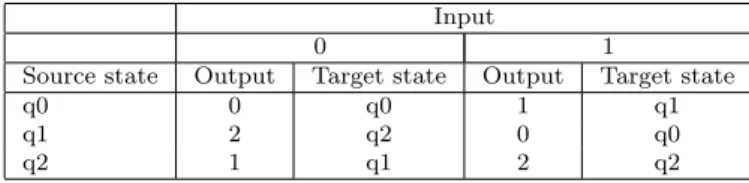
Example 1 An example of a Mealy machine for computing residues modulo 3 for a binary input (most significant bit first) number is given in Figure 1. The set of inputs is I ={0,1}, the set of outputs is O ={0,1,2}, and the set of states is given by Q={q0, q1, q2}, whereq0 is the initial state marked with an extra circle. The transition relation is defined by the table:
Input
0 1
Source state Output Target state Output Target state
q0 0 q0 1 q1
q1 2 q2 0 q0
q2 1 q1 2 q2
Table 1 Transition relation for the Mealy machine in Figure 1.
The transition relation in Mealy machines is extended from symbols to strings (traces, sequences) as follows:
Definition 2 Theextended transition relation u/s⇒ on a Mealy machineM= hI, O, Q, q0,→i is the least relation that satisfies, for q, q0, q00 ∈ Q, u ∈ I∗,
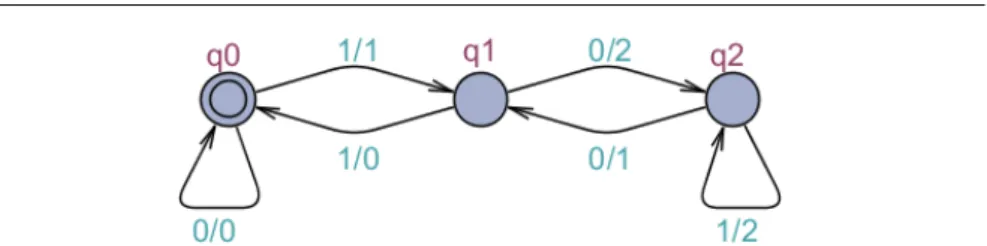
Fig. 1 A Mealy machine for computing residues modulo 3. For example, the machine maps 010 to 012 (path:q0 0/0 −−→q0, q0 1/1 −−→q1, q1 0/2
−−→q2) computing 0 mod 3 = 0, 1 mod 3 = 1,
2 mod 3 = 2; 1101 is mapped to 1001 computing 1 mod 3 = 1, 3 mod 3 = 0, 6 mod 3 = 0, 13 mod 3 = 1; and 1110 to 1012 computing 1 mod 3 = 1, 3 mod 3 = 0, 7 mod 3 = 1, 14 mod 3 = 2.
– q/⇒q, and
– ifq−−→i/o q0 andq0u/s⇒ q00thenqi u/o s⇒ q00,
where denotes the empty sequence. A state q ∈ Q is called reachable if
q0
u/s
⇒ q, for someu∈I∗ ands∈O∗.
The output strings that can be observed after supplying an input string to a Mealy machine are defined using this relation:
Definition 3 Anobservation is a pair (u, s) ∈I∗×O∗ such that sequences
uandshave the same length. For q∈Q, we defineobsM(q) to be the set of
observations ofMfrom stateq, by
obsM(q) ={(u, s)∈I∗×O∗| ∃q0:q
u/s
⇒ q0}.
We writeobsM as a shorthand forobsM(q0).
Since Mealy machines are input enabled, obsM(q) contains at least one
pair (u, s) for each input sequence u∈I∗. We callM behavior deterministic
if obsM contains exactly one pair (u, s), for each u ∈ I∗. In this case, we
write outM(u) to denote the unique s with (u, s) ∈ obsM. In this paper,
we consider only behavior deterministic Mealy machines. It is easy to see that a deterministic Mealy machine is also behavior deterministic. Two states
q, q0 ∈ Qareobservation equivalent, denoted q ≈q0, if obsM(q) =obsM(q0).
Two Mealy machines M1 and M2 with the same sets of input symbols are
observation equivalent, notationM1≈ M2, ifobsM1 =obsM2.
3.2 Active learning of Mealy machines
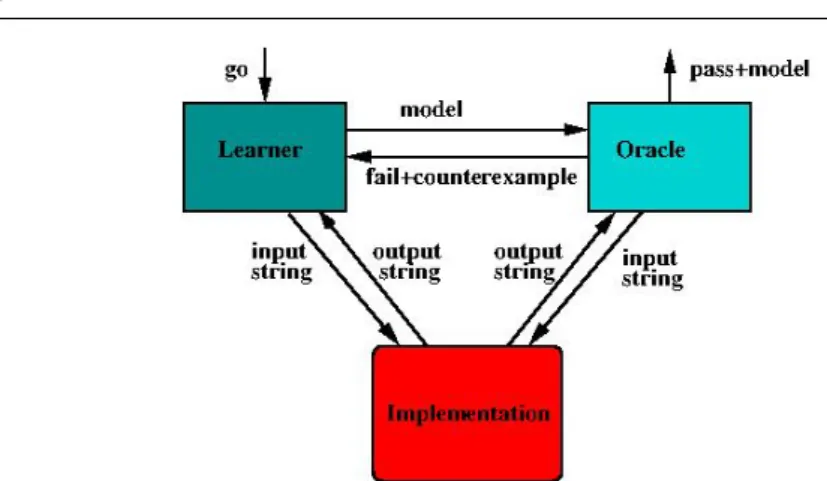
Active learning or query learning is a learning setting in which a learner can ask questions (queries) to a teacher. In our case, the teacher consists of an implementation, a black-box software system that we would like to analyze, in combination with an oracle that produces statements about the correctness of models produced by the learner. By providing this software system with inputs,
Fig. 2 Basic setting for active learning of software models.
and reading the generated outputs, the learner tries to determine (reverse engineer) its inner workings. With some modifications [45], we can apply the well-known L∗ DFA learning algorithm [8] to this data in order to learn a
Mealy machine model for a black-box software system. The basic setup for active learning is illustrated in Figure 2.
Let M=hI, O, Q, q0,→ibe a behavior deterministic Mealy machine. An
implementation ofMis a device that accepts sequencesu∈I∗of input sym-bols, calledoutput queries or membership queries. Whenever an implementa-tion ofMreceives a queryu, it returnsoutM(u) as output.
An oracle is a device which accepts Mealy machines models as inputs. These input models are referred to asequivalence queriesorhypotheses. Upon receiving an hypothesisH, the oracle may experiment with an implementation of a Mealy machine M by posing output queries. After a finite number of output queries, the oracle will either produce outputpasstogether with model H, or else outputfail together with acounterexample, which is an observation (u, s) ∈ (obsM\obsH)∪(obsH \obsM). A proper oracle is an oracle that
only generates pass when M ≈ H. The combination of an implementation of Mand a proper oracle corresponds to what Angluin [8] calls a minimally adequate teacher forM.
Alearner is a device that, once it is triggered by ago-command, may pose output queries to an implementation of some (unknown) Mealy machineM, and equivalence queries to an oracle for this implementation, see Figure 2. The task of the learner is to learn a model that is observation equivalent toMin a finite number of steps, from the answers generated by the implementation and the oracle in response to the queries. The typical behavior of an L∗ -style learner is to start by asking sequences of output queries until a “stable” hypothesisHcan be built from the answers. After that an equivalence query is made to find out whether His correct. If the oracle answerspass then the learner has succeeded. Otherwise the returned counterexample is added to the set of observations, and additional output queries are asked until the learner has singled out a new smallest stable hypothesisH0that is consistent with the
current set of observations. This new hypothesis H0 is sent to the oracle in
another equivalence query, and a possible counterexample is then again used in output queries in order to update the current hypothesis. This process is iterated until the oracle answers pass in response to an equivalence query. A nice property ofL∗ and query learning is that, assuming a proper oracle,
it requires only a polynomial number of queries in order to findH such that M ≈ H. This is surprising since learning the smallest deterministic finite state automaton (and by restriction Mealy machine) that is consistent with a given dataset is well-known to beNP-hard [34].
LearnLib LearnLib [49] is a tool that supports active learning of Mealy ma-chines or DFAs based on the L∗ algorithm. It contains many optimizations that reduce the number of queries asked byL∗, and a means of selecting them in a graphical user interface. Furthermore, it implements multiple learning strategies, that differ in the method used to construct the model (depth-first or breadth-first), and includes different ways to generate membership queries. Finally, the LearnLib tool also includes various model-based testing algorithms (see Section 3.4) in order to implement the oracle component. The LearnLib tool was used by the winning team in the 2010 Zulu DFA active learning competition [21]. We use LearnLib as the basic active learning tool.
Uppaal The model-checker Uppaal [13] is one of the best known model check-ers today. It is based on timed automata [6] and can be used to test logical properties of these systems, extended with specified using a subset of compu-tation tree logic (CTL) [38]. In addition to the timed properties of systems, UPPAAL models can contain integer variables, structured data types, and channel synchronizations between automata. It contains an extensive graphi-cal user interface including an automaton editor, an intuitive query language, a simulator, and a verification engine.
In this article, we use the Uppaal GUI as an editor for extended finite state machines (EFSM).
3.3 Automatic abstraction refinement
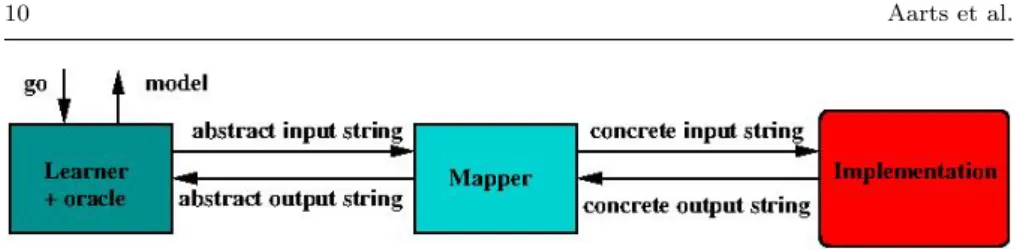
Tools that are able to bridge the gap between active learning tools such as LearnLib and real software systems are required for numerous applications in different domains. Instead of learning deterministic finite state automata or Mealy machines, they aim at learning models of extended finite state machines (EFSM), including parameter values and guarded transitions based on these values. Abstraction is the key for scaling existing automata learning methods to realistic applications. The idea is to place a mapper in between the im-plementation and the learner/oracle, that abstracts (in a history dependent manner) the large set of actions of the implementation into a small set of abstract actions for the learner/oracle, see Figure 3.
Fig. 3 Introduction of the mapper component.
The concept of an intermediate component that takes care of abstraction is very natural and is used, implicitly or explicitly, in many case studies on automata learning. Aarts, Jonsson and Uijen [2] formalized the concept of such an intermediate abstraction component. By combining the abstract machine H learned in this way with information about the mapper, it is possible to effectively learn an EFSM that is equivalent to the Mealy machineMof the implementation. Roughly speaking, the learner is responsible for learning the global “control modes” in which the system can be, and the transitions be-tween those modes, whereas the mapper records some relevant state variables (typically computed from the data parameters of previous input and output actions) and takes care of the data part of the implementation.
Tomte [1] is an automatic abstraction refinement tool that uses and learns abstractions in order to map the extended finite state machine world of soft-ware systems into the Mealy machine world of active learning tools such as LearnLib. Tomte is named after the creature that shrank Nils Holgersson into a gnome and (after numerous adventures) changed him back to his normal size again. This is exactly what the Tomte tool is doing: It shrinks the alphabet in order to be able to learn an abstract model (through numerous experiments), and then the abstract model is enlarged again to a model of the original im-plementation by enriching it with information from the mapper component.
The current version of Tomte is able to automatically construct mappers for a restricted class of extended finite state machines, which is called scalarset Mealy machines, in which one can test for equality of data parameters, but no operations on data are allowed. The notion of a scalarset data type originates from model checking, where it has been used by Ip & Dill for symmetry re-duction [41]. Currently, Tomte can learn models that may only remember the first and last occurrence of a parameter. A major challenge is the development of new algorithms for the automatic construction of mappers: the availability of such algorithms will allow to infer a wider class of systems and boost the applicability of automata learning technology.
Tomte uses the technique of counterexample-guided abstraction refine-ment: initially, the algorithm starts with a very course abstraction, which is subsequently refined if it turns out that the learned model is not behavior-deterministic. Nondeterminism arises naturally when we apply abstraction: it may occur that the behavior of the implementation is fully deterministic but that due to the mapper (which, for instance, abstracts from the value of certain input parameters), the implementation appears to behave
nondeter-ministically from the perspective of the learner. Tomte uses LearnLib as basic learning tool and therefore the abstraction of the implementation may not exhibit any nondeterminism: if it does then LearnLib crashes and Tomte has to refine the abstraction.
Using Tomte, it is possible to learn fully automatically models of several realistic software components, including the biometric passport [4] as well as the SIP and TCP protocol [2].
3.4 Model based testing
Unfortunately, in practice there is unlikely to be an oracle that can answer equivalence queries, making a direct application ofL∗ often impossible. The typical solution (also adopted in this paper) is to approximate these queries using randomly generated membership queries [8]. Thus, for every equivalence query, we generate many input strings, for each we ask a membership query, and if an observed output string is different from the output generated by the model, we return this string as a counterexample. If no such string is found, there is some confidence that the current hypothesis is correct and the more strings we test, the higher this confidence. Since state machines cannot be learned from a polynomial amount of membership queries [11], this procedure requires an exponential number of queries in the worst case. Instead of generating these approximate equivalence queries uniformly at random, it therefore makes sense to use the current hypothesis and observations to only ask informative ones. The problem of finding such informative membership queries is known as test selection, which is one of the main problems dealt with bymodel-based testing.
InModel-based testing(MBT), which is a new technique that aims to make testing more efficient and more effective [55], thesystem under test (SUT) is tested against a model of its behavior. This model, which is usually devel-oped manually, must specify what the SUT shall do. Test cases can then be algorithmically generated from this model using an MBT tool. When these test cases are executed on the SUT and the actual test outcomes are com-pared with the model, the result is an indication about compliance of the SUT with the model. Usually, MBT algorithms and tools areproper (sound), i.e., a test failure assures non-compliance, but they are notexhaustive, i.e., absence of failing tests does not assure compliance: “Program testing can be used to show the presence of bugs, but never to show their absence!” [30].
MBT approaches differ in the kind of models that they support, e.g., state-based models, pre- and post-conditions, (timed) automata, or equational ax-ioms, and in the algorithms that they use for test generation. In this paper we concentrate on two state-based approaches: finite, deterministic Mealy ma-chines (also called Finite State Machine FSM), and a class of non-deterministic automata, also referred to as labeled transition systems (LTS).
In the Mealy machine approach to MBT, the goal is to test whether a black-box SUT, which is an implementation of an unknown Mealy machineI,
is observation equivalent to a given Mealy machine specificationS, i.e., to test whetherI≈S [44].
The LTS approach, which does not require determinism, finiteness of states and inputs, input-enabledness, nor alternation of inputs and outputs (a label on a transition is either an input or an output), is more expressive than Mealy machines. Consequently, it requires a more sophisticated notion of compliance between an SUT and a model. The implementation relationiocooften serves this purpose [53]. The tools JTorX and TorXakis, among others, generate tests based on this relation; see Section 3. Since it is straightforward to transform a Mealy machine into an LTS, by splitting every (input,output)-pair transi-tion into two LTS transitransi-tions with an intermediate state, LTS-based testing can be easily applied to Mealy machine models. The other way around is more cumbersome. Some sophisticated methods exist for this purpose based on parametrizing the labels in a symbolic way and to lift test generation to the symbolic level [32]. This has the additional advantage that test selection algorithms can utilize the parameter structure, i.e., try different integer values.
JTorX and TorXakis JTorX [14] is an update of the model-based testing tool TorX [54]. TorX is a model-based testing tool that uses labeled transition systems to derive and execute tests (execution traces) based on ioco[53] , a theory for defining when an implementation of a given specification is correct. Using on-line testing, JTorX can easily generate and execute tests consist-ing of more than 1 000 000 test events. JTorX is easier to deploy and uses a more advanced version ofioco. It contains a graphical user interface for easy configuration, a simulator for guided evaluation of a test trace, interfaces for communication with an SUT, and state-of-the-art testing algorithms.
TorXakis [47] is another extension of the TorX model-based testing tool. In addition to the testing algorithms, TorXakis uses STS’s with symbolic test gen-eration to deal with structured data, i.e., symbols with data parameters [31], where TorX and JTorx use flattening. By exploiting the structure of input actions, TorXakis is able to find certain counterexamples much faster than LearnLib and JTorX.
4 Conformance to a Reference Implementation
4.1 Basic approaches
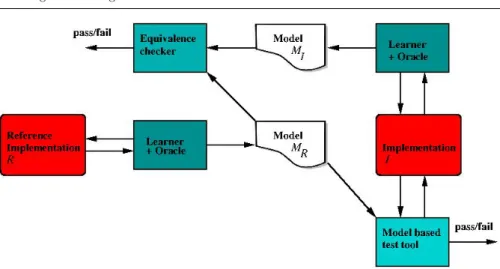
Figure 4 illustrates how we may use model synthesis for establishing confor-mance (i.e., behavior equivalence) of protocol implementations relative to a given reference implementation. Using a state machine synthesis tool, we first actively (query) learn a state machine model MR of the reference implemen-tationR (using, e.g., LearnLib). Now, given another implementationI, there are basically two things we can do. The first approach is that we provideMR
Fig. 4 Basic approaches of using automata learning to establish conformance of implemen-tations. The learners interact with the implementations in order to construct models, which are then subsequently used for model-based testing or equivalence checking.
as input to a model based testing tool (e.g., JTorX). This tool will then use
MR to generate test sequences and apply them to implementationI in order
to establish the conformance ofI to the learned modelMR, i.e., whether they implement the same behavior. The model based testing tool will either output “pass”, meaning that the tool has not been able to find any deviating behav-iors, or it will output “fail” together with an input sequence that demonstrates the difference betweenIandMR. The second, more ambitious approach, is to use the learning tool to learn a modelMI of the other implementationI, and then use an equivalence checker to check observation equivalence ofMR and
MI. The equivalence checker will either output “yes”, meaning that the two models are equivalent, or “no” together with an input sequence that demon-strates the difference between the two models. In the latter case, we check whether this trace also demonstrates a difference between the corresponding implementationsRand I. If not, we have obtained a counterexample for one of the two models, which we may feed to the learner in order to obtain a more refined model ofR orI.
In this paper, we use the CADP toolset to check observation equivalence of models.
CADP [33] is a comprehensive toolbox for verifying models of concurrent sys-tems, i.e., models consisting of multiple concurrent processes that together de-scribe the overall system behavior. Relying on action-based semantic models, it offers functionalities covering the entire design cycle of concurrent systems: specification, simulation, rapid prototyping, verification testing, and perfor-mance evaluation. It includes a wide range of verification techniques such as reachability analysis and compositional verification. CADP is used in this pa-per to check strong bisimulation equivalence of labeled transition systems. Two
behavior deterministic Mealy machines are observation equivalent iff their as-sociated labeled transition systems are strong bisimulation equivalent.
4.2 The reference model as a conformance oracle
The model-based testing (oracle) part of automata learning can be time con-suming in practice. We therefore experimented with an alternative approach in which the modelMRof the reference implementationRis used as an oracle
when learning a model for an implementationI. We will see that this use of what we call a conformance oracle may significantly speed up the learning process.
Suppose a learner has constructed an hypothesized Mealy machine model
MI for implementationI. We want to use the availability ofMR to speed up
the validation (or counterexample discovery) forMI, and reduce the use of the
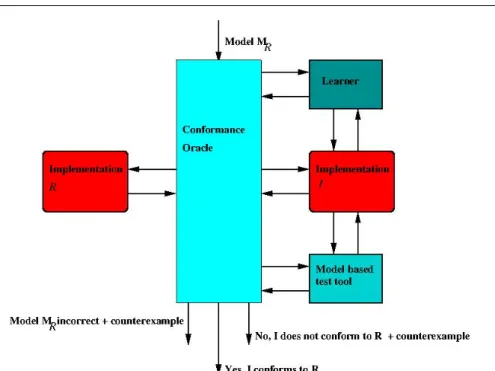
model based test oracle as much as possible. Our approach works as follows: 1. We first use an equivalence checker to testMR≈MI. If so, then we use a
model based test tool to further increase our confidence thatMI is a good model ofI. If model based testing reveals no counterexamples we are done, otherwise the learner may use a produced counterexample to construct a new model of I, and we return to step (1).
2. If MR 6≈ MI then the equivalence checker produces an input sequence u
such that outMR(u)6=outMI(u). We applyuto both implementations R
andI, and writeoutR(u) andoutI(u), respectively, for the resulting output sequences.
3. If outR(u) 6= outMR(u) then model MR is incorrect and we are done (a
learner may use counterexample uto construct a new model for R). 4. Otherwise, ifoutI(u)6=outMI(u) then modelMI is incorrect. In this case
the learner may use counterexampleuto construct a new model forI, and we return to step (1).
5. Otherwise, we have identified an observable difference between implemen-tationsR andI, i.e.,I is not conforming to reference implementationR. Figure 5 illustrates the architectural embedding of a conformance oracle.
5 The BRP Implementation and Its Mutants
The bounded retransmission protocol (BRP) [37, 27] is a variation of the well-known alternating bit protocol [12] that was developed by Philips Research to support infrared communication between a remote control and a television. In this section, we briefly recall the operation of the protocol, and describe the reference implementation of the sender and the 6 mutant implementations.
The bounded retransmission protocol is a data link protocol which uses a stop-and-wait approach known as ‘positive acknowledgement with retransmis-sion’: after transmission of a frame the sender waits for an acknowledgement
Fig. 5 Conformance oracle.
before sending a new frame. For each received frame the protocol generates an acknowledgement. If, after sending a frame, an acknowledgement fails to appear, the sender times out and retransmits the frame. An alternating bit is used to detect duplicate transmission of a frame.
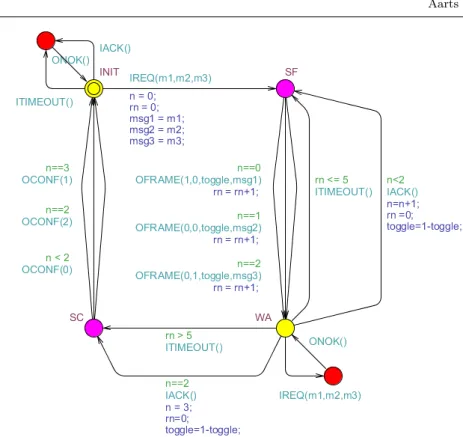
Figure 6 illustrates the operation of our reference implementation of the sender of the BRP. Actually, the reference implementation that we used is a Java executable that was generated automatically from this diagram (rep-resented as a Uppaal xml file, see Section 3). The sender protocol uses the following inputs and outputs:
– Via an input IREQ(m1, m2, m3), the upper layer requests the sender to transmit a sequence m1 m2 m3 of messages. For simplicity, our reference implementation only allows sequences of three messages, and the only mes-sages allowed are 0 and 1. When the sender is in its initial state INIT, an input IREQ(m1, m2, m3) triggers an outputOFRAME(b1, b2, b3, m), other-wise it triggers outputONOK.
– Via an outputOFRAME(b1, b2, b3, m), the sender may transmit a message to the receiver. Heremis the actual transmitted message, b1 is a bit that is 1 iff m is the first message in the sequence, b2 is a bit that is 1 iff m is the last message in the sequence, and b3 is the alternating bit used to distinguish new frames from retransmissions.
– Via inputIACKthe receiver acknowledges receipt of a frame and via input
ITIMEOUTthe sender is informed that a timeout has occurred, due to the
Fig. 6 Reference implementation of the BRP sender. The input symbols start withI, the output symbols start withO. In addition to symbols, the transitions contain value checks (or guards, ==,<,>) and assignments (=).
in state WA(“wait for acknowledgement”), an input IACKor ITIMEOUT
triggers either an output OFRAME(b1, b2, b3, m) or an output OCONF(i). If the sender is not in stateWA,ONOKis triggered.
– Via an output OCONF(i), the sender informs the upper layer about the way in which a request was handled:
– i= 0: the request has not been dispatched completely,
– i= 1: the request has been dispatched successfully,
– i= 2: the request may or may not have been handled completely; this situation occurs when the last frame is sent but not acknowledged. An outputOCONFoccurs when either all three messages have been trans-mitted successfully, or when a timeout occurs after the maximal number of retransmissions.
Note that, within the state machine of Figure 6, inputs and outputs strictly alternate. Thus it behaves like a Mealy machine. The state machine maintains variablesmsg1,msg2andmsg3to record the three messages in the sequence, a Boolean variabletoggleto record the alternating bit, an integer variablento record the number of messages that have been acknowledged, and an integer
variable rnto record the number of times a message has been retransmitted. Each message is retransmitted at most 5 times.
We consider the following six mutants of the reference implementation of the sender (see Appendix A):
1. Whereas the reference implementation only accepts a new request in the
INIT state, mutant 1 also accepts new requests in state WA. Whenever mutant 1 receives a new request, the previous request is discarded and the sender starts handling the new one.
2. Whereas in the reference implementation each message is retransmitted at most 5 times, mutant 2 retransmits at most 4 times.
3. Whereas in the reference implementation the alternating bit is only toggled upon receipt of an acknowledgement, mutant 3 also toggles the alternating bit when a timeout occurs.
4. In mutant 4 the first and last control bit for the last message are swapped. 5. Mutant 5 outputs an OCONF(0) in situations where the reference
imple-mentation outputsOCONF(2).
6. If the first and the second message are equal then mutant 6 does not transmit the third message, but instead retransmits the first message. Since input and output messages still alternate, all of the mutants still behave as Mealy machines. For all BRP implementations, we consider the inputs:IREQ(m1, m2, m3),IACK, andITIMEOUT, wherem1, m2,andm3 can be either 0 or 1. Thus, the input alphabet consists of 10 input symbols: 8 different IREQ inputs, one IACK input, and one ITIMEOUT input. We also have the following outputs: ONOK, OFRAME(b1, b2, b3, m), and OCONF(i), where 0≤i≤2, i.e., 20 output symbols. In the next section, we discuss how to connect these implementations to an active Mealy machine learner and a model-based testing tool.
6 Experiments
In this section, we report on the experiments that we did using LearnLib and JTorX to establish conformance of the six mutant implementations to the reference implementation.
Learning BRP models In order to learn models of the reference implementa-tion and its mutants, we connect the implementaimplementa-tions, which serve as SUT, to the LearnLib tool.1In order to approximate the equivalence queries, since 1 In previous work [3] we used TCP/IP socket communication. TCP/IP uses
optimiza-tions, TCP delayed acknowledgment technique and Nagle’s algorithm, for reducing packet overhead. These optimizations slow down he communication in a setting with very small messages. In normal communication between SUT and learner the communication is an al-ternating pattern of sending input followed by a returned output. However in between two queries to the SUT an extra RESET input is sent, which breaks this alternating pattern. Exactly at that point the optimizations in TCP/IP cause a delay in communication to hap-pen. Effectively this means thateach query to the SUT gets an extra delay. By disabling
RefImpl Mut1 Mut2 Mut3 Mut4 Mut5 Mut6 vr0-1 states 156 156 128 156 156 156 136 MQ 24998 22174 19618 22488 24684 24998 21662 std.dev. 1717 627 1006 769 1828 1717 736 TT 14 5830 7 15 14 14 14 std.dev. 13 5142 6 13 13 13 13 Succeeded 10/10 10/10 10/10 10/10 10/10 10/10 10/10
Table 2 Learning statistics for the BRP reference implementation and mutants 1-6
all BRP implementations behave as Mealy machines, this is the type of state machine that we infer with our approach. In our experiments we consider the inputs:IREQ(m1, m2, m3),IACK, andITIMEOUT, wherem1, m2,andm3 can be either 0 or 1. Thus, the input alphabet consists of 10 input symbols: 8 differ-entIREQinputs, oneIACKinput, and oneITIMEOUTinput. Moreover, we have the following outputs: ONOK, OFRAME(b1, b2, b3, m), and OCONF(i), where 0 ≤ i ≤ 2. In order to approximate equivalence queries, LearnLib provides several algorithms. We used the LearnLib test suite with randomly generated test traces containing 100 to 150 inputs.
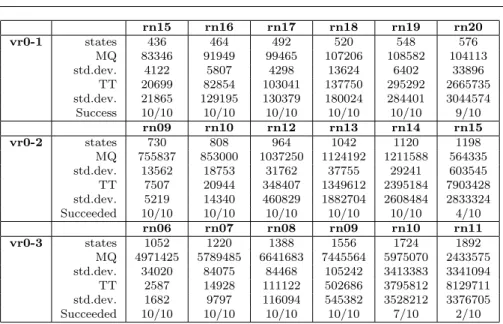
The results of the inference of the reference implementation and the six mutants are shown in Table 2. For every implementation, we list the number of states in the learned model, as well as the total number of membership queries (MQ). Moreover, we list the total number of test traces generated for approximating equivalence queries (TT). Note that these numbers do not include the last equivalence query, in which no counterexample has been found. Using CADP, we verified that all the learned models indeed are correct, i.e., equivalent to the Uppaal models described in Section 5. Each experiment in this section was repeated 10 times with different seeds for the equivalence queries. For each measured value its average over the 10 experiments is listed in the table together with the standard deviation. If an experiment did not succeed to learn the model withing two hours we aborted the experiment. In the last row we display how many of the 10 experiments did succeed. Even if an experiment did fail, we still use its numbers in calculating the average and the standard deviation, giving a lower bound for the real average and standard deviation for this experiment.
If we take a closer look at Table 2, we observe some interesting peculiarities. First, the number of test traces for mutant 1 is much higher than for the other implementations. The reason for this is that mutant 1 also accepts new requests in stateWA. Whenever mutant 1 receives a new request, the previous request is discarded and the sender starts handling the new request. This makes it much harder to find a counterexample that produces anOCONF(0) or
the Nagle optimalization in the TCP/IP socket communication we can prevent these delays to happen. For even better performance we used direct method calls to the SUT by linking the SUT code against our learner. Removing this delay made the queries in the experiments much faster than in [3]. Membership queries in general are much shorter than equivalence testing queries, therefore the performance gain per query in the first are much bigger than in the latter.
rn15 rn16 rn17 rn18 rn19 rn20 vr0-1 states 436 464 492 520 548 576 MQ 83346 91949 99465 107206 108582 104113 std.dev. 4122 5807 4298 13624 6402 33896 TT 20699 82854 103041 137750 295292 2665735 std.dev. 21865 129195 130379 180024 284401 3044574 Success 10/10 10/10 10/10 10/10 10/10 9/10 rn09 rn10 rn12 rn13 rn14 rn15 vr0-2 states 730 808 964 1042 1120 1198 MQ 755837 853000 1037250 1124192 1211588 564335 std.dev. 13562 18753 31762 37755 29241 603545 TT 7507 20944 348407 1349612 2395184 7903428 std.dev. 5219 14340 460829 1882704 2608484 2833324 Succeeded 10/10 10/10 10/10 10/10 10/10 4/10 rn06 rn07 rn08 rn09 rn10 rn11 vr0-3 states 1052 1220 1388 1556 1724 1892 MQ 4971425 5789485 6641683 7445564 5975070 2433575 std.dev. 34020 84075 84468 105242 3413383 3341094 TT 2587 14928 111122 502686 3795812 8129711 std.dev. 1682 9797 116094 545382 3528212 3376705 Succeeded 10/10 10/10 10/10 10/10 7/10 2/10
Table 3 Learning statistics for reference implementation, part 1
OCONF(2) output, since this requires six successiveITIMEOUTinputs without
intermediate IREQ inputs. The probability that LearnLib selects (uniformly at random) six successiveITIMEOUT inputs in a row is low, since each time
ITIMEOUTonly has a 10% chance of being selected. This issue will be analyzed
in more detail in Section 7. Second, the numbers for mutant 2 are slightly smaller than for the other implementations. The reason for this is that in mutant 2 the maximal number of retransmissions is smaller: 4 instead of 5, see Figures 7-12. The size of the model and the times required for constructing and testing hypotheses (explored in the next section) all depend on the maximal number of retransmissions. This will be explored further in the next section.
More learning experiments Besides the maximal value of the retransmission counter, also changes in the domain of message parameters m1, m2, and m3 will influence the learning results for the different implementations. Therefore, we ran some additional experiments for different parameter settings of the reference implementation and mutant 1 (the behavior of mutants 2-6 is similar to that of the reference implementation). We evaluated how LearnLib performs for different maximal values for the retransmission counterrn. Moreover, we investigated what happens when we allow more than 2 possible values for each message parameter.
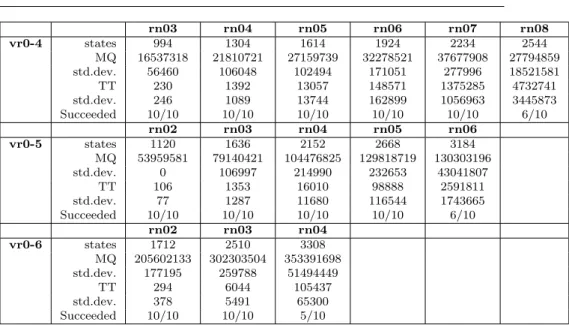
Table 3, 4 and 5 show the results of learning models of the reference imple-mentation and mutant 1 using different maximal numbers of retransmission and different value ranges for the messages m1, m2,andm3. As expected, in-creasing the number of retransmissions and the value ranges for messages both results in bigger models for which more membership and test traces are needed
rn03 rn04 rn05 rn06 rn07 rn08 vr0-4 states 994 1304 1614 1924 2234 2544 MQ 16537318 21810721 27159739 32278521 37677908 27794859 std.dev. 56460 106048 102494 171051 277996 18521581 TT 230 1392 13057 148571 1375285 4732741 std.dev. 246 1089 13744 162899 1056963 3445873 Succeeded 10/10 10/10 10/10 10/10 10/10 6/10 rn02 rn03 rn04 rn05 rn06 vr0-5 states 1120 1636 2152 2668 3184 MQ 53959581 79140421 104476825 129818719 130303196 std.dev. 0 106997 214990 232653 43041807 TT 106 1353 16010 98888 2591811 std.dev. 77 1287 11680 116544 1743665 Succeeded 10/10 10/10 10/10 10/10 6/10 rn02 rn03 rn04 vr0-6 states 1712 2510 3308 MQ 205602133 302303504 353391698 std.dev. 177195 259788 51494449 TT 294 6044 105437 std.dev. 378 5491 65300 Succeeded 10/10 10/10 5/10
Table 4 Learning statistics for reference implementation, part 2
rn03 rn04 rn05 rn06 rn07 rn08 vr0-1 states 100 128 156 184 212 240 MQ 13214 18199 22174 27999 32256 27365 std.dev. 402 515 627 738 850 16821 TT 154 1250 5830 61495 667761 7903190 std.dev. 129 1615 5142 78465 516786 3371144 Succeeded 10/10 10/10 10/10 10/10 10/10 6/9 rn02 rn03 rn04 rn05 vr0-2 states 184 262 340 418 MQ 171318 243928 326408 334443 std.dev. 1603 2281 2960 131246 TT 347 9655 278077 4388168 std.dev. 331 8693 159918 2974071 Succeeded 10/10 10/10 10/10 8/10 rn02 rn03 rn04 vr0-3 states 380 548 716 MQ 1730589 2495661 1272022 std.dev. 0 0 1017988 TT 3312 224096 6522672 std.dev. 3031 246072 2488837 Succeeded 10/10 10/10 2/10
Table 5 Learning statistics for mutant 1
and, accordingly, more time for learning and testing. Increasing the number of messages leads to a fast growth of the time required to construct a hypoth-esis and the time required to find counterexamples for incorrect hypotheses. Increasing the maximal number of retransmissions leads to a fast growth of the time required to find counterexamples for incorrect hypotheses, but only
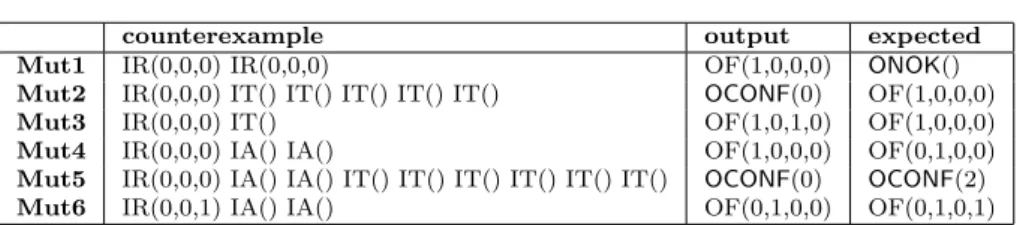
counterexample output expected Mut1 IR(0,0,0) IR(0,0,0) OF(1,0,0,0) ONOK()
Mut2 IR(0,0,0) IT() IT() IT() IT() IT() OCONF(0) OF(1,0,0,0)
Mut3 IR(0,0,0) IT() OF(1,0,1,0) OF(1,0,0,0)
Mut4 IR(0,0,0) IA() IA() OF(1,0,0,0) OF(0,1,0,0)
Mut5 IR(0,0,0) IA() IA() IT() IT() IT() IT() IT() IT() OCONF(0) OCONF(2)
Mut6 IR(0,0,1) IA() IA() OF(0,1,0,0) OF(0,1,0,1)
Table 6 Equivalence checking of mutant models and reference implementation (IT =
ITIMEOUT, IR =IREQ, IA =IACK, OF =OFRAME).
to a linear growth of the time required to construct a hypothesis. For mutant 1, the time needed for testing increases so fast that if the maximal number of retransmissions is 8 and there are 2 messages, not every seeds results in a correct model within 2 hours. Once LearnLib fails to learn a correct model, we assume that it will also fail for larger values of the parameters. Also in the case where the maximal number of retransmissions is 5 and there are 3 messages, LearnLib is not able to construct a correct model for all seeds for mutant 1 within 2 hours. This is not surprising, because in both cases the probability to select a counterexample is even lower than for mutant 1 in Table 2.
Conformance checking We compare the two methods, described in Section 4.1, for establishing the conformance of the mutant implementations to the refer-ence implementation of BRP. We only consider the versions of the models with at most 5 retransmissions and 2 different messages.
The first method used the CADP (bisimulation) equivalence checker to compare the models MI that we learned for the mutant implementations I
with the model MR learned for the reference implementation R.2 For each of the mutants, CADP quickly found a counterexample trace illustrating the difference between the models of the mutant and the model of the reference implementation (for each mutant it takes around 3 seconds to find the coun-terexample). The counterexamples found by CADP are depicted in Table 6.
The second method used the modelMRof the reference implementationR
as input for the JTorX model based testing tool and the mutant implementa-tionsIas SUTs. Test steps were executed until a counterexample was found. Again, JTorX found a counterexample for each of the mutant implementa-tions. The number of IO symbols (one input or output) and the running times of the experiments are shown in Table 7. The resulting counterexamples are rather long sequences and are therefore not shown in the table.
If we look at Table 7 we immediately see that the number of IO symbols needed for mutant 5 is much bigger than for the other mutants. When we compare the computation times from Table 2 and Table 7 we really can’t make a good comparison, because both methods are too fast. Therefore, we made the task more difficult by increasing the retransmission counter to 10 and repeated both experiments. Note that in learning the mutants for the retransmission
mut1 mut2 mut3 mut4 mut5 mut6
vr0-1 IO symbols 5 894 19 37 6657 198
rn05 std.dev. 1 768 12 20 4983 268
Table 7 Conformance testing with learned reference model and mutant implementations using JTorX
RefImpl Mut3 Mut4 Mut5 Mut6
vr0-1 states 296 296 296 296 256 rn10 MQ 55417 46509 55417 55417 47166 std.dev. 3767 1899 3767 3767 3083 TT 280 357 280 280 280 std.dev. 171 266 171 171 171 Succeeded 10/10 10/10 10/10 10/10 10/10
Table 8 Learning statistics for reference implementation and mutants 3-6 with rn=10
mut1 mut3 mut4 mut5 mut6
vr0-1 IO symbols 5 19 37 109154 178
rn10 std.dev. 1 12 20 90617 228
Table 9 Conformance testing mutants with rn=10 and vr=0-1 using Jtorx
counter of 10 we skipped mutant 1, because it was already shown in table that it couldn’t be learned in 2 hours, and we skipped mutant 2 because the only difference between mutant 2 and the reference implementation is a different retransmission number.
After learning the new mutants CADP could again find in around 3 sec-onds a counterexample trace illustrating the difference between the models of the mutant and the model of the reference implementation. When we com-pare the results in Table 8 and Table 9 we see that model based testing based on a model of the reference implementation is the fastest method for finding bugs in implementations for all the mutants except for mutant 5. In the case of mutant 5 learning is faster. This can be explained by the fact that if we look at the counter example for mutant 5 in Table 7 we immediately see that the number ofITIMEOUTinputs in the counterexample is directly related to the value of the retransmission counter rn. Since finding longer test strings takes longer, this increases the time required by JTorx to find a counterexam-ple. Appearently, since LearnLib tests hypotheses in a way similar to JTorx, learning the model of mutant 5 requires shorter strings (or the set of possible strings is smaller) than proving mutant 5 behaves differently from the refer-ence model. Investigating, why and when this effect occurs is topic of further study. In general, however, learning models of proposed implementations takes more time than model based testing them but also provides more information in the form of a learned model. Even in these cases, it may still be beneficial to use learning tools since the learned models can for instance be used for model checking analysis.
7 Further analysis and improvements
7.1 Why random testing sometimes fails
In our experiments, the most effective technique available in LearnLib for approximating equivalence queries turned out to be random testing. In order to analyze the effectiveness of this method, we may compute the probabilities of reaching states that provide a counterexample within a certain number of transitions, by translating the Mealy machine of the teacher (the system under test) into a discrete time Markov chain (DTMC). This DTMC has the same states as the Mealy machine, and the probability of going from state q to state q0 is equal to the number of transitions from q to q0 in the Mealy machine divided by the total number of inputs. Through analysis of this DTMC, the MRMC model checker can compute the probability of finding certain counterexamples within a given time.
MRMC [42] is a probabilistic model checker, which can be used to check the probability that a logical statement (such as a system breakdown) occurs in a given continuous- or discrete-time Markov chain, with or without reward functions. (common in Markov decision processes [48]). Such a logical state-ment can be expressed in a probabilistic branching-time logic PCTL [36] or CSL [10]. The probabilistic models may also contain reward functions (com-mon in Markov decision processes [48]) and bounds on these can be checked in combination with the time and probability values.
We use MRMC to compute the probability of reaching certain states in an implementation within a certain number of steps in a setting where inputs are generated randomly. We wrote a small script that converts LTSs in.aut for-mat to DTMCs in.tra/.labformat, which are accepted as input by MRMC.
Using MRMC we computed that for the reference implementation with up to 7 retransmissions the probability of reaching, within a single test run of 125 steps, a state with an outgoingOCONF(0) transition is 0.0247121. This means the probability of reaching a state with an outgoing OCONF(0) transition within 75 test runs is 0.847. This result explains why LearnLib requires very few test runs to learn a correct model of this system, which it does within seconds. Using MRMC, we also computed that for the version of mutant 1 with up to 7 retransmissions the probability of reaching, within 125 steps, a state with an outgoingOCONF(0) transition is only 0.0000010. Hence, finding a counterexample by random testing will take much longer for mutant 1 than for the reference, explaining why LearnLib needs 667761 (see Table 5) test runs on average to find this counterexample (0.999999667761 ≈ 0.51 is the probability of not finding this trace in 667761 tries).
rn5 rn7 vr0-1 (#test symbols, st. dev) (1785, 1921) (19101, 22558)
vr0-2 (#test symbols, st. dev) (2991, 2667) (18895, 15158)
vr0-9 (#test symbols, st. dev) (3028, 3199)
Table 10 Equivalence query statistics for mutant 1 with TorXakis.
7.2 Using abstraction to speed up testing
A simple way to increase the probability of finding counterexamples for mutant 1 within a short time is to increase the probability ofITIMEOUT inputs, for instance by assigning an equal probability of 1/3 to the ITIMEOUT, ACK andIREQinputs. Symbolic testing tools and abstraction learners will use this distribution because they initially assume that the parameter values are not as important as the input types. TorXakis and Tomte (see Section 3) are such tools and we therefore evaluated the effect of using these instead of the basic random testing implemented in LearnLib.
TorXakis For the experiments above we employed LearnLib for both the learn-ing and testlearn-ing phase. However, it is also possible to perform the equivalence check by an external tool. We experimented with the LTS-based model-based testing tool TorXakis to see whether we can improve on detecting incorrect hypothesis models.
Table 10 summarizes the results obtained with TorXakis when testing mu-tant 1 against the hypothesized LearnLib model forrn7, vr0−1 andrn5, vr0− 2. In addition, the results for the scenarios rn5, vr0−1, rn5, vr0−9, and
rn7, vr0−2 are presented. LearnLib did not manage to find a counterexample in these cases. The numbers in Table 10 are the average lengths of the test runs, measured in test symbols (both input and output), until a discrepancy between the model and mutant 1 was detected. The average is taken over 10 different random test runs. We do not measure the timing because this is not so useful for TorXakis. TorXakis explicitly tests for non-occurrence of outputs by means of a time-out, and while the time value chosen for this time-out is in some sense arbitatry, it has a very strong influence on the total duration of a test.
TorXakis is able to detect counterexamples for the incorrect hypothesized models forrn7, vr0−1, and forrn5, vr0−2. Only after the IREQ input has been selected, the message values are randomly selected. This implies that increasing the domain of possible message values does not increase the length of the test case required to detect the counterexample. Combined with the fact that TorXakis generates one very long test case, it is able to find a counterexample for the scenariorn7, vr0−2 within reasonable time. In conclusion, TorXakis is able to detect counterexamples within reasonable time, which LearnLib could not detect.
Tomte Through the use of counterexample abstraction refinement, Tomte is able to learn models for a restricted class of extended finite state machines in
rn09 rn10 rn12 rn13 rn14 rn15 vr01 states 62 68 80 86 92 98 MQ 1518 1875 2449 2629 2196 1377 std.dev. 3 4 3 4 1372 1564 TT 1175 3525 51589 89133 182508 258552 std.dev. 1998 2816 34687 33648 82534 78432 Succeeded 10/10 10/10 10/10 10/10 7/10 4/10
Table 11 Learning statistics for mutant 1 using Tomte
mut1 mut2 mut3 mut4 mut5 mut6
vr01 states 16 127 16 16 155 20 MQ 1771 17798 1771 1771 21718 2211 std.dev. 0 0 0 0 0 0 TT 0 0 0 0 0 0 std.dev. 0 0 0 0 0 0 Succeeded 0/10 0/10 0/10 0/10 0/10 0/10
Table 12 Finding counterexamples using a conformance oracle, casern= 5
which one can test for equality of data parameters, but no operations on data are allowed. The current version of Tomte requires that only the first and the last occurrence of parameters of actions is remembered. As a result, Tomte can only learn models for instances of mutant 1, where eachIREQinput overwrites previous occurrences of the message parameters. For these instances, however, Tomte outperforms LearnLib with several orders of magnitude. Table 11 gives an overview of the statistics for learning mutant 1 with Tomte. Since in Tomte the entire range of message values for mutant 1 is abstracted into a single equivalence class, Tomte needs far fewer queries than LearnLib (cf. Table 5). Work is underway to extend Tomte so that it can also learn the BRP reference implementation and the other mutants.
7.3 Using a conformance oracle
Above, we demonstrated how to make random testing a little smarter by mak-ing use of abstractions. This results in a speed up in the time random testmak-ing requires to find a counterexample, but even this method has its limits as shown in Table 11. We now show that we can remove random testing altogether using the notion of a conformance oracle descibed in Section 4.2, with CADP as an equivalence checker.
The results of our experiments are Table 12. The conformance oracle quickly discovers the counterexamples for all the mutants. In addition, Ta-ble 12 shows that finding a counterexample using the conformance oracle is nearly trivial for four of the mutants: for these mutants the final hypothesis only has between 16-20 states. For mutants 1 and 5 we would like to scale up thernparameter in order to discover the limits of using the conformance or-acle setup and to compare its performance to that of a state-of-the-art model
rn09 rn10 rn11 rn12 rn13 rn14 vr01 states 267 295 323 351 379 407
MQ 42751 50189 54949 63227 68267 77385
Table 13 Finding a counterexample for mutant 5 using a conformance oracle
rn09 rn10 rn11 rn12 rn13 rn14
vr01 IO symbols 54701 109154 141285 475398 497128 1066146 std.dev. 39385 90617 95454 475627 541333 803093
Table 14 Conformance testing mutant 5 using Jtorx
based testing tool. For mutant 1, however, increasing this parameter has no influence on the counterexample (see Table 6) and the time required to find it remains (nearly) the same for both the conformance oracle and a model based testing tool. For mutant 5, the number of queries needed to find a coun-terexample does depend on the rn parameter: with a higher rnvalue, more
ITIMEOUTinputs are required to show the difference between mutant 5 and
the reference implementation. The results are displayed in Tables 13 and 14. Testing using a conformance oracle is really quick: the experiment typically run within a few seconds. Furthermore, the number of membership queries required to build the hypothesis seems to increase only linearly with increasing
rn. In contrast, as Table 14 shows, the number of IO symbols required by JTorX increases much faster. The reason for this is that the time required by random testing depends on the probability of reaching a state that provides a counterexample, while testing using a conformance oracle is fully deterministic and thus independent of this probability.
8 Conclusion
We show how to apply active state machine learning methods to a real-world use case from software engineering: conformance testing implementations of the bounded retransmission protocol (BRP). To the best of our knowledge, this use of active learning methods is entirely novel. We demonstrate how to make this application work by combining active learning algorithms (LearnLib and Tomte) with tools from verification (an equivalence checker, CADP) and testing (a model-based test tool, JTorX).
A nice property of the BRP is that it contains two parameter values (the number of retransmissionsrnand the range of message valuesvr), which can be increased to obtain increasingly complex protocols. This makes it an ideal use case for state machine learning methods because it allows us to discover the limits of their learning capabilities. We investigated these limits on test-ing the conformance of six mutant implementations with respect to a given reference implementation. All implementations were treated as black-box soft-ware systems. The goal of our experiments was to discover how active learning
tools can be used to establish the conformance between the mutant and im-plementation models. The results of these experiments can be summarized as follows:
– The problem of test selection is a big bottleneck for state-of-the-art active learning tools. Existing model based testing tools can be used to make this bottleneck less severe.
– Increasing the number of message values vr (the alphabet size) increases the time required for test selection as well as the time needed for finding an hypothesis (using membership queries).
– Increasing the maximal number of retransmissionsrn(the length of coun-terexamples) increases the time required for test selection much faster than the time needed for finding an hypothesis.
– Establishing conformance using an equivalence checker and two learned models is very fast. Using only a single learned model and a model based testing tool is also fast, but can run into problems because test selection takes much longer than equivalence checking.
– Interestingly, there are cases where learning a mutant model (and checking equivalence) is faster than model based conformance testing. In general, however, learning a single model and subsequent testing is faster than learning two models.
Furthermore, we noticed in our experiments that the state-of-the-art Learn-Lib active learning tool quickly runs into trouble when learning one of these mutant implementations. This case was analyzed separately using a proba-bilistic model checker (MRMC), and based on this analysis we suggested two ways of improving the performance of the active learning method: using a state-of-the-art model-based test tool (TorXakis) for symbolic evaluation of equivalence queries, using a new learning method based on abstraction re-finement (Tomte), and introducing a new way of learning based on the novel concept of a conformance oracle. Such a conformance oracle effectively learns two models at once and uses the (partially) learned models in an equivalence checker to quickly answer equivalence queries asked by either learner. When the models are similar, this can greatly reduce the cost of learning.
The concept of a conformance oracle opens up several interesting directions for future work. In particular, since it can also be used as a model based tester, it would be interesting to further investigate exactly when and why it can be used to establish conformance more quickly than state-of-the-art model based test tools. Our study already found one such case in mutant 5, where tools based on random testing are troubled by the low probability of reaching a state that leads to a counterexample. A conformance oracle in combination with an active learning tool finds the same counterexample deterministically and in fewer steps. The concept is also closely linked to transfer learning: it can use a previously learned model to speed up the process of learning a new (similar) model. A conformance oracle, however, can transfer these models during the learning process itself, making it an interesting approach for distributed learning settings.
The BRP use case, including the models as well as all the scripts used to link the different tools together, will be made available on-line for testing and learning by fellow researchers athttp://www.italia.cs.ru.nl.
Acknowledgements We thank Colin de la Higuera and Bernard Steffen for suggesting to use the learned reference model for answering equivalence queries, and Axel Belinfante for assisting us with JTorx.
References
1. F. Aarts, F. Heidarian, H. Kuppens, P. Olsen, and F. Vaandrager. Au-tomata learning through counterexample-guided abstraction refinement. In D. Giannakopoulou and D. M´ery, editors, 18th International Sympo-sium on Formal Methods (FM 2012), Paris, France, August 27-31, 2012. Proceedings, volume 7436 of Lecture Notes in Computer Science, pages 10–27. Springer, Aug. 2012.
2. F. Aarts, B. Jonsson, and J. Uijen. Generating models of infinite-state communication protocols using regular inference with abstraction. In Pro-ceedings of the 22nd IFIP WG 6.1 international conference on Testing software and systems, ICTSS’10, pages 188–204, Berlin, Heidelberg, 2010. Springer-Verlag.
3. F. Aarts, H. Kuppens, J. Tretmans, F. Vaandrager, and S. Verwer. Learning and testing the bounded retransmission protocol. In J. Heinz, C. Higuera, and T. Oates, editors,JMLR Workshop and Conference Pro-ceedings, 11th International Conference on Grammatical Inference (ICGI 2012), volume 21, pages 4–18, September 2012.
4. F. Aarts, J. Schmaltz, and F. Vaandrager. Inference and abstraction of the biometric passport. InProceedings of the 4th international conference on Leveraging applications of formal methods, verification, and validation - Volume Part I, pages 673–686. Springer-Verlag, 2010.
5. F. Aarts and F. Vaandrager. Learning I/O automata. In CONCUR, volume 6269 ofLecture Notes in Computer Science, pages 71–85. Springer, 2010.
6. R. Alur and D. L. Dill. A theory of timed automata.Theoretical Computer Science, 126:183–235, 1994.
7. G. Ammons, R. Bodik, and J. R. Larus. Mining specifications. In Pro-ceedings of the Symposium on Principles of Programming Languages, pages 4–16. ACM, 2002.
8. D. Angluin. Learning regular sets from queries and counterexamples. In-formation and computation, 75(2):87–106, 1987.
9. J. Antunes, N. Neves, and P. Verissimo. Reverse engineering of protocols from network traces.Reverse Engineering, Working Conference on, 0:169– 178, 2011.
10. A. Aziz, K. Sanwal, V. Singhal, and R. Brayton. Verifying continuous time markov chains. In R. Alur and T. Henzinger, editors, Computer