Dahlia sp. (Asteraceae) is a valuable plant cultivat-ed in many countries in home gardens and containers or as a cut flower [Otani et al. 2013]. Lately, it is more and more often used in green public areas [Pudelska et al. 2015]. The decorative value of dahlia is colour -ful inflorescences with interesting petals of different colours, sizes and shapes, as well as colourful leaves [Shivayogeppa 2008, Jiménez Mariña 2015]. There is observed a constantly increasing demand on dahlias due to their long blooming period, till the late autumn and little cultivation requirements. Commercially
dahlias are propagated mainly through shoot cuttings [Pudelska et al. 2015, Jiménez Mariña 2015], what needs a lot of healthy mother plants. Division of tu-berous roots is ineffective and recommended usually in amateur cultivation [Hetman et al. 2017]. The main exporter of dahlia is the Netherlands, where the area of cultivation is around 400 ha [Jiménez Mariña 2015].
The biggest threats in dahlia cultivation are viral diseases. Plants might be infected with a few different viruses, of which dahlia mosaic virus (DMV) is noted the most often [Wang et al. 1988, Pappu et al. 2005].
THE INFLUENCE OF GROWTH REGULATORS ON DAHLIA
PROPAGATION IN TISSUE CULTURE AND ACCLIMATIZATION
OF PLANTS IN
ex vitro
CONDITIONS
Barbara Marcinek, Marzena Parzymies
, Monika Poniewozik, Danuta Kozak,
Wojciech Durlak
Institute Of Horticulture Production, Subdepartment Of Ornamental Plants And Dendrology, University Of Life Sciences In Lublin, Poland ABSTRACT
The aim of the work was to evaluate the influence of cytokinins on in vitro propagated dahlia and their
con-sequent effect on acclimatization. Plant material consisted of shoot tips and nodes. Among the three cytoki
-nins, benzyladenine, kinetin and 2-isopentenyl-adenine, only BA effectively stimulated the shoot multiplica
-tion from axiliary buds. The highest multiplica-tion rate was obtained from nodes in the presence of 0.25–
0.5 mg·dm–3 BA. Higher concentrations shortened the internodes and decreased the leaf blades and growth of callus.
1 mg·dm–3 of KIN and 2iP positively influenced the shoot growth and size of leaves. Gibberellic acid (GA
3) used
with BA increased the number of auxillary shoots. The best quality shoots and the highest multiplication rate were obtained when 2 mg·dm–3 BA was used with 5 mg·dm–3 GA
3. Cytokinins affected the rooting and accli
-matization ex vitro. Dahlia shoots multiplicated in the presence of 1 mg·dm–3 KIN or 2iP rooted faster in the soil and 100% survived in field, while those from 1 mg·dm–3 BA media rooted slowly, had shorter shoots and only 60% of them survived. Plants bloomed after 11–12 weeks in the field. Dahlia plants that had been multiplicated in the presence of KIN had larger diameter and fresh weight in the field. BA and 2iP positively influenced the flower diameter, length of flower stalk and a number of the first-order shoots.
Key words: micropropagation, cytokinins, gibberellic acid, tuberous plant INTRODUCTION
A development of the in vitro technique allows to eliminate viruses in case of valuable varieties [Wang et al. 1988, Sediva et al. 2004], ensures obtaining a lot of healthy and uniform propagation material [Fati -ma et al. 2007], allows to breed new varieties through mutations and production of polyploids, as well as to introduce them into cultivation [Dalda Şekerci and Gülşen 2016].
To initiate dahlia tissue culture a few types of ex -plants are commonly used: shoot tip ex-plants [Salman et al. 2010], nodal explants [Al-Mizory 2013], leaves fragments [Otani et al. 2013] and inflorescences buds [Hernandez-Perez and Mejila-Munoz 1994]. An indi -rect organogenesis through callus is also often used in case of dahlia [Fatima et al. 2007, Wadankar and Malode 2012, Ibrahim and Daraj 2015b]. In the avail -able data there are a few actual reports on the influence of growth regulators on multiplication and rooting of Dahlia sp., however, they present divergent informa -tion. The most often they recommend supplementation of the media with benzyladenine (BA) in combination with naphthaleneacetic acid (NAA) [Priyanka-Rana et al. 2001, Sediva et al. 2004, Fatima et al. 2007, Sal -man et al. 2010, Ibrahim and Daraj 2015a]. There is few publications on the use of gibberellic acid (GA3) to stimulate elongation and induction of dahlia shoots, and the recommended concentrations are in a very wide range, from 0.1 to 10 mg·dm–3 [Wei et al. 1990, Shatilo et al. 1991, Priyanka-Rana et al. 2001].
In the presented work, the attempt was undertaken to estimate the most effective and practical method for Dahlia cultorum micropropagation with the use of tip and nodal explants and the media supplemented with indole-3-butyric acid (IBA) in combinations with cy -tokinins and gibberellic acid (GA3) as well as to es -timate the consequent influence of growth regulators on acclimatization of plants to ex vitro conditions and their cultivation in the soil.
MATERIAL AND METHODS
Dahlia cultorum ‘Pirat’ was chosen for the ex -periment. It is a high variety, growing up to 100 cm. It forms cactus flowers of an intensive red colour. It blooms from July.
Plant material for tissue culture initiation were shoot tips and nodal segments without leaves, excised
during Spring from young shoots sprouting from tu-berous roots of plants cultivated in a greenhouse. Ex-plants were washed in a tap water with the addition of a detergent (Ludwik), immersed in a 70% ethanol for 5 seconds and then disinfected in a 1% sodium hypo-chlorite (NaOCl) solution for 30 minutes and washed three times in sterilized distilled water.
The influence of a type and concentration of cytoki
-nins on shoots multiplication
Shoot tip fragments of 10 mm length with one pair of fully developed leaves and one-node pieces, derived from a stabilized in vitro cultures were placed in Er -lenmeyer 300 ml flasks with 50 ml of the media. The media contained Murashige and Skoog [1962] (MS) macro- and microelements and vit. B1 – 0.1 mg·dm–3, vit. B6 – 0.5 mg·dm–3, vit. PP – 0.5 mg·dm–3, glycine – 2 mg·dm–3, inositol – 100 mg·dm–3 and sucrose – 30 g·dm–3. The media were supplemented with one of three cytokinins: BA (benzyladenine), KIN (kinetin) or 2iP (iso-pentenyladenine), in concentrations of: 0.25, 0.5, 1.0, 2.0 or 4.0 mg·dm–3 in combination with 0.5 mg·dm–3 of IBA (indole-3-butyric acid). A control was the medium without growth regulators. The me -dia were solidified with BIOCORP agar in concentra -tion of 6.75 g·dm–3. The media pH was set to 5.8 and then it was autoclaved in the temperature of 121°C and under 1 hPa air pressure. Each combination in -cluded 4 flasks with 5 explants. Flasks with explants were placed in a growing room in the temperature of 22°C during the day and 20°C at night, with 16-hour photoperiod. The light intensity was 35 µmol⋅m–2⋅s–1 at the level of the cultures. The experiment lasted 6 weeks. The following features were evaluated in case of shoot tip explants: length of the main shoot, number of nodes per shoot, number of leaves, fresh weight of the main shoot, percentage of the explants that formed axillary shoots. In case of both shoot tips and nodal explants the number of axillary shoots was estimated. They were divided into groups of the following sizes: < 5 mm, 6–15 mm and > 16 mm. On the basis of the obtained results, a percentage share of the shoots of each length in a total number of shoots was counted. In case of both types of explants a percentage of plants that formed callus tissue and its’ fresh weight was marked. A multiplication rate (number of secondary explants obtained by division of the main and axillary
shoots that could be used for further cultivation) was also counted per each treatment. The experiment was conducted twice.
The influence of BA and GA3 at different concentra
-tions on multiplication and quality of shoots
Nodal segments obtained from a stabilized in vitro culture were used as explants. They were placed on MS media supplemented with BA in concentrations of 1.0, 2.0 and 4 mg·dm–3 in combination with GA
3 in
concentrations of 0.1, 0.5, 1.0, 2.0 and 5.0 mg·dm–3. The other supplements and media preparation condi -tions were the same as in the first experiment. After 6 weeks of culture, a number of obtained axillary shoots was counted. They were classified into three ranges: < 5 mm, 6–15 mm and > 16 mm. On the basis of the obtained results a percentage share of shoots in each group in a total number of axillary shoots obtained in each combination was marked. A multiplication rate was also counted as in the first experiment. The exper -iment was repeated twice.
A subsequent influence of cytokinins on rooting
and acclimatization of dahlia ex vitro
Nodal explants of dahlia were placed on the MS media supplemented with BA, KIN or 2iP in concen -tration of 1 mg·dm–3 with 40 explants in each treat -ment. After 6 weeks of growth, plantlets were taken out from Erlenmeyer flasks and the residues of the media were removed through washing under tap run -ning water. A lower part of the shoot was treated with a powder rooting substance containing 0.25% of in -dole-3-butyric acid and planted in containers of 1000 ml volume, containing a mixture of peat and perlite (2 : 1 v/v). The containers with plants were placed in a growing room at a temperature of 20°C. Half of plants were left in containers and measured after 12 weeks of cultivation. The other half – 20 plants from each treatment, were planted after 8 weeks of rooting in containers into soil (1st of June) on an Experimen -tal Farm situated in Central Eastern Poland (51°23'N, 22°56'E). Dahlias were cultivated in soil of the Hap -lic Luvisol type, containing 1.6% of organic matter. During a vegetation period, date of the beginning of blooming of each flower was noted and at the end of the experiment the following features were estimated: height and diameter of plants, fresh weight of plants,
fresh weight of the aboveground part of plant, number of shoots of the first order and a number and length of tuberous roots.
Statistical analysis
The obtained values of each studied feature were analyzed statistically with a Statistica 13 software (StatSoft), with the use of one-way ANOVA. The sig -nificance between the means was evaluated with the Tukeys’ intervals at the 5% level of significance. RESULTS
The influence of cytokinins on multiplication and quality of dahlia shoots
Shoots used for in vitro cultures of dahlia initia-tion may be excised during a whole vegetainitia-tion period; however, young shoots obtained from plants planted in a glasshouse at the end of winter, when the winter dormancy ended, are the easiest to disinfect (effective -ness over 90%).
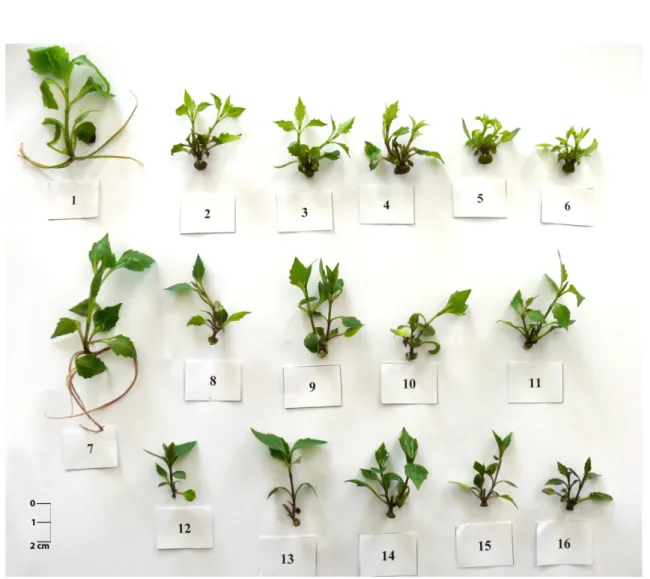
Analyzing growth of shoot tip fragments it was noted, that cytokinins used in the experiment had an influence on their elongation, as shown in Ta -ble 1. The highest shoots were observed on the con -trol media, without growth regulators (41.4 mm), as well as on media containing kinetin in concentration of 0.25 mg·dm–3 (37.4 mm) or 2iP in concentrations of 0.25–1.0 mg·dm–3 (from 28.7 to 34.4). The addi -tion of BA to the medium, in the lowest concentra -tion used, inhibited growth of shoots. When BA was used in the highest concentration, (4 mg·dm–3), shoots were 4 times shorter in comparison to the control and it was noted that on that media shoots formed the least leaves as well (8.1). The most leaves were obtained in case of shoots cultivated in presence of 2iP in con -centration of 1 mg·dm–3 (10.4). Shoots growing on the media without growth regulators or containing kine -tin in concentration of 0.25 mg·dm–3 formed leaves with long petioles and large leaf blade area. The best-formed leaf blades of dark green colour were obtained on media supplemented with kinetin in concentrations of 1.0–2.0 mg·dm–3 or 2iP in concentration of 0.25– 1.0 mg·dm–3, what is presented in Figure 1 and 2. The fresh weight of the main shoot depended on its height and leaf blades size. Shoots of the highest fresh weight were obtained on the media without growth regu
-Table 1. Effect of different concentrations of cytokinins on Dahlia ‘Pirat’ in vitro shoot tip explants multiplication on MS medium after 6 weeks culture
PGRs type concentration PGRs (mg·dm–3) Length of main shoot (cm) No. of nodes
per shoot No. of leaves per shoot
Mean fresh weight of main shoot (mg) Explant with callus (%) Fresh weight of callus (mg) Control 0 41.4 a* 2.9 ab 9.0 ab 250.0 a 0 d – 0.25 20.5 c-e 3.1 ab 9.4 ab 105.5 c-d 87 a 24.0 c-e 0.5 13.4 e 2.3 b 9.3 ab 85.2 c-d 93 a 36.4 bc 1.0 12.8 e 2.2 b 9.3 ab 79.3 d 100 a 54.9 a 2.0 11.4 e 1.6 b 8.6 ab 113.0 b-d 80 ab 42.6 ab BA 4.0 10.6 e 1.8 b 8.1 b 112.7 b-d 80 ab 40.4 b 0.25 37.4 ab 6.0 a 9.6 ab 223.3 ab 27 cd 14.8 ef 0.5 22.8 b-e 3.6 ab 9.4 ab 216.2 ab 40 b-d 14.0 ef 1.0 20.9 c-e 3.0 ab 8.6 ab 109.5 b-d 73 ab 15.6 ef 2.0 17.8 de 2.8 b 8.8 ab 95.1 c-d 100 a 31.6 b-d KIN 4.0 23.5 b-e 3.3 ab 9.7 ab 123.3 b-d 100 a 22.6 de 0.25 34.4 a-c 3.5 ab 10.0 ab 179.9 a-d 40 b-d 11.9 ef 0.5 28.7 a-d 3.4 ab 9.2 ab 139.3 a-d 20 c-d 8.2 f 1.0 32.9 a-c 3.6 ab 10.4 a 197.7 a-c 60 a-c 14.9 ef 2.0 24.5 b-e 3.4 ab 9.3 ab 122.2 b-d 93 a 19.9 d-f 2iP 4.0 21.2 c-e 3.1 ab 8.6 ab 118.2 b-d 80 ab 25.0 c-e
* Values with the same letters in columns do not differ significantly at p = 0.05
Table 2. Effect of different concentrations of cytokinins on in vitro Dahlia ‘Pirat’ shoot tip explants branching on MS medium after 6 weeks culture
Axillary shoot length structure (%) PGRs type PGRs concentration (mg·dm–3) Explants with axillary shoots (%) No. of axillary shoots < 5 mm 6–15 mm > 16 mm Multiplication rate Control 0 13 f* 2.0 ab – 50 50 3.8 0.25 93 ab 3.8 a 68 32 – 3.3 0.5 80 a-d 3.0 ab 74 26 – 3.8 1.0 87 a-c 3.0 ab 83 17 – 3.2 2.0 100 a 3.2 ab 92 8 – 2.5 BA 4.0 100 a 2.6 ab 82 18 – 1.8 0.25 33 d-f 1.4 b 71 29 – 3.5 0.5 20 ef 2.0 ab 50 50 – 3.0 1.0 27 ef 2.0 ab 88 12 – 3.2 2.0 67 a-e 2.4 ab 88 12 – 3.1 Kin 4.0 40 c-f 2.0 ab 64 21 15 3.3 0.25 13 f 1.5 ab 100 – – 3.5 0.5 20 ef 1.0 b 100 – – 3.3 1.0 47 b-f 2.1 ab 53 33 14 3.3 2.0 33 d-f 1.8 ab 44 44 12 4.5 2iP 4.0 47 b-f 2.0 ab 64 29 7 4.0
lators (250 mg), as well as on the media containing kinetin in concentrations of 0.25–0.5 mg·dm–3 (223.3– 216.2 mg respectively) or 2iP in concentrations of 0.25–1.0 mg·dm–3 (197.7–139.3 mg respectively).
The most convenient method for dahlia shoots mul -tiplication is dividing them into one-node fragments. After 6 weeks of cultivation, it was possible to obtain from 1.6 new nodes in presence of BA in concentration of 4 mg·dm–3 up to6 nodes on the media supplemented with KIN in concentration of 0.25 mg·dm–3, from shoot tip explants. Addition of BA in concentrations of 0.5 to 4.0 mg·dm–3 to the media significantly reduced the number of nodal explants formed. Shoots of dahlia un-der the influence of cytokinins formed callus tissue at the base of the shoots. Its fresh weight increased with
the increase of the concentration of growth regulators. The least shoots with callus and its smallest weight were observed on the media supplemented with KIN or 2iP in concentrations of 0.25–0.5 mg·dm–3 (from 8.2 to 15.6 mg), respectively. The highest fresh weight of callus was noted when shoots were cultivated on the media containing BA in concentrations of 1.0–2.0 mg·dm–3 (54.9 and 42.6 mg respectively). Shoots cul-tivated on the media without growth regulators did not form callus tissue (Tab. 1).
Shoot tip fragments had the ability to form axil-lary shoots and it depended on the type and concentra-tion of cytokinins used in the experiment, as shown in Table 2. On the control medium without growth reg -ulators, only 13% of explants formed axillary shoots, Fig. 1. Microcuttings of dahlia obtained from shoot tip explants after 8 weeks of cultivation on MS media: (1) control medium without cytokinins, (2) BA 0.25, (3) BA 0.5, (4) BA 1.0, (5) BA 2.0, (6) BA 4.0, (7) KIN 0.25, (8) KIN 0.5, (9) KIN 1.0, (10) KIN 2.0, (11) KIN 4.0, (12) 2iP 0.25, (13) 2iP 0.5, (14) 2iP 1.0, (15) 2iP 2.0, (16) 2iP 4.0 mg·dm–3
2 from each axillary bud. Media containing KIN in con -centrations of 0.25–1.0 mg·dm–3 promoted 20 to 33% of explants to form from 1.4 to 2.0 of axillary shoots. An increase of KIN concentration to 2.0 mg·dm–3 stimulated development of axillary shoots, as 67% of explants formed on average 2.4 axillary shoots. It was observed that on the media supplemented with 2iP in concentrations of 1.0–4.0 mg·dm–3 shoots formed on average 1.8–2.1 axillary shoots. In most cases axillary shoots were very short, below 5 mm and difficult to excise from the main shoot, as shown in Table 2. Ad -dition of BA to the medium in the lowest of the tested concentrations (0.25 mg·dm–3) induced 93% of shoot tip fragments to form axillary shoots. In this combina-tion, the most axillary shoots were obtained (3.8) and they characterized with the highest length (32% was from 6 to 15 mm). An increase of BA concentration to 2 mg·dm–3 promoted a formation of axillary shoots on all shoot tip explants but did not increase their number per explant. Moreover, 92% of the obtained axillary shoots were below 5 mm in length (Tab. 2).
It was possible to obtain up to 4.5 secondary ex -plants (multiplication rate). The most of them were ob
-tained on the medium supplemented with 2.0 mg·dm–3 of 2iP, as shown in Table 2. On the control medium it was possible to obtain on average 3.8 of secondary explants and they characterized with long petioles and large leaf blades so that they had to be trimmed. Axil-lary shoots excised from shoot tip explants were usu -ally short and did not increase multiplication rate, as shown in Table 2.
In the presented experiment the influence of type and concentration of cytokinins on regeneration and growth of nodal explants was observed. It was possible to obtain from 1.4 to 4.3 of axillary shoots, depending on the combination, as shown in Table 3. The most axillary shoots were obtained on the media containing BA in concentrations from 0.25 to 2 mg·dm–3 (from 3.5 to 4.3). On the media supplemented with kinetin or 2iP in concentrations from 0.25 to 0.5 mg·dm–3 usually only one axillary shoot regenerated from a node. In-crease of the concentration of those cytokinins did not significantly increase the number of obtained shoots.
Analyzing the number of secondary explants pos -sible to obtain from nodal explants, it was noted that the highest number was obtained in presence of BA
Table 3. Effect of different concentrations of cytokinins on Dahlia ‘Pirat’ in vitro one-node explants branching on MS medium after 6 weeks culture
Axillary shoot length structure (%) PGRs type concentration PGRs (mg·dm–3) No. of axillary shoots explant < 5 mm 6–15 mm > 16 mm Multiplication rate Control 0 1.2 c* 4 37 59 3.2 de 0.25 4.3 a 47 25 28 8.0 a 0.5 4.1 a 48 36 16 6.5 b 1.0 3.5 ab 43 51 7 5.0 b 2.0 4.3 a 52 46 1 4.0 cd BA 4.0 2.6 bc 55 45 – 3.5 de 0.25 1.4 c 20 40 40 3.0 e 0.5 1.5 c 39 24 37 4.0 cd 1.0 1.8 c 23 60 18 6.0 b 2.0 1.7 c 27 48 25 5.0 b Kin 4.0 1.8 c 23 44 33 5.0 b 0.25 1.4 c 33 40 28 3.5 de 0.5 1.6 c 17 31 51 4.0 cd 1.0 1.8 c 18 44 38 6.0 b 2.0 1.8 c 44 44 12 6.0 b 2iP 4.0 1.8 c 64 29 7 5.0 b
* Values with the same letters in columns do not differ significantly at p = 0.05
in concentration of 0.25 mg·dm–3 (8.0). In this com -bination 53% of axillary shoots was over 6 mm long. Increase of BA concentration up to 2 or 4 mg·dm–3 did not significantly influence the number of axillary shoots (Tab. 3, Fig. 2).
Influence of BA and GA3 concentration on growth
and quality of dahlia shoots
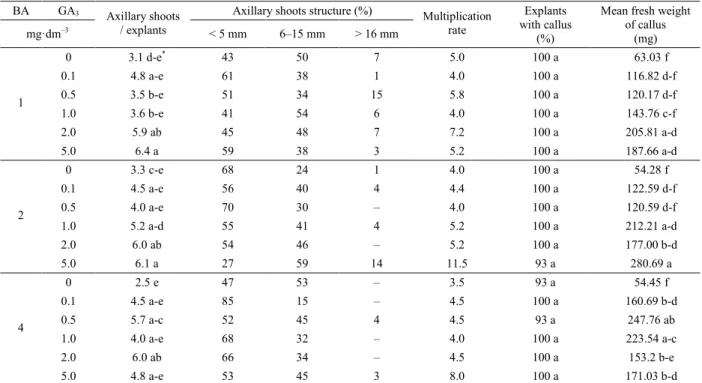
The obtained results indicated that addition of GA3 to BA increased number of axillary shoots obtained. It was observed that on the media supplemented with BA in concentrations of 1 or 2 mg·dm–3 together with GA3 in concentration of 5 mg·dm–3 dahlia shoots branched better (6.4–6.1 axillary shoot per explant re
-spectively) in comparison to the media supplemented with BA only (3.1–3.3), as shown in Table 4 and Fig -ure 3. The longest axillary shoots were obtained on the media containing 2 mg·dm–3 of BA and 5 mg·dm–3 of GA3 (73% of shoots were over 6 mm long). In that combination multiplication rate was the highest (11.5). It was observed that presence of growth regu -lators promoted formation of callus tissue at the base of shoots. It was also noted that the addition of GA3 to BA increased the fresh weight of callus. The highest mean fresh weight of callus was obtained in combi -nation of BA in concentration of 2 mg·dm–3 and GA
3
in concentration of 5 mg·dm–3 (280,69 mg) , as shown in Table 4.
Fig. 2. Microcuttings of dahlia obtained from nodal explants after 8 weeks of cultivation on MS media: (1) control medium without cytokinins, (2) BA 0.25, (3) BA 0.5, (4) BA 1.0, (5) BA 2.0, (6) BA 4.0, (7) KIN 0.25, (8) KIN 0.5, (9) KIN 1.0, (10) KIN 2.0, (11) KIN 4.0, (12) 2iP 0.25, (13) 2iP 0.5, (14) 2iP 1.0, (15) 2iP 2.0, (16) 2iP 4.0 mg·dm–3
The subsequent influence of cytokinins on rooting
and acclimatization of dahlia ex vitro
In the presented experiment the subsequent in-fluence of three cytokinins used in concentration of 1 mg·dm–3 on ex vitro rooting of dahlia plantlets was
evaluated, as shown in Figure 4. It was observed that 100% of dahlia plantlets rooted after 12 weeks of cultivation in soil, no matter the cytokinin used in vitro. The subsequent influence of the cytokinins used on biometrical features of shoots, roots and tu
-Fig. 3. Microcuttings of dahlia obtained after 8 weeks of cul
-tivation on MS media: (1) BA 2.0 mg·dm–3, (2) BA 2.0 + GA
3
5 mg·dm–3
Table 4. Effect of combinations of BA and GA3 on in vitro shoot proliferation of Dahlia ‘Pirat’ nodal explants on MS
medium after 6 weeks culture
BA GA3 Axillary shoots structure (%)
mg·dm–3
Axillary shoots
/ explants < 5 mm 6–15 mm > 16 mm Multiplication rate
Explants
with callus
(%)
Mean fresh weight
of callus (mg) 0 3.1 d-e* 43 50 7 5.0 100 a 63.03 f 0.1 4.8 a-e 61 38 1 4.0 100 a 116.82 d-f 0.5 3.5 b-e 51 34 15 5.8 100 a 120.17 d-f 1.0 3.6 b-e 41 54 6 4.0 100 a 143.76 c-f 2.0 5.9 ab 45 48 7 7.2 100 a 205.81 a-d 1 5.0 6.4 a 59 38 3 5.2 100 a 187.66 a-d 0 3.3 c-e 68 24 1 4.0 100 a 54.28 f 0.1 4.5 a-e 56 40 4 4.4 100 a 122.59 d-f 0.5 4.0 a-e 70 30 – 4.0 100 a 120.59 d-f 1.0 5.2 a-d 55 41 4 5.2 100 a 212.21 a-d 2.0 6.0 ab 54 46 – 5.2 100 a 177.00 b-d 2 5.0 6.1 a 27 59 14 11.5 93 a 280.69 a 0 2.5 e 47 53 – 3.5 93 a 54.45 f 0.1 4.5 a-e 85 15 – 4.5 100 a 160.69 b-d 0.5 5.7 a-c 52 45 4 4.5 93 a 247.76 ab 1.0 4.0 a-e 68 32 – 4.0 100 a 223.54 a-c 2.0 6.0 ab 66 34 – 4.5 100 a 153.2 b-e 4 5.0 4.8 a-e 53 45 3 8.0 100 a 171.03 b-d
Fig. 4. Microcuttings obtained from shoot tip and nodal explants of dahlia obtained after 8 weeks of cultivation on MS medium, ready for acclimatization: (A) BA 1.0, (B) KIN 1.0, (C) 2iP 1.0
mg·dm–3
Table 5. Consequent effect of cytokinins on ex vitro shoots rotting of Dahlia ‘Pirat’ after 12 weeks of cultivation in
containers PGRs (mg·dm–3) Plant height (cm) No. of leaves Fresh weight of above-ground part (mg) No. of tuberous root Length of tuberous roots (mm) Fresh weight of tuberous roots (mg) No. of roots Length of roots (mm) Mean fresh weight of root (mg) BA 1 12.1 b* 14.1 b 736.3 b 1.6 b 7.3 b 123.7 b 1.3 a 5.2b 44.2c Kin 1 17.2 a 16.6 a 2155.9 a 3.6 a 8.0 b 501.0 a 1.5 a 7.7 a 333.6 a 2iP 1 17.3 a 17.3 a 2302.8 a 2.9 a 9.5 a 661.4 a 1.5 a 7.7 a 192.5b
* Values with the same letters in columns do not differ significantly at p = 0.05
Table 6. Consequent effect of cytokinins on morphology of Dahlia ‘Pirat’ cultivated in the field
PGRs (mg·dm–3) Length of shoots (cm) No. of
leaves Plant height(cm) Plant diameter (cm)
Fresh weight of plant (g) Flower diameter (cm) Length of flower shoots (cm) BA 1 5.8 b* 9.2 a 74.2 a 42.8 b 1021.1 b 13.1 a 17.1 a KIN 1 11.8 a 9.1 a 76.2 a 51.0 a 1414.5 a 12.4 b 14.5 b 2iP 1 10.7 a 9.2 a 73.1 a 45.1 b 1099.4 b 13.0 a 15.8 ab
* Values with the same letters in columns do not differ significantly at p = 0.05
Table 7. Consequent effect of cytokinins on morphology of Dahlia ‘Pirat’ cultivated in the field
PGRs
(mg·dm–3) No of first order branches
Fresh weight of aboveground part of plant (g) Fresh weight of tuberous root (g) No. of tuberous root Length of tuberous root (cm) BA 1 2.0 a* 674.1 b 340.0 b 13.9 a 16.0 a KIN 1 1.1 b 875.4 a 576.5 a 12.4 a 15.6 a 2iP 1 2.0 a 682.2 ab 425.5 b 12.6 a 13.6 a
berous roots was observed. The shortest shoots were noted when shoots had been cultivated in vitro in presence of 1 mg·dm–3 of BA. Similarly, in case of that treatment, a number and fresh weight of tuberous roots were significantly lower, in comparison to KIN or 2iP. The number of roots was similar in all treat -ments, however their length and fresh weight were smaller if they had been cultivated on the media con-taining kinetin or 2iP in concentration of 1 mg·dm–3, as shown in Table 5.
After 8 weeks of rooting the plantlets in con -tainers, 20 rooted dahlia shoots from each treatment were planted in soil. During planting it was noted that plants that had been cultivated on the media
supple-mented with BA characterized with shorter shoots, in comparison to KIN or 2iP, therefore they had not been pinched. There were no differences observed in case of a number of leaves as shown in Table 6. It was not -ed that cytokinins us-ed in vitro influenced subsequent growth and blooming of plants in soil. Plants multi -plied in presence of kinetin or 2iP adapted in 100% and all of them bloomed 11–12 weeks after planting, as shown in Figure 5. Dahlias multiplied in vitro on the medium supplemented with BA grew slower in soil. Only 60% of them started to grow, of which only 50% bloomed. Measurements done in field during
blooming showed that multiplication of shoots on 2iP and BA positively influenced diameter of flowers and length of peduncles, in comparison to kinetin. The fi -nal height of plants was comparable in all treatments, as shown in Table 6. Kinetin had a positive subsequent effect on diameter of an aboveground vegetative part of plants and their fresh weight, but reduced a number of first order shoots, what caused weaker branching despite pinching of the main shoot. It was noted that kinetin had a positive subsequent influence on fresh weight of the rooting system, however the differences in the number of tuberous roots and their length de-pending on the cytokinins used in vitro were not stat -ed, as shown in Table 7.
DISCUSSION
Dahlia is propagated in tissue culture through direct or indirect organogenesis (callus induction). A direct or-ganogenesis is an easier and more effective methodso that it is economically justified. The best explants for a quick initiation of cultures are shoot tips and nodes [JU Zhi-xin 2007, Salman et al. 2010, Ren et al. 2012, Al-Mizory 2013, Ibrahim and Daraj 2015a, b, c].
As it was proven in the presented research, a reac -tion of dahlia to type and concentra-tion of cytokinins varied. Benzyladenine strongly reduced elongation Fig. 5. Dahlia plants after 10 weeks of cultivation in soil: (A) BA 1.0 mg, (B) KIN 1,0 mg, (C) 2iP 1,0 mg·dm–3
of shoots but stimulated the development of axillary shoots. The best effects were obtained when the cy -tokinin was used in low concentrations of 0.25–0.5 mg·dm–3. The obtained results confirm those obtained by Priyanka-Rana et al. [2001], who obtained the most shoots from axillary buds on MS media supplemented with 0.25 mg·dm–3 of BA and 0.1 mg·dm–3 of IAA and the study conducted by JU Zhin-xin [2007], who ad -vised MS media containing 0.5 mg·dm–3 of BA + 0.2 mg·dm–3 of NAA for dahlia multiplication. Similarly, Salman et al. [2010] recommended MS medium sup -plemented with 0.41 mg·dm–3 of BA and NAA for the propagation of dahlia in tissue culture from shoot tips. Ren et al. [2012] the best effects obtained when they used 1 mg·dm–3 of BA together with 0.2 mg·dm–3 of NAA. The MS medium with the addition of 2 mg·dm–3 of benzyladenine is also recommended for induction of axillary shoots [Al-Mizory 2013]. In the presented research it was observed that too high concentration of BA excessively reduced the growth of dahlia and size of leaf blades. It was also noted that the combination of BA in concentration of 2 mg·dm–3 and GA
3 in
con-centration of 5 mg·dm–3 allowed to obtain more shoots and increased the multiplication rate to 11.5.
Al-Mizory [2013] proved that BA in concentra -tion of 3–4 mg·dm–3 negatively influenced the length of axillary shoots and the number of available nod-al explants, what was confirmed in the presented re -search. The same author showed that kinetin less stim -ulated growth of axillary shoots and the best effect was obtained when it was used in concentrations of 1–2 mg·dm–3 and increase of the concentration had no effect on axillary shoots induction. However, it was advantageous to use BA in combination with KIN in concentrations of 1.5 mg·dm–3 each. Ibrahim and Da-raj [2015a, c] recommended to use NAA and BA in concentration of 2 mg·dm–3 each for direct regenera-tion of dahlia, what was not confirmed in the presented work. Higher concentrations of cytokinins and auxins are recommended mainly for indirect organogenesis of shoots from tissue culture [Sharma et al. 2001, Fati -ma et al. 2007, Ibrahim and Daraj 2015b, c]. However, the study conducted by Wadankar and Malode [2012] proved that the most shoots regenerated from callus tissue when it was cultivated on the media supple -mented with 0.5 mg·dm–3 of BA. A combined use of BA and KIN had also a positive influence when they
were used in low concentration 0.25 mg·dm–3, howev -er, the use of BA alone was more effective.
The multiplication rate might be increased even twice when 2 mg·dm–3 is used together with 5 mg·dm–3 of GA3, what was proven by Wei et al. [1990], who showed that addition of gibberellic acid is necessary to increase axillary shoots induction in case of dahl-ia. The authors advised to use BA in concentration of 3 mg·dm–3 in combination with 10 mg·dm–3 of GA
3 and
0.2 mg·dm–3 of NAA. The presented work showed that use of cytokinins in high concentration might inhibit dahlia shoots multiplication and increase callus tissue induction. Priyanka-Rana et al. [2001] recommended 1 mg·dm–3 of BA together with 0.1 mg·dm–3 of NAA with 0.1 mg·dm–3 of GA
3 as the best combination of growth
regulators. In the presented study it was observed that GA3 used in such concentration enhanced only multipli-cation of axillary shoots but did not influence their elon -gation. The obtained results confirm studies conducted by Shatilo [1991], who used GA3 in concentration of 4 mg·dm–3 for dahlia micropropagation.
Dahlia is propagated effectively and quickly in in vitro cultures when shoots are divided into nodal pieces. It is possible to obtain 2 shoots per node, what in the end gives 6 nodal explants. On the media sup-plemented with 0.25–0.5 mg·dm–3 of BA it is possible to obtain on average 4 shoots per explant, but 2 are shorter than 5 mm, what finally allows to obtain 8 ex -plants per node after 6 weeks of cultivation. Dahlia negatively reacted to longer cycles. Lengthening the cycle up to 8 weeks might cause necrosis of shoot tips and leaves as well as a change of colour of leaves into light green. It indicates a quick use of carbohydrates from the media. Many authors stated that dahlia quite well forms roots in in vitro cultures in presence of auxins in low concentrations [Wei et al. 1990, Shatilo 1991, Al-Mizory 2013]. The concentration of mac -ro- and microelements, as well as a type of sugar and media gelling agent, might influence rooting of dahlia shoots in vitro [Al-Mizory 2013]. The presented study showed that dahlia rooted well on the MS media with -out growth regulators (up to 75%).
Rooting of plants in tissue culture increases costs of production, therefore it is easier and cheaper to root plantlets directly ex vitro. It was observed that almost 100% of plantlets rooted and they could have been moved into the soil, where they bloomed
during the same year and formed tuberous roots. BA had a disadvantageous subsequent influence on rooting of plantlets and inhibited growth of plants in soil. Dahlias propagated on the media supplemented with 1 mg·dm–3 of kinetin or 2iP bloomed in 100%, while those cultivated on BA in concentration of 1 mg·dm–3 developed slower so that only 50% of plants flowered.
CONCLUSIONS
A quick multiplication of dahlia through a division of nodal explants is obtained on the MS media supple -mented with 0.25–0.5 mg·dm–3 of BA.
Use of GA3 in concentration of 5 mg·dm–3 in com-bination with BA in concentration of 2 mg·dm–3 in-creases multiplication rate and enhances elongation of axillary shoots.
Microshoots of dahlia root very well in ex vitro conditions. Rooted plants might be moved into the soil after 8 weeks of acclimatization.
The last cycle before direct rooting of microshoots should be conducted on the medium containing 1 mg·dm–3 of kinetin, what facilitates acclimatization of plants to ex vitro conditions and guarantees quick growth and blooming in the soil.
Micropropagation of dahlias allows to obtain even and healthy plants, blooming abundantly in the first year of cultivation in the field. The type of cytokinin used for multiplication of shoots does not influence the final height of plants and the number of tuberous roots. Kinetin applied during the in vitro cultivation, posi -tively influences fresh weight of plants.
ACKNOWLEDGEMENTS
The research has been funded by the University of Life Sciences in Lublin, Institute of Horticulture Production, Subdepartment of Ornamental Plants and Dendrology (OZO/DS1).
REFERENCES
Al-Mizory, L.S.M. (2013). Effect of different concentration of cytokinins, carbon source and agar on in vitro prop-agation of Dahlia sp. through one single node. J. Life Sci., 7(10), 1103–1112.
Dalda Şekerci, A., Gülşen, O. (2016). Overview of dahlia breeding. Sci. Papers Ser. B, Horticulture, 60, 199–204. Fatima, B., Usman, M., Ashraf, T., Waseem, R., Ali, M.A.
(2007). In vitro shoot regeneration from cotyledon and
hypocotyl explants of dahlia cultivars. Pak. J. Agric. Sci., 44(2), 312–316.
Hernandez-Perez, F., Mejila-Munoz, J.M. (1994). Dahlia
(Dahliavariabilis Cav.) micropropagation. Rev. Chap
-ingo Ser. Hortic., 1(1), 63–66.
Hetman, J., Łukawska-Sudoł, S., Pudelska, K., Parzymies, M. (2017). The effect of cutting metod on footing of
Dahlia pinnata Cav. cutting. Acta Sci. Pol. Hortorum Cultus, 16(2), 149–160.
Ibrahim, M.A., Daraj, I.A. (2015a). Micropropagation of
dahlia plants Dahlia variabilis Wild (Desf.). Effect of explant and plant growth regulators on shoot regenera
-tion and growth. Adv Agric. Bot., 7(1), 1–6.
Ibrahim, M.A., Daraj, I.A. (2015b).Micro propagation of
dahlia plants (Dahlia variabilis). Direct and indirect
or-ganogenesis techniques. Adv. Agric. Bot., 7(1), 28–35. Ibrahim, M.A., Daraj, I.A. (2015c). Effect of some treat
-ments on seeds germination, shoots multiplication
and rooting of dahlia plants via in vitro culture. Swed. J. Plant Biotechnol., 13–21. Website: www.sjpb.se. Jiménez Mariña, L. (2015). El cultivo de la Dalia. Cultiv.
Trop., 36(1), 107–115.
Ju, Z.X. (2007). Study on the technology of tissue culture
and rapid reproducing of Dahlia pinnata F1. J. Anhui
Agric. Sci., 35(21), 6374.
Otani, Y., Endo, C., Chin, D.P., Mii, M. (2013). Highly ef
-ficient system for plant regeneration from leaf and stem
explants in Dahlia. Plant Biotechnol., 30(2), 141–146. Pappu, H.R., Wyatt, S.D., Druffel, K.L. (2005). Dahlia mo
-saic virus: molecular detection and distribution in dahlia
in the US. Hort. Sci., 40, 697–699.
Priyanka, R., Varghese, T.M., Yadav, N.R., Chowdhury, V.K., Chowdhury, J.B. (2001). In vitro studies in Dahlia variabilis. Ann. Agric. Bio. Res., 6(1), 9–13.
Pudelska, K., Hetman, J., Łukawska-Sudoł, S., Parzymies, M. (2015). The efficiency of mother crowns and quality of soft cuttings of a few dahlia cultivars. Acta Sci. Pol. Hortorum Cultus 14(6), 189–200.
Ren, G.H., Chen, J., Zhang, F.F., Yang, H.Y., Zhang, Y.L., Xu, B.L., Zhao, G.Y. (2012). On the technology of tis -sue culture and rapid reproduction of Dahlia pinnata [J]. J. Beihua Univ. (Nat. Sci.), 4. Available: http://en.cnki. com.cn/Journal_en/A-A000-ZLYY-2012-04.htm Salman, M.A., Hamad, M.S., Al-Ahmer, S.M. (2010). In
vi-tro propagation of Dahlia variabilis. Al-Anbar J. Agric. Sci., 8(1), 148–161.
Sediva, J., Novak, P., Kanka, J., Laxa, J. (2004) Microprop
-agation, detection and elimination of DMV in the Czech collection of Dahlia. Acta Hortic., 725, 495–498. Sharma, H.P., Sinha, A.K., Nag, K.K. (2001). Callus induc
-tion and regenera-tion from shoot apex of Dahlia pinnata
var. White alvas. In: Perspectives in biotechnology Pro
-cedings of national symposium, Warangal India, 26–27 February 1999. Scientific Publishers, Jodhpur, 121–124. Shatilo, V.I. (1991). Some patterns of rhizogenesis in shoots
of dahlia in vitro. Byull. Glavn. Bot. Sada, 159, 72–75. Shatilo, V.I., Keldysh, M.A., Morozova, S.E. (1991). Hor
-monal induction of organogenesis in culturing isolated apices of Dahlia. Byull. Glavn. Bot. Sada, 159, 68−72.
Shivayogeppa, G., Dinakar Adiga, J., Prabhuling, G., Red
-dy, B.S., Sathyanarayana, B.N. (2008). Strategies for in vitro conservation of Dahlia (Dahlia variabilis L.). Acta Hortic., 865, 393–396.
Wadankar, G.D., Malode, S.N. (2012). In vitro regeneration of Dahlia cav. J. Global Biosci., 1, 28–41.
Wang, W.C., Tronchet, M., Larroque, N., Dorion, N., Al
-bouy, J. (1988). Production of virus-free Dahlia by mer -istem culture and virus detection through cDNA probes
and Elisa. Acta Hortic., 234, 421–428.
Wei, S.L., Li, P.M., He, Z.P., Han, B.W. (1990). Rapid prop -agation of monomerous stem by tissue culture of Dahlia pinnata Cav. Acta Agr Univ. Pekin., 16(4), 381–385.