Preventive Maintenance Supply Chain
Management Optimal Scheduling on VMACL
Machines by Implementing Simulation
Annealing Algorithms
Yuyun Hidayat*1, Titi Purwandari2, Achmad Bachrudin3, Aziza Ayu Nurjannah4, Agus Santoso5, Sukono6
1,2,3,4Department of Statistics, Faculty of Mathematics and Natural Sciences, Universitas Padjadjaran, Indonesia.
5Department of Statistics, Faculty of Sciences and Technology, Universitas Terbuka, Indonesia. 6Department of Mathematics, Faculty of Mathematics and Natural Sciences, Universitas Padjadjaran,
Indonesia.
*Corresponding author: [email protected] Abstract— PT. Braja Mukti Cakra uses various types
of engines to produce parts for truck cars. Vertical Lathe Automatic Chucking Machine (VMACL) is a machine that has the highest frequency of damage when compared to other machines. To reduce damage costs, preventive maintenance is well scheduled. This scheduling problem solving is done using the Annealing Simulation Algorithm. The results of the analysis give direction that the scheduling that must be done are: The maintenance action schedule for the Lifter component is at month 1,6,7,22,24,34, for the Insert component at 4,15,18,27,33 months, and for the Door component at the 2nd month, 12,13,16,17,30,36. Replacement actions for the Lifter component were carried out in the 4,5th month, 1,17,20,29, for the Insert component in the 9,19,22,23,35 months, and for the Door component in the 1,20,27 months. . Scheduling for 36 months using the Simulated Annealing Algorithm will cost IDR. 84,119,244.60 and produce greater reliability than the previous reliability of 58.44%.
Keywords—VMACL, reduce damage costs, preventive maintenance, Annealing Simulation Algorithm.
1.
Introduction
Over time, humans use various kinds of technology to help their work. The technology must of course always be treated so that results can be maximized. One example of the technology used is a machine. Therefore, the machine must be properly scheduled so it can reduce the occurrence of damage and
continue to function properly [1]-[3]. Maintenance that is carried out regularly is one of the ways companies can do to maintain the function of the
machine so as to reduce the chance of the machine to be damaged [4]. This type of treatment is preventive maintenance (PM), which is a plan that involves routine inspections to prevent damage [5].
Determination of PM scheduling, Moghaddam (2010) conducted a study using Genetic Algorithms and Simulated Annealing Algorithms [6]. The objective function in the Simulated Annealing Algorithm is multi-objective. The aim is to obtain results that maximize reliability and minimize total costs. Research related to preventive maintenance (PM) can be seen at [7]-[10]. In this study, conducted to determine the optimal PM. Bouzidi-Hassini et al. (2015), determine the scheduling of engine maintenance by considering the resolution of one machine used as well as the multi-machine resolution used. If the maintenance process is carried out as a whole then multi-machine resolution is used [11]. Besides that, Touat et al. (2017) using genetic algorithms and fuzzy logic methods to solve the problem of scheduling PM machines [12]. In the study of Pang et al. (2018) uses a scatter simulated annealing algorithm to minimize the total delay and total turnaround time for bi-objective PM scheduling problems at a station [13]. Also, Lin et al. (2019), consider many chromosomes in genetic algorithms to obtain the best PM scheduling [14].
PT. Braja Mukti Cakra uses a variety of machines to produce parts for truck cars. Vertical Machine Automatic Chucking Lathe (VMACL) is a machine that has the highest frequency of damage when compared to other machines. To reduce the occurrence of damage, PM needs to be done in the form of periodic inspections, cleaning, replacement
______________________________________________________________
International Journal of Supply Chain Management
IJSCM, ISSN: 2050-7399 (Online), 2051-3771 (Print)
of parts, and lubrication which is carried out on a well scheduled basis [15]-[18]. Based on the description above this study is interested in scheduling an optimum PM using the Simulated Annealing Algorithm by considering reliability.
2.
Material and Method
In this section, we provide the material and methods used in the study, as follows:
2.1. Material
The data used is data from the Maintenance Section of PT. Braja Mukti Cakra concerning damage to the Vertical Machine Automatic Chucking Lathe in the January 2017 period to July 2018. In this study three components were used, namely the Lifter, Insert and Door components.
2.2. Method
In this section, we discuss the issue of preventive maintenance scheduling on VMACL machines,
using the Simulated Annealing Algorithm.
Discussions include: VMACL, damage, preventive maintenance, Simulated Annealing Algorithm, reliability.
3
Mathematical models
This section discusses distribution compatibility test, parameter estimation, Mean Time to Failure (MTTF) and Mean Time to Repair (MTTR), simulated annealing algorithm and Multiobjective Optimization Model on Simulated Annealing 3.1 Goodness of fit test of Weibull
Distribution (Mann’s test ) 3.1.1 Hypothesis tests
H0 : The time between damage / repair time data follows the Weibull distribution pattern. H1 : Breakdown time / repair time does not
follow the Weibull distribution pattern. α = 5% 3.1.2 Test Statistics
= + − + = + − − = 1 1 1 2 1 1 1 1 1 ] / ) ln [(ln k ] / ) ln [(ln k M k i i i i r k i i i i M t t M t t (1) Where: 2 1 r k = 2 1 2 -r k = Mi=Zi+1−Zi )] 1 ln( ln[ 25 , 0 5 , 0 + − − − = n i i ZDegree of freedom Ftabel are v1=2k2 and v2=2k1
3.1.3 Tests criteria
Reject H0 if Mcount > Ftabel = F(α,v1,v2), else accept H0
3.2 Goodness of fit test of Exponential
Distributions (Bartlett Test) 3.2.1 Hypothesis tests
H0 : The time between damage / repair time data follows the Exponential distribution pattern.
H1 : The time between damage / repair time data does not follow the Exponential distribution pattern. α = 5% 3.2.2 Test Statistics ) 6 /( ) 1 ( 1 ln ) 1 ( r 1 2r[ln B 1 1 r r t r t ri i r i i + + − = = = (2) 3.2.3 Tests criteria Accept H0 if 2 1 , 2 1− r− X < B < 2 1 , 2r−
X and else reject it.
3.3 Parameter estimation
Using the Maximum Lihihoodood Estimation method, the estimated parameters β and θ for the Weibull distribution data are as follows:
( )
−= = 1 1ln n i tni t n 1 n tn = Estimated parameter λ for exponentially distributed data is as follows.
= + − = r i ti n r tr r 1 ( )
(3)3.4 Mean Time to Failure (MTTF) and Mean Time to Repair (MTTR) The Mean Time to Failure (MTTF) for the average damage time distributed by Weibull, is formulated as follows: TTF TTF MTFF + = (1 1 ) (4)
Whereas MTTF for Exponential distribution, is formulated as follows: TTF MTTF = 1 (5)
The Mean Time to Repair (MTTR) for the Weibull distribution is formulated as follows:
) 1 1 ( TTR TTR MTTR + = (6)
Whereas the MTTR for Exponential distribution is formulated as follows: TTR MTTR= 1 (7)
3.5 Simulated Annealing Algorithm
The simulated annealing algorithm can be performed as follows:
a) Determine the initial temperature (T0), namely by first determining the initial temperature, final temperature, and cooling rate.
b) Determine a new solution
c) Evaluate new solutions using the following criteria. ) ( ) (Xi 1 E Xi E E= − + (8) Where,
∆E= difference in objective value
E(Xi+1) = the objective value of a new solution E (Xi) = the objective value of initial solution Solution is accepted if the difference in objective value ≤0. Or with probability
r e
E
P( )= −E/T New solutions can still be
selected.
d) Reducing the temperature, if the final temperature has not been reached, then the temperature is lowered by a predetermined cooling rate.
e) Determine the best scheduling solution by stopping the algorithm when the final late temperature is reached.
3.6 Optimation Model of
Multiobjective in Simulated Annealing
3.6.1 The Minimum Total Cost
The Minimum Total Cost function can be calculated by taking into account the following three components: a) Failure Cost cost component MTTR x cost) labor cost (downtime Fi= + + b) Maintenance Cost cost e maintenanc component MTTR x costs) labor cost (downtime Mi= + + c) Replacement Cost cost t replacemen component MTTR x costs) labor cost (downtime Ri= + +
3.6.2 Maximum Function of Reliability Maximum function of reliability for ith component jth period is as follows:
( )
X( )
X )) ( (λ liability Max βi i,j i β N i J j i,j i − =
=1 =1 1 exp Re (9) WhereN = planning maintenance period
J = time interval N ..., 1,2, i= and j=1,2,...,J
4
Numerical Simulation
From the results of numerical analysis obtained by Mann's Test, the time data between Lifter, Insert, and Door component damage follows the Weibull distribution with parameter values β = 1.00557 and θ = 62.6872 for Lifter components, parameter values β = 1.02081 and θ = 153.987 for Insert components, and parameter values β = 1.03277 and θ = 169.093 for the Door component. The parameter values are obtained by using Software R. While the MTTF value for time data between Lifter component damage is 62.5422, Insert component is 152,685, and door components are 166,986.
Table 1. Damage, Maintenance and Replacement Costs
Failure Cost IDR 3,821,756
Maintenance Cost IDR 3,585,291
Replacement Cost IDR 3,915,986
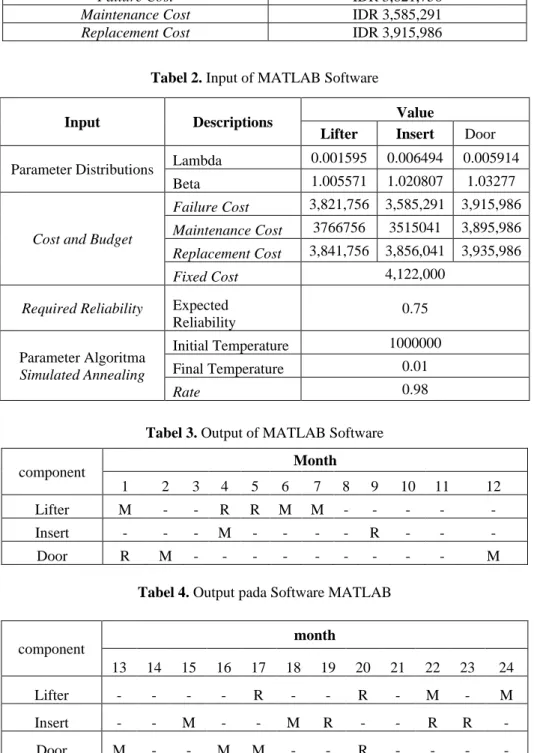
Tabel 2. Input of MATLAB Software
Input Descriptions Value
Lifter Insert Door
Parameter Distributions Lambda 0.001595 0.006494 0.005914
Beta 1.005571 1.020807 1.03277
Cost and Budget
Failure Cost 3,821,756 3,585,291 3,915,986
Maintenance Cost 3766756 3515041 3,895,986 Replacement Cost 3,841,756 3,856,041 3,935,986
Fixed Cost 4,122,000
Required Reliability Expected
Reliability 0.75 Parameter Algoritma Simulated Annealing Initial Temperature 1000000 Final Temperature 0.01 Rate 0.98
Tabel 3. Output of MATLAB Software
component Month
1 2 3 4 5 6 7 8 9 10 11 12
Lifter M - - R R M M - - - - -
Insert - - - M - - - - R - - -
Door R M - - - M
Tabel 4. Output pada Software MATLAB
component month
13 14 15 16 17 18 19 20 21 22 23 24
Lifter - - - - R - - R - M - M
Insert - - M - - M R - - R R -
Door M - - M M - - R - - - -
Tabel 5. Output of MATLAB Software
component Month
25 26 27 28 29 30 31 32 33 34 35 36
Lifter - - - - R - - - - M - -
Insert - - M - - - M - R -
Door - - R - - M - - - M
Costs for damage, maintenance, and
replacement can be seen in Table 1. Also, the
results of the analysis conducted using MATLAB Software obtained input as given in Table 2.
By using the input from Table 2, the data will be processed using software and the output will be obtained. The output results obtained from MATLAB Software are given in Table 3.
The results in Table 3, show that the maintenance schedule for the Lifter component must be carried out in the 1.6, 7th month while the maintenance action for the Insert and Door component must be carried out respectively in the 4th, 2nd and 6th
month, respectively.
Table 4, also shows that the maintenance schedule for the Lifter component must be carried out in the 22nd and 24th months while the maintenance action for the Insert component must be carried out in the 15th month, 18 the same for the Door component i.e. in the 13th, 16th and 17th months while The Insert maintenance component is carried out in the 15th and 18th months. As for the replacement schedule for the Lifter, Insert and Door components, respectively, it must be done in the 17th, 19,20,22, and 23 months.
Table 5, also shows that the maintenance schedule for the Lifter component must be carried out in the 34th month while the maintenance action for the Insert component must be done in the 27th and 34th month the same for the Door component i.e. at the 30th and 36th months. The component replacement schedule occurs in the 29th month for the 35th month Lifter for Insert and the 27th month for the door.
5
Conclusions
Scheduling for 36 months using the Simulated Annealing Algorithm will cost IDR. 84,119,244.60 and produce greater reliability than the previous reliability of 58.44%.The maintenance schedule for the Lifter component is 6 times in 3 years, for the Insert component is 5 times in 3 years, and for the Door component is 7 times in 3 years. The replacement action for the Lifter component and the Insert component are carried out 5 times and for the Door component 3 times the component replacement is performed.
Acknowledgments
Acknowledgments are conveyed to the Rector, Director of Directorate of Research, Community Involvement and Innovation, and the Dean of Faculty of Mathematics and Natural Sciences, Universitas Padjadjaran, with whom the Internal
Grant Program of Universitas Padjadjaran was made possible to fund this research. The grant is a means of enhancing research and publication activities for researchers at Universitas Padjadjaran.
References
[1] Chen, J. S. “Single-machine scheduling with
flexible and periodic maintenance.” Journal of
the Operational Research Society, Vol. 57, No. 6, pp. 703-710, 2006.
[2] Xu, D., Cheng, Z., Yin, Y., and Li, H. “Makespan minimization for two parallel machines scheduling with a periodic availability constraint.” Computers & Operations Research, Vol. 36, No. 6, pp. 1809-1812, 2009.
[3] Xu, D., Yin, Y., and Li, H. A note on
“scheduling of nonresumable jobs and flexible maintenance activities on a single machine to
minimize makespan”. European Journal of
Operational Research, Vol. 197, No. 2, pp. 825-827, 2009.
[4] Lewis E. E. Introduction to reliability
engineering. New York: John Wiley & Sons; 1987.
[5] Heizer, J. H., and Render, B. Operations
management, India: Pearson Education, 2008.
[6] Moghaddam, K. S. (2010). “Preventive
maintenance and replacement scheduling: models and algorithms.” PhD thesis,
University of Louisville, 2010.
[7] Lin, B., Wu, J., Lin, R., Wang, J., Wang, H.,
and Zhang, X. “Optimization of high-level preventive maintenance scheduling for
high-speed trains.” Reliability Engineering &
System Safety, Vol. 183, pp. 261-275, 2019
[8] Wang, S., and Liu, M. “A branch and bound
algorithm for single-machine production
scheduling integrated with preventive
maintenance planning.” International Journal
of Production Research, Vol. 51, No. 3, pp.
847-868, 2013.
[9] Wang, S., and Liu, M. “Multi-objective
optimization of parallel machine scheduling integrated with multi-resources preventive
maintenance planning.” Journal of
Manufacturing Systems, Vol. 37, pp. 182-192,
2015.
[10] Feng, H., Xi, L., Xiao, L., Xia, T., and Pan, E.
“Imperfect preventive maintenance
optimization for flexible flowshop
manufacturing cells considering
sequence-dependent group scheduling." Reliability
Engineering & System Safety, Vol. 176, pp.
218-229, 2018.
[11] Bouzidi-Hassini, S., Tayeb, F. B. S., Marmier,
F., and Rabahi, M. “Considering human resource constraints for real joint production
and maintenance schedules.” Computers &
Industrial Engineering, Vol. 90, pp. 197-211,
2015.
[12] Touat, M., Bouzidi-Hassini, S.,
Benbouzid-Sitayeb, F., and Benhamou, B. “A
hybridization of genetic algorithms and fuzzy logic for the single-machine scheduling with flexible maintenance problem under human
resource constraints.” Applied Soft
Computing, Vol. 59, pp. 556-573, 2017.
[13] Pang, J., Zhou, H., Tsai, Y. C., and Chou, F.
D. “A scatter simulated annealing algorithm for the bi-objective scheduling problem for
the wet station of semiconductor
manufacturing.” Computers & Industrial
Engineering, Vol. 123, pp. 54-66, 2018.
[14] Lin, C. S., Lee, I. L., and Wu, M. C. “Merits
of using chromosome representations and shadow chromosomes in genetic algorithms
for solving scheduling problems.” Robotics
and Computer-Integrated Manufacturing,
Vol. 58, pp. 196-207, 2019.
[15] Tsai, Y. T., Wang, K. S., and Tsai, L. C. “A
study of availability-centered preventive
maintenance for multi-component
systems.” Reliability Engineering & System
Safety, Vol. 84, No. 3, pp. 261-270.
[16] Low, C., Ji, M., Hsu, C. J., and Su, C. T.
“Minimizing the makespan in a single machine scheduling problems with flexible
and periodic maintenance.” Applied
Mathematical Modelling, Vol. 34, No. 2, pp.
334-342, 2010.
[17] Lee, J. Y., and Kim, Y. D. “Minimizing the
number of tardy jobs in a single-machine
scheduling problem with periodic
maintenance.” Computers & Operations
Research, Vol. 39, No. 9, pp. 2196-2205,
2012.
[18] Su, L. H., and Wang, H. M. “Minimizing total
absolute deviation of job completion times on
a single machine with cleaning
activities.” Computers & Industrial