A Technical Guide for
Floor & Roof Framing
Construction
Boise Engineered Wood Products • Technical Guide • Nov 006
The SIMPLE FRAMING SYSTEM
TABLE OF CONTENTS
The SIMPLE FRAMING SYSTEM® . . . . 2
Boise and the Building Regulations . . . . 3
Boise and the Environment . . . . 4
Features and Benefits . . . . 5
Lifetime Guarantee . . . . 5
Product Profiles . . . 6 - 7 Design Support: BC CALC® ,BC FRAMER® . . . . 8
BCI® Joist Specifications . . . . 9
BCI® Joists — Design Properties . . . 10 - 11 BCI® Joists Used as Joists / Beams . . . . 10
BCI® Joists Used as Rim Joists / Bearers . . . . 11
BCI® Joists Used as Columns / Studs . . . . 11
BCI® Joists Used as Ties . . . . 11
Allowable Nail Spacings . . . . 11
BCI® Joists — Floor Applications . . . 12 - 35 About Floor Performance . . . . 12
Floor Design Criteria . . . . 13
Residential Floor Span Tables . . . . 14
Floor Framing Details Overview . . . . 15
Floor Details . . . 16 - 24 Framing Around Stair Openings . . . 25 - 26 Load Bearing External Cantilever Details . . . . 26
Temporary Construction Bracing . . . . 27
Hole Location and Sizing . . . . 28
Ground Floor Construction . . . . 29
Fire, Sound and Air Leakage Solutions . . . . 30 - 35 BCI® Joists — Roof Applications . . . 36 - 43 Roof Design Criteria . . . . 36
Roof Rafter Span Tables – 400mm centres . . . 37
Roof Rafter Span Tables – 600mm centres . . . 38
Roof Framing Details Overview . . . . 39
Roof Details . . . . 40 - 43 VERSA-LAM® Products . . . 44 - 51 Introduction to VERSA-LAM® Products . . . . 44
VERSA-LAM® Beam Specifications . . . . 44
VERSA-LAM® Design Properties . . . . 45
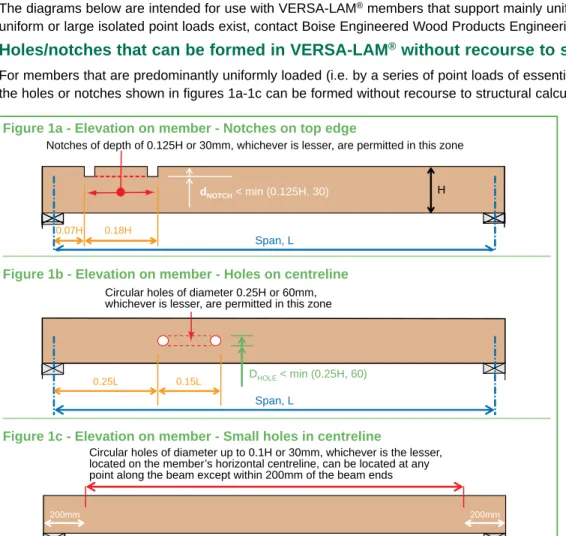
VERSA-LAM® Holes and Notches . . . . 45
Allowable Nail Spacings . . . . 46
VERSA-LAM® Used as Beams . . . . 46
Allowable Loads on VERSA-LAM® Beams . . . . 47
VERSA-LAM® Used as Columns . . . . 48
Common Framing Details . . . . 48
Multiple Member Connectors . . . . 49
VERSA-LAM® Products . . . . 50
Used as Rim Material . . . . 50
Used as Rim Joists / Bearers . . . . 50
Concentrated Load Capacities of Boise Rim Products . . . . 51
BCI® Joists Used as Wall Studs . . . . 52
Metalwork Connectors . . . . 53
Glossary . . . . 54
Helpful Hints . . . . 55 Contact Information . . . . Back Cover
ABOUT BOISE
The SIMPLE FRAMING SYSTEM® is a comprehensive
product and technical support package offering
com-petitive floor and roof solutions for use in high performance
domestic and commercial applications .
Boise is headquartered in Boise, Idaho, and provides products and services to help customers work more
efficiently, build more effectively, and create new ways to
meet business challenges . We manufacture engineered wood products, plywood, lumber, and particleboard . Boise
is a significant operator in the forest products industry
worldwide . Visit us at our website at www .bc .com . Globally, Boise is the fastest growing manufacturer of engineered wood products and is already the world’s largest supplier of laminated veneered lumber (LVL) beams, lintels, columns, and posts .
Boise has been supplying quality timber products to
the UK and Europe since the opening of our UK office
in 1972 . Today, in partnership with Crown Timber plc, the country’s leading provider of structural timber products to the timber engineering industry, we provide and support our SIMPLE FRAMING SYSTEM® range
of engineered wood products through a variety of specialist distribution facilities .
Experienced and resourceful staff provide technical and distribution expertise dedicated to delivering complete and
plot specific solutions nationwide. Our size and resource
base ensures the stability of supply in an ever changing and evolving marketplace . Boise is a participant in the Sustainable Forestry Initiative®
(SFI®), a comprehensive forest
management programme that is a combination of environmental responsibilities and sound
business practices . The procurement systems of Boise’s engineered wood product facilities have been audited by PricewaterhouseCoopers to the SFI® Standard and its
products will carry the SFI® Label . These procurement
systems provide tracking information on Boise’s supply chain sources . The SIMPLE FRAMING SYSTEM® is a highly efficient use of renewable timber fibre that can be
tracked back to source .
For more information on Boise corporate and our
Boise and the Building Regulations
BCI
®Joist Floors and Meeting the Requirements of the Building Regulations
In the UK, all building products need to meet the
requirements of the Building Regulations relevant to both the products and their intended use within a building . BCI® Joists used in floor construction need to meet the requirements of Part A (structure), Part B (fire), Part E
(sound) and Part L1 (air leakage) .
Boise’s engineered wood products have been assessed by the leading UK building material approval authorities including the British Board of Agrement and TRADA . For BCI® Joists these include BBA Certificate 99/3620 and TRADA Q Certificate Number 036/007. VERSA-LAM® has been granted BBA Certificate 99/3619. Such certification
is crucial for demonstrating the products compliance with Part A of the Building Regulations . Further information on the structural properties of these products are detailed on the following pages of this guide:
Pages
BCI® Joists . . . .9, 10, 11 & 51 VERSA-LAM® . . . .44, 45, 47, 48, 50 & 51
It is appropriate to consider the means of meeting the requirements of Parts B, E, and L1 of the Building
Regulations simultaneously, to ensure that the floor solution meets all the requirements in an efficient and cost
effective way . Details of the means by which BCI® Joist floor construction meets these requirements are given on
the following pages:
Pages
BCI® Joists - Fire, Sound, and
Air Leakage . . . . 30 - 35
Boise Engineered Wood Products • Technical Guide • Nov 006
Engineered wood products represent a bold step forward, not only in terms of their ease of use, excellent performance, and cost saving characteristics, but in the environmental credentials that they offer to specifiers and end users who are increasingly required to prove the eco ratings of the buildings that they construct.
Unlike conventional timber, the performance of engineered wood products can be accurately predicted which means we can
fine-tune a design so that exactly the right amount of product is employed for any given situation. Put
simply, there is no need to over-specify, saving both money and resources. In addition, the product’s manufacture requires no ancient or virgin timber and leads to very little wastage since virtually the whole tree is utilized – typically at least a third less trees are required than to develop the same profile conventionally. It is also worth remembering that, due to the manufacturing process, engineered wood products are stronger than the solid wood alternative. When it comes to comparisons with steel and concrete, figures for embodied energy and manufacturing emissions leave engineered wood products as the clear environmental favourite every time. Properly managed, harvesting trees and protecting the environment are indeed compatible objectives.
Quite rightly, the timber industry is under the environmental microscope, and it is ever more important for us all to prove that we are responsible through third-party auditing processes. At Boise, we are justifiably proud of our record. We are a founding member of the
Sustainable Forestry Initiative (SFI®) programme and the company’s
fibre procurement systems are certified to the SFI® standards while
our engineered wood products qualify under the SFI’s fibre source on-product labeling programme.
In August 005, the SFI® scheme has introduced a chain of custody
system that suppliers to UK government departments can use to
identify the percentage content of timber from SFI® managed forests
and so assure buyers that the timber is from a sustainable source.
The SFI® scheme joins the Canadian Standards Association (CSA)
Forest Stewardship Council (FSC) and The Programme for the Endorsement of Forest Certification (PEFC) schemes in providing assurance of both legal and sustainable timber. We have led the UK market since January 2005 by being the first company permitted to
stamp our engineered wood products with the SFI® label. This label
means that the facility that produced the product bearing it is part of a programme whose participants plant more than .7 million trees every day.
The SFI® programme provides a standard for integrating the
sustainable growing and harvesting of trees with protection of wildlife, plants, soil, and water quality. It is the only forest certification system with both land management and wood fibre procurement performance criteria and is founded on the concept of continuous improvement. There are currently over 50 million acres of forestland
in North America enrolled in the SFI® programme, making it among
the world’s largest sustainable forestry programmes.
SFI® is governed by a 15-member, multi-stakeholder Sustainable
Forestry Board made up of five members from the forest industry, five representatives from the environmental community, and five “other” stakeholders from academia, small private landowners, and other interested groups.
Boise undertakes SFI® certification audits annually. Trained auditors
from PricewaterhouseCoopers conduct the audits with a team of technical auditors specializing in hydrology, wildlife biology, roads, harvesting, and best management practices.
During its most recent audit, PricewaterhouseCoopers cited a number of good sustainable management practices. For example, Boise’s advance purchasing of wood chips, which allows chip vendors to plan volumes in advance, thus reducing the possibility of harvesting in unsuitable locations or during bad weather just to fulfill a contract.
Also noted was the company’s high level of professional leadership on numerous local, state, and national committees and organizations. Claims about the environmental performance of building materials and products are easy to make, but their sustainability is difficult to substantiate without a universal measuring system. We believe it is important to have a full understanding of how products compare so we are now pursuing the aim of profiling our products to help designers and specifiers ensure that they are selecting the materials that will best fulfill a sustainable brief.
The more participants in the various certification programmes, the faster the building green movement will grow. Timber has always been an important building material but now, with the move towards environmentally conscious building gathering momentum, we must be ready with innovative timber products that shout their environmental credentials and remove any doubt from people’s minds.
EcoHomes
EcoHomes is an assessment method in the UK that rates the environmental qualities of new and renovated dwellings. Buildings are verified by independent assessors and rated on a scale of pass, good, very good and excellent. The scheme rewards developers who improve the environmental performance of a development through good design, rather than through high capital cost solutions. EcoHomes is designed to help tackle climate change, resource use, impact on wildlife and balance these issues against the need to provide safe and healthy living and a high quality of life. For more
details about EcoHomes please visit the website www.ecohomes.org.
During 005 Boise commissioned the BRE to carry out a life cycle analysis, environmental profile and EcoHomes points rating on
our BCI® Joist products. The results and subsequent Green Guide
rating can be found on line at www. redbooklive.com in the section for domestic specification or we can supply details upon request. In summary, Boise has complied with the requirements identified in the scheme SD 028 and is authorised to use the BRE Certificate Mark on all publications related to the
environmental profile of our BCI® Joist products. Certificate number
ENP 0, issue , 6/06/006 to 5/06/009 refers.
Our undertaking to carry out this assessment in conjunction with the SFI® Chain of Custody certification for both our BCI® Joist
and VERSA-LAM® beam manufacturing facilities is testament to
our commitment to the UK construction industry and the evolving specification market.
For more information on
Boise Engineered Wood Products,
please telephone 01993 871235,
email [email protected] or visit www.bc.com/eu
Boise and the Environment
Environmental Profiles Scheme Certificate Number ENP 340
BCI® Joists and
VERSA-LAM® Products are approved
for use by the BBA .
Feature
Benefit
Laminated Veneer Lumber (LVL) Stable, strong and reliable engineered wood product that will not shrink, twist, cup, or bow like solid timber .
Tight manufacturing tolerances Accurate product sizes for installation into service class 1 & 2 environments . No shrinkage - no squeaks .
Wide range of products Competitive and compatible solutions .
Clean appearance Inspires product confidence for the builder, inspector, and home buyer .
Stiff and strong Quiet, flat floors – even ceilings. No herringbone strutting / blocking required at the mid span .
Light in weight Easy to handle .
Eased edges Reduces potential splinter injuries . Pre-stamped knock out holes Easy access for wiring and plumbing .
High performance OSB web Accommodates holes for larger services if necessary in accordance with guidelines detailed in this technical guide .
BC CALC® and BC FRAMER® Computer-aided design . Full supporting calculations and layout
drawings .
Full layout drawings Easy-to-read, job-specific joist layout plans. Precise component packages Easy to install, no waste .
Installation guide Easy-to-read installation instructions . Technical guide Comprehensive technical details . Technical support team Expert help is on hand .
Site trimming Easy to cut on site using basic hand tools .
Materially efficient
Wise use of natural resources . The peeling process in the
manufacture of LVL is a very efficient use of round log raw
materials . The BCI® Joist is a very efficient structural shape.
Quality assured – BBA approved Clean, consistent, reliable products .
Lifetime guarantee Instills confidence in the products and the construction.
Lifetime Guaranteed
Quality and Performance
Boise warrants its BCI® Joist, VERSA-LAM®,
and ALLJOIST® products to comply with
our specifications, to be free from defects in material and workmanship, and to meet or exceed our performance specifications for the normal and expected life of the structure
when correctly stored, installed and used according to our Installation Guide.
Engineered Wood
Products
Certificate Number 036/007
Boise Engineered Wood Products • Technical Guide • Nov 006
BCI
®
Joists
A world leader in high quality engineered wood products, Boise Engineered Wood Products offers a wide range of BCI® Joists .
BCI® Joists are manufactured to precise specifications
using VERSA-LAM® laminated veneer lumber flanges
bonded to an orientated strand board (OSB) web . The use of VERSA-LAM® as the flange material avoids
the inherent problems that plague solid timber such as shrinking, twisting, cupping, and bowing, all of which
contribute to squeaking floors.
Light in weight, yet immensely strong, the long-length BCI® Joists are quick and easy to install . Delivered to
site in precise precut component packages, the SIMPLE FRAMING SYSTEM® dramatically reduces installation
times and the potential for error .
Straight and true, BCI® Joists create flat floors and
even ceilings . Pre-stamped holes in the OSB web allows speedy installation of wiring and plumbing . Other holes can be made in the web to accommodate larger services .
VERSA-LAM
®
VERSA-LAM® provides the foundation for the SIMPLE
FRAMING SYSTEM® .
Manufactured by bonding high-specification
rotary-peeled timber veneers to create huge billets of
engineered wood, VERSA-LAM® is one of the strongest
and most reliable engineered wood products available in the UK today .
Available in a wide range of sizes, VERSA-LAM® is
an excellent partner for BCI® Joists in the SIMPLE
FRAMING SYSTEM® and can also be used for a variety of purposes including floor and roof beams, lintels,
purlins, columns, studs, door stock, and more . VERSA-LAM® is popular amongst timber frame
designers and manufacturers with a range of sizes suitable for timber frame as well as masonry construction .
Boise leads the world in new veneer technology . Our Product Development Team continuously researches new veneer species and bonding techniques to further push the boundaries of engineered wood products .
VERSA-LAM
®
as Rim
VERSA-LAM® is available in a 38mm width for use as a
high grade rim board in timber frame applications . It can also be used as a stairwell closue and in certain beam applications .
VERSA-LAM® has been specially developed to
withstand high compressive stresses perpendicular to the grain . This makes it ideal as a rimboard in timber frame construction ot transmit the vertical loads from
load-bearing walls through the floor construction to the
load-bearing walls below .
The use of VERSA-LAM® can reduce the need for
squash blocks in high load applications .
VERSA-LAM® is available in a range of depths to
suit the other components in the SIMPLE FRAMING SYSTEM® .
I
-bloc
™
UK Patent GB2406343B
I-bloc™ is a specially profiled LVL joist cap designed to
enable BCI® Joists to be built into masonry external and
party walls whilst meeting all current Building Regula-tion and NHBC technical requirements .
There is no need for extensive propping as the I-bloc™
allows decked floors to be used as a safe working
platform . There is also no need for additional restraint straps parallel to the joists as they sit on the wall with a minimum 90mm bearing .
Using the I-bloc™ stops air leakage around the joist ends in compliance with Building Regulations, Part L1 (air leakage) . Once installed, it eliminates the need for
a silicone sealant finish at the joist ends on the inner
blockwork leaf, subject to good workmanship when keying with mortar .
The I-bloc™ is quick and easy to use; it is simply a push
fit with no mechanical fixings or glue required. It can be
used on perimeter and party walls in compliance with
Building Regulations, Part B (fire) and Part E (sound)
requirements .
Boise Engineered Wood Products • Technical Guide • Nov 006
BC CALC
®Software
BC CALC® is our software program for sizing BCI®
Joists and VERSA-LAM® beams and operates
within Microsoft Windows® 95, 98, NT, 2000, ME
and XP .
BC CALC® is simple to use, yet flexible enough
to analyze a wide variety of joist and beam applications . Span, load and hole information entered by the user is used by the program to analyze the SIMPLE FRAMING SYSTEM® range of
engineered wood products .
Easy to read design reports may be printed after analysis has been run . This report clearly shows all span and load information as well as the analysis results .
BC CALC® is available to designers, architects
and engineers on CD-ROM . For more information, call Boise Engineered Wood Products on
01993 871235 .
BC FRAMER
®Software
Floor and roof framing layouts are quickly and expertly created by our skilled designers using our powerful and flexible BC FRAMER® software
package .
Working in conjunction with BC CALC®, the
software allows prompt detailing of walls, framing areas, stairwell openings and joist layouts creating cost effective design solutions . 3D views, large scale details, full product and price schedules are all at our designers’ fingertips .
BC FRAMER® software provides full working
drawings for design approval and for site installation . The software can also interface with other CAD systems to ensure full compatibility and flexibility for the Building Designer .
Materials and Manufacture
BCI® Joists are manufactured with VERSA-LAM®
LVL flanges, oriented strand board (OSB) webs and waterproof structural adhesives . The OSB web sections are glued together at 1220mm centres to form a continuous web . The webs are glued into a 12mm deep groove in the centre of the wide face of the flange members . All components are machine-assembled and pressed in one continuous operation . Boise operates the two largest and fastest I-joist plants in the world .
Quality Assurance
BCI® Joists are approved for use in the UK by the
British Board of Agrément and are manufactured under a factory production control system audited on a monthly basis by a third-party inspection agency .
Sizes
Five joist series, BCI® 5000s, 6000s, 6500s, 60s and
90s, are available . Each joist is available in a range of depths as detailed in the product profile illustration above . Joists are manufactured up to 20m long .
Tolerances
The tolerances (in mm) on member sizes are: Joist length . . . ±3 .2 Joist height . . . ±0 .76 Flange thickness . . . ±1 .27 Flange width . . . .-0 .51 to +0 .38
Moisture Content
BCI® Joists will arrive on-site with a moisture content
of 8% to 10% . In a service class 1 environment (as defined in BS5268-2:2002), BCI® Joists will remain
at an equilibrium moisture content of approximately 10%, whilst in a service class 2 environment, they will absorb a little moisture from the atmosphere and attain a final equilibrium moisture content of 12% to 14% .
NOTE: The corresponding equilibrium moisture contents of solid timber in service classes 1 and 2 will be approximately 12% and 18%, respectively, having typically been delivered to site at a moisture content of 18% to 24%.
Preservative Treatment
BCI® Joists are untreated products with a natural
durability sufficient to ensure a minimum design life of 60 years when installed in a service class 1 or 2 environment and not subject to mechanical damage or insect attack . Differences in the swelling char-acteristics of the materials used in BCI® Joists mean
that preservative treatment should not be under-taken without consulting Boise Engineered Wood Products s as this may affect the structural integrity of the component .
BCI
®5000s
9 .5mm 28mm 241mm 302mm 356mm 51mmBCI
®6000s
241mm 302mm 356mm 406mmBCI
®6500s
BCI
®60s
BCI
®90s
28mm
38mm 38mm
28mm
2006 European Product Profiles
241mm 302mm 356mm 406mm 9 .5mm 9 .5mm 241mm 302mm 356mm 406mm 241mm 302mm 356mm 406mm 9 .5mm 9 .5mm 59mm 65mm 59mm 89mm
BCI
®Joist Specifications
BCI® Joists are approved for use under
the UK Building Regulations by British Board of Agrément BBA Certificate No. 99/3620.
BBA certification is recognised by:
N .H .B .C . Zurich Municipal UKTFA TRA
Building Contractors Building Control Officers
Engineered Wood
Products
Certificate Number 036/007
Boise Engineered Wood Products • Technical Guide • Nov 006
BCI® Joists are intended for use as structural members such as floor or roof joists, beams, rafters, wall studs or
ceiling ties, in service class 1 or 2 environments as defined in BS5268-2:2002 .
Design properties for BCI® Joists in these internal conditions
are given in the table below for long-term loading . Design prop-erties for shorter load durations may be determined by applying the appropriate value of the
k
3 modification factor given inBS5268-2:2002 .
Notes
/1 The properties given above are applicable to
long-term load duration . Permissible strength values for other load durations may be obtained by multiplying by 1 .25 for medium-term loading or 1 .5 for short-term loading as detailed in BS5268-2:2002 .
/2 The properties given above presuppose
adequate lateral restraint is provided to the compression flange via continuous boarding or discrete restraints applied at maximum centres of 400mm .
/3 For web stiffener specifications and fixing
details, see page 18 .
/4 The maximum deflection of a uniformly loaded
joist can be calculated from the following equation :
d = (5wL4/384EI) + (wL2/8GA) where :
w is the uniform load (kN/m) L is the span (m)
EI is the flexural rigidity obtained from the table GA is the shear rigidity obtained from the table
BCI
®Joists Used as Joists / Beams
Long-Term Design Properties of BCI
®Joists in Bending (k
3
= 1 .0)
/1, /2Service Class 1 Conditions — (20oC / 65% rh)
Joist Depth Joist Type Bending Moment Capacity (kNm) Flexural Rigidity (El) (Nmm x 09) Shear Resistance (kN) Shear Rigidity (GA) (Nx106)
End Reaction (kN) Intermediate Reaction (kN)
45mm Bearing 89mm Bearing 89mm Bearing 133mm Bearing
Web Stiffeners Web Stiffeners Web Stiffeners Web Stiffeners Service Class 1 Load Sharing Non-Load Sharing Load Sharing Non-Load Sharing
No Yes No Yes No Yes No Yes No Yes No Yes No Yes No Yes
Load Sharing Non-Load
Sharing Load Sharing
Non-Load
Sharing Load Sharing
Non-Load
Sharing Load Sharing
Non-Load Sharing 241 5000s 6000s 6500s 60s 90s 302 5000s 6000s 6500s 60s 90s 356 5000s 6000s 6500s 60s 90s 406 6000s 6500s 60s 90s
Long-Term Design Properties of BCI
®Joists in Bending (k
3
= 1 .0)
/1, /2Service Class 2 Conditions — (20oC / 85% rh)
Joist Depth Joist Type Bending Moment Capacity (kNm) Flexural Rigidity (El) (Nmm x 09) Shear Resistance (kN) Shear Rigidity (GA) (Nx106)
End Reaction (kN) Intermediate Reaction (kN)
45mm Bearing 89mm Bearing 89mm Bearing 133mm Bearing
Web Stiffeners Web Stiffeners Web Stiffeners Web Stiffeners Service Class 2 Load Sharing Non-Load Sharing Load Sharing Non-Load Sharing
No Yes No Yes No Yes No Yes No Yes No Yes No Yes No Yes
Load Sharing Non-Load
Sharing Load Sharing
Non-Load
Sharing Load Sharing
Non-Load
Sharing Load Sharing
Non-Load Sharing 241 5000s 6000s 6500s 60s 90s 302 5000s 6000s 6500s 60s 90s 356 5000s 6000s 6500s 60s 90s 406 6000s 6500s 60s 90s Joist Depth Joist Weight (kg/m) 5000s 6000s 6500s 60s 90s 241 3 .43 3 .73 4 .03 4 .47 6 .11 302 3 .88 4 .18 4 .47 4 .92 6 .41 356 4 .32 4 .62 4 .92 5 .22 6 .86 406 - 5 .07 5 .22 5 .67 7 .31 3 .55 3 .42 433 6 .01 5 .78 1 .82 4 .59 5 .04 4 .41 4 .85 5 .25 5 .56 5 .05 5 .35 10 .06 10 .52 9 .67 10 .12 10 .06 10 .52 9 .67 10 .12 4 .11 3 .95 498 6 .01 5 .78 1 .82 4 .59 5 .04 4 .41 4 .85 5 .25 5 .56 5 .05 5 .35 10 .06 10 .52 9 .67 10 .12 10 .06 10 .52 9 .67 10 .12 4 .58 4 .40 552 6 .01 5 .78 1 .82 4 .59 5 .04 4 .41 4 .85 5 .25 5 .56 5 .05 5 .35 10 .06 10 .52 9 .67 10 .12 10 .06 10 .52 9 .67 10 .12 5 .69 5 .48 645 5 .39 5 .39 1 .75 4 .15 4 .86 4 .15 4 .86 5 .12 5 .39 5 .12 5 .39 9 .19 10 .17 9 .19 10 .17 10 .80 10 .95 10 .80 10 .95 8 .76 8 .43 979 5 .39 5 .39 1 .75 4 .15 4 .86 4 .15 4 .86 5 .12 5 .39 5 .12 5 .39 9 .19 10 .17 9 .19 10 .17 10 .80 10 .95 10 .80 10 .95 4 .54 4 .37 725 7 .05 6 .78 2 .28 4 .76 5 .56 4 .58 5 .34 5 .54 6 .52 5 .33 6 .27 10 .01 10 .70 9 .63 10 .29 10 .01 10 .70 9 .63 10 .29 5 .26 5 .06 832 7 .05 6 .78 2 .28 4 .76 5 .56 4 .58 5 .34 5 .54 6 .52 5 .33 6 .27 10 .01 10 .70 9 .63 10 .29 10 .01 10 .70 9 .63 10 .29 5 .86 5 .63 922 7 .05 6 .78 2 .28 4 .76 5 .56 4 .58 5 .34 5 .54 6 .52 5 .33 6 .27 10 .01 10 .70 9 .63 10 .29 10 .01 10 .70 9 .63 10 .29 7 .43 7 .15 1100 6 .55 6 .55 2 .34 4 .21 4 .95 4 .21 4 .95 5 .55 6 .55 5 .55 6 .55 9 .29 11 .94 9 .29 11 .94 11 .25 12 .31 11 .25 12 .31 11 .42 10 .99 1663 6 .55 6 .55 2 .34 4 .21 4 .95 4 .21 4 .95 5 .55 6 .55 5 .55 6 .55 9 .29 11 .94 9 .29 11 .94 11 .25 12 .31 11 .25 12 .31 5 .40 5 .19 1050 7 .91 7 .61 2 .69 4 .92 6 .02 4 .73 5 .79 5 .80 7 .32 5 .58 7 .03 11 .03 12 .43 10 .60 11 .95 11 .03 12 .43 10 .60 11 .95 6 .25 6 .01 1200 7 .91 7 .61 2 .69 4 .92 6 .02 4 .73 5 .79 5 .80 7 .32 5 .58 7 .03 11 .03 12 .43 10 .60 11 .95 11 .03 12 .43 10 .60 11 .95 6 .97 6 .70 1330 7 .91 7 .61 2 .69 4 .92 6 .02 4 .73 5 .79 5 .80 7 .32 5 .58 7 .03 11 .03 12 .43 10 .60 11 .95 11 .03 12 .43 10 .60 11 .95 8 .93 8 .59 1610 6 .85 6 .85 2 .86 4 .67 5 .28 4 .67 5 .28 5 .85 6 .85 5 .85 6 .85 9 .29 13 .41 9 .29 13 .41 11 .42 15 .03 11 .42 15 .03 13 .73 13 .21 2426 6 .85 6 .85 2 .86 4 .67 5 .28 4 .67 5 .28 5 .85 6 .85 5 .85 6 .85 9 .29 13 .41 9 .29 13 .41 11 .42 15 .03 11 .42 15 .03 7 .15 6 .88 1610 8 .71 8 .37 3 .06 5 .20 6 .43 5 .00 6 .18 6 .12 8 .06 5 .89 7 .75 12 .40 12 .97 11 .92 12 .47 12 .40 12 .97 11 .92 12 .47 7 .97 7 .67 1790 8 .71 8 .37 3 .06 5 .20 6 .43 5 .00 6 .18 6 .12 8 .06 5 .89 7 .75 12 .40 12 .97 11 .92 12 .47 12 .40 12 .97 11 .92 12 .47 10 .30 9 .90 2180 8 .34 8 .34 3 .34 5 .17 6 .24 5 .17 6 .24 6 .48 8 .34 6 .48 8 .34 9 .38 15 .10 9 .38 15 .10 12 .62 16 .42 12 .62 16 .42 15 .84 15 .24 3270 8 .34 8 .34 3 .34 5 .17 6 .24 5 .17 6 .24 6 .48 8 .34 6 .48 8 .34 9 .38 15 .10 9 .38 15 .10 12 .62 16 .42 12 .62 16 .42 3 .20 3 .07 401 5 .23 5 .03 1 .49 3 .67 4 .03 3 .53 3 .88 4 .20 4 .45 4 .04 4 .28 8 .05 8 .42 7 .74 8 .09 8 .05 8 .42 7 .74 8 .09 3 .70 3 .56 461 5 .23 5 .03 1 .49 3 .67 4 .03 3 .53 3 .88 4 .20 4 .45 4 .04 4 .28 8 .05 8 .42 7 .74 8 .09 8 .05 8 .42 7 .74 8 .09 4 .12 3 .96 511 5 .23 5 .03 1 .49 3 .67 4 .03 3 .53 3 .88 4 .20 4 .45 4 .04 4 .28 8 .05 8 .42 7 .74 8 .09 8 .05 8 .42 7 .74 8 .09 5 .13 4 .94 591 5 .39 5 .39 1 .45 4 .15 4 .86 4 .15 4 .86 5 .12 5 .39 5 .12 5 .39 9 .19 10 .17 9 .19 10 .17 10 .80 10 .95 10 .80 10 .95 7 .89 7 .59 896 5 .39 5 .39 1 .45 4 .15 4 .86 4 .15 4 .86 5 .12 5 .39 5 .12 5 .39 9 .19 10 .17 9 .19 10 .17 10 .80 10 .95 10 .80 10 .95 4 .09 3 .93 671 6 .13 5 .89 1 .87 3 .81 4 .45 3 .67 4 .28 4 .43 5 .21 4 .26 5 .01 8 .01 8 .56 7 .70 8 .23 8 .01 8 .56 7 .70 8 .23 4 .73 4 .55 770 6 .13 5 .89 1 .87 3 .81 4 .45 3 .67 4 .28 4 .43 5 .21 4 .26 5 .01 8 .01 8 .56 7 .70 8 .23 8 .01 8 .56 7 .70 8 .23 5 .27 5 .07 853 6 .13 5 .89 1 .87 3 .81 4 .45 3 .67 4 .28 4 .43 5 .21 4 .26 5 .01 8 .01 8 .56 7 .70 8 .23 8 .01 8 .56 7 .70 8 .23 6 .68 6 .43 1010 6 .55 6 .55 1 .94 4 .21 4 .95 4 .21 4 .95 5 .55 6 .55 5 .55 6 .55 9 .29 11 .94 9 .29 11 .94 11 .25 12 .31 11 .25 12 .31 10 .28 9 .89 1520 6 .55 6 .55 1 .94 4 .21 4 .95 4 .21 4 .95 5 .55 6 .55 5 .55 6 .55 9 .29 11 .94 9 .29 11 .94 11 .25 12 .31 11 .25 12 .31 4 .86 4 .68 972 6 .88 6 .61 2 .20 3 .94 4 .81 3 .79 4 .63 4 .64 5 .85 4 .46 5 .63 8 .82 9 .94 8 .48 9 .56 8 .82 9 .94 8 .48 9 .56 5 .63 5 .41 1110 6 .88 6 .61 2 .20 3 .94 4 .81 3 .79 4 .63 4 .64 5 .85 4 .46 5 .63 8 .82 9 .94 8 .48 9 .56 8 .82 9 .94 8 .48 9 .56 6 .27 6 .03 1230 6 .88 6 .61 2 .20 3 .94 4 .81 3 .79 4 .63 4 .64 5 .85 4 .46 5 .63 8 .82 9 .94 8 .48 9 .56 8 .82 9 .94 8 .48 9 .56 8 .03 7 .73 1480 6 .85 6 .85 2 .37 4 .67 5 .28 4 .67 5 .28 5 .85 6 .85 5 .85 6 .85 9 .29 13 .41 9 .29 13 .41 11 .42 15 .03 11 .42 15 .03 12 .37 11 .90 2220 6 .85 6 .85 2 .37 4 .67 5 .28 4 .67 5 .28 5 .85 6 .85 5 .85 6 .85 9 .29 13 .41 9 .29 13 .41 11 .42 15 .03 11 .42 15 .03 6 .44 6 .19 1490 7 .57 7 .28 2 .51 4 .16 5 .15 4 .00 4 .95 4 .90 6 .44 4 .71 6 .20 9 .92 10 .37 9 .54 9 .97 9 .92 10 .37 9 .54 9 .97 7 .18 6 .90 1650 7 .57 7 .28 2 .51 4 .16 5 .15 4 .00 4 .95 4 .90 6 .44 4 .71 6 .20 9 .92 10 .37 9 .54 9 .97 9 .92 10 .37 9 .54 9 .97 9 .26 8 .91 2000 8 .34 8 .34 2 .77 5 .17 6 .24 5 .17 6 .24 6 .48 8 .34 6 .48 8 .34 9 .38 15 .10 9 .38 15 .10 12 .62 16 .42 12 .62 16 .42 14 .26 13 .72 2990 8 .34 8 .34 2 .77 5 .17 6 .24 5 .17 6 .24 6 .48 8 .34 6 .48 8 .34 9 .38 15 .10 9 .38 15 .10 12 .62 16 .42 12 .62 16 .42
Maximum Long-Term Load on BCI® Joists Subject to Uniform Compression
Perpendicular to the Joist Direction (Service Classes 1 and 2)
BCI
®Joists Used as Columns / Studs
The maximum axial compression capacity of BCI® Joists used as struts should be based upon the
capacity of the flange cross-section only:
Pc = σc,adm x Af x
k
12 xk
3Where: Pc = maximum axial compression load (N) σc,adm = 19 .5 N/mm2 for Service Class 1
= 17 .5 N/mm2 for Service Class 2
Af = Total cross-sectional area of the flanges (mm2)
k12
= Slenderness modification factor from BS5268–2:2002k3
= Load duration modification factor from BS5268–2:2002BCI
®Joists Used as Ties
The maximum axial tensile capacity of BCI® Joists used as struts, where both flanges are equally loaded, should be
based upon the capacity of the flange cross-section only:
Pt = σt,adm x Af x
k3
x(
2440)
0.125L
Where: Pt = maximum axial tension load (N) σt,adm = 15 .0 N/mm2 for Service Class 1
= 13 .5 N/mm2 for Service Class 2
Af = Total cross-sectional area of the flanges (mm2)
k3
= Load duration modification factor from BS5268–2:2002 L = Member length (mm) [min . value = 2440 mm]Allowable Nail Spacings
Nailed joints in VERSA-LAM® flanges of BCI® Joists should be designed using the permissible nail values given in
BS 5268-2: 2002 for C27 timber . Nails should be spaced in accordance with the following table:
BCI
®Joists Used as Rim Joists / Bearers
Joist Maximum Load Depth per Metre Run (kN/m)
241 42 .3
302 38 .0
356 34 .2
406 32 .0
Nailing in Wide Face (Perpendicular to Glue Lines) Nail Diameter
(mm) End Distance (mm) Edge Distance (mm) Parallel to Grain (mm)Along Face - Perpendicular to Grain (mm)Across Face
-3 .0 48 15 48 24
3 .35 54 17 54 27
3 .75 60 19 60 30
Nailing in Narrow Face (Parallel to Glue Lines) Nail Diameter (mm) End Distance (mm) Edge Distance (mm) Along Face - Parallel to Grain (mm) Across Face - Perpendicular to Grain (mm) 3 .0 60 15 60 15 3 .35 67 17 67 17 3 .75 75 19 75 19 Nailing perpendicular to Glue Lines (Wide Face)
Nailing parallel to
Glue Lines (Narrow Face)
Boise Engineered Wood Products • Technical Guide • Nov 006
About Floor Performance
Increasing the stiffness of a floor system will improve its performance and “feel” . The most efficient way of increasing the stiffness of the floor is to deepen the joists — this is simple engineering fact - a 25% increase in joist depth will have the same effect as doubling the joist width or halving the joist centres . A clear justification for the “deeper is cheaper” statement that echoes around the engineered wood product industry . Our designers can easily design the floor to performance levels above the minimum code requirements if so desired .
The performance of a floor is matter of opinion . The “feel” that satisfies one individual may not satisfy another . Many factors affect the perceived performance of a floor . These include:
The depth of the joist
The stiffness of a floor can be markedly improved by increasing joist depth . For example, a 25% increase in joist depth will double the floor stiffness .
The spacing of the joist system
The stiffness of a floor increases in proportion to reductions in joist spacing .
Continuous or simple spans
Allowing joists to span over internal load-bearing walls instead of breaking them at these points can increase floor stiffness by up to 240% .
The decking / flooring materialThicker decking slightly improves floor performance — 22mm chipboard increases floor stiffness by 2%* compared to 18mm chipboard and means less 'local' deflection under foot .
The fixing of the decking material to the joist
Gluing the floor deck to the joists significantly improves floor stiffness, by as much as 70% .*
The ceiling material below the joistDirectly applied ceiling boards can improve floor performance by up to 3% .*
Level bearingsUnlevel bearings can mean joists feel "spongy" under foot near bearing positions .
The location of walls and furnitureThe position and size of dead loads on floors can either dampen or exaggerate the dynamic response of floors under foot .
*Figures established from independent laboratory research carried out on behalf of the UK Government.
BCI® Joists are designed for floor applications using the principles of BS5268–2:2002 and the joist properties
contained in BBA Certificate 99/3620 . In general, it can be assumed that floors in modern centrally heated buildings will achieve a Service Class 1 moisture condition . Uniformly distributed dead and imposed loads will be assumed across the whole floor unless otherwise directed . Imposed loads will be selected from the examples tabulated below depending on the intended use of the floor . Dead loads can be taken from the schedule of material weights tabulated below .
BS6399:Part 1 recommends that the loads for all permanent partitions are applied in the given locations as dead loads . In practice, a standard dead load of 0 .75kN/m2 is generally assumed
which makes allowance for a standard floor construction (22mm chipboard decking + 15mm plasterboard ceiling), supporting internal non load-bearing partitions above . Exceptionally, this may be reduced to 0 .5kN/m2 where no partition walls
are known to exist, or increased to a higher value where a heavier form of construction is used .
Plasterboard Chipboard Flooring VERSA-LAM® R BCI® Joist Timber Stud Partition
Schedule of Material Dead Weights
Floor Decking kN/m2 Ceiling Finishes kN/m2
18mm Chipboard 22mm Chipboard 18mm T&G Boarding 22mm T&G Boarding 15mm OSB 18mm OSB 15mm Plywood 19mm Plywood 18mm Particleboard/1 22mm Particleboard/1 16mm S .W . Boarding 19mm S .W . Boarding
12 .5mm Sound Resistant P/board 19mm Gypsum Plank 0 .13 0 .16 0 .10 0 .12 0 .11 0 .13 0 .10 0 .12 0 .22 0 .27 0 .08 0 .09 0 .11 0 .14 5mm Plaster Skim 15mm Plasterboard 12 .5mm Plasterboard 12 .5mm Firecheck P/board 0 .05 0 .11 0 .09 0 .11 Partition Loads kN/m2 12 .5mm Plasterboard on timber studwork 0 .29 Insulation kN/m2 Rock Wool (25mm) Glass Fibre (50mm) 0 .01 0 .01
/1Particleboard refers to cement bonded particleboard Type T1 Flooring .
The minimum stiffness permitted for floors in BS5268-2:2002 is defined by the deflection being limited to 0 .3% of the span or 14mm, whichever is the lesser . Boise recommends that BCI® Joists are designed to higher stiffness criteria in order to
provide superior floor performance . NHBC technical standards require that the maximum deflection is limited to 12mm . Floor performance can be enhanced consistently in practice if the decking is glued to the joist platform, as highlighted by the factors affecting floor performance . This step is also recom-mended as a basis for ensuring superior floor performance in practice .
Standard Imposed Load Allowances
Intended Room Usage kN/m2
Domestic Floors Office Floors Computer Rooms Storage Rooms Gymnasium Stationery Stores Balconies Billiard Rooms Areas with Fixed Seating Concert Halls Bedrooms in Hotels/Motels Dining Rooms/ Lounges Cafes 1 .5 2 .5 3 .5 2 .4/m height of storage 5 .0 4 .0/m height of storage Same as rooms to which
they give access (min 1 .5 for domestic use, 4 .0
for public / office use) 2 .0
4 .0
5 .0 2 .0
2 .0
/1Taken from BS6399:Part1:1996
BCI
Joists — Floor Applications
Boise Engineered Wood Products • Technical Guide • Nov 006
Notes :
/1 All spans quoted are “engineered spans” measured between
centres of bearing points. Minimum bearing lengths required are 45mm at joist ends and 89mm at intermediate supports.
/2 All spans quoted are for standard domestic loading (including allowance for internal partitions) – 0.75kN/m dead loading: .5kN/m imposed loading.
/3 Spans quoted for double span joists are maximum achievable
values assuming both spans are equal. Where joists are continuous over two unequal spans, smaller values
will apply, intermediate between the single and double-span values quoted, depending upon the relative proportions of the
spans involved.
/4 Minimum floor stiffness recommended in BS5268-2:2002 – dictated by maximum allowable floor deflection = 0.% of the span up to a maximum of mm.
/5 Minimum floor stiffness recommended by NHBC – dictated by maximum floor deflection = 0.% of the span up to a maximum of mm.
/6 100% higher floor stiffness than recommended in
BS5268-2:2002 – dictated by maximum floor deflection =
0.5% of the span up to a maximum of 7mm. /7 These spans are stress controlled. All other spans are
deflection controlled.
Max . span Max . span Max . span
Single Span Double Span
Residential Floor Span Tables
Joist Depth (mm) BCI® Joist Type Single Span
Maximum spans (m) for domestic construction
/1, /2Code Recommended/4 NHBC Recommended/5 100% Stiffer than Code/6
600c/c 480c/c 400c/c 300c/c 600c/c 480c/c 400c/c 300c/c 600c/c 480c/c 400c/c 300c/c BCI 45s BCI 40s BCI 60s 241mm 5000s Single Span 6000s Single Span 6500s Single Span 60s Single Span 90s Single Span BCI 45s BCI 40s BCI 60s 302mm 5000s Single Span 6000s Single Span 6500s Single Span 60s Single Span 90s Single Span BCI 45s BCI 40s BCI 60s 356mm 5000s Single Span 6000s Single Span 6500s Single Span 60s Single Span 90s Single Span BCI 45s BCI 40s BCI 60s 406mm 6000s Single Span 6500s Single Span 60s Single Span 90s Single Span
The table below represents maximum spans for a range of floor performance levels for joists in a single span application . Multispanning a joist over intermediate supports can result in improved
performance or the ability to span further . Please refer to BC CALC® or Boise Engineered Wood Products engineering
department for further details .
4 .015 4 .352 4 .645 5 .015 4 .011 4 .256 4 .466 4 .817 3 .103 3 .376 3 .613 4 .015 4 .198 4 .551 4 .808 5 .185 4 .144 4 .398 4 .616 4 .979 3 .239 3 .527 3 .776 4 .198 4 .337 4 .694 4 .926 5 .313 4 .244 4 .505 4 .729 5 .103 3 .343 3 .641 3 .900 4 .337 4 .547 4 .861 5 .104 5 .508 4 .392 4 .665 4 .898 5 .288 3 .495 3 .810 4 .084 4 .547 5 .037 5 .353 5 .623 6 .074 4 .828 5 .133 5 .394 5 .829 3 .963 4 .330 4 .647 5 .037 4 .749 5 .038 5 .286 5 .700 4 .558 4 .837 5 .076 5 .475 3 .698 4 .022 4 .303 4 .749 4 .904 5 .204 5 .461 5 .890 4 .706 4 .995 5 .243 5 .657 3 .859 4 .199 4 .494 4 .904 5 .023 5 .331 5 .595 6 .036 4 .819 5 .116 5 .371 5 .796 3 .984 4 .336 4 .642 5 .023 5 .237 5 .560 5 .836 6 .298 5 .024 5 .335 5 .602 6 .047 4 .214 4 .589 4 .845 5 .237 5 .757 6 .117 6 .426 6 .940 5 .519 5 .866 6 .164 6 .660 4 .748 5 .056 5 .319 5 .757 5 .206 5 .524 5 .796 6 .250 4 .996 5 .303 5 .565 6 .003 4 .196 4 .561 4 .821 5 .206 5 .371 5 .700 5 .982 6 .452 5 .154 5 .471 5 .743 6 .196 4 .374 4 .732 4 .972 5 .371 5 .501 5 .839 6 .128 6 .612 5 .278 5 .603 5 .883 6 .349 4 .515 4 .844 5 .090 5 .501 5 .764 6 .119 6 .424 6 .931 5 .530 5 .872 6 .165 6 .655 4 .772 5 .074 5 .333 5 .764 6 .330 6 .726 7 .065 7 .631 6 .069 6 .451 6 .778 7 .323 5 .223 5 .560 5 .849 6 .330 5 .777 6 .131 6 .435 6 .941 5 .543 5 .884 6 .177 6 .665 4 .788 5 .089 5 .347 5 .777 5 .921 6 .285 6 .597 7 .118 5 .680 6 .031 6 .332 6 .834 4 .903 5 .213 5 .478 5 .921 6 .216 6 .599 6 .927 7 .474 5 .964 6 .333 6 .649 7 .177 5 .147 5 .473 5 .752 6 .216 6 .822 7 .248 7 .613 8 .222 6 .540 6 .951 7 .304 7 .891 5 .629 5 .992 6 .304 6 .822
For timber frame rim details, see F1 to F5.
For mutiple member connectors details,
see F10 to F13.
For stairwell framing details, see pages 25 and 26.
For masonry rim details, see F16 to F19 and F21.
For fixings to steel beams,
see F15. For stud wall support details,
see F3a and F7 to F9. For cantilever details,
see F14. For hole location and sizing chart,
see page 28.
Solid blocking or herring-bone strutting is NOT required on the SIMPLE FRAMING SYSTEM
®.
For installation stability, see Temporary Construction Bracing details on page 27.
For masonry wall restraint details,
see F18.
Boise Engineered Wood Products • Technical Guide • Nov 006
F1
Fixing at end bearing .F1a
Party wall end bearing .F2
BCI® Rim blocking .F3a
Non load-bearing stud wall(perpendicular to joist) .
F4
VERSA-LAM® Rim(perpendicular to joist - external wall) .
F4a
VERSA-LAM® Rim(perpendicular to joist - party wall) .
VERSA-LAM®.
BCI® Joist.
Note: To avoid splitting flange, start locator nail at least 38mm from end. Nails will need to be driven at an angle to prevent splitting of bearing plate.
1-No 3.35x65mm locator nail.
45mm minimum
bearing length. BCI® Joist.
Note: To avoid splitting flange, start locator nail at least 38mm from end. Nails will need to be driven at an angle to prevent splitting of bearing plate.
38mm VERSA-LAM® Rim.
45mm VERSA-LAM®.
End blocking on both sides
of BCI® Joist. 1-No 3.35x65mm
locator nail.
45mm minimum bearing length.
Note: Nail VERSA-LAM® rim board to BCI® Joists with
2-No 3.35x65mm nails, one at the top and one at the bottom (see detail F1).
Note: Skew nail VERSA-LAM® rim board
to wallplate using 3.35x65mm nails at mid point between joist spacings.
BCI® rim blocking.
Note: Nail BCI® rim blocking to wallplate using
3.35x65mm nails each side at 300mm centres. Skew nail top of blocking to joist.
Sole plate to be fixed to BCI® Joist.
Perpendicular non load-bearing stud wall.
For alternative detail, see F4a
38mm C16 timber block fitted between webs of BCI® Joist.
BCI® blocking.
45mm minimum bearing length for BCI® Joist.
89mm stud.
38mm VERSA-LAM®.
BCI® Joist.
F5
VERSA-LAM® Rim (parallel to joist - external wall) .F5a
VERSA-LAM® Rim(parallel to joist - party wall) .
VERSA-LAM® of
adequate width to support floor decking and plasterboard.
Skew nail VERSA-LAM® rim board to plate using
3.35x65mm nails at 300mm centres. W 2 W 2 W
F6
Joist spliced on load-bearing wall .F7
Non load-bearing stud wall(parallel to joist) .
F8
Wall to wall load transfer(BCI® Joist blocking) .
F8a
Wall to wall load transfer
(squash blocks) .
Sole plate to be fixed to nogging.
Non load-bearing partition wall.
35x72mm noggings at 600mm centres with Z-clips at both ends. Attach with 4-No 3.75x30mm square twist nails.
Floor deck.
Squash blocks (38x89mm min.) Load-bearing wall above
(aligned over wall below).
89mm min. 2mm BCI® Joist blocking required
where walls are not built up to underside of floor deck.
15x300mm OSB or plywood splice block to one side only. Fix using 6-No 3.35x65mm nails, clenched.
Min. 5mm gap at top.
Use 45mm VERSA-LAM® blocking
in areas where 3 or more multiple studs are used.
Load-bearing internal wall perpendicular to joist direction and aligned with wall below.
Use BCI® Joist
blocking where less than 3 multiple studs are used.
Note: Nail blocking to wallplate using 3.35x65mm min. nails at 300mm centres.
BCI® Joist
blocking.
Skew nail VERSA-LAM® rim board to plate using
3.35x65mm nails at 300mm centres. BCI® Joist of
adequate width to support floor decking
and plasterboard. W2 W2 W
Boise Engineered Wood Products • Technical Guide • Nov 006
75 75 75 300
Series Backer Block Thickness 5000s 20mm wood panel 6000s 25mm wood panel 60s 25mm wood panels 90s 18mm + 22mm wood panels 6500s 27mm wood panel
Depth Block DepthsBacker 241mm 147mm 302mm 219mm 356mm 269mm 406mm 319mm = = 3.35x65mm nails clenched (100mm nails for 90s Series Joists).
Where nails are clenched, all nails can be driven from near side.
F9
Concentrated load transfer (squash blocks) .F11
Backer block (face mount hanger) .F10
Web stiffeners (fixing and specification).F11a
Backer block (top hung hanger) .F11b
Backer block (fixing and specification).Face mount joist hanger.
Backer block required on both sides of web.
Note: Fix backer block using 8-No 3.35x65mm nails clenched (see F11b). Use 100mm nails for 90s series joist.
High vertical load.
Provide squash blocks where vertical load exceeds rim capacity (see page 51 of the technical guide).
60mm min. Small gap: 3mm min. 50mm max.
OSB or Plywood web stiffener: 50mm min. 50mm min. Joist Depth 241 2-No 3.35x65mm 302 3-No 3.35x65mm 356 5-No 3.35x65mm 406 6-No 3.35x65mm 5000s Series 18x60mm min. 6000s Series 22x60mm min. 60s Series 22x60mm min. Fixings 90s Series 38x60mm min.
Note: Use 100mm nails for 90s Series Joists.
6500s Series 25x60mm min.
Intermediate
Tight Fit. Tight Fit.
Tight Fit. Tight Fit.
End Bearings.
Partial Depth Hangers
(not restraining top flange). Concentrated Loads. Bearings. 2 nails. 241mm 60mm min. = = = 3 nails. 302mm 60mm min. = = = = 5 nails. 356mm = = = = 6 nails. 406mm = = = = 25mm min. 60mm min. 25mm min. 25mm min. Web stiffeners may be used to increase allowable
reaction values in the applications below.
Note: Web stiffeners are not required for BCI® Joists unless used in hangers that do not extend up to restrain the top flange of the BCI® Joist or as required by design. All Nails to be 3.35 x 65mm driven through and clenched over on far side.
Top flange joist hanger. Tight fit.
With top flange hangers, backer block must be installed tight to the underside of top flange. Backer block required on both sides of web.
Note: Fix backer block using 8-No 3.35x65mm nails clenched (see F11b). Use 100mm nails for 90s series joist.
F11c
No backer block required (Cullen UI or HUI hanger) .F11d
No backer block required (Simpson Strong-Tie ITB hanger) .F12
Filler block (fixing and specification).F12a
2-ply BCI® filler block.F12b
Filler block (short length option) .F12c
Filler block (full length option) .UI or HI Hanger fixed using 3.75x30mm square twist nails through all holes.
Backer blocks are not required when UI or HI hangers are used.
UI hanger has only top chord return flange.
HI hanger has full depth return flange.
Fix 2-ply BCI® Joists together using filler blocks at
all bearing points, at incoming load positions, and at max 3.6m centres (see F12b).
See F12 for fixing details.
100
=
=
=
=
Series Filler Block Thickness 5000s 40mm Timber 6000s 47mm Timber 6500s 53mm Timber 60s 47mm Timber 90s 75mm Timber
Depth Filler Block Depth
241mm 147mm
302mm 97mm + 122mm 356mm 122mm + 147mm 406mm 147mm + 172mm
Gap required to avoid forced fit.
50 50
600
100 100 100 100
3.35x65mm nails clenched
Note: Maximum spacing between filler blocks to be 3.6 metres. Intermediate filler blocks should be installed between bearing and incoming load positions.
Intermediate filler block installed where required.
3.6m maximum.
Filler block
(see F12 for fixing details).
3.6m maximum.
Note: A continuous filler and backer block should be considered where numerous incoming joists occur.
(See F11b and F12 for fixing details.)
Continuous backer block.
Filler block. Backer Blocks are not required when ITB hangers are used. ITB Hanger fixed using a minimum of
12-No 3.75x30mm square twist nails into flanges of supporting joist.
Boise Engineered Wood Products • Technical Guide • Nov 006
F12d
2-ply BCI®(Cullen I-clip) .
F12e
Cullen I-Clip(Localized connection) .
F12f
Cullen I-Clip(Multiple connection) .
F13
BCI® Joist toVERSA-LAM® connection .
F14
Typical standard cantilever .F14a
Typical cantilever with wall support .I-Clips fully nailed using 3.75mm square twist nails.
Note: I-Clips to be installed in accordance with manufacturer’s instructions.
Fix 2-ply BCI® Joists together using I-Clips located
within 200mm of all bearing points and incoming load positions and at max 2.0m centres (see F12e).
2-No I-Clips fixed each side of joist where incoming load is greater than 7.6kN.
Intermediate I-Clip installed where required.
1-No I-Clip fixed each side of joist where incoming load is 7.6kN or less.
200mm. 2.0m max.
200mm. 2.0m max.
2-No I-Clips fixed between joists where incoming point loads are greater than 3.8kN.
1-No I-Clip fixed between joists where incoming point loads are 3.8kN or less (see F12d).
VERSA-LAM®
beam.
Face fixed or top flange hanger.
Note: Web stiffeners are required where sides of hanger do not extend up to give restraint to the top flange (see F10).
BCI® Joist blocking
required for all cantilever conditions. Max. 1/3rd back span. Closure. Fix using 3.35x65mm nails at 300mm centres. 600mm 600mm BCI® Joist blocking required for cantilever. Structural panel closure. Web stiffener may be required on each side of joists. Structural panel reinforcement.
Backer block.
F15
Support at steel beam(top flange hanger on timber plate).
F15a
(face fixed hanger with timber packing).Steel beam support within floorF15b
Steel beam support at edge of floor(face fixed hanger with timber packing).
F15c
(masonry hanger shot fired to steel).Steel beam supportF15d
VERSA-LAM® notched into steel beam .F16
Perimeter nogging (timber).
35mm thick minimum timber plate to Building Designers specification (to overhang edges of steel beam by 3mm.)
Top flange
hanger. Face fixed hanger fully nailed to timber packing.
Steel beam to be packed with C16 timber and fixed to Building Designers specification. Floor deck.
Timber packs fixed through web of steel beam to Building Designers specification.
Face fixed hangers nailed to timber packing.
Masonry hanger shot fired to top of steel beam to Building
Designers specification. Steel beam.
Perimeter noggings fixed using Z-clips.
Note: Building Regulations require 90mm minimum bearing to provide wall restraint.
45mm min. bearing. 75mm max.
Solid timber clamps to fit tightly against both sides of VERSA-LAM®
and secured by screws through steel beam web. VERSA-LAM® Beam notched to fit tightly
into steel beam (adequacy of remaining VERSA-LAM® section to be checked.
Floor deck.
Steel Beam to Building Designers design and specification (ensure that VERSA-LAM® receives adequate
bearing on steel bottom flange).
Boise Engineered Wood Products • Technical Guide • Nov 006
F17
Boise I-Bloc™ .F17a
Plywood packer and silicone sealant .F17b
Cullen Restraint Angle .F17d
Plastic Joist Box .F17e
Ledger beam fixed to masonry.F18
Lateral restraint for masonry (strap through BCI® Joist) .No sealant required subject to good workmanship when keying with mortar.
90mm min. bearing meets Building Regulation requirements for lateral wall restraint.
I-bloc width to match BCI® Joist.
Boise I-bloc push fitted to end of BCI® Joist.
Do not nail.
Gap within BCI®
Joist to be keyed with mortar.
Mortar joint struck and recessed and filled with silicone sealant.
90mm min. bearing providing lateral wall restraint.
Ply/OSB filler pieces with all joints filled with silicone sealant. Fix fillers to joist using a minimum of 3-No nails driven through and clenched.
Perimeter noggings.
RA Restraint Angle fixed to BCI® Joist strictly in
accordance with manu-facturer’s instructions.
All nail holes to be filled.
DO NOT use with BCI® Joists 5000s, 6000s and
6500s series
Plastic Joist Box.
Wedges to be tight against BCI® Joist
bottom flange.
Lateral wall restraint as specified by Building Designer.
Plastic Joist Box to be installed in accordance with manufacturer’s instructions. Plastic wedges to centralise BCI® Joist,
tapped in equally on both sides of web.
VERSA-LAM® Ledger fixed to masonry to
Building Designers specification. BCI® Joist.
Face fixed hanger fully nailed to Ledger.
5x30mm galvanised M.S. straps or PFS strap through 38mm slot in web.
Restraint straps to be at 2.0m max centres unless otherwise specified by Building Designer.
35mm wide C16 nogging on edge.
Note: Fix using min. 3-No 3.75x30mm square twist nails.
Block cavity wall.
F18a
Lateral restraint for masonry(strap through 241mm BCI® Joist) .
F18b
Lateral restraint for masonry (strap through 302mm or deeper BCI® Joist) .
F18c
Lateral restraint for masonry(perpendicular strap over BCI® Joist) .
F18d
Lateral restraint for masonry (strap to side of hanger supported BCI® Joist) .
F18e
Lateral restraint for masonry (Simpson Strong-Tie Safety Fast Hanger) .F19
Continuous BCI® Joist throughmasonry wall .
Galvanised wall restraint strap inserted through 30mm deep notch in blockwork. Feed strap through slot in web.
DO NOT NOTCH FLANGE!
Blockwork notch depths: 241mm Joist = 30mm
Note: To be read in conjunction with F18.
35x147mm C16 timber nogging on edge. 75mm Max
Galvanised wall restraint strap inserted through blockwork at course level. Feed strap through slot in web.
DO NOT NOTCH FLANGE!
Underside of flange to top of strap noggings: 302mm Joist = 49mm 356mm Joist = 103mm 406mm Joist = 153m
Note: To be read in conjunction with F18.
35x147mm C16 timber nogging on edge. 75mm Max
Nogging fitted tight between BCI® Joist and wall.
Note: PFS Restraint Strap fixed using min. 8-No 3.75x30mm long square twist nails.
35x147mm C16 Noggings fixed to BCI® Joists using
1-No Z-clip at each end.
Masonry hanger installed in accordance with manufacturer’s instructions.
PST twisted offset restraint strap at 2.0m maximum centres. Fix to top flange of BCI® Joist
using min. 8-No 3.75x30mm square twist nails.
Safety Fast Masonry hanger fitted with Mini-strap to provide lateral wall restraint installed in accordance with manufacturer’s instructions.
Internal load-bearing masonry wall.
89mm min. bearing.
Perimeter noggings have been omitted for clarity (see F16).
Boise Engineered Wood Products • Technical Guide • Nov 006
F20
Stair to Multi-ply BCI® Joist header .F20a
Stair to VERSA-LAM® header .F20b
Stair to BCI® Joist header .F21
Masonry support for VERSA-LAM® beams .F22
Hoist to BCI® Joist fixing.F23
Temporary platform at stairwell .Newel post.
BCI® trimmer.
Stringer. Filler block
(see F12).
Note: Newel post fixed to header to Building Designers specification.
BCI® header.
Newel post.
VERSA-LAM®
trimmer.
Stringer.
Note: Newel post fixed to header to Building Designers specification.
VERSA-LAM®
header.
Newel post. 35x72 mm nogging
(see F7).
Stringer.
Note: Newel post fixed to header to Building Designers specification.
5000s BCI® Joist or wider.
BCI® trimmer.
Mortar joint struck and recessed and filled with sealant.
VERSA-LAM®
beam.
90mm min. bearing providing lateral wall restraint.
Bearer (size to suit hoist design). Backers fitted to both sides of BCI® Joists (see detail F11 & F11b).
Face mount hangers.
Proprietary Hoist and fixings to design and specification of Building Designer. BCI® Joists Stair Header/ Trimmer. Floor decking. 38 x 125 C16 joist. 38 x 100 C16 rail.
Rail to be fixed to header using 3.5mm x 65lg woodscrews at 150mm centres.
Joist to bear on rail and skew nailed to header.
Two alternative framing/fixing details are recommended when framing around stairwells, depending upon the ratio of the cantilever length to the back span of the joists in question, as follows:
Back span to cantilever ratio
Recommended Detail
(See details overleaf)
Up to 3 : 1 No cantilever possible – Split joists over wall –Use Detail B
3 – 5 : 1 Use Detail A
Over 5 : 1 No cantilever possible – Split joists over wall – Use Detail B
Based upon the above guidance, the following look-up tables provide a quick reference to the appropriate framing detail for a range of back spa/antilever ratios:
STAIRWELL FRAMING DETAIL REFERENCE TABLE
(See details overleaf)
Cantilever distance (mm) Back span (mm) 2000 2500 3000 3500 4000 4500 5000 5500 6000 600 A A A B B B B B B 700 B A A A B B B B B 800 B A A A A B B B B 900 B B A A A A B B B 1000 B B A A A A A B B 1100 B B B A A A A A B 1200 B B B B A A A A A 1300 B B B B A A A A A 1400 B B B B B A A A A 1500 B B B B B A A A A
Where cantilever arrangements are required around stairwells in non-domestic applications, contact Boise Engineered Wood Products Engineering to establish which of the above details will apply, or for a specific framing detail engineered to suit the situation .
When framing around stair openings in floors, it is often possible to cantilever the oncoming BCI® joists over an adjacent
load-bearing wall, provided an adequate fixing exists between the header joist and the trimming joist either side .
Full scale laboratory tests on floors framed in this manner have highlighted the important role the decking plays in this arrangement in acting as a structural diaphragm, and of the importance of the header joist/trimming joist connection, particularly when the decking is discontinuous in the vicinity of the openings (i .e . decking joints occur) . Based on these laboratory tests, suitable framing/fixing arrangements for this situation are recommended below .
If in doubt, ask!
Boise Engineering on 01420 590078
Framing Around Stair Openings
Wall built-up to restrain top flange of BCI® Joists.
Closure used where wall is not built-up.
Trimming Joist. Header Joist.
Cantievered Joists. Load-bearing walls.
Cantilever Back Span
Boise Engineered Wood Products • Technical Guide • Nov 006
BCI® Joists which support loads at the ends of cantilevers may require reinforcement, depending upon the
magnitude of the cantilever and the loading imposed . Three reinforcement conditions exist:
1 . No reinforcement required – see non load-bearing cantilever detail F14 .
2 . 18mm x 1220m structural panel reinforcement nailed one side of joist .
3 . 18mm x 1220mm structural panel reinforcement nailed both sides of joist .
Panel reinforcement should be 18mm WBP plywood or OSB to match the full depth of the BCI® Joist . Nail
to the BCI® Joist with 3 .35x65mm nails at 150mm
centres and nail with 4-No 3 .35x65mm nails into backer block . When reinforcing both sides, stagger nails to avoid splitting .
To establish which reinforcement detail applies to any particular cantilever arrangement, contact Boise Engineered Wood Products Engineering .
Load Bearing External Cantilever Details
Joists fixed to header using 3.35x65mm galvanised wire nails (1-No per flange).
Top flange hanger.
Face mount hanger.
VERSA-LAM® Header.
VERSA-LAM®
Header.
Detail A (Back span/cantilever ratio 3-5).
Joist fixed to header using top flange or face mount hanger.
BCI® or VERSA-LAM® Header. Blocking between joists if blockwork up around joists
is not built. Joist split over wall and aligned using plywood splice plates on one side only. Header fixed to trimming joist using top flange or face mount hanger.