Vol. 6, No. 5; September 2019 ISSN 2332-7294 E-ISSN 2332-7308 Published by Redfame Publishing URL: http://aef.redfame.com
70
The Hypothesis of Fiscal Devaluation in Developing Countries:
The Case of Gabon
Médard MENGUE BIDZO1 1
Faculty of Law and Economics, Omar Bongo University, Libreville, Gabon, Gabon
Correspondence: Médard MENGUE BIDZO, Faculty of Law and Economics, Omar Bongo University, Libreville, Gabon, Gabon.
Received: June 13, 2019 Accepted: July 8, 2019 Available online: July 26, 2019 doi:10.11114/aef.v6i5.4408 URL: https://doi.org/10.11114/aef.v6i5.4408
Abstract
In the absence of adjustment by exchange rates, it is suggested that the effects of a devaluation of the exchange rate through taxation be produced.
The purpose of our study is thus to examine the plausibility of such an option in developing countries participating in a monetary union. From a normative perspective, we proceed to an empirical highlighting of the mechanism of classic fiscal devaluation, thanks to the estimation of a model with threshold effects on the data of the Gabonese economy. As a result, the option of fiscal devaluation is conceivable for Gabon. But, its effects would be small.
Keywords: Fiscal devaluation, competitiveness, social contributions, Gabonese economy, threshold effect model, value added tax
JEL Classification: E62, F13, H23 1. Introduction
The economic and financial crisis that hit the world's economies in 2007-2008 revived debates on the effectiveness of adjustment strategies aimed at redirecting these economies onto the path of growth through the restoration of competitiveness. This concern is exacerbated when countries are in monetary union and therefore have a single currency.
Indeed, such a framework prohibits member countries the individual resort to monetary adjustment. However, devaluations of the nominal exchange rate have long been proposed as a possible response to macroeconomic shocks that reduce a country's competitiveness in the face of rigid prices and wages. In the absence of adjustment by exchange rates, it is suggested that the effects of a devaluation of the exchange rate through taxation be produced, thus giving renewed interest to the Keynesian assumption of fiscal devaluations.
Generally, fiscal devaluation amounts to reducing the cost of labor to improve the competitiveness and financial situation of companies. This fall in the cost of labor, without a reduction in the net wage, is financed by an increase in taxation and a moderation of expenditure, in other words transfers to households. It is therefore a matter of having all households finance the fall in the cost of labor, which will ultimately benefit, by less dynamic prices, foreign consumers of local products. The object being to provoke a shock of competitiveness.
Originally, the seminal proposal of the fiscal devaluation (Keynes, 1931) postulates that a rise in tariffs, combined with an export subsidy, would have the same impact on the domestic economy as a nominal devaluation of the tax rate of exchange. In other words, a combination of import duty increases and an export subsidy would lead to an increase in the domestic price of importable goods and a reduction in the export price of exportable goods.
In the current context in which international trade commitments require the removal of explicit trade taxes, fiscal devaluation is implemented equally effectively from changes in value-added tax (Mooij & Keen, 2012)1.
1
The discussion of the appropriate commodity tax regime in the European Union has led to the recognition that moving from taxation of finished products to a uniform rate on an origin basis - that is, to say that, according to the place where they are produced (their taxation on the basis of the destination), on the one hand and according to their place of
Its classic form therefore associates a reduction of the employer’s social contribution (CSE) with an increase of the value added tax (VAT) sufficient to at least preserve the revenues of the State2. Its effectiveness requires rigidity of both the exchange rate and the nominal wage (Mooij & Keen, 2012)3. In this perspective, the assumption of fiscal devaluation is part of the new Keynesian economy.
Several very recent theoretical and empirical studies as well as a certain number of implementations attest to the effectiveness of the fiscal devaluation measure, especially when the monetary instrument is constrained while the country is experiencing a problem of competitiveness. They argue that such a reform certainly reduces the purchasing power of households in the short term, but it has the merit of stimulating economic activity by increasing the competitiveness of sectors exposed to foreign competition.
First of all, at the rank of essentially theoretical analyzes, we can count the study of Aghion and al. (2012) showing that the implementation of a fiscal devaluation in France to reduce the competitiveness deficit that domestic companies face towards their German counterparts and thus to stop what they consider to be a real collapse of market shares of French firms abroad.
In the same vein, Farhi and al. (2012) conduct a comprehensive analysis of fiscal devaluations in a Keynesian-inspired DSGE model. They approach a fiscal devaluation as a specific set of tax measures that generates the same real allocation (in terms of consumption, output or labor supply) that would result from a devaluation of the nominal exchange rate. Their modeling suggests that two specific types of tax policies effectively generate fiscal devaluations. The first policy combines a uniform increase in import tariffs with export subsidies. The second policy combines an increase in value added taxes with a reduction in social security contributions.
Also, a study by Lipinskay and al. (2012) she observes, following Farhi and al. (2012) under which conditions the tax reform undertaken by a member country of a monetary union is effective both in the short and long term. Their methodological approach is based on the modeling of a monetary union composed of two countries in order to highlight the budgetary and monetary interactions that emerge between the member states when one of them implements a fiscal devaluation. The analysis, however, focuses only on the implications of tax reform for the country setting it up, leaving open the question of the coordination of economic policies, especially within the monetary union. If a given country normally implements fiscal devaluation, the effects might actually be beneficial to it. It nonetheless remains uncooperative vis-à-vis other member states.
Then, as for the empirical analyzes, they generally make use of the quantification of the effects of a fiscal devaluation, thanks to simulations on structural models. The main result is that tax changes have positive permanent effects on economic activity and the labor market, but the size of these effects is rather modest (Bank of Portugal, 2011); European Commission (2011); Fève and al. (2009); Besson (2007); Heyer and al. (2012); Klein and Simon (2010); Langot and al. (2011); Klein and Simon (2010).
consumption, on the other hand, essentially corresponds to a devaluation of the exchange rate. Such a shift turns imports into a tax and eliminates exports (Calmfors, 1998).
Since the adoption of the destination base as an international standard for commodity taxes is excluded, the next step is to move away from the taxes on production actually levied on the basis of Originally, compensating for the loss of revenue by increasing the general taxes on the destination, the most obvious (but not only) candidate for the latter role is VAT. This is the essence of a fiscal devaluation.
2
The emphasis on the contribution of the employer, rather than the employee, or even the personal income tax, reflects the view that the relevant rigidity derives from contracts specified in terms of net payment of the employers' social contribution. It is assumed that the reduction of the employers' social contribution is fully passed on to producer prices, so that when the exchange rate is fixed, the foreign exchange price of exports also decreases. The VAT increase does not mitigate this effect since, as a destination tax, it simply does not apply to exports. The reduction of employers' social contribution also reduces the producer price of domestically-produced goods sold in the domestic market, while preserving the producer price of competing imports; but as the enhanced VAT applies equally to imports and domestically produced goods, the combined effect is an increase in the relative price of consumption of imported products. Thus, exports become cheaper abroad and imports more expensive at home. The effect is not exactly equivalent to a depreciation of the exchange rate. Nevertheless, the direct impact on the trade balance should be substantially the same.
3
With a flexible exchange rate, the increase in demand for exports and the reduction in demand for imports caused by this tax change would lead to an appreciation of the nominal exchange rate which cancels out its impact on competitiveness. And even if the exchange rate is fixed, a fiscal devaluation will have no real effect without an adjustment of domestic wages.
72
Specifically and exclusively calling for an econometric approach, the study by Mooij and Keen (2012) highlights much more important short-term effects of fiscal devaluation on economic activity for the euro area countries. She notes, however, that this improvement in the balance of trade is dissipating rather slowly in the long run.
In practice, fiscal devaluation has been implemented in several euro area countries in recent decades. Before the 2007 crisis, it was implemented in Italy (three devaluations in the 1970s), Denmark (1988), Sweden (1993), Ireland (2002) and Germany (2007). Since the occurrence of this crisis, Spain and Finland (2010), the Netherlands (2012) and France (2014) have already successfully experimented with this tax reform (Bernoth & et al., 2014; Puglisi, 2014).
Clearly, it appears overall that fiscal devaluation moderately improves net exports in the member countries of a monetary union. If one can concede that a devaluation should not be a substitute for more fundamental structural reforms, aimed at employment and production through increased competitiveness, such a reform is still useful in the context of of a broader set of reforms aimed at short-term achievement, gains in competitiveness in the face of changing market conditions on the one hand, and in the context of a more comprehensive reform, reducing distortions in growth which hinder the growth of the tax system and transfers, on the other hand (Koske 2013, Puglisi 2014). It is precisely in this normative perspective that we would like to check the plausibility of such a reform in the developing countries members of a monetary union.
In other words, can fiscal devaluation be used in developing countries that are members of a monetary union?
Indeed, very few studies on the option of fiscal devaluation to restore competitiveness and revive the economy, are devoted to the developing countries4 disarmed of the tool of exchange. In addition, we are not aware of any country in this framework that has implemented a fiscal devaluation policy.
In line with Mooj and Keen's (2012) methodology, our study estimates the effects of a possible fiscal devaluation in its traditional form within the context of the Gabonese economy. On the other hand, we specifically resort to a threshold-effects model on the relationship between the value added tax mix and employers' social contribution and net exports. The choice of this non-linear approach allows us initially to highlight the fragility of such a link which ultimately conditions the effectiveness of the measure of fiscal devaluation.
Fiscal devaluation is particularly relevant for Gabon for the following reasons:
1) This is a member country of a monetary union (Economic and Monetary Community of Central Africa) which can no longer have the currency exchange weapon to restore or improve its competitiveness. Even if price competitiveness does not appear to be a major concern for this country because of a generally surplus current account under the oil industry, fiscal devaluation would still be a useful tool for increasing exports. and strengthening competitiveness vis-à-vis trading partners inside and outside the monetary union. This is all the more so because Gabon's trade surpluses are less the result of increased exports than the decline in imports, and especially that of the rise in oil prices (IMF, 2018).
2) Gabon is a developing country particularly marked by a persistence of a high unemployment rate and a crisis of public finances for ten years. Under these conditions, the application of the fiscal devaluation measure, which relies in particular on reducing gross costs per consecutive employee (lower wages and relative nominal prices), offers companies more opportunities to invest in new technologies and new equipment (Blanchard & et al., 2014). All this without the public finances being affected. These potential effects of fiscal devaluation are particularly relevant in capital-intensive sectors. In labor-intensive sectors, a fiscal devaluation could also offer the possibility of hiring new employees without putting additional pressure on the overall costs of the company. Thus, fiscal devaluation could be a remedy for high unemployment and the persistence of undeclared workers, and thus support the government's efforts to reduce the share of its economy in the underground economy.
3) Gabon also records a high level of public debt denominated in foreign currency for more than a decade (Bidzo, 2018). Under these conditions, fiscal devaluation would be an interesting economic policy tool, since it is a budget-neutral measure and therefore prevents the increase of the public debt.
4) Fiscal devaluation can be particularly justified in a strongly imbalanced economy such as that of Gabon, due to the downward rigidity of nominal wages, with a very overvalued real exchange rate and high involuntary unemployment. A fiscal devaluation could then accelerate the necessary adjustments.
4
Indeed, the fiscal devaluation measure does not appear to be a priority in the toolbox of the adjustment strategies of their trade balance. In fact, while the pursuit of competitiveness is undeniably a concern for these countries, fiscal consolidation is taking this objective further. At the point where the rejection of the fiscal devaluation policy appears as a prudent measure for fear that such a reform will not degrade the budget balance.
5) The Gabonese economy has had a high export ratio of around 55% on average for decades (World Bank, 2018). It is therefore a small, largely open economy. However, it is shown that fiscal devaluation stimulates employment, through increased exports in small countries with a high export ratio.
We finally organize this study into two main parts. The first part presents the theoretical model of fiscal devaluation (I). The second part, for its part, is devoted to its empirical verification in the framework of the Gabonese economy (II). 2. The Assumption of Fiscal Devaluation: the Theoretical Model
Based on the modeling of Mooij and Keen (2012), we would like to examine the impact on net exports of a displacement of the tax from the employers' social contribution towards VAT. We first present the articulation of the model before deriving on the assumption of the classic fiscal devaluation.
2.1 Articulation of the Model
We consider a small open economy with a representative consumer over two periods.
The output at period t is characterized by the following income function ( ) defined on and homogeneous of degree one in N global price vectors (exogenous and fixed overall) and the use of labor .
For simplicity, the discount rate is assumed to be zero, so the 2N vectors of the current producer price value over the two periods are : ( ).
The supply of labor or manpower in each period is inelastic in quantity . For period 2, it is assumed for simplicity that there is no imposition of work. The labor market is therefore free.
For period 1, on the other hand, there is a fixed nominal wage and a tax which we approximate to the rate of employers' social contributions (CSE) levied on it; both leaving the price of labor above the market compensation rate ( ̅).
The labor ( ) is then determined by:
( ) [I.1] So (by removing here and elsewhere)
( )
, [I.2]
which means that a reduction in the rate of employers' social contributions favors employment in the first period. Although in practice, seen in ad valorem form, it is convenient tocharacterize the VAT as a vector of specific taxes,
( ). Consumer prices5, assumed to be entirely flexible to changes in VAT rates, are then . The preferences are characterized by the following expenditure function: ( ).
U denoting utility, compensated claims are thus ( ).
Income from employers' social contributions and VAT is supposed to be returned to the consumer as a lump sum. Since these are not the only ones perceived in practice, it is useful, especially for the empirical structuring, to provide for another fiscal instrument. The simplest is to suppose that a flat tax of an amount equal to ( ) is collected during the period t but returned only to the consumer at the amount . corresponding to an ad hoc characterization of certain associated inefficiencies. With the perfect capital markets, the consumer budget constraint therefore implies:
( ) ( ̅) ( ( )) ( ) [I.3]
where .
The value at world prices of net exports during period 1 is thus formulated (recalling that the outputs are given by the price derived from the revenue function):
( ( ( )) ( )). [I.4] The question of interest is how N is affected by the reduction of and the increase of .
5
74
2.2 Derivation of the Fiscal Devaluation Hypothesis
For this, it is shown in Appendix [A] that, for small arbitrary changes in the available fiscal instruments,
[I.5] Où ( ) [I.6] ( ) ( ) [I.7] ( ) [I.8]
And ⁄( ) represents the elasticity of the work demand.
To interpret the effects in equations [I.6] to [I.8], it is easy to start with the effect of an increase in the other non-modeled taxes .
The distorting effect of this reduction reduces the welfare of the consumer throughout his life by H, causing a reduction in demand and therefore tending to increase net exports. The degree of this reduction during period 1 depends, however, on the proportion of this reduced expenditure which occurs in period 1, given by P.
In general, the improvement in net exports of period 1 is all the greater as the marginal propensity to consume is significant during this period.
For , an increase in employers' contribution tends to reduce net exports in period 1. The amount of this decrease is greater when the demand for labor is elastic.
However, the effect decreases with the increase in the marginal propensity to consume of period 1. Indeed, the distorting effect of such an increase results in a reduction in welfare that triggers effects on the demand, which tend to increase net exports.
Under the very weak assumption that the marginal propensity to consume in period 2 is strictly positive, the direct effect by the demand for labor predominates, so that : a higher rate of employers' social contributions unambiguously reduces net exports in period 1.
Equation [I.7] indicates that an arbitrary change in the 2N, VAT rate vectors ( ) affects net exports by two channels. The first is the direct impact on the demand of period 1, which through ( )matrices , reflects not only the intra-period effects of price changes in period 1 by ( ) but also the substitution effects of the price change of period 2 through .
The second channel is the impact on the first-period demand of the welfare loss resulting from the distortions induced by the variations in , again reflecting the marginal propensities to consume.
Finally, the impact of a change ( ) in the VAT structure thus depends on the details of this change and the structure of the responses to the request. For example, increasing the tax on highly elastic offset demand items will do more to reduce net exports than those whose demand is inelastic; and intertemporal substitution effects will come into play when consumer prices increase proportionally differently over the two periods.
All in all, the effect of tax reform of the fiscal devaluation type is globally ambiguous mainly because of the neutrality of the evolution of VAT.
The ambiguity of a VAT reform is particularly clear when , where is a scalar; in other words, when the increase in VAT implies an increase in the same proportion of all consumer prices. Since the linear homogeneity of the expenditure function implies that , in this case ; there is no effect on net exports, the reason being that such a tax change amounts to a flat tax. And the most obvious case in which a VAT reform causes an equi-proportional increase in all consumer prices is when it is perceived at a uniform rate , in both periods, so that
( ( )⁄ ).
The practical relevance of such a result is questionable, however, since most VATs are far from being collected at a uniform rate.
In the particular case of a uniform VAT (or more generally a reform increasing all consumer prices in the same proportion), the ambiguity disappears however, since : in this condition, only the effect of the
reduction in the employer's contribution remains, and a fiscal devaluation, even with a change in the neutral VAT it is not neutral, only increases net exports to period 1 (Appendix [A]).
The ambiguity of the theoretical effects of the fiscal devaluation argument strongly motivates its confrontation with empirical data to verify its practical relevance.
3. The Assumption of Fiscal Devaluation: Empirical Verification
In line with the theoretical modeling arguments, we would like to verify that tax changes can significantly and positively affect net exports to Gabon. In particular, we expect the combination of a reduction in employers' social contribution and a compensatory increase in VAT to have positive effects on net exports, thus making the devaluation measure in Gabon plausible. We especially increase this argument by having it controlled by the effect of the quality of governance, on the one hand, and by the influence of direct investment abroad, on the other hand. In this way, we deepen the analysis of fiscal devaluation with the important and current characteristics of developing economies. Let's take a look at the strategy and the results of the estimation.
3.1 Estimation Strategy
Empirical evidence is obtained using a Hansen (1999) type Threshold Auto Regressive Models (TAR) shift model for estimating threshold effects with sudden transition in time series to reproduce nonlinearity. In this way, we examine in our own way, under what conditions the tax changes may affect net exports, in line with the predictions of the fiscal devaluation hypothesis. We thus interpret the threshold as the limit beyond which the impact on net exports of an increase in VAT revenues is negative.
Threshold modeling is usually composed of a transition mechanism that is based on an observable transition variable, a threshold, and a transition function. More precisely, two transition mechanisms can be envisaged depending on the form of the transition function.
First, we distinguish models with sudden transition thresholds whose transition from one regime to another is immediate. These are the Threshold Auto Regressive Models proposed by Tong (1978) and Tong & Lim (1980). These models initially made it possible to correctly account for the asymmetrical dynamics of the cycle of a series, following shocks of different size and sign.
Two categories of models make it possible to model a sudden transition threshold effect (Ben Salem & Perraudin, 2001).
First, there are models whose threshold is set exogenously (Tsay, 1989). These exogenous threshold effect models have the flexibility of modeling, but their ad hoc characteristics mitigate the analytical scope. Then, we find endogenous threshold effect models according to Hansen's method (1996, 1999).
Secondly, there are Smooth Transition Autoregressive (Smooth Transition Autoregressive) threshold models where the transition from one regime to another is gradual. They were originally proposed by Chan & Tong (1987) and Luukkonen and al. (1988), in response to criticism of the brutality of the transition between regimes in TAR models. Our study, however, retains the TAR method of Hansen (1999) which presents the double advantage of providing an economic explanation of non-linearity in a relatively simple framework and of allowing an economic series to have a different dynamic depending on the regimes or states of the world in which it evolves (Fouquau, 2013).
Two main criticisms, however, are often precisely formulated on this model.
As a first step, the distance of the value of the transition variable to the threshold does not modify the coefficients of the explanatory variables of the regime. Only affects being above or below the threshold.
In a second step, the dynamics of a series can only be described by a limited number of regimes. Of course the number of regimes can be greater than two, but it is finished knowing that each regime must contain a minimum of points to be able to be estimated.
These limits do not affect our analysis, which is based primarily on the assumption of two regimes.
In fact, Hansen's (1996, 1999) method of identifying endogenously determined thresholds consists of a scan in which a reference equation is estimated for different values of the threshold variable.
In this case, we model the fiscal devaluation, based on the relationship between the value-added tax variable and the net exports variable of a country at time t.
( ) ( ) ( ) ( ) [2.1] and , are the marginal effects that may be different depending on the net export regime.
76 is the threshold of the country.
( )Is an indicator function that takes the value 1 if the condition in parenthesis is respected and 0 otherwise. The variable to explain is the ratio of net exports to GDP ( ).
The explanatory variables include two variables of interest, the employers' social contribution (CSE) and the value-added tax (VAT) and the vector ( ) of the variables making it possible to control for the action of the environment and policy variables other than the value added tax and the employer social contribution.
Overall, we use the cyclically-adjusted data (real variables) to reduce the endogeneity bias of the explanatory variables. First of all, with regard to the variables of interest, our specification exposes two regimes with VAT as a transition variable: a first regime for which the value added tax is lower than the threshold ρ and this regime is said to be normal; and a second regime for which the value added tax is above the threshold ρ is critical. In other words, a normal regime is obtained when the value added tax is less than or equal to the threshold (ρ), and a critical regime when it is higher. In this case, ( ) is equal to 1 when and 0 otherwise.
Similarly, ( ) is equal to 1 when and 0 otherwise.
Indeed, the predications of the theoretical model suggest that it is expected that the impact of a tax change on net exports will be positive in the normal regime ( ), thus reflecting an expected effect of fiscal and negative devaluation in critical regime ( ) evoking a retord effect.
Our equation can be rewritten as follows:
{ [2.2]
The index t represents the observation period. is an independent and identically distributed white noise of zero mean and constant variance.
The CSE coefficients are also expected to be negative in the normal regime and positive or zero in the critical regime. Thus, the difference between the coefficients of the variables VAT and CSE, in normal regime, makes it possible to capture the effect of fiscal devaluation on net exports. Specifically, it captures the effect on net exports of compensation of a reduction in employers' social contributions of 1% of GDP by an increase in VAT.
We choose to capture the tax variables of interest through tax revenues rather than rates that generally have shortcomings in the synthesis of policy or administrative measures affecting these instruments (Mooij and Keen, 2012). The VAT variable is thus measured by the value-added tax revenue reported to the total population. While the employers 'social contributions variable is captured by the employers' social contribution revenue as a percentage of GDP.
Such an alternative has two important advantages (Mooij & Keen, 2012). The first is that the revenue collected by certain tax instruments is a summary indicator of the full range of complex features of its rate and base. The second is that the impact on net exports of a gap between sources of income that leaves total incomes unchanged can be easily seen by combining coefficients.
Concerning the control variables, we include governance (political stability) and public deficit to introduce the originality of the Gabonese economy.
Good governance is supposed to positively impact economic activity and hence net exports. This variable is captured by an indicator of the effectiveness of the public action allowing to take into account the perception of the populations on the quality of the public services, the quality of the administration and its independence vis-à-vis the political pressures, the quality of public policies and the credibility of the government's commitment to these policies (Kauffman, Kraay & Mastruzzi, 2008).
Like Mooij and Keen (2012), we naturally involve the other standard export determinants proposed by the international trade6 literature such as the dependency ratio and other taxes.
The dependency ratio is captured by the ratio of the population aged over 65 to those aged 15 to 65. A high dependency ratio should be associated with lower net exports due to net dissaving by the elderly.
6
Like Mooij and Keen (2012), we do not use the real effective exchange rate because it is the transmission channel for tax changes.
Other taxes include revenue from taxes other than VAT and CSE. The coefficient of this variable is expected positive. An increase in compulsory levies has positive effects on the trade balance, but for the wrong reasons: because the fall in imports resulting from the decrease in domestic demand is stronger than the decline in exports resulting from the deterioration of competitiveness. This is why it is preferable to reduce the tax burden to boost exports, domestic production and employment, at the cost of a temporary deterioration of the trade balance.
The public deficit owes its introduction to its non-Ricardian effects on economic activity. It is notably showing, through the hypothesis of twin deficits, that there is a positive relationship between the external and fiscal deficits generated as a result of changes in public spending or taxes.
3.2 Result of the Estimate
Equation [2.2] is estimated using the software Eviews 10 on the quarterly data of the Gabonese economy over the period 1980-2017. Extracted from the World Bank's World Development Indicators database (2018), they are then quarterly through the application of Goldstein and Khan's (1976) interpolation procedure on annual data.
The choice of the period from 1980 to 2017 is based on the fact that these are indeed years that considerably strengthen the integration of the Gabonese economy into international trade thanks to oil exports. Also, these years lie in the great period of monetary and economic unification of the countries of the economic and monetary community of central africa (EMCCA)zone in which Gabon participates.
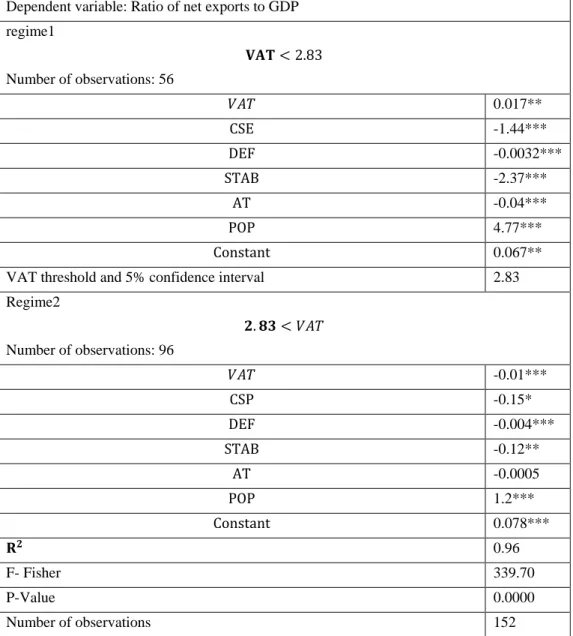
The estimation results of equation [2.2] are reported in Table 1 below.
Table 1. Results of the Hansen Model Estimate
Dependent variable: Ratio of net exports to GDP regime1 Number of observations: 56 0.017** -1.44*** -0.0032*** -2.37*** -0.04*** 4.77*** 0.067**
VAT threshold and 5% confidence interval 2.83
Regime2 Number of observations: 96 -0.01*** -0.15* -0.004*** -0.12** -0.0005 1.2*** 0.078*** 0.96 F- Fisher 339.70 P-Value 0.0000 Number of observations 152
78
Number of observations Scheme1 56
Number of observations Scheme2 96
Significance: 1%(***), 5%(**), 10%(*) Source: Author's calculations
Hansen's specification test makes it possible to reject, with a first-order error of less than 1%, the null hypothesis of linearity for the VAT revenue growth threshold of 2.83%. Therefore, the existence of a non-linear relationship between net exports and value-added tax is allowed at the remarkably stable optimal threshold since the P-value is significantly low compared to the critical value of 1%.
Moreover, the distribution of the number of observations above and below the endogenous threshold gives each regime a number of observations large enough to allow an acceptable identification of the behavior regimes of net exports. In fact, the optimal value-added tax threshold estimated at 2.83% is the rate of revenue growth of the value-added tax from which a regime shift takes place in the dynamics of net exports. . This means that below this threshold, value-added tax revenues negatively affect net exports. While above, net exports are decelerating.
In critically regime, the idea of fiscal devaluation does not seem plausible in the context of the Gabonese economy. A decline in employers' social contributions is combined with a drop in VAT in order to hope for an improvement in the competitiveness of the economy, thus rejecting the occurrence of the mechanism of fiscal devaluation. In this scheme, it is mainly the absence of impact of the employers' social contribution on net exports.
On the other hand, in a normal regime, the empirical data support the devaluation argument in Gabon.
First, all control variables have a significant impact on the estimate. As predicted, the government deficit has a negative and significant effect on net exports. In other words, the public deficit is significantly associated with the trade deficit. On the other hand, against all odds, political stability, other taxes and the dependency ratio have a negative and significant impact on net exports.
For the variables of interest, the results show a positive and significant effect of the VAT variable on net exports, according to the theory. This effect is however weak. An increase in VAT leads to a slight improvement in net exports of around 0.017%. Also, does the variable CSE have a negative and significant effect on net exports (-1.44%) recalling the theoretical implication of the negative influence of an increase in the employer's social contribution on the external balance. This means that a reduction of the compulsory levies on enterprises, in particular the employers' social security contributions, leads, all things being equal, to a consolidation of the external balance through the improvement of cost competitiveness. This translates into either an increase in price competitiveness, hence an increase in exports and a fall in imports, or an increase in corporate margins.
The difference in the coefficients of VAT and CSE finally suggests that a fiscal devaluation would increase net exports to Gabon. In fact, compensation of a 1% drop in the income of the employer’s social contribution by increasing VAT revenues would lead to an increase in net exports of 1.457%. Thus, a VAT increase of 0.017% and a reduction of the CSE of 1.44% would be necessary for a fiscal devaluation to generate an increase in net exports of 1.45% and consequently to restore the competitiveness of the Gabonese economy. This means that it is possible to finance a reduction of the CSE in Gabon by the VAT and rebalance this economy.
It should be noted, however, that this positive effect remains weak compared to the euro zone, in particular where the fiscal devaluation measure would be associated with GDP growth of around 4% (Mooij & Keen, 2012).
This less important effect of fiscal devaluation in Gabon could be partly justified by the very small influence of the VAT increase on net exports (0.017%). In other words, the increase in VAT would not discourage enough imports from the Gabonese economy to allow the improvement achieved in exports as a result of a reduction in the cost of labor eventually lead to a significant improvement in the trade balance. The other probable reason would be a relatively high consumption tax that would not permit a major tax reform. In fact, the 18% VAT rate in Gabon would be relatively high and would reduce the margins of maneuver of the public authorities to engage with the VAT lever of fiscal devaluation. Moreover, empirical evidence on the Gabonese economy of the devaluation hypothesis suggests that sound tax transfers can have a positive impact on the trade balance and thus on the competitiveness of this economy.
Fiscal devaluation is therefore a possible option for the Gabonese economy. But its real effectiveness will depend on certain conditions of its implementation (Mooij & Keen, 2012, Koske, 2013). It thus obviates to the public authorities to make sure of the following elements before applying the measure of the devaluation fiscal.
1) The magnitude of the positive effects of a fiscal devaluation will probably depend on the precise design of the reform.
On the one hand, when the reduction in CSE is targeted at low wages, its effects on production and employment are positive and important. Reducing labor costs for low wages can be particularly attractive in easing constraints imposed by minimum wage legislation or minimum wages agreed between unions and employers. In addition, the employment of this group tends to be relatively sensitive to tax considerations. Targeting the reduction of employers' social contributions to low wages could thus reinforce the impact of a fiscal devaluation on employment, production and the trade balance.
Unfortunately, the reduction of the CSE also gradually triggers an increase in the demand for labor. In the event that the economy slows, employment will increase, putting upward pressure on wages. This wage increase will quickly offset the reduction in social security contributions and curb job growth if the bargaining power of workers is strong, or if the supply of labor is less sensitive to wage variations. Earnings gains from rising employment and nominal wages will gradually increase consumption. As a result, imports will increase, with some of the additional consumption going to foreign goods and exports will decrease. Finally, the initial improvement of the trade balance will be gradually reversed. On the other hand, when the VAT increase is used, it seems sensible to raise the reduced rates, this would reduce the distortions of the economy. However, to the extent that reduced rates apply primarily to non-tradable goods and services, this could encourage the substitution of tradable goods for non-tradable goods and dilute the improvement of the trade balance.
On the other hand, if the combination of a VAT increase and a reduction in the CSE improves net exports by simultaneously reducing the relative price of goods produced in the country and the cost of labor, it implies in lower shares of consumption and investment. Consumption is declining due to the loss of purchasing power resulting from higher prices of imported products. Investment decreases due to changes in relative factor prices. In this context, the effectiveness of a fiscal devaluation will probably depend on the degree of openness of the economy.
2) Fiscal devaluation does not usually have permanent real effects on the economy. If the tax transfer is not associated with a broadening of the tax base, the increase in nominal wages would fully offset the initial CSE reduction as workers seek to compensate for the loss of purchasing power of real after-tax income induced by VAT. However, by distributing the tax burden of workers to other segments of the population, such as pensioners (provided that pensions are not indexed to inflation) and capital income, reform can permanently reduce labor costs. The net effect would be an increase in employment (assuming that labor supply is not inelastic) and a shift in the composition of demand from investment and possibly consumption to net exports. In certain circumstances, it can be expected that fiscal devaluation will also have permanent effects on real GDP. This could be the case, for example, in the presence of labor market distortions that reduce the use of labor. If employers' social contributions distort the relative prices of capital and labor, reducing them could result in reallocation of inputs within or between firms or industries, making the use of inputs more efficient and increasing multifactor productivity (Johansson & et al., 2008).
3) The effectiveness of a fiscal devaluation policy is also based on the management of the time spent on the implementation of the reform. Indeed, if the reform is announced in advance, consumers can postpone purchases of consumer durables to avoid paying the higher VAT rate. This would provide a temporary boost to domestic activity and imports, with adverse effects on the current account position. These effects would be reversed immediately after the reform, when consumption would be lower than that obtained without the increase in VAT announced in advance. 4) Inflation indexation of benefits is another condition for the success of a fiscal devaluation policy. Indeed, if public transfers are indexed to inflation, the increase in prices would lead to a corresponding increase in public transfers. Although this would limit the initial drop in consumption as disposable incomes would fall less, this would reduce fiscal space.
5) The option of fiscal devaluation is also conditioned by respect for the principle of fiscal neutrality. As fiscal devaluation affects macroeconomic conditions, it may be difficult to accurately assess the effects on the fiscal balance. There is therefore a risk that the net impact of the VAT increase and the reduction of the CSE will not be fiscally neutral ex post. As most countries are currently considering fiscal devaluation in need of fiscal consolidation, it may be wise to proceed with caution to ensure that the government's fiscal balance does not deteriorate as a result of the reform. 6) Finally, the measure of fiscal devaluation probably generates externalities on other countries. Especially in a monetary union, a fiscal devaluation is not cooperative in the sense that its benefits to one country, if successful, are at least partially translated into negative repercussions on other countries. Similarly, if several countries simultaneously apply fiscal devaluation, the impact on each of them will be less. Even if this form of revenue-neutral tax competition would not disadvantage each country, the substitution of a drop in the CSE by a VAT increase can have permanent positive effects on the economy, regardless of the direct commercial impact. Thus, the fiscal devaluation policy should
80
be pursued unilaterally in countries where there is an urgent need to improve their competitiveness in order to maximize the benefits for the Union as a whole.
All in all, as Koske (2013) has said, the weapon of devaluation can’t substitute for deeper structural reforms of the labor, product and financial markets. However, it can be useful as part of a broader package of reforms.
4. Conclusion
This paper examines the plausibility of the tax devaluation argument based on the financing of the reduction of employers' contributions by the value-added tax for developing countries participating in a monetary union. We took a micro-based and normative approach that consisted of an analysis of the fiscal devaluation hypothesis in the context of a new Keynesian model of the effects of fiscal policy, on the one hand, and an empirical verification of theoretical predictions, on the other hand. As a result, fiscal devaluation is a possible option to improve the trade balance and hence economic growth in Gabon.
But, unfortunately, its effects would be very small mainly because of the very weak influence of a VAT change on net exports, but also probably because of the mismatch between the framework of the Gabonese economy and the mechanism of the tax devaluation. All things inclined to think that the measure of fiscal devaluation must be integrated into a broader set of reforms.
The fact remains that effective prosecution the effectiveness of fiscal devaluation in such a framework is based on the extent of fiscal reform and the particular structure of the economy.
References
Aghion, P., Cette, G., Cohen, E., & Farhi, E. (2012). For a Fiscal Devaluation. in Le Monde, October, 24.
Bank of Portugal (2011). The Impact of a Tax Change Aimed at Increasing the External Competitiveness of the Portuguese Economy. Economic Bulletin, 17, 39 - 42.
Ben Salem, M., & Perraudin, C. (2001). Linearity tests, specification and estimation of threshold models: a comparative analysis of the methods of Tsay and Hansen. Economy & Forecast, 148, 157-176.
Besson (2007). Social VAT, State Secretariat for Forecasting and Evaluation of Public Policies.
Bernoth, K., Burauel, P., & Engler. (2014). Fiscal Devaluation: Economic Stimulus for Crisis Countries in the Euro Area. DIW Economic Bulletin, 4(10), 14.
Bidzo, M. (2018) , Public Debt and Economic Growth: A Scissor Effect in Developing Countries? The Case of Gabon.
Modern Economy, 9, 1672-1686. https://doi.org/10.4236/me.2018.910106
Blanchard, O. J., Jaumotte, F., & Loungani. (2013). Labor Market Policies and IMF Advice in Advanced Economies during the Great Recession. IMF Staff Discussion Notes13/02, International Monetary Fund.
https://doi.org/10.5089/9781484301289.006
Calmfors, L. (1998). Macroeconomic Policy, Wage Setting, and Employment: What Difference Does the EMU Make?
Oxford Review of Economic Policy, 14(3), 125-51. https://doi.org/10.1093/oxrep/14.3.125
Chan, K. S., & Tong, H. (1986). On estimating thresholds in autoregressive models. Journal of Time Series Analysis, 7, 179-190. https://doi.org/10.1111/j.1467-9892.1986.tb00501.x
De Mooij, R., & Keen, M. (2012). Fiscal Devaluation and Fiscal Consolidation: The VAT in Troubled Times, WP/12/85.
International Monetary Fund, 36. https://doi.org/10.5089/9781475502480.001
Engler, P., Ganelli, G., Tervala, J., & Voigts, S. (2014). Fiscal Devaluation in a Monetary Union, WP/14/201.
International Monetary Fund, 29–30. https://doi.org/10.5089/9781484312131.001
European Commission (2011). The Economic Adjustment Programmed for Portugal, First Review – summer 2011.
European Economy Occasional Papers, 83.
European Commission (2013). Study on the Impacts of Fiscal Devaluation. Taxation Paper No 36. Office for Official Publications of the European Communities, Luxembourg, 153.
Eurostat (2014). Taxation Trends in the European Union – edition, Luxembourg.
Farhi, E., Gopinath, G., & Itskhoki, O. (2012). Fiscal Devaluation. Working Paper 17662, National Bureau of Economic Research, Cambridge, MA. https://doi.org/10.2139/ssrn.2285069
Fève, P., Matheron, J., J., & Sahuc, J.-G. (2009). The social VAT: good or bad idea. Banque de France Working Papers, 244.
doctoral dissertation), University of Orleans, France.
Gauthier, S. (2008). A social VAT exercise, CREST Working Paper, 01.
Gomes, S., Jacquinot P., & Pisani, M. (2014). Fiscal Devaluation in the Euro Area: a Model-Based Analysis, ECB Working Paper, 1725. European Central Bank, 18.
Goldstein, M., & Kahn, M. (1976). Large Versus Small Prices Changes and the Demand for Imports. IMF Staff Papers, 23, 553-556. https://doi.org/10.2307/3866671
Hansen, B. E. (1996). Inference when a nuisance parameter is not identified under the null hypothesis. Econometrica,
64, 413-430. https://doi.org/10.2307/2171789
Hansen, B. E. (1999). Threshold Effects in non-dynamic panels: Estimation, testing, and inference. Journal of Econometrics, 93, 345-368. https://doi.org/10.1016/S0304-4076(99)00025-1
Hansen, B. E. (2000). Sample Splitting and Threshold Estimation. Economica, 68(3), 575-603. https://doi.org/10.1111/1468-0262.00124
Heyer, E., Mathieu, P., & Timbeau, X. (2012). Economic impact of quasi-social VAT. OFCE Review/Debates and Policies, 122, 373-397.
IMF (2018). Restarting Growth, Regional Economic Outlook, Sub-Saharan Africa.
Johansson, A., Heady C., Arnold J., Brys, B., & Vartia, L. (2008). Tax and economic growth. OECD Economics Department Working Papers, 620.
Kaufman, D., Kraay, A., & Mastruzzi, A. (2009). Governance Matters VIIIAggregate and Individual Governance Indicators 1996–2008. Policy Research Working Paper 4978, World Bank.
https://doi.org/10.1596/1813-9450-4978
Keynes, J. M. (1931). A Rejoinder (to D. H. Robertson). in JMK, 13, 219-236.
Klein, C., & Simon, O. (2010). The model MÉSANGE reestimated in base 2000: Volume 1 - Version with volumes at constant prices. INSEE WorkingPapers No. G/03.
Koske, I. (2013). Fiscal Devaluation–Can it Help to Boost Competitiveness? OECD Economics Department Working Paper, No. 1089. OECD Publishing, 6.
Langot, F., Patureau, L., & Sopraseuth, T. (2011). Optimal fiscal devaluation. IZA Discussion Papers, No. 6624.
Lipinskay, A., & Thaddenz, L. V. (2012). On the (in)effectiveness of fiscal devaluations in a monetary union. Federal Reserve working paper, 71.
Luukkonen, R., Saikkonen, P., & Teräsvirta, T. (1988a).Testing Linearity in Univariate Time Series Models.
Scandinavian Journal of Statistic, 15, 161-175.
Milos, M., & Mihajlo, B. (2015). Potentials and Structure of Fiscal Devaluation in Serbia. Annals FLB – Belgrade Law Review, Year LXIII, No. 3.
Mooij, R., & Keen, M. (2012). Fiscal devaluation and fiscal consolidation: the VAT in troubled times. NBER Working Papers, No. 17913.
OECD (2008). OECD Economic Surveys: Germany. OECD, Paris.
Petersen, T. (2010). Appendix: Balancing Mechanisms in Trade and Payments Balances, Rebalancing the Global Economy: Four Perspectives on the Future of the International Monetary System. Published by S. Collignon, R. N. Cooper, M. Kawai and Y. Zhang, Europe in Dialogue 01, Gütersloh, 128–137.
Petersen, T. (2015). Fiscal devaluation- a route to more growth? Policy Briefs Future Social Market Economy Impulse, Bertelsmann Stifting.
Puglisi, L. (2014). Fiscal Devaluations in the Euro Area: What has been done since the Crisis? Taxation Paper, 47, Office for Official Publications of the European Communities, Luxembourg, 11–12.
Reckon, L. L. (2009). Study to quantify and analyze the VAT in the EU25 Member States. Reckon LLP, London.
Tong, H. (1978). On a Threshold Model in Pattern Recognition and Signal Processing. ed. C. H. Chen, Amsterdam: Sijhoff and Noordhoff. https://doi.org/10.1007/978-94-009-9941-1_24
Tong, H. (1990). Nonlinear Time Series: A Dynamical System Approach. Oxford University Press.
Tong, H., & Lim, K. S. (1980). Threshold Autoregression, Limit Cycles and Data. Journal of the Royal Statistical Society, Serie B, 42, 245-292. https://doi.org/10.1111/j.2517-6161.1980.tb01126.x
82
Tsay, R. S. (1989). Testing and Modeling Threshold Autoregressive Processes. Journal of the American Statistical Association, 84, 231-240. https://doi.org/10.1080/01621459.1989.10478760
World Bank (2018). Cd Rom Word Development Indicator.
Appendix A: Derivation of Equation [I.5] to Equation [I.8]
Deriving the equation [I.3] and normalizing , we obtain the following relation:
[A.1]
Starting from equation [I.3] and noting that ( by linear homogeneity of the expenditure function)
( ) , this implies that
( ) (
)
[A.2]
Deriving the net exports in [I.4], we have:
( ). [A.3] By drawing in equation [A.2] and substituting it in equation [A.3], the result follows using the equation [I.3], the
implication of linear homogeneity of the function of income according to which (because ) and noting that:
( ) ( ) [A.4]
A reform combining a reduction of with an increase in a uniform VAT rate leads to an improvement in well-being that results from [A.2], since
.
Copyrights
Copyright for this article is retained by the author(s), with first publication rights granted to the journal.
This is an open-access article distributed under the terms and conditions of the Creative Commons Attribution license which permits unrestricted use, distribution, and reproduction in any medium, provided the original work is properly cited.