The Effect of Internal Audit on Management Performance in
(ADCO)
Husam Shahroor
The Business Division, Higher Colleges of Technology, PO box 41012, Abu Dhabi, UAE
Abstract
The research paper studies the effect of internal audit on management performance in a public enterprise- Abu Dhabi Company for Onshore Oil Operations (ADCO). The research focuses on studying the internal audit practices of ADCO; understanding how internal audit impacts management performance and suggesting the best practices for the internal audit issues. The data required for the study was obtained by using a mixed method approach using both primary and secondary data collection methods. Survey of ADCO employees and the ratio analysis of financial statements of ADCO were the two major primary methods used for the research. Several issues were identified with ADCO’s internal auditing function which can either be due to the poor functioning of the internal auditing or due to the negative perceptions of employees towards internal audit function. Based on the issues identified, recommendations were provided to ADCO to improve their internal audit function.
Keywords: Internal audit, corporate governance, perceptions, ROA, performance
1. Introduction
This research paper study the effect of internal audit on management performance in public enterprise like ADCO. Internal auditing involves making sure that an organization’s risk management, risk compliance, internal control and processes are all in place and operating in an effective manner. In order to do so the auditors have to stand separately from the organization to review it without personal bias. The importance of auditing is such that only experienced professionals con make assessment and bring about the desired organizational behavior or else it would bring in issues thereby affecting the management performance. Hence, it is very important to study how an auditing function impacts the management performance.
1.1 Industry and Company
Oil and gas industry was selected as the target industry for study as it is one of the chief contributors to UAE’s growth and development. UAE is one of the 10 largest oil producers in the world, being the 7th largest producer. The revenue from hydrocarbons are expected to reach $65 Billion in 2017 (EIA, 2017). However, what has been affecting the industry is the decline in oil prices due to which the share of revenues from hydrocarbons has been decreasing since 2013. Majority of the reserves are located in the Abu Dhabi region – which is around 98% of the total reserves (ADCO, 2017). The industry also engages in exports of oil, which is also a major revenue generator for the country’s GDP.
The Abu Dhabi Company for Onshore Petroleum Operations Ltd (ADCO) is an Abu Dhabi based oil producers operating onshore and on shallow coastal waters of Abu Dhabi (ADCO, 2017). ADCO is a subsidiary of another major oil and gas producer, Abu Dhabi National Oil Company, (ADNOC)..The company has been responsible for operations covering around 21,000 square kilometers (ADCO, 2017).. ADCO produces oil from eleven oil fields- Bu Hasa, Asab, Sahil, Shah, Bab, Al Dabb’iya, Rumaitha, Shanayel, Huwaila, Qusahwira and Bida Al Qemzan (ADCO, 2017).
1.1.1 SWOT Analysis
In order to clearly understand the issue at hand a SWOT analysis of ADCO was done. Strengths and weaknesses showed the internal features of ADCO, while opportunities and weaknesses featured the external industry characteristics of ADCO. The SWOT analysis as following:
Strengths
• A subsidiary of one of the leading producers of oil ADNOC.
• Handles majority of the upstream activities based in Abu Dhabi.
• Membership in OPEC and IOC.
• Explores develop and produce hydrocarbons. • Largest producer of hydrocarbons in Abu
Dhabi with 60% share.
Weaknesses
• Recent mining did not yield any oil reserves. • Any future discovery of oil reserves is also
not expected.
• Highly competitive market
• Increasing investment requirements.
Opportunities
• Large hydrocarbon economy which is still growing
• UAE’s potential growth into an important financial and trading hub.
• Large investments in non- energy sectors like infrastructure and technology would give some cushion to declining oil prices.
• Diversified economy with tourism, trade and manufacturing playing key roles.
Threats
• Changes in OPEC policies could create challenges in national energy policy.
• Lack of discoveries force to undertake cost effective projects.
• Need for higher investments for new projects which is challenging at this stage of oil price decline.
• Fall in oil prices.
2. Research Objectives
The major research objective is to study the effect of internal audit on management performance in ADCO. The paper shall identify the auditing systems used in ADCO and shall draw comparisons with the best practices of other organizations. The research objectives identified are;
1. Studying the internal audit practices of ADCO
2. Understanding how internal audit system impacts management performance (causes of negative perceptions) 3. Suggesting the best practices for the internal audit issues.
3. Significance of the Study
This quantitative and qualitative research would help in understanding a much debated issue about the role played particularly by the internal auditors in driving the performance of the management of the organization. Since this study takes into account the case of ADCO, therefore, it would not just provide the management and decision makers with some key insights into the importance of internal audit function in their organization, but would also help to direct management’s attention to development and expansion of areas needing improvement. Moreover, the research study would also be important to professionals from other organizations and to different researchers and practitioners working in other contexts.
4. Literature Review
According to CIIA, Internal auditing is the system that checks and provides assurance that all the processes concerned with risk management, governance and internal control are operating effectively by constantly providing an unbiased and objective view on the operations (CIIA, 2017). The internal auditors are very important to every organization and they are engaged in activities ranging from risk assessment, assisting management with internal controls and monitoring the activities of organization and reporting them to the top level executives. Due to this nature of job, internal auditors are often faced with many challenges within the organization itself that can influence the performance, which are discussed in the literature review sources. Various aspects of internal audit were studied and understood from the resources reviewed in the section.. The concept of internal auditing is very important to all firms, as it is an inherent part of the risk management process undertaken at ADCO and all other firms. Frauds are detected by internal auditors and it helps the company to move in the right direction. Assessment of the internal audit function of ADCO was conducted since the performance of the company is assumed to be affected by the decline in oil prices.
4.1. Theme 1: Importance of internal audit
examined the purpose of internal auditing in corporate governance owing to the various accounting scandals and corporate failures. Carmichael et al., (1996), mentioned in their study that internal audit an important managerial control device due its functions in measuring and evaluating the control systems in organizations. Mordelet (2009) stated that corporate governance is something very important as it has the capacity to affect a firm’s economic performance and ability to access long term low investment capital. Carmichael et al., (1996) and Mordelet (2009) thus indicated that internal auditing and corporate governance are in fact linked and their combined performance is in fact a source of competitive advantage for the firm.
Effective decision-making is very essential for any business entity in today’s corporate world. The study by Pinto et al., (2014) investigated the answer to the question: “What is the perception of management on the role that Internal Audit plays in management practices and decision making within the organizations?” (Pinto , Pereira, Imoniana, & Peters, 2014). The paper also explained some insights from other studies as well that were in line with their study. As per CFC (2011), internal audit is a function that provides the management the support required to help them attain their business objectives in the best way possible. Pinto et al., (2014) adopted a descriptive research method for their study using structured questionnaire administered in non- financial institutions in Sao Paulo State. The responses of the study were analyzed and it was found that internal audit is an important pillar of corporate governance since it constantly supports the management in decision- making. Some other important functions of IAF as identified from the study were- improvement of organization management; increasing the social responsibility of organization; minimizing the organization risks, loss prevention, adding value to organization; enhancing the efficiency, effectiveness and economy of organizational performance (Pinto , Pereira, Imoniana, & Peters, 2014).
Muchiri and Jagongo (2017) in their study investigated the link between internal auditing and financial performance with respect to public institutions in Kenya. The study found that internal auditing did not have any influence on financial performance. However, there are other studies that contradict with the negative link found in this study. According to Bejide (2006), presence of internal audit reduces the overheads, improves efficiency and also reveals losses from poorly managed company assets. These factors result in increased profitability. Prasad and Rao (2000) also found similar results that internal auditing function keeps a check on the organization about any unethical practices. This helps organization to move in the right direction. Muchiri and Jagongo (2017) study’s results also contradict with KPMG results where they found a positive link between internal audit function and financial performance.
4.2. Theme 2: Perceptions against Internal Auditing
Lelis and Pinheiro (2012) in their study examined the perceptions of both auditors and auditees about the internal audit practices. The company under study was a Brazilian company from Energy sector. Some of the major findings of the research were –quality of recommendations and solutions to risk being important factors of auditing services. The findings also confirmed the findings of previous researches by Sarens (2009); Eliot, Dawson and Edwards (2007); and IIA (2010). Besides confirming the previous study findings, the study was also able to propose some attributes of internal auditing division and the auditors of the company. It was identified that there was an overall positive perception towards the internal auditing contribution to improving internal control systems, risk management and process performance (Obert & Munyunguma, 2014). Advisory activity was another factor positively agreed by both auditors and auditees even though a small percentage of auditees were against the idea (Lelis & Pinheiro, 2012).
The research paper, “Internal audit perceptions and their impact on performance of the internal audit function” by Obert and Munyunguma (2014) examined the reasons why negative perceptions are formed against internal audit function as well as its effect on the overall performance. The research indicated that the people getting audited (auditees) always feared the internal auditors. They found that often those people who have conducted illegal activities in the company are the ones with negative perceptions about internal auditors. In every organization the internal auditors are the people behind finding frauds, corruption and money laundering. Hence, they are the enemies for people engaged in illegal deeds (Obert & Munyunguma, 2014). Second factor behind negative perception is the bad reputation of auditors especially if they are less qualified. Third factor was the dependence and objectivity in internal audit function responsible for negative perception (Obert & Munyunguma, 2014).
4.3. Theme 3: Effect of Internal Audit and Internal Control System
In a study conducted by Shamsuddin and Johari (2014) several previous studies were reviewed. Munro and Stewart (2011) found in their study that external auditors depend on internal auditors to support internal control evaluation. They found that internal auditors often try to improve the internal control system of an organization. Similar results were also found by Fadzil (2005) that internal auditors have a positive effect on the monitoring aspect of internal control system and negative impact on the professional proficiency, objectivity and review process by internal auditors (Shamsuddin & Johari, 2014).
4.4. Theme 4: Issues and Challenges of Internal Auditors
EY (2013) reported the challenges of the global internal audit function. The report claimed that internal auditing is facing increasing challenges in today’s dynamic business environment. When companies grow and expand, there is a need to increase the manpower by training; hiring and managing staff by the internal audit department. Multinationals working in a multiple regulatory regime is another major challenge for the department to handle. The rules and regulations are different in different places and this can cause create issues while trying to understand the political dynamics of the country. The change of focus from financial controls to risk management is another major challenge to internal audit function. Hence, IT risks and compliance risks have become a part of their responsibility.. (Harrington, 2013).
Motubatse, Baracand Odendaal (2015) in their study found four challenges of Internal Audit function in the South African Public Sector. First challenge was the lack of business knowledge by internal auditors in the environment where they operate. (Motubatse, Barac , & Odendaal, 2015). Second challenge was the lack of management support to the internal auditors. Third challenge was the lack of audit action monitoring processes. Fourth challenge identified was the problem of trusting the work of internal auditors by the external auditors. The insights form the study can be used to check if the same is happening to ADCO or are they managing the issues effectively.
4.5. Theme 5: Best Practices of Internal Auditing
Internal auditors are very essential instruments for control. Muqattash (2013) through his study explained and proved how the objectivity of internal auditors is very important factor in internal auditing function. A positive relationship was found between audit committee effectiveness and auditors’ objectivity or impartial nature. According to O’Leary & Stewart (2007) found little to no relationship between audit committee effectiveness and auditors’ objectivity. The difference in the study results can be attributed to the difference in the countries’ economy (Muqattash, 2013).
The website Metric Stream explains some of the best practices in Internal Audit. The insights from this website article could be used to identify if the audit practices at ADCO are best or needs improvement. Five best practices were mentioned in the report. First method is putting risk as the main focus of Audit Plan because with ever-changing business environment there is a need for continuous risk reassessment to handle the change. Second method mentioned was to collaborate closely with second line of defense to get an overall picture about the risks and compliance (Metric Stream, 2017). Third method is to provide advice and insights focusing on foresight and less on hindsight. Stakeholders of the company want auditors to show the value of the business and act as a proactive advisor. (Metric Stream, 2017). Fourth practice is to expand and sharpen the skills of Internal Audit. Auditing expertise is very essential to fulfill stakeholder’s expectations. Fifth practice is to automate manual- intensive audit operations so that a proper risk analysis could be done and the available time could be used for other value added services (Metric Stream, 2017).
In conclusion, the literature review section was able to offer the required information. Several resources were reviewed to get a deeper understanding about the subject are of research paper- internal audit. The resources were arranged under five themes so that every aspect of the research question and objectives can be satisfied.
5. Methodology and Data Analysis
The research methodology for this research has been devised keeping in view the past literature that has been reviewed extensively and also the prior understanding of the issue. Both qualitative and quantitative data have been used to gain a better understanding of the issue. Significant amount of research has been studied and reviewed, based on which, questionnaire was developed and interviews were conducted. Due to the reason that the research is primarily based on ADCO therefore, the primary data was collected for the same company. Primary data was selected because of the fact that it would provide greater insight inside the subject area of the company. Further, the data in this regard was not exactly available in the secondary resources. Based on the literature the variables have been decided. Accordingly, the questionnaire was based on the understanding of role of audit department in the performance of an organization and what components affect them.
5.1 Primary Data
Questionnaire survey of ADCO staff and analysis of financial ratios were the two sets of primary data used in the study.. The questionnaire was designed to understand the perceptions of staff of ADCO towards the internal auditing function and how it impacts their performance and 38 responses were collected, which is a good number for this proposed research study. The questionnaire was primarily based on five important themes . These themes are mentioned as follows:
Theme 1: Importance of internal audit Theme 2: Perceptions against internal auditing
Theme 3: Effect of internal audit and internal control system Theme 4: Issues and challenges of Internal auditors
Theme 5: Best practices of internal auditing
Second primary data used were the financial statements of ADCO for the years 2014, 2015 and 2016. The purpose of financial statements were to calculate profitability ratios for the years and to access the relationship with internal auditing function. Thus, four profitability ratios were calculated – ROA, ROE, Gross profit margin and Profit margin ratio. The variations of these ratios in the three-year period were studied. The financial statements were obtained from the company’s website and thus were reliable.
5.2 Secondary Data
All the support resources used to get information to guide the research question and objectives are together grouped as secondary data used in the study. This mainly includes all the resources reviewed and discussed in the literature review section. The five themes provided clear and precise information regarding five angles of the research topic- importance of internal audit; perceptions against internal auditing; effect of internal audit and internal control systems; issues and challenges of internal auditors and best practices of internal auditing.
5.3 Sample
The survey questionnaire was designed with the help of secondary data resources. The sample size of the survey was 30 participants. The sampling technique used was random sampling technique to select a sample which is representative of the entire survey population. Most of the employees who were interviewed belonged to middle management of the company (34%), followed by junior management (24%) and senior management (24%).
6. Data Analysis
6.1 Financial Ratios Analysis
In order to understand the effect of auditing practices on the financial performance of ADCO, several ratios were calculated with the help of primary data from the financial statements of ADCO for the years 2014, 2015 and 2016. The variations of the ratios would show the variation in performance of ADCO over the years. Four profitability ratios were analyzed for understanding the performance of ADCO. Table 1 shows the financial metrics adapted from the financial statements of ADCO for the years 2014, 2015 and 2016.
Table 1: ADCO Financials
2016 2015 2014
AED mm AED mm AED mm
Revenue/Net sales 1437 1529 2504
Total assets 13800 14338 13237
Gross Profit 378 463 1110
Net income/Profit for the year/Net profit -323 528 457
Total equity 10196 10522 9932
Average total assets 20969 20956.5 19690.5
6.1.1. Return on Assets
The ratio calculates the percentage of profit a company earned in relation to the average total assets (Ready Ratios, 2017). Figure 1 shows that ROA decreased in the year 2016 while it was positive in the years 2015 and 2014.
Table 2: ROE for years 2014, 2015 & 2016
Return on Assets = Net income / Average total assets
2016 2015 2014
-323 * 100/ 20969 528 * 100/ 20956.5 457 * 100/ 19690.5
Figure 1: Return on Assets
6.1.2. Return on Equity
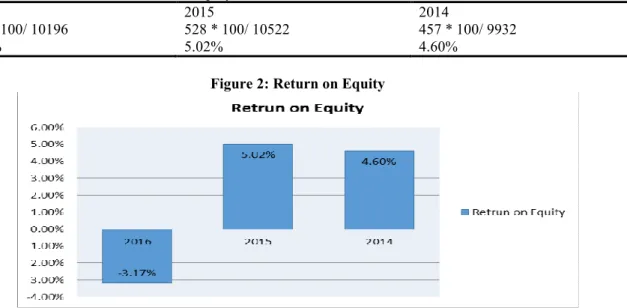
This ratio explains how effectively the company made use of stockholder’s investments. (Accounting explained, 2017). ROE also showed negative growth in the year 2016 due to loss registered in the year 2016. The previous years registered higher growth.
Table 3: ROA for years 2014, 2015 & 2016
Return on Assets = Net income / Total Equity
2016 2015 2014
-323 * 100/ 10196 528 * 100/ 10522 457 * 100/ 9932
-3.17% 5.02% 4.60%
Figure 2: Return on Equity
6.1.3. Gross Margin Ratio
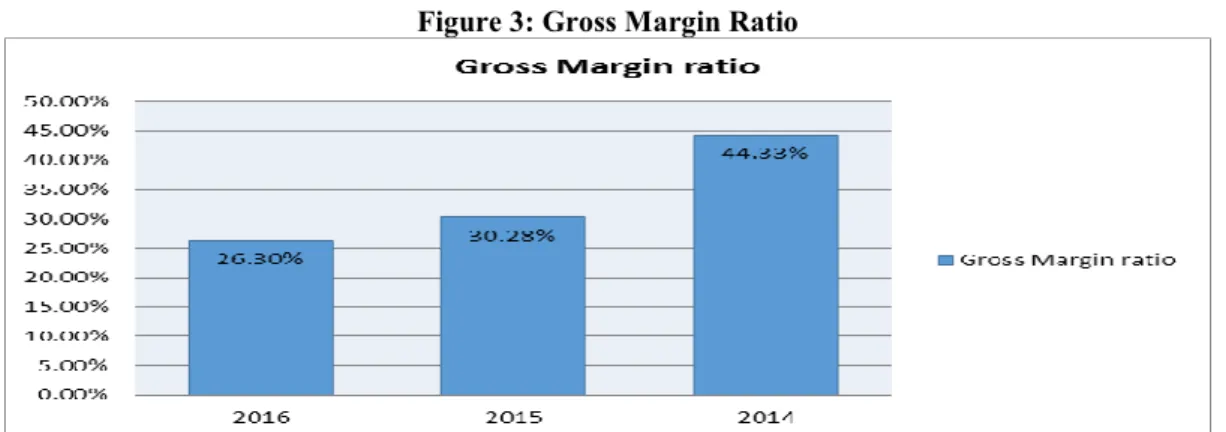
This ratio indicates how much profit ADCO makes after paying off cost of goods sold, which indicates efficiency of a company. (The Strategic CFO, 2017). From the table 4 we can see that even though this ratio is positive the ratio is showing a decreasing trend from the year 2014 to 2016 which indicates that their profit making capacity is below satisfactory in the year 2016.
Table 4: Gross profit ratio for year 2014, 2015 & 2016
Gross Profit Ratio = Gross Profit/ Net sales or revenue
2016 2015 2014
378* 100/ 1437 463 * 100/ 1529 457 * 100/2504
26.03% 30.28% 44.33%
Figure 3: Gross Margin Ratio
6.1.4. Profit Margin Ratio
This is a profitability ratio, which measures the revenue generated after all expenses. Figure 4 shows how profit margin ratio showed a decreasing trend from the years 2014. In fact, 2016 registered a negative ratio indicating that year 2016 was the year of loss.
Figure 4: Profit Margin Ratio
7. Findings
7.1 Survey Findings
Survey of ADCO employees revealed several important insights to understand the perceptions of employees about the impact of internal audit on management performance.. Some of the relevant findings from the survey are mentioned below:
1. Around 90% of the employees interviewed knew the importance of internal audit in maintaining corporate performance and governance. Only 10% felt internal audit function does not to have any effect on the performance. This is very important because if employees do not understand the contribution of internal audit towards the corporate governance it is not good for the company’s performance.
2. Only 11% of the respondents understand the importance of role of internal audit in the overall performance of ADCO. 42% of the employees felt that the role of internal audit has no effect on the overall performance of ADCO.. These responses clearly show some issues internal audit department has in ADCO. If employees cannot understand the role of internal audit, then ADCO’s performance can be affected because internal audit is a function that requires the support and contribution from the entire organization.
3. Another interesting factor was the responses for the statement – ‘Internal audit demonstrates that it understands the business model, governance process, risk and internal control environment’. Only 19% of the employees agreed to the statement. 60% of them disagreed with the statement.. The majority 60% of the employees’ opinion could be because of two reasons- either because of Internal audit not understanding the business model, governance and risk management of ADCO or the employees becoming biased and having a negative perception towards the internal audit department..
4. 32% of the respondents agreed that internal control system has the capacity to improve with internal audit function. . The responses show that there is a definite need for improvement of the internal audit function’s operation..
5. The dynamic and flexible nature of internal audit department was disagreed by majority of the employees of ADCO (68%). This indicates one of the major problems of the internal audit department..
6. Expertise of IA and the related professionals is very important for the functioning and contribution to organization’s business. Around 60% of the employees felt that ADCO’s IA does not have the necessary knowledge, understanding, experience, or interpersonal skills to effectively perform the daily work duties. Hence this is the area where improvements have to be made.
7. 61% of the employees felt that IA function gets good guidance from the seniors. Only 26% of the participants disagreed with this fact. Hence, the communication between the management and IA is not good which can be a problem for the IA to function effectively.
8. Identifying frauds and misdeeds is often one of the major functions of IA to guide the performance of ADCO. This was disagreed by 56% of the employees of ADCO as they did not feel IA has the potential to identify and take action against the problematic practices that would have affected ADCO negatively..
9. Direct reporting powers of IA are very essential, as they have to be in constant contact with the top-level management regarding the activities of a company. Hence, clear and precise roles and responsibilities have to be marked for the IA employees so that they can understand their position in the company. It was interesting to see that 61% of the employees agreed that IA’s roles and responsibilities are clear and precise.
10. Majority of employees (68%) do not think ADCO is following the best practices of IA function. This is a serious drawback because if ADCO does not follow the best practices or evolve accordingly, the chances of them becoming outdated is very high which can seriously impact the performance in the future.
11. Role of audit committee is another important factor to be considered to understand the functioning of IA at ADCO. However 69% of the respondents did not feel that ADCO’s audit committee is not up to mark and is not properly monitoring and working of IA.
7.2 Financial Findings
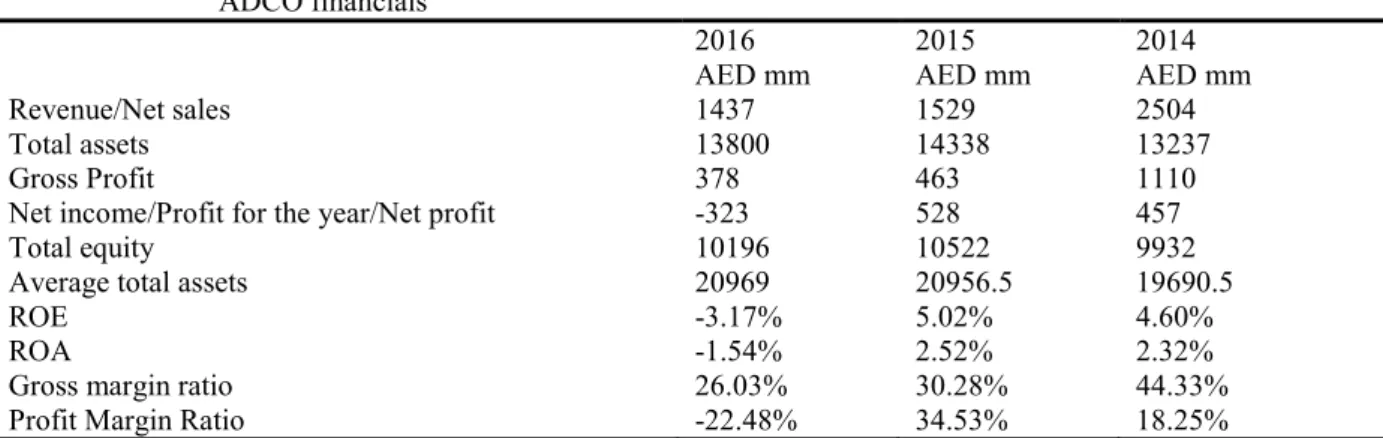
Financial analysis with the help of ratio analysis provided many key findings about the performance of ADCO during the years 2014 – 2016. The major findings are provided in Table 6.
Table 6: ADCO Financials ADCO financials
2016 2015 2014
AED mm AED mm AED mm
Revenue/Net sales 1437 1529 2504
Total assets 13800 14338 13237
Gross Profit 378 463 1110
Net income/Profit for the year/Net profit -323 528 457
Total equity 10196 10522 9932
Average total assets 20969 20956.5 19690.5
ROE -3.17% 5.02% 4.60%
ROA -1.54% 2.52% 2.32%
Gross margin ratio 26.03% 30.28% 44.33%
Profit Margin Ratio -22.48% 34.53% 18.25%
1. ADCO’s return on Assets has decreased and became negative in the year 2016, after registering positive growth in the previous two years. The ROA started with 2.32% in 2014 which increased to 2.52% in 2015 but then decreased drastically to -1.54% in 2016. The loss however cannot be attributed to the effect of internal audit as the oil price decline problem is a prevailing problem affecting all oil companies’ profits.
2. Return on Equity also showed similar trends to that of ROA. The Rate was 4.60% in 2014, 5.02% in 2015 and -3.17% by years 2016. ADCO registered losses indicated form the negative ROE. The negative ROE is because of the negative net income..
3. Gross Margin Ratio of ADCO also showed a decreasing trend over the years with 44.33% in year 2014, 3.28% in year 2015 and low 26.03% in the year 2016. The sales decreased over the same period as well as the net sales. Decreasing trend in gross margin ratio signals a problem in the bottom line operations with labor or material
costs.
4. Profit margin ratio showed similar trends like that of ROE and ROA. The rate increased from 18.25% in 2014 to 34.53% in 2015.Since the company reported losses in the year 2016, the Profit margin ratio reporteda negative ratio. The reasons behind the poor sales may be because of the prevailing oil price volatility in the industry. Budget overruns or unexpected costs can also be the reason behind the negative profits margin ratio.
8. Discussion
From the survey several important functions of Internal Audit were identified. 90% of the employees agreed that IA is very essential in maintaining corporate governance and improving the overall performance. The findings are confirmed by the study of Karagiorgos et al., (2010). The same study also reviewed several other literature resources, which also revealed the same importance. Carmichael et al., (1996) found that IA is very important as a control device in organizations due to its role in measuring and evaluating various systems in the firm. IA’s ability to influence a firm’s economic performance and access long term investment capital were other factors. Mordelet (2009) studied the contribution of IA towards corporate governance. Another study of Pinto etal., (2014) also confirmed the link between IA and corporate governance because of its constant role in decision making process of the firms.
With respect to the link between IA and financial performance, Muchiri andJagongo (2017) mentioned several other established studies that confirmed the link between IA and financial performance. According to Bejide (2006) and Prasad and Rao (2000) the IA function contribute towards the financial performance by reducing the overheads, improving efficiency, revealing losses of poorly managed assets and also checking the organization for any fraudulent practices that might reduce the profitability of company. Identifying the fraudulent practices is one of the functions of IA. Similar function of IA was also confirmed in the survey as 56% of the employees disagreed that the ADCO employees do not have the potential to identify and understand the problem practices of ADCO. The problematic practices of ADCO can affect their performance negatively. However, we cannot confirm that the problems in ADCO’s financial performance were due to the lack of functioning of the IA. Hence this can be considered as an issue with ADCO, and appropriate solution could be suggested.
Negative perceptions of employees towards IA function are a common issue faced by many organizations. There were several responses that signal this aspect. Firstly, 60% employees disagreed that the IA function does not demonstrate the understanding the business model, governance process, risk and internal control environment. Secondly, 68% of the employees disagreed that the IA at ADCO are not flexible or dynamic enough to handle the issues in organization. Thirdly, 68% employees do not feel that IA at ADCO is not following the best practices of internal auditing. Fourth, 60% of the employees also feel that IA staff does not have any necessary knowledge, understanding, experience or interpersonal skills to manage the activities of ADCO. These aspects show that either IA is not functioning ideally or the employees have negative perceptions towards the IA. Some of these negative perceptions confirm with the study of Obert and Munyunguma (2014) where they found that people who are involved in illegal and fraudulent practices might have the negative perceptions towards IA. Hence, they found that people engaged in these activities are often against the practices of IA in firms. Another reason for negative perception is the bad reputation of low qualifications of auditors in the firm, which was also revealed through the survey conducted. Previous study of Lelisand Pinheiro (2012) indicated positive perception of employees towards IA. This was also somewhat reflected in the survey from the 19% employees who agreed that IA understands the risk, business model, governance and internal control environment of ADCO; and 39% of the employees agreed that IA function in ADCO had the potential for risk identification and management.
The close association of internal audit and internal control system of an organization is yet another aspect established by many studies. The survey conducted showed a negative response regarding this aspect from the experience at ADCO. 55% of the employees did not feel that the IA function did not improve the internal control system.. This is not in accordance with many previous studies. Positive effect of internal auditors on internal control system was recognized by Fadzil (2005) as reported in the work of Shamsuddin and Johari (2014).Munro and Stewart (2011)also confirmed the existence of positive link between internal auditors helping to improve the internal control system. But with respect to ADCO, the responses show that there is some problem with the internal auditors’ contribution to internal control system.
Organization can face several issues from the poor internal auditing functions, which can hinder the performance of the organization. The survey revealed several issues ADCO is facing because of poor functioning of the IA department. Problems in direct reporting of internal auditors to top management, problems of audit committee not monitoring the audit function properly and lack of communication with top –level management were the issues identified in ADCO as per the majority of responses provided by the ADCO employees. Similar issues were confirmed by the study of Motubatse, Barac and Odendaal (2015) where they found several issues like lack of business knowledge, lack of management support to the internal auditors, and
lack of audit action monitoring process in South African Public Sector Audit Function.
Following the best practices of auditing is very important to maximize the effectiveness of internal auditing to organizations. 68% of the employees from the survey felt that ADCO does not adopt best practices of internal auditing. This may be attributed to ADCO using old audit practices and not evolving with changes in business practices. This issue, along with inefficiency of audit committee’s role in monitoring the organization can affect the performance and efficiency of ADCO. Muqattash (2013) and Metric Stream (2017) studies have established several factors that ensure good internal auditing in organizations such as timely risk assessment; good communciation to management; auditing expertise; advisory fucntion; and auditor objectivitiy. However, ADCO lack in all these aspects.
9. Research Strengths and Limitations
This research has several strengths in its own limits. The importance of internal audit function to improve the performance of any business; the various issues or challenges the internal audit faces within the organization; and some of the prevailing best practices of internal auditing were some of the major aspects regarding internal audit function understood from the research study. The use of mixed research approach helped in understanding how to choose the right methods to answer the research questions appropriately. Knowledge of financial ratios were used in the research and helped in understanding how to use them to evaluate the performance of ADCO to understand if internal auditing had any influence on the performance. Reviewing various studies as a part of secondary data provided details into how several other researches were carried out about internal audit function. The resources also helped confirming various findings of the current research, which is the backbone of the project.
Besides the strengths there are also several limitations the research had to deal with. The oil and gas industry is going through a turmoil because of volatility of oil prices, which is affecting the performance of companies in the industry. As a result a differentiation of effect of internal auditing on financial performance of the company is not possible since already the performance of case company is affected by poor performance of industry. Hence, only assumptions of the influence were only possible. The research was a small scale study on a particular organization with small sample size therefore; the findings of the study cannot be generalized in other contexts. Furthermore, A cross comparison of the company with similar companies in the same industry would have been more ideal to see the effect of internal auditing practices on management performance.
10. Conclusion
ADCO showed signs of poor internal audit function affecting management performance as evident from the responses from their employees in the survey. However, the link to financial performance is not established accurately as it requires more detailed data from the company which was not collected due to certain limitations. Even though the financial performance showed declined performance in the year 2016, it cannot be attributed completely to the poor functioning of internal auditing as the reason for the performance issue was the prevailing oil price issue in the industry.
Financial analysis for three years have shown that during year 2016, ADCO showed poor performance as evident from the decline in revenues, ROE, ROA, Gross margin and profit margin in year 2016 compared to years 2014 and 2015.. The poor performance however cannot be associated with internal auditing performance as ADCO was facing pressure from the oil price volatility prevailing in the oil and gas market.
Various issues of internal audit function were identified from the analysis that could affect the performance of ADCO. The solutions to the major issues are provided below:
1. 65% of the employees disagreed that ADCO internal auditors do not have the potential to identify and understand the problem practices of ADCO. It is suggested that ADCO should check with the internal auditors to have the right potential to evaluate the risks faced by ADCO as per the audit plans. Internal auditors should always be on alert of signals and clues of fraud from within the organization. ADCO can also appoint efficient external auditors to plan and prepare ADCO’s financial statements as per the professional standards (IIA, 2009). 2. Survey found that 60% of the employees do not feel that ADCO’s IA function does not understand the company’s business model, governance process, risk and control management. ADCO should evolve their risk management to ‘risk governance’ which involves the board of directors, senior management and business units including the internal auditors to continuously assess and evaluate the processes of supervising the risk management activities of organization. This shall ensure timely identification and evaluation of risk reporting as the internal audit has the best view of risk faced by an organization (CLA, 2013).
3. Problems of lack of communication between the management and internal audit function were an issue identified at ADCO. Lack of management support to internal auditors can create issues in operational effectiveness. Hence here ADCO is suggested to employ well -defined communication channels between internal audit, management and the board of directors.. This can be made sure with well defined audit charter where roles and responsibilities are clearly marked; an internal audit plan to allocate resources to risk; regular
communication with audit committee and board regarding the audit activity (CLA, 2013).
4. 60% of the ADCO employees felt that their audit department does not have the necessary knowledge, experience or skills to handle auditing activities. ADCO should hire and employ best-qualified professionals as their internal auditors because they must be qualified and thorough about the business systems of ADCO, developments and several other business aspects. Good auditing certification like the Certified Internal Auditor (CIA); certified Financial Services Auditors (CFSA); Certification in Risk Management Assurance (CRMA) must be checked for to ensure that auditors possess the best qualifications.
5. 68% of ADCO employees felt that ADCO is not following best practices of internal auditing, which is responsible for their poor performance. It is suggested that ADCO conduct research activities and use the best practices of internal audit function, which can serve as the backbone of the company. As Metric Stream (2017) suggested, ADCO must employ methods like timely risk assessment; auditor objectivity; ensuring advisory function of auditors; keeping risk as the focus of internal audit function; establishing good communication channels with management; and expert knowledge of up-to-date audit information.
References
Accounting explained. (2017). Return on Equity. Retrieved 2017, from Accounting explained: https://accountingexplained.com/financial/ratios/return-on-equity
ADCO. (2017). About Us. Retrieved 2017, from ADCO:
http://www.adco.ae/en/Discover/AboutUs/Pages/VisionMessionValues.aspx
ADCO. (2017). Overview. Retrieved 2017, from ADCO: http://www.adco.ae/en/Operations/Pages/ADCO-Operations.aspx
CIIA. (2017). What is Internal Audit? Retrieved 2017, from Chartered Institute of Internal Auditors: https://www.iia.org.uk/about-us/what-is-internal-audit/
CLA. (2013). The Role of internal Audit in Risk Governance. Minneapolis: CLA.
EIA. (2017). Country Analysis Brief: United Arab Emirates.Washington, DC: U.S. Energy Information Administration.
Harrington, L. (2013). Challenges of the global internal audit funtion. EY: Tapestry Networks Inc. IIA. (2009). Internal Auditing and Fraud.Florida,LM: IIA.
Karagiorgos, T., Drogalas, G., Gotzamanis, E., & Tampakoudis, I. (2010). Internal Auditing as an Effective Tool for Coporate Governance. Journal of Business Management, 2 (1), 16-23.
Lelis, D., & Pinheiro, L. (2012). Auditor and Auditee Perceptions of Internal Auditing Practices in a Company in the Energy Sector.Sao Paulo: University of Sao Paulo.
Metric Stream. (2017). Best Practices in Internal Audit. Retrieved 2017, from Metric Stream: https://www.metricstream.com/insights/bestpractices_intaudit.htm
Motubatse, N., Barac , K., & Odendaal, E. (2015). Perceived challenges faced by the internal audit function in the South African Public sector: A case study of the National Treasury.African Journal of Science, Technology, Innovation and Development, 7 (6), 401-407.
Muchiri, N., & Jagongo, A. (2017). Internal Auditing and financial performance of public institutions in Kenya: A case study of Kenya Meat commission. African Journal of Business Management, 11 (8), 168- 174. Muqattash, R. (2013). Audit Committees Effectiveness and its Impact on the Objectivity of Internal Auditors:
Evidence from United Arab Emirates. Research Journal of Finance and Accoutning, 4 (16), 23-31.
Obert, S., & Munyunguma, I. (2014). Internal Audit perceptions and their impact on performance of the itnernal audit function. IOSR Journal of Business and Management, 16 (5), 81-85.
Pinto , J., Pereira, A., Imoniana, J., & Peters, M. (2014). Role in Internal Audit in managerial pratice in organizations. African Journal of Business Management, 8 (2), 68-79.
Ready Ratios. (2017). Return on Assets (ROA). Retrieved from Ready Ratios: https://www.readyratios.com/reference/profitability/return_on_assets.html
Shamsuddin, N., & Johari, N. (2014). The Effect of Internal Audit towards Internal Control System effectiveness. E- proceedings of the Conference on Management and Muamalah, Kolej, Universiti Islam Antarabangsa Selangor (KUIS).
The Strategic CFO. (2017). Gross Profit Margin Ratio Analysis. Retrieved 2017, from The Strategic CFO: https://strategiccfo.com/gross-profit-margin-ratio-analysis/