Flake Patterns on Rapa Nui’s (Easter Island) Stemmed Obsidian Tools (Mata‘a): A Preliminary Analysis of Tool Use
By Mila Lassuy
A Thesis
Presented to the Department of Anthropology and the Clark Honors College at the University of Oregon
in partial fulfillment of the requirements for the degree of Bachelor of Arts
ii
Abstract of the Thesis of
Mila Grace Lassuy for the degree of Bachelor of Arts In the Department of Anthropology, to be taken March 2017
Titled
FLAKE PATTERNS ON RAPA NUI’S (EASTER ISLAND) STEMMED OBSIDIAN TOOLS (MATA‘A): A PRELIMINARY ANALYSIS OF TOOL USE
Approved:__________________________________ Dean Terry Hunt
Abstract
Stemmed obsidian tools (mata‘a) are a ubiquitous component of the archaeological record of Rapa Nui (Easter Island), and have long figured prominently within archaeological debates on the island’s prehistory.
Although they are one of the most common artifacts found on the island, much uncertainty exists regarding the uses and function of these tools.
Most ethnohistoric and contemporary accounts have presented mata‘a as spear-heads, and modern researchers have included this as evidence for a violent history of widespread warfare on the island.
Recent studies, however, have shown that mata‘a are unlikely to have been designed as weapons but possibly were more general purpose cutting tools or agricultural implements.
iii
In this thesis, I attempt to build on these recent studies about potential mata‘a use by documenting and statistically analyzing use-wear and flake patterns on these tools. By cataloguing the shapes, sizes, and location of the flakes on these tools and performing a series of statistical analyses, I present new
quantitative evidence on patterns of use-wear and potential uses of mata‘a. The results have important implications for the potential function of mata‘a, adding another layer of evidence for understanding the role of the tool on the island.
iv
Acknowledgements
This work would not have been possible without the cooperation of the Father Sebastian Englert Anthropological Museum, and funding from the Clark Honors College and Mr. Jim Shepard. I want to express my deepest gratitude for my advisers, Drs. Terry Hunt and Scott Fitzpatrick, for their guidance in the field and the lab, and Roxann Prazniak, for her understanding and encouragement. In addition, I want to thank Robert DiNapoli for his patience, guidance, and assistance during the thesis process.
I also want to thank the Clark Honors College staff, who have mentored and supported me throughout my undergraduate education. Above all, I want to thank my incredible parents for their unwavering belief in me, their constant support, and for teaching me to always be curious, passionate, and confident, while keeping an open heart and mind.
v
Table of Contents
I. Introduction 1
II. Background 5
i. Environmental Context 5
ii. Archaeological Context 6
iii. Historical Descriptions of Mata‘a 7 iv. Osteological Evidence of Warfare 11
v. Artifactual Evidence for Weapons and Warfare 14
vi. Lithic Usewear 20
III. Analysis and results 26
IV. Discussion 55
V. Conclusion 58
VI. Appendix 61
Introduction:
Rapa Nui (Easter Island) is a small volcanic island in the Pacific, with a land-area of 164 km2. It was formed by three volcanic events, which led to the
creation of the geographic features on the island.1 Rapa Nui is most commonly
knownfor the giant stone statues (moai) that are distributed across the island and are often seen in popular media. It is less known that in addition to these megaliths, small worked stones cover the island. One of the most common types of worked stones are the mata‘a, stemmed obsidian tools, found all
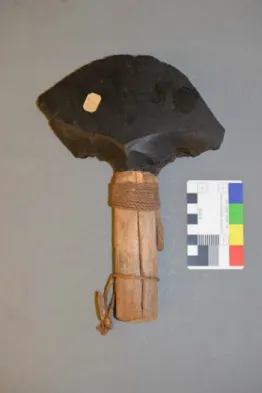
across the island. Often depicted only as the worked stones alone, mata‘a were historically hafted.
Figure 1: Example of a historically collected Hafted mata‘a hafted to a wooden handle. From the British Museum collections (Photo by T.L. Hunt, 2016)
1 Vezzoli, L. and V. Acocella. 2009. Easter Island, SE Pacific: An end-member type of hotspot volcanism.
2
Though perhaps not as visually stunning as the statues (moai), the mata‘a play an important role in understanding Rapa Nui’s past. Historically, Rapa Nui has been portrayed (both in popular and archaeological literature) as having a very large population and then suffering a collapse, fueled by human greed,
violence, and lack of environmental consciousness. This collapse narrative rests on a few pillars: confusion about the date of Rapa Nui’s colonization, interpretation of deforestation as a result of human activity rather than invasive species and natural causes, and ethnohistoric writings claiming rampant
warfare and weaponry2,3. This thesis will focus specifically on the warfare and
weaponry element of that narrative. Since first documented by European explorers, the mata‘a have been interpreted as weapons. Their ubiquity in the archaeological record, along with the ethnohistoric writings of warfare, has been used as evidence for a violent, warring community. Although they have been consistently referred to as weapons and spears, recent archaeological studies indicate that there is little evidence outside of early ethnohistoric reports. Recent studies have shown that due to blade shape it is not likely that these tools were manufactured to be weapons4, which supports a few earlier
micro-usewear studies which concluded that the tools were used primarily for agricultural studies5,6. Research has yet to be done regarding the specifics of
how the mata‘a were moved while in use. This thesis attempts to serve as a preliminary analysis of how the mata‘a were moved in their daily use, using location, size, and shape of visible flake scarring as clues to how the tools were moved as they were being used. In this study, I use the term “movement” to
3
mean the motions in which the mata‘a was put through, as it was used in the daily lives of the Rapanui. An analysis of mata‘a movement is an important addition to the ongoing debate surrounding Rapa Nui’s past, specifically its history of violence, and assumed periods of warfare. Studying the movement of
the mata‘a will give indicate the motions made by the person holding the
mata‘a, providing insight in to mata‘a use. In order to do this study, I investigate
10 questions:
1) Are there more flakes on the upper or lower portions of the mata‘a? • This will provide insight into the position in which the mata‘a
was held as it was moved. If the flakes are mostly in one location versus the other, it will indicate that the mata‘a was help primarily upright, sideways, or in a downward position. 2) Are there more flakes on the dorsal or ventral faces of mata‘a?
• This will provide insight into the way in which the mata‘a was used. If the flakes are mostly on one face or another, it will indicate that the mata‘a were used in such a way that only one face of the tool was actively in use.
3) Are there more flakes on the left or right sides of mata‘a?
• This will provide insight in to the position in which the mata‘a was held as it was used. If flakes are mostly on one side or another, it will indicate that the mata’a were held in such a way that only one side was in active use. Left and right are from the perspective of the dorsal side.
4) Is there a flake size that is more prominent than other flake sizes? • This will provide insight into how forceful the movements are. If
there is a higher incidence of flakes of one size over another, it
2Diamond, J. (2005). Collapse: How societies choose to fail or succeed. Penguin.
3Hunt, T. L., & Lipo, C. P. (2012). Ecological Catastrophe and Collapse: The Myth of'Ecocide'on
Rapa Nui (Easter Island).
4Lipo, C. P., Hunt, T. L., Horneman, R., & Bonhomme, V. (2016). Weapons of war? Rapa Nui mata‘a morphometric analyses. Antiquity, 90(349), 172-187
5Church, F., & Rigney, J. (1994). A micro-wear analysis of tools from Site 10-241, Easter Island–an inland processing site. Rapa Nui Journal, 8(4), 101
66Church, F., & Ellis, J. G. (1996). A use-wear analysis of obsidian tools from an ana
4
will indicate that the mata‘a were moved consistently in ways that produce that size of flake. This information could
potentially also inform us about the types of materials the tools were used on, however this I do not investigate that in this study.
5) Is there a flake shape that is more prominent than other flake shapes?
• This will provide insight into the direction the mata‘a were moved, and what type of motion was employed. If one flake shape is more prominent than the others, it will indicate that
the mata‘a were consistently moved in a manner which creates
the certain flake shape. For example, if there are
predominantly narrow flakes, it will indicate that the mata‘a were moved in longer motions.
6) Are flake size and flake shape independent?
• This will provide insight in to whether the mata‘a were moved in one or more ways that create patterns between flake size and shape. If flake size and shape are not independent, it will indicate that the mata‘a was used in a consistent pattern, which created certain flake sizes in certain shapes. We cannot limit the motions to one, because it is possible that more than one motion creates similar flakes.
7) Are mata‘a face and flake size independent?
• This will provide insight into the way that the mata‘a was held and used. If one face has more flakes of a certain size than another, it will indicate a difference in method of use between the two faces.
8) Are mata‘a face and flake shape independent?
• This will provide insight into the way that the mata‘a was held and used. If one face has more flakes of a certain shape than another, it will indicate a difference in use style between the two faces.
9) Are mata‘a side and flake shape independent?
• This will provide insight into the way that the mata‘a was held and used. If one side has more flakes of a certain shape than another, it will indicate a difference in use style between the two sides.
5
10) Are mata‘a side (left/right) and flake size independent?
• This will provide insight into the way that the mata‘a was held and used. If one side has more flakes of a certain size than another, it will indicate a difference in use style between the two sides.
These questions will provide insight to general questions regarding the type and location of wear on mata‘a. These answers will be an important addition to the framework of mata‘a study.
Background
Environmental Context
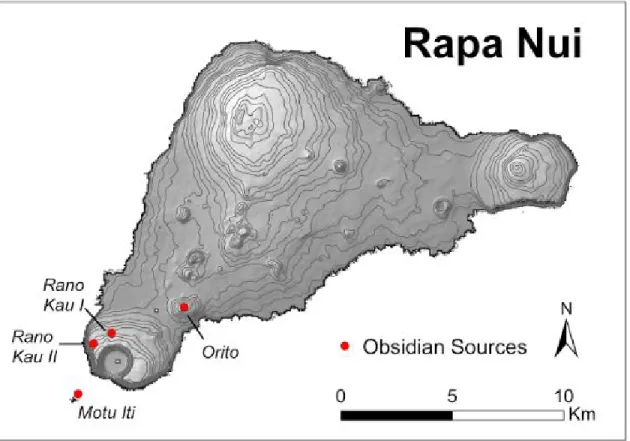
Rapa Nui was formed by three volcanoes. It is located about 3,500 km from the coast of Chile to the east and over 2,000 km from the Pitcairn Islands to the west. The island has a few types of lithic resources, primarily red scoria, basalt, and obsidian. Obsidian is the material from which the mata‘a are created. There are four obsidian sources on the island, all located towards the Southwestern corner (Fig. 2).
6
Figure 2: Topographic Map of Rapa Nui with Obsidian Sources (Created by Robert DiNapoli)
Archaeological Context
Lithic resources were a large part of Rapanui life. In addition to the mata‘a, there were a variety of other lithic tools (such as obsidian flake scrapers, or tools made from basalt) on the island. The Rapanui people even developed an agricultural system involving lithics. They created a system using “lithic mulch.7”
The deliberately rocky fields allowed for more productive land use on the
7Wozniak, J. A. (1999). Prehistoric horticultural practices on Easter Island: lithic mulched
7
windblown island, lessening erosion and holding in moisture in the soil8. This
type of agriculture was widespread on the island9,10. Often, the gardens are
found to have high densities of obsidian debitage mixed in with the porous volcanic rocks which make up the mulch.11 This might suggest that obsidian
tools, potentially mata‘a, are being used in the practice of gardening (i.e. digging) or used to process products of the agricultural practice (i.e. cutting crops).
Mata‘a are historically linked with warfare rather than agricultural or domestic
use, through the accounts of European’s visiting the island. This has played an important role in defining the “collapse” framework through which the island is often viewed.
Historical Descriptions of Mata‘a
The first mention of (what is likely) a mata‘a in written history is seen in a captain’s journal from the 1722 Dutch expedition which first made contact with Rapa Nui. The mention of what is likely a mata‘a appears as the captain,
Cornelius Bouman, describes the islanders’ mealtime activities, stating that they
8Ladefoged, T. N., Stevenson, C. M., Haoa, S., Mulrooney, M., Puleston, C., Vitousek, P. M., &
Chadwick, O. A. (2010). Soil nutrient analysis of Rapa Nui gardening. Archaeology in Oceania, 80-85.
9Wozniak, J. A. (1999). Prehistoric horticultural practices on Easter Island: lithic mulched
gardens and field systems. Rapa Nui Journal, 13(3), 95-99.
10Ladefoged, T. N., Stevenson, C. M., Haoa, S., Mulrooney, M., Puleston, C., Vitousek, P. M., &
Chadwick, O. A. (2010). Soil nutrient analysis of Rapa Nui gardening. Archaeology in Oceania, 80-85.
11Wozniak, J. A. (1999). Prehistoric horticultural practices on Easter Island: lithic mulched
8
“cut bananas with a sharp small black stone around the stem.”12
Bouman remarks throughout his journal that there is little violence at all on the island. He does not mention any spears, or weapons. Bouman even explains that, upon the Dutch arrival, “the inhabitants [of Rapa Nui] had absolutely no weapons at all, they approached us in multitudes with their bare hands in order to welcome us, hopping and jumping for joy.”13 The primary act of violence in
Bouman’s writing on Rapa Nui, in fact, is when “9 or 10” Rapanui people, shot dead by members of Bouman’s crew without command.14
12 Von Saher, H. (1994). The Complete Journal of Captain Cornelis Bouman, Master of the ship Theinhoven, Forming Part of the Fleet of Jacob Roggeveen, from 31 March to 13 April 1722 During Their Stay Around Easter Island. Rapa Nui Journal, 8(4), 100. Retrieved July 31, 2016. 13 Von Saher, H. (1994). The Complete Journal of Captain Cornelis Bouman, Master of the ship Theinhoven, Forming Part of the Fleet of Jacob Roggeveen, from 31 March to 13 April 1722 During Their Stay Around Easter Island. Rapa Nui Journal, 8(4), 99. Retrieved July 31, 2016 14 Ibid.
9
The Spaniards came across the island in 1770, and mata‘a are mentioned in writing again. This time, the mata‘a are presented as possible weapons, though the lack of lethal use is clear. Spanish captain Don Felipe González wrote in his journal that he suspected the Rapanui to be “faint-hearted,” as ‘’they possess no arms, and although in some we observed sundry wounds on the body, which we thought to have been inflicted by cutting instruments of iron or steel, we found that they proceeded from [sharp-edged] stones, which are their only weapons of defence and offence.”15 González, like Bouman, writes that when
the expedition first made contact with the island, the islanders had “no
implements of war about them; I only saw many demonstrations of rejoicing and much yelling.”16
15 Ship logs of 1770 voyage of Captain Don Felipe González (B. G. Corney, Trans.). (n.d.). Retrieved July 31, 2016, from https://www.easterisland.travel/easter-island-facts-and-info/history/ship-logs-and-journals/don-felipe-gonzalez-1770/
10
Just four years after the Spanish made contact with Rapa Nui, Captain James Cook led an expedition to the island. Journals from the Cook expedition do not mention a joyous greeting, however they mention that when the islanders crowded to the shore to see the ships “not one of them had so much as a stick or weapon of any sort in their hands.”17 Though the greeting wasn’t a violent
one, Captain Cook’s expedition is the first to label the mata‘a as actual weapons, describing “lances or spears made of thin ill-shaped sticks, and pointed with a sharp triangular piece of black glassy lava,”18 seen across the
island. Cook’s journals claim that “as harmless and friendly as these people seemed to be, they are not without offensive weapons, such as … spears; which are crooked sticks about six feet long, armed at one end with pieces of flint.”19 This “spear” terminology stuck.
Over the next 100 years, short visits from European missionaries and explorers brought more reports of the mata‘a as weapons, and of the supposed
prevalence of warfare. The “spear point” classification became official in a book titled “Te Pito Te Henua, or Easter Island.” Written in 1891 by explorer and “paymaster” William Thomson, the book features an appendix of artifacts, including a photo of what we now know as a mata‘a.
17 Cook, J. (n.d.). Easter Island ship logs: James Cook, 1774. Retrieved July 31, 2016, from
https://www.easterisland.travel/easter-island-facts-and-info/history/ship-logs-and-journals/james-cook-1774/
18 Hunt, T., & Lipo, C. (2011). The Statues that Walked, 96-97. New York, NY: Free Press. 19 Cook, J. (n.d.). Easter Island ship logs: James Cook, 1774. Retrieved July 31, 2016, from
11
Accompanying the photo is the label “obsidian spear points,”20 and a
description detailing how the mata‘a were used, supposedly fixed to longer sticks and thrust or thrown during the islanders as “the chief weapon used…in their frequent strife.”21 English archaeologist Katherine Routledge published a
book titled “The Mystery of Easter Island” in 1919, and in it she uses the word “spearpoint” to refer to mata‘a synonymously. She discusses the role of the
mata‘a as “both a spear and a javelin,”22 based on discussions with the local
people. In 1940, Swiss anthropologist Alfred Metraux also published a book about the island, his entitled “Ethnology of Easter Island.” The book again referred to the mata‘a as spearpoints throughout the book, taking the nature of the tools to be given. He cites earlier European writings that claim that wounds from mata‘a “were always fatal, if they were deep enough.”23 It is interesting to
consider how much of an impact the earlier European interactions may have had on Rapanui behavior by the early and mid-1900s. By that point, the islanders had been exposed to European ideals, weapons, and violence for around 200 years. It is possible that the role of the mata‘a changed in Rapanui society over time, in response to European interaction.
20 Thompson, W. J. (1891). Te Pito te Henua; or, Easter Island, 182. US National Museum Annual Report 1889. Retrieved August 1, 2016, from
https://archive.org/details/tepitotehenuaor00thomgoog. 21 Ibid.
22Routledge, K. (2005). The Mystery of Easter Island, 219. Cosimo, Inc.. 23Métraux, A. (1971). Ethnology of Easter Island, 165. Bishop Museum Pr.
12
It is important to consider enthnohistoric information, but it is equally as important to consider what implicit bias those ethnohistoric records may hold. All of the writings about mata‘a (and all of early Rapa Nui) are produced by European visitors. Not all of these visitors were not there to truly learn the culture, language, or traditions, and none stayed long enough to do much more than record observations. Of course, their observations were made through their own worldview, and as such what they recorded likely has a strong Euro-centric bias. Even Thompson, who did aim to gain an understanding of the local culture and traditions was not immune to his own worldview. These writings are necessarily are in a context that their writers understand. It is not the fault of the Europeans that they recorded what they saw in a way that they understood, however it is faulty to assume today that these records are entirely factual and accurate. Archaeological evidence must be examined alongside ethnohistoric information.
Osteological Evidence of Warfare
One of the most telling elements of warfare in the archaeological record is injuries on skeletal remains. A study by Owsley et al. in 199424 examines
injuries on Rapanui remains, as does an expanded study by Owsley in 2016.25
The expanded study looks at skeletal remains of Rapanui people collected from
24Owsley, D. W., Gill, G. W., & Ousley, S. D. (1994). Biological effects of European contact on
Easter Island. In Edited by CM Stevenson, G. Lee, and FJ Morin, Easter Island in Pacific Context: South Seas Symposium: Proceedings of the Fourth International Conference on Easter Island and East Polynesia. Easter Island Foundation (pp. 129-34).
25 Owsley, D. W., Barca, K. G., Simon, V. E., & Gill, G. W. (2016). Evidence for injuries and violent death. Skeletal Biology of the Ancient Rapanui (Easter Islanders), 72, 222. Chicago
13
12 institutions. Though many of the bones are comingled, based on the number of frontal bones found, the minimum number of individuals included in the study is 469. Owsley found that the majority of the injuries were found on cranial bones, and appeared to be the result of blunt-force trauma. Though many crania did show some injury damage, very few showed lethal trauma26. People
may have been hitting each other in the head, but they were not killing each other. There was one individual whose cranial injuries indicated that they had been stabbed in the head with an obsidian implement, which may have been a
mata‘a,27 and this is very important to note. It is clear that the mata‘a had the
ability to be used as weapons, however as there is only evidence for one individual being injured by obsidian implement, it appears unlikely that this was the sole or primary mata‘a purpose.
In addition to the low percentage of bones with injuries, Owsley also states that the data “do not easily conform to the expectations envisioned for periods of intense violence as described in ethnohistoric and other accounts” based on two other lines of evidence.
Firstly, the distribution of injuries is inconsistent with injuries found in societies engaged in violent conflict. “Numerous trunk and upper limb injuries would be expected for individuals engaged in major episodes of warfare,”28 according to
26 Owsley, D. W., Barca, K. G., Simon, V. E., & Gill, G. W. (2016). Evidence for injuries and violent death. Skeletal Biology of the Ancient Rapanui (Easter Islanders), 242
27Owsley, D. W., Barca, K. G., Simon, V. E., & Gill, G. W. (2016). Evidence for injuries and violent death. Skeletal Biology of the Ancient Rapanui (Easter Islanders), 246
28 Owsley, D. W., Barca, K. G., Simon, V. E., & Gill, G. W. (2016). Evidence for injuries and violent death. Skeletal Biology of the Ancient Rapanui (Easter Islanders), 244
14
Owsley. The majority of injuries noted on the remains are on the skull. In fact, of the few injuries noted on the clavicle and upper limb, all but one are healed, indicating their non-fatal nature29.
Secondly, the age/sex trauma pattern does not match the profile for a society engaged in violent conflict. Though young males (typically the principal fatalities in instances of warfare) do show a higher rate of cranial injury, they do not appear to have a higher rate of fatal wounding. In addition, female skeletal remains show a slightly higher percentage of postcranial fractures. Owsley suggests this is likely due to ulna fractures as a result of defensive movements stemming from domestic violence30
Owsley notes that while soft-tissue injuries can be fatal, and are not represented in the skeletal record, it is unlikely that those injuries were common, given the types of materials the Rapanui would have had for weapons. As such, Owsley states that “the types and frequencies of injuries observed in Rapanui skeletal remains cannot convincingly be attributed to massacre events or an intense, prolonged civil war”31
Artifactual Evidence for Weapons and Warfare
In addition to osteological evidence, evidence of weaponry can be very telling of war in the archeological record. There have been a few formal analyses of
29 Owsley, D. W., Barca, K. G., Simon, V. E., & Gill, G. W. (2016). Evidence for injuries and violent death. Skeletal Biology of the Ancient Rapanui (Easter Islanders), 244
30 Ibid. 31 Ibid.
15
mata‘a, which examine microscopic usewear, mata‘a blade shape, and stylistic
variation in attempts to better understand the function of the tool.
In the mid-1990s, a series of studies were done on the microwear on obsidian tools on the island, aiming to find out on which materials they were used. Church and Rigney (1994) examined an obsidian assemblage from an inland site, Site 10-241, in South-Central Rapa Nui. The assemblage contained 1136 items. Of these, two were complete mata‘a, 11 were mata‘a fragments, four were possible drills, and the rest were used debitage. Eighteen items were chosen for analysis, in order to provide a variety of artifact classes and proveniences. These items were examined by the high-power approach (see page 22) with an incident light microscope with 80x-1000x magnification, and striations, abrasions, and polishes were documented. These instances of wear were compared against wear present on experimentally developed tools. This allowed the researchers to determine the activities performed, since they knew which actions were performed with the experimentally produced tools, and could compare flakes on these to the flakes on the archaeological tools. This comparison led to the conclusion that the most common activity the mata‘a was used for was scraping, followed by cutting. Other actions identified were sawing and whittling. Church and Rigney also attempt to determine the materials
worked, again relying on comparison with experimentally developed tools. They conclude that the primary materials worked were fresh plants, followed by soft
16
wood and fish.32 They conclude that the activities shown by the wear “are
inconsistent with the original proposed function of these tools as spearpoints.”33
Potential limitations of this research include the very small number of complete
mata‘a, the lack of macroscopic analysis, and the reliance on experimentally
produced tools. Such experiments, while potentially entirely valid, are inherently incomplete. Since modern archaeologists can only take very educated guesses at the potential movements made and materials worked by the tools, there is always the possibility that a motion or material doesn’t occur to the
experimenters. It is probably impossible to consider every single possible movement a tool could make. Another issue inherent with relying on experimentally produced data, especially when dealing with lithics, is the potential for more than one action to produce similar results34. Photos of their
example results are shown, and appear to be different enough at the
microscopic scale to be identifiable, however this is always something that must be kept in mind when doing or reading a study that includes replicated
experimental tools as a reference. Chuch and Ellis (1996) performed a similar study a few years later. This study again used the high-power approach to examine 36 obsidian artifacts from Ana Kionga, a cave site on the island. Two of these artifacts were full mata‘a, and the others were large obsidian flakes35.
32 Church, F., & Rigney, J. (1994). A micro-wear analysis of tools from Site 10-241, Easter Island–an inland processing site. Rapa Nui Journal, 8(4), 101
33 Church, F., & Rigney, J. (1994). A micro-wear analysis of tools from Site 10-241, Easter Island–an inland processing site. Rapa Nui Journal, 8(4), 104
34Dibble, H. L. (1997). Platform variability and flake morphology: a comparison of experimental
and archaeological data and implications for interpreting prehistoric lithic technological strategies. Lithic technology, 22(2), 150-170.
35Church, F., & Ellis, J. G. (1996). A use-wear analysis of obsidian tools from an ana
17
37 total instances of wear were documented. Documented wear included polish, striations, and residues, and was compared against wear from
previously experimentally produced tools. It was concluded that the wear was produced by a set of actions: cutting, scraping, sawing, whittling, and hafting. 81% is attributed to cutting and scraping. Church and Ellis also use residue analysis and experimentation to conclude that materials worked by the mata‘a were primarily plants (51%), followed by bone (16%), wood (14%) and hide (14%). Unfortunately, Church and Ellis do not specify which animal this hide may have come from.This study was primarily aimed at understanding the role of the cave-site, however Church and Ellis state that the microwear on the tools is indicative of “a wide range of domestic activities,” and do not mention the tools showing wear indicative of weaponry.36 This study shares similar
limitations to the previous study, in that it relies on experimentally produced tools as a reference, does not include macroscopic wear, and has a very low number of complete mata‘a actually examined. This thesis will complement these papers by adding a macroscopic analysis, as well as observing where on the tool the wear is located, and whether there are any clear patterns in flake distribution.
More recently, Lipo et al. 2016 conducted a morphometric analysis of the tools, examining mata‘a shape variability. The guiding hypotheses were that if the
36Church, F., & Ellis, J. G. (1996). A use-wear analysis of obsidian tools from an ana
18
mata‘a were systematically produced weapons of warfare, their distal ends
would:
1) Be “constrained in shape due to the demands of performance in combat”
2) “Show a tendency towards a spear-like shape that is consistent with the penetration of enemies.”37
The study looked at a total of 423 mata‘a. Using elliptical Fourier analysis, outlines of the mata‘a were compared over each other, looking not only for overall trends but also for “aspects of shape that might distinguish subgroups from each other.”38
Results of the analysis indicated that mata‘a shapes “vary continuously in their outlines,” and that “there were no subsets of distinctive, lanceolate-shaped objects or any other subgroups.”39 The study concludes that the analysis
produced evidence that “fails to support hypotheses about the use of [the
mata‘a] as lethal weapons involved in systematic warfare.”40
There have been a number of studies in the past which attempt to classify
mata‘a in to categories41,42,43, such as specific cutting and scraping mata‘a,
however no set of classifications has emerged as a strong and definitive list of types, and as such, classifications are not often taken in to account in current
37 Lipo, C. P., Hunt, T. L., Horneman, R., & Bonhomme, V. (2016). Weapons of war? Rapa Nui
mata‘a morphometric analyses. Antiquity, 90(349), 180. 38 Ibid.
39 Ibid.
40 Lipo, C. P., Hunt, T. L., Horneman, R., & Bonhomme, V. (2016). Weapons of war? Rapa Nui
mata‘a morphometric analyses. Antiquity, 90(349), 184.
41 Thomson, W. J. (1891). Te pito te henua; or, Easter Island. Smithsonian Institution. P.536 42Routledge, K. (1919). The Mystery of Easter Island: The Story of an Expedition. P. 223 43 Bormida, M. (1951). Formas y funciones del ‘mata’, el mas conocido artefacto de la arqueologia de Pascua. Archivo para las ciencas del hombre, 4(part 1), 2.
19
mata‘a literature. In 2000, Dr. Ayres conducted a study in which he examined
tool typology and usewear across Rapa Nui.44 He concluded that the mata‘a
were a type of tool, within a larger spectrum of Rapanui tools. Rather than being a class of tool, with individual mata‘a types within that class, the mata‘a were instead a single type of tool.
In a similar vein, a study was recently done which examined stylistic variability
of mata‘a using frequency seriation, in an attempt to study cultural interaction
and cultural transmission across the island. The results demonstrated a “strong spatial and temporal pattern among assemblages,” primarily in the manufacture method of the stem. The blade shape (distal end) varied widely across the island. There did not appear to be any strong spatial or temporal patterns
among the distal ends of the mata‘a. The findings allow for a conclusion that the
mata‘a may not fit in to a set of functional classifications, as their blade shape
varies so widely, however the mata‘a can be potentially classified by location and temporality when looking at the stems45,46. This lack of pattern among the
distal, blade end of the tool supports the mutli-use tool hypothesis rather than the weapon hypothesis, or any hypothesis which furthers a single use. The
44Easter Island Obsidian Artifacts: Typology and Use-wear. In Easter Island Archaeology: Research on Early Rapanui Culture, C. Stevenson, W. Ayres (2000). eds. Los Osos: Easter Island Foundation.
45Lipo, C. P., Hunt, T. L., & Hundtoft, B. (2010). Stylistic variability of stemmed obsidian tools
(mata’a), frequency seriation, and the scale of social interaction on Rapa Nui (Easter Island). Journal of Archaeological Science, 37(10), 2551-2561.
46Lipo, C. P., Hunt, T. L., & Hundtoft, B. (2015). AN ANALYSIS OF STYLISTIC VARIABILITY
OF STEMMED OBSIDIAN TOOLS (MATA’A) ON RAPA NUI (EASTER ISLAND). Lithic Technological Systems and Evolutionary Theory, 225.
20
variable blade shape suggests that the mata‘a were not manufactured differently for different tasks, suggesting they held many roles.
Lithic Usewear
There has been extensive research done regarding lithic usewear analysis, both in terms of usewear studies themselves, and in terms of studies done on the effectiveness of usewear analysis as a field. Early lithic studies focused heavily on classifying tools in to categories (e.g. scraper, adze, drill, arrow), using primarily morphological attributes47. The categorized tools were then used
to infer function, as well as broad society-wide changes in the communities being studied.48 For example, this meant looking at a rounded tool and inferring
it as a scraper, or looking at pointed tools and assuming them to be spears. Classification investigations can be very telling and are still an employed method of study today, however another method of functional analysis, complementary to classification studies, emerged soon after early studies.
Russian archaeologist Sergei Semenov pioneered the technique of examining the wear on the tools and performing experiments to re-create wear patterns. He did not disavow classifications, however he furthered the perspective that “functional attribution based in simple analytical description with no direct
47Marreiros, J. M., Bao, G., & Bicho, N. F. (2015). Use-wear and residue analysis in archaeology. Springer International Publishing
48 Marreiros, J. M., Bao, G., & Bicho, N. F. (2015). Use-wear and residue analysis in archaeology. Springer International Publishing.
21
evidences of use was erroneous.”49 He argued that, while “typology assumes
an important role in archaeology,” understanding the tools “shouldn’t be limited by typological classification…Paleolithic studies need a paleoethnographic and paleotechnical reconstruction of the past human societies,”50 where
“paleoethnographic” refers to broad typologies and “paleotechnical” refers to evidence-based wear studies. Though many of Semenov’s experiments were later critiqued on their validity in associating specific flake patterns with specific worked materials51, he laid the groundwork for examining lithics with
from-the-tool evidence as opposed to solely through the morphologic lens. He pioneered the method of lithic study which observes aspects of wear on individual tools. He observed things like flake patterns, striations, and abrasions on individual tools, while the rest of the lithic analysis community focused on observing broad descriptive elements of the tools, primarily shape. While shape can be a telling factor when determining tool function, wear on the tools complements these broader studies with specific information about each tool, so that function may be more comprehensively inferred.
49 Ibid.
50 Semenov, S. A. (1970). The forms and functions of the oldest tools. Quartär, 21, 1-20. 51 Marreiros, J. M., Bao, G., & Bicho, N. F. (2015). Use-wear and residue analysis in archaeology. Springer International Publishing
22
Following the introduction of usewear analysis, many researchers have debated how this analysis is best done.
There has been a large focus on experimentation52,53, which in turn created a
focus on experiments with blind tests, as a method of verifying experimental results54,55. Early usewear studies focused mainly on low-power magnification
examination, examining only what could be seen with the eye.56 This method
soon proved to make extremely detailed work difficult, as it only allowed for somewhat preliminary conclusions to be made, such as method of tool movement.57
High-power analysis, introduced by Lawrence Keeley in the early 1980s, allows for a more detailed and comprehensive lithic analysis. Using high-powered microscopy, researchers can observe wear such as microabrasions, striations, or polishes created from repetitive movements.58 There has been much debate
about the limitations of each type of study, however it is generally concluded that the two methods are complementary in terms of functional analyses.59
52 Odell, G. H., & Cowan, F. (1986). Experiments with spears and arrows on animal targets. Journal of Field Archaeology, 13(2), 195-212.
53 Fischer, A., Hansen, P. V., & Rasmussen, P. (1984). Macro and micro wear traces on lithic projectile points: experimental results and prehistoric examples. Journal of Danish Archaeology, 3(1), 19-46.
54 Evans, A. A. (2014). On the importance of blind testing in archaeological science: the example from lithic functional studies. Journal of Archaeological Science, 48, 5-14. 55 Odell, G. H., & Odell-Vereecken, F. (1980). Verifying the reliability of lithic use-wear assessments by ‘blind tests’: the low-power approach. Journal of field Archaeology, 7(1), 87-120.
56 Marreiros, J. M., Bao, G., & Bicho, N. F. (2015). Use-wear and residue analysis in archaeology. Springer International Publishing
57 Ibid. 58 Ibid.
59 Odell, G. H. (2001). Stone tool research at the end of the millennium: classification, function, and behavior. Journal of Archaeological Research, 9(1), 45-100.
23
This study employs the former method of study: the low-power approach. Due to time constraints during data collection, the preliminary nature of this
investigation, and a lack of this type of “preliminary” paper on the topic, examining solely the visible flakes and edge damage on the tools in order to make a statement about their movement seemed the best method of study for this research.
Flake patterns indicate a few aspects of tool use. Noting the location of the wear can indicate the manner in which the tool was held and used. If all flakes are on the left side of a tool, for example, it was held in such a way that the entire left side was put to use (i.e. sideways), and used solely on that one side. There is evidence that projectile points used as weapons typically feature large longitudinal flakes along one side of the tool in question60. There are additional
microscopic traces of weaponry use, the most prominent of which is the presence of striations oriented parallel to the long axis of the tool,61 however I
do not observe microscopic aspects of wear in this study.
When there is not a consistent flake pattern, it often indicates that the tools were multi-use tools.62
60Dockall, J. E. (1997). Wear traces and projectile impact: a review of the experimental and
archaeological evidence. Journal of Field Archaeology, 24(3), 321-331.
61 Ibid.
62Odell, G. H., & Odell-Vereecken, F. (1980). Verifying the reliability of lithic use-wear
assessments by ‘blind tests’: the low-power approach. Journal of field Archaeology, 7(1), 87-120.
24
One issue inherent in macroscopic analysis is that often flakes which are
created by different motions appear to have identical shapes. This is particularly true in obsidian flaking, as the stone tends to flake in to wide flakes more often than it flakes in to any other shape.63 These shapes may have slight consistent
variances when observed microscopically64,65, however at the level I observed,
it is not possible to ascertain a difference. This limits my study in that it only allows me to offer a variety of potential motions as opposed to one, however as I will discuss later, that is not an issue given my conclusion.
Obsidian tools present other interesting dilemmas and opportunities for usewear studies. On one hand, the smooth and glassy nature of obsidian virtually eliminates mistaking grains or bumps in the stone itself as human-created wear.66 In addition, obsidian lacks crystal structures (other than
occasional, scattered small crystallite), which means that flakes creation is controlled by external force rather than the crystalline patterns in the stone.67
This allows us to assume that the flakes observed are strong indicators of tool use.
63Domanski, M., Webb, J. A., & Boland, J. (1994). Mechanical properties of stone artefact
materials and the effect of heat treatment. Archaeometry, 36, 177-177.
64Church, F., & Ellis, J. G. (1996). A use-wear analysis of obsidian tools from an ana
kionga. Rapa Nui Journal, 10, 87
65Church, F., & Rigney, J. (1994). A micro-wear analysis of tools from Site 10-241, Easter Island–an inland processing site. Rapa Nui Journal, 8(4)
66Beyin, A. (2010). Use-wear analysis of obsidian artifacts from Later Stone Age shell midden
sites on the Red Sea Coast of Eritrea, with experimental results. Journal of Archaeological Science, 37(7), 1543-1556.
25
On the other hand, because it is formed by quickly cooled lava, obsidian is extremely brittle. Because of this brittle nature, it is susceptible to high amounts of post-depositional damage.68 In this study, I was able to identify
human-created flakes by their consistent placement along the edges of the tools,
however I was unable to ascertain whether or not the edge damage I noted was pre- or post-depositional. I defined edge damage as wear present on the edge which was only present on the edge and did not flake either face. As such, though I recorded it, I do not consider edge-damage during the majority of my analysis. This limits this study in that I may be missing some information helpful to my questions, however not analyzing it removes the risk of over-counted data, and drawing false conclusions.
26
Analysis and Results
In this thesis, I describe and analyze flake and use-wear patterns on 47 mata‘a from the collections housed at the Father Sebastian Englert Museum on Rapa Nui. These artifacts were surface-collected by Father Sebastian Englert during his surveys of the island in the 1930s. This dataset is limited by the fact that the artifacts have no provenience or provenance information, limiting the possibility for any chronological or geographical interpretations. I do not believe this is detrimental to my results, as it has been shown that blade shape varies widely and continuously across the island.69 I perform this
study accepting the mata‘a as one class of tools on the island, rather than attempting to parse out various classifications of mata‘a. This study focuses solely on the flakes on the individual mata‘a, or what Semenov would refer to as the paleotechnical” element of study.70
Data Collection
The mata‘a analyzed in this study are a part of the collection at the Father
Sebastian Englert Anthropological Museum on Rapa Nui. The mata‘a were part of a collection of tools with no provenience, provenance, or prior sorting,
providing a wide range of sizes and shapes of mata‘a. As these tools were brought in as surface collected tools, likely collected while surveying the island,
69Lipo, C. P., Hunt, T. L., Horneman, R., & Bonhomme, V. (2016). Weapons of war? Rapa Nui mata‘a morphometric analyses. Antiquity, 90(349), 172-187.
27
it is also likely that these tools come from an assortment of locations on the island. While this allows variety, it limits further analysis into locational variance of tool use.
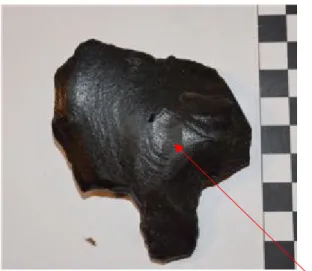
Mata‘a were photographed from both dorsal and ventral sides and traced. The
ventral side of the mata‘a is defined as the face featuring a bulb of percussion (see Figure 4), which is formed when a large obsidian flake (which will become
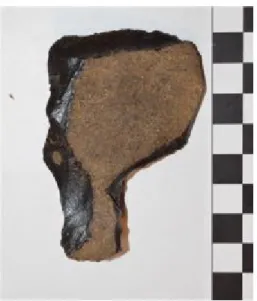
the mata‘a) is broken off a larger obsidian core. The dorsal side (see Figure 3)
is defined as the face lacking a bulb of percussion, and it often retains sections of cortex. Photos of all mata‘a are included as an appendix (Appendix 1).
28
Figure 4: Example ventral side with bulb of percussion Mata‘a 17-01-1329 On the traced images, the wear on each side was noted. The damage
appeared to be primarily flakes, however edge damage was also present and noted. As noted earlier, though edge damage was originally noted, it was not analyzed as I was not able to determine pre- or post-deposition wear. The flakes were recorded in terms of size (small, roughly 0-1 centimeter, medium, roughly 1-3 centimeters, and large, 3 or more centimeters) and shape (wider than they were long, longer than they were wide, or approximately equal length and width.) The shapes were simplified after the initial recording to “Wide,” “Narrow,” and “Even,” (see below).
Flake Size Flake Shape
Small Medium Large Wide Narrow Even
29
30
After data collection, the traced mata‘a images were divided into four quadrants, with the vertical divider being the center of the stem, and the horizontal divider being the measured middle of the tool (Figure 6). In addition to its size and shape, usewear was catalogued by its location (upper left, upper right, lower left, or lower right) and side (dorsal, ventral).. Initially categorizing wear in these specific categories allowed for broader categories to be put together (e.g. “left vs. right,” “upper vs. lower,” & “dorsal vs. ventral”).
Figure 6: Traced & quartered mata’a examples
Research Questions
In my attempt to study mata‘a movement through usewear on the tools, I investigated a series of questions. I’ve listed them again here. All questions were answered using R71.
71 R Core Team (2013). R: A language and environment for statistical computing. R Foundation for Statistical Computing, Vienna, Austria. URL http://www.R-project.org/
31
1) Are there more flakes on the upper or lower portions of the mata‘a? • This will provide insight into the position in which the mata‘a
was held as it was moved. If the flakes are mostly in one location versus the other, it will indicate that the mata‘a was help primarily upright, sideways, or in a downward position. 2) Are there more flakes on the dorsal or ventral faces of mata‘a?
• This will provide insight into the way in which the mata‘a was used. If the flakes are mostly on one face or another, it will indicate that the mata‘a were used in such a way that only one face of the tool was actively in use.
3) Are there more flakes on the left or right sides of mata‘a?
• This will provide insight in to the position in which the mata‘a was held as it was used. If flakes are mostly on one side or another, it will indicate that the mata’a were held in such a way that only one side was in active use. Left and right are from the perspective of the dorsal side.
4) Is there a flake size that is more prominent than other flake sizes? • This will provide insight into how forceful the movements are. If
there is a higher incidence of flakes of one size over another, it will indicate that the mata‘a were moved consistently in ways that produce that size of flake. This information could
potentially also inform us about the types of materials the tools were used on, however this I do not investigate that in this study.
5) Is there a flake shape that is more prominent than other flake shapes?
• This will provide insight into the direction the mata‘a were moved, and what type of motion was employed. If one flake shape is more prominent than the others, it will indicate that
the mata‘a were consistently moved in a manner which creates
the certain flake shape. For example, if there are
predominantly narrow flakes, it will indicate that the mata‘a were moved in longer motions.
6) Are flake size and flake shape independent?
• This will provide insight in to whether the mata‘a were moved in one or more ways that create patterns between flake size and shape. If flake size and shape are not independent, it will indicate that the mata‘a was used in a consistent pattern, which created certain flake sizes in certain shapes. We cannot
32
limit the motions to one, because it is possible that more than one motion creates similar flakes.
7) Are mata‘a face and flake size independent?
• This will provide insight into the way that the mata‘a was held and used. If one face has more flakes of a certain size than another, it will indicate a difference in method of use between the two faces.
8) Are mata‘a face and flake shape independent?
• This will provide insight into the way that the mata‘a was held and used. If one face has more flakes of a certain shape than another, it will indicate a difference in use style between the two faces.
9) Are mata‘a side and flake shape independent?
• This will provide insight into the way that the mata‘a was held and used. If one side has more flakes of a certain shape than another, it will indicate a difference in use style between the two sides.
10) Are mata‘a side (left/right) and flake size independent?
• This will provide insight into the way that the mata‘a was held and used. If one side has more flakes of a certain size than another, it will indicate a difference in use style between the two sides.
Research Question 1:
I began by comparing the average number of flakes on the upper sections of
the mata‘a to the average number of flakes on the lower sections of the mata‘a.
I began with this because while cataloguing, this difference seemed to be the most prominent. Upper sections of mata‘a (no differentiation between
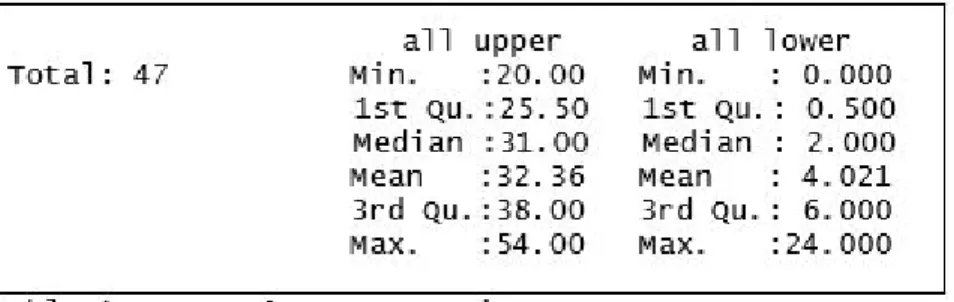
dorsal/ventral or left/right) ranged in number of flakes from 20 to 54, averaging 32, while lower sections ranged from 0 to 24, averaging 4 (see table 1). This immediately seemed to indicate that wear was much more present on the upper
33
sections of mata‘a than it was on the lower. This makes sense, given that the
mata‘a were known to be hafted, however further analysis was done in order to
avoid assumptions and provide as thorough an analysis as possible.
To visualize relationships among and between variables, I created histograms and boxplots of each dataset.
34
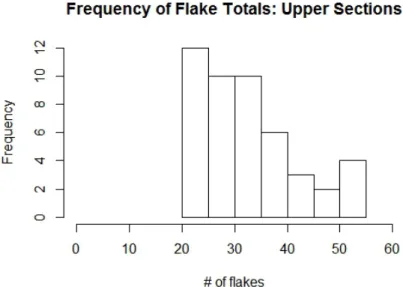
Figure 8: Upper Flake Totals Histogram
Figure 9: Lower Flake Totals Histogram
The histograms indicate that there are higher numbers of flakes on the upper mata‘a sections than the lower sections. The histograms also indicate that the data are not normally distributed. Whether the data are normal or non-normal will determine which statistical tests are the most appropriate. For
35
example, departures from normality may violate the assumptions of parametric tests, such as the student’s T test, and therefore a non-parametic test may be needed. Though this was pretty clear from the histograms, I performed a
Shapiro-Wilks test of normality on both the upper and lower datasets in order to confirm. For this test, the lower the p-value, the less chance the data are
normally distributed. The W value indicates the strength of the result. The upper dataset returned very low results (W = 0.92846, p < 0.01), as did the lower dataset (W = 0.76353, p < 0.01), indicating departures from normality.
Because the data is non-normal, I used a non-parametric test in order to test for a significant difference between the total number of upper and lower flakes. I used a two-sided Kolmogorov-Smirnov test (similar to a two-sided T-test for normally distributed data) to test this question. For this test, and all following significance tests, I test at the 99% confidence (p=0.01) level. The results of this test indicated a significant difference (D=0.97872, p < 0.01). The D statistic indicates the strength of the relationship, and the larger the number, the stronger the relationship. This D statistic indicates a very strong relationship, and the p-value allows us to conclude that there are significantly more flakes on the upper portion of the mata‘a than the lower portion. Because my result was so strong, I chose to only examine the wear on the upper portions of the mata’a for the rest of the tests I performed.
36 Research Question 2:
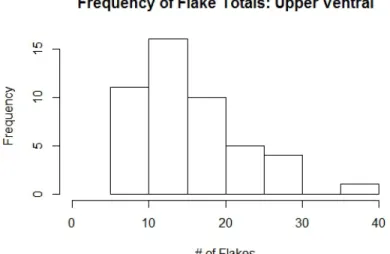
I followed a similar procedure to answer this question as I did the first. The number of flakes on the dorsal side of the upper sections ranged from 5 to 30, averaging 16.6, and number of flakes on the ventral side ranged from 7 to 37, averaging 15.7 (see table 2). Histograms and the Shapiro-Wilks tests indicated that the dorsal face had normally distributed wear (W = 0.96591, P=0.184), however the ventral side did not (W = 0.92217P<0.01). Because of the non-normality of the ventral face, I again performed the non-parametric KS test to test for a significant difference between the number of flakes on the ventral face versus the dorsal face. The results did not indicate a significant difference (D=0.12766, p= 0.8384). This is a weak relationship, and the difference is not significant. There does not appear to be a significant difference between the number of flakes on the dorsal face of the mata‘a and the ventral face.
37
Figure 10: Upper Dorsal and Ventral Flake Totals
38
Figure 12: Upper Ventral Flake Totals Histogram
Research Question 3
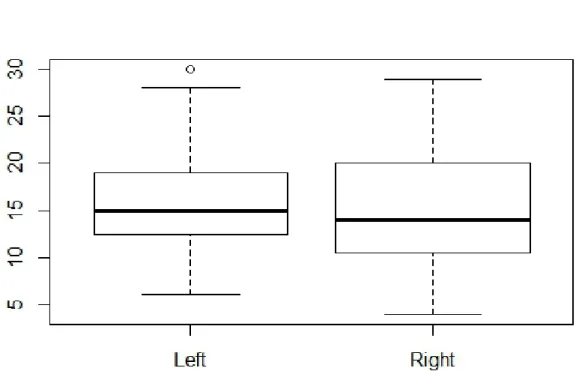
I performed similar analyses to answer my third question. Left and right was decided from the dorsal point of view. Flakes on the upper left side of the dorsal face and flakes on the upper right side of the ventral face were combined as the “upper left,” and flakes from the upper right side of the dorsal face and the upper left side of the ventral face were combined as “upper right.”
The number of flakes on the left sections of the mata‘a ranged from 6 to 30, averaging 15.85. The number of flakes on the right sections of the mata‘a ranged from 4 to 29, averaging 15.15 (see Table 3). Histograms and Shapiro-Wilks tests indicated normality. Shapiro-Shapiro-Wilks results were (W=0.96806,
p=0.2232) for the left side and (W= 0.96725, p= 0.2077) for the right side. Even though these results would typically lead to a parametric test of significance (i.e. a Student’s T Test), I performed a KS test in order to maintain consistency.
39
Very few other datasets tested to be normal. A KS test returned results which did not indicate significance (D = 0.17021, p = 0.5038). There does not appear to be a significant difference in the number of flakes on the left side of the
mata‘a and the right side.
Table 3: Upper Left & Right Data
40
Figure 13: Upper Left Flake Totals Histogram
Figure 14: Upper Right Flake Totals Histogram
Research Questions 4:
The total number of flakes of each size, on each mata‘a (on the upper portions) are summarized in table 4. The number of large flakes on the mata‘a ranged from 0 to 9, averaging just over 2. The number of medium flakes ranged from 0 to 15, averaging just over 4. The number of small flakes on the mata‘a ranged from 4 to 30, averaging just below 15. Edge damage was present on every
41
mata’a, ranging from just 1 occurrence to 28, averaging about 9 instances. Because I was unable to ascertain what edge damage was due to use and what was caused post-deposition, I do not include edge damage in any of my
following investigations, and do not perform any tests of significance with edge damage included.
In order to visualize the data, I created a boxplot and histograms. The boxplot indicates a large difference between the amount of small flakes and the amounts of large and medium flakes. The difference between medium and large flakes is harder to discern from the boxplot.
42
Figure 16: Large Flakes Histogram
43
Figure 18: Small Flakes Histogram
Histograms and Shapiro-Wilks tests of the large and medium flake size data indicate non-normality (both p-values for the S-W tests were less than 0.01). Small flakes appear to have a normal distribution (W=0.96121, p =0.1202). Though the small flakes data is normal, I continue to use non-parametric tests, as everything I compare the small flakes data against is non-normal. I
performed one-sided KS tests of the flake sizes against each other, in order to determine whether or not one flake size was significantly more prevalent than other flake sizes. Because of the results of the boxplot, I chose to do one-sided tests to see if the differences shown were significant. I tested whether or not there were more small flakes than large ones, more small flakes than medium ones, and more medium flake than large ones. The amount of small flakes appeared to be significantly higher than the amount of large flakes (D=0.93617, p < 0.01) and the amount of medium flakes (D=0.80851, p < 0.01), and the
44
amount of medium flakes appeared be significantly higher than the amount of large flakes (D=0.3617, p < 0.01).
All of the KS tests performed returned significant results. This allows us to conclude that there are significantly more small flakes than large or medium flakes, and that there are significantly more medium flakes than large ones. The D-statistic indicates the strength of the significant difference (the higher it is the stronger it is), and as such we can see that though there are significantly more medium flakes than large flakes, this difference is not as strong as the
differences between the number of small flakes and large ones, or small flakes and medium ones.
Research Question 5:
In order to answer the question “Is there a flake shape that is more prominent than other flake shapes,” I performed similar analyses to those used to answer question 4.
The number of wide flakes on each mata‘a ranged from 6 to 49, averaging about 21. The number of narrow flakes ranged from 0 to 33, averaging around 6, and the number of even flakes ranged from 0 to 24, averaging about 5. I created boxplots and histograms to visualize the data.
45
The boxplot indicates a higher occurrence of wide flakes than either of the other two. Narrow and even flakes appear to have relatively equal distributions.
46
Figure 20: Wide Flakes Histogram
Figure 21: Narrow Flakes Histogram
47
Figure 22: Even Flakes Histogram
Shapiro-Wilks tests proved the “narrow” dataset (W = 0.76669, p < 0.01) and the “even” dataset (W = 0.81248, p < 0.01) to be non-normal, and the “wide” dataset (W = 0.95382, p = 0.06118) to be normal.
Though the histogram and Shapiro-Wilks test result indicate normality of the “Wide” dataset, I again ran non-parametric tests to check for significant differences in flake shape, as the datasets I compared the wide data against was not normally distributed. I ran KS tests for wide flakes versus narrow flakes, wide flakes versus even flakes, and narrow flakes versus even flakes. There appeared to be significantly more wide flakes than narrow flakes (D=0.78723, p < 0.01), and significantly more wide flakes than even flakes (D=0.85106, p < 0.01), however there did not appear to be a significant difference between narrow and even flakes (D=0.12766, p = 0.4649)
48
To answer the question “are flake size and shape independent,” I visualized the data by creating a data table and a barplot, which plots the number of flakes of certain sizes by their shapes.
Even Narrow Wide
Large 4 10 94
Medium 10 38 156
Small 145 120 430
Table 6: Shape Distribution Per Flake Size
Looking at the data initially, it appears that the flake sizes tend to be wide more often than not, however the difference is stark for both the large and medium flakes. While there are about
The barplot indicated that the majority of even, narrow, and wide flakes were small flakes, however wide flakes seemed to have a more even distribution of medium and large flakes.
49
Figure 23: Flake Shapes by Size
In order to test whether or not there was a significant correlation between flake size and shape, I performed a chi-square test. Chi-square tests evaluate how likely it is that observed distributions occur due to chance. Low p-values indicate that it is unlikely the events occurred by random chance, and the chi-square statistic indicates the strength of the relationship. The higher the statistic, the stronger the relationship. Still working with a 99% (0.01)
confidence level, this test returned a significant result (X2 = 52.607, p < 0.01).
The test results indicate that size and shape are not independent. Looking again at the barplot (fig. 23) there appears to be a high incidence of small flakes in every category, but a higher amount of medium and large flakes in the wide category.
50 Research Question 7:
To answer this question, I performed a similar set of analyses to the ones used to answer the previous question. I visualized the data by creating a barplot of how many of each sized flake were on each mata‘a face. The barplot indicated that there were very similar flake size distributions on the dorsal and ventral faces.
Dorsal Ventral
Large 54 54
Medium 106 98
Small 379 316
Table 7: Flake Size Distributions By Face
51
Though the barplot did not show much of a difference at all, I performed a chi-squared test in order to test whether there was a correlation between flake sizes and mata‘a faces. The result was not significant (X2 = 1.0236, p = 0.5994).
Flake size and mata‘a face appear to be independent.
Research Question 8:
I used the same analysis process for this question as I had for the previous two. To begin with, I visualized the data by creating a barplot of how many flakes of each shape were on each mata‘a face.
Dorsal Ventral
Even 80 79
Narrow 80 88
Wide 379 301
52
Figure 25: Flake Shapes by Mata‘a Face
The bar plot does not show much of a difference between the different flake shapes present on either mata‘a face. In order to test whether or not there was a correlation, I performed a chi-square test. The test result was not significant (X2 = 4.35, p = 0.1136). Flake shape and mata‘a face appear to be
independent.
Research Question 9:
To answer the question “Are mata‘a side (left/right) and flake shape correlated,” I again performed similar analyses. To begin with, I visualized the data by creating a barplot of the number of each flake size on the two mata‘a sides.
53
Left Right
Even 86 73
Narrow 97 71
Wide 349 331
Table 10: Flake Shape Distribution by Side
Figure 25: Flake Shapes by Mata‘a Side
The barplot indicates that there is a slightly higher occurrence of even and wide flakes on the left side of the mata‘a than on the right side. I performed a chi-square test to check whether or not flake size and mata‘a side were
independent. The test did not return a significant result (X2 = 2.3443, p-value =
0.3097). It appears that flake shape and mata‘a side are independent, and given the relatively small chi-square statistic, this relationship is weak.
54 Research Question 10:
Analysis for this question was performed much like analysis for the prior 4 questions. I began by visualizing the data with a barplot of how many flakes of each size were on each mata‘a side.
Left Right
Large 56 52
Medium 109 95
Small 367 328
Table 11: Flake Size Distribution by Side
55
The bar plot did not indicate any obvious differences in the number of flakes of different sizes on either the left or right sides of the mata‘a. There appear to be slightly more small and medium flakes on the left side, however large flake amounts appear almost identical. In order to see if there was any significant differences, I performed a chi-square test. The test did not return a significant result (X2 = 0.071235, p = 0.965). Flake size and mata‘a side appear to be
independent.
Discussion:
Based on results obtained in the investigations detailed in my “Data” section, I compiled a table (Table 12), summarizing the answers to the questions posed for analysis.