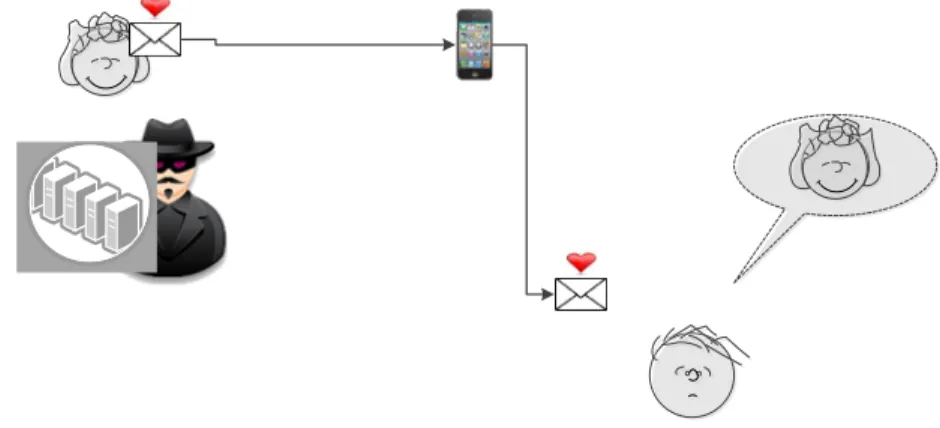
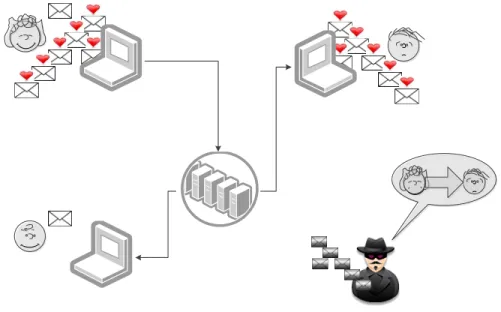
DEDICATION
I would like to dedicate this project to the National Security Agency. For better or worse, good or evil,
what follows would not have been created without you. Because sometimes upholding constitutional
ideas just isn’t enough; sometimes you have to uphold the actual Constitution. May god bless these
United States of America. May she once again become the land of the free and home of the brave.
Ladar LevisonCONTENTS Cover ... 1 Dedication ... 2 Contents ... 3 Figures ... 11 Overview ... 12 Part 1: Abstract ... 14 Part 2: Terminology ... 15
Part 3: System Architecture ... 19
Core operational directives of DIME ... 19
DIME Functional Components ... 21
Transport... 21
Message object ... 23
Classic email agents ... 23
Privacy processing agents... 24
Organization Privacy Agent (OPA) ... 24
User Privacy Agent (UPA) ... 24
Signet lookup services ... 24
Part 4: Management Record ... 26
Location ... 26 Text Records ... 27 Security ... 27 Refresh ... 27 Fields ... 28 Field Definitions ... 28
3
Primary ... 29 TLS ... 29 Syndicates ... 30 Deliver ... 30 Version ... 30 Expiry ... 30 Policy ... 31 Subdomain ... 32 Examples ... 32
Part 5: Signet Data Format ... 34
Endianness ... 34
Header Layout ... 34
Field Layout ... 35
Defined Field Layout ... 35
Undefined Field Layout ... 35
Field Ordering ... 36
Encoding ... 36
Signet Field Introduction ... 36
Reserved Field Types ... 37
Common Fields ... 38
Name Field... 38
Address Field ... 38
Province Field ... 39
Country Field ... 39
Postal Code Field ... 39
4
Phone Field ... 39
Language Field ... 39
Currency Field ... 40
Cryptocurrency Field ... 40
Motto Field ... 41
Message Size Limit Field ... 41
Website Field ... 41
Undefined Fields ... 41
Image Field ... 42
Organizational Signet Fields ... 42
Primary Organizational Key Field ... 43
Encryption Key Field ... 43
Secondary Organizational key Field ... 43
Contact Abuse Field ... 43
Contact Admin Field ... 44
Contact Support Field ... 44
Web Access Host Field ... 44
Web Access Location Field ... 44
Web Access Certificate Field ... 44
Mail Access Host Field ... 44
Mail Access Certificate Field ... 45
Onion Access Host Field... 45
Onion Access Certificate Field ... 45
Onion Delivery Host Field ... 45
Onion Delivery Certificate Field ... 46
5
User Signet Fields ... 46
Signing Key Field ... 47
Encryption Key Field ... 47
Alternate Encryption Key Field ... 47
Custody Field ... 48
User Signature Field ... 49
Organizational Signature Field ... 49
Supported Codecs Field ... 49
Alternate Address Field ... 49
Title Field ... 49
Employer Fields ... 50
Political Party Field ... 50
Gender Field ... 50
Alma Mater Field ... 50
Extensions Field ... 50
Supervisor Field ... 51
Resume Field ... 51
Endorsements Field ... 51
Signet Termination Fields ... 51
Organizational Signature Field ... 52
Signet Identifier Field ... 52
Organizational Signature Field ... 52
Splitting ... 52
Fingerprints ... 52
Validation ... 53
6
Part 6: Message Data Format (D/MIME) ... 55 Introduction ... 55 Historical Context ... 55 Leakage... 56 Transfer Encoding ... 56 Endianness ... 57 Data Structures ... 57 Tracing ... 57 Algorithms ... 58 Message Header ... 58 Chunks ... 58 Specialized Payloads ... 59 Encrypted Payloads ... 59 Keyslots ... 61 Message Structure ... 62 Types ... 64 Envelope ... 64 Tracing ... 64 Ephemeral ... 64 Alternate ... 65 Origin ... 65 Destination ... 65 Metadata ... 65 Common ... 65 Headers ... 65
7
Display ... 65 Display-Multipart ... 65 Display-Multipart-Alternative ... 65 Display-Content ... 65 Attachments ... 66 Attachments-Multipart ... 66 Attachments-Multipart-Alternative ... 66 Attachments-Content ... 66 Signatures ... 66 Author-Tree-Signature ... 66 Author-Signature ... 66 Organizational-Metadata-Bounce-Signature ... 66 Organizational-Display-Bounce-Signature ... 66 Organizational-Signature ... 66
Part 7: Dark Mail Transfer Protocol (DMTP) ... 68
Protocol Model ... 68
Historical Context ... 69
Line Based Protocol ... 70
Commands and Replies ... 70
Mail Transactions ... 71 Objects ... 71 Delivery ... 71 Caching ... 71 Connections ... 71 Certificates ... 72
8
Single Protocol Mode ... 74
Dual Protocol Hosts ... 74
Timeouts ... 75 Termination ... 77 Global Commands ... 77 HELO ... 78 EHLO ... 78 MODE ... 79 RSET ... 79 NOOP ... 80 HELP ... 80 QUIT ... 81
Message Transfer Commands ... 81
MAIL ... 81
RCPT ... 83
DATA... 84
Signet Transfer Commands ... 85
SGNT ... 85 HIST ... 87 VRFY ... 88 Response Codes ... 89 Protocol Extensions ... 89 SIZE ... 89 BINARY ... 90 UNICODE ... 90
9
PIPELINING ... 90
SURROGATE ... 90
Part 8: Dark Mail Access Protocol (DMAP) ... 91
Part 9: Threats and Mitigations ... 92
Threats ... 92 Venues ... 92 Vectors ... 94 Mitigation Strategies ... 96 Message Protection ... 96 Account Modes ... 97 Vector Mitigation ... 98
Network Packet Capture ... 98
Forward Secrecy ... 98
Signet and Key Management ... 99
Basic Management and Operation ... 99
Part 10: Known Vulnerabilities ... 104
Part 11: Credits ... 105 Author ... 105 Ladar Levison ... 105 Contributors ... 105 Dave Crocker ... 105 Unnamed Contributors ... 106 Attribution ... 106 Part 12: References ... 107
10
FIGURES
Figure 1 - Email Basic Handling Architecture ... 19
Figure 2 - DIME Functional Component ... 21
Figure 3 - DIME Transport ... 22
Figure 4 - DIME Message Object ... 23
Figure 5 - Signet Lookup Services ... 25
Figure 6 - Policy Dispositions ... 31
Figure 8 – Message Structure ... 63
Figure 7 - DIME Architecture ... 70
Figure 9 - Author Spoofing ... 93
Figure 10 - Service Provider Spoofing ... 93
Figure 11 - Message Content Disclosure ... 93
Figure 12 - Metadata Disclosure ... 94
Figure 13 - Basic Message Protection ... 97
OVERVIEW
This document is divided into nine sections that will introduce the reader to the Dark Internet Mail Environment (DIME) terminology, architecture, security, data formats, and protocol specifications.
PART 1 OVERVIEW: ABSTRACT
The abstract serves as a short introduction to this document.
PART 2 OVERVIEW: TERMINOLOGY
The Terminology section defines all DIME-specific terminology as well as other industry standard terms, acronyms and key words used throughout this document.
PART 3 OVERVIEW: SYSTEM ARCHITECTURE
The System Architecture section establishes the DIME architecture and can be used as guidelines for software developers to create DIME implementations that meet published standards.
PART 4 OVERVIEW: MANAGEMENT RECORD
The Management Record section describes the DNS record used to advertise DIME support, policies and functions as the cryptographic anchor for a DIME enabled domain.
PART 5 OVERVIEW: SIGNET DATA FORMAT
The Signet Data Format section describes the format of user and organizational signets data format.
PART 6 OVERVIEW: MESSAGE DATA FORMAT
The Message Data Format section describes the format of message data.
PART 7 OVERVIEW: DARK MAIL TRANSFER PROTOCOL (DMTP)
The DMTP section details the unauthenticated protocol specification for message transfers and signet lookups. It provides connection standards, command syntax, and certificate requirements.
PART 8 OVERVIEW: DARK MAIL ACCESS PROTOCOL (DMAP)
The DMAP section details the authenticated access protocol specification used within the DIME ecosystem. This protocol specification will not be released as part of the initial publication of this document.
PART 9 OVERVIEW: THREATS AND MITIGATIONS
The Threats and Mitigations section details threats, mitigation strategies, specific vector mitigation, and provides a discussion of security considerations not covered elsewhere.
PART 10 OVERVIEW: KNOWN VULNERABILITIES
The Known Vulnerabilities section will detail any known vulnerabilities as they are discovered.
PART 11 OVERVIEW: CREDITS
The Credits section provides attributions to the people that helped immensely with this document.
PART 12 OVERVIEW: REFERENCES
The References section list the references used in the creation of this document.
PART 1: ABSTRACT
This document provides the reader a detailed overview of the Dark Internet Mail Environment (DIME) and the elements required for successfully implementing DIME including the protocols and message format specification. As revealed in the Overview, this document includes detailed information covering the following artifacts: Terminology, System Architecture, the Management Record, the Signet Data Format, the Message Data Format, Dark Mail Transfer Protocol, Dark Mail Access Protocol, and a discussion of Threats and Mitigations.
This document provides an analysis of security attack vectors and a discussion covering techniques to mitigate those vectors. A secure system is only as strong as its weakest link and the authors do not pretend to have eliminated the human element. The security of DIME is dependent on the strength of the user’s password and the strength of an endpoint’s defenses. To the degree possible, DIME strives to create a secure system that guarantees the secure delivery of email while minimize leakage of information along the delivery path.
This document should serve as an implementation guide, and its intended audience is the system builder (software developers, integrators). It should be used as a foundation for implementing DIME. This document attempts the
presentation of DIME in such a way that a development and implementation team should be able to design a system that confirms to this document’s strict user-centric security requirements.
PART 2: TERMINOLOGY
The key words “MUST”, “MUST NOT”, “REQUIRED”, “SHALL”, “SHALL NOT”, “SHOULD”, “SHOULD NOT”, “RECOMMENDED”, “MAY”, AND “OPTIONAL” as used in the context of this document are to be interpreted as described below. [KEYWORD]
Key Words Definition
MUST This word, or the terms "REQUIRED” or "SHALL", asserts that the definition is an absolute requirement of the specification.
MUST NOT This phrase, or the phrase "SHALL NOT", asserts that the definition is an absolute prohibition of the specification.
SHOULD This word, or the term "RECOMMENDED", asserts that there may exist valid reasons in particular circumstances to ignore a particular item, but the full implications must be understood and carefully weighed before choosing a different course.
SHOULD NOT This phrase, or the phrase "NOT RECOMMENDED", asserts that there may exist valid reasons in particular circumstances when the particular behavior is acceptable or even useful, but the full implications should be understood and the case carefully weighed before implementing any behavior
described with this label.
MAY This word, or the term "OPTIONAL", asserts that an item is truly optional. One vendor may choose to include the item because a particular
marketplace requires it or because the vendor feels that it enhances the product while another vendor may omit the same item. An
implementation which does not include a particular option MUST be prepared to interoperate with another implementation which does include the option, though perhaps with reduced functionality. In the same vein, an implementation which does include a particular option MUST be prepared to interoperate with another implementation which does not include the option (except, of course, for the feature the option provides). EXPERIMENTAL This word describes functionality that is in the process of development;
functionality marked as experimental in this document and may broken by future specifications
The terminologies used throughout this document are defined in the following section for the reader’s benefit.
Terminology Definition
Account Modes
Trustful In this mode, the server handles all privacy issues on behalf of the user requiring a user to trust the server
Cautious In this mode, the server is used for synchronizing encrypted copies of keys and messages; this mode is designed to provide a user experience similar to that of email today while
minimizing the amount of trust placed in the server
Paranoid This mode requires the minimum amount of trust in a server specifically, the server will never have access to a user’s private keys (encrypted or unencrypted)
Actors Author, Origin Server, Destination Server or Recipient AN Alternate Name or Alt Name
APT An Advanced Persistent Threat is a continuous threat with unlimited resources capable of carrying out extremely sophisticated attacks
ASCII American Standard Code for Information Interchange
Attacker Any unauthorized party attempting to gain access to message data (content, metadata, etc.)
Author The cryptographic identity associated with the creator of a message
CA Certificate Authority
CN Common Name
DER Distinguished Encoding Rules
Destination Represents the recipient’s service provider; the host associated with a DIME-enabled recipient domain
DIME Dark Internet Mail Environment DMAP Dark Mail Access Protocol
D/MIME Dark/Multipurpose Internet Mail Extension DMTP Dark Mail Transfer Protocol
DNS Domain Name System
End-to-End Encryption Represents two end-points that could either be a server or a specific user device
Fingerprint
Core Fingerprint The cryptographic portion of a user signet; SHA-512 hash Ephemeral Fingerprint The current signet (a combination of the author and recipient
user's Full Fingerprint); SHA-512 hash
Full Fingerprint The cryptographic and attribute portion of an organization or user signet; SHA-512 hash
Root Fingerprint The core fingerprint for the first user signet in a chain of custody; SHA-512 hash
Host DNS name and host IP address which could resolve to one or more servers routable over TCP/IP
IP Internet Protocol
Key Ring The private keys associate with a user’s current and former signets
KS Key Store; the authoritative DMTP server providing user and organizational signets
Management Records DNS record advertising DIME support for the domain, provides policies and serves as the cryptographic anchor for the domain
16
MDA Mail Delivery Agent (sometimes referenced as Message Delivery Agent)
MitM Man in the Middle
MS Message Store
MSA Message Submission Agent
MTA Mail Transfer Agent (sometimes referenced as Message Transfer Agent)
MUA Mail User Agent (a fancy way to describe an email client) OCSP Online Certificate Status Protocol; used for obtaining the
revocation status of X.509 certificates OPA Organization Privacy Agent
Organization The service provider or corporation associated with a domain name
Organizational Domain A domain name which excludes any subdomain; a domain plus a TLD extension
Origin Represents the user’s service provider; the host associated with a DIME-enabled user domain
PA Privacy Agent (see OPA and UPA)
PFS Perfect Forward Secrecy ensures that any one session key cannot be compromised if any long-term key is compromised in the future
POK Primary Organization Key: private key capable of signing organizational signets, user signets, and outbound messages Recipient The cryptographic identity associated with the recipient of a
message
RR Resource Records
SR Signet Resolver; resolves domain names to a signet Signature Signatures are created using Ed25519 which is an
implementation of EdDSA using the Twisted Edwards curve: x2 + y2 = 1 (121665/121666)x2y2
This curve is birationally equivalent to Curve25519. Signets
Core Signet The Core Signet represents the cryptographic information allowing the user to perform encryption and decryption; it is signed by an organizational signet
Full Signet The Full Signet represents the Core Signet and also includes biographical and geographical user information; it is signed by a second organizational signet
Organizational signet This signet is used by the organization to sign user signets, decrypt inbound message, decrypt ‘recipient’ chunk on received messages, and decrypt ‘author’ chunk for outbound messages before signing or ‘author’ chunk for bounced messages
User Signet This signet is used to decrypt components of incoming
messages, sign-outbound and decrypt inbound messages, and sign new public keys before transmitting to organization server for publication
Signet Resolver Translates a domain name or email address into a organization or user signet similar in the way DNS translates hostnames into an IP addresses
Signet Ring The collection of user and organizational signets retrieved and authenticated by a Signet Resolver and then stored locally SMTP Simple Mail Transfer Protocol
SNI Service Name Identifier
SOK Secondary Organization Key: private key capable of signing user signets and outbound messages
TCP Transmission Control Protocol TLS Transport Layer Security
TTL Time to Live
UPA User Privacy Agent
User A person or collection of people represented by a single email address; and is used throughout this document in a way that is distinct from how it commonly used in reference to access control systems
PART 3: SYSTEM ARCHITECTURE
Internet electronic mail (email) often transits through a series of independent services. Email privacy is made challenging by the need to disclose handling information to stations along this path. In addition to the usual protection of content, a design goal for secure email must be to limit what meta-information is disclosed so that a handling agent only has access to the information it needs to see. The Dark Internet Mail Environment (DIME)1 achieves this with a core model having multiple layers of key management and multiple layers of message encryption. The system architecture modularizes functionality and that modularity permits a variety of implementation and deployment strategies, and should even permit transit over alternative infrastructure message transfer services.
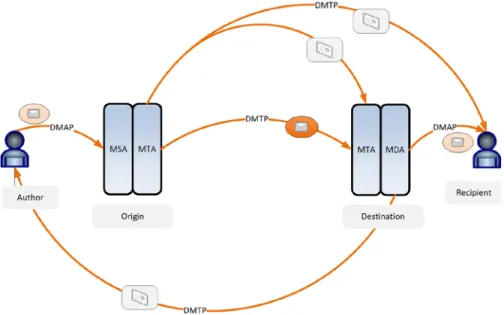
The essential challenge in email privacy is protection against compromised handling agents. Simple wiretapping of transit channels is reasonably well protected against by Transport Layer Security (TLS) [TLS]. However, TLS operates over only one Transmission Control Protocol (TCP) hop and email often travels through a significant number of these hops. Every transfer agent, including the immediate submission and delivery agents associated with the author and recipient(s), may become compromised. When a handling agent is compromised, the attacker could use the breach to gain access to keys, metadata, message content or all three. Hence, mechanisms to protect each are needed. DIME builds upon email’s classic distributed architecture to address these concerns: [IMA]
Figure 1 - Email Basic Handling Architecture
CORE OPERATIONAL DIRECTIVES OF DIME
The core operational directives of DIME are meant to simplify the adoption of a secure email system, minimize exposed data to only the data required for the system to function and only to the actors that have absolute need, and mitigate the breach possibility by unauthorized users. The directives are:
1. Automate key management, which includes: creation, rotation, discovery and validation 2. Transparently encrypt and sign messages to ensure content confidentiality
3. Ensure the system is resistant to manipulation by Advanced Persistent Threats (APTs)
4. Link security to the complexity of a user’s password, and the strength of an endpoint’s defenses 5. Minimize the exposure of metadata
6. Give control back to the user
At a high level, these core operational directives are achieved through the following elements:
• A handling agent only sees information about its immediate neighbors – the agent from which the message came and the agent to which it next goes. This specifically means that while the message transits the open Internet, the only visible organizational information is about the source (origin, MSA) host and destination (receiver, MDA) host. Author and recipient mailbox addresses are encrypted and then embedded within the message object. The origin host only sees the author mailbox address and the destination host and the destination host only sees the origin host and the recipient mailbox address. The origin host does not see the recipient mailbox address and the destination host does not see the author mailbox address.
• Only the author and recipient can decrypt an entire message. The origin host and destination host only have access to their portion of the encrypted envelope and to the overall message structure.
• Messages are tree structured and content encryption is per leaf with independent keys for each leaf, permitting access to individual parts of the message without having to process other parts. This is especially helpful for clients with limited resources and/or bandwidth when accessing messages held in a message store. It also permits other handling actions, such as validation of message signatures, without having to download the entire message.
• Validation of keys is accomplished without the use of a formal CA construct, and no single source of keying information is automatically trusted. The basic validation model is to obtain the key from a credible primary source and then confirm it with another pre-authenticated source. Two pre-authenticated sources are a management record signed using DNSSEC or a TLS certificate signed by a recognized Certificate Authority (CA) because each can be cryptographically traced by a Signet Resolver (SR) back to a trusted key that shipped with the SR.
• Public conveyance can be over a variety of transport services. This greatly lowers the barriers to DIME adoption.
This document provides a description of DIME’s abstract network service architecture. An abstract network service architecture is distinct from any particular software design that might implement it, or specific scenarios that might
derive from it. In particular, implemented software modules might combine or separate abstract network modules. For example, the user agent and the storage service might be implemented together. Alternatively, the user agent might be split between a simple user interaction module and a remote user ‘semantics’ module. (This is, in fact, the usual method of providing webmail user services; the variant of webmail that has the server download code to the user’s browser dynamically is actually a small operational distinction that does not affect the model.)
DIME FUNCTIONAL COMPONENTS
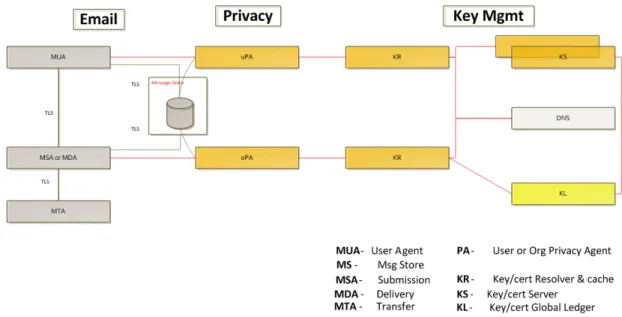
DIME’s addition to a classic email architecture entail a few, security-related modules, replicated at the author’s and recipient’s sites. The basic modules are:
The basic architecture has four categories of components: Classic email agents
Privacy processing agents Key stores and signet resolvers Encrypted message object
Figure 2 - DIME Functional Component
TRANSPORT
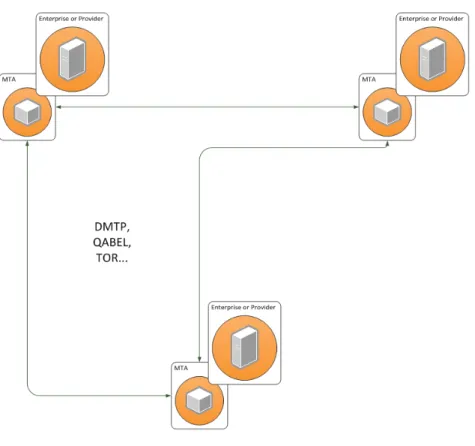
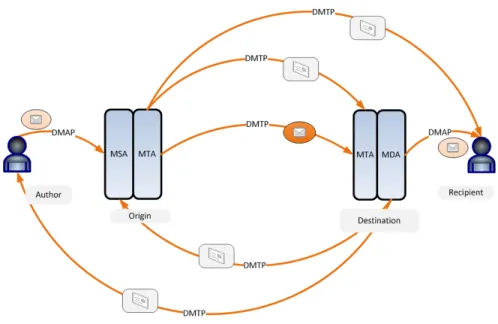
DIME can be adapted to a variety of message transport or transfer services, with the choice of channel creating trade-offs between wiretapping and traffic analysis protection, versus scaling and interoperability with existing services. Using
Simple Mail Transfer Protocol (SMTP) ensures maximum reach but also has maximum exposure. Dark Mail Transfer Protocol (DMTP) is designed to provide similar reach (if adopted) with minimum exposure.
Figure 3 - DIME Transport
MESSAGE OBJECT
In terms of handling and protection, each copy of a message is between the author and one recipient.
The basic message protection model encrypts the entire message, as well as each component, called a chunk, to a distinct, ephemeral symmetric key; this includes encrypting each part of the message content (and attachments), with different keys, to permit separable handling and protection. Access to keys is limited to essential actors: author, origin (submission server), destination (delivery server), and recipient. For example, the origin needs to see information about the destination, but not about the recipient. Messages are decrypted only when the information is needed. A chunk has one or more encrypted key slots. For each actor permitted to decrypt a chunk, there is a separate slot, with its own copy of the symmetric key; the key is encrypted to the actor’s signet. A chunk that can be processed by three actors will have three copies of the symmetric key associated with that chunk.
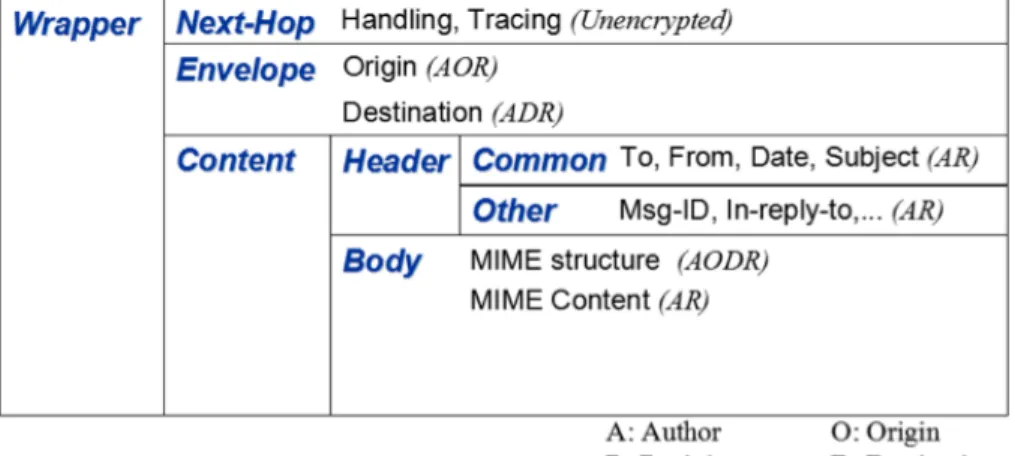
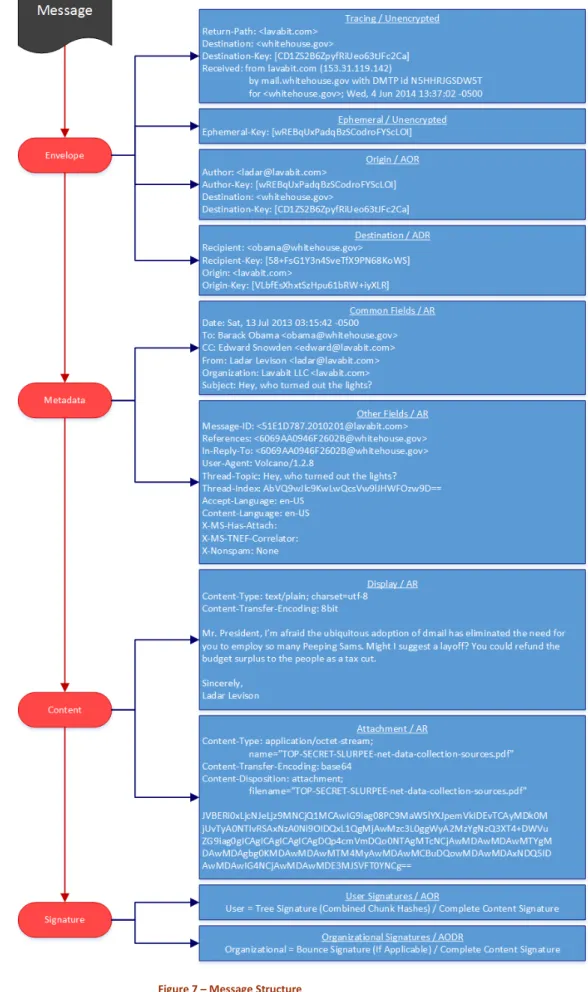
The representation of a message is as a tree-structured object:
Figure 4 - DIME Message Object
The basic structure is:
Wrapper surrounding the entire message
Next-Hop transit handling information, in cleartext, for the currently-active transport Envelope, with Origin and Destination information, separately encrypted
Classic message content, including a header and body (possibly with attachments) [IMF]
The envelope has further sub-structure, with each portion having independent encryption, in order to permit selectively hiding information. It contains metadata such as the envelope information traditionally used by SMTP, [SMTP] as well as privacy-related references.
CLASSIC EMAIL AGENTS
The traditional email user and handling agent functional components are present in DIME. These are: MUA - Mail User Agent
MSA - Message Submission Agent
23
MDA - Mail Delivery Agent MTA - Mail Transfer Agent MS - Message Store
Messages on the Message Store (MS) have the content leaf nodes encrypted, with the structure in the clear. This permits selectively accessing leaves, such as by resource-limited devices, over limited channels.
PRIVACY PROCESSING AGENTS
DIME message processing semantics are embodied in two additional network modules: Organization Privacy Agent and User Privacy Agent.
ORGANIZATION PRIVACY AGENT (OPA)
The Organization Privacy Agent interfaces between a user’s email agent and the rest of the Internet. It facilitates user key management and it creates a domain-name based package around the personal addressing and content of messages. That is, it creates transit package that hides all information about the message, except what is needed for immediate handling. This is accomplished through two functions:
Certification: The authenticity of a user’s signet is asserted by a cryptographic signature generated by the Organization.
Encryption: The Organization wraps and unwraps the full user email address, so that only the associated domain name is visible in the unencrypted envelope while in transit. The message is transmitted over a channel encrypted by TLS so that none of the message is visible during transit. The message object encryption is distinct from the channel encryption used for transmitting messages. TLS is responsible for providing perfect forward secrecy against eavesdroppers recording network communications.
USER PRIVACY AGENT (UPA)
The User Privacy Agent is the user’s email agent. It facilitates traditional drafting of email, alerts user’s to potential signet issues, and facilitates the automatic encryption process. This is accomplished by:
Encryption: The Recipient address is encoded for transit, to be unwrapped by the Destination host. The address is not visible to the author’s origin host. Similarly the author’s address is encoded so that it is visible to the recipient, but not to the destination. The terminal leaf nodes of message content are encrypted, so that only the author and recipient can decode it.
SIGNET LOOKUP SERVICES
Signet lookup services are provided by a purpose-built Key Service (KS), modeled after the Domain Name System (DNS) architecture [DNS]. A Privacy Agent (PA) makes the request to a local Signet Resolver (SR) that in turn queries the
appropriate remote authoritative KS2. Lookups also use tailored Resource Records (RR) in DNS to locate KS and validate the retrieved signet.
Figure 5 - Signet Lookup Services
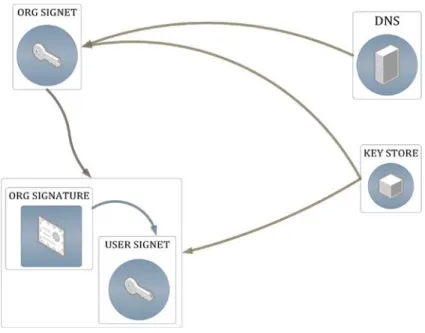
DIME avoids using a classic Certificate Authority (CA) mechanism for validating the signet’s association with a name or address. It does this with a simpler, two-level mechanism:
An organization with a domain name certifies individual users. The organization’s signet is available through (at least) two mechanisms (the management record in DNS and an authenticated KS). The combination serves as relatively independent confirmation.
A user signet supplied by an organization pairs key information with a user address. It includes a variety of other user attributes. Unlike a classic CA-based certificate, a DIME signet is not automatically trusted. Rather the evaluator of it treats it as input. For example, the evaluator seeks at least one confirmation of the address/signet association from another source.
1
Perhaps sending a message through this service could be called “dropping a dime”?
2
The KS is used both for local and remote key access, using different servers.
25
PART 4: MANAGEMENT RECORD
Version 1
A Dark Internet Mail Environment (DIME) management record is published in the Domain Name System (DNS) system and serves as the cornerstone for a DIME enabled organizational domain. The management record advertises policies and hostname information and provides the cryptographic trust anchor for all DIME related functionality. The existence of a management record determines whether messages addressed to a particular organizational domain be sent using the DIME protocols, or as “naked” messages using the Simple Mail Transfer Protocol (SMTP). Organizational domains lacking a valid management record must be considered “legacy” and Mail Transfer Agents (MTAs) should apply any applicable policies regarding the delivery of naked messages.
The only required field, and the primary purpose for a management record, is distributing the Primary Organizational Key (POK). The POK is a public key used for organizational signing, and whose corresponding private key must be used to sign the organizational signet and, if applicable, may be used to generate the Transport Layer Security (TLS) certificate signatures used to validate DIME protocol connections. The POK may also be used, in addition to Secondary
Organizational Keys (SOK), for signing user signets and outbound messages.
LOCATION
Signet resolvers with support for the optional “DIME” q-type, should search for the management record using the DIME q-type first. If the q-type is unsupported, or the request fails, a resolver must also query the target domain using the “TXT” q-type using the prefix “_dime” along with the target domain. A fully qualified domain name for management records when sending a query for the TXT resource record would be _dime.example.tld if the target mailbox was using the organizational domain example.tld.
Signet resolvers attempting to locate the applicable management record for mailbox addresses with a subdomain, such as [email protected], should use an increasingly specific search pattern. Starting with the base
organizational domain, resolvers should continue by working towards the specific subdomain supplied until it encounters a management record with the “subdomain” policy field equal to the value “strict,” or the resolver reaches the specific fully qualified subdomain under consideration. For the domain sub.domain.example.tld, a resolver should begin by requesting the DIME resource record for example.tld or the TXT resource record for _dime.example.tld. Unless a subdomain policy of strict is encountered, a resolver must continue by searching for the DIME record using
domain.example.tld or a TXT record using _dime.domain.example.tld. As the final step in our example, a resolver should search for a DIME resource record using the fully qualified domain or a TXT resource record using
_dime.sub.domain.example.tld.
If the final search does not return a valid management record, and the nearest ancestor domain returned a management record with a subdomain policy of “explicit,” then a signet resolver must fail, and the target domain is considered legacy. Otherwise, if the nearest ancestor management record supplied a subdomain policy of “loose” then the values it
provides should be applied to the target domain. The increasingly specific query process ensures management records associated with ancestor domains may assert control over subdomains.
TEXT RECORDS
Operational considerations must be made if the management record is published using the TXT q-type. The DNS rules regarding TXT records stipulate that individual strings have a maximum length of 255 characters. As such, management records that exceed 255 must be split across strings. For optimal compatibility, management records must not split individual fields across strings.
While most DNS resolvers allow TXT responses up to 4096 octets over UDP, a handful of non-conformant, but widely deployed DNS implementations truncate UDP responses to 512 octets (primarily Cisco PIX/IOS implementations). Organizations seeking to interoperate with the widest variety of resolvers should ensure their management records fit within 512 octets.
The authoritative DNS servers for management records should support DNS queries using TCP so that resolvers may choose to perform management records queries over TCP.3
SECURITY
The DIME security model depends upon the reliability and security of the global DNS system. For this reason we strongly recommended organizations use DNSSEC to prevent the manipulation of DNS responses for their domain. For
management records secured using DNSSEC, resolvers must validate the DNSSEC signatures.
Verifying the signature for an organizational signet using the management record POK value is the preferred method for validating the relationship between a signet and an organizational domain. If a management record is protected using DNSSEC, no other validation paths are required. A management record protected by DNSSEC is considered a pre-authenticated verification source. Consult the signet specification for additional information regarding validation.
DNSSEC support ensures an attacker in a privileged network position will be unable to execute downgrade attacks. If the response for a management record is replaced by a XXXXXXNOTFOUNDXXXX message, a victim might send a naked message over SMTP that otherwise could have been sent surely using DIME. An attacker could also manipulate the POK and DX field values in the response to carry out a Man in the Middle (MitM) attack on the target domain.
REFRESH
If a resolver currently has a cached management record, it must never reduce the amount of time until a record is purged from cache because the “expiry” value retrieved during a refresh has been replaced by a smaller value. This rule should only be applied to the expiry value; all other fields may be overwritten by an updated management record even if resolver ignores the expiry value. This ensures an attacker with control over the DNS servers for a domain is unable to reduce the amount they must wait for cached management records to be expunged and peers to downgrade into legacy mode.
FIELDS
Management records provide information using fields, with each field being comprised of a name/value pair. The table below is provided to indicate the properties associated with each field. The table outlines which fields are required, recommended, or optional, what the type of value each field provides, and whether a default value is applied when the field is absent.
Management records should use the short version of a field name when specifying values, but may use long version. Resolvers must be capable of parsing and recognizing records with both long and short field names. Management records must use lowercase letters for field names and enumerated values, although parsers should match against these strings case insensitively. If a management record does contain uppercase characters in the field names or enumerated values, parsers should accept the input and may issue an optional warning to the user about the incorrect syntax. A field is properly defined as a name followed immediately by an equal sign (ASCII value 0x3d) and the desired value. A field ends when the first space (ASCII value 0x20) or semicolon character (ASCII value 0x3b) is reached. A field also ends if the end of the management record is reached; the final field is the only one which does not require a terminating character. Tab characters (ASCII 0x??) must be treated as spaces, and extraneous whitespace, if discovered, must be ignored.
A single field definition must not span multiple TXT record strings. This means every string must end with either a space or semicolon, with the exception of the last one. This requirement ensures resolvers that concatenate TXT strings together are the same that insert whitespace between strings.
Fields may defined in any order. Fields which allow multiple values must specify every value as a fully formed field, using the complete name/value sequence defined above. If an additional value is encountered for a field which does not support multiple values, a resolver must use the first valid field value encountered. Resolvers that encounter additional instances of unique fields may optionally warn users, or silently ignore it.
FIELD DEFINITIONS
Key Short Disposition Multiple Type Default (Where Applicable)
primary pok Required Yes String tls tls Recommended Yes String
version ver Optional No Numeric 1 expiry exp Optional No Numeric 30 syndicates syn Optional Yes String
deliver dx Optional Yes String
policy pol Optional No Enumerated mixed subdomain sub Optional No Enumerated mixed
PRIMARY
Provides the POK, or public key used to validate signatures supplied by the organizational signet. Signet resolvers must ensure the organizational signet it retrieves provides a POK that matches one of the POK definitions in the management record. A resolver must also ensure the two signatures supplied with an organizational signet are validated using the matching POK value. If an organization rotates their organizational signet, they should include the POK for both signets in the management record until the original signet has expired. A POK may also be used to sign user signets and outgoing messages. When attempting to validate organizational signatures created with a valid POK, consumers may choose to rely on the management record for validation instead of the full organizational signet.
The POK value must be exactly 43 characters in length, and must be a valid Base64 string without padding characters, otherwise a management record must be rejected and the user must be notified of the fatal error. The POK value once decoded must be 32 bytes and contain a valid Ed25519 public key. Resolvers must reject management records where the value is incorrectly encoded or does not correspond to a valid Ed25519 public key. Note that the Base64 specification traditionally calls for a single padding “=” character when 32 octets have been encoded, however management records must omit this padding character when publishing a management record.
The Ed25519 reference implementation represents public keys using compressed points in little endian form. This deviates from other standards which require elliptical curve public keys be stored uncompressed, using big endian multiprecision integers (MPI). See RFC 4880 for details regarding the MPI format, and RFC 6637 for details regarding point encoding formats.
TLS
The certificates for DMTP hosts may be validated using the signatures provided in a TLS field. The value for a TLS field represents a 64 byte Ed25519 signature generated from a certificate in Distinguished Encoding Rules (DER), or native binary, format. The 64-byte signature must be encoded using Base64 without padding characters. Resolvers must reject management records with TLS values that are not 86 bytes in length, or if the value does not contain a valid Base64 string without the two trailing pad characters removed.
If one, or more, values are provided in the DIME management record, then the TLS certificate received while connecting to a DMTP host must match one of the provided values. This requires organizations using multiple certificates to secure DMTP connections provide a signature for all, or none, of the certificates being used. If a resolver finds a TLS field in the management and encounters a DMTP host using a certificate that does not match any of the provided signatures, it must cleanly shutdown the TLS connection and disconnect, treating the connection attempt as a failure. If the threshold for connection failures has not been reached, and additional hostnames are available the consumer should continue onto the next host until it discovers one with a certificate matching one of the TLS field signatures.
For management records protected by DNSSEC a matching TLS field signature must be available, otherwise consumers must reject for self-signed certificates, or certificates signed by unrecognized Certificate Authorities (CA). If the
management record is not protected using DNSSEC, but still provides a TLS field signature, a consumer should ensure the certificate matches one of the available signatures first, followed by the validation rules required by TLS v1.2 [RFC 5246].4
SYNDICATES
The syndicate field provides alternate domains where signet information may be retrieved for validation purposes. The value must be a valid CNAME and not an IP address. If an IP address is provided for a value, a consumer must reject the management record and notify the user. If the value is a valid domain name, but does not resolve, a consumer should ignore the field and proceed. Implementations may optionally warn users when deliver field values do not resolve properly.
DELIVER
Provides the fully qualified domain name for authoritative signet lookups, and for delivering D/MIME messages. The value must be a valid CNAME and not an IP address. If an IP address is provided, a consumer must reject the entire management record and notify the user. If the value is a valid domain name but does not resolve, a consumer should ignore the field and proceed. Implementations may optionally warn users when deliver field values do not resolve properly.
If multiple values are provided and one of values does not properly resolve to an IP address, or the consumer is unable to connect over port 26 it must continue to the next deliver field value. If three of the deliver field values fail, or if a
management record does not specify the deliver field, consumers must rely upon the MX record for the target domain. See the DMTP specification for connection details.
VERSION
The DIME management record syntax version, which controls how a record should be parsed and validated. As of this writing, only a single value for this field, “1,” is valid and is the implied version number if the field isn’t specified. Any value other than “1” must result in a resolver error, unless the version provided has been implemented by the resolver.
EXPIRY
The number of days a management record must remain cached, and a domain should be considered DIME enabled after removing the management record. If a resolver is unable to refresh a management record after the number of days provided by this field value, then the cached record should be expunged and the domain should revert to legacy mode. The TTL value provided with the DNS query should determine how often a resolver attempts to refresh a cached management record.
POLICY
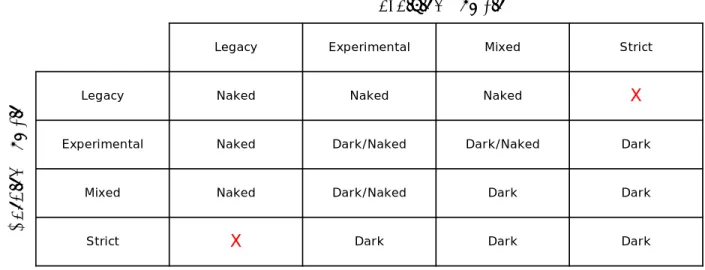
Provides the policy applied when transferring messages between origin and destination domains. Message acceptance and delivery must conform to the advertised policy when one of the organizations involved is DIME-enabled. D/MIME messages must be rejected when the delivery does not conform to the policy, or if the organization does not have a valid management record. In the absence of an explicitly defined policy field, resolvers must apply a default policy of mixed. The table below illustrates the appropriate outcome for a message between two domains with each of the possible policy dispositions.
S
end
ing
D
om
ai
n
Receiving Domain
Legacy Experimental Mixed StrictLegacy Experimental Mixed Strict
Naked Naked Naked
X
Naked Dark/Naked Dark
Naked Dark/Naked Dark Dark
Dark Dark Dark
X
Dark/Naked
Figure 6 - Policy Dispositions
Experimental. This organizational domain will be sending both D/MIME and naked messages. Destinations with policies of experimental or mixed should accept both, while those with a policy of strict must reject naked messages. If a domain does not have a management record available then this organization supports the delivery of naked messages.
Organization with a policy of experimental should publish valid signets for all DIME enabled addresses, or the appropriate error code for valid addresses which are not yet DIME enabled. Senders with a policy of mixed or experimental may choose to deliver naked messages if they encounter an experimental policy for the destination and the recipient addresses does not have a valid signet available.
Mixed. This domain will only send D/MIME messages to domains with a policy of mixed or strict. For domains without a management record, this domain will deliver a naked message. For experimental domains, the message will be sent using D/MIME if a valid signet is available, and as a naked message for addresses which result in the appropriate error code to indicate the recipient is not DIME enabled. Only D/MIME messages must be accepted from other domains with a policy of strict or mixed, while domains with an experimental policy should be allowed to deliver D/MIME and naked messages. Naked messages will be accepted from and delivered to domains without a valid DIME management record. Strict. This domain must only accept D/MIME messages and must send D/MIME messages. If a strict domain encounters a recipient domain without a management record or if signet resolution fails, the send attempt will fail.
SUBDOMAIN
Determines whether a resolver should apply the management record to subdomain addresses. In the absence of an explicitly defined policy field, resolvers must apply a default policy of mixed.
Explicit. Subdomains must provide a management record and organizational signet. The absence of management record results in the subdomain being classified as legacy.
Mixed. Subdomains may supply a management record and organizational signet, which are used instead of the parent domain. If the management record is missing, the values and organizational signet of the parent should be applied to the subdomain address.
Strict. Subdomains must always use the management record and organizational signet of the parent domain which supplies this value.
EXAMPLES
At a minimum, all legal DIME management records must provide a POK. All other values are optional, with default values used in their absence. A simple DIME management record would look like:
DIME management records should specify values for the recommend field TLS, so that resolvers may validate DMTP connections using the TLS provided upon connection. A simple DIME management record which provides a signed TLS value might look like:
Finally, a DIME management record with all of the fields specified might look like:
3
Should we add a field like “tcp=true” which can indicate to resolvers that they should perform the query using TCP?
4
DNS-Based Authentication of Named Entities (DANE) [RFC 6698] provides similar functionality, but lacks widespread
deployment. The primary functional difference is DANE records only support the publication of complete
certificates, a public key or a hash value. DIME uses the POK and cryptographic signatures to validate certificates.
sig=N TE1N TU5N zg1M j ZBNDE zMDR ENkI 1QTQ 0 NEQ2Q TUxM zAtls=Y jRjY WZlM TBlM j E2NzZ jNDY 0MjM 1NGN i YTEwM jI0M 2YwM TM4Y j c5OGF mNjg 5ZWE 1MTU 3 NmE3N 2I 5MDEz Nzkw YQ s ig=b W wyYzI zNTB nbTF ibHV r OHVra zFkb 2F2M zRtb D JkY2E
ver=1 pok =Mmp rdmR j aWtjO TYyZ DllM GhrO G NhMTR sZmo yamt 2ZGM pol=m ixed syn=m irro r.ex ampl e .tld
tls=Q UYxR jA0M kZDM j Q0OUE zOUJ ENEE 5QkU 2 MTdEN DM3O UVEQ TI1Q j Q1REY wODE wODE 2ODl G MUE2Q 0U 1MjQ3 M0Y2 Mw d x=dm t p.dom ain. tld ttl= 1 776 e xp=3 0 su b=st r ict
32
DANE also requires (by specification and not function) the deployment of DNSSEC, while DIME decided to classify
DNSSEC support as a strong recommendation.
33
PART 5: SIGNET DATA FORMAT
This specification details the format and semantics for the signet data format. The Dark Internet Mail Environment (DIME) uses the signet data format to transfer cryptographic information for use in encryption and signing operations. A signet carries with it signatures which must be evaluated by the consumer when determining whether to accept the validity of a signet for an organization or user identity. In addition to the required cryptographic information, a signet may be used to advertise information about the signet owner, or information used to facilitate other non-cryptographic functions commonly supported by DIME implementations.
The signet data format requires a small number of fields containing public keys and signature data. This specification defines additional fields used to optional DIME functionality. The signet data format also allows for an unlimited number of undefined fields. Undefined fields provide an arbitrary name and data value that may be recognized by DIME protocol extensions, or simply to carry arbitrary data for experimentation or use by non-DIME functionality.
ENDIANNESS
The signet data format is a binary schema, which relies on numeric values to convey information and facilitate parsing. The binary values defined by this specification will always use network byte order, which is defined as a big endian representation, requiring the most significant byte to be stored in the smallest address, and the least significant byte be stored in the largest address. Implementations running on little endian systems will need to convert the values to ensure proper processing. v
HEADER LAYOUT
All signets must start with a 5-octet header. The first two octets are a magic number that indicates the signet data format. Signets conforming to this specification must set the magic number appropriately from the following table:
Magic Number Label
1215 User Signet Signing Request
1776 Organizational Signet
1789 User Signet
1952 Organizational Private Keys
2013 User Private Keys
The remaining 3 octets are used to provide the length of the signet data in binary form, without including the 5 octets used by the header. Since the length parameter is 3 octets, signets have a maximum size 16,777,220 octets or 16,777,215 for the fields plus 5 octets for the header. Signet resolver and parser implementations conforming to this specification must be capable of handling signets up to their maximum possible size.
Signet resolver and parser implementations conforming to this specification must accept signets with magic numbers as detailed above and must the parser must generate an error if it encounters any unrecognized magic numbers. The only time a magic number will change is if an update is large enough to warrant.
While parsing signets conforming to signet data formats, a parser must ignore any fields with unrecognized type codes. The unrecognized field types should have a 2 octet value length parameter immediately after their single octet type parameter. This scheme will allow parsers to skip the unrecognized fields and continue processing the signet.
Backwards compatibility is guaranteed to use this scheme for all magic numbers defined within this specification. If the magic number is not equal to those defined in this document, parsers must reject the signet unless they implement a newer signet format specification version. The addition of the new magic number will not guarantee backwards compatibility.
FIELD LAYOUT
This specification provides details for a number of defined fields, whose name is provided by this specification and omitted from the signet layout. The signet data format allows for an unlimited number of undefined fields that include an arbitrary name and value.
DEFINED FIELD LAYOUT
A single octet is used to provide the field type. For fields defined by this specification, a variable layout is used which is specific to the defined field type. Following the type code is a single octet used field specific flags, and is only present for the fields that require it. Variable length value fields must always provide a length parameter that will be 1, 2 or 3 octets. The size of the length parameter is determined by the field type. For defined fields with fixed length values the length parameter is omitted, as the value must always be the length required by the field definition. For defined fields holding a variable length value, the minimum value size is 0, while the maximum value size is determined by the number of octets used by the length parameter. Implementations must be able to handle a length parameter value of 0, which is functionally equivalent to the field being omitted. Fixed length fields must always provide values matching the length associated with the field type.
UNDEFINED FIELD LAYOUT
The undefined field layout has been designed for flexibility, allowing implementations to create fields with variable length names and values. Undefined fields are indicated by the single octet type parameter, which will indicate undefined fields using the value 32. The type parameter is followed by the length of the name encoded in as a single octet parameter. The name value follows the length parameter and must be comprised of valid UTF-8 characters. Names must always be at least 1 character in length, and should always begin with a capital letter. Name values must be constructed without the use of whitespace characters, and may use up to 255 octets. The name parameter is followed by the value length parameter, which is provided using 2 octets. Implementations must accept undefined fields with a
[ M i n ] [ M a x ] [ O p t i o n a l ] [ T y p e ] [ 1 ] [ 1 ] [ ] [ L e n g t h ] [ 1 ] [ 3 ] [ X X X X X X X X ] [ V a l u e ] [ 0 ] [ ~ ] [ ]
value length of 0. The maximum length of an undefined field value is 65535 octets. Values may include binary data, with octets of any possible value, and signet parsing implementations must be capable of handling binary data in undefined field values without issue.
Implementations should be capable of handling invalid undefined fields where the length of the name is 0, or where the name value includes invalid UTF-8 sequences or whitespace characters. Implementations responsible for signet creation must remove these invalid undefined, and consumer implementations must never use the value of an undefined field with an invalid name for any purpose. Implementations may choose whether to provide users with a warning when invalid name values are encountered.
FIELD ORDERING
All fields within a signet must be sorted according to their single octet type parameter, and appear in ascending order. If a consumer encounters a signet that does not conform to this field order, or if a signet includes a unique field multiple times, it must be considered malformed and rejected.
Undefined fields may appear in any order, however the recommended ordering for undefined fields is to sort them alphabetically based on the name parameter. Because the alphabetical ordering is optional, a consumer must assume that undefined fields will be unsorted and act accordingly when searching for an undefined field with a desired name value. Implementations that encounter an undefined field with an identical name value multiple times should use first occurrence of the field by default. Any remaining fields with the desired name value should be ignored unless an extension is multiple values.
ENCODING
As of this publication, the default encoding scheme for user and organizational signets is Radix-64 also known as ASCII armor. [PGP]
SIGNET FIELD INTRODUCTION
The first column provides the number value used to identify fields of a particular type, followed by the English language name for the field. The status column is used to indicate which fields must be provided by a valid user and organizational signet, along with which fields should be defined, and those that are optional. The flags column indicates whether a single octet for providing flags follows the type octet. For fields listed as a fixed type, the length column provides the length for values. The fields listed as using variable type, the length column provides the length for values. Undefined fields are listed, but do not utilize the same layout as defined fields.
[ M i n ] [ M a x ] [ O p t i o n a l ] [ T y p e ] [ 1 ] [ 1 ] [ ] [ L e n g t h ] [ 1 ] [ 1 ] [ ] [ N a m e ] [ 0 ] [ 2 5 5 ] [ ] [ L e n g t h ] [ 2 ] [ 2 ] [ ] [ V a l u e ] [ 0 ] [ 6 5 5 3 6 ] [ ]
36
Field ranges for signets are defined in the following table:
Signet Field Range Description
1 – 15 Encryption Fields (1-3 Organization, 4 – 15 Reserved | 1-6 User, 7 – 15 Reserved) 16 – 92 Common Short Fields
93 – 159 User or Organization Specific Short Fields 160 – 199 Common Long Fields
200 – 250 Organization and User Specific Long Fields 251 Undefined Fields
252 Image Field
253 - 255 Signet Termination Fields
Implementations encountering signets with a magic number matching this specification must be capable of separating semantics from syntax. To ensure this, the layout for an unrecognized field is determined by the numeric type code, with the layout governed by the ranges below. Consumers must be capable of parsing the unrecognized fields syntactically, by advancing over, and semantically ignoring any fields it does not recognize or support.
The maximum size for a field value is determined by the number of octets allocated to hold the value length. The ranges below will dictate the number of octets used by a field to store the length of its value. The maximum size for a defined field is determined by which range it is associated with. Fields outside of the predefined ranges either have a fixed length, are cryptographic and specified elsewhere in this specification, or reserved. If a reserved field is encountered with a value, the signet must be reject. The predefined ranges associated with 1 and 2 octet defined fields capable of variable length values:
Signet Field Range Length Parameter Min Max
16 – 159 1 octet 0 255
160 – 250 2 octets 0 65,535 251 1 for name / 2 for value 0 255 / 65,535
252 3 octets 0 variable*
* The maximum size of an image field is determined the cumulative size of a signet’s other fields. The image field must never overflow the 3 octet signet length. Consumers must ensure the cumulative length of the fields does not overflow the overall length and reject any signet which does. Users must be notified of the error, and informed the overflowing signet could be malicious.
RESERVED FIELD TYPES
The signet field types for all organizational signets conforming to this specification, will be a big endian numeric value in the range 0x01 through 0x03 or 0x0F through 0xFF. The valid signet field types for user signets will be a big endian numeric value in the range 0x01 through 0x06 and 0x0F through 0xFF. Parsers encountering a signet with a value for any type code that falls outside of these ranges must reject the signet as invalid. Parsers adhering to this specification
must also be able to identify and process all of the fields described in this document. An implementation may ignore the value of any informational field, and must ignore the values for any unrecognized field types.
COMMON FIELDS
The two signet types (user and organizational signets) include fields that are common between them. The following tables list the defined signet fields that are common between the user and organizational signets.
Common fields already identified in this specification are detailed in the below table followed by a textual description after the table. These field descriptions will not be repeated in the signet-specific sections.
Any implementation must not vary the use of these common fields between the user and organizational signet formats.
Label Status Multiples Type Length
16 Name Optional No Variable 1
17 Address Optional No Variable 1
18 Province Optional No Variable 1
19 Country Optional No Variable 1
20 Postal-Code Optional No Variable 1
21 Phone Optional Yes Variable 1
22 Language Optional No Variable 1 23 Currency Optional No Variable 1 24 Cryptocurrency Optional No Variable 1
25 Motto Optional No Variable 1
26 Extensions Optional No Variable 1 27 Message-Size-Limit Optional No Variable 1 28 – 92 Unused 1-byte Fields -- -- -- 1
160 Website Optional No Variable 2
161 – 250 Unused 2-byte Fields -- -- -- 2 251 Undefined-Fields Optional Yes Variable 1 + 2 252 Image Recommended No Variable 3
NAME FIELD
Should provide UTF-8 string of characters containing an organization or user’s preferred name. When displaying the value of this field, the label “Name” should be used.
ADDRESS FIELD
Should provide UTF-8 string of characters corresponding to the organization, or user’s physical address. When displaying the value of this field, the label “Name” should be used.
PROVINCE FIELD
Should provide UTF-8 string of letters corresponding to an organization or user’s province, or the principal administrative division of the signet owner’s country. This is more commonly called the state, region, territory, district, or canton depending on the locale. The contents of this field should not be abbreviated. When displaying the value of this field, the label “Province” should be used, unless the client is sophisticated enough to consider the associated country and supply the appropriate colloquial term.
COUNTRY FIELD
Should provide UTF-8 string of letters corresponding to an organization or user’s country. The contents of this field should not be abbreviated. When displaying the value of this field, the label “Country” should be used.
POSTAL CODE FIELD
Should provide UTF-8 string of numbers or letters corresponding to an organization or user’s postal code. The contents of this field should not be abbreviated. When displaying the value of this field, the label “Postal-Code” should be used.
PHONE FIELD
Should provide an organization or user’s phone number. The value must begin with a string of numbers. A semicolon terminates the numeric portion of the field. If a non-numeric value is encountered before the semicolon then a parser must ignore the field entirely. Otherwise if any valid UTF-8 characters appear after the semicolon, they should be considered the label associated with the number. The label is optional, but if it is supplied, a label must not exceed 16 UTF-8 characters and must not include any whitespace characters. If the label exceeds 16 UTF-8 characters, contains a whitespace character, or supplies an invalid UTF-8 octet sequence (aka invalid Unicode codepoint), then the label must be discarded. A consumer may use the numeric portion of a phone number field even if the label is invalid. For fields with missing or invalid labels, the default string “Phone” should be used. A sample phone number field value is:
LANGUAGE FIELD
Should provide a string of characters containing an organization or user’s preferred language identifier. A semicolon terminates the string, and provides an optional separator. The string which follows the semicolon should be considered a secondary language identifier and used if the preceding value is unsupported. The sequence may repeat until either the signet owner’s list of preferred languages is exhausted or the length limit for the field value is reached. The final language may terminate with a semicolon, but its inclusion is optional. When displaying the value of this field, the label “Language” should be used.
4 1 0 8 5 4 6 3 3 4 ; O F F I C E
The value of this field is a language tag plus an optional subtag. The subtag is typically used to indicate a country or region. The language and subtag values will be separated by a dash. [LANGUAGE] The following value would indicate the language is English and the country is the United States of America:
The value may be used to select a signet owner’s preferred language. The value also provides guidance when
formatting dates, times, numbers and currency amounts. When a consumer encounters multiple language identifiers it should select the first fully supported value it encounters. If none of the identifiers are fully supported, a consumer should examine the list a second time, and discard the subtag when making comparisons, considering only the language identifier. The first supported language it encounters should be selected. If this field is missing, and a signet has supplied a value for the field “Country” then its value may be considered as an alternative.
For user signets where the Language and Country fields are missing, invalid or their values unsupported, a consumer may fall back to considering the associated organizational signet using the same logic described above. If all of the described logic fails, a consumer may consider whether the organizational domain includes a country specific Top-Level-Domain (TLD), and select based on its value. If all else fails, the default value “en-US” should be used.
Consumers should use the list of recognized languages and subtags maintained by the Internet Assigned Numbers Authority (IANA) when evaluating language identifiers. [IANA-LANG]
CURRENCY FIELD
A UTF-8 string of letters which should correspond to the foreign exchange symbol associated with an organization or user’s preferred form of national currency. A semicolon terminates the ‘currency’ string, and provides an optional separator. If a UTF-8 string follows the semicolon it should be another foreign exchange symbol. The sequence may repeat until either the signet owner’s list of preferred currencies is exhausted or the length limit for the field value is reached. The final currency symbol may terminate with a semicolon, but its inclusion is optional. When displaying the value of this field, the label “Currency” should be used.
CRYPTOCURRENCY FIELD
A UTF-8 string which should correspond to an organization or user’s or preferred cryptographic currency. The 3 character cryptocurrency type is separated from the address information by a colon. A semicolon terminates the cryptocurrency string, and provides an optional separator. If a UTF-8 string follows the semicolon it should be another cryptocurrency type separated from the address by a colon. The sequence may repeat until either the signet owner’s list of preferred cryptocurrencies is exhausted or the length limit for the field value is reached. The final cryptocurrency symbol may terminate with a semicolon, but its inclusion is optional. When displaying the value of this field, the label
“Cryptocurrency” should be used.
If an implementation supports the use of this field value then the following cryptocurrency symbols must be recognized:
e n - U S
Symbol Name Website BLK Blackcoin https://www.blackcoin.co/ BTC Bitcoin https://bitcoin.org/ DRK Darkcoin https://www.darkcoin.io/ LTC Litecoin https://litecoin.org/ PPC Peercoin http://www.peercoin.net/ STR Stellar https://www.stellar.org/ XRP Ripple https://ripple.com/currency/
In the event this field is empty, a consumer should assume the preferred cryptocurrency is Bitcoin. The value of this field should match the following syntax:
MOTTO FIELD
A UTF-8 string of numbers corresponding to a user or organization motto or vision statement. When displaying the value of this field, the label “Message-Size-Limit” should be used.
MESSAGE SIZE LIMIT FIELD
A string of numbers corresponding to the system wide size limit for incoming messages, when provided by an organizational signet, and the user specific size limit when provided with a user signet. The minimum legal value is 1 megabyte. When both signets provide legal values for this field, then the smaller of the two values takes precedence. If the value falls below this limit it must be ignored. When displaying the value of this field, the label “Message-Size-Limit” should be used.
WEBSITE FIELD
A UTF-8 string of letters or numbers corresponding to a signet owner’s website. The value for this field must be a valid Hypertext Transfer Protocol (HTTP) Universal Resource Locator (URL) or HTTP Secure (HTTPS) URL. If the field does not contain a valid HTTP or HTTPS value it must be ignored. The URL should use HTTPS, although this requirement remains optional. When displaying the value of this field, the label “Website” should be used.
UNDEFINED FIELDS
TBD
BTC: 1 9 g y 9 i f M J u H o R b V p X B g t f 6 N T A T 6 P i D b 8 S Q