77
CHAPTER-4
AN OVERVIEW OF THE SMALL SCALE ELECTRICAL
CONTRACTING INDUSTRY AND CURRENT
MATERIAL MANAGEMENT PRACTICES
Similar to other industries, a successful business in manufacturing is a team effort. The different members of the team have to coordinate design, estimating, material purchasing and installation in order to maximize productivity, earn a profit at the end of the project, and complete the project within time and budget. It is difficult to achieve efficient installation of the components and the maximum production of the crew at every instant. The industry has to plan and schedule the purchasing, expediting, receiving, storage, and installation of the materials by coordinating the different parties involved (i.e. estimating, job managers, and field personnel). In addition, in order for the company to be successful, the company should consist of individuals trained to perform the tasks assigned to them in an effective way (Johnson, 1986).
4.1 ELECTRICAL CONTRACTORS INDUSTRY- BACKGROUND Electrical units are in the business of providing services that will allow customers to use electricity. In this era, almost everyone uses electricity; therefore anyone can be a customer for an electrical contractor. The environment of the electrical industry presents a situation different from
78
other business. Many firms specialize in an area of work in the electrical industry and can perform work only in the area of their specialization. The electrical contracting market has expanded in recent years compared the other areas of construction. Employees in the electrical contracting industry account for around 13% of the total employees in the construction industry (Electrical Contractor, 2008). The nature of the electrical contracting & fabrication business requires that a large volume of sales needs to be achieved in order to support the company. Many electrical companies are not necessarily large companies, therefore the company has to provide services efficiently and at the lowest cost possible in order for the company to remain in the business. Contractors should keep a good reputation, trust, and they should serve all customers efficiently (Johnson, 1986). In the last 14 years the electrical contracting industry has tripled their volume of sales (Electrical Contractor, 2008). Figure 4.1 shows estimated sales and material purchases done by electrical contractors in USA, between 2000 and 2009. In addition, the number of employees in electrical contracting activities increased by more than 410,000. This includes production and overhead employees. Production employees are those that perform actual hands on job in the field. Overhead employees are office and managerial employees. The sales per employee also rose significantly during the same period. This increase in sales brought an increase in profit per employee (Electrical Contractor, 2008)
79
Figure 4.1: Estimated Sales and material Purchases by Electrical Contractors (Source: Electrical Contractor, 2008)
The expansion of the electrical contracting industry has not been only in the amount of dollars that they receive for their job and employees involved, but in addition in the types and diversity of jobs. Typically the electrical contractors had worked as a subcontractor for the prime contractors. This tendency is changing and from the year 2000 onwards, electrical contractors got engaged in a variety of previously uncommon working arrangements. Some of these arrangements include the electrical contractor serving as prime contractor to the owner, and also the use of "negotiated" approaches between the owner and the electrical contractor (Electrical Contractor, 2008). Figure 4.2 presents some of the roles that the electrical contractors can assume. Some of the projects in which this tendency can be seen include hotels and data centers in which telecom and other technology features need to be installed. It is fair to say that the electrical contracting market is in
$15.50 $16.00 $16.80 $19.50 $21.50 $23.20 $26.00 $27.50 $32.00 $33.50 $40.00 $42.50 $45.00 $53.00 $59.50 $64.30 $72.00 $76.50 $89.50 $98.50 $-$20.00 $40.00 $60.00 $80.00 $100.00 $120.00 1 2 3 4 5 6 7 8 9 10 R e venue/ cost a ll fig u re s in Bi llion $
Year starting from 2000 to 2009
Purchase Sales
80
transition from the traditional subcontracted power jobs to the technology prime contracts (Electrical Contractor, 2008).
Figure 4.2: Roles that Electrical Contractors Can Assume (NECA) Traditionally electrical contractors have been involved in residential, commercial, industrial, institutional and other types of work. Most of the contractors that are involved in commercial and industrial projects do not work in small residential projects. In today’s business environment, electrical contractors can be involved in projects involving power, as well as other projects that don't involve power at all. Some of them are now engaged in new construction and in other areas such as modernization, maintenance, repair and preparing existing facilities with the latest video/data/voice systems. There is an increase in demand for modernization and maintenance of buildings. Owners of commercial and other type of buildings seek to provide state of the art facilities. In addition, many companies want to offer Internet facilities for their customers, while others are establishing data companies. Modernization has become an area of continuous work for electrical contractors. Furthermore, they are involved in
81
work not necessarily described as traditional construction such as fiber optics installation and close circuit systems. Some of the traditional power contractors had evolved using their management skills and workforce to perform other installations such as fiber optic. This does not mean that the electrical contractors do not work as subcontractors for power purposes, but the role is changing to include more specialized technology prime contracts (Electrical Contractor, 2001).
4.2 SERVICES PROVIDED BY ELECTRICAL MANUFACTURING AND CONTRACTING INDUSTRIES
Because of these changes and the new type of contracts in which these contractors are involved, the type of services that they can provide has also changed. Some of the services that they can provide are design, selection and purchase of equipment, installation of electrical and non-electrical components, pulling of wire and cable, and testing of facilities. Electrical contractors don’t provide design in every job, but the number of jobs in which they are providing this service has increased. This is mainly because of the present trend is changing from the traditional design/bid/build to design/build. In a design/build the electrical contractor is involved in the design. This involvement eliminates incomplete drawings. In modernization projects, the electrical contractor designs much of the systems to be implemented. The relationships between the parties involved in a design/build project are closer than in a traditional project, which requires more involvement of the electrical contractor and this involvement could represent an increase in profit. In traditional projects they receive a set of drawings and specifications, usually unclear and incomplete, that they have to follow. In design/build projects they are more involved and can get more
82
detailed drawings and specifications and this could result in a better final product. In addition, this involvement brings with it more involvement in the product selection process. Their role in determining which products will be used in the project has increased. Most of the time the electrical contractors are picking the type of materials to be used in a project. In many cases the owner buys equipment directly, but it is the electrical contractor who advises and approves the equipment to be ordered. In some cases the plans are not complete and some discretion is left to the electrical contractor. Contractors are considered product experts, therefore owners ask for their advice more frequently. Moreover, in some cases the electrical contractor submits alternates and frequently the owner asks for value engineering to lower costs.
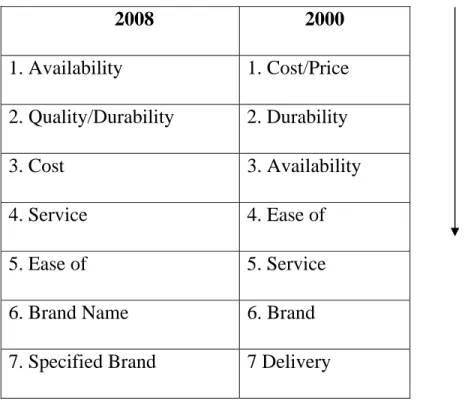
4.3 MATERIALS PURCHASING BY ELECTRICAL INDUSTRIES Given the change in the roles that the electrical contractors play, including nontraditional roles, the change in the area of materials purchases is evident. The Electrical Contractor Magazine conducted a study called Profile 2008, where the contractors were asked about their top three concerns when buying material. For the majority, price was the number one concern. However, the study concluded that cost was named first by less than 50% of the respondents, no matter of what size business is. This figure would have been higher in the 1990s. As times have changed, apparently, more and more contractors are changing with them. Table 4.1 shows a comparison on materials purchasing criteria between 2000 and 2008. As can be seen from this table, the price criteria was the top priority around year 2000, but availability was the top priority in 2008 (Electrical Contractor, 2008).
83
Table 4.1: Materials Purchasing Criteria Priorities between 2000 and 2008 (Source: Electrical Contractor)
2008 2000 Decr easing P riority 1. Availability 1. Cost/Price 2. Quality/Durability 2. Durability 3. Cost 3. Availability 4. Service 4. Ease of 5. Ease of 5. Service
6. Brand Name 6. Brand
7. Specified Brand 7 Delivery
Electrical contractors rely and buy the majority of their materials from their local suppliers. However, for works involving voice/video/data technology they have to buy materials from other places, because their local distributors are not ready to supply the materials that they need in this category. This situation has forced to find other suppliers including catalogue suppliers and other distributors. The relationship with suppliers can be critical and could decide between a profit and loss. Suppliers offer product capacity information, availability, and delivery. With this information the contractor can finance his operations and plan the work depending on the time of arrival of materials. Because of the impact that a supplier can have in the financial and production aspects of contractors, electrical contractors prefer to do business with more than one supplier. By having more than one supplier they can avoid product mispricing (i.e. a supplier charging more for products and materials), and they could have a bigger selection of products.
84
Most contractors are not buying products using e-commerce. The primary reason is that they don't have the facilities to store all the materials needed for a project and then deliver them to site as needed. This will require a materials handling system and the majority of electrical contractors are looking to carry less inventory by relying on their local distributors to deliver materials when they are needed (Electrical Contractor, 2008).
4.4 TYPICAL PRODUCTS USED BY ELECTRICAL CONTRACTORS In order to achieve the maximum productivity of the crew it is very important to have the material, equipment and tools at the right place and when needed. Common literature classifies the products used by electrical contractors into two major categories: power products and equipment, and low voltage products and equipment (Electrical Contractor, 2008). Power products and equipment are products used to deliver energy to the customers and products that use that energy. Among such products and equipment the following examples can be included;-
• Boxes & Fittings • Emergency Lighting • Fixtures (lighting) • Floor Boxes • Fuses • Lamps (lighting) • Lighting Controls • Metal-clad Cable • Meters & Sub meters
85
Low voltage products and equipment refer to products that are not directly related to energy transmission.
Examples of such products and equipment include:- • Category 5 LAN Copper Cable
• Fiber Optic Cable
• Fiber Optic Components • Fire Alarm Systems
• Intercom & Nurse Call Systems • Premise Wiring Hubs (voice/data) • Raceway (voice/data)
• Routers (voice/data) • Security Equipment • Smoke Alarms
Johnson (1986) states that there is a category known as the expendable or consumable materials. Expendable materials are materials that are used while installing the material and equipment on electrical jobs. These materials are needed in the installation, but they do not remain as an integral part of the installation work. Field personnel’s buy these materials day by day as needed and as they are consumed. The following materials are examples of expendable materials:
• Batteries
• Broom
• Brushes • Chisels • Cups
86 • Drills • Bolts • Gasoline • Oil • Chalk lines • Thinner • Lumber • Tape • Soap • Plaster
Based on field interviews to electrical contractors, in general, materials purchased by electrical contractors fall into two categories; miscellaneous material or commodities, and major materials. Miscellaneous materials refer to off-the-shelf items such as cables, conduits, straps and fittings. Major materials include switch gears, lighting fixtures, alarm systems and other items that need to be designed/fabricated specifically for a given job. Some definitions for major and miscellaneous material (http://contractorreferral. com) follow.
• Transformer- A device that changes, or transforms, alternating current from one voltage to another.
• Switch- A device that closes and opens an electric circuit by moving two electrical conductors into contact to close the circuit or separate them to close the circuit.
• Contactor- A device similar to a switch that uses contact blocks forced together to close the circuit or separated to open the circuit. • Switchgear- A freestanding assembly including primary (disconnect)
87
switches, secondary (feeder) switches, and overcurrent protection device (fuses and circuit breakers).
• Lighting Fixture- An assembly having one or more lampholders, or a lamp holder used in lieu of such an assembly.
• Control Panel- A panel, cabinet, or enclosure containing two or more controllers, contractors, relays, or other control devices for the control of electrical circuits, equipment, apparatus or system.
• Circuit Breaker- A switch which stops the flow of current by opening the circuit automatically when more electricity flows through the circuit than the circuit is capable of carrying; resetting may be either automatic or manual.
• Distribution Panel- The main electrical control center, which contains switches or circuit breakers, is connected to the service wires, and delivers current to the various branch circuits.
• Substation- an assembly comprised by voltage switches and circuit breakers, a step down transformer, meters, buswork, and secondary low voltage switchgear
• Raceway- Any channel courses supporting and protecting electrical conductors, including conduits, wireways, surface metal raceway, cable trays, floor and ceiling raceways, busways, and cable bus.
• Panelboard- A single panelboard or group of panel units designed for assembly in the form of a single panel including buses and with or without switches or automatic overcurrent protective devices, or both, for the control of light, heat, or power in a cabinet or enclosure placed in or against a wall or partition and accessible only from the front; also called a Switchboard.
88
• Conduit- A protective sleeve or pipe commonly used for individual electrical conductors
• Busway- An assembly of copper or aluminum bars in a metallic
housing used when it is necessary to tap onto an electrical power conductor.
• Electrical Metallic Tubing (EMT) - Unthreaded light weight piping for running electrical conductors; easier to handle than rigid conduit and installed more rapidly because of the type of non-threaded fittings used with it; also called Thin Wall Conduit
• Flexible Conduit- Electrical conduit made of a spirally wound metallic strip.
• Aluminum Conduit- A pipe constructed of a light alloy material used to enclose electric wires to protect them from damage.
• Plastic Coated Conduit- A type of conduit for electrical wiring that is used around moist areas and highly corrosive fumes.
• PVC Conduit- Lengths of rigid plastic pipe made of polyvinyl
chloride.
• Steel Conduit- A pipe, tube, or channel used to enclose electric wires or direct the flow of a fluid.
• Fitting- A device used for connecting pipes together.
• Cable Fitting- Couplings, elbows, tees or unions used to form a junction or connect cable lines together.
• Hanger- A device attached to walls or other structure for support of pipe lines.
• Outlet Box- A box or container which houses an electrical outlet and its connections.
89
• Cable- A bundle of two or more electrical conductors.
• Wire- A metal drawn out into the form of a thread or thin flexible rod, used for fencing, binding, or to conduct an electrical current
• Bolt- A threaded metal rod or pin for joining parts, having a head and usually used with a threaded nut.
• Nut- A small square or hexagonal flat piece of metal or other material with a threaded hole through it for screwing on the end of a bolt to secure it.
4.5 CURRENT MATERIAL MANAGEMENT PRACTICES IN THE
ELECTRICAL MANUFACTURING AND CONTRACTING INDUSTRY
The study considered the entire range of activities necessary for procuring the needed material, starting with the estimating process and ending with site delivery, distribution and storage logistics. Research outcomes included documenting the problem bottlenecks in the supply chain as well as identifying and classifying the various criteria that influence the decision process for procuring material. A conceptual framework for the material supply chain process was developed based on various discussions and interviews with office and site personnel from the electrical contracting industry in Dehradun & Selaquai industrial area. From the information acquired from these interviews, five distinct phases that comprise the process were identified: 1-Bidding Phase, 2-Sourcing Phase, 3-Materials Procurement, 4-Construction Phase, 5-Post- Construction Phase. The following subsections will discuss the five phases in more detail.
90
4.5.1 Phase 1: Bidding
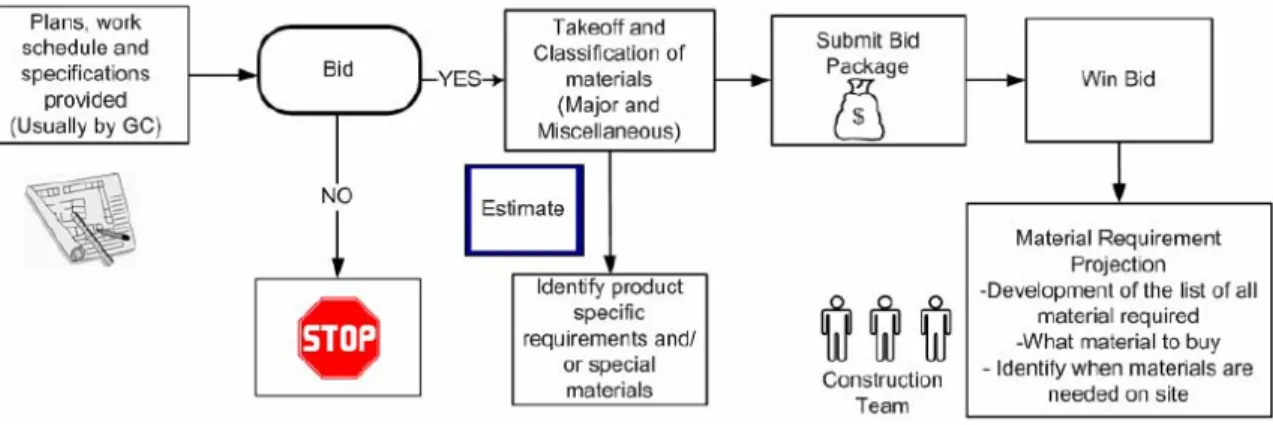
The materials management process starts from the time that the industry receives the drawings and specifications. The materials takeoff and identification process is the first step in this phase and involves identifying the materials needed as well as any special requirements or special materials to be used in the project. Quantities needed are estimated and a bid package is put together and submitted, typically to the GC. Figure 4.3 presents a diagram of the bidding phase.
Figure 4.3: Bidding Phase
In general, materials used by electrical contractors can be classified into two categories: miscellaneous materials or commodities, and major materials. Miscellaneous materials refer to off-the-shelf items such as cables, conduits, straps and fittings. Major materials include switch gears, lighting fixtures, alarm systems and other items that need to be designed/fabricated specifically for a given job.
Most of the contractors create "electronic" or computerized estimates by using a customized program that is suitable for their needs by using a computer application such as Microsoft Excel, MS WORD. Few companies
91
prepare manual estimates, which are verified several times prior to submitting the bid. Some companies use internal cost codes for material takeoff and identification that are assigned to the material being estimated. In some companies, project managers are involved in the estimating phase. The involvement of the project managers could lead to the preparation of more realistic estimates due to the project manager's knowledge of electrical systems, materials and equipment. In other companies, the estimate is prepared by the estimating department and no field personnel are involved. However in these companies, the estimate is verified by the EC once the contractor successfully wins the bid.
Typically, databases of historical prices are used to prepare the estimate and subsequent bid packages. For major material, contractors rely on prices from suppliers and/or manufacturers or they use prices from a database of historical prices. These databases of prices are updated periodically to reflect current market prices. If there is a blanket or yearly contract for a particular item, the prices for commodities under the yearly contract are known. This blanket contract ensures that the price for those commodities will be fixed for a predetermined period, usually one year. In some instances, trade catalogs are used for the bid prices when there are no blanket orders or a database of prices is not available. The purchasing department verifies the prices used in the estimate prior to submitting the bid.
After successfully winning the bid for a particular project, some companies schedule a kick-off meeting that includes the superintendent, the project manager and all the foremen. At this meeting, the superintendent and the project manager re-estimate the quantities for major material and commodities. They generate a material requisition schedule (e.g. release
92
forms) specifying material types, quantities needed, dates when the material should be delivered and any additional information needed for clarification. In addition, any notes related to particular items and the drawings for the job are included. Other companies do not re-estimate the project as long as the quality and clarity of drawings provided is good and no changes were made to the design. In these companies, the initial estimate is verified 2-3 times before submitting the bid.
4.5.2 Phase 2: Sourcing
The first stage in this phase is the selection of reputable suppliers and manufacturers. The selection of suppliers is critical and the contractor needs to verify that the supplier is capable of delivering the right material (i.e. type, quality and quantity) when needed (i.e. at dates specified). In general, most materials (miscellaneous and major) are purchased through suppliers/distributors. Most EC's prefer to buy materials from their local suppliers and from suppliers with whom they had worked before. Some companies have specialized agents within their purchasing department for supplier selection and procurement. In order to do business with these suppliers, they need to verify that the supplier is capable of delivering the material when needed. In addition, in order to get reasonably good prices for the material; they request quotations from different suppliers. Suppliers are usually selected based on lowest price, however, contractors may consider suppliers with higher prices but that will provide better service or that have a record to supply the right material in the quantities needed at the times specified. In some situations incomplete proposals from suppliers may delay the selection process.
93
The purchasing process is different depending on the type of material ordered. For miscellaneous materials (commodities) most contractors select their suppliers/distributors based on a bidding process, unless there are blanket purchase orders or yearly contracts for certain types of commodities. Under the bidding process, the contractor requests quotations for that material from suppliers that the contractor trusts and from suppliers that the contractor has worked with on previous projects. In the case of a blanket contract, the contractor buys the commodity items under the contract from that particular supplier. Due to high competition in their market areas, some contractors don't use blanket or yearly contracts because they are able to get better prices at any time by requesting bids from their suppliers. Typically, the contractor requests prices for an amount of material that is less than the amount that was estimated (e.g. 80% of original estimated material needed). This approach is used to avoid material surplus on the job-site. Based on the quotations submitted, the contractor selects the supplier.
For major materials, the contractor most often negotiates prices directly with the manufacturer, if the manufacturer is specified in the contract documents. However, the contractor has to buy the material through the supplier/distributor after a markup has been applied. Otherwise, the contractor requests bids from different qualified manufacturers that produce the required material type. Getting the manufacturers to bid against each other is beneficial for the contactor because he can get better prices. The contract is awarded to a manufacturer after this negotiated or bidding process is complete. As opposed to miscellaneous material, the contractor typically purchases the total amount that was originally estimated for major materials. This is because major materials need to be fabricated and require longer lead times. If the amount requested is less than the amount originally
94
estimated and there are shortages, the contractor will have to wait until more material is fabricated, which can cause disruptions and delays.
Typically, after the contract has been awarded to the supplier, an agreement is set by the issuance of a temporary purchase order. This temporary purchase order is an assurance to the supplier that the contractor will buy the material from that particular supplier. After the contract is awarded, the supplier issues submittals, usually 4-5 copies, for major material and certain miscellaneous material to the electrical contractor. The EC submits them to the GC who in turn submits them to the engineer/owner's representative for approval. The temporary purchase order is approved and becomes a purchase order once the submittals have been approved by the engineer/owner's representative. This process is illustrated in Figure 4.4. 4.5.3 Phase 3: Material Procurement
The material requisition and expediting phase is very critical to the success of a material management process. The person in charge of procuring materials or the purchasing department, in the case of a large company, needs to ensure that the correct materials in the correct quantities are delivered. This person also needs to verify the release dates at which the material is needed and to clearly specify those delivery dates and the location of delivery to the supplier.
95 Fig 4.4: Sourcing Phase
On fol the ma req sit fro sm per fir any (re On gen ma rel nce a suppl llow up sy e jobsite in any compa quisition s e staff and om the sup maller size rsonnel. In st verifies y material equisition a nce a mate nerated fro anager. A lease form. lier is sele ystematical n the quan anies, this chedule. In d then is se ppliers/dist e jobs, ma n companie availabilit s from sup and expedi Figure erial requis om the co material . In this for cted and th lly the statu ntities need s process n large job ent to the p tributors u aterial ma es that hav ty of mater ppliers. Fig iting) phas e 4.5: Mat sition sche onstruction requisition rm, the typ he materia us of orde ded and w starts wit bs, the sch purchasing under contr ay be requ ve a wareh rials in the gure 4.5 p e erial Proc dule is in n site by e n starts wi pe of mater al is ordere red materi within the t th the gen hedule is u g departme ract. In sm uisitioned house, the e warehous resents the curement P place, ind either the f ith the ge rial needed d, the cont ial to insur timeframe neration o usually pre ent for mat maller com directly b purchasing se before r e material Phase ividual req foreman o neration o d and the q tractor has re delivery specified. of a mater epared by t terial requ mpanies or by the fie g departme requisitioni procureme quisitions a or the proj of a mater quantities a 96 s to y to In rial the uest in eld ent ing ent are ect rial and
97
the dates when the material is needed are specified. In the case that the foreman prepares the material release form, it is sent to the project manager. The project manager is in charge of requesting the material from the purchasing department. The purchasing department requests the material from the supplier specifying the material type, quantity needed, time when the material is to be delivered and instructions on where to deliver.
Small companies may not have a purchasing department and the project manager is in charge of procuring the material directly from the supplier. Similar to the case in which there is a purchasing department, the material requisition process starts from the construction site by either the foreman or the project manager. Once a release form is generated, suppliers are contacted for procuring the material needed. The type of material needed, quantities and the time when the material is needed is specified to the supplier.
4.5.4 Phase 4: Construction
Material delivery usually occurs during the construction phase. Material is generally requested for delivery to the jobsite. In some instances material delivery to the jobsite may not be feasible due to storage or access limitations. In this case, the material is delivered to other locations such as the contractor's warehouse, a pre-fabrication shop or another subcontractor storage area. Figure 4.6 describes the different material delivery and storage options.
Material is delivered to a warehouse in cases such as when critical specialty items are ordered early and are not going to be installed immediately, when storage area at the job- site is unavailable, or if the material will be used for pre-fabrication. Storage of the material at the warehouse prior to moving it
98
to the jobsite increases indirect costs due to re-handling. Here too, we can see the role of decision analysis and information systems in helping the contractor tradeoff these costs against the costs of shortages and more shipments.
Some companies utilize a pre-fabrication shop facility to assemble components in a controlled environment. Advantages of pre-assembly include increased production time and reduced labor costs compared to performing the assembly process in the field where poor weather conditions and space limitations may cause work delays. The increase in productivity and savings in labor costs out weigh additional costs encountered due to pre- fabrication and re-handling.
99
100
The culture of the construction industry might be opposed to pre-fabrication. Some site personnel, particularly job foremen, may not favor pre-fabrication due to fear of loss of control on material and installation. Consequently, upper management in some companies have developed incentive programs to introduce site staff to the benefits of pre-fabrication and to facilitate a change of culture and acceptance of the process.
In other instances, the EC may utilize a subcontractor's yard for storage and subsequent delivery and installation. A typical example of this situation involves the use of the rigging subcontractor to store large-size materials such as transformers. In addition to being used for installation, the subcontractor provides storage space until material can be delivered to the site and installed. A further benefit to the contractor is the subcontractor's responsibility for any damage to the material stored at his/her yard. There is an additional fee that the contractor has to pay for the storage space and for the risk taken by the subcontractor with respect to material damage. There is a tradeoff between paying the fee and utilizing the contractor's own, limited storage space possibly requiring smaller, more frequent shipments. Another consideration is the subcontractor's assurance that the material will retain its quality and that it will be installed when needed.
4.5.4.1 Material Requisition Process
Material requisition problems greatly affect the construction stage and failure to manage this phase effectively could result in project disruption and possible delays due to late deliveries, stockouts due to small quantities bought, material delivered to the wrong locations, material backordered and effects in overall costs. The requisition process for miscellaneous material starts in the construction phase and is focused on how much material to buy,
101
when to buy this material, where to deliver this material, when to deliver, which supplier to buy from, where to store on site.
The decision of how much to buy is very important to assure that the quantities needed are available and that there are no material shortages. The decision of when to buy is important to ensure that material is available when needed. The decision of where to deliver the material requires space planning and consideration of site limitations, pre- fabrication strategies, and subcontractors to be used. This decision should be made to minimize theft, loss and damage and at the same time considering availability of material when needed. The decision of when to deliver requires knowledge of the schedule and actual installation rates. The decision of which supplier to buy from depends on contract agreements, specifications and performance of the supplier. The decision on where to store on site depends on site restrictions and space availability.
Various interviews were conducted to investigate the different approaches used by the electrical contractors to request material during the construction phase. Based on literature review and interviews, the process starts with the generation of material release forms by the supervisor/foreman or the project manager. In this form, the material needed, quantities and the dates when the material is needed are specified. The supervisor/foreman sends the form to the project manager, who is in charge of requesting the material from the purchasing department. The purchasing department requests the material from the supplier and instructs the supplier about material type, quantities, time when the material is needed and instructions for delivery. Figure 4.7 depicts a typical material requisition process for miscellaneous material for an electrical contracting and manufacturing company.
102
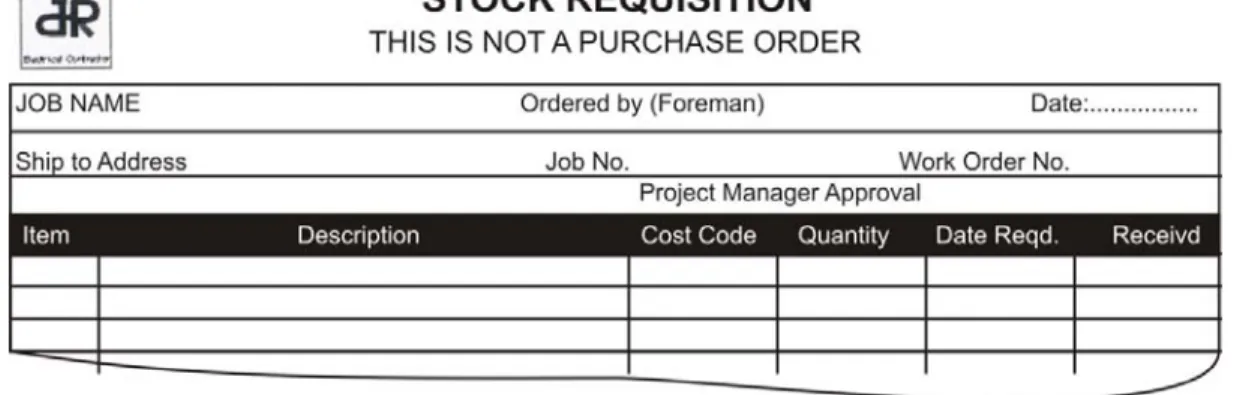
(Step-1) Whenever materials are needed at the construction site, a material requisition process is initiated by site personnel (e.g. foreman or the project manager). The process involves the generation of a stock requisition form, presented in Figure 4.8. In this form, the material description, quantities needed, dates when the material is needed, and material cost codes are specified.
Other information specific to the job including personnel names and phone numbers, job address and ID, date and signatures are also included when filling the requisition form. The PM also includes a contact name and phone number of a designated site personnel in charge of receiving the material ordered when it is delivered to the site. Once the form is completed manually, the PM sends it to the purchasing department
103
104
Figure 4.8: Stock Requisition Form
(Step-2) The PM updates a material release summary form (Figure 4.9), based on the new order completed (Step-1). The purpose of this form is to keep records of the material being used in the project and the balance available for requisition. A copy of the summarized releases is sent to the foreman
Fig. 4.9: Material Release Summary Form
(Step-3) The purchasing department requests the material from pre-selected suppliers/vendors and instructs the supplier/vendors about material type, quantities needed, time when the material is to be delivered and instructions for delivery (i.e. location and contact person).
105
The purchasing department forwards a copy of Form 1 with this information to each supplier/vendor. Material is generally requested for delivery to the jobsite. Material is generally requested for delivery to the job site. In some instances this may not be feasible due to storage or access limitations. In this case, the material is delivered to other locations such as the contractor's warehouse or another subcontractor storage area. Material is delivered to a warehouse in cases such as when critical specialty items are ordered early and are not going to be installed immediately, when storage area at the job- site is unavailable, or if the material will be used for pre-fabrication. Storage of the material at the warehouse prior to moving it to the jobsite increases indirect costs due to re-handling. Some companies utilize a pre-fabrication shop facility to assemble components in a controlled environment. Advantages of pre-assembly include increased production time and reduced labor costs compared to performing the assembly process in the field where poor weather conditions and space limitations may cause work delays. The increase in productivity and savings in labor costs out weigh additional costs encountered due to pre-fabrication and re-handling. Some site personnel, particularly job foremen, may not favor pre-fabrication due to fear of loss of control on material and installation. Upper management for some companies has developed incentive programs to introduce site staff to the benefits of pre-fabrication and to facilitate a change of culture and acceptance of the process.
In other instances, the electrical contractor may utilize a subcontractor's yard for storage and subsequent delivery and installation. A typical example of this situation involves the use of the rigging subcontractor to store large size materials such as transformers. In addition to using him for installation, the subcontractor provides available storage space until material can be delivered to the site and installed.
106
(Step-4) In the case that the material is delivered to the warehouse, the PM fills a notification of delivery to warehouse form (Figure 4.10) to notify the warehouse personnel that certain material will be delivered to the warehouse for storage. This form specifies the type and quantity of material to be delivered, when it will be delivered, job number, supplier/vendor's name, carrier name, and holding period for the material. This form should be prepared and sent at least 24 hours in advance of delivery. Once delivered, the warehouse personnel verify the material received against the notification of delivery to warehouse form and stamps the packing slip for acknowledgement that the material was received. The packing slip is forwarded to the purchasing department for payment purposes. If there is any damaged material, it is noted on the packing slip and the purchasing department is notified. The warehouse personnel also notifies the PM by phone of all material received and stored at the warehouse.
Notification of Delivery to Warehouse
Date _____________ Job Number ________________
PM _____________
Vendor _____________ Carrier _______________
Date of Expected Delivery ___________________ Description of Packing (i.e. reels, pallets, boxes)________________
Quantity Description
Total Weight of Shipment ____________
Disposition of Material (i.e. ship to job, pack and hold); _______________________________________________
Time Period to hold material ________________________
107
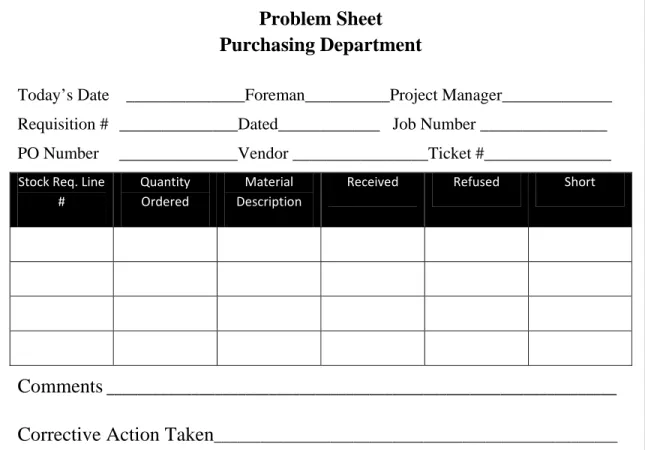
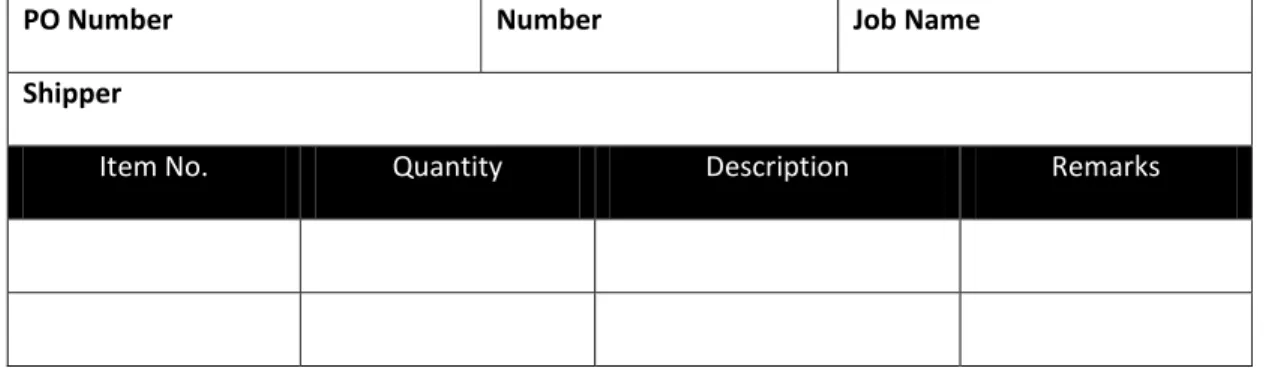
(Step-5) In the case that the material is delivered to the jobsite, the designated site personnel verify the material received against the stock requisition form. Actual quantities received are recorded in the received column in the requisition form. If there are any discrepancies in material quantities, damages to material or items not delivered, the foreman fills a problem sheet form (Figure 4.11) and forwards a copy of this form to the purchasing department. At the time that the material is received, the foreman also fills a receiving report (Figure 4.12) and forwards this receiving report to the PM.
Problem Sheet Purchasing Department
Today’s Date ______________Foreman__________Project Manager_____________ Requisition # ______________Dated____________ Job Number _______________
PO Number ______________Vendor ________________Ticket #_______________
Stock Req. Line #
Quantity Ordered
Material Description
Received Refused Short
Comments __________________________________________________________________
Corrective Action Taken____________________________________________________
108
Receiving Report
PO Number Number Job Name
Shipper
Item No. Quantity Description Remarks
Figure 4:12 Receiving Report
(Step-6) For payment purposes, a copy of the packing slip is faxed to the purchasing department, from the warehouse or the site, for acknowledgment of delivery of material and payment purposes.
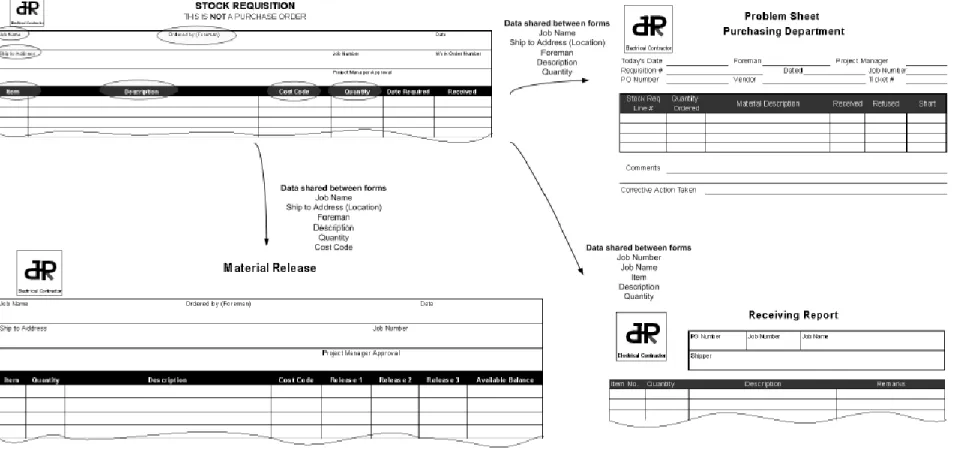
Figure 4.13 illustrates a summary of the information flow between the forms used in the requisition process. The stock requisition form, Figure 2, is the base form used to input information into the other forms. This information transfer between forms is done manually, which requires double entry. The process is time consuming and prone to error due to the manual input of data.
109 Figure 4.13: Information Flow between the Paper Forms
110
From the stock requisition form, the material description and quantity requested in a particular period is input into the material release form. This form is used to keep track of the material ordered in each period and the remaining balance. If there are any problems with the material ordered (e.g. damage material, incorrect quantities) the site personnel writes the material description and the problem encountered into a problem sheet form. Most of this information is coming from the stock requisition form. When an order of material is received, a receiving form is filled. In this form, PO number, job number, job name, material description, and quantity received. All the information, except the quantity received, is obtained from the stock requisition form.
4.5.5 Phase 5: Post-Construction
After installation of the materials on the structure, the EC has to manage any surplus material. The surplus is handled differently depending on the type of material and also whether or not the contractor has a warehouse. If the company has a warehouse, the surplus material is stored in the warehouse for use in future projects. Other companies return surplus material to the supplier for reimbursement. Usually, there is no penalty or re-stocking fee for commodity items. For specialty items there is usually a 20-25% penalty. The EC has to track surplus material to avoid lost or theft. Figure 4.14 presents the post-construction phase
An effective material management system is essential to avoid material shortages, misplacements, loss, and theft which might result in increases in crew idle times, loss of productivity and delay of activities. Electrical contractors should implement an efficient material management system due to the fact that in most of the cases they are asked to squeeze their bids in
111
order to keep the costs of project under budget. In such a case, failures to effectively manage materials could result in decreases in profit or even a loss. The material management processes for the companies visited are very similar, although there are some differences.
Figure 4.14: Post Construction Phase
The primary goal for these companies is to have the material needed, in the amounts needed, with the quality required, and the time that they are needed. Based on the interviews conducted, most companies have a material management system that serves their needs, although it could be improved. Standardization of the material management system could be a step forward in improving the system for all the companies and eliminating some of the bottlenecks.
112
113
114
The flowcharts presented in Figures 4.15{A & B} represent general flowchart that describe a compilation of the current material management practices for the companies visited. Individual flowcharts for all the companies visited were prepared and these flowcharts represent the way in which every company handles their material. Figure 4.15{A & B} presents a flowchart for the material management process for Contractor A of the companies interviewed. The rest of the flowcharts developed, narratives and questionnaires from interviews can be seen in the Appendix. A narrative of their material management process follows.
This section presents a narrative of the materials management process for this company. The steps presented on the flowchart, illustrated in Figure 4.15 {A & B}, are described in this document. The description is based on the numbers assigned to every box on the flowchart.
1, 2, 3: Estimating, Bid Submittal, Bid Won Prepare the estimate for the project.
• Engineering Drawings and Specifications are needed
• Cost Codes used for material (internal Contractor A codes)
• Assemblies used for material takeoff
• Prices from Trade Services catalog
• Prices Revised by Purchasing Division
• Materials are classified into two categories
• Major Material
o Gear- Electrical Distribution equipment
• Panels
115 • Sub-stations
• Transformers
o Lighting fixtures
• Chandeliers, Wall brackets
o Systems Division - Special division that purchase this type of material
Fire Alarms
• Security Alarms
o Generators- Locally generated power
• UPS systems
• Generators systems
• Miscellaneous Material (Commodities)
o Bolts o Nuts o Conduit o Wire o Boxes o Electrical tape o Wire connectors o Electrical fittings
o Conduit strap fasteners
o Dimmers
o Hanger supports
o Elbows
116
4. Re-Takeoff
• There is a Kick-Off Meeting between the Superintendent/PM/ Foreman.
• Foreman and PM re-takeoff the quantities for major material and commodities.
• The time frame when materials are needed is specified.
• Prepare Pre-Requirement and Buy Packages.
o Pre-Requirement contains a list of miscellaneous material needed, specifications for that material, quantities and time when they are needed, any additional information needed for clarification, temporary PO, notes related to items, drawings for the job.
o Buy Package contains a list of major material needed, specifications for that material, quantities and time when they are needed, any additional information needed for clarification, temporary PO, notes related to items, drawings for the job. Major Material
5.0, 5.1 Prepare Buy Package
• Quantities needed are specified.
• Specifications from the engineer are included with the buy package.
• Date Needed (Time Frame).
• Computer generated report (Temporary PO) sent to purchasing by PM. Scope of work not completely specified and a material list is not specified. Based on the drawing and specifications, the manufacturer provides the required material to Contractor A.
117
5.2, 5.3, 5.4, 5.5, 5.6
• Negotiate prices with supplier/manufacturer (Purchasing
department).
• Award contract for each major material to a manufacturer.
• Material has to be acquired through supplier.
• 100% of material estimated is procured.
• Request submittals from the manufacturer, typically around 04 copies of each submittal (PM).
• Approve submittals (Engineer ).
• Once submittal is approved, the material order is approved and held for release at a specific period through a temporary PO. The temporary PO guarantees the purchase. An agreement is established in price and backed up by Contractor A's reputation. 5.7, 5.8, 5.9
• Request for material release (Foreman)
o There can be multiple releases for material.
o Releases scheduled 2-3 months in advanced based on progress of the work, schedule of the project, weather.
o Coordination between PM and foreman.
o Quantities needed and date needed are specified in the release request.
• Forward material requests to purchasing (PM)
o All major material is released at once by type.
o PM keeps a record of the material released.
o Establish if the material will be delivered to the pre-fab shop or to the site.
118
5.10, 5.11, 5.12, 5.13, 5.14
• If the material will not be pre-fabricated, it is sent to the construction site.
• Receive and verify material received against the packing slip sent by the supplier (Foreman).
• Inspect material for damage and/or shortage of quantities (Foreman).
• Fill a problem sheet if material is damaged or quantities received are less than the quantities requested.
• Send packing slip form to accounts payable for payment purposes and acknowledge of received material.
Miscellaneous Material 6.0, 6.1, 6.2
• Specify quantities needed.
• Specifications are included with the pre-req.
• Date Needed (Time Frame).
• Fill stock requisition by hand. This form includes material and quantities needed, and estimated dates for delivery.
• Generate computer form (PM). This form will be sent to the purchasing department.
6.3, 6.4, 6.5, 6.6, 6.7
• Solicit bids to various suppliers (Purchasing)
• 80% of the estimated materials are requested.
• Award contract to supplier.
119 • An agreement is specified by a temporary PO and the company's
reputation.
• Approve submittals (Engineer). 6.8, 6.9
• Prepare material release request form.
o There can be multiple releases for material.
o Releases scheduled in advanced based on progress of the work, schedule of the project, weather.
o Coordination between PM and foreman.
o Quantities needed and dates needed are specified in the release request.
• The PM takes care of all releases
o PM keeps running balance of material.
o PM sends form to foreman indicating amounts remaining.
• Send release request to purchasing (PM).
• Request material directly from supplier (Purchasing). Decision to Make with Respects to Delivery Location
Material can be either sent to the pre-fabrication ( Pre-fab) shop or the field.
o If the material is going to be used for pre-fabrication it is sent to the pre-fab shop or storage if it is a critical item ordered very early. Otherwise, it is sent directly to the site for storage and/or installation.
o In certain instances material may be sent to a sub contractor who will store until installation due to lack of space availability in the field. An example of this situation is material that needs to be
120
installed using rigging equipment. The rigging company stores the material until installation time.
o In some instances, material is shipped to a manufacturer to incorporate into a major item (e.g. modular wiring incorporated into light fixtures prior to delivery to the jobsite).
7.0, 7.1, 7.2, 7.3, 7.4, 7.5
• If the material is going to be used in pre-fabrication, the material is delivered to the warehouse. In some instances, critical materials that are ordered early are stored in the warehouse until they are going to be installed.
• The material is inspected against the packing slip sent by the supplier/distributor. It is inspected for quality, quantity and to verify that the delivered material was the material that was ordered.
• Once the material is inspected, it is stored in the warehouse and a notice to delivery to warehouse is sent to the project manager to notify that the material was delivered.
• The material is used in the pre-fabrication process.
• Once the pre-fabrication process is finished, the assembled material is delivered to the site when needed. The material is stored on site. 8.0, 8.1, 8.2, 8.3, 8.4
o Miscellaneous material is sent directly to the site if it is not going to be used in the pre-fab shop.
o Material delivered is based on the release request.
o Receive and verify material received against the package slip sent by the supplier (Foreman).
121 o Inspect material for damage and or shortage of quantities (Foreman).
o Fill problem sheet if material is damaged or quantities received are less than the quantities required.
o Send packing slip to accounts payable for payment purposes and acknowledge of received material Send problem sheet to purchasing department (Foreman).
o Forward problem sheet to the supplier (Purchasing).
o Replace damaged material and/or supply additional material not delivered (Supplier).
8.5
• If additional commodities are needed, prepare a pre-requirements and send it to the PM (Foreman).
• This is because 75-80% of the originally estimated commodities are bought.
• Prepare a computer report and send it to purchasing (PM).
• Negotiate prices with supplier (Purchasing).
• Award contract to a supplier (Purchasing).
• Request material release as needed (Foreman). 4.6 SUPPLIER/INDUSTRY ARRANGEMENTS
Unavailability of materials when needed can greatly affect the productivity of the workforce, thus causing delays to activities, increasing the cost of the project and possibly delaying the completion of the project. There is no doubt availability of materials when needed is critical for the successful completion of the project. The contractor should search for arrangements
122
that will ensure availability of materials when they are needed. This section presents an overview of the value added services that suppliers offer to contractors, partnering agreements between contractors and suppliers, and the benefits for the contractor when using this type of arrangements.
4.6.1 Partnering
The construction industry has been characterized by adversarial relationships between the parties involved. Traditionally, the most common way in which the contractor gets most of his projects is by hard bid. Because of the competitive nature of hard bidding, the contractor needs to obtain materials and subcontractor’s services at the lowest cost possible. Usually, the contractors request bids from suppliers and subcontractors in order to get the lowest prices possible for their services and products. Suppliers or subcontractors will try to win the contract by offering a relative low price to the contractor. Sometimes the price offered might not be low enough to win the contract and the contractor could request a lower price. If the supplier or subcontractor does not lower the price, the contract might be awarded to another party. This bidding process might create adversarial relationships because the suppliers or subcontractors could get the job at a lower amount than what they originally were expecting; therefore they are making less profit. Because of this loss in profit, the supplier or subcontractor might not be totally devoted to this particular contract and some problems might arise The relationship of a contractor with his suppliers is critical for the successful completion of any construction project. Availability of materials is essential for the timely completion of activities and for the productivity of the labor force. If materials are not available when they are needed, a variety of problems might arise. Leenders et al. (2002) offer a classification of
123
supplier based on the quality of the service that the supplier offers to the customer. The classifications that they present are unacceptable suppliers, acceptable suppliers, good suppliers, preferred suppliers, and exceptional suppliers. A description of each category follows:
• Unacceptable suppliers- these suppliers are not able to meet the operational needs of the customer and are not able to provide materials when they are needed. In addition, they don't offer means to satisfy the strategic needs of their customers.
• Acceptable suppliers- these suppliers meet the current operational needs of the customer, however, the services that they provide can easily be matched by any other supplier.
• Good suppliers- these suppliers are a step above acceptable suppliers in the fact that they can provide the materials needed, but in addition they can also provide some value added services.
• Preferred suppliers- these suppliers offer a system that integrates the buying/selling functions in an electronic format. This integration eliminates duplication and allows to process transactions faster. These suppliers meet both the operational needs of the company as well as their strategic needs.
• Exceptional suppliers- these suppliers are able to recognize and anticipate the needs of their customers and are able to satisfy those needs. Because of the value they provide to their customers, they are valued. They allow customers to experiment with different scenarios and approaches, because of their efficiency, which results in minimization of risk for their customers.
124
To minimize the risk of not having materials when they are needed, companies are recurring to set up partnering agreements with suppliers. A partnering agreement is a business relationship that looks forward to the benefits of the partners involved. A partnering agreement does not represent a legal partnership with the associated partners, instead it refers to an informal working agreement to maintain cooperative relationships. In such types of agreement, the decision process should be done in a win-win basis for all the parties involved. No benefits should be acquired by hiding information from other parties. A successful partnering relationship consists of trust, fairness and commitment from all the parties involved. Communication is a very important aspect in Partnering. Open and honest communication among team members is critical.
Leenders et al. (2002) describe two different types of partners, basic and extended partners. They point out that all suppliers should be treated as basic partners with respect among parties, honesty, trust, open communication, and understanding of the aspects that drive their relationship. An extended partnership is only established with key suppliers. This type of agreement goes beyond basic partnering and is oriented on the goals of the supplier and customer. It is not uncommon to have a team, comprised from supplier/customer employees, to create plans for mutual success and profitability. Extended partnering has a long term view and improvement of both parties should be the main objective.
Anderson (1994) defines some key elements of a Partnering agreement. A brief description of these elements follows:-
• Commitment -All members of the team should commit to good faith and fair dealings with the other partners
125
• Equity- When developing mutual goals and plans for the companies, the interest of the stakeholders must be considered. If there are aspects that stakeholders don't appreciate or think that are valuable, they won't commit to the partnership agreement.
• Communication- Open and honest communication is critical.
• Trust- Trust is critical for resolution of issues. Information sharing among partners without fear is essential.
• Issue Resolution System- There must be a fair process for dispute resolution without finger pointing. These issues should be solved quickly and in a fair way.
• Evaluation- Meetings are needed to evaluate the work being
performed by the team. An assessment of work performed vs. work accomplished is essential to identify if the partnership agreement is working as expected.
4.6.1.1 Benefits of Partnering
One of the biggest benefits of a Partnering agreement is the elimination of adversarial relationships between contractors and suppliers. The cooperative environment between the parties minimizes the risk of unavailability of materials on the construction site when they are needed. In addition, the contractor will ensure that bills are paid as stated in the partnership agreement, which provides a better cash flow for the supplier. Another main benefit is the information sharing between parties, which can lead to the enhancement of one company's competitive position by using the information and resources provided by the partner company
126
4.6.1.2 Concerns with Partnering
One of the biggest concerns with Partnering comes from the supplier side. Some suppliers feel that they can gain more benefits if they continue in the competition based environment. Suppliers don't want to change the procurement tools and techniques that they have been used for a competitive environment (Leenders et. al., 2002). A change to a partnership type of agreement will require the revision of their current procurement tools and techniques. Some of the suppliers might argue that some Companies might try to take advantage of the partnership and their preferred status, a situation that can create problems among partners. Another aspect that brings concerns is the intellectual rights for new technology developed by these partners. A critical aspect deals with the fact that sometimes there is a doubt on how far a partner can be trusted for information sharing purposes. There is always the feeling that this information might end in the competitor's desk, which could seriously harm the competitive edge of the company. 4.6.2 Value Added Services
Ogleshy et al. (1989) says typically the supplier/distributor is viewed by the electrical contractor only as the source that supplies the materials needed for the construction of the project. Many suppliers are looking for ways to survive in a market full of suppliers. These days it is difficult for a supplier to compete in the market based on product price alone, therefore suppliers are looking for other ways to generate income by providing additional services to their customers. These services are known as Value Added Services (VAS). Some of the benefits that a customer can expect when receiving supplier value added services include:-
127
• Quality- the supplier will ensure that the contractor will receive defect free materials
• Timely deliveries- supplier will ensure timely delivery of materials • Continuity of supply- the supplier will ensure supply of materials as
needed to reduce risk of shortages of materials
The services provided by the supplier can range from testing of materials to inventory management. Services provided by the supplier include:-
• Training of employees • Testing of materials • Inventory management • Bar coding services • Financing
• Availability of materials from different manufacturers • Competitive prices
• Bill of material ordering • Invoice statement and faxing • Customized delivery service
These and other services will be described in the following sections. Access to products
The distributor offers a variety of products from different manufacturers. This helps the contractor to compare and select the materials by just visiting one place and by comparing prices, availability and quality.
128
Training of Employees
Suppliers can provide training to customer's workforce on how to install components. This is a beneficial tool to improve workforce knowledge on the product, thus increasing productivity and lowering the time required to install them.
Testing of Materials
The supplier can test power equipment and other equipment before delivering to the site. This will eliminate deliveries of defective equipment, which will eliminate the time and cost required to send that equipment back to the supplier. In addition, the supplier could calibrate the equipment to the levels specified after doing the testing.
Bar coding
By using bar codes, the supplier can ensure fast and accurate handling. With bar codes attached to particular equipment, information about that particular equipment can be provided instantly by scanning the bar code. Incoming goods can be count directly and manual entry errors are avoided. Materials used can be scanned and inventories can be kept easier and almost in real time, once the material is scanned and the information sent to the inventory database.
Vendor Managed Inventory (VMI)
The supplier/distributor can provide the contractor with relative fast access to equipment and materials needed. The contractor does not need to have an extensive inventory on the construction site and/or warehouse. These VMI services can be provided in two ways: the supplier can provide a trailer on
129
site and/or the supplier can provide yearly contracts for miscellaneous materials.
• Trailer on Site: The supplier buys a trailer and provides it with material ordered by the contractor in it. The contractor buys all the material in the truck and the supplier manages the inventory on the truck throughout the duration of the project. The supplier bills the contractor for materials used at predetermined prices. Once the job finishes, the contractor returns the remaining material and receives a credit from the supplier.
• Yearly Contracts: The supplier can agree on a yearly contract with the contractor. This yearly contract guarantees price, availability and delivery of materials when the contractor needs them. These yearly contracts reduce the contractor's risk of being out of materials. These yearly contracts could have two forms; fixed price or fixed profit. In a fixed price contract, the supplier sells materials to the contractor at a predetermined price for an entire year. In a fixed profit contract the item is sold at the cost in that particular day plus the profit specified in the yearly contract. These contracts provide market share for the supplier. Yearly contracts are not used for major items such as switch gears, fixtures. Suppliers can't fix the price of commodities such as wires and PVC piping, because their price is dependent on market conditions.
Technical expertise and information
The distributor/supplier can assist the contractor in designing power, communications, and control systems. The supplier can also serve as a contact point with the manufacturer in case that the manufacturer's
130
assistance is needed in the performance of lighting design, short-circuit analysis and other devices coordination studies, or any other design assistance.
Short Term Financing
The supplier/distributor provides the contractor with credit, usually 30 days, when the contractor buys materials. This service provides a better cash flow for the contractor and reduces the use of the line of credit.
Competitive Prices
There is an excess of suppliers/distributors in the market. Suppliers are always looking for ways to stay competitive in the market. The competition among distributors is beneficial for the contractor, since he can get better prices as opposed to a market in which there is only one supplier. Sometimes when suppliers have good relations with contractors, they usually offer good prices to these contractors.
Customized Delivery Service
Supplier can offer deliveries that meet the requisites of the contractor. In addition, suppliers can provide free delivery services to local areas. This represent cost savings for the contractor. Suppliers could also provide Just In Time deliveries, which minimize the storage needed by the contractor. Invoice statement and faxing
Some suppliers provide overnight transmittal of invoices of daily purchases. This service allows the contractor to keep records of daily expenses. In addition, the contractor knows how much he has to pay to that particular supplier on the specified paying day.
131
Bill of Material Ordering
With this service, the supplier can consolidate invoices on a daily or weekly basis. These invoices can be sent electronically to the contractor. All invoices can be converted into a single invoice that contains all the purchase orders for that particular period of time.
Kitting
Kitting refers to a part that is comprised of components from different manufacturers, but has been assembled by the supplier and only one part number has been assigned to the assembled part. This makes it easier for the contractor, because if the contractor is going to assemble the part by himself, he has to know the part numbers for all the components of the part. In addition, there are savings on the time required to assemble the part. Invoice Consolidation
Invoice consolidation is used when a contractor wants to pay the bill on a specific day rather than paying for materials as they are received on the jobsite. By using the invoice consolidation service, the contractor only makes a monthly payment to the supplier instead of making several payments during a particular month.
Interactive Quote System
This service allows the contractor to obtain immediate prices and information on the availability of the material. The contractor saves time, because he can get this information by just sending a quote to the supplier by fax, instead of visiting the store in person to check for availability and price for the materials.