Abstract— Principles of an enhanced evaluation approach through Computer Science is introduced. Functions of education process as knowledge delivery and assessment are analyzed. Structural formation is presented using drafting function, describing function, developing function and diagnosing function. A new and unique evaluation schema for analyzing weakest area of student is introduced. The rigorous formation of enhanced evaluation approach becomes an essential segment of framework design and development. It is described how this enhanced evaluation approach (EEA) can help students to assess themselves by this framework. The structure of framework formation and aims and objectives of the research are introduced. Enhanced evaluation approach incorporates all the prior traditional and modern approaches. Need of Computer Based Individual Enhanced Evaluation Approach and its algorithm are described. Modern ways for bona fide knowledge management are introduced. Development schemes of framework and directions for further research, its usability and future work are discussed.
Index Terms— computer science, enhanced evaluation approach, framework design, framework development, knowledge management.
I. INTRODUCTION
Computing has already revolutionized the way we live our lives, so it is reasonable to predict that it will play a major role in shaping our long term future. The rise of Computer Science in Education system is commendable. Technological innovation is widely seen as gateway to a brighter human future. Computer Science is a big-part player of human life. Though, the subject has own technical defects which should be coped up with this modern approach [1] [3] [6]. However, traditional methods of education are limited and development in delivering education is needed to be investigated as there is no solution for evaluation of student’s results or weak area.
It is, therefore necessary to overcome a major disconnect between computer science and its technical applications. Computer Science as a discipline needs to be given the tool for effective evaluation of students. This proposed research work attempts to form blueprint of designing and inventing new framework for analyzing learner’s knowledge delivery channels with result through computer science and similar disciplines. Initially, the role of education relatively acts as driving force on human life [5] [6] [14]. This paper presents a proposed concept of enhanced evaluation approach.
Manuscript received September 25, 2013; revised October 10, 2013 M.Satoskar is in Research and Development area of Advance Computer Science and Technology at Maharashtra, INDIA
(email: [email protected])
II. RATIONALE OF RESEARCH
Education is an initial impetus to the brighter future. Rigid education and exam system can limit scope for adaptive deep learning, but at least curriculum design can rise to the challenge of exploiting technical applications to adapt to the needs of students so that each can progress in his own way. Adaptive learning has emerged to cater for this, combining technical applications with interactive methods to tailor education system and assessment methods to the student. By considering the following facts about computer science and education, the need for this study becomes significant.
1. Standard of educational organisation based on well designed curriculum, education program and students outcomes too.
2. Traditional standard methods are available but effective evaluation method is backbone for competency.
3. Effective evaluation process is impossible without efficient learning and assessment resources.
However, Computer Science is different from “Learning Technology” or “Educational Technology”, in its broadcast sense, indicates the use of educational material associated with technologies that have been acquired with the information age. Therefore, Learning Technology conveys the meaning of “usage of computer science which aids the learning process” throughout the paper.
The rationale for the project is to research a new scientific basis of student’s brain knowledge delivery channels assessment along with evaluation through Enhanced Evaluation Approach (EEA) along with variants by designing enhanced evaluation framework. Knowledge delivery may include three channels of delivery: via text, via audio, via video [3] [5] [6] [14]. However, Human can easily absorb things which are seen visually. The impact of visual is effective.
III. ENHANCED EVALUATION APPROACH (EEA): Assessment is another area that has attracted a lot of interest [1] [2] [4]. As the traditional and modern approaches which are developed on the basis of the prior have failed to conclude about the logical reasoning of the failure of the student in the particular weaker sections which .thus leads us to the need of this efficient evaluation scheme.
An Enhanced Evaluation Approach:
Computer Science and its Framework
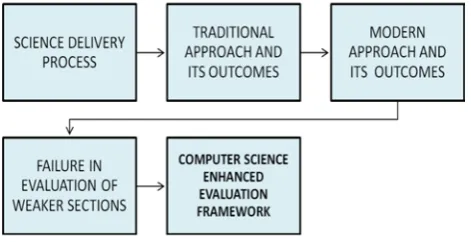
Delivering knowledge is a continuous process that takes place mainly on the basis of two important aspects without which, the process isn’t really a process and those are the deliverer and the consumer. It all starts with the basic traditional approach where the knowledge was delivered to the students without much use of most of the technological media that we use frequently now a days. Thus the outcomes from the process showed some failures in the evaluation as the student was not able to throw some focus on the weaker sections as it only consisted of what he has gained and nothing about what he has lost. in the traditional approach there were some faults in the efficiency of the delivery process as well which were coped up in the modern approach which was designed on the basis of the prior one. Though this system handled the inefficiency of the delivery process itself this approach even failed in the evaluation problem. Thus all the evaluation incapabilities led us to frame such a tool that will help to overcome these prior defects [3] [5] [6] [14].
With this theoretical concept which will extend through computing, result will be displayed in form of channels. It will show what learner grasps? Which information delivery channel he better understand? Which area he should improve? For example, if the assessment shows that the student is lacking in the parameter of reading then he should focus on that particular parameter specifically. So that he will improve his outcomes by his own assessment though the framework. Interestingly, it can be said as Personalization.
This research focuses on the concept of Enhanced
Evaluation. Research into EEA should not be seen as option
but as a necessity [1]. This EE approach can allow students to evaluate their results much more efficiently
Malcolm Forbes admits: “It’s so much easier to suggest solutions when you don’t know too much about the problem”
However, the solution of the problem can be found in this approach. In summary, there are three main types of solutions stated below:
• Self-assessment: Students can check their own understanding (or lack thereof) of particular concept of the gained knowledge.
• Summative: This can be used to make a judgment about the student’s achievement in a particular module of course.
• Usability: This can update all the terminologies in the framework which will be automatically to connect the web such that it can access across the world.
IV. AIMS OF RESEARCH
a) To make an original contribution by applying theory of computer science to solution, a problem in the field of real time assessment of learner brain in the education delivery and absorption channel such that student (Science consumer) can assess themselves personally by three mediums of knowledge delivery namely via text (books), audio and video i.e. lectures given by lecturer (Science deliverer).
b) To develop and implement a new logical core of modelling of effective education with assessment and a practical means for applying it.
c) More significantly this framework of computing focuses on the collection and analysis about the opportunity cost which the disciple has to suffer because of the concerned whatsoever other factors.
d) Framework should be able to provide justification of result to students.
V. OBJECTIVES
i. In this proposed study, learner can check their progress and improvement and this concept will guide them to the area which needs improvement (if any).
ii. The main objective of the research is to develop unique classical concept of learning evaluation such that every student will understand weakest area of their knowledge formation and delivery after exam/ module results regarding to the strong and moderate or week aspects of the knowledge acquisition.
VI. RESEARCH METHODOLOGIES AND PRINCIPLES
The methodology of the research is aimed at defining the information processing channels of learner context within which education can be effective and then developing practical algorithms with automatic facility of framework for personalization of assessment of result and evaluation of outcomes which not only provide the information needed to learner weakest area but which can do so in real time
assessment and evaluation through the framework tool. It
will contain a whole course structure and relative data. However, each and every entry will be saved automatically in framework of what they have studied. Additionally, it will connect to web. The exam set will be redesigned on those parameters such that assessment will take place in terms of personalization.
[image:2.595.56.292.57.178.2]The basic building block is curriculum and education program development which needs to be analyzed and redesigned to design assessment framework method. It can be predefined what will be the text and what science deliverer (Teacher) is going to teach students that means audio along with video (if any). The analogy of the knowledge delivery defines mainly four functions which are the part and parcel of the entire procedure and they are defined as follows:
where D1= drafting function, D2= describing function, D3= developing function and D4= diagnosing function.
This diagram represents how the various functions of this process are interdependent. The whole process of knowledge delivery here is stated on the basis of four essential important functions which are namely drafting function (D1), describing function (D2), developing function (D3) and diagnosing function (D4). The process from the perspective of both the ends that are science deliverer and the consumer starts at the drafting function where all the concepts of the context are stated. This function sets up a base for differentiating function in which all the concepts are differentiated as per their basic core theme and then interlinks them. This leads to the next step that is of the developing function in which the consumer which is the student here develops his knowledge to such an extent that he will hold the capacity of applying it practically. And the whole delivery process ends at the diagnosing function where by any evaluation procedure the strong and weaker sections are concluded. Here as we can see the ending stone of this one process shows the importance as well as proves to be a stepping stone of the evaluation system. And the effective use of all these interdependent functions leads to a strong and bona fide knowledge core.
At the beginning of the education process, as the matter of fact shows that the student is at the step stone that is nothing. At this point of time the student is assumed to have negligible or no knowledge. After that, the teacher or any available transmission media take that student one step further which is D1 (drafting function) where the core of the concepts are described. The process further leads to D2 (describing function) which gives the student visual clarity about how the concepts are interconnected and the whole process there after leads to the of D3 (developing function) where the student develops his knowledge and holds the capacity to predict the outcomes of the things or situations which he has learned in his curriculum, in his real practical life. Then the whole process leads to the end part of D4 (diagnosing function) where the student gets the clear idea of his strengths and weaknesses which help him to improve his knowledge.
But though we are considering our knowledge system on the basis of these four functions only there are various related conditions that are also of importance which are generally violated in the assessment to be more and more precise each time and should be more appealing. These all factors in the combination will create a core for the successful knowledge delivery and its assessment for students’ betterment.
For example a student learns his curriculum via three main important mediums viz. text input (Ti), audio inputs (Ai), and also lastly video inputs (Vi).
∑
+ += Vi Ai Ti
Kd (1)
where Kd= knowledge delivery, Ai= audio input, Ti= text input, Vi= video inputs delivered by the manufacturer that is the teacher.
Here, knowledge delivery is considered as whole process consisting of text, audio and visual input delivered to the student. Mathematically, we can say that knowledge delivery is the summation of text, audio and visual input.
These media deliver knowledge to the student to the maximum possible extent. But though the input is of the quality and quantity no one can acquire it completely and effectively as the grasping power and analyzing capacity of each disciple various enormously. Same as the in the process of reflection and refraction of light, the process faces some transmission losses the knowledge delivery and acquiring process even faces some losses. Thus the knowledge acquired by the student can be analyzed by under stated mathematical relations:
TKa=Ti(n)−Ti(l) (2)
AKa=Ai(n)−Ai(l) (3) )
( ) (n Vil Vi
VKa= − (4)
where TKa stands for text knowledge acquired, Ti(n) stands for total text input and Ti(n-l) stands for the transmission losses during the entire process. Same parameters are applied as such for audio and video channels.
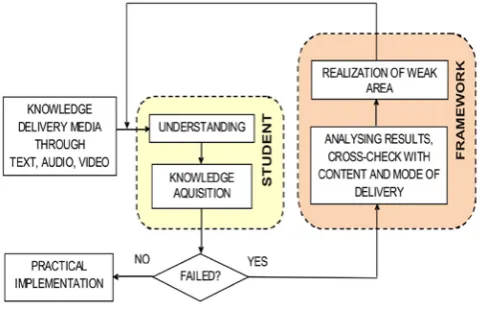
[image:3.595.61.291.58.108.2]In the equation though we have assumed the media aren’t lacking in any parameter and are delivering to the maximum possible extend, though each student has different capacity of grasping and applying. As the learning capabilities vary enormously among the students, to calculate how much each student has actually acquired we have to the find the difference between the quantity of knowledge delivered to that specific student and the possible acquisition and transmission losses at the fault of science deliverer or consumer. We can describe the whole science delivery scheme from the perspective of teacher as well as the student through the following algorithm
Fig 2: Knowledge Delivery Schema
[image:3.595.306.547.557.711.2]As shown in Figure 3, knowledge delivery media are the main sources of knowledge delivery and assessment of science consumer [1] [7] [8] [14]. The cycle of evaluation is said to be complete when a science consumer can analyze his weak area of knowledge delivery and redevelops it and returns his results back to the society.
The possible acquisition and transmission loss we can calculate from the results that come as an output of the input given in the examination. In the existing assessment policy a student can only understand how many marks he obtained which imply that how much marks he has lost. But as we all know this system does not further inform the student about his strengths and weaknesses in the course i.e. which is actually the most important and required thing. This tool emphasizes on such a system that will tell a student that `in which topics or the context of the curriculum is weak for him or in which he has not been able to give the desired effective output in the examination. This is possible when the student has the record of what he has done in the past period up to which extent as he will enter the entire data in the database about what he is focusing from time to me. In this cases even there are two probabilities that the student has learnt the topic or he hasn’t. If he hasn’t then it’s completely his liability as he has suffered the loss due to his own negligence or any other reason, but if he had learnt the context then the question arises that why he couldn’t apply his knowledge or why his output is not up to that extent or is there any problem he is facing in any of the knowledge delivery functions those are described above?
And thus we can analyze the total marks obtained by the student even from the following mathematical relation:
VKa AKa TKa
Ka= (6)
where Ka = the total quantity of the knowledge acquired by a student, TKa = knowledge acquired through the text medium, AKa = knowledge acquired through the audio medium, VKa = knowledge acquired through the video medium.
Through this mathematical relation we can state that the total knowledge acquired by the student is nothing but the combination of all the quantities of the context he understood through all the three possible ways which are namely text, audio and video. The approach will be to develop the algorithms by Computer Science and demonstrate their effectiveness in detecting weakest area of students and also will provide necessary tools for its betterment.
VII. CONCLUSION AND FUTURE WORK
This work will attempt to form a logical core of effective higher education development and practically can be implemented as an enhanced evaluation approach framework for students. Initially, the aims and objectives of this research briefly defined and the role of this proposed framework is discussed.
However, the whole concept is directly proportional to education system containing major input parameters (Designing of educational program development, Curriculum development, and assessment with evaluation of
outcomes). This proposed framework and application will based on platform independent approach which will be directly connected to web. It is a classic one cycle of education extended from philosophy which will be developed technologically to synthesize new result.
A new assessment methodology, analyze weak area of students, has been introduced and analyzed. This was addressed as part of Enhanced Evaluation Approach (EEA) framework, where the media of knowledge delivery and its progress were analyzed using the four functions: drafting function (D1), describing function (D2), developing function
(D3) and diagnosing function (D4). Furthermore,
development of algorithm will make a framework through Computer Science.
This Computer Science approach study will make it possible to create generic unique solution of learner’s assessment and evaluation which can be extended in future in terms of standardized education level in developed as well as developing countries. Moreover, this project has no boundaries in terms of development and it can be extended for blind learners as well as in all higher educational programs across the world.
The enormity and importance of research and development of an Enhanced Evaluation Approach (EEA) and its framework will be extremely useful in real world. This concept and framework will highlight student’s weak thread of delivery channel of their brain so that they can improve it by taking necessary efforts to overcome the weak aspects with the help of perfect result of evaluation.
REFERENCES
[1] Satoskar,M. “Advancements of Curriculum Design: Framework for Computer Science (Submitted for publication)”, Second Michael Faraday IET India Summit 2013- An IET Conference, India. Paper ID: MFISS136
[2] McGettrick, A., Theys, M., Soldan, D., Srimani, P. “Computer Engineering Curriiculum in the New Millenium”, IEEE Transactions on Education, Vol. 46, No. 4, November 2003.
[3] Schagaev, I., Folic, N., Ioannides, N. and Bacon, E. “Curriculum Design, Development and Assessment for Computer Science and Similar Disciplines”, FECS’12- The 2012 Int’l Conference on Frontiers in Education: Computer Science and Computer Engineering, Las Vegas, Paper ID: FEC4130, July 2012
[4] Journal of a Computer Society of India Communications – Knowledge Digest for IT Community, Vol.36, Issue No -9- Dec 2012
[5] Intelligent Systems- Web Enhanced Design of University Curriculum: Approach – ICT call 10, 2013
[6] Schagaev, I., Bacon, E. and Ioannides, N. “Curriculum Design and Development for Computer Science and Similar Disciplines”. International Journal of Knowledge Society Research (IJKSR), 1, 3, 17-32, 2010.
[7] Popescu,E (2010). A Unified Learning Style Model for Technology- Enhanced Learning: What, Why and How? International Journal of Distance Education Technologies, 8(3).
[8] Christine Evans- Pughe. Engineering and Technology, IET UK, Vol.8 Issue 2, March 2013.
[9] Director, S., Khosla, P., Rohrer, R., Rutenbar, R. “Reengineering the Curriculum: Design and Analysis of a New Undergraduate Electrical and Computer Engineering Degree at Carnegie Mellon University”, Proceedings of the IEEE, Vol. 83, No. 9, September 1995.
[10]Diamond, R. Designing and Improving Courses and curricula in Higher Education, Jossey-Bass, ISBN: 1555421296, 1989.
[11] “International Workshop Report on Curriculum Development in Technical Education”, United Nations Educational, Scientific and Cultural Organization (UNESCO), Italy, 1993.
[13]The Joint Task Force on Computing Curricula Association for Computing Machinery IEEE- Computer Society, “Computer Science Curricula 2013” Version 1, February 2013.
[14]Schagaev, I., Bacon, E., and Ioannides, N. “An Approach to Curriculum Design for Computer Science", 3rd World Summit on the