0883-9514/00 $12.001 .00
u
IMPLEMENTING A BUSINESS
PROCESS MANAGEMENT
SYSTEM USING ADEPT:
A REAL-WORLD CASE STUDY
N. R. JENNINGS, P. FARATIN, and T. J. NORMAN
Dept. Electronic Engineering, Queen Mary & Westfield College, University of London, London, United Kingdom
P. O’BRIEN and B. ODGERS
BT Research Labs, Martlesham Heath, Ipswich, Suffolk, United Kingdom
J. L. ALTY
Dept. of Computer Studies, Loughborough University, Loughborough, Leicestershire, United Kingdom
T his article describes how the agent±based design of ADEPT (advanced decision
environment for process tasks)and implementation philosophy was used to prototype a
business process management system for a real±world application.T he application
illustrated is based on the British T elecom(BT)business process of providing a quote to a
customer for installing a network to deliver a speciÐed type of telecommunications service.
Particular emphasis is placed upon the techniques developed for specifying services,
allowing agents with heterogeneous information models to interoperate,allowing rich and
Ñexible interagent negotiation to occur,and on the issues related to interfacing agent±based
systems and humans.T his article builds upon the companion article(Applied ArtiÐcial
Intelligence V ol.14,no.2,pgs.145È189)that provides details of the rationale and design of
the ADEPT technology deployed in this application.
Many advances have been made in recent years within organizations in pre± paring a culture of dynamic improvement. From the globalization of trade, total quality management initiatives (Bradley, 1994 ; Bulled, 1996), through regulatory and competitive pressures, and on to ISO 9001± conformant quality management systems, the emphasis has been placed increasingly on the notion of service. This embraces both the service that an organization
Address correspondence to Prof. Nick Jennings, Department of Electronics and Computer Science, University of Southampton, Southampton SO17 1BJ. E-mail: [email protected]
provides to its customers and the service that departments within an organ± ization provide to one another.
To achieve and sustain such dynamic improvement, service± oriented organizations need an infrastructure that supports exible and robust man± agement of their business activities in a changing world. In particular, the denition and execution of efficient business processes requires considerable eŒort to be invested in consulting everyone involved and in capturing the
requirements and constraints of all the relevant parties. This endeavor involves not only the humans contributing to a process, but also the under± lying information systems that facilitate and often have processes embedded within them. To this end, the ADEPT project has developed a business process support infrastructure that is inherently service± oriented, in which both humans and automated tasks can work cooperatively (see the afore± mentioned companion article for the justication and description of ADEPTs conceptual and implementation framework).
In more detail, a business process is composed of a number of primitive functional activities or tasks. In any reasonably complex process, depen± dencies exist between the tasks and so they have to be executed in a con± trolled and ordered way. This execution invariably involves the consumption of resources. In most organizations, these resources are grouped intobusiness unitsthat control the way in which they are deployed. Within ADEPT, these business units are represented by autonomous soft± ware agents. The agents communicate with one another over a network and negotiate over how they can collaborate to manage the overall business process. To be consistent with the service± oriented philosophy, negotiation and collaboration are at the level of the services that agents oŒer to one
another. In this case, a service is a packaging of tasks and other (sub)services that allows an agent to oŒer or receive from another agent some functional
operation. A service can be reused as a component of another service, and agents can take the role of provider (server) or customer (client) for services.
Against this background, the purpose of this article is to demonstrate how the ADEPT concepts and implementation can be used to build a business process management system for a real± world application. For our particular purposes, the exemplar business process is from BT (British Telecom) and it relates to providing a quote for installing a network at a customer’s premises. The contributions of this article are as follows : it demonstrates how a real± world application can be conceived of as a multi± agent system ; it highlights many of the problems that need to be addressed when building a multiagent system for real± world applications ; and it shows the potential advantages and disadvantages of using multiagent systems as a software solution technology.
The section entitled Designing the Agent System indicates how this business process was divided into agents and agencies and how services were assigned within this structure. The section on Implementing the Agent System within ADEPT indicates how the design was realized using ADEPT as a solution technology. Here particular emphasis is given to the negotiation involved in provisioning services and on the techniques for sharing information between agents with heterogeneous information models. The section on Interface Design Issues addresses the issues involved in having both human and arti± cial agents in a business process management system. The nal section reects upon the experiences in building this application and oŒers some
general insights into the problems of building real± world multiagent systems.
BTS PROVIDE CUSTOMER QUOTE BUSINESS PROCESS
The scenario described in this article is based on BT’s business process of providing a quotation for designing a network to provide particular ser± vices to a customer (Figure 1). The scenario has been simplied for the pur± poses of explanation and demonstration. The actual business process for this service contains 38 tasks and nine choice points. Despite this simplication, the key aspects of the process are still present. Each activity requires resourcing and has a start/end point whereby progress can be measured. Choice points indicate which sequences of activities require provisioning and there are a number of concurrent activities that require coordination.
The overall process receives a customer service request as its input and generates as its output a quote specifying how much it would cost to build a network to realize that service. The process involves up to six types of business unit: the sales department that is the customer’s point of contact ; the customer service division that handles the basic administration of the process ; the legal department that checks the validity of customers’ requests ; the design division that determines how the service network can be realized ; the surveyor department that visits customers’ premises ; and the provider of an outsourced service for vetting customers.
In more detail, the process is initiated by a customer contacting the sales department. The customer’s details are captured and while the customer is being vetted (in terms of verifying their identity), their requirements are elic± ited. If the customer fails the vetting procedure, then the quote service ter± minates. Assuming the customer is satisfactory, their requirements are recorded and mapped against the service portfolio. If the requirements can be met by a standard oŒ± the± shelf portfolio item, then an immediate quote
can be oŒered based on previous examples. In the case of bespoke services,
FIGURE 1. The Provide Customer Quote Business Process.
and network costing, a nal costing is produced. Finally, the customer is informed of the service quote and the business process terminates.
In terms of the typical characteristics of corporate± wide business pro± cesses that were outlined in the companion article, the provide customer quote process has the following traits :
resources available to carry out the business processes’ activities vary.
d The
For example, the numbers of designers, surveyors, and lawyers that can work on the process depends upon staŒavailability at any given time.
Similarly, the number of customers that can be checked depends upon the current capacity of the vetting agencies. Moreover, for a given customer, it is not possible to predict when they rst enter the system which path through the business process will be enacted.
process involves approximately equal amounts of human and
d The
automated tasks. Tasks such as checking the legality of services, surveying a customer’s premises, and designing the network are performed by humans, whereas tasks such as costing portfolio services and delivering the nal quote are automated.
organizations are involved in the process. British Telecom is d Multiple
responsible for the majority of the activities, but the task of vetting cus± tomers is outsourced to external companies that bid for contracts on an as± needed basis.
process is physically distributed across diŒerent resource units that
d The
are situated at various BT sites. Also the vetting companies can be located anywhere in cyberspace.
resources involved in the process are controlled by their respective
d The
business units in an autonomous way. Thus, the design department deter± mines the number of designers that are available for this process (bearing in mind that this is not the only activity in which the design department is engaged). Similar observations are true for the surveyor and legal depart± ments.
are many concurrent problem± solving activities± both within a d There
given process instance and across process instances.
business process manager needs to have a view of the entire process
d The
so the efficiency of the activity can be determined. Thus, information is needed about the process instances that take signicantly longer than average, about where bottlenecks occur, and so on.
DESIGNING THE AGENT SYSTEM
This section describes how the customer quote business process was mapped into a multiagent system. The main steps in this endeavor are deter± mining which agents should be present and how they should be organized into agencies, specifying the services the agents should provide to one another, and setting the mode of provision for the identied services.
Mapping the Business Process into Agents and Agencies
Since the ADEPT solution has to operate within the present organiz± ational structure, our rst step was to identify the business units involved in the customer quote activity. As indicated previously, there are ve business units within BT involved in this activity : the sales department, the customer handling department, the design department, the legal department, and the survey customer site department. Given the fact that these business units represent autonomous problem± solving entities with their own set of resources, the obvious design choice is to make each of them an agent. However, this position is complicated by the fact that customer handling is dealt with at two physical sites± London and Edinburgh. While it would obviously be possible to view the two sites as one logical entity, we decided upon two separate agents since there is comparatively little coordination between the sites and there are no control relationships between the sites. The nal type of entity involved in the business process is the customer vetting organizations. As already explained, vetting is outsourced. As there are multiple potential providers of the customer checking activity, it seems natural to represent each of them as separate agents since they are, in eŒect,
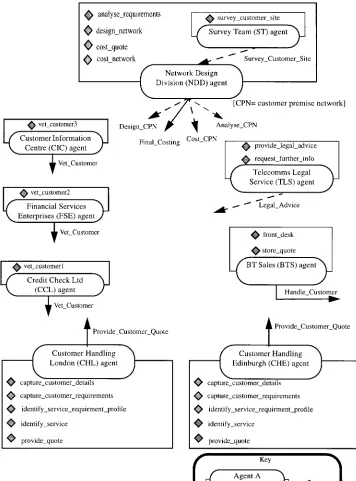
direct competitors. Thus, the implemented system contains the following agents (Figure 2): the BT sales (BTS) agent ; the customer handling in London (CHL) agent; the customer handling in Edinburgh (CHE) agent ; the network design department (NDD) agent ; the telecommunications legal service (TLS) agent ; the surveyor team (ST) agent; and the three external agents± customer information center (CIC) agent, nancial services enter± prises (FSE) agent, and customer check ltd. (CCL) agent± that provide the customer vetting.
has a system that schedules the work of the surveyors so as to optimize factors like the distances between jobs and the amount of overtime required. Therefore, in this case, the agents represent the interests of the pool of resources and the resource utilization information used during service provi± sioning originates from the work scheduling system. This approach was found to be more efficient than having each agent represent the interests of an individual resource.
Having identied the set of agents, the next step is to determine the organizational relationship between them. In the ADEPT context, this equates to determining which agents are peers of one another and which are subagencies. In the provided customer quote case, this is, in general, a fairly easy choice since most agents represent distinct, autonomous departments that have no controlling authority over one another. The exception to this is the survey department that is part of the design department. Thus, it was decided that all the agents should be peers apart from the ST agent that would be a subagency of the NDD agent. In the latter case, having ST as a subagency is a natural choice since only NDD needs to interact with it. Moreover, the ST agent is an integral part of the NDDs functioning, since the design service cannot be performed without having a surveying capabil± ity. This means the two agents have a close and cooperative working relationship which is exactly that captured by the subagency concept.
Assigning Services to Agents
Having identied the agents involved in the business process, the next step is to determine the services they will provide to one another. In most cases, this question can be answered by considering the roles of the various agents and by applying the software engineering principle of minimal coup± ling between problem± solving groups (Sommerville 1992).1 Having said this, however, it is important to note that the composition of services oŒered by
an agent is determined by the requirements of all the business processes within an enterprise, not just one. Hence, some services are necessarily dened at a level of granularity that does not appear as natural for one application, but which makes sense when the totality of the business pro± cesses are considered.
BTS agent handles customer service inquiries on behalf of BT. This
d The
service (Handle–Customer) encapsulates the entire quote process and
represents the customer’s sole point of contact. To perform this role, BTS requires one of the customer handling departments to provide a quote.
vet customer agents (CIC, FSE, and CCL) provide a customer check±
d The
ing service (Vet–Customer) to the customer handling agents (CHE and
ST agent provides the service of surveying a customer’s premises to
d The
the NDD agent (Survey–Customer–Site).
customer handling agents provide the (identical) service of providing
d The
quotes to the BTS agent (Provide–Customer–Quote). To provide this
service, the customer handling agents need to be able to call upon a vetting service, a legal advice service, and a costing and design service.
TLS agent provides advice on whether a particular customer’s
d The
request is legal in the country where the network is to be situated. This service (Legal–Advice) represents an important choice point in the process. If the proposed request is illegal, then the quote process must terminate and the customer must be informed. Therefore, this service is provided to the customer handling agents (rather than the NDD agent directly), since they are responsible for liaising with the customers.
NDD agent provides the services of analyzing the requirements of a
d The
bespoke customer premise network (CPN) (Analyse–CPN), of designing a CPN (Design–CPN), and of costing the network (Final–Costing, Cost–CPN) to the customer handling agents. These services are used in business processes other than that for providing a customer quote, and so they are represented separately even though they are always invoked together in this particular context.
Having specied the agents’ services, the next step is to determine in which agents the constituent tasks (see Figure 1) should be located so that the services are realized in the most eŒective fashion. To minimize the coup±
ling between agents, tasks are managed by the agent that provides the service of which they are part unless an explicit statement is made to the contrary.
Handle–Customer service requires the BTS agent to provide a
d The
point of contact for the customer (thefront–desk task) and the ability to store information about a customer’s request while the quote process is being enacted (thestore–quotetask).
Vet–Customer service is composed of a single task
d The
(vet–customer). Since the exact means by which this service is realized
will vary between the agents, the specic tasks also vary (hence, the 1, 2, and 3 subscripts in Figure 2).
Legal–Advice service is composed of two basic tasks : providing
d The
the advice (provide–legal–advice) and requesting additional infor± mation when it is needed (request–further–info).
Survey–Customer–Site service is composed of a single task
d The
(survey–customer–site).
Provide–Customer–Quote service involves the following tasks :
d The
determining the customer’s requirements (capture–customer–
requirements); identifying the desired service’s requirements prole
(identify–service–requirement–profile); identifying the par±
ticular service if it is a portfolio item (identify–service); and provid± ing the nal quote to the BTS agent (provide–quote).
Analyse–CPN service involves analyzing the customer’s require±
d The
ments in more detail (analyse–requirements). The Design–CPN
service is where the bespoke network is designed (through the
design–network task). The Cost–CPN service uses the
cost–network task to calculate the actual cost of the customer design.
The Final–Costing service calculates the nal quote for the customer
that might include additional value added services (e.g., maintenance con± tract options) and ensures the quotation is appropriately authorized (both for bespoke and portfolio items) through thecost–quotetask.
Determining Modes of Service Provision
Having determined the agents’ services, the nal design choice relates to the way these services will be provisioned. As indicated in the companion article, services can be provisioned in two ways:on demand: one agreement covers multiple invocations of a particular service; and one± o†: a single service instance is provisioned at a time. The former is used for services that have a high volume of invocation. This means they are usually on the main path of the business process. The latter is used for services that are invoked less frequently. The rationale for this is that negotiation consumes both time and resources, and hence for services that are used frequently, it makes sense for the cost of the negotiation to be amortized over numerous services. However, the main advantage of negotiating afresh for each service instance is that the agreement can be tailored more accurately to the prevailing cir± cumstances. Hence, for services that are invoked infrequently, the increased resource overheads tend to outweigh the timeliness of the agreements.
In the provide customer quote process, it was decided that the following services should be made on demand since they are required for each and every invocation of the business process : Handle–Customer,
Provide–Customer–Quote, Vet–Customer and Final–Costing.
The remaining services are provisioned as and when they are needed :
Legal–Advice, Survey–Customer–Site, Design–CPN, Cost–CPN
andAnalyse–CPN.
IMPLEMENTING THE AGENT SYSTEM WITHIN ADEPT
nology. The rst section discusses the issues associated with specifying ser± vices in ADEPT’s service description language; the next section shows how the ADEPT approach to information sharing is used in practice; the section following illustrates service provisioning in a range of negotiation contexts ; and the nal section demonstrates the service management function in oper± ation.
Specifying Services
Services are specied using the service description language (SDL) intro± duced in the companion paper. Each service description consists of a name (unique for that service), a set of inputs, a set of outputs, a guard, and a body. The inputs specify the information that is to be used by the service and the outputs specify the information provided to the client on completion of the service. The guard is a boolean expression that is evaluated when the service is rst invoked. If this expression evaluates to be false, the service fails without the body of the service being processed. The body of a service description loosely species how the service is to be executed. It consists of the restrictions on the order in which component services are to be executed, the conditions under which the service will be considered successfully exe± cuted, and how information ows between these component services.
A service description represents the server agent’s knowledge of how to provide a service. However, a potential client agent does not have this knowledge since the service’s realization is encapsulated by the provider. Therefore, services are advertised as service prototypes. A service prototype provides a client agent with the necessary information with which to manage the execution of a service provided by a server agent, given that there exists an appropriate agreement between them. This information consists of the name of the service, and its inputs and outputs. An agent also represents the tasks it is responsible for managing in a similar way, providing the name of the task, its inputs and outputs. Sample service and task prototypes for the CHE agent are shown in Figure 3. The service prototype refers to the service
Vet–Customer, and indicates there is a single input to this service, the
details of the customer concerned, and a single output, the verdict of the
Vet–Customerservice provider. Note that unlike a service description, the inputs to a service as specied in a service prototype only refer to the input as being mandatory (man) or optional (opt). Inputs that are provided by the server itself are not specied. The task prototype refers to the task
capture–customer–details. There is one mandatory input to this task
and a single output: the telephone number of the customer and their full details, respectively. The task is, therefore, to contact the customer by phone and determine details such as their postal address and fax number.
The inputs and outputs of service prototypes are always dened in terms of the client agent’s information model. This may be diŒerent from the
server’s information model, in which the server agent’s service description is dened. For example, the service description of theVet–Customerservice
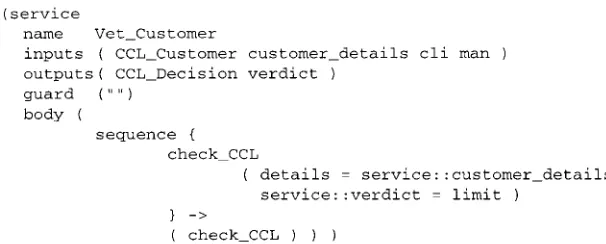
(Figure 4) that may be provided by the CCL agent is expressed in terms of the internal information model of that organization. It is important to note two features of a client’s service prototype and the associated server’s service description. First, the name of the service must be identical ; service names are common to all agents whatever information model is used. Second, each information object is prexed with the name of the information model in which it is dened. The information objects used to represent the inputs and outputs of CHEs service prototype are prexed by ‘‘BT,’’ that represents the British Telecom information model, and CCLs service description uses infor± mation objects prexed by ‘‘CCL,’’ that represents that organization’s infor± mation model. (Refer to the next section for information on how information is shared between these agents during service execution.)
CCL’s Vet–Customerservice description is rather simple, consisting of a single task to be performed. The body of this service description contains a single sequence block with the completion condition that the task
check–CCLis successfully completed. The content of this block is a call to
that task, where the task’s input (called details) is the CCL–Customer
[image:12.412.53.356.458.580.2]information object that is input to the Vet–Customer service, and its output is the CCL–Decision information object called verdict that is
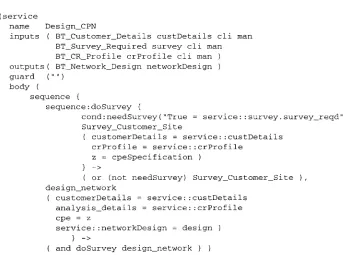
the service’s nal output. To illustrate the use of SDL more fully, the service description for the NDD agent’sDesign–CPNservice is shown in Figure 5.
The three inputs to this service are all mandatory and are to be provided by the client, and so each of these will be mentioned in the client’s service prototype. These inputs are the details of the customer, an information object that indicates whether a survey is required of the proposed network site, and the prole of the customer’s requirements. The service’s output is a single information object representing the completed network design. The service has no guard and so the body is always executed. The body consists of two sequence blocks, and refers to a task (design–network) and a service (Survey–Customer–Site). The main block is considered to have been completed, and hence the service is completed, if both of the symbols
‘‘doSurvey’’ and ‘‘design–network’’ evaluate to true. The doSurvey
symbol evaluates to true when the sequence subblock with the same name is successfully completed, and the symboldesign–networkevaluates to true when the task with the same name is successfully completed. ThedoSurvey
subblock and the design–network task are specied to be executed in sequence and so thedoSurveysubblock is always executed rst. This sub±
block is completed if the condition (or (not needSurvey)
Survey–Customer–Site) evaluates to true. This is the case if either
needSurvey evaluates to false orSurvey–Customer–Siteevaluates to
[image:13.412.31.374.326.581.2]true. This is a sequential subblock, and so each element in the execution list
is executed in strict order. The rst element is a conditional test that deter± mines the truth condition of the survey–reqd slot within the survey
input to this service. This information object is of type
BT–Survey–Required, dened as follows :
(class BT–Survey–Required) (Types–String cr–profile) (Types–Boolean survey–reqd))
This information object associates a string that identies the customer requirements prole and a boolean indicating whether or not a survey is required for this order. (Note that a single customer may place multiple orders at the same time, and so it is essential to distinguish between them by indicating which requirements prole this refers to). The survey–reqd
boolean is referred to in the service description by using the keyword
service, that indicates that this information object is an input or output
of the service being described, followed by a double colon ‘‘::,’’ the variable denoting the information object survey, dot ‘‘.,’’ and the slot
survey–reqd. Thus, this conditional tests the truth condition of this
boolean. If it is false, the conditional evaluates to false, the completion con±
dition of the doSurvey subblock becomes (or true
Survey–Customer–Site) (where the completion condition of
Survey–Customer–Site is unknown at this time), and hence the block
has been successfully completed. If a survey is required, the completion
statement of this subblock becomes (or false
Survey–Customer–Site), and hence the completion condition of
Survey–Customer–Site must be determined to evaluate the completion
condition of this subblock. Thus, if a survey is required, the
Survey–Customer–Siteservice is executed.
Assuming that there exists an agreement with an agent that is able to provide the Survey–Customer–Site service, the agent proceeds to execute the service. The inputs to the service are the customer details and customer requirement prole that are provided as input to theDesign–CPN
service, and there is a single output that is bound to the variable ‘‘z.’’ If this
service is successfully completed, its completion condition becomes true, and hence the completion condition of the doSurvey subblock becomes true. The execution of this service then proceeds to the task design–network.
The task prototype for this task is given below :
(task–prototype name design–network
Note that the variable z only has a value if the
Survey–Customer–Site service has been executed. This is reected
in the task prototype, where the third input to the task is specied as optional. The output of this task is bound to the variable
service : :networkDesign; i.e., the output of theDesign–CPNservice.
If both the design–network task and thedoSurvey subblock are suc± cessfully completed (i.e., both symbols design–network and doSurvey
evaluate to true), then the serviceDesign–CPNis successfully completed, as specied in the completion condition of the service.
This example illustrates the power of the SDL. With this language, it is possible to specify the same service in a number of ways. For example, the
Design–CPN service description could equally be expressed without the
doSurvey subblock by combining the completion condition of this sub±
block with the completion condition of the task design–network.
However, through experience, we have found that the use of subblocks gives structure to the service description, simplies the completion conditions of each block, and aids both the understanding and debugging of service descriptions when building an application. In short, this is simply good soft± ware design.
Information Sharing
Information that is shared by two or more agents must have a common interpretation. However, it was seen in the previous section that agents within the provide customer quote application do not all share a common model of information. For example, agent CHE uses the BT information model, and CCL uses an information model that is particular to the organiz± ation it represents. The inputs and outputs to services are specied in the agent’s local information model within their service descriptions. Therefore, the question that must be addressed is how agents with diŒering information
models communicate in the provisioning and execution of services. The approach adopted in the ADEPT system is to use a common information model in which all information is referred to and passed during interagent communication (see Section 3.2 of the companion paper for more details). The common information model used in this application is the BT informa± tion model.2 To avoid confusion, information objects within a particular
information model are prexed by the name of that model; e.g., information objects in the BT information model are prexed with the string ‘‘BT.’’
To illustrate information sharing in ADEPT, consider the provision and execution of a Vet–Customer service. This service is available from three external agents : FSE, CCL, and CIC, each of which uses a diŒerent internal
agents CHL (customer handling in London) and CHE (customer handling in Edinburgh) require services of this kind when providing a quote. However, the information they require is diŒerent. Customer handling in Edinburgh
requires a BT–Customer–Credit–Verdict information object. This
associates a unique string that identies the customer concerned, with a boolean that indicates whether or not the customer’s credit is good.
(class BT–Customer–Credit–Verdict (Types–String customer–details)
(Types–Boolean customer–credit–acceptable))
Customer handling in London, requires a BT–Customer–Credit–
Rating information object. This associates a unique string that identies
the customer concerned, with a oat representing the estimated credit limit of the customer and an integer representing the condence of this estimate.
(class BT–Customer–Credit–Rating (Types–String customer–details) (Types–Float customer–credit–limit) (Types–Integer confidence))
Furthermore, the information that is available from CHE and CHL as input to a Vet–Customer service is the details of the customer to be
vetted; i.e., a BT–Customer–Details information object. Therefore, for FSE, CCL, and CIC to be able to provide a Vet–Customer service to CHE and CHL, they must make use of the information available (i.e.,
BT–Customer–Details), when they act to produce the outputs required
(i.e., BT–Customer–Credit–Verdict or BT–Customer–Credit–
Rating).
By using its acquaintance models, CHL will be able to identify that FSE, CIC, and CCL are all able to provide the Vet–Customer service. Cus± tomer handling in London, will then propose a service level agreement (SLA) to each of these potential service providers (see the next section). In addition to specifying the service’s price, time scale, etc., the SLA indicates the inputs that may be provided and the outputs that are expected by the client. On receipt of a proposal, it is the job of the agent to ensure that the inputs are acceptable and the outputs may be provided as specied. In this case, both FSE and CIC are able to translate the information that is provid± ed by its tasks (FSE–Verdict and CIC–Rating, respectively) into the
BT–Customer–Credit–Ratinginformation object required by CHL, but
CCL cannot3 (see Figure 6). The information that is available from CCLs
tasks is CCL–Decision, which may only be translated into an instance of
FIGURE 6. Outputs and translations from the variousVet–Customerservices.
BT–Customer–Credit–Verdictinformation object instead, CCL cannot
provide this service to CHL, and negotiation will terminate.
During service execution, information that is provided by the client must be transformed into the common information model by the client, transmit± ted to the server, and then transformed by the server into its local informa± tion model. Information that is then to be provided to the client as output must be transformed into the common information model by the server, transmitted to the client, and then transformed by the client into its local information model. In this example, the client (CHL or CHE) uses the common information model internally, and so information translation is performed by server agents only (FSE, CIC, or CCL). Suppose that CIC has an agreement to provide a number of instances of aVet–Customerservice to CHL and that CHL has invoked this agreement. The agreement species that CHL must pass CIC the information concerning the customer to be vetted. After vetting this customer, CIC must communicate the results that are represented by an instance of the information object class CIC–Rating, to CHL. Customer information center has a method (a stored information model mapping) of transforming an information object of type
CIC–Rating to the required output, BT–Customer–Credit–Rating.
This translation is performed by the communication module and the output communicated to CHL. Suppose that FSE has an agreement with CHE for the same service, and wishes to communicate the results of executing this service to CHE. FSE has no direct mapping from FSE–Verdict to
BT–Customer–Credit–Verdict(see Figure 6), and so it searches for a
method of performing the required translation. In this case, a valid mapping can be found by concatenating the mapping between FSE–Verdict and
BT–Customer–Credit–Rating, and the mapping between
BT–Customer–Credit–Rating and BT–Customer–Credit–
Verdict. These methods may then be combined to create a single direct
mapping from FSE–Verdict to BT–Customer–Credit–Verdict for
Service Provisioning
This rst part of this section illustrates the process of providing agents with the necessary domain information on which to base their negotiation behavior (the next section). It then goes on to describe the operation of the agents’ negotiation reasoning model in two service provisioning scenarios (the section following).
Specifying the Domain
-
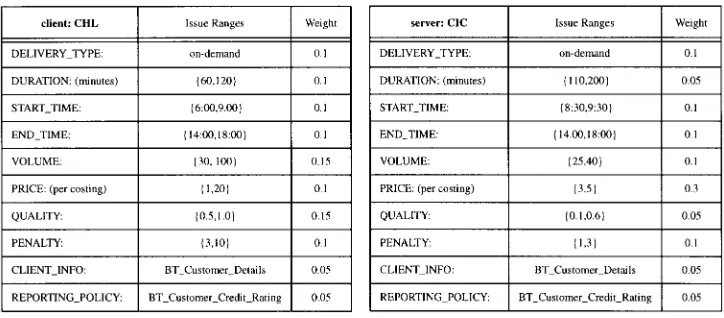
Dependent Negotiation InformationFor service provisioning, the rst task of an ADEPT system designer is to specify the structure of the negotiation object (i.e., dene the SLA template± point ii of Section 2.4 in the companion paper). This template should include all those issues that represent important dimensions/ attributes of a service that need to be settled during the service provisioning phase. In general, the set of negotiation issues may vary between applica± tions, but some attributes (e.g., price, duration, penalty, and volume) are usually present. In the BT application, the set of issues is xed and common to all agreements± see Figure 7 for a list of all the attributes used in this application. (The precise meaning of each slot is discussed in Section 3.3.2 of the companion paper.) It is important to note that some of these issues are quantitative in nature (e.g., price, volume) and so the negotiation space is continuous, whereas other issues are qualitative in nature (e.g., outputs required, mode of provision) in which case the negotiation space is discrete (e.g., x is produced/not produced by the service, service is provisioned as one± oŒor on± demand).
[image:18.412.26.388.422.581.2]Once the negotiation issues have been identied, the designer must specify, in the agent’s self± model, the reservation values and the relative importance (or weights) for each issue (see the companion article). Reser±
vation values represent the limits of acceptable values for that service issue. For example, the highest price the agent is willing to pay for a service or the shortest duration for completing the service. The weights indicate the rela± tive importance of each issue. For example, in some cases price might be the dominant issue, and in others quality may be more important.
To illustrate these points, consider the negotiation between the CHL and the CIC agents for theVet–Customerservice (Figure 7). For each quanti± tative issue, the minimum and maximum acceptable values are specied. Thus, CHL is willing to pay between £1 and £20 for the Vet–Customer
service, while CIC will only perform the service if it receives at least £3. Negotiations over qualitative values diŒer to the extent that there is less
scope for compromise. In fact, the qualitative issues in this application domain have a single discrete value. Thus, the fact that the server needs the client to provide information on customer details is not something that CHL can negotiate over. If it is not provided, then CIC simply cannot perform the service. The same is true if a given server can only provide one± oŒscheduling of services and does not support on± demand provision± ing ; again, it is an innate property of the agent and it is not something that can be argued over during the negotiation. Thus, negotiation over qualit± ative issues is more a process of satisfying and delivering on constraints.
On some issues, the client and the server may have mutual interests. In the above example, both CHL and CIC have mutual interests with respect to the delivery type and the type of information that each agent will provide for the service. However, for most issues, clients and servers have opposing interests. For example, CHL would prefer CIC to start the service earlier in the day, take a shorter time for each vetting instance, process more cus± tomers for a lower payment, and incur a higher penalty for breaking the contract. Therefore, in the agreement space, clients and servers represent opposing forces on most issues and it is only through the process of negotia± tion that mutually acceptable positions can be reached.4
The client and the server also diŒer in the importance they attach to
each of the negotiation issues. In the above example, CHL assigns the highest importance to the volume of service invocations that can be handled and the quality to which the vetting is carried out. CIC, on the other hand, assigns the most importance to the price it pays for the service.
An Execution Trace of ADEPTs Negotiation Model
To illustrate the operation of ADEPTs negotiation model, this sub± section describes two exemplar service provisioning episodes in detail (see Section 3.3 of the companion paper for more details of the model itself). The rst involves the negotiation between the customer vetting agents and the customer handling agents over the Vet–Customer service. The second
FIGURE 8. Reservation values and relative importance weightings for theVet–Customernegotiation.
agent for theDesign–CPNservice. The former can be characterized as com± petitive, multilateral, interorganizational negotiation, whereas the latter is a cooperative, bilateral, intraorganizational process. In order to focus atten± tion on the key aspects of the reasoning model, we consider a subset of the negotiation issues. Moreover, in the rst scenario we concentrate on the decisions involved in setting the logistics of negotiation and the strategy modication reasoning, while in the second scenario we focus on the tactical and evaluatory aspects of the model.
Negotiating for the Vet–CustomerService. Assume the negotiation set
for theVet–Customerservice is composed of three issues: theprice paid
per invocation, the volume of invocations between the contract’s start and end times, and thepenalty for breaking the contract. For each issue, both the clients (CHL and CHE) and the servers (CIC, FSE, CL) have preferences over the reservation values and have rankings of the relative importance of the various issues (Figure 8). Compared to CHE, CHL is willing to pay more for the service, requires a larger number of service invocations, and demands a higher penalty for failure. CHL is indiŒerent to the importance of
the price and penalty issues, but holds the volume of the service as the most important issue. CHE, on the other hand, is indiŒerent between the volume
and penalty of a service, but considers price to be the most important issue in the negotiation set. The least expensiveVet–Customerservice is provid± ed by CIC that holds price as the most important negotiation issue. However, it oŒers a lower volume of invocations than FSE and CCL and it
prefers the lowest penalty for contract violation. FSE, on the other hand, typically requires a higher payment for the service, can provide more instances of the service, is prepared to accept higher penalty rates, and is indiŒerent between the negotiation issues. The largest capacity agent, CCL,
demands the highest prices for its service and is prepared to pay higher penalties. It considers the penalty to be the least important issue and it attaches equal weight to price and volume.
lines, CIC has a fairly short deadline, FSE, CHL, and CHE have medium deadlines and CCL is under no signicant time pressure. Further assume that CHL has had no previous interactions with the servers, but that CHE has and that it has developed the preference ordering FSE. CCL. CIC. Finally, assume the negotiations start at diŒerent times ; CHL rst, followed
by CHE.
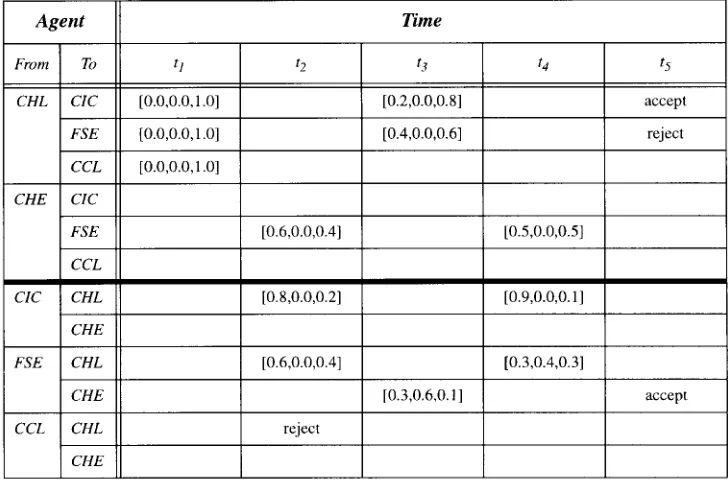
Given this context, we will now step through a sample negotiation con± centrating predominantly on the logistics and strategy modication aspects of the reasoning model (Figure 9). Details of the reasoning associated with generating the specic oŒers and in evaluating oŒers are given in the second
scenario (the next section). In this case, an agent’s strategy is represented as a 3± tuple [x1, x2, x3], wherex1 represents the weight assigned to the time± dependent tactic, x2 represents the weight attached to the resource± dependent tactic, and x3 represents the weight attached to the behavior± dependent tactic.
CHE initiates the negotiation at t1 by proposing the same SLA to allof the servers in parallel since it has no preferences over the servers and has enough time to negotiate (Rule 2 of Figure 11 of the companion paper). Since all the potential servers are from a diŒerent organization and time and
[image:21.412.25.389.339.582.2]resources are not yet a consideration, CHLs strategy is to base its negotia± tion stance on the behavior of its opponent (Rule 1 of Figure 12 of the companion paper).
After evaluating the proposed SLA, each potential server responds att2.
In this example, FSE and CIC nd the proposed SLA unacceptable and counter± propose an alternative. Since this is a competitive negotiation and there are no previous interactions between the participants, each server sets a strategy that to some degree is based on CHLs behavior (Rule 1 of Figure 12 of the companion article). CICs and to a lesser extent FSEs, strategies place a large emphasis on the time remaining since they have a compara± tively short time in which to make an agreement (mixture of rules 1 and 3 in Figure 12 of the companion article). CCL rejects CHLs oŒer since it cannot
map between the output of its vetting service (CCL–Decision) and the information required by CHL (BT–Customer–Credit–Rating) (see the previous section).
Also assume that CHE starts its negotiation at t2by making an oŒer to
FSE as its most preferred server (Rule 1 of Figure 11 of the companion paper). Given the previous successful interactions between this pair, CHE adopts a strategy that places greater emphasis on the time to reach an agree± ment than on the behavior of the opponent (i.e., the degree of trust that exists between the agents means that CHE does not adopt a pure behavior± based strategy (cf. CHL’s strategy for the same negotiation)).
Att3,CHL receives back the two counter proposals and evaluates them. The one from CIC has the highest utility since it will have conceded the most (it is under the most time pressure). FSE will have conceded, but not as much. Assuming neither of these oŒers are acceptable, CHL needs to
prepare new counter proposals. Before doing this, however, it determines whether it should modify its strategies. Since time is starting to run short, it needs to switch its strategies from being purely behavior± based to ones that take greater account of time (Rule 1 of Figure 13 in the companion article). Since CIC is conceding more rapidly, CHL tries to exploit it to maximize its gain (Rule 3 of Figure 13 of the companion article). Therefore, it places a greater emphasis on the time remaining than it does on the behavior of the opponent. FSE has conceded less than CIC, and so CHL attaches a greater weight to its time dependent tactic.
Also at time t3,FSE evaluates CHEs oŒer. It nds the oŒer unaccept±
able and so counterproposes. Since FSE is now engaged in multiple, concur± rent negotiations, it selects a strategy that places a high degree of emphasis on the amount of resources it consumes during the course of the negotiation (variant of Rule 2 in Figure 12 of the companion article). As in its negotia± tion with CHL, time is also an important factor, but the behavior of the opponent is relatively less important since the agents have an ongoing relationship.
At time t4, the vet customer agents have received and evaluated the latest oŒers from CHL. Again, assuming they are unacceptable, they need to
and so modies its strategy so that remaining time is an even more domi± nant factor in its decision± making (further application of Rule 1 of Figure 13 of the companion article). FSE places greater emphasis on resources con± sumed (because of its concurrent negotiation threads), and since its conces± sions have been mirrored in CHLs proposal it places a slightly lower relative weighting on the behavior of its opponent.
Also at timet4,CHE receives the proposal coming back from FSE. This proposal will be fairly conciliatory in nature (because FSE does not want to expend too much resource on the negotiation and because time is starting to become pressing). To reect this cooperative stance, CHE modies its strat± egy to be slightly more reciprocal and slightly less driven by the time remaining. This has the overall eŒect of making its response conciliatory in
nature.
At time t5, CHL receives the counterproposals from the vet customer agents. It evaluates them and determines that it should accept the oŒer of
CIC that has again conceded to most of its demands. CHL determines that it should not try and extract even more concessions since time is now running short. Having accepted CICs oŒer, CHL rejects FSEs oŒer. When
FSE receives the rejection, it chooses to accept CHEs latest oŒer because it
wants to ensure its services are utilized and because the oŒer incorporates
the majority of its demands.
In summary, CHL and CIC reach an agreement because they both concede throughout the negotiation (although CIC gives more ground). Consequently, they quickly reach the region where their acceptance levels intersect. On the other hand, FSEs rate of approach to the acceptance level intersection region is slower. The CHE± FSE negotiation is short because both agents concede quickly (due to the trust built up in their previous interactions) and so the agreement space is entered into early on in the nego± tiation. Finally, because CCL could not map to the information model required by CHL and because it was not CHEs most preferred service provi± der, it failed to secure a deal.
Negotiating for theDesign–CPNService. This scenario covers the nego± tiation between the CHL and NDD agents for the Design–CPN service. Here we focus on the tactical and evaluatory aspects of the negotiation model and we assume that, once selected, strategies are not modied. The domain information about reservation values and issue importance is shown in Figure 10. We consider two distinct negotiation situations : both agents have a short time to reach an agreement (time for agreement is NOW) and both agents have no signicant time pressure (time for agreement is HAVE±
FIGURE 10. Reservation values and relative importance weightings for theDesign–CPNservice nego-tiation.
resource± , and behavior± dependent tactics.
Before the specics of the scenarios can be discussed, a more detailed description of the operation of the tactics needs to be given. What follows builds upon the discussion in the companion paper and the corresponding justications for the particular formula used are given in Sierra et al. (1997).
The time± and resource± dependent tactics operate in similar ways. Ini± tially, they put forward a value that lies somewhere within their reservation range (see Figure 14 of the companion article for examples of the reasoning behind the setting of these values). They then modify this value in sub± sequent negotiation rounds depending on the amount of time or resource remaining. This continues until either the agent has an oŒer accepted or the
time by when an agreement must be in place passes (in which case the nego± tiation has failed). At their deadline, the agents put forward their reservation value. More formally, in a negotiation between agents a and b over issuei (that has a minimum value ofminiand a maximum ofmaxifor agenta), the value (x) put forward by aat a particular instant is determined by the nego± tiation parametera(aÎ {0,1}) in the following way.5
xa® b[i]5
5
mini1 ai(maxi2 mini)
if the reservation value is the minimum of the 2 values mini1 (11 ai)É(maxi2 mini)
if the reservation value is the maximum of the 2 values. (1)
aia(t)5 k i
a1 (12 k i
a)
1
min(t,tmax)tmax
2
1/b
, (2)
where tmax is agent a’s negotiation deadline,b Î R+ is the decay function for the tactic (i.e., how quickly the rate of concession changes± the higher the value of b the more quickly the agent concedes), and0, k i# 1 is the value of the initial oŒer for issuei.6
For resource± dependent tactics, a is based on the amount of resource consumed or remaining in a given negotiation episode. In this case, a is proportional to the number of agents actively involved in the negotiation at the current moment (NA) and inversely proportional to the number of mes± sages (NM) that have been sent in the course of the current services provi± sioning episode. (This tactic has the eŒect of increasing the rate of concession
as the number of agents being negotiated with decreases and the number of message interchanges increases):
aia(t)5 k i
a1 (12 k i
a)É e] (NA/NM). (3)
Behavior± dependent tactics diŒer from time and resource± related func± tions in that they base their behavior on the actions of their negotiation opponent. In this scenario, agents exactly reproduce, in percentage terms, the behavior of their opponent one time step ago. When insufficient exchanges have taken place to determine the way in which an opponent’s behavior is changing, the agents adopt a time± dependent tactic that is mod± erately conciliatory in nature (in order to maximize the likelihood of eliciting a cooperative response (Axelrod, 1984)).
As indicated in the companion article, the values put forward for a given SLA are a combination of the values suggested by the three tactic families for each negotiation issue, moderated by the relative weight set by the strate± gic reasoner.
Once the values for each of the negotiation issues have been set, the SLA is sent as a proposal to the negotiation opponent. The SLA is evaluated according to the following rules (found also in the companion paper). Assume agent ais the sender and agent bis the recipient. If the current time is greater than the deadline, then the oŒer is rejected and negotiation is
terminated. Otherwise, if the utility of the received SLA is greater than or equal to that whichb would send to a at this time, then baccepts the SLA; otherwise, b oŒers a the SLA it generated for the comparison. Agents rate
x2 mini
maxi2 mini If the value is acceptable and increasing
Via(x)5
5
1
12 x2 minimaxi2 mini
2
If the value is acceptable and decreasing (4)2 100 If the value is unacceptable± iemaxi, x, mini.
With the relevant details in place, we can now return to the negotiation scenarios (Figure 11). We rst consider the case where both agents have a short time to reach an agreement. We assume there is a universal discrete clock, set to zero before the rst proposal. Let the deadline to reach an agreement(tmax)be 8 time units for both agents. As CHL has only a short time to reach an agreement and because it is negotiating with an agent from the same organization, it selects a strategy based solely on time remaining for each of the three issues (Rule 3 of Figure 12 of the companion article). Thus, its strategy can be represented as the following tactic weight vector
[ [1,0,0],[1,0,0],[1,0,0,] ] for the issues of price, volume, and penalty, respec± tively. The NDD agent goes through a similar reasoning process, but since it is the sole provider of a service it knows it can aŒord to negotiate a bit
harder (choose a behavior± dependent strategy) on those issues that it nds important. Thus, it adopts the following tactic weight vector [ [0,0,1],[0,0,1],
[1,0,0] ]for the issues of price, volume, and penalty.
Since CHL is under time pressure and since NDD belongs to the same organization, it makes low initial oŒers on all issues (opposite of reasoning
of Rule 1 in Figure 14 of the companion article). In this case, ‘‘low’’ corre± sponds to 50 percent of the diŒerence between the minimum and the
maximum of the issues’ reservation values (i.e.,k is 0.5 for all issues). Also it sets a comparatively high concession rate for its time± dependent tactics (b5 5) since it needs to reach an agreement quickly. The utility of this
oŒer to CHL is 0.5 (from equation 4 : [0.5*12 (152 10)/
(202 10)]1 [0.25*(4.52 2)/(72 2)]1 [0.25*(3.52 2)/(52 2)]).
On receiving this oŒer, NDD performs two concurrent operations. It
evaluates the incoming SLA that has a utility of 2 100 (using equation 4). It also computes the oŒer it would have sent to CHL based on its current
strategy. In this case, NDDs initial stance is tougher than that of CHL, and it selects 20 percent of the diŒerence between the minimum and maximum of
the reservation values for issues of price and volume (that it considers to be more important) and 50 percent for penalty (that is less important). Thus, its initial oŒer is [27.6, 1.4, 2.49]. These values were computed in the following
behavior± dependent tactics concede comparatively less on price and volume (a concession is made since the behavior± dependent tactics require at least two oŒers to be made before they can operate, and in the meantime they
concede a moderate amount± see above discussion). The utility of this initial proposal is 0.67 (from equation 4 : [0.4*(27.62 18)/(302 18)]1
[0.4*(12 (1.42 1)/(32 1)]1 [0.2*(12 (2.492 0)/(32 0)]), which is greater than 2 100 and so NDD sends [27.6, 1.4, 2.49] to CHL as its counter± proposal.
Upon receipt of this counterproposal, CHL computes its utility to be
2 74.95 (from equation 4). The value is negative since only the penalty issue is within CHLs range of reservation values. At the same time, CHL com± putes the counter oŒer it would send at this time. The value foraprice is 0.88
(in equation 2 : tmax5 8, t5 2, b5 5, k 5 0.5), which means the oŒer sug±
gested by the time± dependent tactics is 18.78 (from equation 1). Since the time± dependent tactics compute a independently of the issue aprice5
Combining the values suggested by the diŒerent tactics, the
avolume5 apenalty.
comparison oŒer is[18.78, 2.6, 2.36]. The proposal has a utility of 0.12 (from
equation 4), which is greater than 2 74.95 and so it is sent as a counter oŒer.
CHL’s new oŒer is now within NDDs, acceptable region on all issues
(utility is no longer negative). However, the oŒer NDD would have sent at
this time is [22.03, 2.42, 2.73](calculations are as before). Note that in gener± ating this oŒer the behavior± dependent tactics reciprocate CHLs concession
over price and volume (e.g., over price CHL has conceded by 25.2%, and so NDD comes down by the same amount to 22.03). The utility of the proposal NDD would have sent is 0.268, which is greater than 0.147 and so NDD sends it.
The process of evaluation and counterproposal generation continues until one of the agents receives a bid that has a higher utility than the oŒer it
was preparing to send. In this scenario, this happens at T5 6 for NDD. This service provisioning episode reaches a successful conclusion, because CHL uses time± dependent tactics that give ground rapidly because of the short time available in which to make an agreement. Moreover, CHLs con± cessions are reciprocated by NDD since it uses behavior± dependent tactics for the issues of price and volume. When taken together, these factors mean that the region of agreement is entered into quickly. The nal point to note is that although the rate of concession of the two agents is almost identical, the end points of the utility functions for the two agents are diŒerent (0.065
vs. 0.18). This is because NDD took a tougher negotiation stance by making lower initial oŒers.
agreement(tmax)be 15 time units for both agents. Under these circumstances, the time± dependent tactic’s rate of concession is slower than the previous scenario (since the interval to tmax is higher). Resource± and behavior± dependent tactics behave as before since the former models concessions according to the number of agents and the length of the negotiation thread and the latter is independent of the time remaining.
All the domain information (reservation values and weights) is similar to the previous scenario. The rst diŒerence is in the strategies that the agents
select. For CHL, although it has plenty of time for negotiation, it still needs to conserve its resources, since it is likely to be involved in several concur± rent negotiations. In addition to this, since it is negotiating with an agent that belongs to the same organization, it should endeavour to reciprocate any concessions made by the other party. These two factors are of equal importance and are used by CHL to set [0,0.5,0.5], [0,0.5,0.5], [0,0.5,0.5] as its strategy for the issues of price, volume, and penalty (see Rule 4 of Figure 12 of the companion article). NDD, on the other hand, can aŒord to adopt a
tougher negotiation stance (for the same reason as above) and so it places some weight on the time± dependent tactics (that give slow concession rates when there is plenty of time until the deadline). It must also take resources into consideration because it will be involved in multiple, concurrent nego± tiations. Finally, for similar reasons to CHL, NDD should reciprocate con± cessions at least to some degree. For these reasons, NDD adopts the following weight vectors for the three tactics ([0.1,0.6,0.3],
[0.1,0.6,0.3], [0.1,0.6,0.3]) for issues price, volume, and penalty (a variant of Rule 4 in Figure 12 of the companion article). We again assume that stra± tegies are static.
Negotiation is again initiated by CHL. Since there is a reasonable amount of time to negotiate, let the strategy of both agents be to set their initial oŒers to the 10 percentile of the diŒerences in an issue’s reservation
values for all issues (see Rules 1 and 2 in Figure 14 of the companion article). The rationale for this is if the initial oŒer is further away from reservation
value, then it is more likely that the nal oŒer will yield a larger utility (and
the fact that the negotiation may take longer is not a major concern). (Faratin et al., 1998).
Upon receipt of this oŒer, NDD evaluates it and nds it to be unaccept±
able since none of the values are within its reservation range. As before, it generates a counterproposal by the same means as in the previous scenario. The weighted combination of tactics suggest 26.4 units for the price of the service. This value is computed in the following way. The time± dependent tactics compute the value of aprice to be 0.1 (from equation 2 : tmax5 15,
t5 1,b5 0.4,k 5 0.1). Therefore, the suggested oŒer by this tactic family is
28.8 (from equation 1). Resource± dependent tactics compute the value of to be 0.43 (from equation 3 : k 5 0.1, NA5 1, NM5 1). From equa±
tion 1, the resource± dependent tactics suggest 25.6 for price. Finally, since CHL has not made at least two oŒers to NDD, the behavior± dependent
tactics concede a small amount (to 28.2) by playing a time± dependent tactic with a value for b that gives away a small amount of utility. These three values are then linearly combined according to the weights that the strategy has selected (namely, [0.1,0.6,0.3]). Hence, the actual value NDD utters to CHL over price is 26.4 ([28.8*0.1]1 [25.6*0.6]1 [28.2*0.3]). Similar reasoning generates the other values for volume and penalty.
The process of evaluation and counterproposing continues in this fashion until there is a crossover in the acceptance levels for all of the issues (time T5 12 for the NDD agent). It can be seen that oŒers begin to become
mutually acceptable after eight time steps (cf. sixth time step in the previous scenario). In addition to this, CHLs rate of concession for all issues becomes progressively less as time passes. This is due to two factors. First, CHL is reaching its reservation values for all issues because the resource± dependent tactics (with a weighting of 0.5 for all issues) suggest values close to reser± vation values as the length of the negotiation thread increases. Second, the other, and equally weighted component of the CHLs oŒers, are the
behavior± dependent tactics. Since NDD is conceding less (compare oŒered utilities in T5 9 column and T5 11 column), these tactics imitate this resistance to concession by the opponent on all issues and suggest oŒers
close to, or at, the values of CHLs previous oŒer. Therefore, the dynamics of
CHLs oŒers are the resultant forces of these two tactics± resource tactics
suggest concession and behavior± tactics suggest rmness in the light of NDDs reluctance to concede.
Service Management
During negotiation, it is important that an agent possesses the latest information about its planned resource usage so as not to overcommit the business unit it represents. ADEPT agents maintain a resource model and a schedule of resource commitments that enables them to determine whether they can support an SLA. In the vet customer negotiation, for instance, the CIC agent needs to consider whether it has sufficient instances of the task (see gure 2) to provide theVet–Customerservice
vet–customer3
person in theVet–Customerteam is oŒsick, their resource information is
de± registered (temporarily lowering CIC’s capacity) and then re± registered when they return to work.
ADEPT agents diŒerentiate between those SLAs that cover one± oŒser±
vices and those that cover on± demand services. One± oŒservices can be scheduled accurately by reserving the appropriate resource for the agreed period stated in the SLA. For example, after an Analyse–CPNnegotiation
is completed, NDD is able to schedule one invocation of the
analyse–requirements task over the time period dened within the
negotiation. On± demand services, on the other hand, require the block booking of resources to cover multiple invocations over a certain period. In this case, an estimation of the volume of expected executions is required (this comes from the volume slot in the SLA± see Figure 7). The ADEPT agent then sets aside an appropriate number of resources (task instances) for a particular period of time. The quantity and duration of these reservations are inuenced by the agent’s self± knowledge about the maximum number of concurrent invocations and the average time a service takes to run. When an on± demand service is actually invoked, the agent simply uses part of the associated block booking it has already set up. Consider, for instance, the case of CIC forming an agreement with CHL for the Vet–Customer
service. If CHL negotiates well, it may end up with an SLA that has a volume of 40 invocations between 8 :30 and 18 :00 (CICs greatest capacity± Figure 7). In this case, CIC needs to reserve sufficient instances of the
task to full this responsibility.
vet–customer3
The resource management function that is presently performed by the ADEPT agent could be outsourced to an existing legacy resource manage± ment system (as discussed in the section entitled Mapping the Business Process into Agents and Agencies). In this situation, the existing system would schedule and allocate work and provide resource utilization informa± tion to the agent during negotiation. This approach might be necessary where resources need to be optimized across a business unit, or where there is a heavy reliance on a legacy system, or even where complex estimation calculations are required that would be better sited outside the agency.
The other main service management functionality relates to handling exceptions. Here there are four classes of exception that can occur during the service management phase:
1. Communication failure: Information sent between agents becomes cor±